
A complete issue · 17 pages · 1893
Judge — July 1, 1893
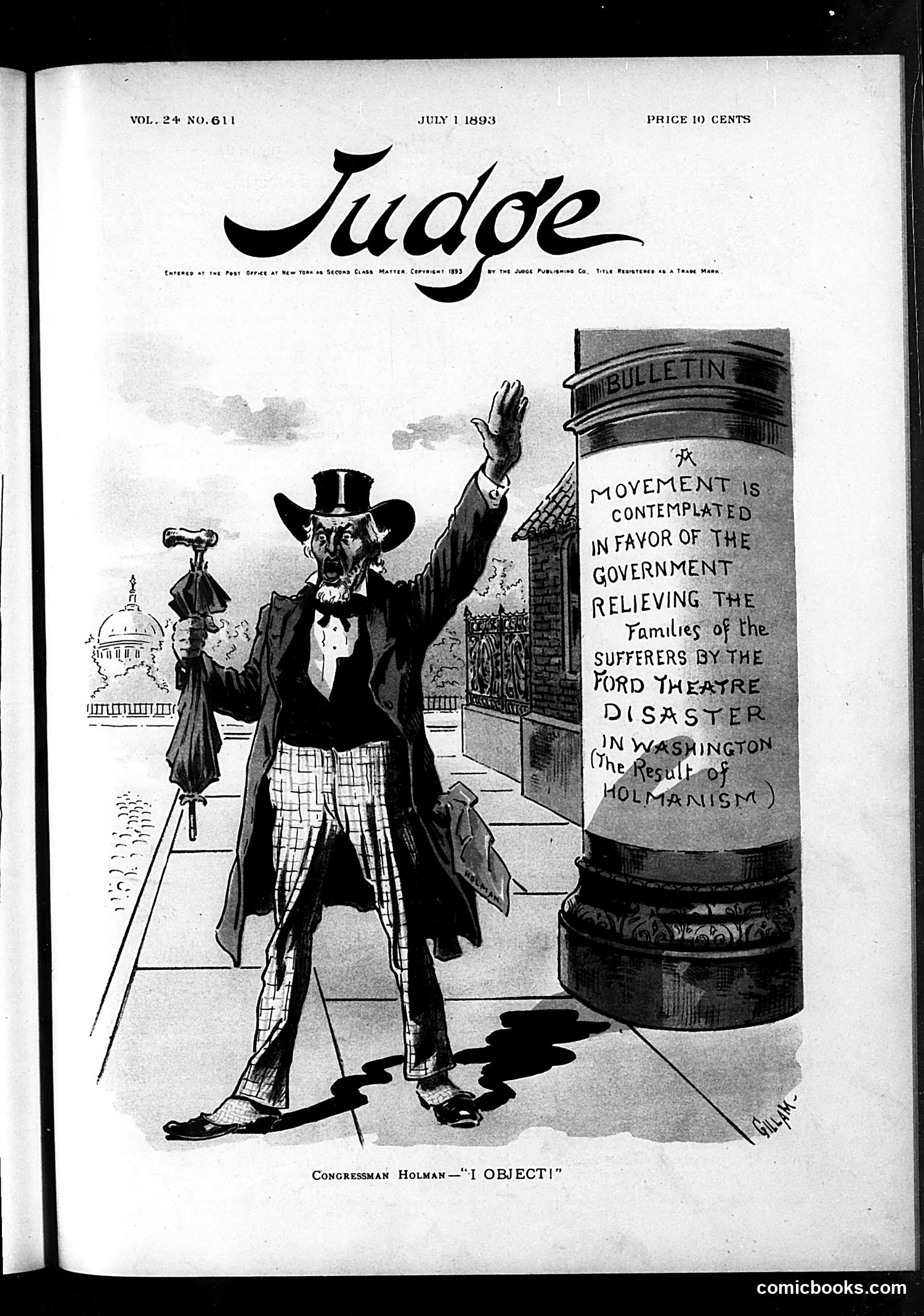
This July 1, 1893 *Judge* cartoon satirizes Congressman Holman's opposition to government relief for victims of the Ford Theatre disaster in Washington, D.C. The figure represents Holman objecting to charitable aid, which the bulletin labels as "holmanism"—the congressman's personal ideology against such expenditures. Uncle Sam (depicted with surveying equipment) gestures in frustration at this obstruction. The satire mocks Holman for prioritizing fiscal stringency over humanitarian assistance to families who lost loved ones in the theatre collapse. By naming the opposition philosophy after him personally, *Judge* ridicules what it presents as cold-hearted penny-pinching that ignores genuine human suffering.
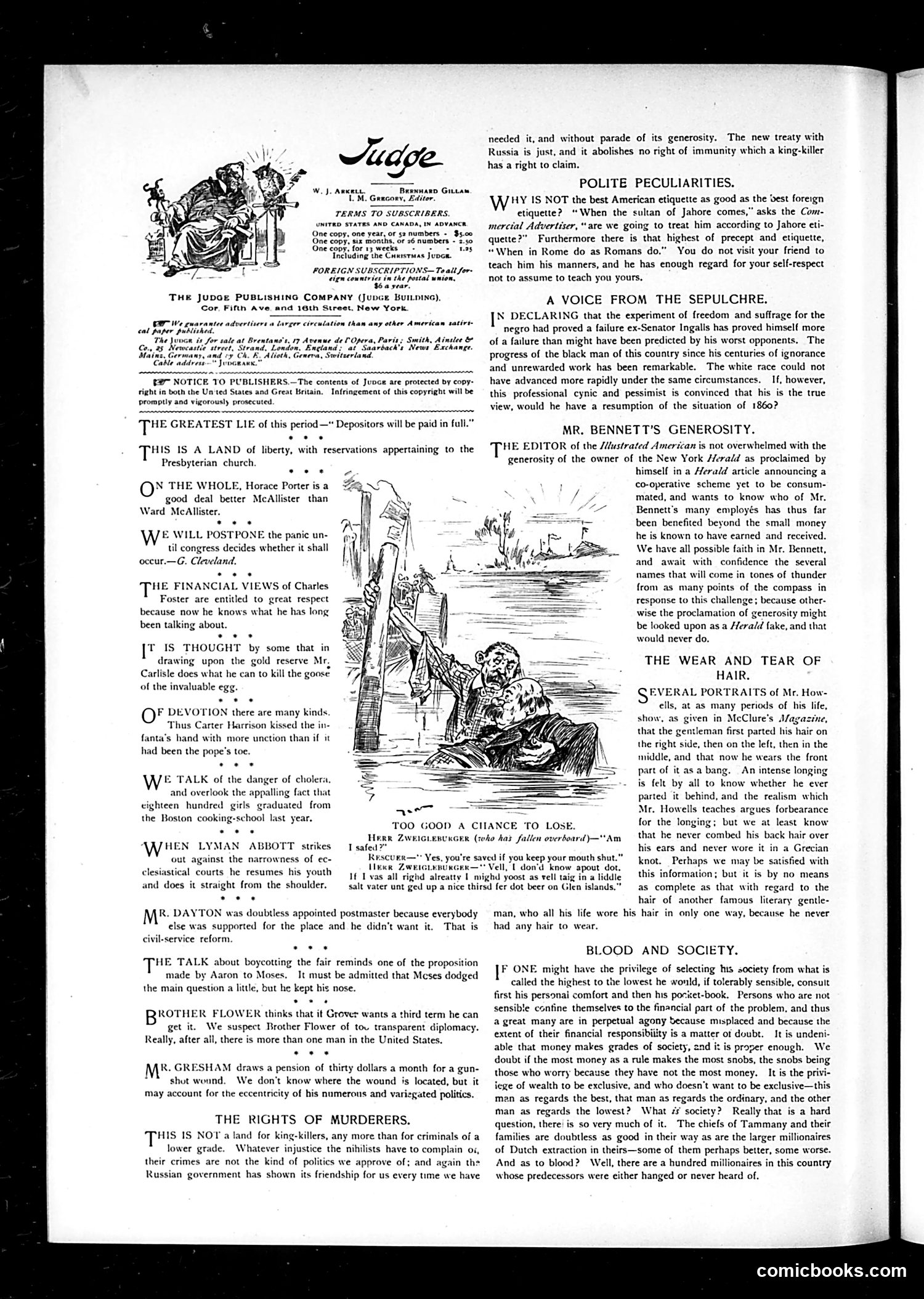
This page features editorial commentary and satirical sections typical of Judge magazine's format. The main illustration depicts a figure in water, possibly representing a drowning or struggling situation—likely political satire, though the specific reference isn't entirely clear from the image alone. The text sections include "Polite Peculiarities" (commentary on American versus foreign etiquette), "A Voice from the Sepulchre" (discussing African American suffrage progress), and pieces on various social topics including hair fashion and class distinctions. The overall tone reflects early 20th-century American satirical journalism, mixing social commentary with light humor. Without clearer context for the main illustration's subject, the precise political target remains unclear, though the content suggests commentary on contemporary social and political issues of the era.
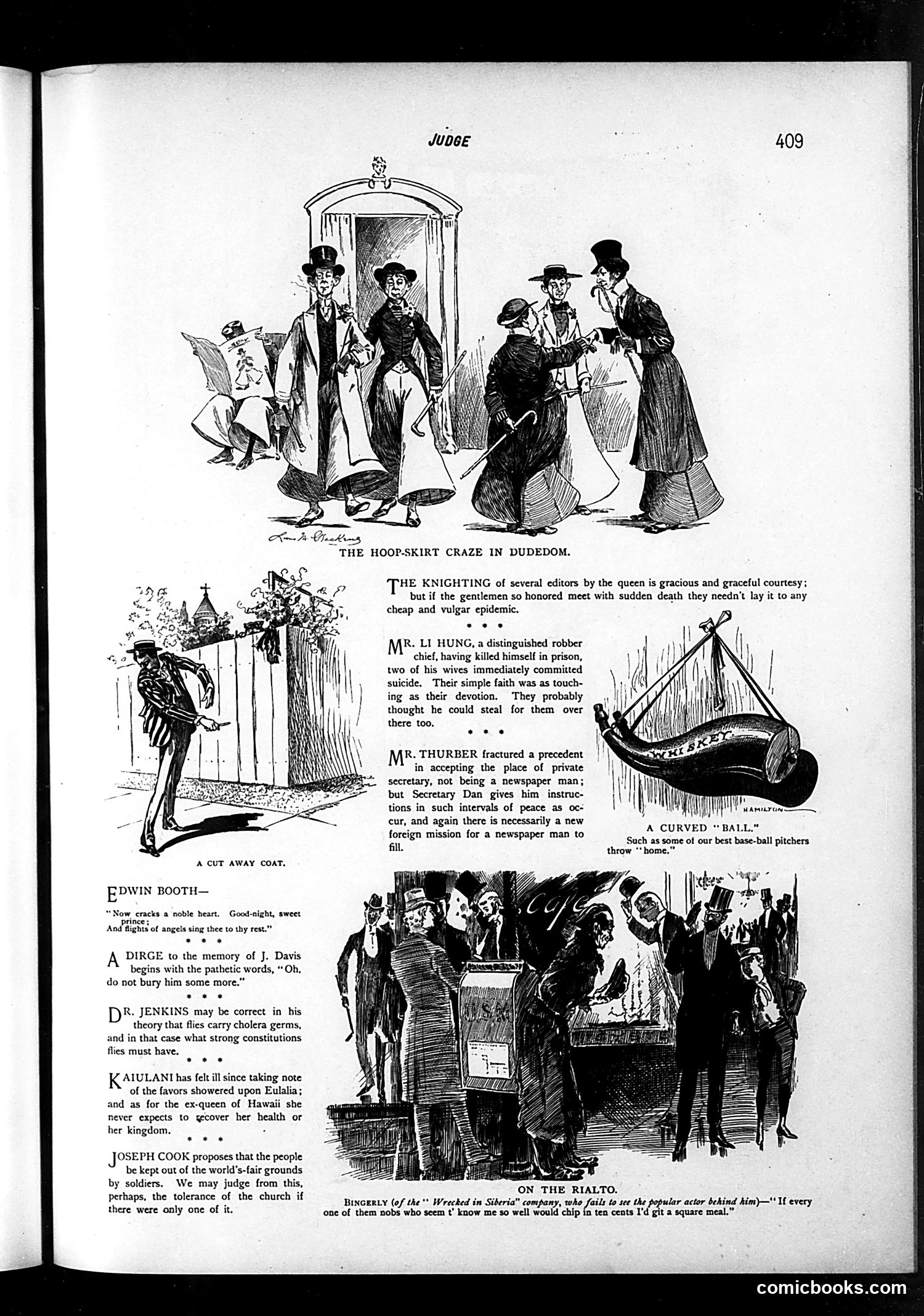
**Top Cartoon: "The Hoop-Skirt Craze in Dudedom"** This satirizes men adopting women's fashion—specifically the voluminous hoop skirts that were controversial Victorian women's wear. The cartoon mocks the absurdity of gentlemen wearing such impractical garments, suggesting a reversal or confusion of gender norms that contemporary readers would find ridiculous. **Lower Section:** The page contains satirical commentary on current events and public figures, including references to editors being knighted, robbery, and various political/social topics. "On the Rialto" appears to reference social gatherings or theater culture. **Overall Purpose:** This page exemplifies Judge's role as a satirical publication critiquing social trends, fashion absurdities, and public figures through humor and caricature—typical of American satirical magazines from this era.
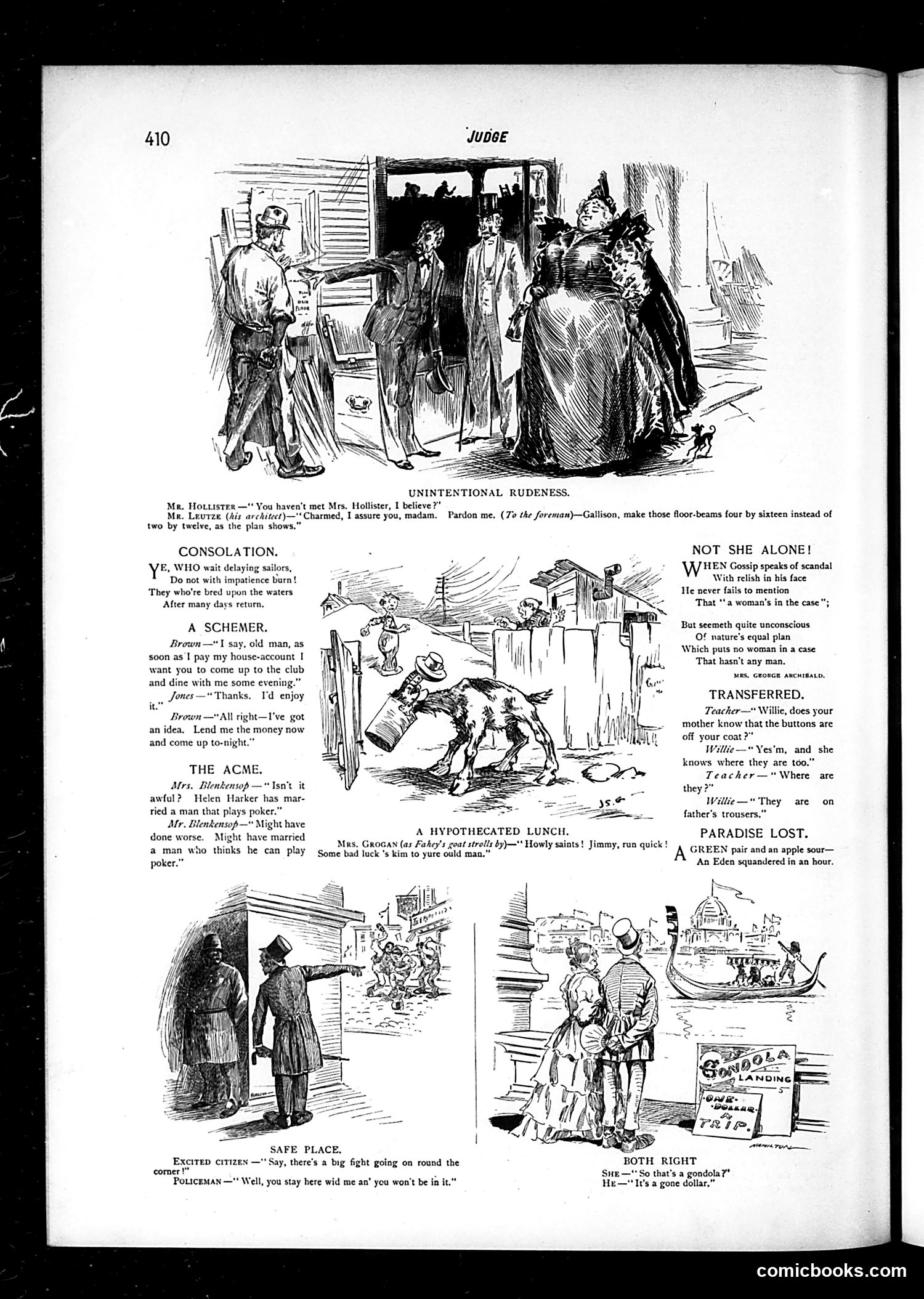
This page contains multiple brief satirical sketches typical of Judge magazine's humor format: **"Unintentional Rudeness"**: An architect accidentally insults Mrs. Hollister by discussing floor measurements while being introduced to her—missing social cues while focused on work details. **"A Schemer"**: Brown manipulates Jones by promising club dinner, then asks to borrow money and invites himself that same night instead, exposing scheming social climbers. **"The Acme"**: Contrasts Helen Harker marrying a poker player versus a man who *thinks* he plays poker—suggesting delusional incompetence is worse than actual vice. **"Safe Place"** and **"A Hypothecated Lunch"**: Police and safety humor depicting urban chaos. **"Not She Alone!"** and **"Transferred"**: Satirize gender double standards and absent-minded husbands who lose coat buttons to their children. **"Paradise Lost"**: A couple on a gondola in Venice realizes they've spent their money ("gone dollar"), losing their romantic fantasy. The humor relies on wordplay, social observation, and period anxieties about money, propriety, and domestic life.
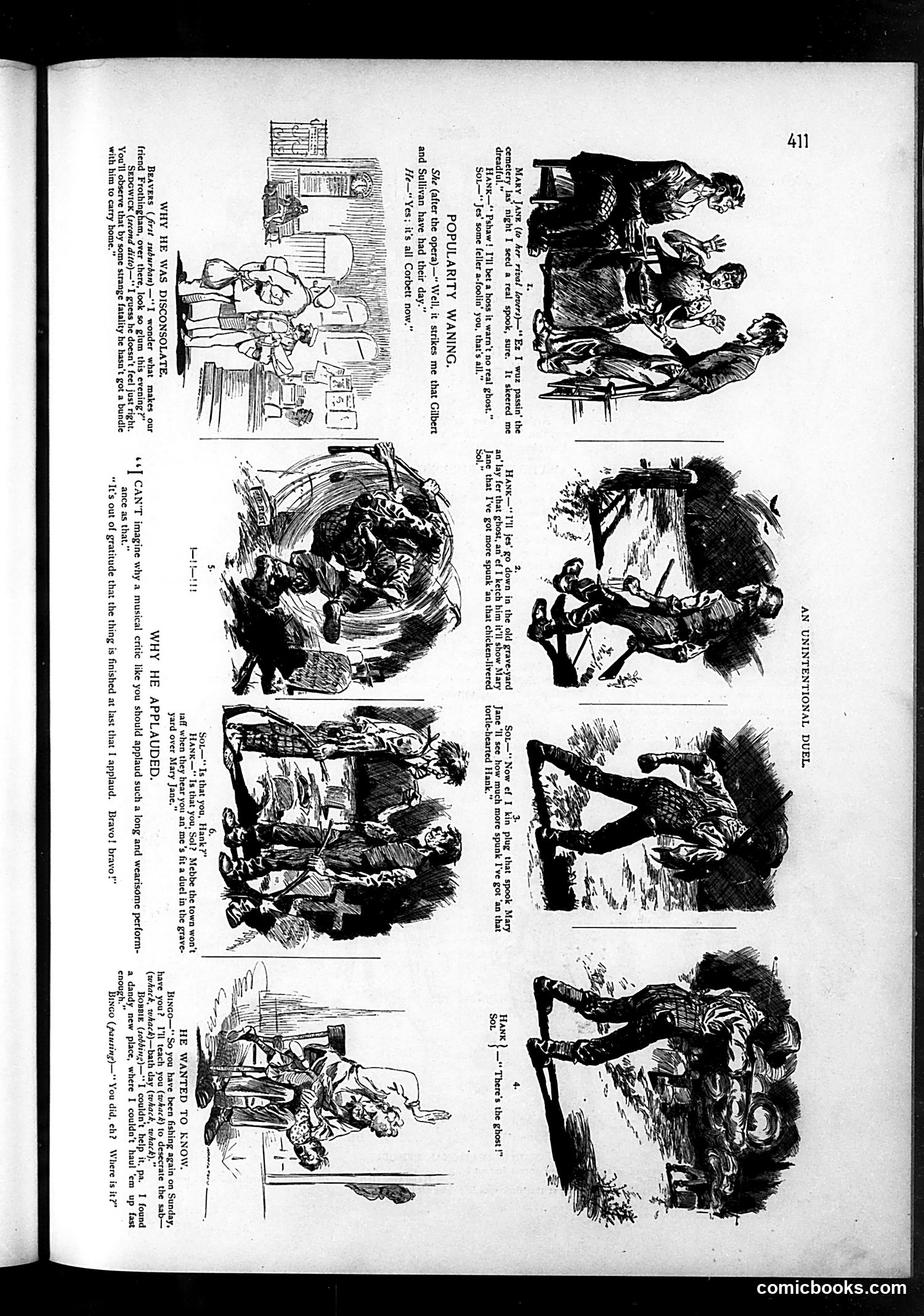
This page from *Judge* contains several standalone gag cartoons typical of late 19th-century American humor magazines. The main feature, "An Unintentional Duel," depicts rural characters Hank and Sol who each independently decide to hunt a "ghost" in a graveyard to impress a woman named Mary Jane, unaware the other is doing the same. The joke is that they'll likely encounter each other in the dark and mistake one another for the supernatural threat they're seeking—hence an "unintentional duel" between would-be rivals. The dialect and character types (rural/working-class males competing for female attention) reflect period stereotypes. Other cartoons mock suburban boredom, operatic tedium, and various domestic situations. The humor is straightforward slapstick and situational comedy rather than politically pointed satire—typical filler content for *Judge*'s entertainment pages.
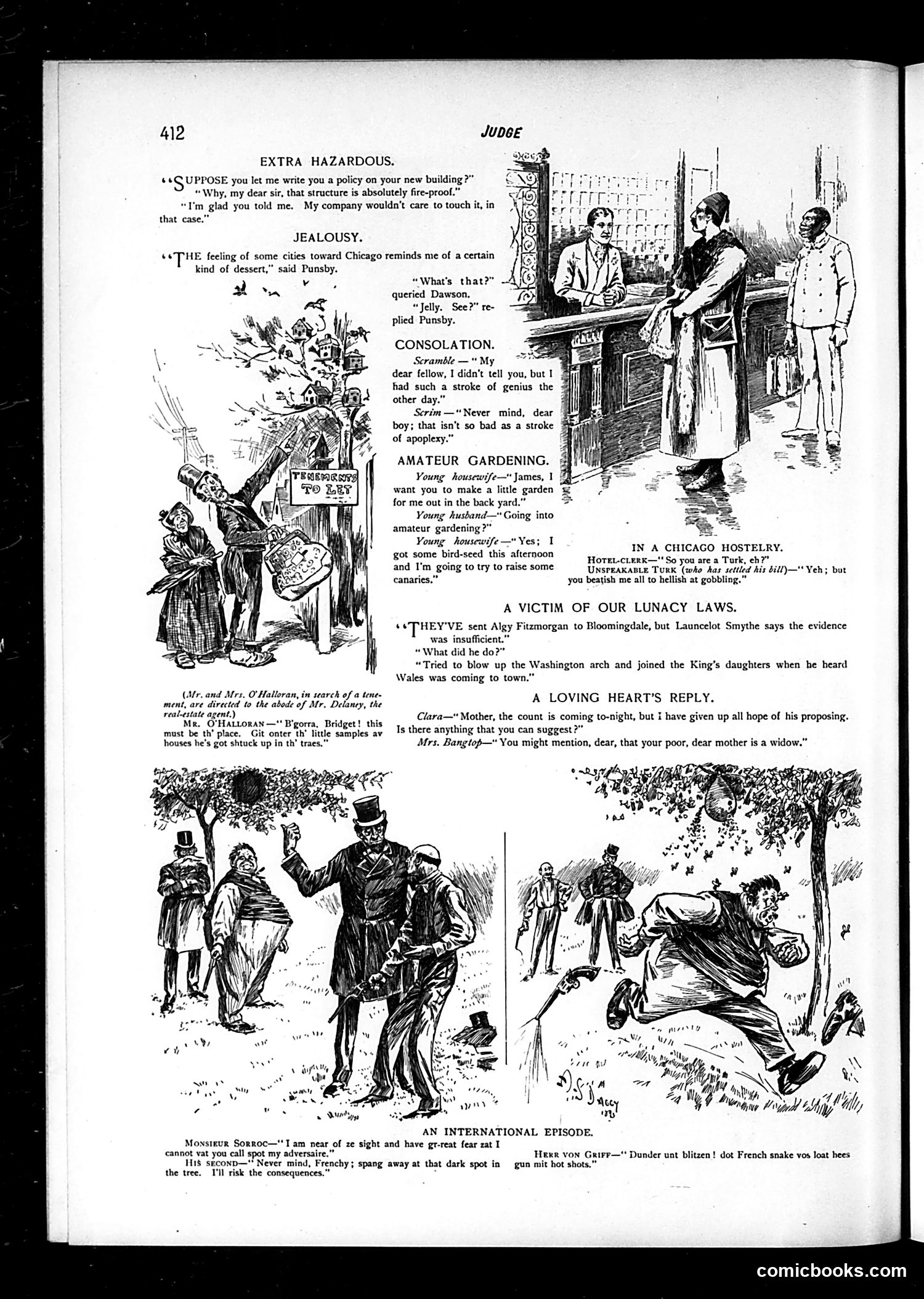
This page contains multiple satirical vignettes typical of early 20th-century American humor magazines: **"Extra Hazardous"** jokes about insurance absurdity—an agent won't insure a fireproof building because there's no profit in zero risk. **"Jealousy"** uses a food metaphor: other cities resent Chicago's rapid growth and prosperity (the "jelly" wobbles unstably, implying jealous instability). **"A Victim of Our Lunacy Laws"** satirizes commitment standards: a man sent to an asylum merely for attempting to blow up the Washington arch and joining women's clubs—suggesting the criteria for institutionalization were absurdly broad. **"An International Episode"** features ethnic caricatures (French and German accents rendered phonetically) in a dueling scene, poking fun at European military honor culture. Other sections include domestic humor about amateur gardening and romantic disappointment. The cartoons reflect period preoccupations with urban rivalry, mental health law, and ethnic stereotyping presented as lighthearted comedy.
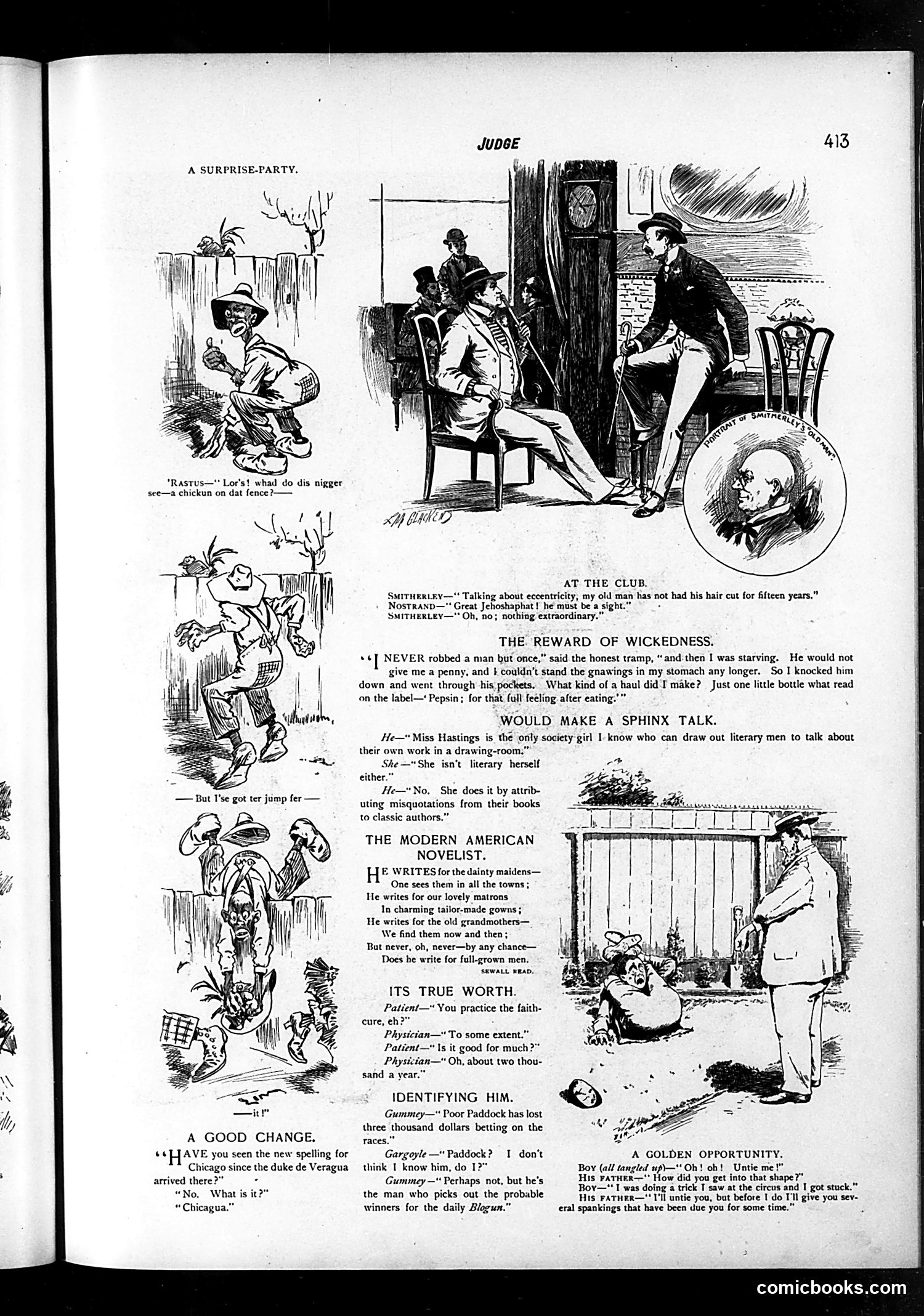
This page contains multiple satirical humor pieces typical of Judge's late 19th-century content: **"A Surprise-Party"** uses racist dialect humor common to the era, depicting a Black character ("Rastus") spotting a chicken—relying on harmful stereotypes about African Americans. **"A Good Change"** jokes about the Duke of Veragua's visit to Chicago, suggesting the city should rename itself "Chicagua" (Spanish-ified) in his honor—mocking both the duke's arrival and American deference to European nobility. **"At the Club"** satirizes social eccentricity among the wealthy, where not cutting one's hair for fifteen years is considered unremarkable in high society. **"The Reward of Wickedness"** presents ironic social commentary: a tramp's robbery victim carried only Pepsin antacid, suggesting wealthy misers deserve karmic comeuppance. **"The Modern American Novelist"** criticizes contemporary fiction writers for catering only to women and elderly readers, never to adult men—a commentary on perceived feminization of American literature. The remaining pieces offer lighter social satire on faith healers, horse-racing tips, and parental discipline.
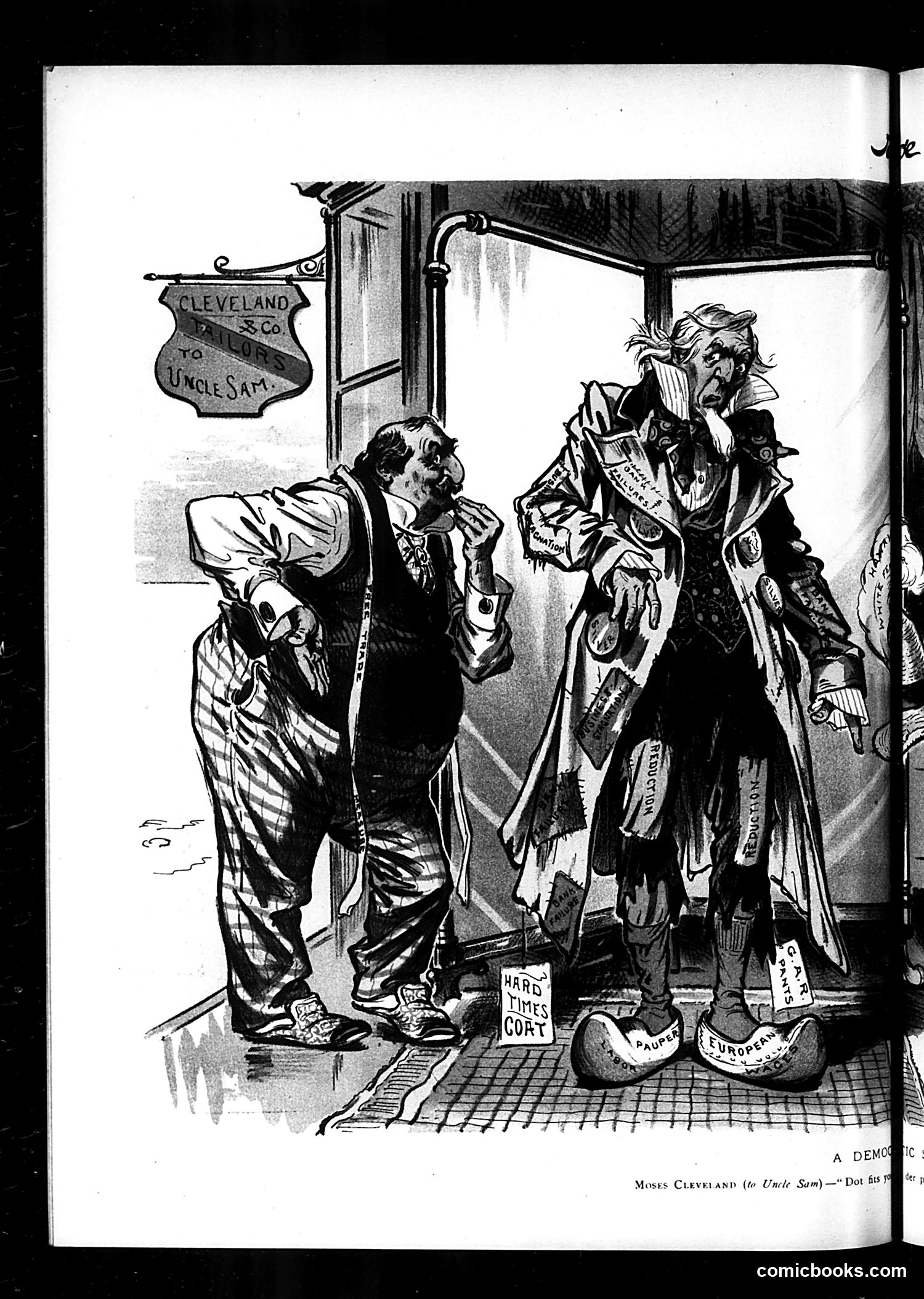
This is a satirical cartoon titled "Moses Cleveland (to Uncle Sam)—Dot Iss It" depicting two caricatured figures at what appears to be a Cleveland & Co. office (sign visible upper left). The figure on the left, labeled Moses Cleveland, appears to be a Jewish immigrant businessman with exaggerated features typical of period ethnic caricature. He's gesturing toward the figure on the right—Uncle Sam—who is laden with various international labels and trade-related items (marked "Hard Times Court," "European," "Pauper"). The satire appears to critique either immigration policy, trade negotiations, or international commerce during economically difficult times. The "Moses Cleveland" character seems to be making a pointed comment to Uncle Sam about America's economic or political situation, likely reflecting anti-immigrant or protectionist sentiments common in late-19th/early-20th century American political cartooning.
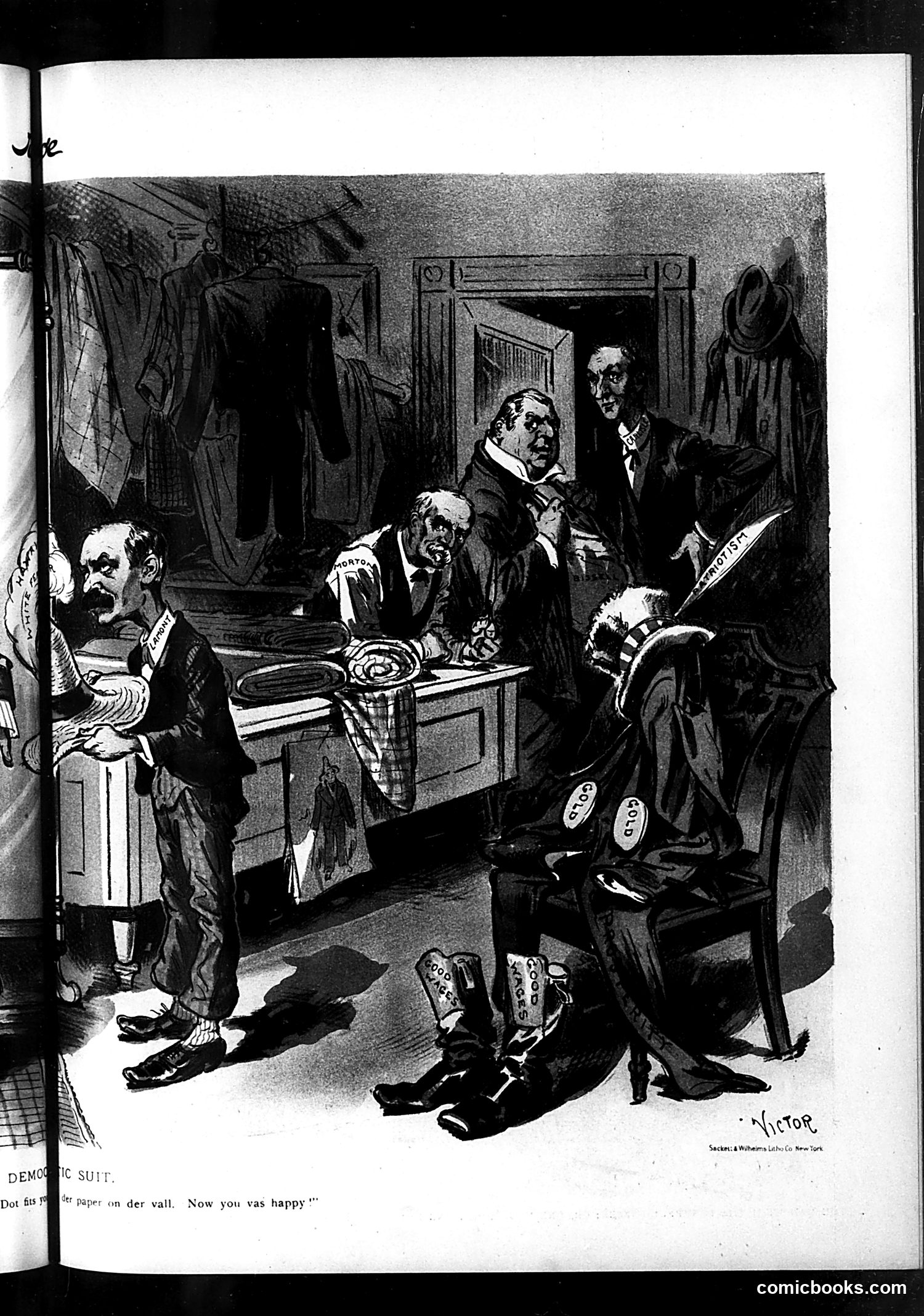
This cartoon, signed by Victor, satirizes Democratic Party leadership through exaggerated caricature. The scene depicts several men in formal attire in what appears to be a tailor's shop or fitting room, with garments hanging in the background. The caption reads "Now you vas happy," spoken in a mock-German accent by what appears to be a tailor figure (left). The cartoon likely critiques Democratic politicians receiving new party direction or policy—the "suit" being both literal clothing and metaphorical party platform. The German-accented tailor suggests ethnic stereotyping common to period satire. Without visible dates or clearer identifying labels, the specific political moment remains unclear, but the tone mocks Democratic leadership as puppets being "fitted" with new positions.
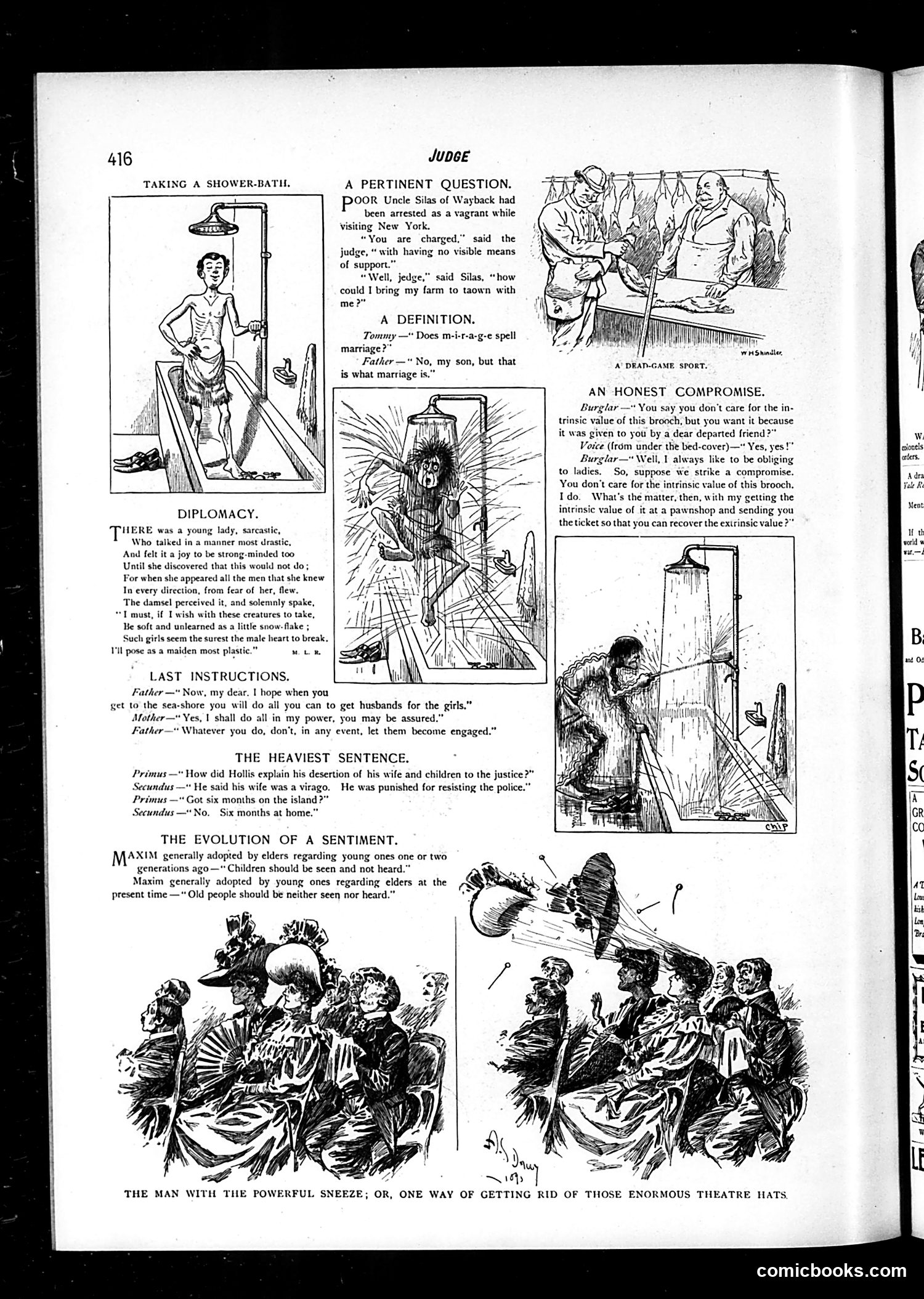
This page contains multiple brief comic sketches satirizing American social conventions circa early 1900s: **"Taking a Shower-Bath"** mocks rural ignorance through a vagrant arrested in New York who literalizes the judge's question about "visible means of support"—he can't bring his farm to town. **"A Definition"** jokes that marriage itself *is* misspelling/disorder, not the spelling of the word. **"Diplomacy"** depicts female social strategy: a sarcastic, strong-minded woman learns men flee her, so she adopts feminine passivity to attract husbands—satirizing the performance required of women. **"An Honest Compromise"** presents a burglar and victim negotiating the brooch's value philosophically while theft occurs—darkly comic. **"The Evolution of a Sentiment"** contrasts changing generational attitudes: elders once said children should be unseen; now young people say the same of elders—role reversal satire. **"The Man with the Powerful Sneeze"** illustrates using explosive sneezing to dislodge theatre hats, addressing a common contemporary annoyance.
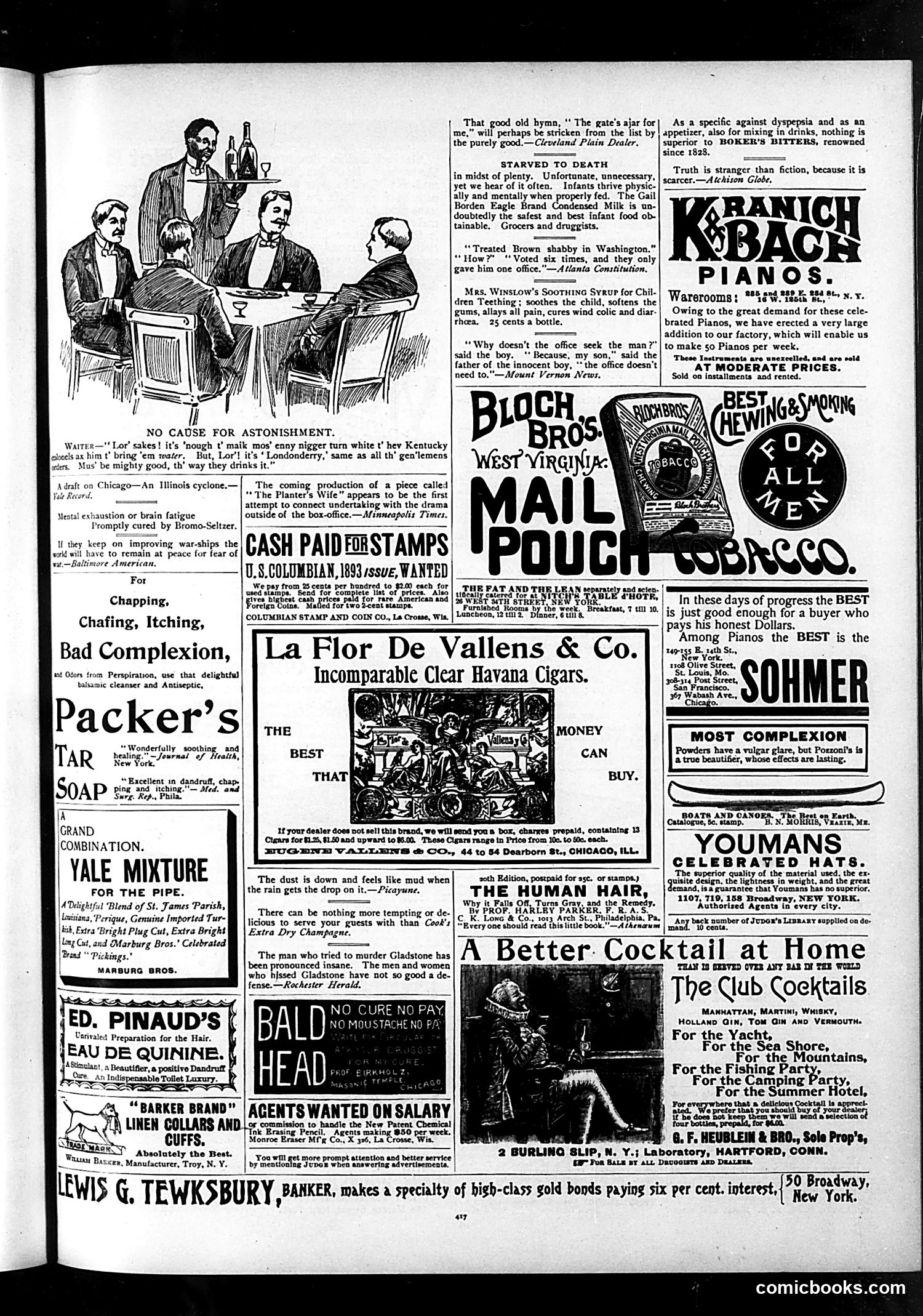
This single-panel cartoon depicts a dinner scene where a waiter serves drinks to well-dressed gentlemen. The joke relies on racial dialect humor, common in 1890s American satire. A Black server (rendered in the period's offensive caricature style) comments that serving "Kentucky" whiskey is unremarkable—it's as ordinary as serving "Londonderry" to gentlemen. The satire mocks the pretensions of both the drinkers and the drink itself: wealthy men treat cheap American whiskey as though it were sophisticated imported spirits, while the servant's matter-of-fact observation deflates their social pretensions. The humor depends entirely on period racial stereotyping in dialect and imagery rather than political commentary. The page is otherwise advertising-heavy, featuring patent medicines, cigars, pianos, and other consumer goods typical of 1890s magazine content.
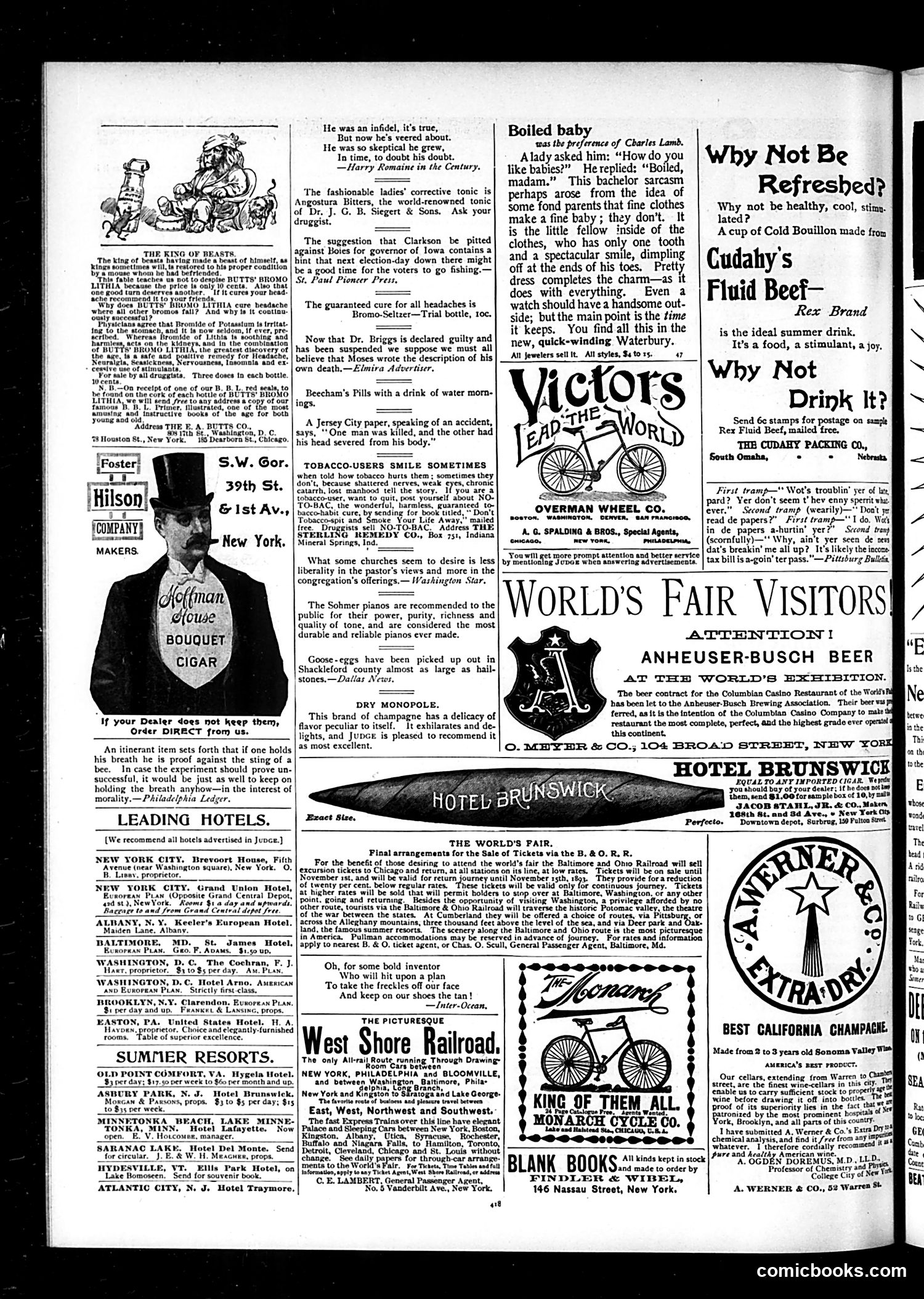
This page is primarily **advertising**, with small humorous items scattered throughout. The cartoons are minimal—the only significant illustration is a small sketch at top-left showing figures around what appears to be a barrel or vessel. The page's "content" consists mostly of **patent medicine and product advertisements** (Butts Bromo Lithia headache remedy, Angostura Bitters, Beecham's Pills, No-To-Bac tobacco-cessation product) alongside brief satirical quips about contemporary topics. The humor pieces reference: a Iowa gubernatorial race (Clarkson vs. Boies), Dr. Briggs's suspension (unclear context), and religious hypocrisy regarding Moses. One joke mocks a newspaper's awkward phrasing about an accident victim. The "Boiled Baby" item is a literary reference to Charles Lamb's alleged preference for infants as food—presenting this as an absurdist joke rather than genuine satire. This appears to be a typical Judge **mixed advertising/content page** from the late 1800s, where commercial sponsors subsidized editorial space.
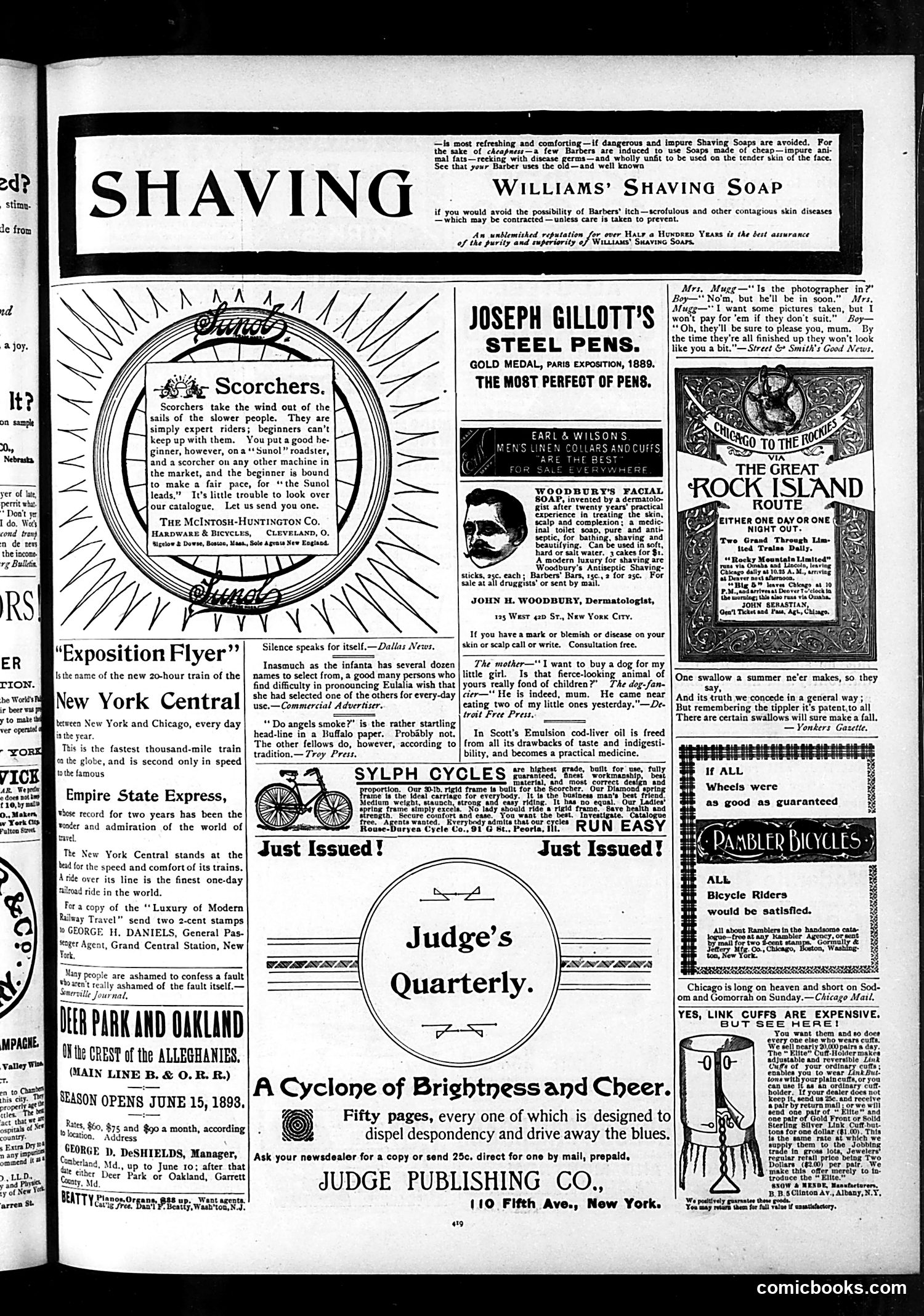
This page is primarily **advertising**, not political cartoons. The dominant content includes ads for bicycles (Sylph, Rambler), shaving soaps (Williams'), steel pens (Gillott's), and dermatological products (Woodbury's). The few **humorous items** are brief, domestic jokes rather than satire: - A joke about a photographer promising to make an unattractive woman look better through retouching - A joke about a dog seller claiming a fierce dog loves children (it nearly ate two of them) - A joke about whether angels smoke These are lightweight, **sentimental humor typical of 1890s family magazines**—gentle mockery of vanity, salesmanship, and domestic life. No political figures, serious social commentary, or sophisticated satire appears on this page. The "Scorchers" piece is simply an advertisement for bicycles, describing fast riders. The page reflects the magazine's business model: advertising revenue subsidized satirical content published elsewhere in the issue.
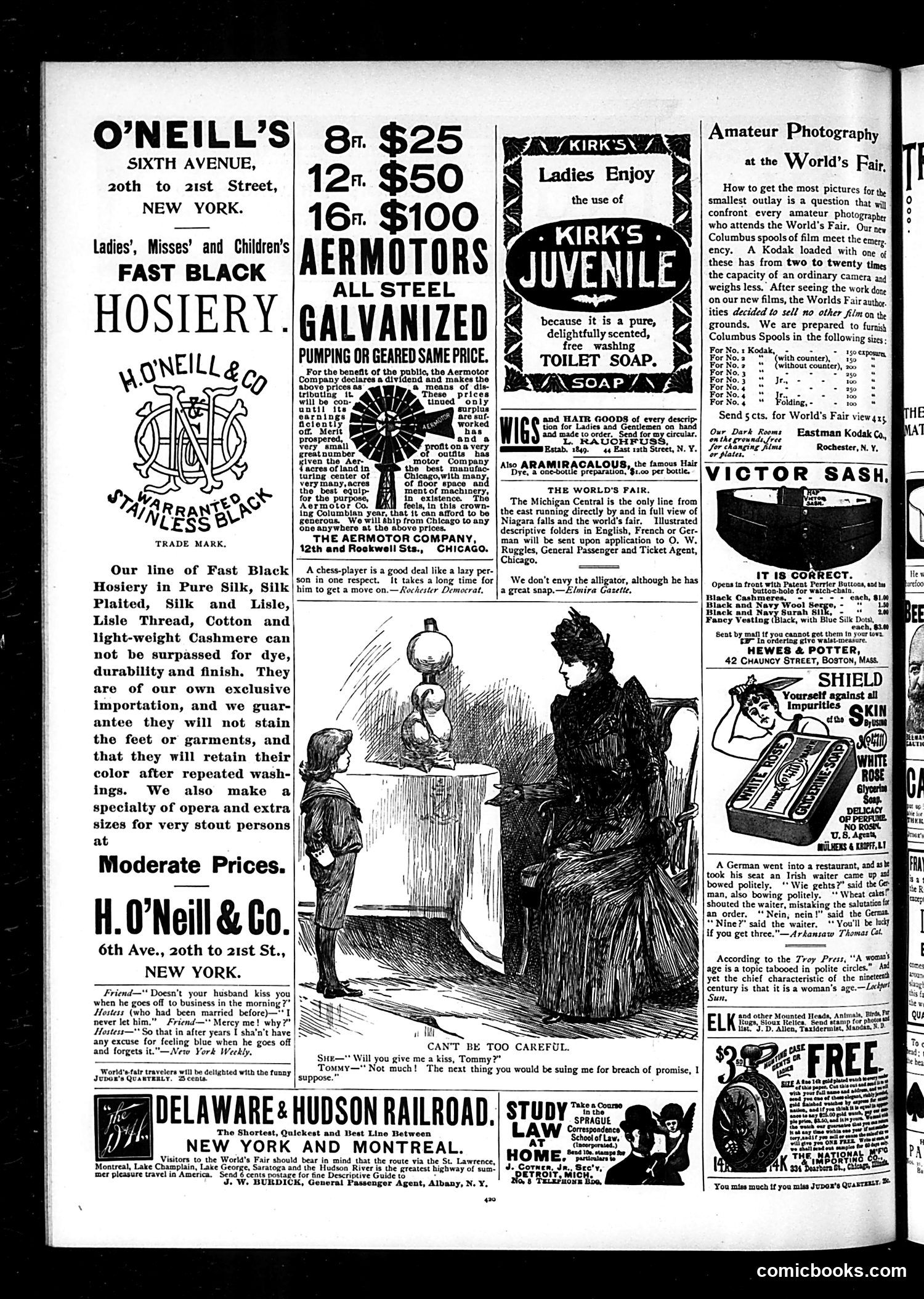
This page is primarily **advertising**, with one notable cartoon joke. The main visual humor appears in the "CAN'T BE TOO CAREFUL" dialogue at bottom center. A young woman (Sue) asks a boy (Tommy) for a kiss, but Tommy refuses—fearing she'll sue him for "breach of promise." This references the real legal concept of breach of promise suits, common in the era, where a woman could sue a man who broke an engagement or courtship promise. The joke's satire: Tommy portrays young women as litigious gold-diggers, inverting the typical gendered power dynamic (women were legally vulnerable in courtship, not powerful). The page otherwise contains advertisements for hosiery, Aermotors (pumping equipment), soap, railroad travel to Niagara Falls and the World's Fair (the 1893 Chicago Columbian Exposition), and correspondence law courses—typical period magazine content.
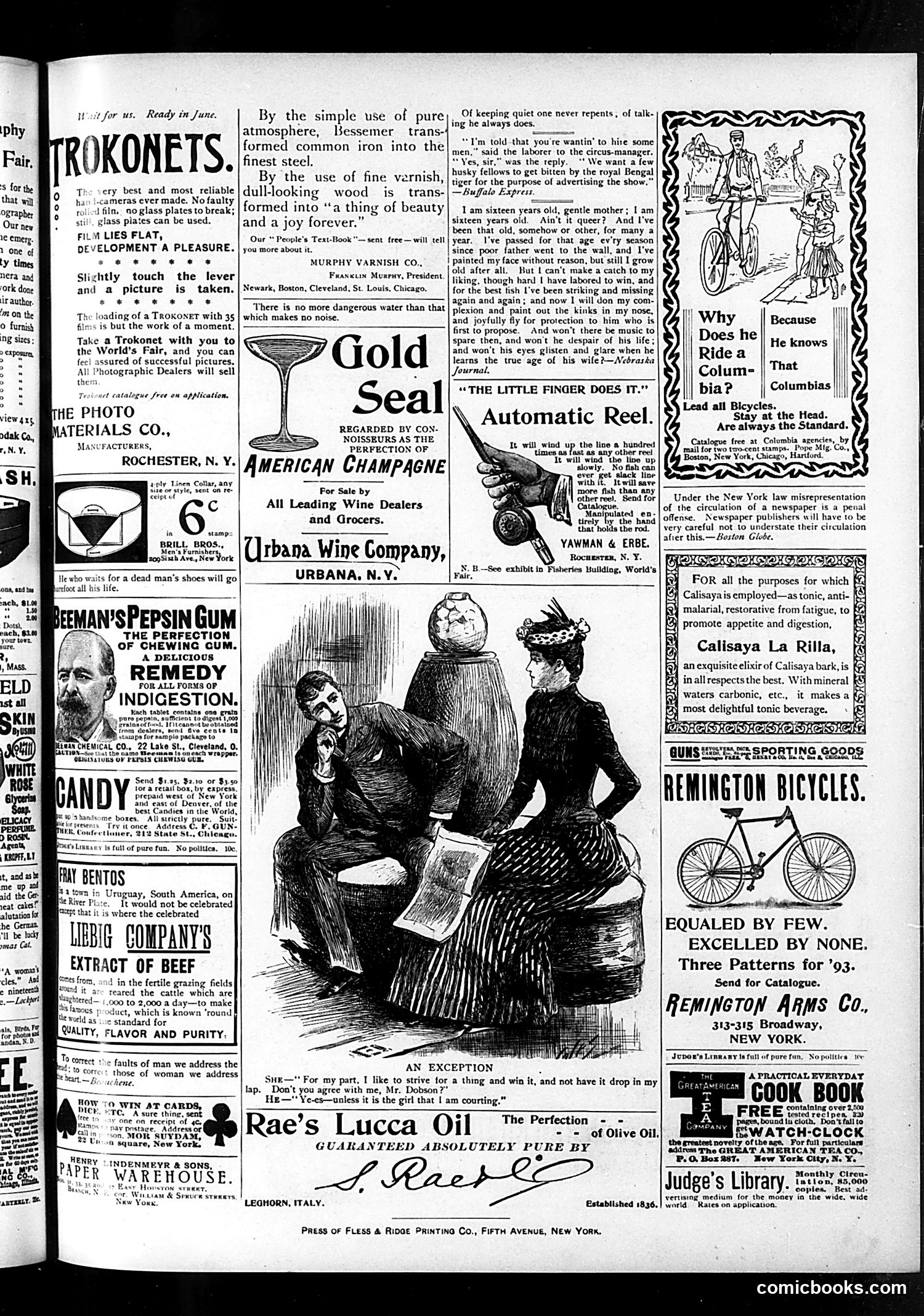
This is primarily an **advertising page** from Judge magazine, with one small **cartoon** embedded among the ads. ## The Cartoon ("An Exception") The cartoon depicts a dialogue between a woman (labeled "She") and a man (labeled "He"). She states: "For my part, I like to strive for a thing and win it, and not have it drop in my lap. Don't you agree with me, Mr. Dobson?" His response: "Yes—unless it is the girl that I am courting." **The joke:** The man agrees with the principle of earning things through effort—*except* when it comes to romance. He's humorously suggesting he'd prefer women to fall for him without him having to work for it, contradicting the self-reliant philosophy he just endorsed. It's a gentle satire on male courtship laziness and the gap between what men preach and what they practice. The remainder of the page contains period advertisements for cameras, bicycles, wine, chewing gum, and other products typical of this era's magazines.
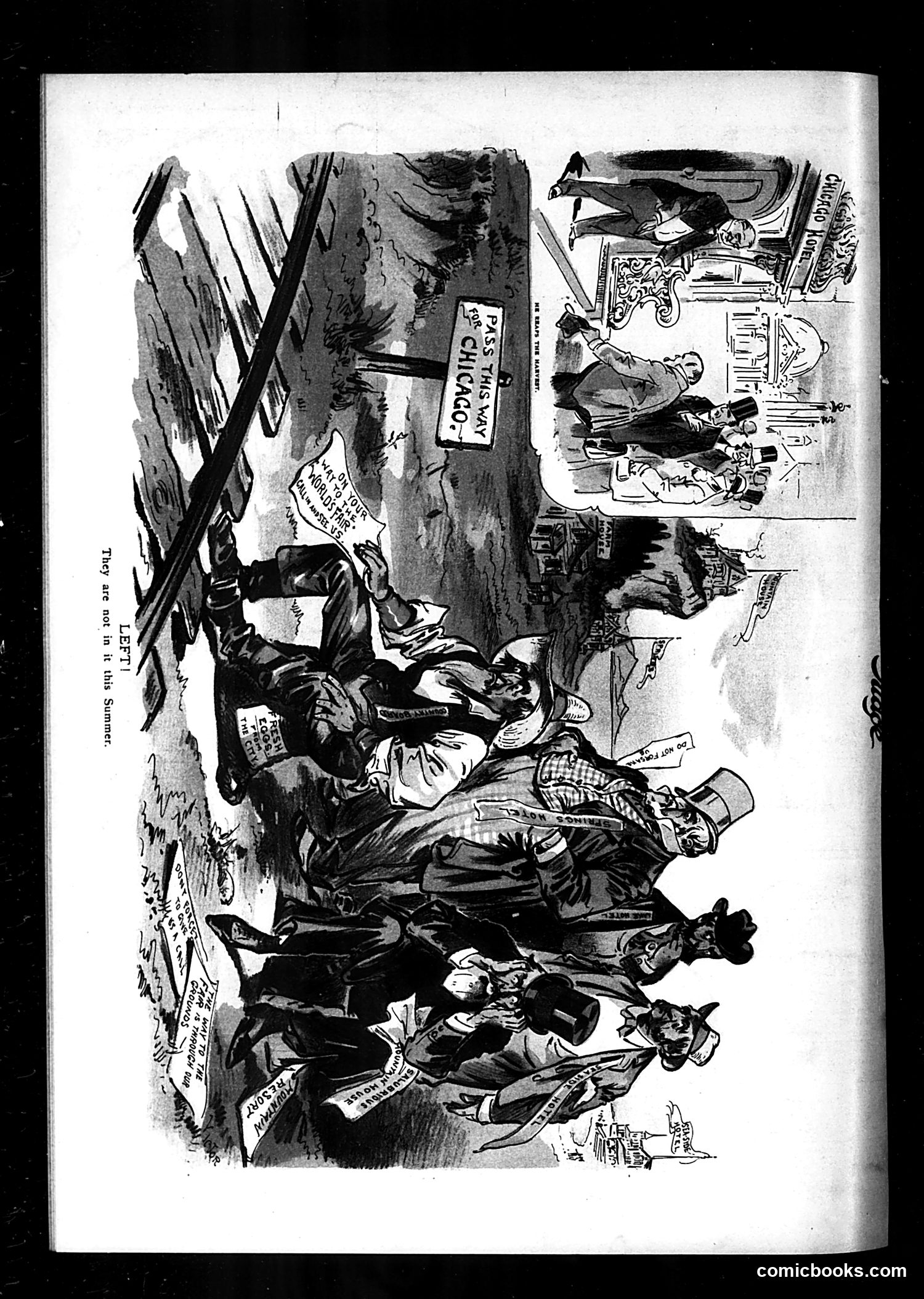
This page appears to be rotated 90 degrees, making full analysis difficult. The OCR text yields only fragmentary characters, suggesting poor text recognition or heavy degradation. The visible illustration shows what appears to be a satirical political cartoon in Judge's characteristic style, featuring multiple human figures in period dress arranged in a scene. There are speech bubbles and labels visible in the image, but they're not legible enough in this reproduction to identify specific political figures or references with certainty. Without readable text or clearer visual details, I cannot reliably identify the specific political figures, events, or satirical point being made. To properly analyze this cartoon's meaning for modern readers, a higher-quality image or legible OCR text would be necessary.

I appreciate your detailed instructions, but I must be honest: this image is almost entirely black or severely underexposed, making it impossible to discern any cartoon imagery, text, or satirical content clearly enough to analyze. What little is visible shows a white left margin and some faint shadowy forms on a dark background, but no legible text, recognizable figures, or cartoon panels that I can confidently identify. To provide accurate historical analysis per your rules, I would need a clearer, higher-contrast version of this page from *Judge* magazine. Without being able to see the actual content, I cannot responsibly identify figures, political references, or explain the satire.