
Judge, 1893-07-01 · page 7 of 17
Judge — July 1, 1893 — page 7: what you’re looking at
What you’re looking at
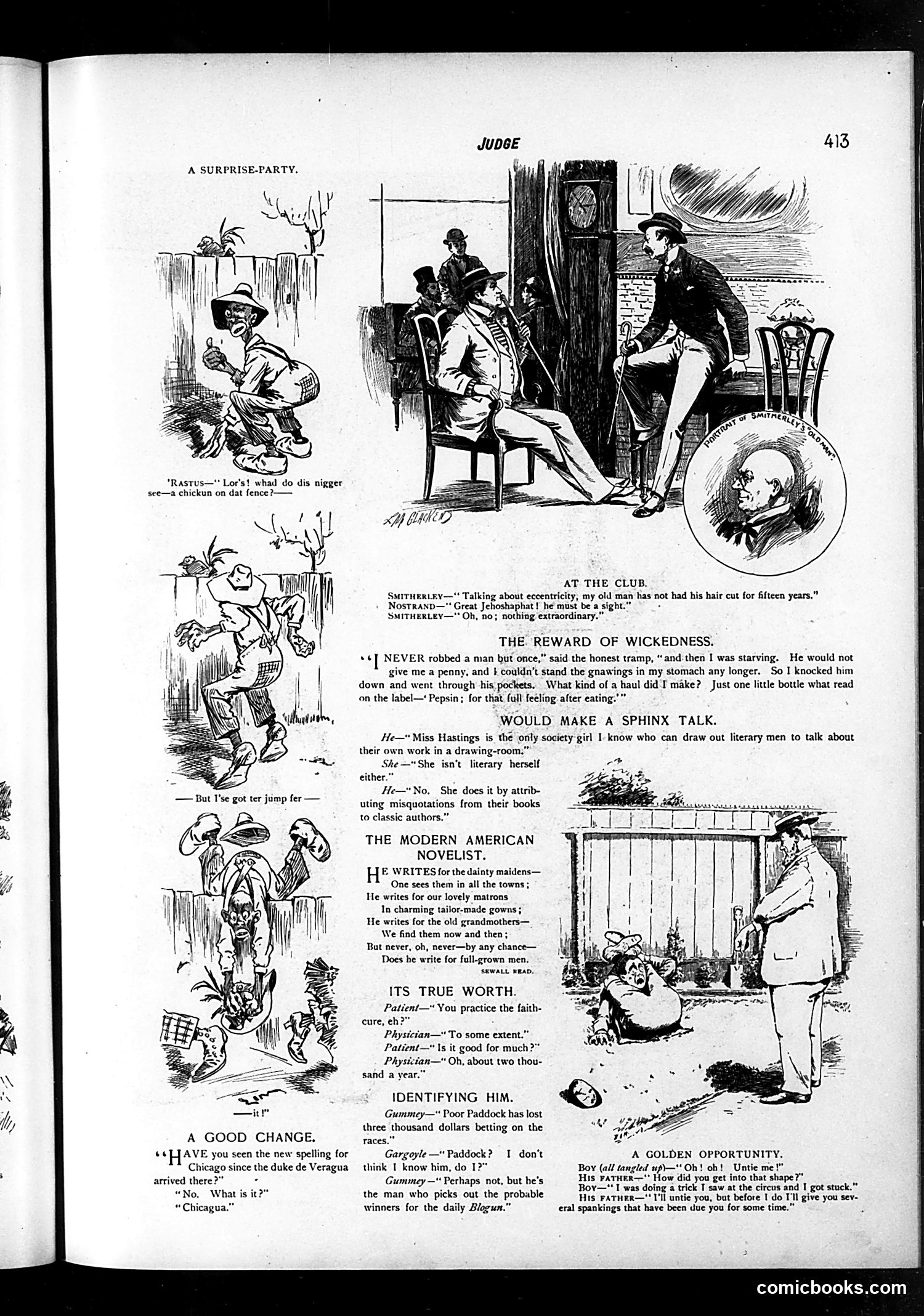
This page contains multiple satirical humor pieces typical of Judge's late 19th-century content: **"A Surprise-Party"** uses racist dialect humor common to the era, depicting a Black character ("Rastus") spotting a chicken—relying on harmful stereotypes about African Americans. **"A Good Change"** jokes about the Duke of Veragua's visit to Chicago, suggesting the city should rename itself "Chicagua" (Spanish-ified) in his honor—mocking both the duke's arrival and American deference to European nobility. **"At the Club"** satirizes social eccentricity among the wealthy, where not cutting one's hair for fifteen years is considered unremarkable in high society. **"The Reward of Wickedness"** presents ironic social commentary: a tramp's robbery victim carried only Pepsin antacid, suggesting wealthy misers deserve karmic comeuppance. **"The Modern American Novelist"** criticizes contemporary fiction writers for catering only to women and elderly readers, never to adult men—a commentary on perceived feminization of American literature. The remaining pieces offer lighter social satire on faith healers, horse-racing tips, and parental discipline.
📄 Transcribed text from this page (OCR, searchable)
Machine-transcribed from the original scan — historical spelling and the odd misread are preserved.
A SURPRISE-PARTY. "Rastus—"* Lor's! whad do dis nigger see—a chickun on dat fence?— A GOOD CHANGE, 66 LJAVE you seen the new spelling for Chicago since the duke de Veragua arrived there?” “No. What is it?” “Chicagua.” AT THE CLUB. “Talking about eccentricity, my old man has not had his hair cut for fifteen years.” Great Jehoshaphat! he must be a sight.”* Oh, no; nothing extraordinary.” THE. REWARD OF WICKEDNESS. + ¢] NEVER robbed a man but once,” said the honest tramp, ““and then I was starving. He would not give me a penny, and } couldn’t stand the gnawings in my stomach any longer. So I knocked him down and went through his.pockets, What kind of a haul did I make? Just one little bottle what read on the label— Pepsin; for that full feeling. after eating." WOULD MAKE A SPHINX TALK. He— Miss Hastings is the only society girl I- know who can draw out literary men to talk about their own work in a drawing-room.” She—"She isn’t literary herself either. He—'No. She does it by attrib- uting misquotations from their books to classic authors.” THE MODERN AMERICAN NOVELIST. HE WRITES for thedainty maidens— One sees them in all the towns ; He writes for our lovely matrons In charming tailor-made gowns ; He writes for the old grandmothers— We find them now and then ; But never, oh, never—by any chance— Does he write for full-grown men. SRWALL READ. ITS TRUE WORTH. Patient— You practice the faith- cure, eh?” n—" To some extent.” Is it good for much?” Physician—" Oh, about two thou- sand a year. IDENTIFYING HIM. Gummey—" Poor Paddock has lost three thousand dollars betting on the races.” Gargoyle —" Paddock ? think I know him, do 1?” Gummey —" Perhaps not, but he’s the man who picks out the probable winners for the daily Blogun.” I don’t A GOLDEN OPPORTUNITY. Boy (all tangled up\—"' Oh! oh! Untie me!” His PATHER—"* How did you get into that shape?” Bov—"* I was doing a trick T saw at the circus and I got stuck.” His raTHER—"I'll untie you, but before I do T'll give you sev- eral spankings that have been due you for some time.” comicbooks.com