
A complete issue · 16 pages · 1893
Judge — June 10, 1893
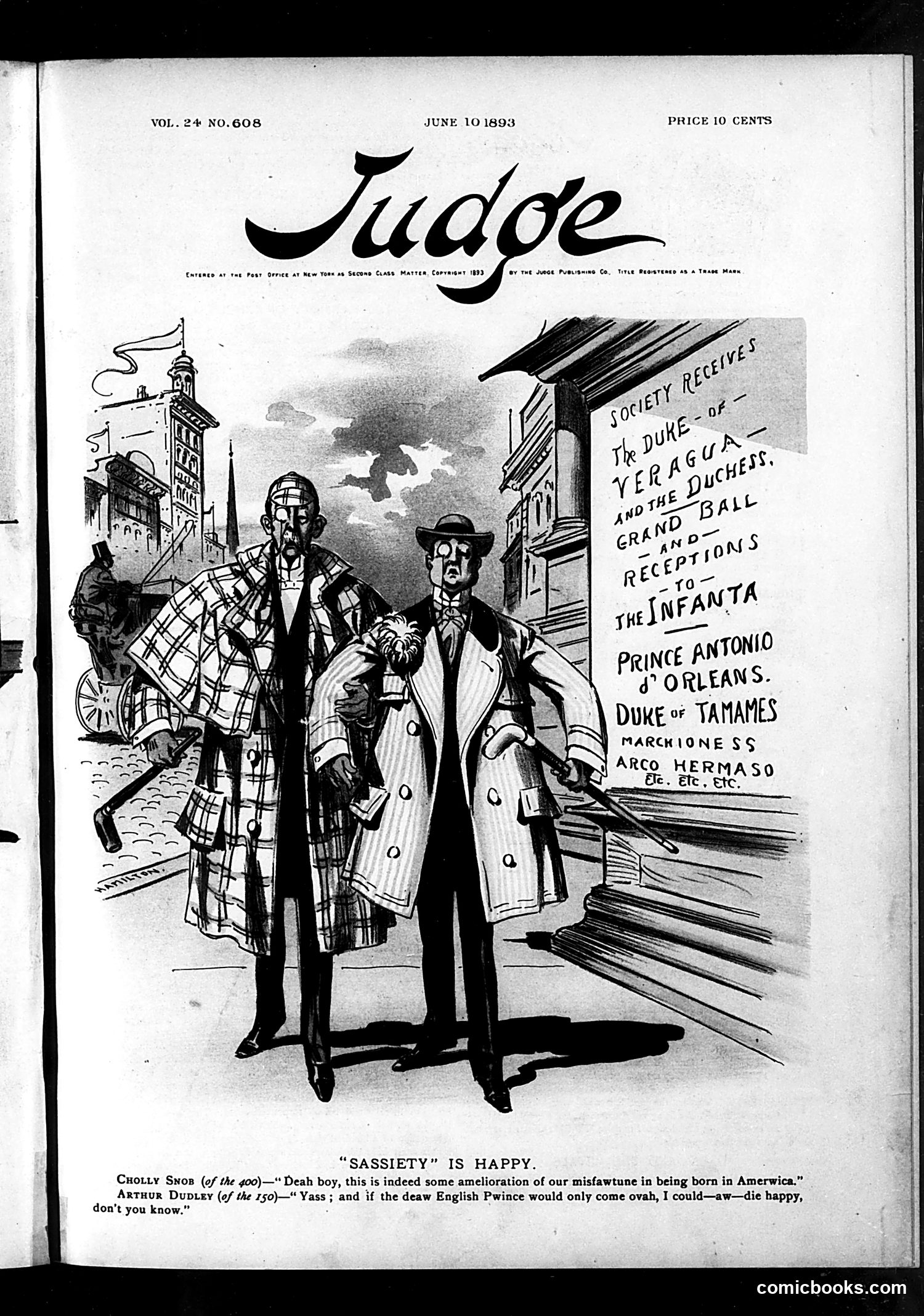
This Judge magazine cover from June 10, 1893 satirizes the visit of Spanish royalty to America. The two figures represent **Cholly Snob** and **Arthur Dudley**, recurring satirical characters representing upper-class American social climbers. The joke centers on their delight at receiving invitations to society events honoring Spanish nobility—apparently the **Duke of Veragua**, **Prince Antonio d'Orleans**, the **Duke of Tamames**, and the **Infanta**. Dudley's quoted remark mocks American social aspiration: he's thrilled that distinguished European royalty would visit, implying American "sassiety" (society) gains legitimacy through European approval. The satire targets American nouveau riche pretentiousness and their desperate desire for Old World validation of their social status.
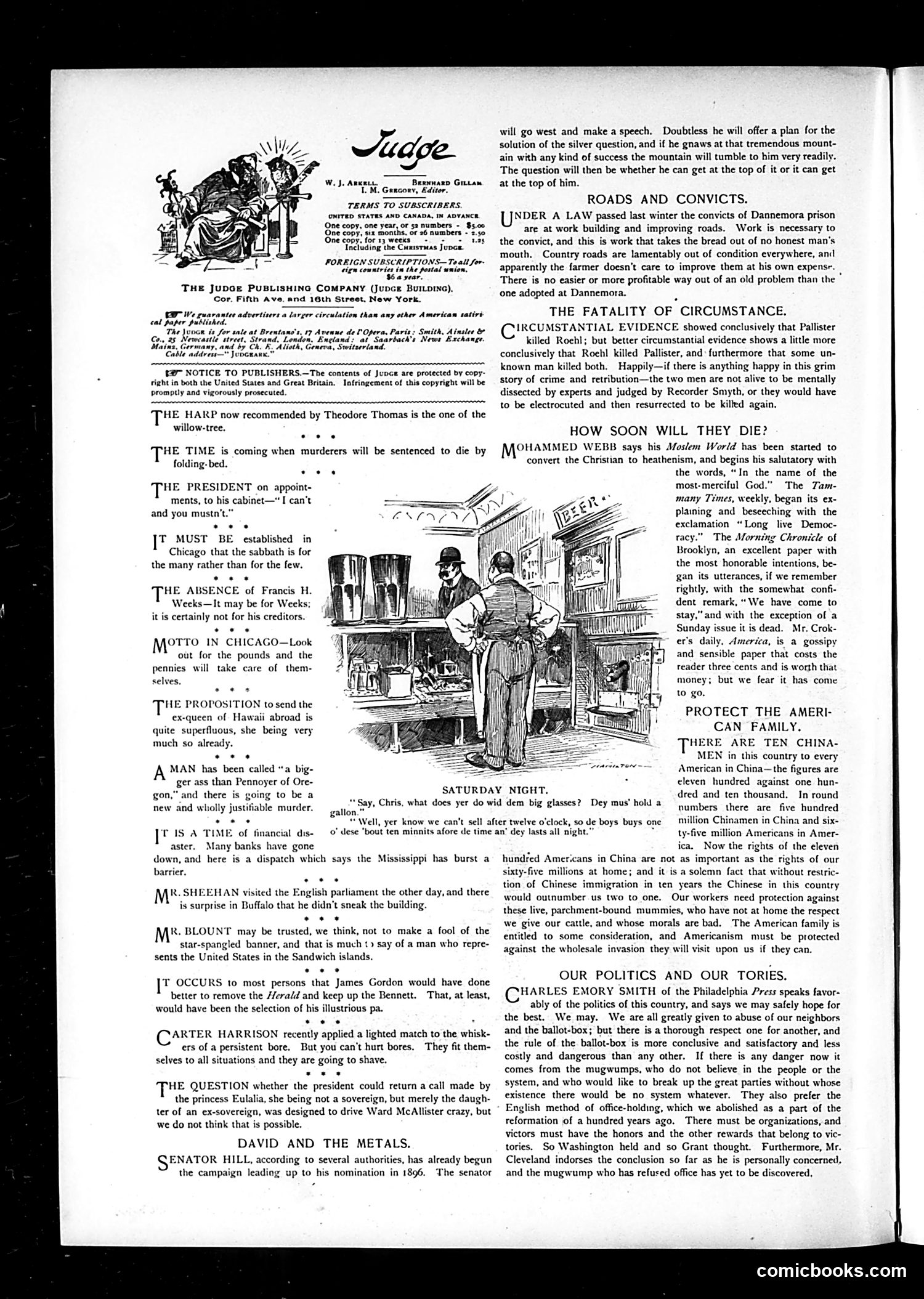
The main illustration depicts a working-class scene—likely a saloon or shop—where one man asks another "Say, Chris, what does yer do wid dem big glasses?" The response jokes about not affording liquor after midnight closing, so "de boys buys one oder 'bout dem minutes before de time as 'day lasts all night.'" This appears to satirize late-19th-century liquor laws and working-class drinking culture, using exaggerated dialect ("yer," "dem") typical of Judge's period humor. The cartoon mocks both the artificial constraints of closing hours and men's resourcefulness in circumventing them—a commentary on Prohibition-era tensions between regulations and actual behavior. The surrounding editorial content addresses unrelated political topics (Chinese immigration, election politics), making this a typical Judge issue mixing visual satire with commentary.
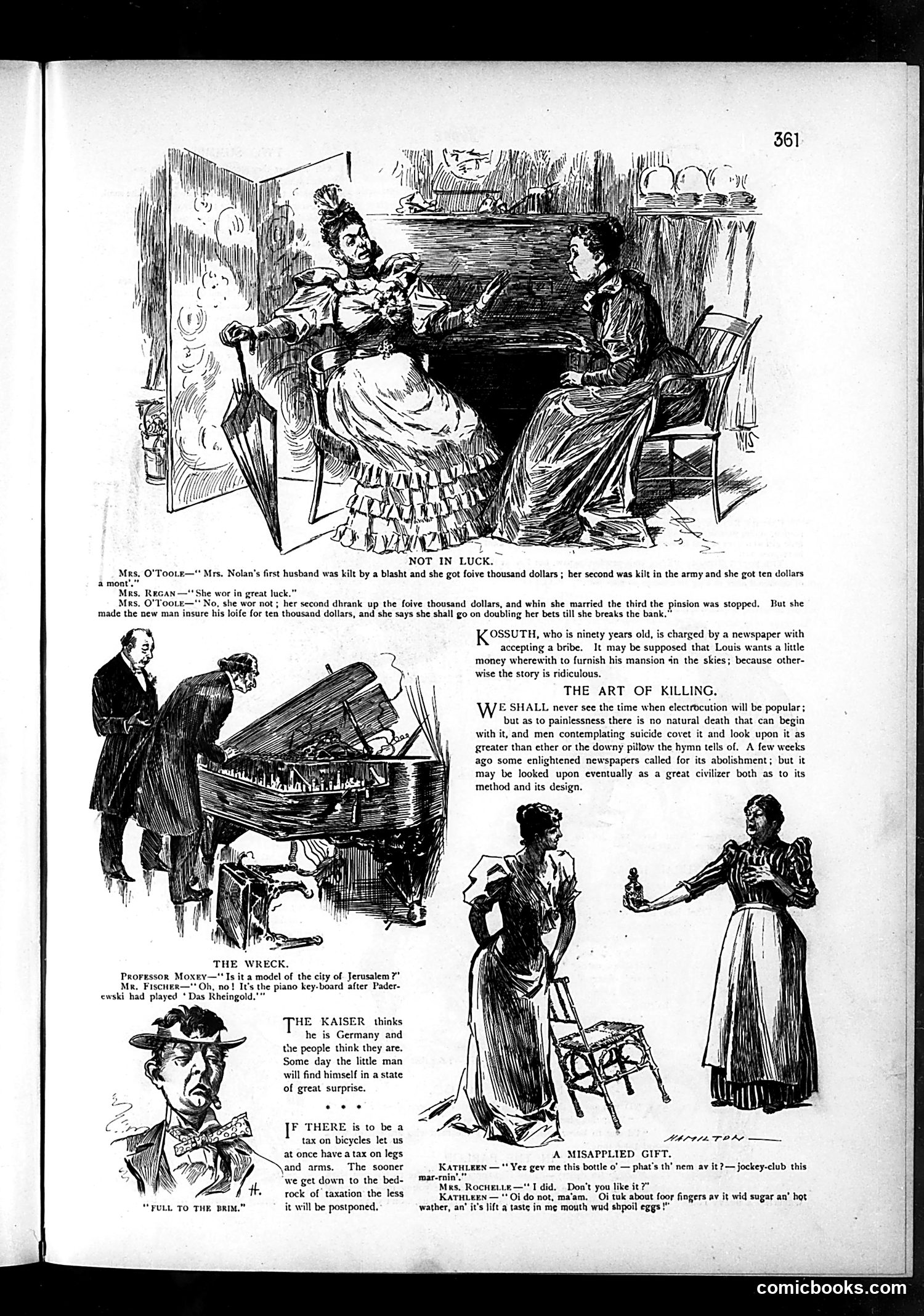
This page contains several unrelated satirical sketches typical of Judge's format: **"Not in Luck"** depicts a woman discussing marriages and financial gain—mocking women's mercenary attitudes toward husbands. **"The Wreck"** shows a piano mishap, with the joke hinging on mistaking a keyboard for something else (unclear without clearer context). **"The Art of Killing"** discusses electrocution as capital punishment, likely referencing contemporary debates about this relatively new execution method. **"The Kaiser"** features a caricatured German figure (suggesting pre-WWI or WWI-era content), with commentary on his perceived arrogance. **"Full to the Brim"** presents a brief tax joke about bicycles. **"A Misapplied Gift"** concludes with women discussing an inappropriate gift involving "jockey-club" (unclear reference). The page reflects Judge's typical mix of domestic humor, political commentary, and topical satire.
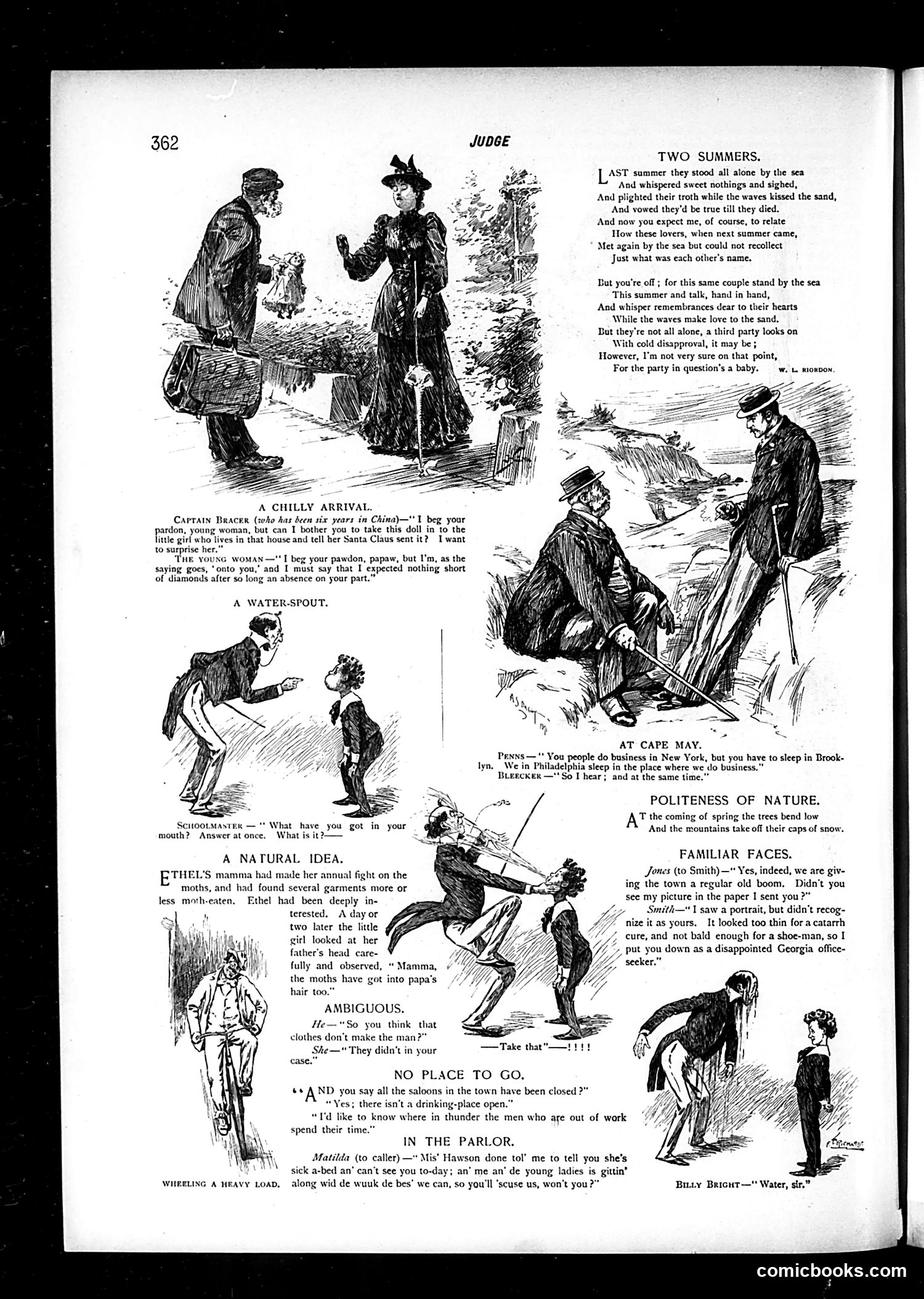
This page from *Judge* contains multiple short satirical pieces typical of the magazine's format: **"A Chilly Arrival"** mocks a military officer returning from China after six years, expecting his romantic gesture (a doll gift) to delight a young woman—who instead sarcastically demands diamonds, having moved on completely. **"A Water-Spout"** and **"A Natural Idea"** are brief joke exchanges about children's innocent observations (a schoolmaster's mouth contents, a girl noticing her father's hair loss resembles moth damage). **"Two Summers"** is a sentimental poem about young lovers reuniting—the joke being they can't remember each other's names, but return the next year with a baby, suggesting they eventually reconciled. **"No Place to Go"** satirizes Prohibition-era drinking culture, suggesting unemployed men now lack places to congregate now that saloons are closed. The remaining pieces are minor gags about social awkwardness, mistaken identity in newspaper photos, and domestic servants. The overall tone reflects *Judge*'s characteristic blend of romance, domestic life, and social commentary through humor.
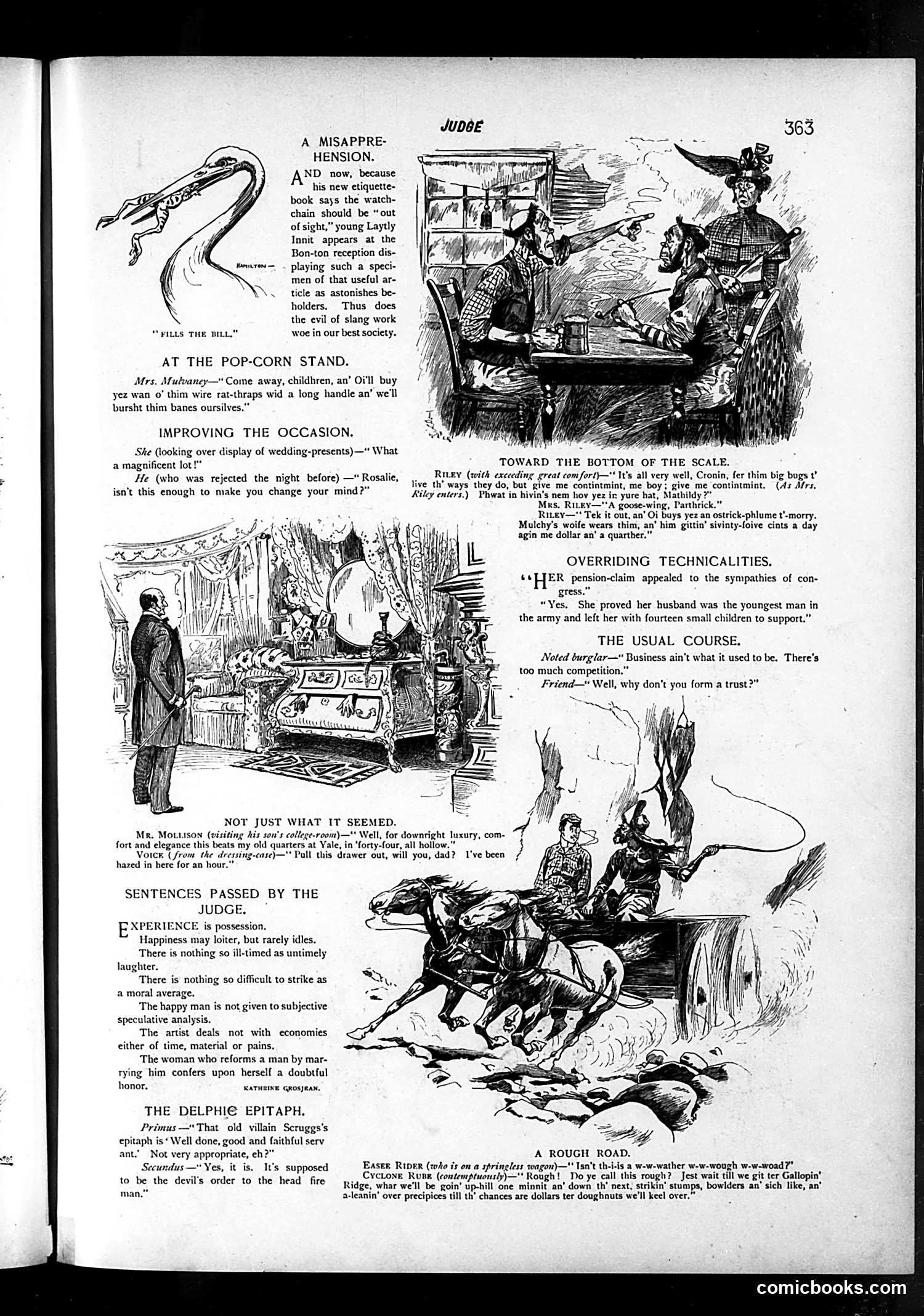
This page contains multiple short satirical pieces typical of Judge's humor circa the 1880s-90s: **"A Misapprehension"** mocks etiquette-obsessed society: a young man, following a new etiquette book's advice to hide his watch chain, instead displays an ostentatiously large one—defeating the book's purpose through literal misreading. **"At the Pop-Corn Stand"** uses Irish-dialect humor (common to the era) with Mrs. Mulvaney planning to buy rat traps disguised as popcorn equipment to "burst" her children's bones—dark humor presented as working-class comic relief. **"Overriding Technicalities"** satirizes pension fraud: a widow's claim succeeds by exploiting a technicality (her husband was the army's youngest soldier) rather than actual hardship. **"The Usual Course"** jokes that even burglars recognize monopolistic consolidation: when one complains of business competition, his friend suggests forming a trust—referencing the era's growing corporate trusts. Other vignettes mock college luxury, epitaphs, and Irish-accented rural complaints about bad roads.
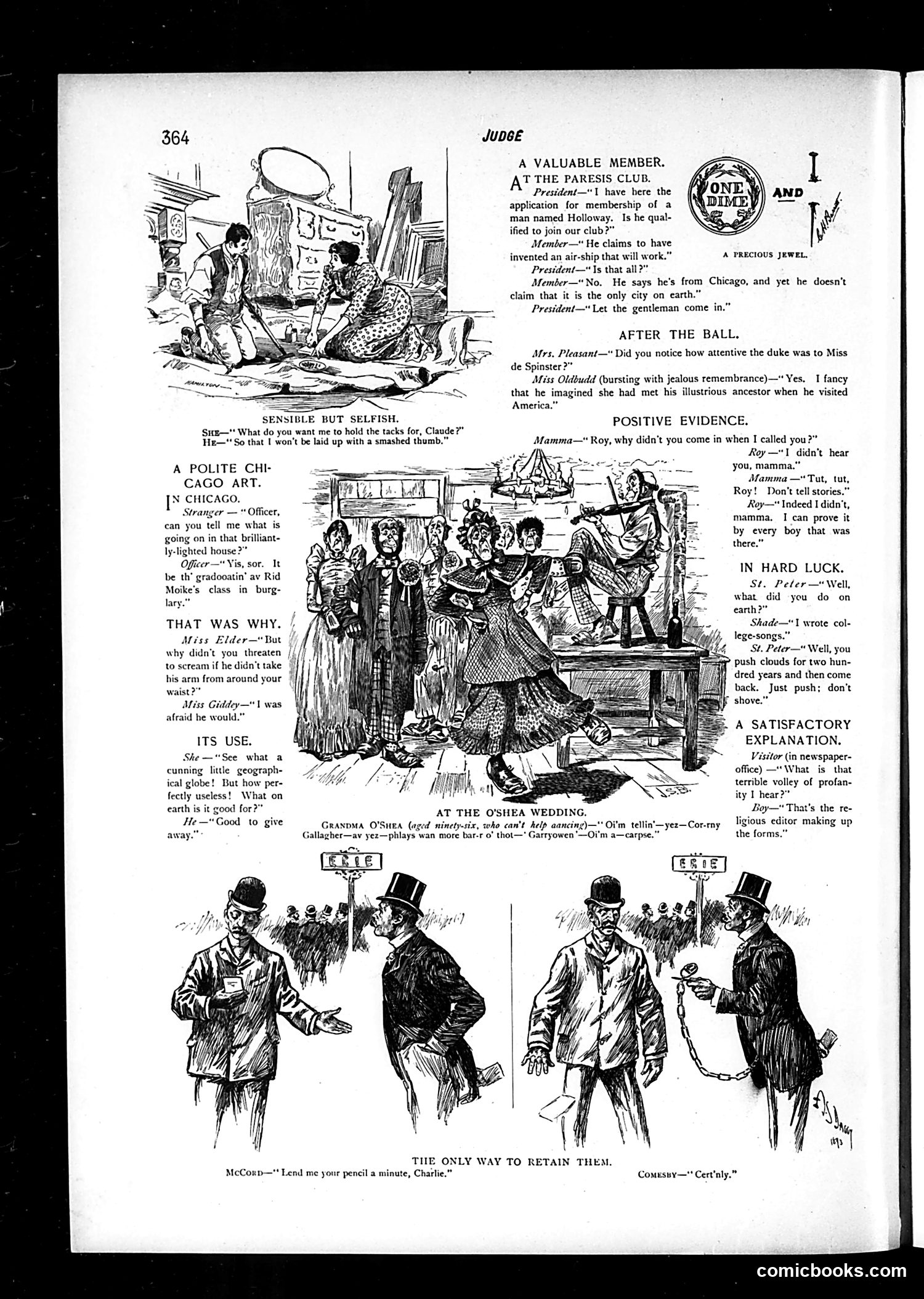
This page contains multiple brief satirical sketches typical of Judge's humor circa early 1900s: **"A Valuable Member"** mocks Chicago's reputation for boasting by suggesting a man from Chicago who *doesn't* claim it's superior is worthy of club membership—inverting expected Chicago arrogance. **"After the Ball"** satirizes social climbing and snobbery: a woman assumes a European duke must have met her ancestor, reflecting period anxieties about American wealth versus Old World aristocracy. **"A Polite Chicago Art"** plays on Irish-American immigrant dialect humor (the officer's speech), common in period comedy. **Other sketches** target familiar domestic situations: children lying, marital dynamics, office culture, and a joke about retaining borrowed pencils through chains—suggesting chronic borrowing problems. **"In Hard Luck"** depicts a college songwriter condemned to menial heavenly labor—a dig at sentimental college-song sentimentality. The page reflects early 20th-century American prejudices (Irish stereotypes, class anxiety) and domestic humor conventions now dated but historically revealing of period attitudes.
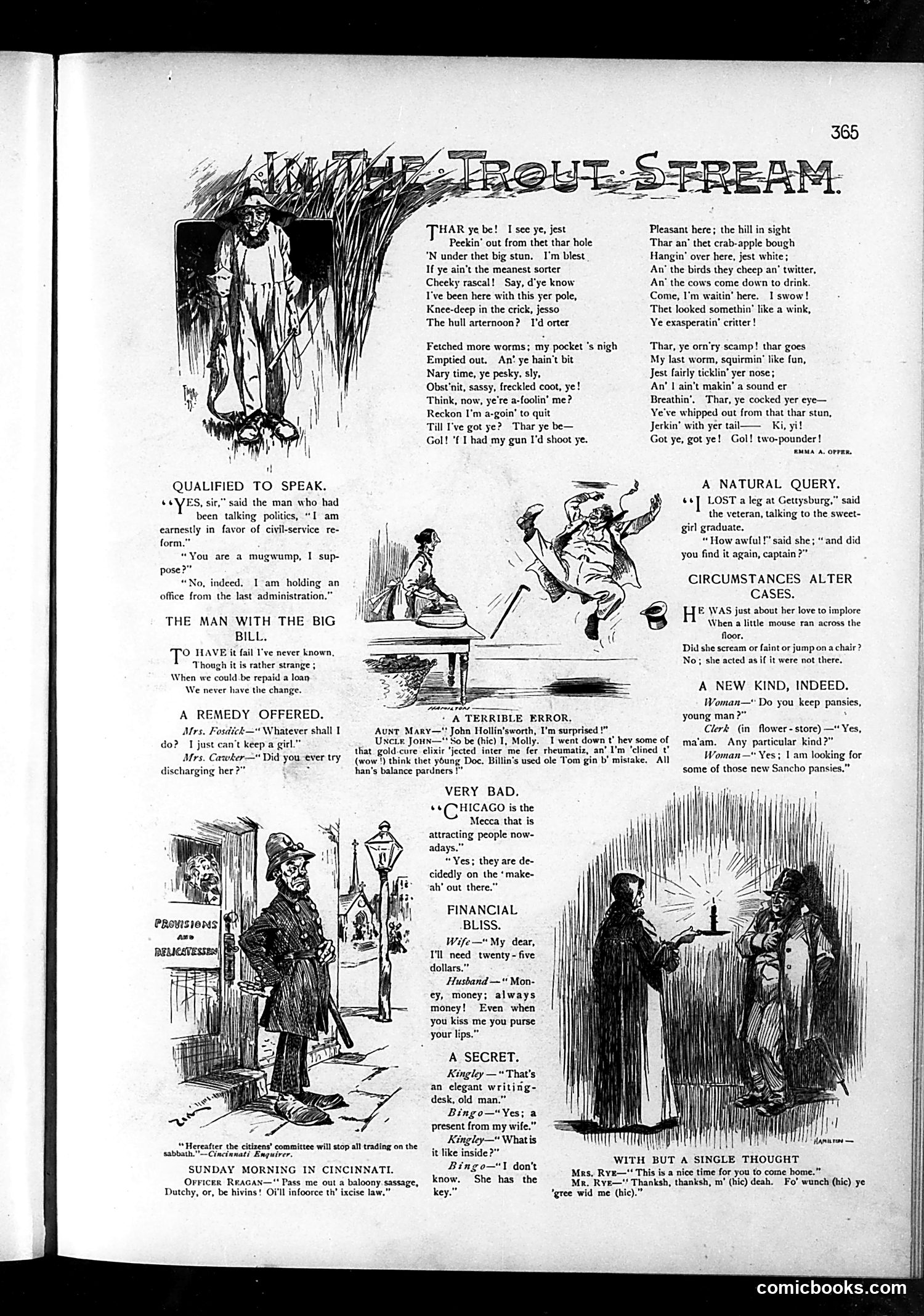
This page contains multiple brief satirical jokes and cartoons typical of late-19th-century American humor journalism. **Key content includes:** - **"Qualified to Speak"**: Mocks a politician claiming to support civil-service reform while admitting he holds an office from the previous administration—hypocrisy of reform rhetoric. - **"The Man with the Big Bill"**: A wordplay joke about someone unable to get change for a loan. - **"Sunday Morning in Cincinnati"**: Officer Reagan enforcing excise laws (alcohol prohibition regulations), with dialect humor common to the era. - **"A Terrible Error"**: A drunk man addressing another, with the humor apparently depending on a mistaken identity or drunken confusion. - **"Circumstances Alter Cases"**: A woman shows no reaction to a mouse—unexpected behavior that subverts expectation. - **"A Natural Query"**: A sweet young woman naively asks a Civil War veteran if he "found" his lost leg again—gentle satire of innocence. The page mixes political commentary (civil service reform, prohibition enforcement) with domestic humor and sentimental Civil War references typical of Judge's era.
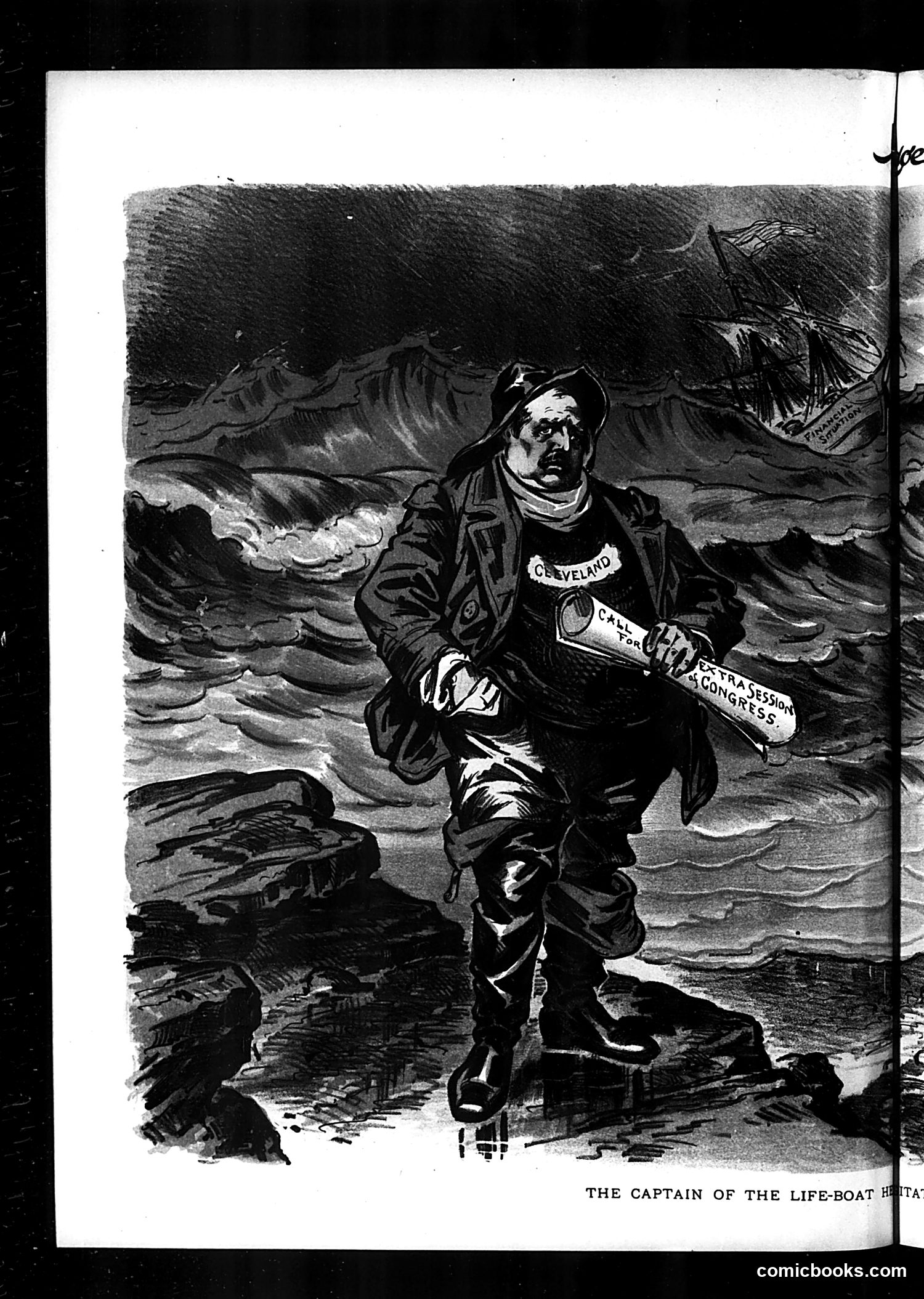
This political cartoon depicts "The Captain of the Life-Boat," a figure in dark clothing holding documents labeled "CLEVELAND" and what appears to be "CALL FOR EXTRA SESSION" and "CONGRESS." The character stands amid turbulent waters with rocky terrain, suggesting a crisis or emergency scenario. The satire appears to target President Grover Cleveland during an economic or political crisis requiring congressional intervention. The "life-boat" metaphor suggests the nation is in danger, with Cleveland positioned as the captain attempting to navigate troubled waters. The documents he clutches indicate his call for emergency congressional action. Without the publication date visible, the specific crisis remains unclear—likely the Panic of 1893 or another major Cleveland-era crisis requiring extraordinary governmental response.
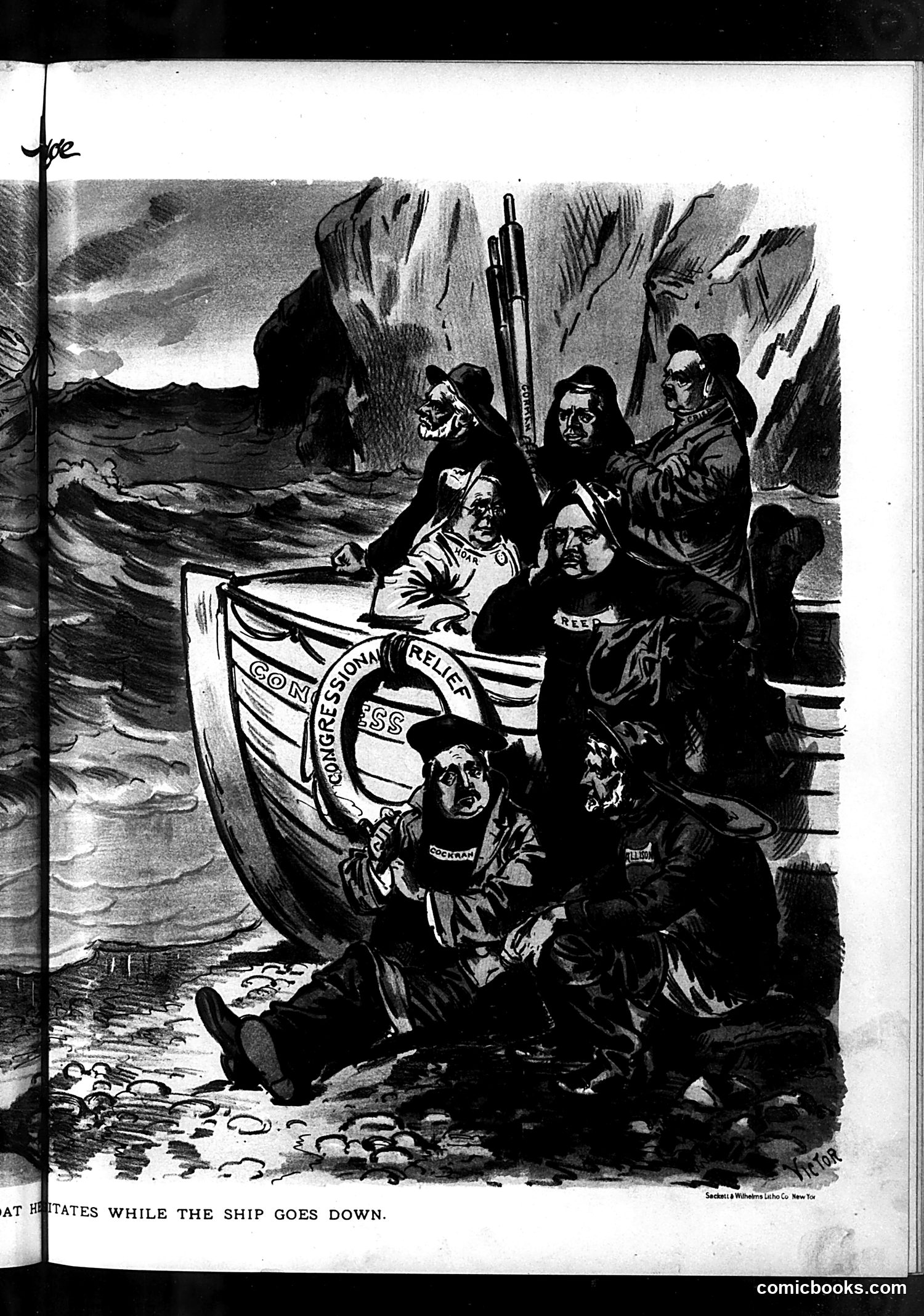
This political cartoon depicts a shipwreck scene where figures in a lifeboat hold a flag labeled "CONGRESSIONAL RELIEF" while the ship sinks in the background. The title suggests criticism of government hesitation during a crisis. The satire appears to target Congress's slow response to a disaster—likely an economic crisis, natural disaster, or wartime emergency. While ordinary people perish ("the ship goes down"), politicians debate or delay relief efforts, clutching bureaucratic banners rather than taking decisive action. The caricatured figures represent Congressional leadership, portrayed as indecisive and self-serving. The cartoon's point: government officials prioritize procedure and political positioning over urgent humanitarian needs, allowing preventable suffering while they deliberate. Without a visible date, the specific crisis remains unclear, but the theme reflects recurring Judge magazine criticism of Congressional inefficiency.
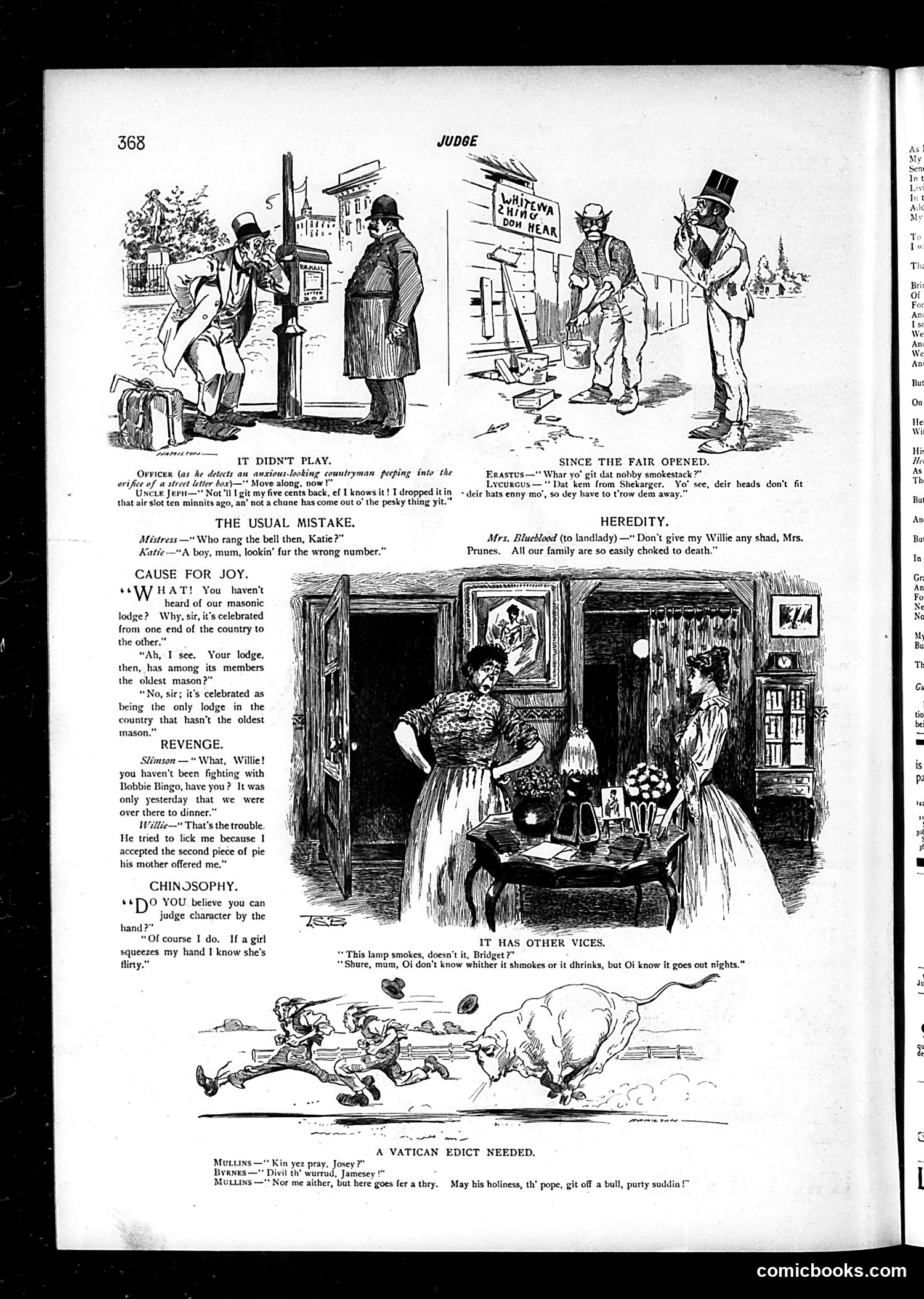
This page contains multiple humor pieces satirizing everyday life and social pretensions circa the Gilded Age. **Top cartoons**: Mock rural/immigrant characters—one frustrated with a malfunctioning street mailbox, another bewildered by fair exhibition attractions. The humor derives from class difference and unfamiliarity with urban technology. **Middle sections**: Short comedic dialogues lampooning social climbing (a masonic lodge bragging about being the *only* lodge lacking an "oldest" mason—nonsensical vanity), domestic service mistakes, and pseudo-scientific claims about character reading. **"Heredity" cartoon**: Mocks upper-class pretension—a snobbish woman fears her son will choke on shad fish because her family is "easily choked to death," implying both physical delicacy and inherited weakness. **Bottom cartoon**: Irish working-class characters attempting prayer, with "Vatican Edict" suggesting anti-Catholic mockery of Irish immigrants' piety. Overall, the page ridicules social pretension, rural ignorance, immigrant accents, and emerging urban culture through exaggerated dialect and absurdist scenarios.
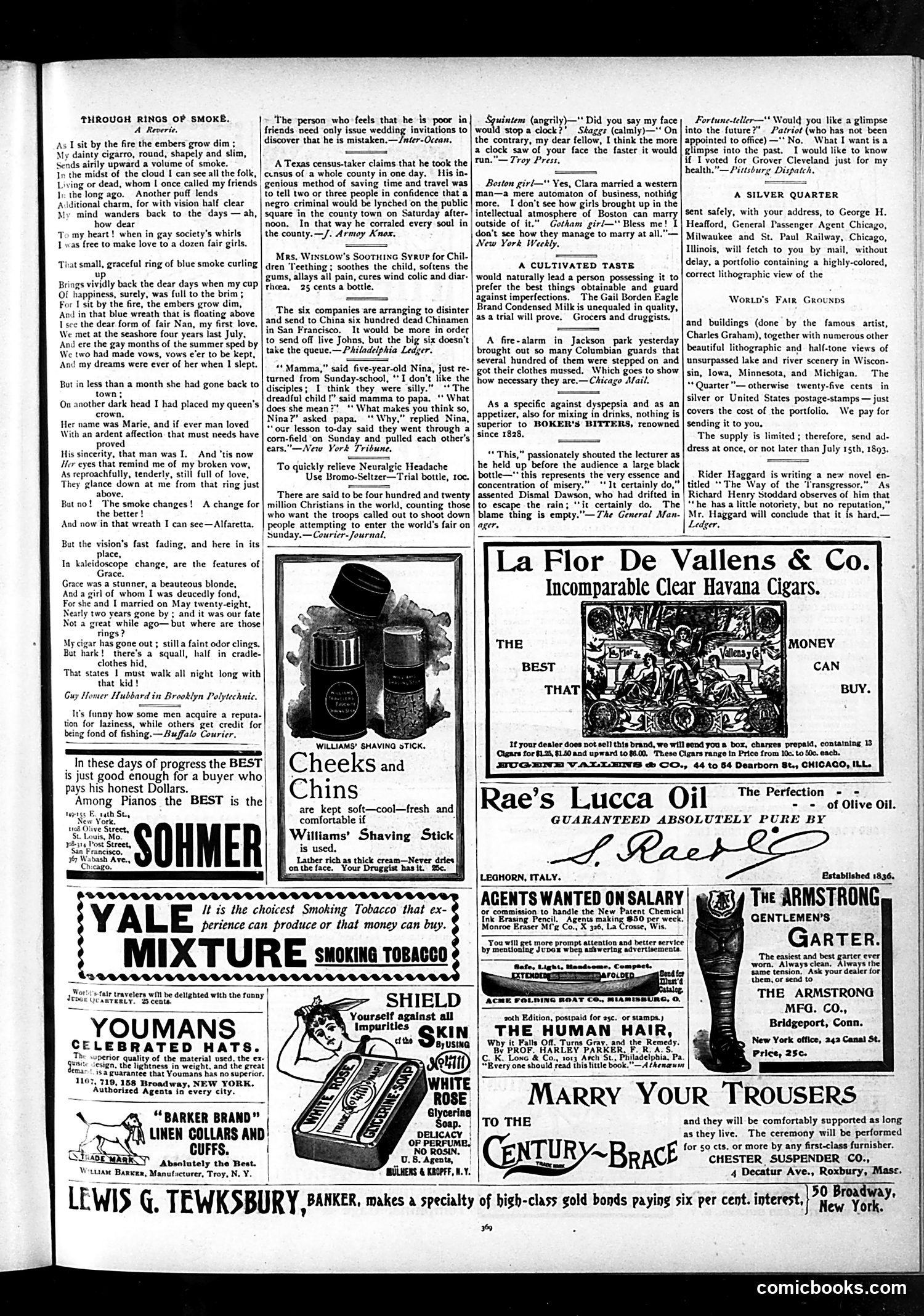
This page features a sentimental poem/short story (likely the main content) about a man sitting by his fireplace, watching cigar smoke form shapes that trigger nostalgic memories of past romantic interests—Nan, Marie, Alfaretta, and Grace (whom he married). The narrative's ironic ending reveals his wife is currently angry with him, forcing him to walk around with their crying baby all night, deflating the romantic reverie. The humor is domestic and melancholic: the contrast between his romanticized memories of carefree flirtation and present marital reality. The closing line's bitterness ("My cigar has gone out") reinforces that his pleasant escape is ruined. The page is primarily **advertising**—cigars, hats, shaving products, tobacco, olive oil, garments, and financial services dominate the margins, typical of *Judge* magazine's revenue model. These ads are era-appropriate products (1890s-1900s), targeting middle-class male readers. No specific political satire or identifiable caricatures appear here.
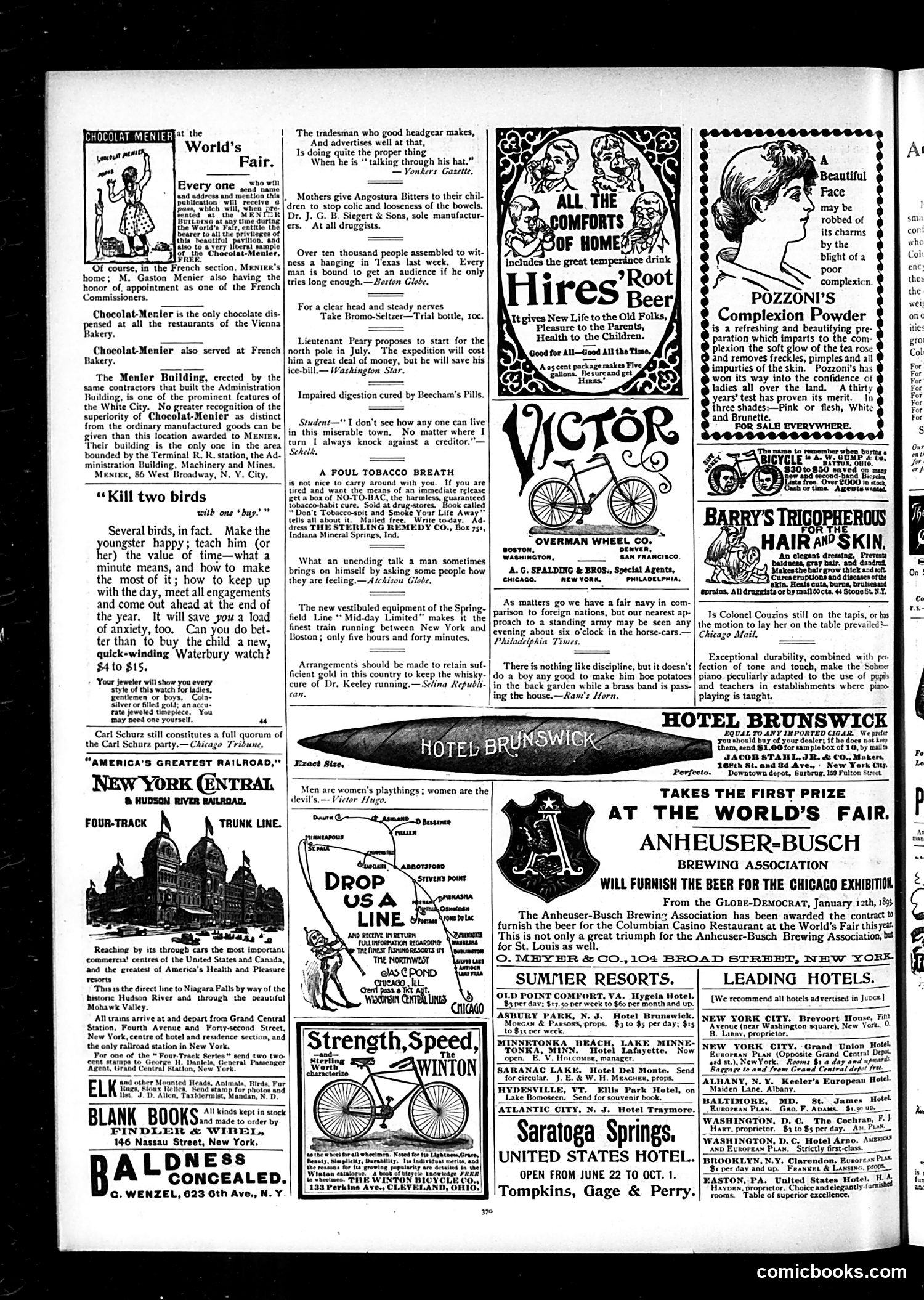
This page is primarily **advertising**, with minimal satirical content. Judge magazine uses its editorial space to promote products at the 1893 World's Columbian Exposition in Chicago. The main items are commercial advertisements for Chocolat-Menier chocolate, Waterbury watches, and the New York Central Railroad, along with patent medicines like Bromo-Seltzer and Beecham's Pills. The few brief satirical jokes include wordplay about a tradesman "talking through his hat" (advertising well) and a quip that anyone can draw a large crowd to a hanging if they "try long enough"—typical late-Victorian dark humor. **Context for modern readers**: This reflects the era's heavy reliance on patent medicines (often containing alcohol or opioids), the World's Fair as a major commercial spectacle, and the magazine's dual role as both satirical publication and advertising vehicle.
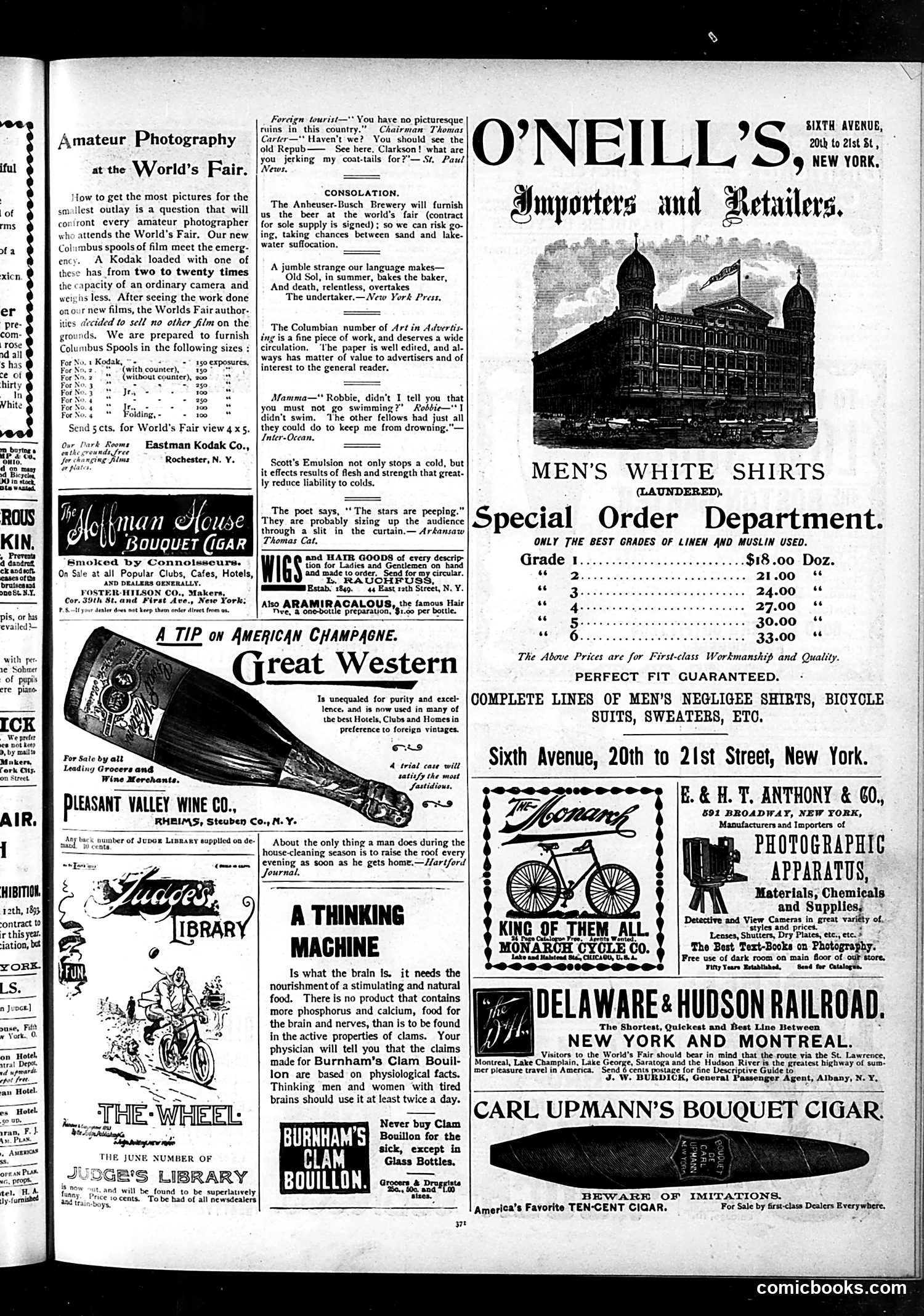
This is primarily an advertising page from Judge magazine with minimal satirical content. The only identifiable political cartoon appears in the upper left, featuring a dialogue between a "Foreign tourist" and "Chairman Thomas Carter." The tourist remarks on America's lack of "picturesque ruins," prompting Carter to begin boasting about "the old Repub-" (likely Republic or Republican Party), before being interrupted by "Clarkson" who yanks his coattail, saying "what are you jerking my coat-tails for?" The joke targets American politicians' tendency to brag about national assets, while the interruption suggests embarrassment about airing partisan politics. The "ruins" reference may allude to internal Republican Party divisions of the period, though the specific political context remains unclear from the visible text alone. The remainder of the page consists entirely of period advertisements for shirts, cameras, cigars, wine, and photography equipment.
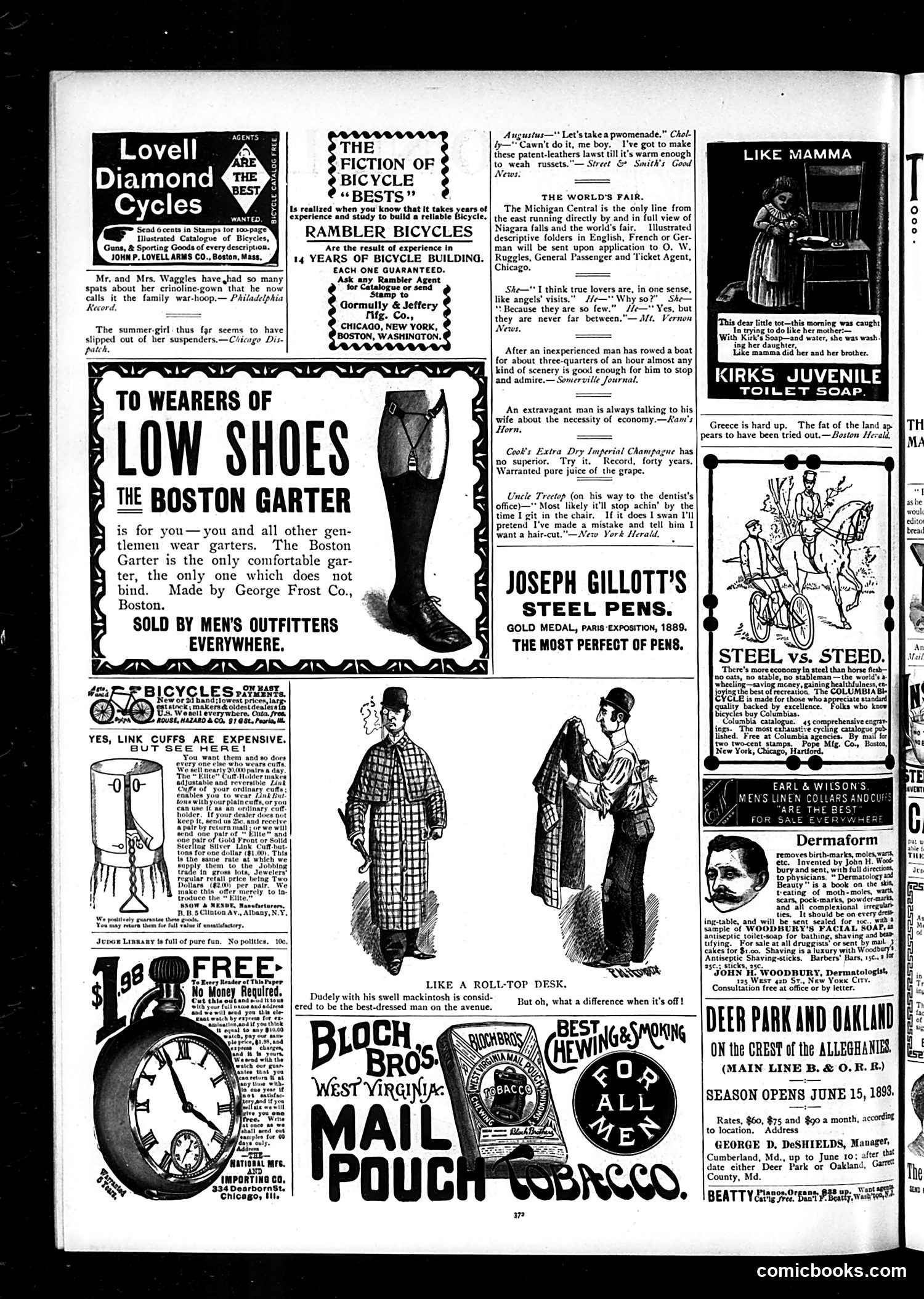
This page from *Judge* magazine is primarily an **advertisement-heavy collection** rather than a satirical cartoon page. It consists mainly of period product ads (bicycles, garters, pens, soap) interspersed with brief, disconnected humorous quips. The few actual jokes target domestic life: husbands annoyed by wives' fashion (crinoline "war-hoops"), gentlemen's fashion anxieties (patent leather shoes versus russets), and dating dynamics ("true lovers like angels' visits—never far between"). One gag mocks an inexperienced rower's indifference to scenery; another jokes about a dental patient hoping toothache pain will excuse him from treatment. The broader context: these are lightweight observations on **Victorian courtship, class consciousness, and male anxieties about appearance and economy**—typical *Judge* fare targeting its genteel male readership. The humor assumes familiarity with period fashion codes and gender dynamics that modern readers would find quaint rather than satirical.
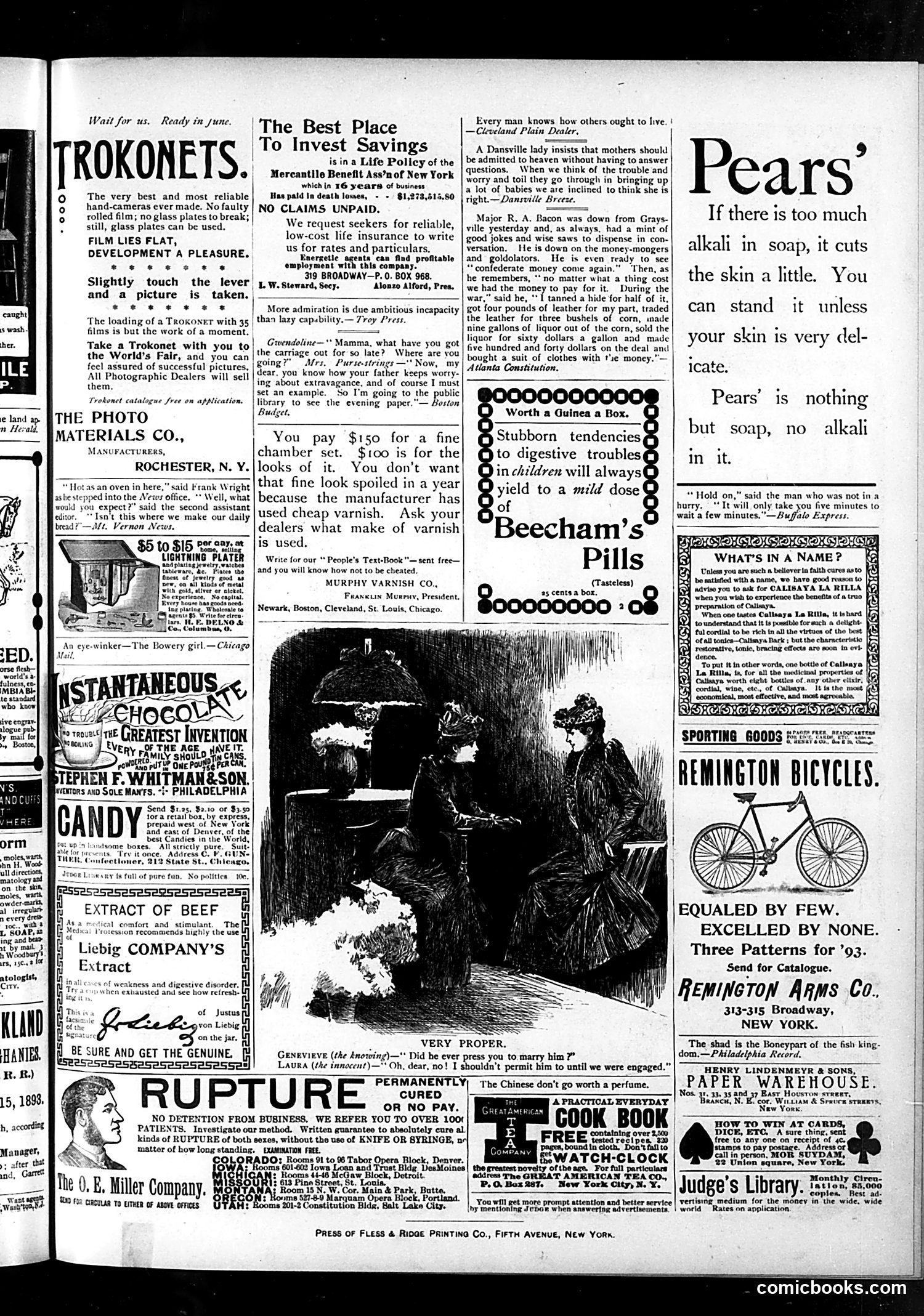
This page is **primarily advertisements** with brief satirical snippets and a central cartoon. The main cartoon, titled "VERY PROPER," depicts a social scene with the caption: "GENEVIEVE (the fascinating)—'Did he ever properly ask you if?'" and "LAURA (the innocent)—'Oh dear, no! I shouldn't permit him to until we were engaged.'" **The joke** mocks Victorian courtship conventions: Laura claims she won't permit romantic advances until engagement, implying strict moral codes—yet the cartoon suggests such propriety is absurdly artificial or hypocritical for the era. The page also includes brief editorial quotes commenting on social issues (mothers in heaven, Confederate money memories, extravagance), typical of Judge's satirical format. The remainder comprises product advertisements: cameras (Trokonets), life insurance, chocolate, bicycles, and various patent medicines—characteristic of 1890s magazine monetization. The advertisements themselves sometimes contain mild humor or exaggeration typical of period marketing.
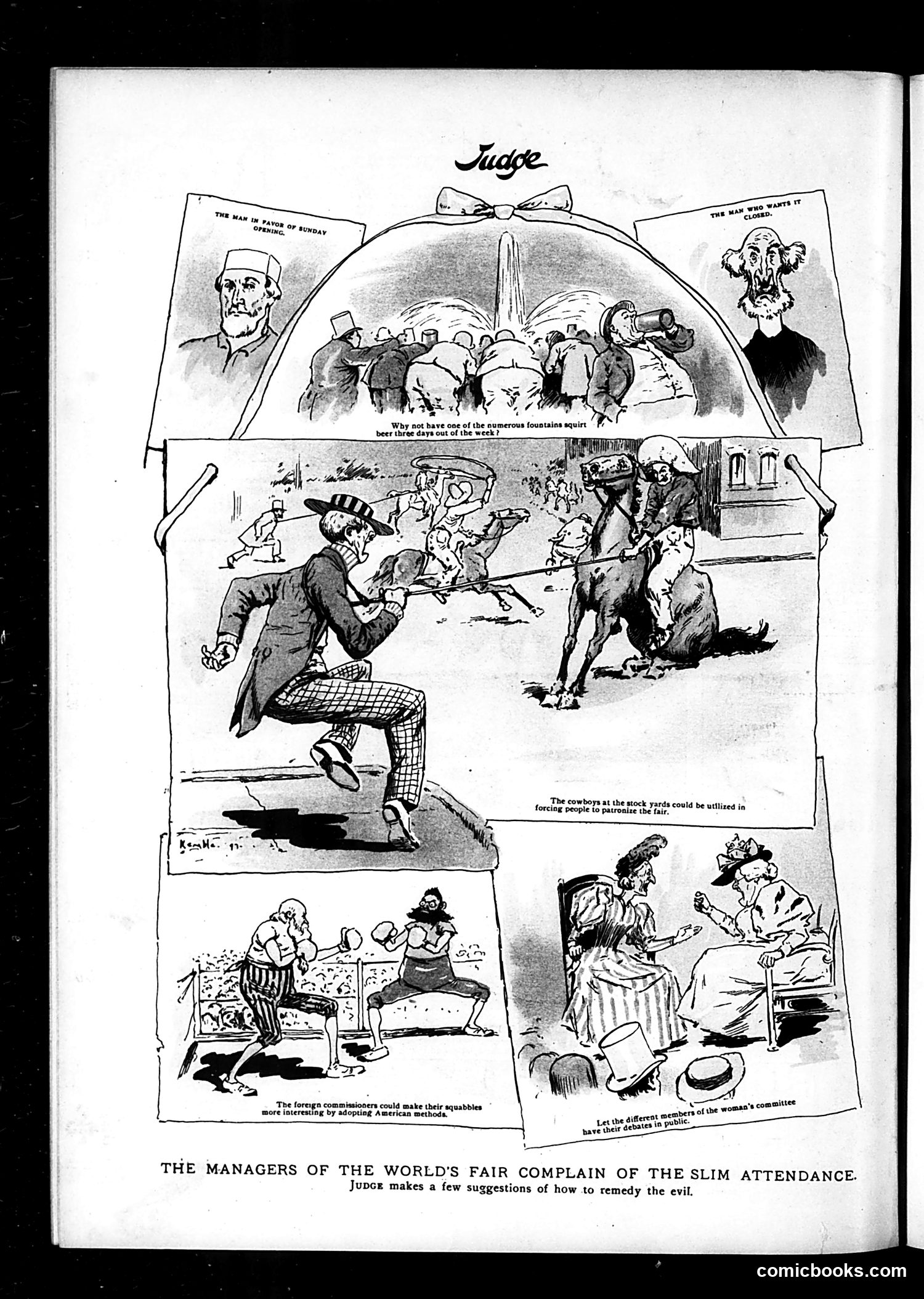
This Judge magazine satire mocks the managers of the World's Fair (likely Chicago's 1893 Columbian Exposition) who complained about disappointing attendance. The cartoon presents absurd "solutions" through caricatured suggestions: installing beer fountains, employing cowboys from stockyards to force attendance, and having women's committee members conduct their disputes publicly for entertainment. The satire ridicules both the fair's organizers for their poor planning and the era's social divisions—suggesting the fair failed because it lacked the lowbrow attractions (alcohol, cowboys, public scandals) that would genuinely draw crowds. It mocks class pretensions: the "refined" fair couldn't compete with rougher entertainment. The caricatures appear to represent different social constituencies whose interests the fair supposedly served but actually alienated.