
Judge, 1893-06-10 · page 6 of 16
Judge — June 10, 1893 — page 6: what you’re looking at
What you’re looking at
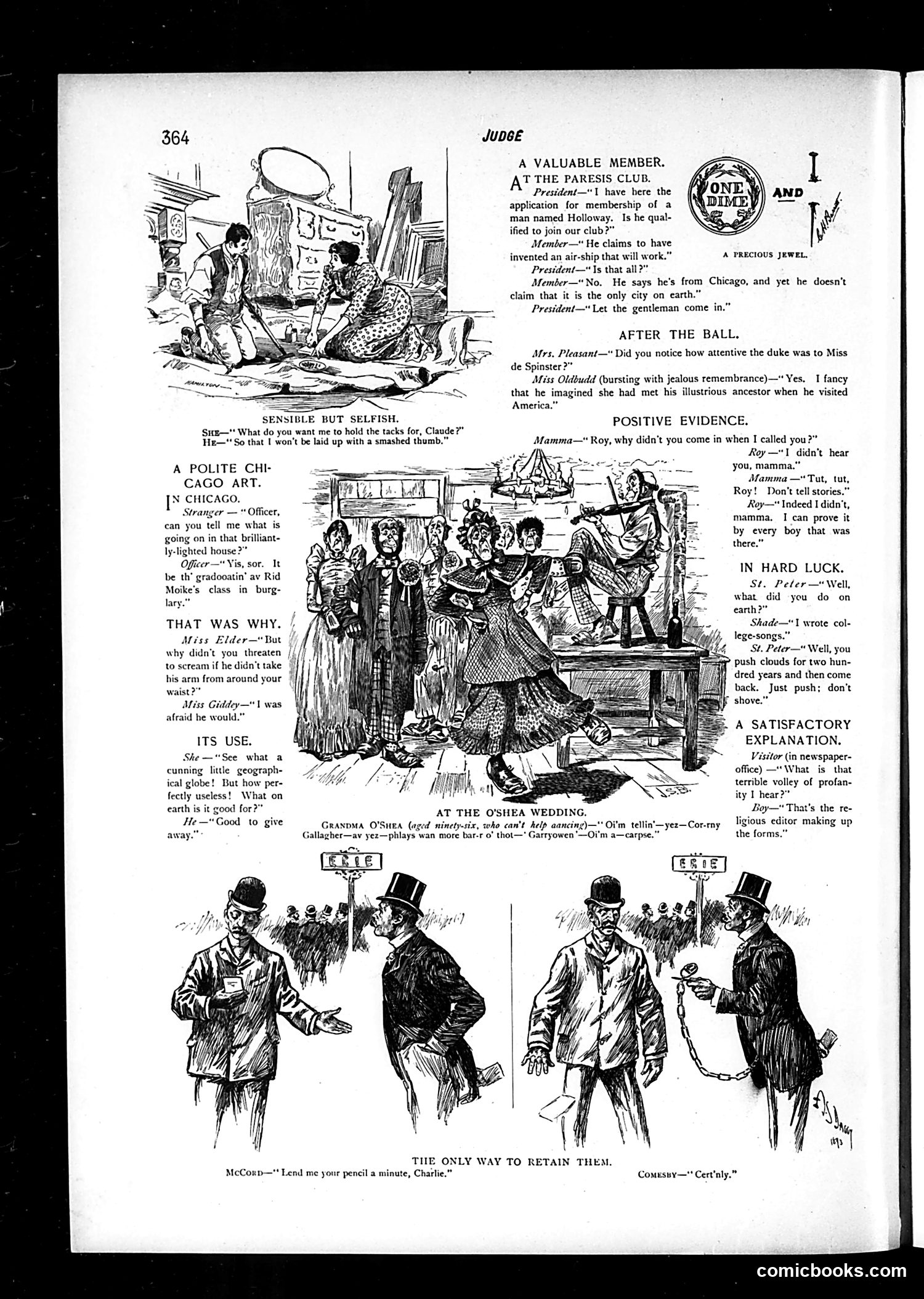
This page contains multiple brief satirical sketches typical of Judge's humor circa early 1900s: **"A Valuable Member"** mocks Chicago's reputation for boasting by suggesting a man from Chicago who *doesn't* claim it's superior is worthy of club membership—inverting expected Chicago arrogance. **"After the Ball"** satirizes social climbing and snobbery: a woman assumes a European duke must have met her ancestor, reflecting period anxieties about American wealth versus Old World aristocracy. **"A Polite Chicago Art"** plays on Irish-American immigrant dialect humor (the officer's speech), common in period comedy. **Other sketches** target familiar domestic situations: children lying, marital dynamics, office culture, and a joke about retaining borrowed pencils through chains—suggesting chronic borrowing problems. **"In Hard Luck"** depicts a college songwriter condemned to menial heavenly labor—a dig at sentimental college-song sentimentality. The page reflects early 20th-century American prejudices (Irish stereotypes, class anxiety) and domestic humor conventions now dated but historically revealing of period attitudes.
📄 Transcribed text from this page (OCR, searchable)
Machine-transcribed from the original scan — historical spelling and the odd misread are preserved.
JUDGE A VALUABLE MEMBER. T THE PARESIS CLUB. President—" have bere the application for membership of a man named Holloway. Is he qual- ified to join our club?” Member—" He claims to have invented an air-ship that will work.” ‘A PRECIOUS JEWEL. President—1s that all?” Member—"No. He says he's from Chicago, and yet he doesn’t claim that it is the only city on earth.” President—"Let the gentleman come in.” AFTER THE BALL, Mrs. Pleasant—" Did you notice how attentive the duke was to Miss de Spinster?” Miss Oldbudd (bursting with jealous remembrance)—" Yes. I fancy that he imagined she had met his illustrious ancestor when he visited ——— America.” SENSIBLE BUT SELFISH. POSITIVE EVIDENCE. ‘What do you want me to hold the tacks for, Claude?” So that I won't be laid up with a smashed thumb.” Mamma—" Roy, why didn’t you come in when I called you?” F : Roy —"1 didn’t: hear A POLITE CHI- " - * 7 you, mamm. CAGO ART. a Ce) Mamma —"Tut, tut, [8 ctttcaco. } D Roy! Don't tell stories. Stranger — “Officer, : v7 : Roy—" Indeed I didn't, can you tell me what is x D mamma. I can prove it going on in that brilliant- ie oe é iKE by every boy that was ly-lighted house?” ‘ \ F there. Officer —"\ , v s 5 = be th’ gradooatin’ av Rid ‘ ; : = IN HARD LUCK. Moike’s class in burg- Ai! fi \i St. Peter —“Well, Maik ; F ; what did you do on 4 4 / - earth?” THAT WAS WHY. / i Shade—"1 wrote col- Miss Elder—"But . 3 i ; ii}, \ege-songs.” why didn’t you threaten // ‘ 3 ay St. Peter—" Well, you to scream if he didn't take fj f! Ih He 4 push clouds for two hun- his arm from around your | in Lt " H dred years and then come waist?” i i 1 . Z A J] back. Just push; don’t Miss Giddey- (1) rae i Dy . > shove.” afraid he would.” ! ‘ ge A SATISFACTORY ITS. USE. \\ Vas = ASSINE ; EXPLANATION. She —“See what a se ¥ - . ie cunning little geograph- ical globe! But how per- fectly useless! What on earth is it good for?” He—"Good to give Visitor (in newspaper- office) “What is that terrible volley of profan- : ag ity 1 hear?” AT THE O'SHEA WEDDIN , t's the re: a: GRANDMA O'SHEA (aged ninety-six, who can't help aancing)— ligious editor making up away.’ Gallagher—av yez—phlays wan more bar-r o' thot—' Garryowen the forms.” TIE ONLY WAY TO RETAIN THEM. McCorp—"* Lend me your pencil a minute, Charlie.” Comesuy—"* Cert'nly.” comicbooks.com