
A complete issue · 16 pages · 1893
Judge — April 29, 1893
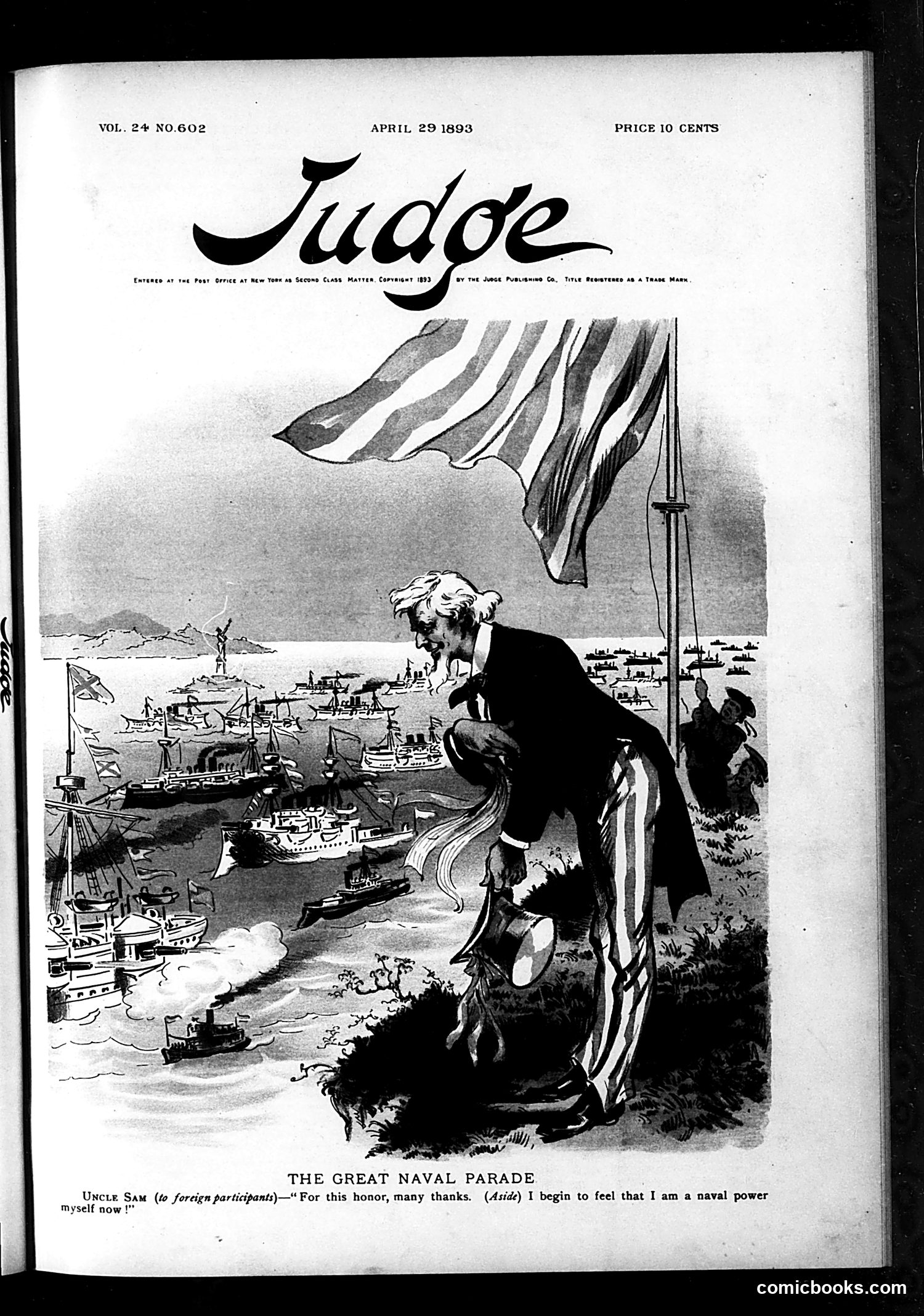
This cartoon satirizes Uncle Sam's newfound pride in American naval power. The figure labeled "Uncle Sam (to foreign participants)" declares he now feels like "a naval power myself!" while observing an impressive naval parade below. The satire appears to reference America's growing military ambitions in the 1890s. The "foreign participants" suggest international naval presence, likely at a major American naval exhibition or parade. Uncle Sam's boastful tone—almost surprised at his own naval strength—mocks what the cartoonist sees as overconfident American nationalism. The elaborate fleet depicted in the harbor below emphasizes the scale of American naval development, which the magazine treats with satirical approval mixed with skepticism about American pretensions to great-power status.
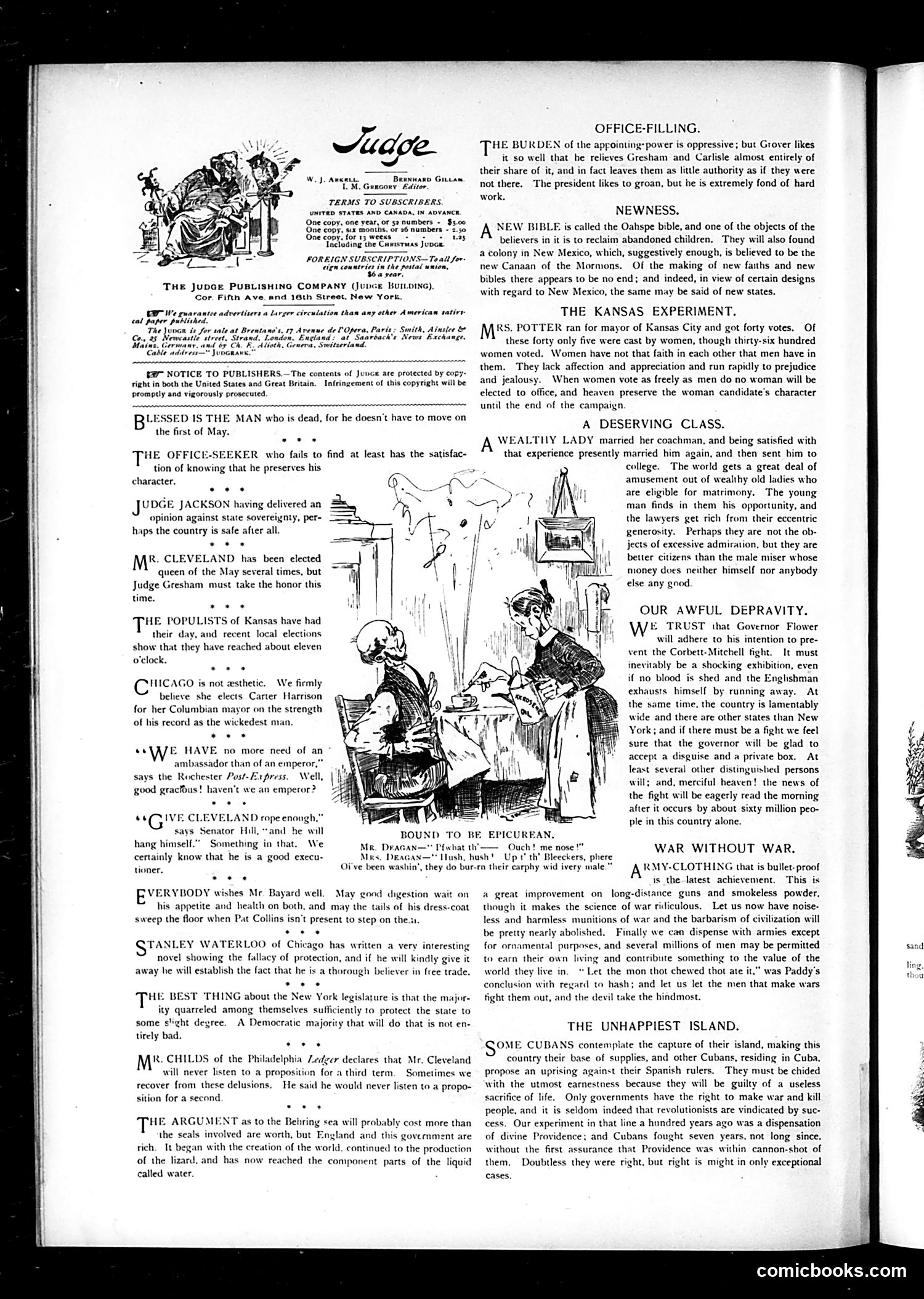
This page contains editorial commentary rather than cartoons. The main illustrated piece shows a woman at a desk, likely depicting commentary on women in politics or office-holding. The text discusses several contemporary issues: the Oshspe Bible and New Mexico settlements; Kansas women voting (the state apparently had female voters); wealthy women marrying coachmen; and Governor Flower's handling of the Corbett-Mitchell boxing match (a major 1890s sporting event). Other sections critique Chicago's city government, praise Stanley Waterloo's novel on police methods, debate New York legislature protections, and comment on Cuba's independence aspirations from Spain. The satire targets political inefficiency, women's evolving social roles, and contemporary governance debates—reflective of 1890s American concerns.
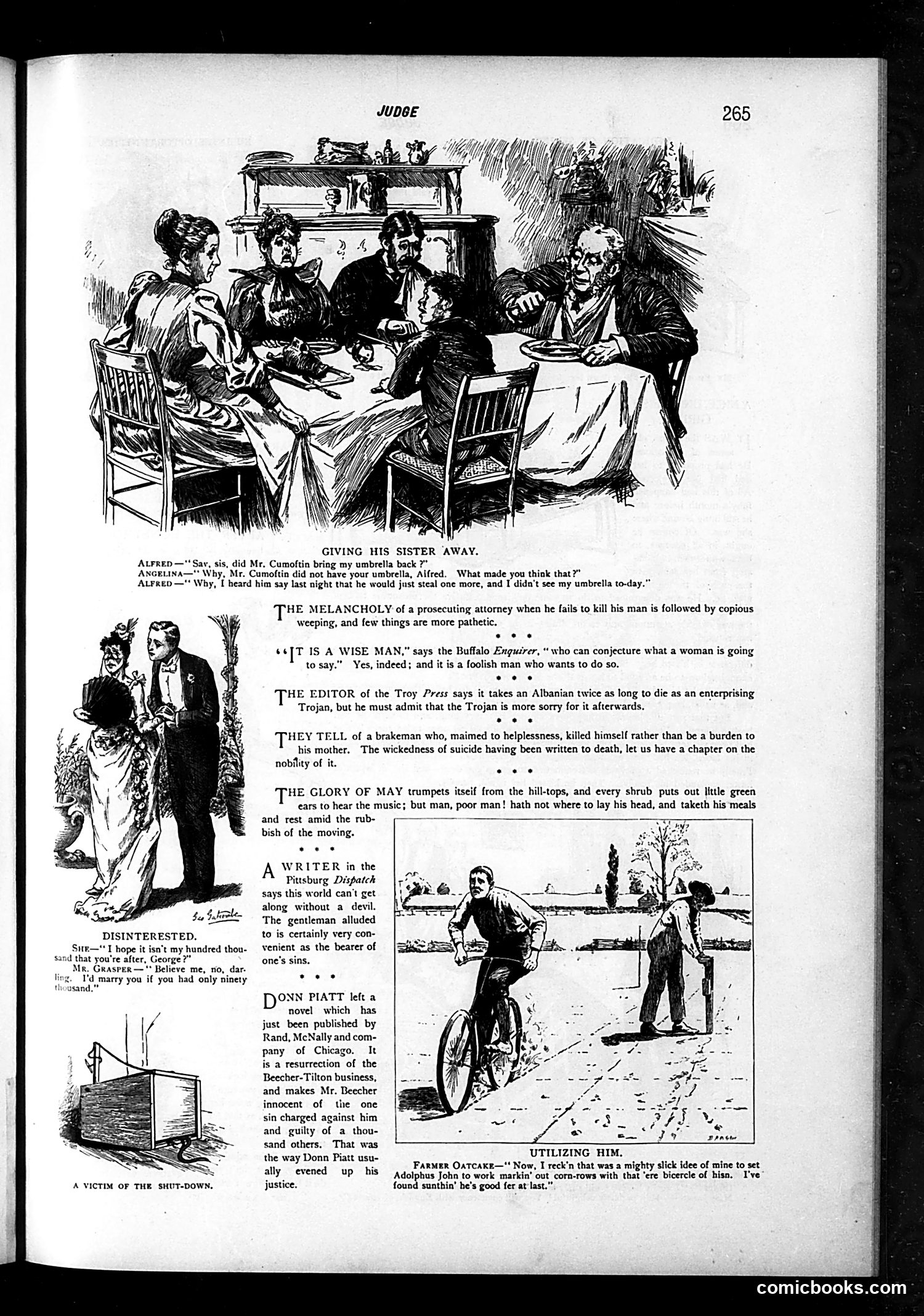
This page contains several brief satirical commentary pieces and illustrations typical of Judge's editorial humor. **Top cartoon ("Giving His Sister Away"):** Shows a family dinner scene where Alfred complains his umbrella is missing. Mr. Comodian claims he didn't take it, but Alfred notes Comodian brought one today—implying theft. The joke satirizes petty dishonesty masked by social propriety. **Lower vignettes:** Include brief moral observations about prosecutors, wisdom, and human folly—typical of Judge's aphoristic style. **"Utilizing Him" illustration:** Depicts a farmer and boy with a bicycle, with dialogue suggesting using the bicycle for farm labor—a joke about adapting modern conveniences for rural work. The page exemplifies Judge's mix of domestic humor, social observation, and illustrated jokes aimed at middle-class American readers of the era.
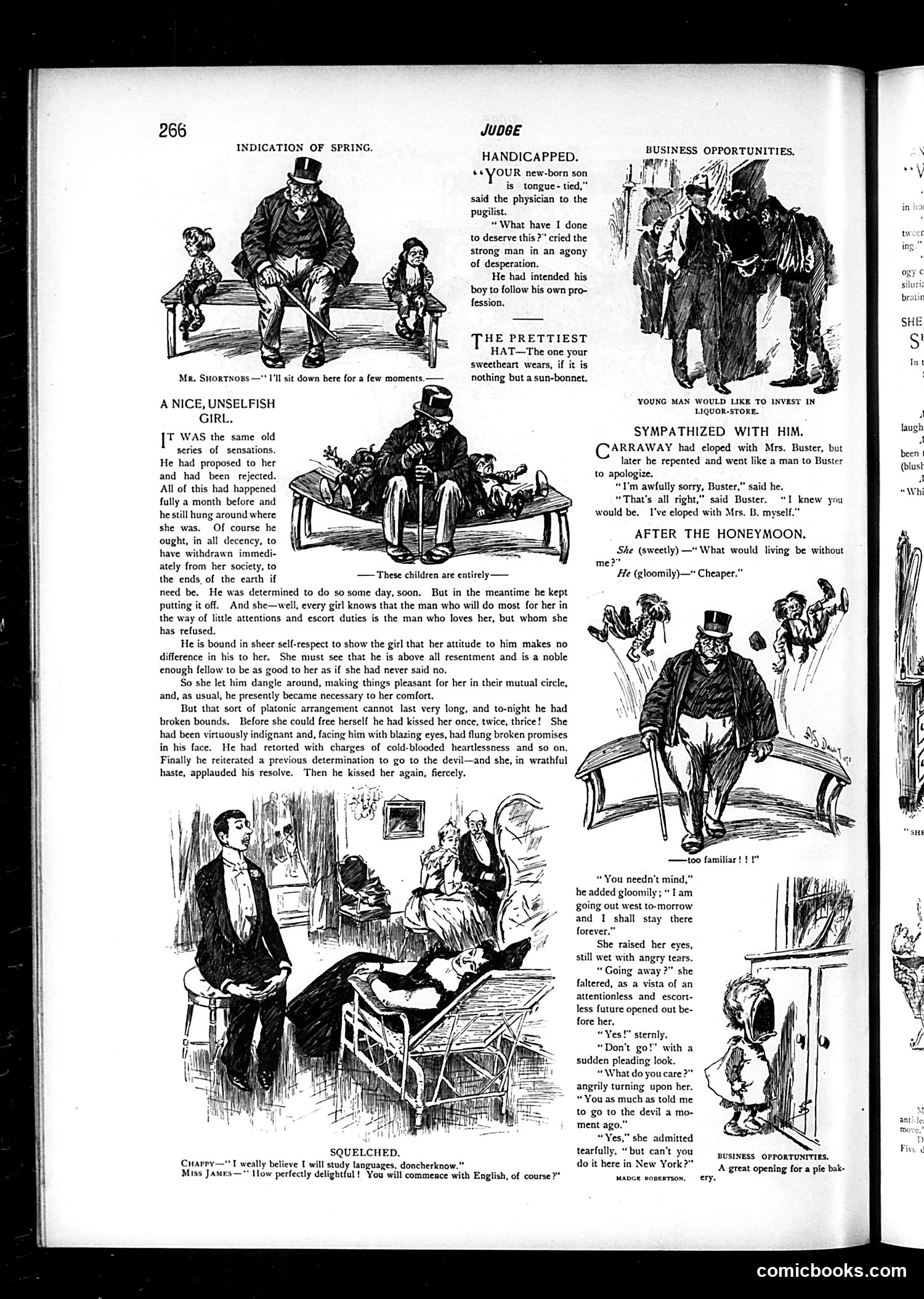
This page from *Judge* presents several satirical vignettes mocking late-19th-century social conventions and relationships: **"A Nice, Unselfish Girl"** satirizes the dynamics of unrequited love—a rejected suitor continues hovering around his beloved, providing attentions while she exploits his devotion. The humor lies in exposing how both parties tacitly enable an unsustainable "platonic arrangement." **"After the Honeymoon"** cynically depicts marriage's disappointing reality: the husband's blunt response that life would be "cheaper" without her deflates romantic illusions. **"Sympathized with Him"** jokes about infidelity becoming normalized—both men have now eloped with the other's wife, making them commiserating peers. Other sketches mock masculine professions (a pugilist's disappointment that his tongue-tied son can't become a fighter) and gender stereotypes about hats and sentimentality. The overall theme: expose the gap between Victorian romantic ideals and messy human behavior.
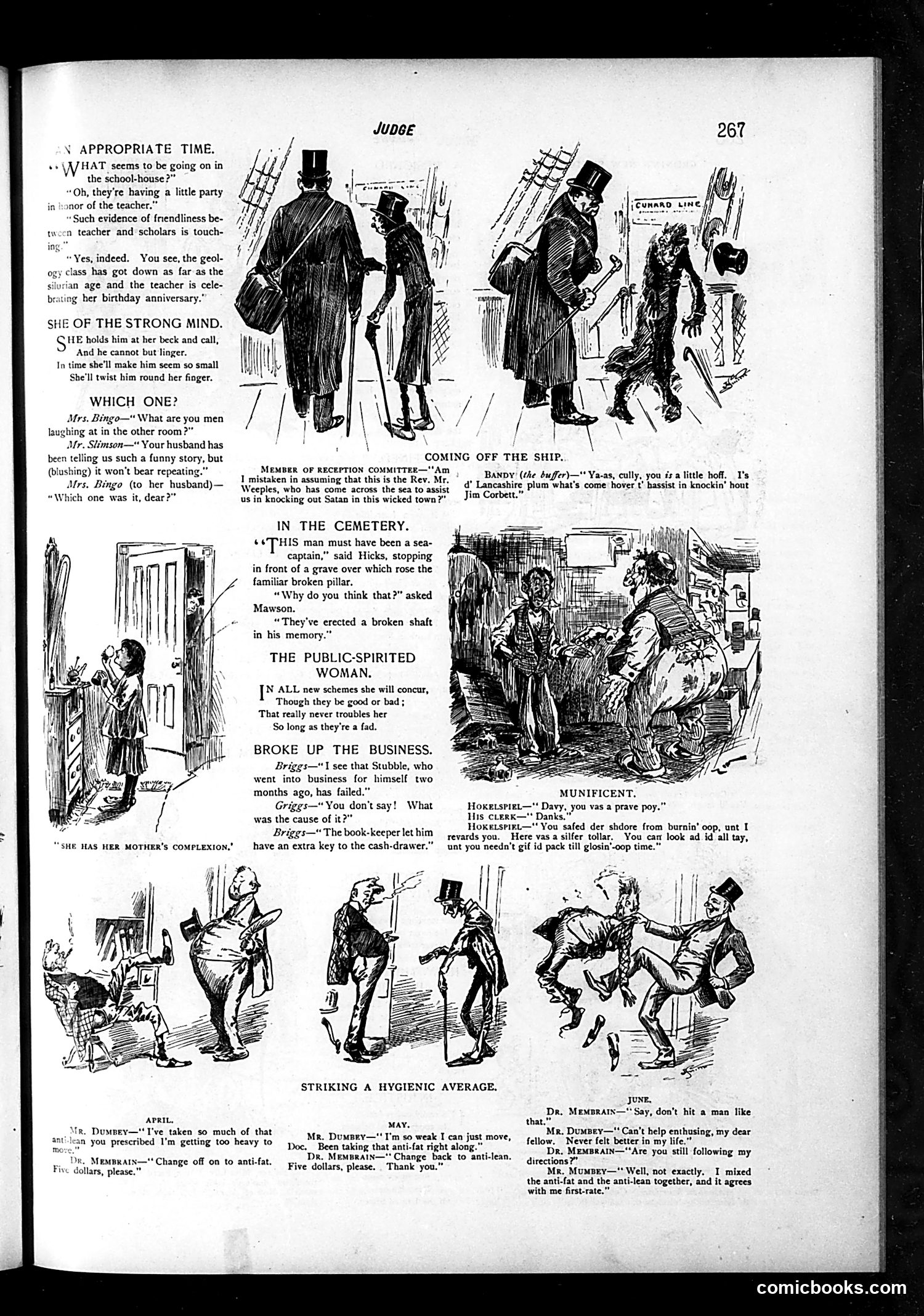
This page from Judge contains multiple standalone satirical cartoons mocking Victorian-era social conventions and character types: **"She of the Strong Mind"** satirizes domineering wives who control their husbands. **"Which One?"** jokes about a husband's indiscretion—he's told a risqué story he won't repeat, and his wife demands to know which "funny story" it was, implying he has multiple inappropriate tales. **"In the Cemetery"** is wordplay: a broken pillar monument leads to the (incorrect) assumption the deceased was a sea captain—missing that "broken shaft" is simply decorative cemetery architecture. **"The Public-Spirited Woman"** mocks women who support new trends uncritically, following fads rather than principles. **"Broke Up the Business"** blames embezzlement (extra cash-drawer key) for business failure. **"Striking a Hygienic Average"** satirizes faddish health treatments: a doctor prescribes alternating anti-fat and anti-lean medicines, and the patient accidentally mixes them—defeating the purpose while feeling fine. This mocks both quack medicine and patient gullibility.
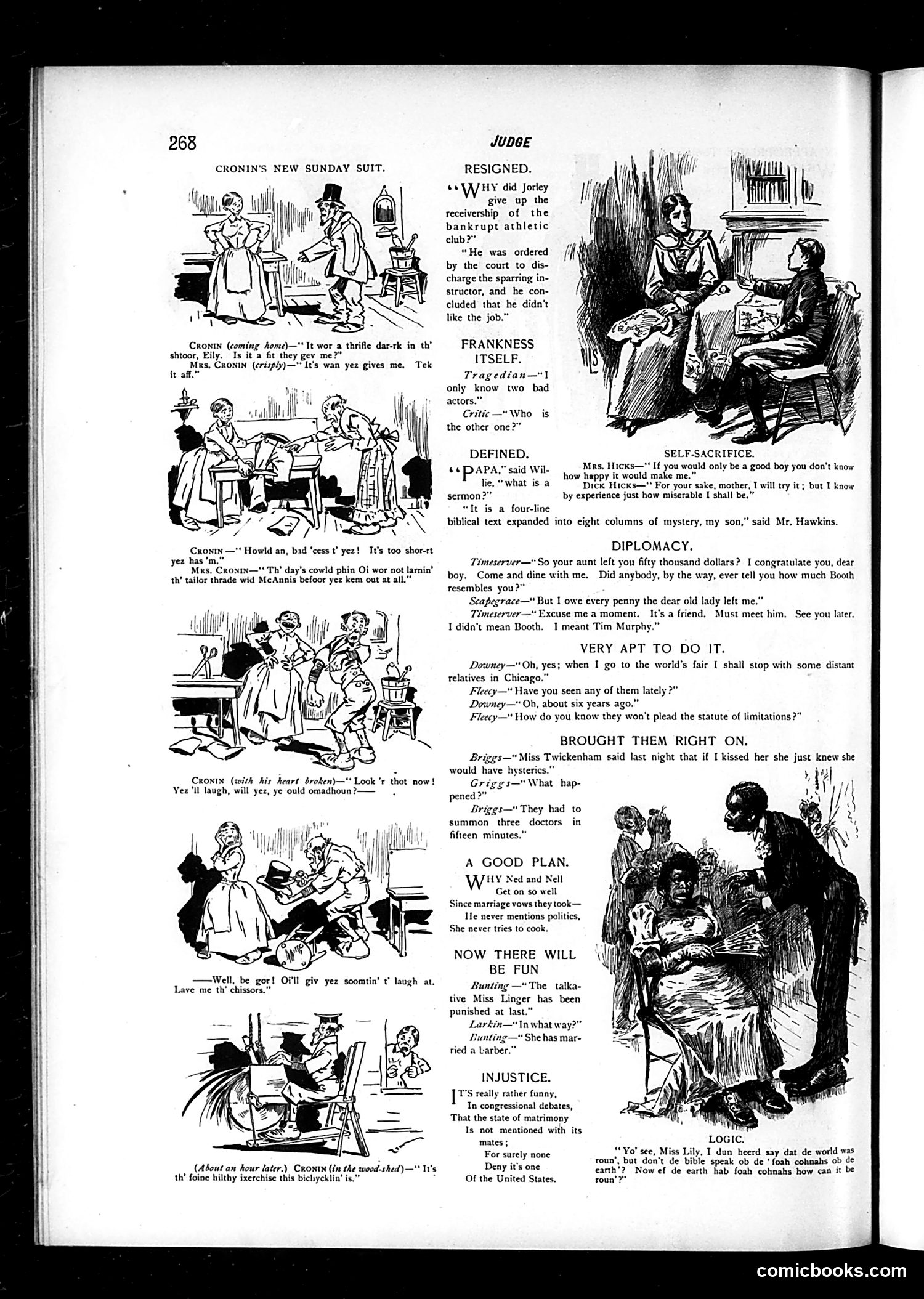
This page contains multiple short humorous pieces typical of late-19th/early-20th-century American satirical humor: **"Cronin's New Sunday Suit"** depicts working-class Irish immigrants (identifiable by dialect and names) in domestic conflict—a wife criticizes her husband's new suit fit, leading him to cut it up in frustration. The broad Irish-American stereotypes and slapstick were standard comedy fodder of the era. **Other brief jokes** mock pretension and social hypocrisy: an actor's false flattery toward a rich heir who's actually broke; a mother's self-sacrificial guilt-tripping; a con man abandoning a poor acquaintance when learning he's penniless. **"Injustice"** makes a pun: matrimony should be considered a U.S. "state" (playing on "state of matrimony") alongside the actual states. **The final dialogue** appears to satirize naive rural ignorance about science versus biblical literalism—a figure misreading "four corners of the earth" as evidence the world isn't round. The humor relies on period stereotypes and now-dated social observations rather than current political events.
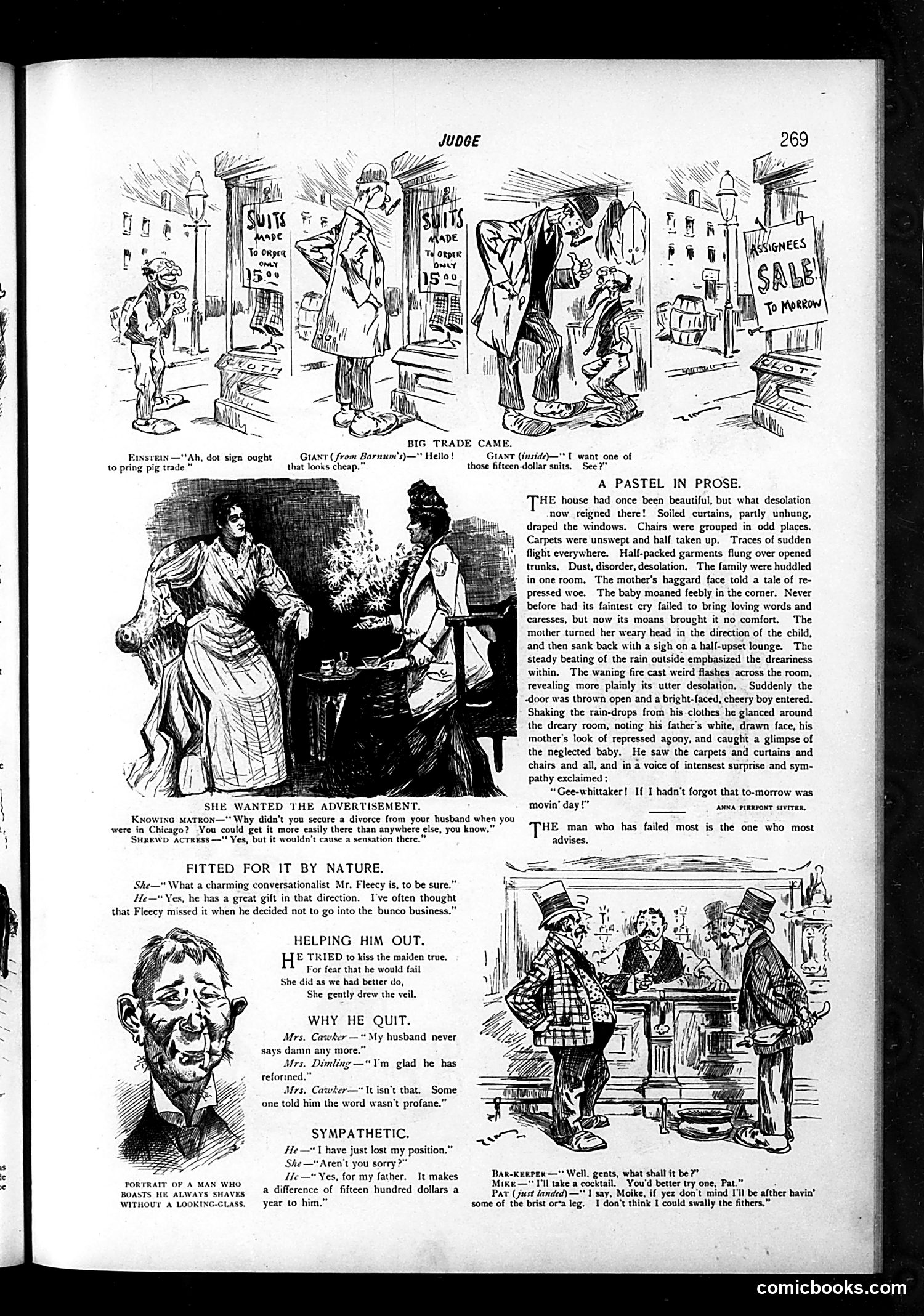
This page contains several unrelated satirical pieces typical of Judge magazine's format. **"Big Trade Came"** (top): A pun on Einstein and circus giants. Einstein mentions bringing "pig trade," while two giants (one supposedly from Barnum's circus) discuss cheap fifteen-dollar suits—mocking both the celebrity fascination with famous figures and consumer culture's focus on bargains. **"A Pastel in Prose"** (center-left): A sentimental short story about family hardship and poverty, interrupted by a cheerful boy's arrival. The piece satirizes melodramatic Victorian literature's overwrought emotionality. **Other shorts**: Various jokes mocking marital discord ("She Wanted the Advertisement"), infidelity, character flaws, and Irish immigrant stereotypes (the final bar scene with "Mike" and "Pat" using exaggerated dialect). The page reflects Judge's typical approach: mixing topical humor, social commentary on wealth and class, literary parody, and ethnic stereotypes common to late 19th/early 20th-century American humor.
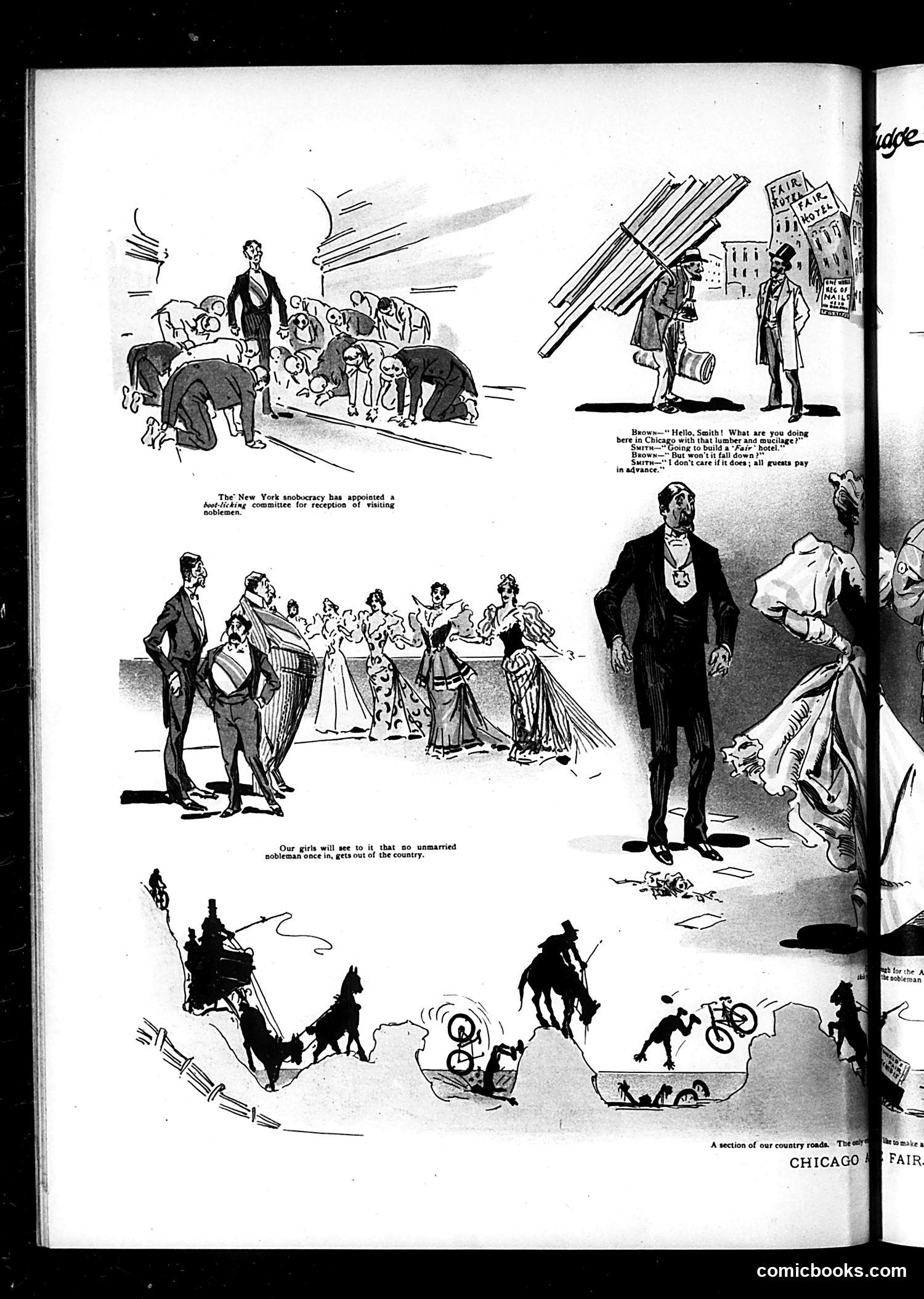
This page contains multiple satirical cartoons about early 1900s American society and urban life. The top panel shows New York's snobbery regarding visiting noblemen. The middle section depicts "an unmarried nobleman" escaping the country—satirizing how wealthy foreign visitors were socially pursued by American high society. The right panel shows a dialogue about Chicago construction and building materials, mocking urban development practices. The bottom panel titled "A section of our country roads" illustrates the poor state of American rural roads, showing various hazards: vehicles stuck in mud, people on bicycles, and horses struggling—a common satirical target of the era, critiquing infrastructure neglect outside major cities. The cartoons collectively mock American snobbery, urban chaos, and rural neglect.
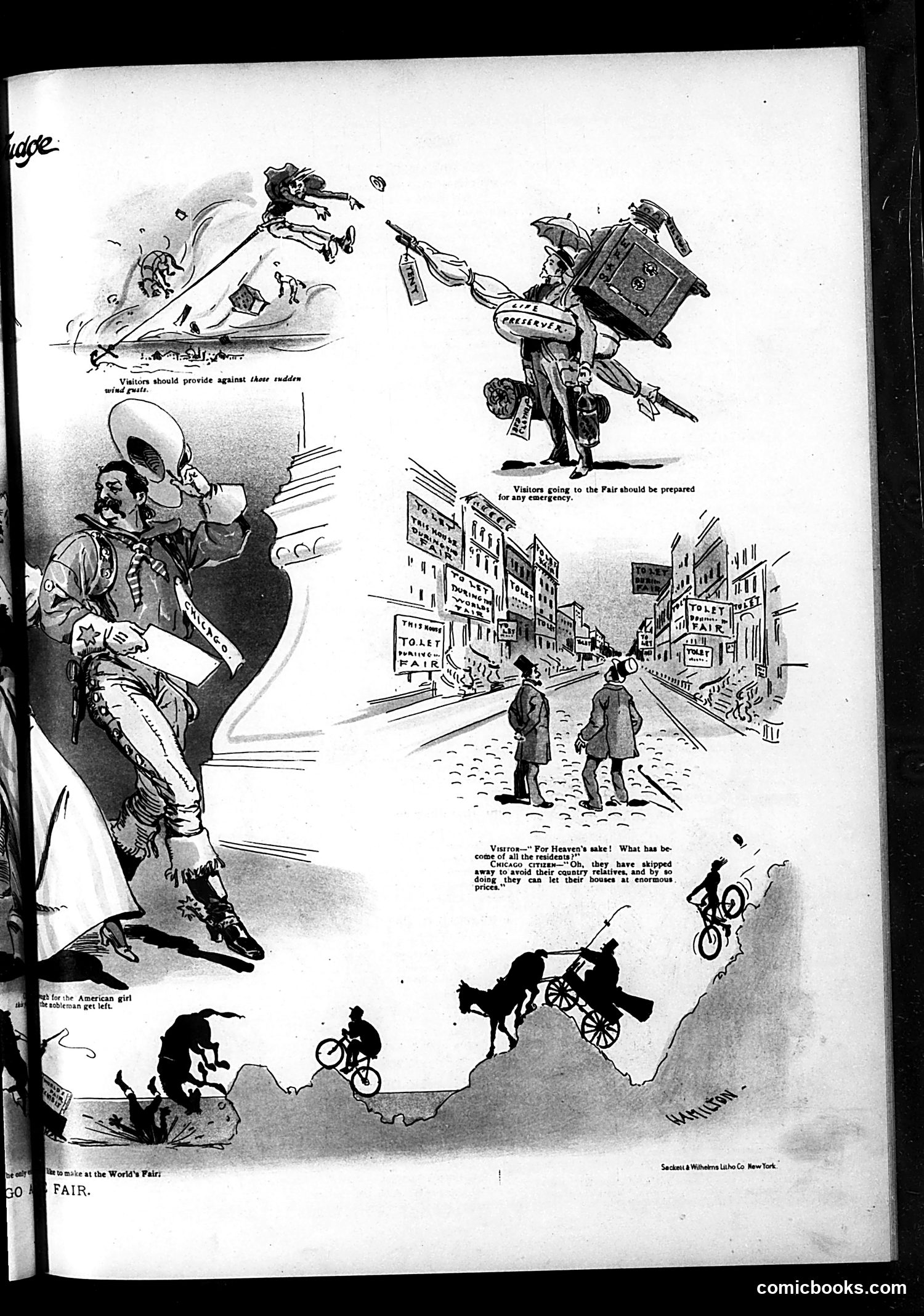
This page satirizes the **World's Fair** (likely the 1893 Chicago World's Columbian Exposition). The cartoons mock visitors' expectations and Chicago residents' mercenary behavior. The central scene shows two bewildered visitors arriving at the Fair's streets, with the caption explaining that Chicago residents have deliberately abandoned their homes to rent them to visiting relatives at inflated prices—a commentary on opportunistic profiteering. The surrounding vignettes depict various hazards visitors face: a figure juggling luggage and chaos (top right), someone being knocked over, cyclists colliding, and general mayhem. The bottom caption advises visitors to "be prepared for any emergency," sarcastically suggesting the Fair itself is dangerously disorganized. The page mocks both Chicago's exploitation of fair-goers' enthusiasm and the incompetence of event management, while the left panel critiques American women's marital prospects at such events (the headline "for she American girl / fit xobleman get left").
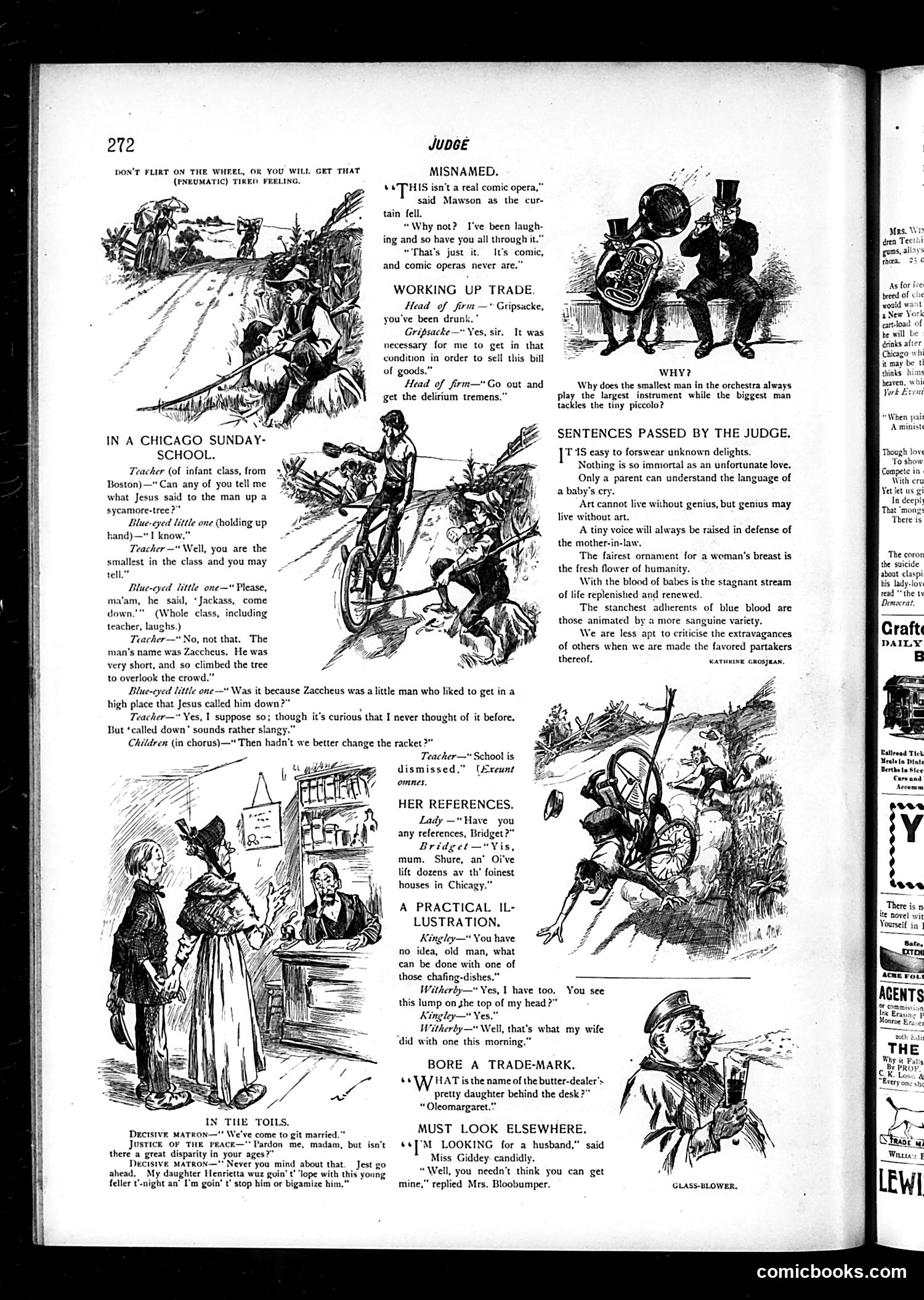
This page contains multiple short satirical pieces typical of Judge's format: **"Misnamed"** and **"Working Up Trade"** are brief jokes about business and theater ethics—one mocking a "comic opera" that's actually funny (violating the genre), another suggesting a salesman must get drunk to sell inferior goods. **"In a Chicago Sunday-School"** satirizes both religious instruction and Irish-American dialect humor. A Boston teacher's lesson on Zaccheus is derailed when a child repeats the phrase "called down" as modern slang, prompting the teacher to dismiss class entirely—mocking both overly-sensitive educators and children's irreverence. **"Her References"** uses an Irish maid character ("Bridget") claiming to have worked in "foinest houses"—standard period ethnic humor about Irish domestic workers. The remaining items are brief jokes about marriage, age gaps, domestic disputes, and trade professions. **Context**: This reflects 1890s American humor relying heavily on ethnic caricature, gender stereotypes, and workplace satire—standards of the era now considered offensive.
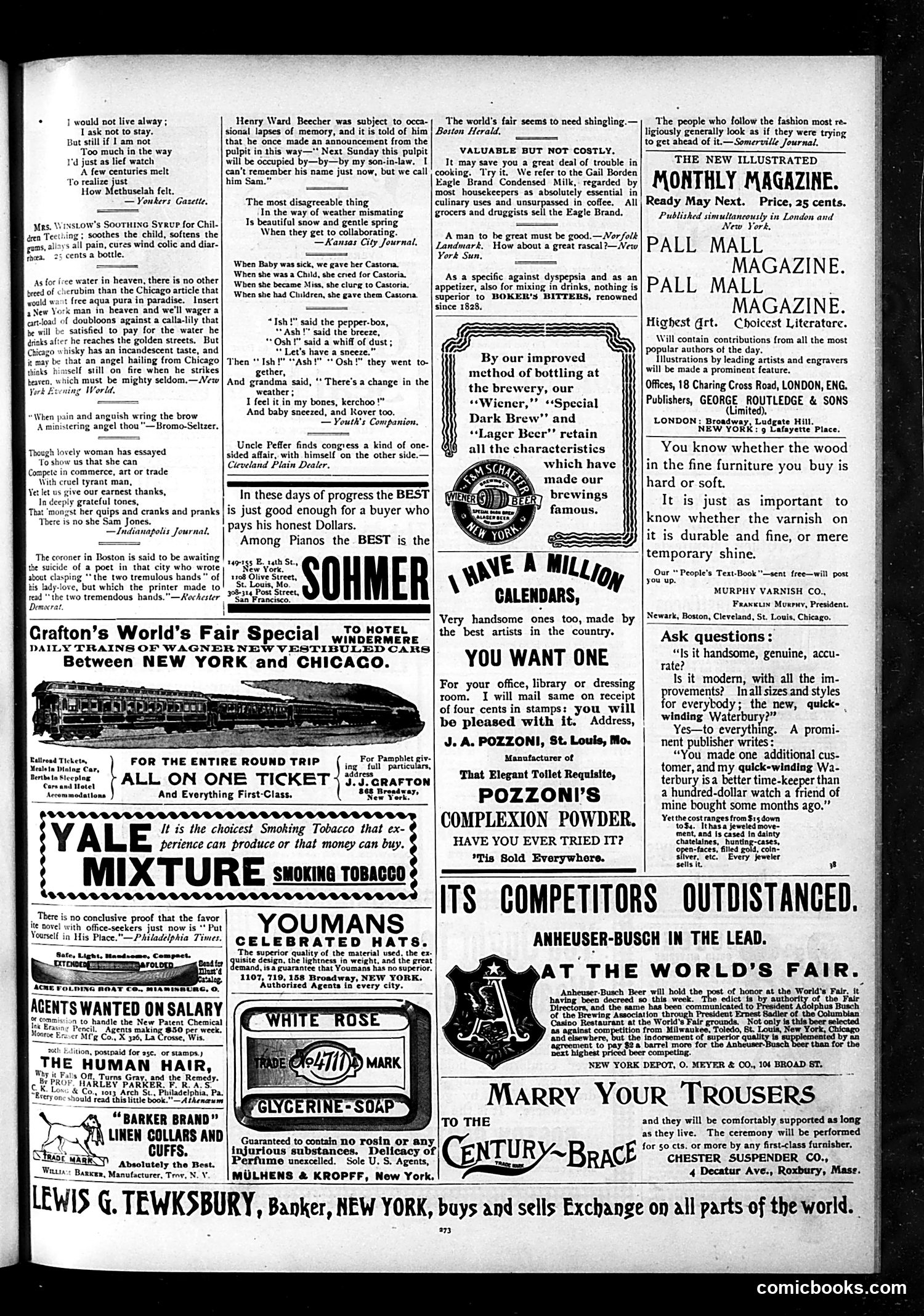
This is primarily an **advertising page** from Judge magazine, with minimal editorial cartoon content. The page features numerous product advertisements (Yale tobacco, Sohmer pianos, Pozzoni's powder, etc.) interspersed with brief humorous quotes and anecdotes. The few satirical items present include: - A **joke about Henry Ward Beecher's memory loss**, referencing the famous minister's occasional public confusion - **Barbs at Chicago's water quality** and heaven's drinking water - **Light mockery of women's ambitions** in commerce and trade (reflecting 1890s attitudes) - **Uncle Peffer's congressional critique**, suggesting Congress operates as a "one-sided affair" with him on the losing side—likely referencing a contemporary political figure or recurring comic character The page's dominant purpose is **commercial promotion** rather than political satire. The brief jokes and quotes serve as filler between advertisements, reflecting Judge's dual function as both satirical magazine and advertising vehicle during this period.
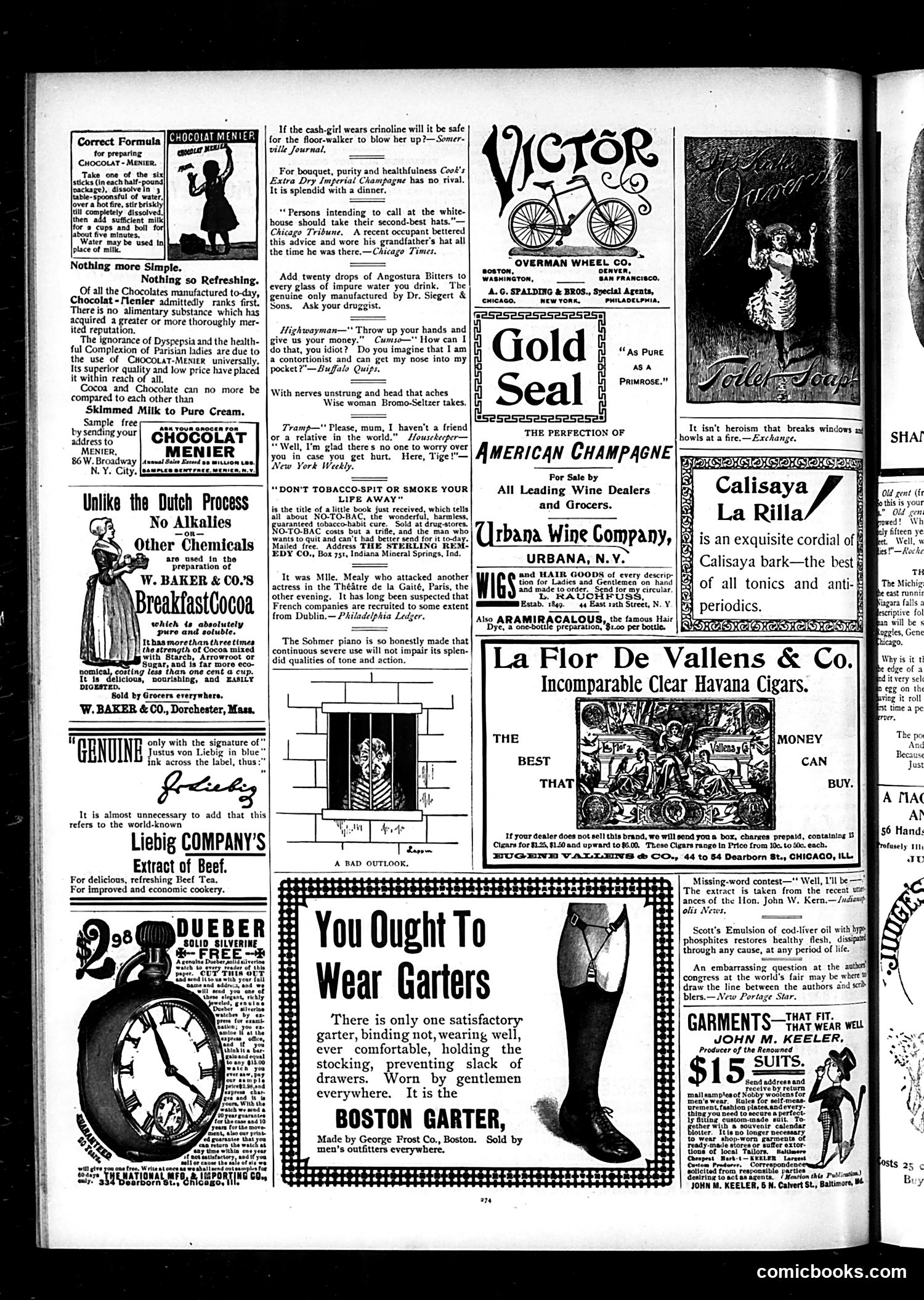
This page is primarily **advertising**, not political cartoons. It contains various product advertisements from the late 19th/early 20th century, interspersed with short humorous anecdotes and jokes typical of *Judge* magazine. The small humor items include workplace jokes (about floor-walkers and cash-girls), jibes at political figures visiting the White House, and quips about tramps and housekeepers. These reflect period anxieties: propriety around women in crinoline, absurdities of poverty, and visits by unnamed politicians. The ads showcase products of the era—chocolate, champagne, cocoas, cigars, garters, and hair products—reflecting contemporary consumer culture. A notable ad warns against tobacco-spitting, suggesting public health concerns of the time. No significant political cartoons are visible; the page relies on brief satirical jokes rather than illustrated political commentary.
This is primarily an **advertising page** from Judge, a satirical magazine, circa 1884. Most of the content consists of product advertisements interspersed with brief humorous anecdotes. **The humor content** includes: - A rural visitor marveling at how much a city boy has aged in fifteen years - A joke about why a sea-fowl's egg stays on a cliff edge while pantry items fall - An aunt asking a child about school; the child dislikes everything except reading - Observations on Shakespeare comparing jays to larks and adders to eels - A brief joke about a wayward necktie **The advertisements** promote various products: Williams' Barbers' Soap, Monarch bicycles, candies, baldness treatments, root beer, cigars, and hotels. The satirical content is minimal and unfocused—these are throwaway jokes typical of period humor magazines. Without identifying specific political figures or events, the page primarily represents how Judge mixed advertising revenue with lightweight comedy for middle-class readers.
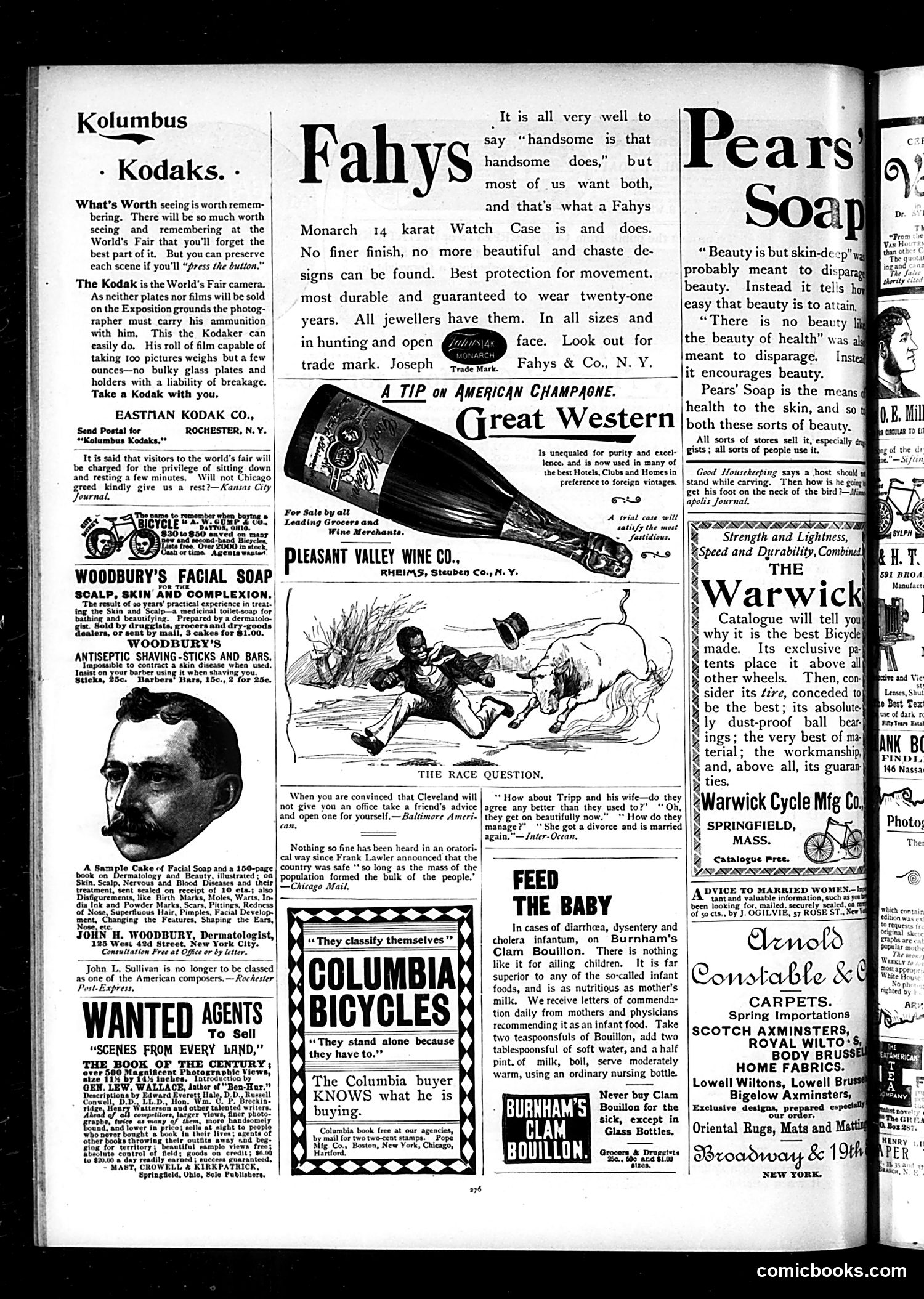
This page is primarily **advertisements** with one notable satirical cartoon titled "The Race Question." The cartoon mocks Cleveland's political prospects by presenting a domestic metaphor. The dialogue suggests someone should "take a friend's advice and open one for yourself"—implying Cleveland should abandon his political ambitions. The joke's punchline involves a couple (Tripp and wife) who "get on beautifully now" after divorcing and remarrying separately, suggesting the solution to conflict is separation. **Political context**: This likely references President **Grover Cleveland** and contemporary political divisions. The "race" in the title isn't about ethnicity but political "racing"—Cleveland's political viability. The domestic discord metaphor sarcastically suggests political problems require radical solutions like divorce. The cartoon's cynicism reflects Judge magazine's satirical approach to politics and politicians of the era, using domestic humor to critique public figures.
This page is primarily an **advertising page** from Judge magazine, not a satirical cartoon section. The only substantial editorial content is a brief comment about **John Wanamaker** ("That modern Holy Willie"), a Philadelphia department store magnate and public figure. The satire critiques his claimed satisfaction about financial losses from the Reading Railroad failure, viewing his explanation as hypocritical piety. The author compares him to "Holy Willie"—a reference to a Scottish character known for self-righteous hypocrisy—arguing that Wanamaker is actually glad to have avoided association with insider trading during the crash, making his stated gratitude performatively false. The rest of the page features period advertisements: Moulton's Cocoa, rupture treatments, Joseph Gillott's steel pens, bicycles, photographic equipment, and various patent medicines. Several humorous anecdotes about schoolchildren and word pronunciation appear, likely filler material typical of the era's periodicals.
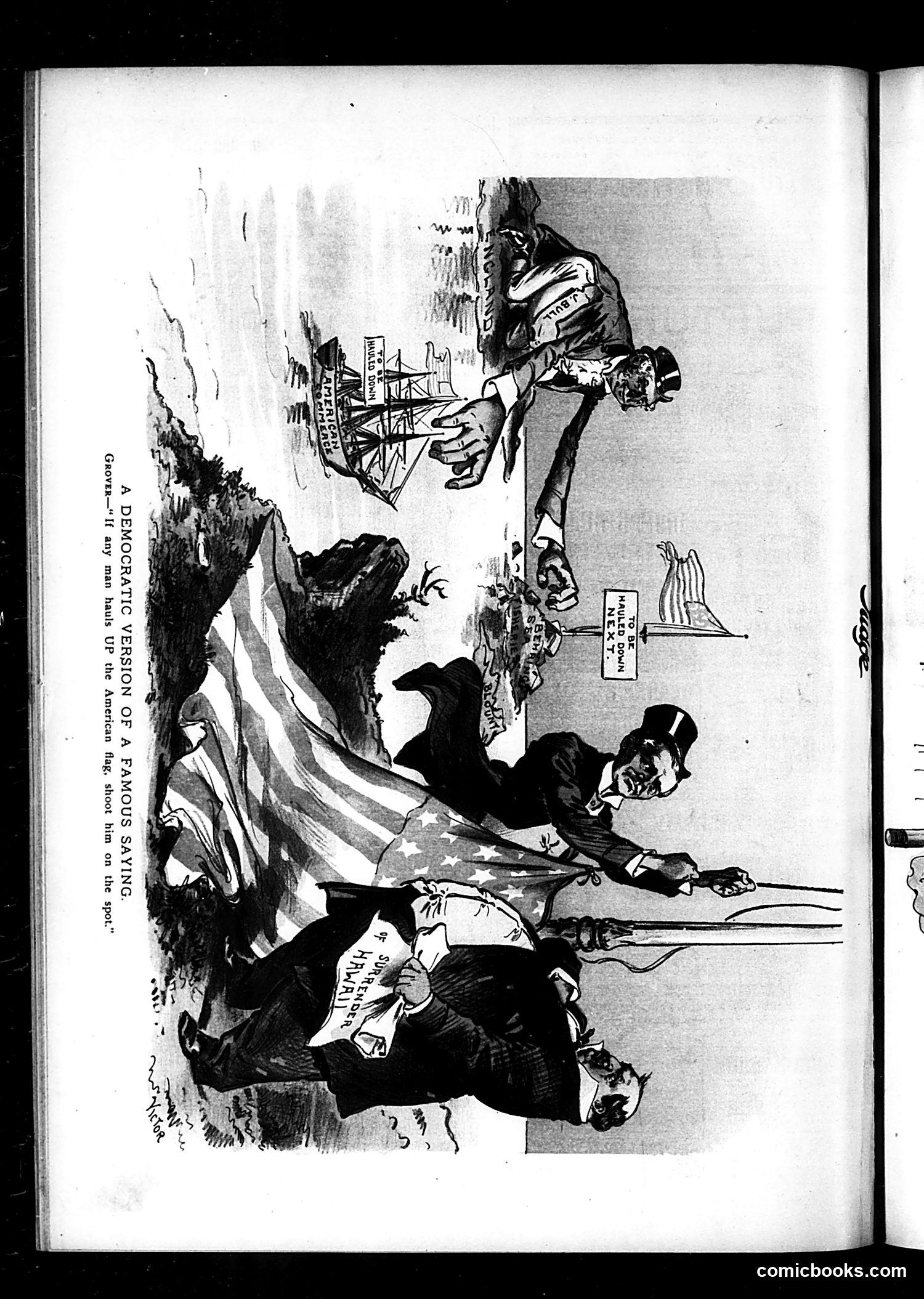
This Judge magazine cartoon satirizes President Grover Cleveland and Democratic Party politics. The image depicts a figure (labeled "Grover," referring to Cleveland) issuing a violent order: "If any man hauls UP the American flag, shoot him on the spot." The satire inverts a famous patriotic saying to mock what the cartoonist viewed as Democratic hostility toward American nationalism or patriotic symbols. The exaggerated threat of shooting someone for displaying the flag ridicules what Judge's editors saw as anti-American Democratic policies or rhetoric. The "DEMOCRATIC VERSION" framing suggests the cartoonist believed Democrats opposed American patriotism—a common Republican attack during the Gilded Age. The dark humor relies on readers recognizing both the famous original saying and contemporary political tensions around national identity and party allegiances.