A complete issue · 16 pages · 1893
Judge — March 18, 1893
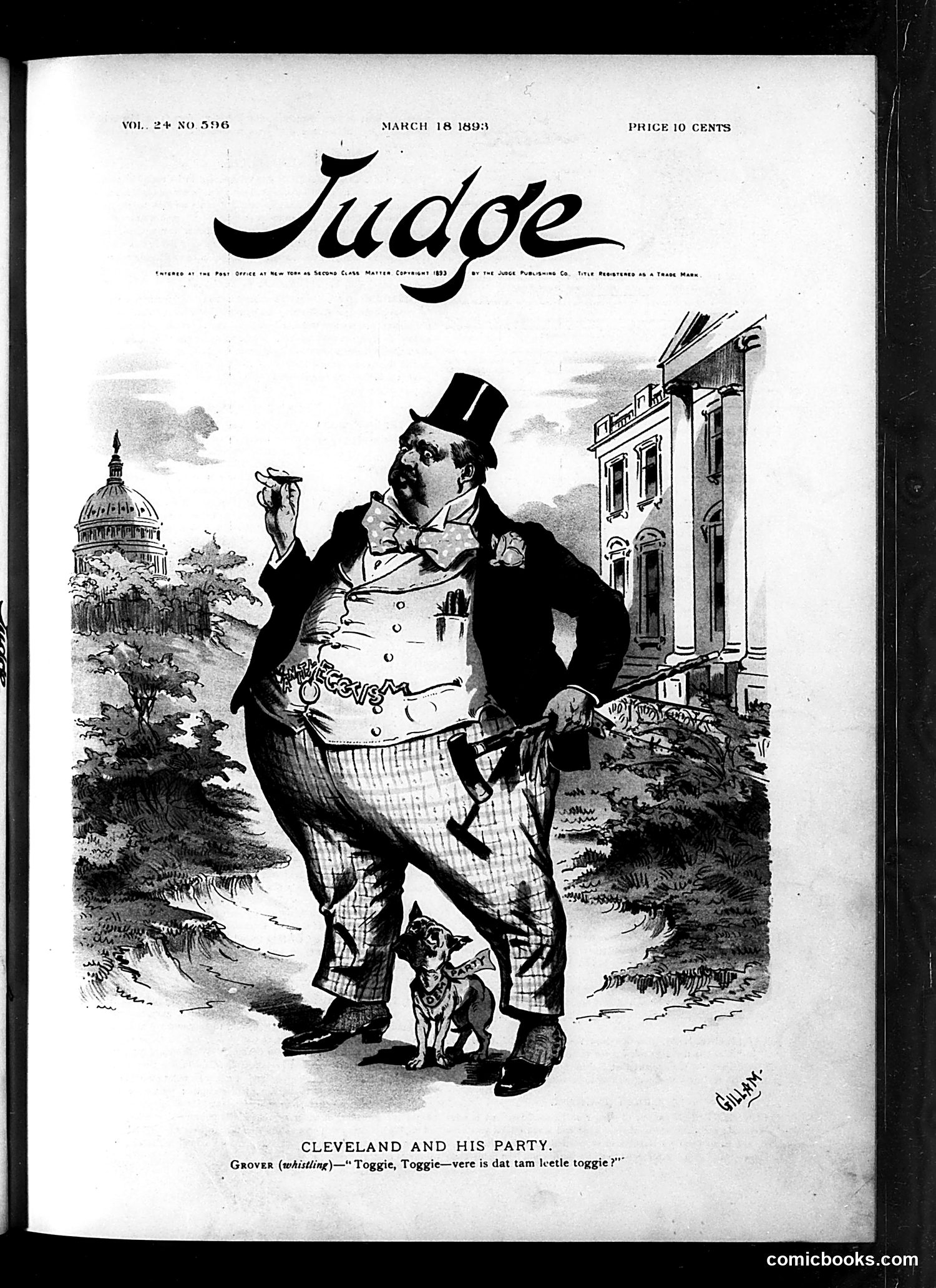
**"Cleveland and His Party"** This cartoon depicts President Grover Cleveland as a rotund, well-dressed gentleman in top hat and formal wear, standing before classical government buildings (likely the Capitol and White House). He holds a small dog labeled "Toggie" while whistling. The caption reads: "Grover (whistling)—'Toggie, Toggie—vere is dat tam leetle toggie?'" The satirical point appears to mock Cleveland's search for political support or party unity ("Toggie" likely representing his party or coalition). The exaggerated physique, the somewhat childish tone of the caption (mimicking an accent), and his seemingly carefree whistling while searching suggest political instability or Cleveland's inability to control his fractious Democratic Party during the economically turbulent early 1890s.
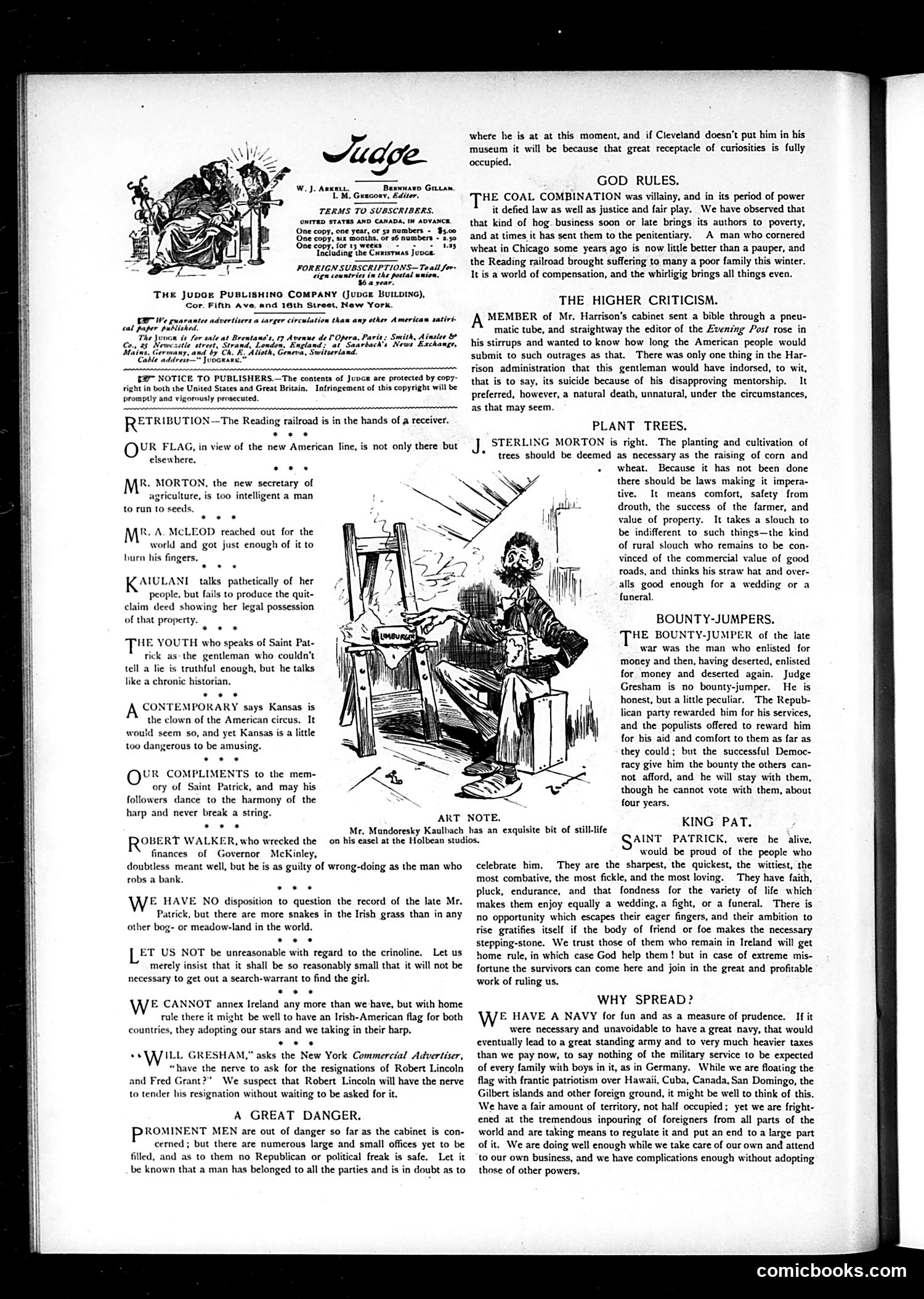
This page contains editorial commentary rather than political cartoons. The main illustration shows a figure at a drafting table, labeled "ART NOTE" as depicting "Mr. Mindorsky Kasilbach" with "an exquisite bit of still-life on his easel at the Holbein studio." The editorial sections ("GOD RULES," "THE HIGHER CRITICISM," "PLANT TREES," "BOUNTY-JUMPERS," "KING PAT," "WHY SPREAD?") address various contemporary issues: railroad receiverships, religious debates, agricultural policy, Civil War desertion/re-enlistment, Irish immigration, and naval expansion. The satirical tone critiques political hypocrisy, particularly regarding Republican treatment of deserters and Democratic bounty-jumpers. Without clearer context or caricatured figures, the exact targets remain unclear, though the commentary suggests Gilded Age political commentary circa the 1870s-80s.
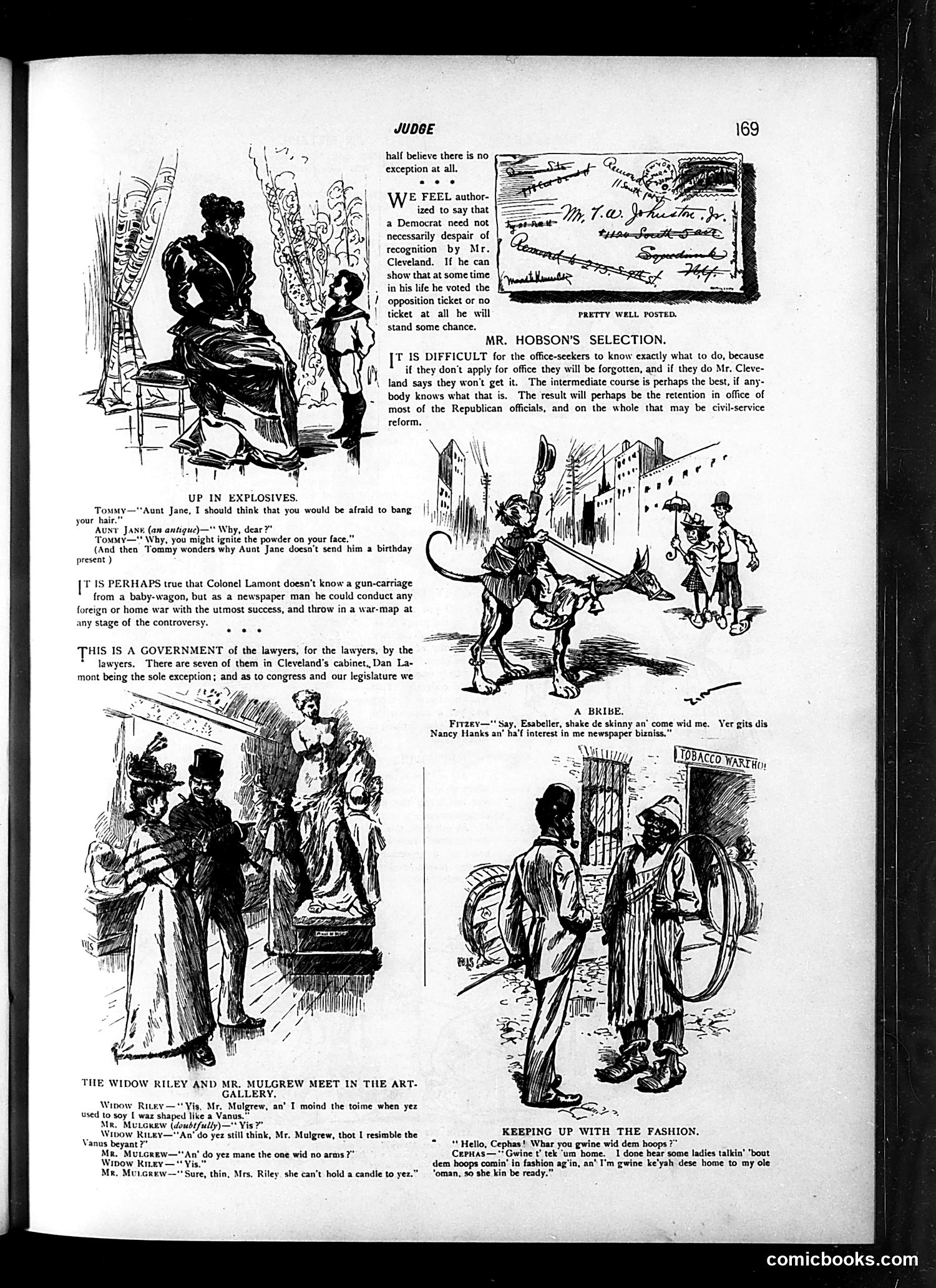
This page contains several satirical cartoons and commentary on American politics and society, likely from the late 19th or early 20th century. **Political Content:** The text discusses Democratic candidates, references to Cleveland, and criticism of Republican office-seekers and civil-service reform. One section critiques that Cleveland's cabinet consists primarily of lawyers, sarcastically calling it "a government of the lawyers, for the lawyers, by the lawyers." **Cartoon Themes:** The illustrations satirize political corruption and bribery ("A Bribe"), social pretension, and fashion obsession ("Keeping Up with the Fashion"). One cartoon depicts what appears to be a donkey (Democratic symbol) being presented with a bribe. **Overall Point:** The page mocks Democratic political leadership, civil service practices, and societal superficiality through exaggerated illustrations and pointed editorial commentary typical of Judge magazine's partisan humor.
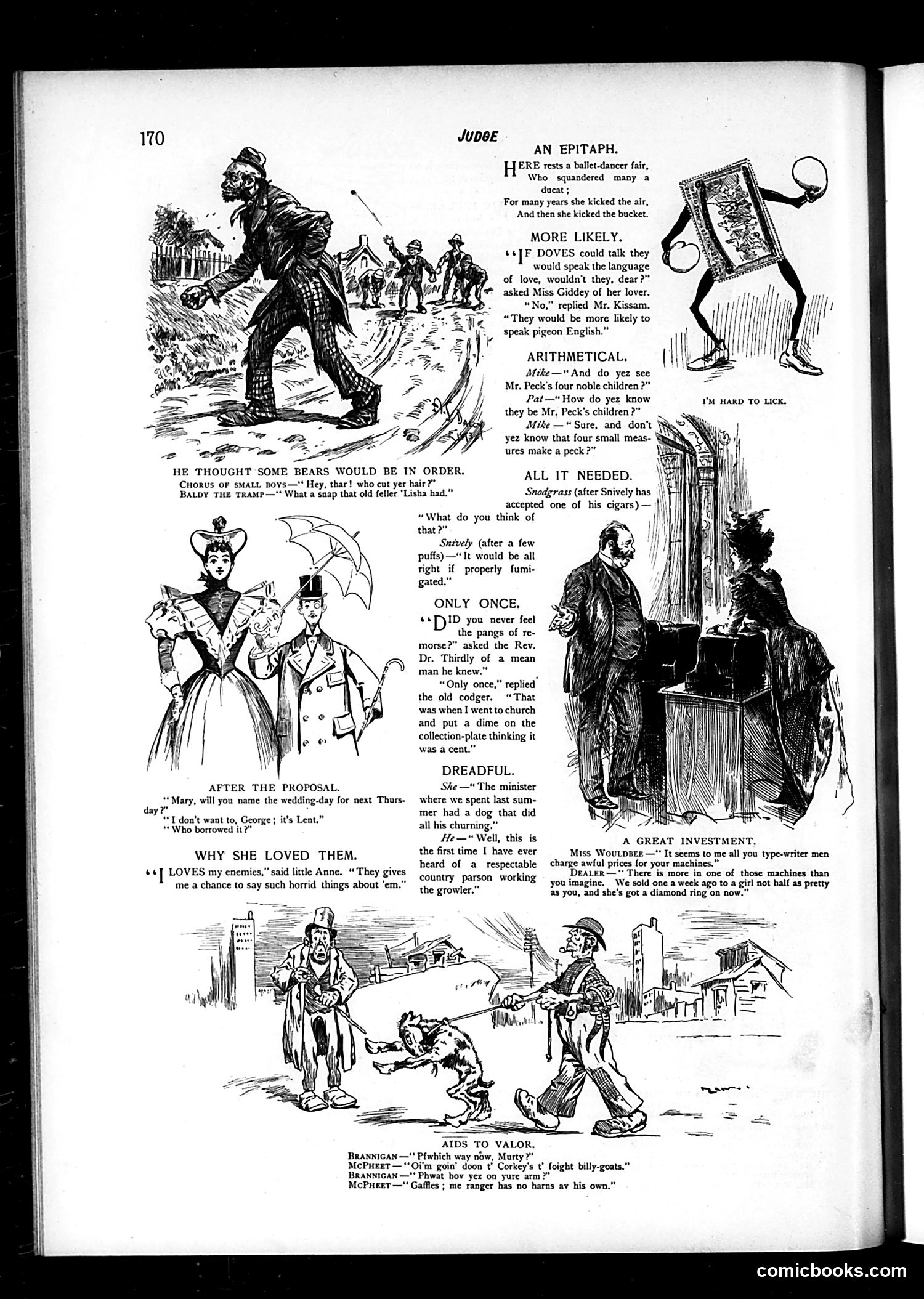
This page collects brief humorous items typical of *Judge* magazine's satirical format. The content includes: **Verse & Wordplay**: "An Epitaph" jokes about a ballet dancer's death using double meaning ("kicked the bucket"). "More Likely" and "Arithmetical" sections play on puns (pigeons/pigeon English; "peck" as measurement). **Social Satire**: "Why She Loved Them" mocks a child's twisted morality. "A Great Investment" suggests women can acquire luxury goods (diamond rings) through typewriter sales—commentary on both female consumers and commercial materialism. **Character Comedy**: "Only Once" depicts working-class hypocrisy (a miser's only remorse involves donating a dime instead of a penny). "AIDS TO VALOR" features Irish immigrant characters in broad dialect, using Anglicized names ("Brannigan," "McPheet"), fighting billy-goats—ethnic stereotyping common to period humor. The overall tone targets marriage, greed, class pretension, and ethnic caricature—standard *Judge* material for American middle-class readers.
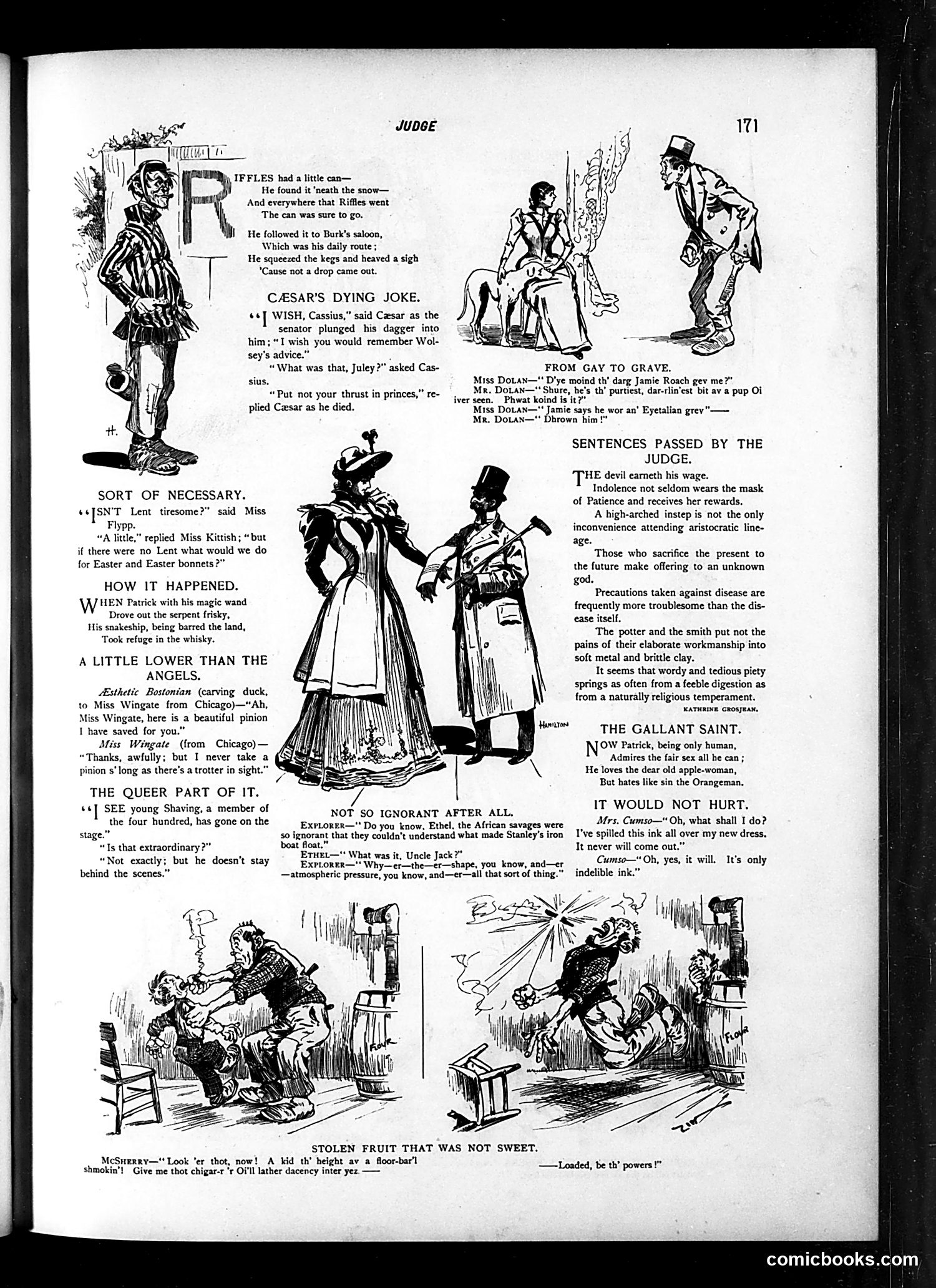
This page collects brief satirical jokes and cartoons typical of 1890s-era Judge magazine. Key features: **"Caesar's Dying Joke"** plays on the historical assassination, with Caesar punning about "thrust in princes"—a pun on both stabbing and trusting. **Irish stereotypes** appear repeatedly: "Patrick" references (driving out serpents, the "Orangeman"), and phonetically-spelled Irish dialect humor ("Oi," "thot," "chigar-r") were common period comedy. **Social commentary** includes jabs at: Boston aesthetes valuing appearance over substance; wealthy young men ("four hundred") seeking stage careers; and the tedium of Lenten observance. **"Sentences Passed by the Judge"** offers philosophical aphorisms—typical of Judge's "wisdom" sections. The cartoons satirize class pretension, ethnic stereotypes, and sexual/romantic situations through drawings paired with punchy dialogue. The overall tone reflects Gilded Age humor: cynical, class-conscious, and reliant on now-offensive ethnic caricature.
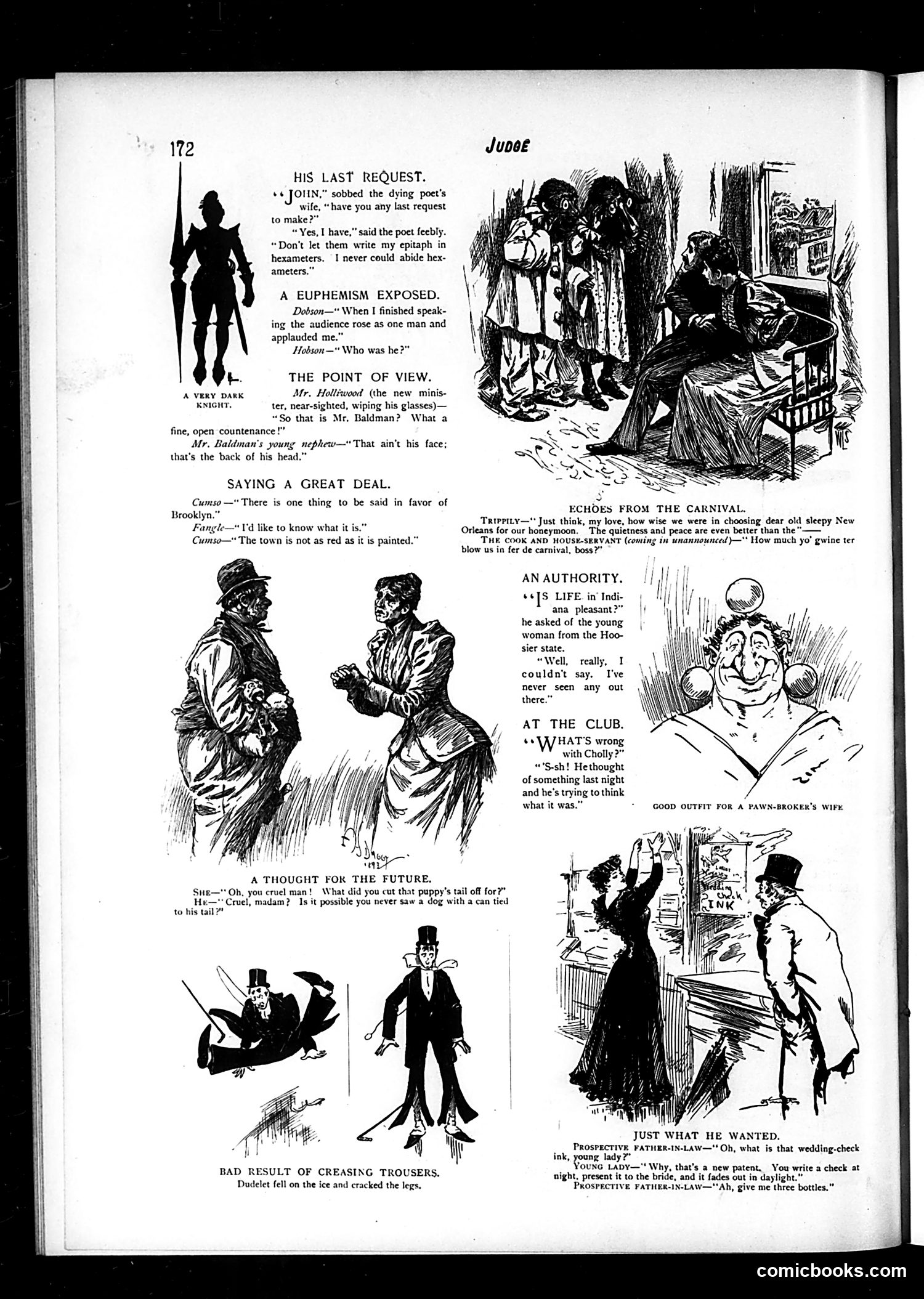
This page contains multiple short humorous sketches typical of early 20th-century satirical magazines. The jokes rely on wordplay and social observation rather than political commentary: **"His Last Request"** mocks pretentious poetry conventions—a dying poet's concern with technical meter appears absurdly trivial. **"A Euphemism Exposed"** plays on Dobson's claim that his audience "rose as one man," with Hobson implying only one person actually stood (the other was sitting/leaving). **"The Point of View"** jokes about a near-sighted minister complimenting what he thinks is a man's face—but it's actually the back of his bald head. **"Saying a Great Deal"** is unclear but appears to mock Brooklyn's reputation. **"Echoes from the Carnival"** references New Orleans's Mardi Gras, with servants asking for carnival spending money. The remaining sketches feature domestic humor: trouser-creasing accidents, Indiana stereotypes, romantic misunderstandings, and a father-in-law appreciating disappearing-ink checks (implying he plans to repudiate payment).
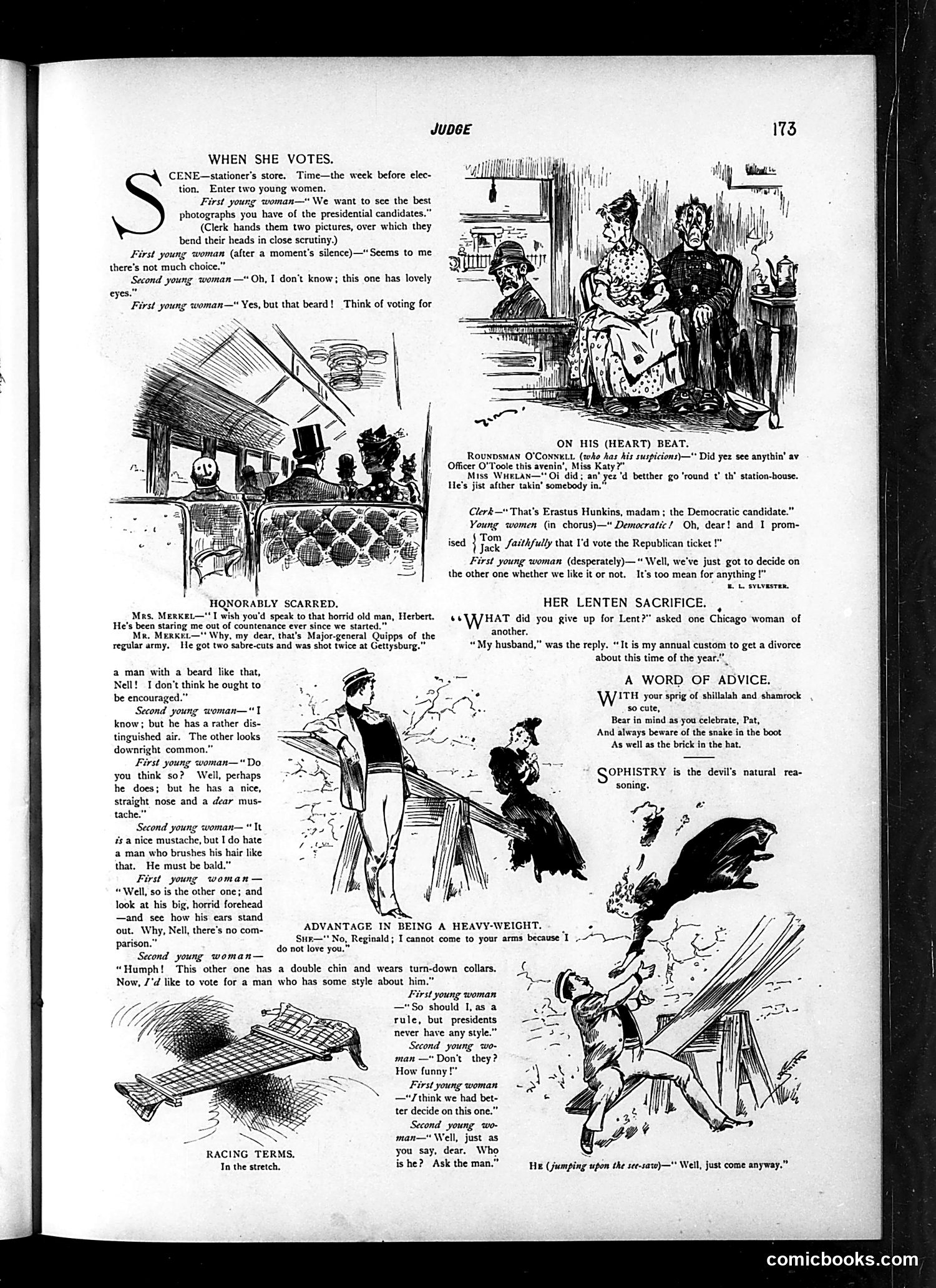
This page satirizes women's newly acquired voting rights (likely post-1920 suffrage era). The main cartoon mocks female voters as shallow and indecisive: two women selecting a presidential candidate based purely on physical appearance—one prefers a candidate's "lovely eyes," the other is horrified by his beard. When told he's the Democratic candidate, they panic because they promised to vote Republican, illustrating the satire's point that women voters lack serious political conviction. The surrounding vignettes reinforce stereotypes about women's priorities: one woman gives up her husband for Lenten sacrifice; another fixates on a man's mustache and baldness. The humor assumes women are trivial, appearance-obsessed, and unsuited for political decision-making—reflecting deep-seated anxieties about female enfranchisement among Judge's presumably male readership. This represents anti-suffrage sentiment disguised as comedy.
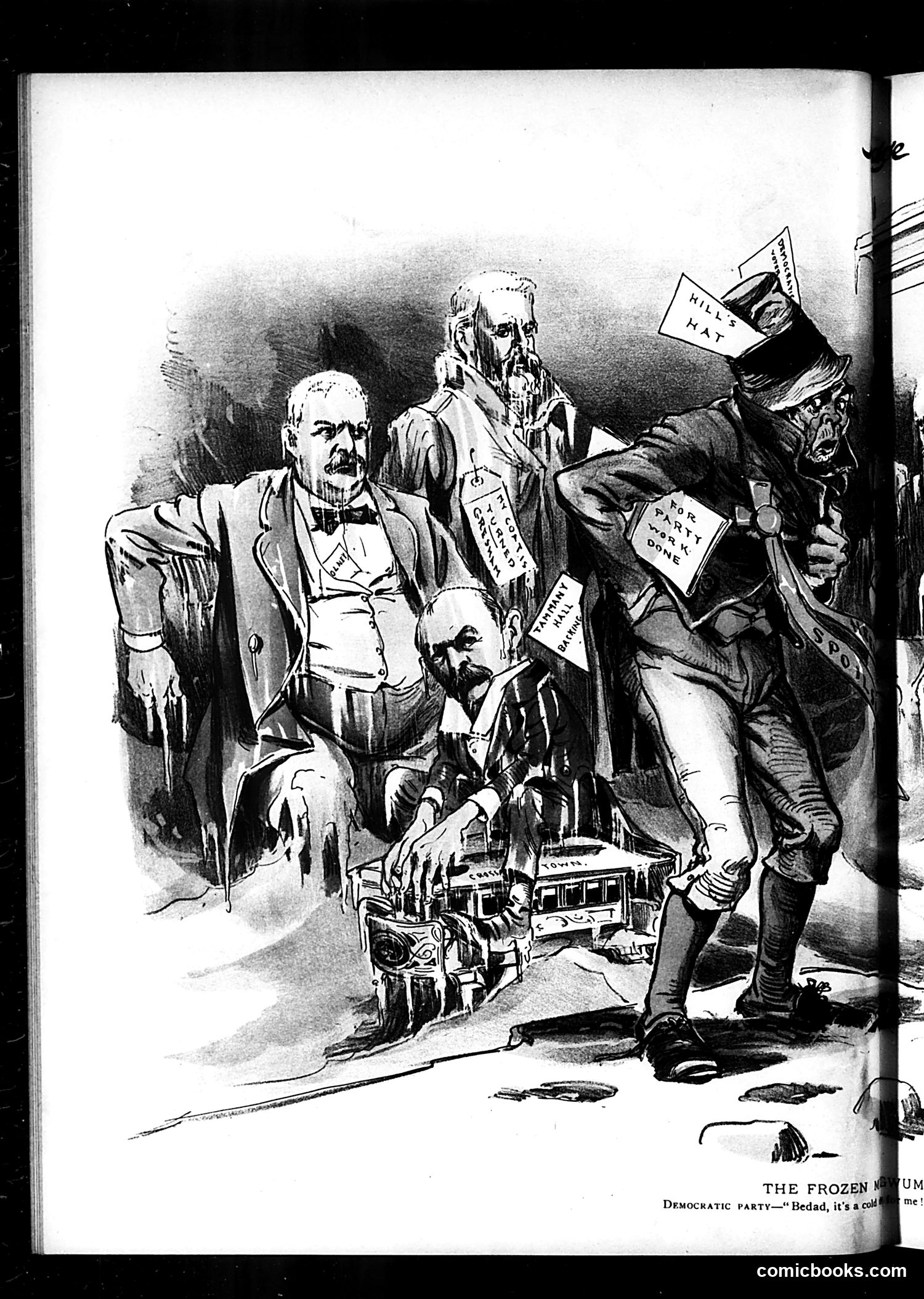
This political cartoon satirizes the Democratic Party as frozen or immobilized. A demonic figure (likely representing a Republican or opposing force) gestures mockingly at several prominent Democratic men who appear rigid and lifeless, like frozen statues. One seated figure holds what appears to be a toy train or mechanical device. The title reads: "Democratic party—'Bedad, it's a cold—'" (an incomplete Irish-inflected exclamation), suggesting the party has become ineffectual or dead in the political landscape. Without a clear date visible, the cartoon likely comments on Democratic Party weakness during a specific political period, possibly the Reconstruction era or Gilded Age when Republicans dominated national politics. The caricatured figures appear to represent Democratic leadership rendered powerless or irrelevant by political circumstances.
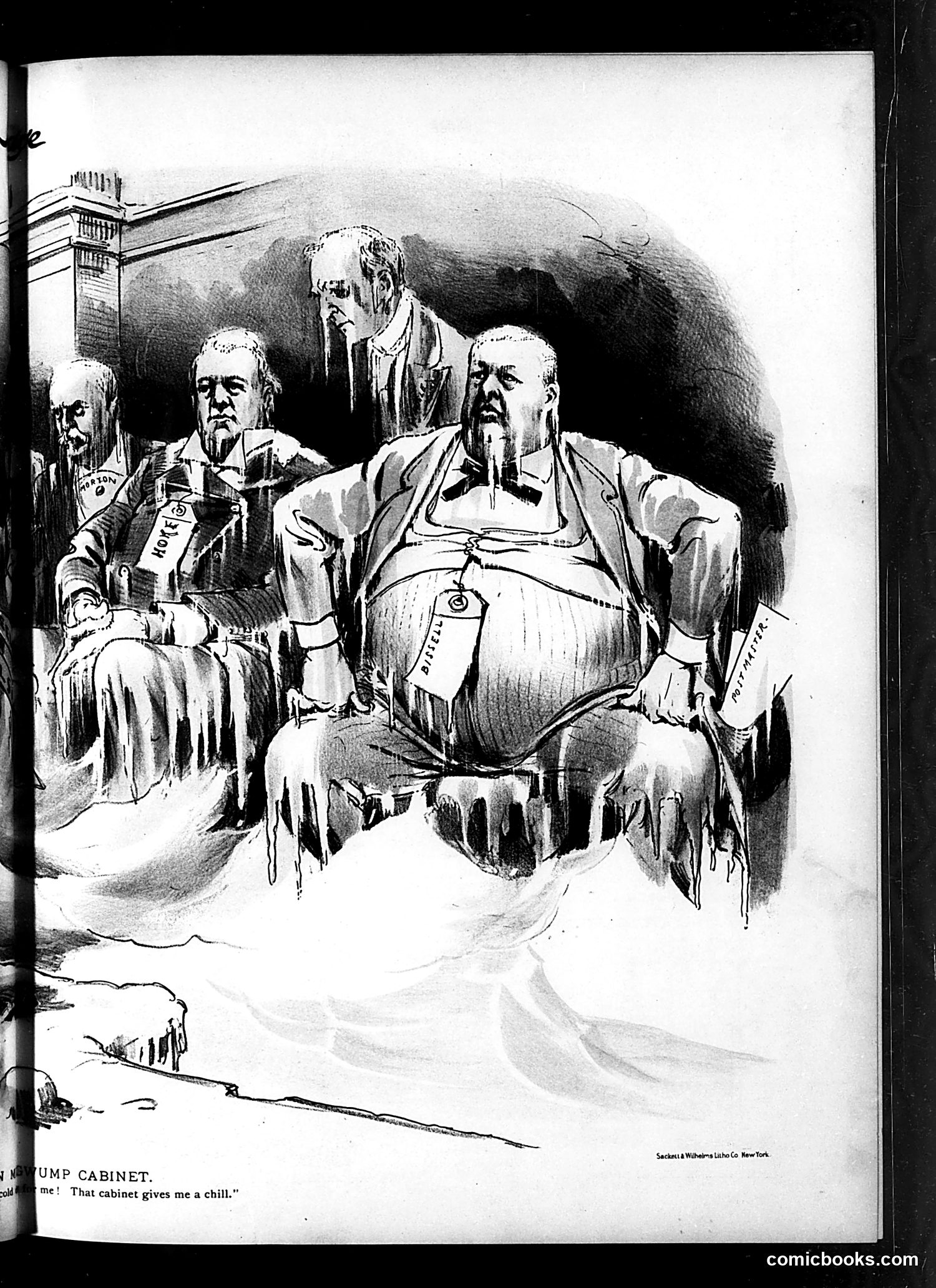
This is a satirical cartoon titled "Ump Cabinet" depicting what appears to be a baseball umpire as a central figure surrounded by other men in formal dress, some wearing military or official regalia with medals and insignia. The caption reads: "That cabinet gives me a chill." The satire appears to critique a political cabinet (likely from the Trump administration, given the "Ump" reference) by comparing it to an umpire's cold demeanor or questionable decisions. The figures surrounding the central corpulent character seem to represent cabinet members, their formal attire and decorations suggesting political authority. The overall tone suggests criticism of the cabinet's composition or direction, with the "chill" implying discomfort or concern about leadership choices. The snow/cold setting reinforces the temperature metaphor in the joke.
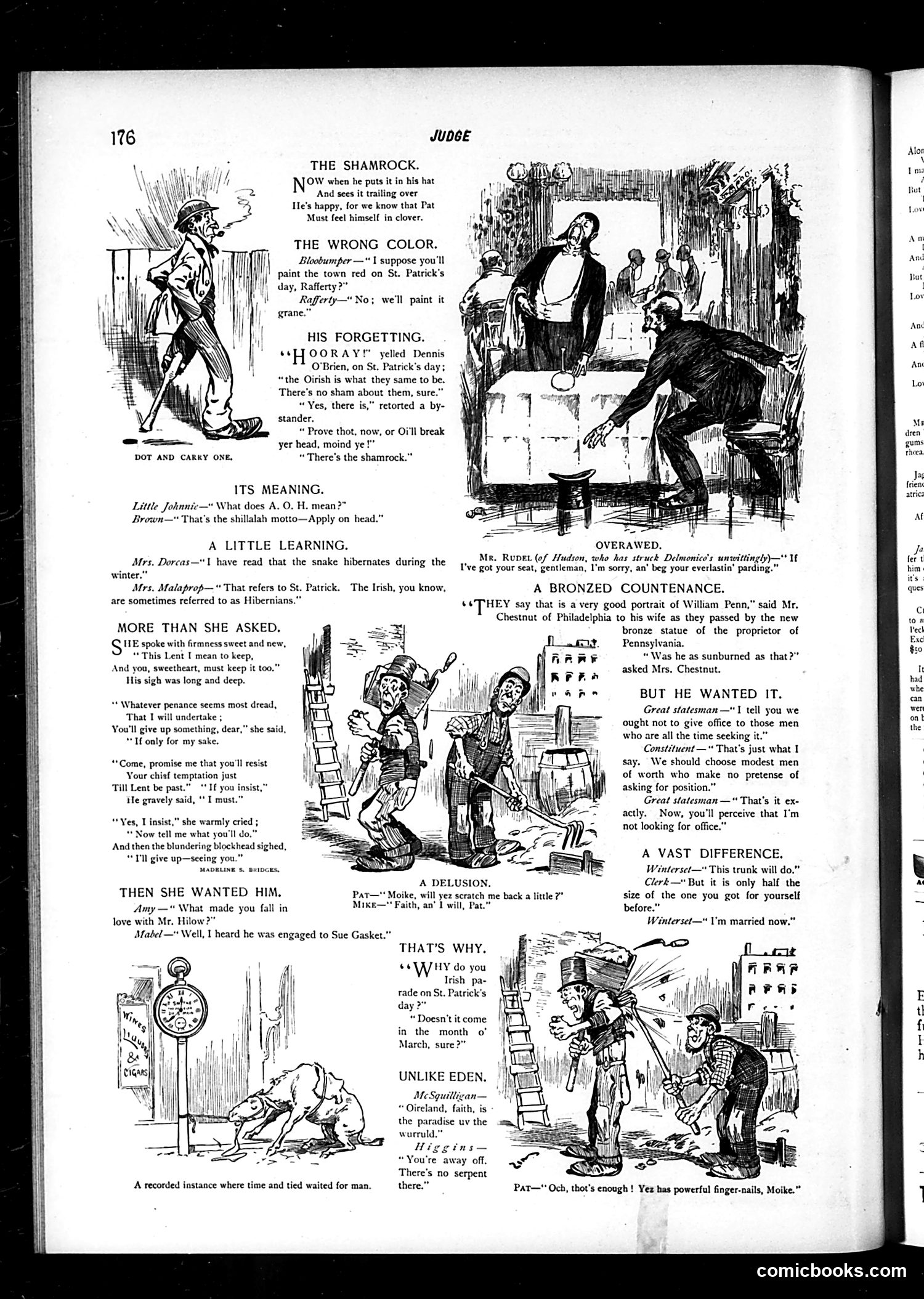
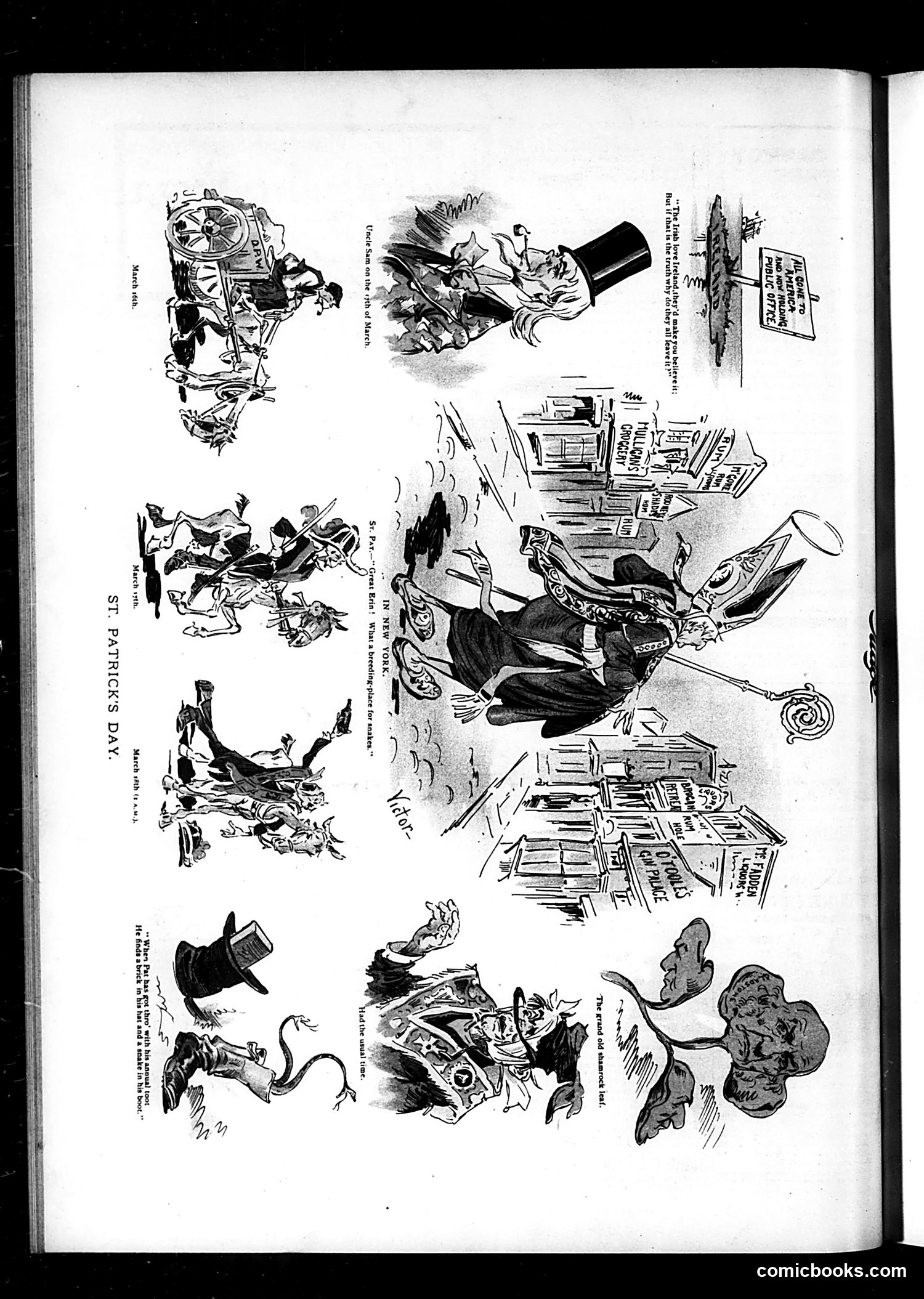
This page from Judge magazine presents multiple short jokes and cartoon vignettes satirizing Irish-American stereotypes around St. Patrick's Day. The humor targets Irish immigrants and Irish-Americans through exaggerated dialect, malapropisms, and cultural caricatures. Key satirical elements include: **"The Wrong Color"**: Mocks Irish-Americans planning to celebrate by "painting the town" in green rather than the traditional red, suggesting cultural confusion or affectation. **"His Forgetting"**: Plays on the stereotype of Irish combativeness and ignorance—a character disputes whether the Irish are genuine, threatening violence if proven wrong, then points to a shamrock as "proof." **"More Than She Asked"**: References Irish men's supposed drinking habits and difficulty with Lenten abstinence. **"Unlike Eden"**: A joke claiming Ireland has no snakes (referencing St. Patrick legend) and humorously suggests it's therefore *worse* than paradise—implying Irish badness. The cartoons consistently employ thick Irish dialect ("Oirish," "Hibernians") and depict Irish characters as crude, quarrelsome, and intellectually limited. This reflects late 19th-century American nativist attitudes toward Irish immigrants.
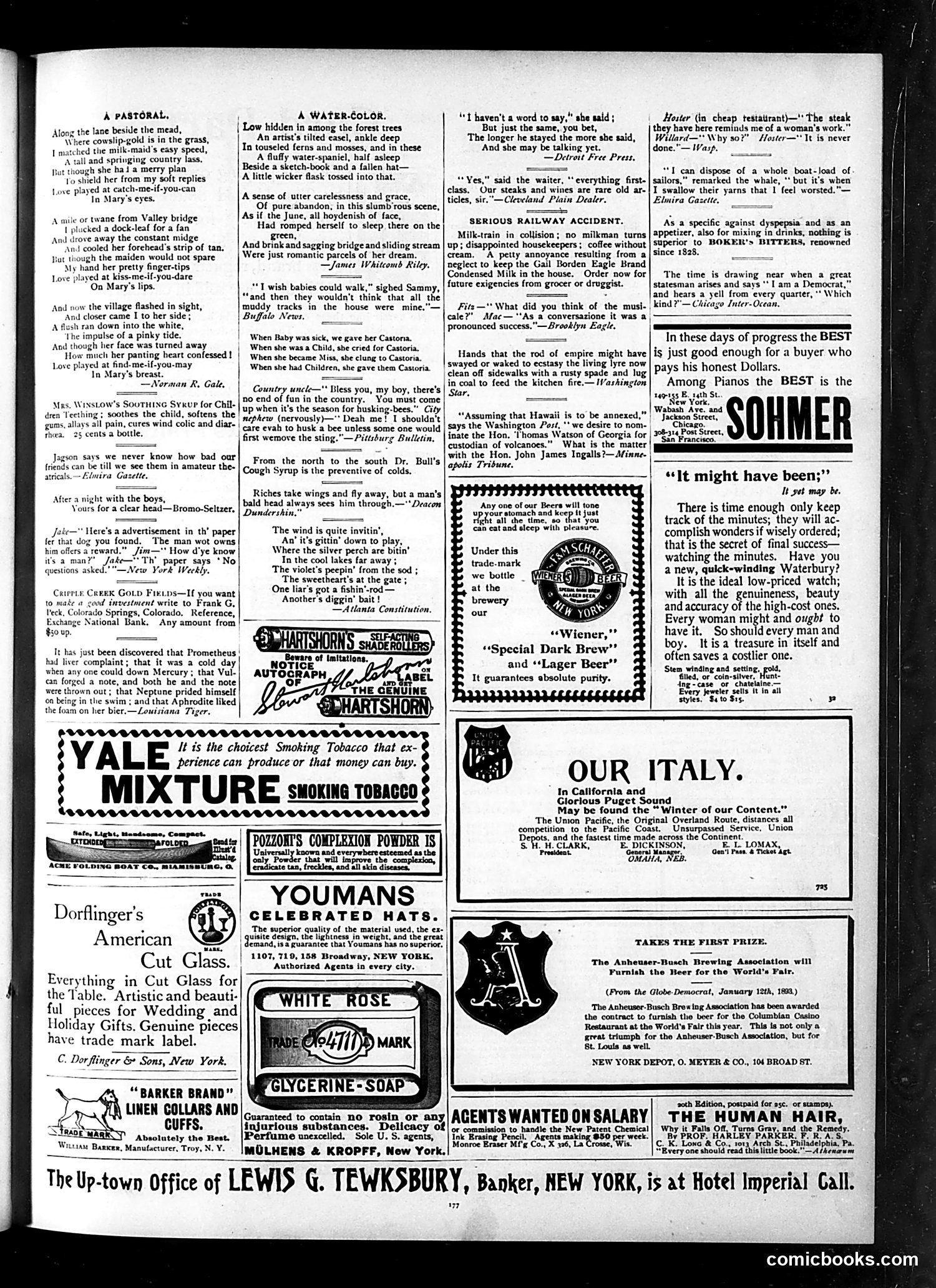
This is primarily an **advertising and literary page** from Judge magazine, with minimal political content. The page features three poems—"A Pastoral" (romantic rural scene), "A Water-Color" (impressionistic nature sketch), and verses about country life—alongside period advertisements for consumer products: smoking tobacco, soothing syrup for children, cut glass, hats, soap, and financial services. The few humor items are light social satire: jokes about amateur theater, a dog's reward notice playing on "no questions asked" implying criminality, and a city nephew's nervousness about "husking bees" (country social gatherings). There's gentle mockery of rural/urban cultural differences and advertising clichés. **No identifiable political cartoons or caricatures appear.** The page reflects turn-of-the-century American consumer culture and genteel literary tastes rather than political commentary.
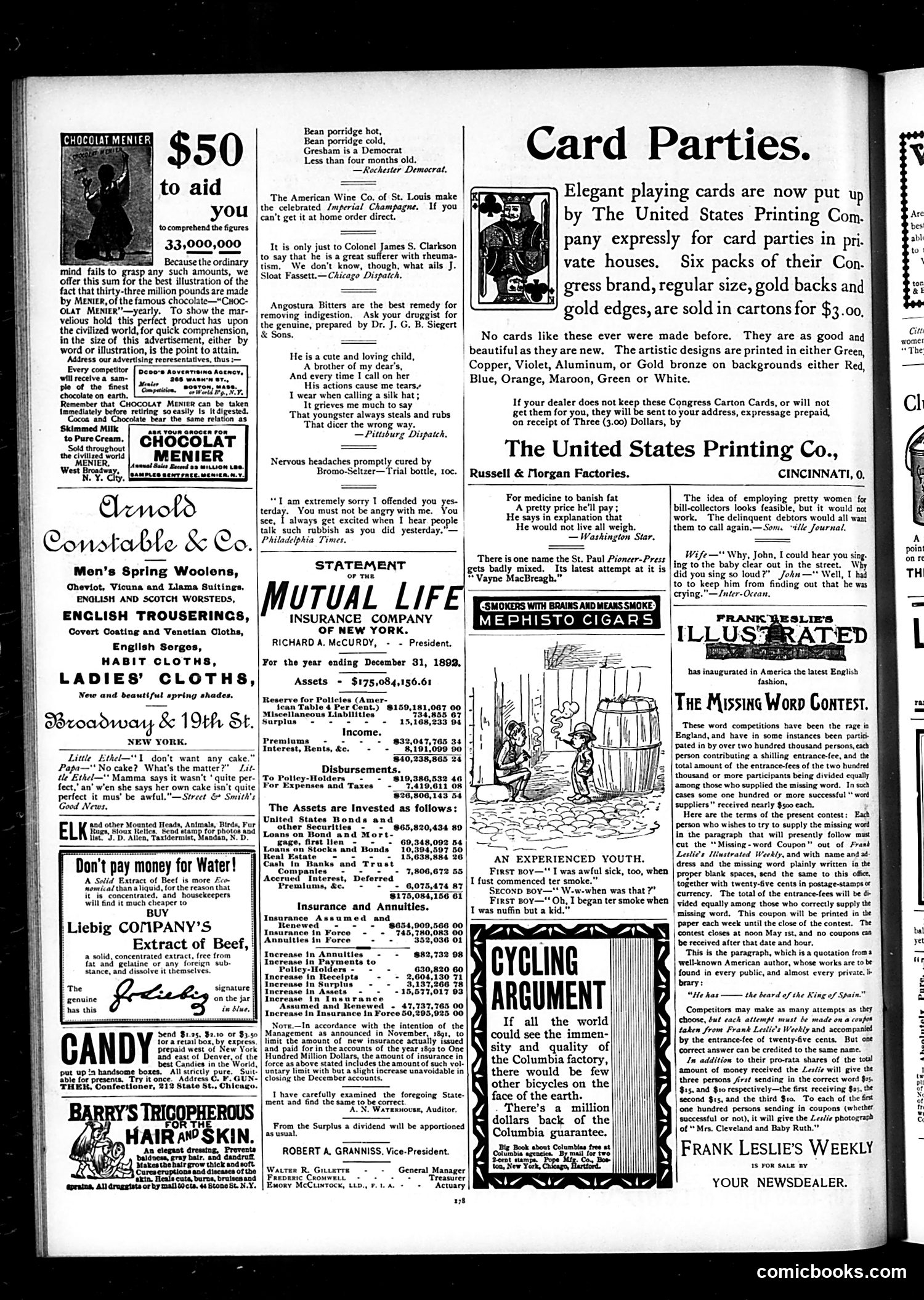
This page is primarily **advertisements and commercial content**, with minimal political satire or editorial cartooning. The main cartoon visible shows "An Experienced Youth"—depicting a young boy bragging about smoking, likely satirizing youth culture or smoking habits of the era. The "Card Parties" article discusses elegant playing cards newly manufactured for upscale social gatherings, reflecting the late 19th-century leisure culture of the American elite. Small inserted jokes mock contemporary figures (Colonel Clarkson's rheumatism, a child stealing silk hat items) and promote patent medicines popular at the time (Angostura Bitters, Bromo-Seltzer). Most notable content consists of advertisements for chocolate, champagne, clothing, extracts, and hair treatments—typical of Judge magazine's revenue model. Without more context about specific political events of 1892-1893, the satirical intent of most references remains unclear. The page essentially documents commercial culture and consumer products of the Gilded Age rather than offering substantive political commentary.
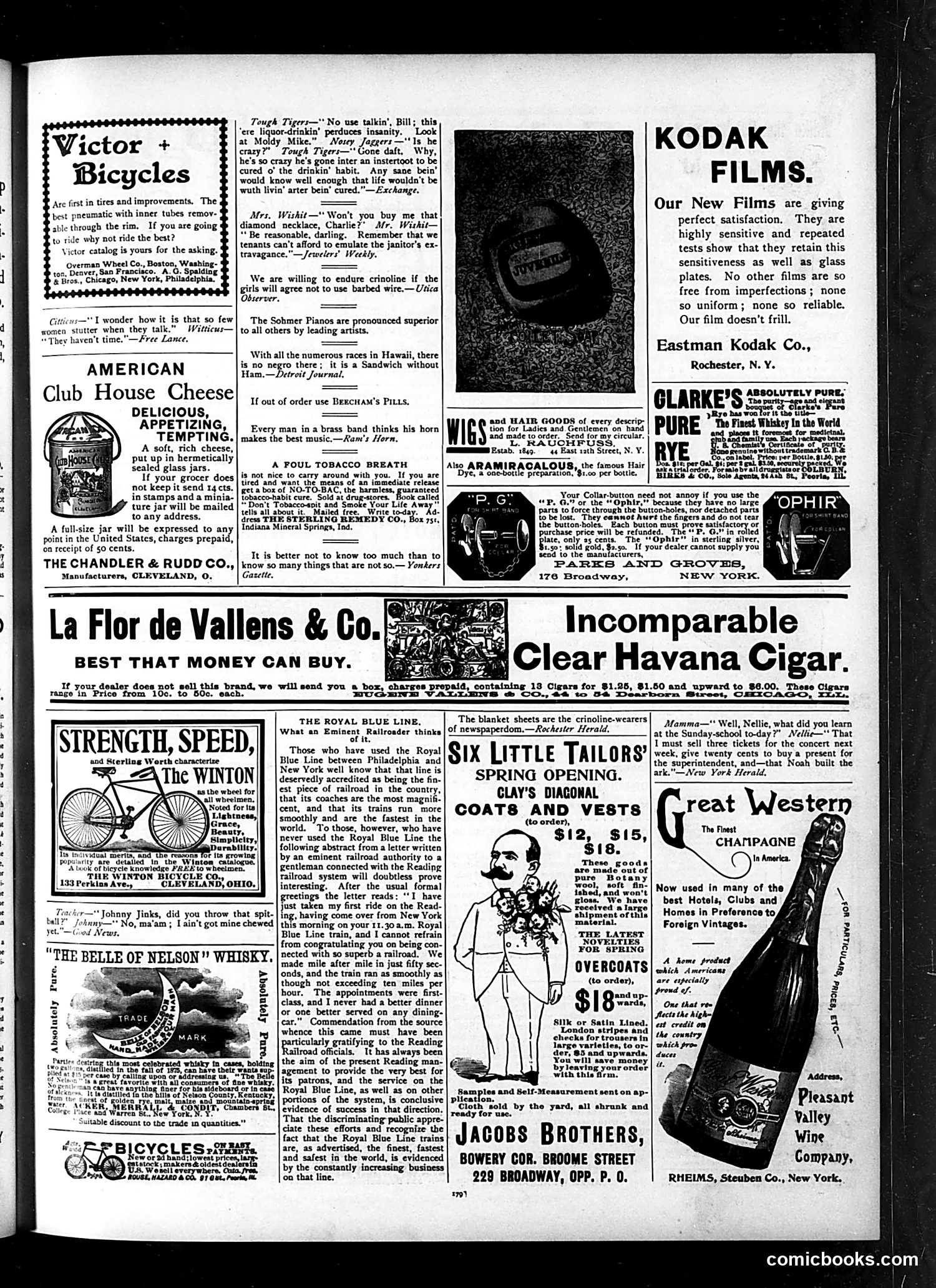
This is primarily an **advertising page** from Judge magazine, with minimal editorial content. The small comic items are brief one-liners rather than political cartoons: **Comic References:** - "Tough Tigers" joke mocks alcoholics who enter sanitariums, suggesting sobriety makes life unbearable - "Mrs. Wiskit" satirizes class pretension—a renting couple envying their janitor's wealth - A Hawaii joke plays on racial stereotypes (the offensive "Sandwich without Ham" reference) - Brief observational humor about brass bands, women's fashion (crinolines), and tobacco breath **Context for Modern Readers:** These are mild Victorian-era social satire and gender jokes typical of the period. The "Wiskit" joke reflects anxiety about American social mobility and appearances. The Hawaii reference reflects casual period racism now completely unacceptable. The page is dominated by **product advertisements**: bicycles, cheese, whiskey, cigars, film, hair products—reflecting Judge's commercial function as much as its satirical mission.
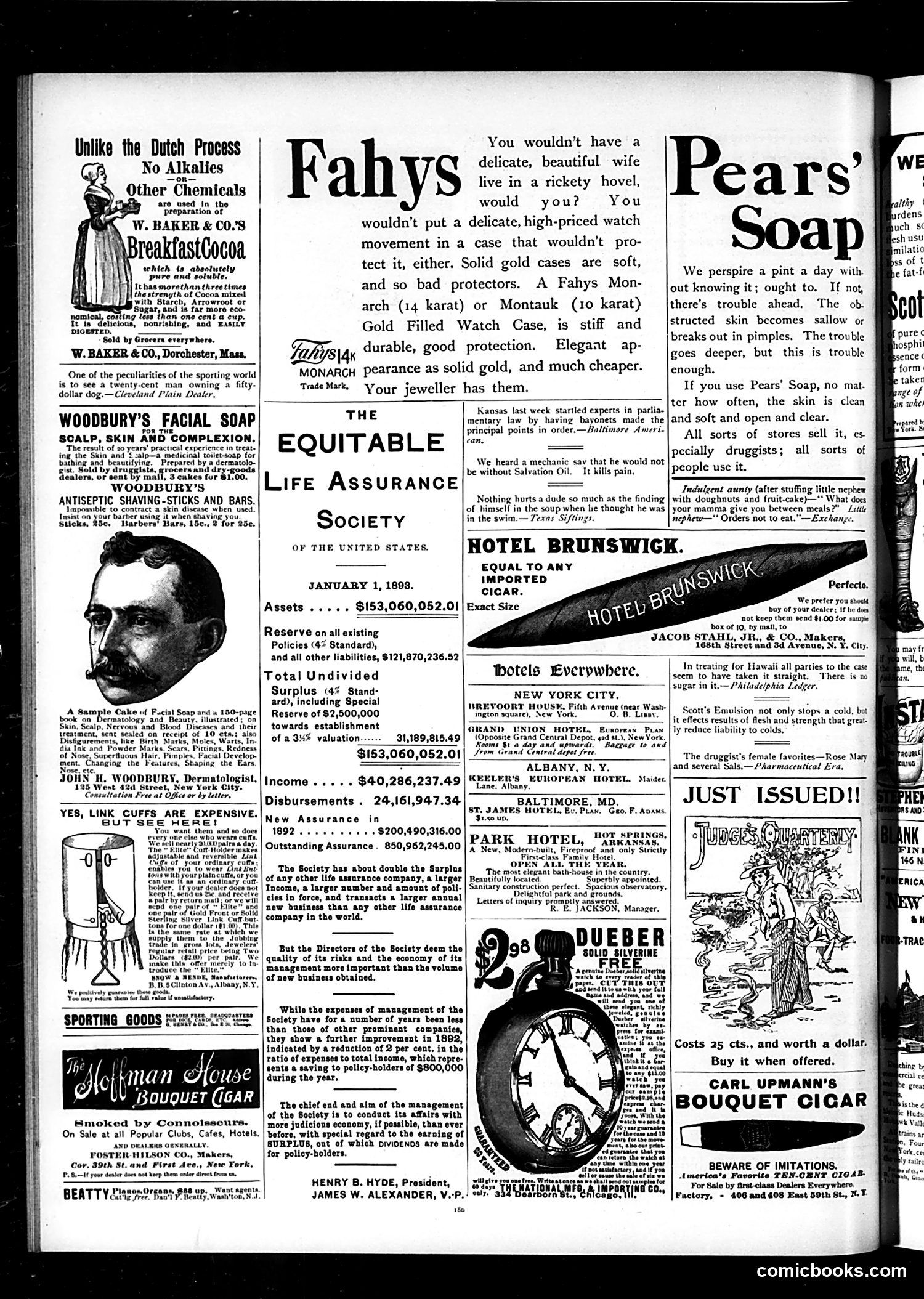
This is primarily an **advertising page** from Judge magazine (January 1, 1893), containing no discernible political cartoons or satirical commentary on the visible portions. The page features standard late-19th-century product advertisements: W. Baker & Co.'s cocoa, Woodbury's facial soap and shaving products, Fahys watch cases, the Equitable Life Assurance Society financial statement, various hotels, the Hoffman House cigar, Dueber watches, Pears' Soap, and Bouquet cigars. There is one **minor joke** in the sporting goods section: "One of the peculiarities of the sporting world is to see a twenty-cent man owning a fifty-dollar dog"—a quip about working-class men prioritizing expensive hunting dogs over their own modest means. The "Jugs Quarterly" illustration appears to be a magazine cover or advertisement insert, but lacks clear satirical content visible here. The page reflects typical Judge content: primarily commercial, with advertisements subsidizing the publication.
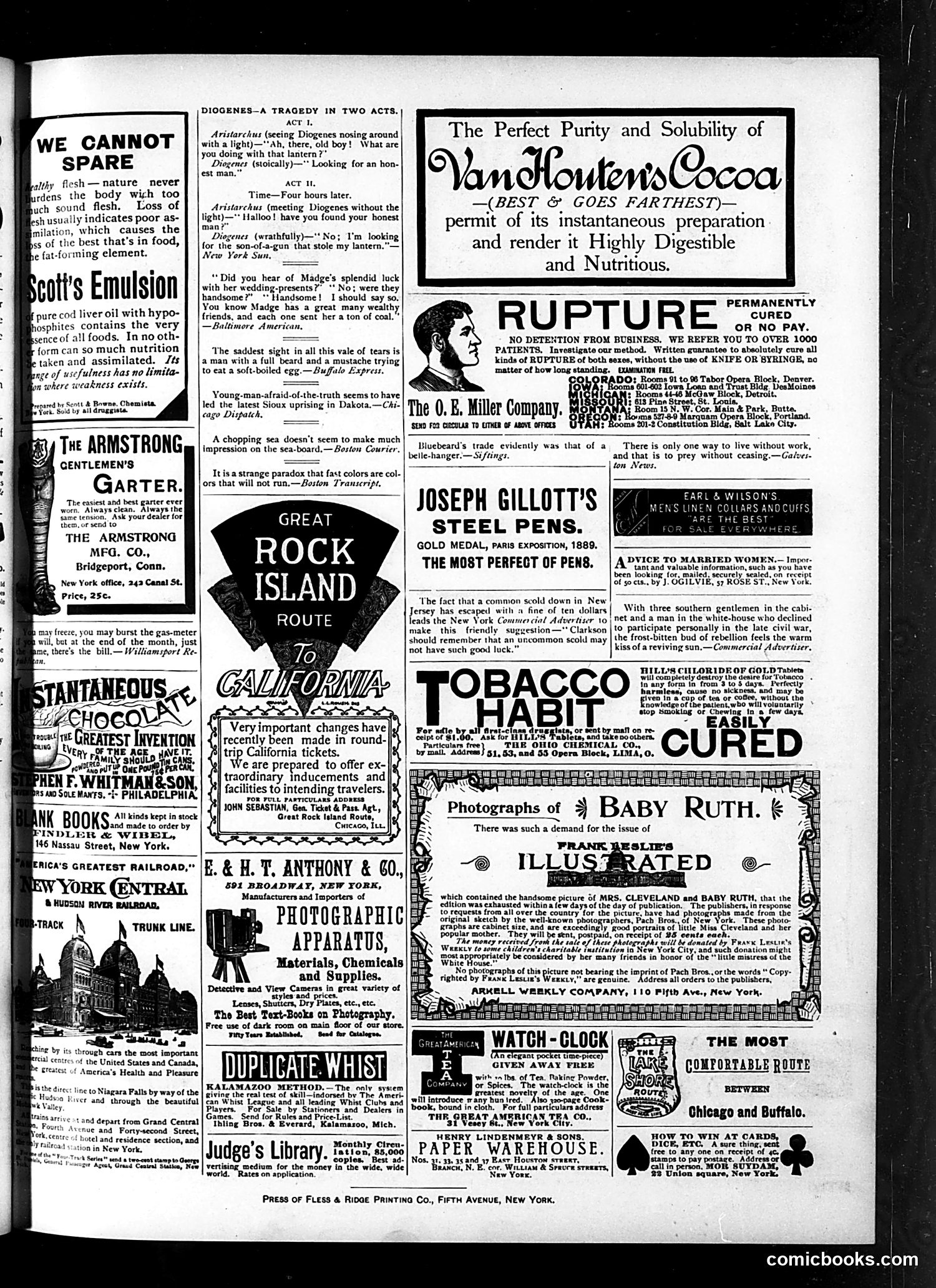
This page is primarily **advertising**, typical of late-19th-century American magazines. Notable content includes: **Main Features:** - A humorous two-act sketch "Diogenes—A Tragedy in Two Acts" referencing the ancient Greek philosopher Diogenes, who famously searched for an honest man. The joke: after losing his lamp (his tool for searching), he now seeks the thief who stole it—suggesting dishonesty is more common than honesty. - Various comic short jokes about everyday life (soft-boiled eggs, railroad travel, beards, coal deliveries as wedding gifts). **Advertisements** dominate, hawking: - Scott's Emulsion (cod liver oil tonic) - Medical "cures" (rupture treatments, tobacco habit remedies) - Transportation (Great Rock Island Route, railroads) - Photography equipment - Garters, chocolate, books The overall tone reflects Gilded Age skepticism about finding virtue, while promoting patent medicines and consumer goods—a mix typical of *Judge*, a satirical magazine balanced by commercial revenue.