
A complete issue · 18 pages · 1892
Judge — December 24, 1892
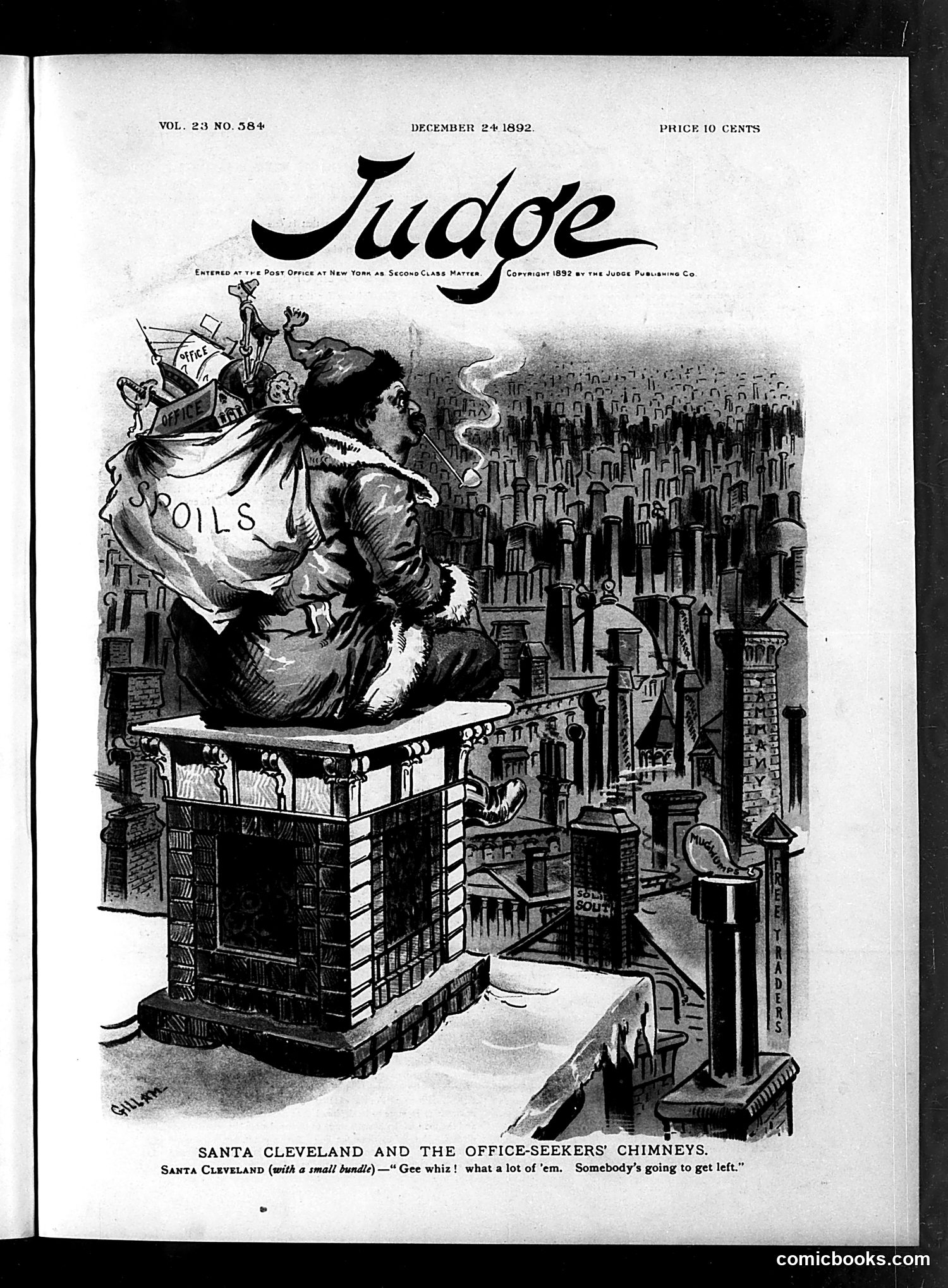
This is a political cartoon satirizing President Grover Cleveland during the 1892 election season. Cleveland, depicted as Santa Claus carrying a sack labeled "SPOILS," sits atop a chimney overlooking a cityscape filled with countless additional chimneys—representing the numerous federal office positions sought by job applicants. The joke mocks the pressure Cleveland faced from office-seekers wanting government positions, a practice called the "spoils system." The cartoon suggests Cleveland cannot possibly satisfy all these petitioners, as there are far too many chimneys (positions) to fill with gifts (jobs). This reflects contemporary criticism of patronage politics and the exhausting demands placed on a sitting president by his party's supporters seeking federal employment.
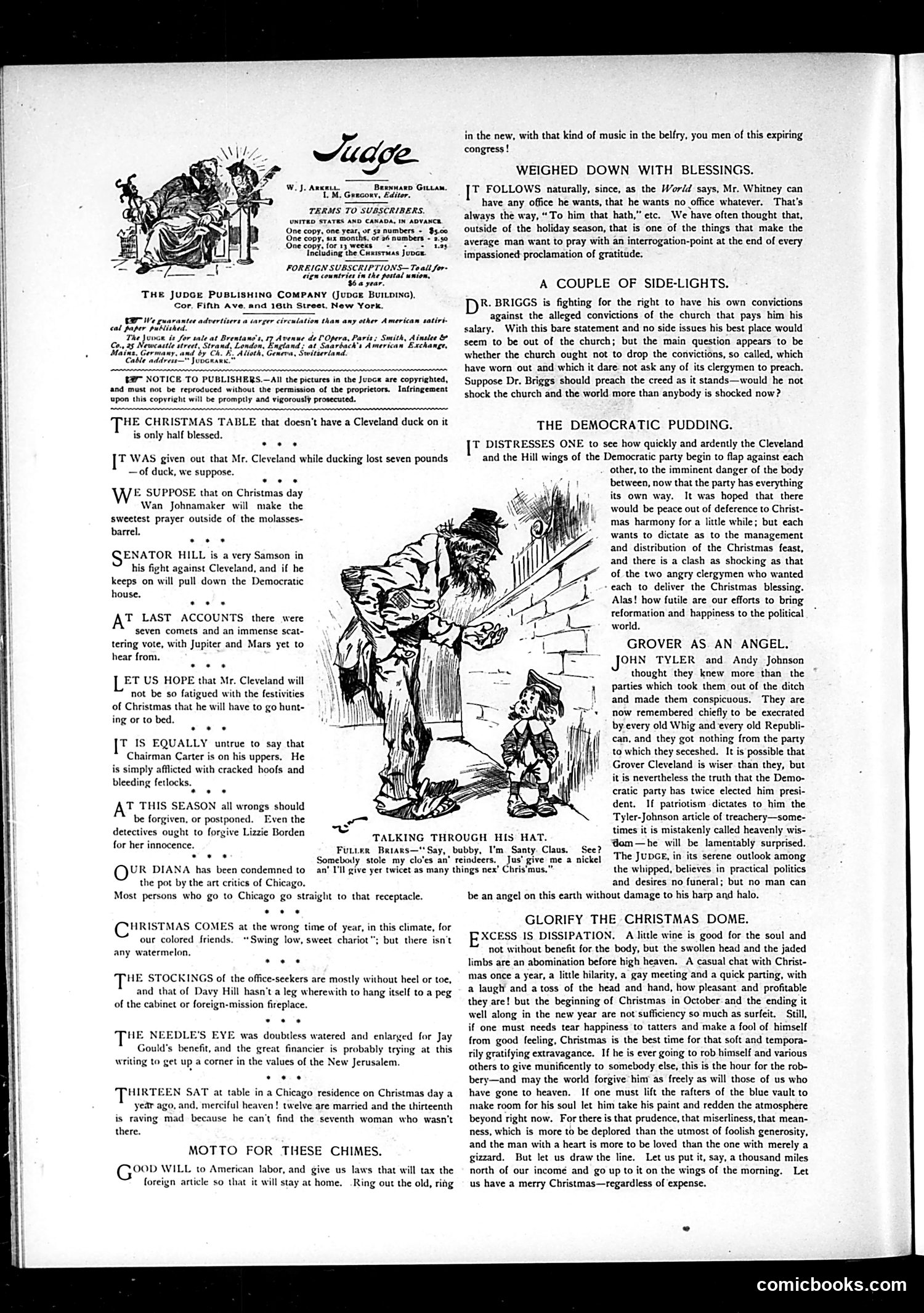
This satirical page targets **Democratic Party leadership** during the Christmas season, circa early 1900s. The main cartoon depicts Santa Claus being pulled in opposite directions by two Democratic figures—likely representing party factions fighting over control and the "Christmas feast" (political patronage and resources). The accompanying article "**The Democratic Pudding**" mocks the party's internal chaos, suggesting rival Democratic figures are as contentious as "two angry clergymen" fighting over Christmas blessings. The satire implies Democrats prioritize their own power struggles over serving the public good. References to "Cleveland," "Senator Hill," and "Grover" (Cleveland) indicate this targets specific late-19th-century Democratic leaders whose factional disputes weakened the party. The humor lies in depicting serious political infighting as absurdly petty behavior.
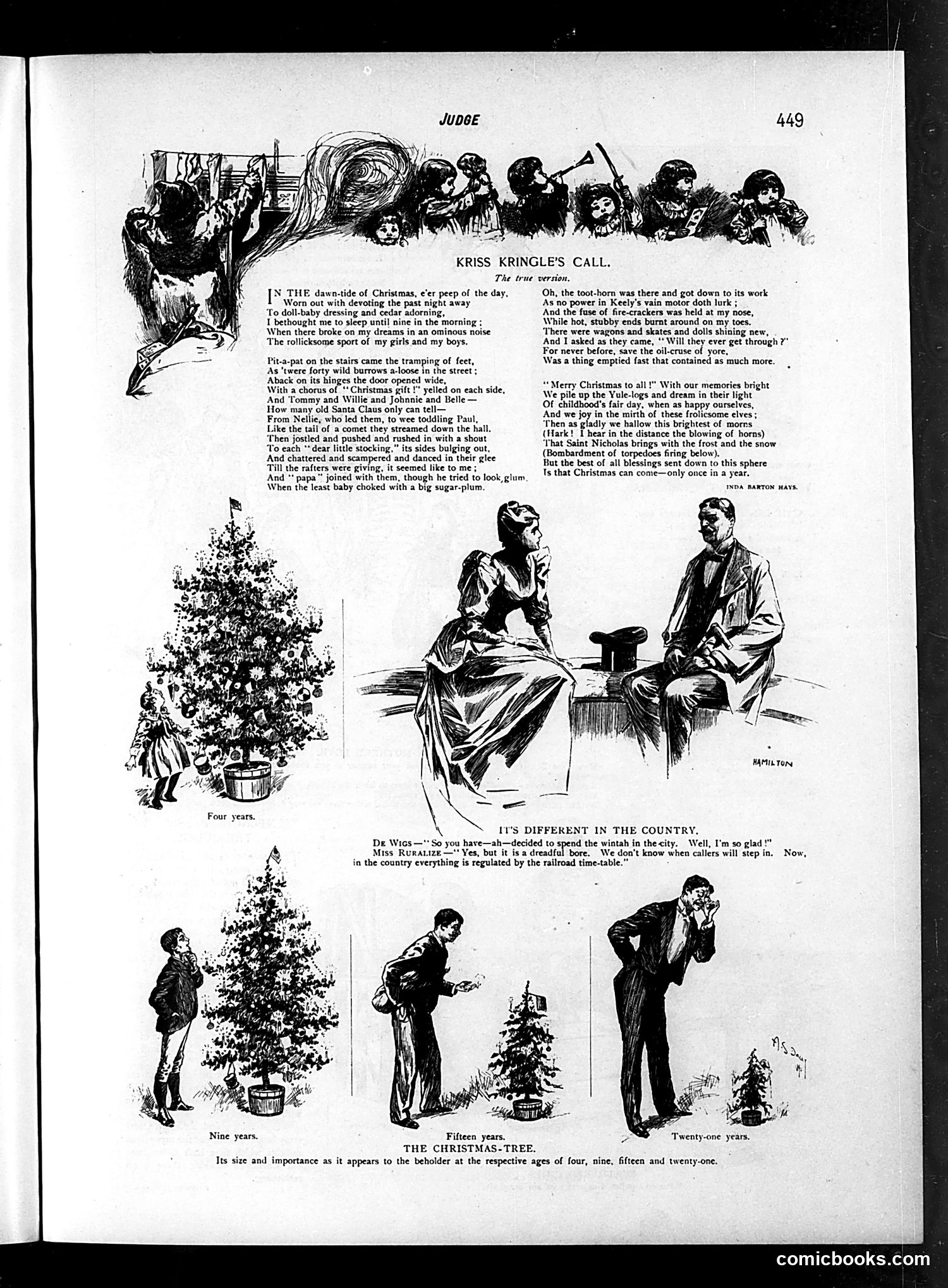
This page contains three distinct pieces: 1. **"Kriss Kringle's Call"** - A sentimental Christmas poem by Nora Barton Hays depicting children's joy during the holidays, with nostalgic imagery of Christmas morning and toys. 2. **"It's Different in the Country"** - A dialogue cartoon showing an urban couple debating whether to spend Christmas in the city or country, with the husband reluctant due to unpredictable rural train schedules. 3. **"The Christmas-Tree"** - A series of four illustrations showing how a Christmas tree's perceived importance grows as a person ages (four, nine, fifteen, and twenty-one years old), satirizing how adults become increasingly sentimental about holiday traditions compared to children. The page is primarily sentimental holiday content rather than political satire, reflecting Judge's mixed editorial approach combining humor with domestic themes.
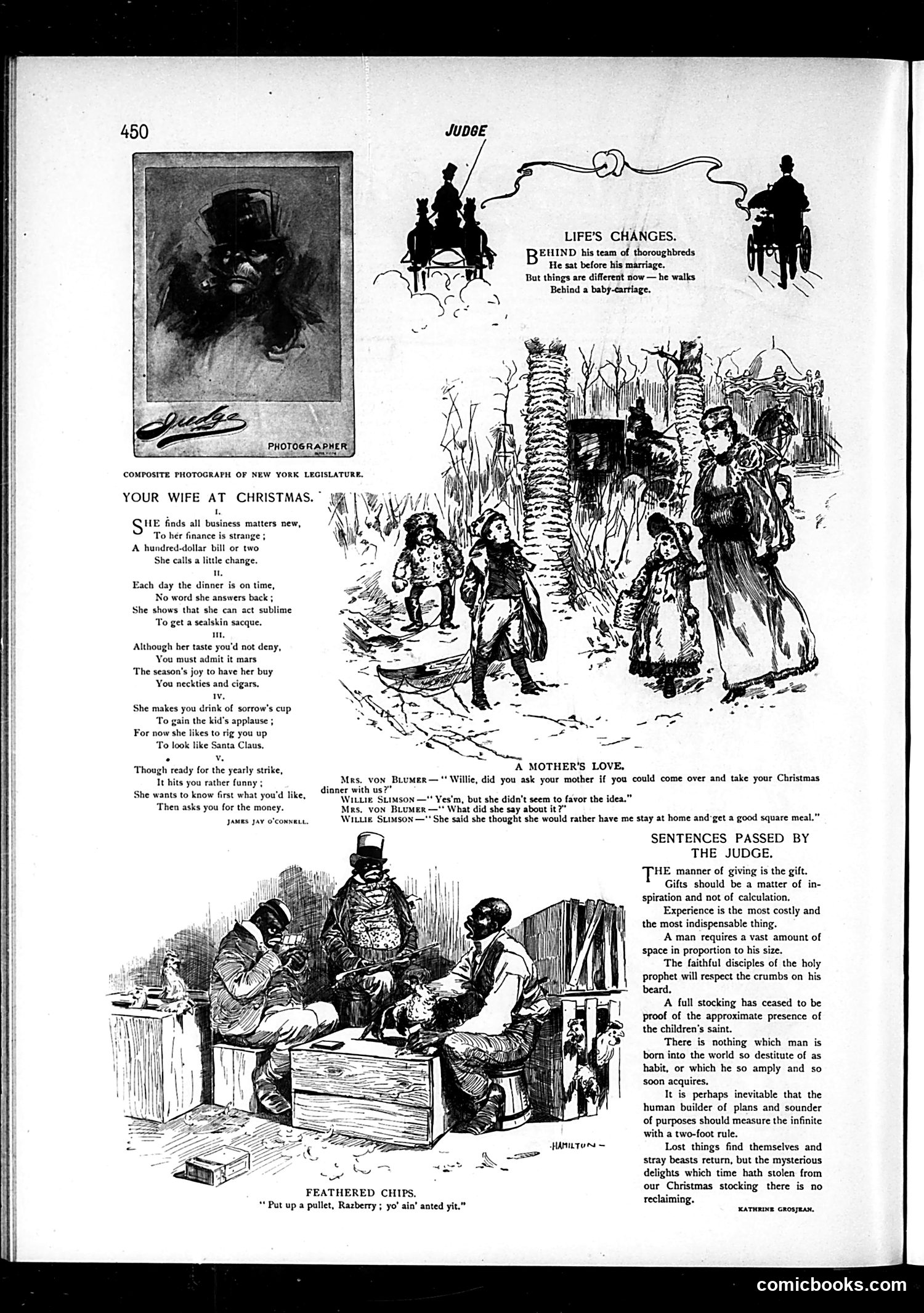
This page contains Christmas-themed satirical humor typical of late-19th-century Judge magazine. The main cartoons mock domestic life and marriage: **"Life's Changes"** contrasts a man before and after marriage—formerly riding behind thoroughbreds, now pushing a baby carriage, suggesting loss of status and freedom. **"Your Wife at Christmas"** by James Jay O'Connell presents married life's contradictions: wives handle finances carelessly, demand expensive gifts (sealskin sacks), yet somehow manage dinner punctually. The satire suggests wives are simultaneously incompetent with money yet skilled manipulators who exploit husbands' desire to impress them—requiring them to dress as Santa Claus for children. **"A Mother's Love"** shows a boy's mother refusing to let him dine elsewhere, preferring he eat a "good square meal" at home—gentle mockery of maternal possessiveness. The page also includes philosophical "Sentences Passed by the Judge" (wisdom statements) and minor jokes. Overall, the humor reflects Victorian anxieties about marriage's constraints on male independence and wives' spending habits.
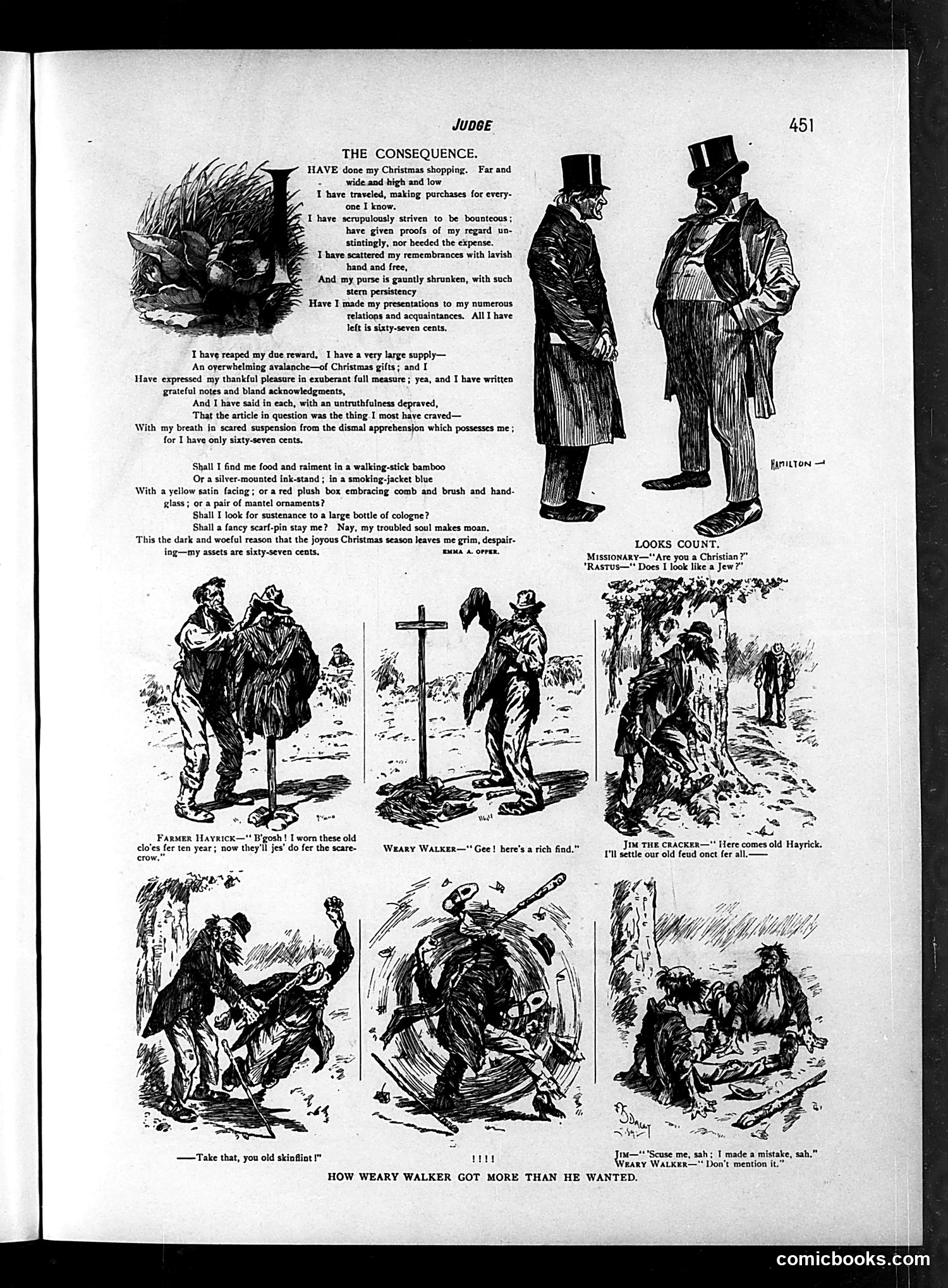
This page satirizes Christmas gift-giving excess and its financial consequences. The main poem, "The Consequence," follows a spendthrift narrator who lavishly purchased gifts for everyone but exhausted his savings—leaving only sixty-seven cents. The humor lies in the ironic reversal: he received an "overwhelming avalanche" of gifts in return, yet cannot afford food or clothing, instead possessing useless luxuries like cologne bottles and ornamental scarves. The lower comic strip, "How Weary Walker Got More Than He Wanted," depicts a poor man named Walker receiving unexpected confrontations from multiple people (including "Rastus" and "Jim the Cracker," using period racial stereotypes common to Judge). The implication appears to be that his generosity—or assumed generosity—created social complications he didn't anticipate. The satire targets the compulsory nature of holiday spending and its social entanglements.
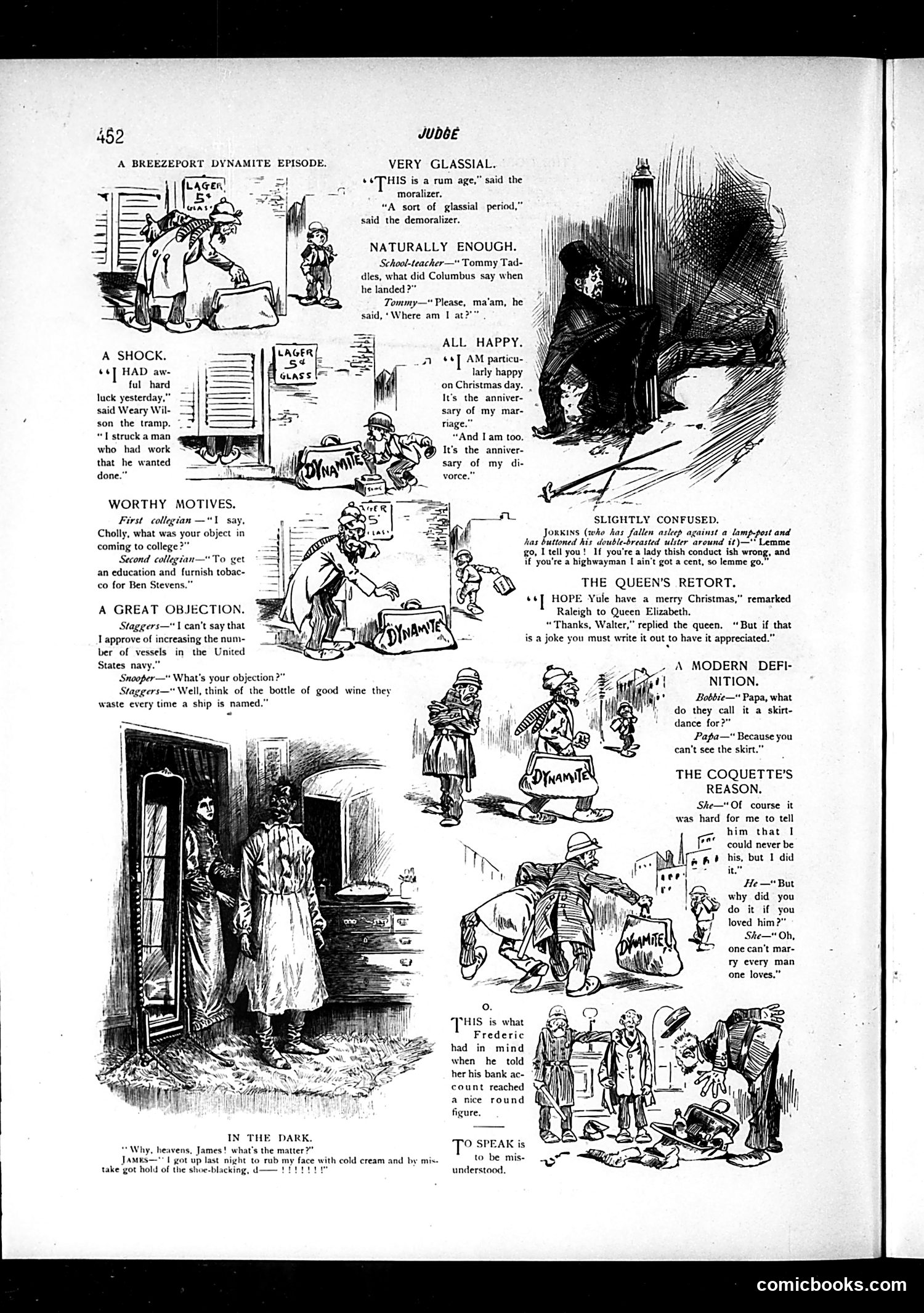
This page from *Judge* contains a collection of brief satirical jokes and cartoons mocking social conventions of the era (appears to be late 19th century): **Key satirical targets:** - **"Weary Wilson" cartoon**: Mocks tramps by inverting sympathy—the vagrant considers finding work "bad luck," undermining sentimental portrayals of the poor. - **Navy joke**: Ridicules wasteful government spending on naval expansion by focusing absurdly on wine wasted at ship-naming ceremonies. - **"Slightly Confused" drunk**: Social commentary on intoxication and blurred moral boundaries among lower classes. - **Queen Elizabeth retort**: Jokes about written vs. oral communication and Victorian formality. - **"Skirt-dance" definition**: Sexual innuendo about scandalous dance performances (likely referencing contemporary "skirt-dancing" controversy). - **Coquette's reason**: Satirizes women's romantic inconsistency and marriage market dynamics. The humor relies on class stereotypes, gender mockery, and topical references now obscure to modern readers.
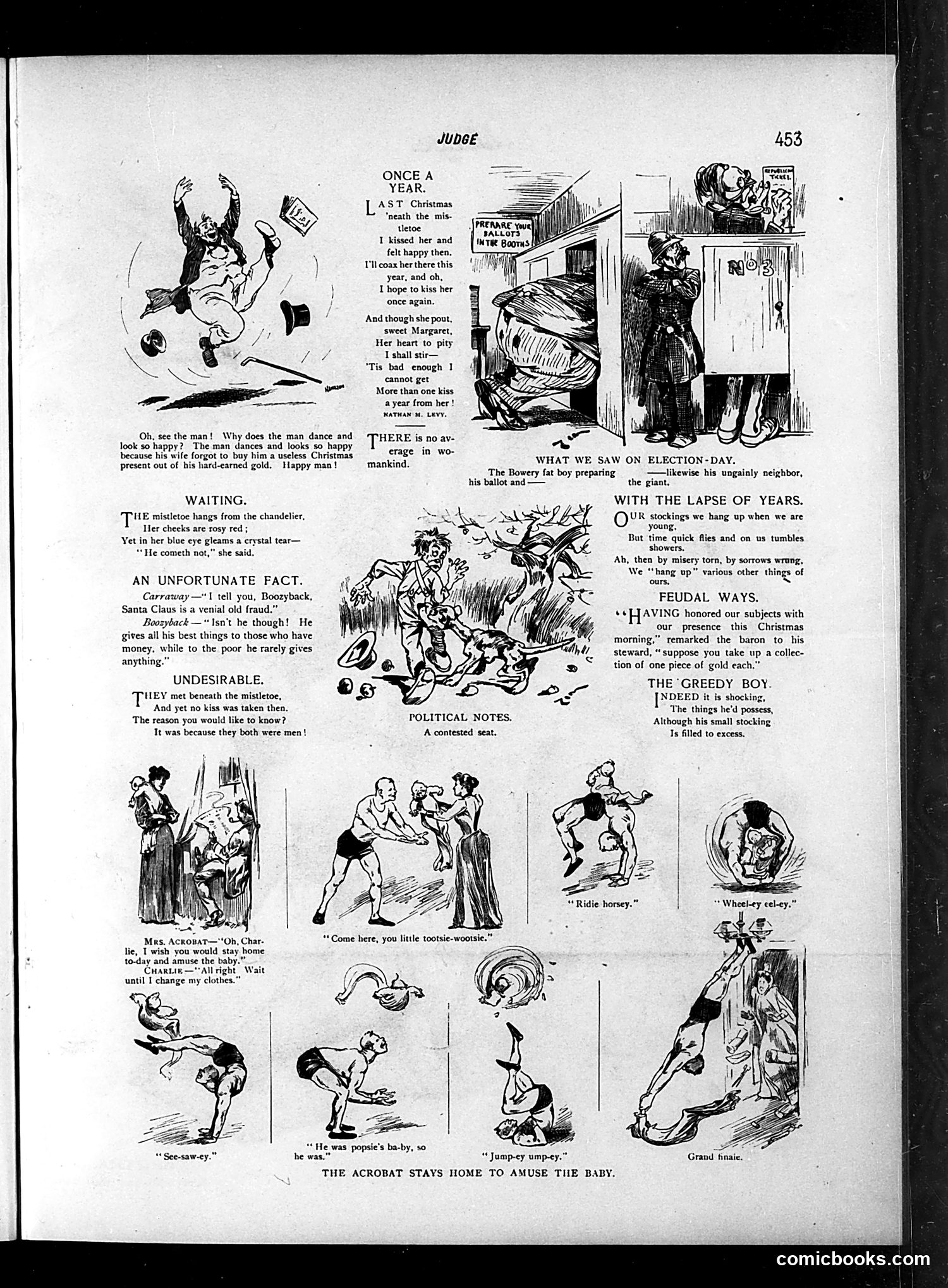
This page contains multiple short humorous pieces and cartoons typical of late-19th/early-20th century satirical magazines. **Key content:** - **"Once a Year"** (poem): A man laments kissing his wife only once yearly—at Christmas beneath mistletoe, satirizing marital coldness. - **"An Unfortunate Fact"**: Two drunk men discuss Santa Claus as a "venial fraud" because he gives gifts to the wealthy while poor children receive nothing—social commentary on economic inequality. - **"Undesirable"**: Two men meet under mistletoe but don't kiss because they're both men—reflecting period attitudes toward masculinity. - **"Political Notes"**: A "contested seat" cartoon likely references an election dispute (text mentions "election-day"). - **"The Acrobat Stays Home"**: A series of gymnastic poses the acrobat performs to entertain a baby, playing on the word "acrobat" and circus/physical comedy. The page mixes domestic humor, social critique, and slapstick comedy typical of Judge's satirical approach.
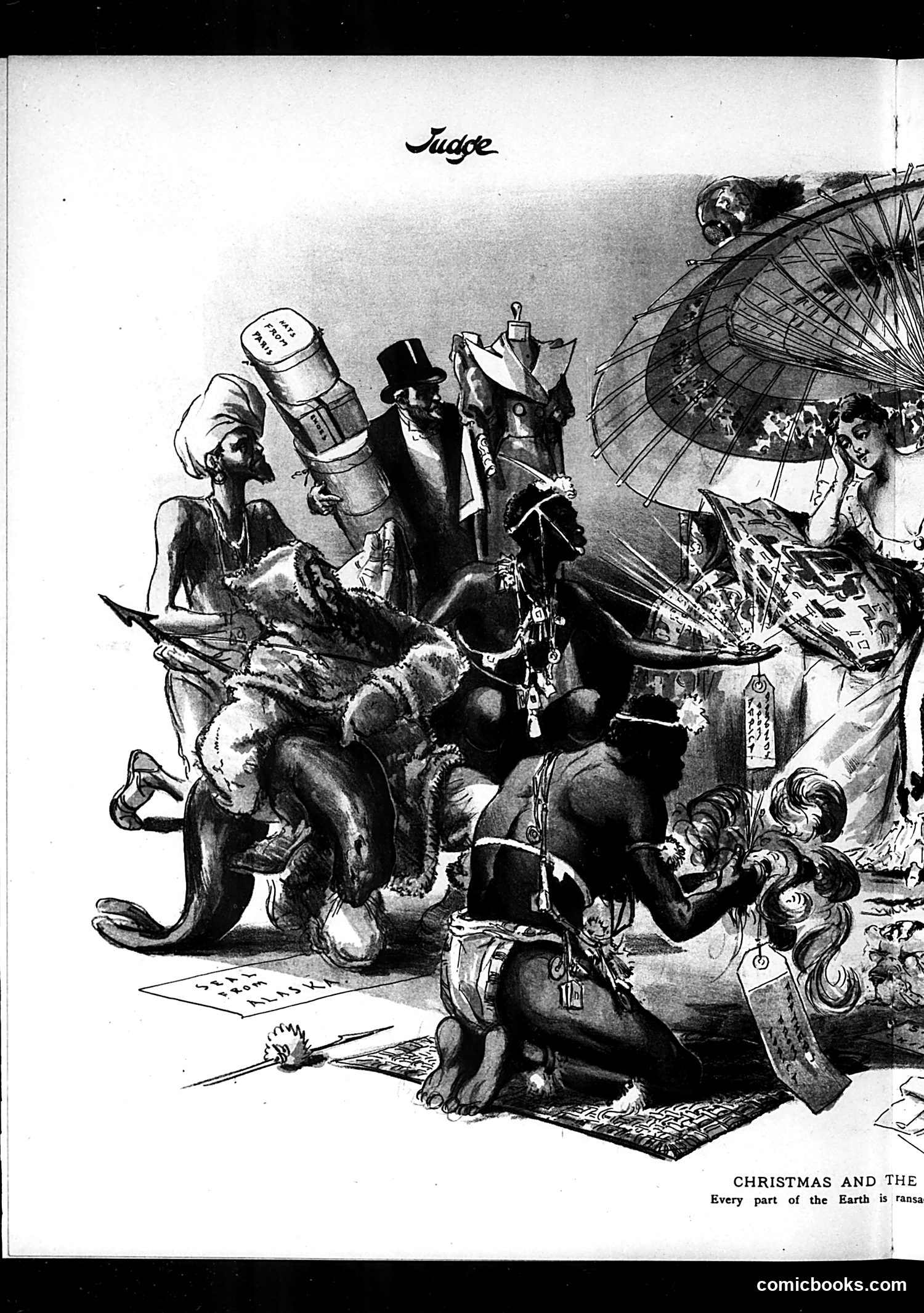
This Judge magazine page presents a Christmas-themed political cartoon titled "Christmas and the..." (the complete phrase is cut off). The image depicts an elaborate satirical scene with anthropomorphized animals in formal Victorian dress conducting what appears to be a diplomatic or commercial negotiation. The central figures include well-dressed gentlemen in top hats alongside various animals, suggesting an allegory about international relations or trade. The presence of umbrellas, formal attire, and what appear to be official documents suggests commentary on global commerce or diplomacy during the Victorian era. Without the complete title and given the OCR errors, the specific political references remain unclear. The phrase "Every part of the Earth" suggests themes of global reach or imperial expansion, common Judge satire subjects. The satirical tone targets what appears to be international dealings or holiday-season commercialism.
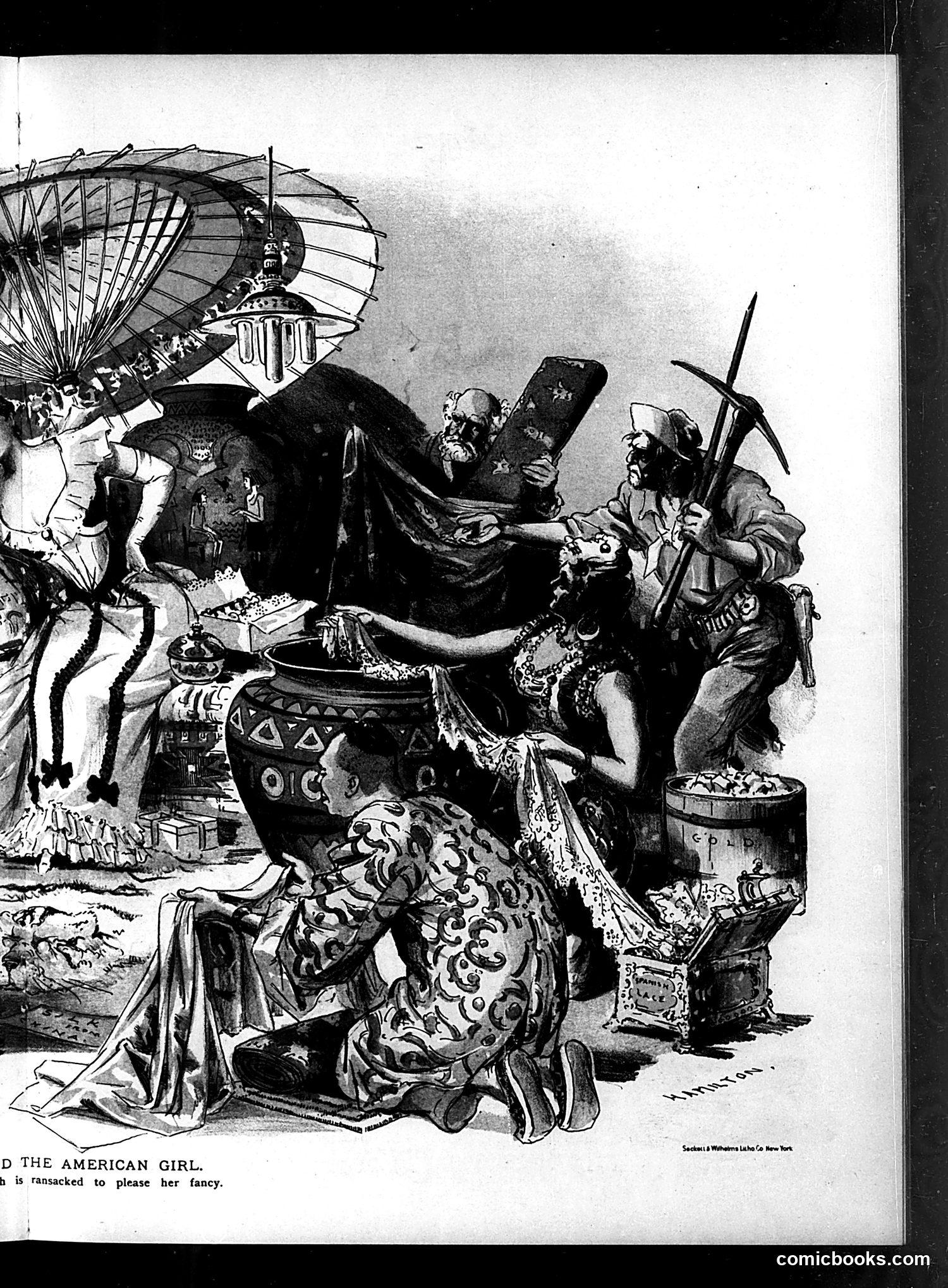
This appears to be a satirical cartoon from *Judge* magazine critiquing American consumerism and the "American Girl." The image shows what appears to be wealthy men (rendered with exaggerated ethnic features, suggesting foreigners or wealthy merchants) displaying exotic goods—ornate vases, elaborate umbrellas, fine fabrics, and luxury items—to entice an American woman (not clearly visible in the fragment). The caption "ransacked to please her fancy" suggests the satire targets wealthy American girls' extravagant consumption habits and their appetite for imported luxuries. The elaborate presentation and foreign merchants imply commentary on either American materialism, the cost of catering to women's desires, or anxiety about foreign goods flooding American markets. The exact historical moment and specific targets remain unclear from this page fragment.
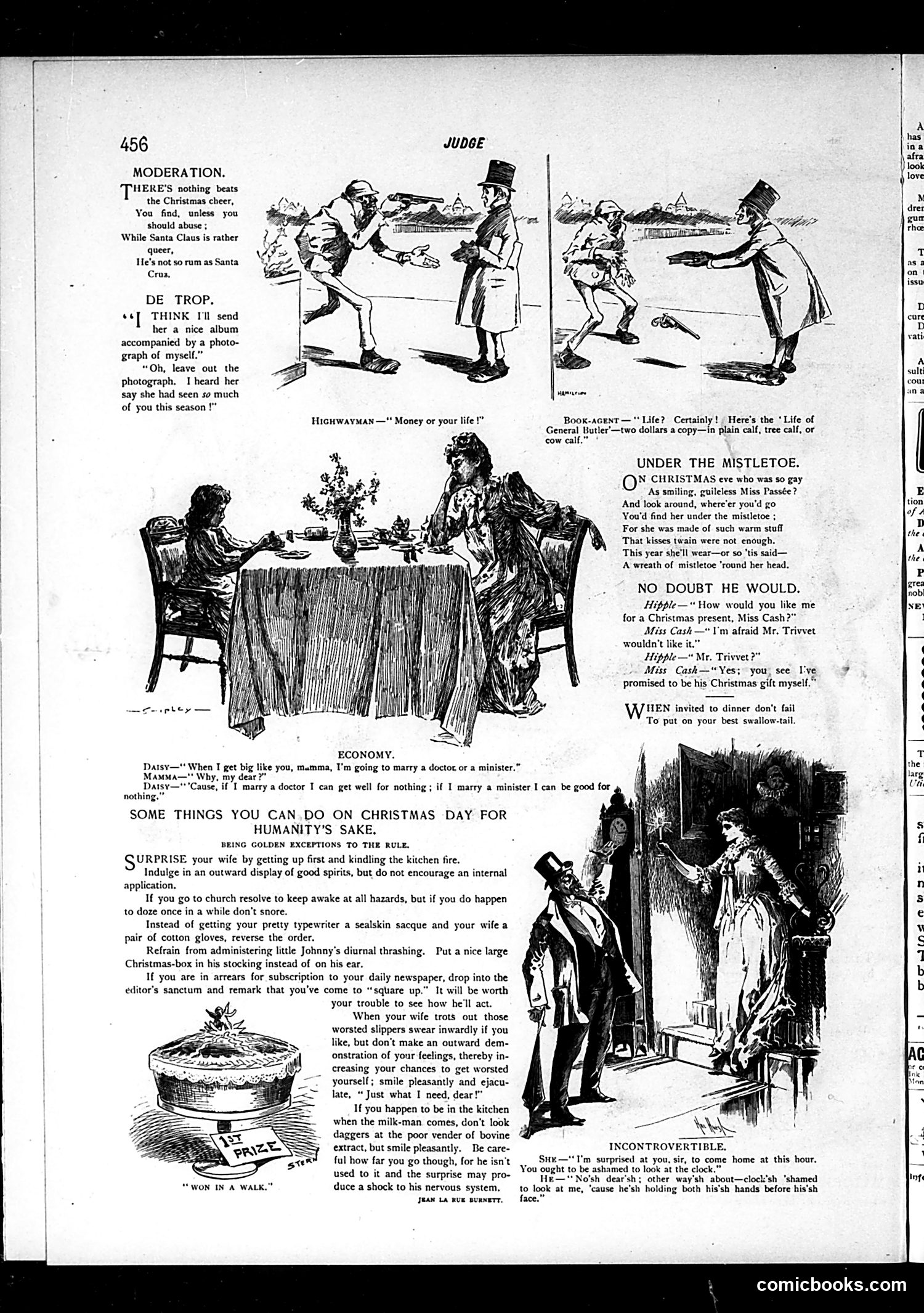
This Christmas-themed page from Judge magazine contains several brief satirical comics mocking Victorian social conventions and domestic life: **"Highwayman"**: A book agent confronts a robber, offering "General Butler's Life" as an alternative to money—satirizing aggressive Christmas book sales tactics. **"Under the Mistletoe"**: Mocks Miss Paste's overeager kissing under mistletoe, suggesting she'll need an actual wreath around her head this year due to excessive holiday romance-seeking. **"Economy"**: A child's innocent logic that marrying a doctor means free medical care, or a minister means built-in moral discipline, satirizes practical (mercenary) marriage motivations. **"Some Things You Can Do"**: Tongue-in-cheek advice for husbands—do household chores, stay awake in church, pay newspaper subscriptions, and suppress complaints about wives' gift choices. The irony mocks male domestic complacency. **"Incontrovertible"**: A drunk husband arrives home late; his wife criticizes his clock-watching, and he retorts the clock is ashamed *he's* there—crude bathroom humor about drunkenness. The overall theme: holiday sentimentality contrasts sharply with marital frustration and class anxieties.
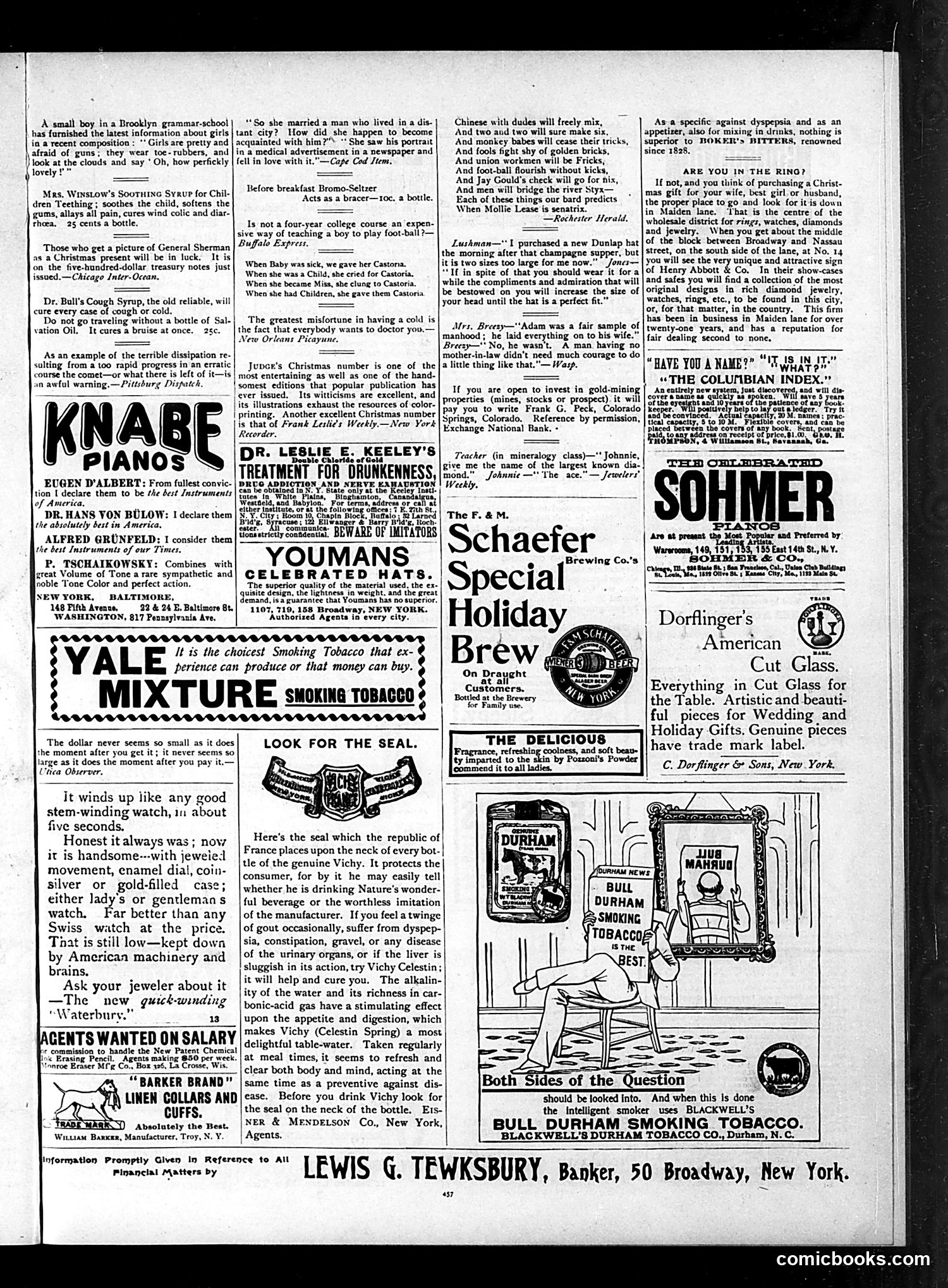
This page is primarily **advertising and filler content** from Judge magazine, a satirical weekly. The actual satirical content is minimal. The few humor items are brief, disconnected jokes: - A Brooklyn schoolboy's composition claiming girls wear "toe-rubbers" and fear guns - A woman who married a man after seeing his medical advertisement portrait - Light domestic humor about wives and husbands The page is dominated by **advertisements** for patent medicines (Bromo-Seltzer, Mrs. Winslow's Soothing Syrup, Castoria cough syrup), consumer goods (Knabe Pianos, Yale Smoking Tobacco, Sohmer glass), and financial services. These ads reflect late 19th/early 20th-century consumer culture. One ad warns against counterfeit Vichy water, suggesting consumer fraud was common. Another advertises gold-mining investment opportunities—typical of the era's speculative schemes. There is no coherent political satire or commentary on this particular page. It appears to be a standard issue mixing light humor with commercial advertising.
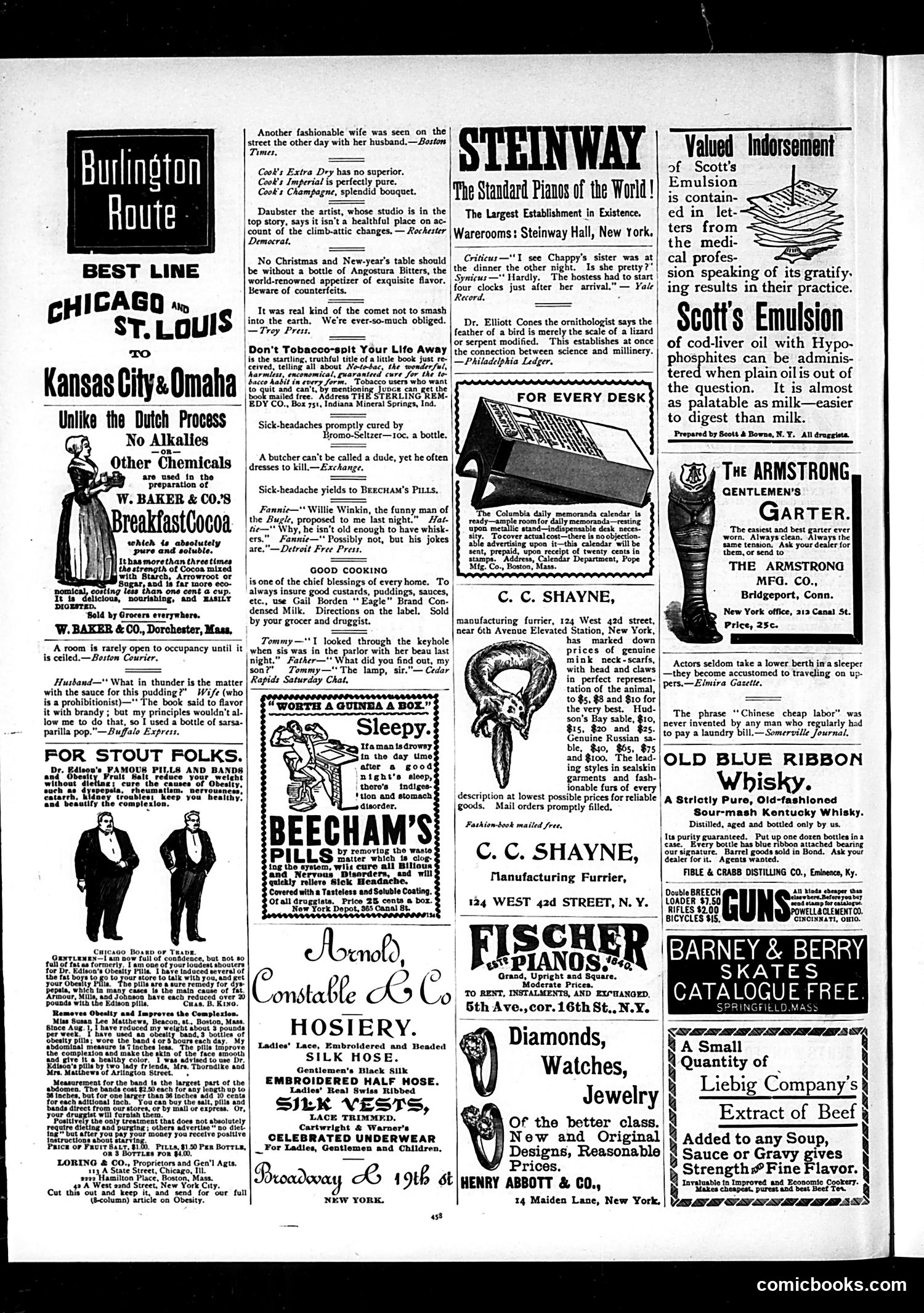
This page is primarily **advertisements** from a historical magazine, with minimal cartooning or political satire. The visible content includes small **humorous quips and jokes** scattered throughout—brief one-liners about contemporary life (e.g., a joke about a prohibitionist wife using sarsaparilla instead of brandy in cooking; a joke about a fashionable wife being seen with her husband, implying this was unusual). The page is dominated by **commercial ads** for products like W. Baker & Co.'s breakfast cocoa, Beecham's Pills, Gail Borden's condensed milk, and various other consumer goods typical of the late 19th/early 20th century. These ads use common marketing tactics of the era: health claims, endorsements, and competitive positioning. There is **no identifiable political cartoon or sustained satirical commentary** on this particular page—it functions primarily as advertising space with scattered light social humor interspersed among the ads.
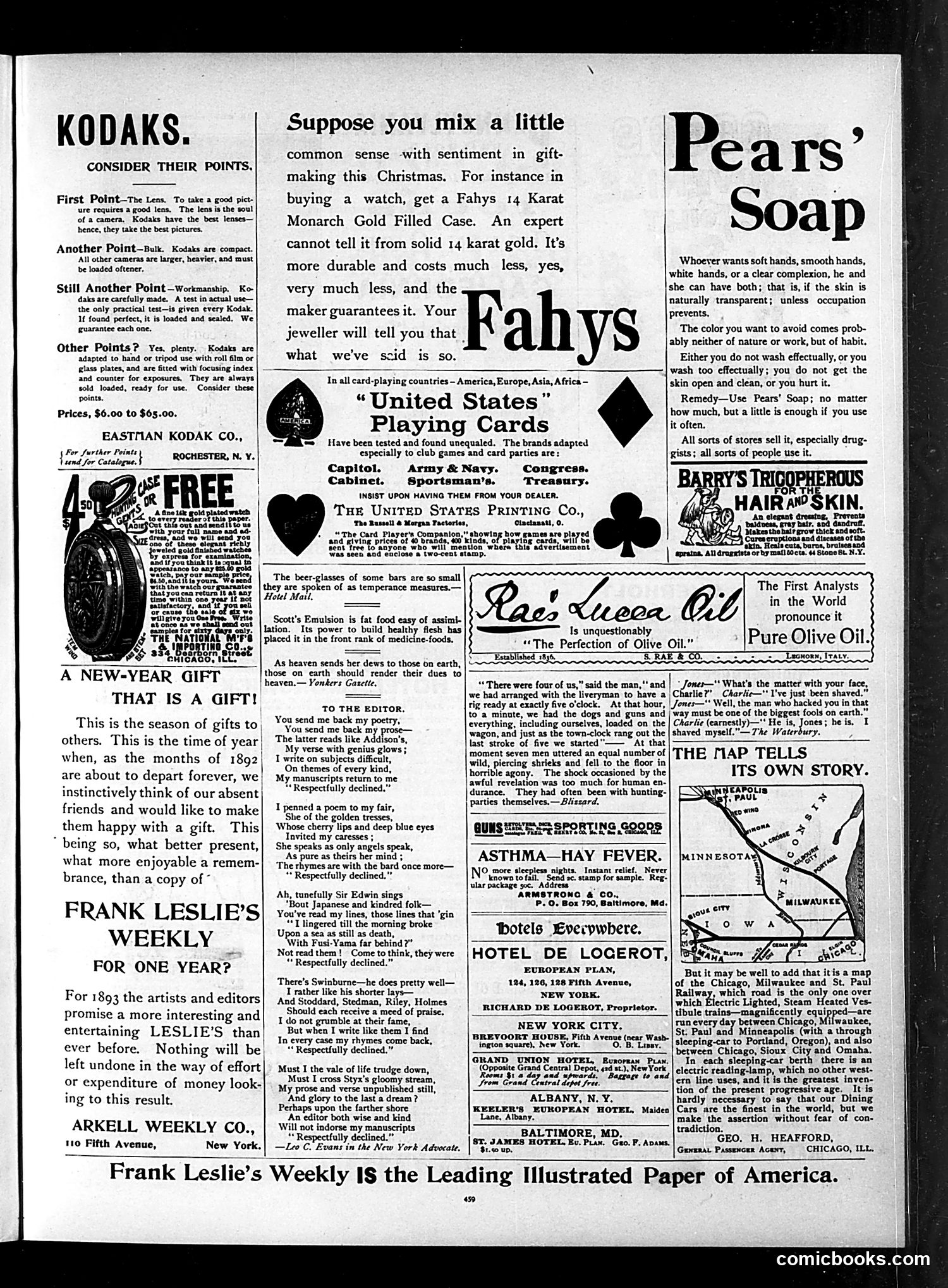
This page is primarily **advertising**, not political satire. It contains product advertisements for Kodak cameras, Fahys watches, "United States" playing cards, Pears' Soap, and other goods, interspersed with brief humorous quotes and notices. The only potentially satirical content appears in small filler items: a joke about bar beer-glasses being "temperance measures" (mocking temperance advocacy), and editorial notes. However, these are minor asides, not cartoons or sustained satire. The page reflects **1892-1893 consumer culture**, showcasing emerging technologies (Kodak cameras) and branded luxury goods marketed as gifts. The "Frank Leslie's Weekly" masthead indicates this is from that illustrated magazine, but this particular page serves mainly as an advertising vehicle rather than satirical commentary.
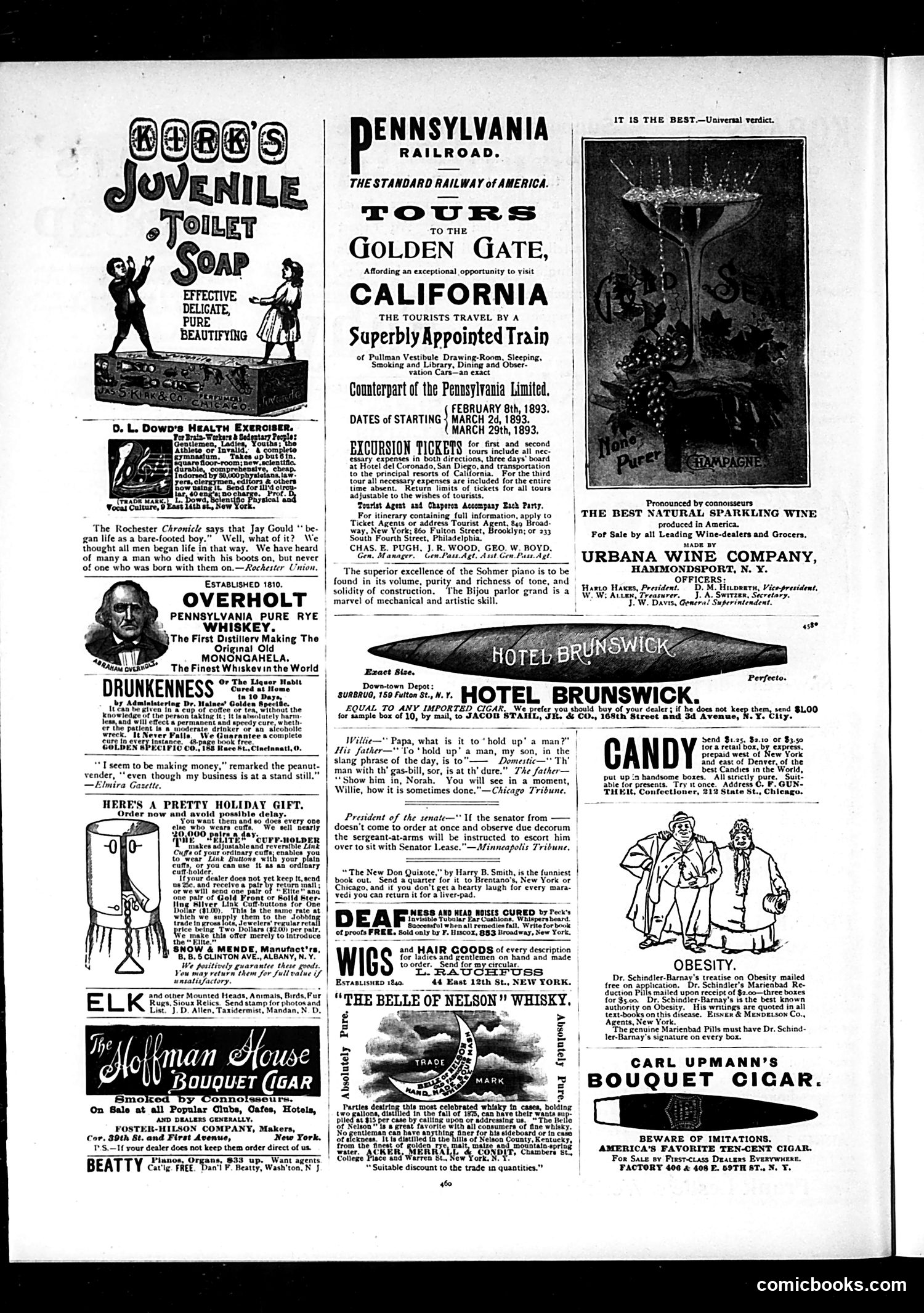
This page is primarily **advertising with minimal cartoons**. The small illustrated content includes: 1. **The Jay Gould joke** (top): A brief text commentary mocking millionaire Jay Gould's humble origins. The humor is about class—noting Gould went "barefoot" as a child, but the quip is that everyone starts in poverty, so this proves nothing remarkable. 2. **Small illustrations promoting products**: These include an Overholt Whiskey ad, a Golden Gate train tour advertisement, and various product advertisements (cigars, pianos, wigs, etc.). 3. **The "Drunkenness" cure ad** references Dr. Maines' treatment—a patent-medicine advertisement. The page is dominated by **commercial advertising** rather than political satire. Judge magazine mixed editorial content with paid ads. The few jokes present target wealthy figures like Gould or promote products humorously, typical of 1890s commercial magazines.
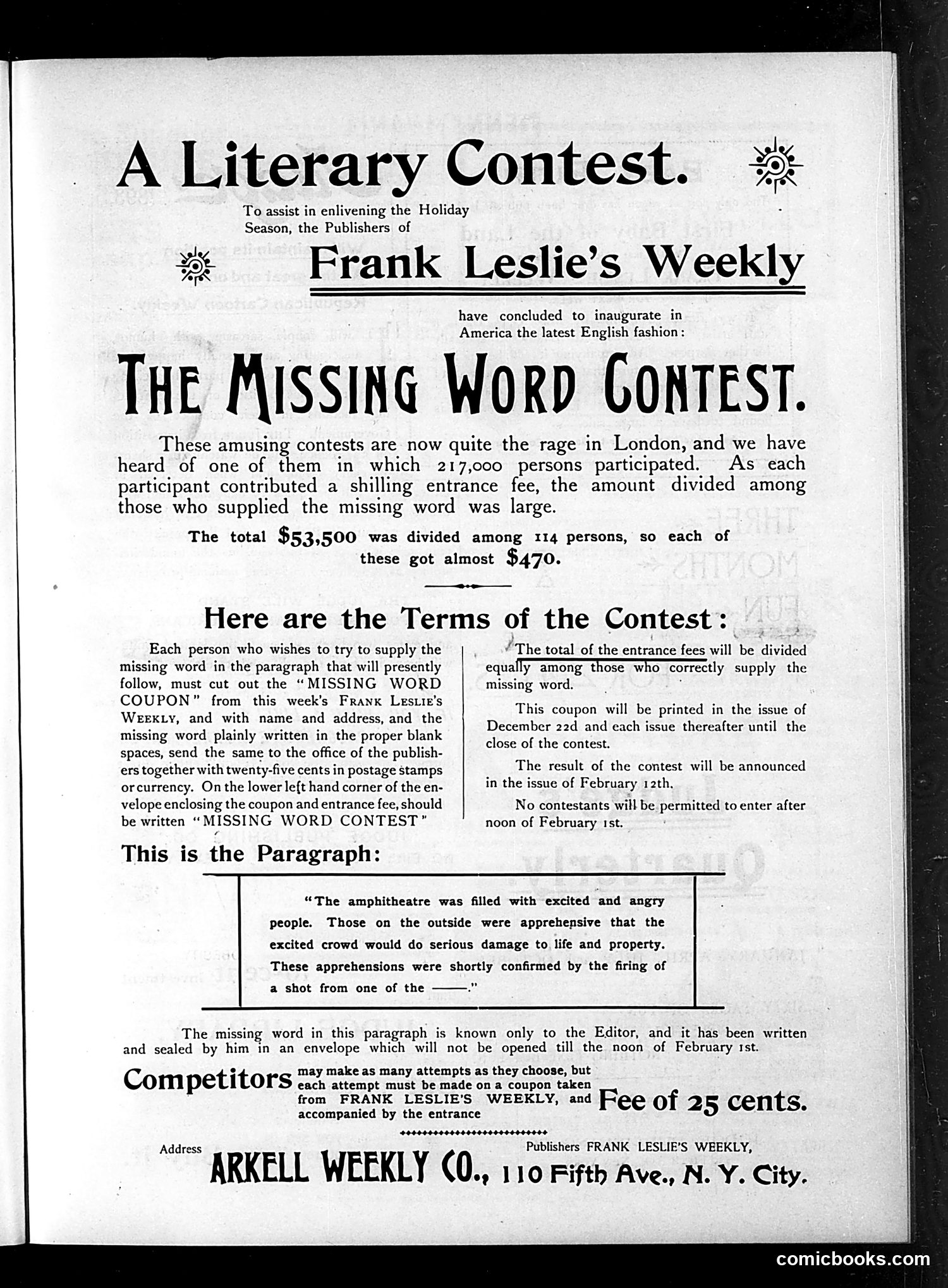
This page is primarily **advertising disguised as satire**. Frank Leslie's Weekly is promoting an actual literary contest (a "Missing Word" game imported from England) by having Judge magazine publish the announcement. The satire lies in the **implicit mockery of the contest itself**: Judge presents the London precedent—where 217,000 people paid entrance fees and only 114 winners shared $53,500—as absurdly profitable for publishers while offering meager individual payouts (~$470 each). The obscured word in the specimen paragraph (about violence in an amphitheater) remains deliberately vague, emphasizing the contest's gimmicky nature. The joke for Judge's readers: this is a thinly-veiled scheme to extract 25-cent entrance fees from numerous hopeful participants, most of whom will lose. By framing it as importing "the latest English fashion," the ad humorously highlights American enthusiasm for adopting questionable European trends. This is essentially a **house advertisement** with satirical framing rather than a standalone cartoon or comic strip.
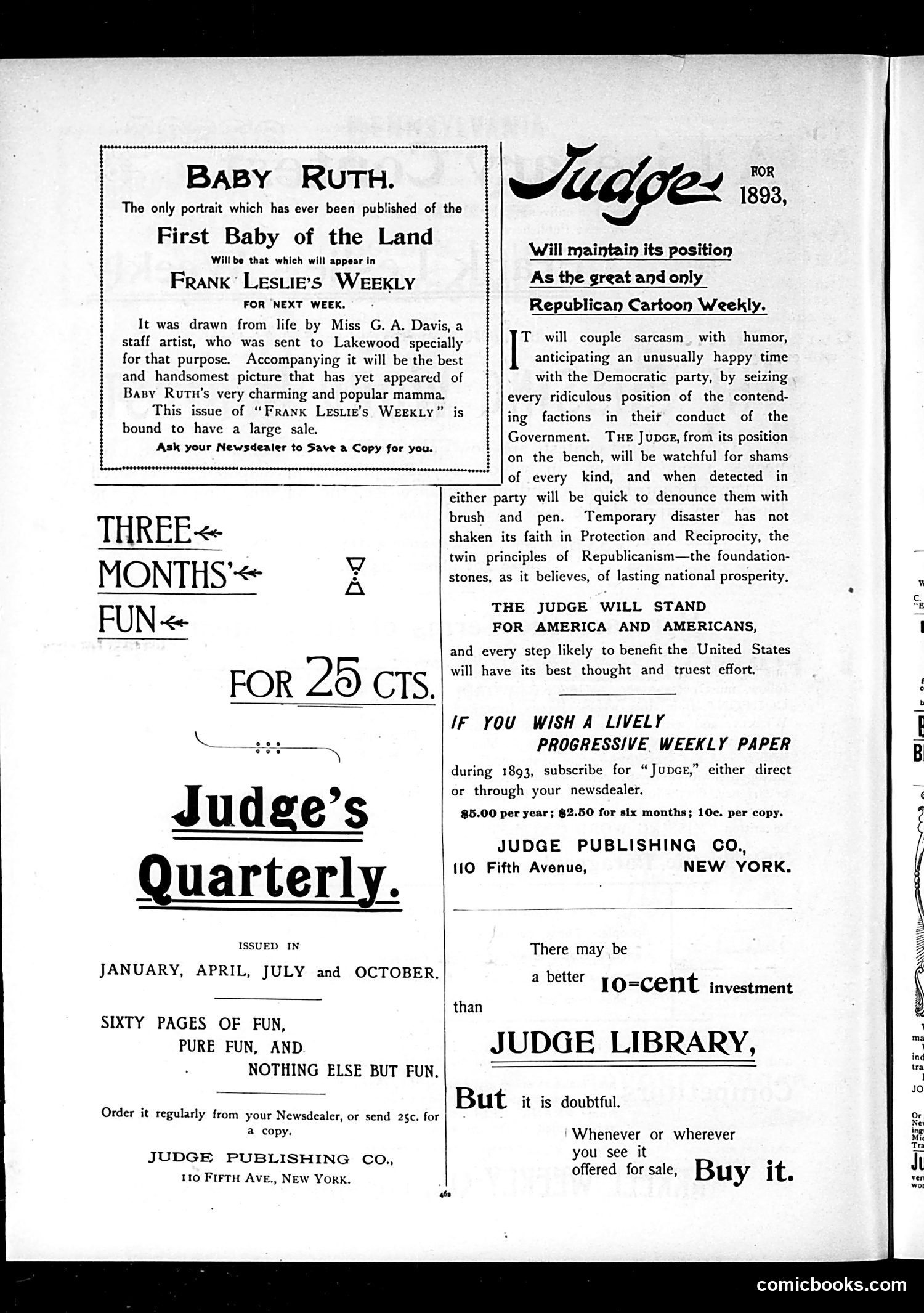
This page is primarily **advertising and promotional content** for Judge magazine itself, not political cartoons. The "Baby Ruth" announcement promotes an upcoming portrait in *Frank Leslie's Weekly* of President Cleveland's infant daughter—described as "the First Baby of the Land"—drawn from life by staff artist G.A. Davis. The main editorial section announces Judge's 1893 mission: as a "Republican Cartoon Weekly," it will use "sarcasm with humor" to attack Democratic positions while championing Republican principles of "Protection and Reciprocity." Judge pledges to act as watchdog against governmental corruption "either party," standing for "America and Americans." The remainder consists of **subscription pitches** for Judge's Quarterly (25 cents) and the Judge Library (10 cents), emphasizing their entertainment value. The tone is self-promotional rather than substantively political—the page markets the magazine's identity as humorous Republican advocacy.
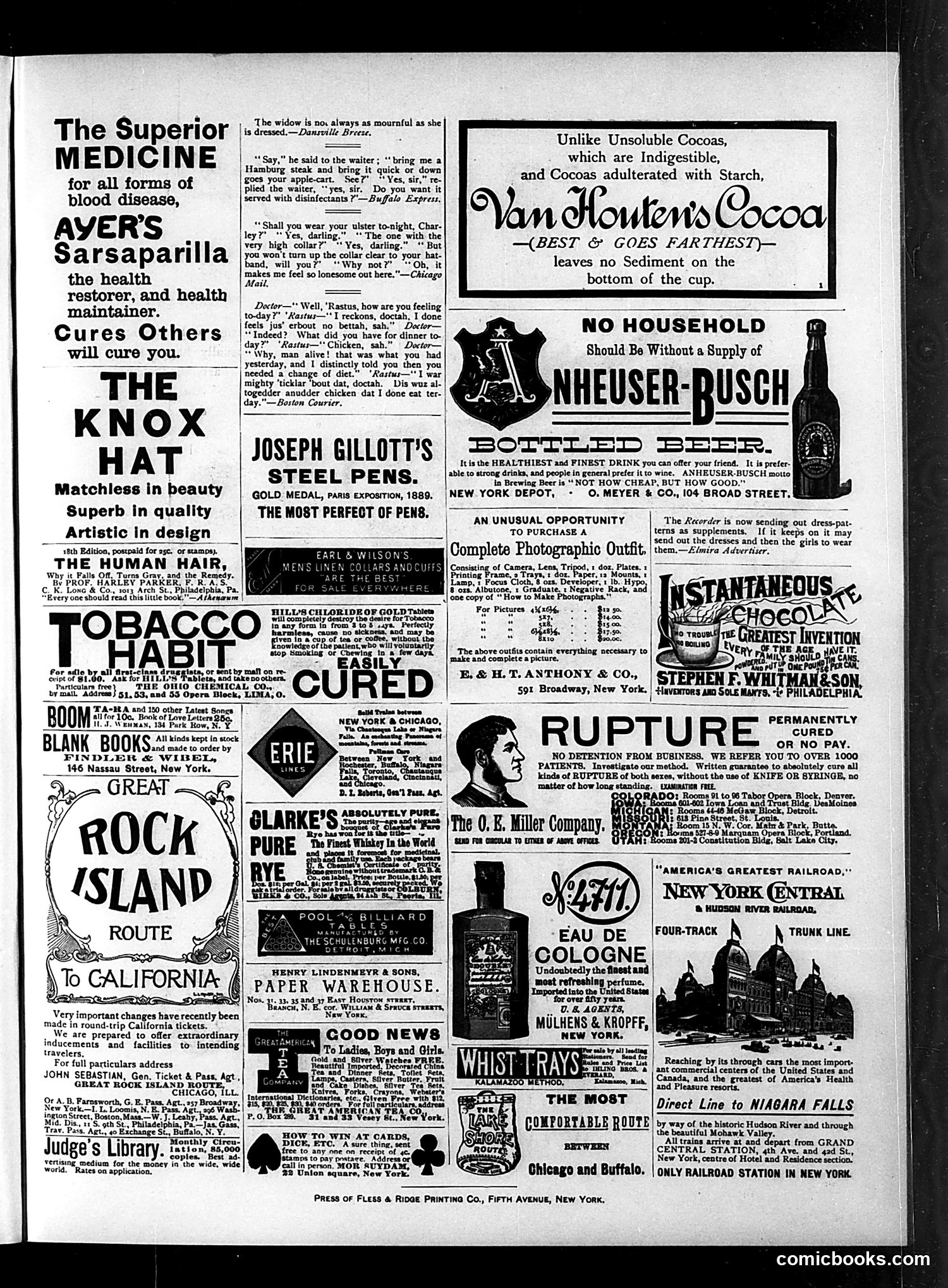
This page is primarily **advertisements** with small humorous filler pieces—typical of Judge magazine's format. The advertisements showcase 1890s patent medicines and consumer goods: Ayer's Sarsaparilla (claiming to cure "blood disease"), Hill's Chloride of Gold tablets (falsely claiming to cure alcoholism), and Clarke's Pure Rye whiskey. These represent the era's largely unregulated medicine market, where dubious remedies made extraordinary health claims. The small jokes scattered between ads reflect period humor: a waiter's sarcastic response about disinfectants, a racist dialect piece featuring "Rastus," and commentary on contemporary fashion (high collars, women's clothing). The page includes legitimate products too: Gillott's steel pens, Van Houten's cocoa, Anheuser-Busch beer, and railroad tickets to California—reflecting the consumer culture Judge's middle-class readers inhabited. The satire lies implicitly in Judge's acceptance of these ads: they mock the extravagant medical claims while profiting from them.
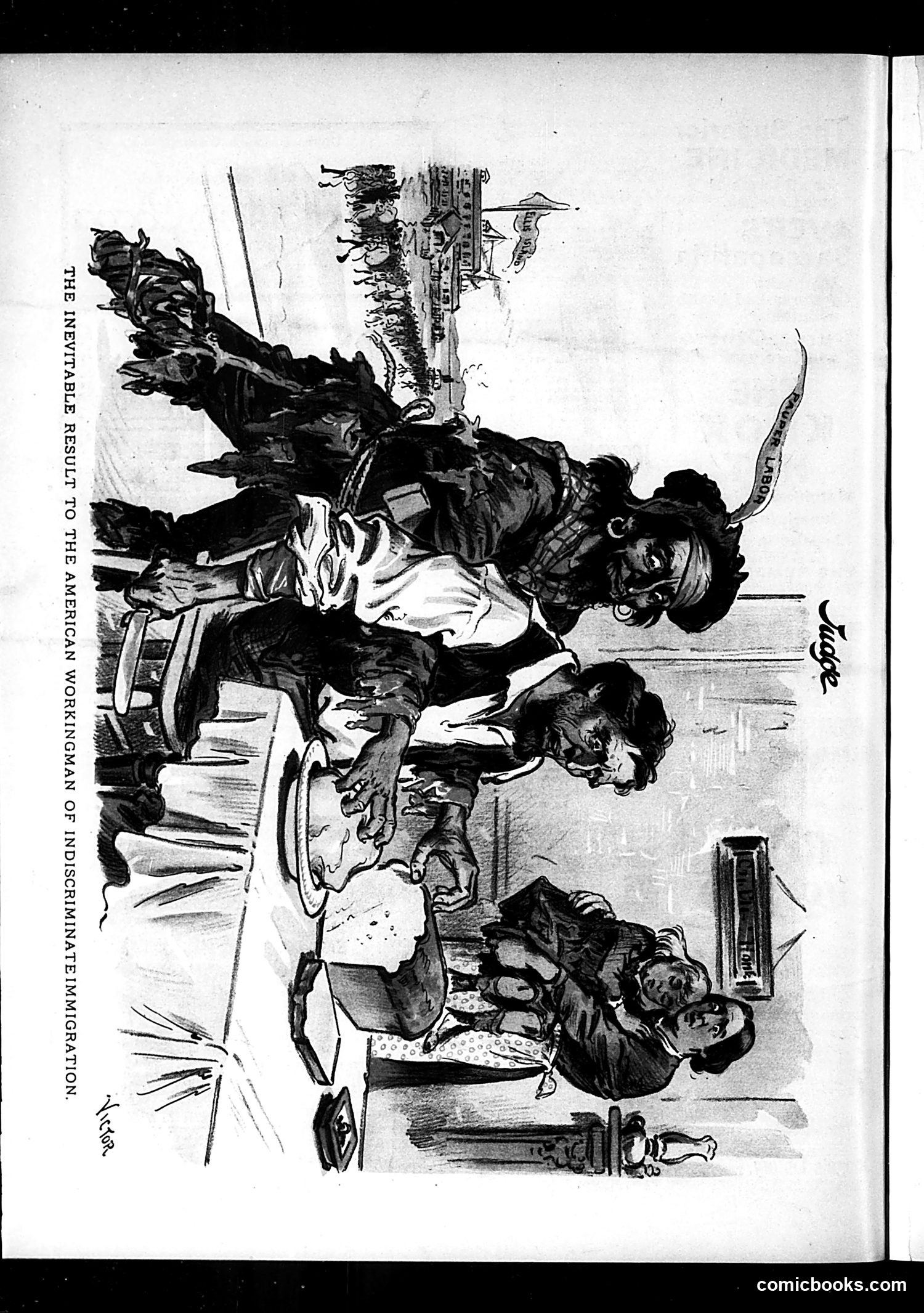
This political cartoon satirizes concerns about immigration's impact on American workers. The title states "The Inevitable Result to the American Workingman of Indiscriminate Immigration." The image depicts a chaotic street scene where impoverished immigrants (shown with exaggerated features typical of late-19th-century caricature) overwhelm American workers. A figure representing the American workingman appears displaced or struggling amid the crowd. The cartoon reflects period anxieties about wage depression and job competition from newly arrived immigrants, particularly from Southern and Eastern Europe. The satire argues that unrestricted immigration harms native workers' economic prospects. This reflects real contemporary labor debates, though the cartoon employs dehumanizing caricatures common to *Judge* magazine's editorial approach during this era of restrictionist sentiment.