
A complete issue · 16 pages · 1892
Judge — November 19, 1892
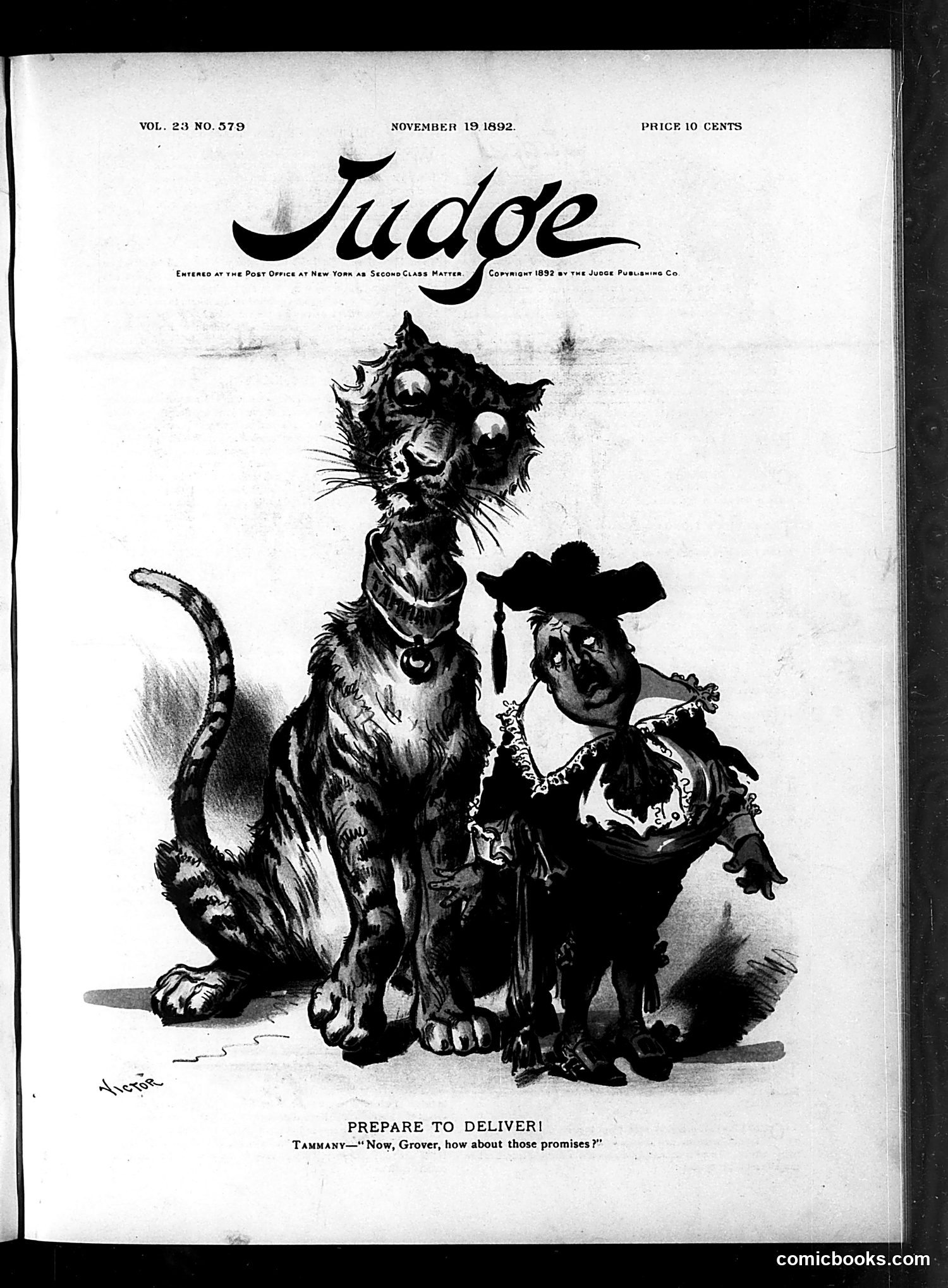
This 1892 *Judge* cartoon depicts a large, menacing cat confronting a small, formally dressed man (identified as "Tammany"). The caption reads: "Now, Grover, how about those promises?" **Context:** This satirizes Tammany Hall, the notoriously corrupt New York Democratic political machine. The "cat" likely represents either a threatening creditor or the consequences of broken campaign pledges. "Grover" refers to President Grover Cleveland, who was elected on reform promises. **The Satire:** The cartoon mocks the gap between campaign rhetoric and actual delivery—suggesting Cleveland faces pressure to fulfill promises, while Tammany Hall (symbolized as a predatory animal) looms as an obstacle or threat. The visual metaphor of a small man confronted by an enormous cat emphasizes Tammany's intimidating political power and the difficulty of genuine reform.
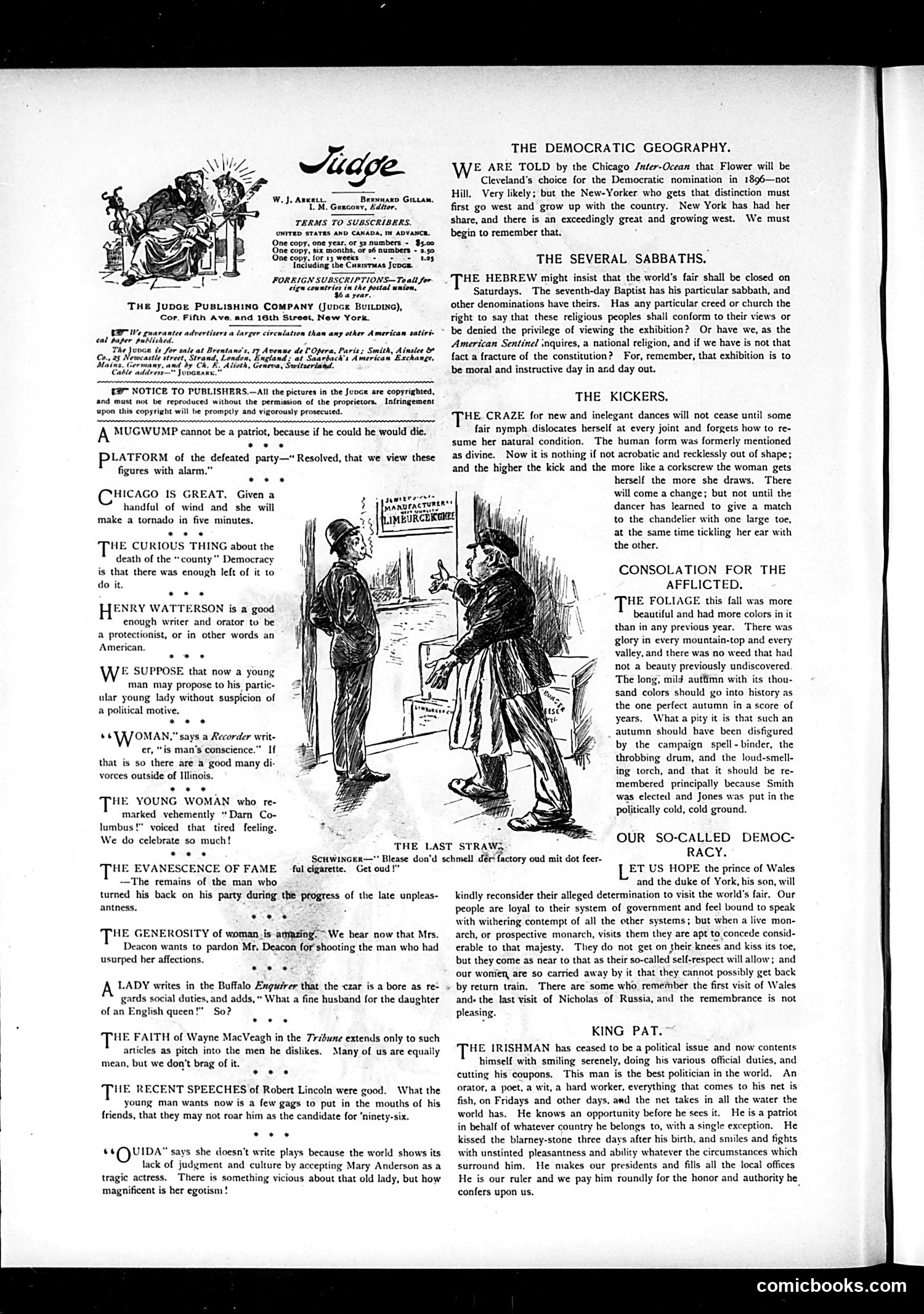
This page contains multiple political commentary sections rather than a single cartoon. The main illustrated piece shows two figures in what appears to be a "Last Straw" scenario—likely depicting a political disagreement or confrontation. The text sections critique various Democratic positions and figures. "The Democratic Geography" mocks Cleveland's western policy choices. "The Several Sabbaths" satirizes religious denominations' political affiliations. "King Pat" praises an Irishman (likely a political figure) for his pragmatic approach to politics and governance, suggesting he transcends partisan divisions. The overall tone attacks Democratic politics while celebrating practical, non-ideological leadership. Without clearer identification of specific figures or dates visible in the OCR text, precise historical context remains uncertain.
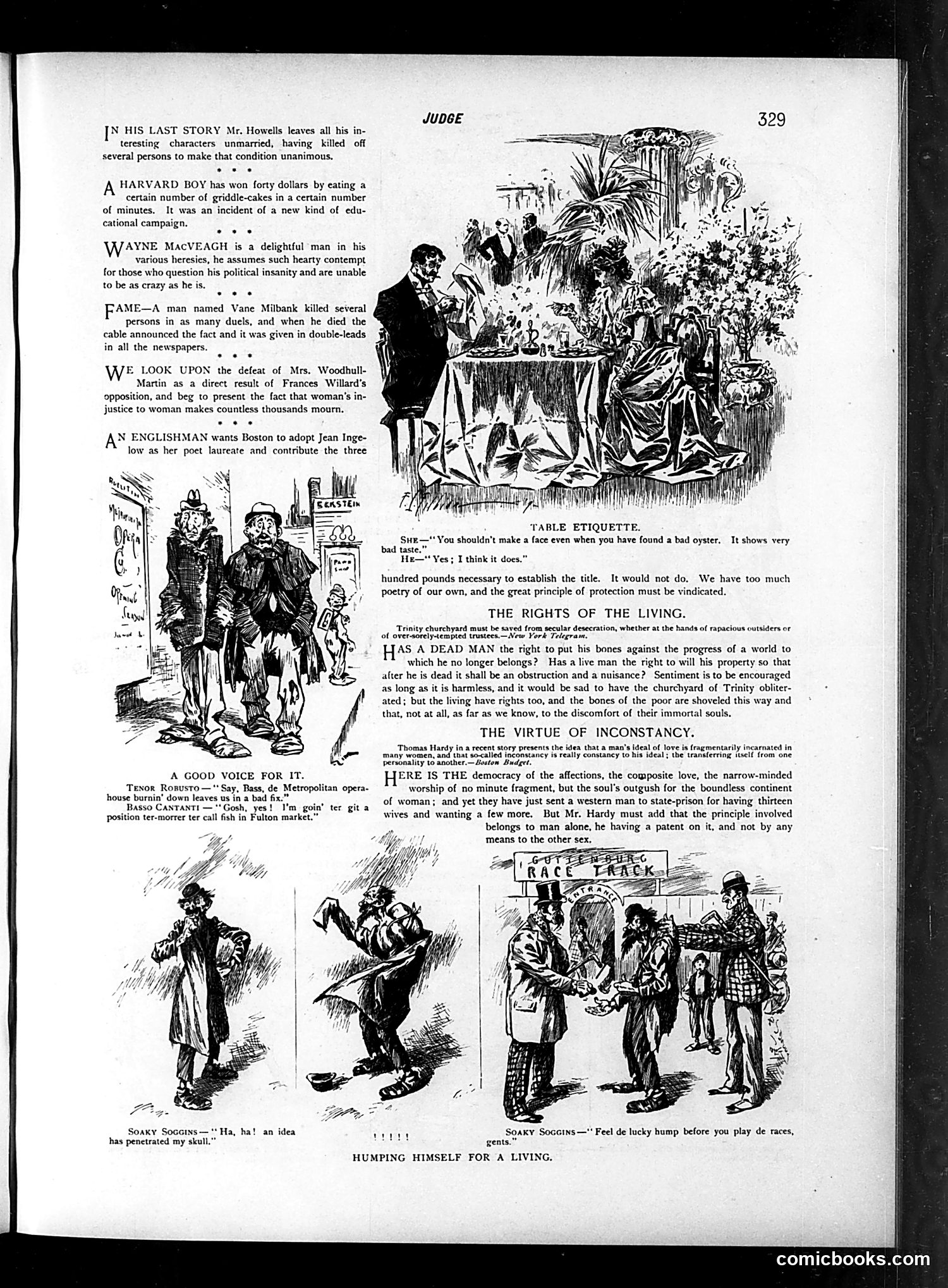
This page contains several short satirical pieces and cartoons typical of Judge's social humor. **"Table Etiquette"** depicts a formal dinner scene mocking pretentious dining customs—the caption ridicules making a face over a bad oyster, suggesting affected manners among the wealthy. **"The Rights of the Living"** and **"The Virtue of Inconstancy"** appear to be philosophical essays critiquing social hypocrisy, discussing churchyard disputes and romantic inconsistency respectively. **"Humping Himself for a Living"** shows lower-class street characters (Soaky Soggins) in comic sketches—one attempting to manipulate a wealthy person, another at a racetrack—satirizing working-class desperation and schemes for survival during what appears to be the early 20th century. The overall tone mocks both upper-class pretension and lower-class hustling.
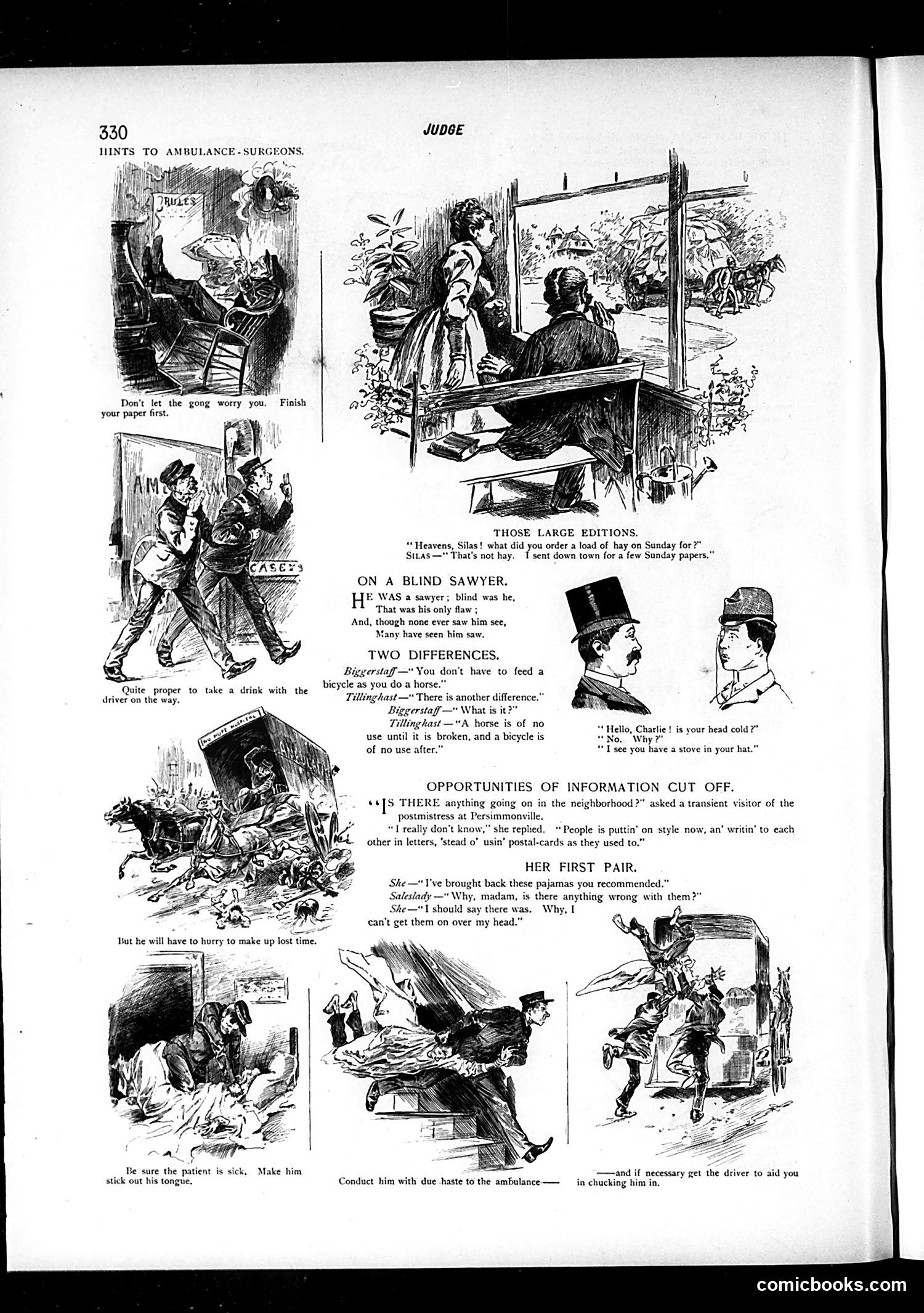
This page from *Judge* contains several unrelated satirical sketches typical of late-19th/early-20th-century American humor: **"Those Large Editions"** mocks Sunday newspaper consumption—a farmer orders what appears to be hay but is actually a massive stack of Sunday papers, satirizing the era's explosive growth in newspaper publishing and readership. **"On a Blind Sawyer"** is a pun-based joke playing on homophones ("saw" as both tool and past tense of "see"). **"Two Differences"** jokes about bicycles versus horses during the bicycle craze period, when bicycles were replacing horses for transportation. **"Opportunities of Information Cut Off"** satirizes changing communication habits—a postmistress notes people now write private letters instead of postcards, cutting off her access to neighborhood gossip she previously enjoyed reading. **"Her First Pair"** plays on a newlywed's confusion about pajamas, suggesting naïveté about proper dress. The "Hints to Ambulance-Surgeons" sketches offer crude medical humor about patient handling.
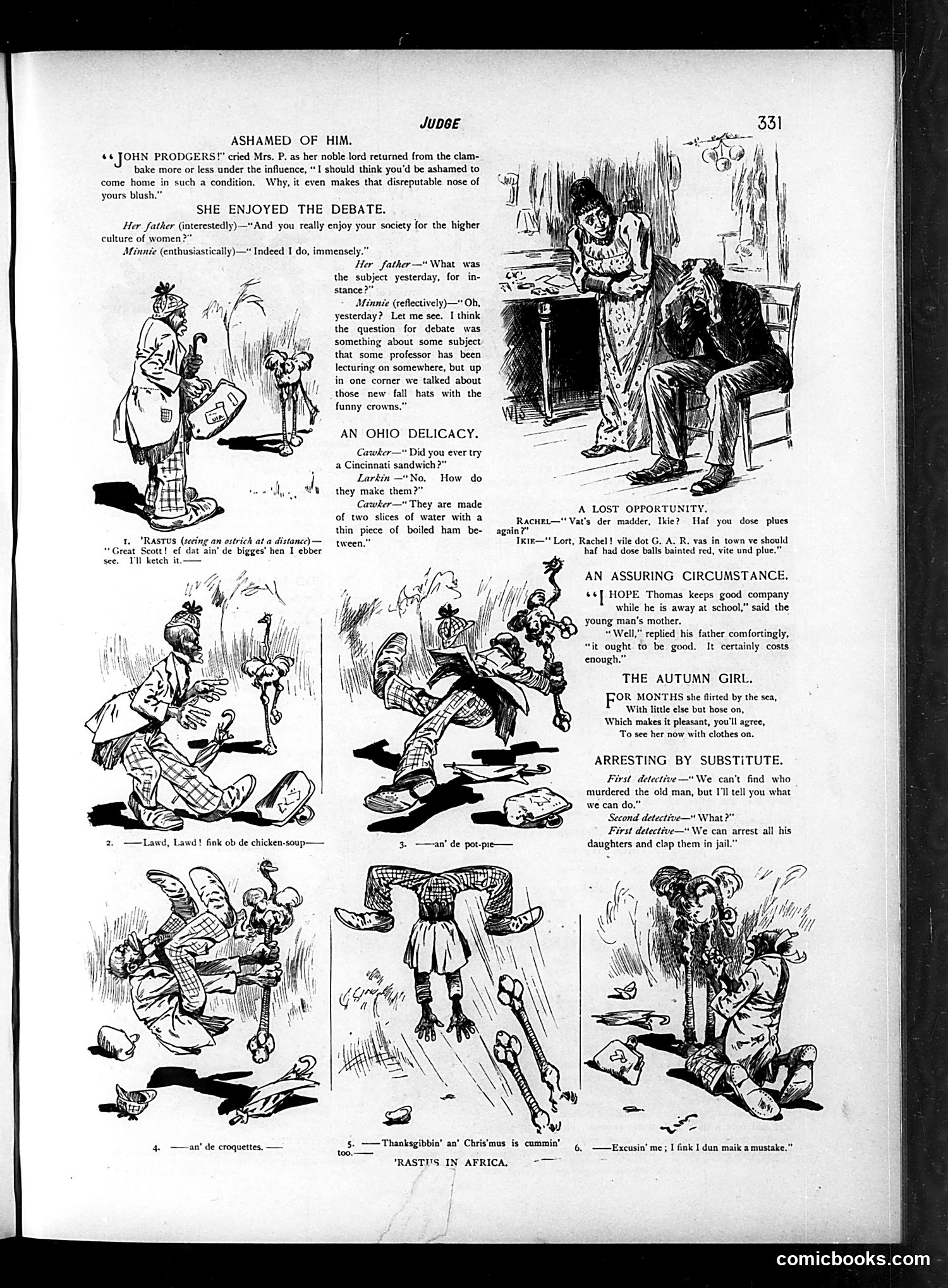
This page contains multiple unrelated comic sketches and jokes typical of Judge magazine's format: **"Ashamed of Him"**: A drunk man returns home; his wife shames him by noting his nose blushes at his disreputable condition. **"She Enjoyed the Debate"**: Satire on women's "culture" societies—a daughter claims to attend intellectual debates but admits the real discussion was about fashionable fall hats with unusual crowns. **"An Ohio Delicacy"**: A joke about Cincinnati sandwiches made with water and boiled ham—mocking the city's food. **Various sketches**: Racist caricatures of Black characters ("'Rastus") in absurd situations (mistaking an ostrich for a hen, speaking broken English). The bottom sketches use heavy dialect humor common to period entertainment. **Other shorts**: Brief comedic vignettes on unrelated topics (an assuring circumstance about school expenses, autumn fashion humor). The page reflects Judge's satirical approach: mocking social pretension, regional differences, and relying heavily on ethnic/racial stereotypes considered acceptable humor in this era.
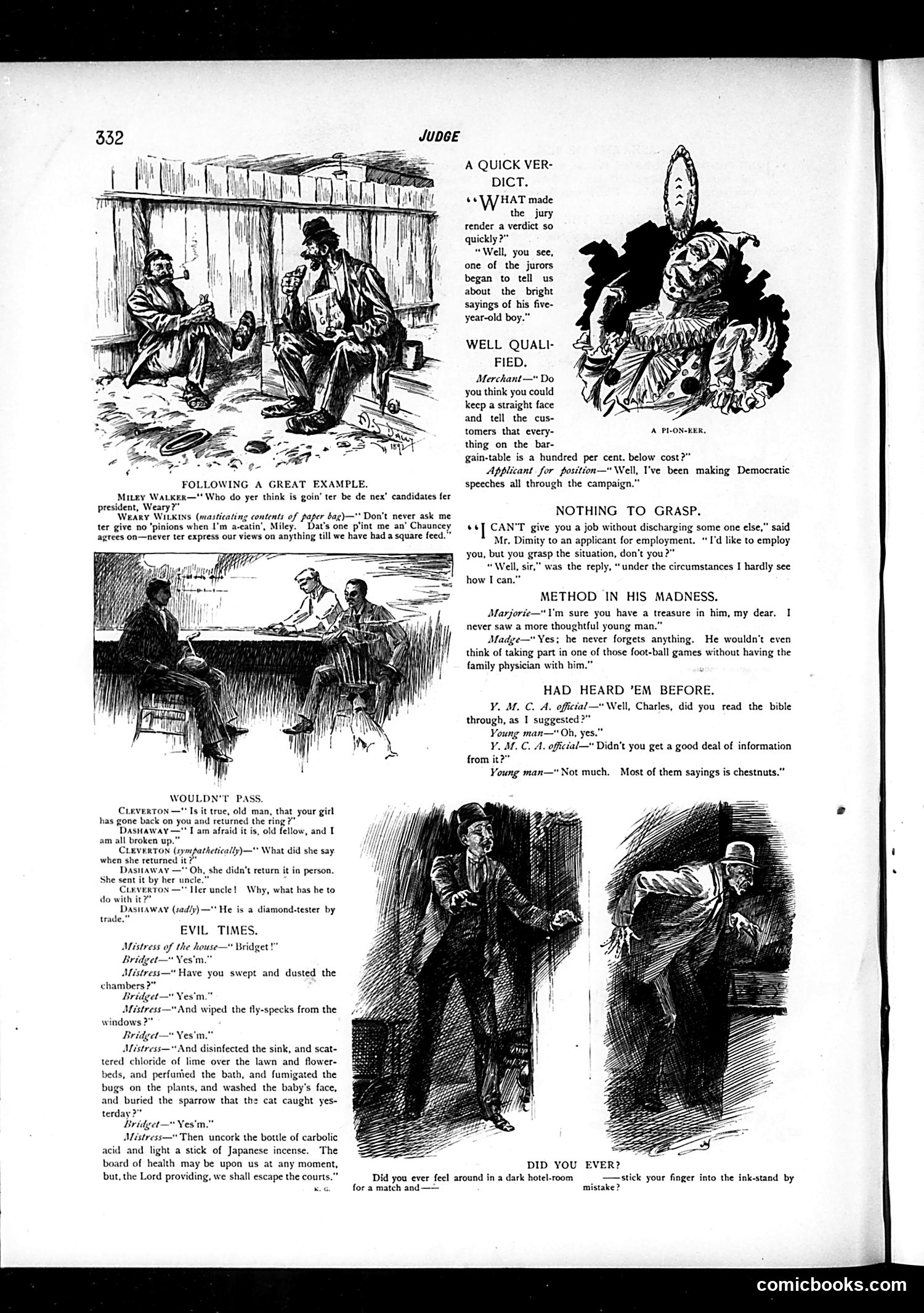
This page collects multiple short satirical jokes typical of Judge's format: **Political Content:** "Following a Great Example" references the 1892 presidential campaign, comparing Democratic speechmaking to Chauncey Depew's famous principle of never expressing opinions without "a square feed" (full stomach). The joke mocks Democratic campaign rhetoric as hollow. **Social Satire:** Other jokes target contemporary concerns—a merchant hiring someone to lie about discount prices (Democratic politicians as natural liars), a job applicant claiming experience making speeches, and various domestic/servant humor. **General Humor:** Several jokes mock everyday situations: juries distracted by tedious anecdotes, overzealous housekeeping during health board anxiety, romantic rejection via a diamond-tester uncle, and the universal experience of accidentally sticking one's finger in an inkwell in darkness. The illustrations are crude woodcuts typical of 1890s satirical magazines. The overall tone combines class-conscious humor, political mockery of Democrats, and relatable domestic comedy aimed at middle-class readers.
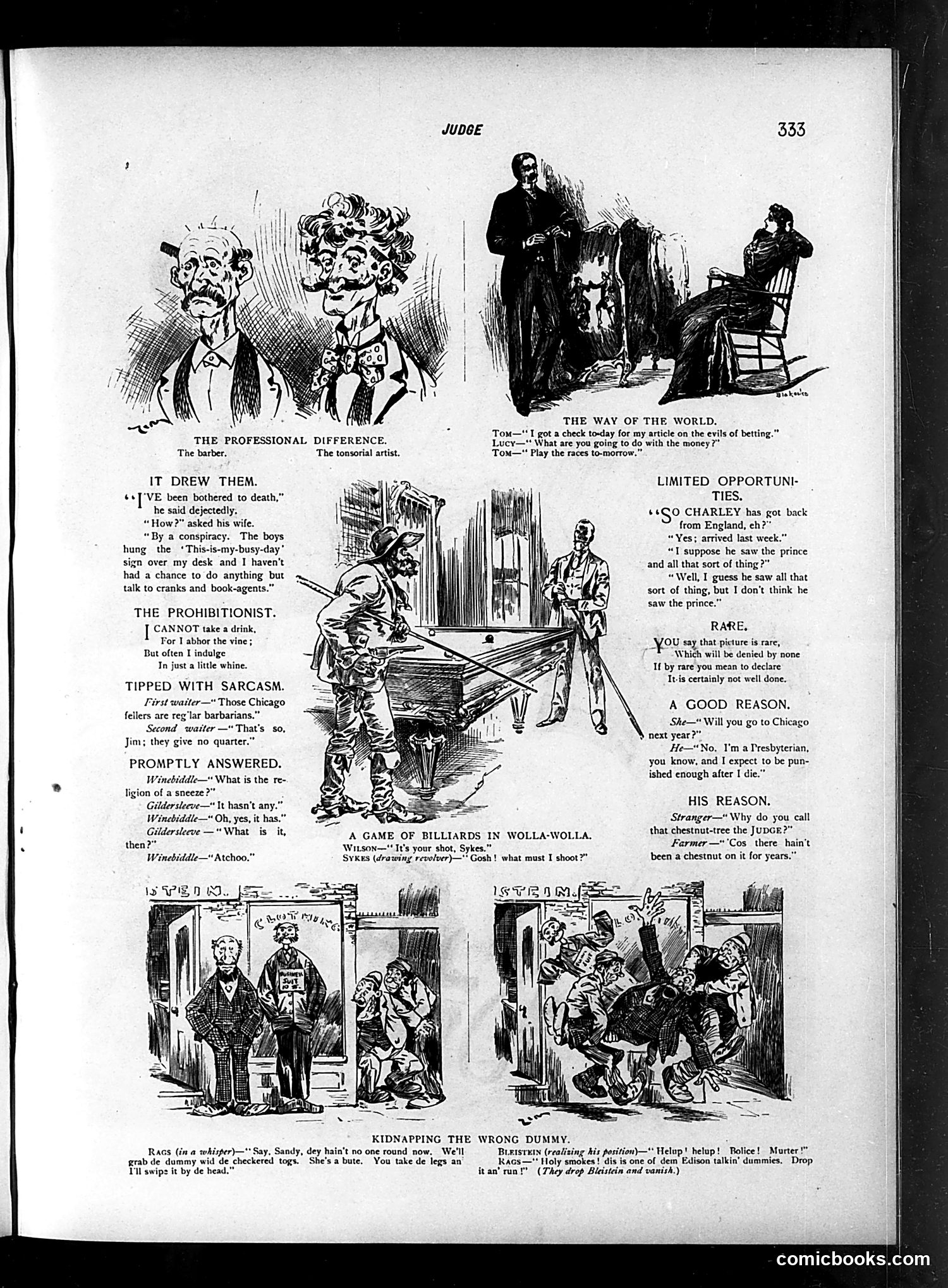
This page contains multiple brief satirical sketches typical of Judge magazine's humor circa early 1900s. **Key pieces:** "The Professional Difference" contrasts a barber and "tonsorial artist"—mocking how professionals use fancy terminology for identical work. "It Drew Them" satirizes a man pestered by "cranks and book-agents"—social commentary on nuisance visitors. "The Prohibitionist" jokes that while refusing alcohol, the prohibitionist indulges in "whining"—mocking temperance advocates as hypocritically complaining. "Tipped with Sarcasm" contains an ethnic slur about "Chicago fellers" being "barbarians." "The Way of the World" ironically depicts someone receiving payment for an anti-gambling article, then gambling away the money. "Kidnapping the Wrong Dummy" depicts criminals mistakenly abducting an Edison talking dummy instead of a person—topical humor referencing Edison's recent phonograph technology as novelty entertainment. The humor relies on wordplay, irony, and contemporary social anxieties about technology, temperance, and labor.
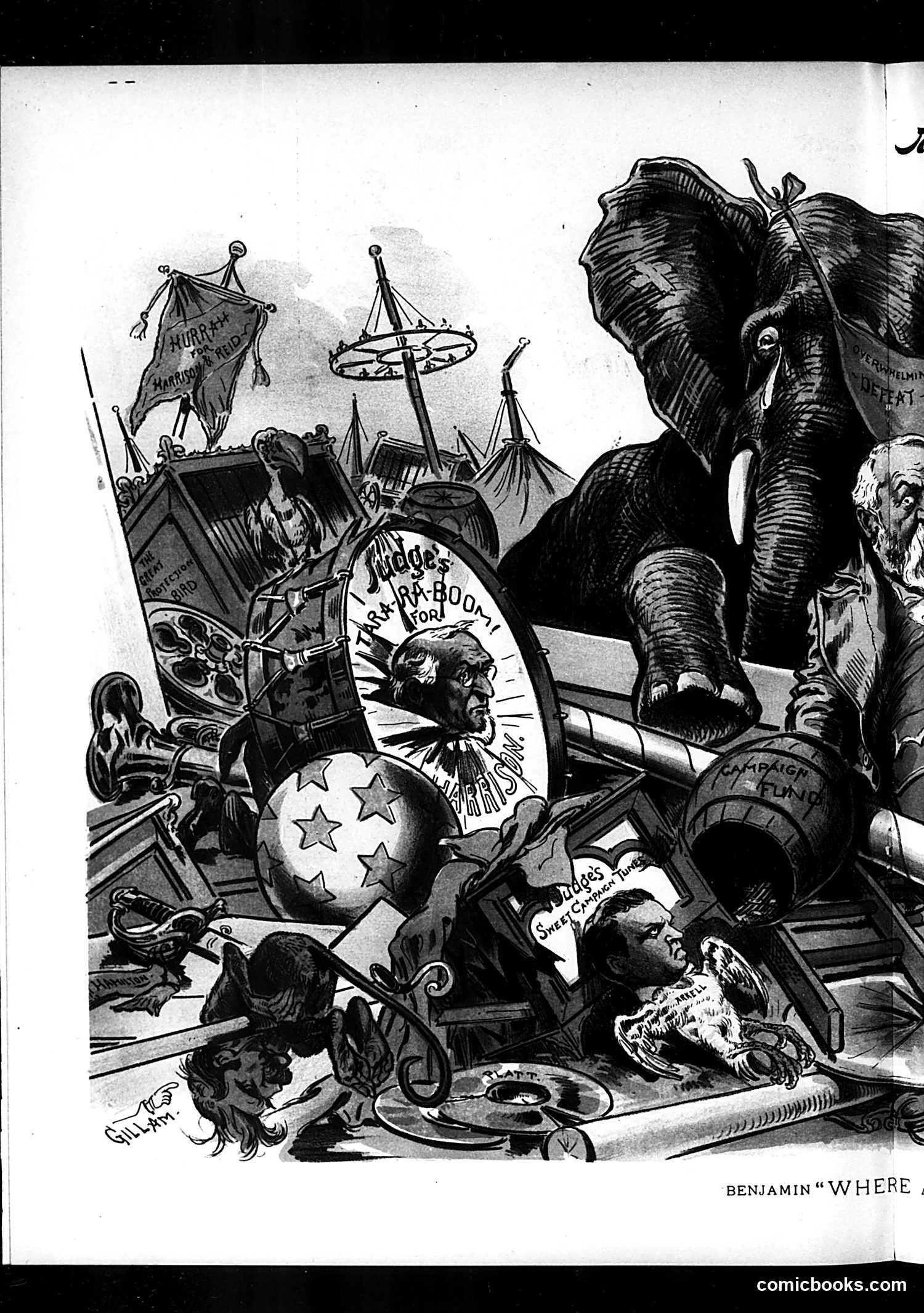
This appears to be a satirical cartoon from *Judge* magazine depicting a large elephant (the Republican Party symbol) surrounded by carnival/circus imagery and various labeled elements related to political campaigns and fundraising. Visible text references include "Campaign Fund," "Hurrah," and what appears to be "Where" (possibly incomplete). The composition suggests critique of Republican campaign spending or carnival-like spectacle in politics. The carnival setting—with tents, wheels, and performers—satirizes the "circus" nature of political campaigning, likely from the early 20th century based on the style. The elephant presides over this chaotic scene of political machinery and fundraising apparatus. Without clearer OCR text or a visible date, specific figures remain unclear, but the general satire critiques the theatrical, expensive nature of political campaigns.
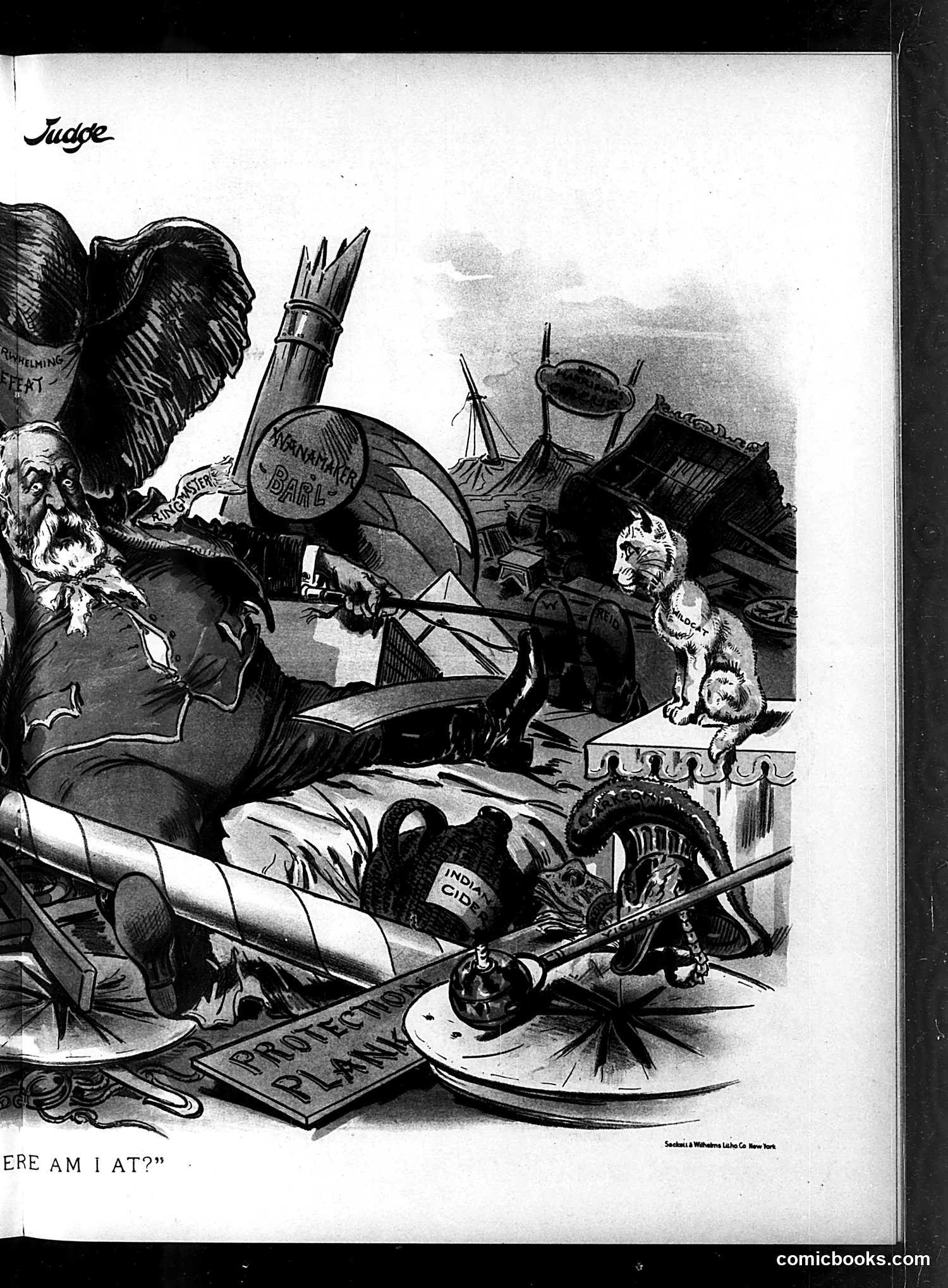
This appears to be a satirical cartoon from *Judge* magazine titled "Where Am I At?" The image depicts a bearded man (likely a political figure or symbol of authority) surrounded by chaotic debris including ships, weapons, and various objects labeled with what appear to be references to conflicts or colonial ventures. A cat or similar animal sits nearby observing the scene. The cartoon likely critiques American imperial ambitions or foreign policy entanglements—possibly related to naval expansion, colonial acquisitions, or military interventions. The figure's confused question "Where am I at?" suggests satire about unclear or contradictory foreign policy objectives. Without clearer text labels on the scattered objects or date information, specific historical context remains uncertain, but the imagery points to anxieties about America's growing international military involvement.
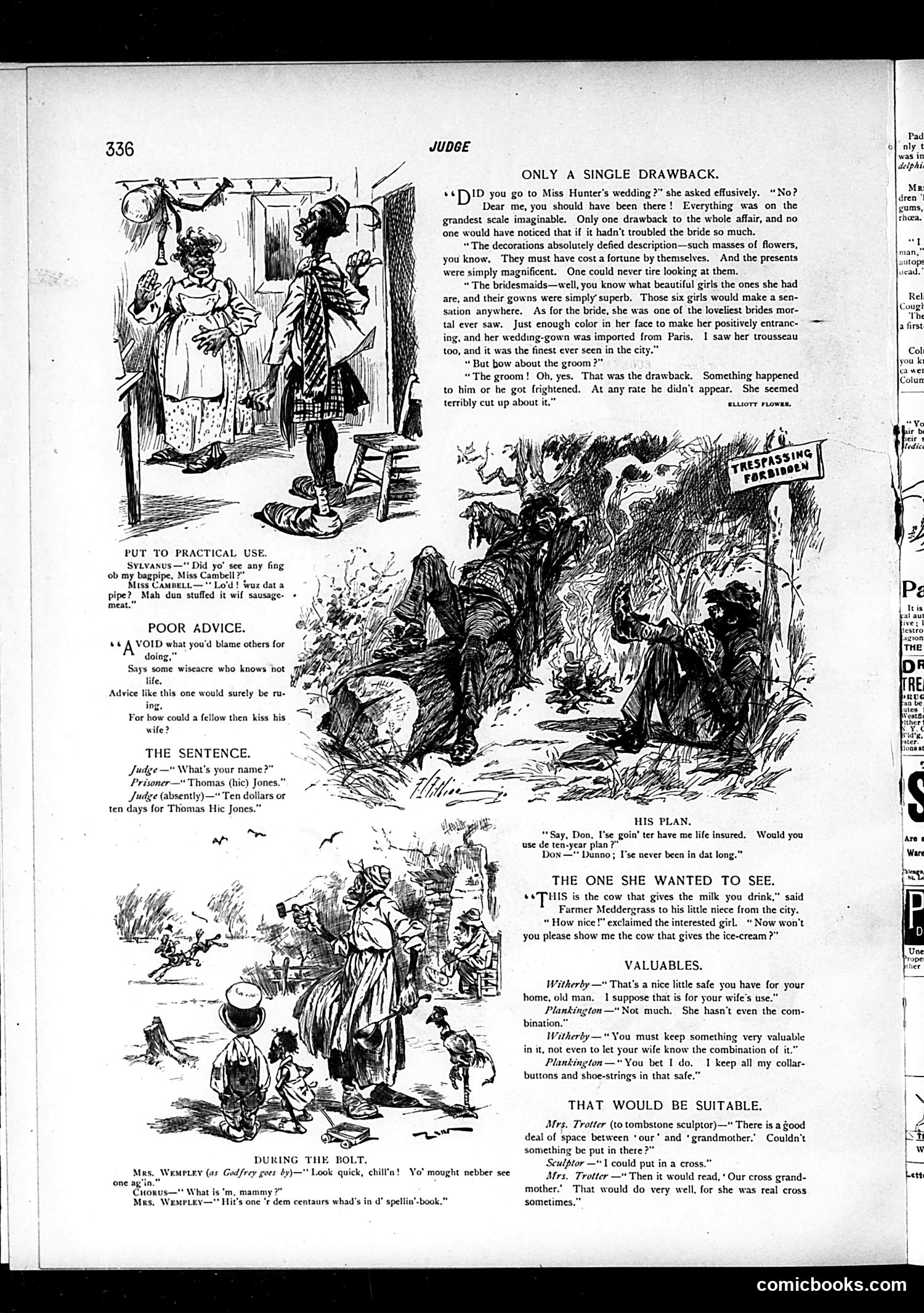
This page contains multiple short humorous sketches typical of Judge magazine's satirical format: **"Only a Single Drawback"** mocks wedding excess—a bride has lavish decorations, bridesmaids, imported gown, and trousseau, but the groom fails to appear. The joke satirizes how the wealthy obsess over material details while the actual marriage collapses. **"The Sentence"** is a simple pun: a drunk prisoner named "Thomas (hic) Jones"—"hic" being a hiccup sound—gets sentenced for the name as read literally. **"The One She Wanted to See"** jokes about urban ignorance: a city girl, shown a cow producing milk, naively asks to see the cow that produces ice-cream. **"Valuables"** mocks marital discord—a man keeps his safe locked from his wife, claiming only collar-buttons inside, implying he distrusts her completely. **"That Would Be Suitable"** features wordplay where a widow wants space on her tombstone; adding a cross makes it read "Our cross grandmother"—she was literally ill-tempered. The sketches reflect period concerns: marriage troubles, class pretension, rural-urban divide, and spousal distrust.
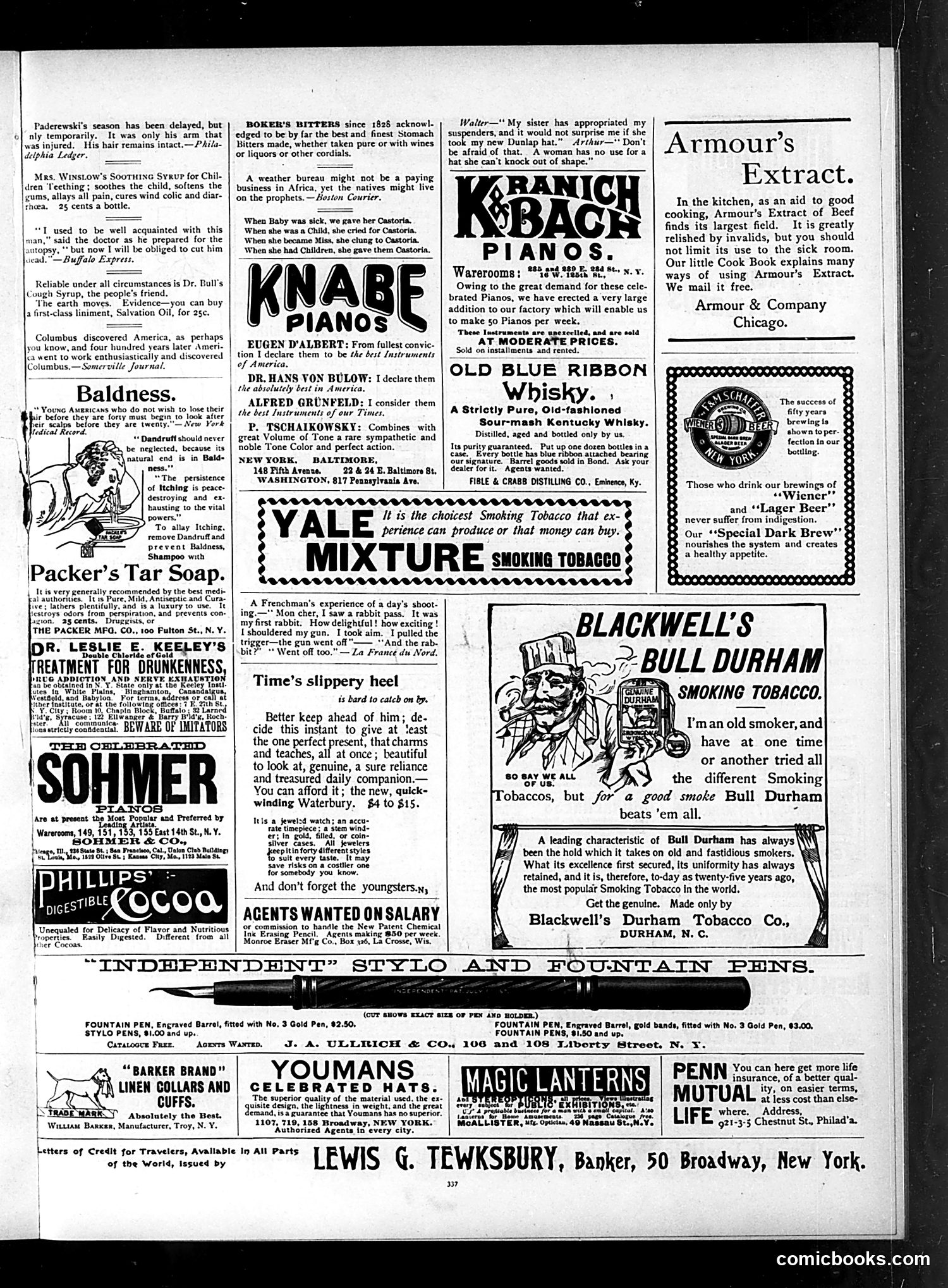
This page from *Judge* magazine is primarily filled with **advertisements** from the Gilded Age (late 1800s), with only scattered brief satirical items. **Identifiable content:** The main satirical text concerns **Ignacy Jan Paderewski**, the famous Polish pianist and composer who was a major celebrity of the era. A joke mocks that "Paderewski's season has been delayed" due to an arm injury, but jokes that his hair remained intact—referencing Paderewski's famously distinctive long, flowing hair, which was nearly as celebrated as his musical talent. The humor lies in absurdly suggesting his iconic hair mattered more than his performing ability. Another brief item jokes about a doctor preparing a "topsy" (autopsy), using dark early American humor. **Context:** The page shows how 19th-century magazines mixed serious advertisements with lightweight humor. The ads target wealthy readers (pianos, whisky, jewelry) and reflect period health obsessions (baldness remedies, "bitters" tonics).
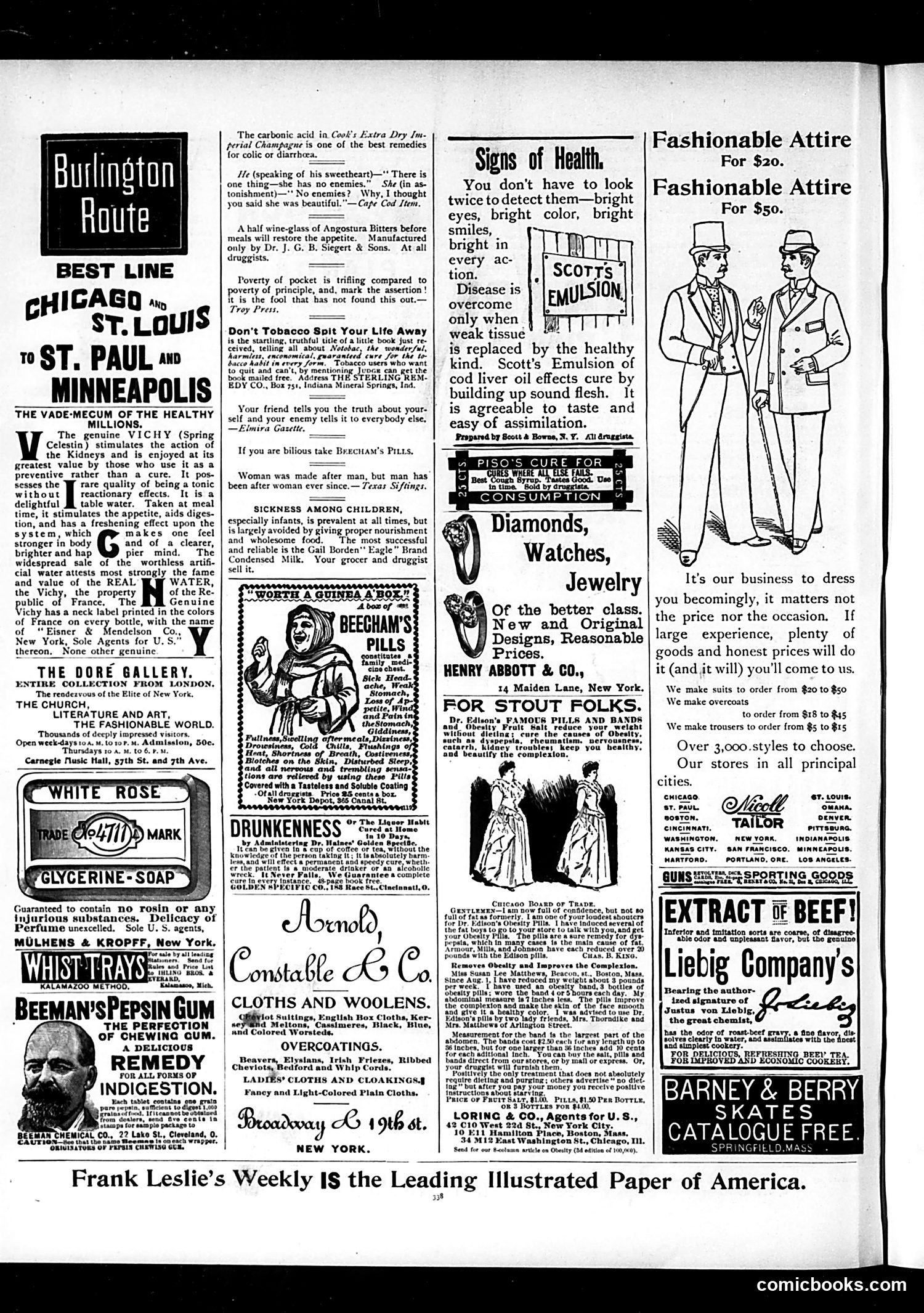
This page is primarily **advertising**, not editorial cartoon content. It's a turn-of-the-century (appears early 1900s) compilation of patent medicines, commercial products, and services. The ads reflect era-specific concerns and medical misconceptions: - **"Signs of Health"** promotes Scott's Emulsion (cod liver oil), marketed as a cure-all for building "sound flesh" - **Beecham's Pills** claim to treat "all forms of indigestion" - **Piso's Cure** advertises for consumption (tuberculosis) - **Liebig Company's Extract of Beef** for vitality - Various remedies for tobacco addiction, drunkenness, and digestive issues Notable is the **casual promotion of dangerous substances**: Angostura Bitters before meals, carbolic acid for infant colic, and unregulated "remedies" lacking any scientific basis. The page also includes clothing merchants and jewelry advertisements, showing how Judge mixed editorial and commercial content. The only humor visible is minor social commentary in short quoted quips scattered throughout.
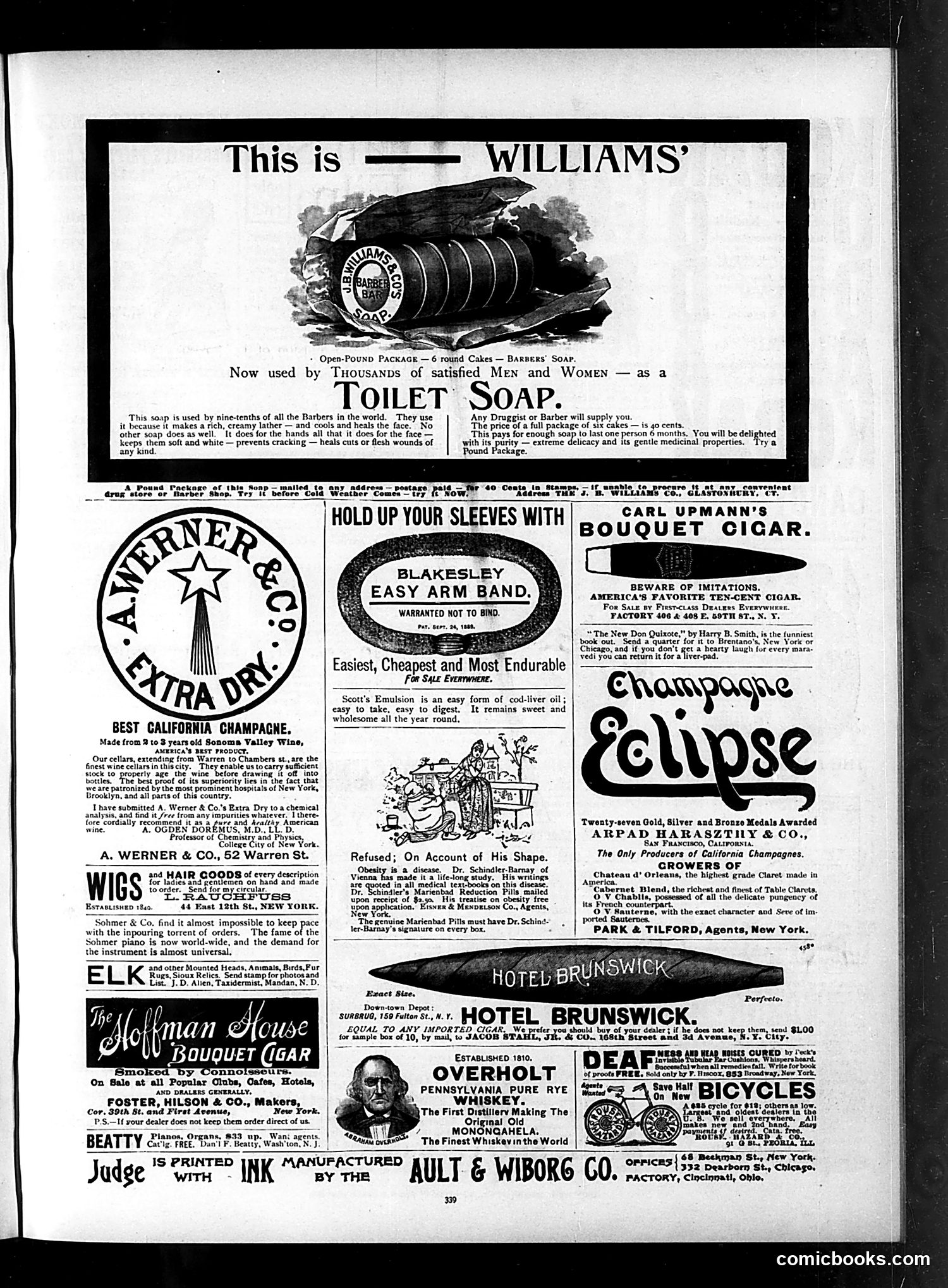
This page is primarily **advertisements** from late 19th-century American businesses, not political satire. Judge was a humor magazine that relied heavily on advertising revenue. The ads showcase products typical of the era: Williams' Barber Soap (marketed to both men and women for toilet use), California champagne, cigars (Bouquet, Hoffman House), hair goods, pianos, taxidermied animal heads, arm bands, and—notably—"Dr. Schindler's Marienbad Reduction Pills" for obesity treatment. One ad includes a small cartoon labeled "Refused; On Account of His Shape," showing a rotund figure rejected due to obesity, which was treated as a medical condition requiring pills. The page reflects Gilded Age consumer culture and emerging patent medicine marketing. There is **no identifiable political cartoon or satire** on this page—it's a commercial space demonstrating how Judge financed itself and what products advertisers believed appealed to the magazine's affluent readership.
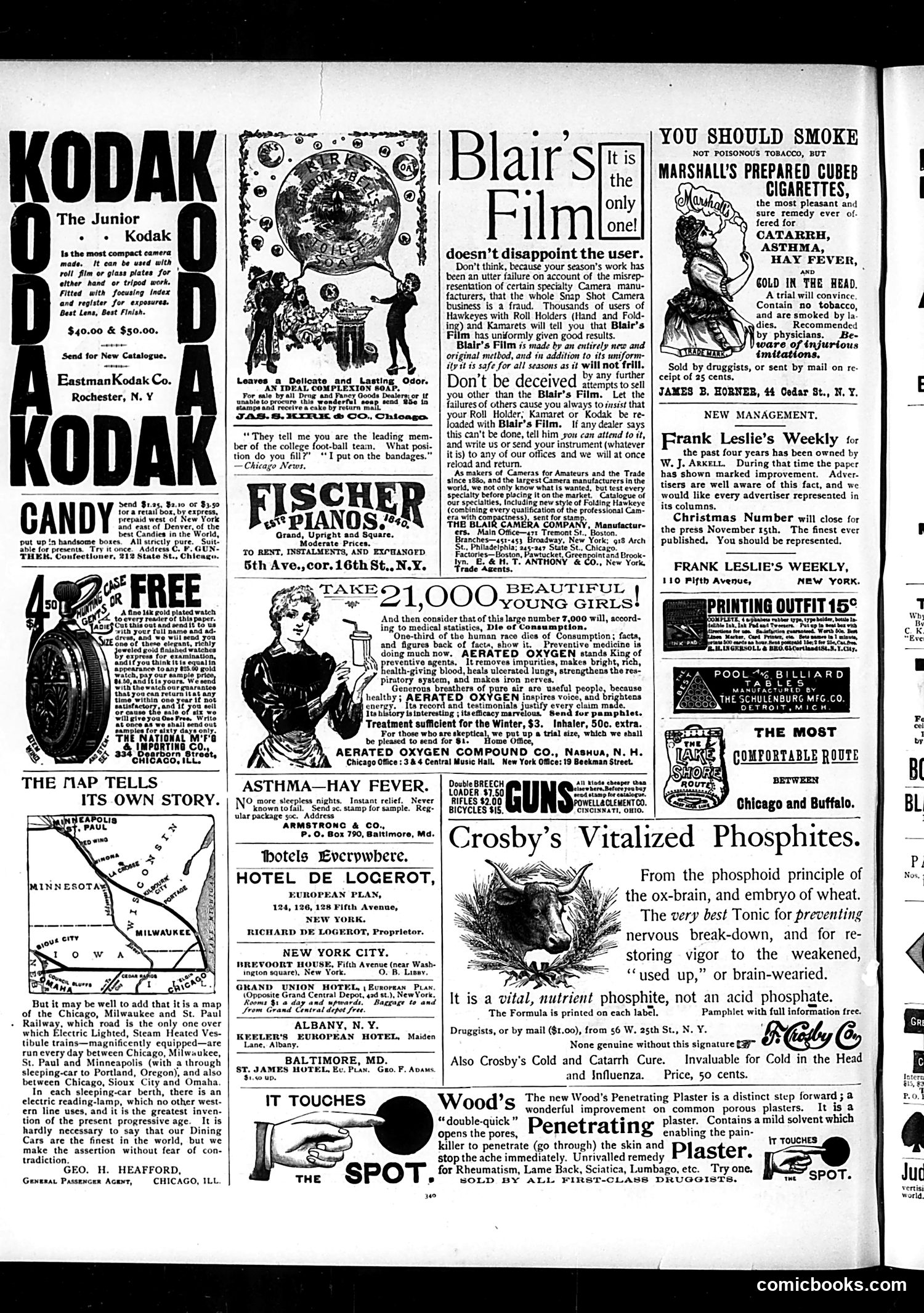
This page is primarily **advertisements** with one **joke** worth noting: **The Humor:** A college football player is asked his position on the team. He replies: "I put on the bandages." This joke satirizes the brutality and injury rate in early American college football—suggesting the player's main role is treating the constant injuries rather than playing. It reflects contemporary concerns about football's danger. **The Advertisements:** The bulk of the page features typical turn-of-the-century products: Kodak cameras, candy, pianos, hotels, railway services, and patent medicines (Crosby's Phosphites for "nervous break-down," Wood's Penetrating Plaster). **Notable:** The "Aerated Oxygen" consumption ad claims to cure consumption (tuberculosis)—a major killer then. This reflects both the disease's prevalence and the era's often-fraudulent "cure-all" marketing. The page captures advertising culture and public health concerns of the early 1900s.
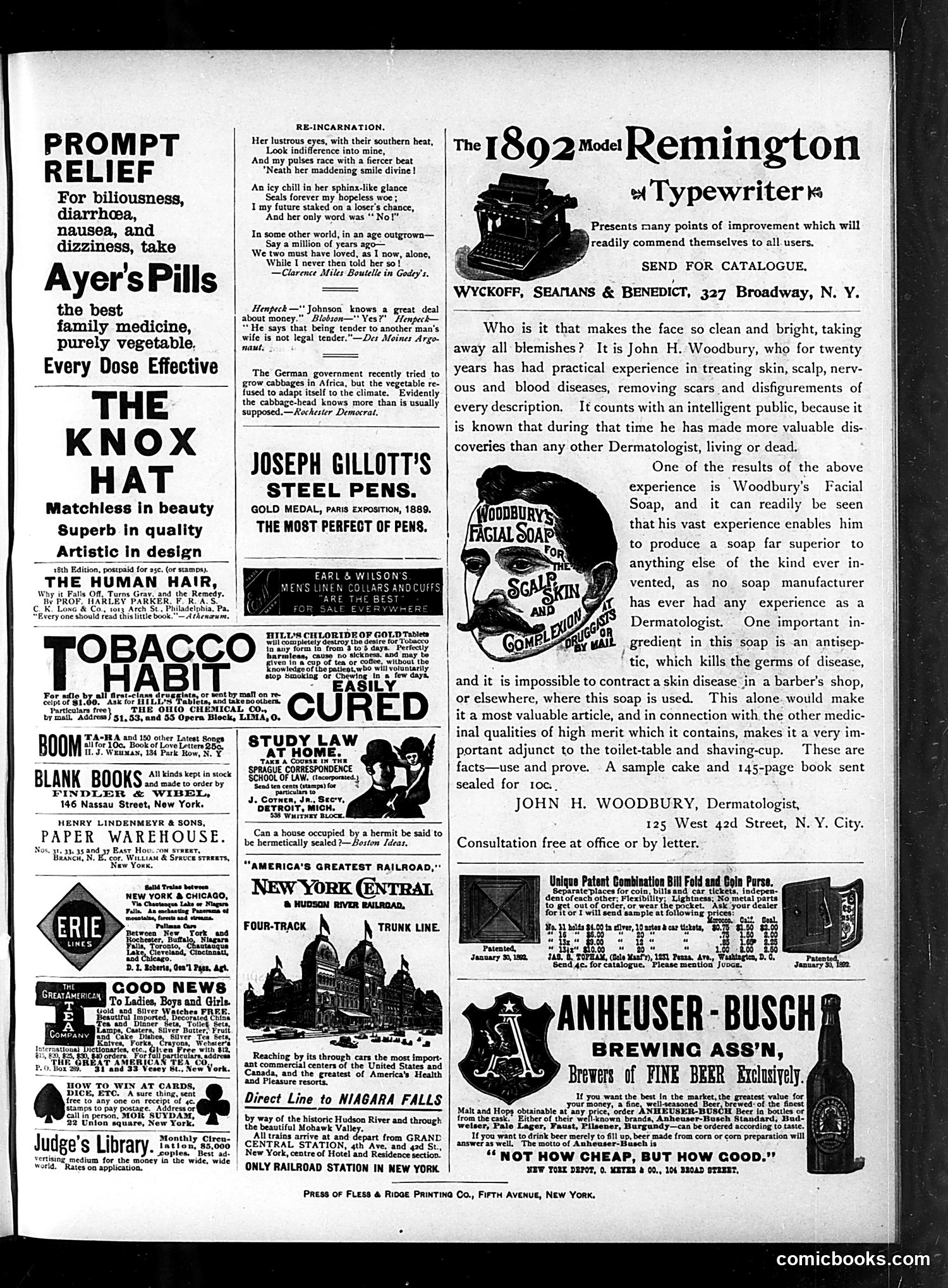
This page is primarily **advertising**, not political satire. It's from Judge magazine but contains mostly commercial advertisements typical of late 19th-century publications. The page includes: - **Patent medicine ads** (Ayer's Pills, Hill's Chloride of Gold for tobacco habit) - **Product advertisements** (Knox hats, Remington typewriters, Anheuser-Busch beer, Woodbury's Facial Soap) - **Services** (correspondence law school, paper warehouse) The only **satirical content** is a brief poem titled "RE-INCARNATION" about unrequited love, and several one-liner jokes (about money as "legal tender," German cabbage cultivation, hermetically sealed houses). These are generic humor pieces, not political commentary. **What a modern reader should know**: This reflects Judge's dual nature—a satirical magazine that survived primarily through advertising revenue. The ads themselves reveal period concerns: patent medicines (largely unregulated), men's grooming products, and new technologies like typewriters. The tone is entirely commercial rather than politically critical.
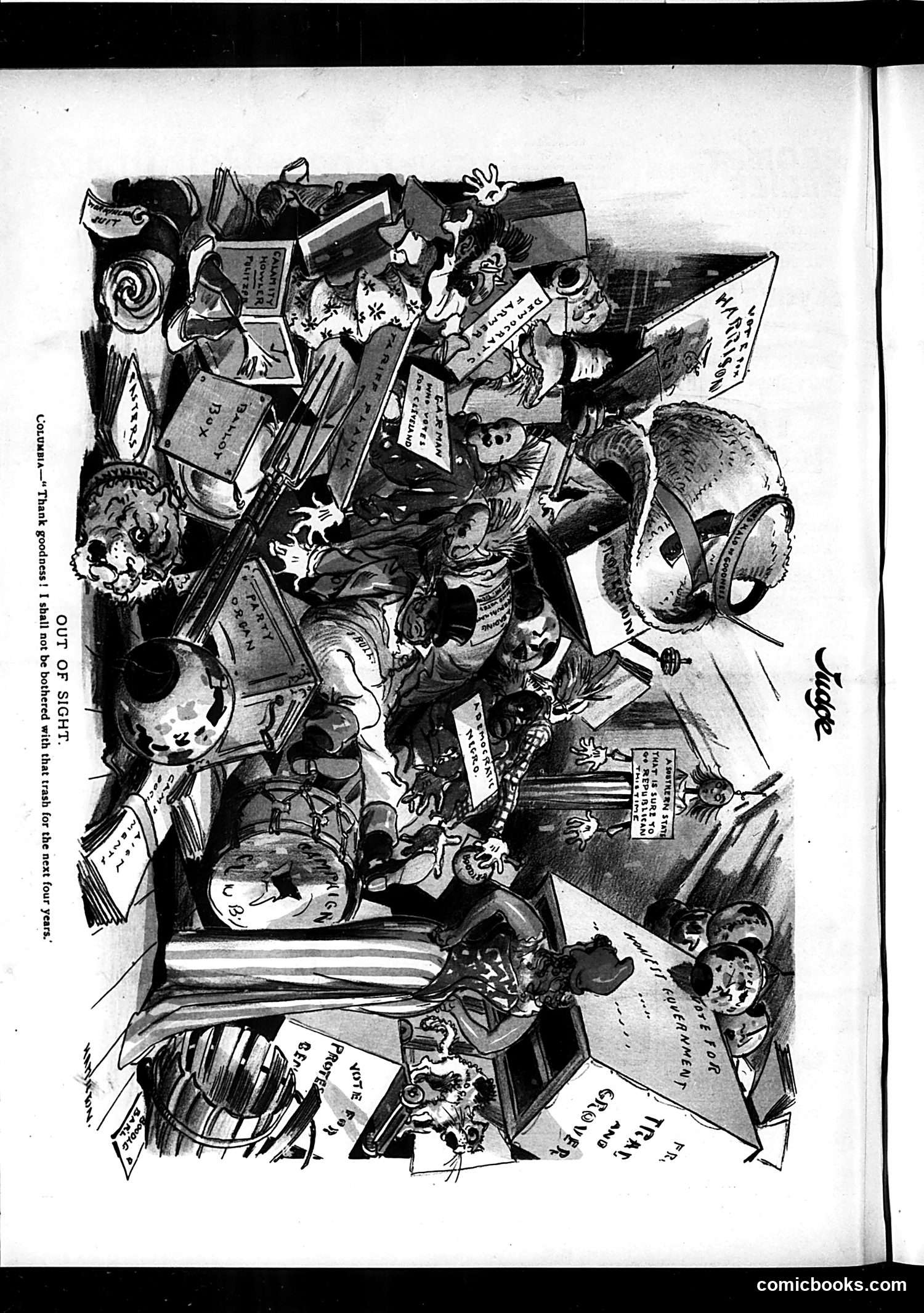
This political cartoon depicts Columbia (the female personification of America) expressing relief that something troublesome is "out of sight" for the next four years—likely referring to a political figure or administration being removed from power or out of office. The chaotic pile of objects surrounding Columbia appears to represent the "trash" or problems she's glad to be rid of. The cartoon's title "OUT OF SIGHT" and her comment about a four-year period suggests this relates to an election cycle, possibly depicting public relief at a departing president or political group. Without seeing a clear date or identifying captions for specific figures in the pile, I cannot definitively state which election or administration this satirizes, but the message is clearly celebratory of removing something Columbia considers unwanted from the political landscape.