
A complete issue · 16 pages · 1892
Judge — September 10, 1892
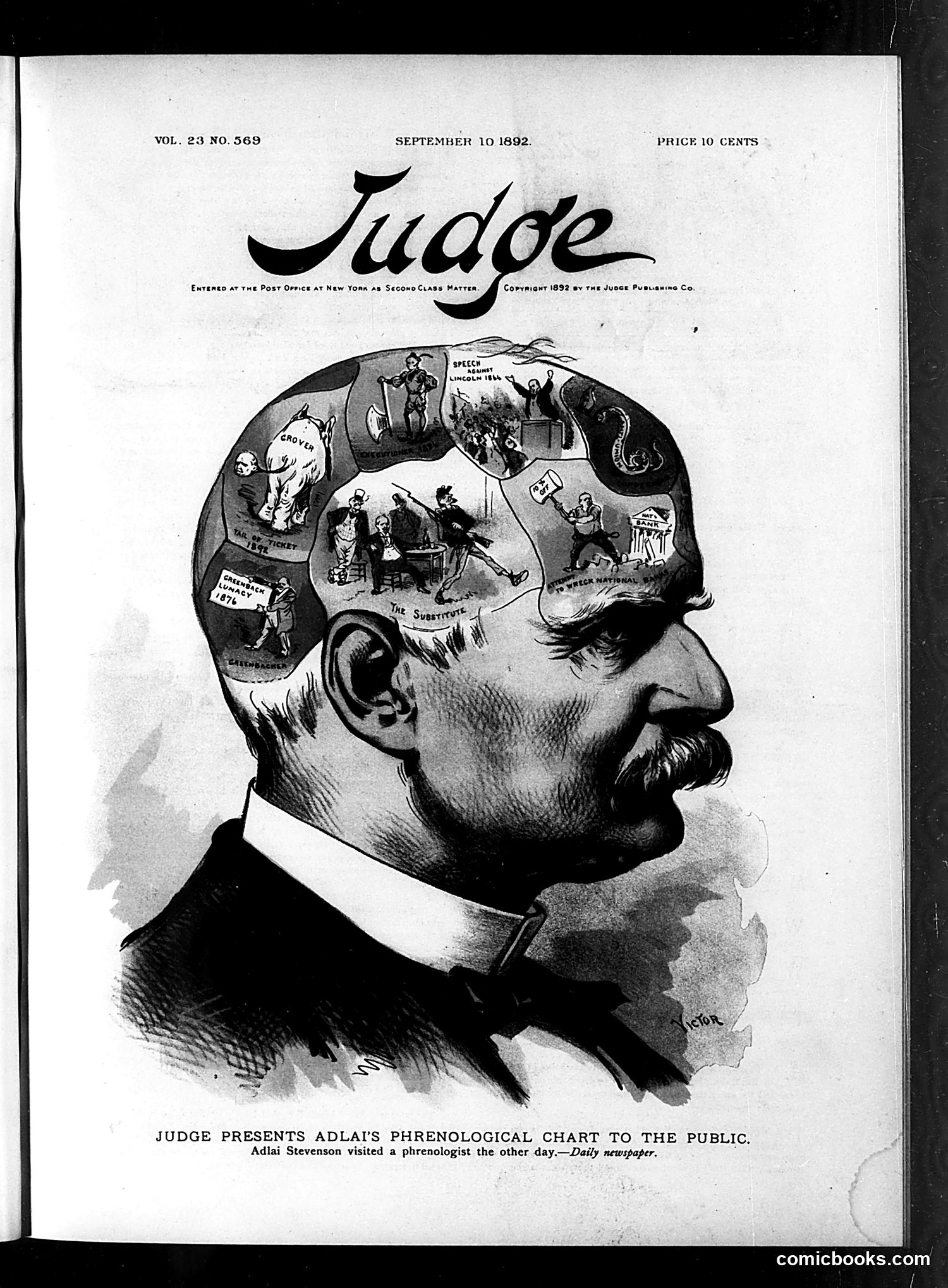
This is a satirical phrenological chart—a pseudo-scientific visualization of someone's mental faculties based on skull shape. The cartoon depicts a man's head in profile with various scenes illustrated inside, labeled with different character traits and activities (visible labels include "Speech," "The Substitute," and references to voting/national matters). The caption states "Judge presents Adlai's phrenological chart to the public," referencing Adlai Stevenson, who visited a phrenologist. The satire mocks both phrenology (a discredited 19th-century practice) and Stevenson himself, suggesting his mental makeup is comedically bizarre or contradictory. This 1892 publication likely relates to the presidential election year, using pseudo-science as a vehicle for political ridicule.
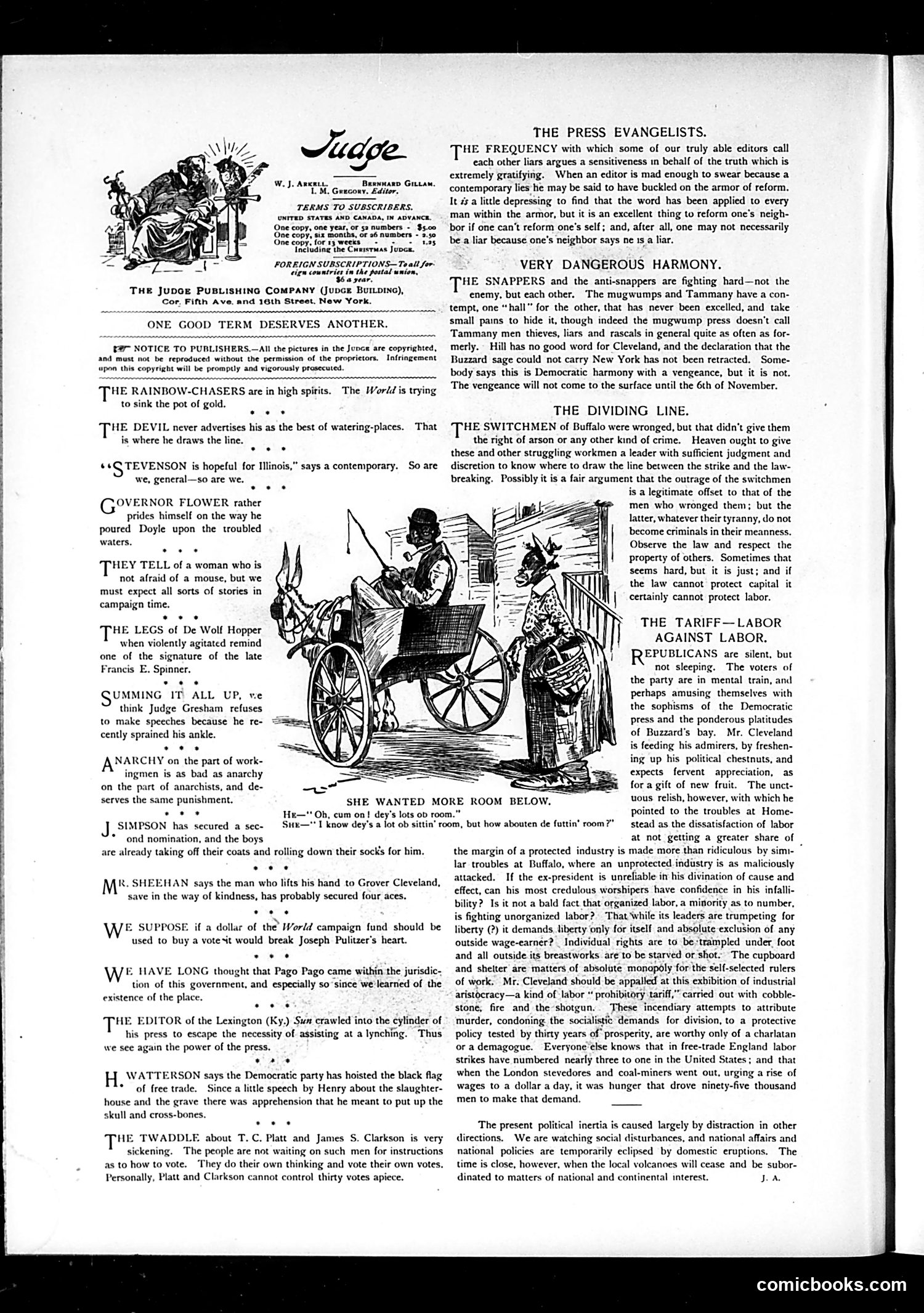
The main cartoon titled "SHE WANTED MORE ROOM BELOW" depicts a woman in a carriage being driven by a skeletal figure (Death), illustrating a dark joke about domestic space complaints. The woman says "Oh, cum on! day's lots do room" while the driver responds about "fittin' room?"—playing on her desire for more living space. The surrounding editorial content, titled "THE PRESS EVANGELISTS" and "VERY DANGEROUS HARMONY," criticizes Democratic and Republican newspapers for fighting each other rather than uniting. Multiple short items mock political figures including Cleveland and Gresham, satirizing editorial hypocrisy, labor disputes, and tariff politics. The overall tone attacks partisan press behavior during what appears to be the 1890s political era.
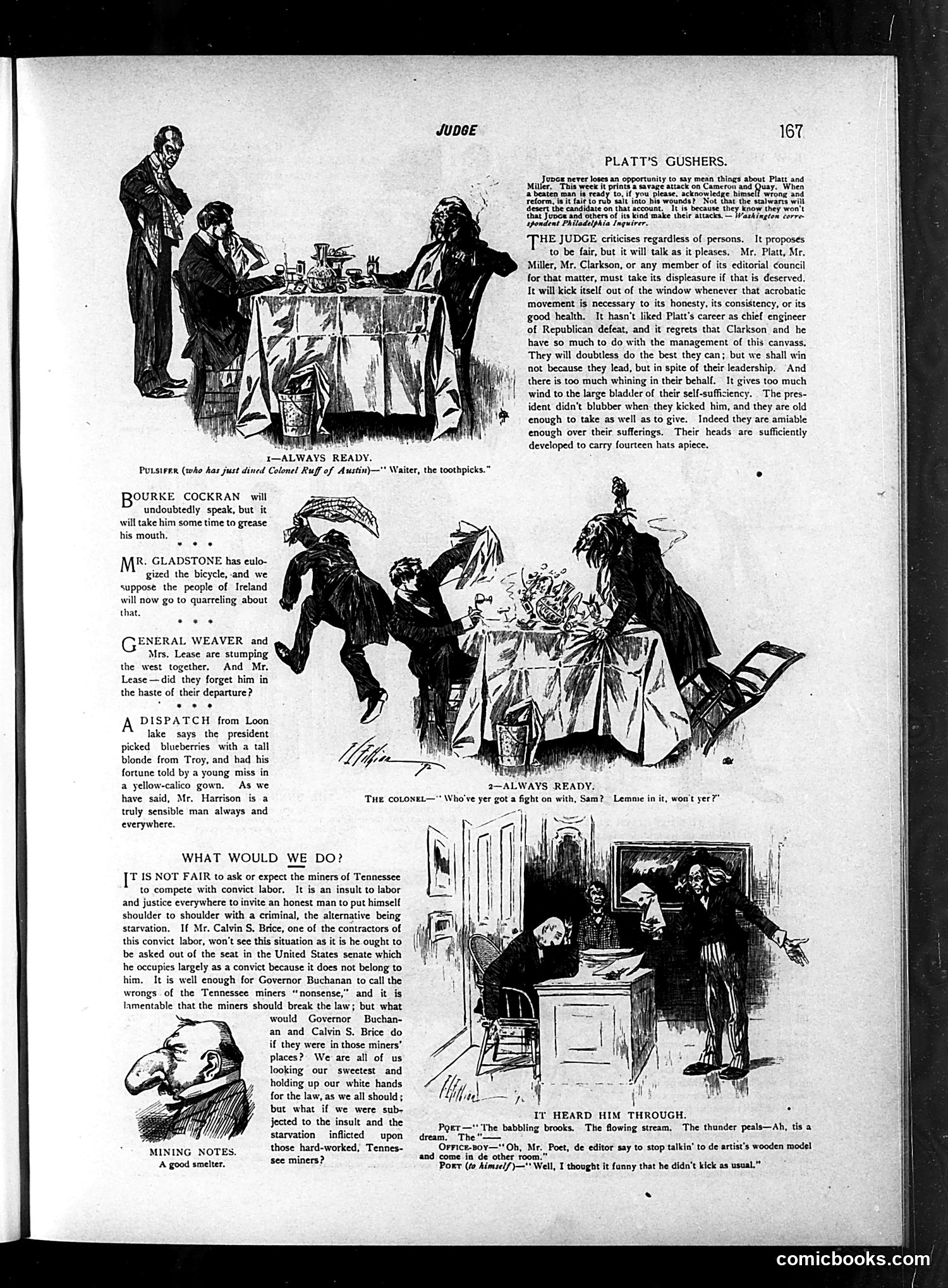
This page satirizes Republican political leadership and mining labor issues, likely from the early 1900s. **"Platt's Gushers"** (top cartoon) mocks Thomas C. Platt (New York Republican boss) and associates like Mark Hanna and others. The Judge criticizes their self-congratulatory speeches and insufficient action on labor conditions, specifically regarding miners' welfare. **"Always Ready"** cartoons depict political figures (likely including General Weaver and Mrs. Lease) as ready for opportunistic action, suggesting their positions shift with political winds. **"What Would We Do?"** addresses Tennessee coal miners' exploitation. It challenges whether Republican leaders like Governor Buchanan and Calvin S. Brice would endorse honest men calling out labor injustices—or if they'd accuse them of being criminals. The satire questions Republican hypocrisy on worker protection versus law-and-order rhetoric.
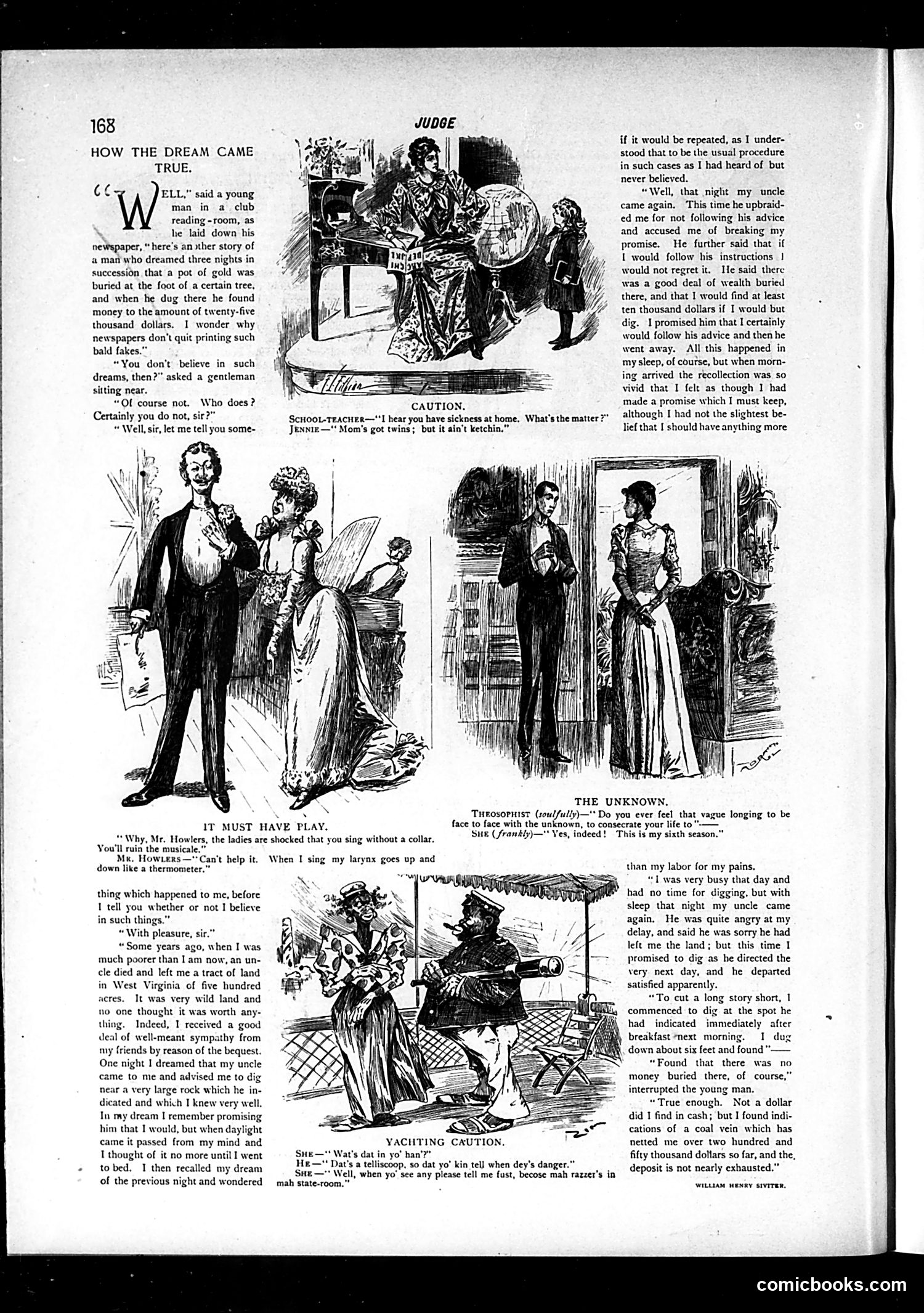
This page contains several brief satirical sketches typical of late 19th-century American humor magazines. **"How the Dream Came True"** mocks the popular newspaper trope of get-rich-quick dreams. A skeptical young man dismisses such stories as "bald fakes," but then recounts his own experience: he dreamed his deceased uncle directed him to dig on inherited West Virginia land. Following the dream's instructions, he found no gold—but discovered coal deposits worth $250,000. The satire lies in the ironic twist: the protagonist becomes living proof of the very "fake" narrative he dismissed, suggesting even skeptics fall prey to fortune-seeking mythology. The smaller captioned sketches ("It Must Have Play," "The Unknown," "Caution," "Yachting Caution") are unrelated vignettes poking fun at social pretensions and absurdities—a singing gentleman without a collar, philosophical affectation, a schoolteacher's misunderstanding, and sailors' miscommunication. These are typical filler material for the magazine, requiring no specific historical knowledge to understand their domestic humor.
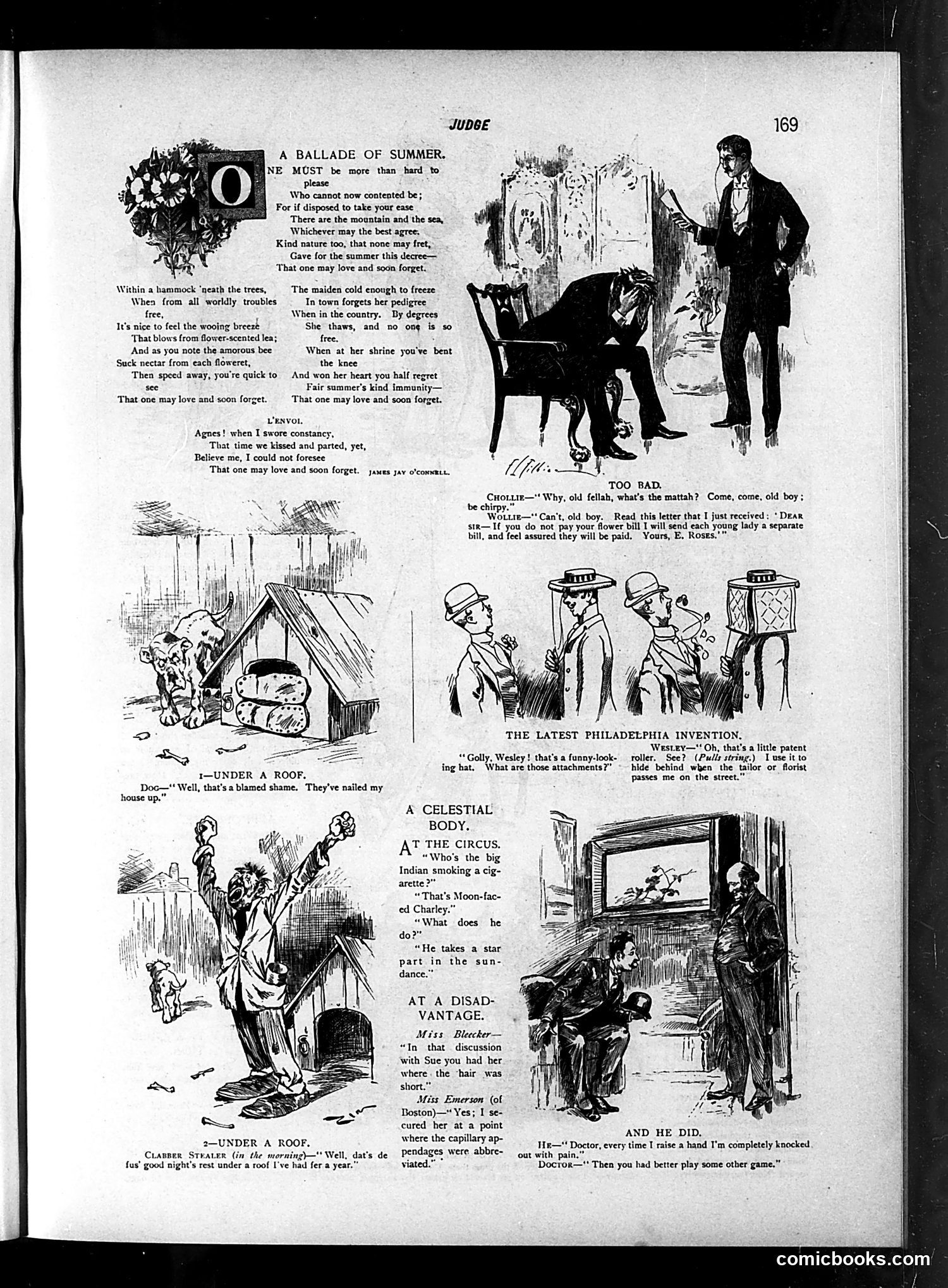
This page contains lighthearted humor and social commentary typical of late 19th/early 20th-century American satire: **"A Ballade of Summer"** mocks romantic fickleness—the poem suggests summer encourages casual love affairs that are quickly forgotten, particularly among wealthy leisure classes who retreat to country estates. **"Too Bad"** satirizes nouveau riche social pretension: a man receives dunning notices from florists and flower vendors, each addressed separately to different women, exposing his simultaneous courtships. **"The Latest Philadelphia Invention"** ridicules debt avoidance through a hat with attachments to hide from creditors (tailors and florists). The remaining sketches—about circus performers, social misunderstandings, and physical mishaps—are gentler humor without obvious political content. Overall, the page targets middle and upper-class anxieties: financial instability, social climbing, romantic duplicity, and creditor harassment during an era of economic uncertainty.
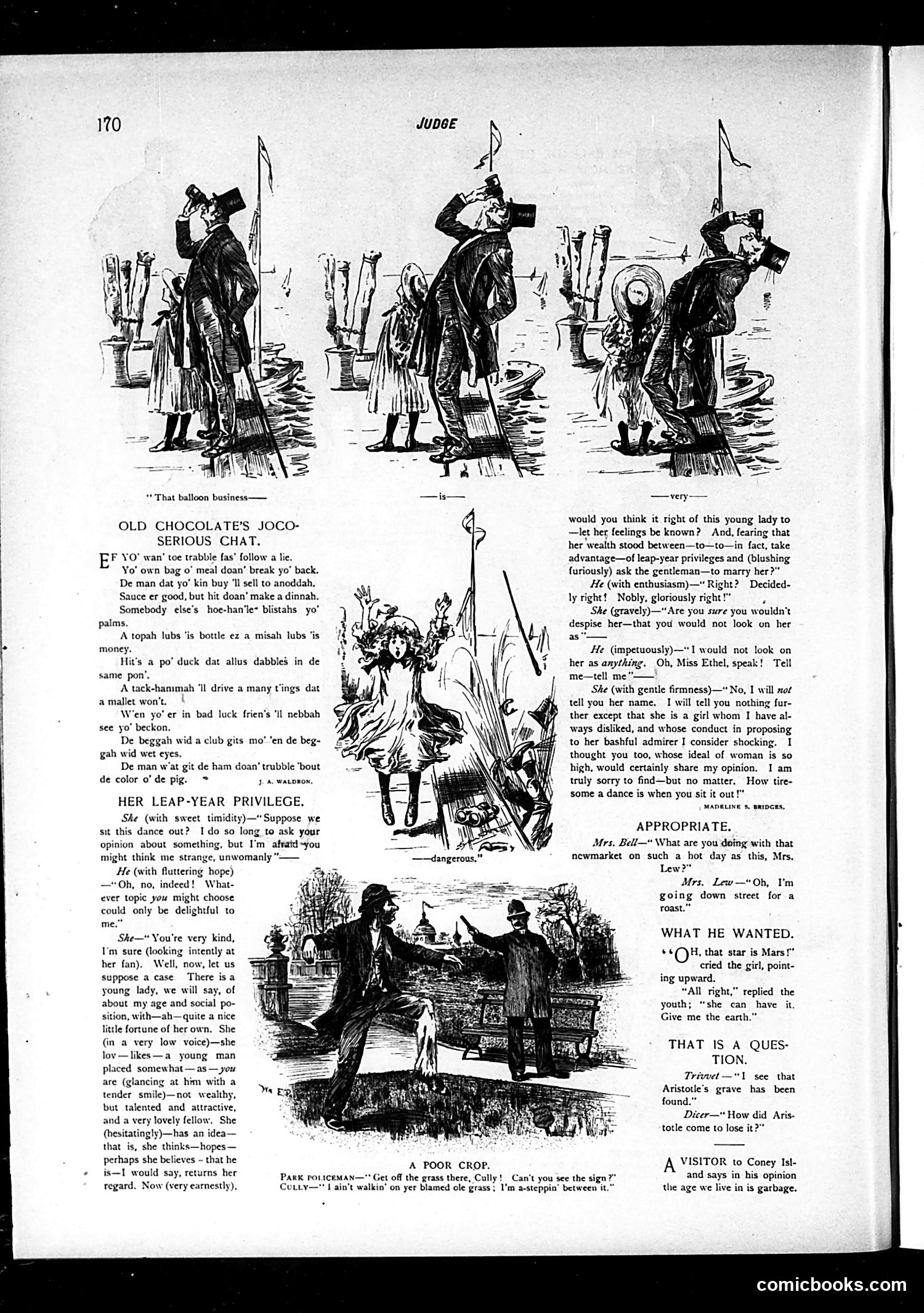
This page contains multiple short humorous pieces typical of late 19th/early 20th-century satirical magazines: **"Old Chocolate's Joco-Serious Chat"**: Features dialect humor from an African American character dispensing folk wisdom in exaggerated dialect—common but offensive racial stereotyping of the era. **"Her Leap-Year Privilege"**: A flirtation sketch where a woman uses leap-year convention (when women could propose to men) to ask a gentleman about marriage, then reveals she was describing someone she *dislikes* and was testing his character. The joke subverts romantic expectations. **"A Poor Crop"**: A park policeman catches a vagrant; the vagrant claims he's not walking *on* the grass but "between" blades—absurdist wordplay humor. **Brief gags**: Including romantic quips ("Give me the earth" vs. Mars) and a commentary on modern life being "garbage." The illustrations depict these scenes with period engraving style. The humor relies on dialect, gender role reversals, class commentary, and wordplay typical of Judge's satirical approach.
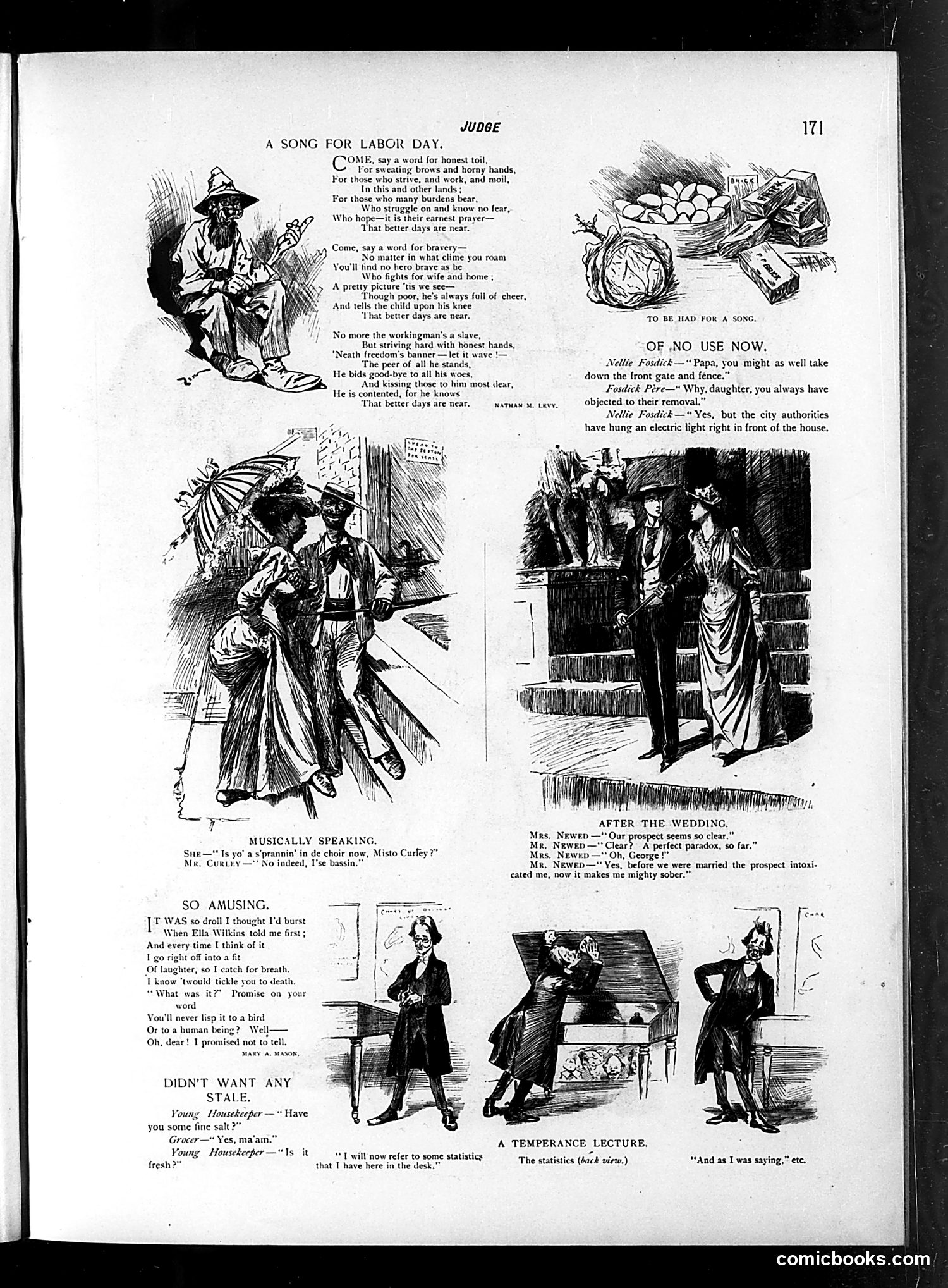
This page contains multiple satirical sketches reflecting late 19th/early 20th-century American concerns. **"A Song for Labor Day"** (top left) celebrates workers and their dignity, addressing the labor movement's core values—honest work, family support, and freedom from servitude. **"Of No Use Now"** mocks suburban vanity: a daughter demands her parents remove their front gate because an electric streetlight now illuminates their property, making the decorative fence pointless. The satire targets status-conscious nouveau riche. **"After the Wedding"** jokes about disillusionment in marriage—the wife notes that before marriage, prospects seemed intoxicating; now they make her "mighty sober." **"So Amusing"** and **"Didn't Want Any Stale"** are light domestic humor pieces about gossip and household shopping. **"A Temperance Lecture"** (bottom right) depicts a boring prohibitionist speaker viewed from behind, suggesting the tedium of temperance advocacy—a major social reform movement of the era. Overall, the page balances labor celebration with satirical jabs at middle-class pretension and reform movements.
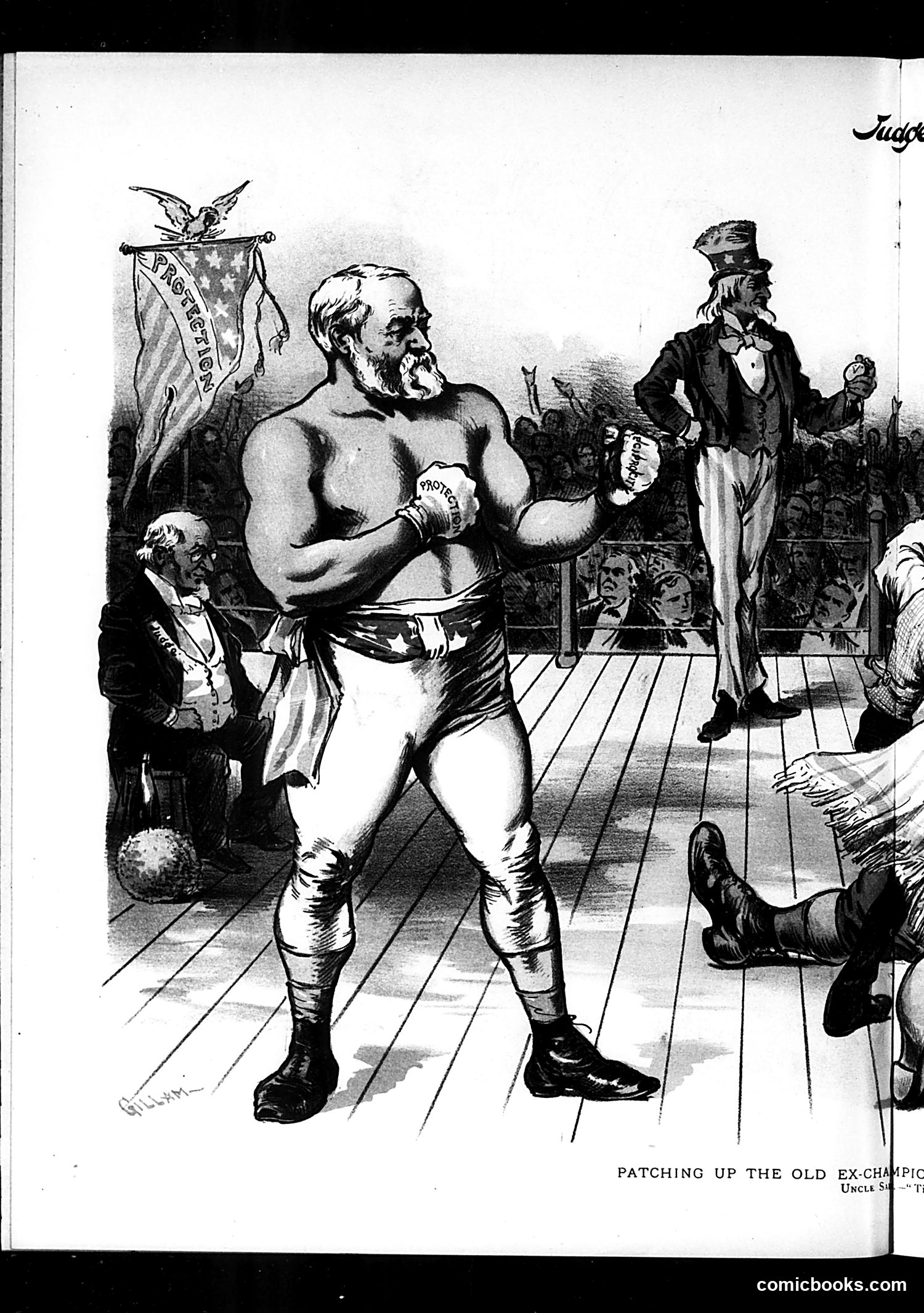
This Judge magazine cartoon depicts "Uncle Sam" (the bearded figure in top hat on the right) overseeing a boxer labeled "PROTECTED" who appears physically worn down. The cartoon satirizes American protectionist trade policies, suggesting they've damaged rather than strengthened the nation's competitive position—hence "patching up the old ex-champion." The boxer's exhausted appearance and bandaged state indicate that protective tariffs, intended to shield American industry, have instead weakened it. The eagle banner and audience of well-dressed observers suggest this concerns national economic policy and public interest. The satire argues that protectionism, meant to preserve American economic dominance, has paradoxically left the country less capable—no longer a true champion despite government support.
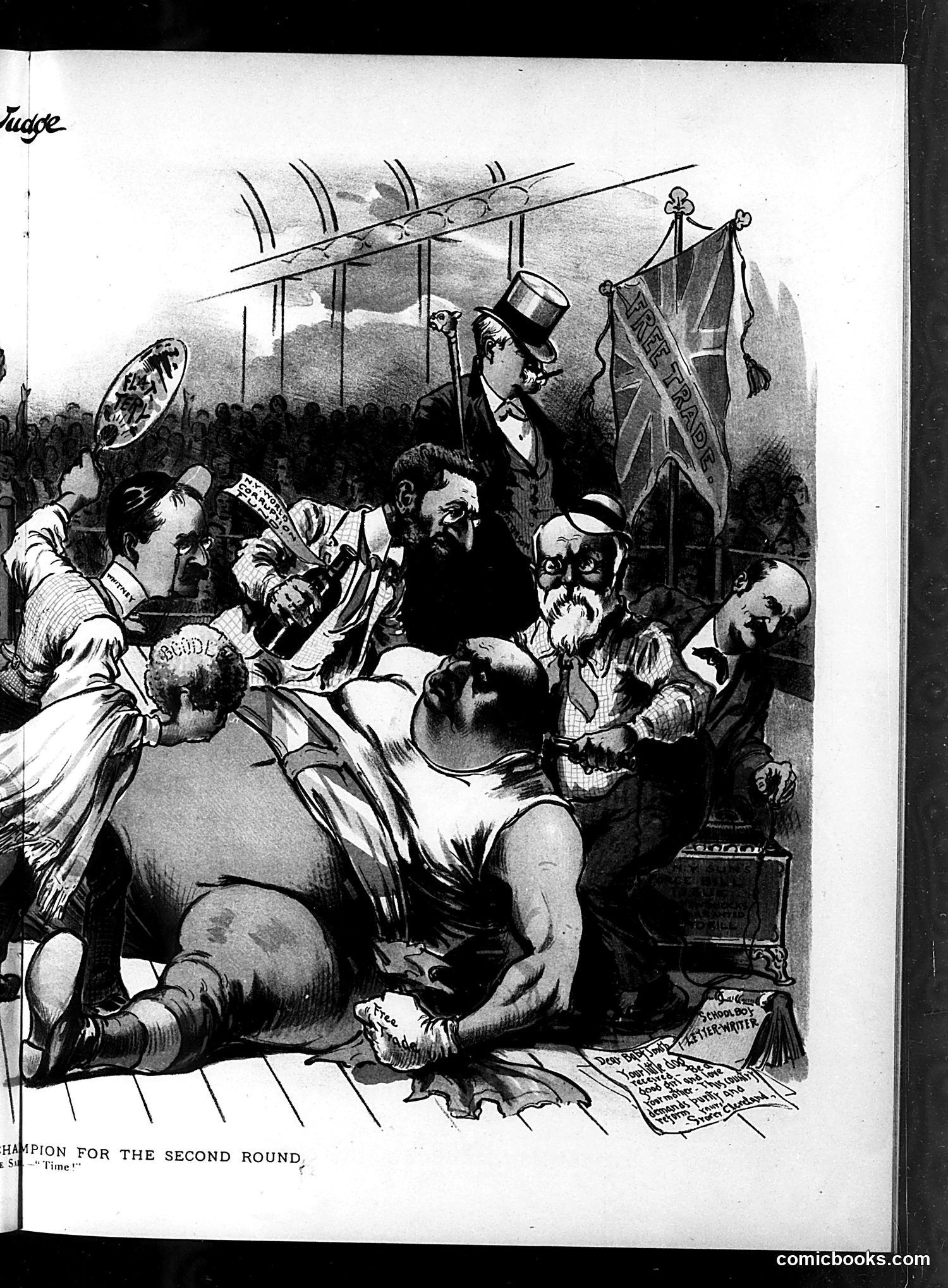
This political cartoon depicts a circus-like scene labeled "Time," showing what appears to be a boxing match or confrontation. A well-dressed man in a top hat stands elevated, presumably as a referee or promoter, overlooking a chaotic crowd of caricatured figures below. The composition suggests a satirical commentary on political competition or electoral struggle. The "second round" reference indicates this depicts a continuation of some ongoing political conflict. The circus setting and exaggerated character caricatures are typical Judge magazine satire. However, without the publication date visible, identifying the specific political figures, election, or event being mocked is difficult. The imagery suggests commentary on rough-and-tumble politics or competition, but the particular historical context remains unclear from the visual elements alone.
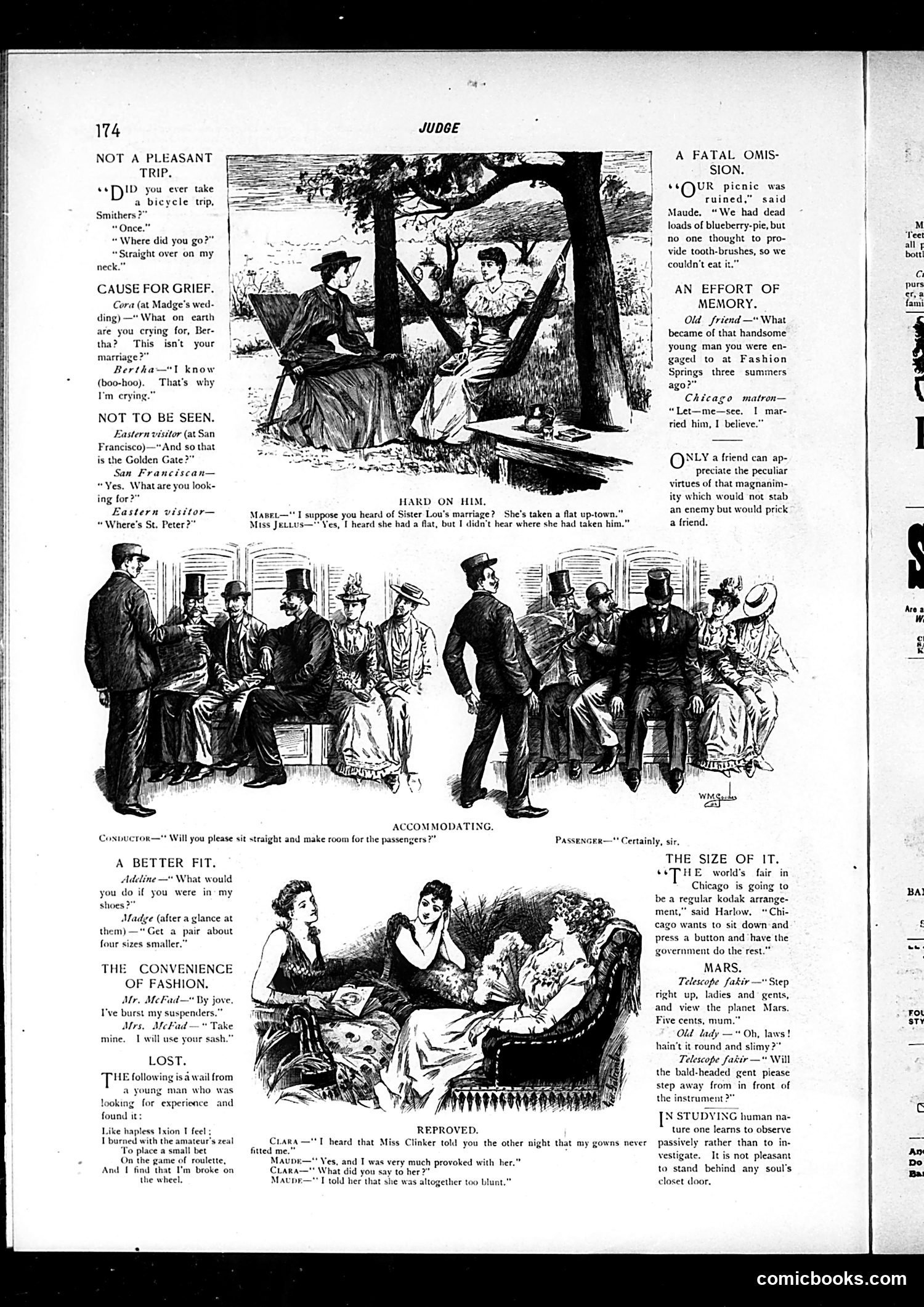
This page from *Judge* magazine contains various short humorous sketches and jokes typical of late 19th-century American satirical humor. **Key recurring themes:** **Social awkwardness and class humor**: Several sketches mock pretension and social missteps—a woman upset about borrowed sashes, conductors dealing with crowded passengers, and city folk behaving foolishly. **Marriage satire**: Multiple items joke about matrimony as disappointing or absurd (a woman crying at someone *else's* wedding; a "Chicago matron" barely remembering marrying someone). **Gender humor**: Typical period jokes about women's fashion, appearance ("four sizes smaller shoes"), and romantic disappointment. **Urban/technological commentary**: References to Chicago's World's Fair, photography ("kodak"), and telescopes suggest contemporary interest in modernity and its pitfalls (con artists selling fake telescope views of Mars). **The overall tone** is lighthearted mockery of everyday life, relationships, and human folly—standard fare for *Judge*, which aimed at educated, middle-class readers with gentle social satire rather than sharp political commentary.
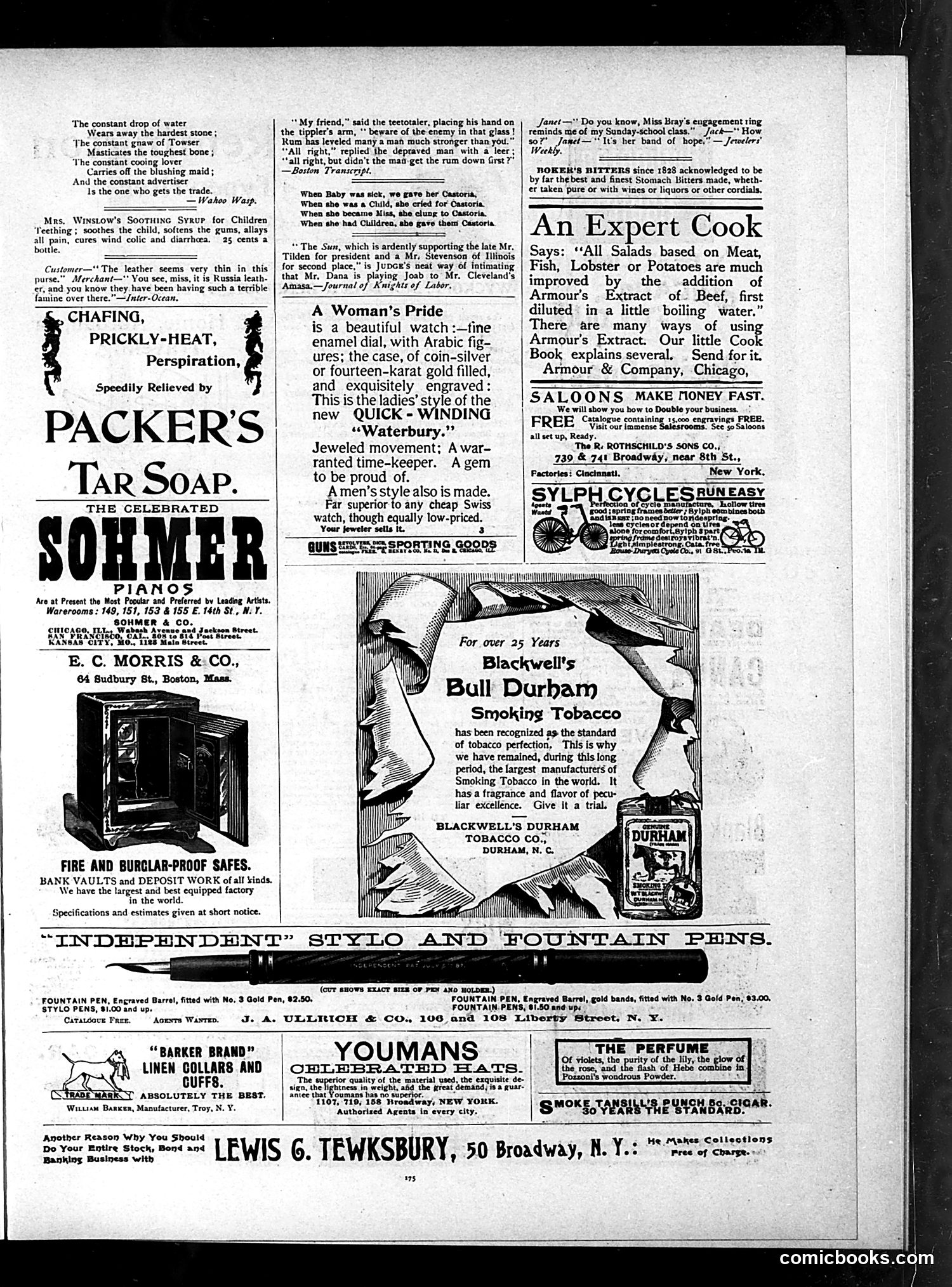
This page is primarily **advertising**, typical of late 19th-century magazines. The visible editorial content includes three brief satirical items: 1. **"My friend" anecdote** (Boston Transcript): A temperance advocate warns a drunk about alcohol's dangers. The drunk's reply—that the man must have consumed the rum first to warn against it—is a joke about the hypocrisy of reformed drinkers lecturing others. 2. **Russia leather joke** (Inter-Ocean): A customer complains leather is thin; a merchant blames the Russian famine, sarcastically suggesting scarcity explains poor quality—contemporary reference to Russia's 1891-92 famine. 3. **Dana/Cleveland political reference** (Journal of Knights of Labor): Mocks newspaper editor Charles Dana for supporting both Samuel Tilden and Stephen Cleveland for president, comparing him to the biblical figure Joab playing political games. The page otherwise features period advertisements for patent medicines, pianos, safes, watches, tobacco, and other goods—standard Judge content reflecting Gilded Age commerce and consumer culture.
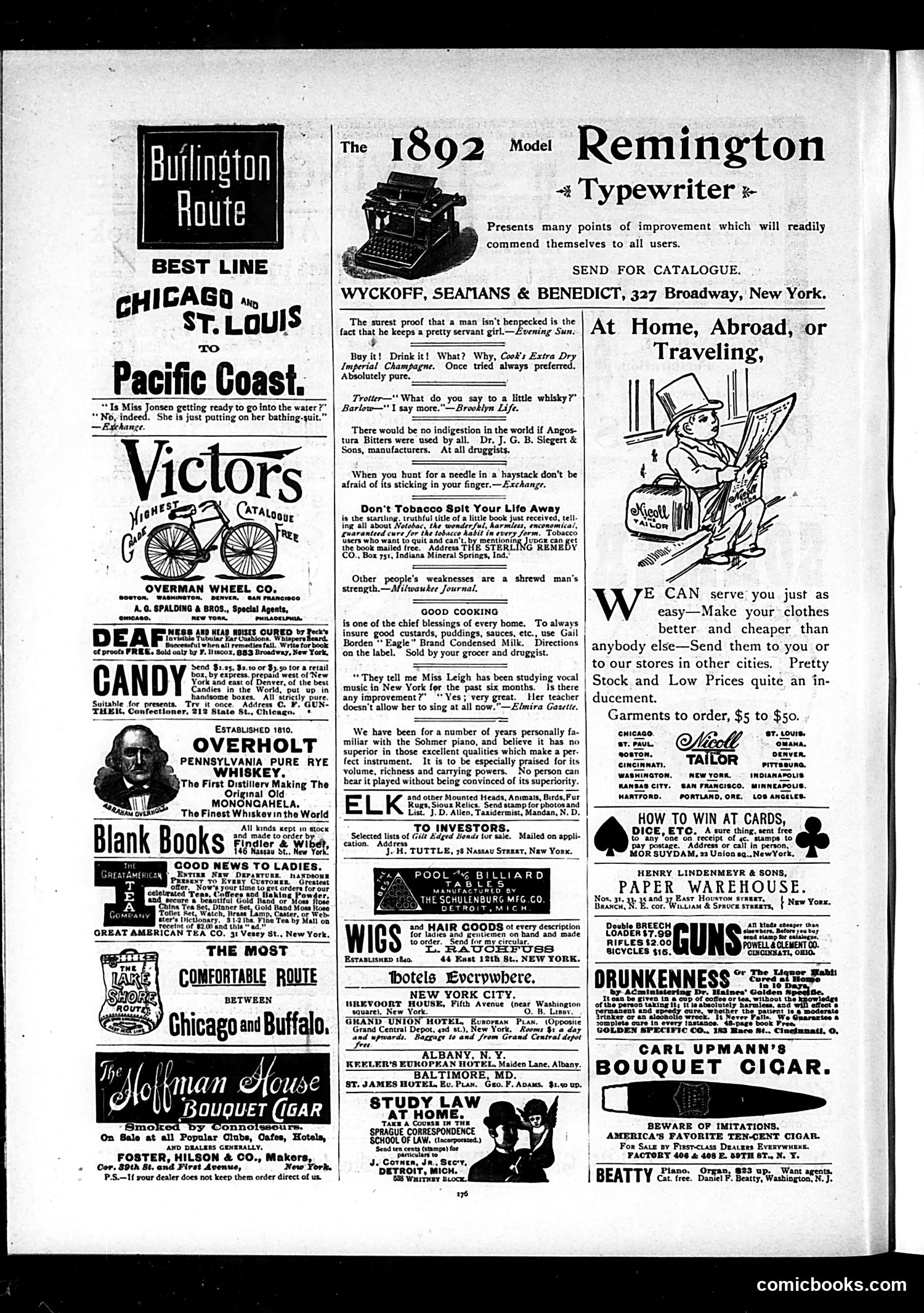
This page is primarily **advertising**, not editorial or satirical content. It contains no discernible political cartoons or social satire requiring historical context. The advertisements reflect 1890s consumer products and services: typewriters, bicycles, railroad routes, household goods (champagne, condensed milk, bitters), pianos, cigars, and financial services. Small comic asides embedded in ads (exchanges and witticisms about servants, bathing, whisky, and vocal lessons) are generic period humor—not topical satire. The page's only visual element beyond product images is a small illustration of a traveling man with a bag, promoting a tailor service. This is generic advertising imagery, not political commentary. **In sum:** This is a commercial page with no meaningful satirical content to decode for modern readers—just period consumer culture and mild, apolitical jokes.
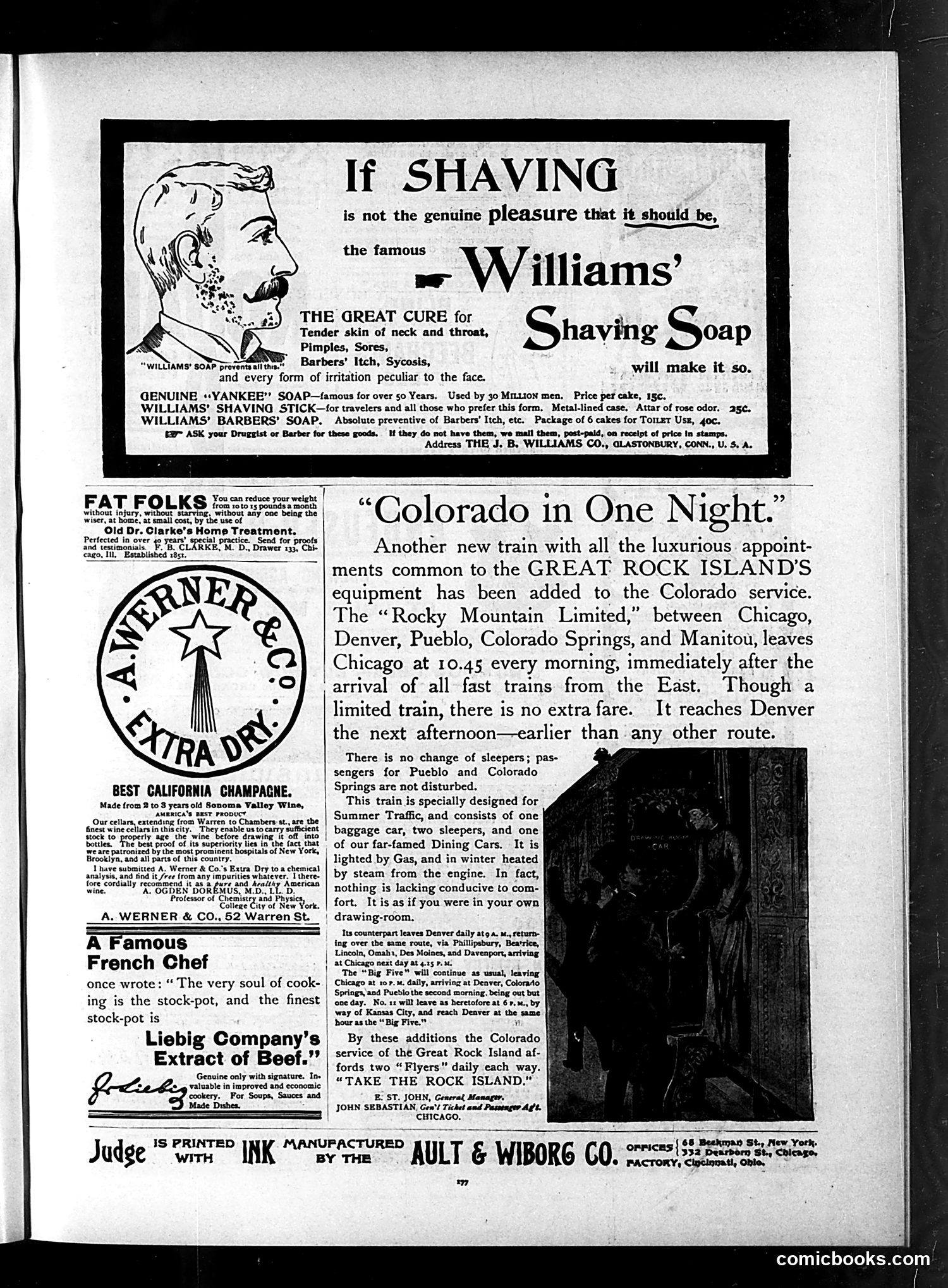
This page is primarily **advertising**, not satire or political commentary. The main content consists of five advertisements: 1. **Williams' Shaving Soap** – Claims to cure shaving irritations like barber's itch and pimples 2. **Fat Folks remedy** – Promises weight reduction 3. **A. Werner & Co. champagne** – California wine with a doctor's endorsement 4. **Liebig Company's Extract of Beef** – A cooking ingredient, quoted by a "Famous French Chef" 5. **Rock Island Railway** – The largest ad, promoting the new "Rocky Mountain Limited" train service from Chicago to Denver There are **no cartoons** visible on this page. The only illustration is a simple star logo for the railway company. This appears to be a typical page from *Judge* magazine's advertising section, featuring contemporary consumer products and services aimed at middle to upper-class readers.
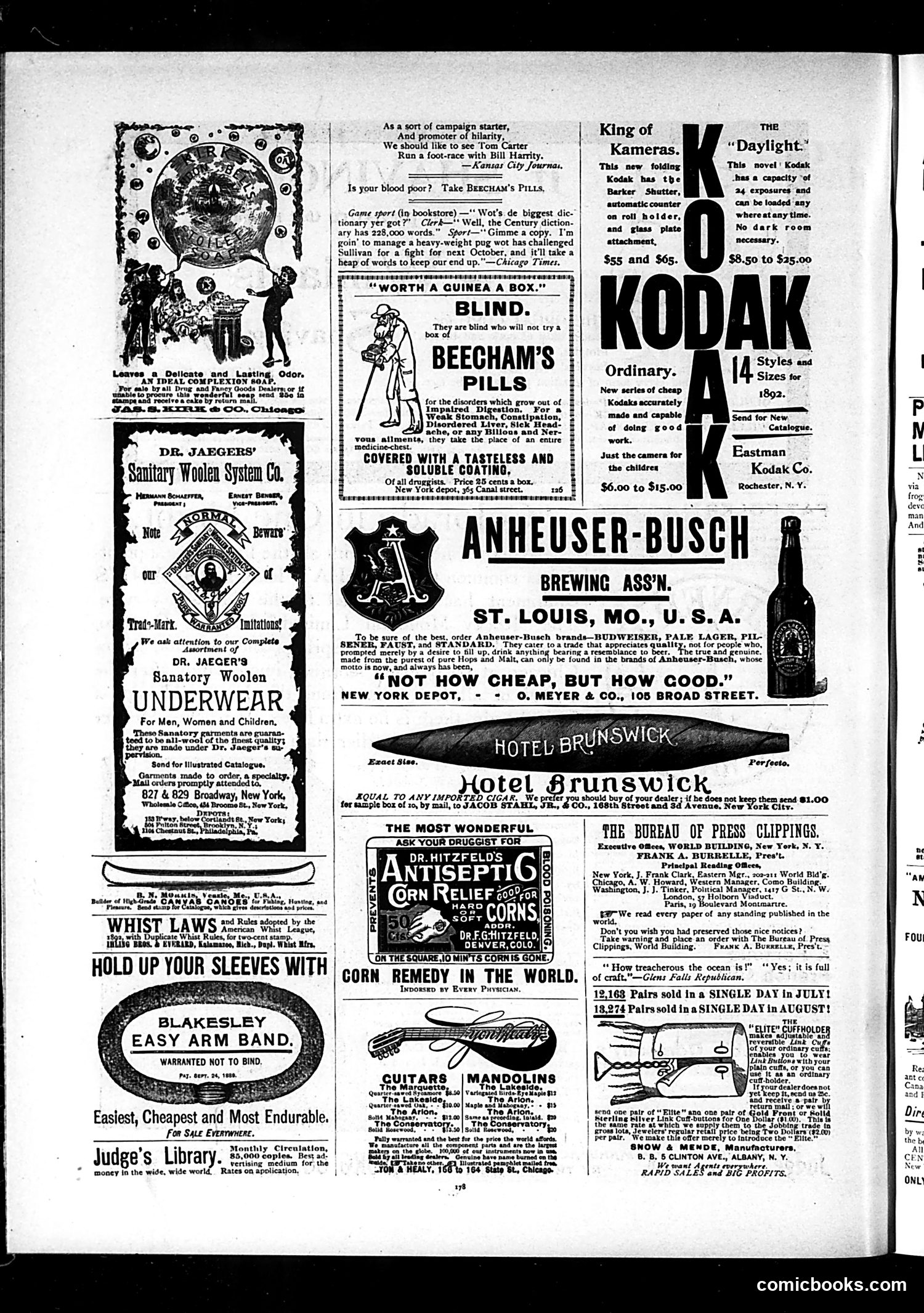
This is primarily an **advertising page** from Judge magazine, with one small satirical item at the top. The main joke references **Tom Carter and Bill Harrity**, apparently prominent political or sports figures of the era (the Kansas City Journal is quoted). The humor suggests these men were rivals or had contrasting abilities—the implication being that watching them race would be amusing, possibly because one was notably slow or unfit. Without additional historical context, the specific reference is unclear to modern readers. The page is otherwise dominated by commercial advertisements typical of the 1890s: patent medicines (Beecham's Pills for digestive ailments), photographic equipment (Kodak cameras), beer (Anheuser-Busch), sanitary underwear, corn remedies, and other consumer goods. The ads emphasize quality, scientific advancement, and personal health—reflecting period consumer anxieties. The "Bureau of Press Clippings" advertisement at bottom right shows the emerging media monitoring industry.
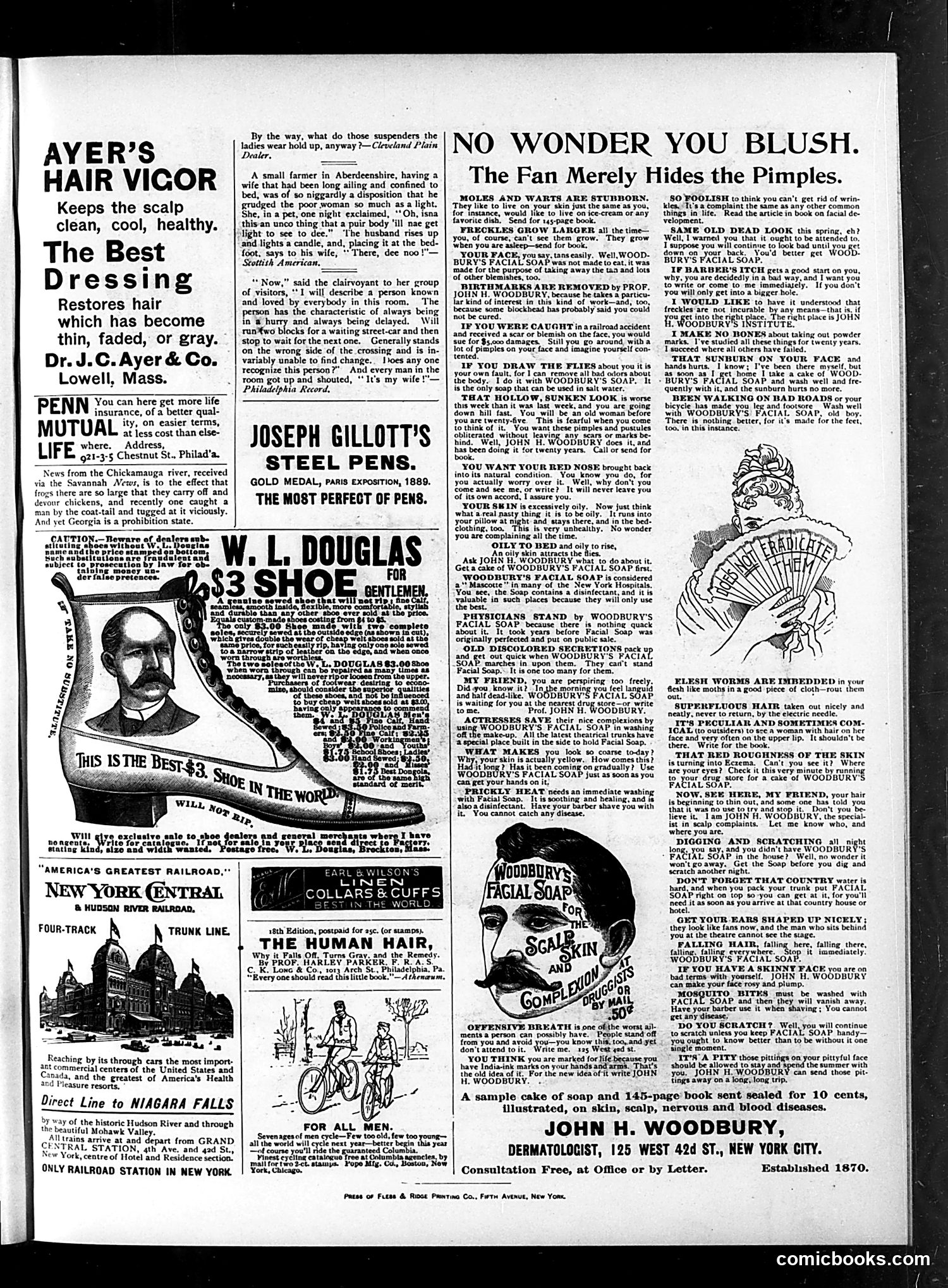
This page is primarily **advertising**, dominated by a large dermatological advertisement for Woodbury's Facial Soap and Prof. John H. Woodbury's skin treatments. The central image shows a woman's face partially hidden by a fan. The "satire" here is actually **marketing strategy disguised as social commentary**. Woodbury addresses common skin complaints—pimples, freckles, moles, birthmarks, tan—by rhetorically validating women's embarrassment about them ("No wonder you blush"). The advertisement then positions his products and services as solutions, using pseudo-scientific claims ("freckles grow larger...when you are asleep"). The tone mimics genuine advice columns while promoting expensive dermatological treatments. The page includes typical period advertisements for hair vigor, steel pens, shoes, and railroads, but Woodbury's dominates, suggesting this was likely a paid promotional feature. The real "joke" targets female vanity and insecurity—a common advertising tactic of the era—rather than genuine satirical commentary.
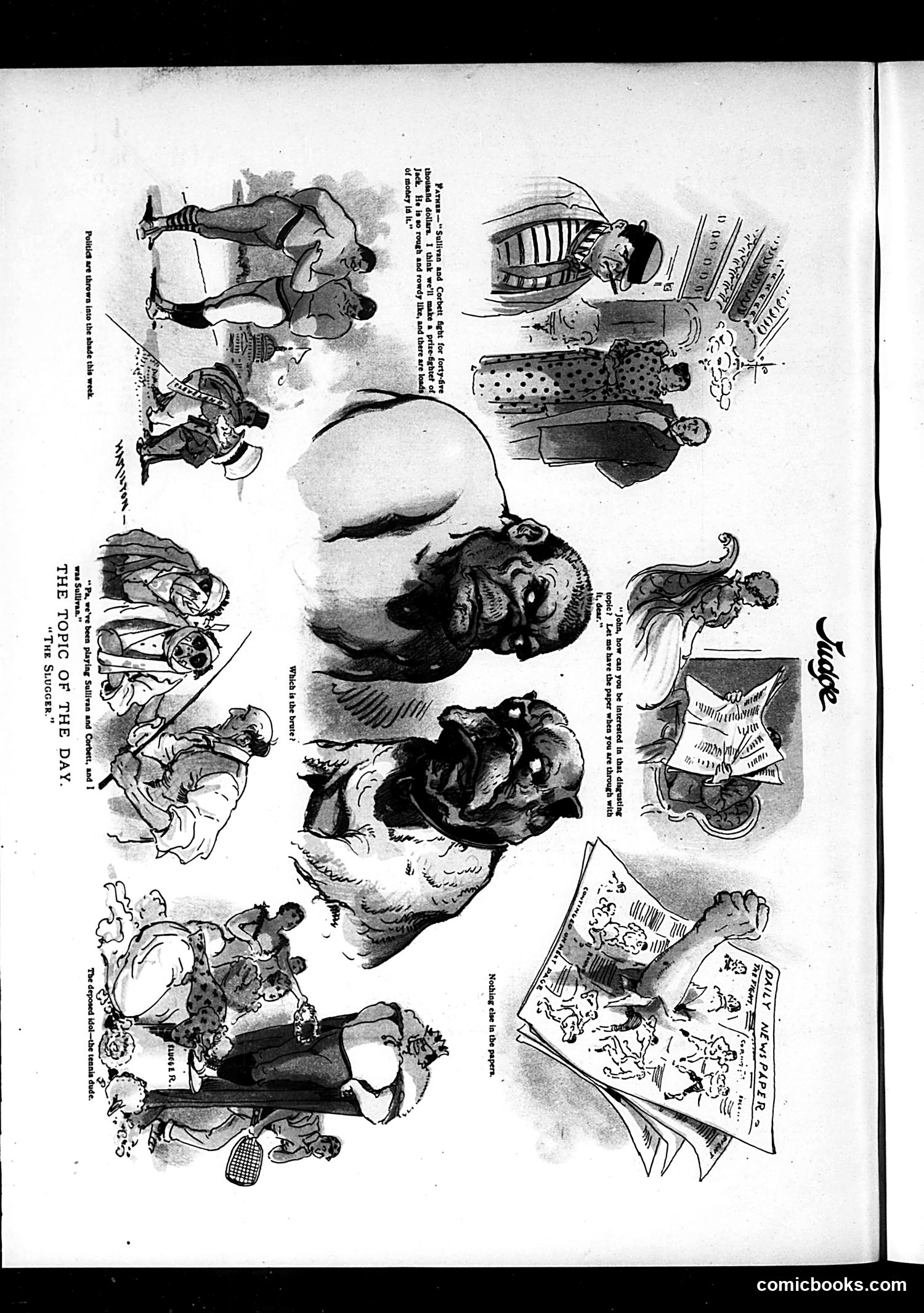
This page satirizes the massive public obsession with the Sullivan-Corbett boxing match, which offered a lucrative purse of $45,000. The central cartoon depicts a grotesquely large boxer's head dominating the composition, labeled "The Slugger." The satire's point: boxing has completely consumed public attention and displaced all other topics—including politics itself (explicitly stated: "Politics are thrown into the shade this week"). The various smaller figures surrounding the giant head represent different segments of society fixated on the fight, including a child who's been playing at imitating the boxers. The caption "The deposed idol—the tennis dude" suggests that refined sports like tennis have been knocked aside by this crude, violent spectacle. Judge is mocking the American public's lowbrow fascination with prizefighting as a sign of cultural degradation, while simultaneously recognizing its undeniable grip on the national imagination.