
Judge, 1892-09-10 · page 6 of 16
Judge — September 10, 1892 — page 6: what you’re looking at
What you’re looking at
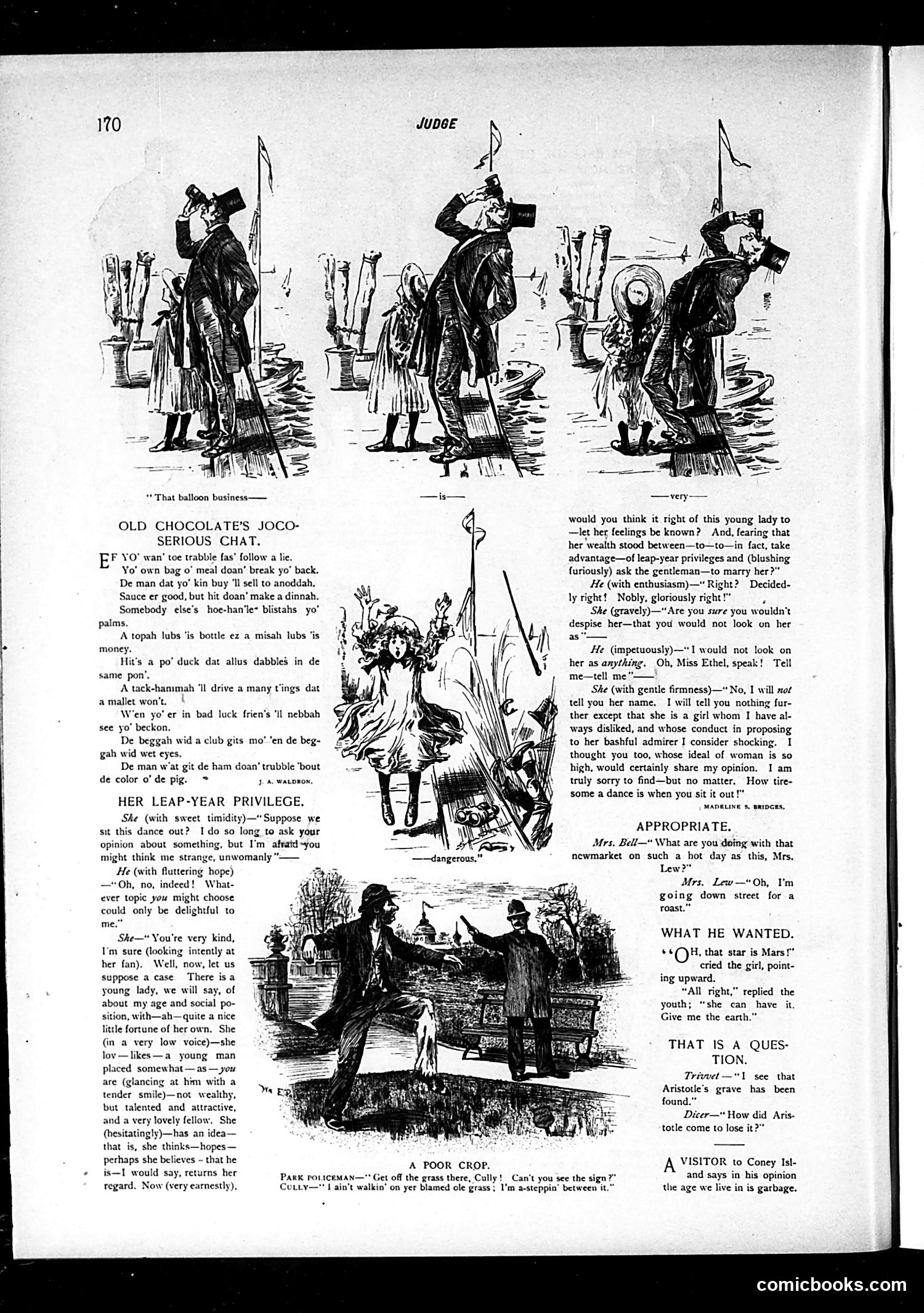
This page contains multiple short humorous pieces typical of late 19th/early 20th-century satirical magazines: **"Old Chocolate's Joco-Serious Chat"**: Features dialect humor from an African American character dispensing folk wisdom in exaggerated dialect—common but offensive racial stereotyping of the era. **"Her Leap-Year Privilege"**: A flirtation sketch where a woman uses leap-year convention (when women could propose to men) to ask a gentleman about marriage, then reveals she was describing someone she *dislikes* and was testing his character. The joke subverts romantic expectations. **"A Poor Crop"**: A park policeman catches a vagrant; the vagrant claims he's not walking *on* the grass but "between" blades—absurdist wordplay humor. **Brief gags**: Including romantic quips ("Give me the earth" vs. Mars) and a commentary on modern life being "garbage." The illustrations depict these scenes with period engraving style. The humor relies on dialect, gender role reversals, class commentary, and wordplay typical of Judge's satirical approach.
📄 Transcribed text from this page (OCR, searchable)
Machine-transcribed from the original scan — historical spelling and the odd misread are preserved.
“That balloon business — OLD CHOCOLATE’S JOCO- SERIOUS CHAT. EF YO" wan’ toe trabble fas" follow a lie. Yo’ own bag 0’ meal doan’ break yo" back. De man dat yo" kin buy ‘ll sell to anoddah. Sauce er good, but hit doan’ make a dinnah. Somebody else’s hoe-han'le- blistahs yo" palms. A topah lubs ‘is bottle ez a misah lubs ‘is money. Hit’s a po’ duck dat allus dabbles in de same pon’, A tack-hammah ‘ll drive a many t'ings dat amallet won't. ‘ W'en yo’ er in bad luck frien’s ‘Il nebbah see yo’ beckon. De beggah wid a club gits mo’ ‘en de beg- gah wid wet eyes. De man wat git de ham doan’ trubble ‘bout de color o' de pig. > J. A. WALDRON. HER LEAP-YEAR PRIVILEGE, She (with sweet timidity)—" Suppose we sit this dance out? Ido so long to ask your opinion about something, but I'm afraid~you might think me strange, unwomanly "— He (with fluttering hope) —"Oh, no, indeed! What- ever topic you might choose could only be delightful to me.” She—"You'te very kind, I'm sure (looking intently at her fan). Well, now, let us suppose a case There is a young lady, we will say, of about my age and social po- sition, with—ah—quite a nice little fortune of her own, She (in a very low voice)—she lov—likes—a young man placed somewhat—as—you are (glancing at him with a tender smile)—not wealthy, but talented and attractive, and a very lovely fellow. She (hesitatingly)—has an idea— that is, she thinks—hopes— perhaps she believes - that he is—I would say A POOR CROP. PARK PoLiceMAN—"* Get off the grass there, Cully ! Can't you see the sign ? CuLLy—"' 1 ain't walkin’ on yer blamed ole grass; I'm a-steppin’ between it.” would you think it right of this young lady to —let her feelings be known? And, fearing that her wealth stood between—to—to—in fact, take advantage—of leap-year privileges and (blushing furiously) ask the gentleman—to marry her?" He (with enthusiasm)—" Right? Decided- ly right! Nobly, gloriously right !" i ‘She (gravely)—“Are you sure you wouldn't ise her—that you would not look on her He (impetuously)—"I would not look on her as anything. Oh, Miss Ethel, speak! Tell me—tell me" — She (with gentle firmness)—“No, I will not tell you her name. I will tell you nothing fur- ther except that she is a girl whom I have al- ways disliked, and whose conduct in proposing to her bashful admirer I consider shocking. I thought you too, whose ideal of woman is so high, would certainly share my opinion. I am truly sorry to find—but no matter. How tire- some a dance is when you sit it out !" MADELING S BRIDGES, APPROPRIATE. Mrs, Bell— What are you doing with that newmarket on such a hot day as this, Mrs. Lew?" Mrs. Lew —"Ob, I'm going down street for a roast.” WHAT HE WANTED. . ‘Ou that star is Mars!" cried the girl, point- ing upward. “All right,” replied the youth; “she can have it. Give me the earth.” THAT IS A QUES- TION. Trévvet —"“1 see that Aristotle's grave has been found.” Dicer—" How did Aris- totle come to lose it?” A VISITOR to Coney Isl- and says in his opinion the age we live in is garbage. comicbooks.com