
A complete issue · 16 pages · 1892
Judge — August 27, 1892
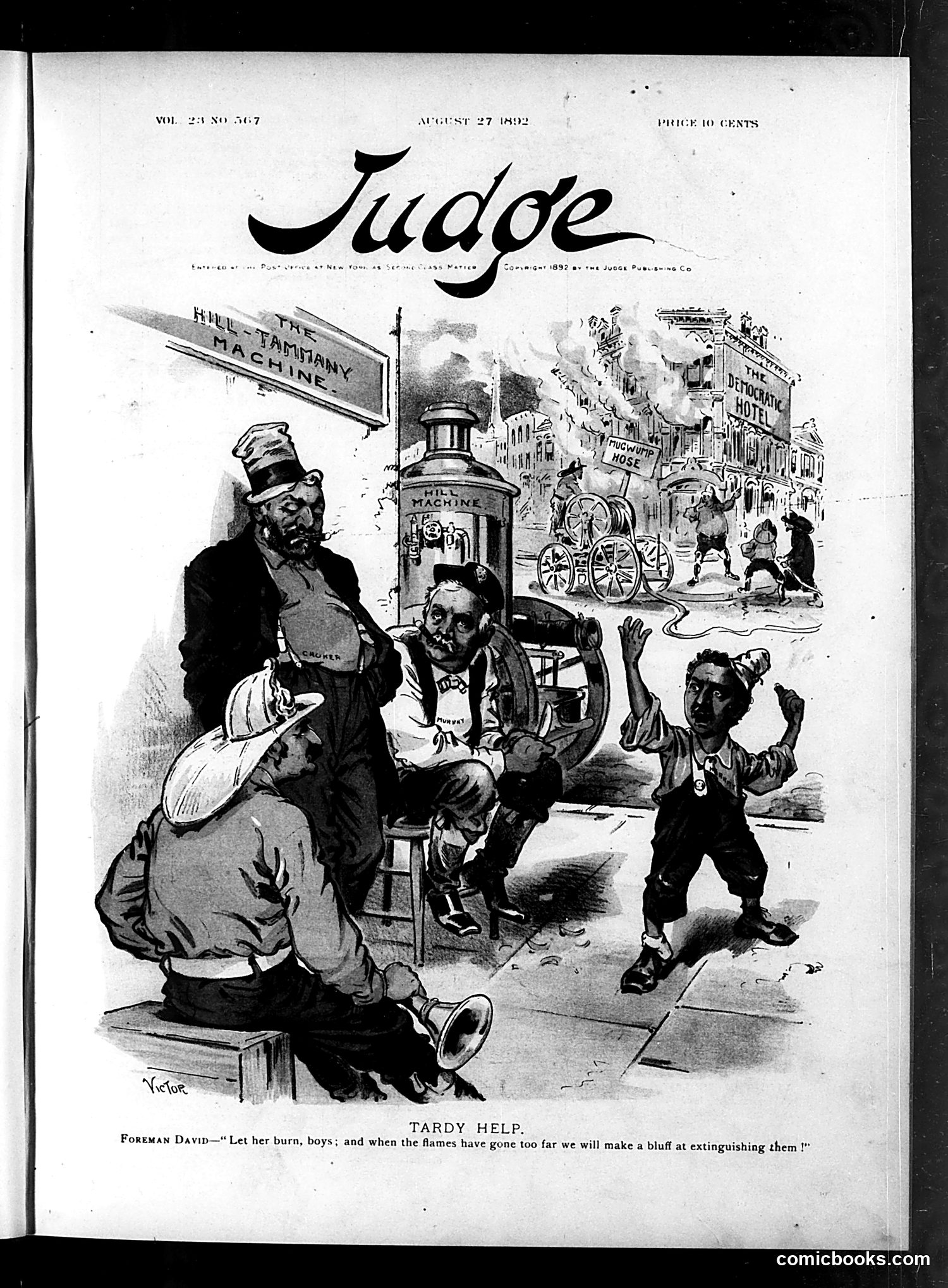
This cartoon satirizes inadequate fire-fighting response to urban conflagrations. The caption quotes "Foreman David" dismissing initial fire-suppression efforts, vowing to "make a bluff at extinguishing" flames once they spread further—a critique of municipal negligence. The scene depicts a factory fire (labeled machinery visible in background) with caricatured figures representing city officials or fire department leadership. The exaggerated facial features and body language suggest incompetence or indifference to the disaster unfolding. The industrial setting with tenement buildings reflects late-19th-century urban concerns about inadequate safety regulations and firefighting infrastructure. The satire targets governmental procrastination and the gap between promised and actual emergency response during America's rapid industrialization.
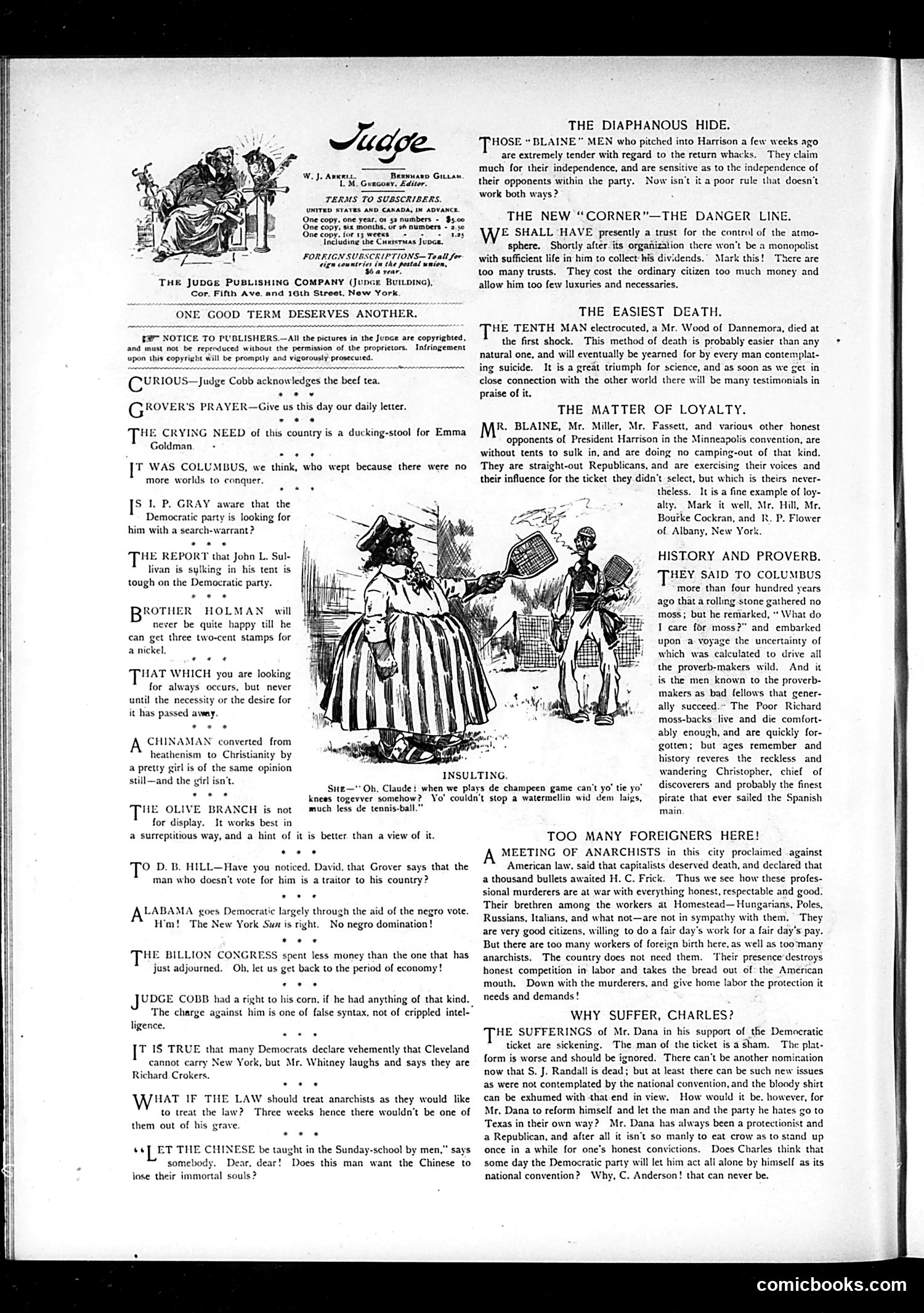
This page contains editorial commentary and satirical "items" rather than a single unified cartoon. The main illustration shows a woman being accosted, labeled "INSULTING," depicting street harassment. The text attacks Democratic politics and foreign anarchists. References include: - "Blaine men" (likely James G. Blaine, Republican politician) - Criticism of Cleveland and Whitney (Democratic leaders) - Anti-anarchist rhetoric, suggesting foreign radicals threaten American workers - Commentary on S.J. Randall's death and Democratic succession struggles The satirical items mock Democratic Party divisions and hypocrisy, while expressing nativist anxiety about anarchist immigrants. The piece advocates excluding foreign agitators while defending American labor from competition. Overall, it reflects late 19th-century Republican partisan politics and contemporary fears about radical foreign ideologies.
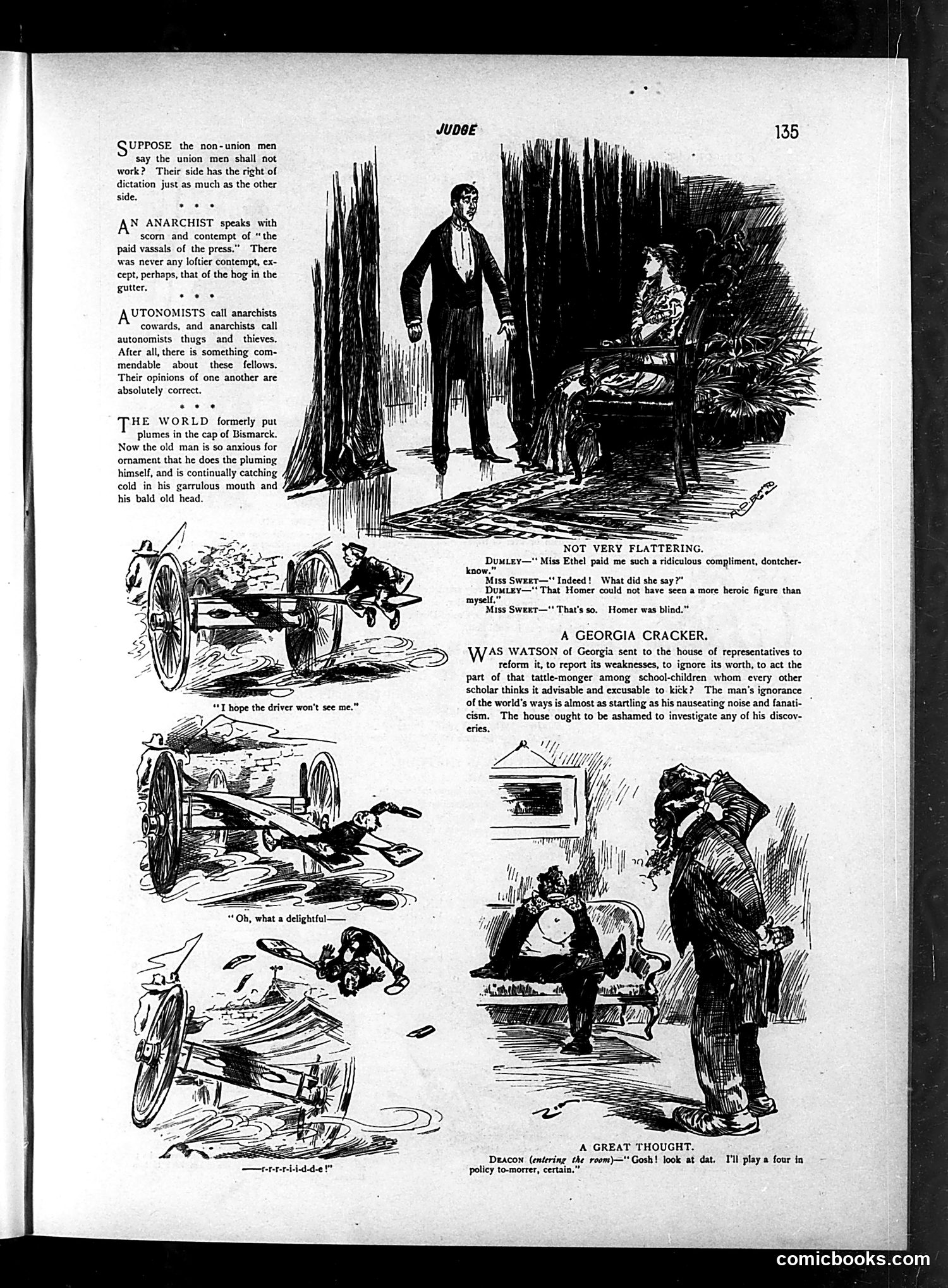
This page contains several satirical pieces on political and social topics: **Upper section:** Editorial commentary on labor disputes, anarchism, and autonomism—comparing non-union workers' rights to union claims, while mocking anarchist rhetoric as contemptible and autonomists as hypocritical "thieves." **"A Georgia Cracker":** A story about Watson of Georgia (likely Thomas E. Watson, a Populist politician) reporting to the House of Representatives on alleged "tattletale-monger" behavior among schoolchildren—satirizing what the author considers absurdly trivial matters being investigated by Congress. **Cartoons:** Several humorous illustrations accompany these pieces, including one with a caption "I hope the driver won't see me" (depicting someone hiding from a vehicle) and another labeled "A Great Thought," mocking political or social pretensions. The page reflects late 19th/early 20th-century American political satire.
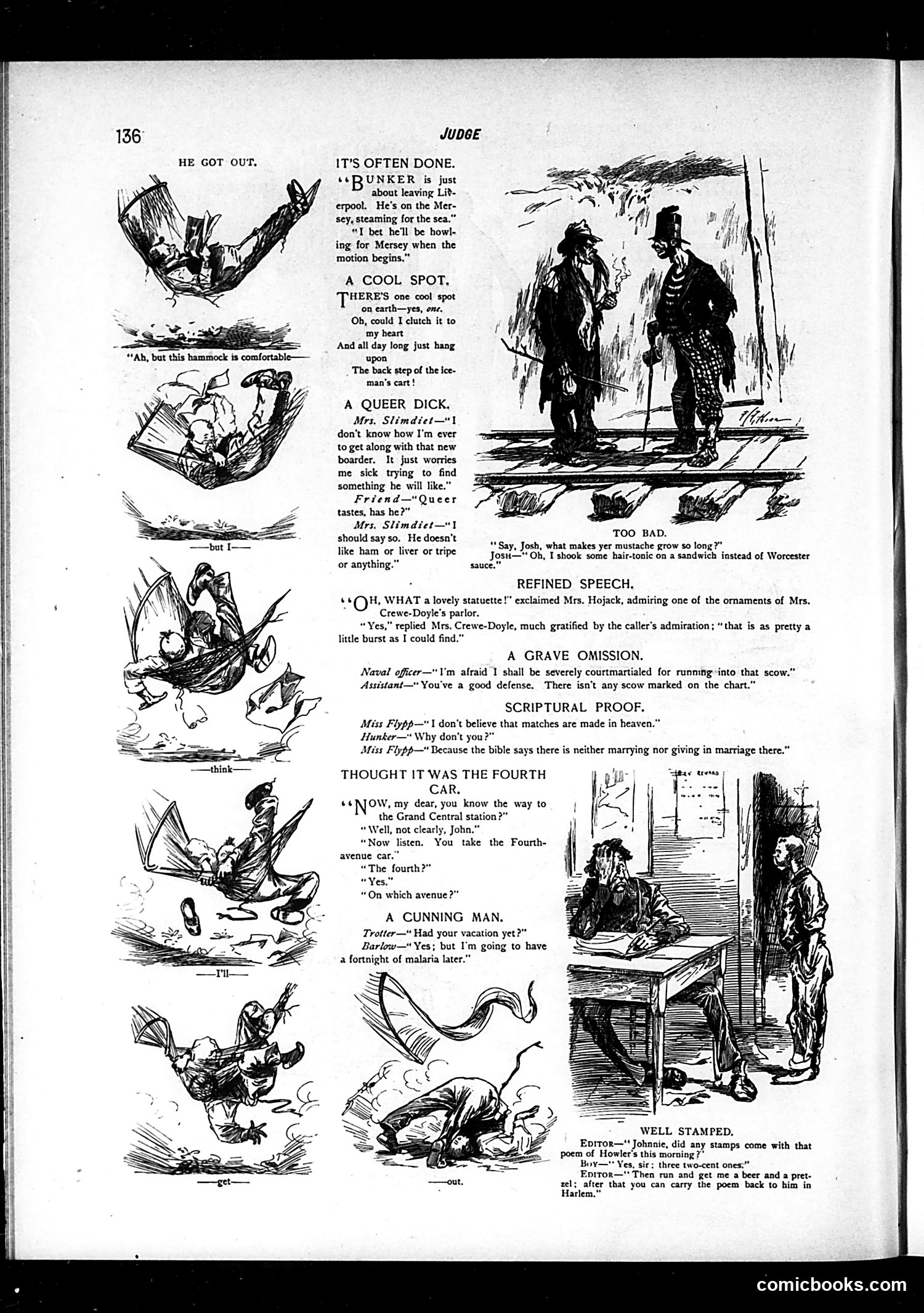
This page contains various short humorous anecdotes typical of Judge magazine's satirical style. Key jokes include: **"He Got Out"**: A man boarding a ship (possibly named Bunker) will get seasick during the voyage—wordplay on "howling for the Mersey" (the river) versus seasickness. **"A Cool Spot"**: Nostalgic humor about wanting to ride on an iceman's cart for relief on a hot day—reflecting pre-refrigeration era concerns. **"A Queer Dick"**: A difficult boarder who dislikes common foods (ham, liver, tripe), poking fun at finicky eaters. **"Too Bad"**: A man used hair tonic on a sandwich instead of sauce, resulting in an unusually long mustache. **"Scriptural Proof"**: A woman argues matches aren't made in heaven because the Bible says there's no marriage there—playing with the phrase "made in heaven." **"Well Stamped"**: An editor rejects a poem for lacking postage stamps (treating it as worthless), using it to buy beer instead. The cartoons mock everyday absurdities, social pretension, and wordplay typical of Victorian-era humor magazines.
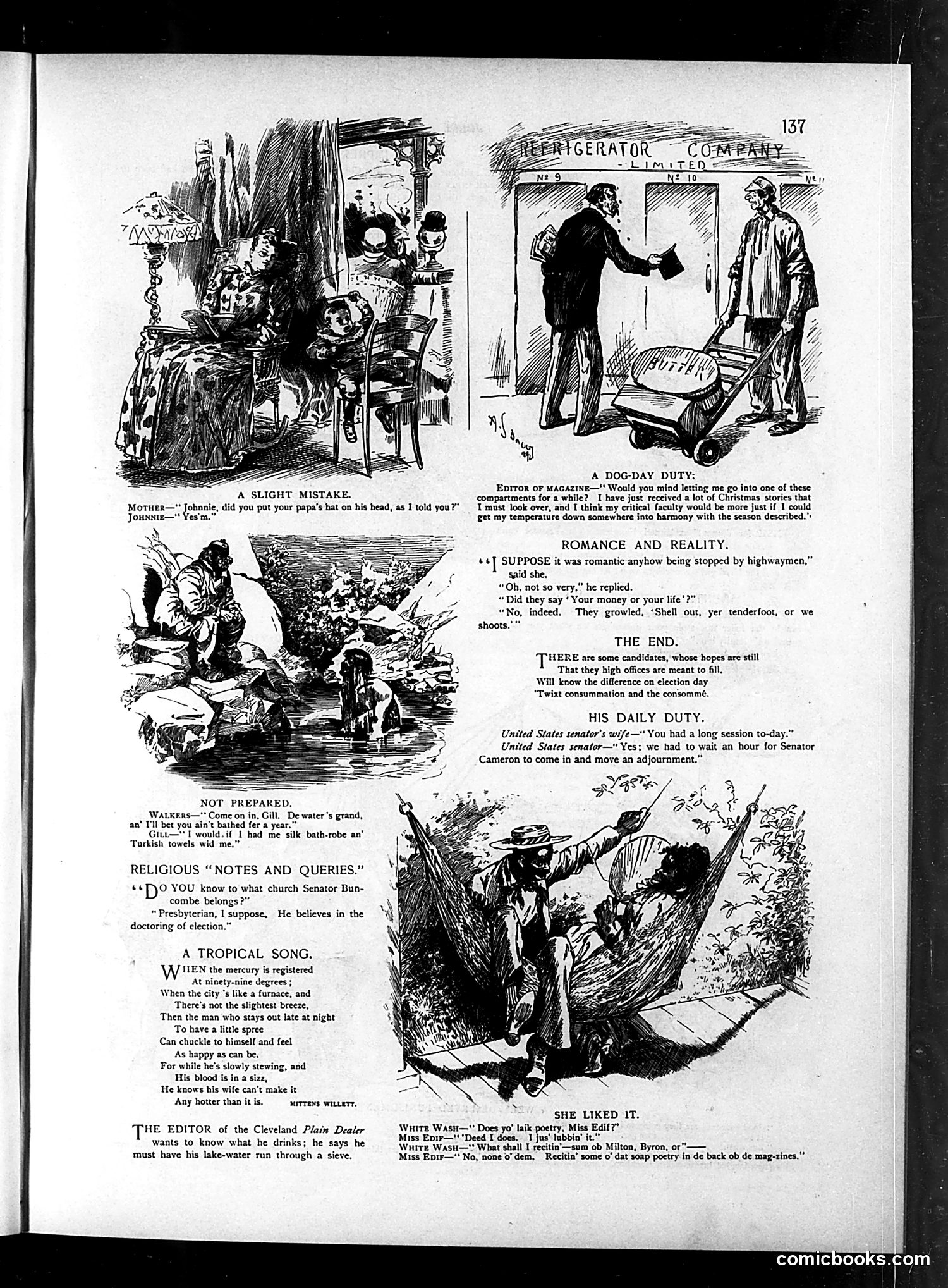
This page contains multiple short satirical pieces lampooning American society and politics circa early 1900s. **"A Dog-Day Duty"** mocks magazine editors overwhelmed by Christmas stories submitted during summer heat—suggesting they need refrigeration to maintain critical judgment. **"Romance and Reality"** contrasts literary romanticism with frontier roughness: highwaymen say "shell out, yer tenderfoot, or we shoots"—crude rather than theatrical. **"His Daily Duty"** appears to joke about a senator's wife waiting for him to attend to political business. **"Religious Notes and Queries"** satirizes Senator Buncombe as Presbyterian because he believes in "doctoring of election"—implying corrupt voting manipulation disguised as religious principle. **"A Tropical Song"** humorously suggests a cheating husband welcomes summer heat because it keeps his wife too uncomfortable to confront him. **"She Liked It"** mocks readers' poor taste: preferring sentimental magazine poetry to Milton or Byron.
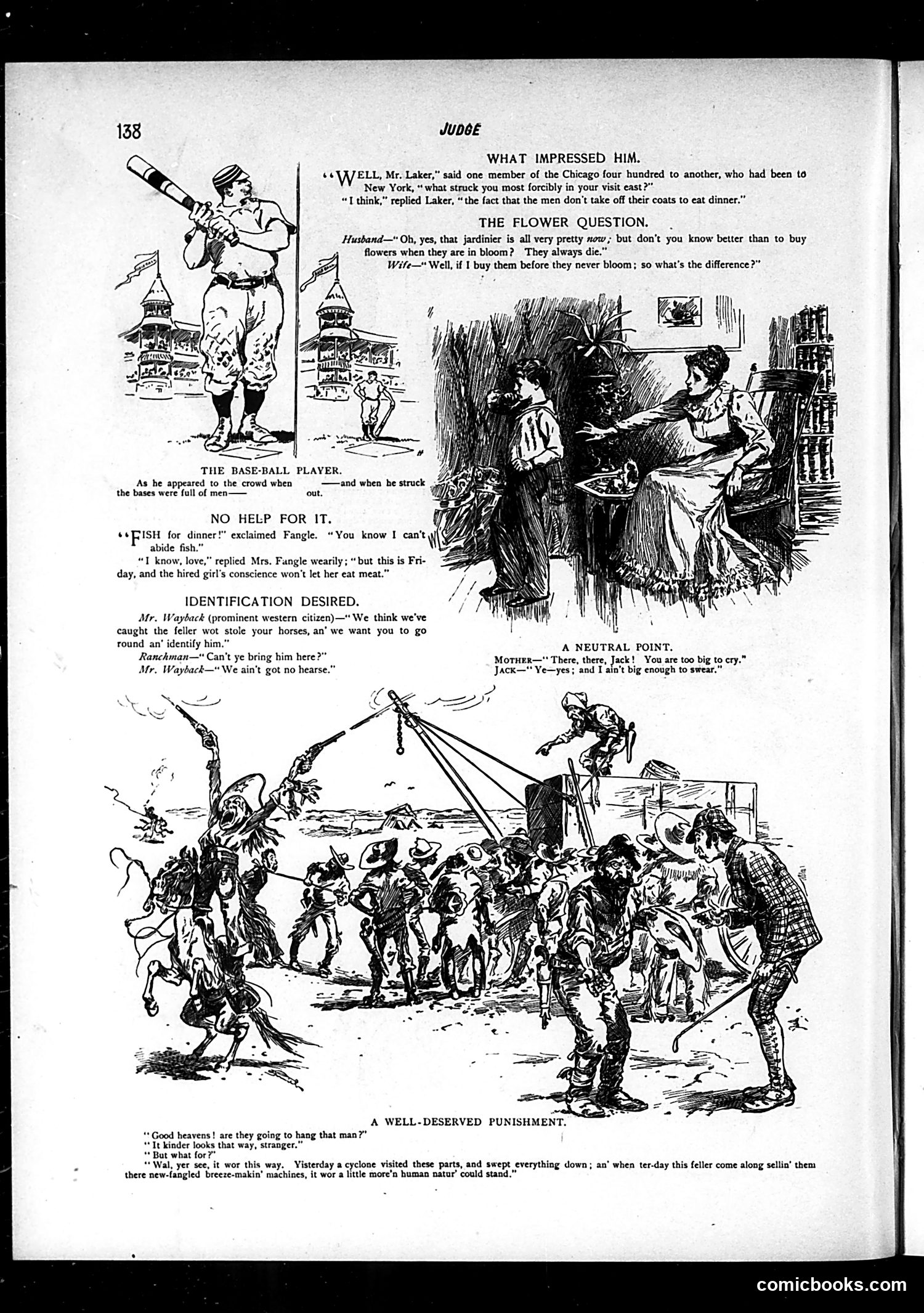
This page contains six separate humor pieces typical of Judge's late 19th/early 20th-century satirical style: **"What Impressed Him"**: A Chicago socialite visiting New York is struck that eastern men keep their coats on during dinner—suggesting midwestern formality versus eastern casualness. **"The Flower Question"**: A marital dispute about when to buy flowers, satirizing husbands' impractical logic about plant care. **"The Base-Ball Player"**: Visual gag contrasting a baseball player's confident stance versus his strikeout collapse. **"No Help For It"**: A domestic comedy where religious dietary rules (Friday fish abstinence) force unwanted meals. **"Identification Desired"** and **"A Neutral Point"**: Frontier humor depicting rural justice and child-rearing through dialect. **"A Well-Deserved Punishment"**: Frontier satire where a cyclone survivor hangs a man selling mechanical fans—dark humor about community tolerance after disaster. The page reflects Judge's focus on class distinctions, gender relations, and regional American stereotypes.
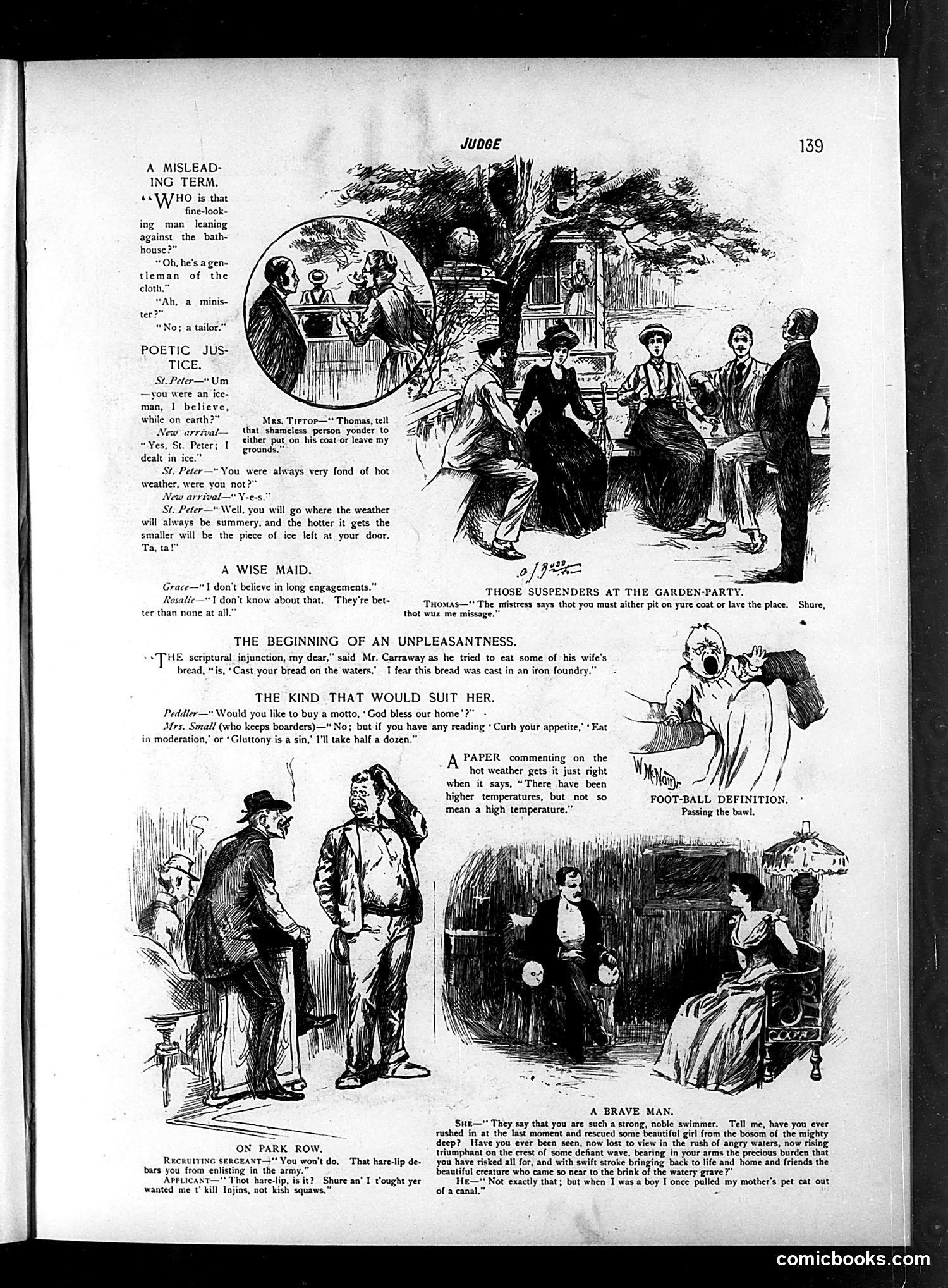
This page contains multiple brief satirical sketches typical of Judge's humor circa early 1900s: **"A Misleading Term"**: Jokes about imprecise language—a "gentleman of the cloth" refers to a tailor, not a clergyman, confusing the listener. **"Poetic Justice"**: An ice-man arrives in the afterlife; St. Peter punishes his love of hot weather by sending him somewhere eternally summer-hot, where his daily ice ration shrinks—ironic comeuppance. **"Those Suspenders at the Garden-Party"**: An Irish servant (indicated by dialect) relays his mistress's demand that an underdressed man either cover up or leave. **"The Beginning of an Unpleasantness"**: A husband complains his wife's bread is so hard it must have been cast in an iron foundry—wordplay on scripture. **"A Brave Man"**: Deflates romantic heroism; when asked about rescuing drowning maidens, a man admits his bravest act was pulling his mother's cat from a canal. The humor relies on class commentary, Irish stereotypes, wordplay, and puncturing pretension—typical Judge satire of everyday social situations.
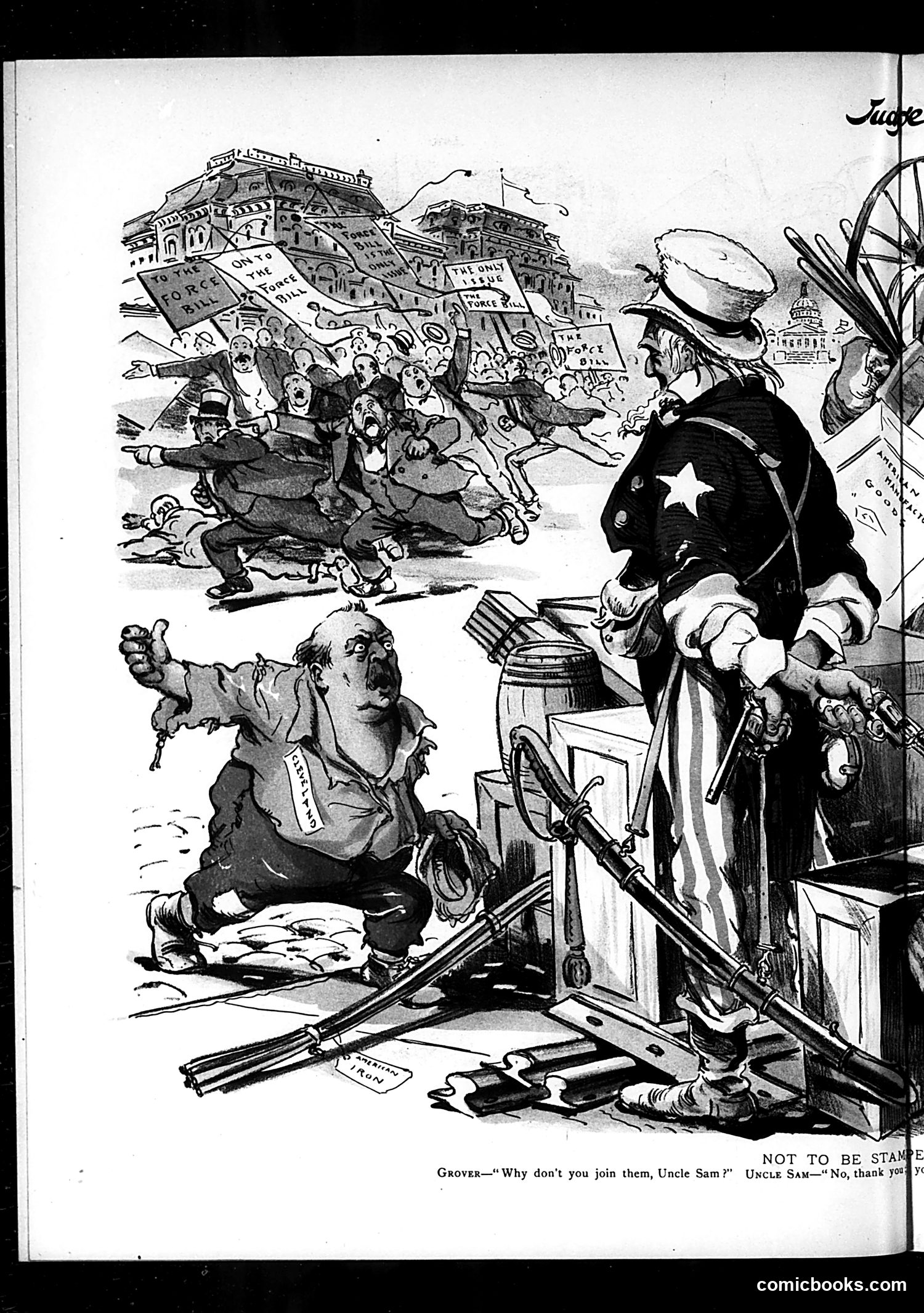
This Judge magazine cartoon depicts a confrontation between two figures: **Grover** (likely President Grover Cleveland) and **Uncle Sam** (representing the United States government). In the background, a large mob of people surges around a building labeled with various protest signs, suggesting civil unrest or a labor/political movement. Grover urges Uncle Sam to "join them," but Uncle Sam firmly refuses ("No, thank you"). The satire critiques Cleveland's stance toward a popular movement—possibly labor agitation or populist activism of the 1890s era. The cartoon suggests Grover is trying to persuade the government to support what appears to be a mass movement, which Uncle Sam resists. The exact historical event remains unclear without the publication date, but the image captures tension between executive authority and popular mobilization.
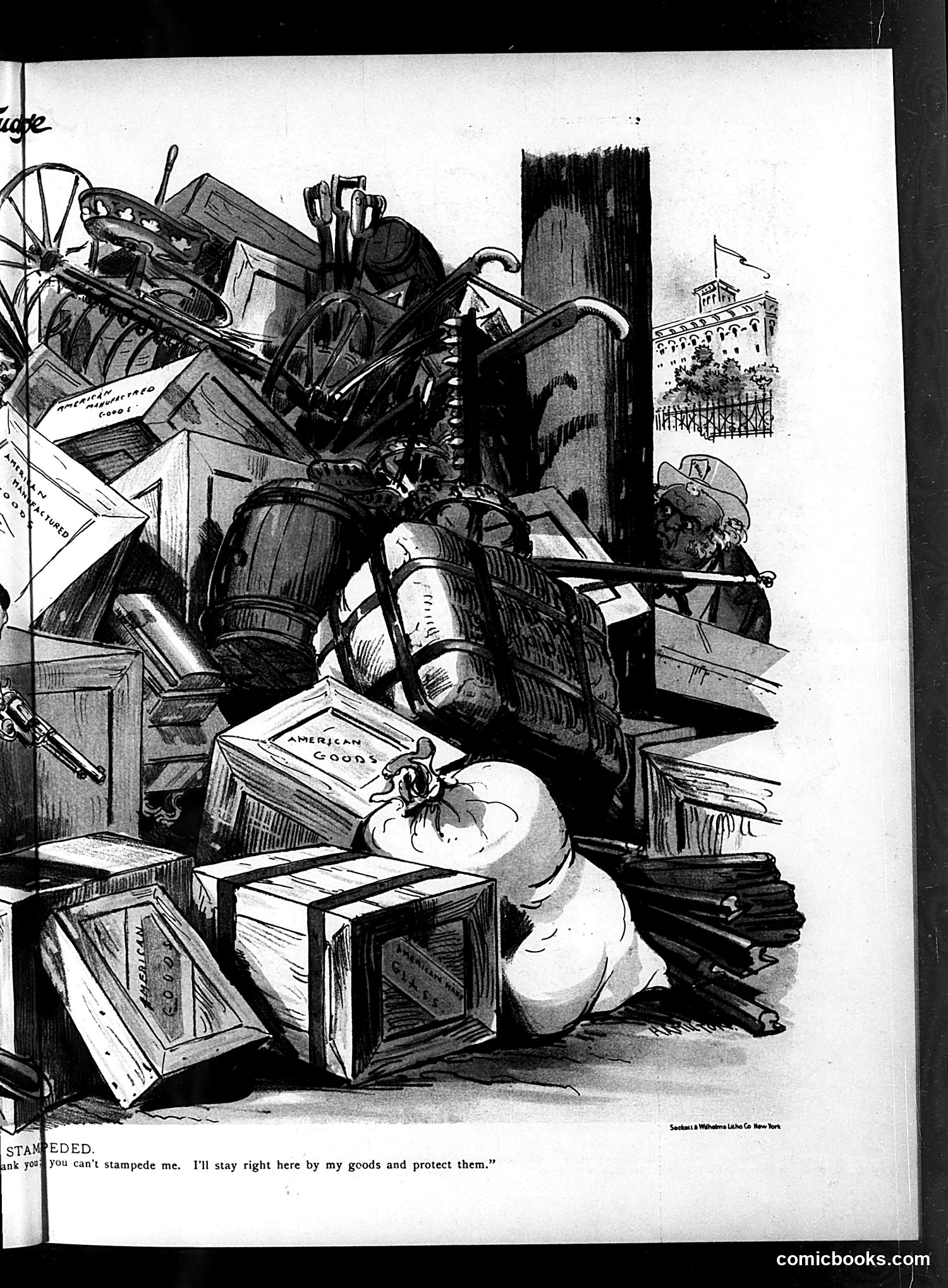
This political cartoon depicts **Uncle Sam** (personified as America) standing protectively over boxes labeled "American Goods." He refuses to be "stampeded" by various forces—likely representing tariff pressures or trade threats of the era. The chaotic imagery surrounding Uncle Sam—machinery, barrels, industrial equipment, and what appears to be a government building in the background—suggests commercial and political turmoil. His resolute stance and quoted declaration indicate defiance against external economic pressure or protectionist challenges. The cartoon likely addresses **trade policy debates** common in Judge magazine's era, satirizing either protectionist sentiment or foreign trade pressures. Without the magazine's date or additional context visible, the specific historical event remains unclear, though the message is clear: Uncle Sam will defend American commercial interests against intimidation.
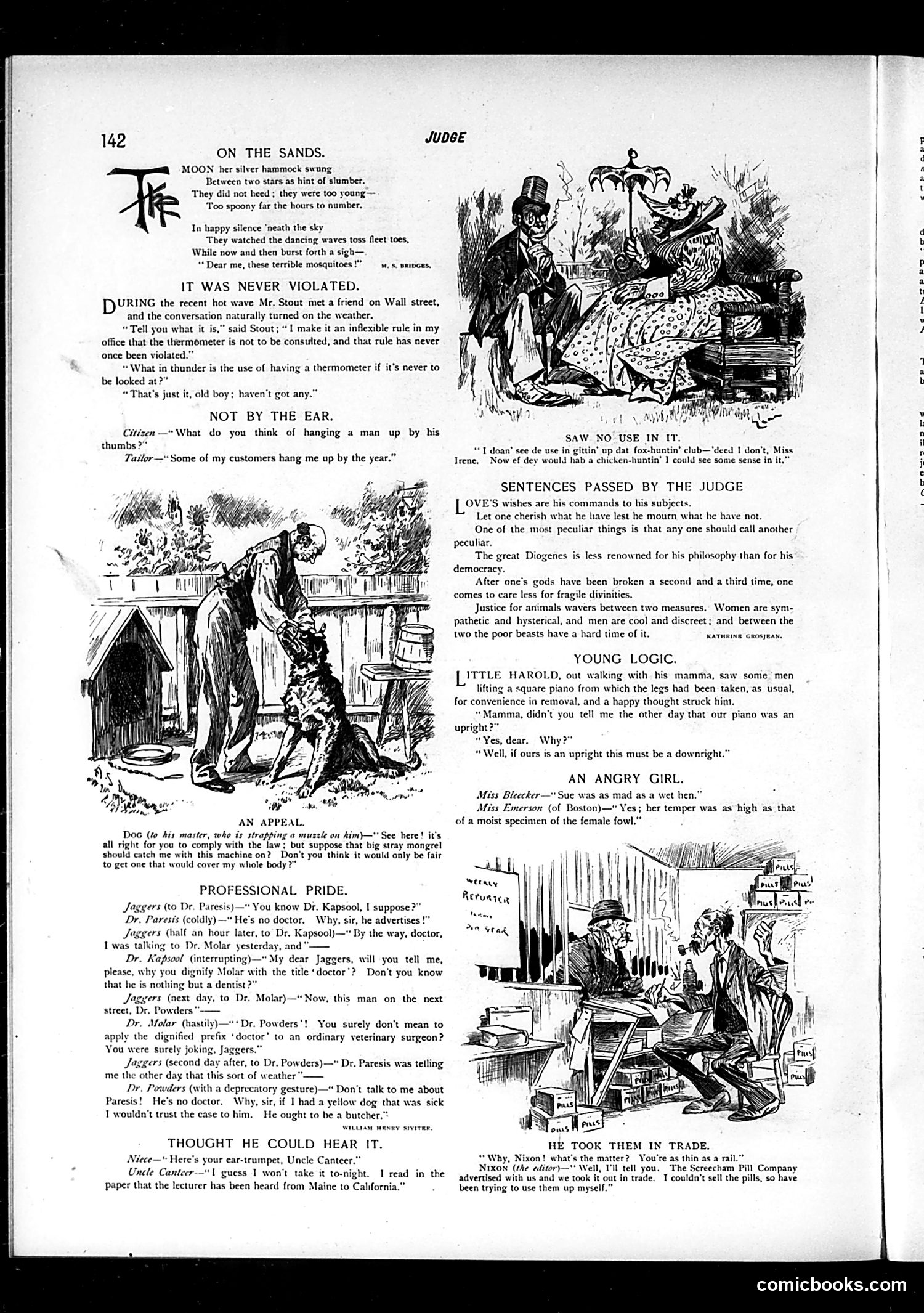
This page contains multiple satirical shorts and cartoons typical of Judge magazine's humor. **"It Was Never Violated"**: Mocks a Wall Street businessman's absurd logic—he claims an inflexible office rule never to consult the thermometer, then admits he doesn't own one. The satire targets pretentious professional affectation. **"Not by the Ear"**: A tailor hangs by unpaid debts while a citizen questions hanging criminals by thumbs—dark humor about creditor abuse. **"Professional Pride"**: The longest piece satirizes professional snobbery. A gossipy man (Jaggers) visits three doctors in succession, each dismissing the previous one's credentials—a dentist isn't a "real" doctor, a veterinarian isn't either. The joke exposes how professionals create arbitrary hierarchies and gatekeeping to maintain status, regardless of actual competence. Other shorts mock romantic clichés, twisted metaphors, and gender stereotypes common to the era's light humor.
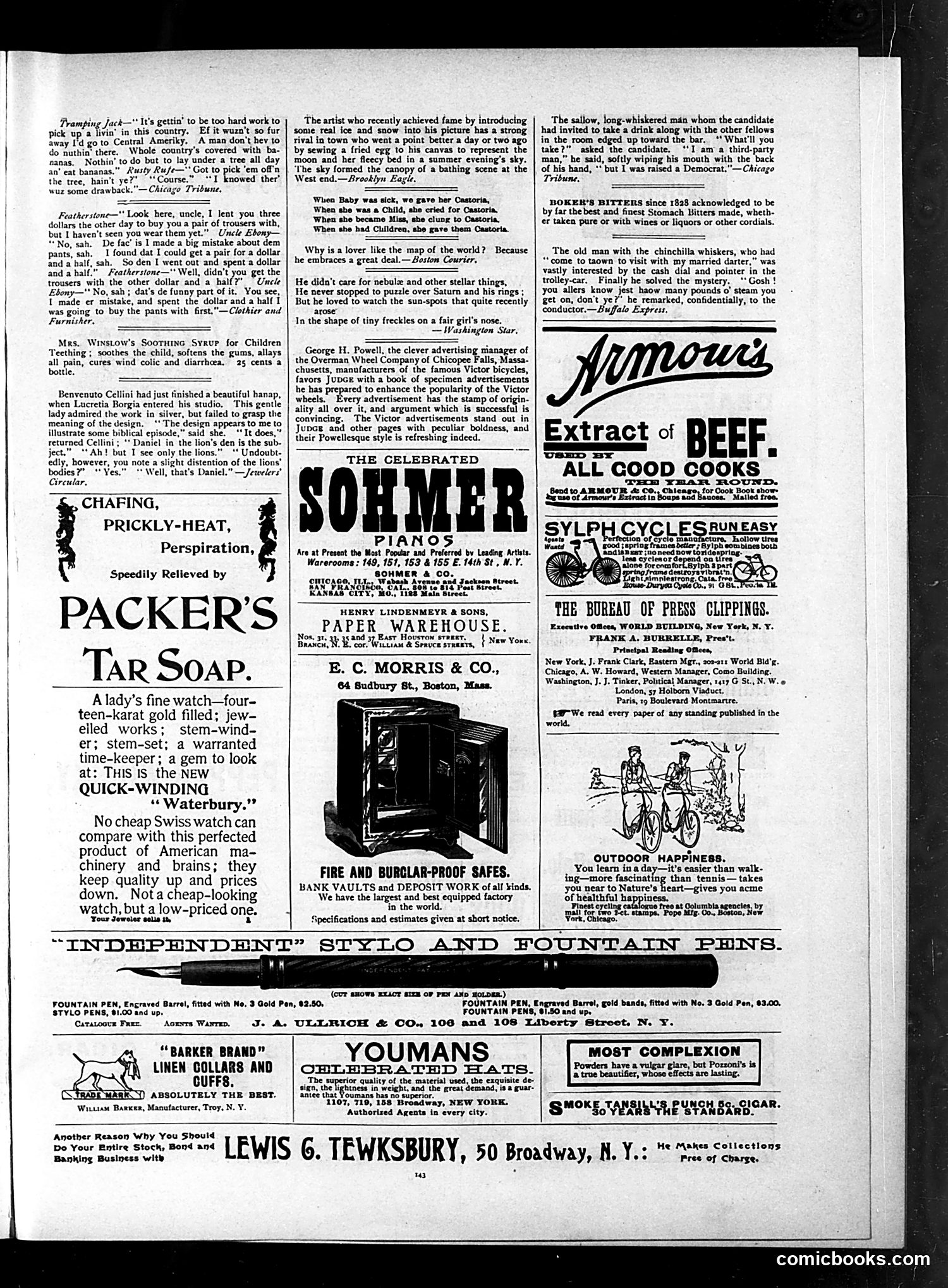
This appears to be a page from *Judge* magazine consisting almost entirely of advertisements interspersed with brief humorous anecdotes rather than political cartoons. The few jokes present reflect period racial and class stereotypes: one depicts dialect-speaking Black characters in a financial misunderstanding; another mocks a wealthy man's inability to grasp artistic meaning. There's also wordplay about a lover "embracing" a map and absurdist humor about an artist literally sewing a fried egg onto canvas to represent the moon. The extensive advertisements promote products like Packer's Tar Soap, Sohmer Pianos, Sylph Bicycles, and Waterbury watches—typical consumer goods of the era. The page includes no identifiable political commentary or significant satirical content targeting public figures or events. It's essentially a commercial advertising vehicle with light humor meant to entertain readers between product pitches.
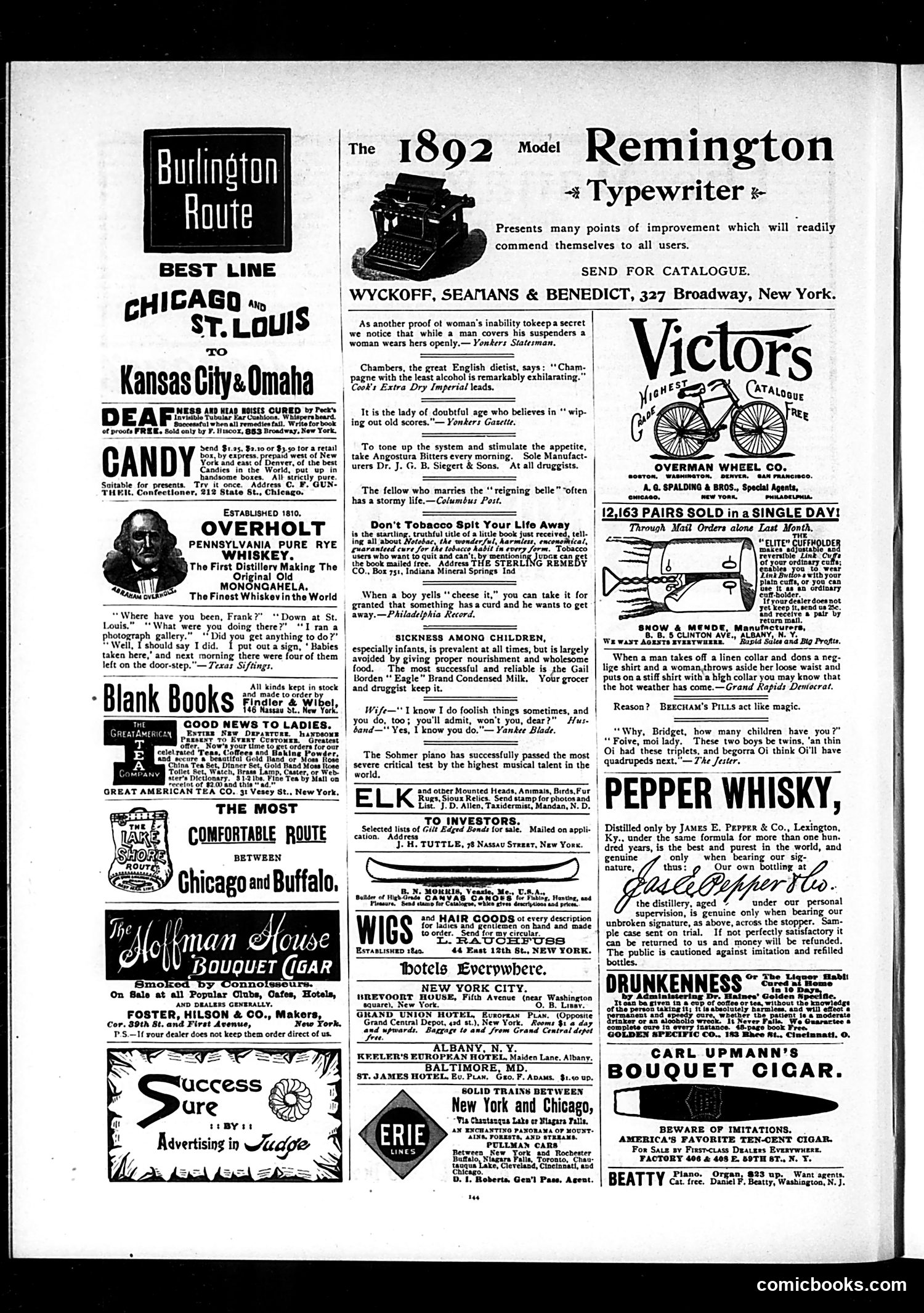
This is primarily an **advertising page** from Judge magazine, with minimal editorial content. The few cartoon-like elements are brief humorous quips accompanying ads rather than substantive political satire. The page's humor reflects **late-19th century gender stereotypes**: one caption jokes that women "can't keep secrets" because they openly wear suspenders (a male garment), implying women lack discretion. Another mocks a woman of "doubtful age" who tries to "wipe out old scores," suggesting vanity and vindictiveness. The bulk of the page advertises products typical of the 1890s: whiskeys (Overholt, Pepper), cigars, typewriters, hair goods, and patent medicines—including "cures" for tobacco addiction and childhood illness. A small anecdote about a photographer in St. Louis provides light humor unrelated to politics. No identifiable political figures or events appear. This is a **commercial page** reflecting period consumer culture and contemporary attitudes toward women rather than satirical commentary.
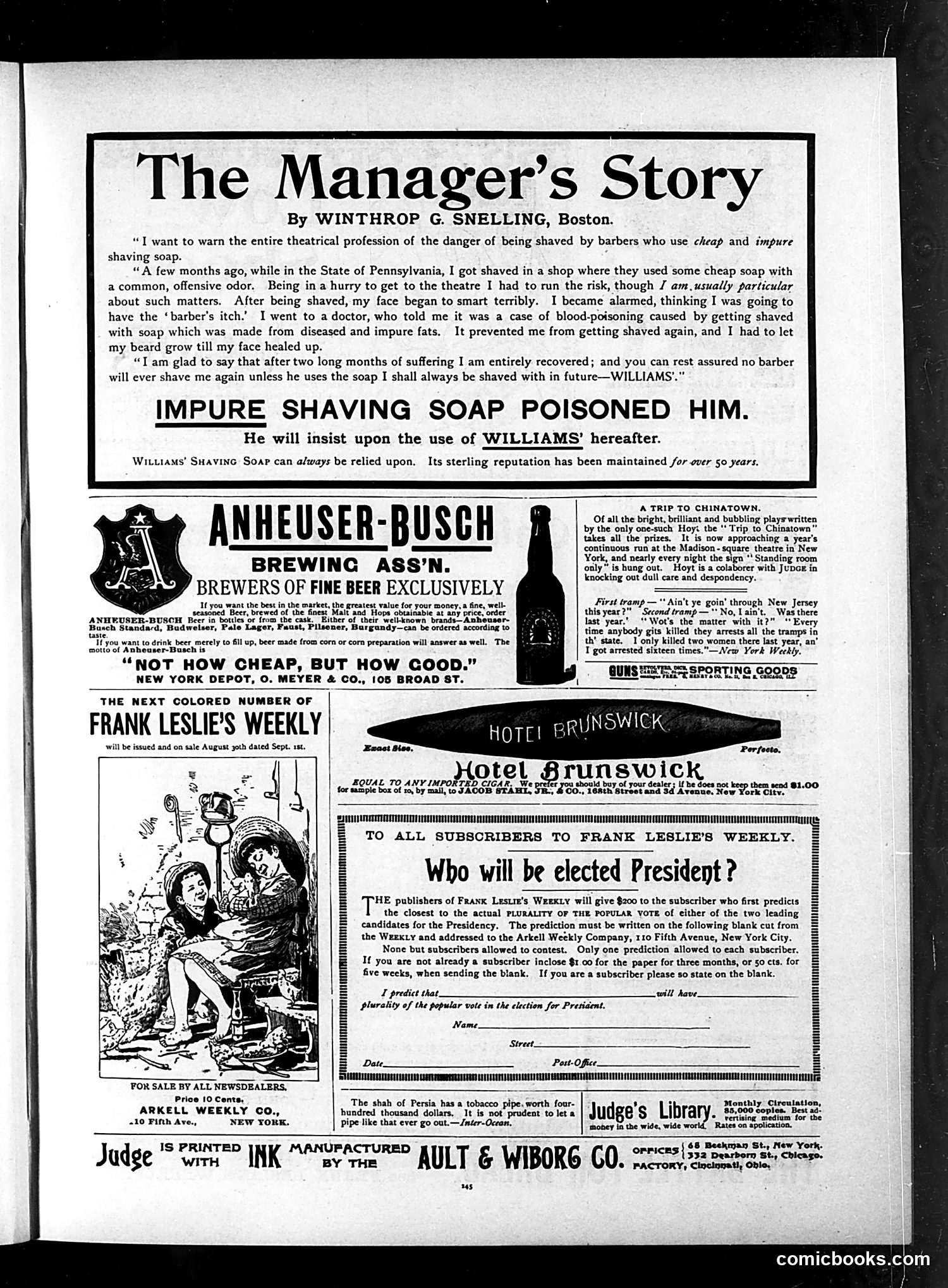
This page is primarily **advertising and promotional content** rather than political satire. The main pieces are: 1. **"The Manager's Story"** (top): A testimonial ad for Williams' Shaving Soap. A theater manager claims cheap soap caused blood poisoning; he now insists on Williams'. This is straightforward product advertising using fear tactics—common in late-19th-century marketing. 2. **Anheuser-Busch Brewing** ad emphasizes quality beer, not cheap corn-based substitutes—similar messaging to the soap ad. 3. **Frank Leslie's Weekly promotion**: Announces an upcoming issue and a contest offering $200 to subscribers who best predict the popular vote plurality in a presidential election. The specific election year is unclear from visible text. 4. **Hotel Brunswick and Judge's Library ads**: Standard commercial placements. The page reflects **Gilded Age consumer culture**—emphasizing quality products over cheap alternatives, and using celebrity/authority testimonials (the theater manager) to sell goods. The presidential prediction contest suggests this ran during an election year, likely the 1890s.
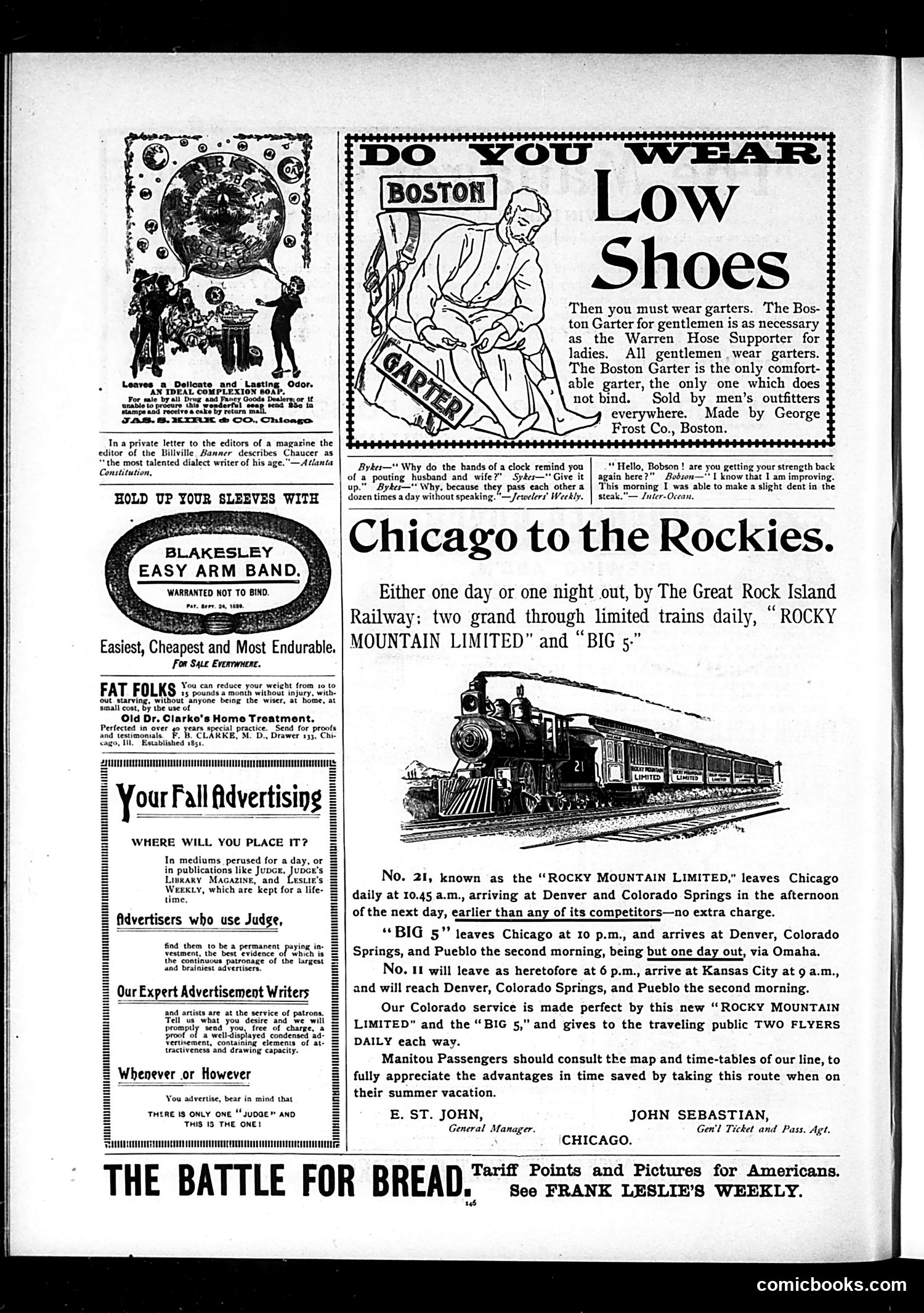
This page is primarily **advertisements** from Judge magazine, with minimal editorial content. The visible jokes are minor: one about clock hands resembling a "pouting husband and wife" who ignore each other, and another about a man barely denting steak, suggesting weakness. The advertisements focus on **turn-of-the-century consumer products**: arm bands, weight-loss treatments ("Old Dr. Clarke's Home Treatment"), garters for men, and Boston Garters specifically. There's also a substantial railroad advertisement for the Great Rock Island Railway's service to Colorado (the "Rocky Mountain Limited" and "Big 5" trains). A brief editorial note mocks the editor of the Billville Banner for calling Chaucer "the most talented dialect writer of his age"—a humorous understatement given Chaucer's canonical status. The page emphasizes Judge's value as a **permanent advertising medium** (kept for years, not discarded like dailies), pitched directly to advertisers. It's essentially a sales pitch for advertising space rather than satirical content.
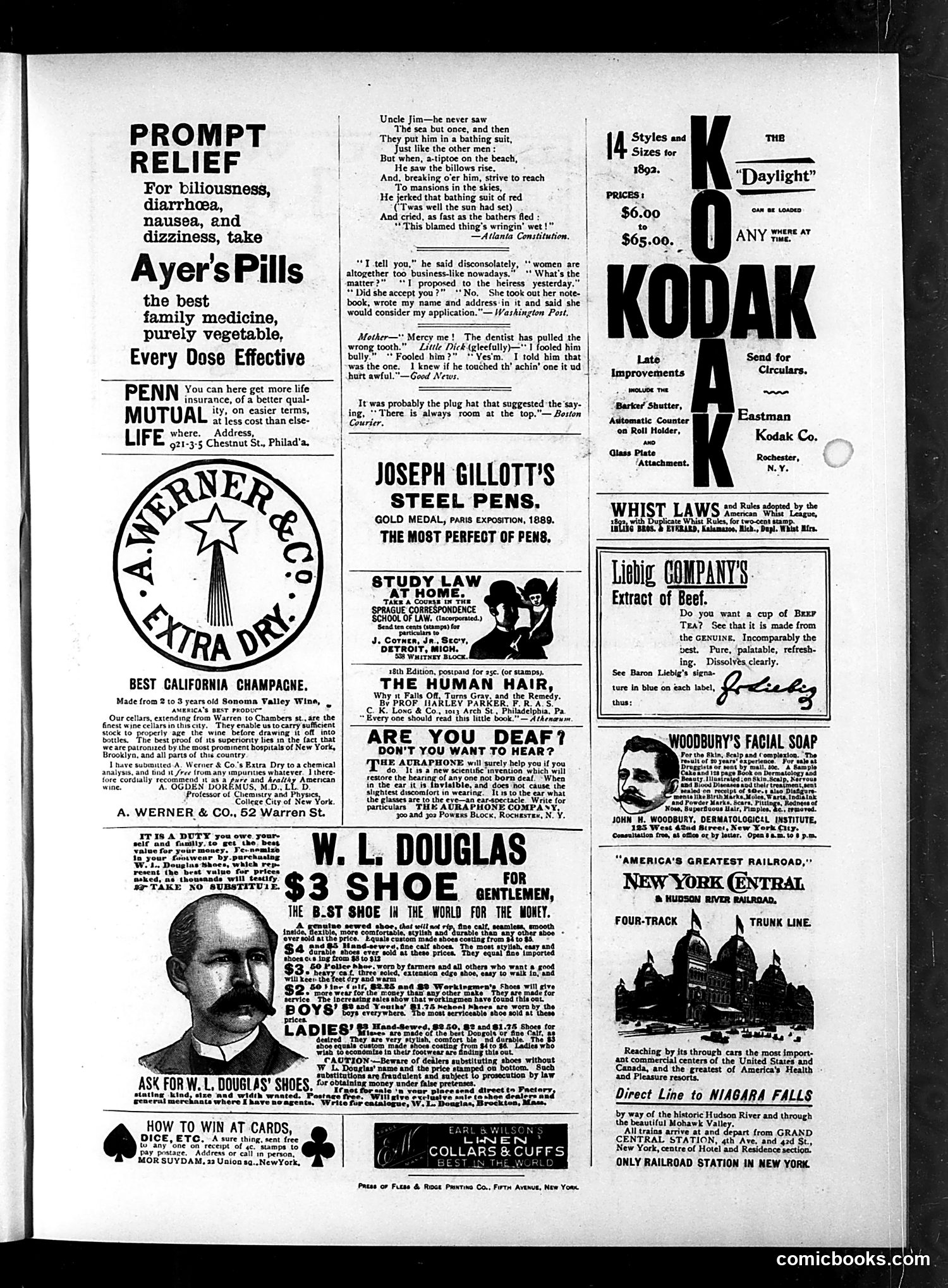
This is primarily an **advertising page** from Judge magazine, with minimal editorial cartoon content. The main satirical element is a brief poem titled "Prompt Relief" about "Uncle Jim," which pokes gentle fun at an elderly man's discomfort in a bathing suit—a mild joke about physical modesty and aging, typical of the era's humor. The page is dominated by **patent medicine and consumer product advertisements** typical of the 1890s: Ayer's Pills, Werner champagne, Gillott's steel pens, and notably, a large ad for "W.L. Douglas $3 Shoe" featuring a stern-looking man with a prominent mustache. The ads reflect **late-Victorian consumer culture** and include products now considered dubious (the "Auraphone" hearing device, various tonics) alongside legitimate goods. Small filler jokes appear throughout—brief anecdotes about dentists, marriage proposals, and hats—standard magazine humor of the period. **No clear political satire is evident.** This appears to be a standard commercial advertising page rather than satirical commentary.
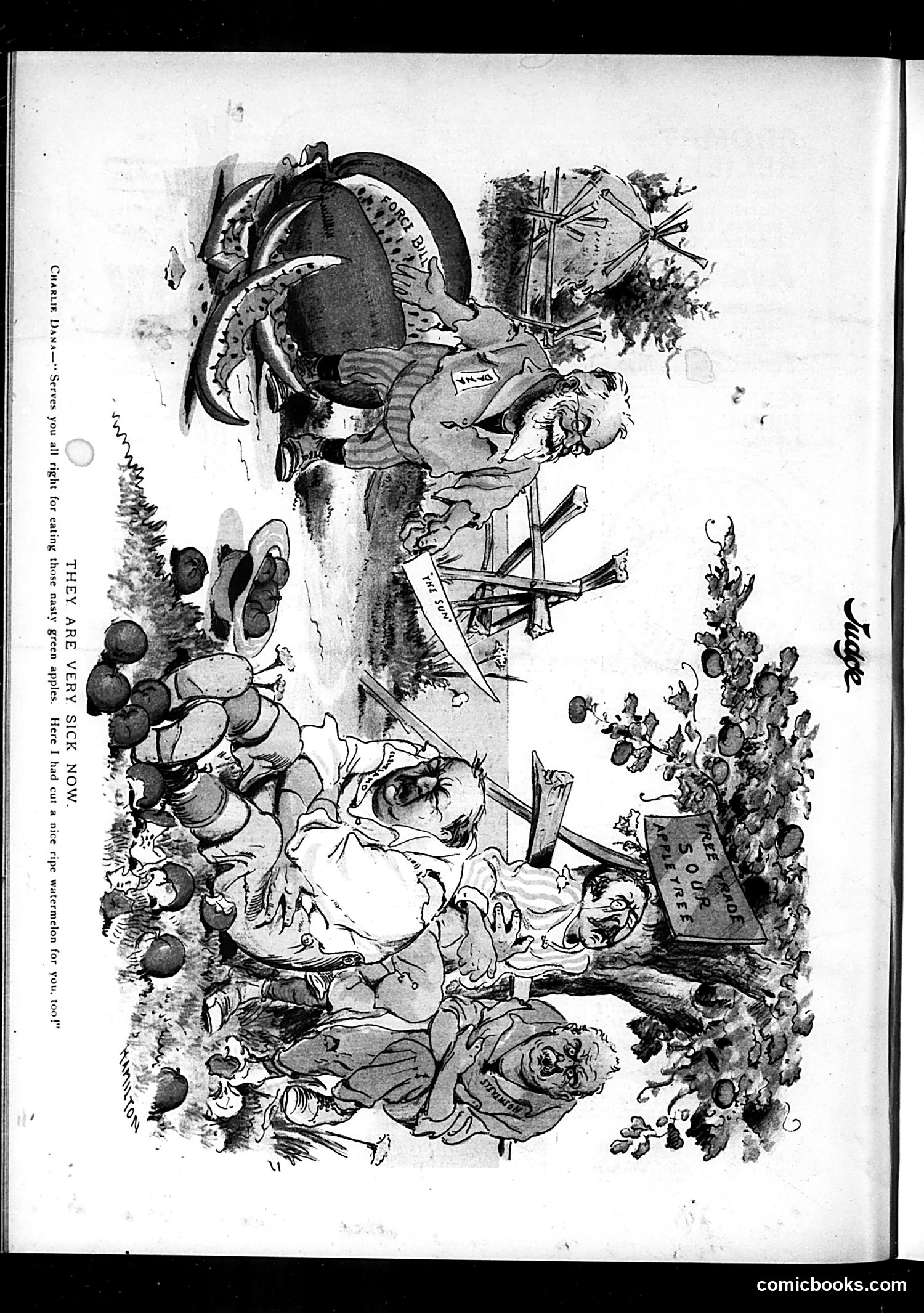
This appears to be a satirical cartoon from Judge magazine featuring Charles Dana (editor of the New York Sun), depicted offering watermelon to sick figures. The caption's tone—"serves you all right"—suggests Dana is blaming others for their misfortune while highlighting his own better judgment. The "green apples" and "ripe watermelon" likely function as political metaphors rather than literal fruit. Without clearer identification of the sick figures or specific historical context visible in the image, the exact political situation remains unclear. However, the cartoon's structure—showing Dana as a knowing figure superior to the afflicted—suggests it's mocking Dana's self-righteousness about some contemporaneous political or social matter where he claimed superior foresight. The satire appears to target Dana's condescending attitude toward others' misfortunes.