
A complete issue · 18 pages · 1892
Judge — August 13, 1892
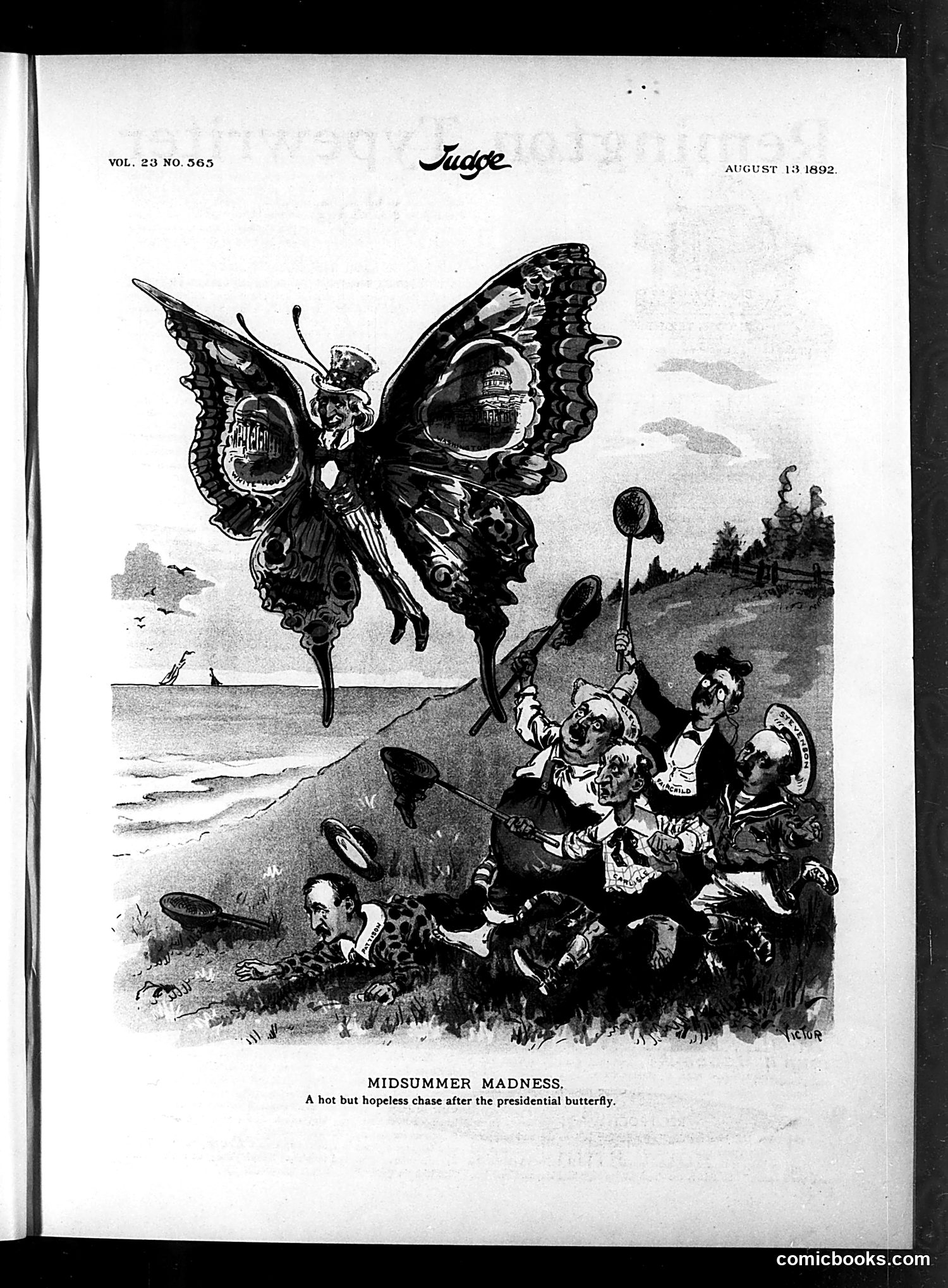
This political cartoon satirizes the 1892 presidential election as a chaotic "chase after the presidential butterfly." A giant butterfly with a face (representing the presidency itself) flies above a group of frantically pursuing politicians on a beach landscape. The figures below appear to be prominent candidates or political figures of 1892, depicted as foolish, desperate pursuers. One man lies on the ground; others jump and wave nets, showing the undignified scramble for the presidency. The satire mocks how politicians desperately pursue high office—portrayed as an elusive, fluttering butterfly that cannot be caught. The "midsummer madness" title suggests this frantic competition is absurd and irrational, offering Judge's cynical commentary on American electoral politics during this period.
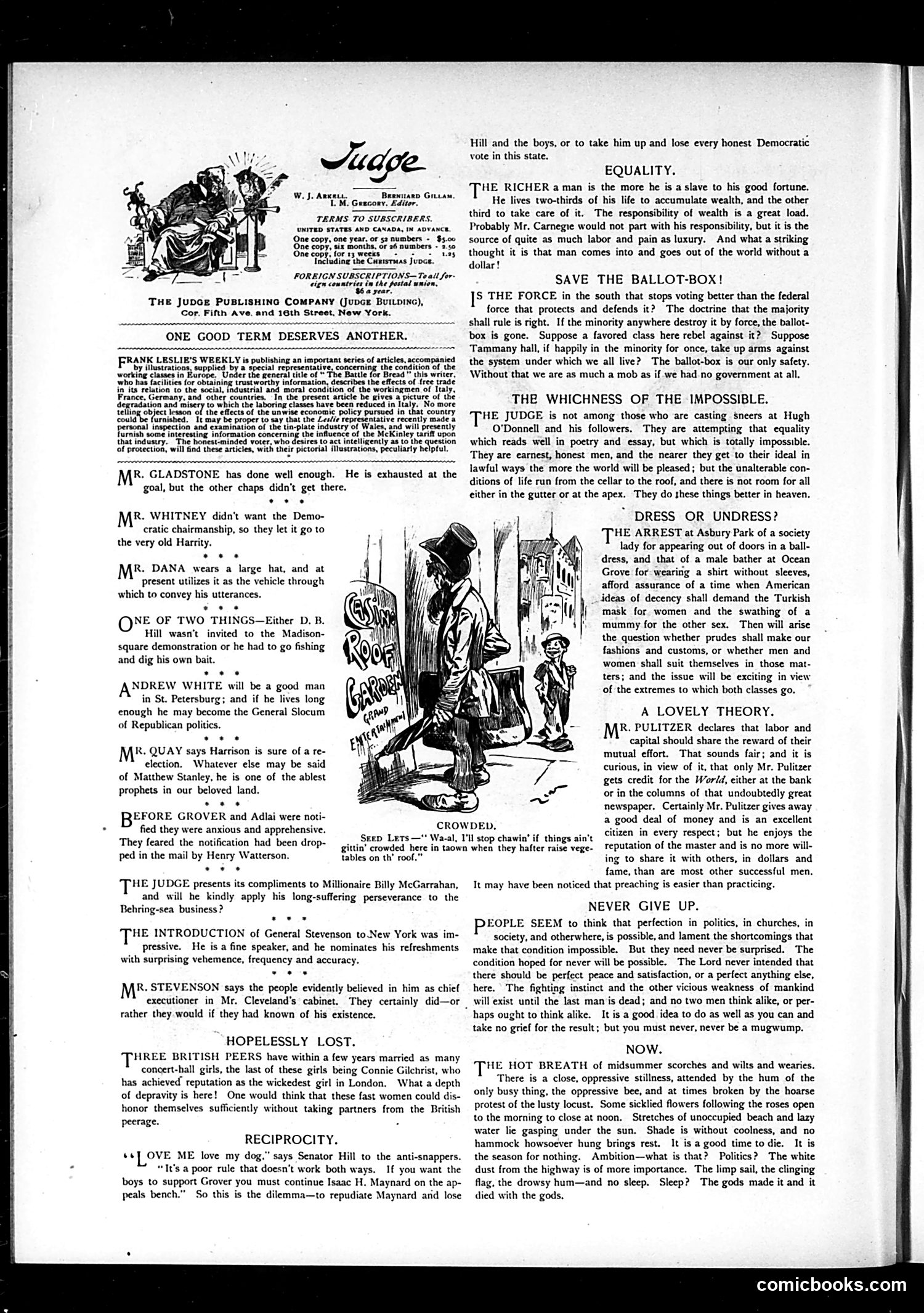
The central cartoon depicts a crowded urban street scene with working-class figures—likely immigrants or poor laborers—gathered around what appears to be a street vendor or performer. The illustration supports the page's editorial content critiquing wealth inequality and political reform. The accompanying text articles mock various political figures and social issues of the era. References include criticism of millionaire Billy McCarthran, debates over labor and capital distribution, and commentary on class divisions. The satirical pieces attack both wealthy industrialists and reformers they view as impractical idealists. The overall tone suggests this is from the Gilded Age period, when Judge magazine regularly targeted wealth inequality, political corruption, and competing visions for American democracy through sharp social satire.
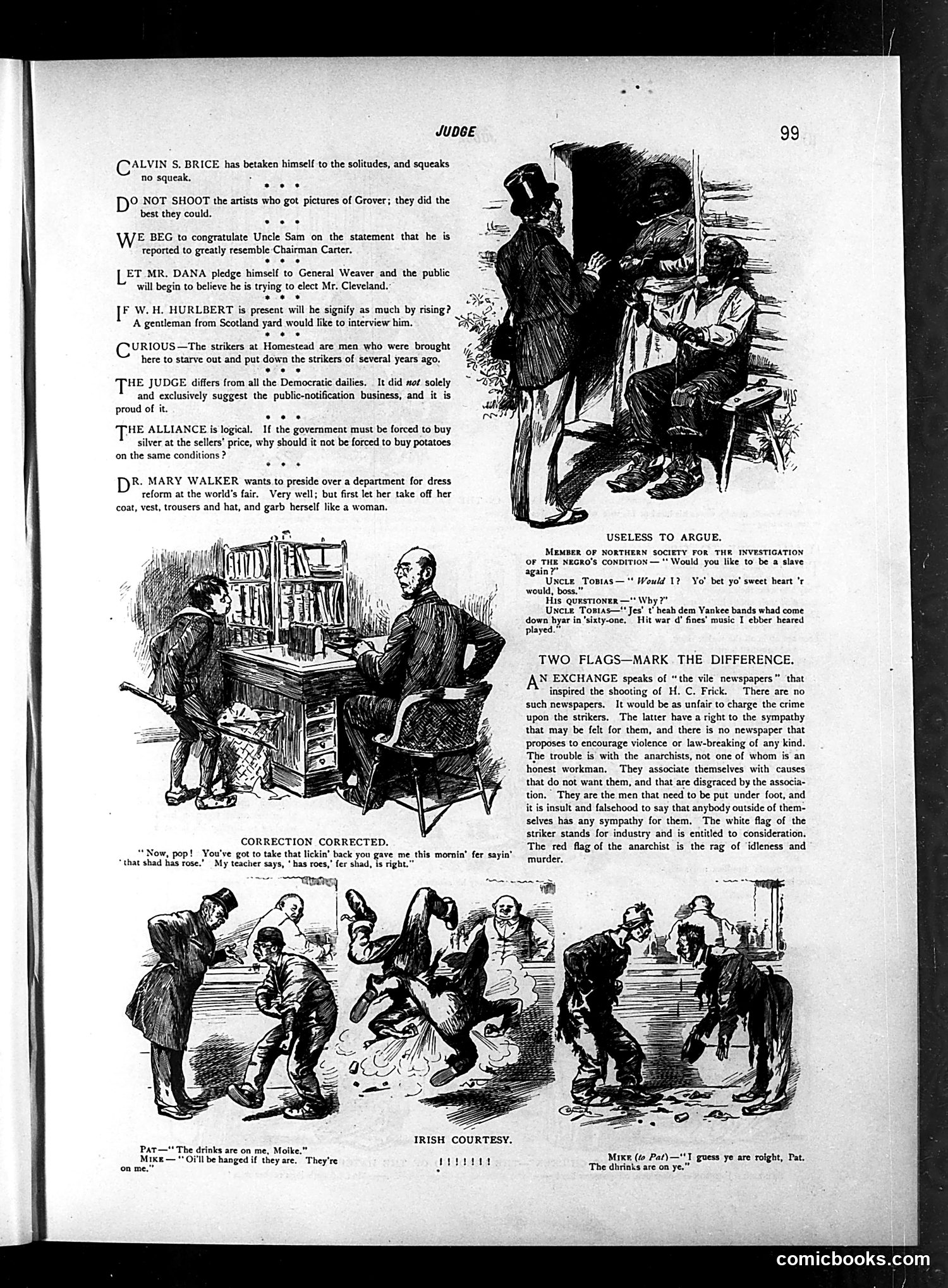
This satirical page critiques labor unrest and political figures of its era. The top section contains brief editorial jabs at figures like Calvin S. Brice and references to Cleveland's election and General Weaver (likely the Populist candidate James B. Weaver). The main cartoon "Two Flags—Mark the Difference" contrasts strikers' causes with anarchism, arguing newspapers unfairly blame strikes on anarchists. It distinguishes between the "white flag" of legitimate labor grievances and the "red flag" of anarchism/violence. Below, "Irish Courtesy" depicts violent street confrontations, likely referencing labor disputes or ethnic tensions in 1890s America. The dialogue suggests drunkenness and threats. The "Correction Corrected" section shows a father-child exchange about dishonesty, apparently satirizing journalistic accuracy. Overall, the page reflects anxieties about strikes, anarchism, and immigrant communities during the tumultuous 1890s labor era.
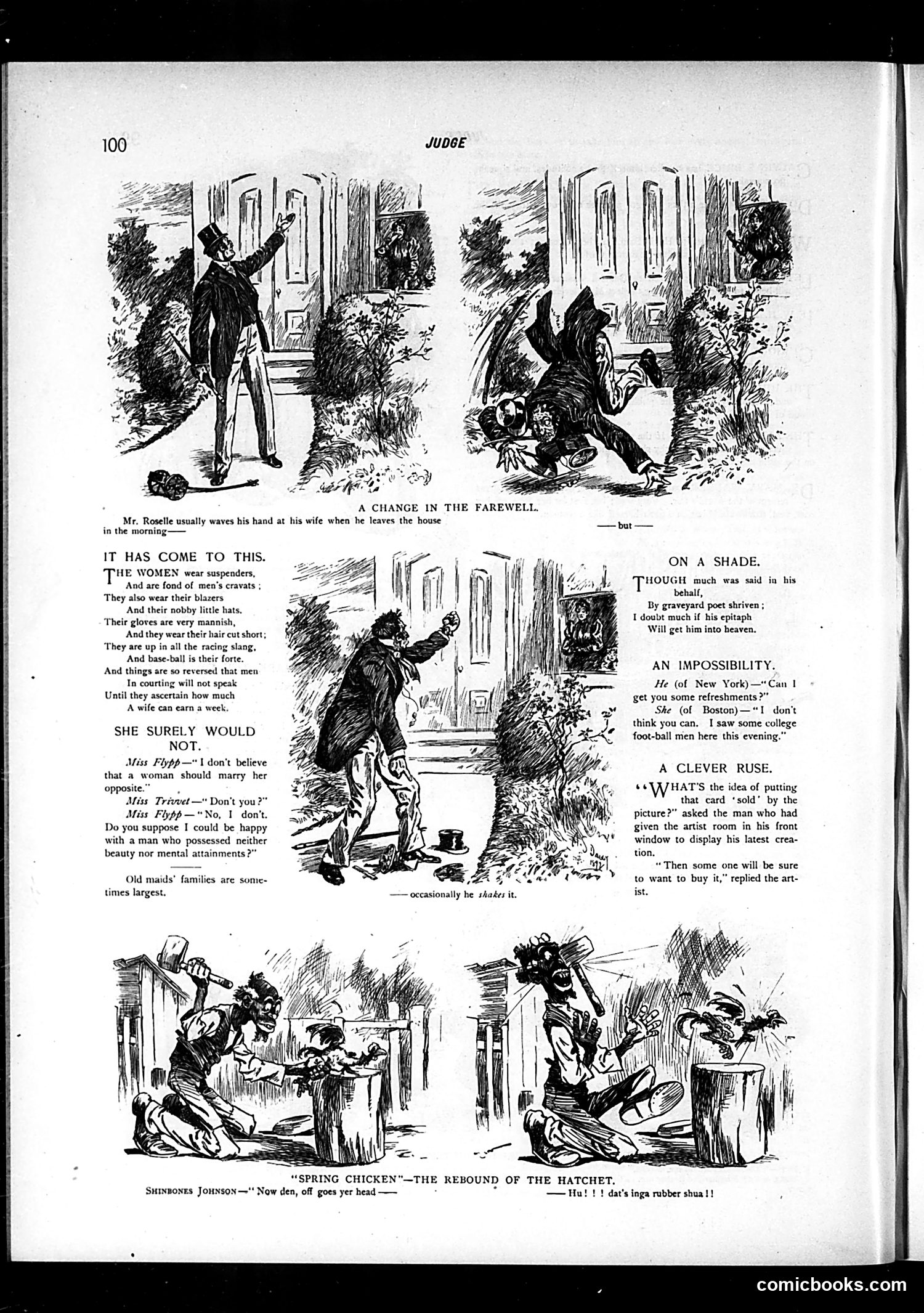
This page collects several unrelated satirical pieces typical of Judge's humor: **"It Has Come To This"** mocks the "New Woman" of the late 19th/early 20th century—women adopting masculine fashions (suspenders, short hair, blazers) and interests (racing, baseball). The satire reverses gender roles: men now ask women about their earning potential before courting. The dialogue between Miss Flypp and Miss Trévvet ridicules women's superficiality—Miss Flypp refuses a man lacking "beauty nor mental attainments," contradicting feminist ideals. **Other vignettes** include mild domestic humor ("A Change in the Farewell"), wordplay about selling art ("A Clever Ruse"), and ethnic comedy featuring "Shinbones Johnson" in dialect, a common period trope. **Context**: This reflects anxieties about women's increasing independence and professional ambitions during the Progressive Era, presented through mockery rather than serious critique.
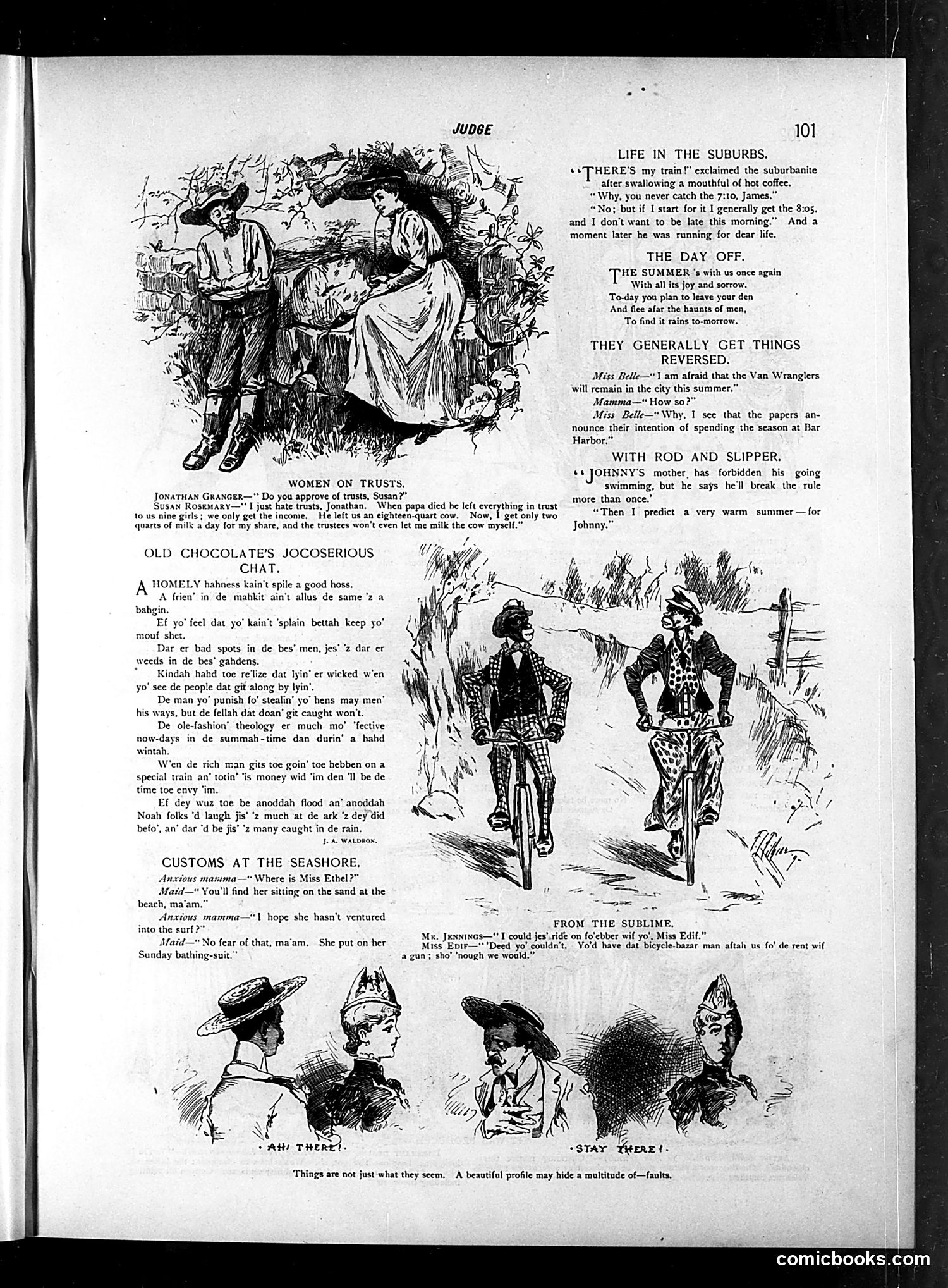
This page from *Judge* contains several disconnected satirical pieces mocking contemporary American social issues: **"Women on Trusts"** jokes about legal trusts—wealthy estates placed under trustee control. A woman complains that her father's will grants her only milk *income* from a cow, not ownership, satirizing how trusts restricted women's financial autonomy. **"Old Chocolate's Jocoserious Chat"** presents folk wisdom in dialect from an African American character, a common (if problematic) *Judge* format of the era, offering homespun philosophy on morality and wealth. **Seashore customs** mockingly describe a mother's concern about her daughter swimming, who reassures her by noting the daughter only wears a "Sunday bathing-suit"—implying full coverage prevented impropriety. **Suburban life** satirizes commuters' absurd logic: rushing to catch trains they'll miss anyway. **Romance sketches** humorously depict young courtship and class anxieties about bicycles and rental debts. The overall tone targets upper-middle-class pretensions, gender restrictions, and social hypocrisy typical of 1890s *Judge* content.
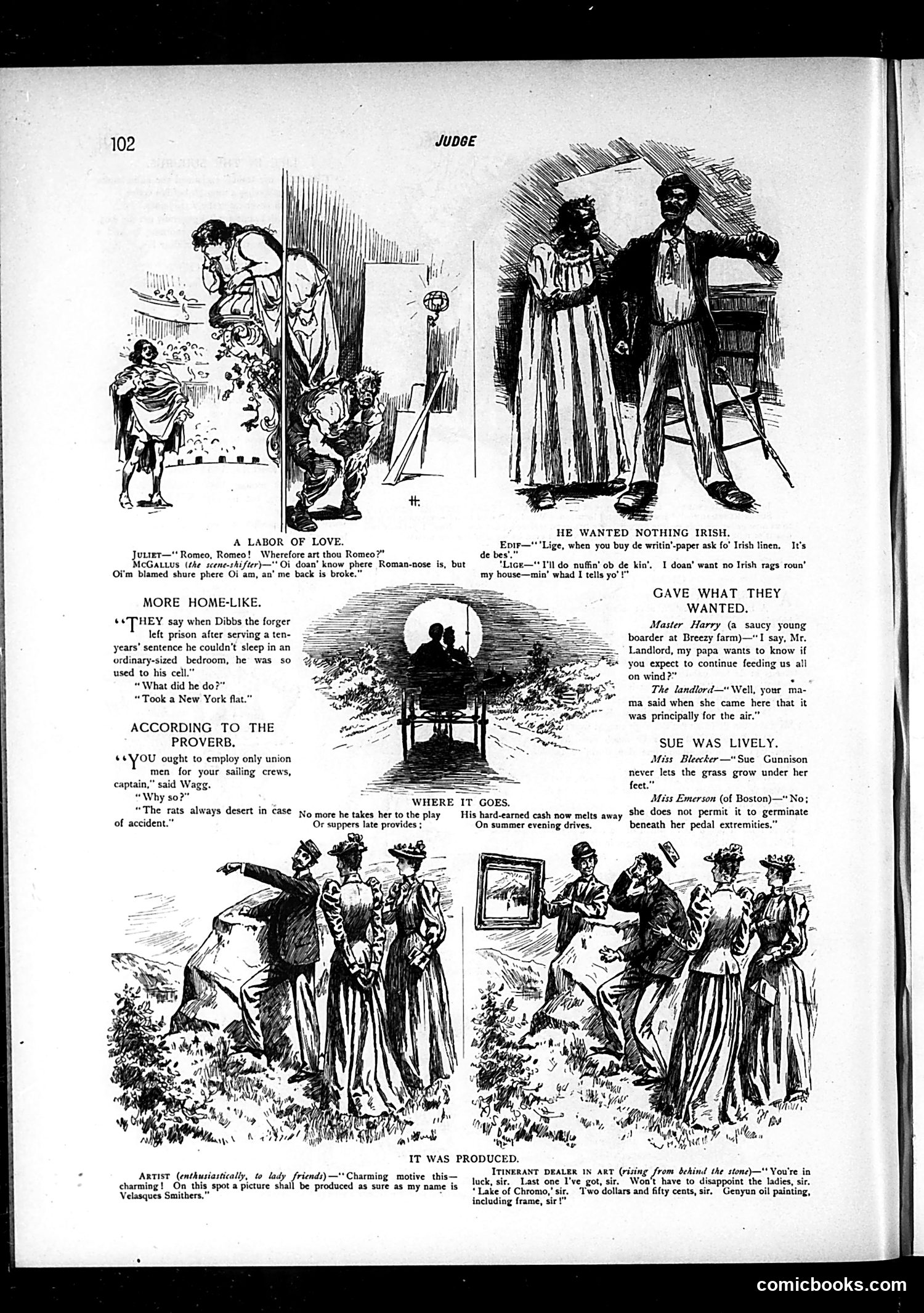
This page contains six separate humorous vignettes typical of late 19th-century American satirical humor: 1. **"A Labor of Love"**: Mocks theatrical pretension—a scene-shifter complains about his aching back while actors perform Romeo and Juliet above him. 2. **"More Home-Like"**: A joke about Dibbs the forger who, after serving ten years in prison, finds a cramped New York apartment feels like home because it resembles his cell. 3. **"According to the Proverb"**: A pun about rats deserting sinking ships, applied to union labor disputes. 4. **"He Wanted Nothing Irish"**: An ethnic stereotype joke where a Black character refuses Irish linen writing paper, not wanting "Irish rags" in his house. 5. **"Gave What They Wanted"** and **"Sue Was Lively"**: Mild domestic humor about boarders and courtship. 6. **"Where It Goes" / "It Was Produced"**: An artist is tricked into buying a fake painting from behind a stone. The page reflects period attitudes including casual ethnic mockery and working-class humor. Most jokes rely on puns, class distinctions, and contemporary social references now largely obscure.
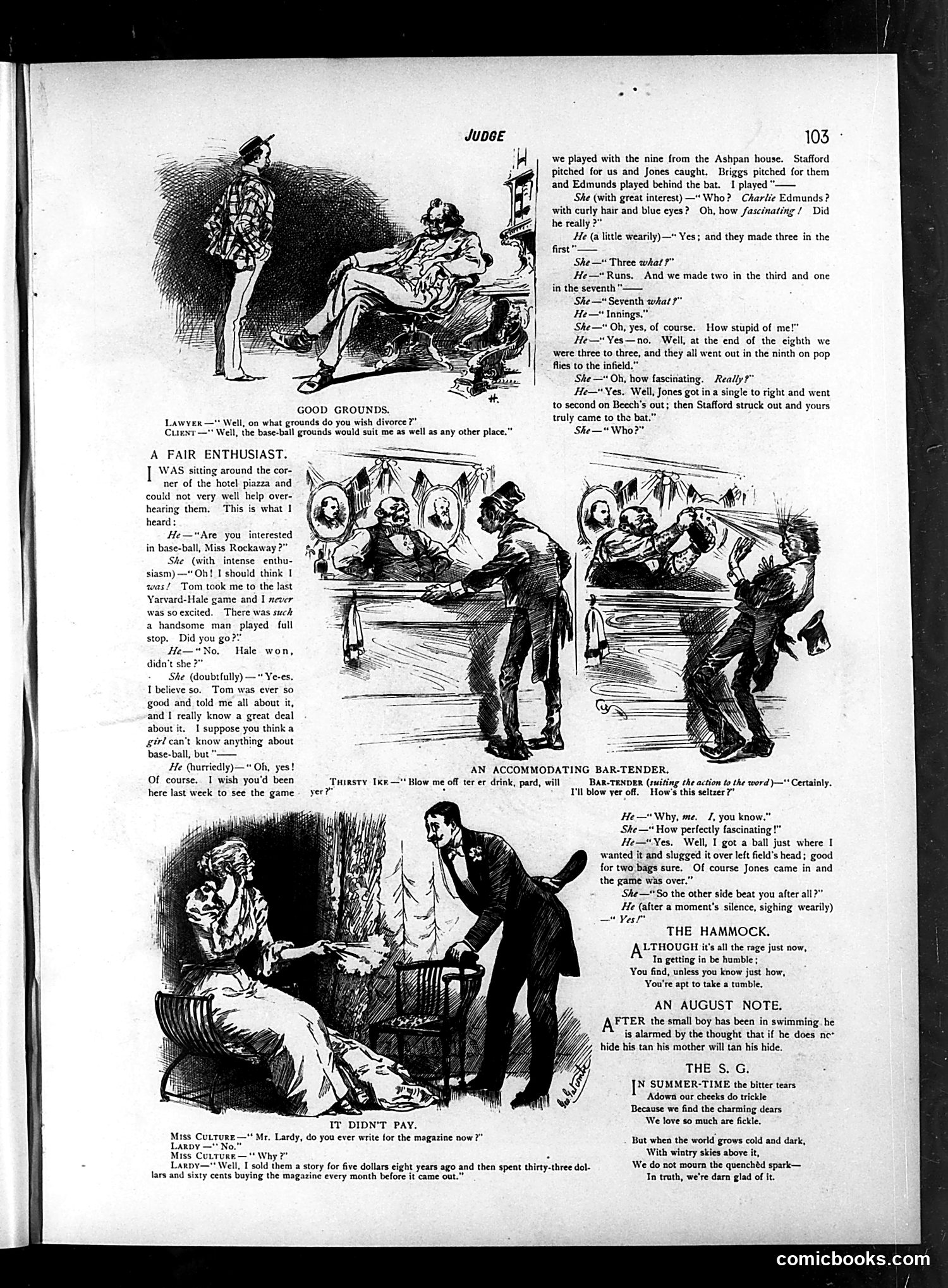
This page contains several satirical sketches typical of Judge's late 19th/early 20th-century humor: **"A Fair Enthusiast"** mocks a woman who claims interest in baseball but reveals complete ignorance—she thinks "Hale won" refers to a player rather than understanding Harvard beat Yale. The joke targets women feigning intellectual interest in male-dominated sports they don't understand. **"Good Grounds"** is a brief pun: a lawyer jokes that baseball grounds are as valid as any for divorce, satirizing both frivolous divorces and baseball's cultural prominence. **"An Accommodating Bar-Tender"** shows wordplay: a drunk asks to be "blown off" (treated to a drink), and the bartender literally blows seltzer in his face—physical comedy mocking drunkenness. The remaining pieces—"The Hammock," "An August Note," and "The S.G."—are light verse about summer activities and romantic disappointments. Overall, the page reflects Judge's focus on domestic life, gender relations, and gentle social observation rather than hard political satire.
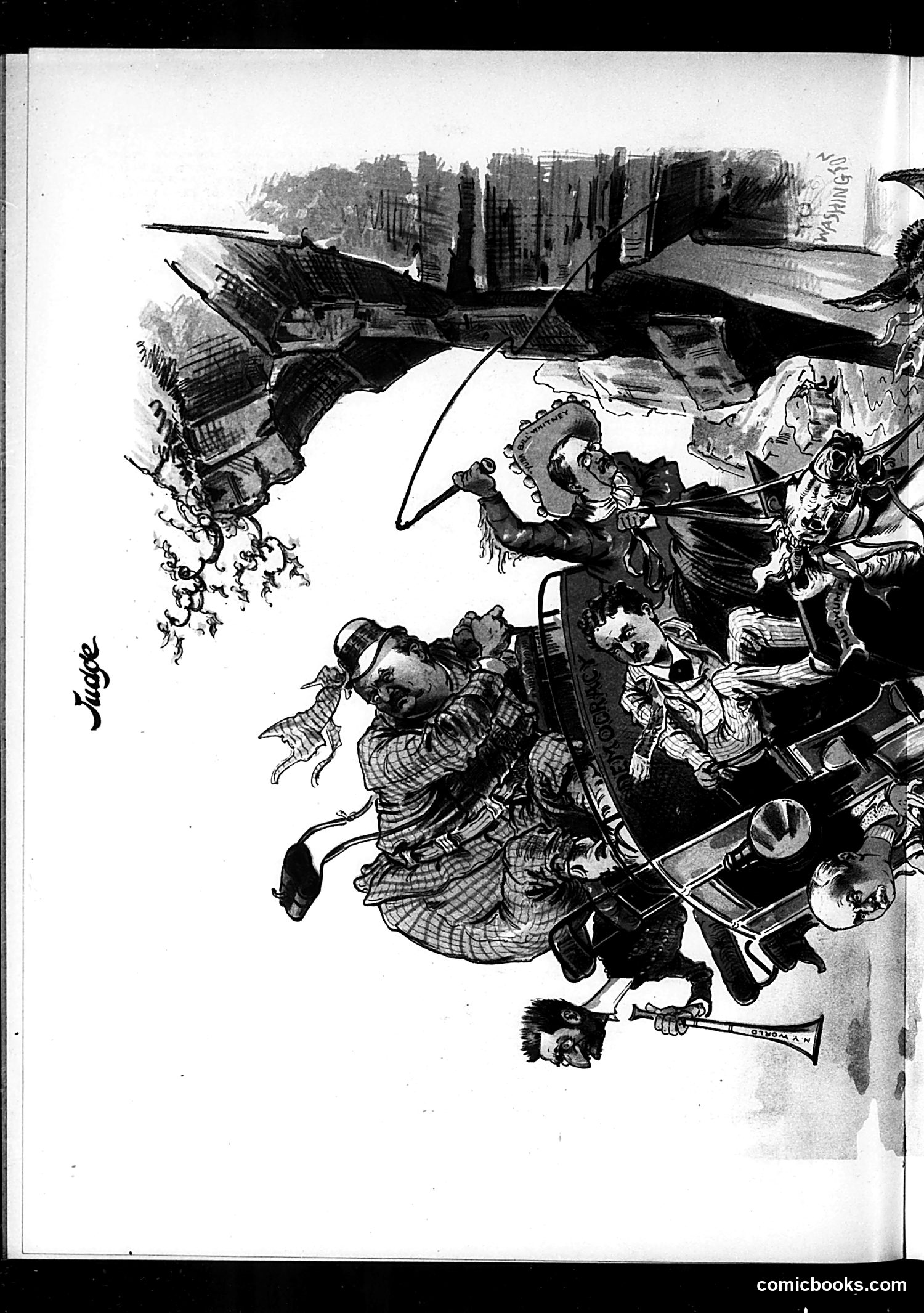
This appears to be a satirical illustration from *Judge* magazine, though the OCR text has not extracted clearly. The image shows a chaotic scene with multiple figures in period dress (appearing to be late 19th or early 20th century) engaged in what looks like a comedic or violent struggle. The central figure wears a hat and checkered clothing, wielding what appears to be a whip or stick. Several other characters surround this scene in exaggerated poses. A cityscape looms in the background. Without clearer text or identifying labels, I cannot definitively identify the specific political figures or events being satirized. The style suggests commentary on urban politics, labor disputes, or social conflict, but the exact subject remains unclear from the visual evidence alone.
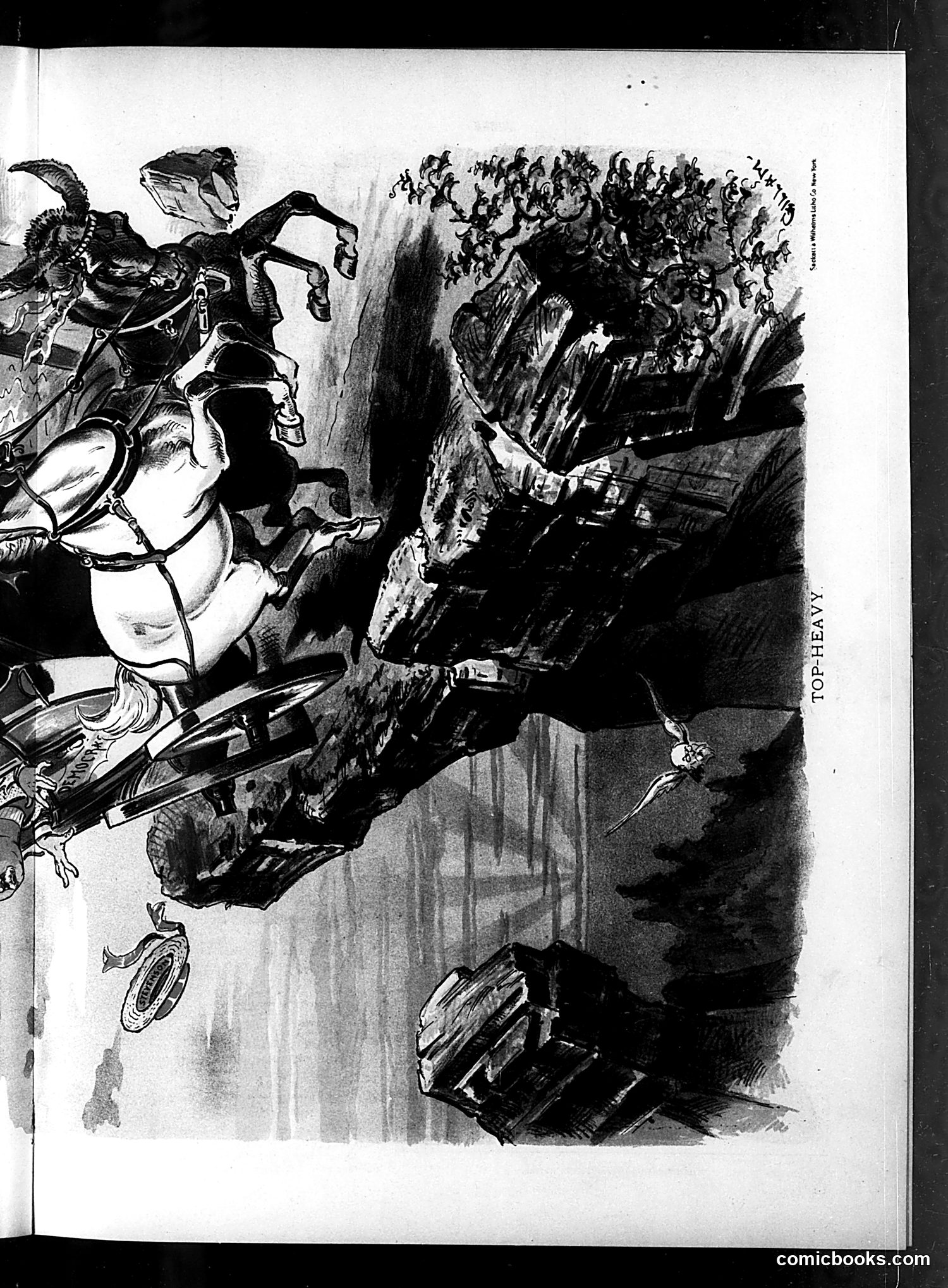
This appears to be a satirical cartoon from *Judge* magazine depicting a military or governmental scene. On the left, a mounted figure in ornate military dress (possibly a general or authority figure) observes a chaotic crowd scene on the right—masses of people gathered around what appears to be a fortified structure or bunker. The cartoon likely critiques military command, crowd control, or government authority during a specific historical period. The stark contrast between the composed, decorated officer and the turbulent crowd suggests satire about leadership disconnect or military response to civilian unrest. However, without clearer identification of specific figures or visible dates, I cannot definitively determine the exact political event or individuals being satirized. The OCR text appears corrupted and provides no clear caption.
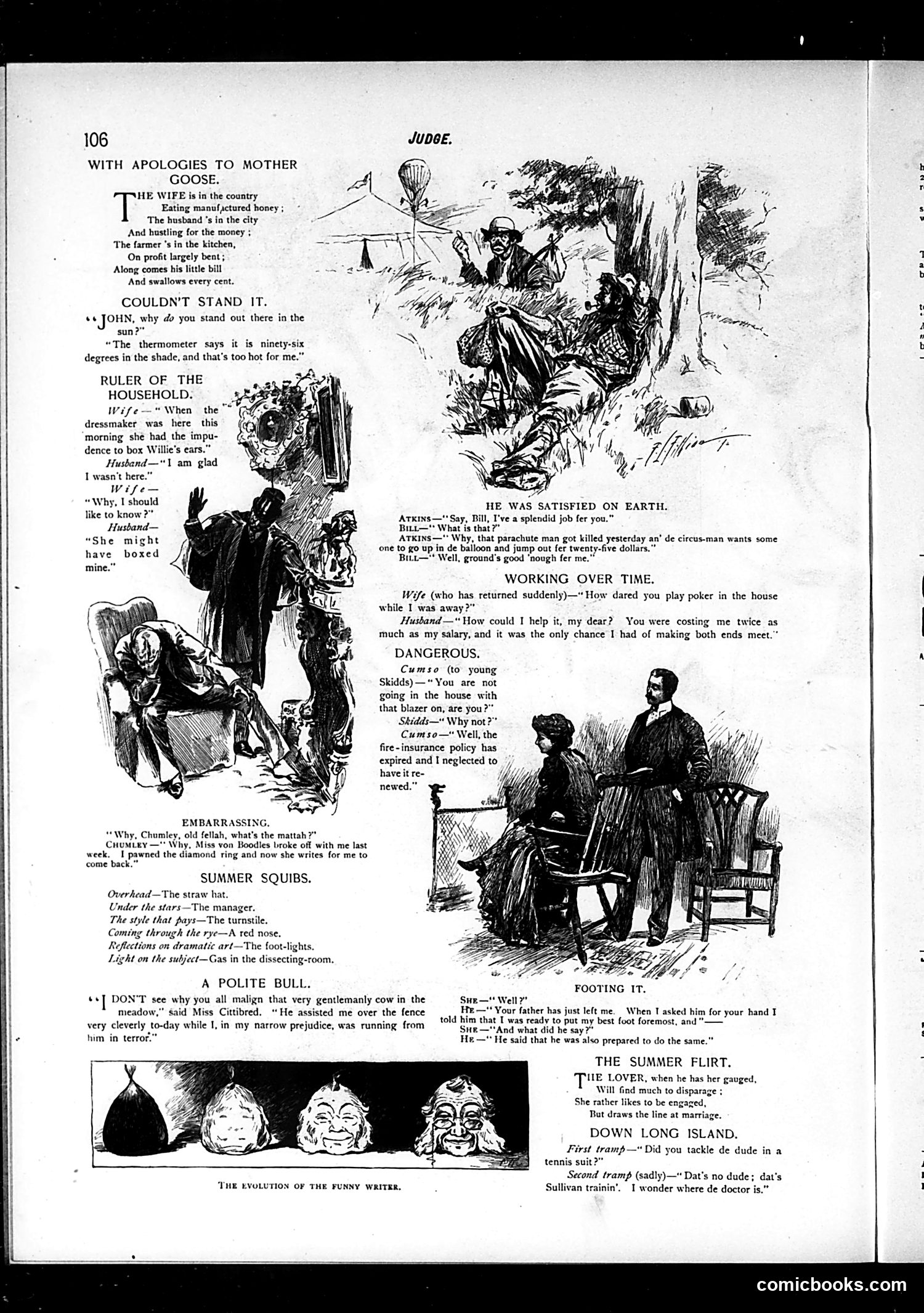
This page contains Victorian-era humor satirizing domestic and social life. Key pieces include: **"With Apologies to Mother Goose"**: A parody critiquing the economic strain on families—the wife enjoys leisure in the country while the husband hustles for money in the city, only to have profits consumed by bills. **Domestic humor sketches** mock gender relations: a husband avoiding a dressmaker's "boxing" him as she did his wife; a wife discovering her husband playing poker while she's away (he justifies it as necessary to "make both ends meet" given her expensive habits). **Social commentary**: "A Polite Bull" ironically praises a cow's "gentlemanly" assistance, mocking upper-class pretension. "Summer Squibs" are brief one-liners about theatrical life and fashion. **Class satire**: References to parachutists, circuses, and "dudes" in tennis suits mock working-class and leisure-class stereotypes. The final image shows "The Evolution of the Funny Writer"—apparently depicting different faces/expressions. The overall tone targets financial anxiety, marital tension, and social pretense characteristic of late 19th-century American humor.
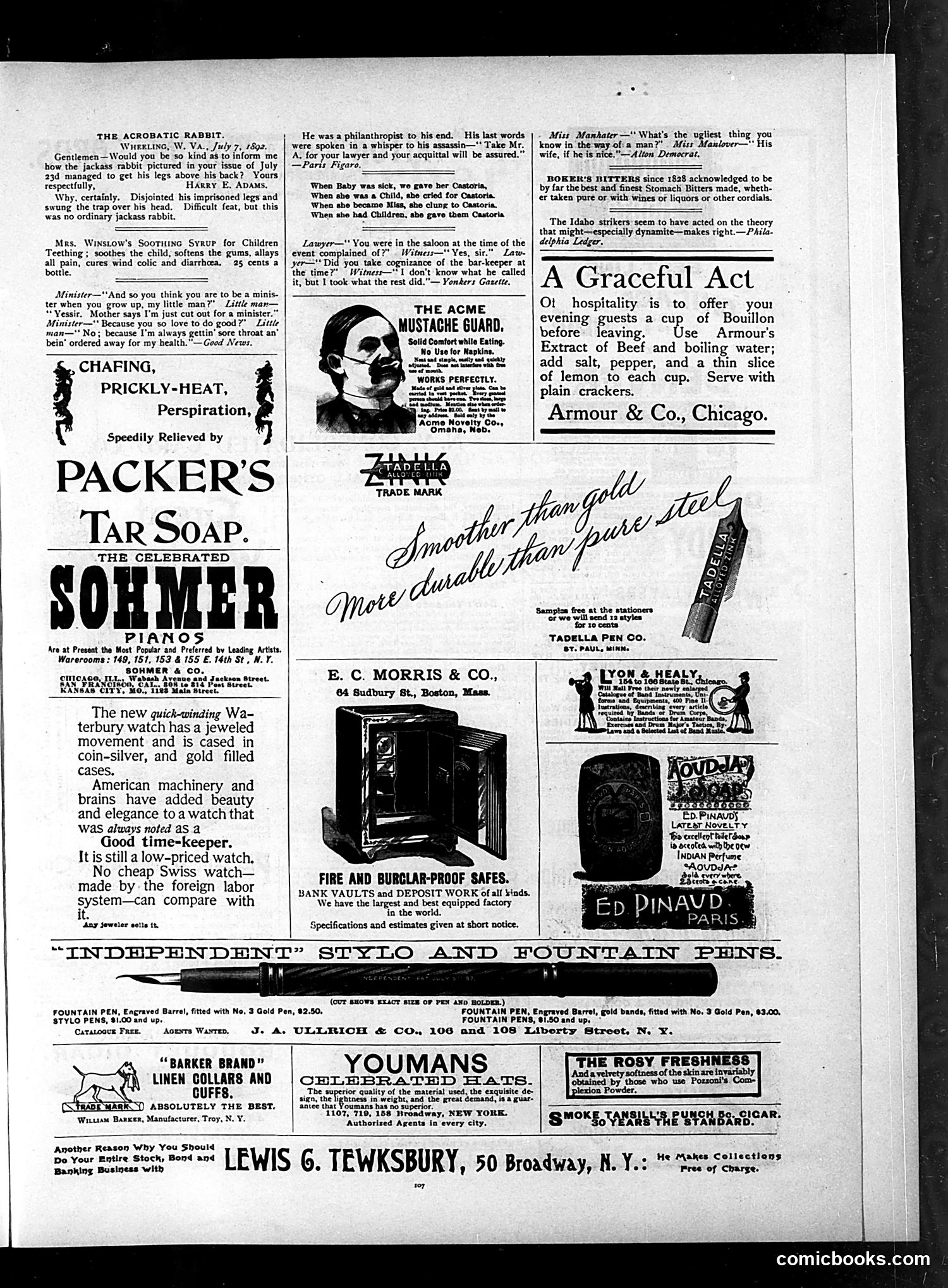
This page is primarily **advertising**, typical of Judge magazine's revenue model. However, it contains several short **satirical items**: 1. **"The Acrobatic Rabbit"** — A humorous reader's letter about how a jackass rabbit escaped a trap by dislocating its legs, showcasing Judge's lighthearted animal humor. 2. **Minister joke** — A child wants to be a minister because he has a sore throat and gets "ordered away for my health"—satirizing how clergy avoid work by claiming illness. 3. **Lawyer/witness exchange** — A witness claims he didn't understand what the bartender "called" something but took "what the rest did" (drinks)—mocking both imprecise legal testimony and witness dishonesty. 4. **Idaho strikers reference** — A brief jab at labor strikers who used dynamite, suggesting "might makes right"—reflecting Judge's conservative anti-labor stance typical of 1890s Republican satirical magazines. The page otherwise consists of product advertisements for watches, pianos, soaps, safes, and other goods—standard for the era.
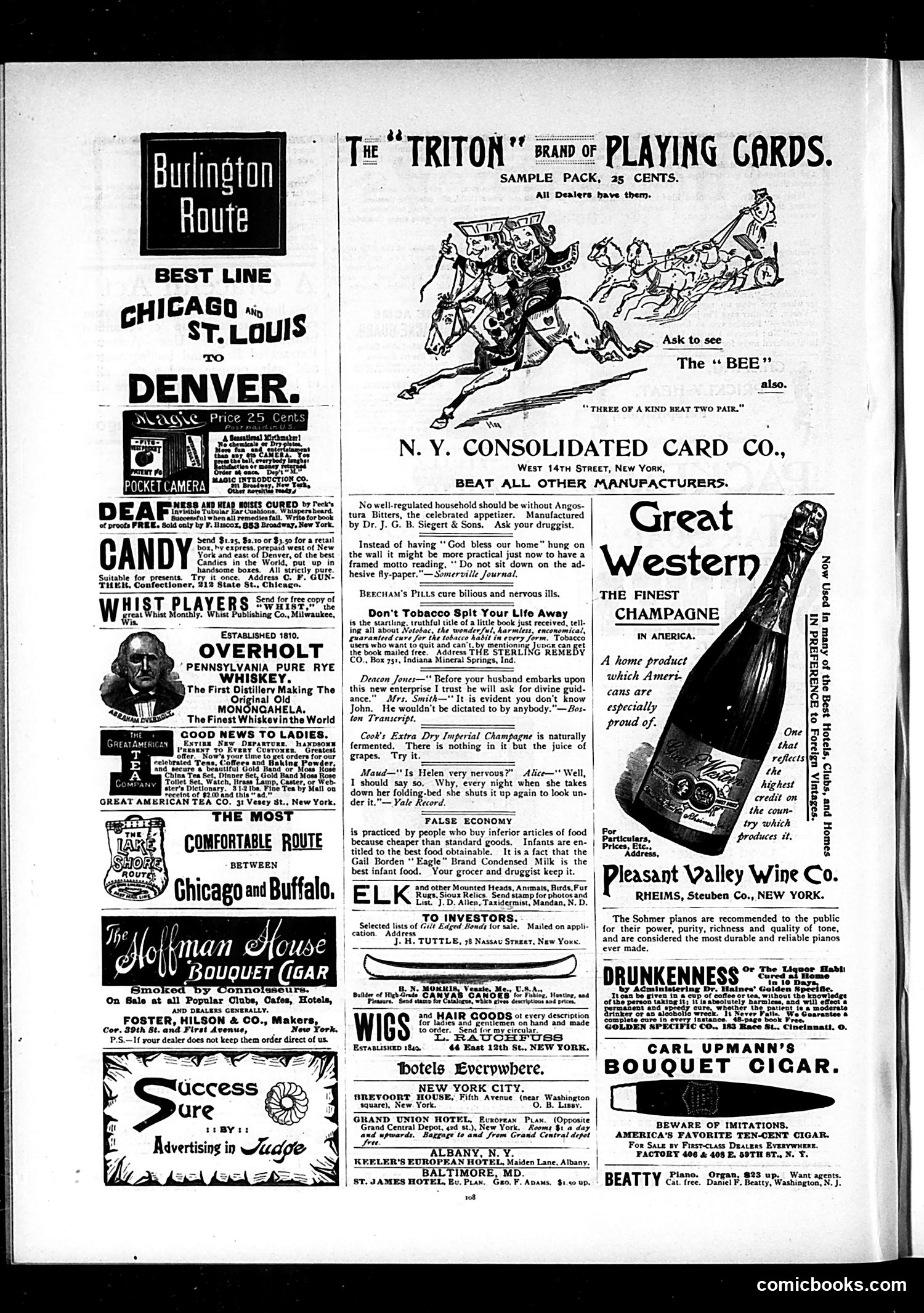
This page is primarily **advertising content** from Judge magazine, not political commentary or satire. It consists almost entirely of commercial advertisements from late 19th-century businesses. The only sketch with potential satirical intent appears in the text excerpts, showing brief joke-dialogue snippets (about a husband not taking "divine guidance," a nervous woman with a folding bed, etc.). These are mild, everyday humor pieces mocking domestic situations rather than political targets. The ads themselves are notable for what they reveal about the era: remedies for tobacco addiction ("Don't Tobacco Spit Your Life Away"), patent medicines (Bergman's Pills, Angostura Bitters), infant formula, whiskey, cigars, railroad routes, and hotels. The Triton Playing Cards advertisement shows a horse-racing image. **This page lacks meaningful political or social satire to analyze.** It's essentially a page of period commercial notices, interesting primarily as a historical artifact of 1890s consumer culture and advertising practices.
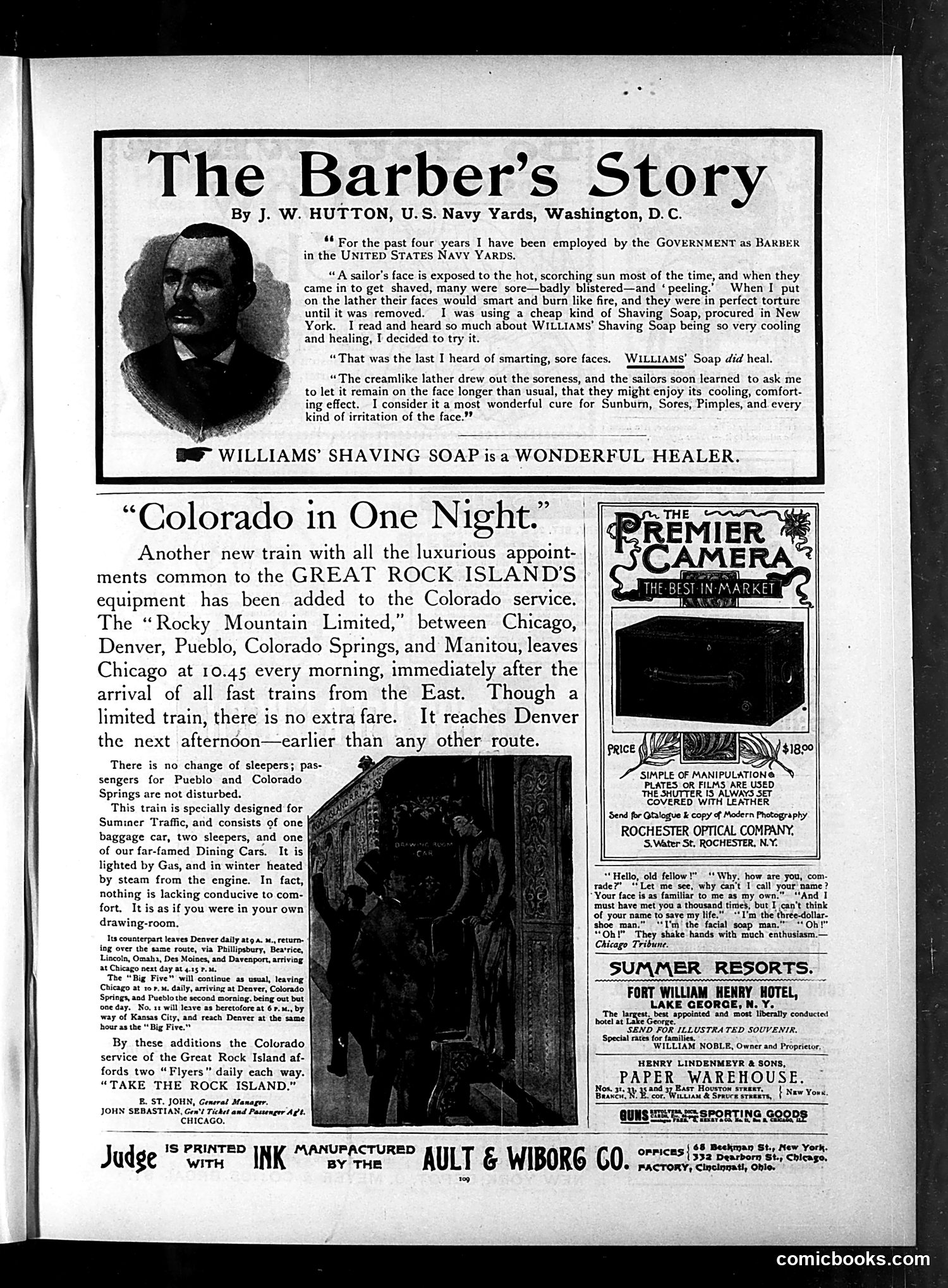
This page is primarily **advertisements and promotional content** rather than political satire or editorial cartoons. The main content includes: 1. **"The Barber's Story"** - A testimonial advertisement for Williams' Shaving Soap, featuring a Navy barber's endorsement about the product's healing properties for sun-damaged and irritated sailor faces. 2. **"Colorado in One Night"** - A Great Rock Island railroad advertisement promoting the new "Rocky Mountain Limited" train service between Chicago and Colorado destinations. 3. **Small cartoon/joke** - A brief Chicago Tribune reprinted comic about two men who keep meeting but can't remember each other's names (one sells three-dollar shoes, the other facial soap). 4. **Additional ads** - For the Premier Camera, Fort William Henry Hotel, paper warehouse, and sporting goods. The page reflects typical turn-of-the-century **Judge magazine content**: commercial advertisements mixed with light humor. There is no significant political commentary or social satire present on this particular page.
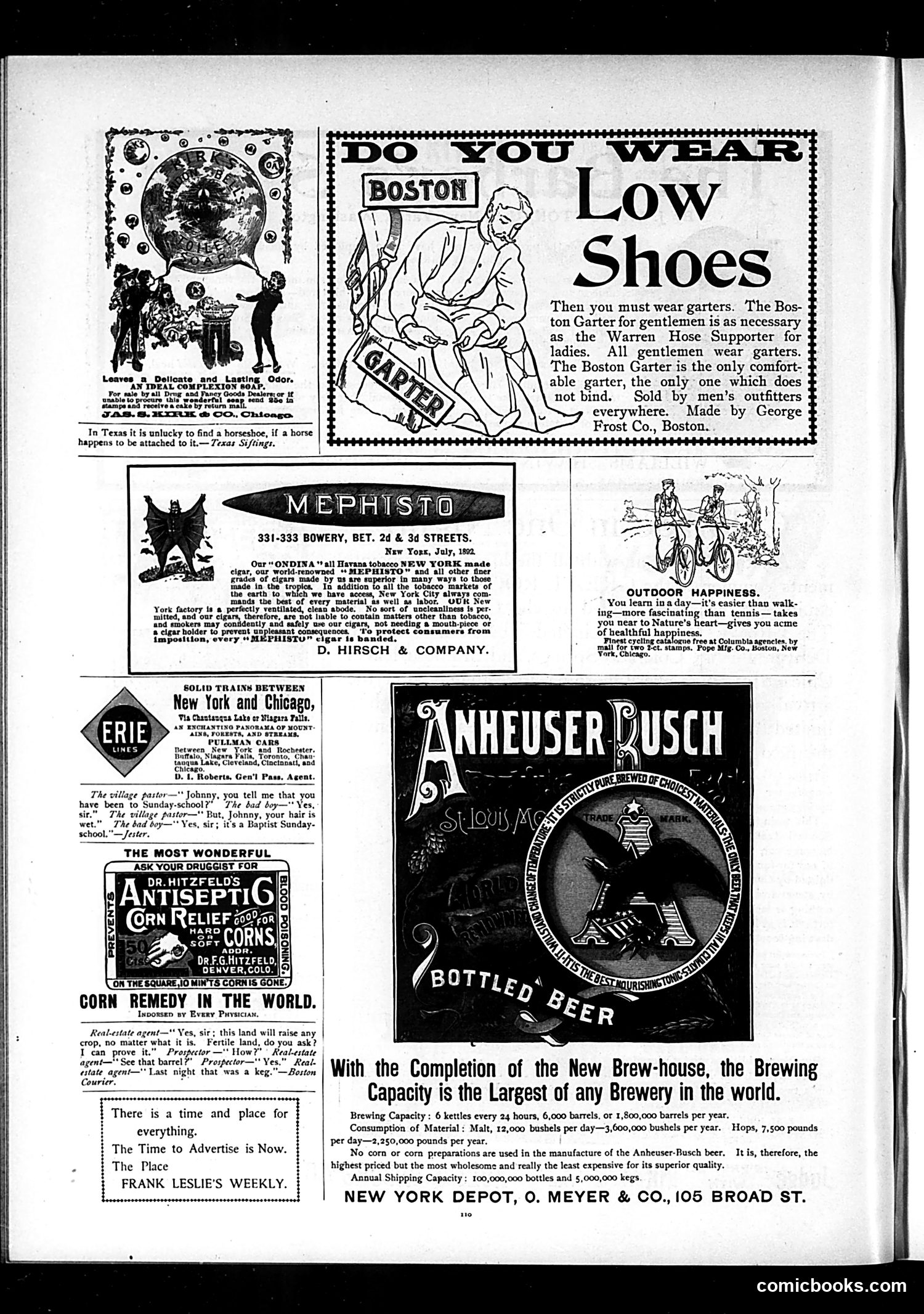
This is primarily an **advertising page** from Judge magazine (July 1892), with minimal editorial content. The page features various product advertisements interspersed with brief jokes typical of the era. Notable advertisements include: - **Boston Garters** for men (promoting comfort and no binding) - **Mephisto cigars** from D. Hirsch & Company, emphasizing quality New York manufacturing - **Erie Railroad** promoting elegant train service between New York and Chicago - **Dr. Hitzfeld's Corn Remedy** (antiseptic corn treatment) - **Anheuser-Busch beer**, touting their new brew-house as the world's largest brewery by capacity The scattered jokes are mild period humor: a Sunday school boy with wet hair (Baptist reference), a real estate agent's exaggeration about fertile land, and a Texas superstition about horseshoes. **Overall context**: This reflects Gilded Age consumer culture and advertising practices, with products marketed to gentlemen and middle-class readers. The emphasis on manufacturing quality and scale (particularly Anheuser-Busch) reflects late 19th-century American industrial pride.
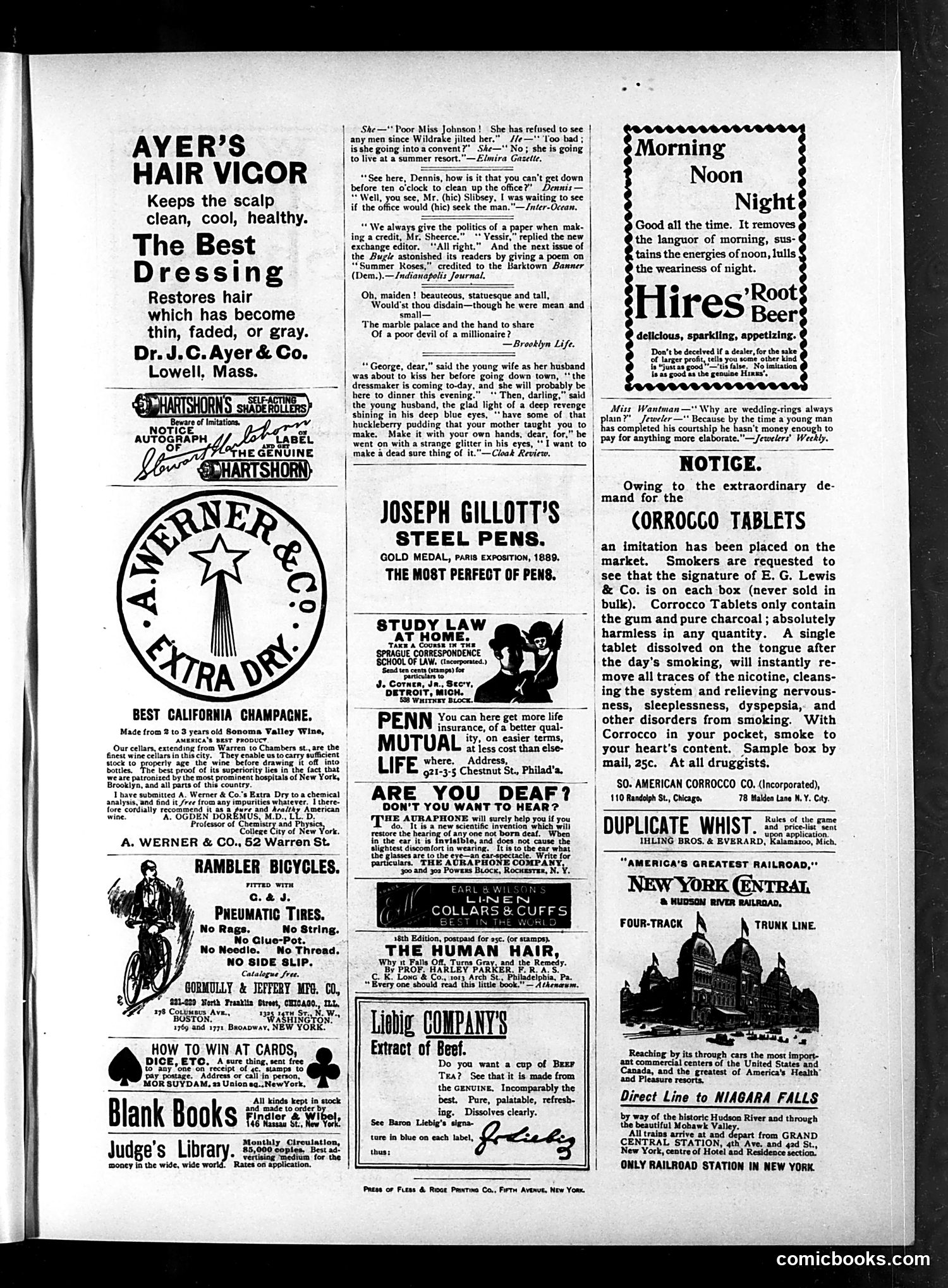
This is primarily a **product advertisement and classifieds page** with minimal original satirical content. The page consists almost entirely of late-19th-century advertisements—for hair tonic, champagne, bicycles, legal correspondence courses, and medical devices (hearing aids, hair restoration). The only clearly satirical elements are brief **humorous anecdotes** scattered between ads: - A joke about an office worker delaying cleanup, hoping the boss will ask him to leave early - A poem mocking wealthy but unattractive suitors - A dark joke about a wife telling her husband to cook with her mother's recipe—implying he plans to poison her for insurance money These snippets reflect period concerns: social climbing, marriage anxieties, and gender dynamics. However, without cartoons or substantial editorial content, this page offers limited satirical commentary—it's essentially a revenue-generating classifieds section typical of late-Victorian humor magazines that relied heavily on advertisements.
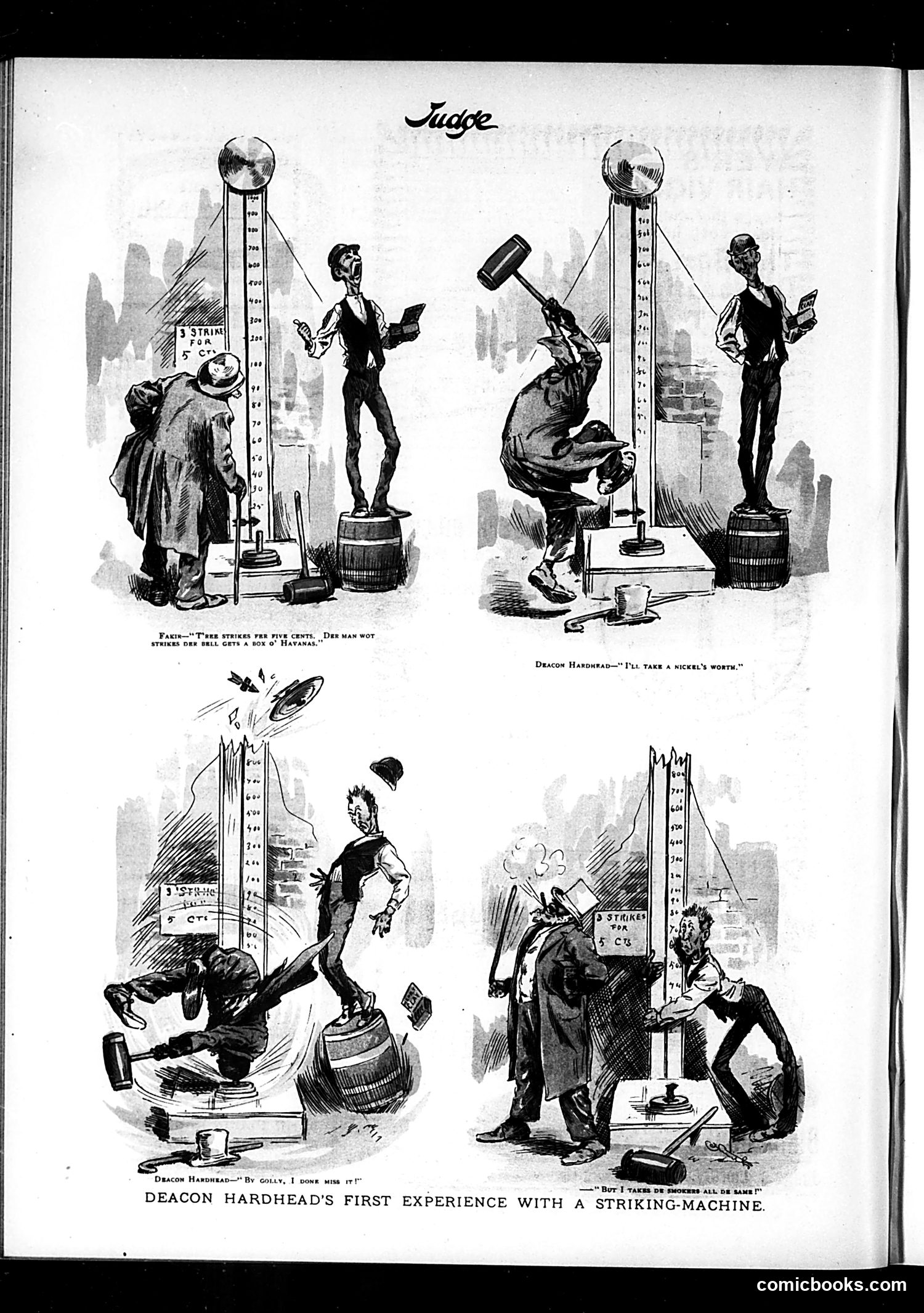
This is a comic sequence satirizing a naive character ("Deacon Hardhead") encountering a carnival strength-testing machine—the kind where you strike a pad to ring a bell and win prizes (cigars, here). The joke unfolds across four panels: The deacon is initially skeptical, then confident he'll succeed ("I'll take a nickel's worth"), but the machine repeatedly defeats him—he either fails to ring the bell or, in one panel, appears to be knocked backward by the recoil. The satire targets rural or unsophisticated people susceptible to carnival games. The "Faxin'" character (appears to be a carnival operator with a German or Yiddish accent) profits from foolish customers. The humor relies on physical comedy and the deacon's embarrassing underestimation of his own strength versus the machine's engineering.
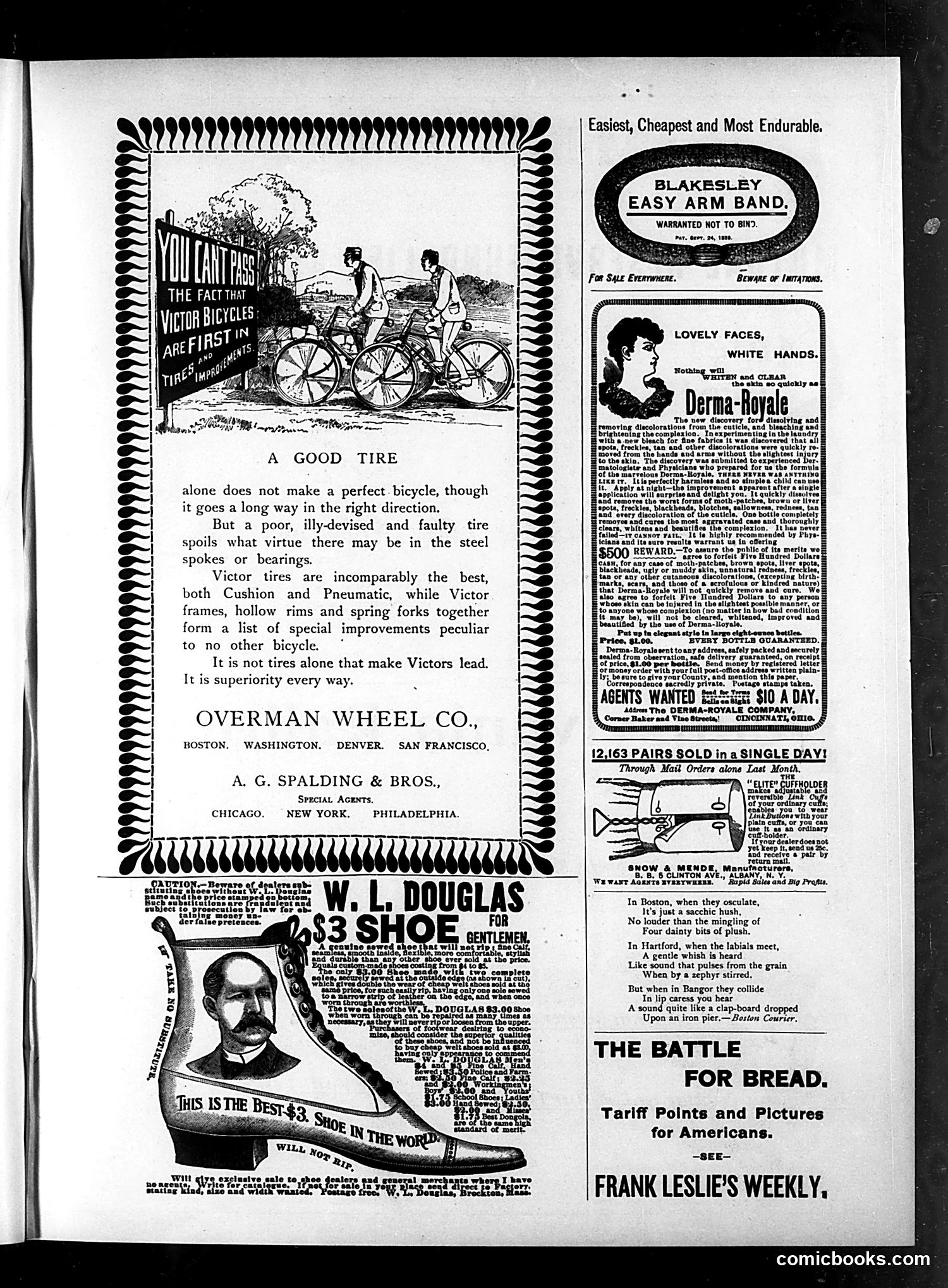
This is primarily an **advertising page** from Judge magazine, not a political cartoon. The page contains multiple product advertisements arranged around editorial content: **Main Advertisement:** Victor bicycles dominate the left side, emphasizing that superior tires alone don't guarantee quality—the entire bicycle construction matters. This was during the 1890s bicycle craze. **Other Advertisements Include:** - W.L. Douglas shoes ($3.00, marketed as the best value) - Blakesley Easy Arm Band (a medical device) - Derma-Royale (a skin-whitening cosmetic product offering $500 reward for dissatisfied customers) - A collar or clothing fastener selling 12,163 units in one day **Editorial Content:** A humorous poem about kissing sounds in different American cities (Boston, Hartford, Bangor), and an advertisement for Frank Leslie's Weekly covering tariff politics. The page reflects late 19th-century consumer culture and advertising strategies, including beauty products targeting women with problematic racial beauty standards typical of that era.
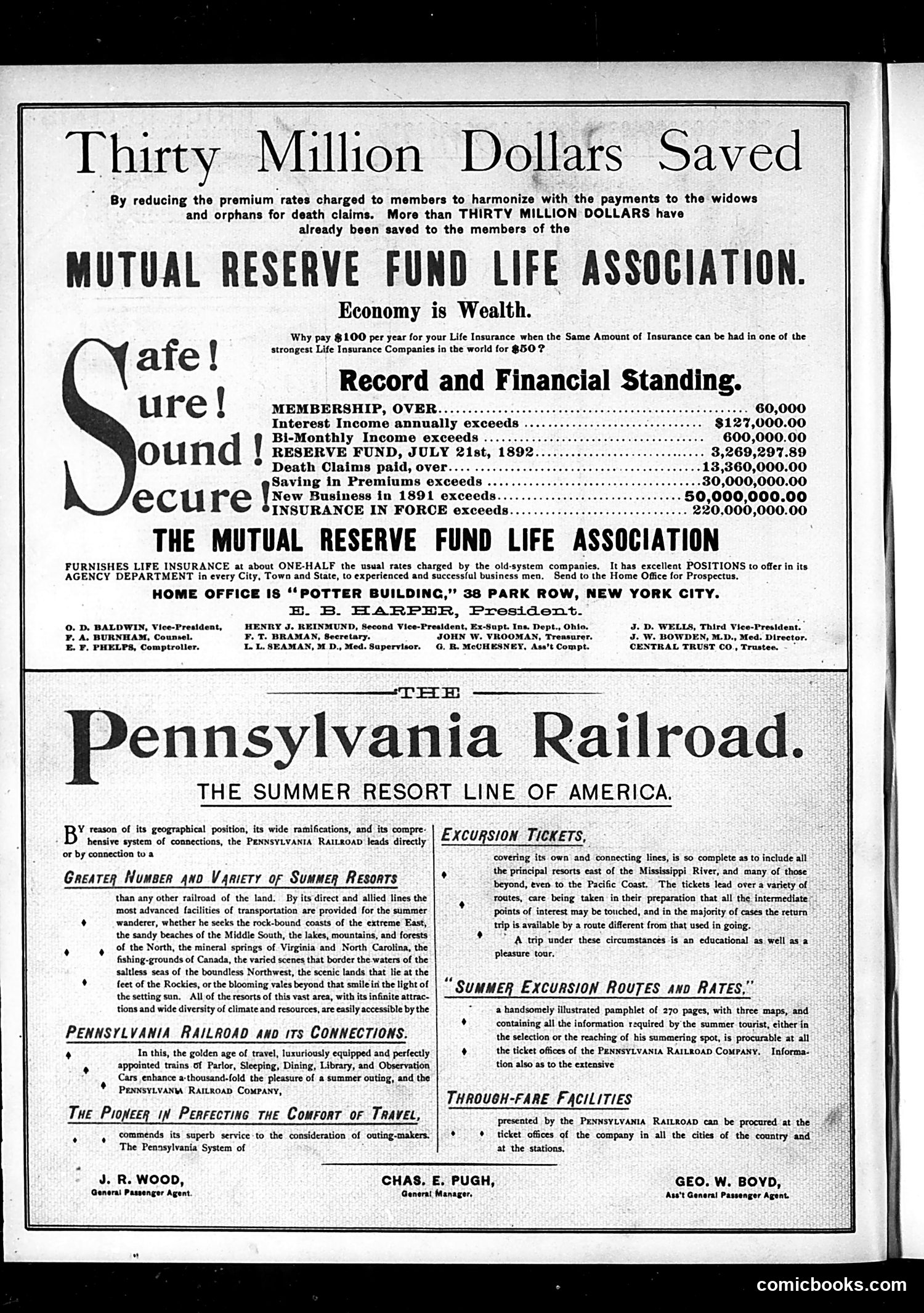
This page is primarily **advertising content**, not satire or political commentary. It contains two major advertisements: 1. **Mutual Reserve Fund Life Association**: An insurance company advertisement emphasizing cost savings. The pitch contrasts their $50 annual premium against competitors' $100 for equivalent coverage—a direct competitive appeal. The decorative text ("Safe! Sure! Sound! Secure!") uses period marketing language. The financial statistics (membership, reserves, insurance in force) serve as credibility markers. 2. **Pennsylvania Railroad**: A travel advertisement promoting their "Summer Resort Line," highlighting their extensive rail network connecting major American resorts from the Atlantic coast to the Pacific. It emphasizes luxury amenities (Parlor, Sleeping, Dining cars) and positions the railroad as the premier travel option. Both ads represent typical late-19th-century commercial messaging—factual claims, testimonials of financial strength, and appeals to leisure/comfort. There is no visible satirical cartoon or political commentary on this page.