
Judge, 1892-08-13 · page 6 of 18
Judge — August 13, 1892 — page 6: what you’re looking at
What you’re looking at
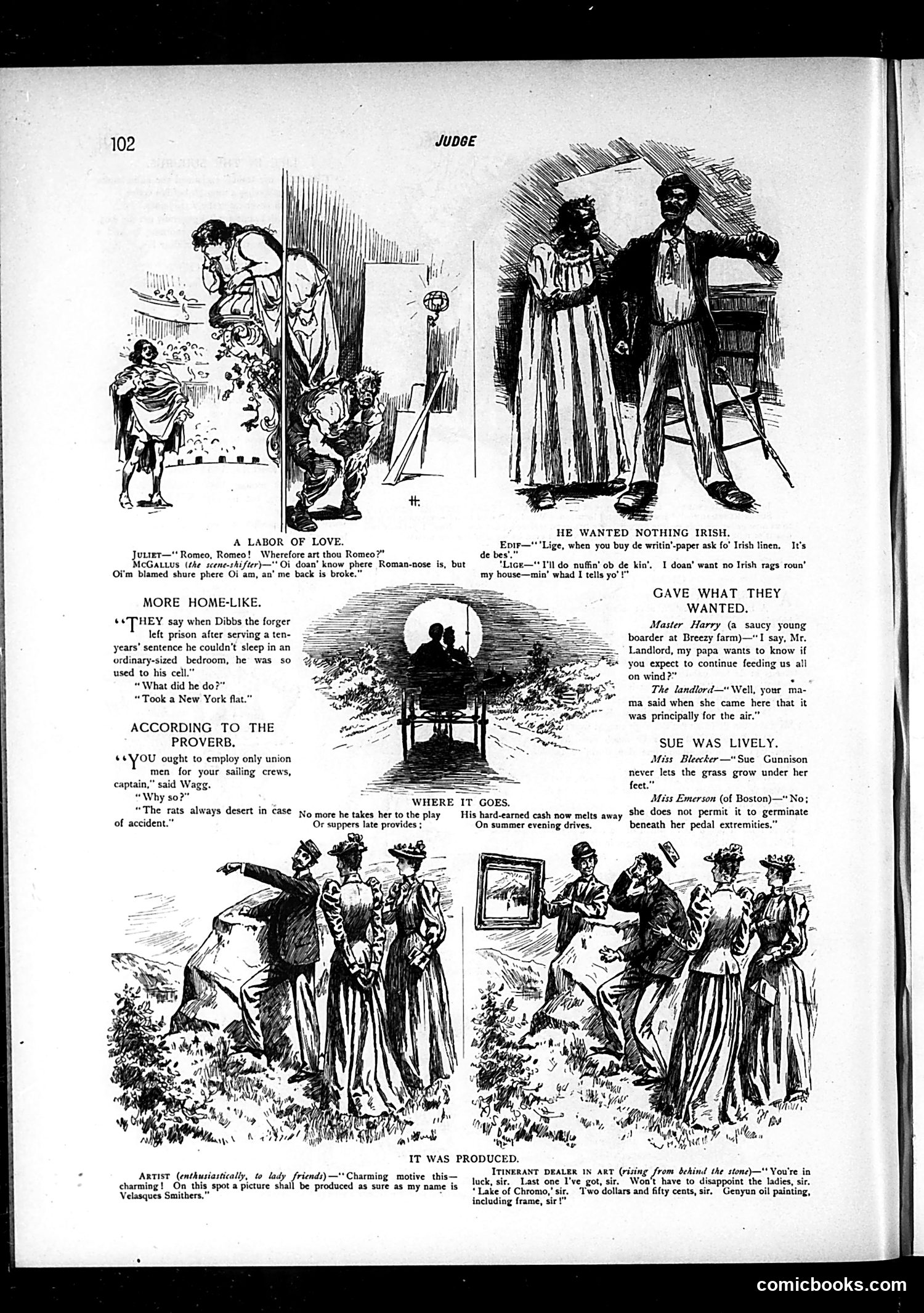
This page contains six separate humorous vignettes typical of late 19th-century American satirical humor: 1. **"A Labor of Love"**: Mocks theatrical pretension—a scene-shifter complains about his aching back while actors perform Romeo and Juliet above him. 2. **"More Home-Like"**: A joke about Dibbs the forger who, after serving ten years in prison, finds a cramped New York apartment feels like home because it resembles his cell. 3. **"According to the Proverb"**: A pun about rats deserting sinking ships, applied to union labor disputes. 4. **"He Wanted Nothing Irish"**: An ethnic stereotype joke where a Black character refuses Irish linen writing paper, not wanting "Irish rags" in his house. 5. **"Gave What They Wanted"** and **"Sue Was Lively"**: Mild domestic humor about boarders and courtship. 6. **"Where It Goes" / "It Was Produced"**: An artist is tricked into buying a fake painting from behind a stone. The page reflects period attitudes including casual ethnic mockery and working-class humor. Most jokes rely on puns, class distinctions, and contemporary social references now largely obscure.
📄 Transcribed text from this page (OCR, searchable)
Machine-transcribed from the original scan — historical spelling and the odd misread are preserved.
A LABOR OF LOVE. JutretT—"* Romeo, Romeo! Wherefore art thou Romeo?” McGattus (the scene-shifter)—"' Oi doan’ know phere Roman-nose is, but Oi'm blamed shure phere Oi am, an’ me back is broke.” MORE HOME-LIKE. ¢ THEY say when Dibbs the forger left prison after serving a ten- years’ sentence he couldn't sleep in an ordinary-sized bedroom, he was so used to his cell.” “ What did he do?” “Took a New York flat.” ACCORDING TO THE PROVERB. ‘© YOU ought to employ only union men for your sailing crews, captain,” said Wagg. “Why so?” aa ee HE WANTED NOTHING IRISH. Epir—""'Lige, when you buy de writin'-paper ask fo" Irish linen, It's de bes’.” "Lice—"*I'll do nuffin’ ob de kin’, I doan’ want no Irish rags roun’ my house—min’ whad I tells yo’ !” GAVE WHAT THEY WANTED. Master Harry (a saucy young boarder at Breezy farm)—"I say, Mr. Landlord, my papa wants to know if you expect to continue feeding us all on wind?” : The landlord—"Well, your ma- ma said when she came here that it was principally for the air.” SUE WAS LIVELY. Miss Bleecker —"Sue Gunnison never lets the grass grow under her feet.” WHERE IT GOES. Miss Emerson (of Boston)—" No; “The rats always desert in caS¢ No more he takes her tothe play Hi of accident. Or suppers late provides ; Artist (enthusiastically, to lady friend:)—* Charming motive this— charming! On this spot a picture shall be produced as sure as my name is Velasques Smithers.” is hard-earned cash now melts away SH€ does not permit it to germinate ‘On summer evening drives. beneath her pedal extremities.” a “Ai! IT WAS PRODUCED. ITINERANT DEALER IN ART (rising from behind the stone)—"* You're in luck, sir. Last one I've got, sir. Won't have to disappoint the ladi * Lake of Chrom ‘wo dollars and fifty cents, sir. Genyun oil painting, including frame, sir comicbooks.com