
Judge, 1892-08-13 · page 2 of 18
Judge — August 13, 1892 — page 2: what you’re looking at
What you’re looking at
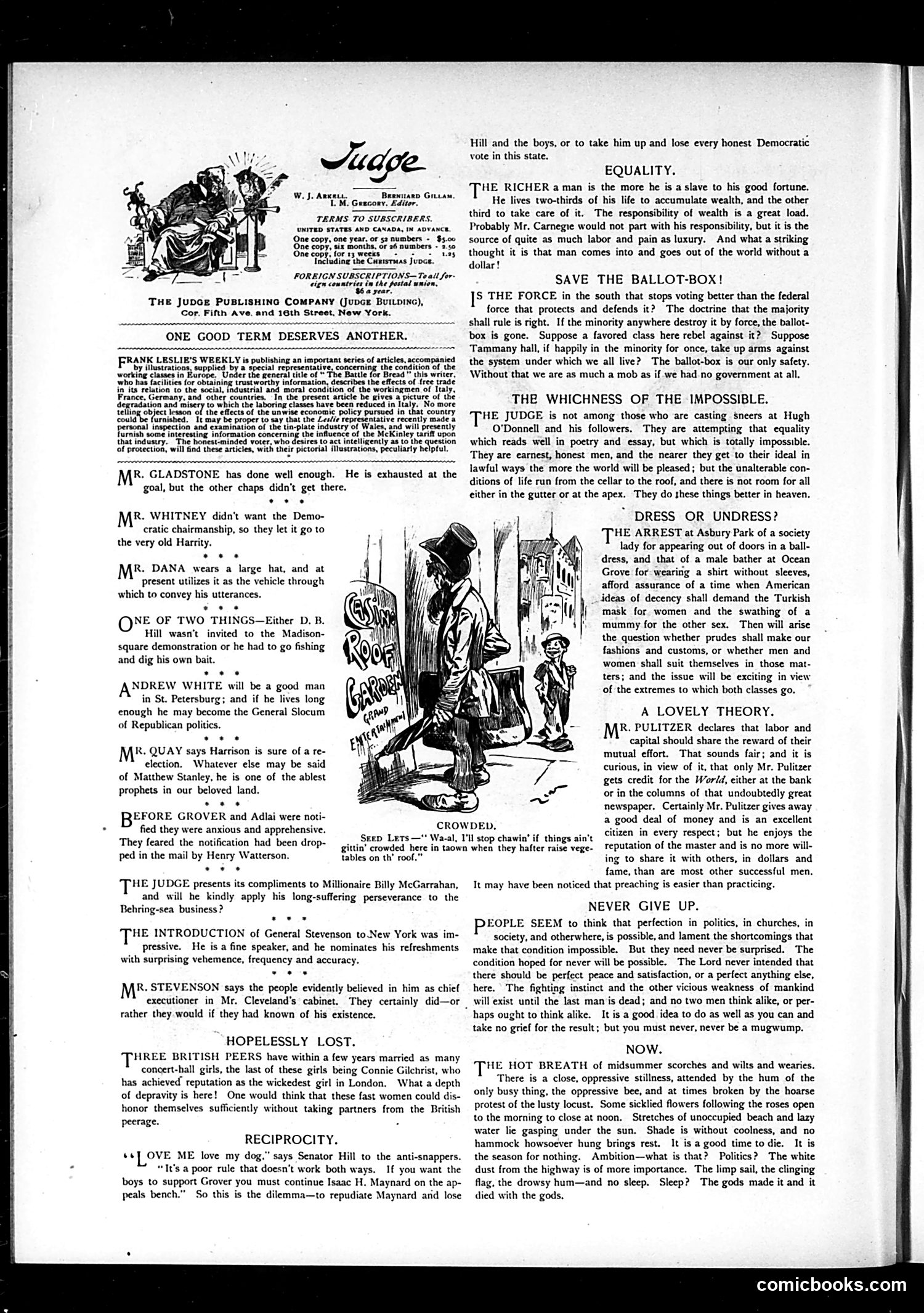
The central cartoon depicts a crowded urban street scene with working-class figures—likely immigrants or poor laborers—gathered around what appears to be a street vendor or performer. The illustration supports the page's editorial content critiquing wealth inequality and political reform. The accompanying text articles mock various political figures and social issues of the era. References include criticism of millionaire Billy McCarthran, debates over labor and capital distribution, and commentary on class divisions. The satirical pieces attack both wealthy industrialists and reformers they view as impractical idealists. The overall tone suggests this is from the Gilded Age period, when Judge magazine regularly targeted wealth inequality, political corruption, and competing visions for American democracy through sharp social satire.
📄 Transcribed text from this page (OCR, searchable)
Machine-transcribed from the original scan — historical spelling and the odd misread are preserved.
W, J. Arwen. Brenan Grutam. I. M. Geecony. Editor. TERMS TO SUBSCRIBERS. UNITED STATES AND CANADA, IN ADVANCE. ‘Qne copy, one year. of sz numbers - $5.00 One copy, six months, or 26 numbers - 2.50 One copy. for 13 wees = = has Inclading the Cursos Juoce. FOREIGN SUBSCRIPTIONS—Te alt for- ign countries in the postal wm ‘$a year. THE JUDGE PUBLISHING COMPANY (Jupce BuiLpinc), Cor. Fifth Ave. and 16th Street, New York. ONE GOOD TERM DESERVES ANOTHER. FRANK LESLIE'S WEEKLY is publishing an important series of articles, accompanied by illustrations, supplied by a special representative, concerning the condition of the working classes in Europe. Under the general title of " The Battle for Bread” this writer, who has facilities for obtaining trustworthy information, describes the effects of free trade in its relation to the social, industrial and moral condition of the workingmen of Italy, France, Germany, and other countries, In the present article be gives a picture of degradation and misery to which the laboring classes have been reduced in Italy. No more telling object lesson of the effects of the unwise economic policy pursued in that country could be furnished. It may be proper to say that the Leslie representative recently made a Personal inspection and examination of the tin-plate industry of Wales, and will presently furnish some inter ‘information concerning the influence of the McKinley tariff upon that industry. . The honest-minded voter, who desires to act intelligently as to the question of protection, will find these articles, with their pictorial illustrations, peculiarly helpful. MP: GLADSTONE has done well enough. He is exhausted at the goal, but the other chaps didn’t get there. M®- WHITNEY didn’t want the Demo- cratic chairmanship, so they let it go to the very old Harrity. R. DANA wears a large hat, and at present utilizes it as the vehicle through which to convey his utterances. ONE OF TWO THINGS—Either D. B. Hill wasn’t invited to the Madison- square demonstration or he had to go fishing and dig his own bait. eee NDREW WHITE will be a good man in St. Petersburg; and if he lives long enough he may become the General Slocum of Republican politics. eee R. QUAY says Harrison is sure of a re- election. Whatever else may be said of Matthew Stanley, he is one of the ablest prophets in our beloved land. cee EFORE GROVER and Adlai were noti- fied they were anxious and apprehensive. They feared the notification had been drop- ped in the mail by Henry Watterson. THE JUDGE presents its compliments to Millionaire Billy McGarrahan, and will he kindly apply his long-suffering perseverance to the Behring-sea business? tables on th’ roof,” THE INTRODUCTION of General Stevenson to.New York was im- pressive. He is a fine speaker, and he nominates his refreshments with surprising vehemence, frequency and accuracy. R, STEVENSON says the people evidently believed in him as chief executioner in Mr. Cleveland's cabinet. They certainly did—or rather they would if they had known of his existence. HOPELESSLY LOST. THREE BRITISH PEERS have within a few years married as many concert-hall girls, the last of these girls being Connie Gilchrist, who has achieved reputation as the wickedest girl in London. What a depth of depravity is here! One would think that these fast women could dis- honor themselves sufficiently without taking partners from the British peerage. : RECIPROCITY. +s] OVE ME love my dog.” says Senator Hill to the anti-snappers. “It’s a poor rule that doesn’t work both ways. If you want the boys to support Grover you must continue Isaac H. Maynard on the ap- peals bench.” So this is the dilemma—to repudiate Maynard arid lose CROWDED, 3—"* Waal, I'll stop chawin’ if things ain't here in taown when they hafter raise vege- Hill and the boys, or to take him up and lose every honest Democratic vote in this state, EQUALITY. THE RICHER a man is the more he is a slave to his good fortune. He lives two-thirds of his life to accumulate wealth, and the other third to take care of it. The responsibility of wealth is a great load. Probably Mr. Carnegie would not part with his responsibility, but it is the source of quite as much labor and pain as luxury. And what a striking thought it is that man comes into and goes out of the world without a dollar! SAVE THE BALLOT-BOX! Is THE FORCE in the south that stops voting better than the federal force that protects and defends it? The doctrine that the majority shall rule is right. If the minority anywhere destroy it by force, the ballot- box is gone. Suppose a favored class here rebel against it? Suppose Tammany hall, if happily in the minority for once, take up arms against the system under which we all live? The ballot-box is our only safety. Without that we are as much a mob as if we had.no government at all. THE WHICHNESS OF THE IMPOSSIBLE. THE JUDGE is not among those who are casting sneers at Hugh O'Donnell and his followers. They are attempting that equality which reads well in poetry and essay, but which is totally impossible. ‘They are earnest, honest men, and the nearer they get to their ideal in lawful ways the more the world will be pleased; but the unalterable con- ditions of life run from the cellar to the roof, and there is not room for all either in the gutter or at the apex. They do these things better in heaven. DRESS OR UNDRESS? HE ARREST at Asbury Park of a society lady for appearing out of doors in a ball- dress, and that of a male bather at Ocean Grove for-wearing a shirt without sleeves, afford assurance of a time when American ideas of decency shall demand the Turkish mask for women and the swathing of a mummy for the other sex. Then will arise the question whether prudes shall make our fashions and customs, or whether men and women shall suit themselves in those mat- ters; and the issue will be exciting in view of the extremes to which both classes go. A LOVELY THEORY. M® PULITZER declares that labor and capital should share the reward of their mutual effort. That sounds fair; and it is curious, in view of it, that only Mr. Pulitzer gets credit for the Wor/d, either at the bank or in the columns of that undoubtedly great newspaper. Certainly Mr. Pulitzer gives away a good deal of money and is an excellent citizen in every respect; but he enjoys the reputation of the master and is no more will- ing to share it with others, in dollars and fame, than are most other successful men. It may have been noticed that preaching is easier than practicing. NEVER GIVE UP. EOPLE SEEM to think that perfection in politics, in churches, in society, and otherwhere, is possible, and lament the shortcomings that make that condition impossible. But they need never be surprised. The condition hoped for never will be possible. The Lord never intended that there should be perfect peace and satisfaction, or a perfect anything else, here. The fighting instinct and the other vicious weakness of mankind will exist until the last man is dead; and no two men think alike, or per- haps ought to think alike. It is a good. idea to do as well as you can and take no grief for the result; but you must never, never be a mugwump. Now. HE HOT BREATH of midsummer scorches and wilts and wearies. There is a close, oppressive stillness, attended by the hum of the only busy thing, the oppressive bee, and at times broken by the hoarse protest of the lusty locust. Some sicklied flowers following the roses open to the morning to close at noon. Stretches of unoccupied beach and lazy water lie gasping under the sun. Shade is without coolness, and no hammock howsoever hung brings rest. It is a good time to die. It is the season for nothing. Ambition—what is that? Politics? The white dust from the highway is of more importance. The limp sail, the clinging flag, the drowsy hum—and no sleep. Sleep? The gods made it and it died with the gods. comicbooks.com