
A complete issue · 18 pages · 1892
Judge — August 6, 1892
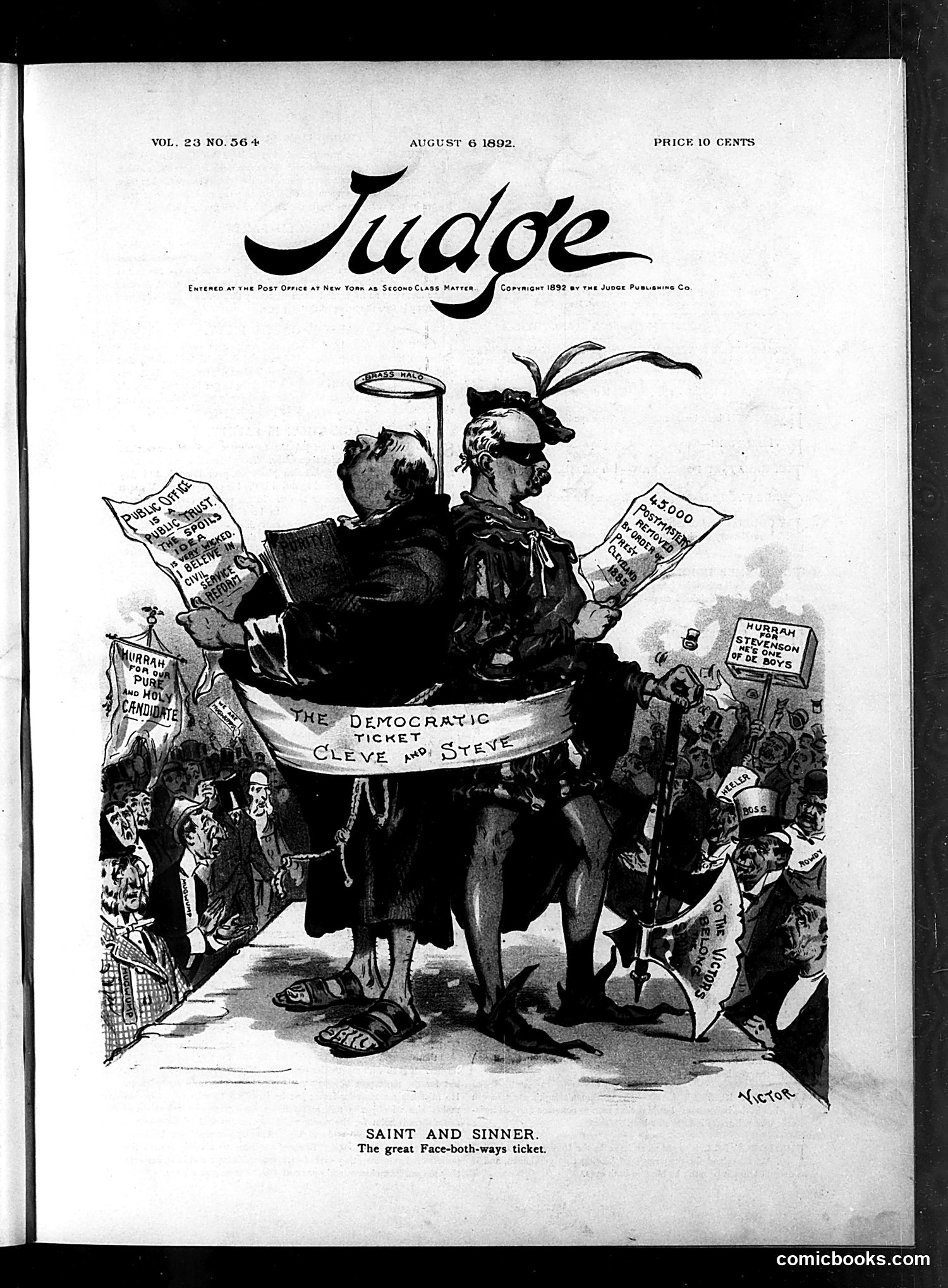
This 1892 political cartoon satirizes the Democratic presidential ticket of Grover Cleveland and Adlai Stevenson. The caricatured figures are depicted as two-faced—literally wearing halos and devil horns simultaneously—to suggest hypocrisy and contradiction. The surrounding crowd holds signs with conflicting messages (visible references include promises about "pure and honest candidate" alongside "$4,000" and "Hurrah" placards), implying the ticket appealed to incompatible constituencies through contradictory promises. The "face-both-ways" metaphor suggests Cleveland and Stevenson presented themselves differently to different voters—claiming moral virtue while making corrupt political deals. This was a common attack on politicians accused of inconsistency between public rhetoric and actual positions or conduct.
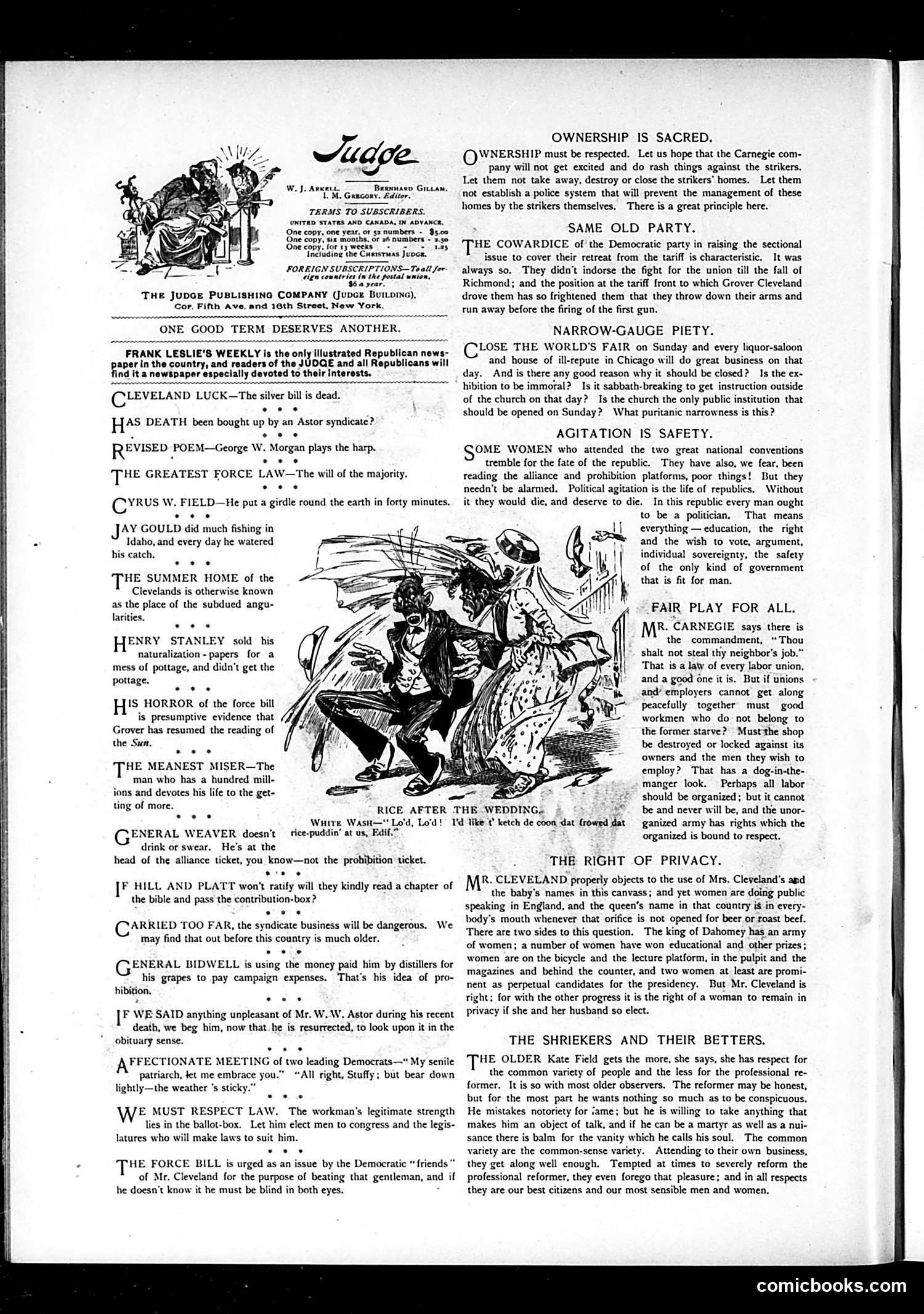
This page contains editorial commentary rather than a single cartoon. The main illustration titled "WHITE WASH—'Lord, Lord! Till like t' catch de coon dat froze dat possum in de salt!'" depicts a chaotic domestic scene with racial caricature. The surrounding text columns address contemporary political issues: Cleveland's tariff policy, labor disputes and unionization, women's suffrage and public behavior, and privacy concerns regarding Mrs. Cleveland's public activities in England. The "White Wash" cartoon appears to satirize domestic disorder or incompetence through racist imagery typical of 1880s-90s Judge magazine. Without additional context, the specific political target remains unclear, though it likely comments on mismanagement or hypocrisy among public figures of that era.
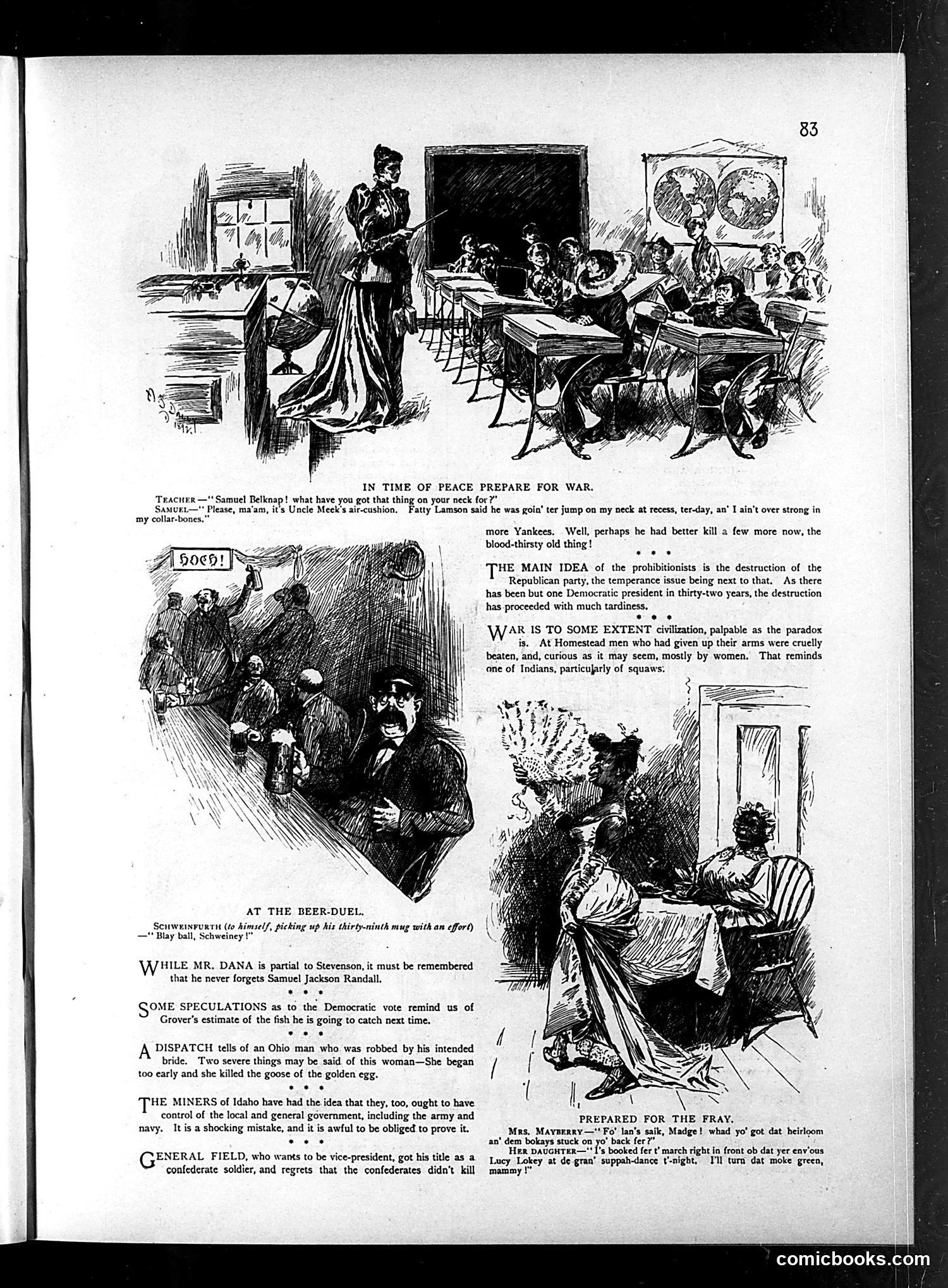
This page satirizes late-19th-century American political and social tensions. The top cartoon titled "In Time of Peace Prepare for War" depicts a schoolteacher instructing students on militarism, mocking prohibitionist and Republican efforts to weaken the nation. The dialogue references "Uncle Meek's air-cushion" and conflates pacifism with military unpreparedness. The text below critiques prohibitionists' goal of destroying the Republican party, while paradoxically claiming war civilizes society. References to "Homestead men" (likely the 1892 labor conflict) and Native Americans ("Indians") suggest ironic commentary on American violence. Lower cartoons mock various political figures—"Schweinefurth" at a beer duel, and Mrs. Mayberry's domestic scene—employing ethnic stereotypes and crude humor typical of 1890s American satire. The overall message appears anti-prohibitionist and pro-Republican.
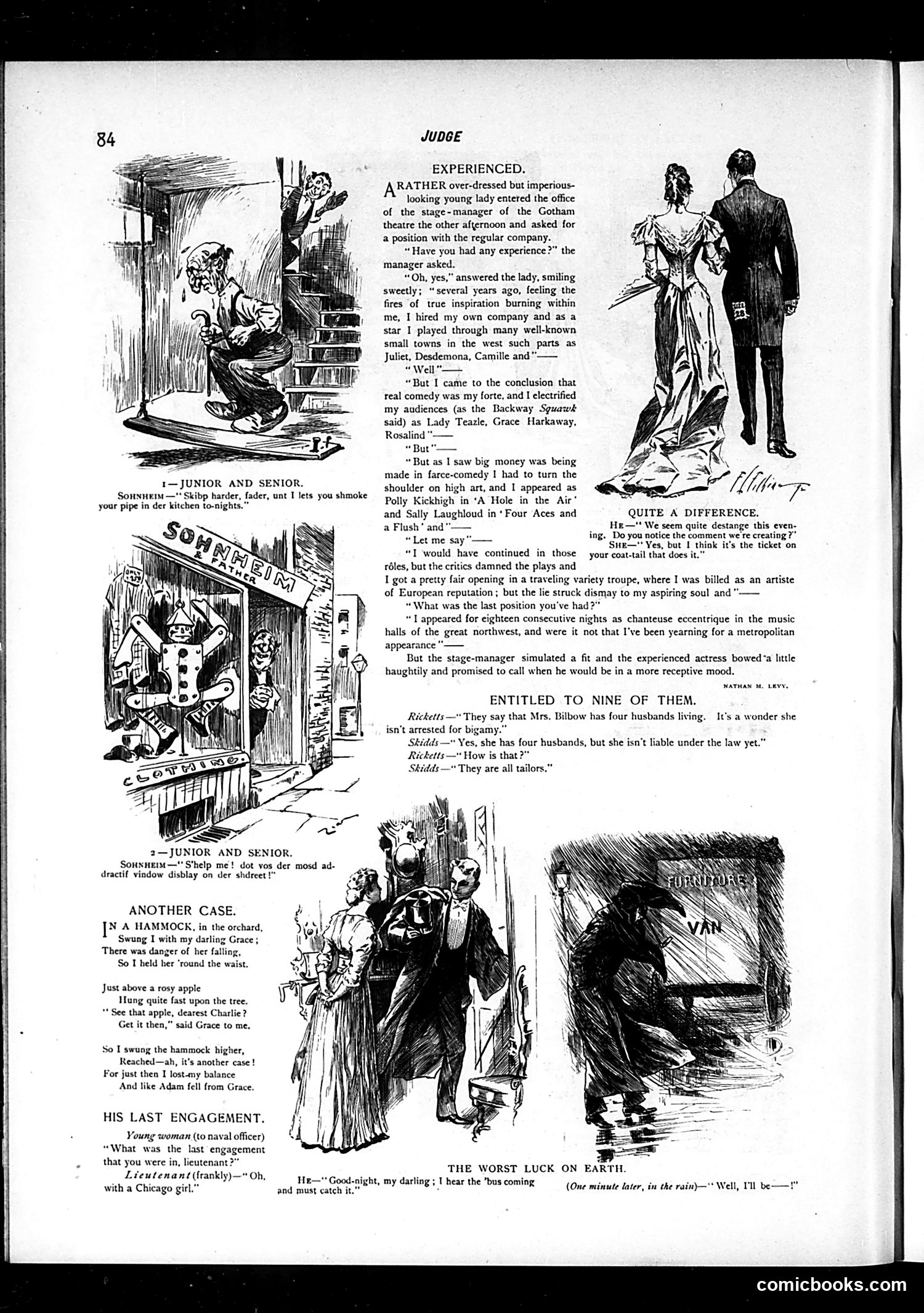
This page contains several satirical pieces typical of Judge's humor circa early 1900s: **"Experienced"** (main story): Mocks an over-dressed, pretentious young actress auditioning for a theater company. She rambles endlessly about her supposed impressive background—playing Shakespeare roles in small western towns, performing in failing farce-comedies, working as a music hall "chanteuse." The stage-manager's silent frustration (he tries interrupting with "Let me say") suggests her inflated resume contradicts her obvious lack of real success. The satire targets theatrical pretension and verbose self-promotion. **"Junior and Senior"** sketches: Appear to feature German-accented characters (indicated by dialect spelling), likely depicting immigrant working-class men and their observations—one about smoking privileges, another about window displays. **"Another Case"** (poem): A playful narrative about a man in a hammock reaching for an apple, losing his balance, and "falling from Grace"—wordplay on the woman's name. Minor pieces mock naval officers, marital disputes, and bad luck. The overall tone reflects Judge's characteristic upper-class mockery of social climbers, immigrants, and theatrical absurdity.
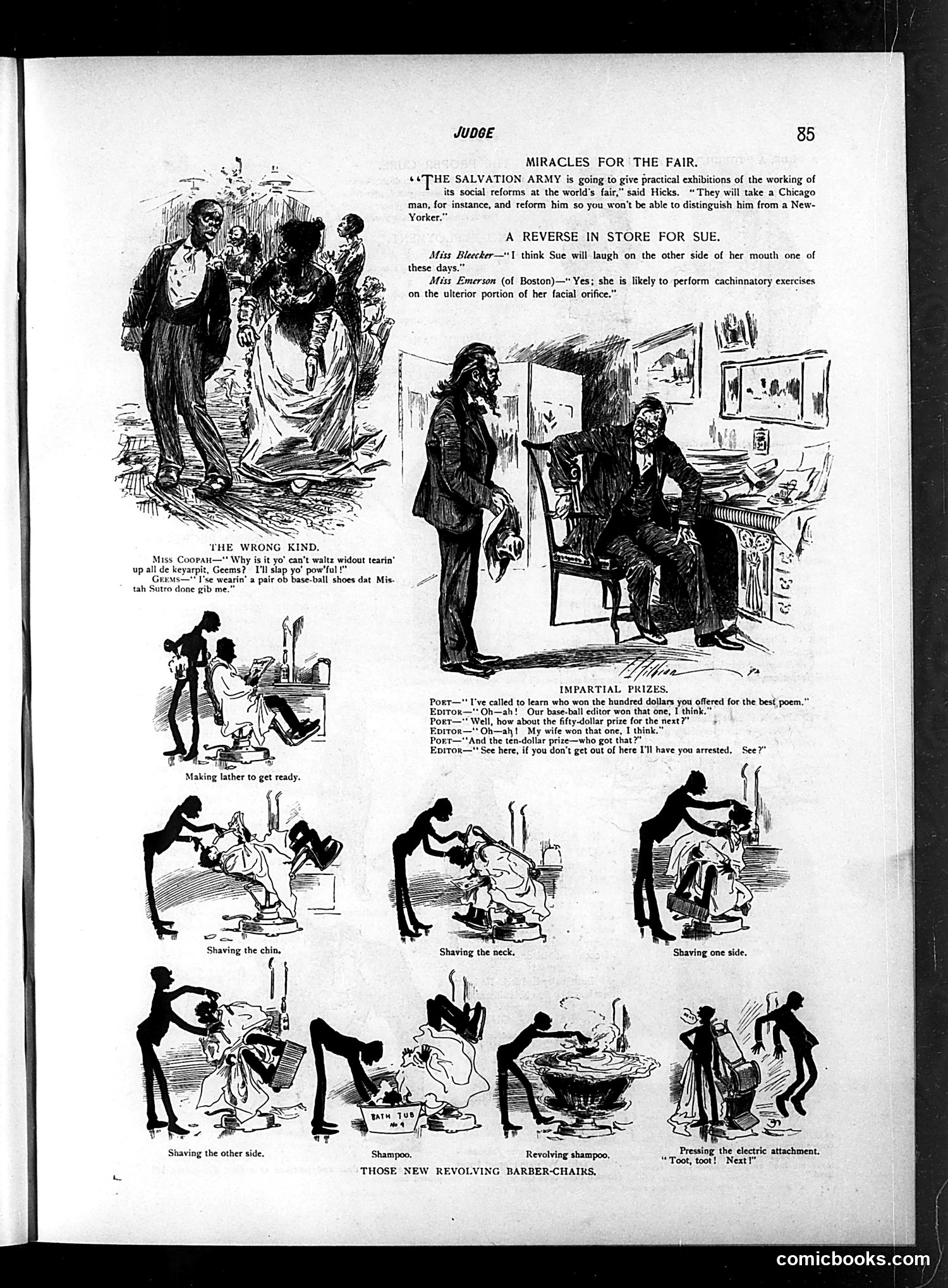
This Judge magazine page contains three satirical pieces: 1. **"Miracles for the Fair"**: Mocks the Salvation Army's claim to reform people, joking that they could take a disreputable Chicago man and make him indistinguishable from a respectable New Yorker—poking fun at regional stereotypes. 2. **"A Reverse in Store for Sue"**: Two women use absurdly pretentious language about Sue's future embarrassment, satirizing affected Boston speech patterns and over-intellectualized expression. 3. **"Impartial Prizes"**: A poet visits an editor who's awarded prizes to the baseball editor and his own wife for submissions—obviously biased judging. The poet threatens arrest, leading to the punchline about new revolving barber chairs shown below, depicting exaggerated barbering procedures. The humor likely satirizes either new mechanical salon equipment or corrupt nepotism in literary contests. The page uses visual gags and class-based humor typical of early-20th-century American satire.
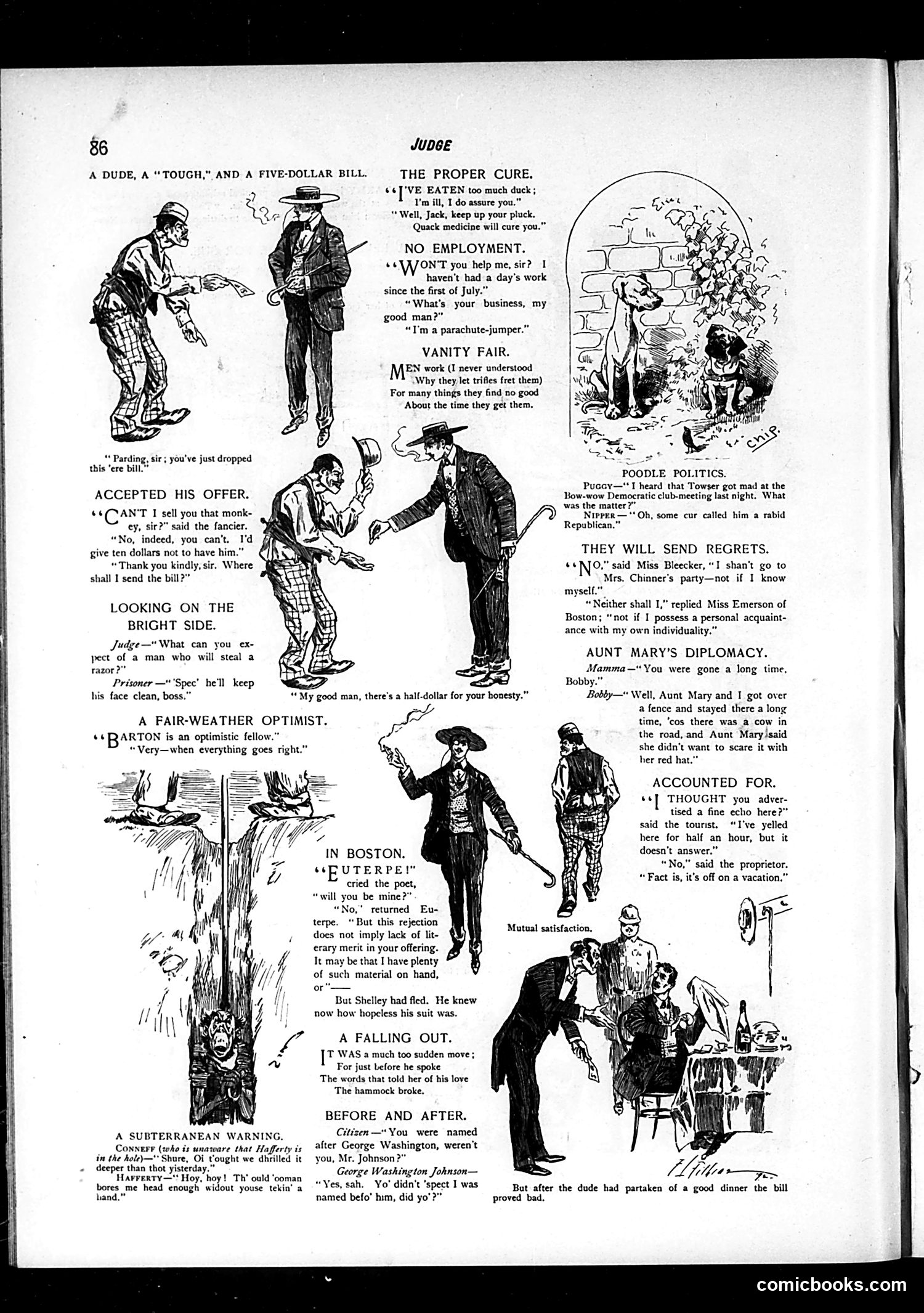
This page from the satirical magazine Judge contains multiple brief comics and jokes typical of late 19th-century American humor. **Key items:** - **"A Dude, A 'Tough,' and a Five-Dollar Bill"**: Shows a working-class man ("tough") honestly returning a dropped bill to a wealthy "dude," who then tries to pay him to take a monkey off his hands—mocking the dude's obliviousness. - **"No Employment"**: A parachute-jumper can't find work since July 1st—likely referencing a specific historical event or seasonal layoff period (unclear which). - **"Poodle Politics"**: Dogs debate at a Democratic club meeting, with one called a "rabid Republican"—anthropomorphic satire of partisan political divisions. - **"A Fair-Weather Optimist"**: Mocks shallow optimism that only appears when conditions are favorable. - **Minor pieces** on medical quackery, romantic rejection, and social pretension round out the page. The humor relies on class commentary, political mockery, and period-specific references now requiring historical context.
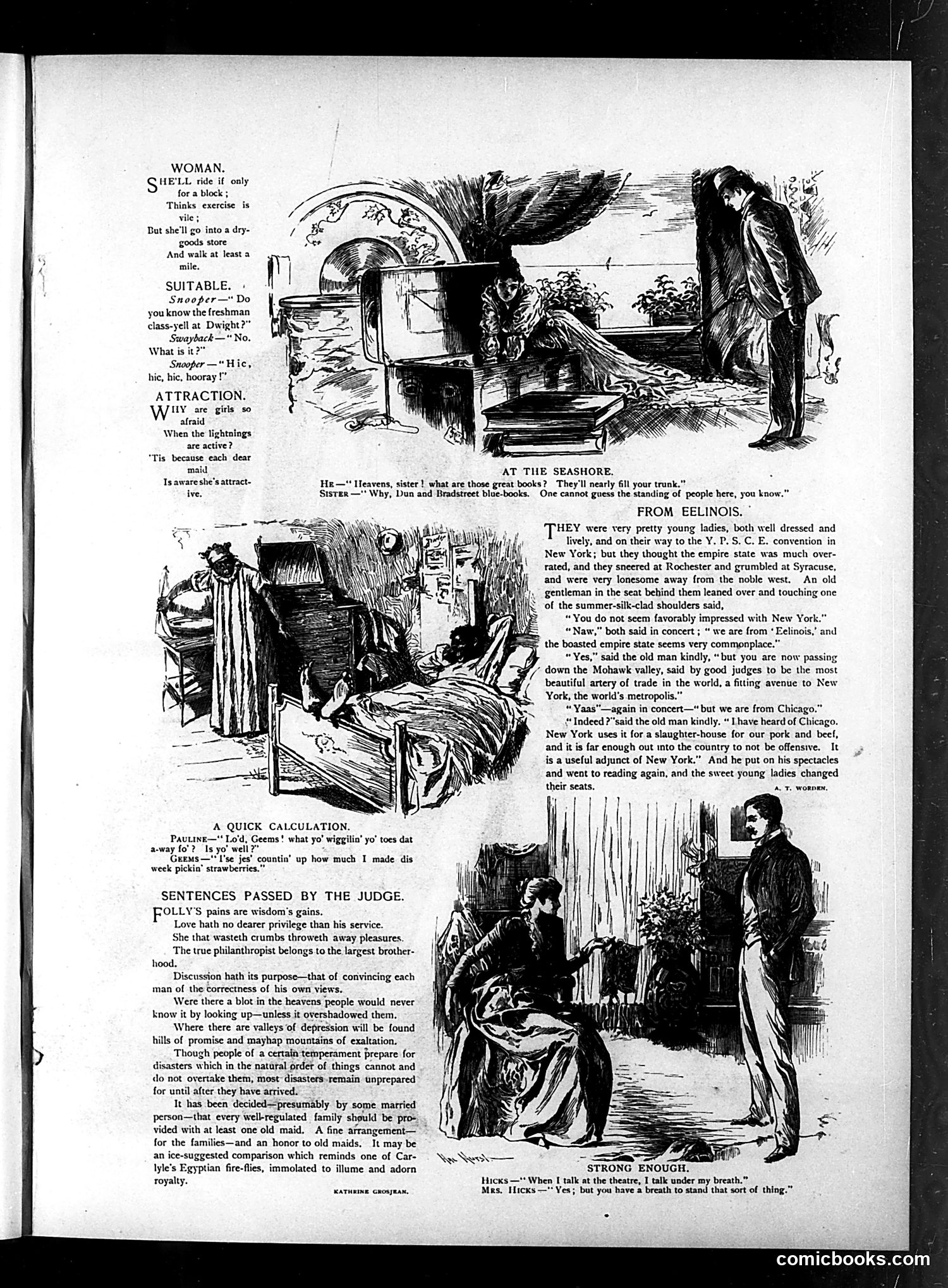
This page contains several satirical humor pieces typical of late 19th-century American magazines: **"At the Seashore"** mocks provincial attitudes: two young women from Illinois attending a Y.P.S.C.E. (Young People's Society of Christian Endeavor) convention in New York dismiss the Hudson Valley and New York itself as commonplace, boasting instead about Chicago. An elderly gentleman deflates their pride by suggesting New York actually *uses* Chicago as a slaughterhouse for meat—a backhanded insult wrapped in courtesy. **Other pieces** include mild observations on women's contradictory behavior (avoiding carriages but walking miles in shops), collegiate humor, and romantic jokes about lightning attracting women. The overall tone is genteel mockery of American provincial pride and gender stereotypes—typical Judge content aimed at educated urban readers amused by rustic pretension and social awkwardness.
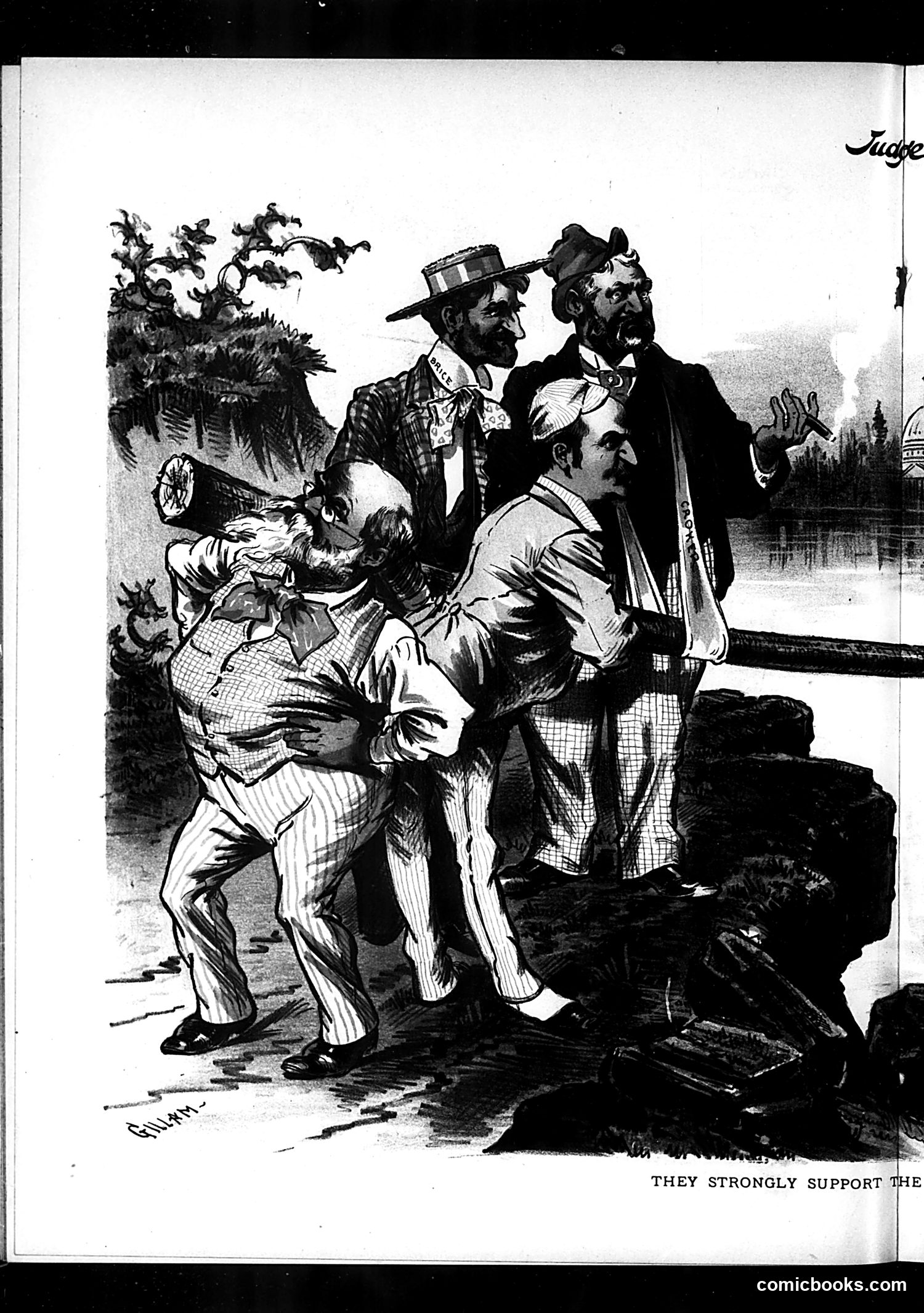
This *Judge* magazine cartoon depicts four men by a riverside, with the caption "THEY STRONGLY SUPPORT THE—" (text cut off). The two figures in back wear formal attire and hats, appearing to be politicians or gentlemen of means. The two in front, depicted with exaggerated features in lighter clothing, appear to represent working-class or immigrant characters—a common caricature style in late 19th/early 20th-century American satire. The cartoon likely satirizes political hypocrisy: wealthy or powerful figures claiming to "strongly support" something (possibly labor rights, immigration reform, or another populist cause) while maintaining obvious class divisions. The incomplete caption prevents identifying the specific political issue referenced, but the visual composition emphasizes the stark contrast between the figures to mock insincere political posturing.
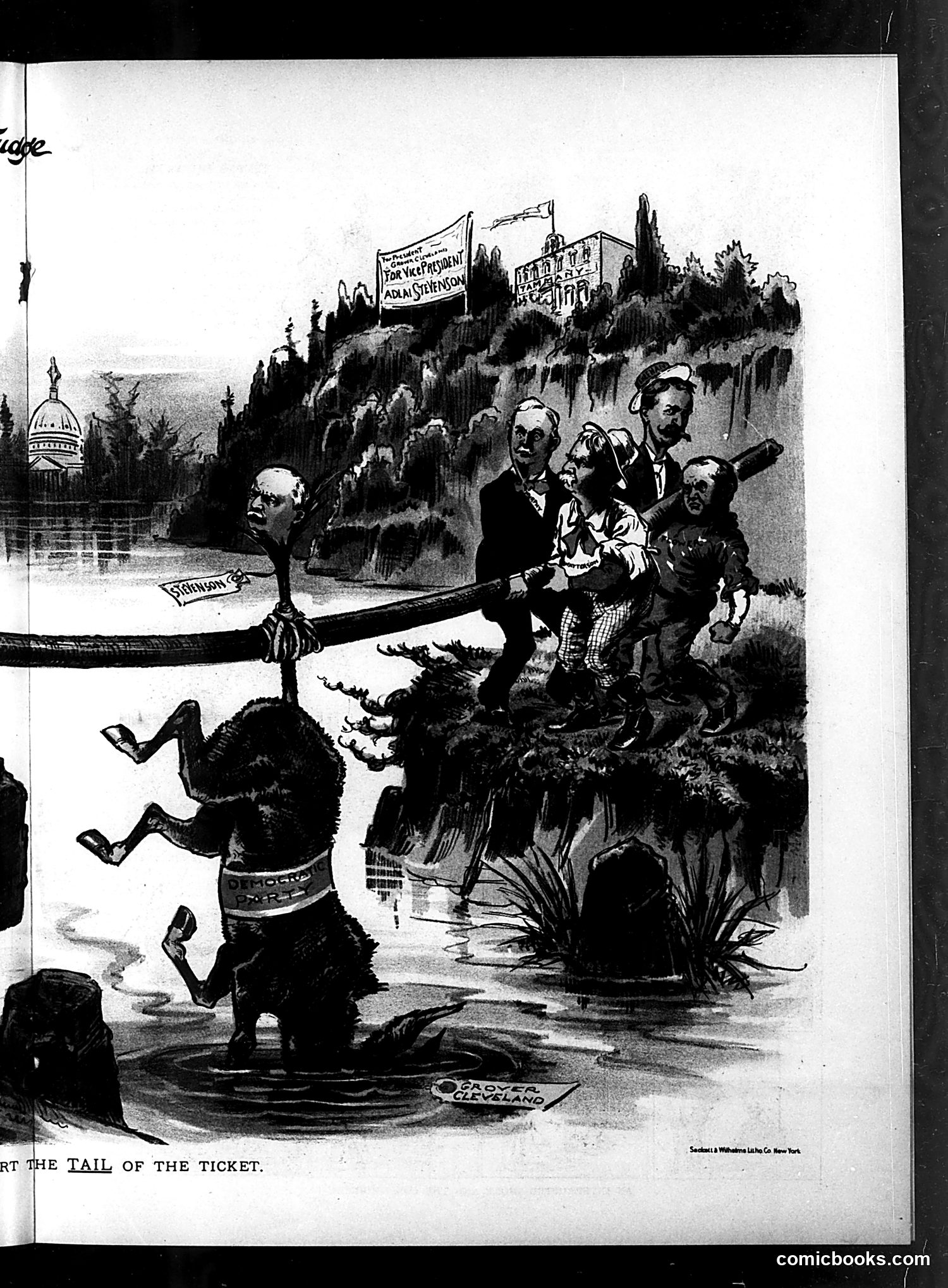
This political cartoon depicts figures being pulled or controlled by a donkey (symbol of the Democratic Party) in what appears to be a swampy landscape. A building labeled "FOR VICE PRESIDENT ADLAI STEVENSON" sits on a hill in the background, suggesting the cartoon concerns a vice-presidential nomination or ticket-building controversy. The satire appears to criticize Democratic Party leadership as being controlled by or following behind a donkey—a commentary on party direction or leadership decisions regarding the vice-presidential slot. The title suggests discussion of how vice-presidential candidates were selected or their secondary status ("tail") on the ticket. The specific political context—likely involving Adlai Stevenson and Democratic Party mechanics—would require additional historical documentation to identify with certainty.
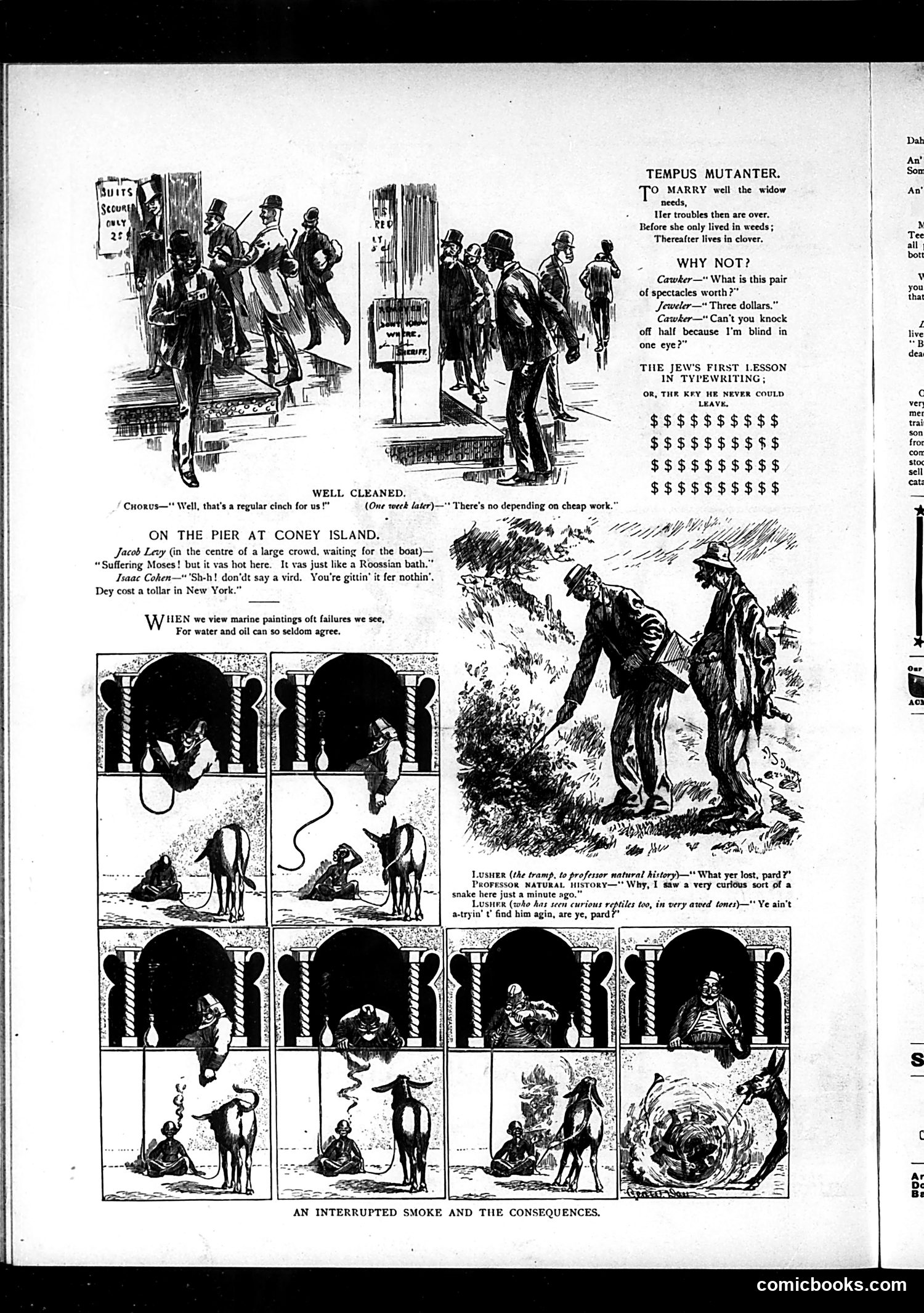
This page contains several satirical sketches typical of Judge's late 19th/early 20th-century content: **"Well Cleaned"** and **"On the Pier at Coney Island"**: These mock Jewish immigrants using Yiddish-inflected English dialect humor. Jacob and Isaac discuss avoiding paying for bathhouse services at Coney Island—stereotyping Jews as cheap and keen on getting something free. This reflects period attitudes toward Eastern European Jewish immigrants. **Marine Painting joke**: A straightforward gag about oil and water not mixing, with a follow-up punchline about cheap workmanship. **"The Jew's First Lesson in Typewriting"**: A visual pun showing a Jewish typist repeatedly hitting the dollar sign ($) key—reinforcing the stereotype that Jewish people are obsessed with money. **"Tempus Mutanter"**: A wordplay title satirizing widows who remarry, moving from poverty ("weeds") to comfort ("clover"). The page reflects Judge's reliance on ethnic stereotyping, particularly anti-Semitic caricature, as standard satirical fare.
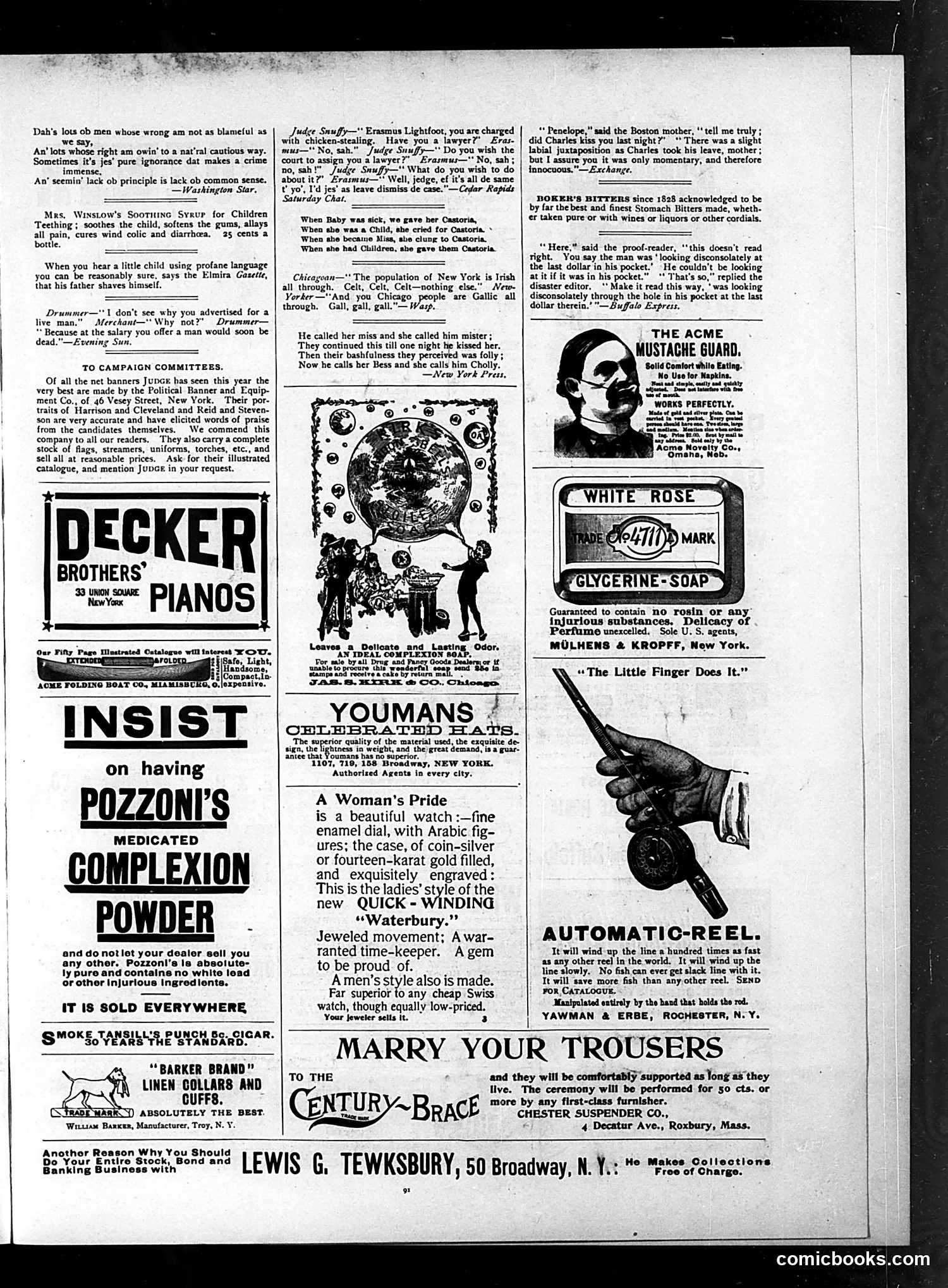
This page is primarily **advertisements and humorous short items**, not political cartoons. The main content includes: **The Humor Pieces:** - A dialect joke featuring "Judge Snuffy" and "Erasmus Lightfoot," an African American character, discussing a chicken-stealing charge. The humor relies on racist stereotypes and dialect mockery common to this era. - Various brief quips about relationships, professions, and urban life (Chicago vs. New York ethnic composition). **The Advertisements:** Decker Brothers Pianos, Pozzoni's Complexion Powder, Youmans Hats, Waterbury Watches, Century-Brace (men's suspenders), and other period products dominate the page. **Historical Context:** This appears to be from the 1880s-1890s based on the candidates mentioned (Harrison, Cleveland, Reid, Stevenson). The page reflects the casual racism, ethnic stereotyping, and gender assumptions typical of Judge magazine's humor during this period—content that would be considered deeply offensive today.
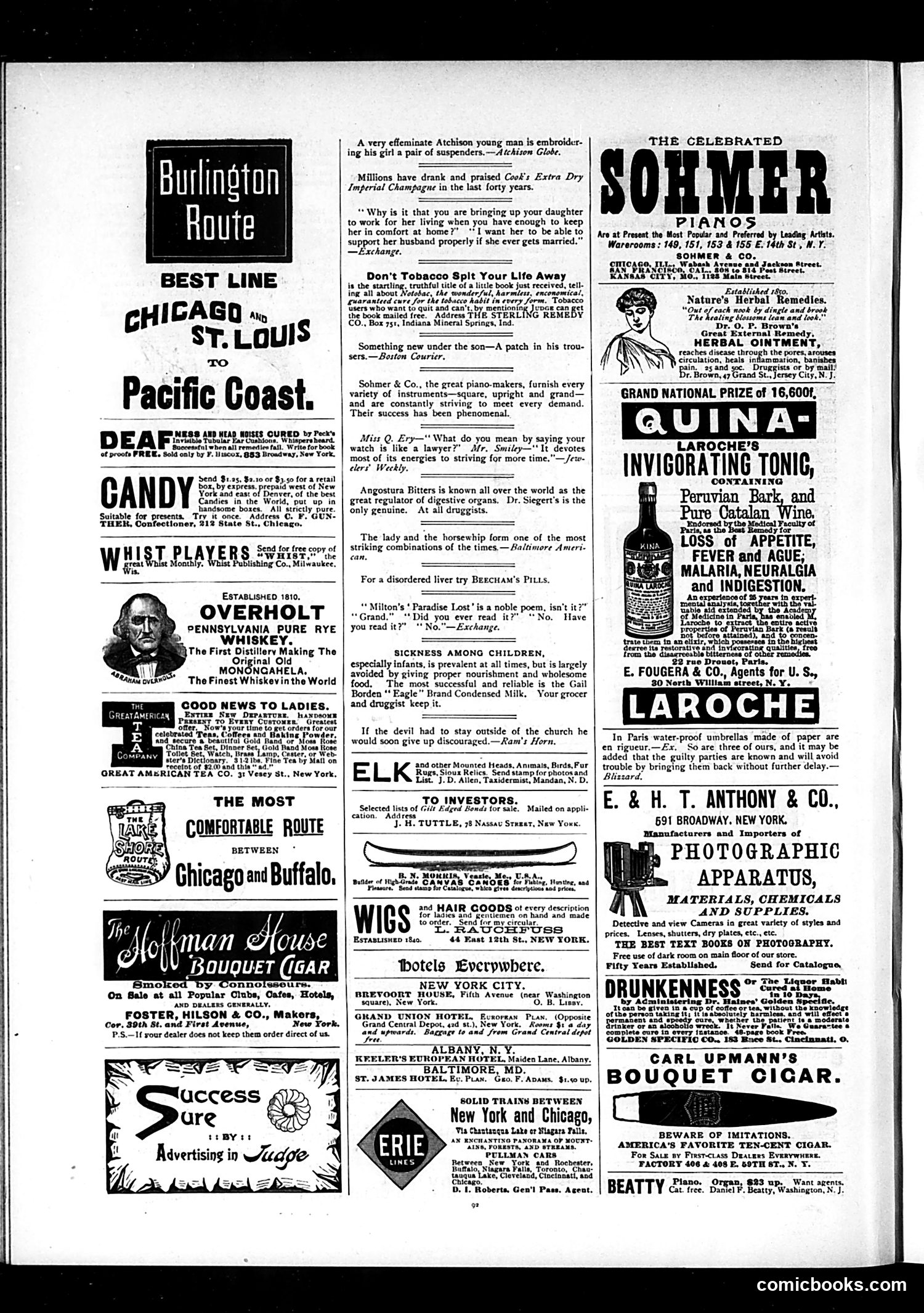
This is primarily an **advertising page** from Judge magazine, with minimal editorial content. The few satirical items are brief, understated quips typical of the era: **Notable satirical content:** - An item mocking an "effeminate Atchison young man" embroidering suspenders for his girlfriend—playing on anxieties about masculine behavior - A joke about a father raising his daughter to "support her husband properly"—satirizing women's economic dependence and role expectations - A quip comparing a watch to a lawyer for "striving for more time"—standard turn-of-century lawyer mockery - A line about "the lady and the horsewhip"—likely referencing contemporary scandals or domestic violence issues **The advertisements** dominate, hawking patent medicines (Angostura Bitters, Beecham's Pills, Sterling Remedy for tobacco addiction), whiskey, champagne, condensed milk, pianos, and cigars—reflecting late-19th/early-20th-century consumer culture and the prevalence of unregulated medical claims in advertising. There are **no identifiable political cartoons or caricatures** on this page; the satirical content is purely textual and mild by modern standards.
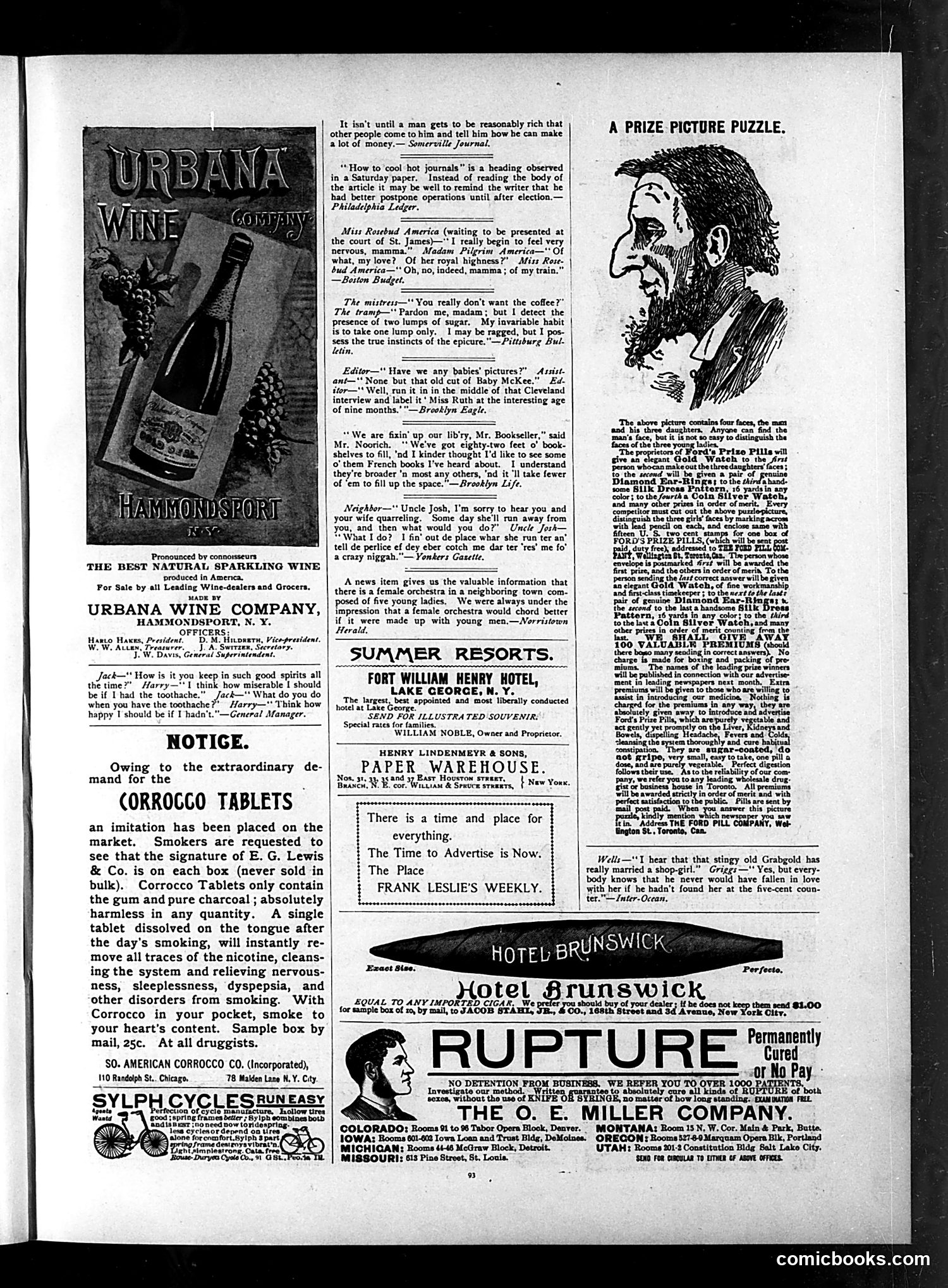
This page is primarily **advertising and humor pieces**, not political cartoons. The main content includes: **The Cartoon**: "A Prize Picture Puzzle" (upper right) shows an exaggerated caricatured face. The text below suggests this is a **visual puzzle** where readers identify hidden faces or objects within the illustration—a common entertainment format in Judge magazine. **The Humor Pieces**: Short jokes and anecdotes scattered throughout satirize: - Wealthy people seeking financial advice - Social climbing (a debutant nervous about her train at court) - Class pretension (a wealthy man wanting "broad" French books to fill shelves quickly) - Marital discord and class stereotypes **The Advertising**: Wine, hotels, bicycles, and patent medicines dominate—reflecting late 19th/early 20th-century consumer culture. The humor reflects **period attitudes** toward wealth, social aspiration, and gender roles rather than specific political events. No major historical figures appear to be referenced.
This page is primarily **advertising**, with small humorous filler content typical of 1890s magazines. The main satirical elements are brief jokes: - **Haskins/Morris exchange**: Mocks the irony of someone writing a 13-hour daily work schedule while advocating for 8-hour workdays—a contemporary labor reform debate. - **"Chappie" cartoon**: Satirizes upper-class affectation through a dandy's pretentious speech ("aw," "dontcherknow"), poking fun at artificial aristocratic mannerisms. - **Ethel/Tom dialogue**: A cynical observation that politicians win elections through manipulation while statesmen earn respect—suggesting contemporary distrust of electoral politics. The page's main message appears in the large **"Losing Money Lively"** advertisement: Judge claims major advertisers *avoid* their magazine, thereby losing exposure to 290,000 weekly readers. This is self-promotional irony—by naming product categories that don't advertise in Judge, they shame potential clients into purchasing ads. The numerous product advertisements (Kodak, cocoa, whisky, beer) represent typical late-19th-century consumer goods marketing.
This page is primarily **advertising**, with small comic bits interspersed. The visible cartoons/jokes are brief social humor typical of the era: **Comic Vignettes:** - A young man seeking a wife while "entirely ignorant" of marital realities - A wife confronting her tipsy husband returning from a labor union meeting at 5 a.m.—she sarcastically suggests he sit on the doorstep and "consider" the recent lockout (labor dispute) - A husband reporting his wife threw dictionary words at him during an argument **Political/Social Context:** The labor union reference reflects late 19th-century labor unrest and strikes. The marital dynamics jokes reflect period gender assumptions. **Advertisements:** The bulk of the page showcases patent medicines (Ayer's Sarsaparilla), soaps (Pears, Woodbury's), pens, tires, and food products—typical Judge content that funded the magazine. The content is relatively light satirical humor and commercial promotion rather than sharp political cartooning.
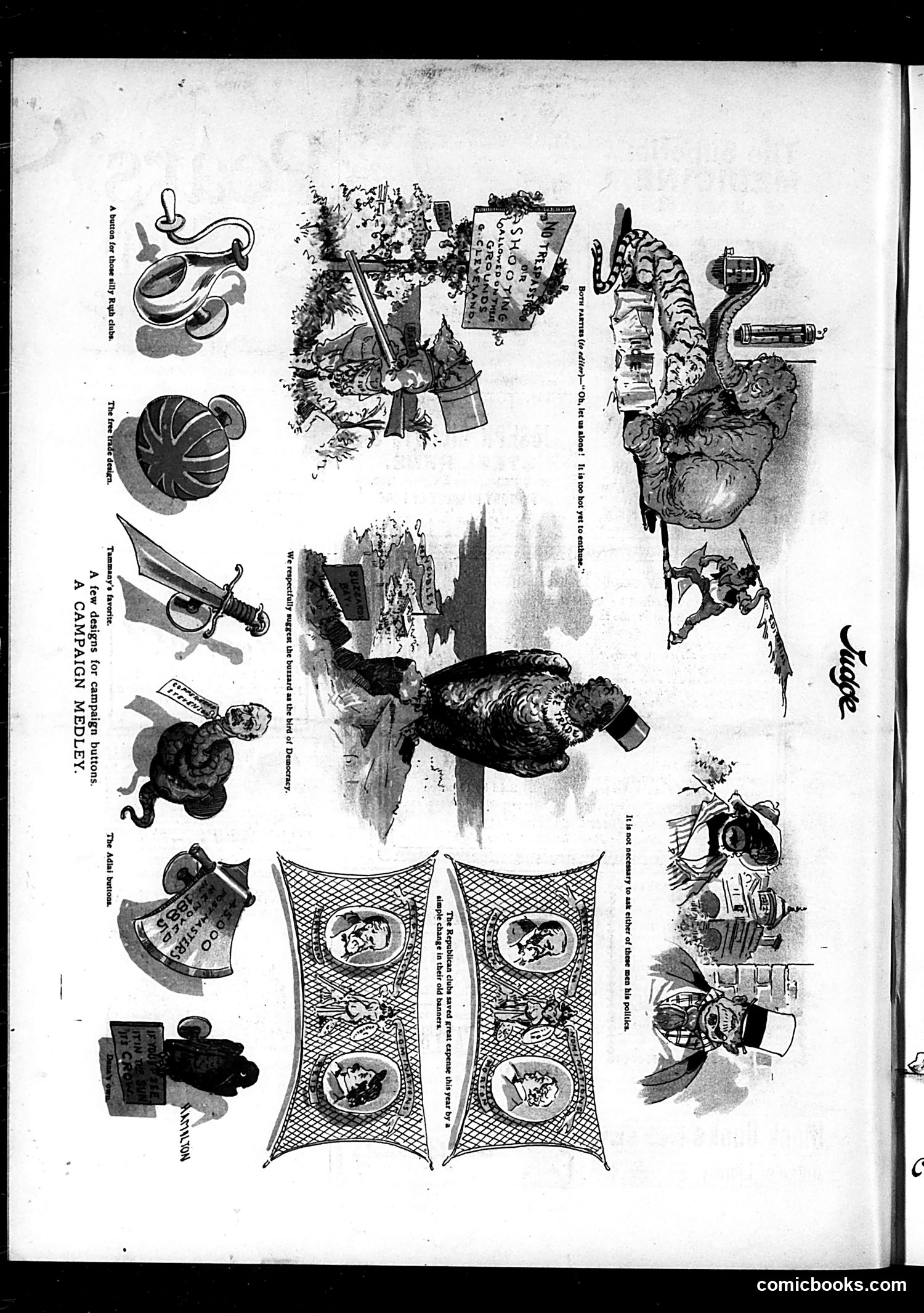
This page from *Judge* magazine presents campaign button designs, likely from an early 20th-century U.S. election. The central figure appears to be a politician (possibly a presidential candidate), surrounded by various decorative buttons and political imagery. The text references "Tammany's favorite" (Tammany Hall, New York's Democratic political machine) and "Adlai buttons," suggesting this satirizes competing political campaigns. The phrase "a button for those silly Ruth clubs" is unclear without additional context, though it may reference a specific political organization. The ornamental buttons displayed showcase different emblems and designs typical of campaign merchandise from this era. The satire likely mocks the proliferation of campaign paraphernalia and the sometimes absurd nature of political merchandising, presenting them as a "medley" of competing partisan symbols and slogans.
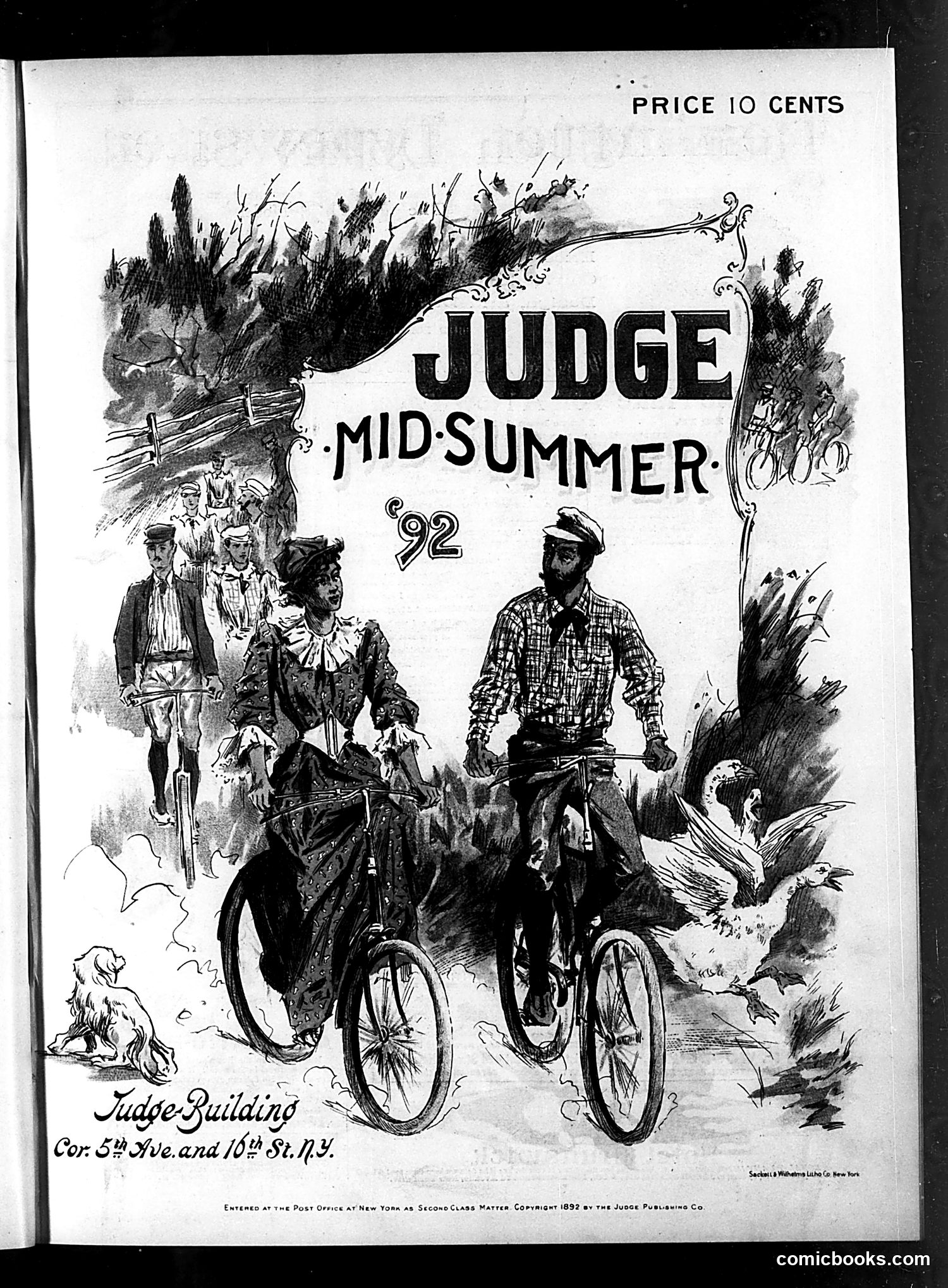
This is a cover for *Judge* magazine's mid-summer 1892 issue. The illustration depicts two cyclists (a woman and a man in period attire) riding bicycles through a rural landscape with decorative natural borders. The cycling craze was a major cultural phenomenon of the 1890s, particularly significant for women's liberation—bicycles offered unprecedented mobility and independence. The stylish dress and confident postures suggest this is celebrating the bicycle as a modern marvel. The satire likely mocks either the bicycle fad's excess popularity or contemporary anxieties about women's changing social roles via this new technology. The ornate, nature-framed composition ironically juxtaposes the "modern" bicycle with traditional pastoral aesthetics.
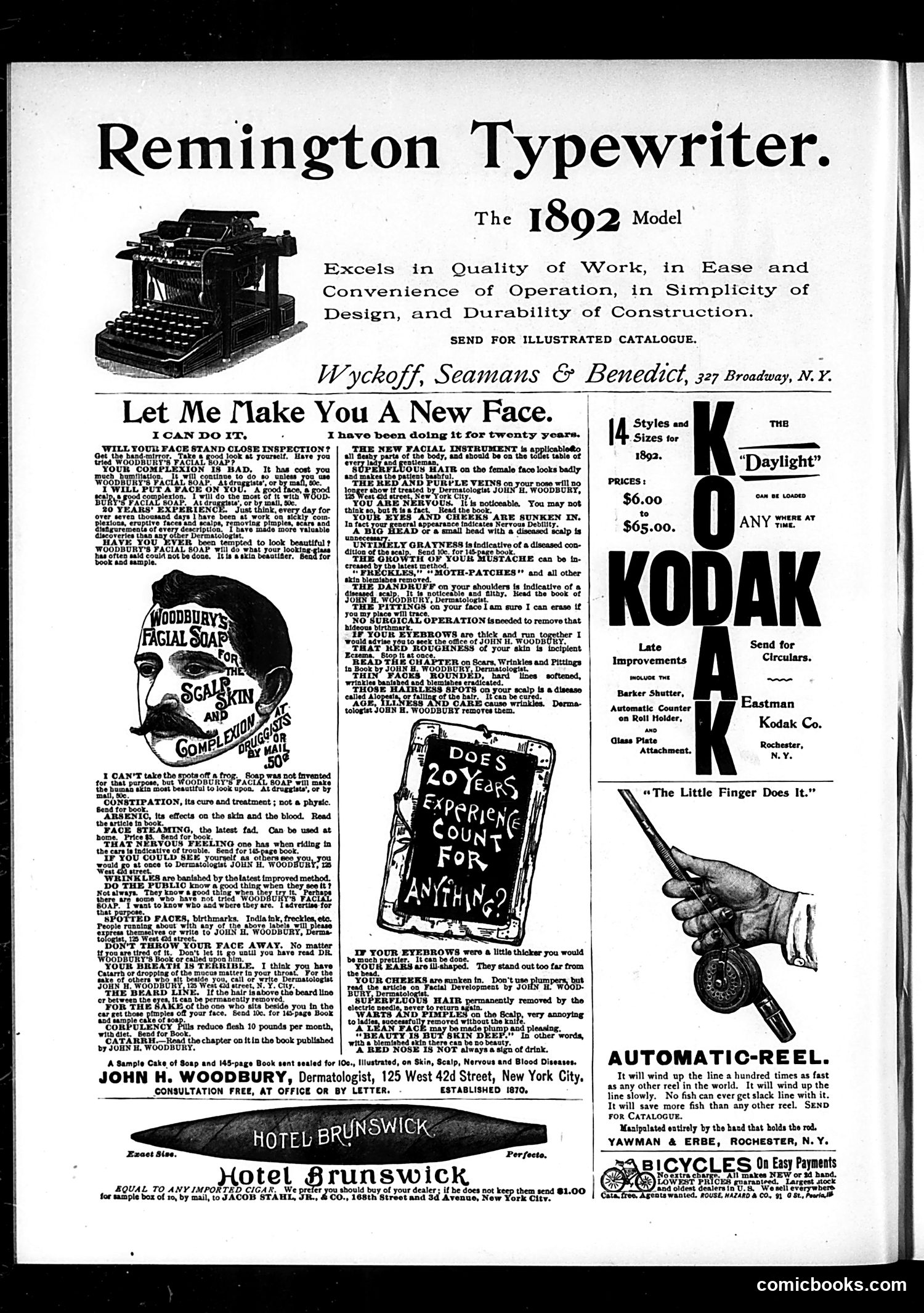
This page is primarily **advertising**, not political satire. It features multiple product advertisements typical of an 1892 American magazine. The dominant ad promotes **John H. Woodbury's dermatological services** — a "facial specialist" offering to treat various skin conditions (wrinkles, freckles, superfluous hair, sunken eyes, etc.). The accompanying illustration shows a man's face in profile, emphasizing facial features. This reflects late 19th-century beauty culture and emerging cosmetic dermatology. Other advertisements include: - **Remington Typewriter** (1892 model) - **Kodak cameras** and film - **Hotel Brunswick** - **Bicycles** (payment plans available) - **Woodbury's Facial Soap** The Woodbury ads contain satirical commentary — humorous, exaggerated descriptions of facial flaws and their social consequences — but this is **commercial satire** designed to sell services by making readers self-conscious about appearance, not political commentary. The page reflects Gilded Age consumer culture and emerging mass-market advertising strategies.