
A complete issue · 16 pages · 1892
Judge — July 23, 1892
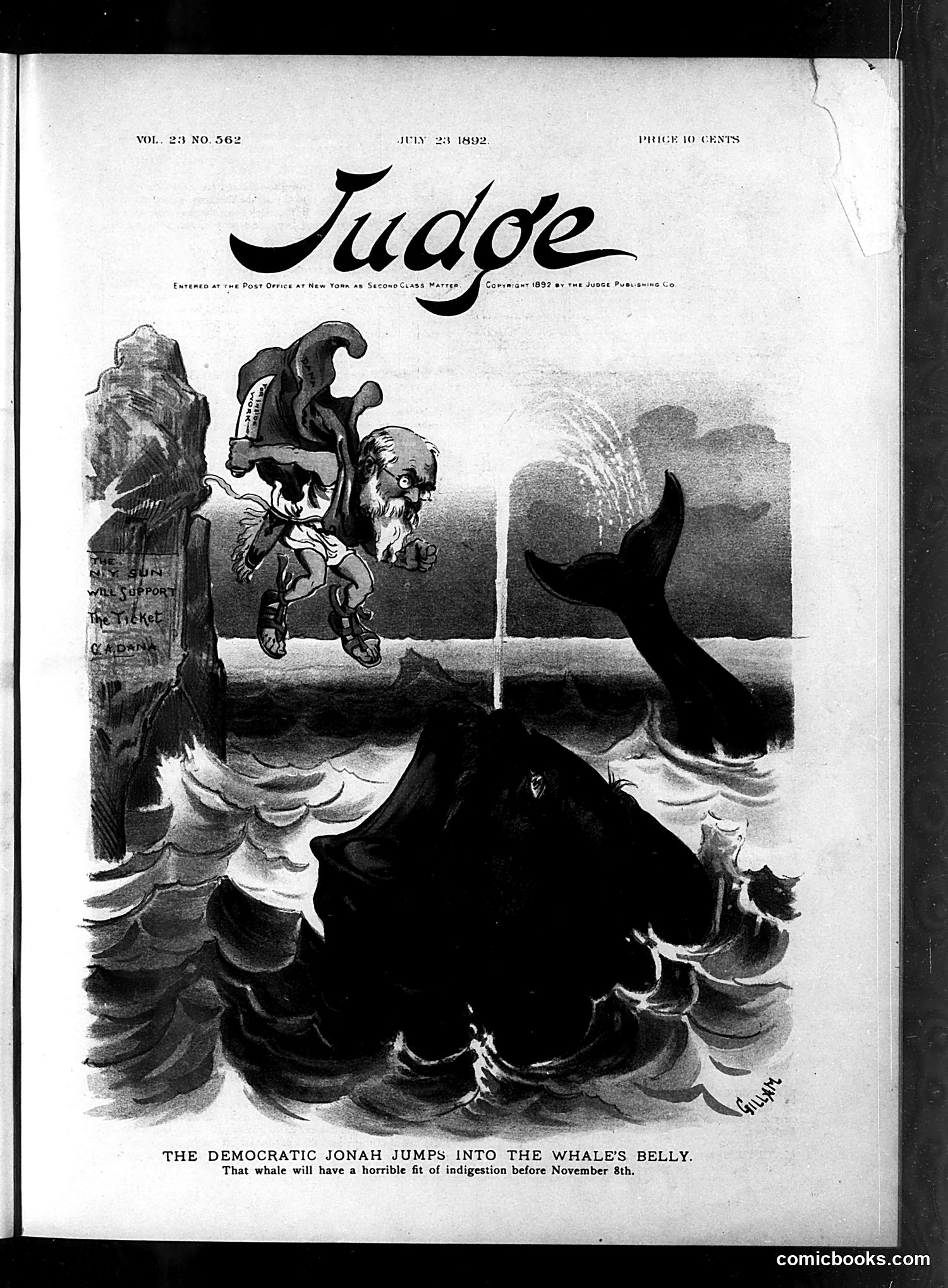
This political cartoon satirizes the Democratic Party during the 1892 election cycle. "The Democratic Jonah" depicts a caricatured figure (representing Democratic leadership or candidate) being swallowed by a whale—a biblical reference to Jonah's misfortune. The caption warns the whale will suffer "a horrible fit of indigestion before November 8th," implying Democrats will be a burden and likely lose the upcoming election. The jester figure on the left appears to represent the magazine's perspective as commentator. The satire uses the whale as a metaphor for the nation or electorate, suggesting that embracing Democratic leadership would be disastrous. This reflects Judge's Republican editorial stance during the 1892 presidential campaign.
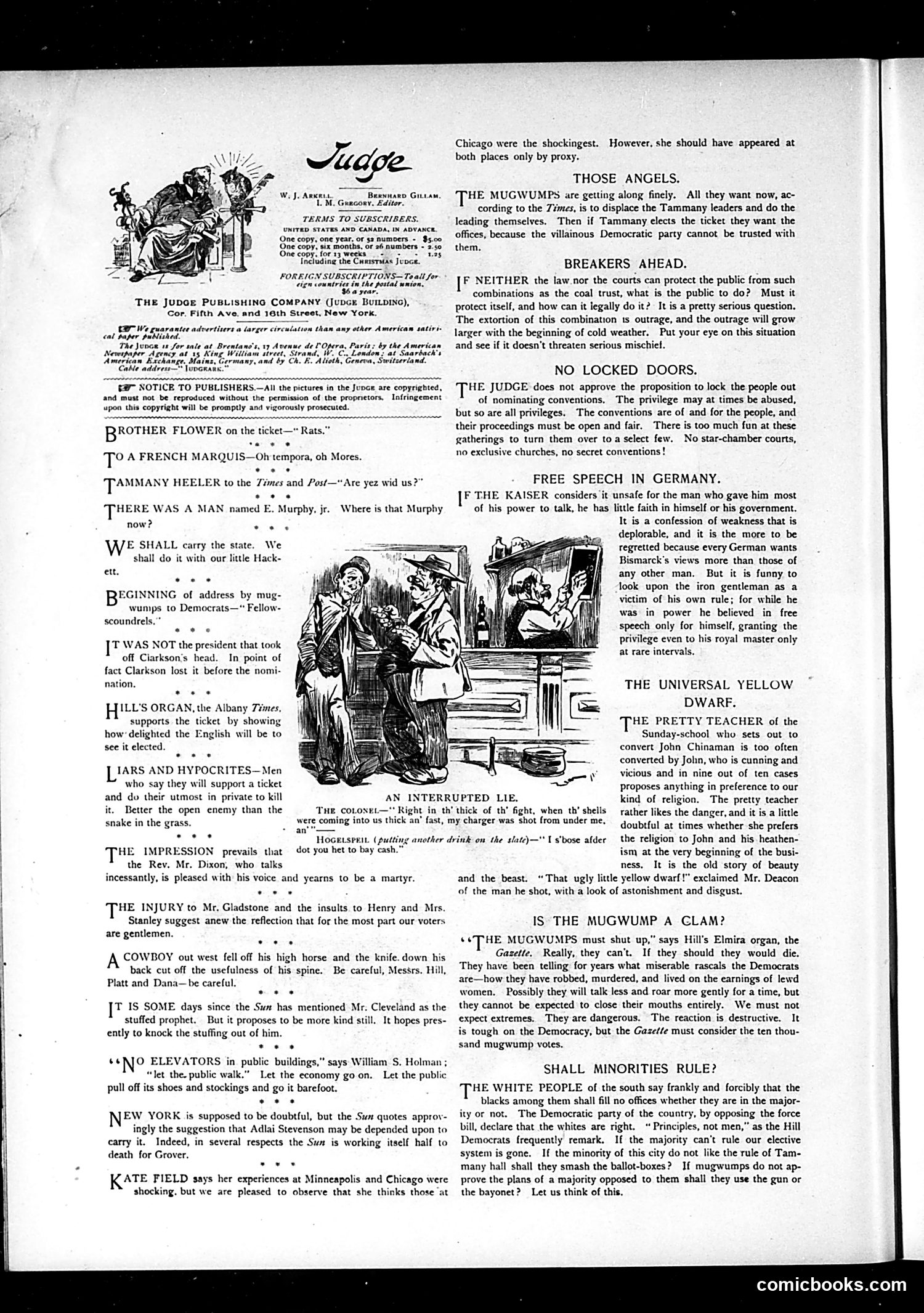
This page contains satirical commentary on early 20th-century American politics, particularly attacking Democratic Party practices. Key elements: **"An Interrupted Lie"** (central cartoon): Depicts what appears to be Democratic operatives caught in dishonest campaign tactics—the caption references a "colored man" being used fraudulently, satirizing Democratic exploitation of Black voters while simultaneously denying them rights. **Political Commentary**: Articles mock Democratic conventions as secretive ("no locked doors"), criticize their treatment of minorities, and question whether "mugwumps" (independent Republicans) truly support Democratic candidates. The overall tone attacks Democratic hypocrisy on racial issues and electoral integrity—suggesting they manipulate Black voters while maintaining discriminatory policies. The satire assumes Republican readers and reflects late-19th/early-20th-century partisan journalism where both parties exploited racial divisions for political advantage.
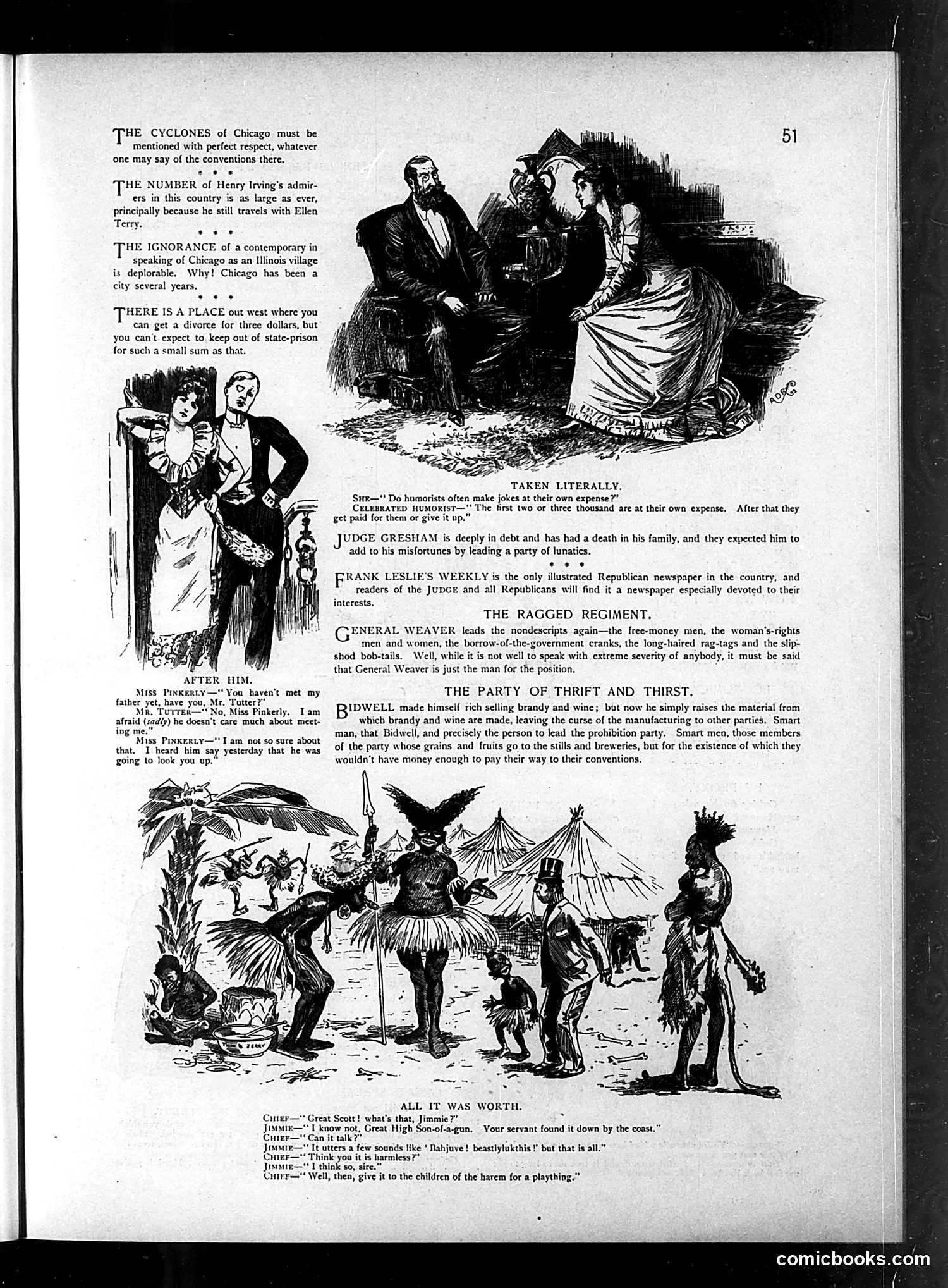
This page contains multiple satirical items about late 19th-century American politics and society: **Top cartoon** ("Taken Literally"): Mocks wealthy "celebrated honorists" (likely wealthy Republicans) who make jokes at their own expense during charity fundraising, then expect the poor to subsidize them. **"The Ragged Regiment"**: Criticizes General Weaver for championing "free-money men" and women's-rights advocates while leading the Populist/reform movement—suggesting his coalition is incoherent. **"The Party of Thrift and Thirst"**: Satirizes Bidwell, who grew rich selling alcohol but now leads prohibition efforts. The joke: prohibitionists lack funds because their own members consume the very products being banned. **Bottom cartoon** ("All It Was Worth"): Depicts a chaotic scene with demons/devils and caricatured figures, likely satirizing corrupt political dealings or fraudulent schemes. The page targets political hypocrisy across parties.
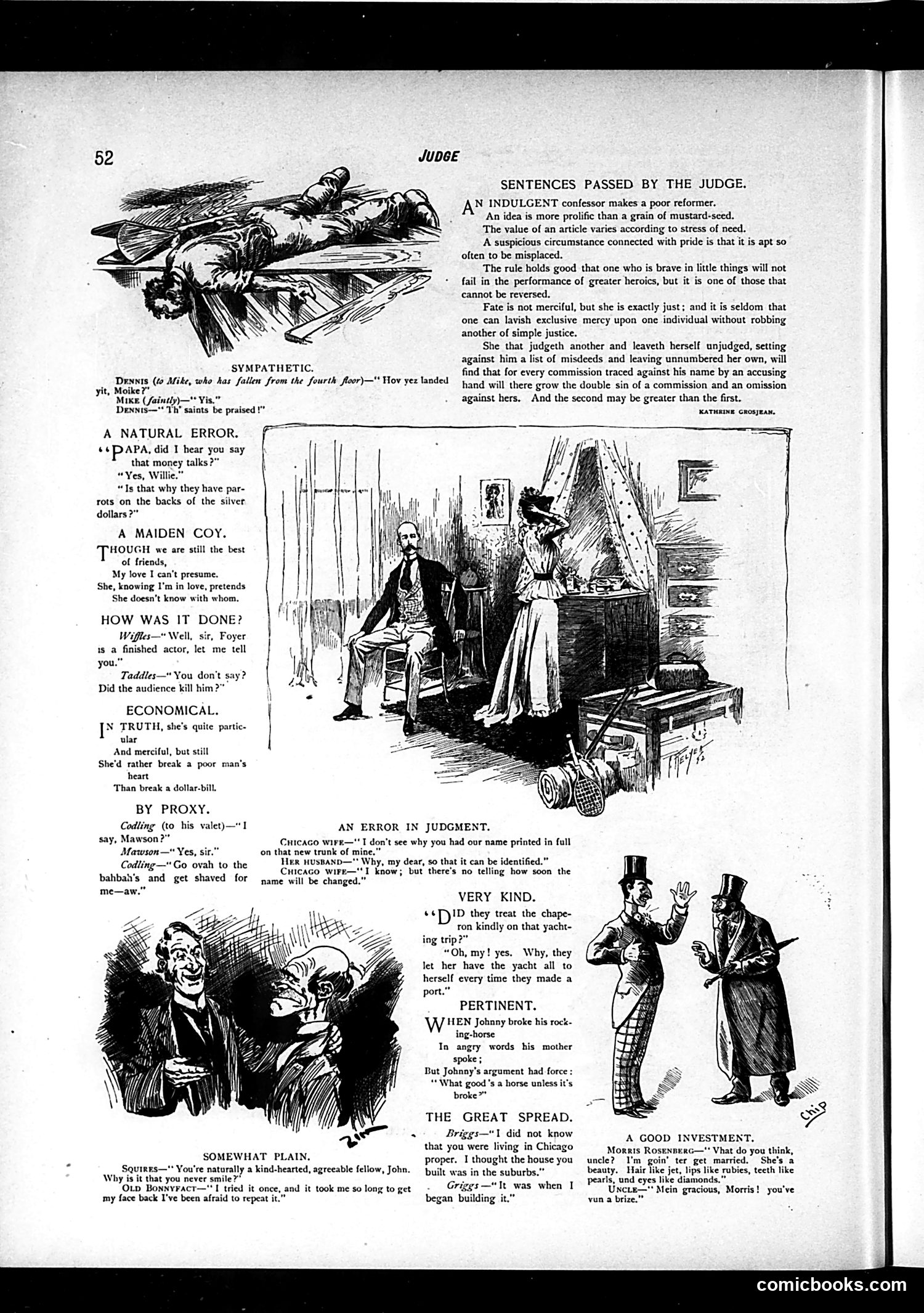
This page from *Judge* magazine contains multiple short satirical pieces typical of the publication's format—moral aphorisms, brief comic dialogues, and illustrated jokes. **Key Content:** The "Sentences Passed by the Judge" column offers moral observations on human nature (hypocrisy, judgment, fate). Several small jokes mock everyday situations: a child's innocent misunderstanding of "money talks" (confusing currency with parrots), a man breaking a rocking horse and sarcastically questioning its usefulness when damaged, and marital misunderstandings about name changes and trunk identification. **Social Commentary:** The satire targets recognizable Victorian/Edwardian anxieties: class consciousness ("economical" women choosing money over romance), gender dynamics (the "maiden coy," women's judgment), and material values (the emphasis on property and inheritance). The humor relies on wordplay, irony, and observational comedy about middle-class domestic life rather than explicit political targets. These are gentle, moralistic satires of human folly and social pretension typical of early 20th-century humor magazines.
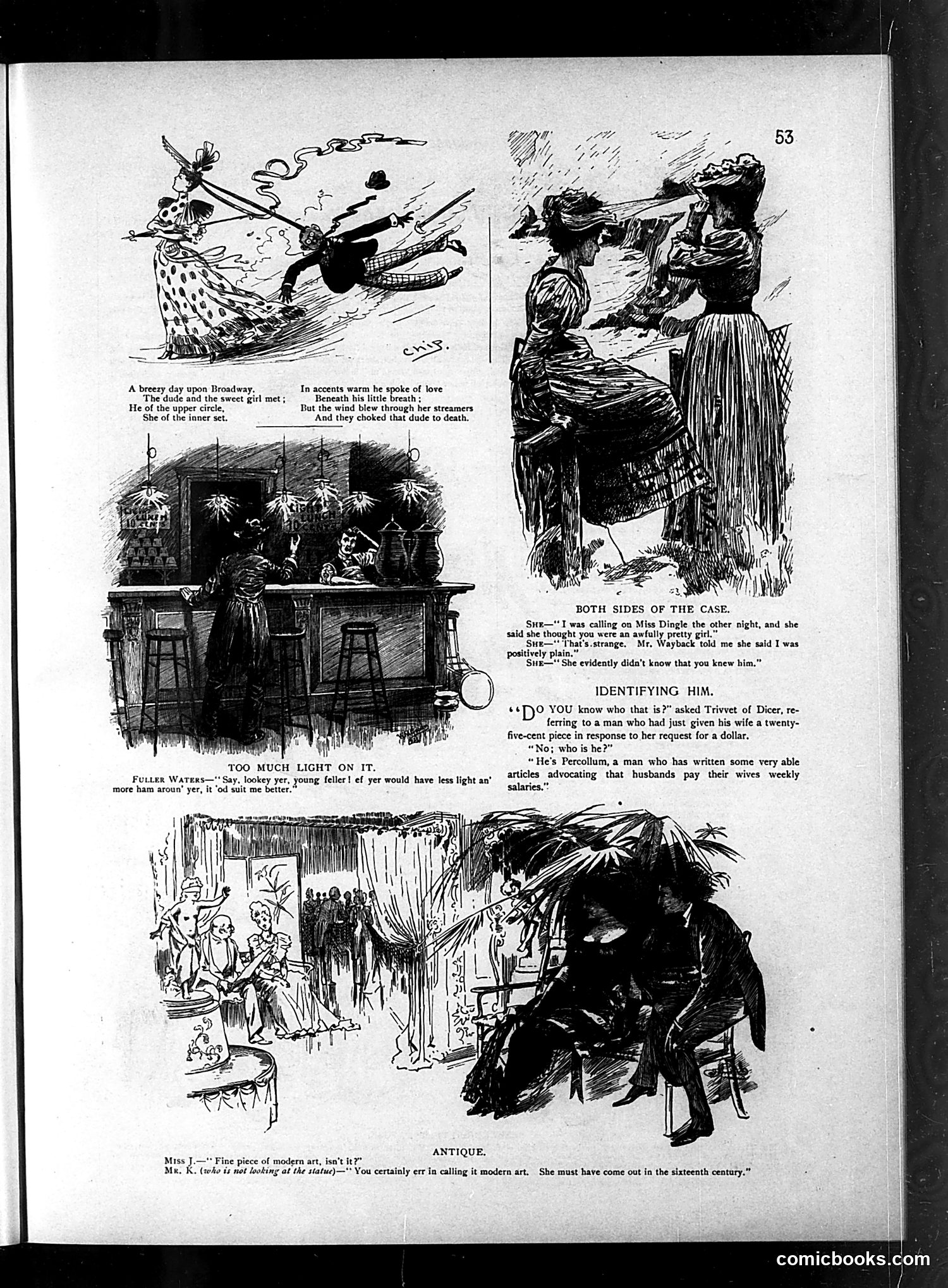
This page contains several short satirical comics mocking late 19th/early 20th-century social conventions: **"Broadway" sketch**: A wealthy "dude" and upper-class woman meet; the wind tangles her feathered hat, choking him—satire on both male vanity and women's impractical fashion. **"Both Sides of the Case"**: Women gossip about a man's appearance, but he hears conflicting reports—mockery of how reputation spreads through social circles. **"Identifying Him"**: A man who gives his wife only 25 cents when she asks for a dollar is identified as "Percollum," a writer advocating husbands pay wives weekly salaries—satire on both miserly husbands and the emerging "wages for housework" movement. **"Antique"**: A woman calls a modern sculpture "art" while her companion notes it looks sixteenth-century—mockery of pretentious modern art appreciation. All four jokes target social pretension, gender relations, and class distinctions of the era.
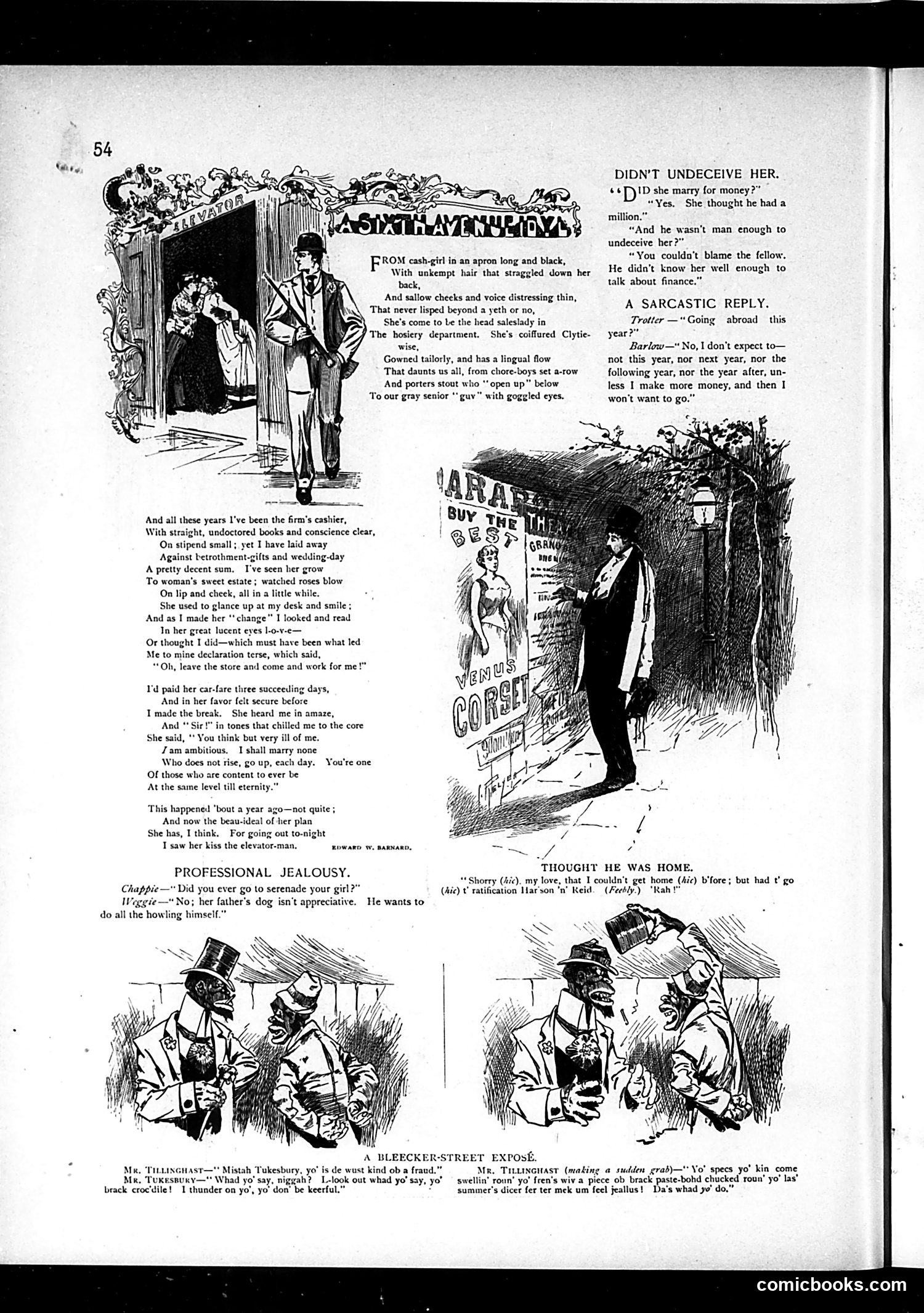
This page from *Judge* magazine contains several satirical pieces reflecting late 19th/early 20th-century social attitudes: **"A Sixth Tenant"** (top): A poem mocking social climbing. A young cashier-turned-saleswoman rejects her long-faithful male coworker's marriage proposal because he hasn't "risen" professionally. The satire's punchline: she ends up kissing the elevator operator—implying her ambitions are hollow and her judgment poor. **"Professional Jealousy"** (middle): A brief joke about a man unable to serenade his girlfriend because her father's dog drowns him out by howling—absurdist humor. **"A Bleecker-Street Exposé"** (bottom): Features racist dialect humor depicting African American characters in a confrontation, reflecting the era's deeply offensive entertainment conventions. **"Thought He Was Home"** (right): A drunk husband's excuse about attending a political rally (Harrison/Reid ratification) is mocked by his suspicious wife. The page reflects *Judge*'s satirical targets: female ambition, class pretension, and romantic folly—though presented through lenses now recognized as socially regressive.
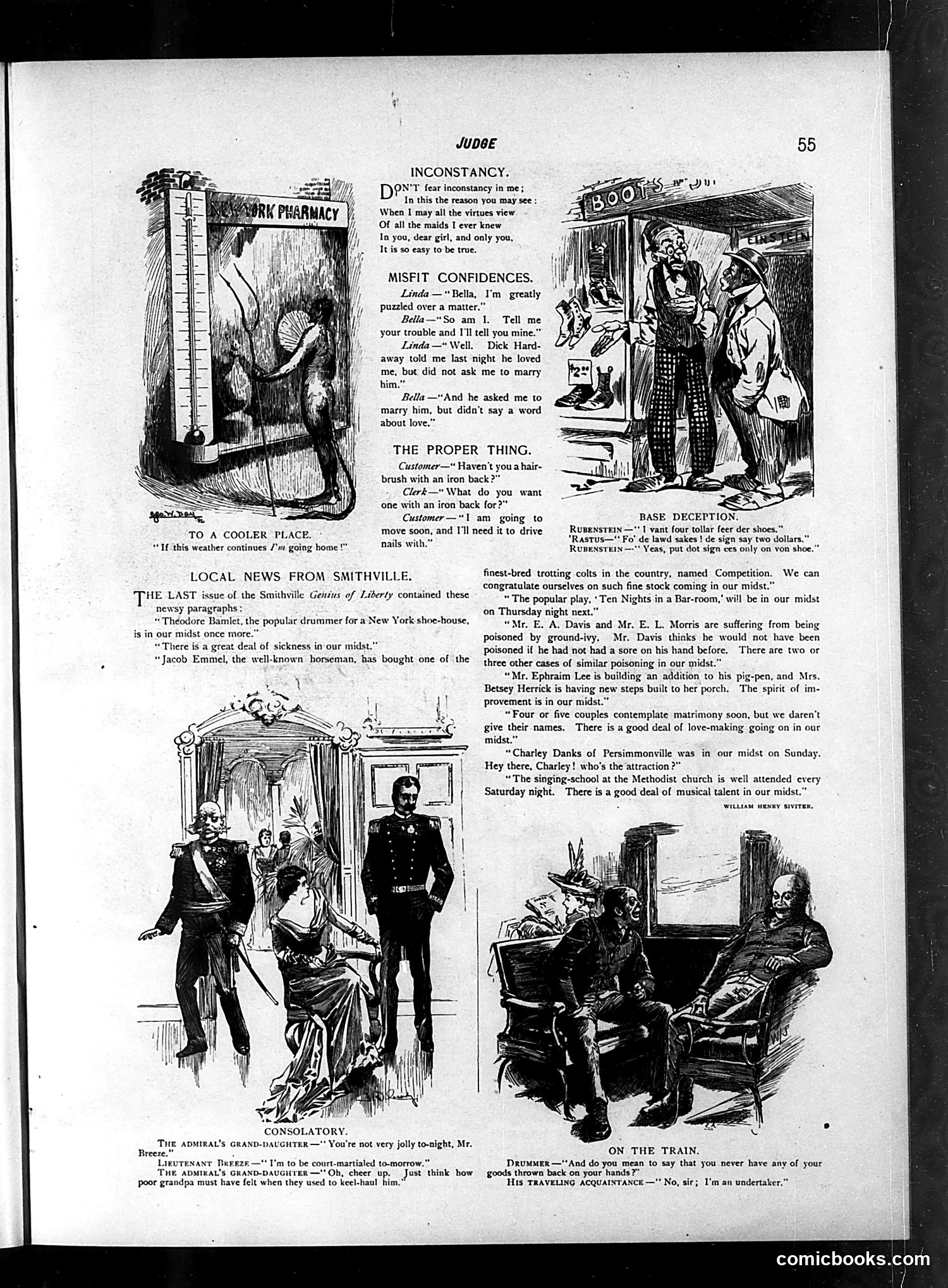
This page contains several satirical cartoons and humorous short pieces typical of late-19th-century American humor magazines: **"Inconstancy"** and **"Misfit Confidences"** are romantic comedies about miscommunication between courting couples—she won't commit without a proposal; he won't mention love. **"The Proper Thing"** jokes about a customer needing an iron-backed hairbrush to drive nails when moving—absurd practicality. **"Base Deception"** mocks a shoe merchant's dishonest signage (marking a two-dollar shoe as one dollar on only one shoe). **"Local News from Smithville"** parodies small-town gossip columns with mundane announcements about livestock, theatrical productions, and courting couples. **"Consolatory"** depicts a naval officer court-martialed tomorrow, with the admiral's daughter offering weak comfort. **"On the Train"** features a traveling salesman and an undertaker—the joke being the undertaker's grim profession ensures he never has unsold "goods" returned. The humor relies on wordplay, social awkwardness, and gentle mockery of provincial life and human foibles.
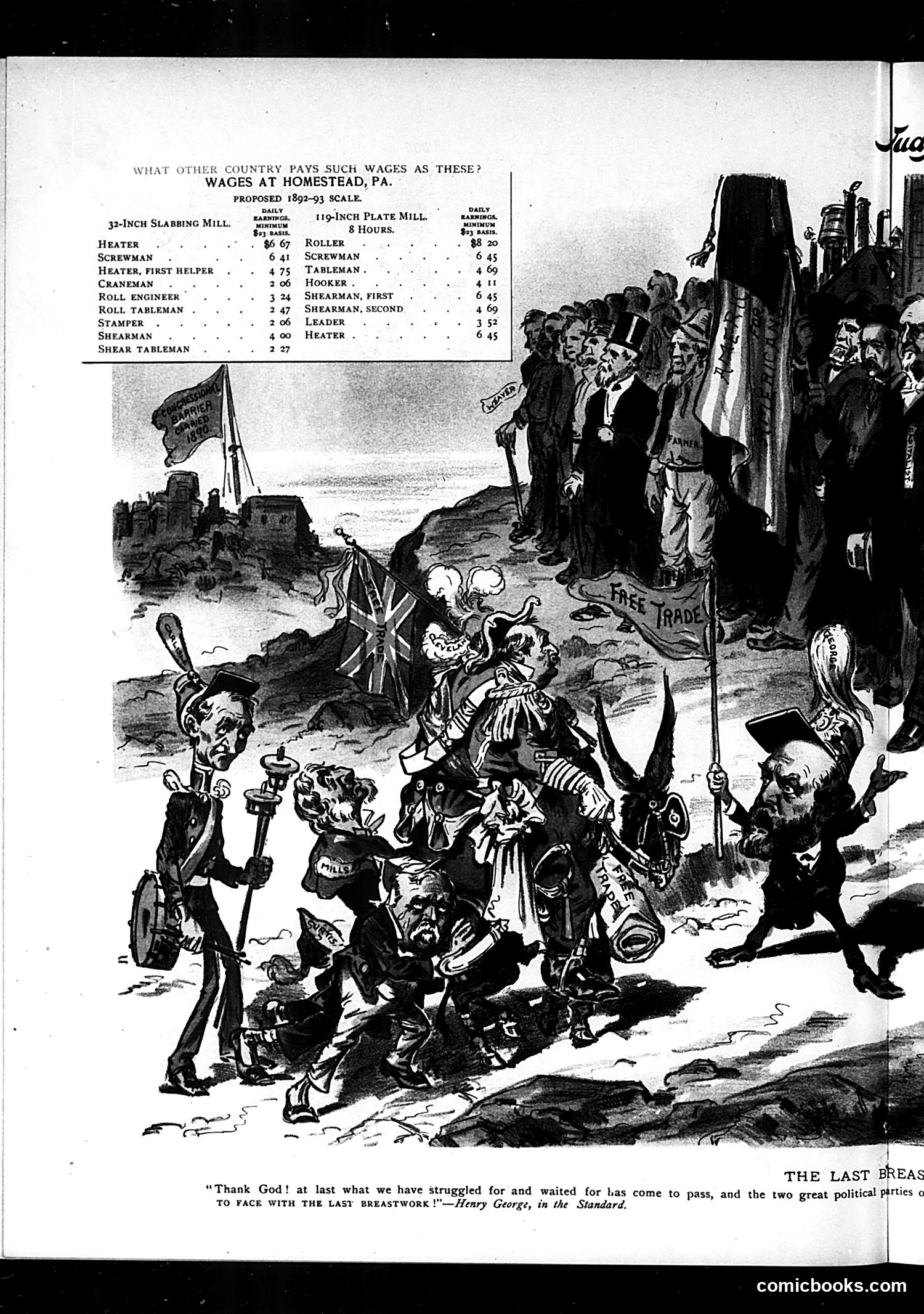
This 1892 Judge cartoon satirizes the Homestead Strike—a violent labor dispute at Andrew Carnegie's steel mill in Homestead, Pennsylvania. The wage tables above show proposed pay cuts that sparked the conflict. The cartoon depicts personified political and economic forces as military combatants. Caricatured figures representing capital, labor interests, and political factions engage in battle before fortified positions. The "Free Trade" banner and references to "the two great political parties" suggest this addresses the broader tariff and labor debates dividing American politics. The quoted epigraph from Henry George (labor advocate) indicates the cartoon frames labor's struggle as a final, desperate stand—"the last breastwork"—against economic forces. Judge's satirical point appears critical of the conflict's intensity and the political implications of unresolved labor disputes threatening American industrial stability.
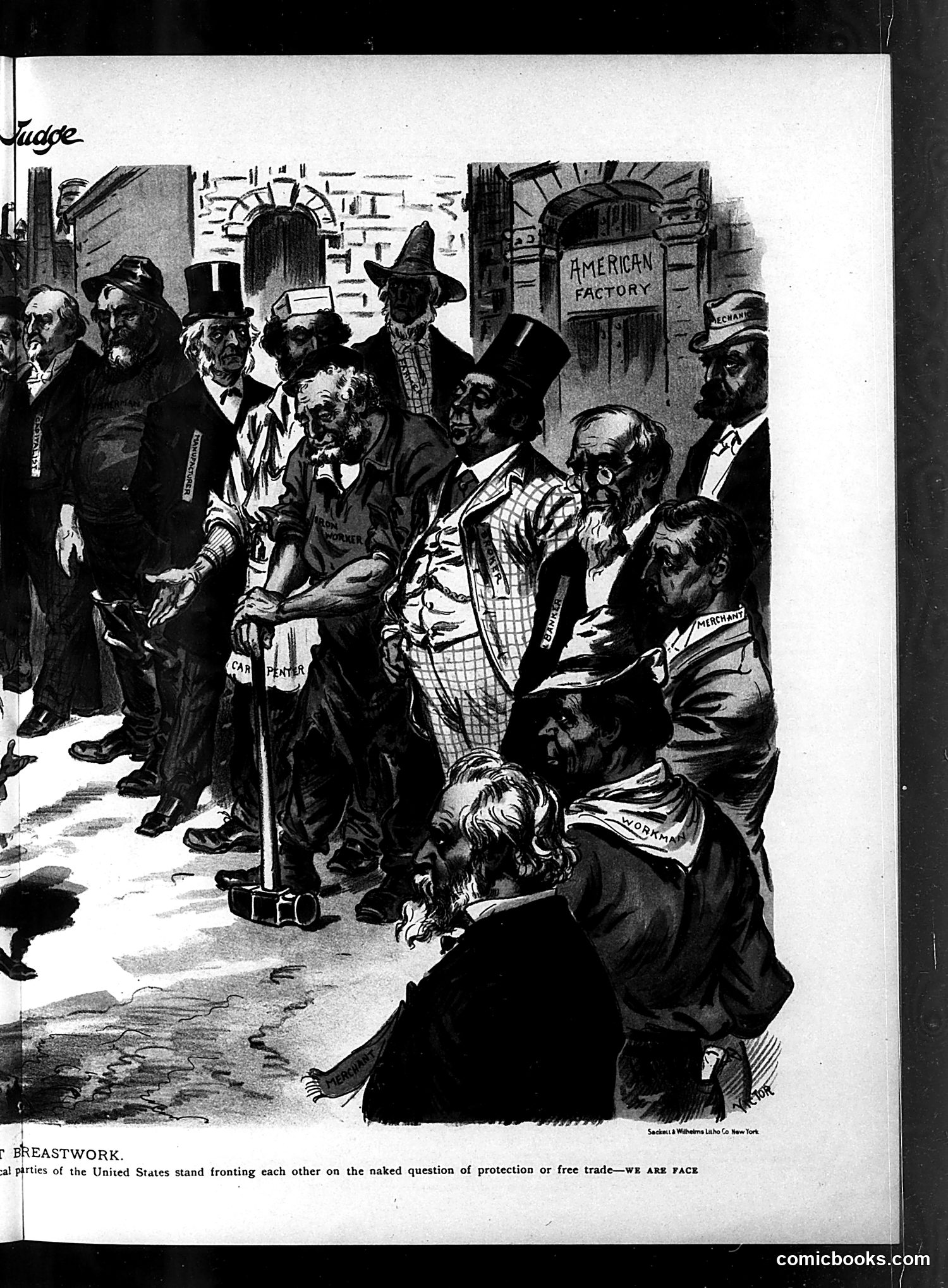
This Judge magazine cartoon satirizes late 19th-century American tariff debates. The title "Breastwork" is a military metaphor—a defensive fortification. The cartoon depicts political parties of the United States (labeled figures include "Merchant," "Worker," and references to "American Factory") confronting each other over trade policy. They're drawn as caricatured figures in a street scene, seemingly at an impasse or confrontation. The caption states parties "stand fronting each other on the naked question of protection or free trade—WE ARE FACE [to face]." The satire critiques how American political factions used protectionist tariffs as a "breastwork" (defensive barrier) in their ideological struggle. Different interest groups—merchants, workers, manufacturers—had conflicting economic interests regarding tariffs, and the cartoon ridicules their inability to reach consensus, depicting the debate as an absurd standoff rather than productive negotiation.
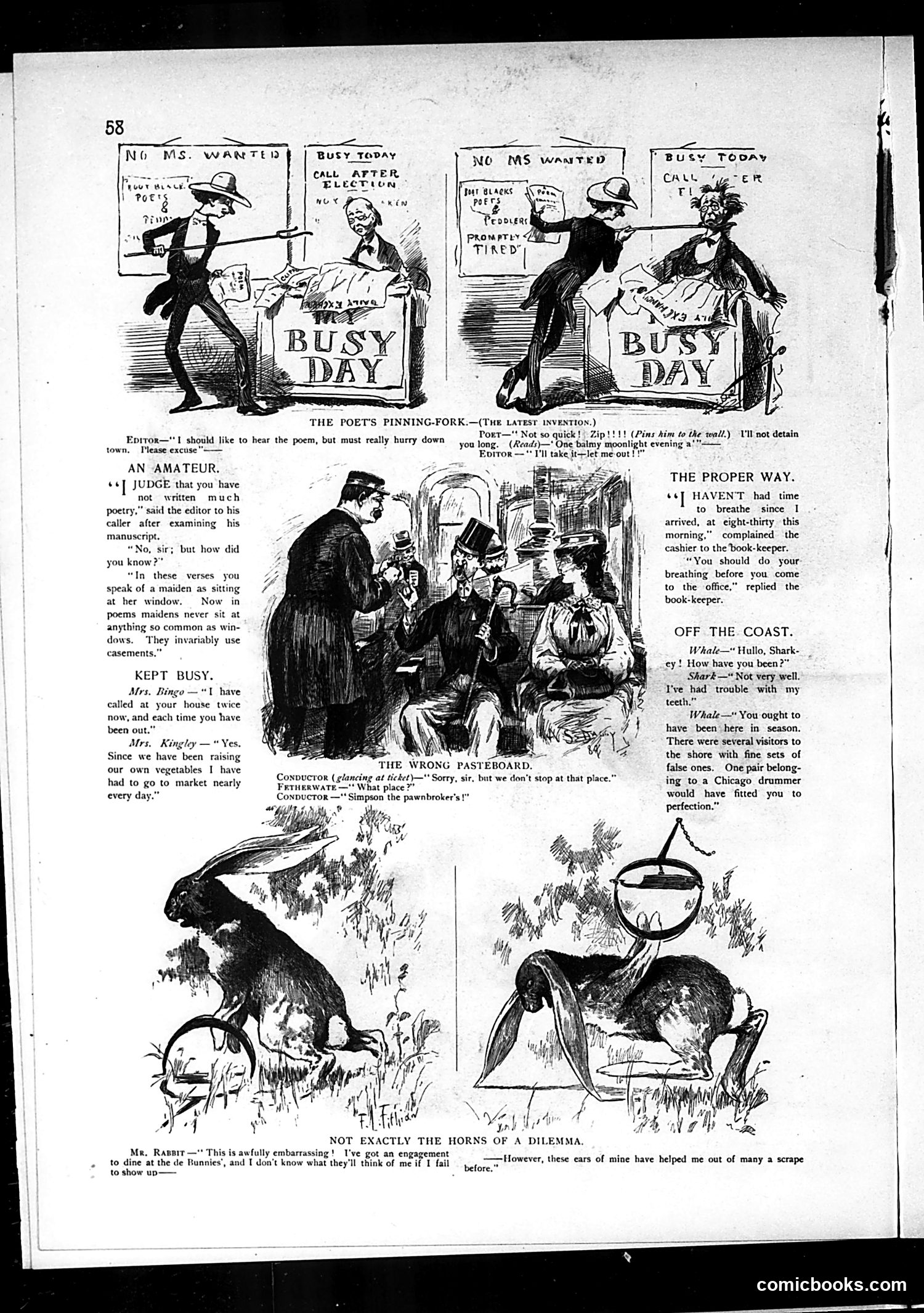
This page contains several brief humorous sketches satirizing early 20th-century urban life and social conventions: **"The Poet's Pinning-Fork"** mocks editors rejecting amateur poetry submissions. The "invention" shows a poet literally pinned to a wall by an impatient editor, satirizing the constant stream of unsolicited manuscripts editors endured. **"An Amateur"** jokes about poetic conventions—an editor pedantically insists maidens in poems must sit at "casements" (windows), not ordinary ones, mocking pretentious literary affectation. **"Kept Busy"** presents domestic humor: a woman claims she's always out because she now markets her own vegetables, reflecting early 20th-century home production during wartime or economic pressures. **"The Proper Way"** offers absurdist workplace advice about breathing "before" arriving at the office. **"Off the Coast"** features animal dialogue where a whale mentions sharks finding false teeth from visitors—dark humor about dental mishaps. **"Not Exactly the Horns of a Dilemma"** shows a man embarrassed about missing a dinner engagement. These are light, observational humor pieces typical of Judge's satirical magazine format.
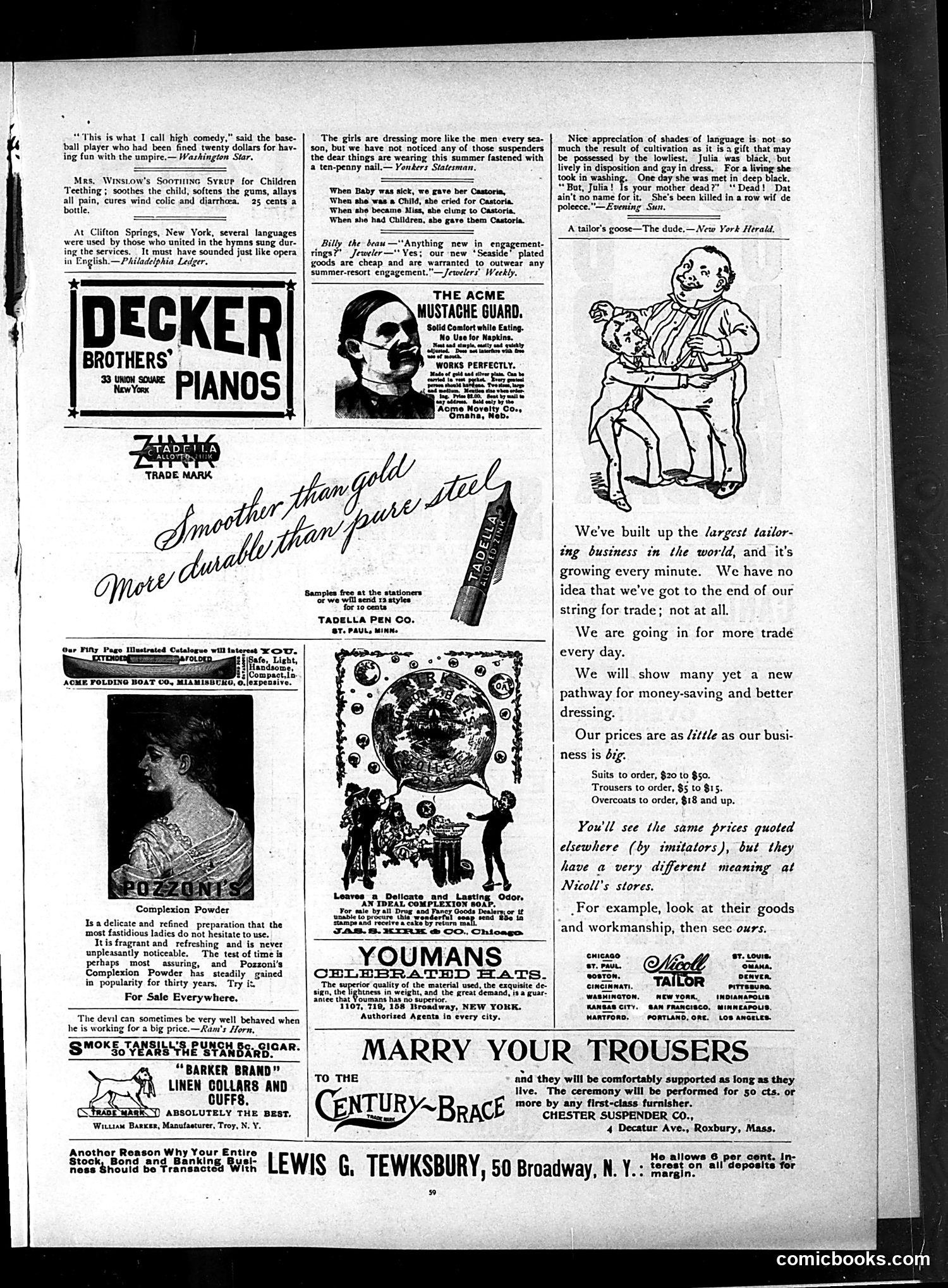
This page is primarily **advertising** with brief satirical commentary interspersed. The cartoons and jokes are minor: **Key satirical items:** 1. **Baseball joke**: A player fined for "having fun with the umpire" calls this "high comedy"—mocking both the player's behavior and the umpire's authority. 2. **Women's fashion commentary**: A quip noting girls dress more like men but haven't adopted men's suspenders fastened with "ten-penny nails"—satire on evolving gender presentation in dress. 3. **Engagement rings joke**: A jeweler offers cheap "Seaside" plated rings "warranted to outwear any summer-resort engagement"—mocking the brevity of summer romances. 4. **African American dialect joke**: Julia, a washerwoman, uses non-standard English ("Dat ain't no name for it") when discussing her mother's death—reflecting period racial stereotyping. The bulk of the page features **consumer product advertisements** (pianos, pens, hats, tailoring services, complexion powder) typical of Judge's revenue model, with minimal satirical content.
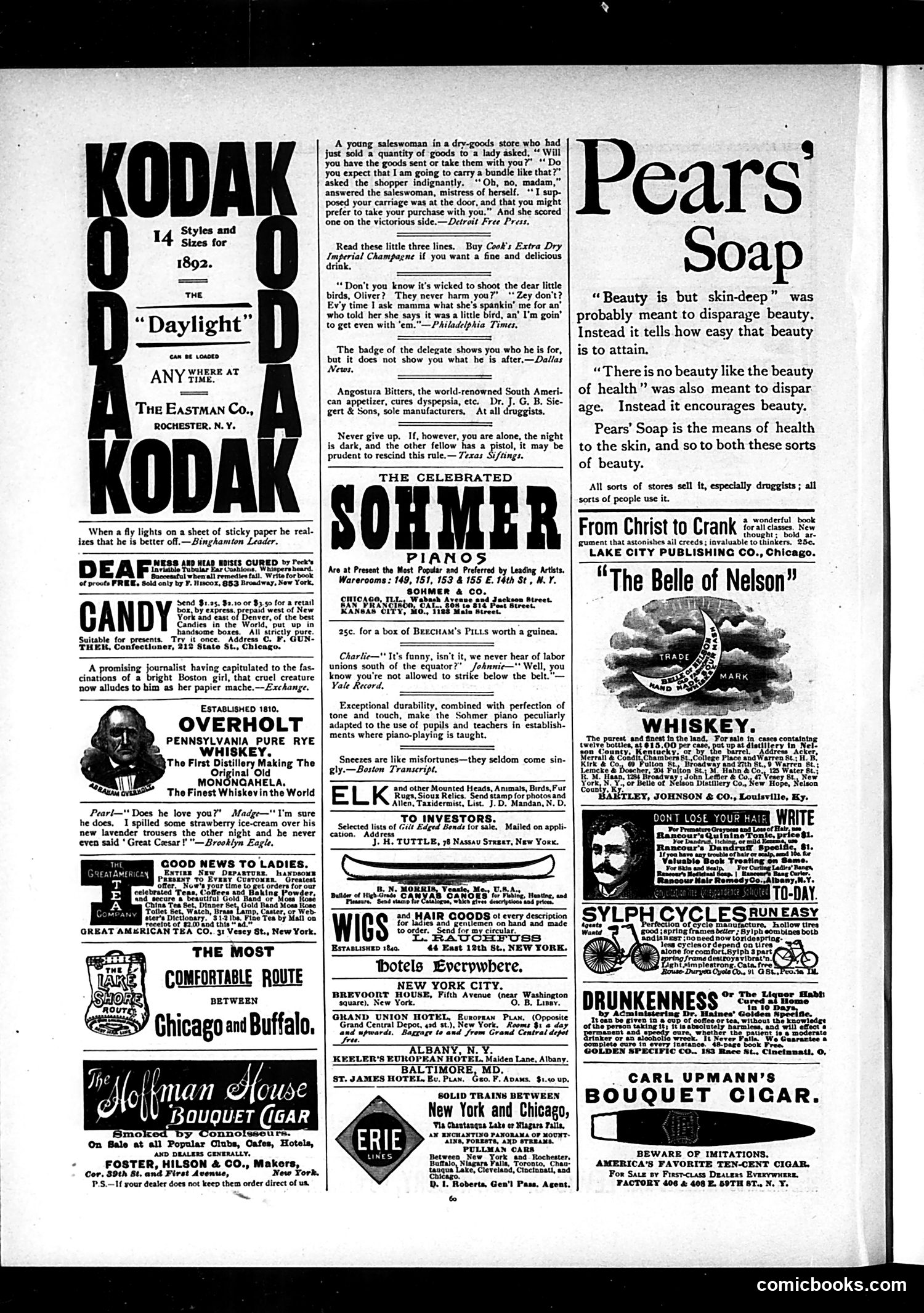
This is primarily an **advertising page** with scattered humor pieces rather than political satire. The content reflects 1890s American consumer culture and light social commentary: **Key Elements:** - **Kodak advertisement** dominates the left side, promoting the "Daylight" camera model—part of Eastman's revolution in making photography accessible to ordinary consumers - **Product ads** fill most space: Pears' Soap, Sohmer pianos, Overholt rye whiskey, Sylph bicycles, cigars—targeting affluent readers - **Brief humorous anecdotes** scattered throughout (sales clerk exchange, children's dialogue about spanking, journalist romance)—these are gentle social humor, not political satire - **No identifiable political cartoons or caricatures** appear on this page The page reflects Judge's hybrid nature: satirical magazine serving as vehicle for upscale consumer advertising. The humor is domestic and genteel, typical of 1890s American periodicals addressing middle-to-upper-class audiences.
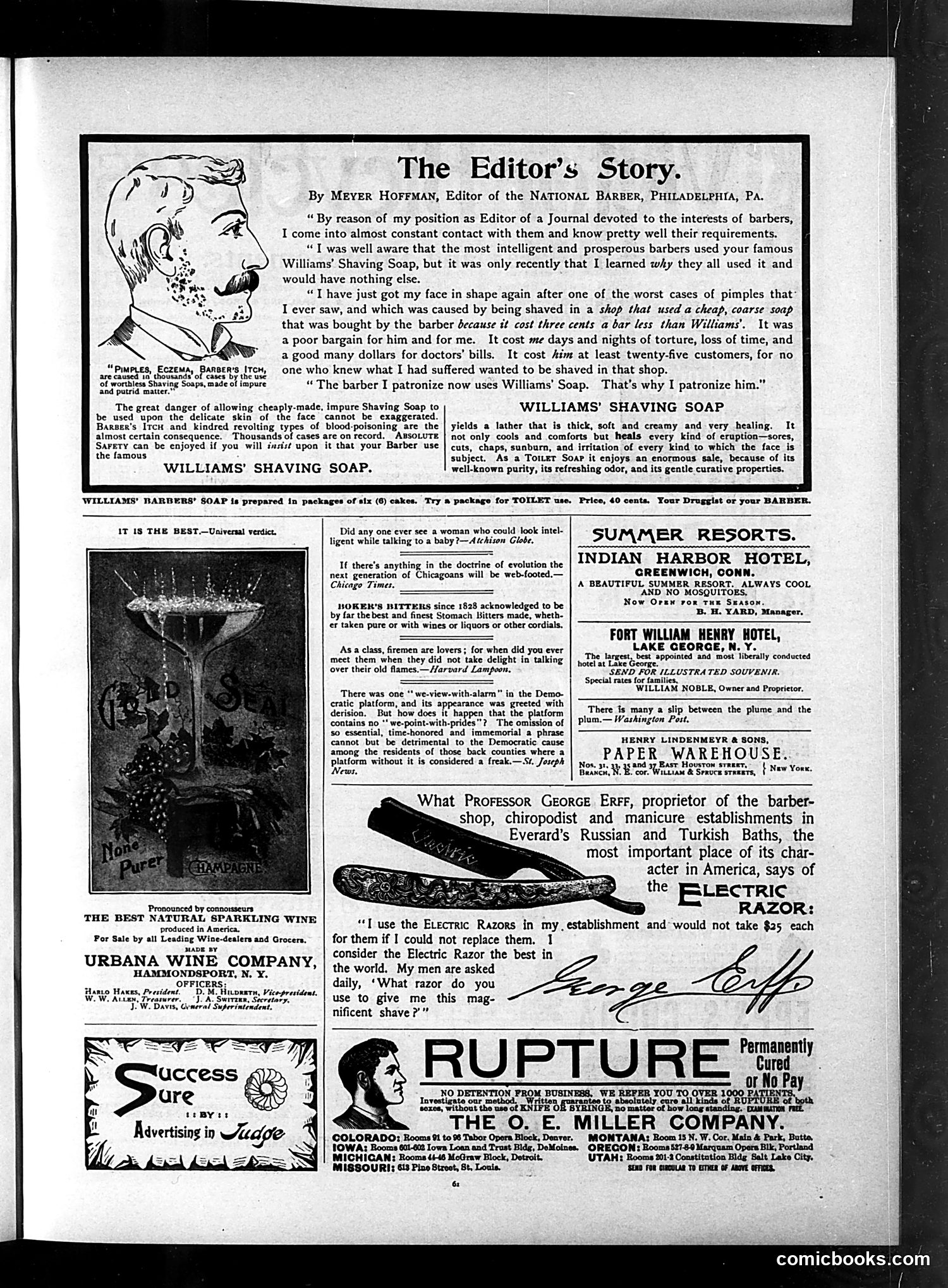
This page is primarily **advertising and promotional content**, not political satire. The dominant feature is "The Editor's Story" — a lengthy testimonial advertisement for Williams' Shaving Soap, attributed to Meyer Hoffman, editor of the National Barber journal. The narrative describes Hoffman's skin damage from cheap soap used at a careless barber, positioning Williams' as the superior product. This is classic turn-of-century **advertorial** — advertising disguised as editorial content, lending credibility through attributed endorsement. The page also includes scattered brief humor items (about babies, firemen, Chicago evolution jokes) and ads for various products: Urbana Wine, Noker's Bitters, summer resorts, and an "Electric Razor" endorsement. There is **no political cartoon or satire evident**. The only illustration is a wine bottle label. This appears to be a standard Judge magazine page mixing light humor with paid advertisements — typical for that era's magazines.
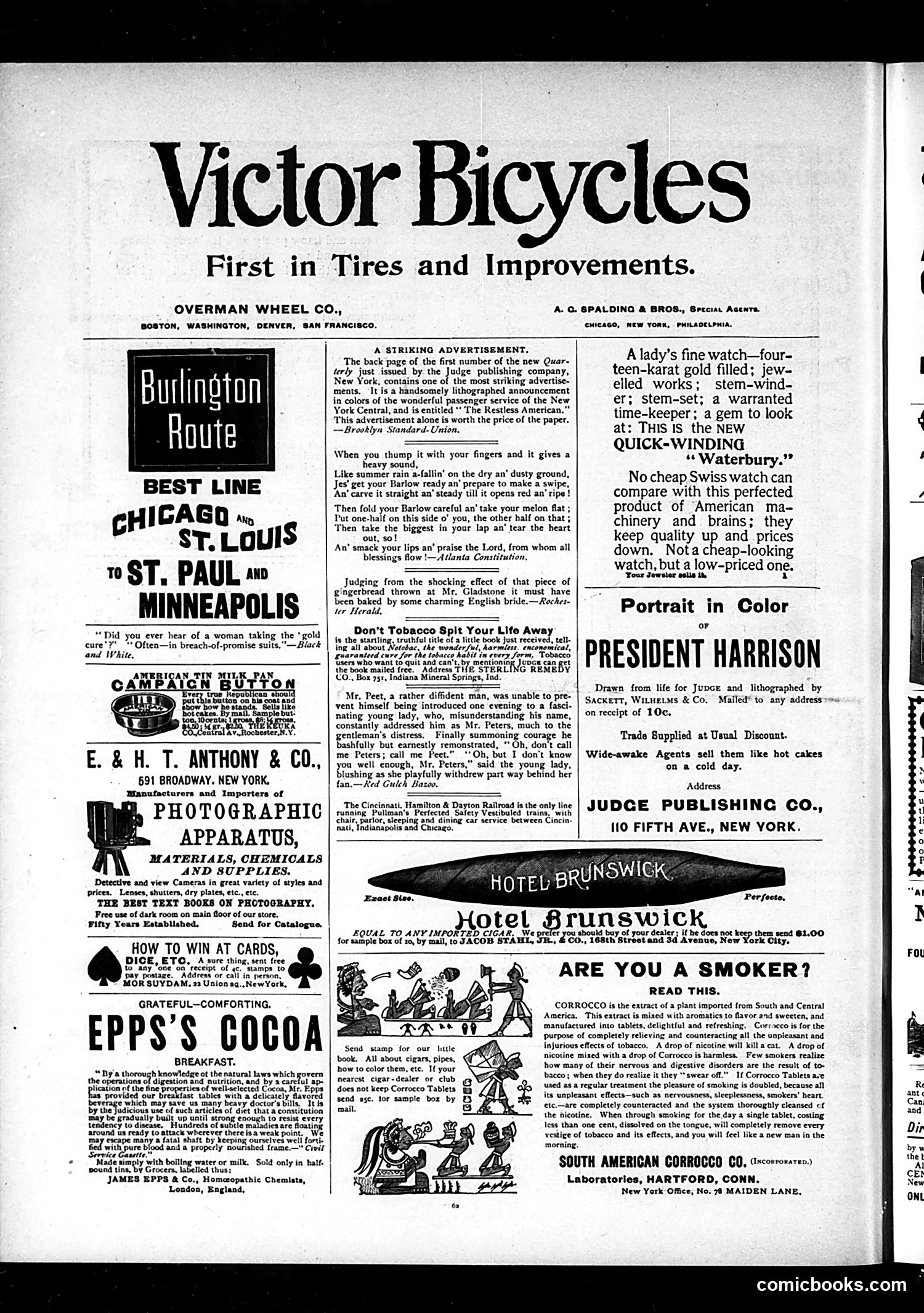
This is primarily an **advertising page** from Judge magazine, not a satirical cartoon page. The layout contains multiple paid advertisements for products and services, interspersed with brief humorous anecdotes. The page includes ads for Victor Bicycles, Burlington Route railroad, photographic equipment, cocoa, and patent medicines. Notable is an advertisement for "Don't Tobacco Spit Your Life Away," a nicotine cessation product—reflecting late 19th/early 20th-century concerns about tobacco addiction. The brief jokes scattered throughout are generic period humor: one about women and breach-of-promise lawsuits, another mocking William Gladstone being hit with gingerbread. These represent typical Judge content—light social commentary rather than sharp political satire. The political reference is minor: a campaign button promoting Republican positions on tariffs (the "tin milk pan" reference likely alludes to tariff debates affecting American manufacturing). This appears to be a **commercial page** designed to generate advertising revenue rather than showcase editorial cartoon content.
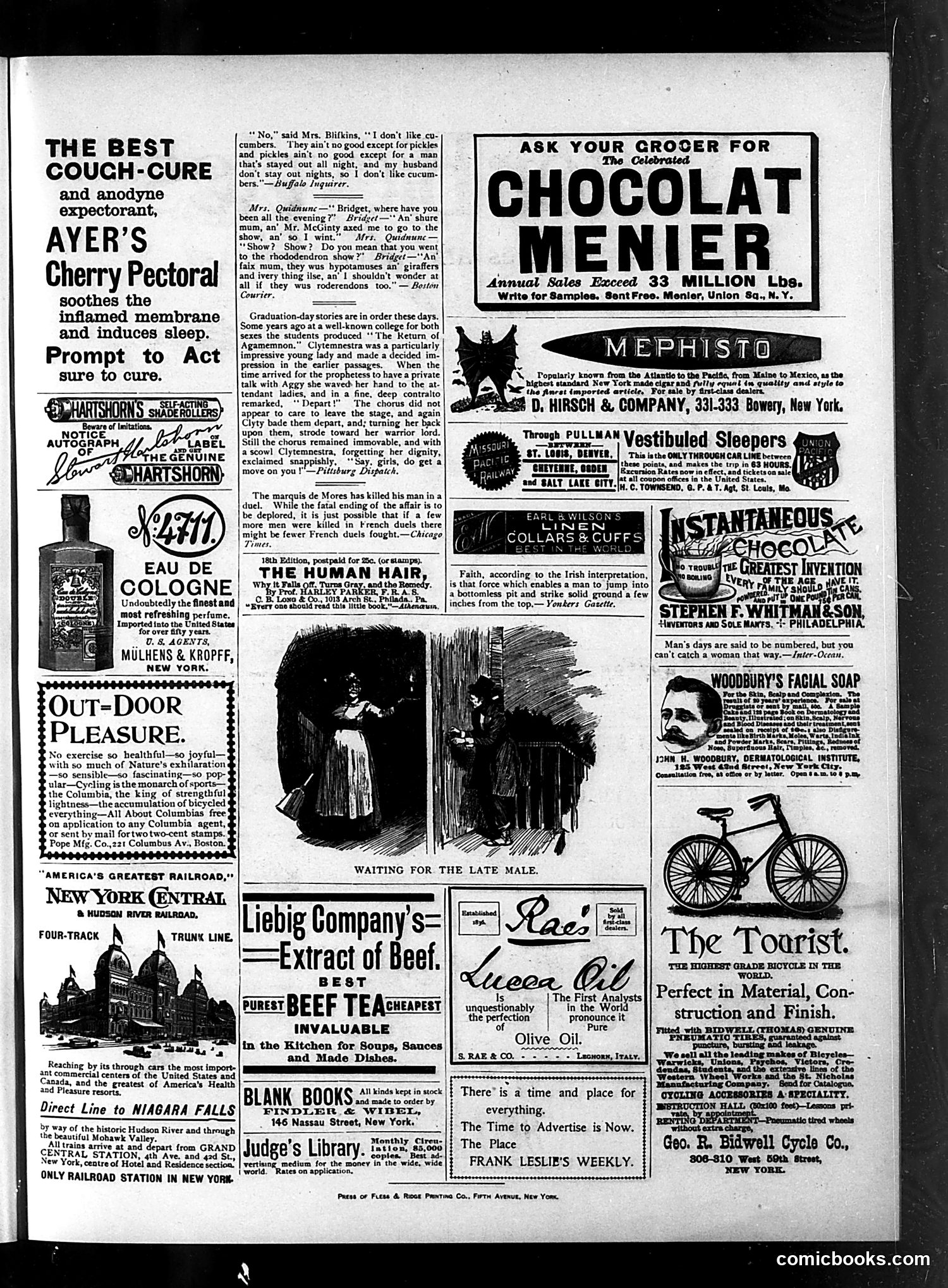
This page is primarily **advertisements and humor snippets** from Judge magazine, not political cartoons with satirical messaging. The **central cartoon** ("Waiting for the Late Male") depicts a woman and man in period dress, likely illustrating a domestic scene referenced in the accompanying text. The **humor pieces** are brief anecdotes mocking: - Mrs. Blifkins's illogical dislike of cucumbers - An Irish maid's malapropisms about zoo animals ("rhododendron shaw" for "rhododendron show") - A theatrical performance where an actress forgets decorum The page is otherwise filled with **product advertisements**: patent medicines (Ayer's Cherry Pectoral), colognes, bicycles (Columbias), railroads, beef extract, chocolate, soap, and other goods typical of late 19th-century publications. The humor relies on **everyday domestic situations and ethnic stereotypes** (Irish dialect) rather than political satire. This reflects Judge's approach: mixing commercial advertising with light social comedy aimed at middle-class readers.
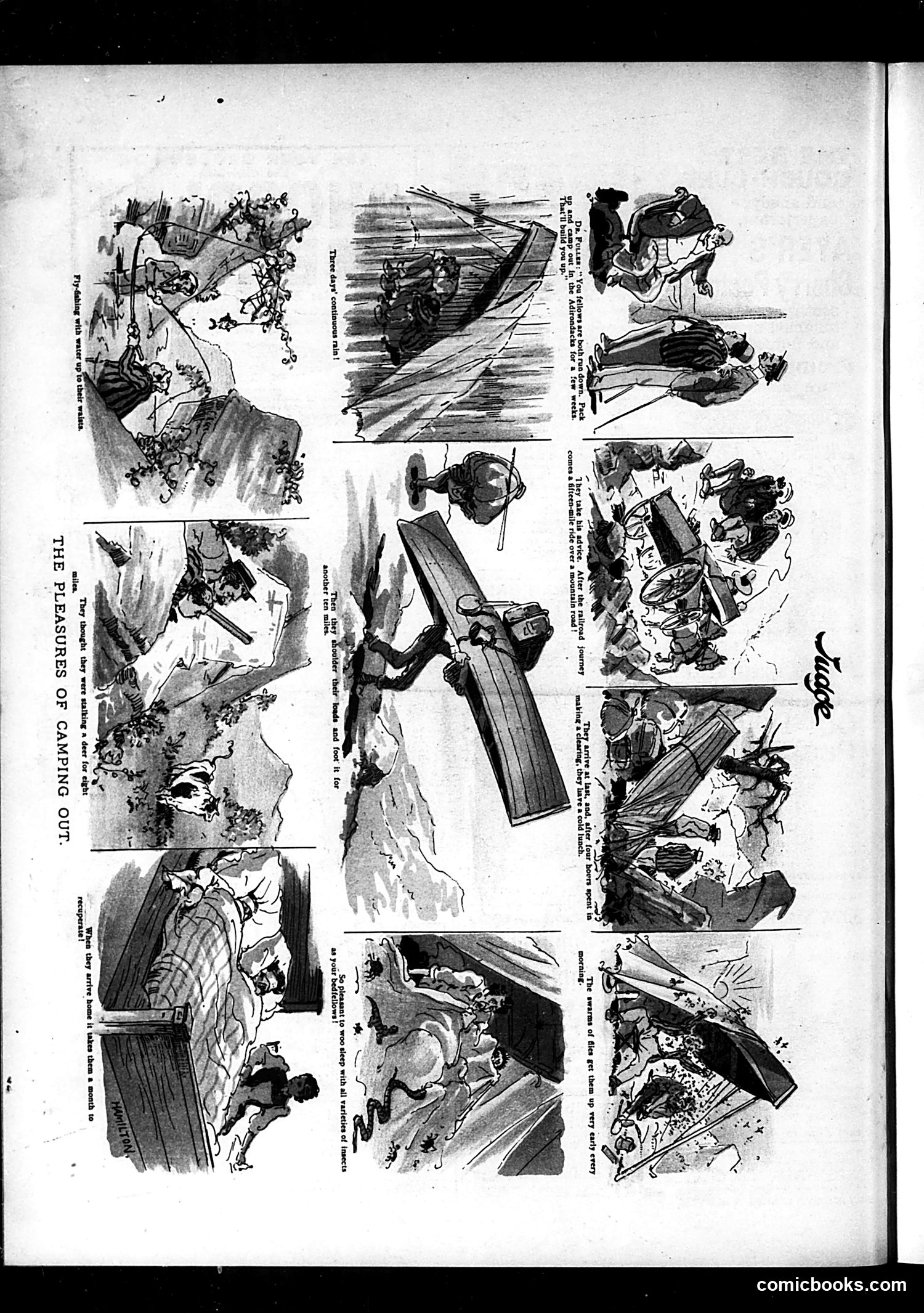
This is a satirical comic strip titled "The Pleasures of Camping Out" that mocks the romantic notion of roughing it in nature. The sequence shows wealthy urbanites following advice to vacation in the Adirondacks for their health. However, the reality depicted is comically disastrous: they endure an arduous fifteen-mile mountain journey, nearly drown while wading through water up to their waists (apparently mistaking a deer for game to hunt), and require a month of recovery once home. The satire targets the late-19th/early-20th-century trend among city dwellers to escape civilization for "authentic" wilderness experiences, suggesting such adventures are exhausting, dangerous, and ultimately counterproductive to the supposed health benefits. The humor lies in the gap between the idyllic camping fantasy and the bedraggled, exhausted reality.