
Judge, 1892-07-23 · page 4 of 16
Judge — July 23, 1892 — page 4: what you’re looking at
What you’re looking at
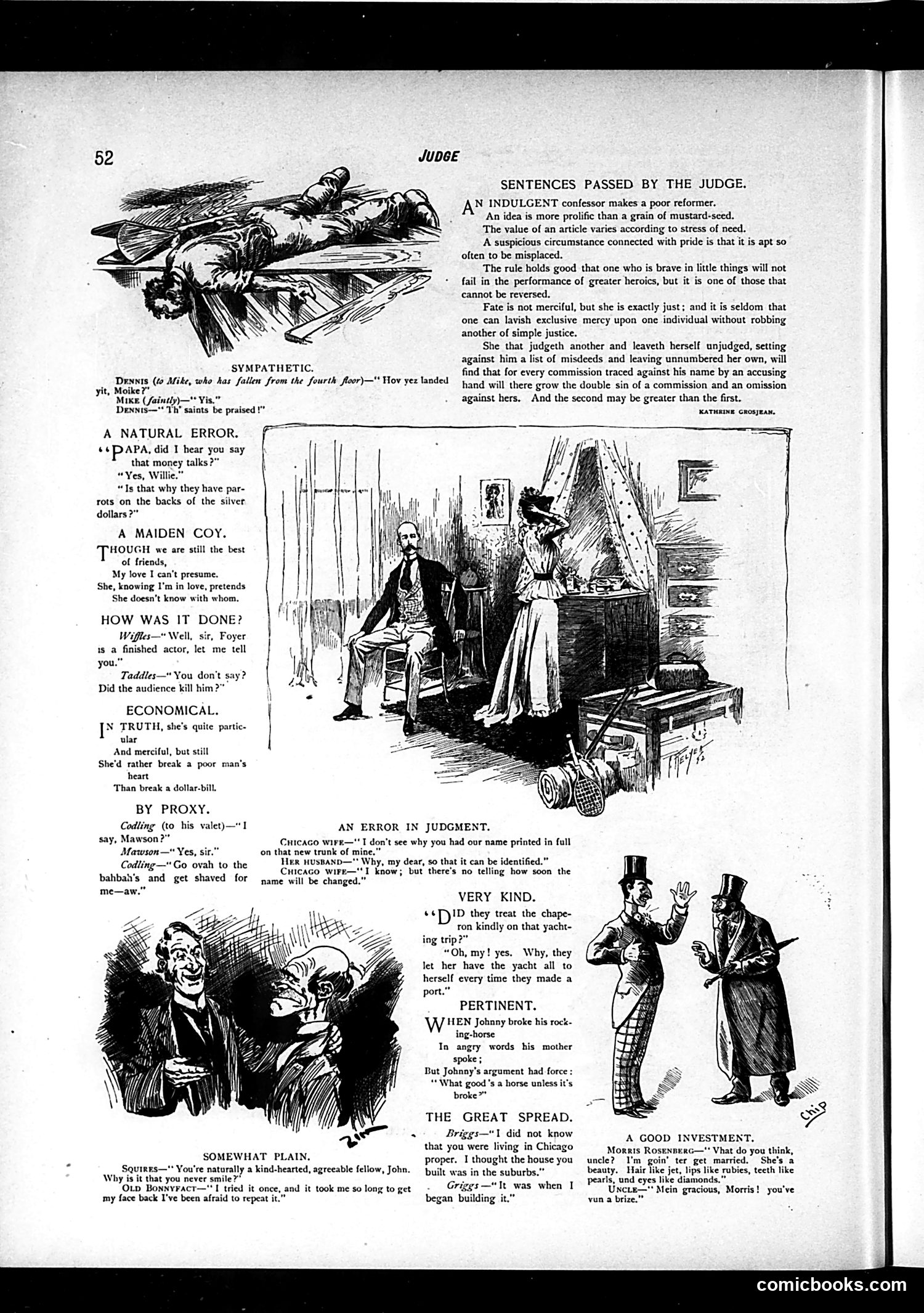
This page from *Judge* magazine contains multiple short satirical pieces typical of the publication's format—moral aphorisms, brief comic dialogues, and illustrated jokes. **Key Content:** The "Sentences Passed by the Judge" column offers moral observations on human nature (hypocrisy, judgment, fate). Several small jokes mock everyday situations: a child's innocent misunderstanding of "money talks" (confusing currency with parrots), a man breaking a rocking horse and sarcastically questioning its usefulness when damaged, and marital misunderstandings about name changes and trunk identification. **Social Commentary:** The satire targets recognizable Victorian/Edwardian anxieties: class consciousness ("economical" women choosing money over romance), gender dynamics (the "maiden coy," women's judgment), and material values (the emphasis on property and inheritance). The humor relies on wordplay, irony, and observational comedy about middle-class domestic life rather than explicit political targets. These are gentle, moralistic satires of human folly and social pretension typical of early 20th-century humor magazines.
📄 Transcribed text from this page (OCR, searchable)
Machine-transcribed from the original scan — historical spelling and the odd misread are preserved.
SENTENCES PASSED BY THE JUDGE. N INDULGENT confessor makes a poor reformer. An idea is more prolific than a grain of mustard-sced. The value of an article varies according to stress of need. A suspicious circumstance connected with pride is that it is apt so often to be misplaced. The rule holds good that one who is brave in little things will not fail in the performance of greater heroics, but it is one of those that cannot be reversed. Fate is not merciful, but she is exactly just; and it is seldom that one can lavish exclusive mercy upon one individual without robbing another of simple justice. She that judgeth another and leaveth herself unjudged, setting against him a list of misdeeds and leaving unnumbered her own, will ; SYMPATHETIC. 2 find that for every commission traced against his name by an accusing st, DIMMS (0 Afie, who has fallen from the fourth floor)—" Voy yer landed and will there grow the double sin of a commission and an omission ye MiKE (faintly) —"* Vis.” against hers. And the second may be greater than the first. Dennts—" Th’ saints be praised !" A NATURAL ERROR. f ++ PAPA, did T bear you say that money talks?” “Yes, Willie.” “Is that why they have par- rots on the backs of the silver dollars ?” A MAIDEN COY. HOUGH we are still the best of friends, My love I can’t presume. She, knowing I'm in love, pretends She doesn't know with whom. HOW WAS IT DONE? Wiffles—"Well, sit, Foyer | as a finished actor, let me tell you.” Taddles— You don't say? Did the audience kill him?” ECONOMICAL. | [® TRUTH, she’s quite partic. ular And merciful, but still She'd rather break a poor man's heart ‘Than break a dollar-bill. BY PROXY. Codling (to his valet)—"1 AN ERROR IN JUDGMENT. say, Mawson?” Cuicaco wirk—"'T d Mawson—" Yes, sir.” on that new trunk of ‘9 “ v Hex HusBAND—"* Why, my dear, so that it can be identified.” Codling: Ge oh io the CHICAGO WiFE- I know; but there's no telling how soon the bahbah's and get shaved for name will be changed.” me—aw.” KATURINE GROSJEAM. "t see why you had our name printed in full VERY KIND. +4 D)ID they treat the chape- ron kindly on that yacht- ing trip?” “Ob, my! yes. Why, they let her have the yacht all to herself every time they made a port.” PERTINENT. WHEN Johnny broke his rock- ing-horse In angry words his mother spoke ; But Johnny's argument had for “* What good 's a horse unless i broke?” THE GREAT SPREAD. a Briggs—"1 did not know that you were living in Chicago Morris Rosenserc—'* Vhat do you think, Proper. I thought the house you uncle? I'm goin’ ter get married. She's a Sq built was in the suburbs.”” beauty. Hair like jet, lips like rubies, teeth like Why is it that you never smile?" sites rial py pearls, und eyes like diamonds.” Otp Bonnyract—"'I tried it once, and it took me so long to get Grigg: It was when I appt Unciz—"* Mein gracious, Morris! you've my face back I've been afraid to repeat it.” began building i yun a brize.” A GOOD INVESTMENT, SOMEWHAT PLAIN, ‘tRES—** You're naturally a kind-hearted, agreeable fellow, John. comicbooks.com