
A complete issue · 16 pages · 1892
Judge — July 9, 1892
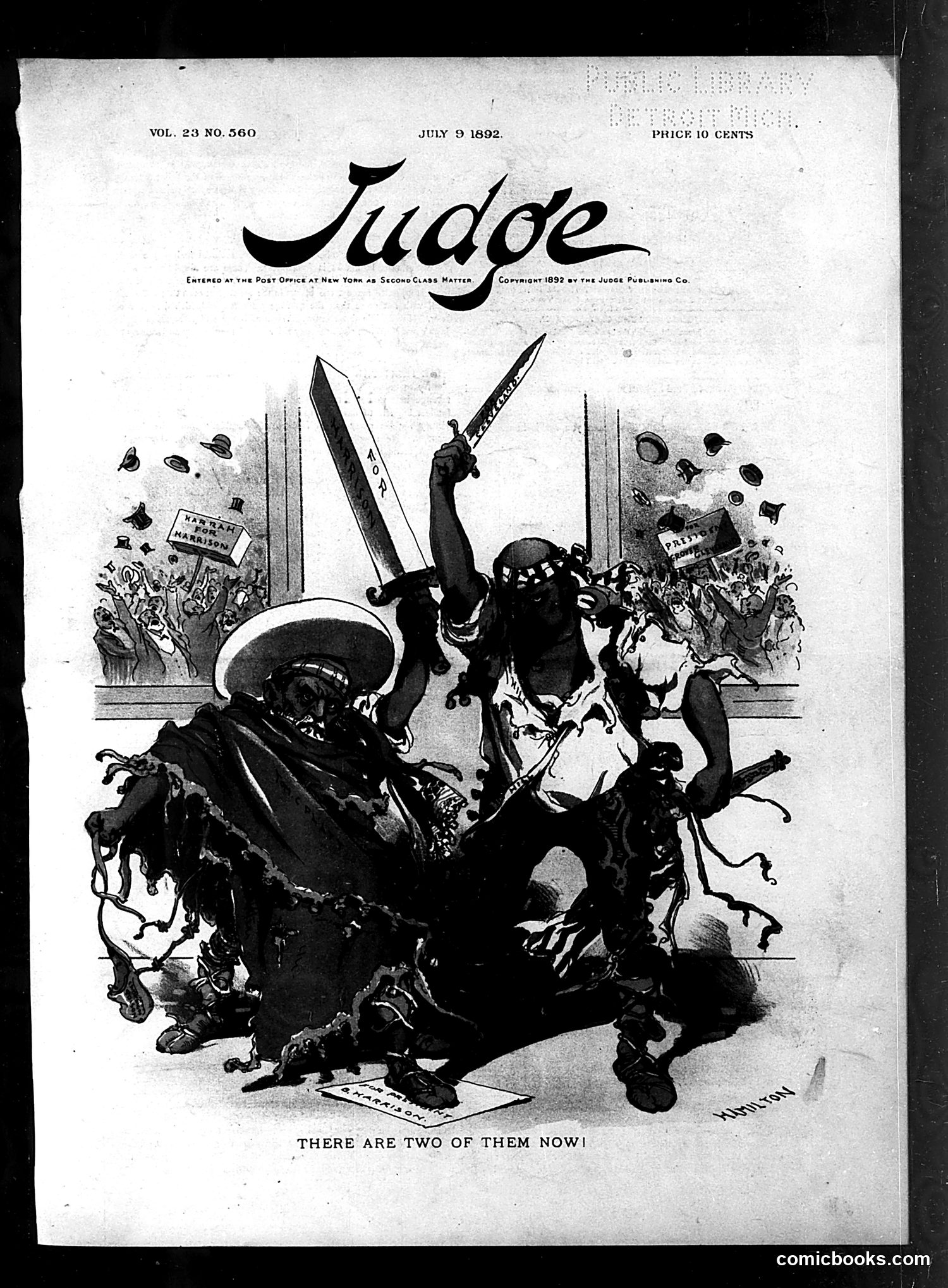
**Caption:** "There Are Two of Them Now!" This political cartoon satirizes the 1892 presidential election. The central figure appears to be a warrior or gladiator wielding swords, surrounded by chaotic crowds. The "two of them" likely refers to the split in the Republican Party—President Benjamin Harrison faced challenges from former President James G. Blaine, or possibly references the emergence of the Populist Party as a third force alongside Republicans and Democrats. The violent imagery—swords, weapons, crowds in conflict—suggests the cartoon depicts the election as a brutal political battle. The carnival-like atmosphere with crowds throwing items indicates the satirist viewed the election campaign as chaotic and destabilizing to the nation. The warrior figure embodies the aggressive political combat of the moment.
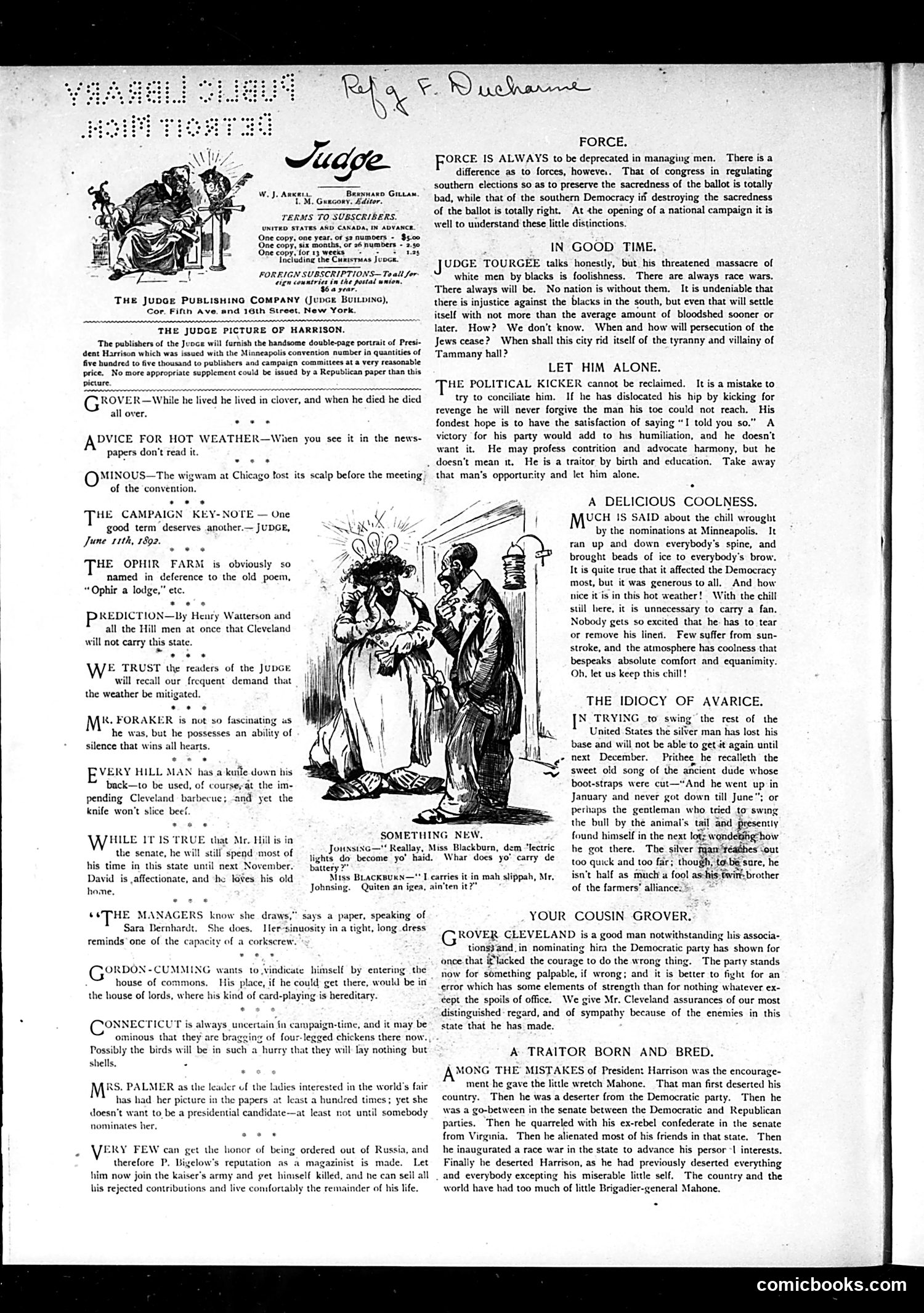
This page contains several short satirical items typical of Judge magazine's editorial section. The main cartoon titled "SOMETHING NEW" depicts two figures in conversation—likely political figures of the era—discussing strategy or deception (the dialogue mentions "reallay" and carrying "bills"). The text items below mock various political figures and situations. "THE POLITICAL KICKER" criticizes attempts to reconcile with a political opponent who "kicked for revenge." "A TRAITOR BORN AND BRED" attacks President Harrison's alleged inconsistency, accusing him of deserting both Democratic and Republican parties and starting "a race war." The overall tone attacks Republican leadership as hypocritical and dangerous. Without clearer identification of the cartoon figures or a visible date, precise political context remains uncertain, though the content suggests 1890s campaign-era criticism.
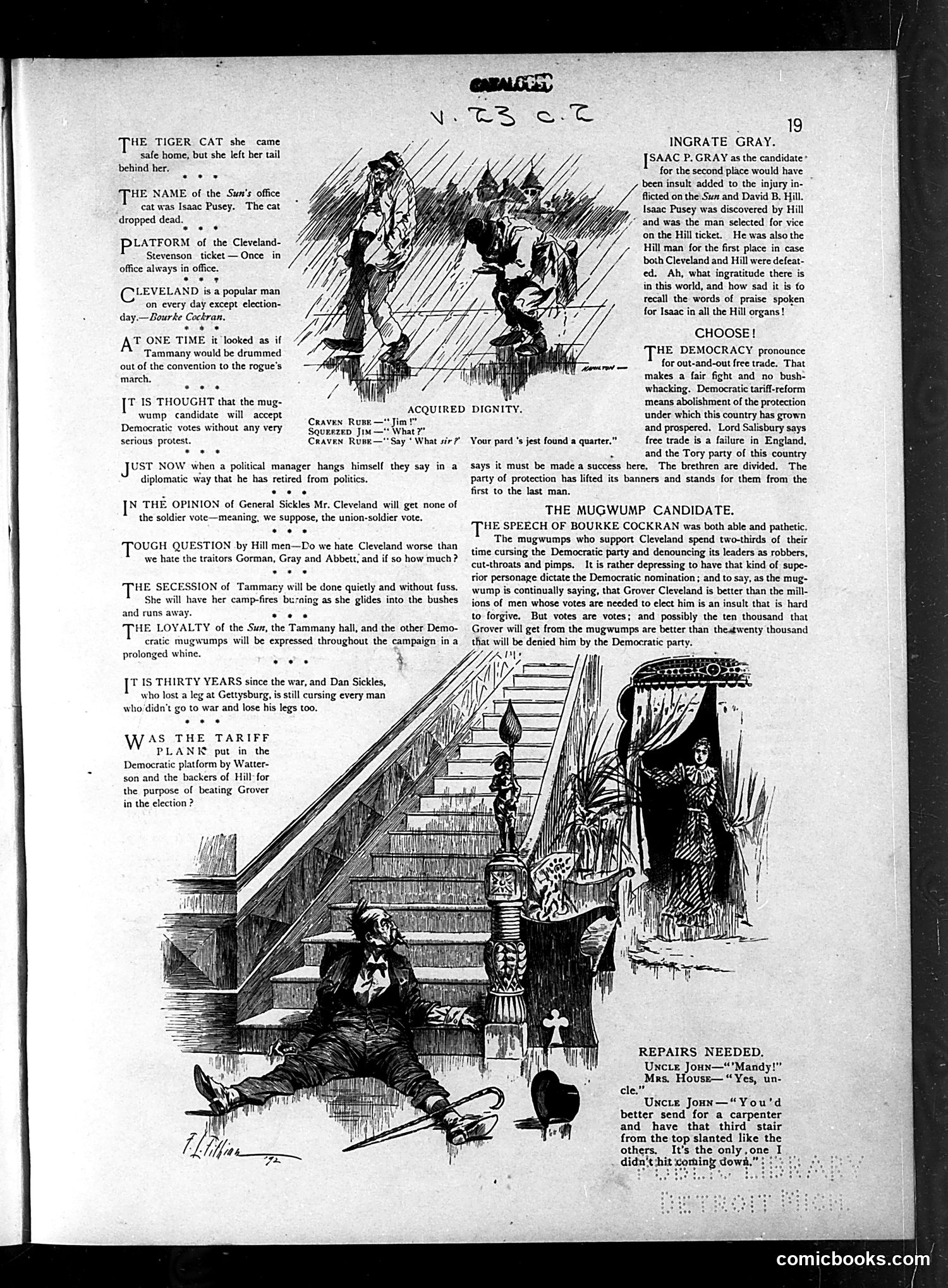
This page satirizes the 1884 U.S. presidential election, specifically mocking Democratic candidate Grover Cleveland and the party's vulnerabilities. The cartoon "Acquired Dignity" (top) depicts a man who has "found a quarter"—a visual metaphor for sudden, unearned respectability. This references Cleveland's damaged reputation from scandal. The text sections attack the Democratic platform on free trade and tariffs, quote unfavorable opinions from political figures like General Sickles, and mock Cleveland supporters ("mugwumps") as hypocritical. The lower illustration showing someone tumbling down stairs labeled "Repairs Needed" represents the Democratic party's perceived instability and internal divisions. Overall, Judge uses humor and caricature to ridicule Cleveland's candidacy and Democratic party positions on economic policy and leadership fitness.
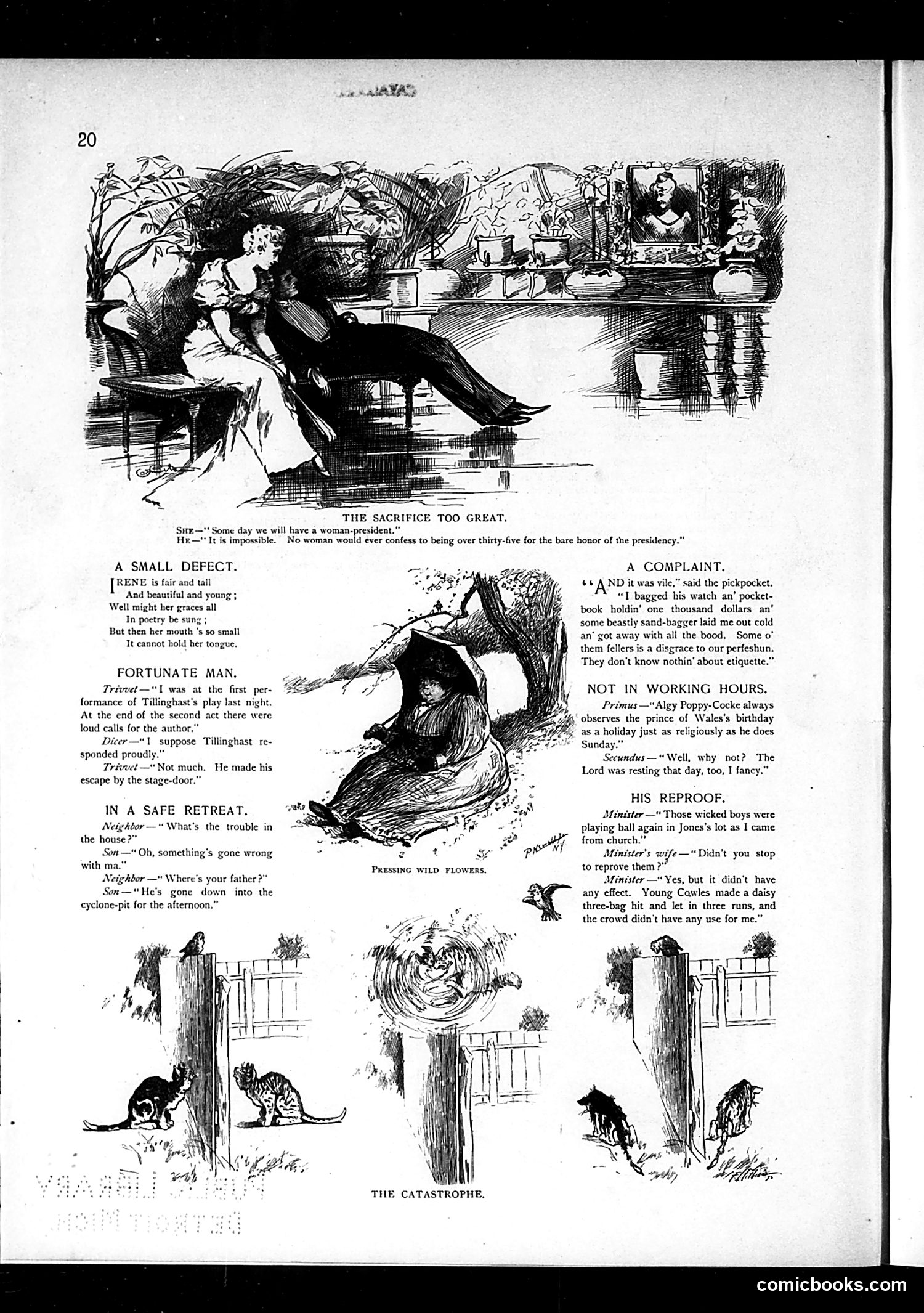
This page from Judge magazine contains multiple short satirical pieces reflecting late 19th/early 20th-century social attitudes: **"The Sacrifice Too Great"** mocks the prospect of female leadership, with a man arguing that no woman would endure the presidency for mere honor—implying women are too vain about age to sacrifice themselves publicly. **"A Small Defect"** uses misogynistic humor: a beautiful young woman's only flaw is her inability to stay silent, playing on the stereotype of talkative women. **"Fortunate Man"** and other brief dialogue pieces satirize middle-class social pretensions and male behavior—cowardly playwriting, domestic tensions, and social hypocrisy. **"A Complaint"** presents a pickpocket lamenting his robbery, expecting sympathy from criminal peers, mocking criminal "honor codes." **"The Catastrophe"** (illustrated) shows a humorous domestic mishap. Overall, these pieces reflect Judge's satirical targets: women's suffrage opponents, class anxieties, and period social conventions, using crude stereotypes typical of the era's humor.
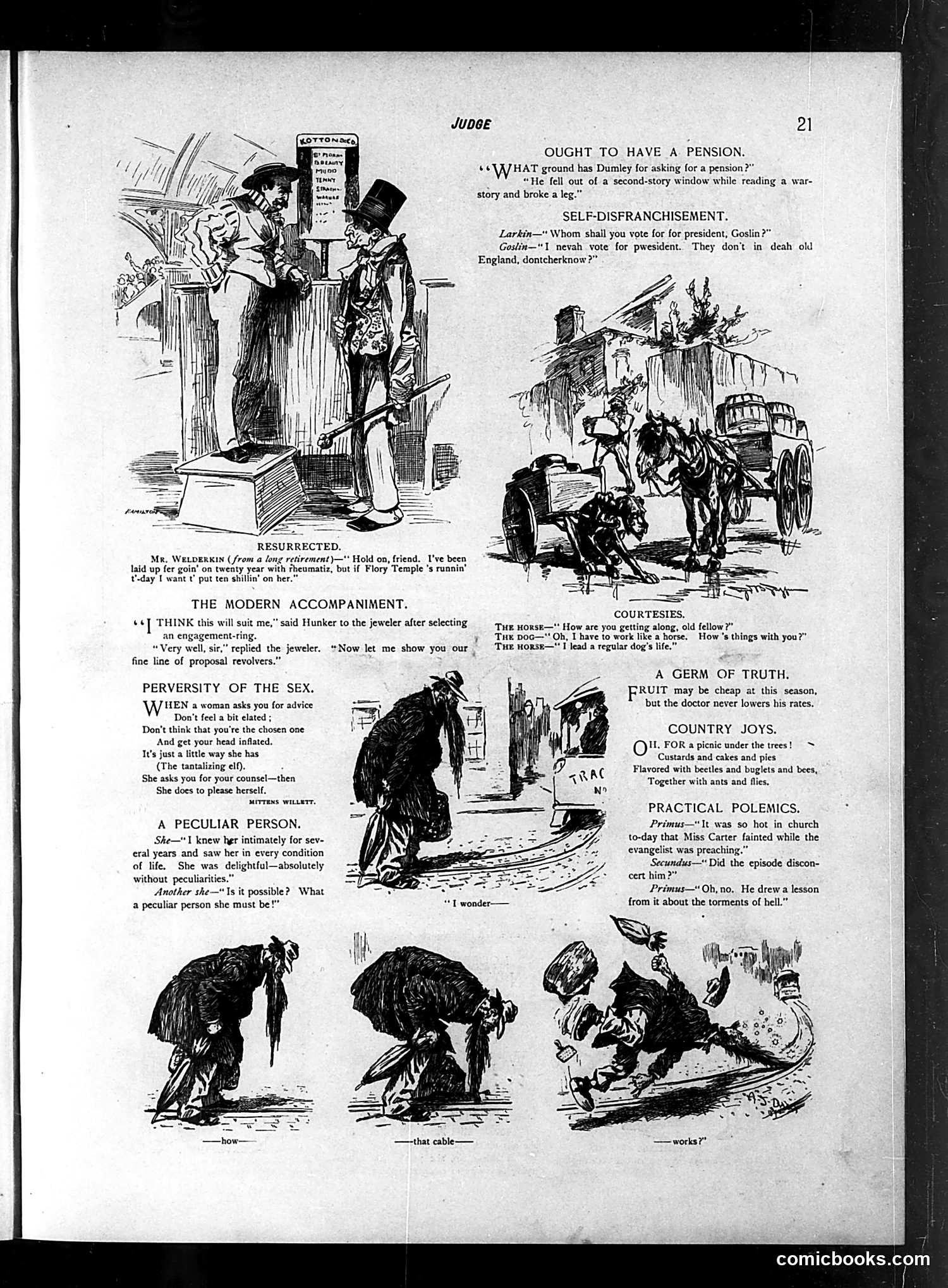
This page contains multiple short satirical pieces typical of early 20th-century American humor magazines: **"Ought to Have a Pension"**: Mocks someone claiming a pension after a self-inflicted injury from reading war stories—satire on frivolous pension claims. **"Self-Disfranchisement"**: A character named Goslin, speaking in affected dialect, claims English people don't vote for president, humorously confusing English and American political systems. **"Resurrected"**: An elderly man emerges from twenty years of retirement to place a bet on a horse named "Flory Temple"—satirizing how even invalids will gamble on racing. **"The Modern Accompaniment"**: A jeweler recommends "proposal revolvers" alongside engagement rings—dark satire on marriage anxieties and domestic conflict. Other pieces mock women's inconsistency, medical profiteering, and clergy indifference. The cartoons use exaggerated facial features and working-class dialect typical of period humor targeting immigrants and lower classes. The satire is gentle rather than sharp.
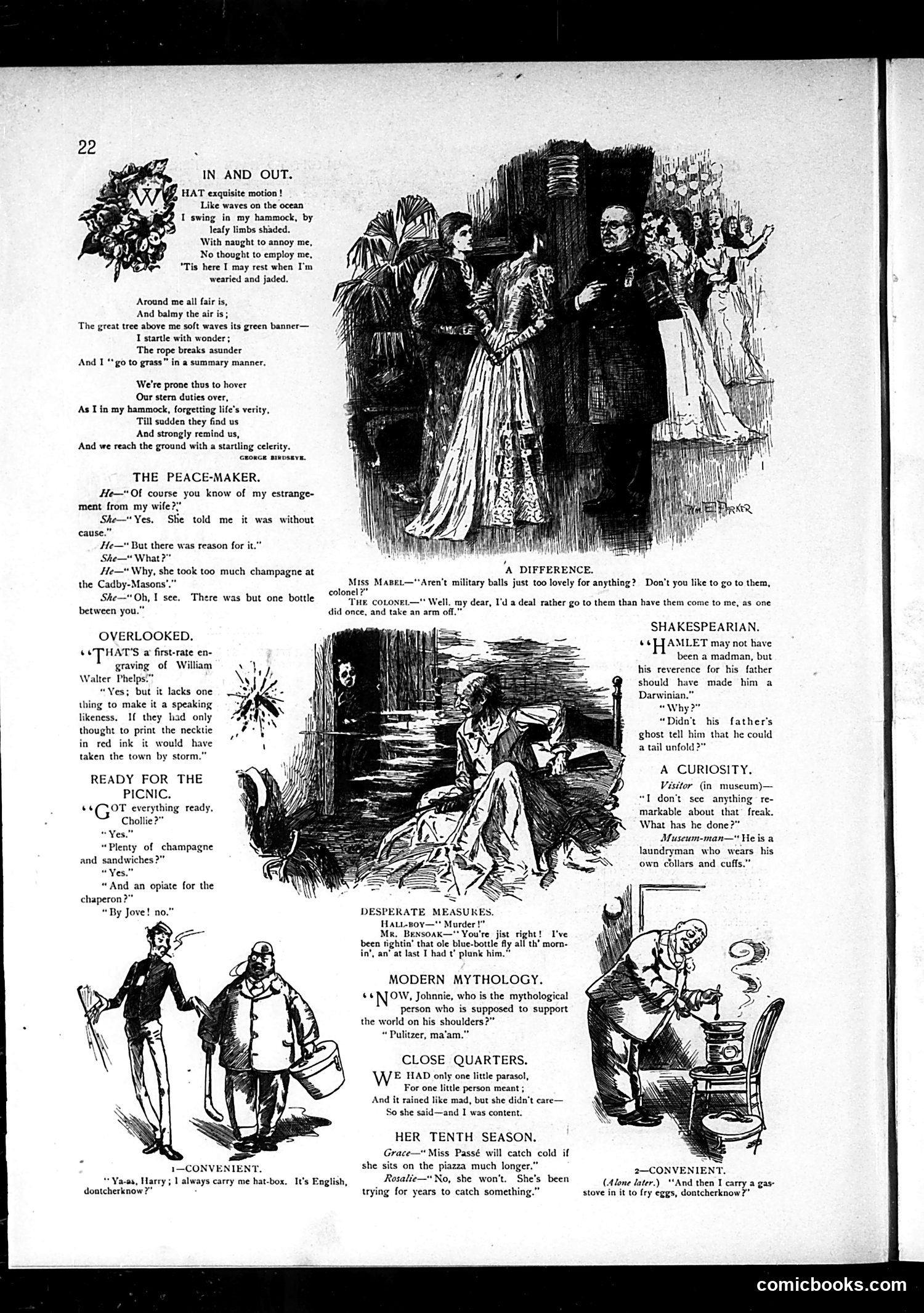
This page contains multiple short humorous sketches typical of Judge magazine's format. Key satirical points: **"The Peace-Maker"**: A couple's marital dispute stems from the wife's excessive champagne consumption at a society event—mocking upper-class excess and frivolous domesticity. **"A Difference"**: A colonel jokes he'd rather attend military balls than have them "come to me, as one did once, and take an arm off"—likely referencing combat casualties or military accidents. **"Modern Mythology"**: A child answers that "Pulitzer" (newspaper magnate Joseph Pulitzer) supports the world on his shoulders—satirizing media's perceived cultural dominance and influence. **"Her Tenth Season"**: A woman trying unsuccessfully to "catch something" (marriage) for ten seasons reflects period anxieties about unmarried women. **"A Curiosity"**: A laundyman wearing his own starched collars and cuffs is presented as a museum exhibit—absurdist humor about mundane eccentricity. The sketches target marriage, courtship, class pretension, and media influence through quick wit rather than sophisticated political commentary.
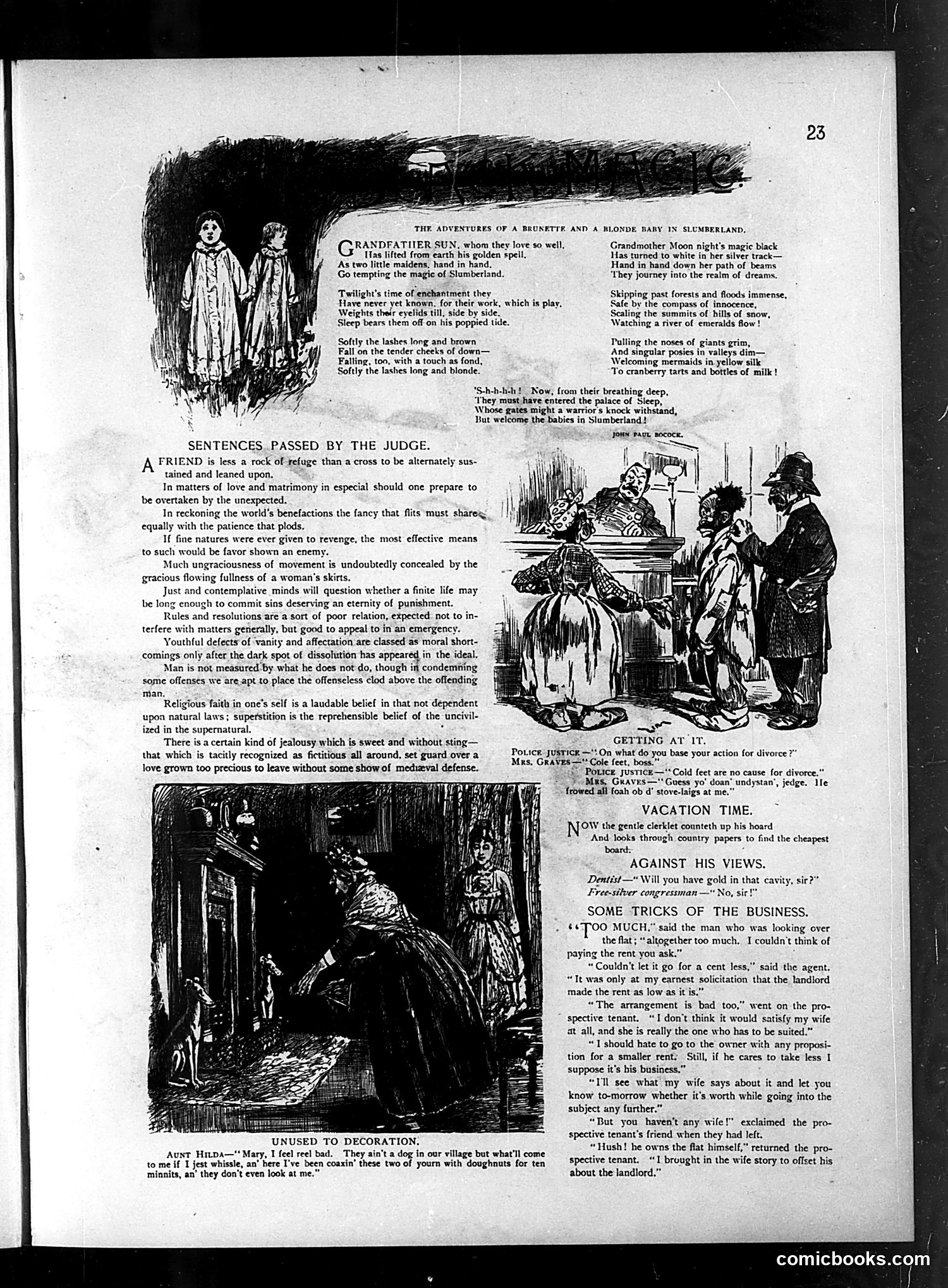
This page contains several satirical pieces typical of late-19th/early-20th century American humor: **"Adventures of a Brunette and Blonde Baby in Slumberland"** is a whimsical children's poem with accompanying illustrations about two girls entering dreamland—straightforward fantasy content without political reference. **"Sentences Passed by the Judge"** offers philosophical observations on friendship, love, morality, and human nature in aphoristic form—social commentary rather than political satire. **"Getting at It"** is a brief dialect humor piece depicting a Black woman seeking divorce, using exaggerated speech patterns common to period entertainment. It reflects contemporary racial stereotyping without specific political reference. The remaining sections—"Vacation Time," "Against His Views" (mocking free-silver politics), and "Some Tricks of the Business" (about rental negotiations)—offer mild social satire on clerks, politicians, and landlord-tenant disputes. The page is predominantly light humor and aphorism rather than sharp political cartoon satire.
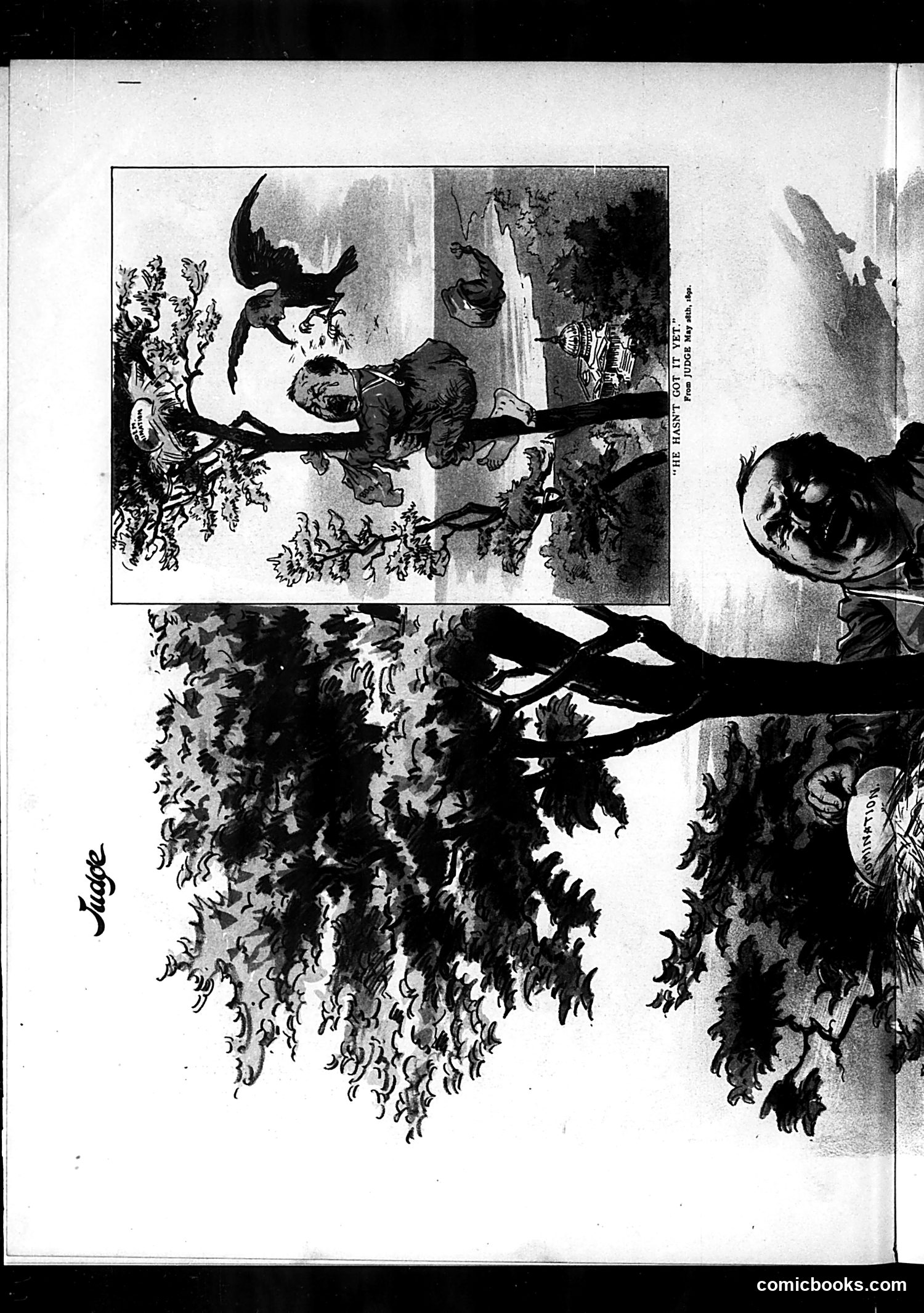
I can see this is a page from *Judge* magazine containing black-and-white satirical imagery, but the OCR text is too corrupted to read clearly ("comicbooks.com sear ee AoW BOGAL Bo" etc.). The images appear to show caricatured figures in period dress, with decorative foliage elements, suggesting social or political satire typical of *Judge*. However, without legible text identifying the subjects, date, or satirical target, I cannot reliably explain what specific figures, events, or issues are being mocked. To accurately interpret this cartoon, I would need either clearer OCR text or additional context about the publication date and issue.
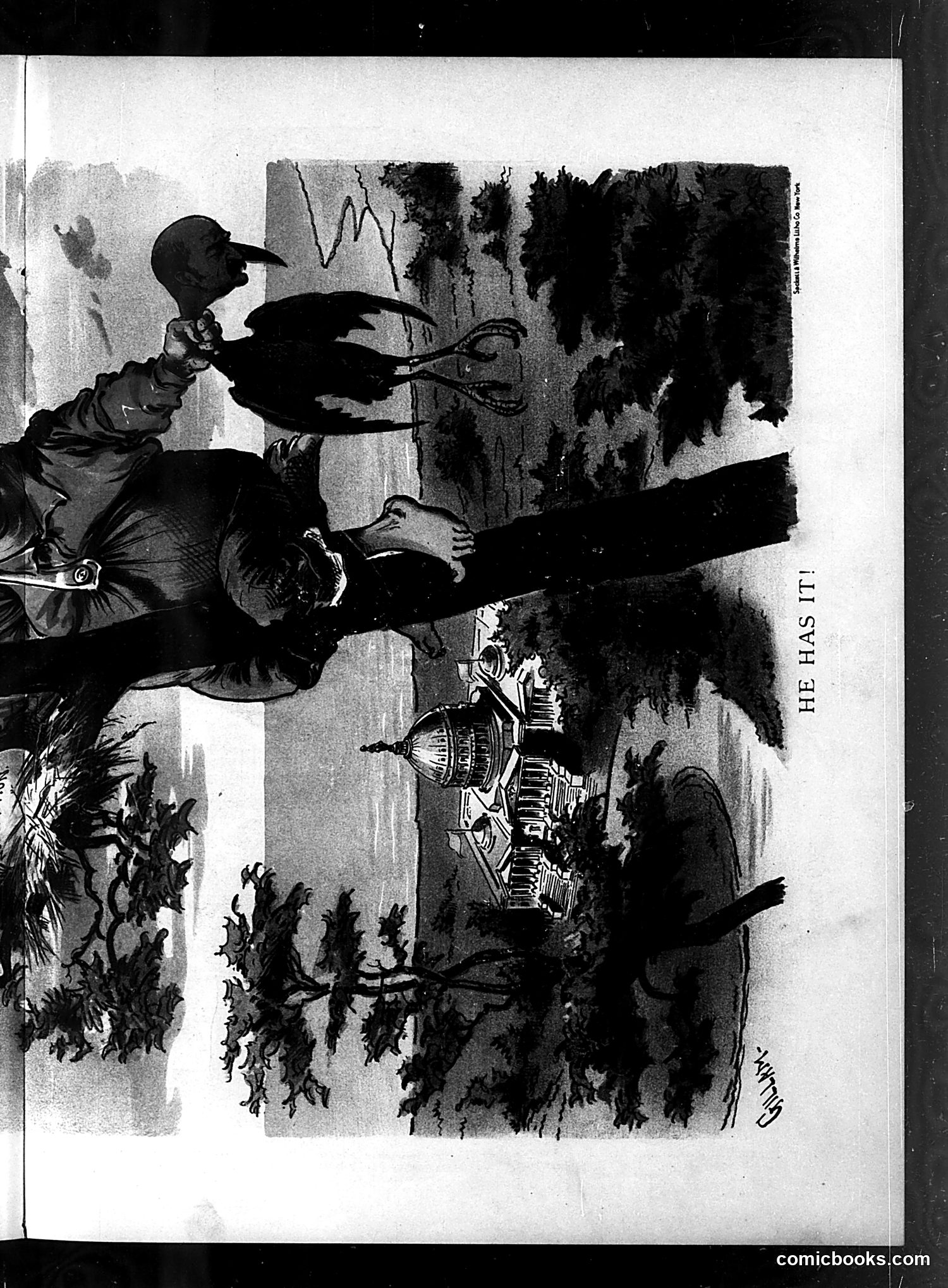
This appears to be a satirical illustration from *Judge* magazine, though the OCR text is too corrupted to read clearly. The image shows a figure in a cap wielding large scissors against what appears to be a building or structure with dark, sketchy shading. The caption reads "HE HAS IT" (visible on the right margin). The cartoon likely depicts someone—possibly a political figure or reformer—"cutting" or dismantling something, using scissors as a metaphor for decisive action. Without clearer text or dating information, the specific target of this satire is unclear, but the imagery suggests critique of either destructive reform efforts or forceful political action. The architectural or industrial subject matter suggests this may relate to urban policy, labor issues, or government intervention of the late 19th or early 20th century.
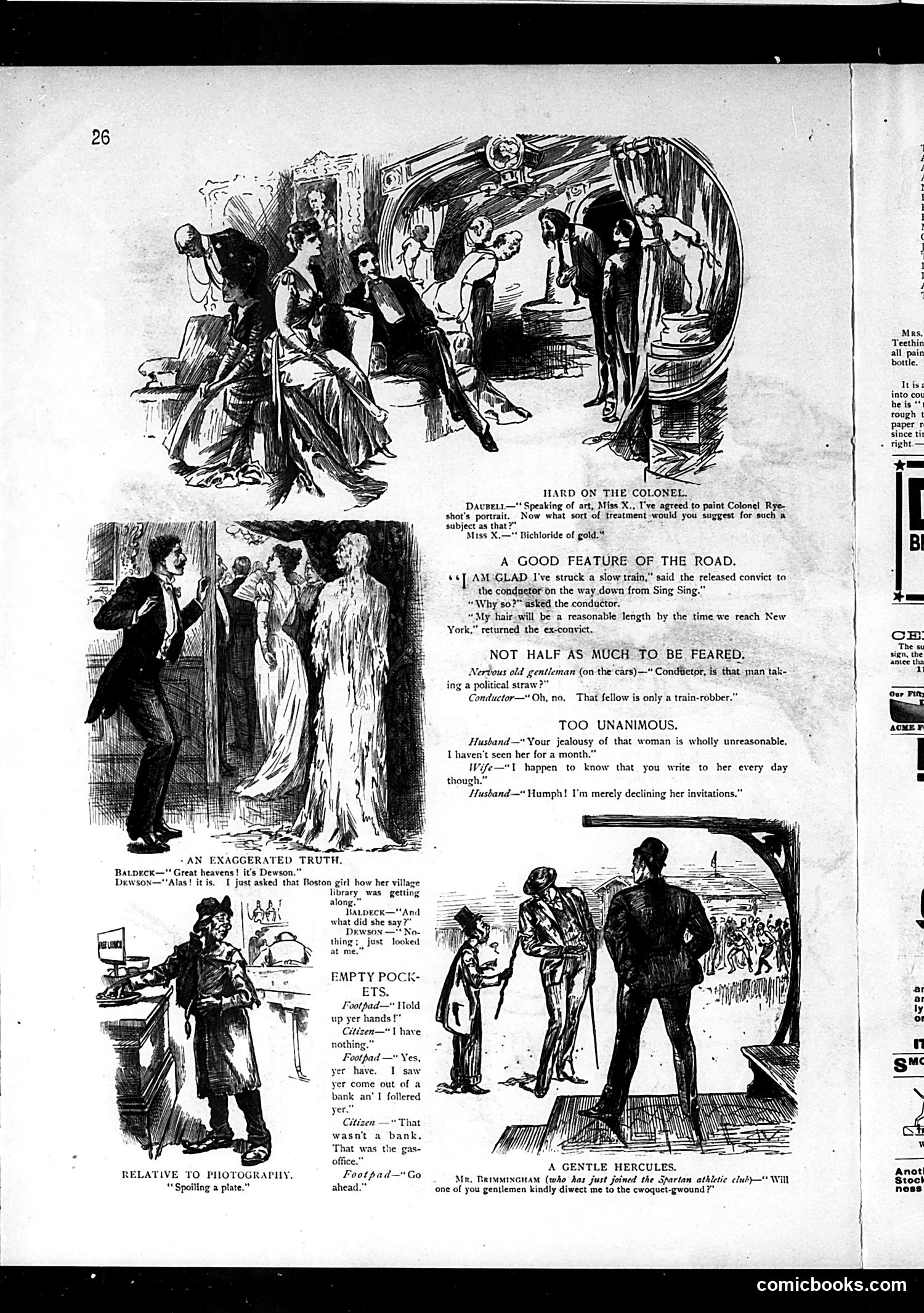
This page contains several brief satirical jokes typical of late-19th-century American humor: **"Hard on the Colonel"** jokes about portraiture, with a woman suggesting "bichloride of gold" (a poison) as treatment for painting an unpleasant subject—dark humor about the Colonel being difficult. **"A Good Feature of the Road"** satirizes the recently-opened Sing Sing prison railroad, where a released convict appreciates the slow train because his hair will grow back to normal length during the journey (implying prison haircuts were humiliating). **"Not Half as Much to be Feared"** plays on contemporary anxieties: a nervous passenger mistakes a man with a political straw (apparently a novelty item) for a train robber—suggesting train robbery was a real concern, but political merchandise was viewed as equally suspicious or annoying. **"Too Unanimous"** depicts a husband caught in an obvious lie about correspondence with another woman, caught in his own weak excuse. **"A Gentle Hercules"** mocks a pretentious new member of an athletic club who speaks with affected pronunciation ("cwoquet-gwound"), suggesting nouveau riche absurdity.
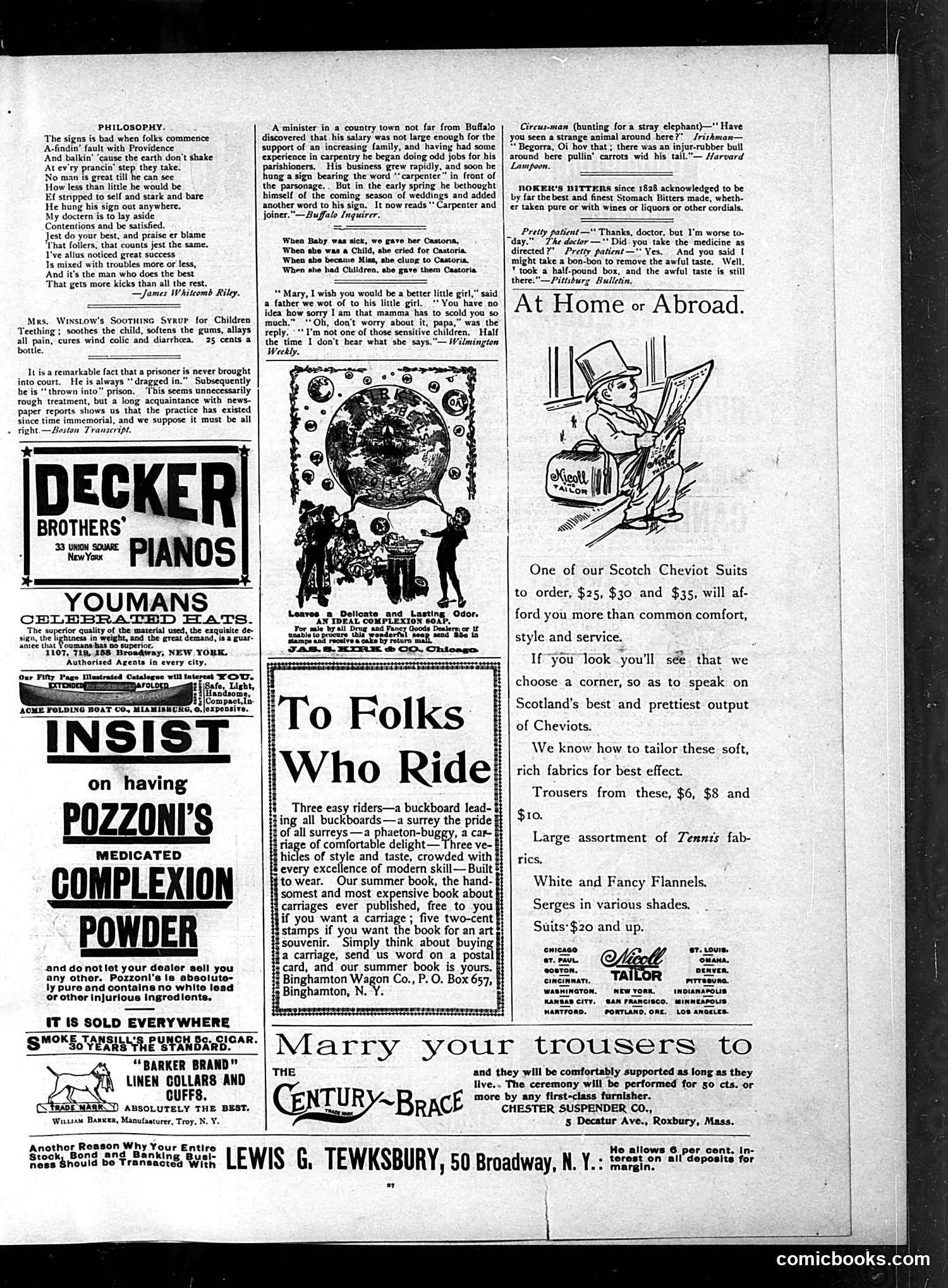
This page is primarily **advertising with minimal editorial content**. The main illustrated piece appears to be a small cartoon showing a circus performer searching for a stray elephant, with dialogue about encountering a bail bondsman—likely a brief joke about urban mishaps. The philosophical quote by James Whitcomb Riley emphasizes humility and acceptance of life's troubles as universal experiences. Most of the page comprises period advertisements for consumer goods: Decker Bros. pianos, Youmans hats, Pozzoni's complexion powder, Mrs. Winslow's Soothing Syrup, Pozzoni's powder, Barker Brand collars, and the Century Brace (a trouser supporter). There's also an ad for Binghamton Wagon Company and Mitchell clothing. The "At Home or Abroad" section promotes Scottish Cheviot suits and accessories—typical merchant advertising of the era. **Overall**: This is a conventional magazine page mixing light humor with commercial appeals to middle-class readers, rather than political satire.
This page is primarily **advertising**, not satirical content. It's a typical Judge magazine advertisement section from the late 1800s featuring various consumer products: bicycles (Premier Cycles, Sylph Cycles), alcoholic beverages (Allsopp's Ale, Pennsylvania Rye Whiskey, Cook's Wine), cigars (Bouquet, Hoffman House), patent medicines (hair goods, "deafness cures"), candy, and transportation services (Burlington Route, Erie Line). The only satirical elements are brief **quoted jokes** interspersed between ads—humorous observations about weddings, hypnotized Minneapolis husbands, editors' wives, and college freshmen. These are typical period humor: mild social commentary and wordplay rather than pointed political satire. The Overholt Whiskey section includes a small portrait, but it's promotional, not caricature. This page exemplifies how Judge financed itself: advertising revenue subsidized satirical content elsewhere in the magazine.
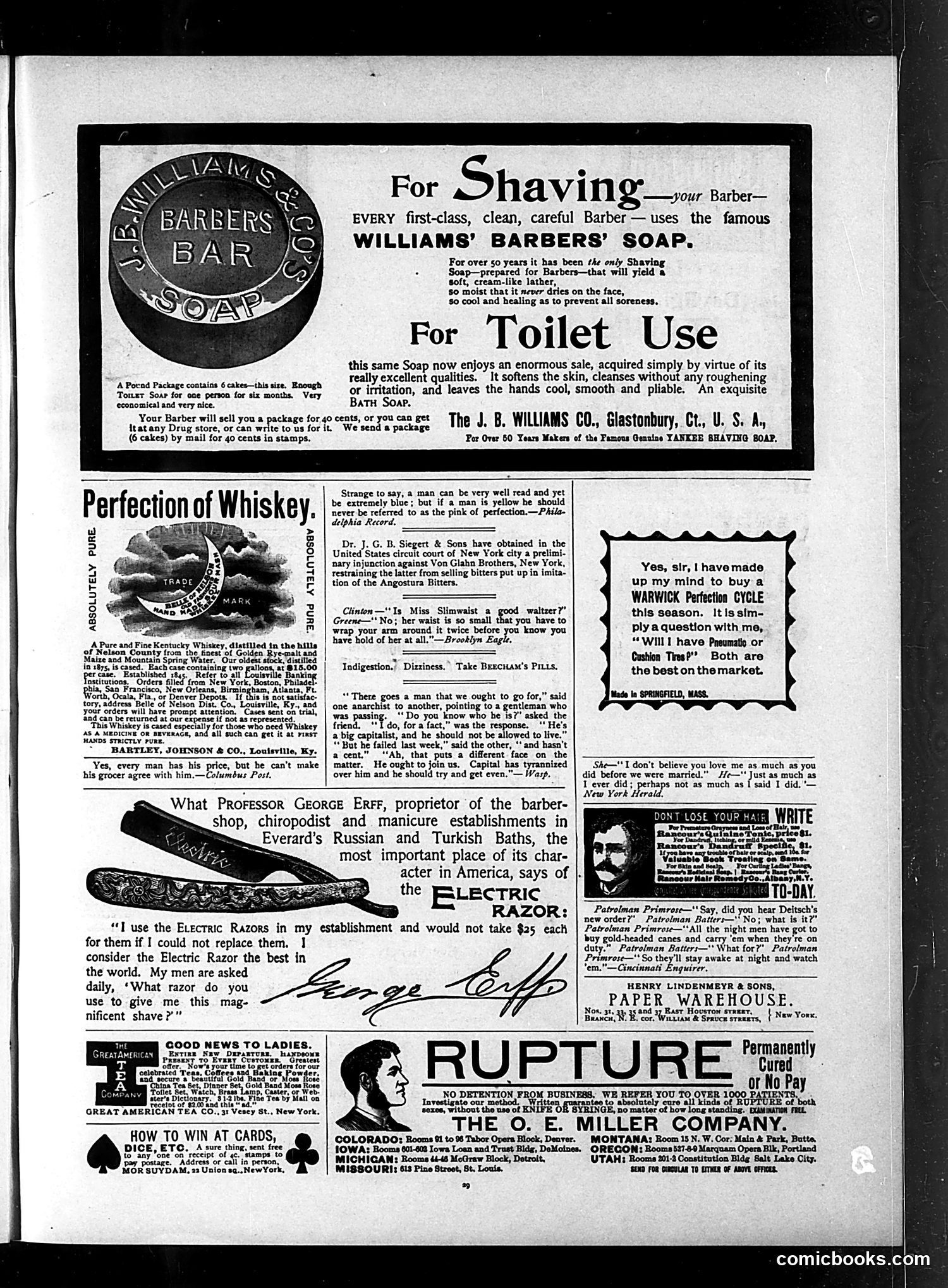
This page is primarily **advertising**, not political satire. It contains product endorsements and commercial notices typical of early 1900s publications. The main content includes: - **Williams' Barbers' Soap advertisement** promoting a 50-year-old shaving product - **Bartley, Johnson & Co. whiskey ad** claiming medicinal value - **Professor George Erff testimonial** endorsing Electric Razors for his barbershop/bathhouse - **Warwick Perfection Cycle** (bicycle) advertisement - **Rupture treatment** and other patent medicine ads There are brief **humorous snippets** (jokes about romance, anarchists, and digestion) scattered between ads, but these are filler content, not editorial cartoons. The page reflects **Gilded Age commercial culture**—heavy advertising for grooming products, questionable "medicines," and consumer goods, alongside generic humor. No identifiable political figures or satire are visible. This appears to be a typical Judge magazine advertising section rather than its satirical editorial content.
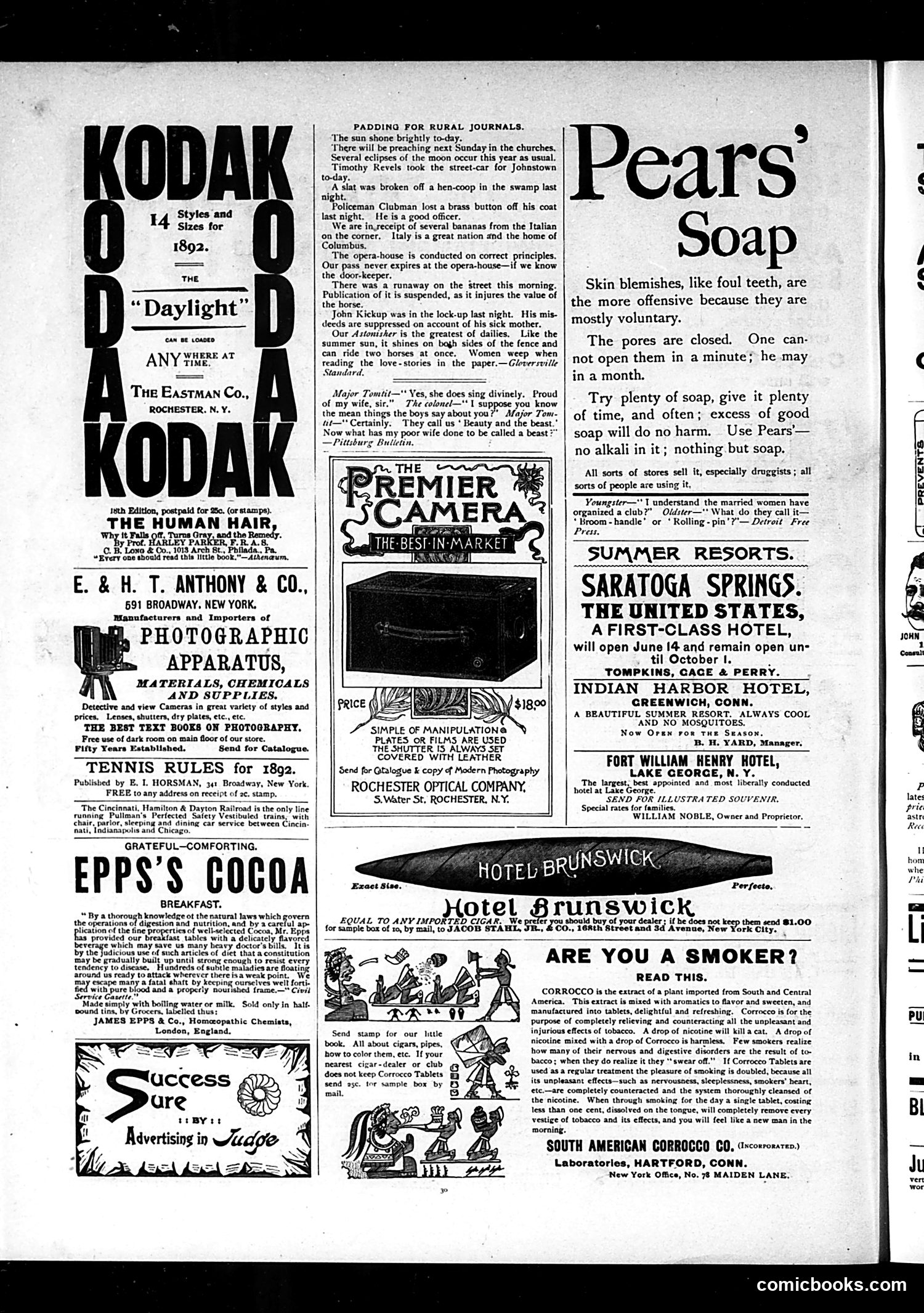
This page is primarily **advertising**, with one notable satirical section. ## The Satire: "Padding for Rural Journals" The main satirical content mocks **rural newspaper filler**—bland, trivial content used to pad small-town papers. Examples include: "The sun shone brightly to-day," "Timothy Revels took the street-car for Johnstown," and "A Mat was broken off a hen-coop in the swamp last night." The satire targets how rural papers: - Suppress unflattering news (the runaway horse story) to avoid hurting property values - Suppress criminal reports out of sympathy for perpetrators - Make absurd boasts about their own importance Judge ridicules the self-aggrandizing claim that their paper "shines on both sides of the fence" and "can ride two horses at once"—transparently false journalistic objectivity. ## The Rest The page consists entirely of period advertisements for photography equipment (Kodak, Eastman), hotels, cocoa, and the Premier Camera—typical Judge revenue from the 1890s. The two brief humorous anecdotes ("Major Tomtit") are conventional joke-filler.
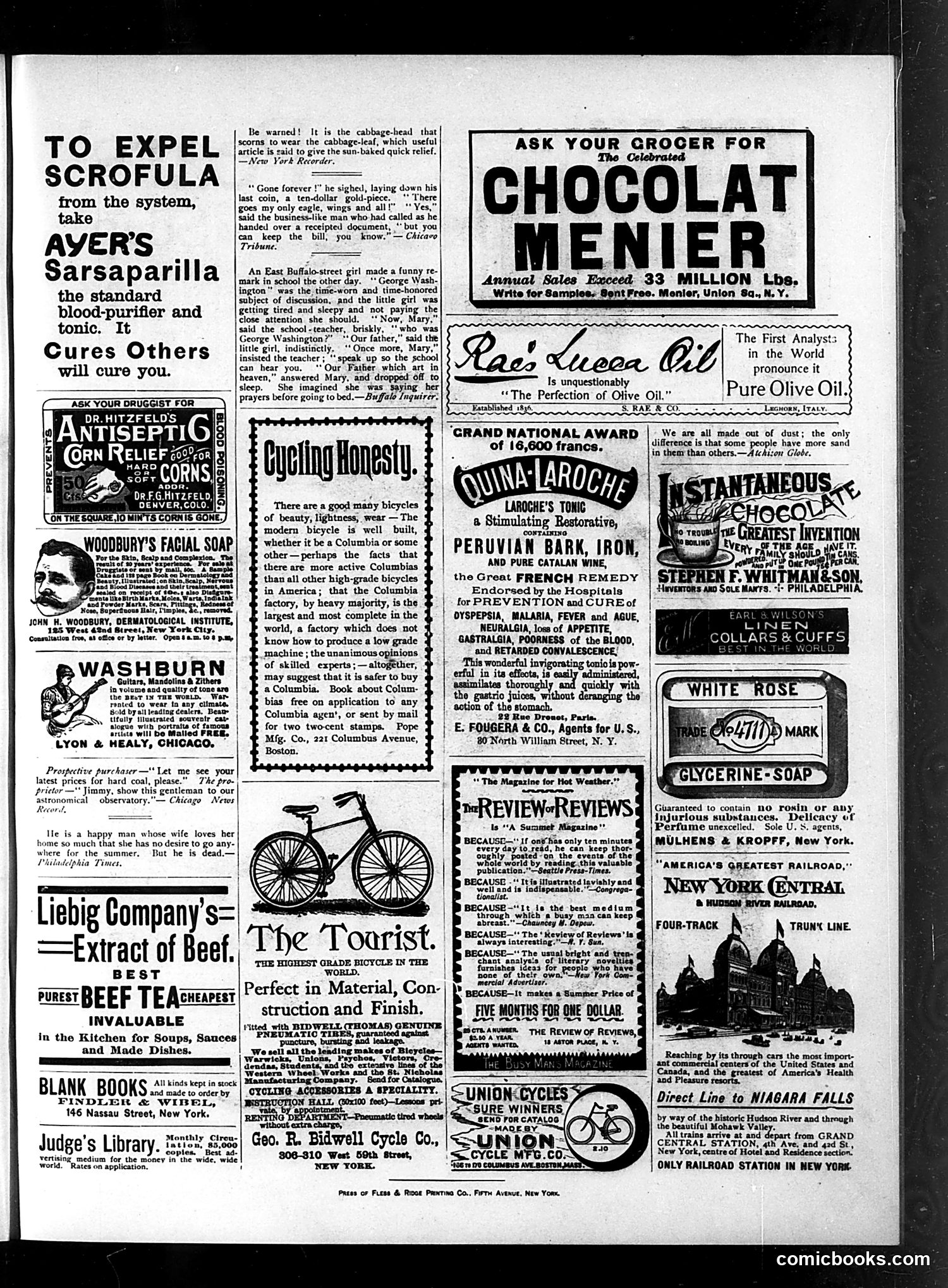
This is primarily a **page of advertisements**, typical of Judge's revenue model in the late 19th century. Rather than editorial cartoons, it showcases period patent medicines and consumer goods with exaggerated health claims common to the era. Notable ads include: - **Ayer's Sarsaparilla**: Claims to cure "scrofula" (a tuberculosis-related disease), exemplifying the snake-oil marketing of the time - **Quina Laroche**: A "French remedy" with Peruvian bark and wine, promoted for fever and digestive ailments - **Liebig's Beef Extract**: Marketed as a kitchen staple for soups - **Menier Chocolate**: Legitimate product advertisement among patent medicines - **Bicycles**: Columbia and Tourist brands, reflecting the 1890s cycling craze The page also includes three brief **humorous shorts**—small jokes about coal prices, cabbage-head philosophy, and a child confusing George Washington with the Lord's Prayer—typical filler content. No political satire is evident; this is simply period advertising demonstrating unregulated medical marketing before FDA oversight.
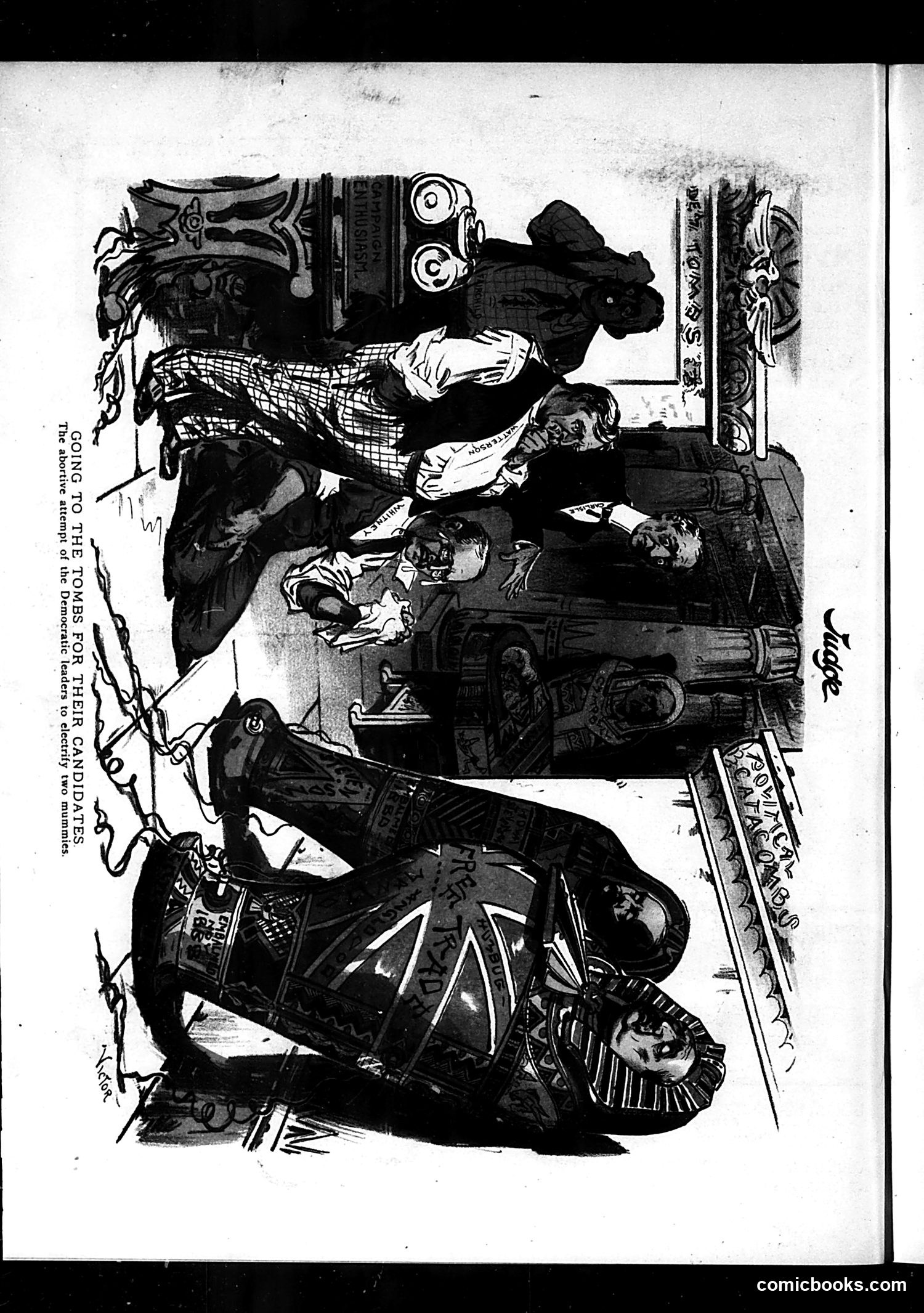
This is a satirical cartoon titled "Going to the Tombs for Their Candidates," depicting Democratic Party leaders as grave robbers attempting to resurrect political "mummies" as candidates. The caption's subtitle—"The abortive attempt of the Democratic leaders to electrify two mummies"—clarifies the metaphor: the cartoon mocks Democrats for nominating aging or politically "dead" candidates rather than fresh talent. The image shows figures in a tomb-like setting with coffins and skeletal remains, suggesting Democratic leadership is literally and figuratively digging up the political past. The "electrify" reference likely alludes to attempts to energize or revive these dated candidates through campaigning. Without specific dates visible, the exact election targeted remains unclear, but the satire criticizes Democratic candidate selection as relying on outdated figures rather than innovative leadership.