
A complete issue · 17 pages · 1892
Judge — July 2, 1892
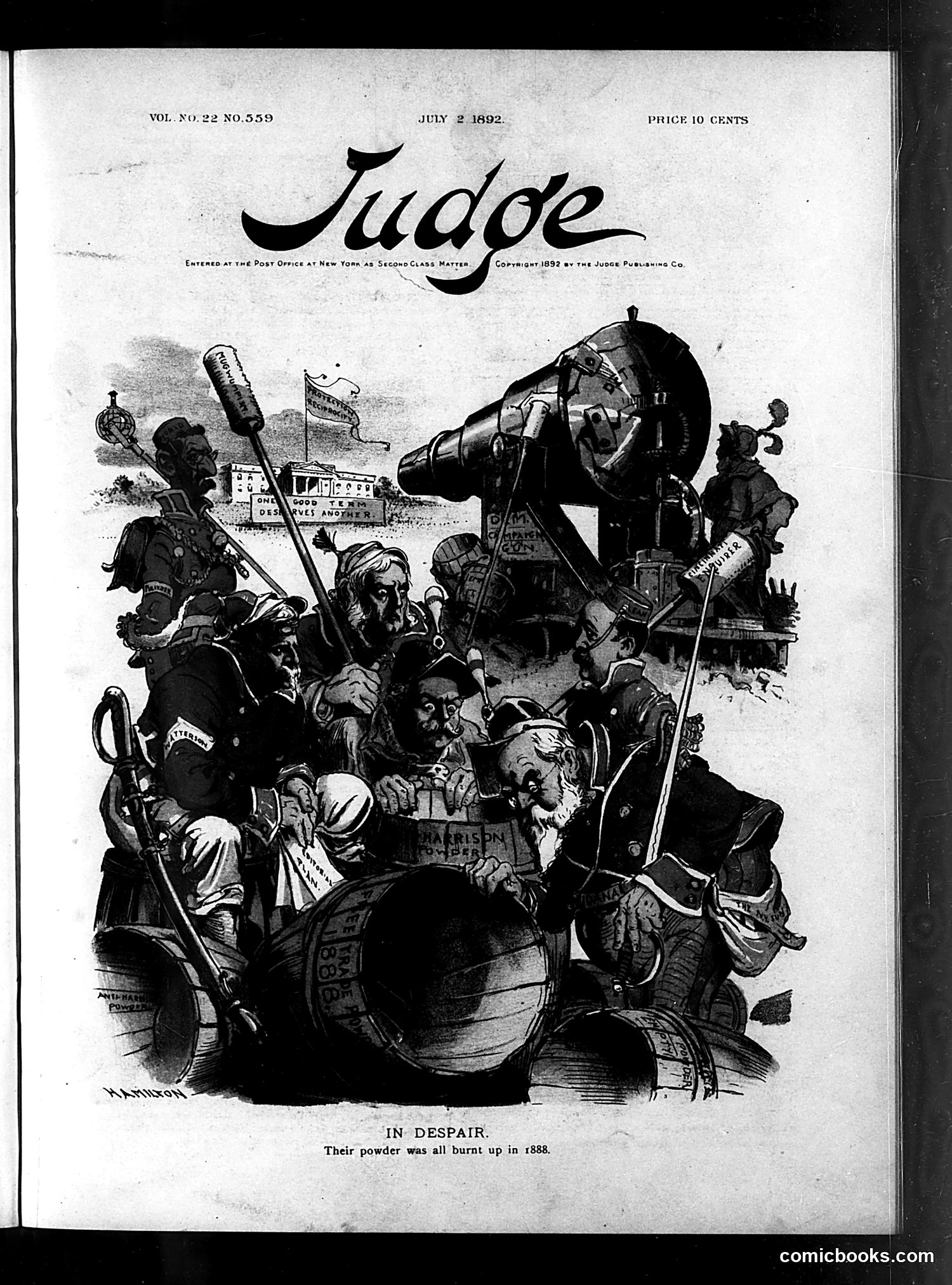
This satirical cartoon from July 2, 1892, depicts military and political figures in distress, surrounded by cannons and ammunition. The caption references events from 1888, suggesting these figures exhausted their political resources or ammunition—likely metaphorical—during that year's conflicts or campaigns. The caricatured faces and military regalia suggest this addresses a specific political crisis or war. The "despair" and depleted "powder" imply that certain factions had spent their political capital or military capacity, leaving them weakened by 1892. Without clearer identification of the specific figures or 1888 historical context referenced, the exact political targets remain unclear, though the composition clearly mocks military or political leadership as exhausted and ineffectual.
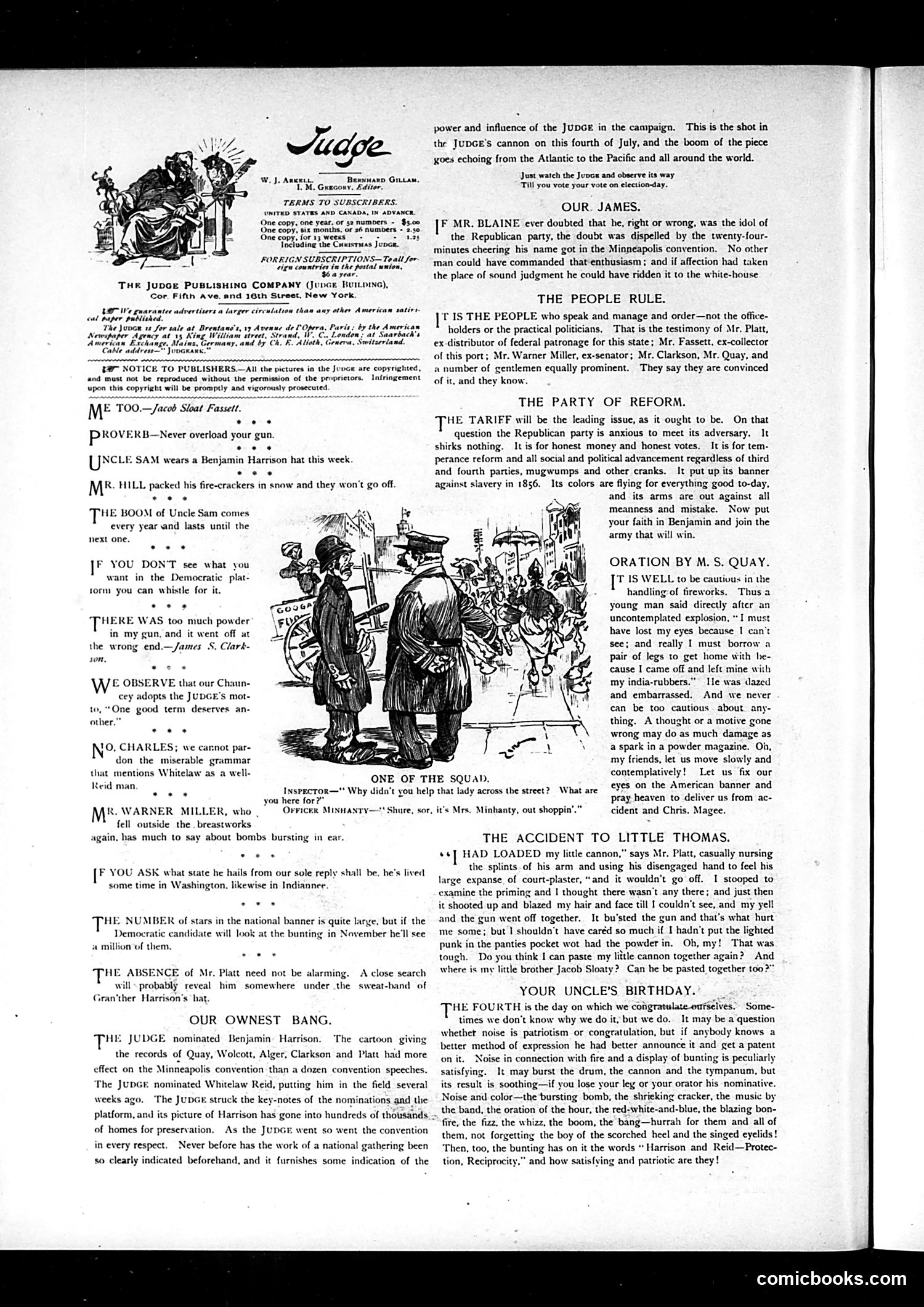
This page contains Republican campaign satire from the 1856 election era. "Our James" likely refers to James Buchanan, the Democratic candidate, whom the text mocks as unfit for the presidency. The cartoon "One of the Squad" depicts two men discussing fireworks—likely a satirical commentary on political chaos or incompetence during the election season. "The Party of Reform" promotes the Republican party's platform, emphasizing the tariff as their leading issue and their opposition to slavery expansion. "Your Uncle's Birthday" appears to mock Fourth of July celebrations and political rhetoric around patriotism and nationalism. The overall page agenda is pro-Republican, anti-Democratic, using humor and caricature to influence 1856 voters toward Benjamin Harrison or the Republican platform rather than Democratic alternatives.
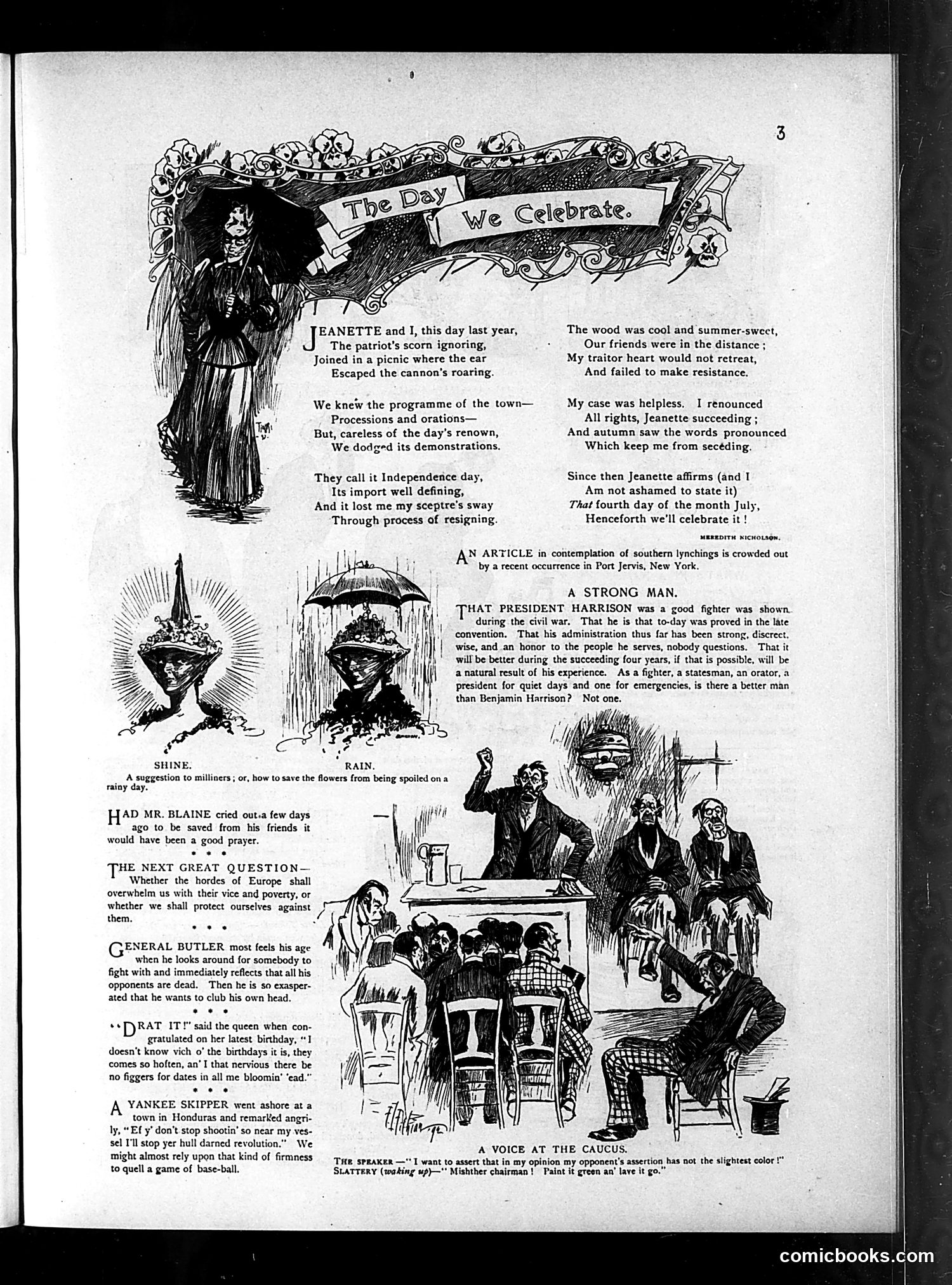
This page satirizes American politics and social issues of the late 19th century. "The Day We Celebrate" poem mocks Independence Day observance, with a speaker claiming to have abandoned patriotic ideals after witnessing betrayal. "A Strong Man" praises President Benjamin Harrison as superior to his predecessor, suggesting the administration will be "strong, direct, wise" compared to what came before. The remaining sketches are humorous vignettes: "Shine" and "Rain" offer practical tips for urban life; "The Next Great Question" debates European immigration policy; and other brief comic pieces satirize everyday American concerns like dating, baseball, and political caucuses. The overall tone is conservative, nationalist, and dismissive of certain immigrant or minority perspectives—typical of Judge's editorial stance during this era.
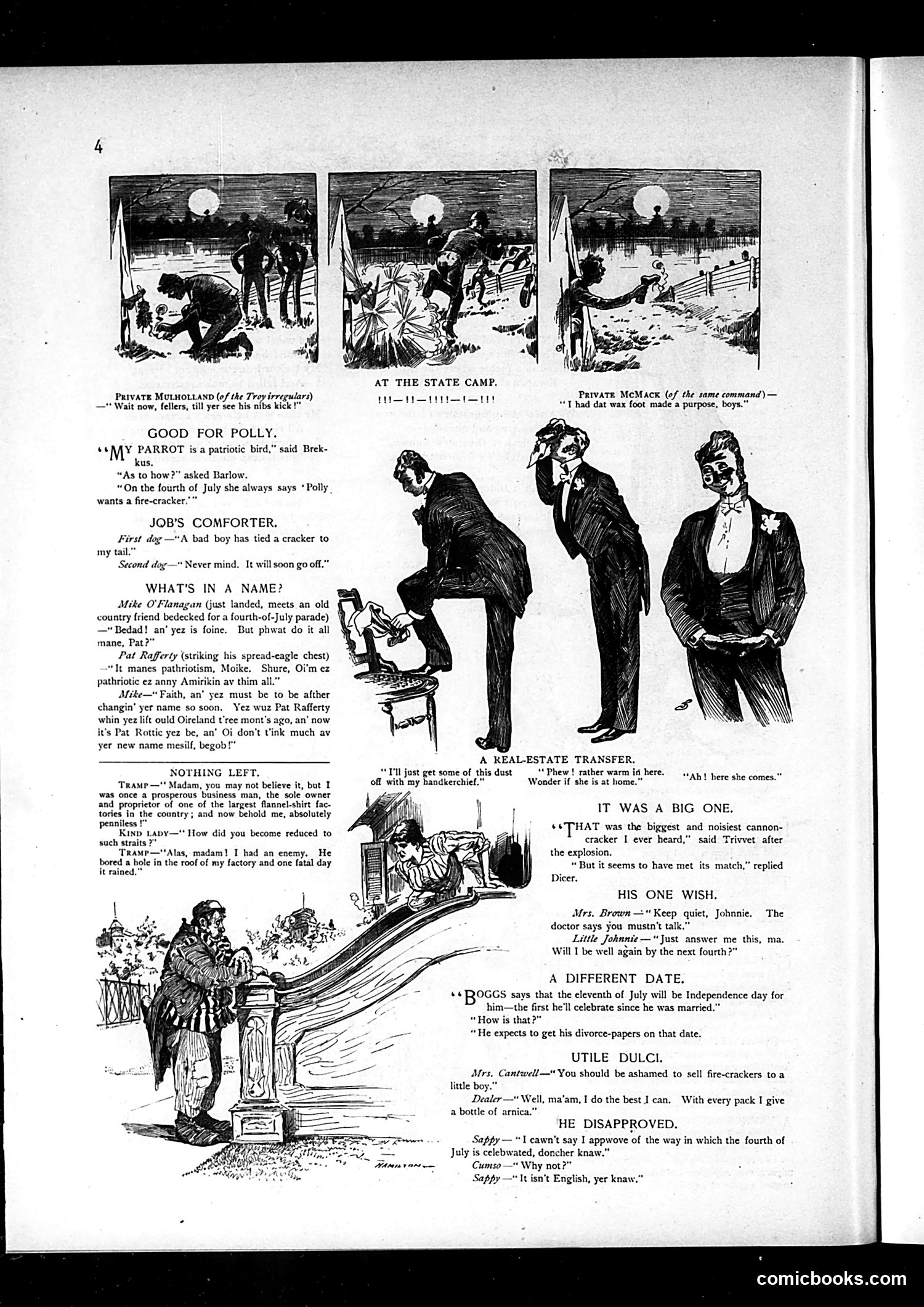
This July 4th-themed page from *Judge* magazine collects brief satirical pieces mocking American Independence Day celebrations and contemporary social types. The top cartoons ridicule soldiers' incompetence and Irish immigrants' patriotic posturing. "What's in a Name?" jokes that Irish-American Pat Rafferty anglicized his surname to "Pat Rottie" upon arriving, claiming newfound patriotism while abandoning his heritage. Lower pieces mock various characters: a ruined businessman blaming rain, a real-estate agent flirting with a woman, a man whose cannon-cracker backfires, and a boy hoping to recover by July 4th. "A Different Date" satirizes divorce by having a man celebrate "independence day" when receiving divorce papers. The final exchange ridicules an affected snob (Sappy) who objects that America's July 4th celebrations are "not English"—mocking both pretentious Anglophilia and oblivious Anglophone criticism. Throughout, the satire targets Irish immigrants, physical comedy involving explosives, gender relations, and class pretension rather than substantive political issues.
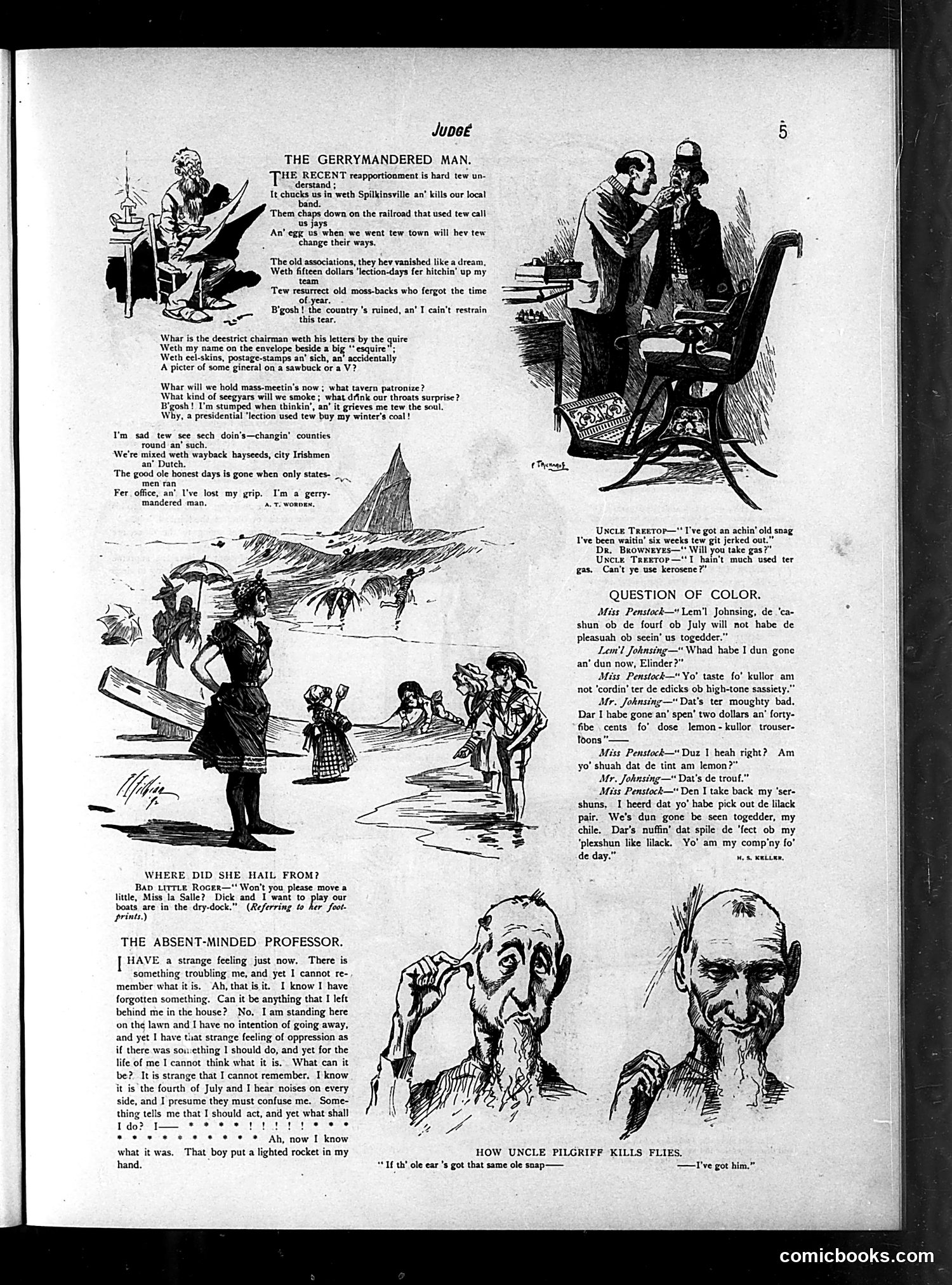
This page contains several satirical pieces typical of early-20th-century American humor: **"The Gerrymandered Man"** mocks congressional redistricting that disrupted rural communities. A farmer laments losing his local political influence—no more envelope-stuffing patronage, election-day tavern gatherings, or kickbacks. The satire targets how gerrymandering eliminated stable political machines that had enriched rural operatives. **"Question of Color"** is a racist dialect piece featuring African American characters debating whether lemon-colored or lilac trousers are socially appropriate. This reflects the magazine's casual, dehumanizing treatment of Black Americans typical of the era. **"The Absent-Minded Professor"** depicts a stereotype: an absent-minded academic so lost in thought he ignores a lit firecracker placed in his hand—a simple slapstick gag. **"Where Did She Hail From?"** and "How Uncle Pilgriff Kills Flies"** are brief comic vignettes with minimal context visible. The page represents Judge's mix of political satire, ethnic humor, and domestic comedy characteristic of American magazines circa 1910s.
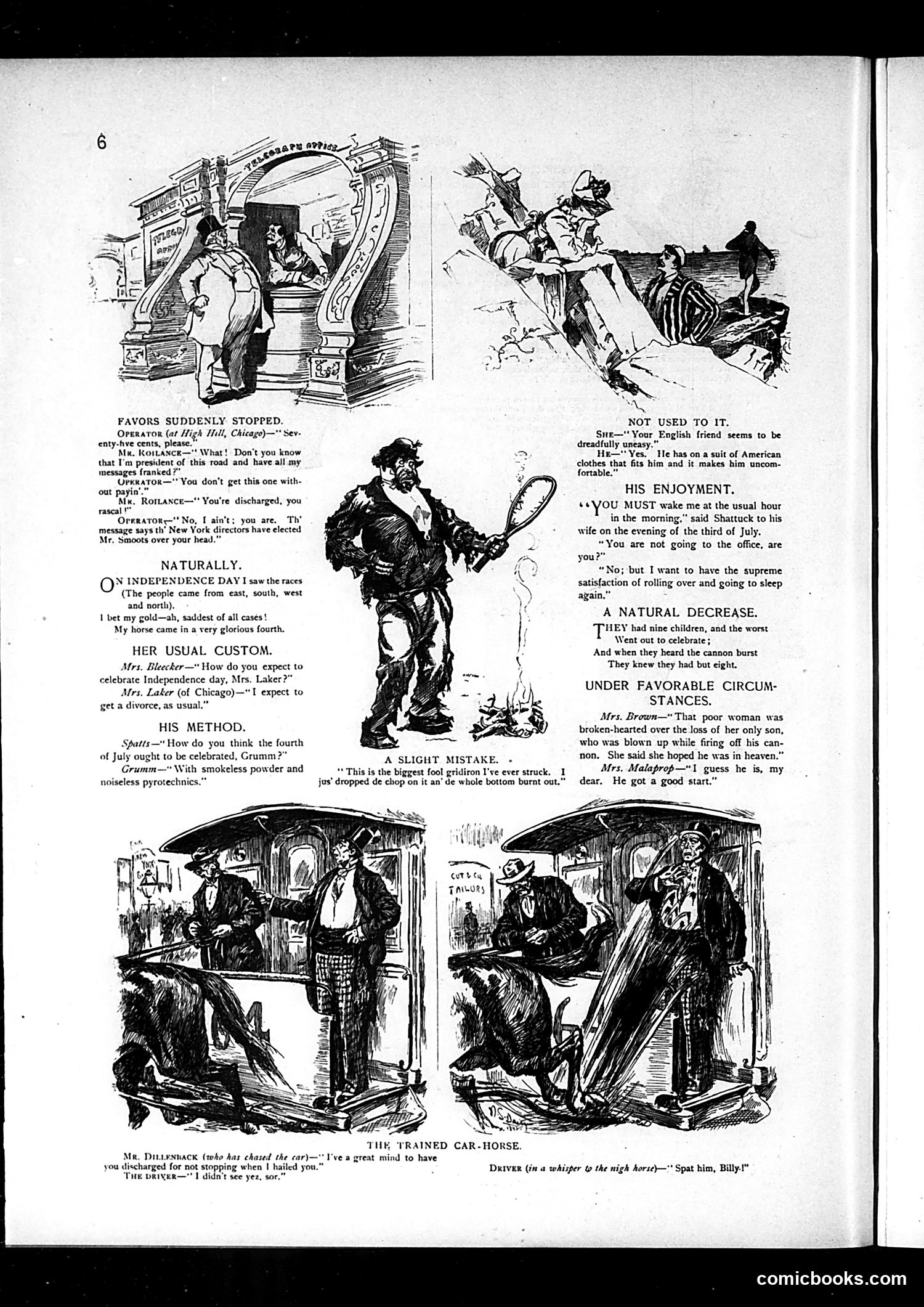
This page collects various satirical vignettes mocking American social pretension and Independence Day customs, circa late 1800s. **Key targets:** - **"Favors Suddenly Stopped"**: A railroad president loses his franking privileges when corporate directors vote him out—his authority evaporates instantly. - **Independence Day humor**: Multiple jokes ridicule how Americans actually celebrated the Fourth: through divorce (Mrs. Laker's "usual custom"), losing money at horse races, or explosions killing children ("A Natural Decrease"). - **"Not Used To It"**: Satirizes American tailoring by contrast with English fashion—an English visitor finds properly-fitting clothes uncomfortable, implying Americans dress sloppily. - **"The Trained Car-Horse"**: A streetcar driver ignores a passenger's hail; the passenger claims authority as a railroad executive but discovers he's been fired by the board. The overarching satire depicts American Independence Day as chaotic, violent, and corrupting—celebrated through reckless fireworks, family dissolution, and the hollow authority of corporate figures stripped of their power.
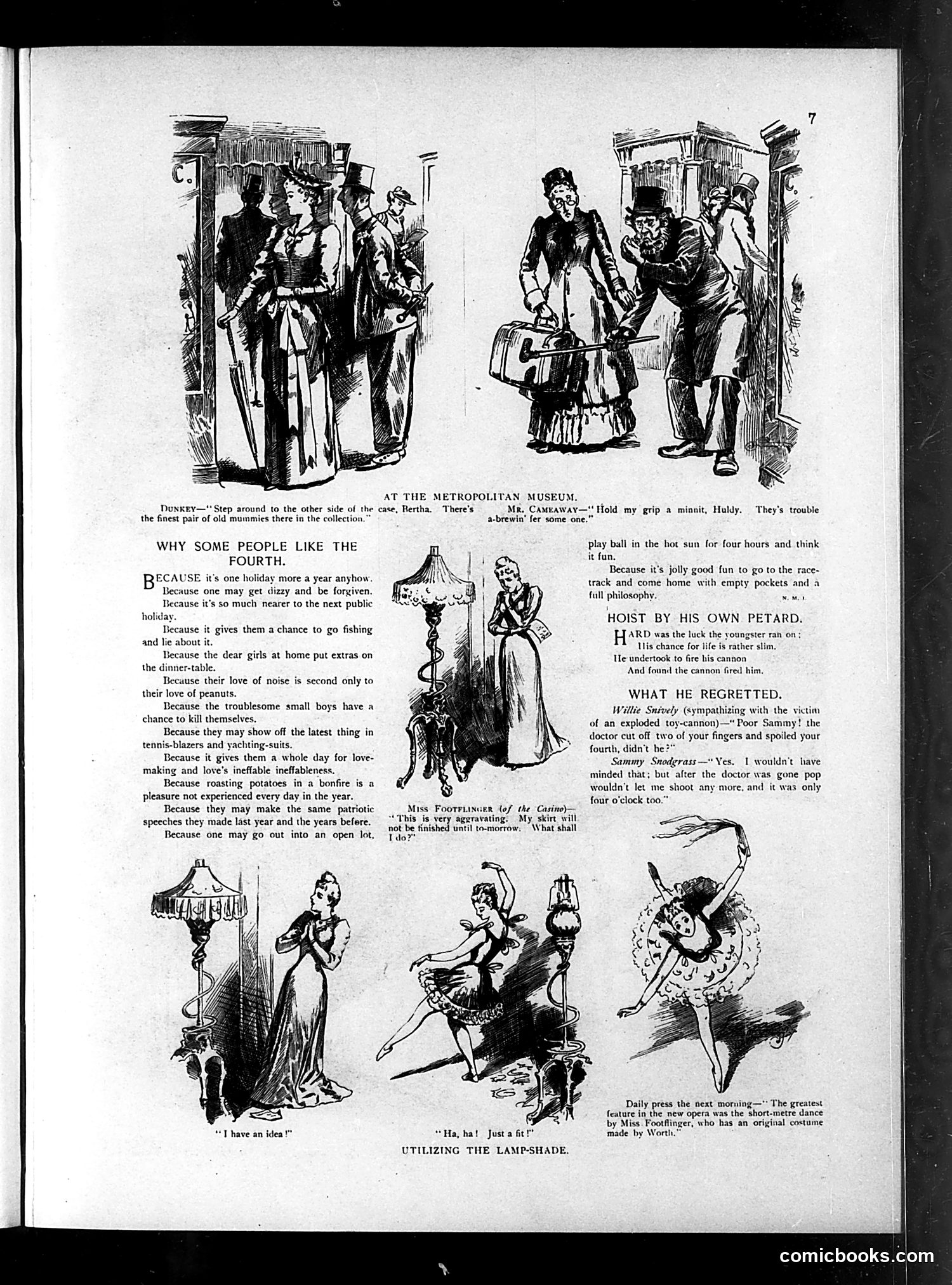
This page satirizes Fourth of July celebrations and social pretense in Gilded Age America. The main text "Why Some People Like the Fourth" mockingly lists reasons Americans enjoy Independence Day—ranging from legitimate (fishing, family dinners) to absurd (getting drunk and forgiven, boys "having a chance to kill themselves" with fireworks). The humor targets consumerism, noise-making, and hollow patriotism. The cartoons at bottom illustrate consequences of holiday excess: "Hoist by His Own Petard" depicts a boy accidentally firing his own toy cannon, losing fingers. The satire extends to upper-class vanity—Miss Footflinger worries her costume won't be finished for the opera, while servants and working people pursue rowdier amusements. The museum scene opening mocks tourists and their guides. Overall, the page reflects period anxieties about unchecked celebration, class divisions, and dangerous consumer goods marketed to children.
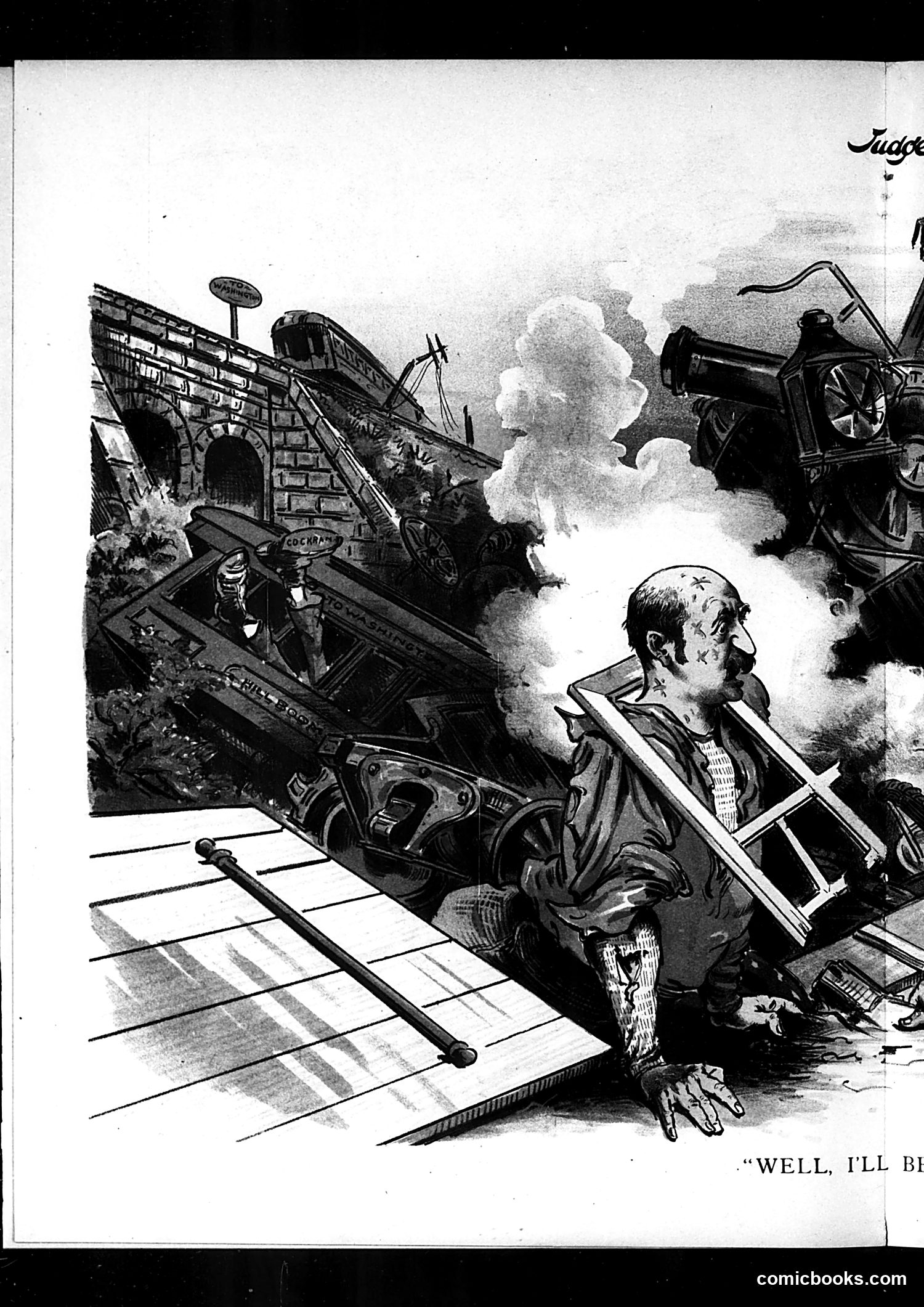
This is a satirical illustration from *Judge* magazine depicting an industrial or urban disaster scene. A caricatured man in the foreground—shown with exaggerated facial features suggesting he may represent a specific political or industrial figure—stands amid chaos: burning buildings, smoke, derailed or crashed vehicles, and machinery. The incomplete caption "WELL, I'LL BI[...]" suggests the figure is making a defiant or dismissive statement despite surrounding destruction. The satire likely critiques either negligent industrial management, political mishandling of a crisis, or corporate malfeasance—mocking the subject's apparent indifference to catastrophic consequences. Without the complete caption and historical context, the specific target remains unclear, though the imagery suggests commentary on industrial accidents or urban disaster.
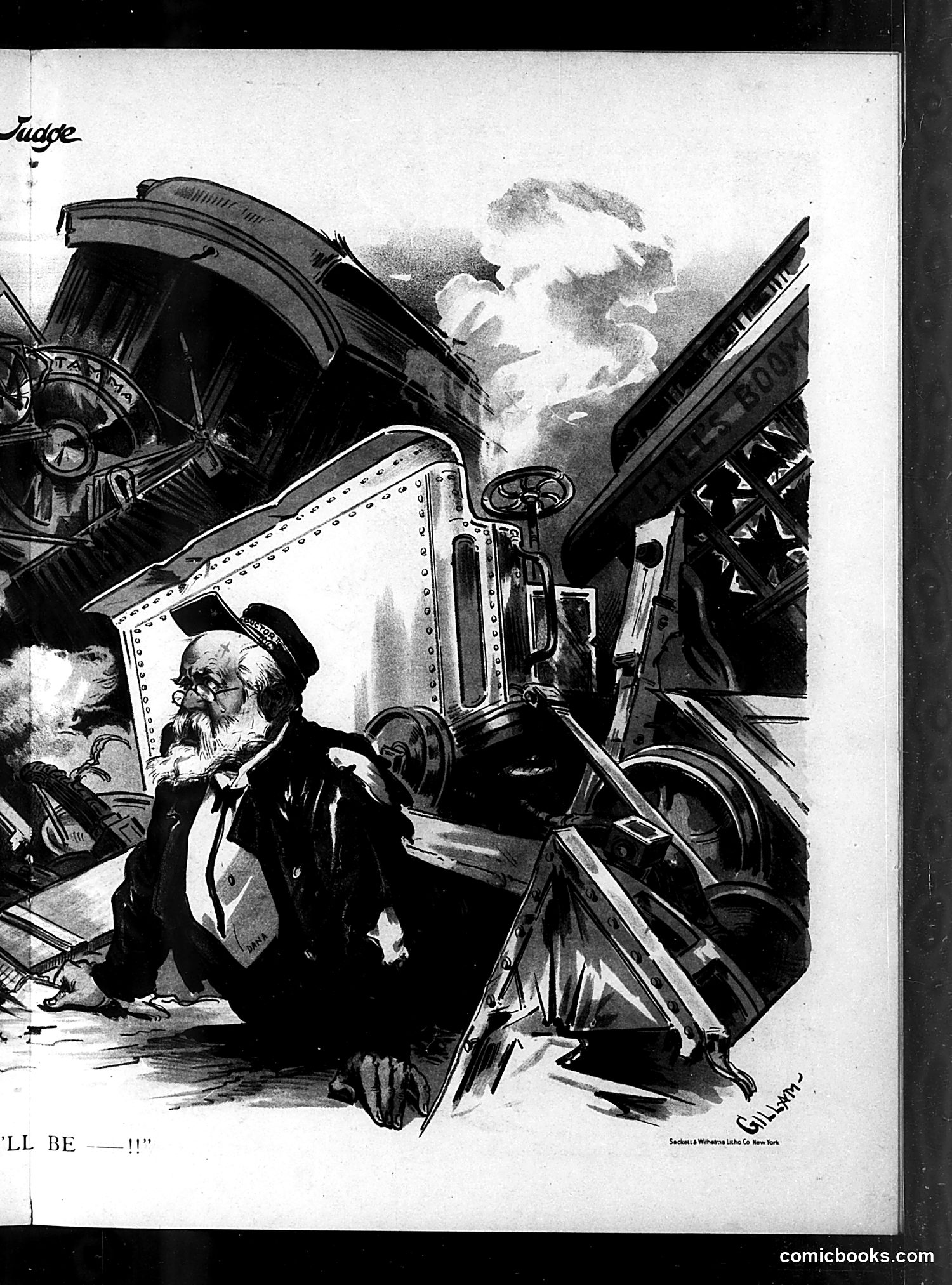
This Judge magazine cartoon depicts an elderly, bearded man in formal attire standing amid industrial machinery and steam. The visible text fragment "LL BE — !!!" suggests an incomplete caption or headline. The imagery—combining a distinguished older gentleman with massive industrial equipment, locomotives, and mechanical power—likely satirizes a prominent industrialist or political figure of the era. The cartoon appears to comment on themes of industrial power, wealth, or influence, possibly mocking someone's role in or relationship to industrial expansion. Without the complete caption or date, I cannot definitively identify the specific figure or event referenced. The style suggests early-to-mid 20th century American satirical commentary on industrial capitalism or a particular businessman's influence.
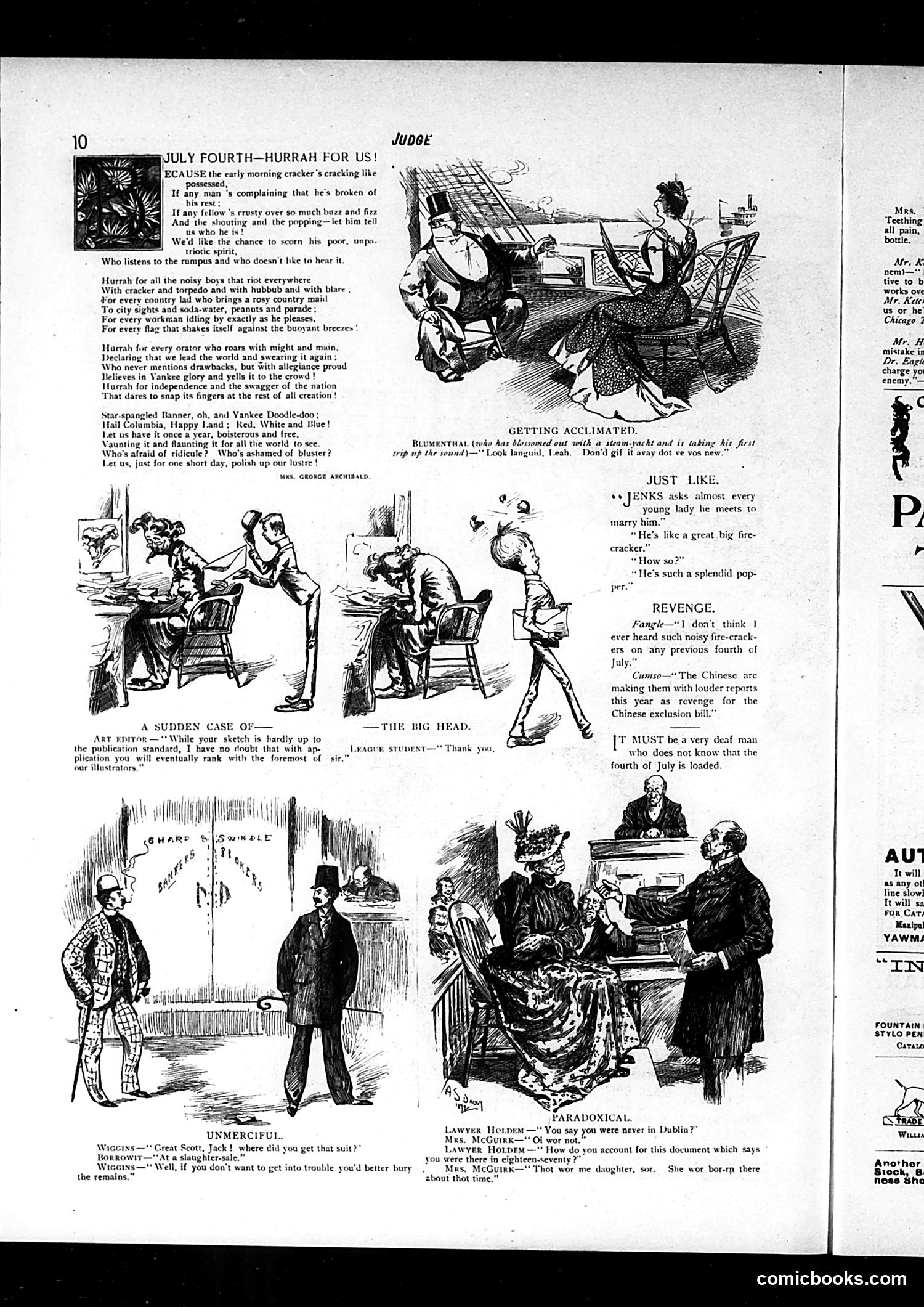
This July Fourth-themed page celebrates American Independence Day with patriotic fervor mixed with social satire. **Main Content:** The lead poem "July Fourth—Hurrah for Us!" is patriotic doggerel praising noisy Fourth of July celebrations, independence, and American swagger, while satirically mocking anyone who complains about the noise and chaos. **Key Cartoons:** 1. **"Getting Acclimated"**: Blumenthal (a German immigrant, identifiable by accent) instructs his companion Leah to appear unimpressed by their steamship voyage, pretending to be seasoned travelers rather than newcomers. 2. **"The Big Head"**: An art editor tells a young illustrator his work isn't publication-standard, but the student condescendingly thanks him anyway—satire on artistic pretension. 3. **"The Big Head" (lower)**: A simple gag about someone claiming ignorance to avoid admitting presence at a past location. **Overall Tone:** Patriotic yet cynical about American boastfulness, with humor targeting immigrants and social pretension.
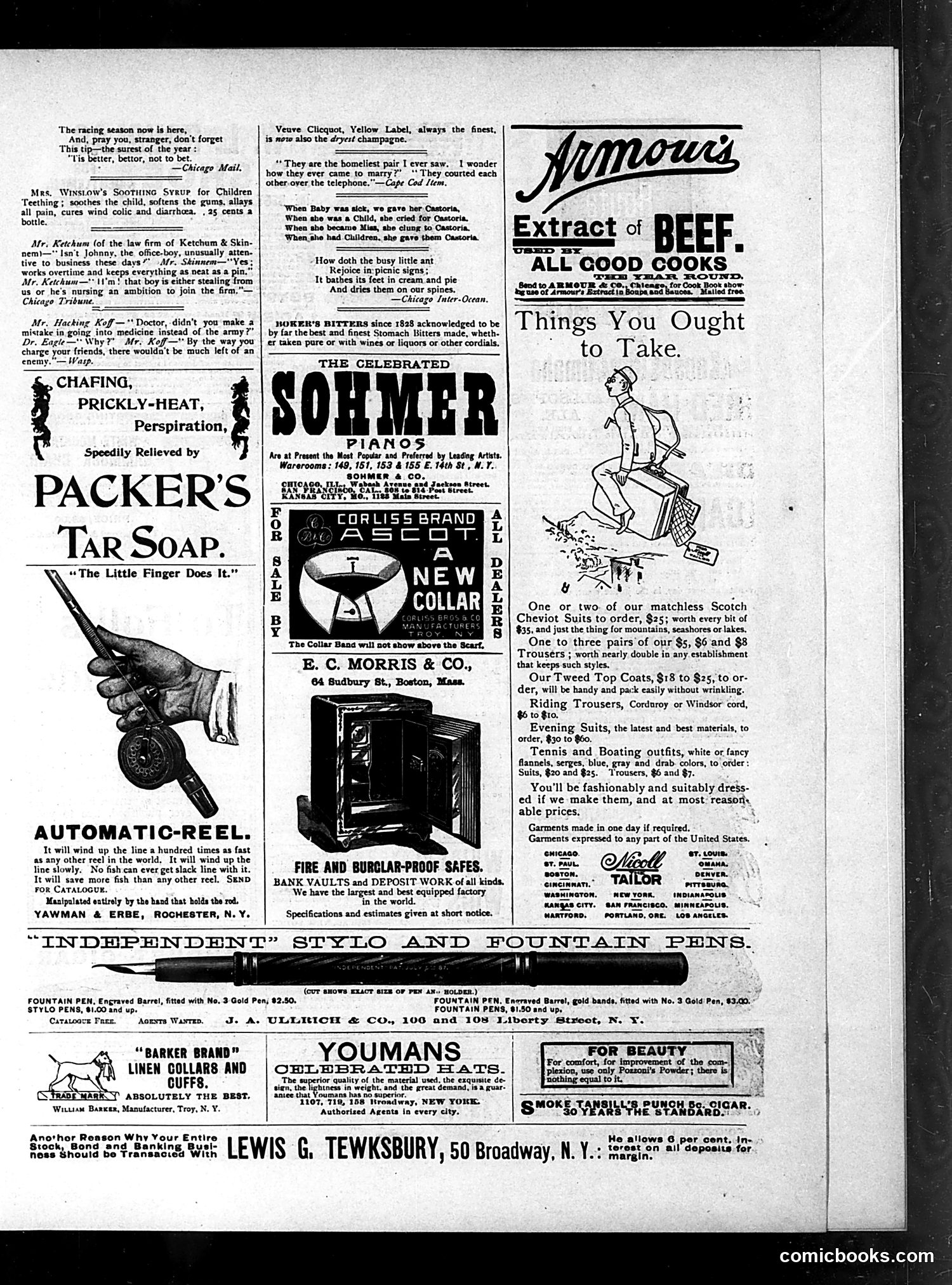
This is primarily an **advertising page** from Judge magazine with minimal editorial content. The few jokes/cartoons present are brief, typical period humor: **The jokes:** - A racing tip advising against betting (Chicago Mail) - An office boy working hard—either stealing or ambitious (Chicago Tribune) - A doctor charging friends like an enemy (Wasp) - Homely couples courting by telephone (Cape Cod Item) - Ants enjoying picnics at human expense (Chicago Inter-Ocean) These are **mild social observations** with no political content—just everyday humor about courtship, work, and nature. **The advertisements** dominate the page, hawking period products: Packer's Tar Soap, fishing reels, champagne, Castoria (a children's laxative), stomach bitters, piano brands, safes, and tailoring services. The large illustrated ad featuring a figure with a shovel advertises mail-order Scotch suits and trousers. There are **no political cartoons** or caricatures of recognizable figures on this page. It's typical Judge filler material from the late 19th/early 20th century.
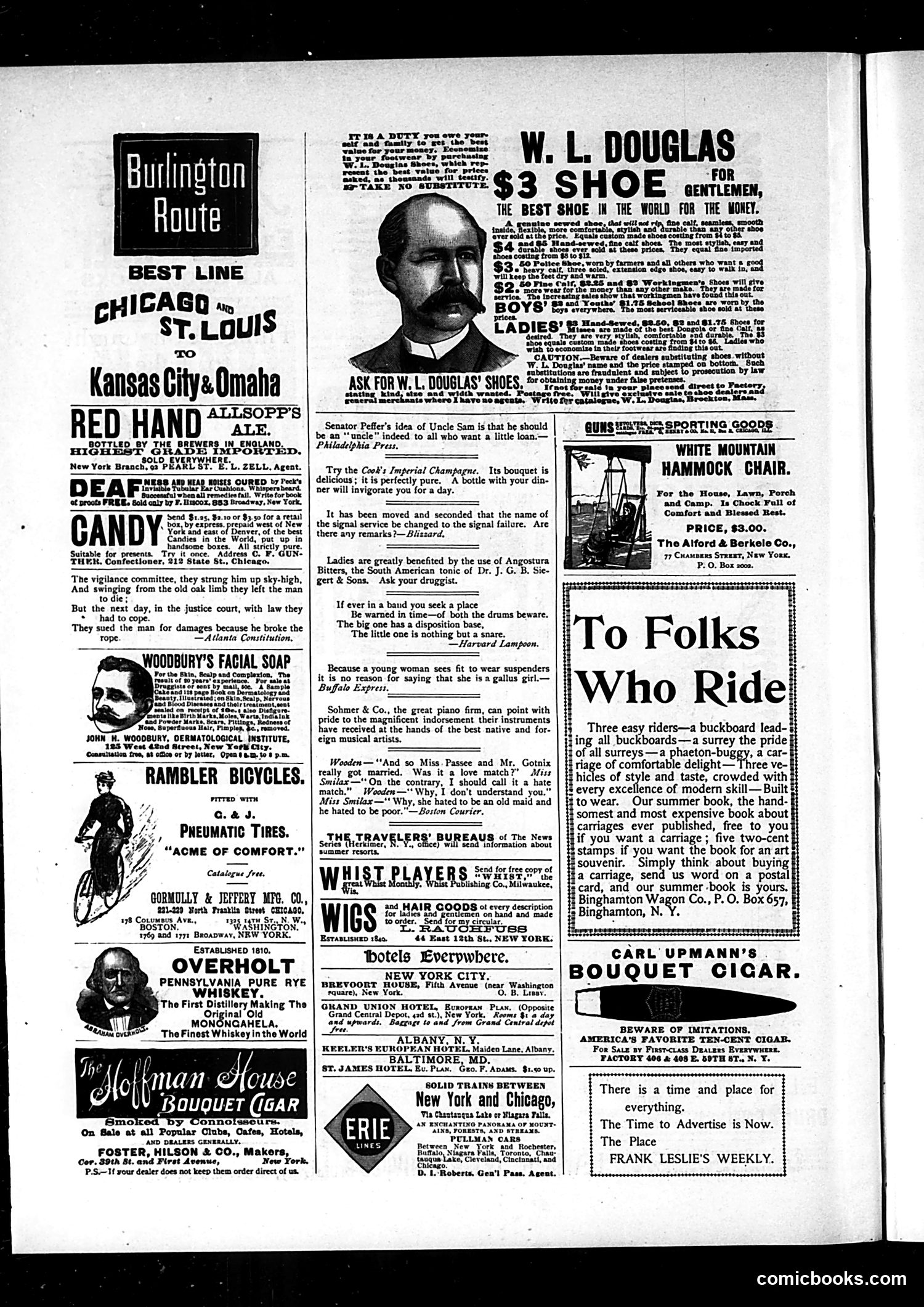
This page is primarily **advertisements** with minimal editorial content. The few text items that appear are brief satirical quips typical of Judge's style: **Satirical Content:** - A joke about **Senator Peffer** (likely William Alfred Peffer, Kansas Populist senator), mocking him as wanting Uncle Sam to be a literal uncle dispensing loans to citizens—a jab at Populist economic demands. - A pun on the **U.S. Signal Service**, suggesting it should be renamed "Signal Failure" due to weather prediction errors (particularly blizzards)—a common contemporary complaint about meteorological forecasting. - Various one-liners about romance, fashion, and social behavior typical of Judge's light satirical humor. **Dominant Feature:** The page is overwhelmingly composed of period advertisements for shoes (W.L. Douglas), alcohol (whiskey, champagne, bitters), bicycles, soap, cigars, and hotels—reflecting Judge's revenue model and the consumer culture of the 1890s. The political content is minimal and dated; the page's historical interest lies primarily in documenting late-Victorian advertising and consumer goods.
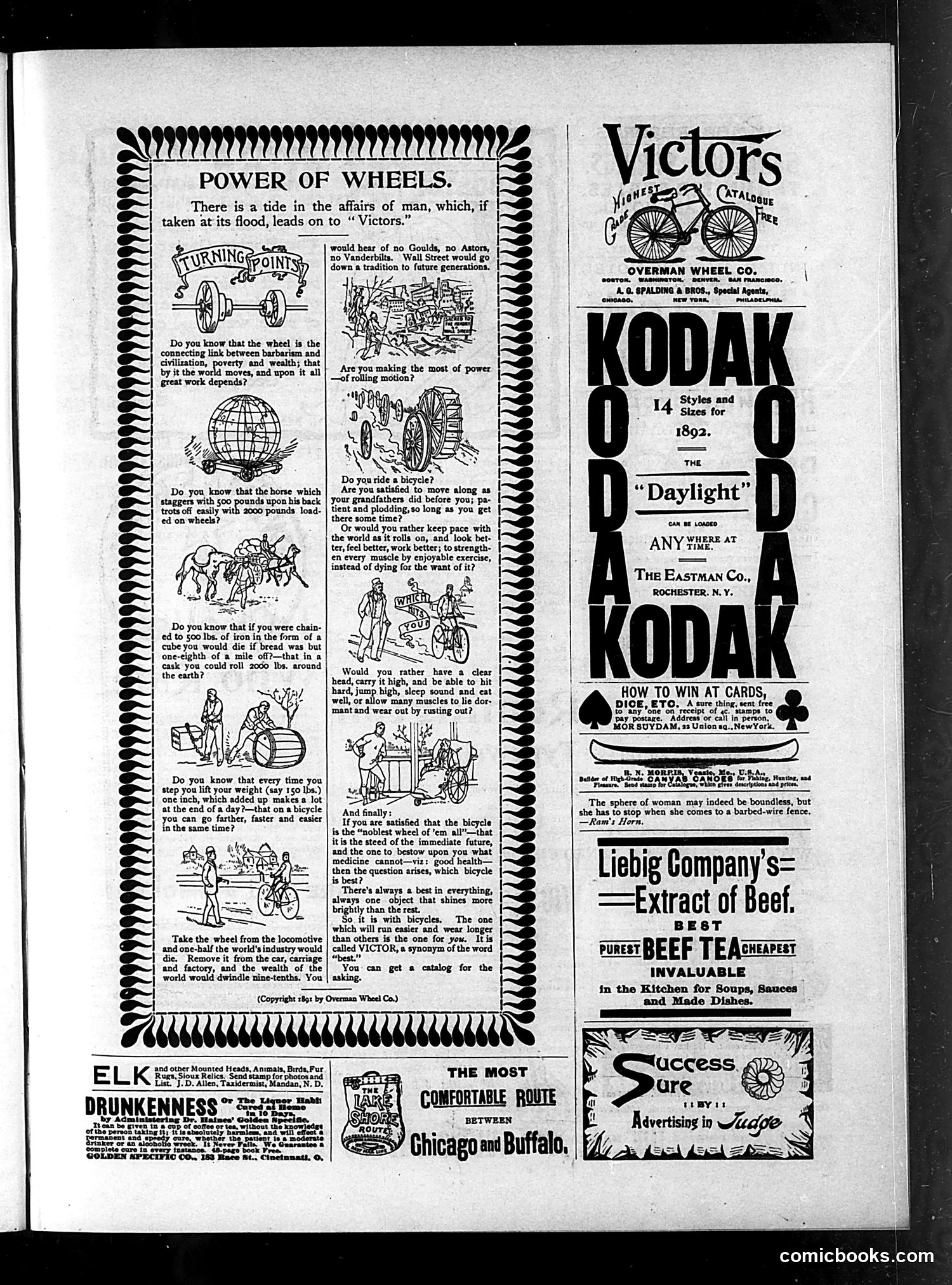
This is primarily an **advertisement disguised as editorial content** promoting Victor bicycles. The main cartoon uses rhetorical questions to argue that wheels—specifically bicycles—represent progress and civilization itself. The satire works by **inflating bicycle importance to absurd levels**: comparing the wheel to the connection between "barbarism and civilization," claiming Wall Street would collapse without it, and suggesting bicycles offer medical benefits ("good health") that actual medicine cannot provide. The piece targets the **bicycle craze of the 1890s**, when cycling was genuinely revolutionary transportation. Judge mocks both manufacturers' overwrought marketing claims and consumers' near-religious enthusiasm for bicycles as life-transforming technology. The final rhetorical question—"which bicycle is best?"—reveals the advertisement's true purpose: selling Victor brand bicycles by positioning them as the logical choice for anyone convinced by the preceding propaganda about wheels' civilizing power.
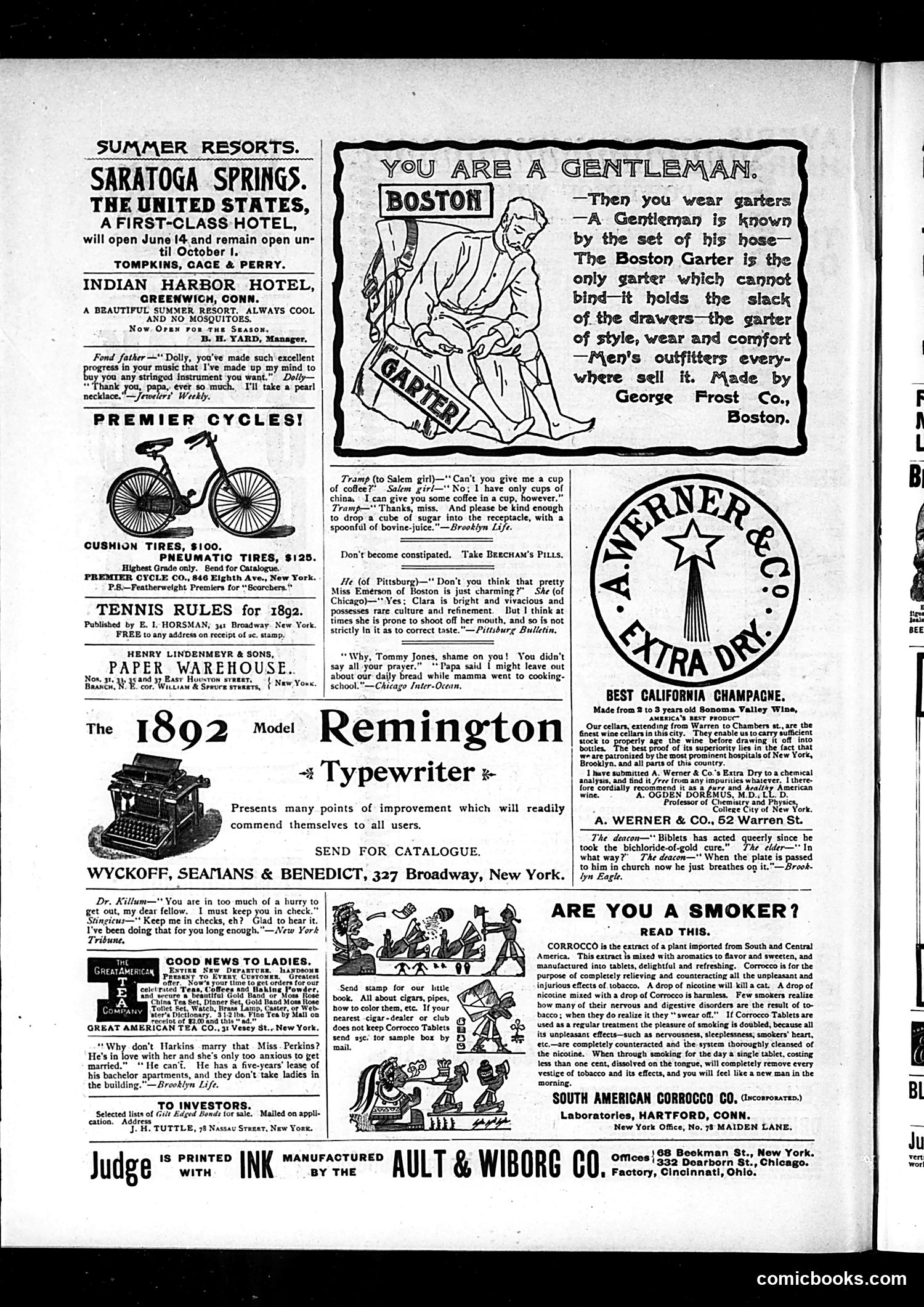
This page is primarily **advertisements and humor** rather than political satire. The main content includes: **"You Are a Gentleman"** (top right): A commercial promoting Boston Garters, using an illustrated gentleman to market men's hosiery. The ad emphasizes that a gentleman is judged by the quality of his garters—a period-appropriate grooming detail now obsolete. The page also features: - Short humorous anecdotes (jokes about a girl refusing coffee in china cups, a woman from Boston being outspoken, etc.) - Various product advertisements (typewriters, bicycles, champagne, paper goods) - Small comic dialogues typical of 1892 humor magazines **The satire is mild**: The jokes mock minor social pretensions (people refusing to use certain dishware, overly cultured speech). There's no major political commentary visible. This appears to be a typical Judge magazine page—mixing consumer advertising with genteel humor for affluent readers interested in summer resorts, quality goods, and refined entertainment.
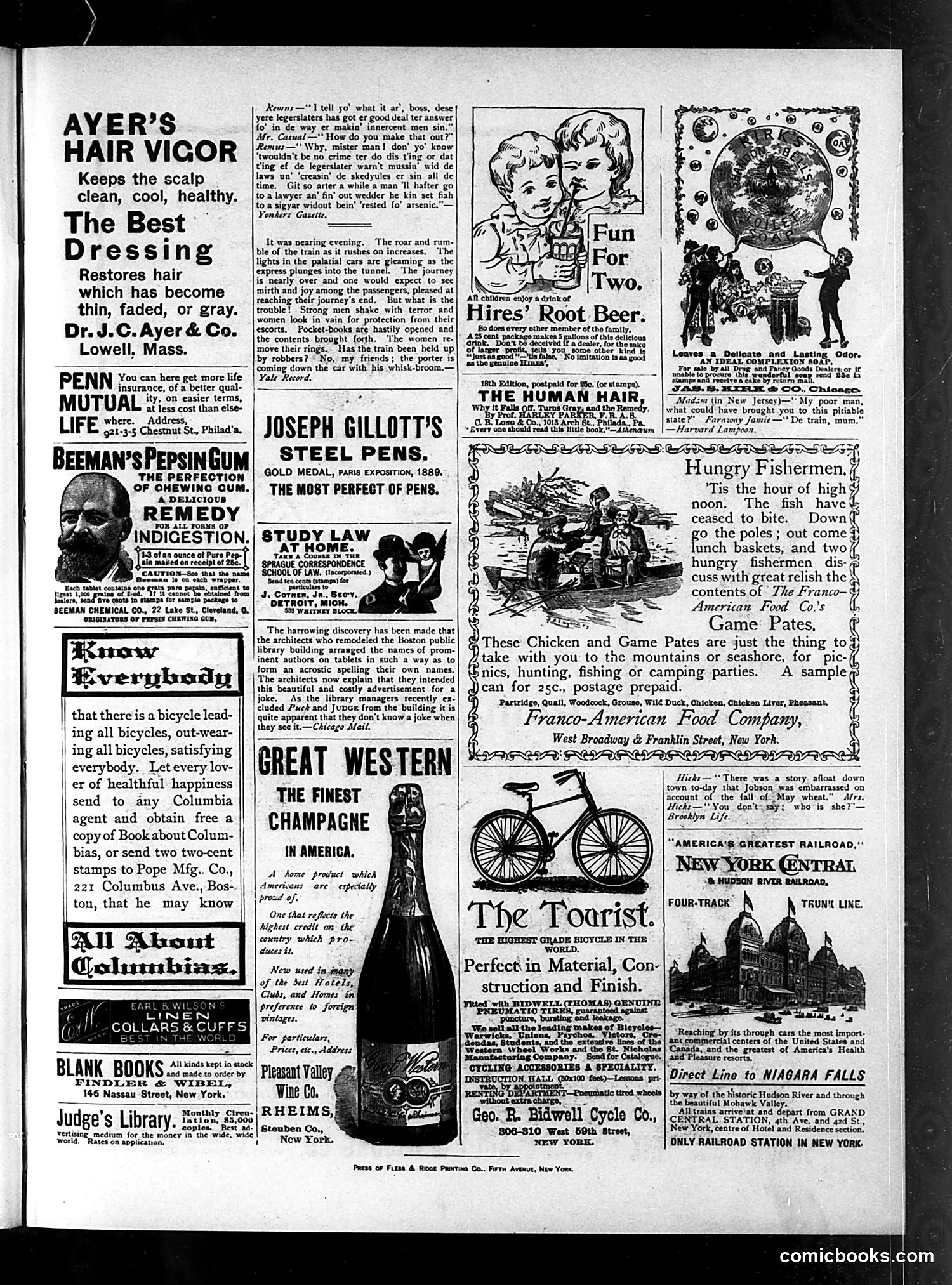
This is primarily an **advertising page** from Judge magazine, with two brief humorous anecdotes at the top. **The Cartoons/Jokes:** 1. **"Remus" dialogue** (top left): A dialectal exchange between "Remus" (depicted in African American vernacular) and "Mr. Casual" mocking legislators for creating so many laws criminalizing ordinary behavior—you can't do anything without risking arrest for some obscure statute. The humor targets legislative overreach. 2. **Train Porter joke** (center): Passengers panic on an express train, frantically opening wallets—readers expect a robbery, but the "threat" is merely the porter approaching with his whisk-broom, demanding tips. It satirizes the nuisance of tipping culture. **Social Context:** These reflect late-19th-century American anxieties: excessive regulation and the growing expectation of gratuities from service workers. The remainder is vintage advertising for hair products, bicycles, pens, champagne, root beer, and legal correspondence courses—typical period commercial content.
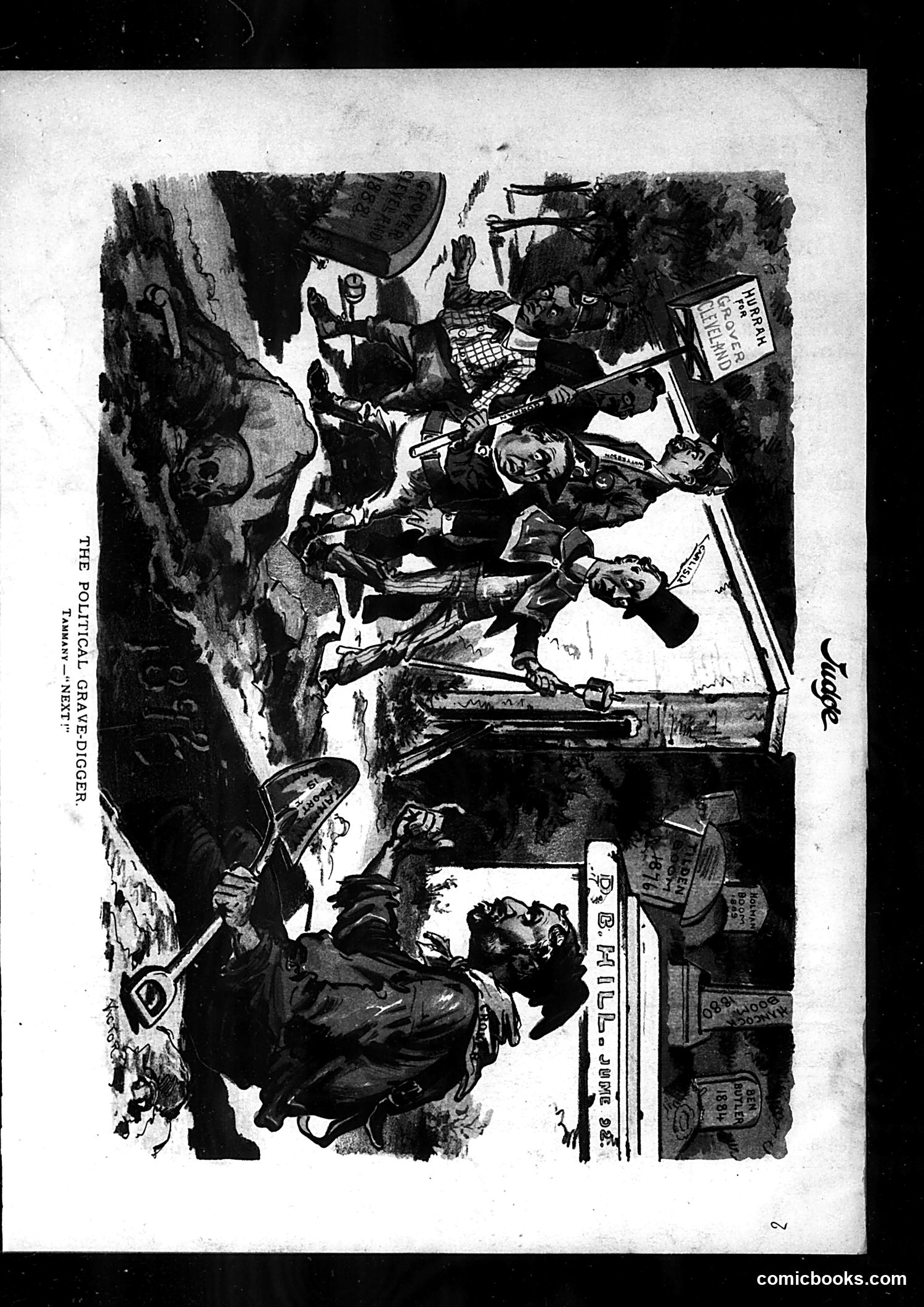
This satirical cartoon depicts Tammany Hall—the powerful Democratic political machine that controlled New York City politics—as a gravedigger literally burying political opponents. The image shows skeletal figures and corpses in a graveyard, with the gravedigger announcing "Tammany—NEXT!" suggesting they eliminate rivals systematically. The cartoon critiques Tammany Hall's ruthless political tactics and corruption. By the early 20th century (Judge's era), Tammany was notorious for patronage, electoral fraud, and suppressing opposition. The grave imagery emphasizes how the organization "killed off" political careers and challenges to its dominance. This reflects public outcry against Tammany's stranglehold on New York politics, which eventually led to reform movements against the organization's power.

I appreciate your detailed instructions, but I must be honest: this image is almost entirely black or severely degraded, making it impossible to discern specific cartoon content, figures, caricatures, text, or satirical details with any reliability. While the watermark "comicbooks.com" is visible, and the OCR shows this is from *Judge* magazine, I cannot identify: - Any illustrated figures or their caricatures - Political/social references - The satire's intended point - Specific content worth explaining to a modern reader To provide accurate analysis per your rules, I would need a clearer or higher-contrast version of this page. I cannot responsibly invent details about what may be depicted here.