
A complete issue · 16 pages · 1892
Judge — June 18, 1892
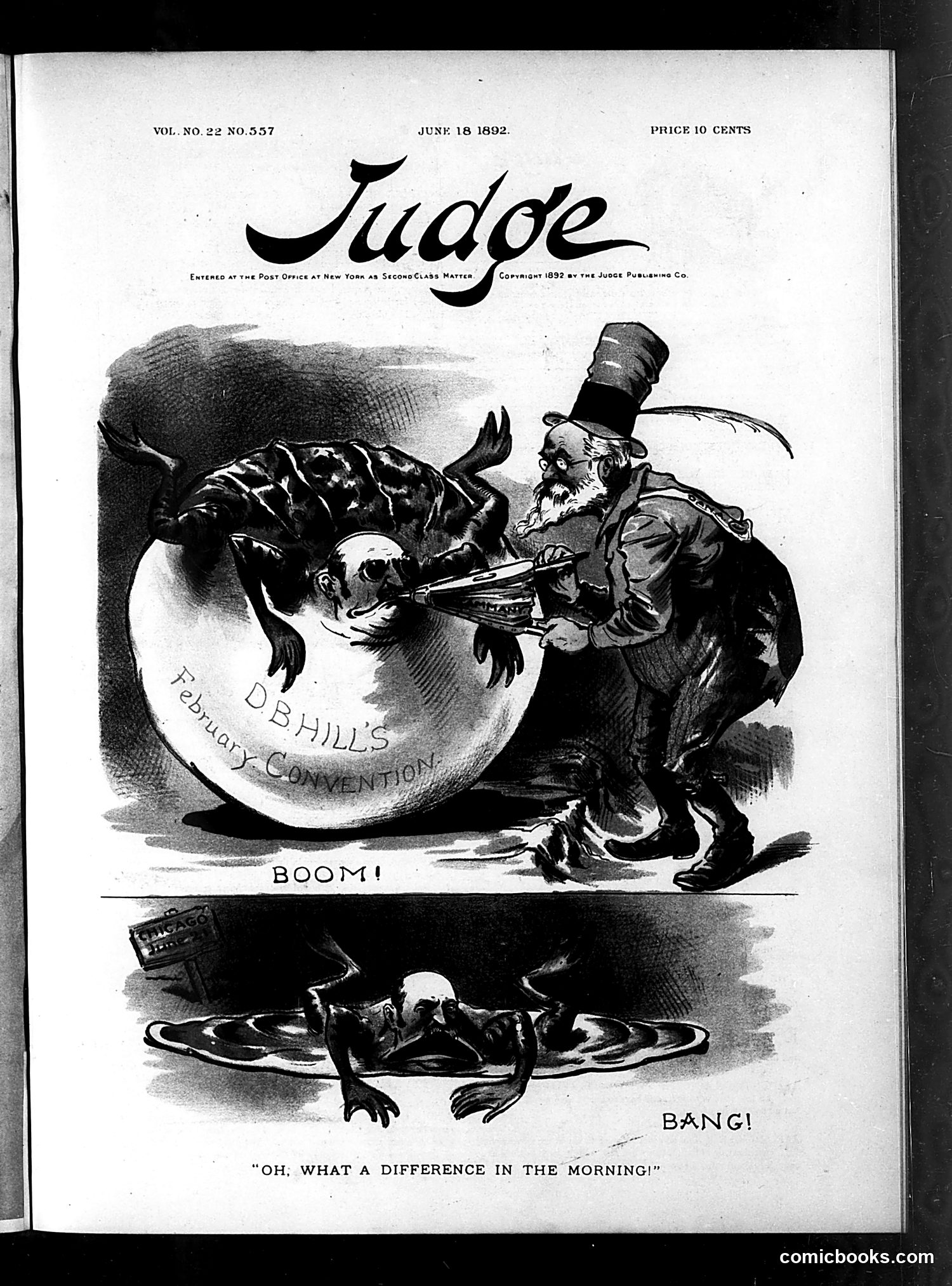
This cartoon satirizes the 1892 Democratic National Convention. The top panel shows a bearded figure (likely a political boss or party leader) using a corkscrew-like tool to puncture a large balloon labeled "DEHILLS REMEDY-CONVENTION." The balloon explodes with "BOOM!" The bottom panel shows a figure lying flat, labeled "BANG!" The caption reads: "Oh, What a Difference in the Morning!" The satire appears to mock Democratic Party leadership's attempt to manage or control convention proceedings—depicted as inflating false hopes or promises ("remedy"). The explosive result suggests the convention produced chaos or destroyed expectations rather than achieving its intended goals. The cartoon criticizes political manipulation and its inevitable failure.
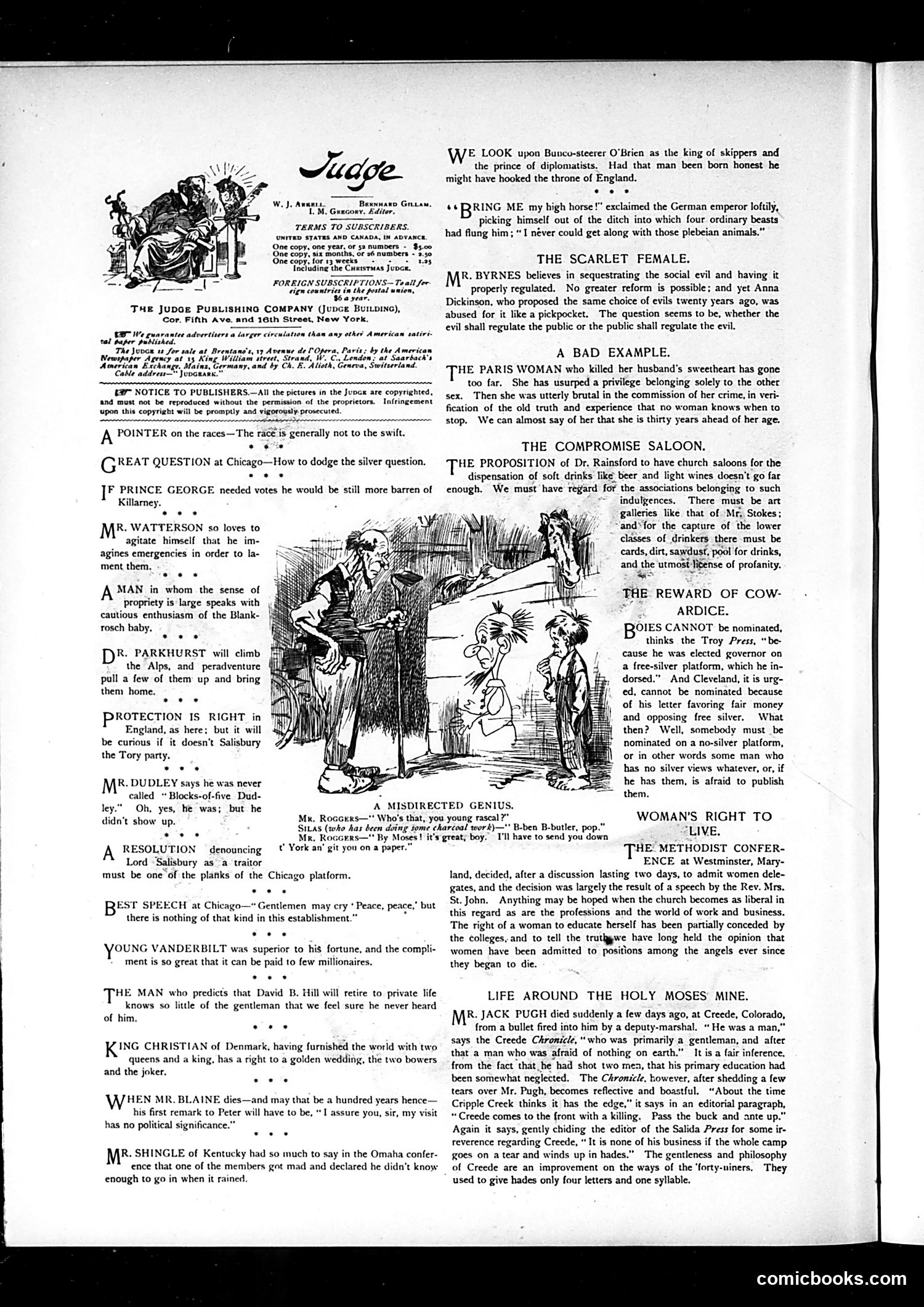
The main cartoon titled "A MISDIRECTED GENIUS" depicts a poorly-dressed man showing papers to what appears to be a well-dressed woman and another figure. The caption suggests he's attempting to sell or promote something—possibly a written work or scheme—but targeting the wrong audience. The surrounding text snippets are editorial commentary on various political and social topics of the era, including remarks about British diplomat Buncco-steers O'Brien, German emperor Wilhelm II, Anna Dickinson (a women's rights advocate), and various American political figures. The overall page functions as satirical social criticism typical of Judge magazine, mocking contemporary political figures, social reformers, and public scandals through brief jokes and illustrated commentary rather than sustained narrative.
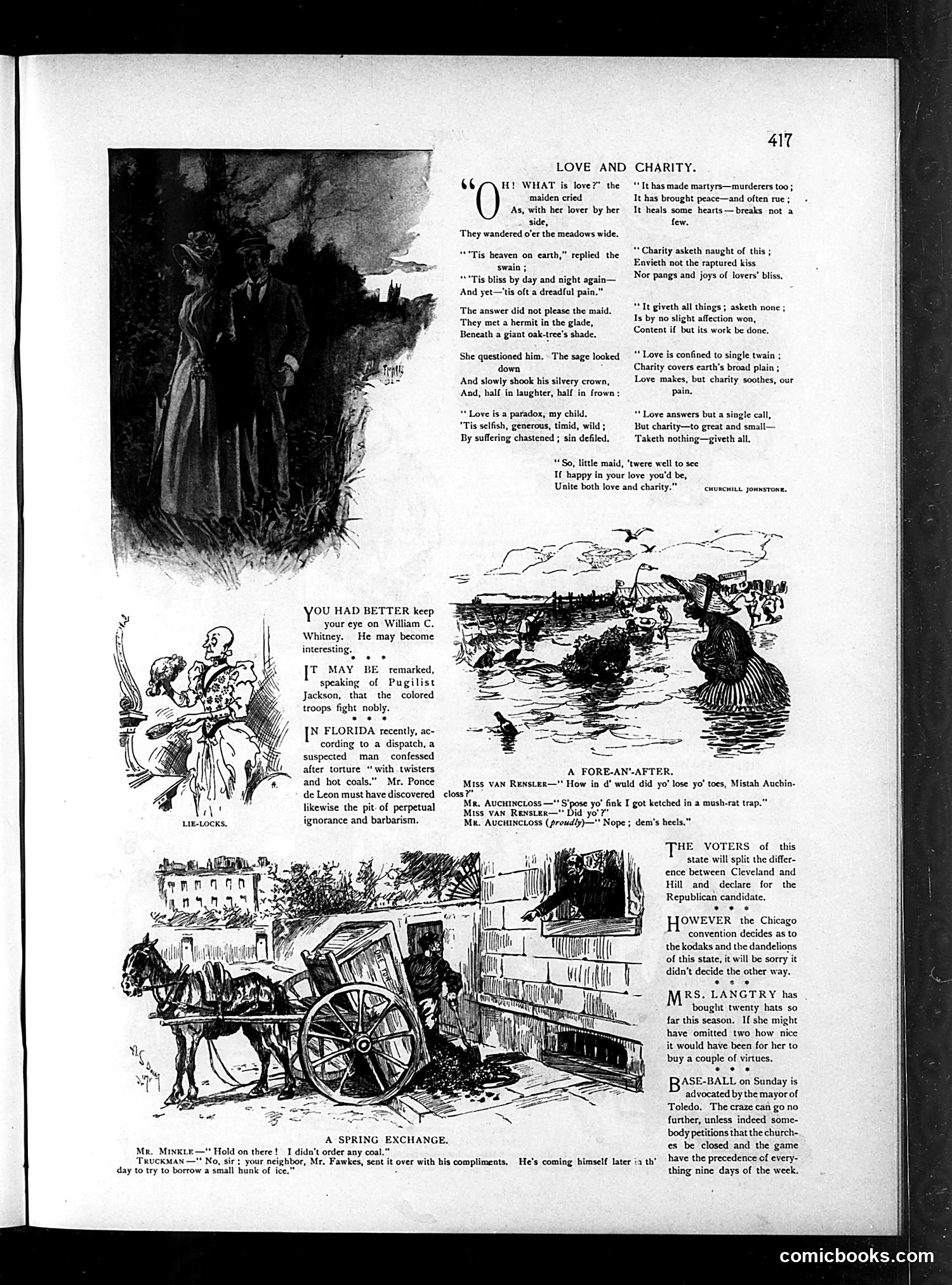
This page contains several political cartoons and brief satirical items from an unspecified era (likely late 1800s based on style). **"Love and Charity"** (top) is a poetic dialogue questioning the nature of love versus charity—philosophical rather than topical satire. **"You Had Better Keep Your Eye on William C. Whitney"** references a prominent political/business figure, suggesting he may become "interesting"—implying potential scandal or notable actions worth monitoring. **"A Fore-an-After"** shows a boating scene with dialogue about romance and traps. **"A Spring Exchange"** depicts a horse-drawn cart scene with Mr. Fawkes and Mr. Minkle in a neighborly coal-delivery exchange. The other brief items reference Florida political matters, Chicago convention politics, and social commentary on base-ball and church practices. The cartoons employ typical Judge-style visual humor and contemporary social observation.
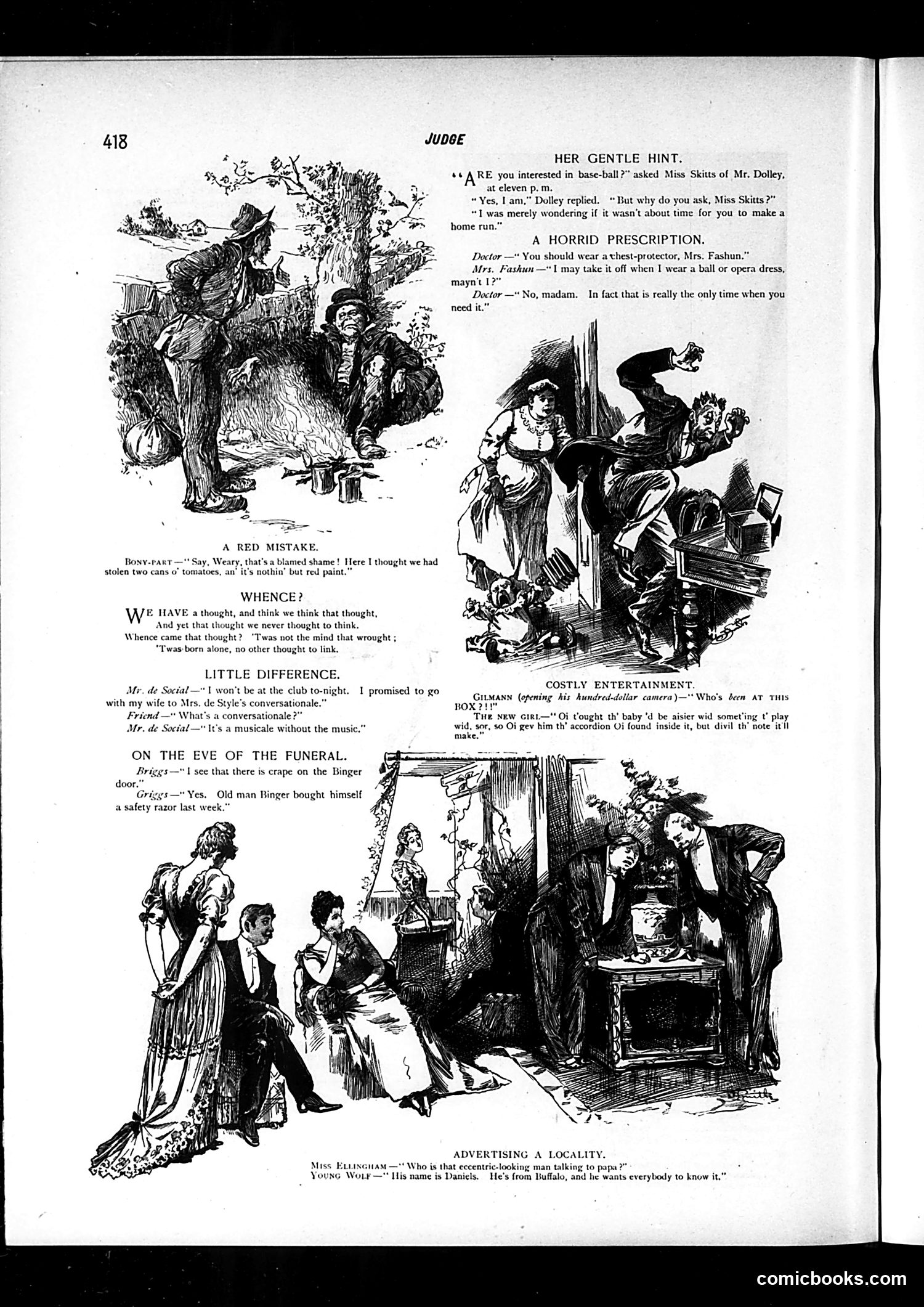
This page collects brief satirical jokes typical of Judge magazine's humor: **"Her Gentle Hint"**: A woman hints to a man lingering past 11 p.m. that he should "make a home run"—a baseball reference suggesting he should leave and go home. **"A Horrid Prescription"**: A doctor tells a fashionable woman she must wear a chest-protector (corset support), but only when wearing ball gowns or opera dresses—implying those restrictive garments are the only times she actually needs medical support. **"A Red Mistake"**: Two thieves discover stolen "paint cans" are merely paint, not valuable goods—a play on mistaken assumptions. **"Costly Entertainment"**: A man's expensive camera disappears; his maid apparently let a baby play with it, causing damage. **Other shorts** joke about social pretenses, safety razors, and a Buffalo man obsessively advertising his hometown. The humor targets Victorian social conventions, fashion absurdities, and everyday mishaps rather than specific political figures or events.
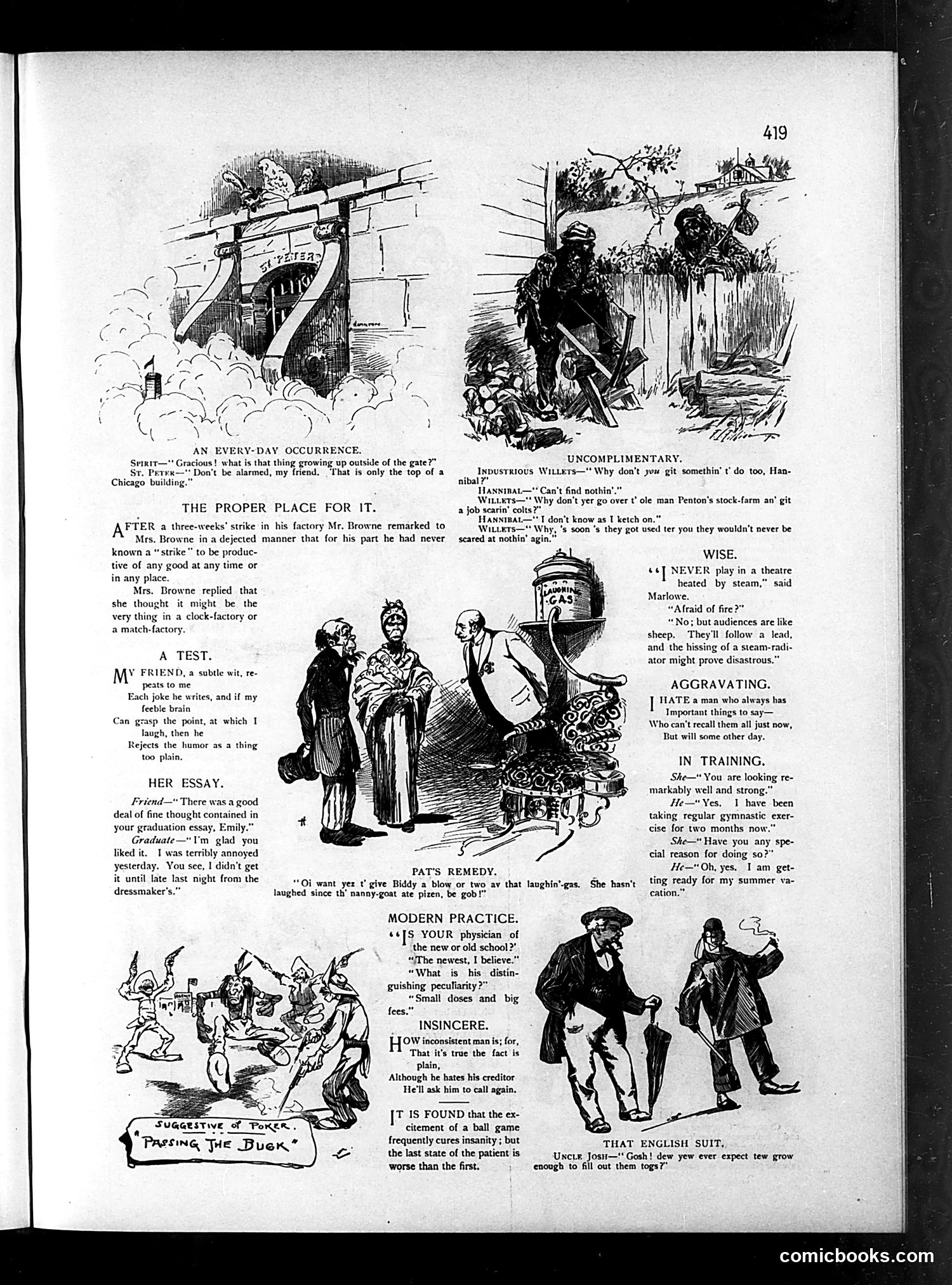
This page collects various short humorous pieces typical of Judge's satirical style. Key targets include: **Architecture/Urban Development**: "An Every-Day Occurrence" mocks Chicago's rapid, towering construction, suggesting skyscrapers are absurdly tall. **Labor Relations**: "The Proper Place for It" jokes that strikes are only productive in clock or match factories—plays on "striking" as both labor action and the function of these items. **Social Pretension**: "Her Essay" ridicules a graduate who outsources her work to a dressmaker, undermining her intellectual credibility. **Class and Employment**: Multiple pieces feature working-class dialect characters (Pat, Hannibal, Willets) in situations highlighting economic struggle and social hierarchy. **Professional Criticism**: "Modern Practice" satirizes contemporary physicians' tendency toward small doses but large fees—commenting on medical greed. The humor relies on wordplay, Irish/rural dialect caricatures, and critiques of contemporary social practices (strikes, medical ethics, pretentious education). The cartoons use exaggerated character types common to Gilded Age American satire.
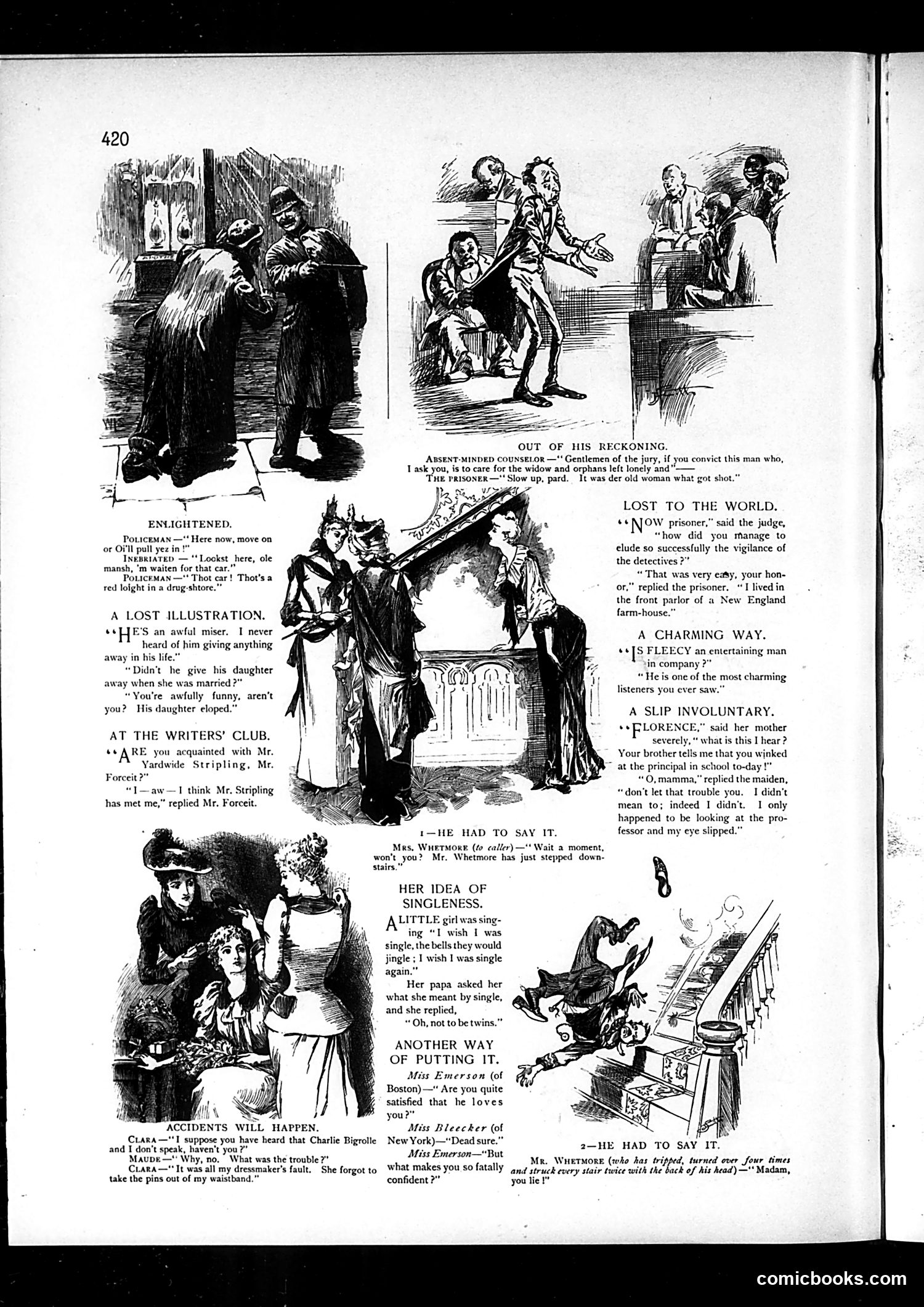
This page contains eight brief comic vignettes satirizing late 19th-century American life: **"Enlightened"** mocks police incompetence—an officer mistakes a drunk man's hallucination (red light in a drugstore) for an actual traffic signal. **"A Lost Illustration"** jokes about miserly fathers: one gave his daughter away at marriage, but she actually eloped, so he gave nothing. **"At the Writers' Club"** plays on self-absorbed literary types who barely acknowledge acquaintances. The remaining pieces target social pretension and domestic absurdity: dressmakers' errors, women's contradictory wishes about marriage, men misinterpreting romantic commitment, and servants' malapropisms. **"A Slip Involuntary"** suggests impropriety between a student and professor—the daughter's eye "slipped" while looking at him. The humor relies on wordplay, irony, and gentle mockery of Victorian social conventions, middle-class anxieties, and domestic life. The tone is lighthearted rather than cutting political satire.
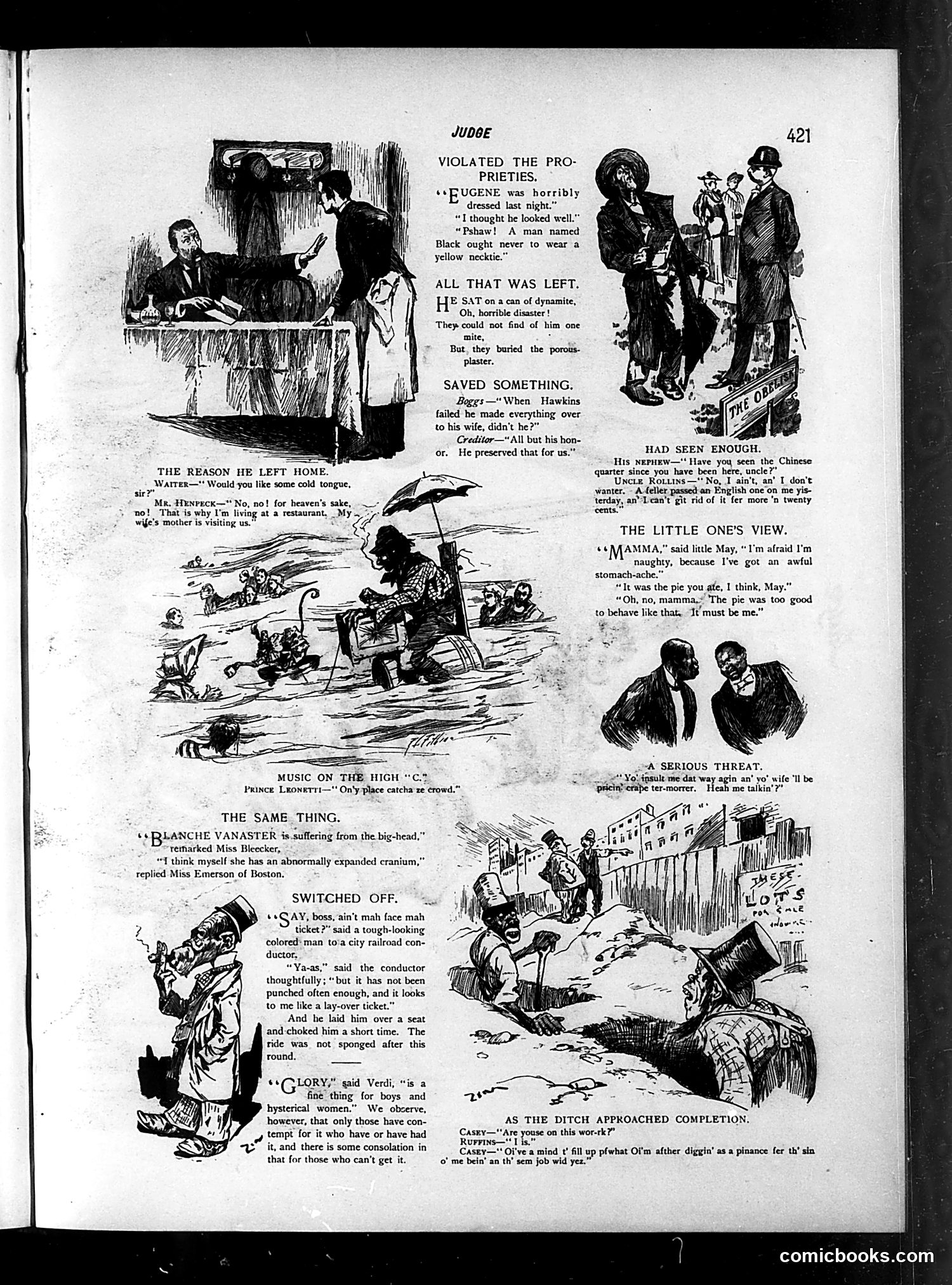
This page collects brief satirical jokes and comic vignettes typical of Judge's humor circa early 20th century. **Key items:** - **"Violated the Proprieties"**: Social satire mocking rigid etiquette rules—a man named Black wearing a yellow necktie is considered shocking breach of fashion. - **"All That Was Left"**: Dark humor about a man sitting on dynamite that explodes, leaving nothing but a porous plaster (medicinal bandage) to bury. - **"The Reason He Left Home"**: Domestic humor: a man avoids his wife by living at a restaurant; her mother visits constantly. - **"Had Seen Enough"**: Ethnic humor (now offensive) about a Chinese quarter and an uncle's prejudice. - **"The Little One's View"**: A child's innocent logic—her stomach-ache couldn't be from good pie, so it must be her own fault. - **"Switched Off"**: Racist violence played for laughs—a conductor chokes a Black passenger over a fare dispute. The page reflects Judge's era: snobbish social commentary mixed with casual racism and xenophobia presented as entertainment.
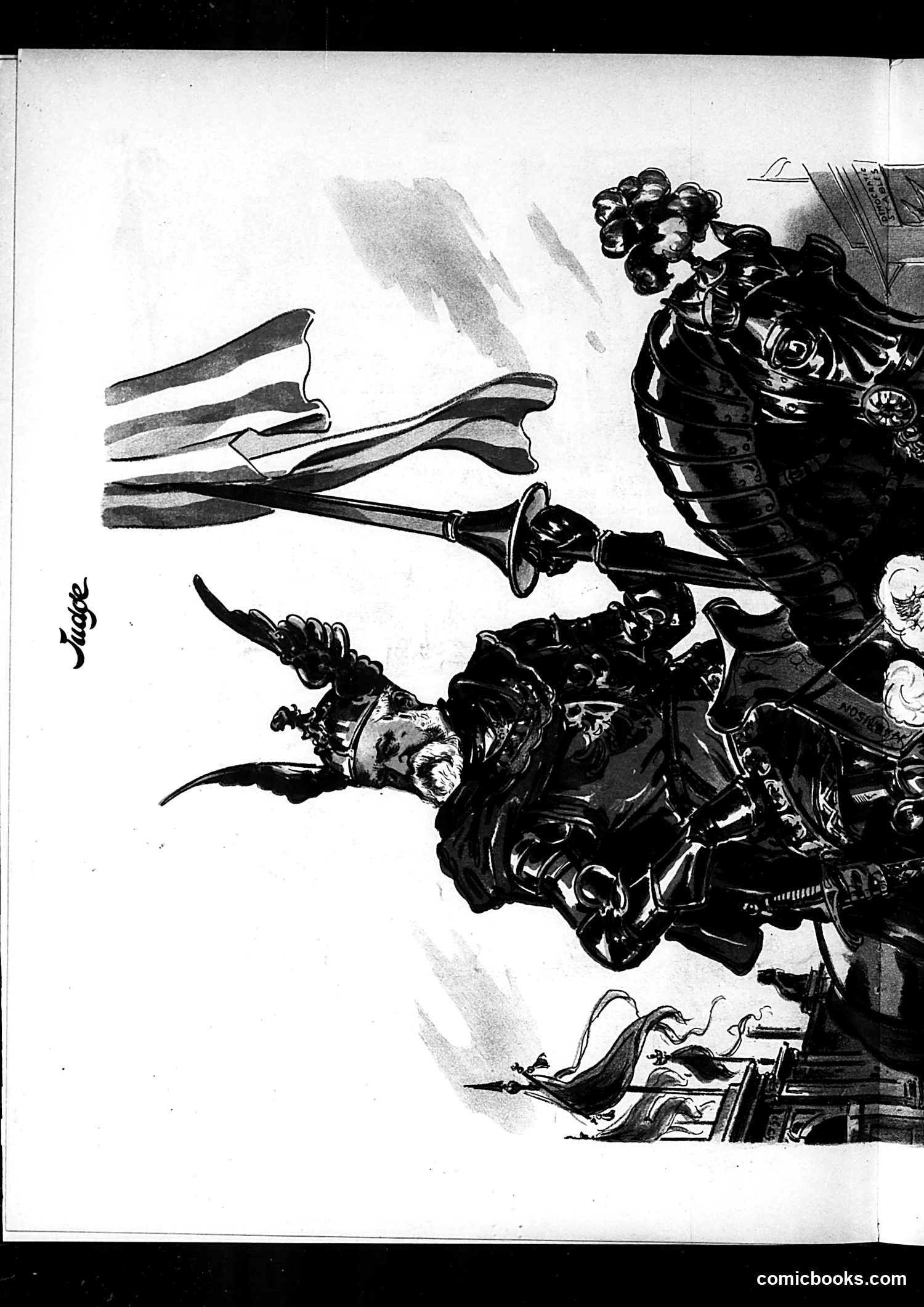
This appears to be a political cartoon from *Judge* magazine, though the OCR text provides no substantive content beyond the source attribution. The image shows a caricatured figure in military or formal dress being elevated or carried by a group of people above. The figure holds what appears to be a ceremonial trumpet or horn with flowing ribbons. The style and composition suggest satire about political elevation or promotion, possibly depicting someone being "raised up" by supporters or party machinery. However, **without legible text or a visible date on this page**, I cannot definitively identify the specific figure, political event, or satirical point being made. The cartoon likely comments on political ambition or manipulation of a public figure, but the exact context remains unclear.
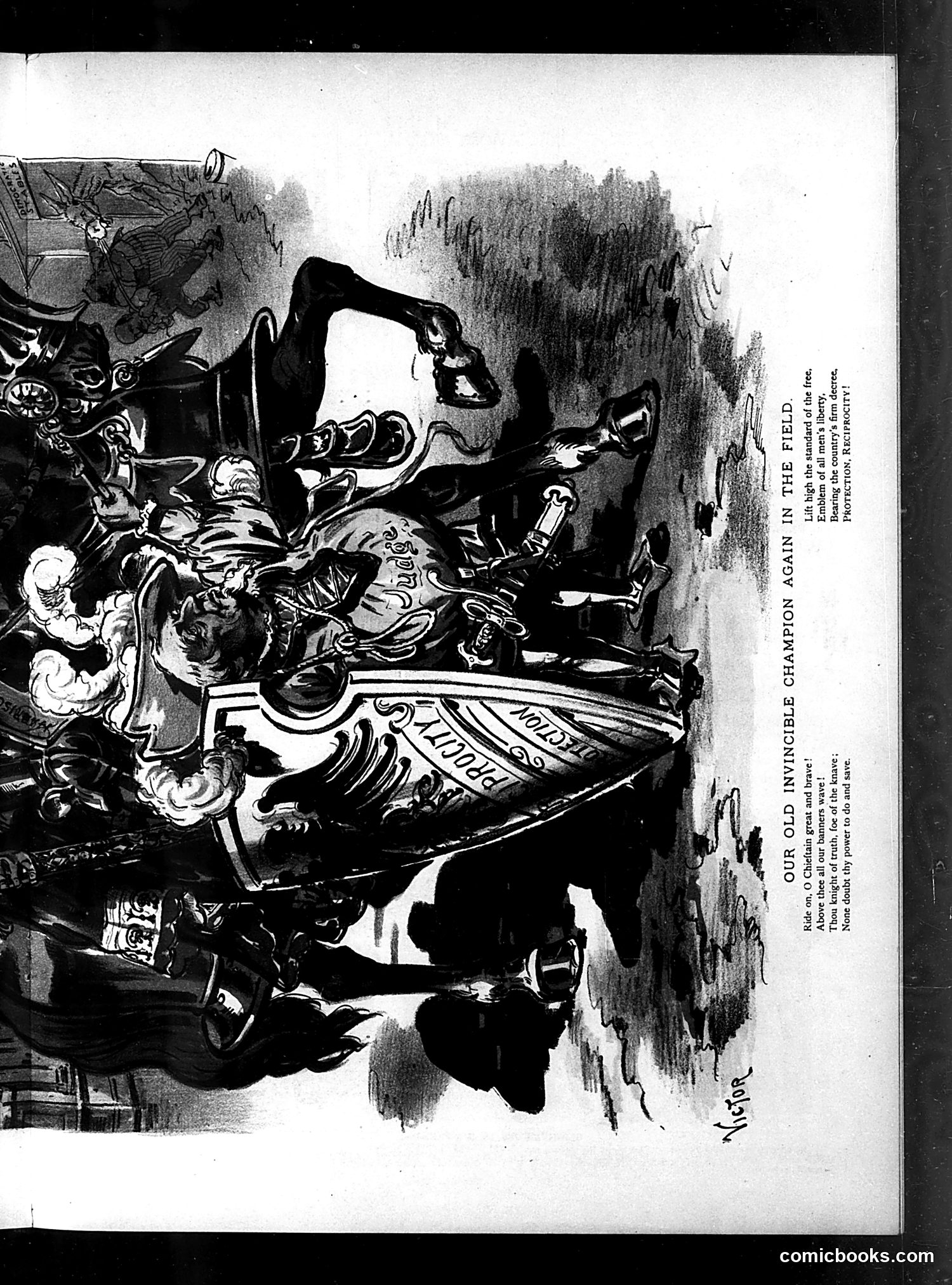
This page is printed upside-down, making full interpretation difficult. However, the visible text references "OUR OLD INVINCIBLE CHAMPION AGAIN IN THE FIELD" and mentions "Ride on, O Glorious great one!" with additional laudatory language about a champion being "Established at a time's notice" and "Need only to be seen to take the shine out." The elaborate illustration appears to show a figure in ornate, decorative dress riding or positioned triumphantly, suggesting political satire celebrating or mocking a public figure's return to prominence or re-election. Without the text properly oriented and clearer image details, I cannot confidently identify the specific political figure, date, or historical context. The page appears to be from *Judge* magazine's satirical tradition of celebrating or lampooning political leaders, but the specific target remains unclear from this orientation.
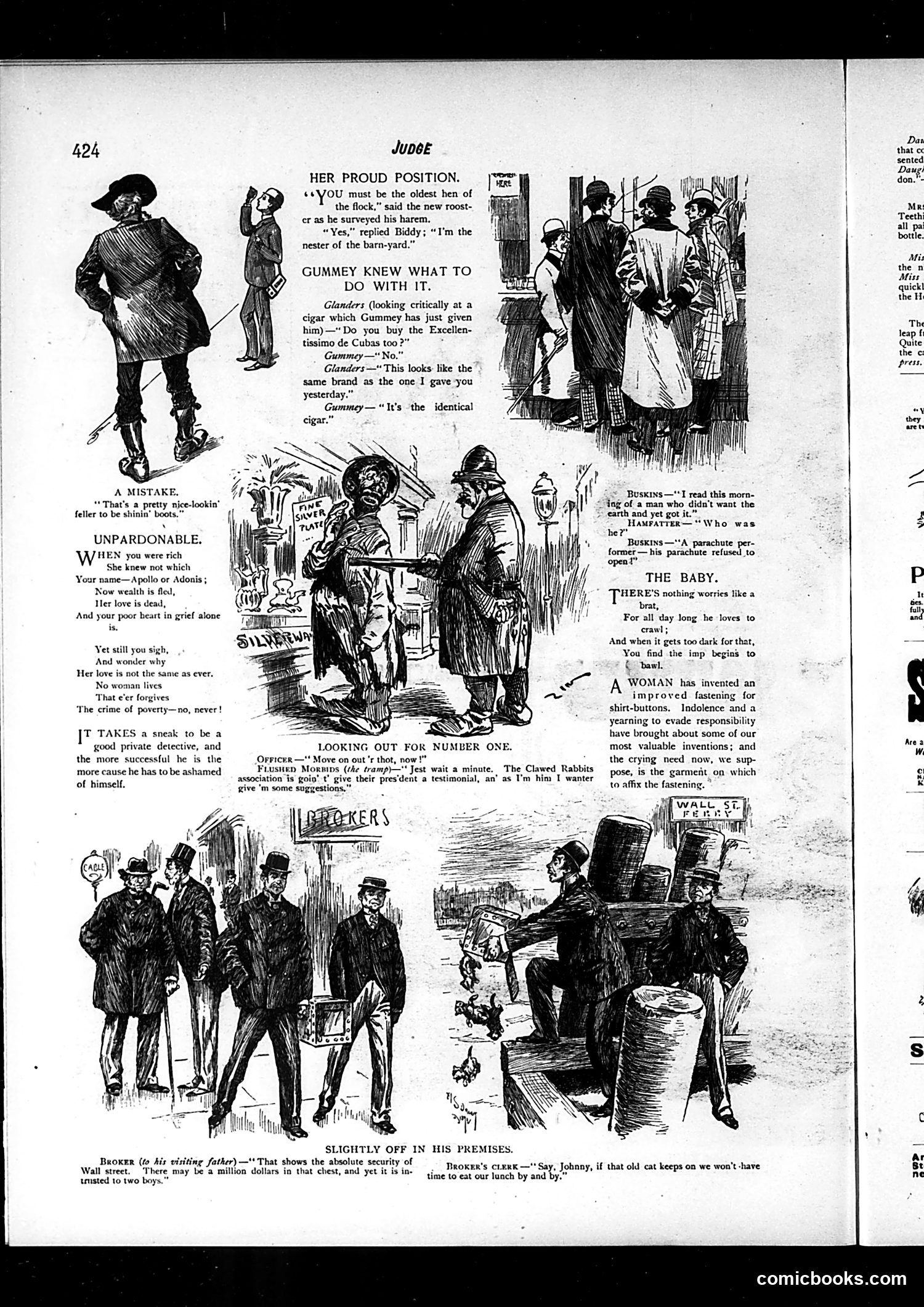
This page contains multiple unrelated satirical cartoons and humorous verses typical of Judge magazine's format. **"Her Proud Position"** mocks vanity through a barnyard scene where an aging hen boasts of seniority. **"Gummey Knew What to Do With It"** satirizes a man passing off identical cigars as different brands—commentary on consumer deception or cheap cigar quality. **"A Mistake"** and **"Unpardonable"** are brief verses about shallow relationships: the first mocks appearance-based attraction; the second bitterly suggests women abandon poor men regardless of past affection. **"Looking Out for Number One"** depicts a tramp leveraging an upcoming testimonial dinner (unclear which public figure) to solicit money from police. **"The Baby"** humorously catalogs infant chaos, then pivots to mock a woman's recent invention of improved shirt-button fasteners—suggesting even trivial innovations emerge from human laziness. **"Slightly Off in His Premises"** shows brokers discussing Wall Street security while a clerk jokes about a cat preventing lunch—likely satirizing indifference to workplace chaos amid financial confidence. The page reflects turn-of-century American satirical humor targeting consumer fraud, domestic relationships, and class dynamics.
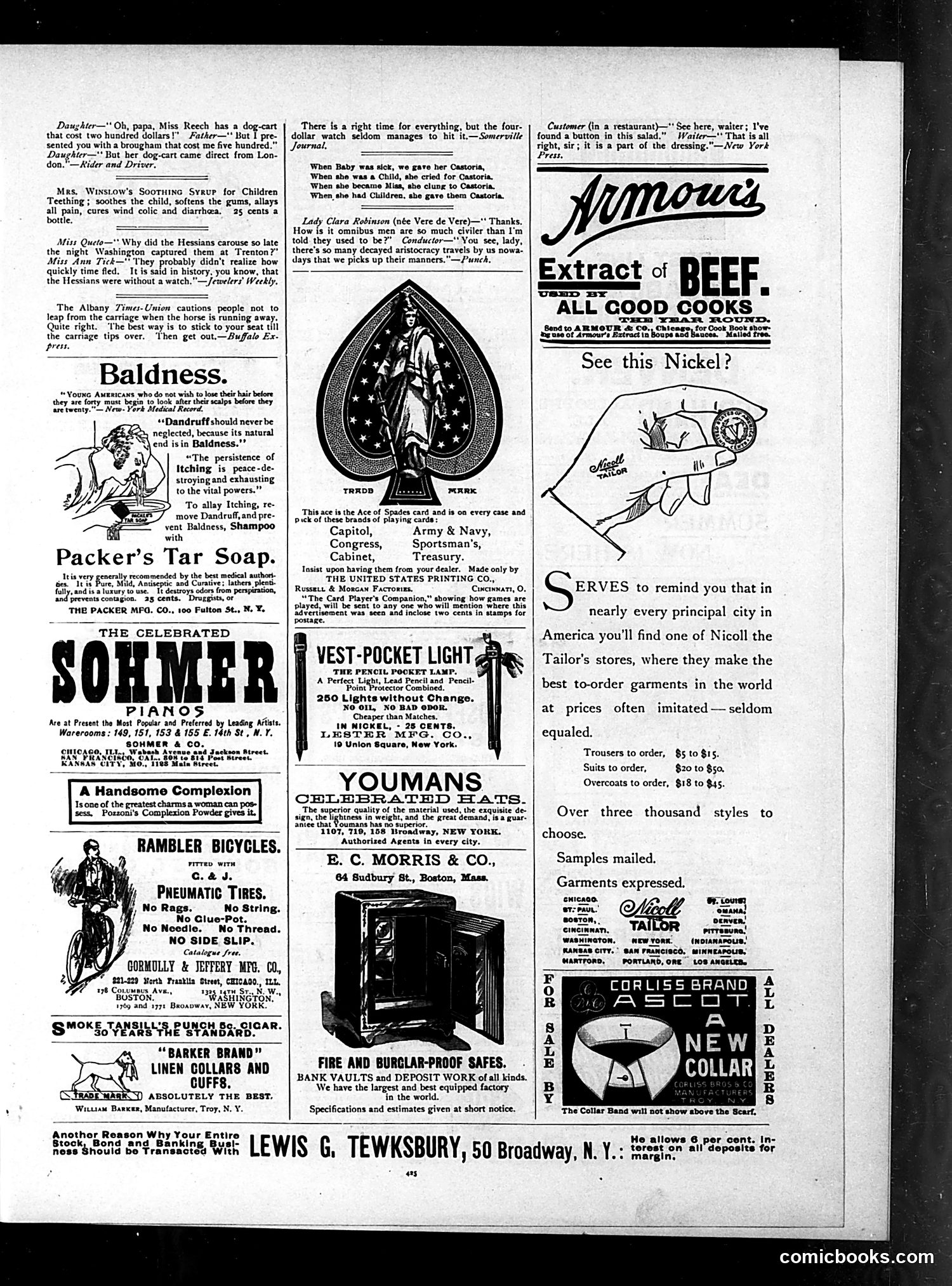
This page is **primarily advertising**, with several small humorous snippets scattered throughout rather than coherent political cartoons. The notable satirical content includes: **Social Commentary:** - A joke about wealth display: a daughter complains her father's expensive brougham is inferior because a friend's dog-cart came "direct from London"—satirizing American materialism and the obsession with European imports as status symbols. - A quip about Hessian soldiers (German mercenaries in the Revolutionary War) being unpunctual drunks because they "were without a watch"—light historical humor from *Jewelers' Weekly*. **The bulk of the page** consists of late-19th-century advertisements for products like Packer's Tar Soap (for baldness), Sohmer Pianos, Rambler Bicycles, corsets, and safes. The advertising reflects contemporary concerns: hair loss, "handsome complexions," and pneumatic bicycle tires as innovations. The page demonstrates how Judge mixed satirical commentary with commercial content, targeting middle-class American readers concerned with appearance, technology, and status.
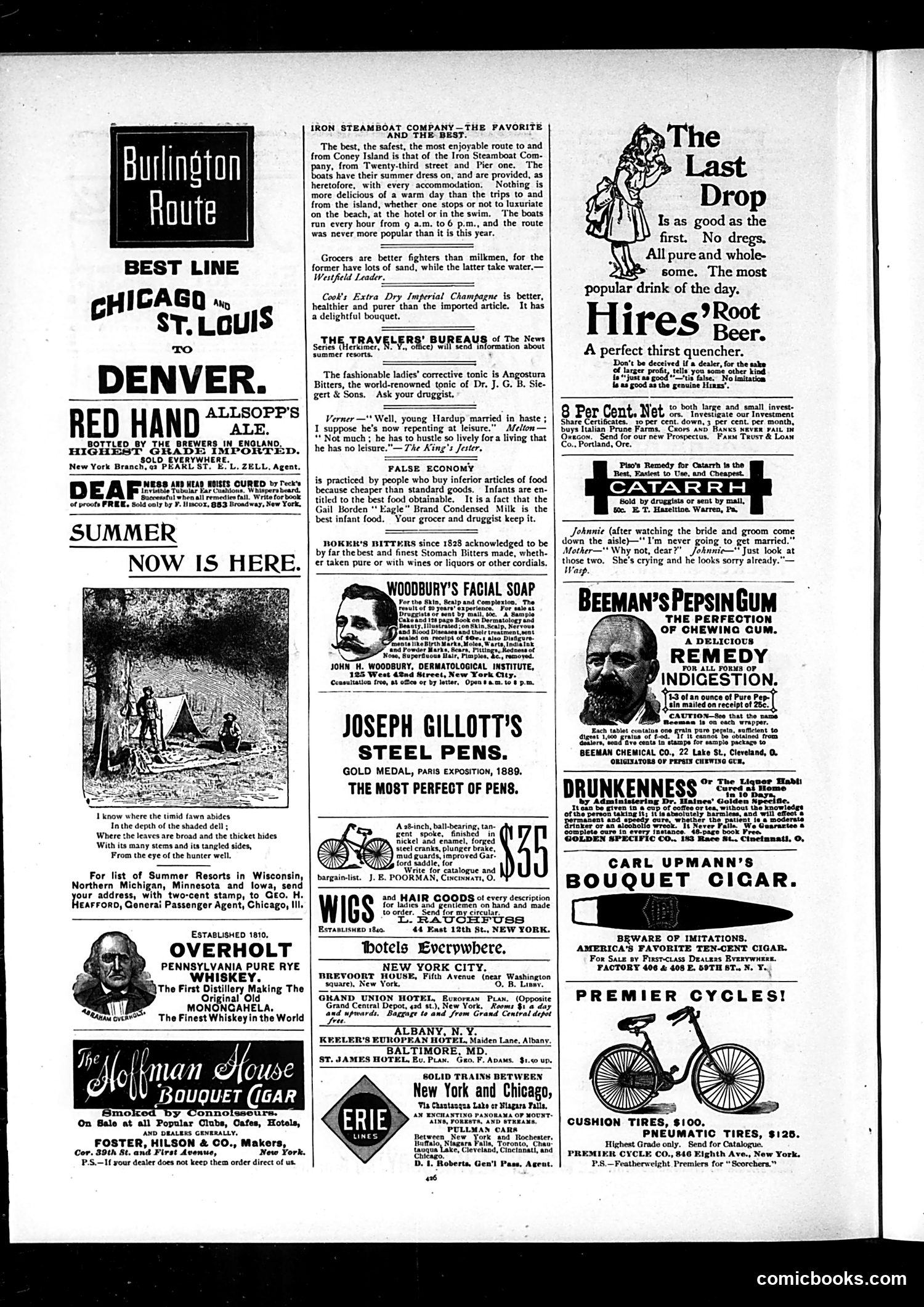
This page is primarily **advertising**, not political satire. It's from an early 1900s issue of Judge magazine and consists almost entirely of product advertisements typical of that era. The ads promote now-obsolete or defunct products: patent medicines (Angostura Bitters, Beeman's Pepsin Gum for indigestion), alcohol (Overholt rye whiskey, Allsopp's ale), beauty treatments (Woodbury's Facial Soap), writing instruments (Gillott steel pens), and transportation (Iron Steamboat Company ferries to Coney Island, Burlington Route rail service). A few **brief jokes** appear among the ads—including one about a groom marrying in haste and having no leisure for regret. These are generic humor filler, not political commentary. **Key context for modern readers**: This reflects an era when magazines survived on advertising revenue and when patent medicines with dubious health claims were legally marketed. The products themselves reveal period concerns (dermatology treatments, stomach bitters as cure-alls) and entertainment options (Coney Island beach visits).
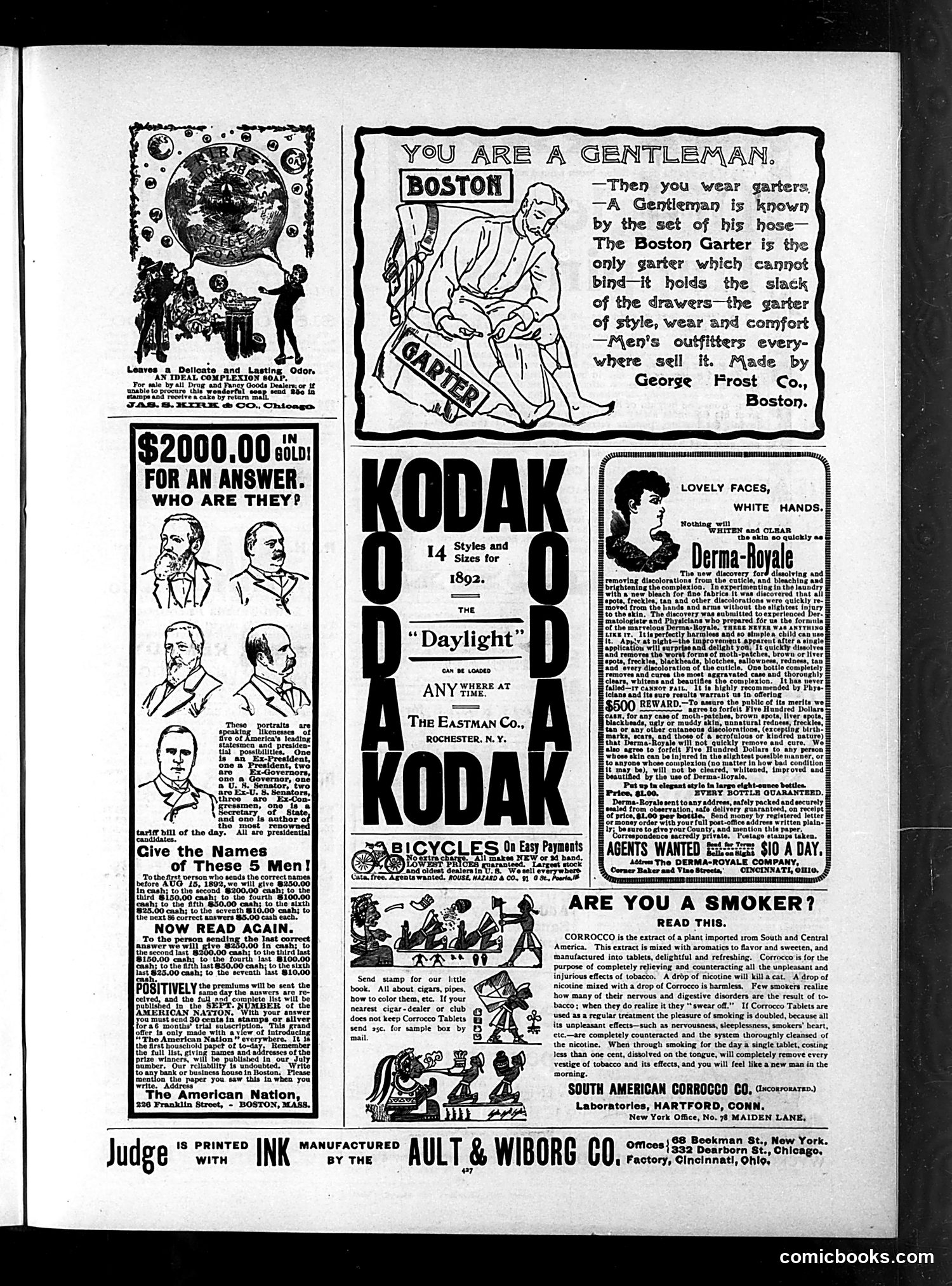
This page is primarily **advertisements and contests** rather than political satire, though it reflects 1892 commercial culture. The main contest ($2,000 reward) asks readers to identify five men shown as portrait sketches—described as "most renowned" figures and "presidential candidates." Without captions, their identities are unclear to modern readers, though the contest suggests they were recognizable public figures of 1892. The advertisements reveal period concerns: Boston Garters (men's hosiery), Kodak cameras, Derma-Royale (a skin-whitening product with dubious medical claims and a "$500 reward" guarantee), and Corrocco tobacco. The Derma-Royale ad is notably problematic by modern standards, promoting skin bleaching and making exaggerated health claims. A small section addresses smoking, claiming Corrocco extract provides health benefits. The page reflects turn-of-century consumer culture, dubious patent-medicine marketing, and casual racial attitudes embedded in beauty standards.
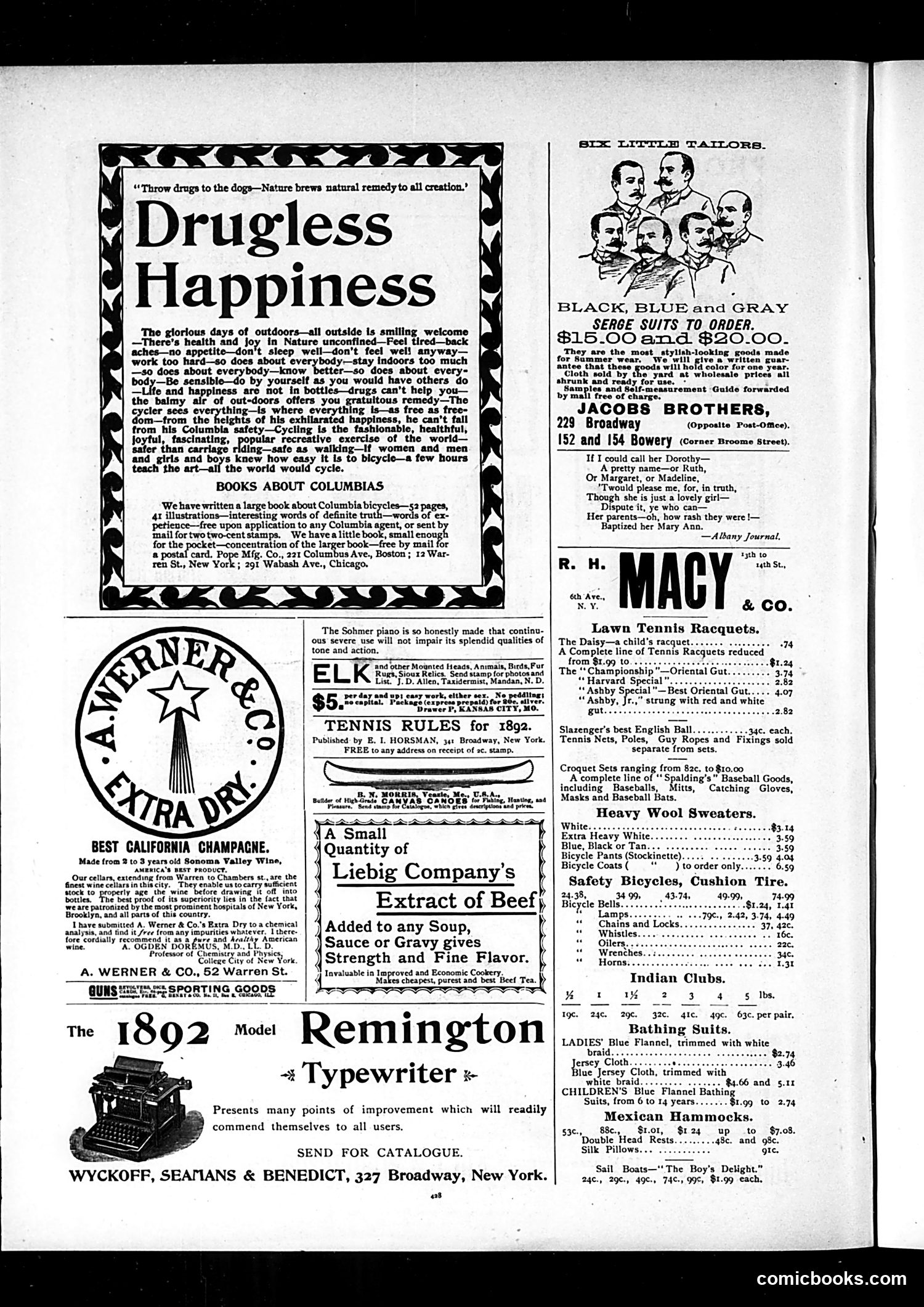
This page is primarily **advertising**, typical of 1890s magazines. The dominant visual element is a "Drugless Happiness" advertisement promoting outdoor exercise and cycling as natural health remedies—reflecting the era's enthusiasm for bicycles as modern recreation and transportation. The text ironically contrasts sedentary indoor life ("work too hard," "stay indoors too much") with outdoor activity, particularly cycling on Columbia bicycles. This reflects the 1890s "safety bicycle" craze that democratized cycling. Other advertisements include: - **Sohmer pianos** (quality instruments) - **Liebig's Extract of Beef** (popular Victorian cooking ingredient) - **Remington typewriter** (1892 model—cutting-edge technology) - **Tennis equipment and clothing** (leisure activities for the affluent) - **A humorous verse** about a girl named "Mary Ann" (mocking her unfashionable name) The page captures 1890s consumer culture: bicycles, sports, technology, and manufactured foods representing modernity and progress to contemporary readers.
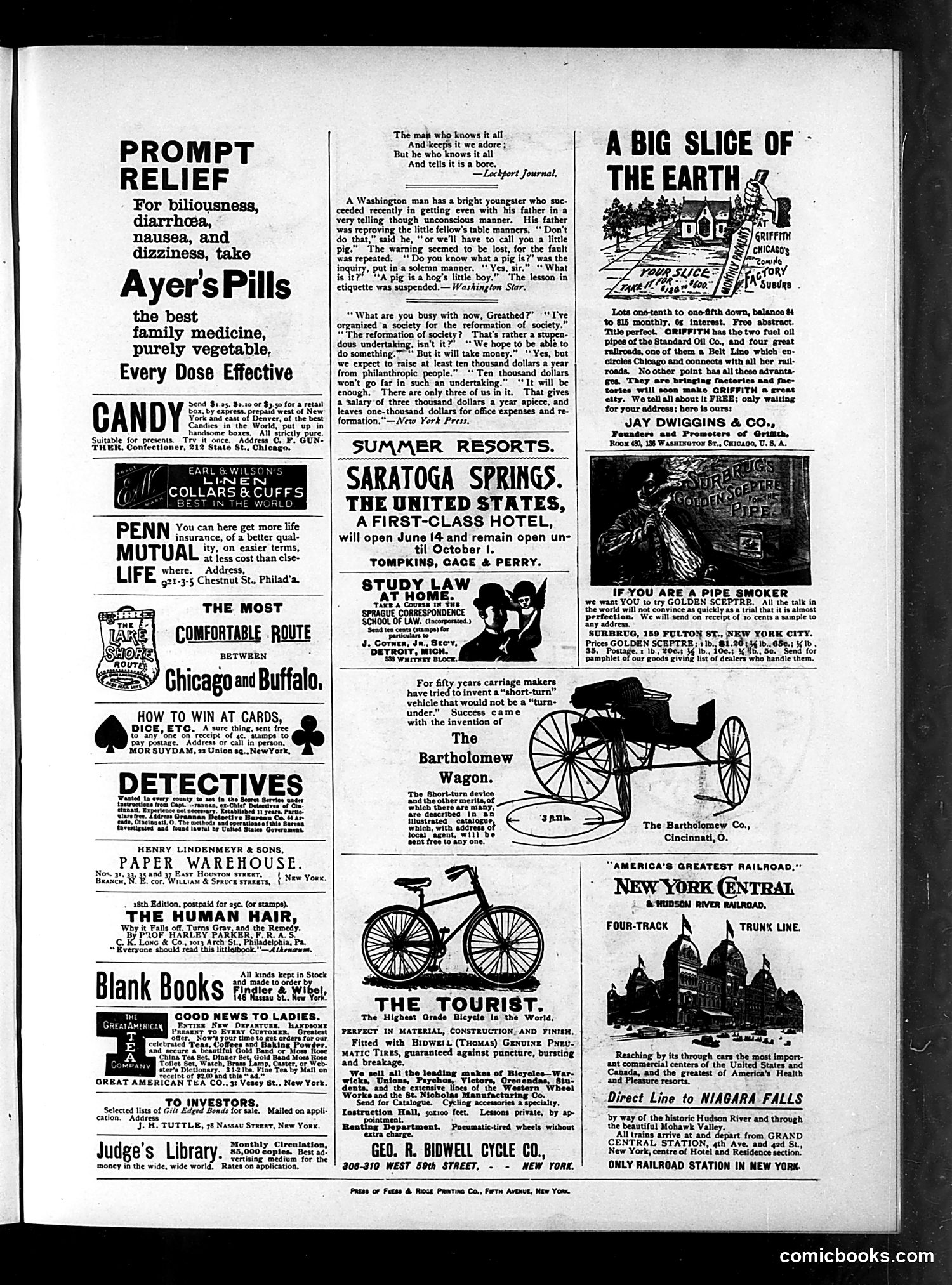
This is primarily an **advertising page** from Judge magazine, with minimal editorial content. The few non-commercial pieces include: **"The Man Who Knows It All"** — A brief satirical poem contrasting the person who knows everything but stays quiet (admirable) versus one who knows everything and *tells* everyone (bore). Standard social commentary on annoying know-it-alls. **Two Short Anecdotes:** 1. A Washington father corrects his son's table manners by calling him a "pig." The son retorts that "a pig is a boy's life before he gets sense," getting the last word. Gentle humor about children outwitting parents. 2. A man describes his new "society for the reformation of society"—a three-person organization splitting $10,000 annual funding equally among themselves with only $1,000 left for actual reform work. This mocks philanthropic organizations' overhead and self-serving administrators. The rest is **product advertising**: patent medicines (Ayer's Pills), insurance, hotels, bicycles, railroads, real estate development, and other period goods. No significant political satire or caricature present on this page.
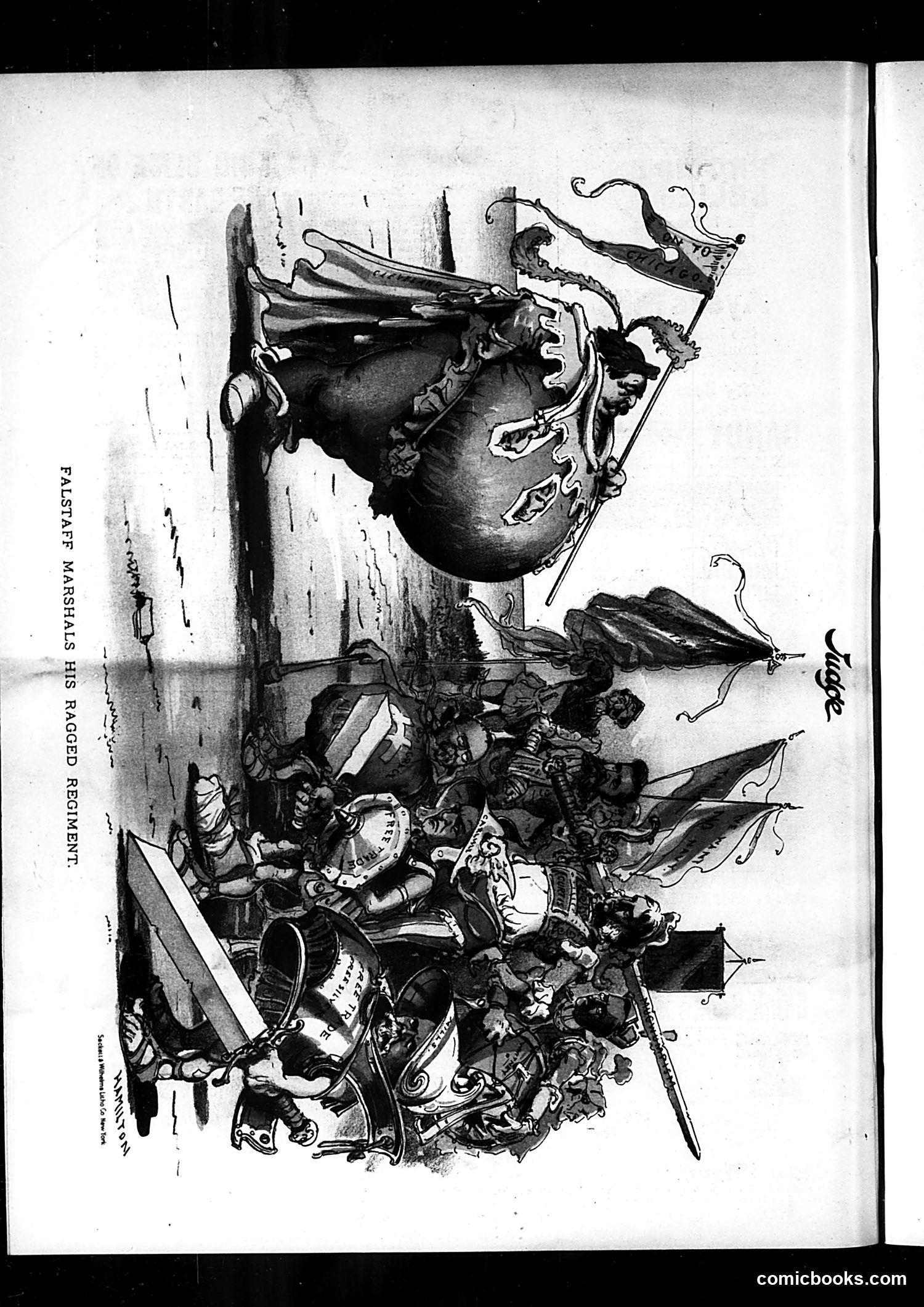
This engraving depicts Shakespeare's character Falstaff from *Henry IV*, shown as a large, corpulent figure towering over a chaotic group of soldiers below. The title references Act III of the play, where Falstaff assembles a disreputable army. The satire appears to be political commentary using Shakespeare as its frame. The "ragged regiment"—poorly equipped, disorganized soldiers—likely represents contemporary political incompetence or military mismanagement. Falstaff's bloated figure dominates the composition, suggesting he embodies or is responsible for the chaos below. Without clearer identification of the specific historical moment or figures caricatured among the troops, the precise political target remains unclear, but the overall message critiques leadership of an incompetent, ragtag organization.