
A complete issue · 18 pages · 1892
Judge — May 14, 1892
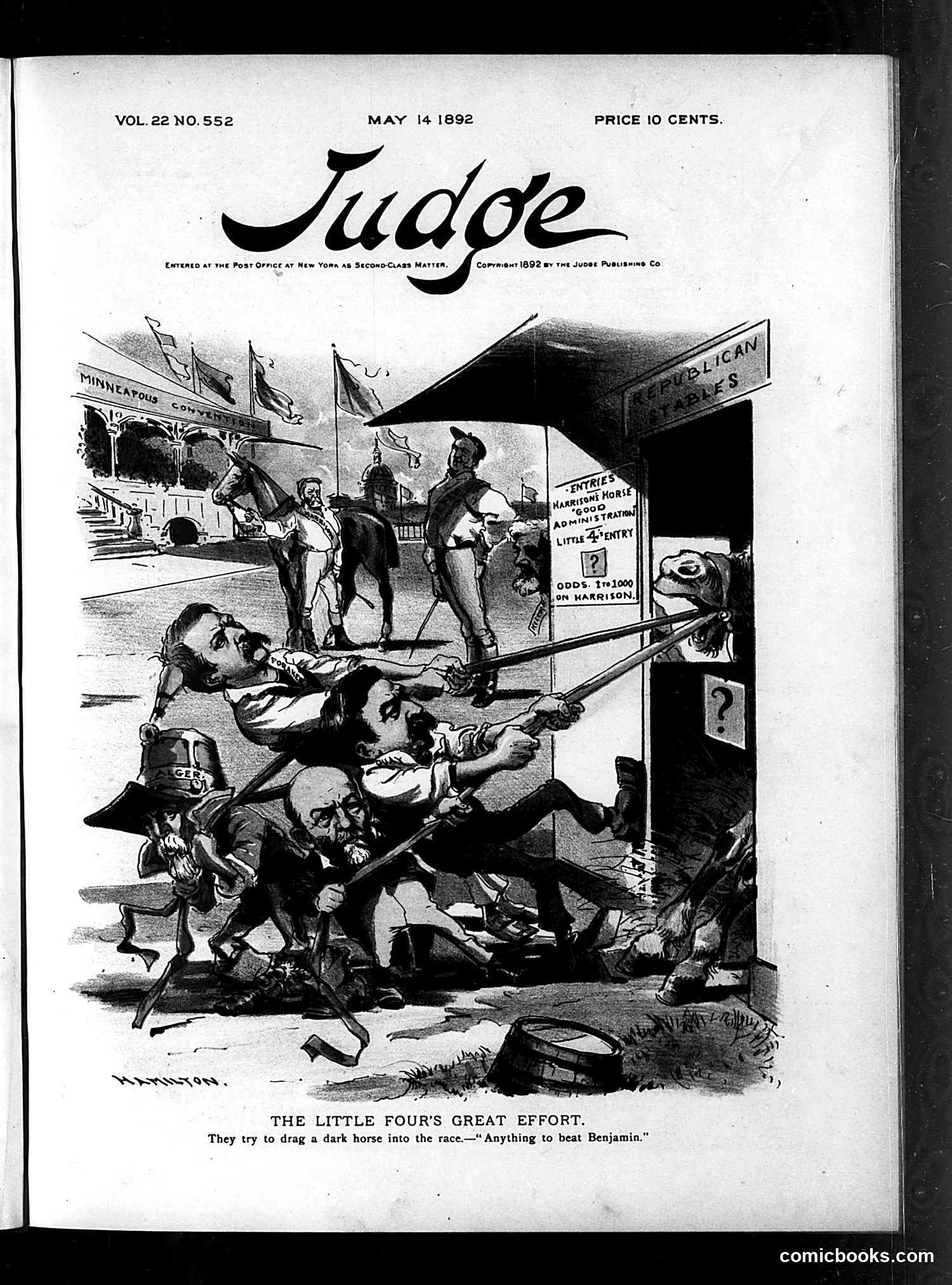
This political cartoon satirizes the 1892 presidential race, specifically the "Little Four's" effort to prevent Benjamin Harrison's reelection. The caricatured figures appear to represent Democratic and Populist opponents attempting to unite against the incumbent Republican president Harrison. The phrase "drag a dark horse into the race" references introducing an unexpected candidate to split the vote. The Minneapolis Convention setting and "Republican Larks" booth establish the Republican National Convention context. The exaggerated caricatures using physiognomy typical of 1890s political cartoons depict the opposition as frantic and desperate. The cartoon mocks their coordination efforts as chaotic and unlikely to succeed against Harrison's reelection bid, which ultimately failed when Grover Cleveland won that November.
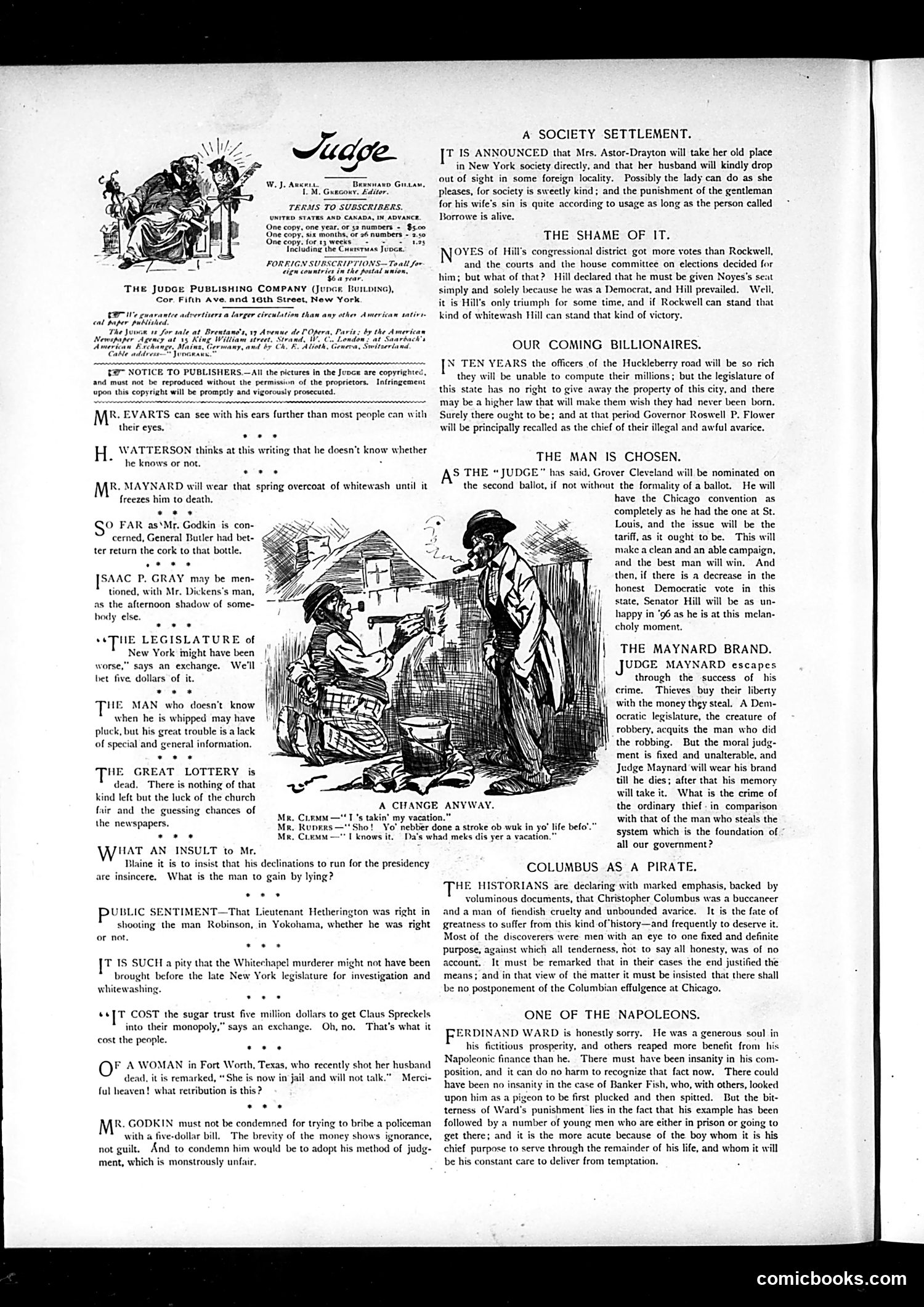
The main cartoon titled "A CHANGE ANYWAY" depicts a woman telling a man: "I's takin' my vacation." He responds: "No! Nothin' doin'! a stroke oh wuk in ys life befo'." She replies: "Well, a change anyway, seein' yuh off a vacation." This is a domestic humor joke about marriage and work. The satire suggests that a wife views her husband's vacation absence—even temporary relief from his presence—as a welcome "change" from their ordinary married life. The dialect spelling ("ys," "yuh") marks the characters as working-class. The joke mocks the tedium of lower-class marriage and domestic routine, implying the wife finds the husband's company burdensome enough that his leaving constitutes her idea of vacation. It's typical of Judge's era in using class stereotypes for comedic effect.
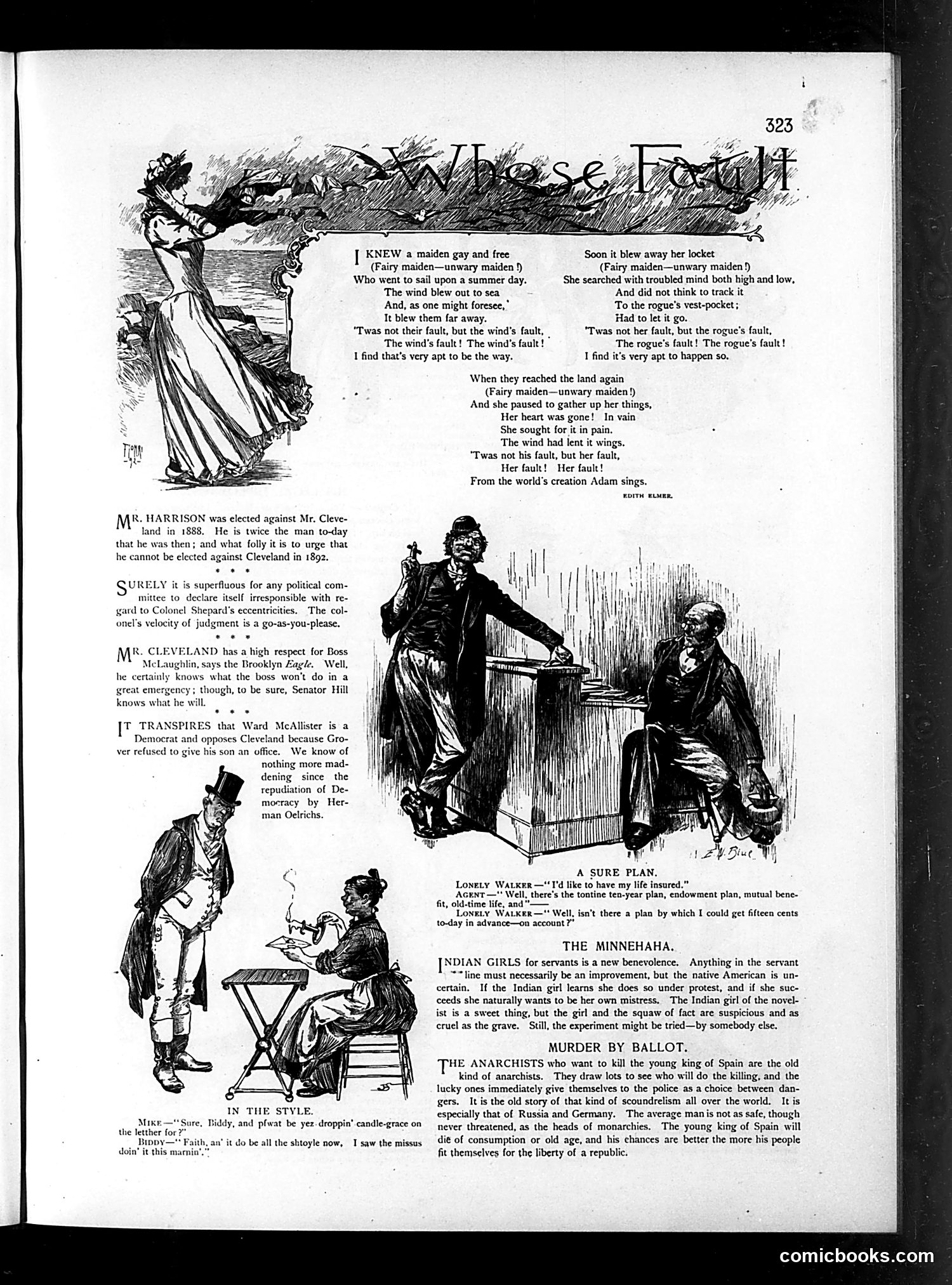
This Judge magazine page from the 1890s contains political commentary and satirical sketches: **"The Wind's Fault"** (top): A poem about a maiden losing her belongings to wind, likely satirizing how politicians blame external circumstances rather than accepting responsibility—a recurring Judge theme. **Political Remarks**: Brief commentary on Harrison's 1888 election victory against Cleveland, with sardonic observations about political judgment and Cleveland's respect for subordinates. **"A Sure Plan"** (middle): A sketch of what appears to be a life insurance pitch, satirizing aggressive sales tactics of the era. **"In the Style"** (bottom left): Mocking social pretension through dialogue between characters. **"The Minnehaha" and "Murder by Ballot"**: These sections address Indian servants and anarchist threats to European monarchy—reflecting late-Victorian anxieties about colonialism and political violence. The overall tone is characteristic Judge satire: mocking political incompetence, social climbers, and contemporary anxieties.
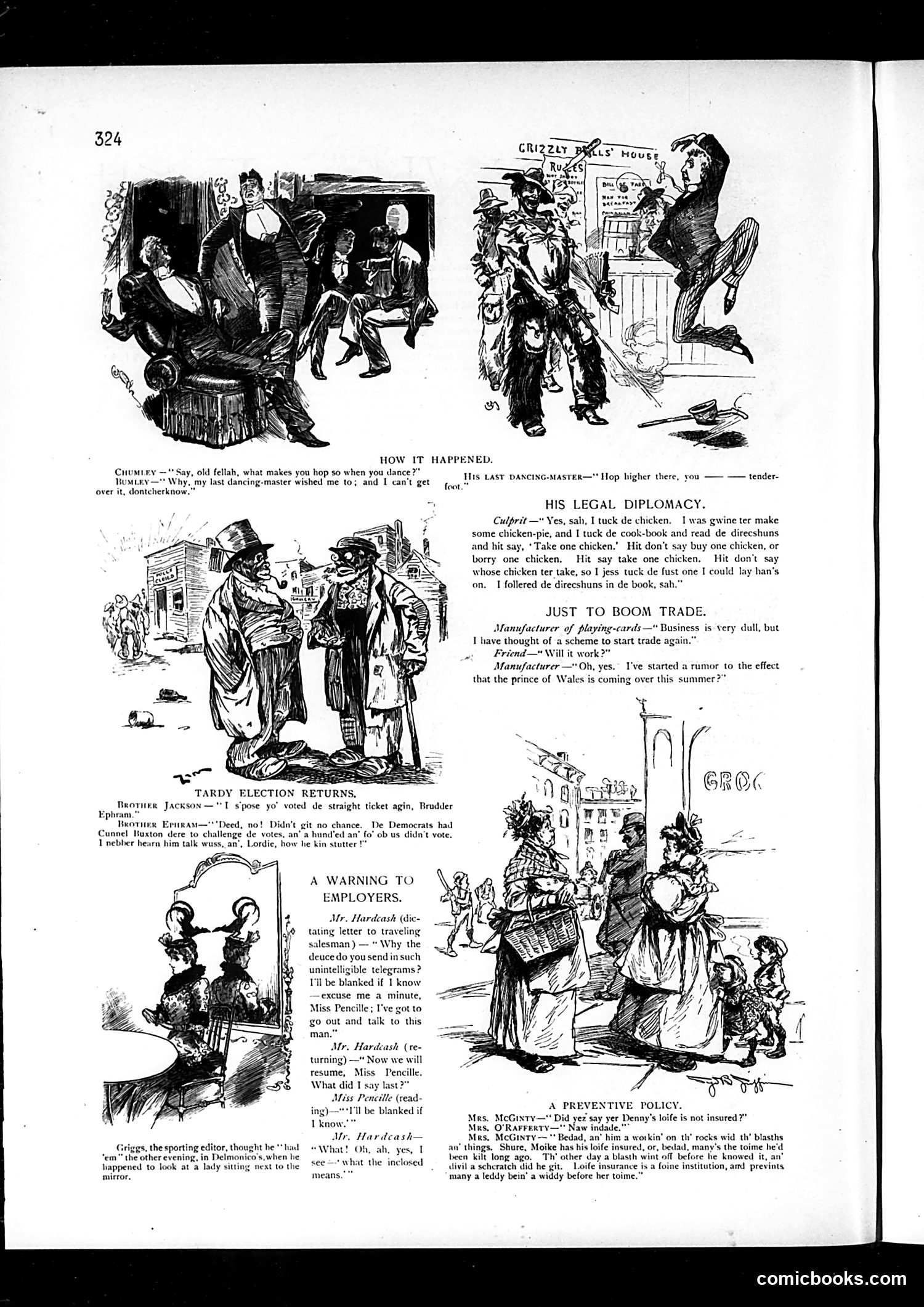
This page contains several satirical sketches typical of late 19th-century American humor: **"How It Happened"** mocks an Anglophile dancer who adopts affected mannerisms from his British dancing-master, unable to break the habit. **"His Legal Diplomacy"** features a Black defendant using literal interpretation of a cookbook's instructions as a defense for stealing a chicken—satirizing both the absurdity of legalistic arguments and period racial stereotypes common in Judge. **"Just to Boom Trade"** shows a playing-card manufacturer spreading rumors about the Prince of Wales visiting America to stimulate business—mocking both commercial hype and celebrity obsession. **"Tardy Election Returns"** references post-Reconstruction election challenges, with Democratic operatives intimidating Black voters through a stuttering official, reflecting real disenfranchisement tactics of the era. **"A Warning to Employers"** and **"A Preventive Policy"** are workplace humor sketches about miscommunication and insurance. The page emphasizes Judge's typical comedic targets: pretension, commercial duplicity, and racial caricature accepted as standard humor in its era.
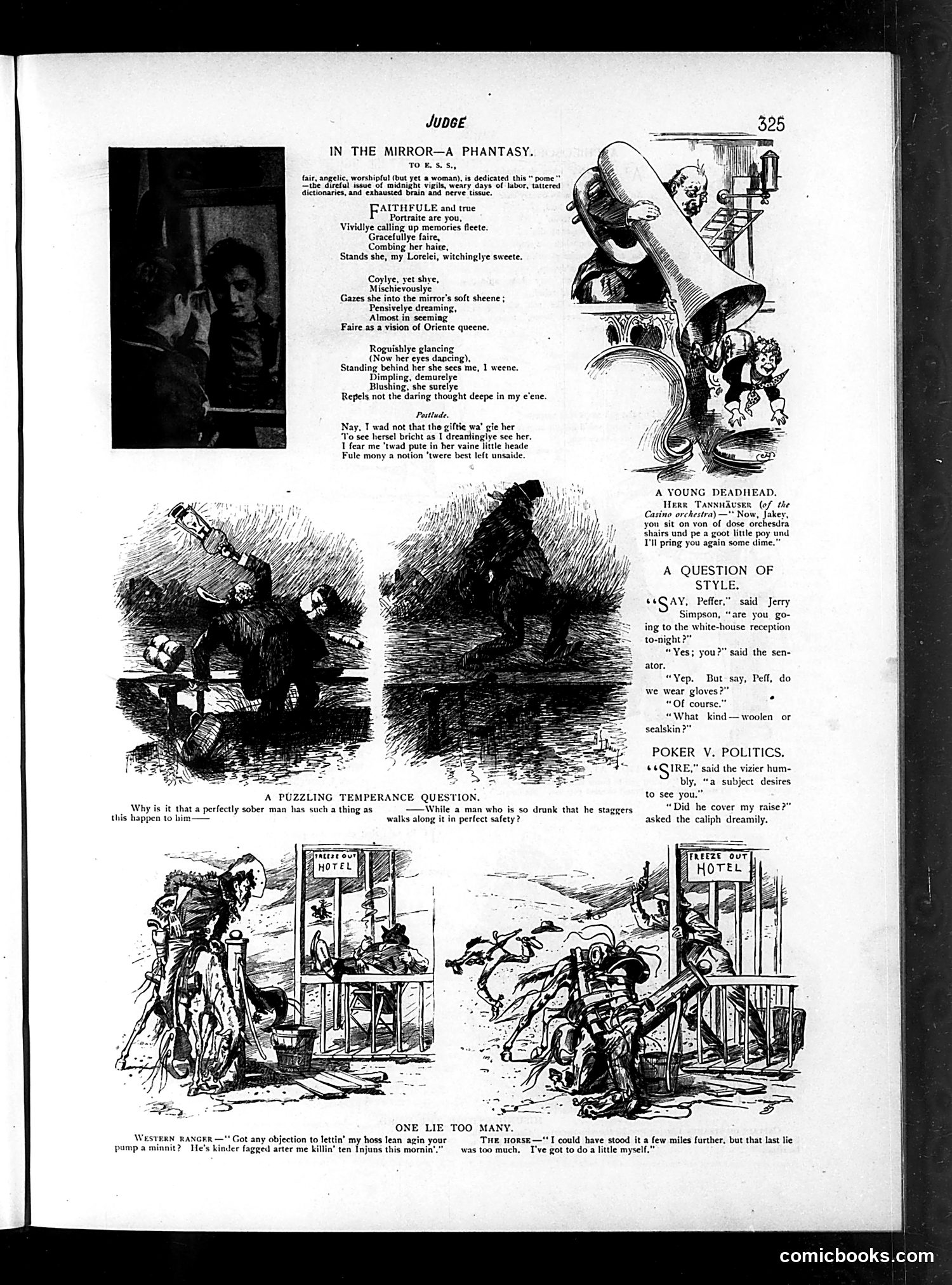
This page contains several short satirical pieces typical of late 19th-century Judge magazine: **"In the Mirror—A Phantasy"** is a romantic poem mocking overly sentimental Victorian poetry, complete with archaic language ("e'ene," "wae gie her"). The satire targets flowery love verse and male fantasy. **"A Question of Style"** jokes about senators Jerry Simpson and "Peffer" attending a White House reception, debating whether to wear wool or sealskin gloves—satirizing political pretension and formality among rural politicians. **"Poker v. Politics"** presents a brief absurdist joke about a caliph asking if someone "covered my raise," mixing gambling and politics. **"A Puzzling Temperance Question"** uses the paradox of drunk men walking safely versus sober men stumbling—a temperance-era joke about alcohol's contradictory effects. **"One Lie Too Many"** depicts a Western ranger exaggerating his exploits to a horse owner, who finally rebels at yet another tall tale—satirizing frontier braggadocio. The illustrations employ period-typical wood-engraved style.
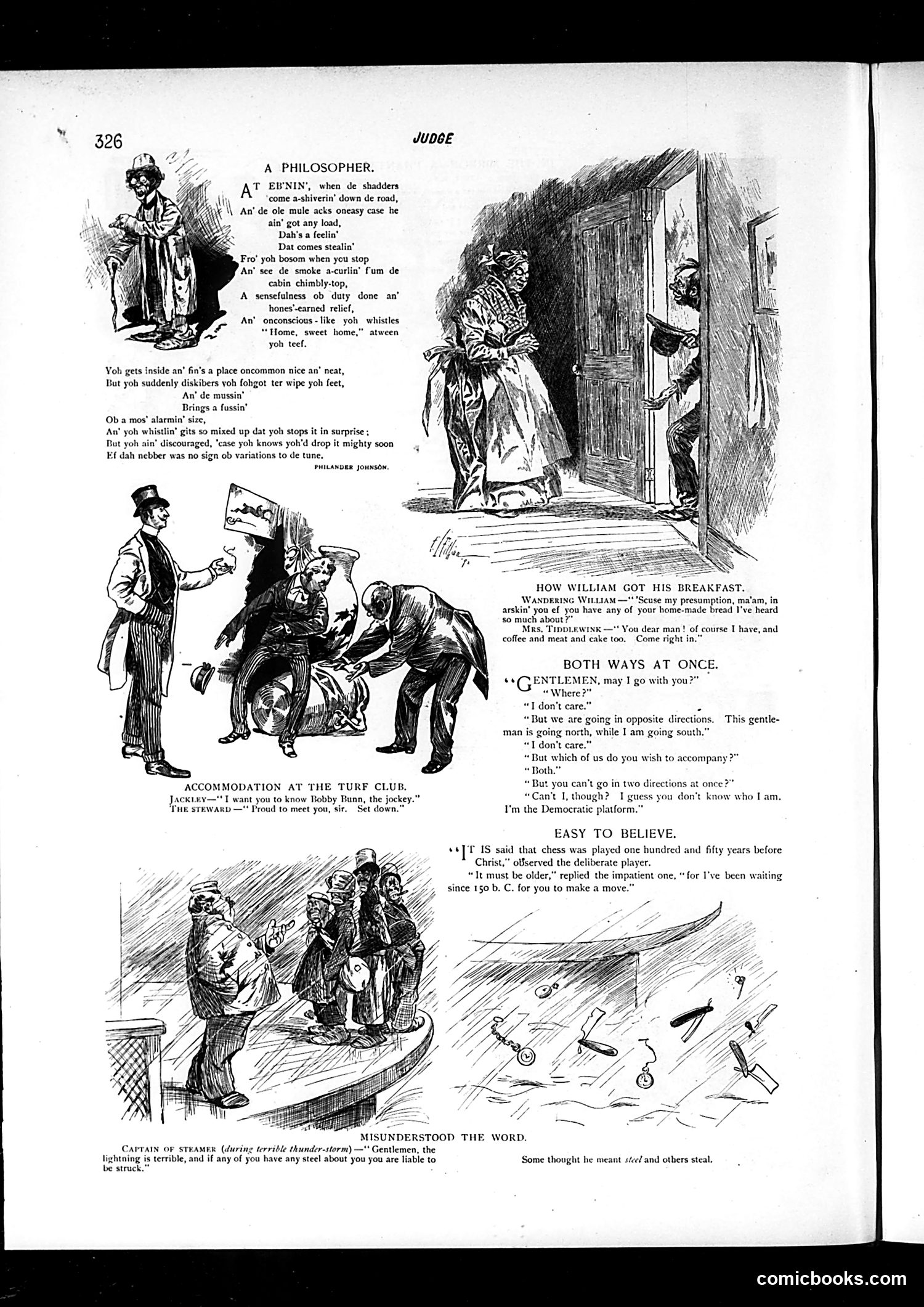
This page contains six separate humorous vignettes typical of late-19th-century American satire: **"A Philosopher"** presents a dialect poem celebrating a laborer's honest contentment returning home—sentimental nostalgia for rural/working-class life. **"How William Got His Breakfast"** depicts a vagabond's successful panhandling through flattery, satirizing both gullibility and deception. **"Both Ways at Once"** mocks the Democratic Party platform as internally contradictory and directionless—a common political jab suggesting the party stood for nothing coherent. **"Accommodation at the Turf Club"** jokes about social climbing and name-dropping at sporting venues. **"Easy to Believe"** plays on the implausibility of chess's ancient origins through impatient wordplay. **"Misunderstood the Word"** contains a pun: a ship captain warns passengers about "steel" during a lightning storm, but some mishear it as "steal," fearing theft rather than electrical danger. Overall, the page mixes working-class humor, political satire, and wordplay—characteristic of Judge's middlebrow appeal.
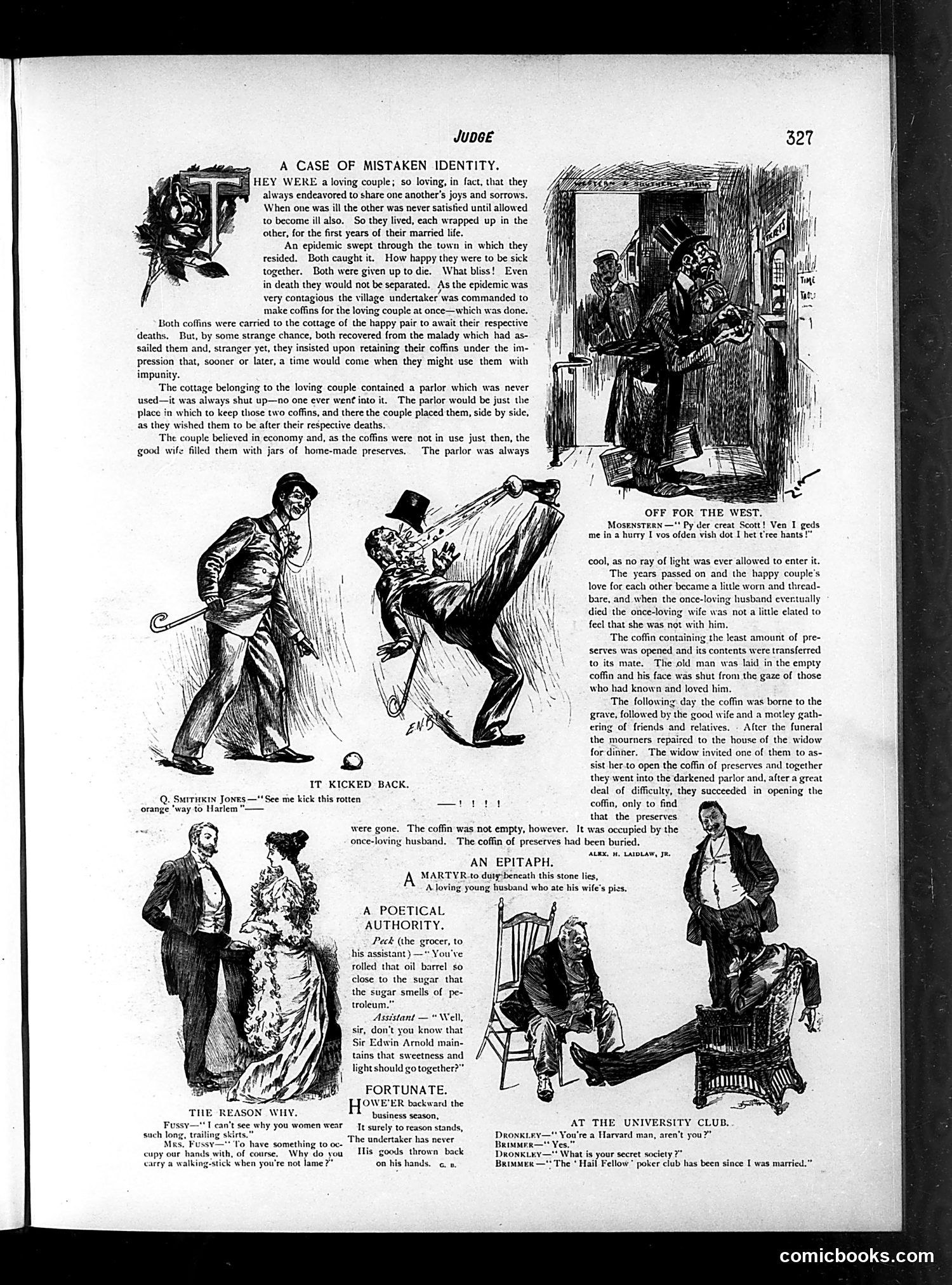
This page contains multiple satirical vignettes typical of late-19th/early-20th-century Judge humor: **"A Case of Mistaken Identity"** (main story): A darkly comic tale where an overly devoted couple keeps coffins in their parlor filled with preserves. When the husband dies, the wife accidentally buries the *preserves* coffin instead, discovering only later that her husband was in the *other* coffin—implying her relief at not having to share even death with him. The satire mocks Victorian sentimentality about marriage while playing on ironic fate. **Minor comic sketches** address contemporary topics: "Poetical Authority" jokes about Sir Edwin Arnold (a famous poet/editor), conflating his famous phrase "sweetness and light" with the oil/sugar proximity. Other vignettes include period humor about fashion, business cycles, and social clubs. The drawings show typical Judge illustration style—detailed Victorian engravings. The overall page reflects Judge's characteristic blend of darker wit with social observation, targeting middle-class pretensions and romantic pieties of the era.
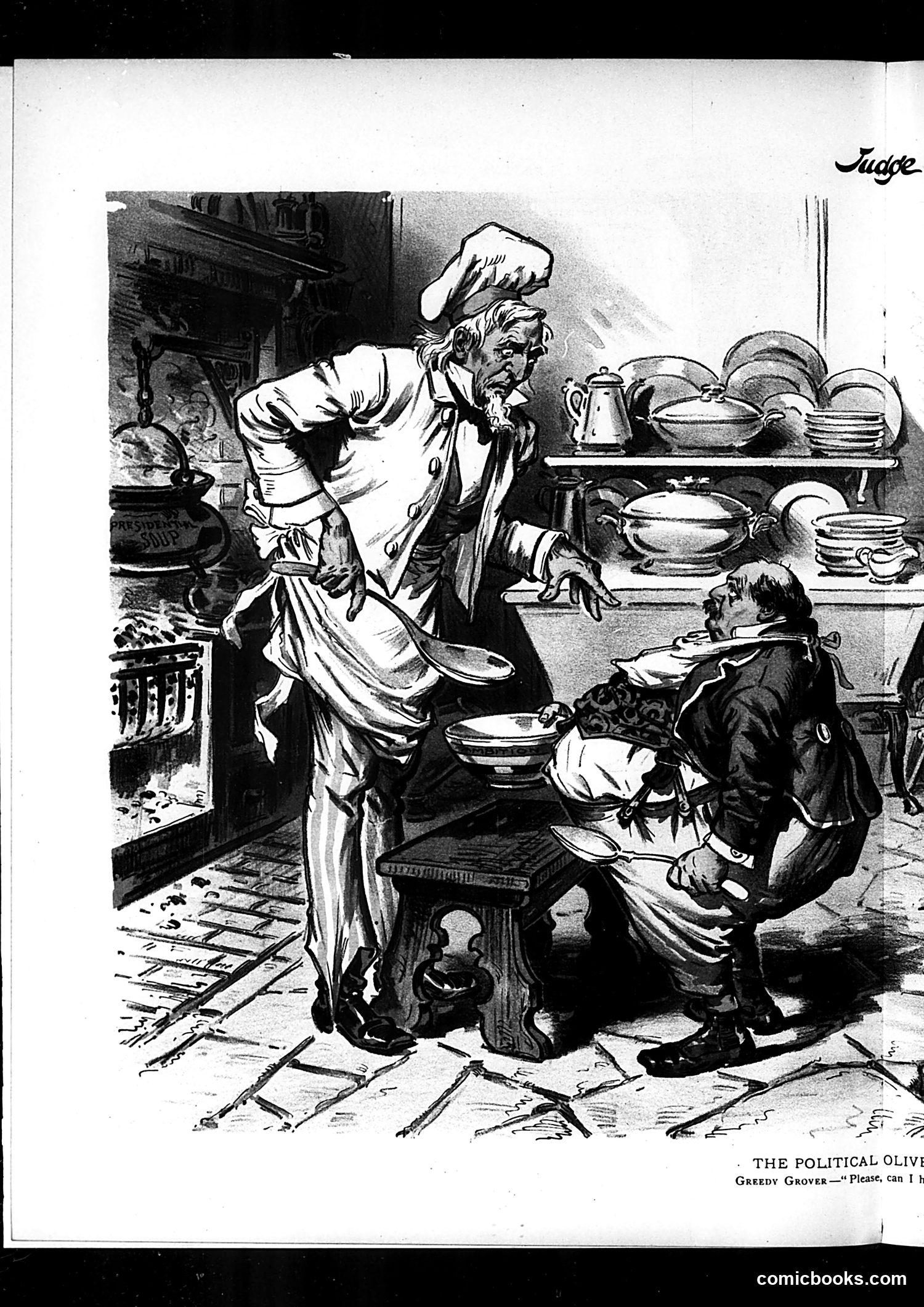
This Judge cartoon satirizes a figure identified as "Greedy Grover" (likely President Grover Cleveland, serving 1885-1889 and 1893-1897), depicted as a chef greedily ladling soup or stew in a kitchen. A small child reaches up asking, "Please, can I h[ave some]?" The cartoon appears to critique Cleveland as withholding resources or benefits from the common people (represented by the child) while serving himself generously. The "olive" in the title likely refers to an olive branch or peace offering that never materializes—Cleveland's policies failing to benefit ordinary citizens despite the imagery of abundance in the kitchen. This reflects period criticism of Cleveland's conservative economic policies during economic hardship, particularly the depression of the 1890s.
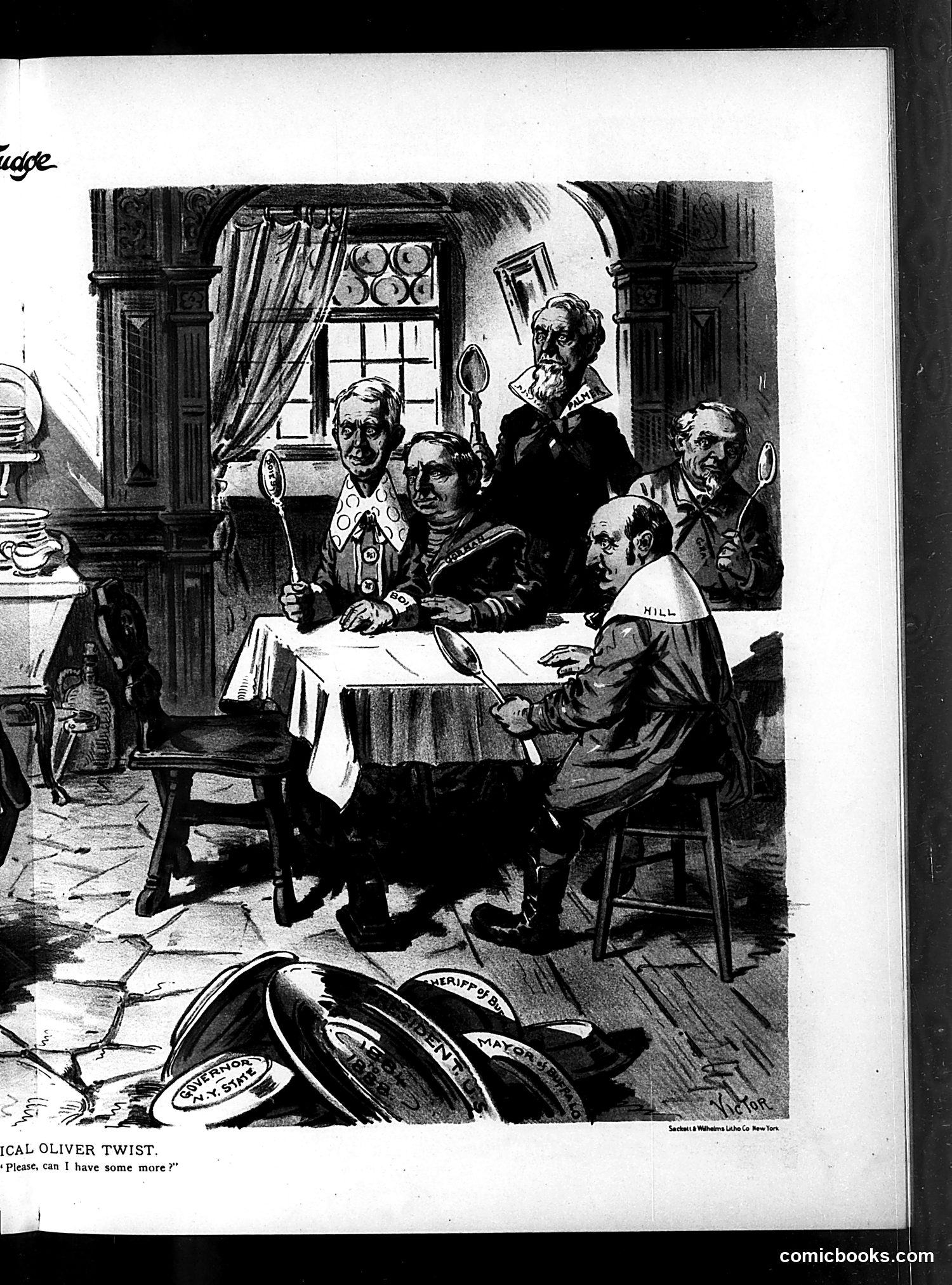
This cartoon satirizes what appears to be a legal or governmental proceeding, referencing Dickens's *Oliver Twist*. The caption "Please, can I have some more?" echoes the famous scene where orphan Oliver requests additional gruel. The cartoon depicts officials or judges seated at a table examining documents labeled with what appear to be municipal positions ("Sheriff's," "Mayor's"). The scattered items on the floor suggest bureaucratic chaos or corruption. The satire likely critiques government officials greedily seeking additional power, positions, or resources—paralleling Oliver's desperation for basic sustenance. The Dickensian reference implies these officials, unlike the sympathetic orphan, don't deserve such requests; they're portrayed as corrupt or gluttonous rather than needy. Without a clear date or byline visible, the specific political scandal referenced remains unclear.
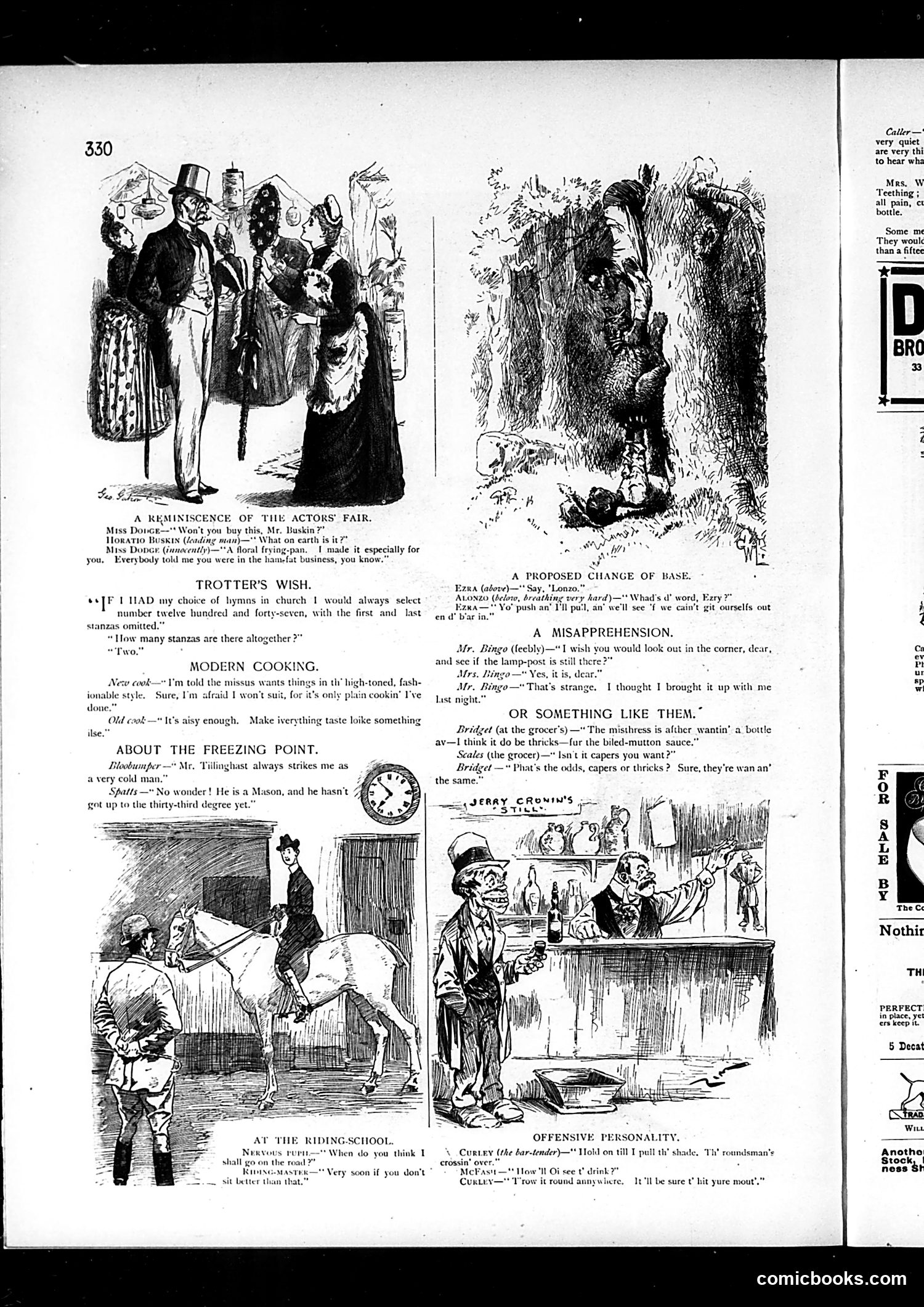
This page contains six unrelated comic sketches typical of Judge's satirical format. The humor relies on wordplay, class differences, and ethnic stereotypes common to the era: **"Actors' Fair"** mocks thespians' pretentiousness about cooking. **"Trotter's Wish"** plays on the mathematical absurdity of selecting hymn #1247 but wanting only two stanzas performed. **"Modern Cooking"** contrasts old and new culinary approaches—the experienced cook knows shortcuts; the new "high-toned, fashionable" cook struggles. **"Freezing Point"** contains a Mason/Masonic pun about coldness and degrees. **"Riding School"** depicts a nervous pupil. **"Offensive Personality"** and other sketches use Irish-accented dialogue (indicated by phonetic spelling like "thricks" for "tricks"), reflecting common period caricatures of Irish immigrants and servants. The humor targets working-class figures and dialect speakers rather than political figures.
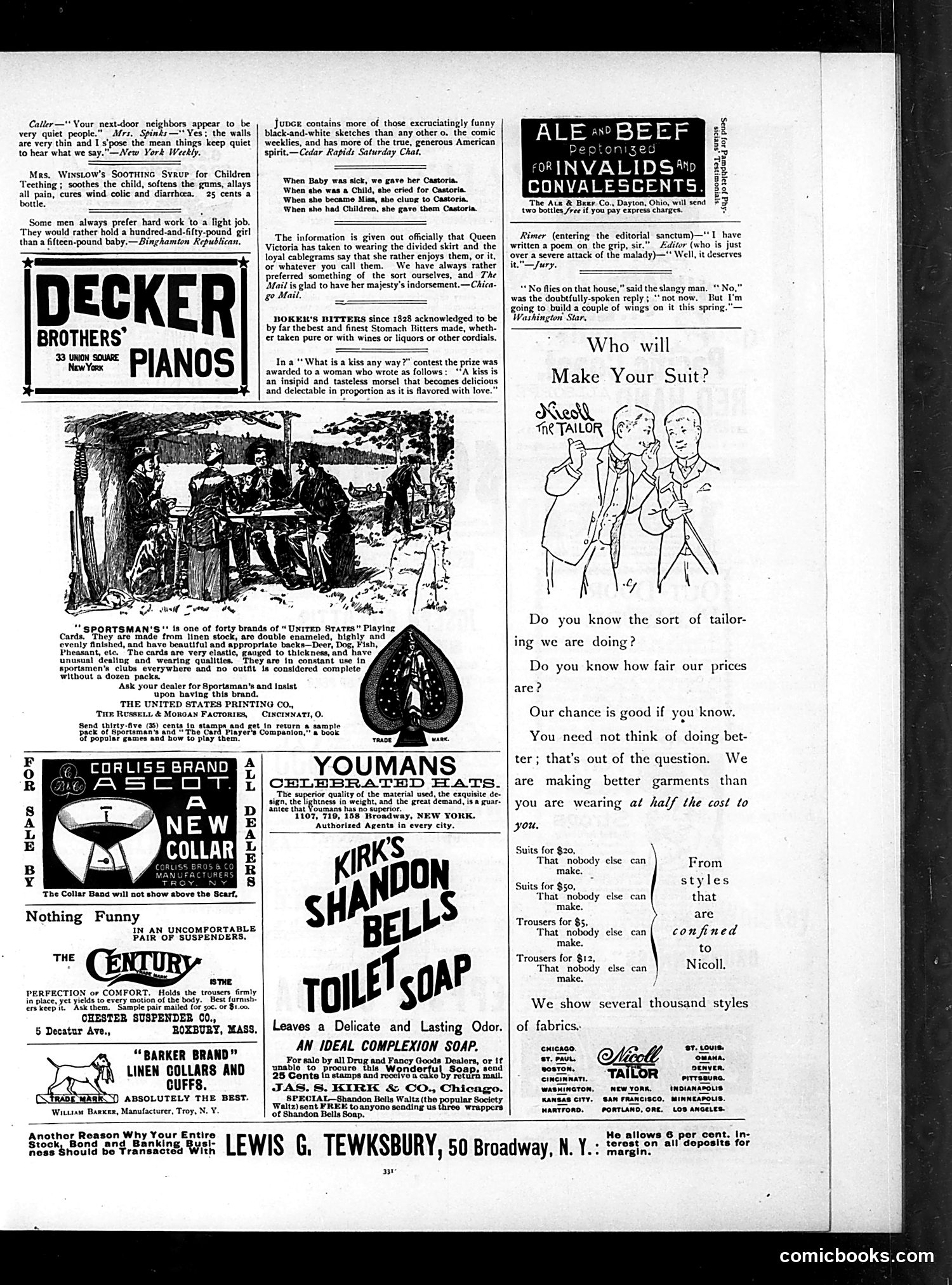
This is primarily an **advertising page** with a small cartoon joke at the top. The lone cartoon depicts a domestic satire: Mrs. Spinks tells a caller that her neighbors are quiet—but she suspects they're deliberately keeping silent so *they* can eavesdrop on *her* household through thin walls. The joke targets 19th-century tenement living conditions where privacy was nonexistent and neighbors routinely monitored each other's affairs out of nosiness or boredom. The rest of the page consists of period advertisements (patent medicines like Castoria and Bokel's Bitters, pianos, collars, soaps) interspersed with brief humorous filler items—newspaper clippings about Queen Victoria adopting divided skirts and a kiss-definition contest. These fillers were standard Judge content to fill space between ads. No political figures or significant satire appear here. This is a typical commercial page from a satirical weekly that relied heavily on advertising revenue.
This page is primarily **advertising**, not political satire. It contains commercial notices for late 19th-century products and services: railroad travel (Burlington Route to Pacific Coast), beverages (Allsopps ale, champagne, cocoa), bicycles (Columbia), razors, medical devices (ear cushions, alcohol cure), cigars, pianos, and steel pens. The only satirical content appears to be brief **humorous quips** embedded among ads: 1. A joke about a wedding ring being expensive because of alimony payments 2. A joke about a wife waiting for the new servant to unpack her trunks before deciding on a dress 3. An opening verse mocking composer Paderewski's wild hair, compared to politician Peffer's beard These are light social humor rather than pointed political commentary. The page reflects Judge's format: mixing advertisements with short, mild jokes about domestic life and contemporary figures. Without additional context, the Paderewski/Peffer reference's specific satirical point remains unclear.
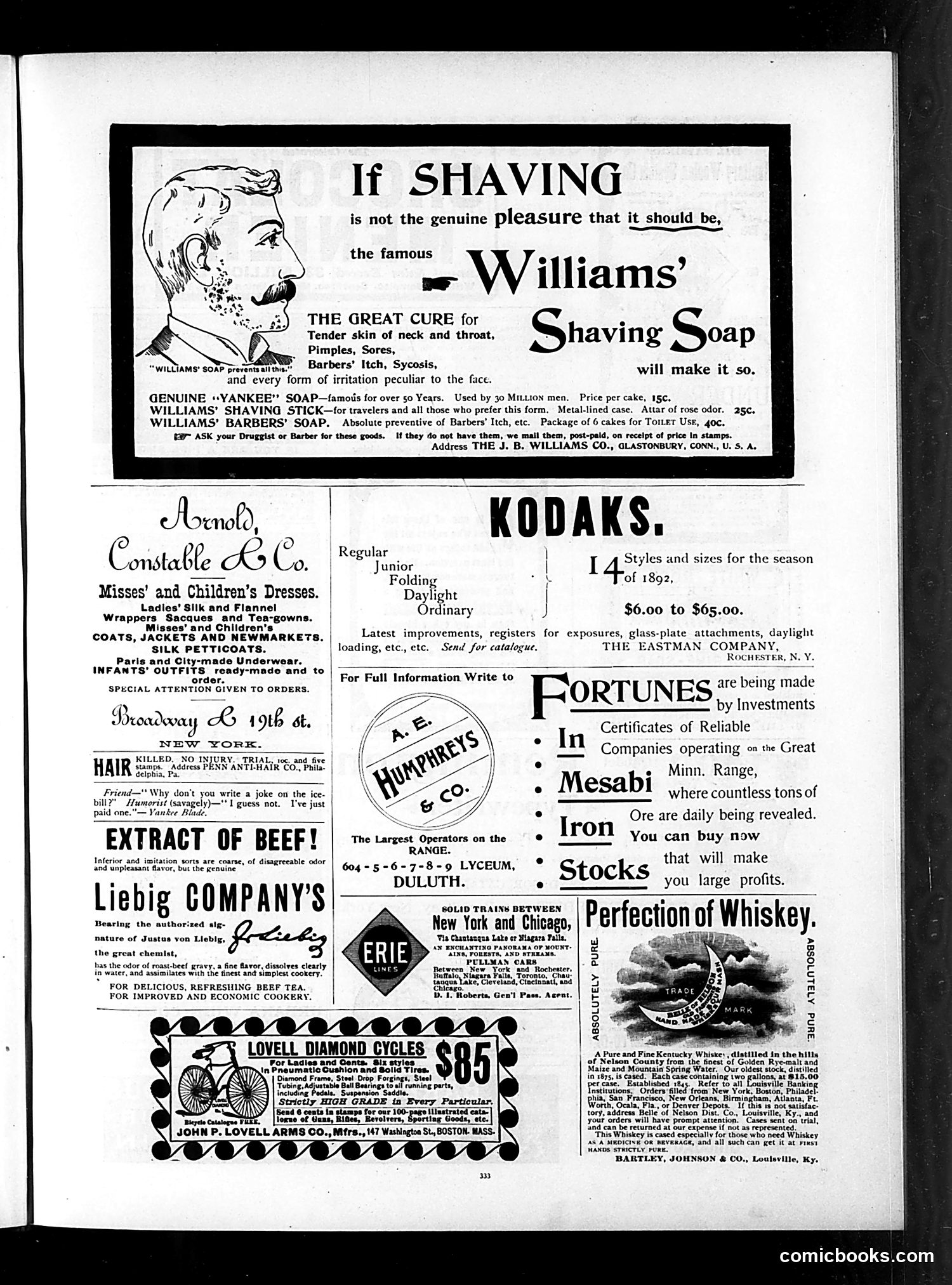
This is primarily a **advertisements page** from Judge magazine, circa 1892. Rather than satire or political cartoons, it showcases period product ads. Notable content includes: - **Williams' Shaving Soap** (top): Markets remedies for "barbers' itch" and skin irritation—common occupational hazards when shaving was a regular barbershop service. - **Kodak cameras**: Advertises multiple models ($6-$65), highlighting the still-novel technology of consumer photography. - **Liebig's Extract of Beef**: A popular commercial beef concentrate (predating bouillon cubes) marketed as economical cooking ingredient. - **Lovell Diamond Cycles**: Bicycles were fashionable consumer goods in the 1890s; this ad emphasizes "high grade" manufacturing. - **Mining investment schemes**: Mesabi iron range and other speculative securities—reflecting the era's investment culture. A small joke about ice-bill humor appears amid ads, but this page primarily documents **consumer goods and commercial culture of the 1890s** rather than political satire.
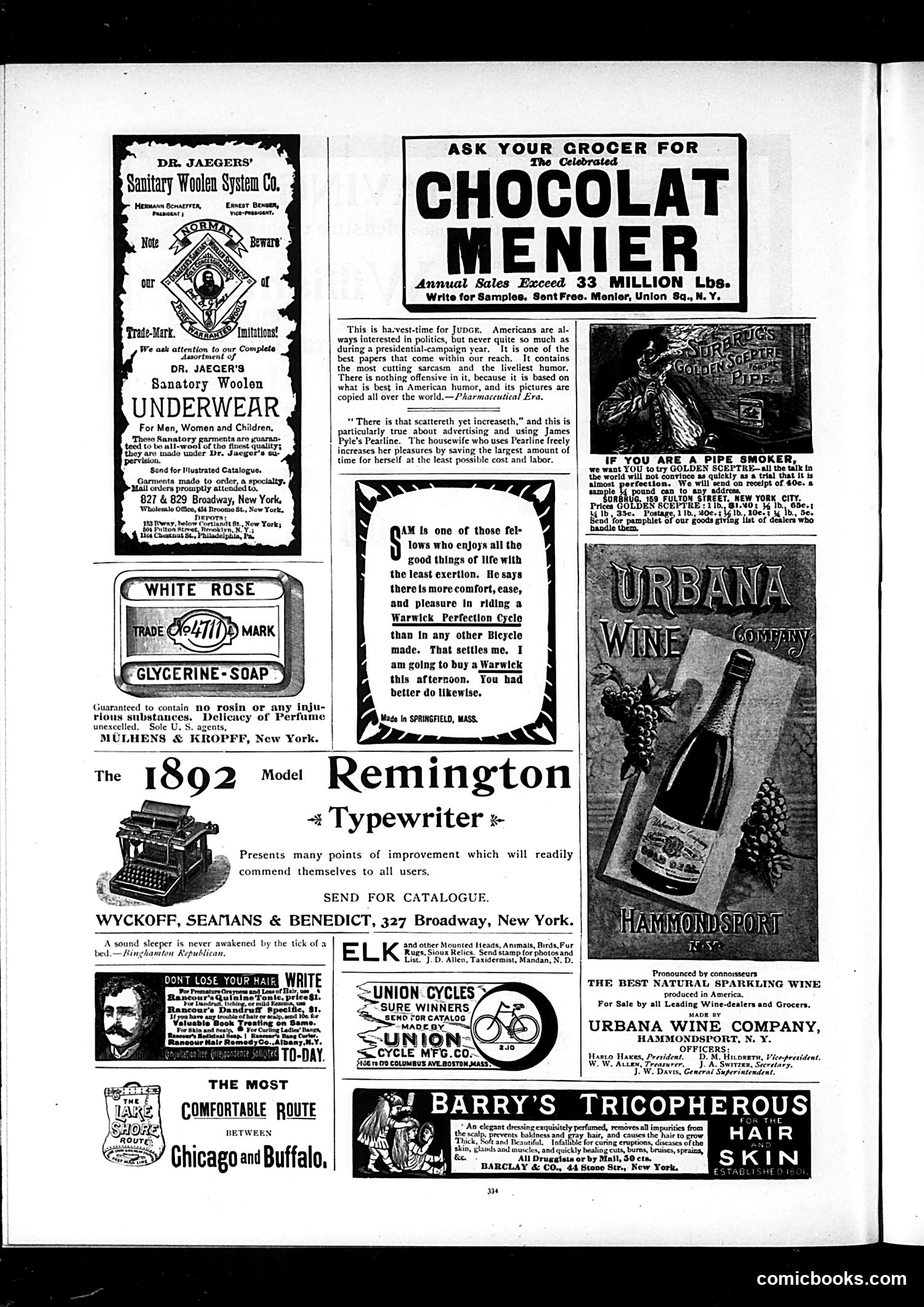
This is primarily an **advertising page** from Judge magazine, not a satirical cartoon page. The OCR'd text includes an editorial note praising Judge's political content, but the page itself showcases commercial advertisements typical of late 19th-century publications. The ads reflect period concerns: Dr. Jaeger's "sanitary woolen underwear" (based on germ-theory health fads), Menier chocolate, bicycle manufacturers (the "safety bicycle" was a recent innovation), typewriters, and patent medicines like Barry's hair tonic and Barclay's medicinal dressing. The single notable element is a brief cartoon featuring a bicycle enthusiast recommending the **Warwick Perfection Cycle**—a gentle lifestyle advertisement rather than political satire. The page demonstrates how Judge subsidized its satirical content through lucrative advertising to affluent readers interested in modern consumer goods and health products.
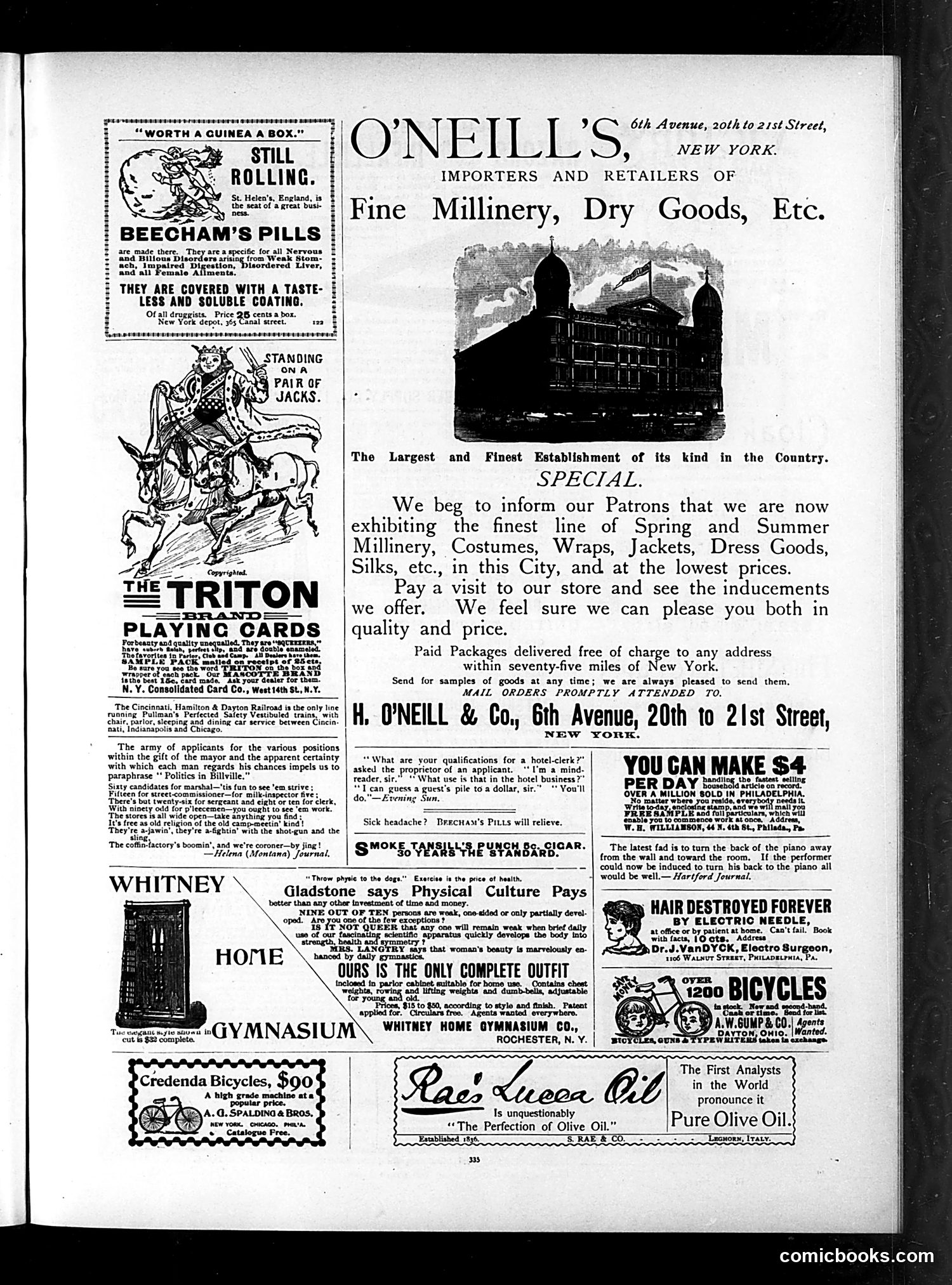
This is primarily an **advertising page** rather than editorial content. The main satirical element is a short poem titled **"Politics in Billville,"** which parodies political corruption in local government. The poem satirizes the chaos of municipal job-seekers during what appears to be a mayoral election or appointment cycle. It mocks the assumption that winning positions (marshal, commissioner, inspector, sergeant, policemen) is guaranteed, portraying candidates as violent, lawless, and corrupt—"ajawin'" and "a-fightin'" over positions while stores stand "wide open" for plunder. The dark joke concludes that the coffin factory is thriving and "we're coroner—by jing!"—meaning so many will die in the resulting chaos that the coroner's position becomes valuable. This reflects late-19th-century American cynicism about urban machine politics, where government jobs were spoils distributed to political allies, not merit-based positions. The satire suggests municipal governance was essentially organized theft and violence. The remainder of the page consists of period advertisements for O'Neill's department store, pharmaceuticals, and various consumer goods.
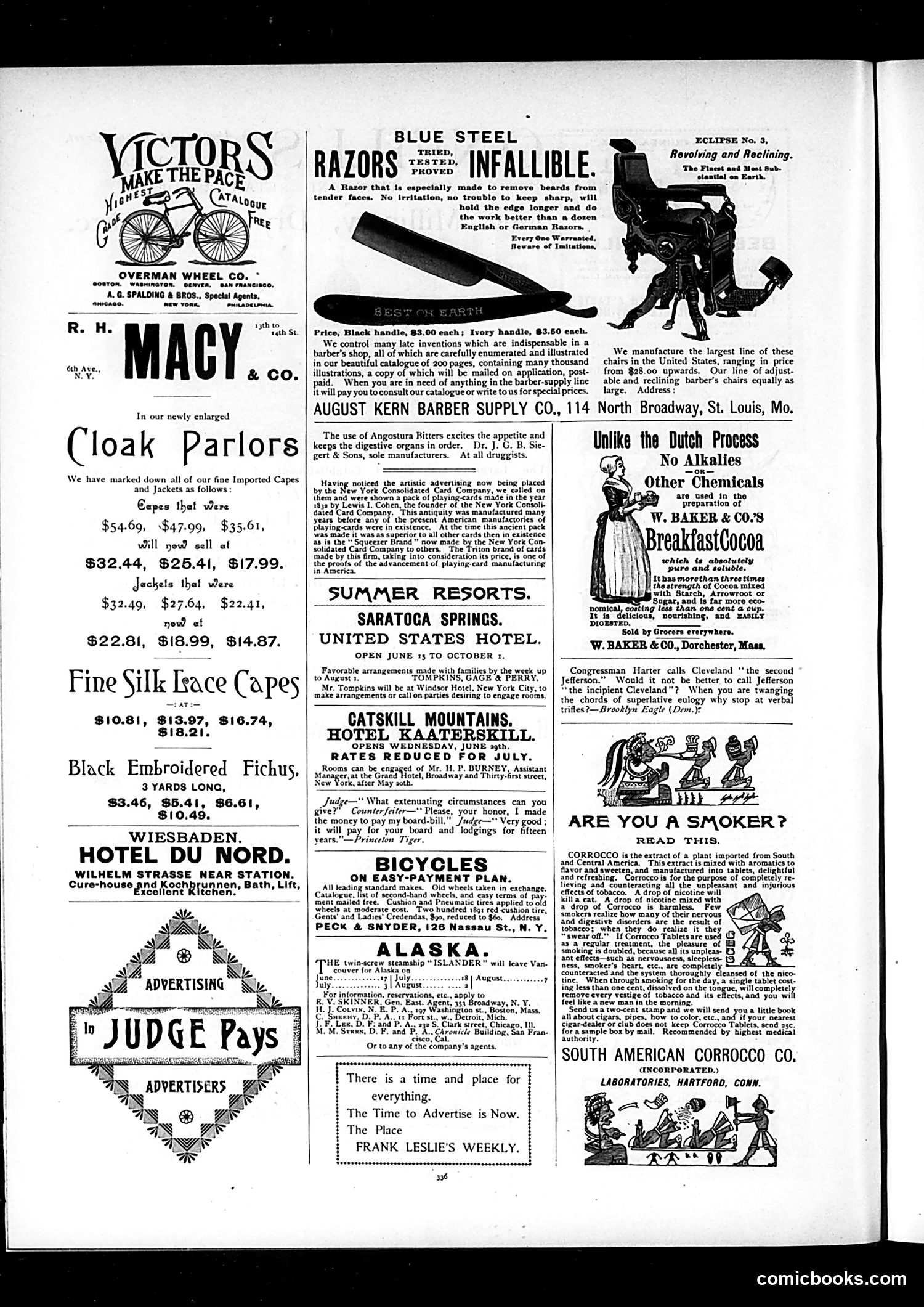
This is primarily an **advertising page** from Judge magazine, with no prominent cartoons or satirical content. The page is filled with period advertisements (1890s-era) for retail goods and services: R.H. Macy & Co. cloak sales, Victor and Overman bicycles, Blue Steel razors for barbers, W. Baker's Breakfast Cocoa, Angostura Bitters, playing cards, summer resort hotels (Saratoga Springs, Catskill Mountains), and a bicycles-on-installment ad. There is one **small joke** presented as a "Judge" caption: a counterfeiter facing a judge claims he made counterfeit money to pay his board bill; the judge approves, saying it will cover his room and lodgings for fifteen years—a play on inflation and the prison sentence he'll receive. The only illustrated element promoting reader attention is a diamond-shaped "Advertising in Judge Pays" notice mid-page, encouraging advertisers to buy space in the magazine.
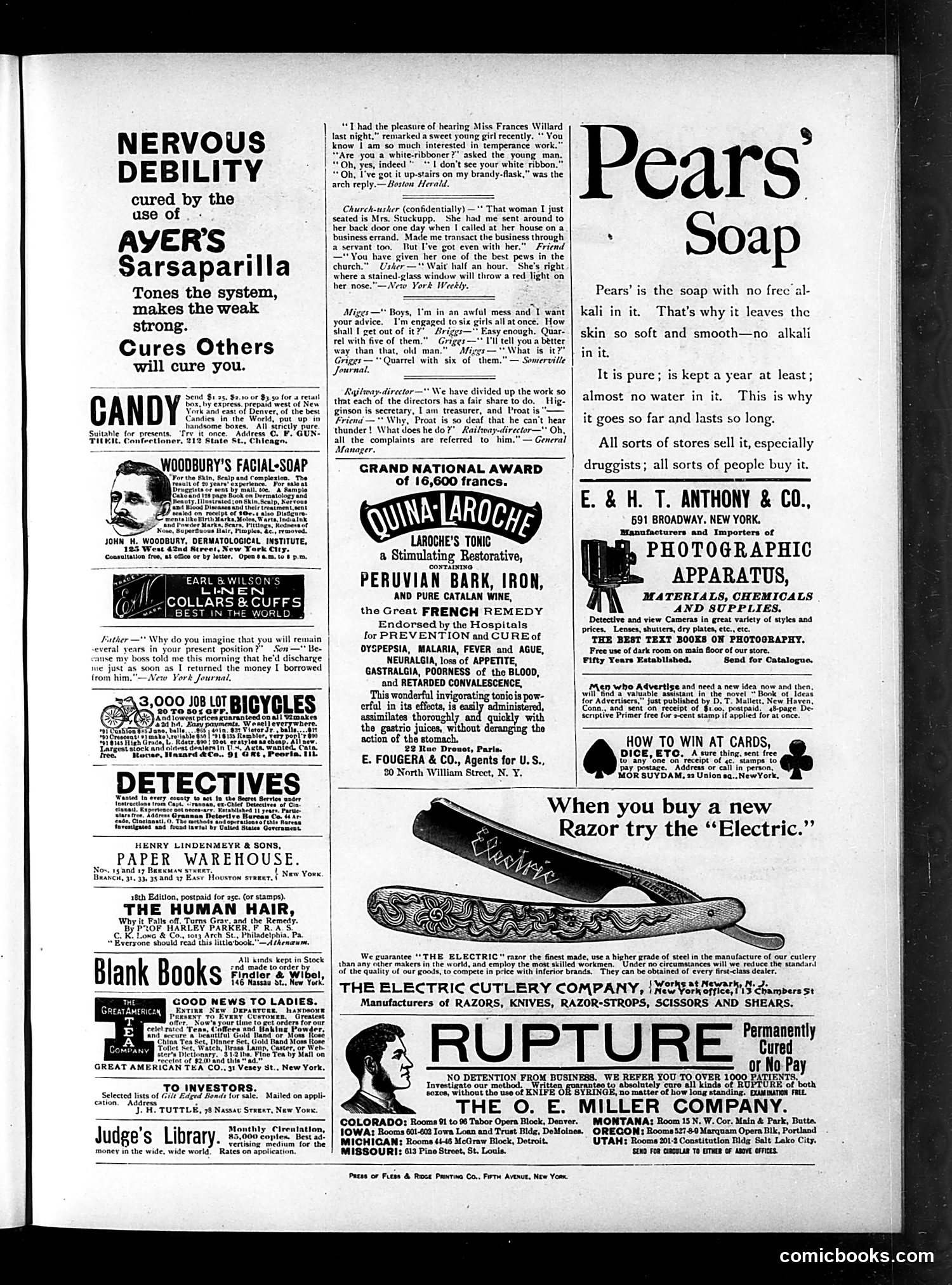
This page is **primarily advertisements** with a few short humorous anecdotes inserted between ads—typical of Judge magazine's format. The **jokes** are brief, satirical observations about contemporary social behavior: - A young woman claims to support temperance work while keeping alcohol ("brandy-flask") hidden upstairs—mocking hypocrisy. - A church usher deliberately seats an unpleasant woman where red stained glass makes her look bad—petty revenge humor. - A confused romantic scenario about a young man seeking advice on managing multiple relationships simultaneously. - A railway director assigns complaint duties to a deaf man—absurdist humor about bureaucratic incompetence. The **advertisements reflect late 19th-century concerns**: patent medicines (Ayer's Sarsaparilla for "nervous debility"), dubious health remedies (Quina-Laroche tonic), and practical products (soap, razors, bicycles). These ads reveal period anxieties about health and social status. **No political cartoons appear on this page**—it's primarily a vehicles for consumer advertising with scattered satirical snippets typical of Judge's lighthearted, gossipy tone.
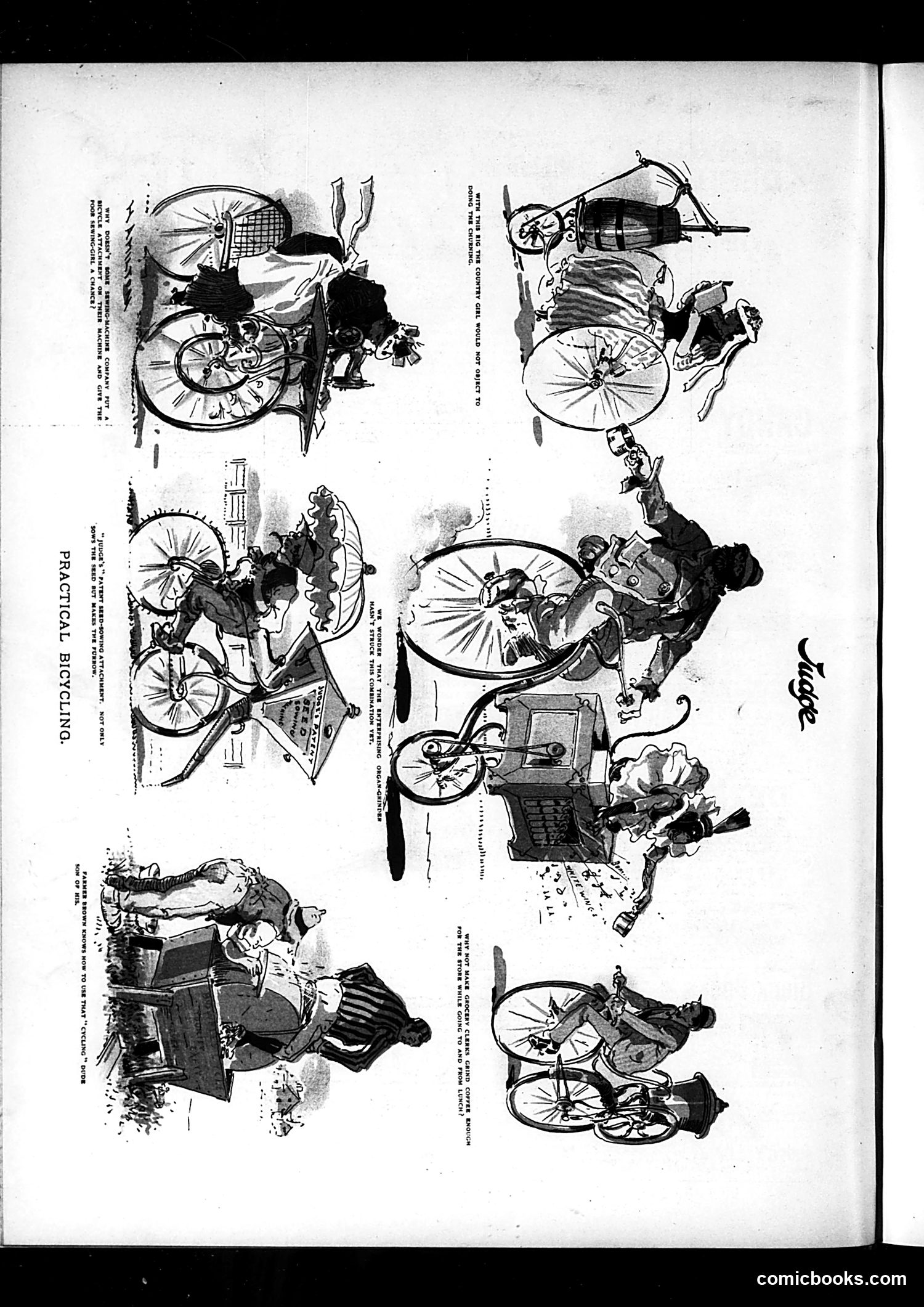
This page satirizes the bicycle craze of the 1890s by reimagining bicycles as practical work machines. The cartoons mock both: **The leisure activity itself**: Bicycling was a fashionable pastime for wealthy urbanites ("cycling dudes"), seen as frivolous. **Labor exploitation**: The satire suggests bicycles could be retrofitted to perform actual work—churning butter for country girls, grinding coffee for grocery clerks, sewing for poor seamstresses, and sowing seeds for farmers. **The joke's edge**: By showing bicycles powering productive labor, Judge critiques how the wealthy enjoy bicycles as recreation while working-class people labor. The sardonic tone suggests the ruling class should either put bicycles to useful work or acknowledge their own idleness. The title "Practical Bicycling" inverts the bicycles' actual use, highlighting the contradiction between leisure and labor in Gilded Age America.