
Judge, 1892-05-14 · page 2 of 18
Judge — May 14, 1892 — page 2: what you’re looking at
What you’re looking at
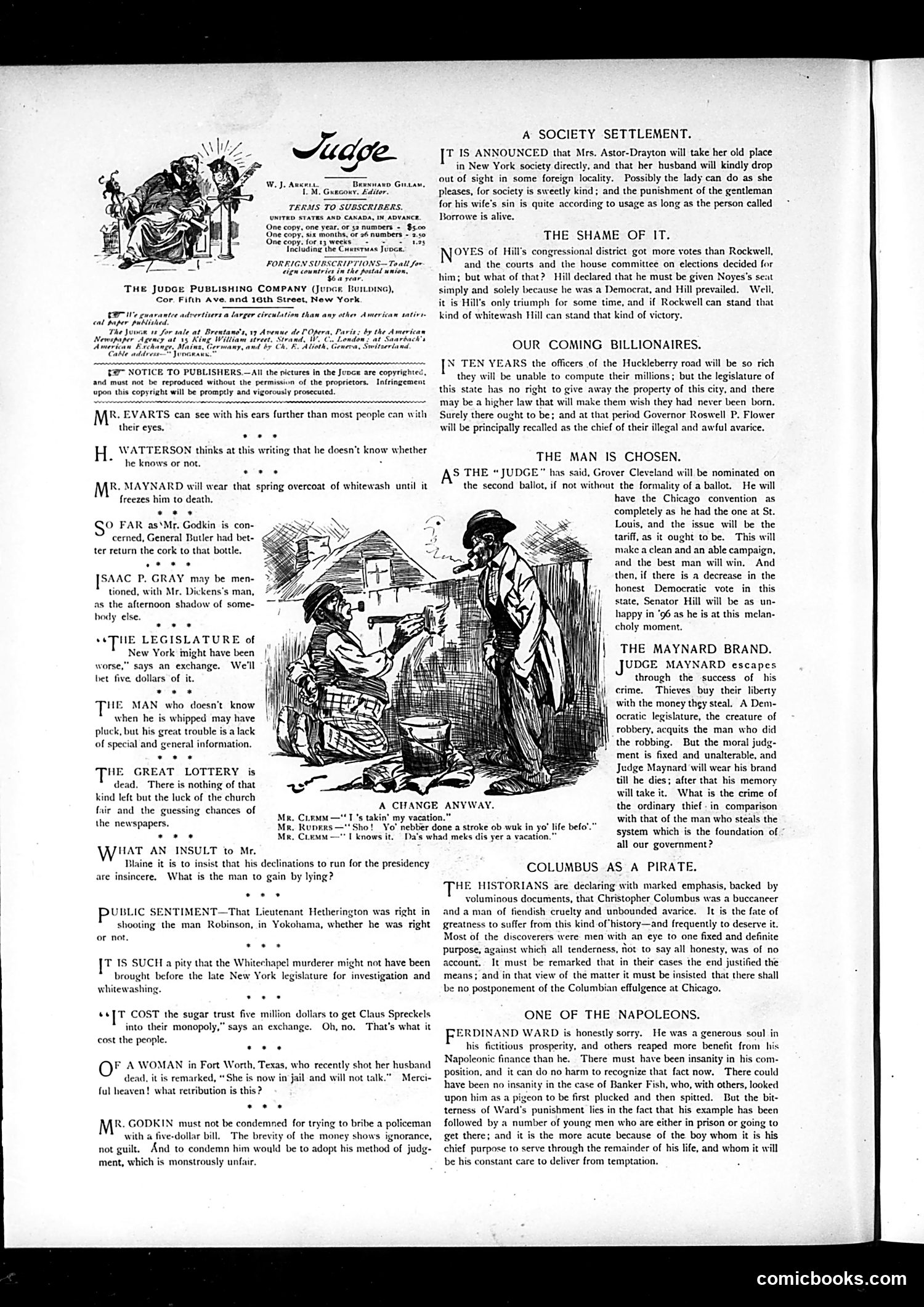
The main cartoon titled "A CHANGE ANYWAY" depicts a woman telling a man: "I's takin' my vacation." He responds: "No! Nothin' doin'! a stroke oh wuk in ys life befo'." She replies: "Well, a change anyway, seein' yuh off a vacation." This is a domestic humor joke about marriage and work. The satire suggests that a wife views her husband's vacation absence—even temporary relief from his presence—as a welcome "change" from their ordinary married life. The dialect spelling ("ys," "yuh") marks the characters as working-class. The joke mocks the tedium of lower-class marriage and domestic routine, implying the wife finds the husband's company burdensome enough that his leaving constitutes her idea of vacation. It's typical of Judge's era in using class stereotypes for comedic effect.
📄 Transcribed text from this page (OCR, searchable)
Machine-transcribed from the original scan — historical spelling and the odd misread are preserved.
dpe. W. J. Anwrn Brnxnaeo Gu.tas, 1. M. Guxcouy. £ditor. TERMS TO SUBSCRIBERS. LUNITRD STATES AND CANADA, IN ADVANCE, ‘One copy, one year. or $2 numpers = $3.00 ‘One copy, six months, or 26 numbers = 2.0 One copy: for 13 weeks == nas Including the Cwursrwas Juoce. FORRIGN SUBSCRIPTIONS—To all for ‘tien countrics im the postal union, , THE JUDGE PUBLISHING COMPANY (Juncr BuILDIn Cor. Fifth Ave. and 16th Street, New York. RTI's cwarantee advertisers a larger circu cal paper published. The Jun 11 for sale at Brentano's, 17 Avenue del Opera, Paris: by the American Newspaper Agency at 15 Villian street, Strand, Il ‘ondom; at Saardach's Ame fermany.and by Ch, B. Alioth, Geneva, Switeertand. ion tham any other American sativt~ $2 NOTICE TO PUBLISHERS.—All the pictures in the Junce are copyrighted, and must not be reproduced without the permission of the proprietors. Infringeme ight will be promptly and vigorously prosecuted. ARTS can see with his ears further than most people can with their eyes. H WATTERSON thinks at this writing that he doesn’t know whether * he knows or not. i. M®- MAYNARD will wear that spring overcoat of whitewash until it freezes him to death, eee O FAR as*Mr. Godkin is con- cerned, General Butler had bet- ter return the cork to that bottle, SAAC P. GRAY may be men- tioned, with Mr. Dickens's man, as the afternoon shadow of some- body else. seTHE LEGISLATURE of New York imight have been worse,” says an exchange. We'll het five. dollars of it. vee THE MAN who doesn’t know when he is whipped may have pluck, but his great trouble is a lack of special and general information. HE GREAT LOTTERY is dead, There is nothing of that kind left but the luck of the church fair and the guessing chances of the newspapers. WHat AN INSULT to Mr. Blaine it is to insist that his declinations to run for the presidency incere. What is the man to gain by lying? Mr. Rupers Mr. CLesat — “Sho! I knows it. UBLIC SENTIMENT—That Lieutenant Hetherington was right in shooting the man Robinson, in Yokohama, whether he was right or not. T IS SUCH a pity that the Whitechapel murderer might not have been brought before the late New York legislature for investigation and whitewashing. 4] COST the sugar trust five million dollars to get Claus Spreckels into their monopoly,” says an exchange. Oh, no. That's what it cost the people. A WOMAN in Fort Worth, Texas, who recently shot her husband dead, it is remarked, “She is now in jail and will not talk.” Merci- ful heaven! what retribution is this? eee R. GODKIN must not be condemned for trying to bribe a policeman with a five-dollar bill. ‘The brevity of the money shows ignorance, not guilt, And to condemn him would be to adopt his method of judg- ment, which is monstrously unfair. A CHANGE ANYWAY. Mr. Cea —"' T's takin’ my vacation,” Yo" nebber done a stroke ob wuk in yo! life befo’." Da's whad meks dis yer a vacation.” A SOCIETY SETTLEMENT. T IS ANNOUNCED that Mrs. Astor-Drayton will take her old place in New York society directly, and that her husband will kindly drop out of sight in some foreign locality. Possibly the lady can do as she pleases, for society is sweetly kind; and the punishment of the gentleman for his wife’s sin is quite according to usage as long as the person called Borrowe is alive. THE SHAME OF IT. OYES of Hill's congressional district got more votes than Rockwell, and the courts and the house committee on elections decided for him; but what of that? Hill declared that he must be given Noyes’s seat simply and solely because he was a Democrat, and Hill prevailed. Well, it is Hill's only triumph for some time, and if Rockwell can stand that kind of whitewash Hill can stand that kind of victory. OUR COMING BILLIONAIRES. N TEN YEARS the officers of the Huckleberry road will be so rich they will be unable to compute their millions; but the legislature of this state has no right to give away the property of this city, and there may be a higher law that will make them wish they had never been born, Surely there ought to be; and at that period Governor Roswell P. Flower will be principally recalled as the chief of their illegal and awful avarice. THE MAN IS CHOSEN. AS THE “JUDGE” has said, Grover Cleveland will be nominated on the second ballot, if not without the formality of a ballot. He will have the Chicago convention as completely as he had the one at St. Louis, and the issue will be the tariff, as it ought to be. This will make a clean and an able campaign, and the best man will win, And then, if there is a decrease in the honest Democratic vote in this state, Senator Hill will be as un- happy in ‘96 as he is at this melan- choly moment. THE MAYNARD BRAND. UDGE MAYNARD escapes through the success of his crime. Thieves buy their liberty with the money thgy steal. A Dem- ocratic legislature, the creature of robbery, acquits the man who did the robbing. But the moral judg- ment is fixed and unalterable, and Jedge Maynard will wear his brand till he dies; after that his memory will take it, What is the crime of the ordinary thief. in comparison with that of the man who steals the system which is the foundation of all our government? COLUMBUS AS A PIRATE. THE HISTORIANS are declaring with marked emphasis, backed by voluminous documents, that Christopher Columbus was a buccaneer and a man of fiendish cruelty and unbounded avarice. It is the fate of greatness to suffer from this kind of history—and frequently to deserve it. Most of the discoverers were men with an eye to one fixed and definite purpose, against which all tenderness, fot to say all honesty, was of no account. It must be remarked that in their cases the end justified the means; and in that view of the matter it must be insisted that there shall be no postponement of the Columbian effulgence at Chicago. ONE OF THE NAPOLEONS. DINAND WARD is honestly sorry. He was a generous soul in his fictitious prosperity, and others reaped more benefit from his Napoleonic finance than he. There must have been insanity in his com- position, and it can do no harm to recognize that fact now. There could have been no insanity in the case of Banker Fish, who, with others, looked upon him as a pigeon to be first plucked and then spitted. But the bit- terness of Ward's punishment lies in the fact that his example has been followed by a number of young men who are either in prison or going to get there; and it is the more acute because of the boy whom it is his chief purpose to serve through the remainder of his life, and whom it will be his constant care to deliver from temptation. rE comicbooks.com