
Judge, 1892-05-14 · page 7 of 18
Judge — May 14, 1892 — page 7: what you’re looking at
What you’re looking at
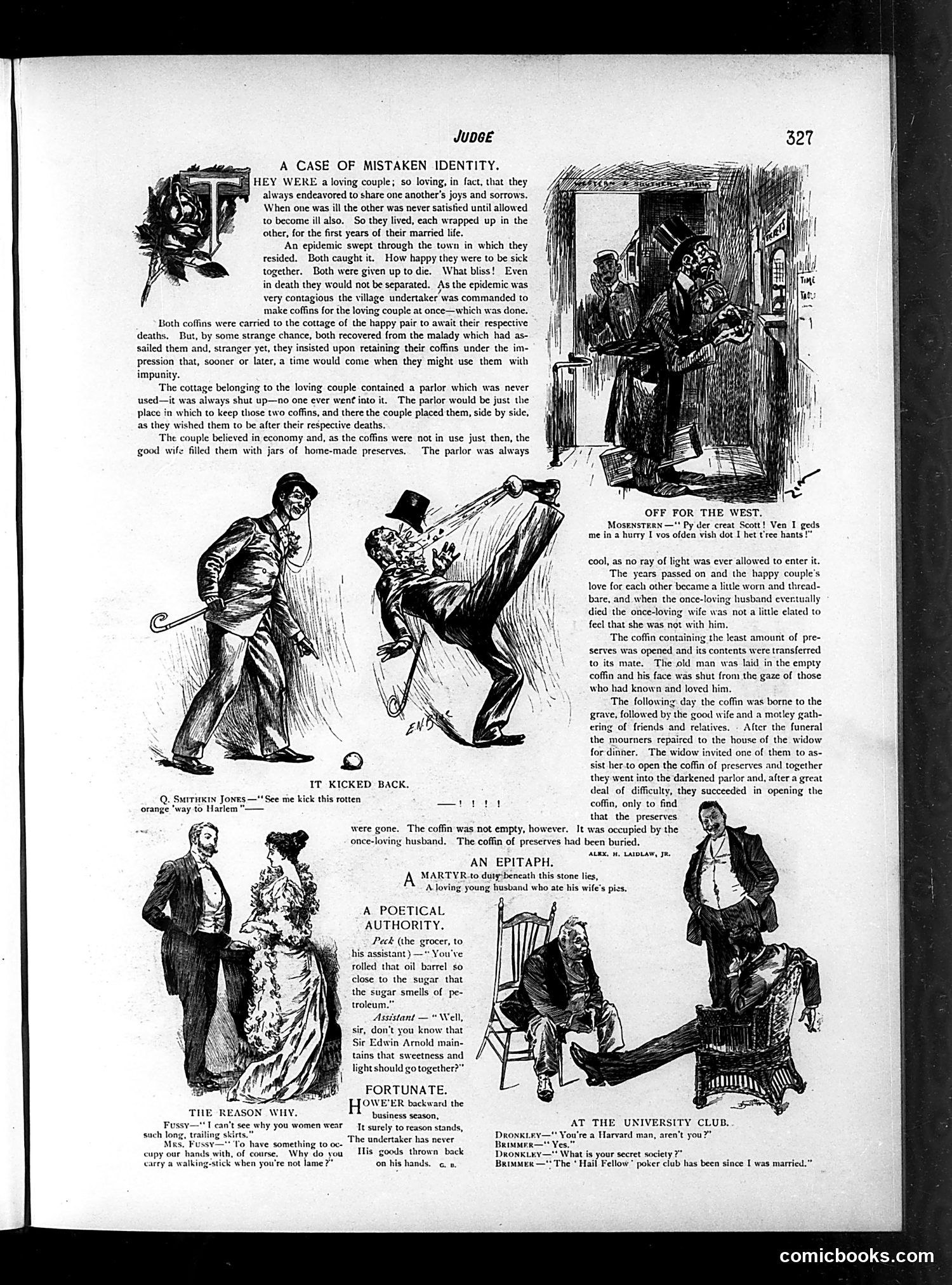
This page contains multiple satirical vignettes typical of late-19th/early-20th-century Judge humor: **"A Case of Mistaken Identity"** (main story): A darkly comic tale where an overly devoted couple keeps coffins in their parlor filled with preserves. When the husband dies, the wife accidentally buries the *preserves* coffin instead, discovering only later that her husband was in the *other* coffin—implying her relief at not having to share even death with him. The satire mocks Victorian sentimentality about marriage while playing on ironic fate. **Minor comic sketches** address contemporary topics: "Poetical Authority" jokes about Sir Edwin Arnold (a famous poet/editor), conflating his famous phrase "sweetness and light" with the oil/sugar proximity. Other vignettes include period humor about fashion, business cycles, and social clubs. The drawings show typical Judge illustration style—detailed Victorian engravings. The overall page reflects Judge's characteristic blend of darker wit with social observation, targeting middle-class pretensions and romantic pieties of the era.
📄 Transcribed text from this page (OCR, searchable)
Machine-transcribed from the original scan — historical spelling and the odd misread are preserved.
JuD6E A CASE OF MISTAKEN IDENTITY. HEY WERE a loving couple; so loving, in fact, that they ¥ always endeavored to share one another's joys and sorrows. When one was ill the other was never satisfied until allowed to become ill also. So they lived, each wrapped up in the other, for the first years of their married life. ‘An epidemic swept through the town in which they resided. Both caught it. How happy they were to be sick together. Both were given up to die. What bliss! Even in death they would not be separated. As the epidemic was very contagious the village undertaker was commanded to make coffins for the loving couple at once—which was done. Both coffins were carried to the cottage of the happy pair to await their respective deaths, But, by some strange chance, both recovered from the malady which had as- sailed them and, stranger yet, they insisted upon retaining their coffins under the im- pression that, sooner or later, a time would come when they might use them with impunity. The cottage belonging to the loving couple contained a parlor which was never used—it was always shut up—no one ever went into it. The parlor would be just the place in which to keep those two coffins, and there the couple placed them, side by side, as they wished them to be after their respective deaths. The couple believed in economy and, as the coffins were not in use just then, the good wife filled them with jars of home-made preserves. The parlor was always IT KICKED BACK. Q. Surrirxty Jones —'* See me kick this rotten, orange ‘way to Harlem "— OFF FOR THE WEST. Mosenstern —"* Py der creat Scott! Ven I geds me in a hurry I vos ofden vish dot I het t'ree hants!" cool, as no ray of light was ever allowed to enter it. The years passed on and the happy couple's love for each other became a little worn and thread- bare, and when the once-loving husband ever:tually died the once-loving wife was not a little elated to feel that she was not with him. The coffin containing the least amount of pre- serves was opened and its contents were transferred to its mate. The old man was laid in the empty coffin and his face was shut from the gaze of those who had known and loved him. The following: day the coffin was borne to the grave, followed by the good wife and a motley gath- ering of friends and relatives. . After the funeral the mourners repaired to the house of the widow for dinner. The widow invited one of them to as- sist her.to open the coffin of preserves and together they went into the darkened parlor and, after a great deal of difficulty, they succeeded in opening the coffin, only to find that the preserves were gone. The coffin was not empty, however. It was occupied by the once-lo s husband. The coffin of preserves had been buried. ALEX, ot, LAIDLAW, JR AN EPITAPH. A MARTYR to duty:beneath this stone li Aloving young husband who ate his wit A POETICAL AUTHORITY. Peck (the grocer, to his assistant) —" You've rolled that oil barrel so close to the sugar that the sugar smells of pe- troleum.” Assistant — “Well, sir, don’t you know that Sir Edwin Amold main- tains that sweetness and light should go together?” FORTUNATE. HOWEER backward the business season, Tt surely to reason stands, Mrs. *'To have something to oc- The undertaker has never cupy our hands with, of course. Why do you His goods thrown back carry a walking-stick when you're not lame ?* on his hands. ¢. THE REASON WHY. Fussy—''I can’t see why you women wear such long, ints.” AT THE UNIVERSITY CLUB. You're a Harvard man, aren't you?" t is your secret society 7” ‘The * Hail Fellow * poker club has been since I was married.” comicbooks.com