
A complete issue · 16 pages · 1892
Judge — May 7, 1892
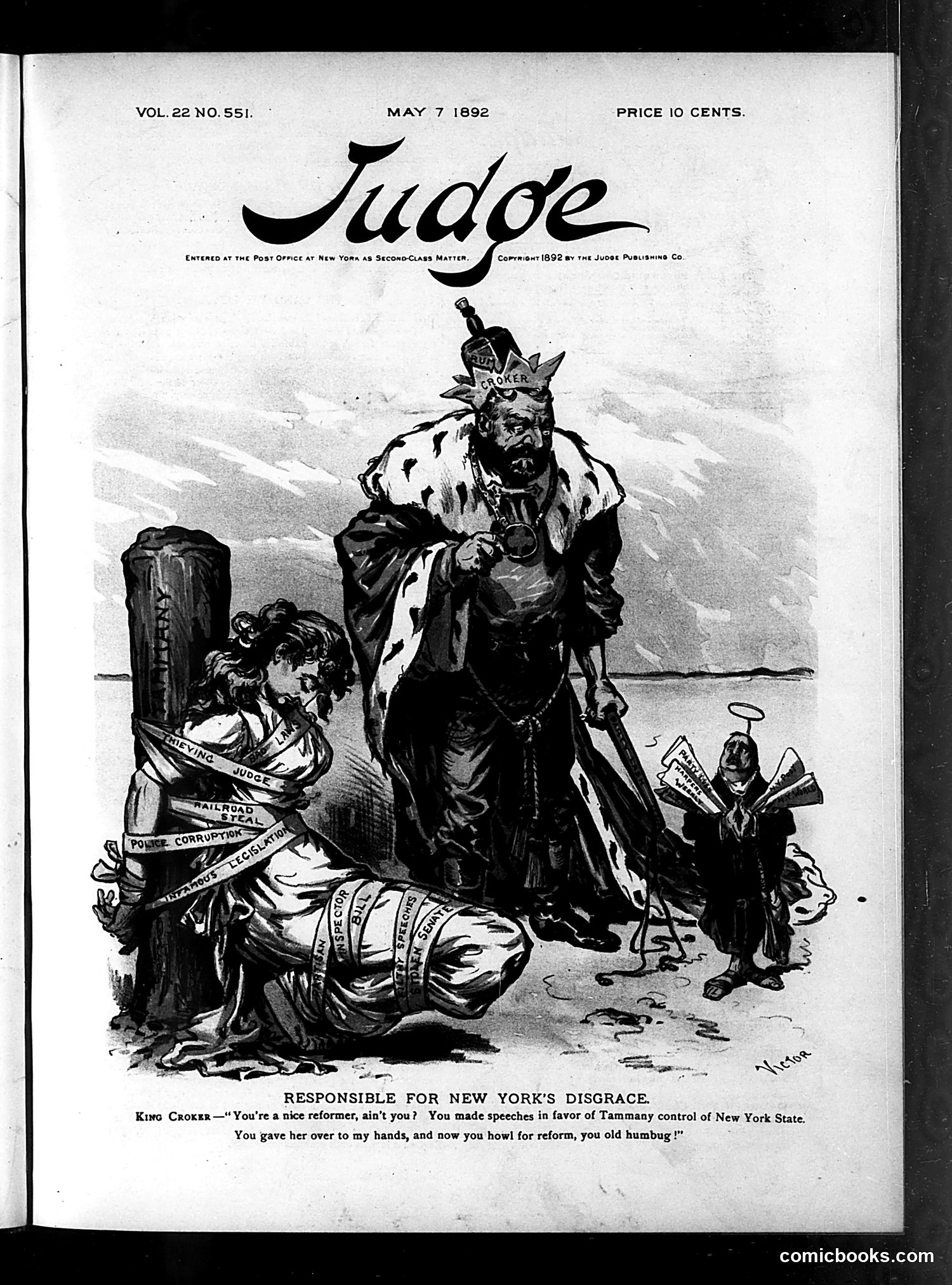
This May 7, 1892 *Judge* cartoon depicts a demonic "King Croker" figure towering over a bound, gagged woman representing New York State. The woman is labeled with bands reading various corruptions: "Bribery," "Police Corruption," "Gambling," and "Saloons." The caption has Croker sarcastically address the woman, claiming she wanted reform and a "Tammany machine" but now "howls for reform." The satire targets Richard Croker, the notorious boss of New York's Tammany Hall political machine, blaming him personally for widespread civic corruption, vice, and moral degradation plaguing the state. The cartoon uses the bound woman as a metaphor for New York itself, enslaved by machine politics and criminal influence.
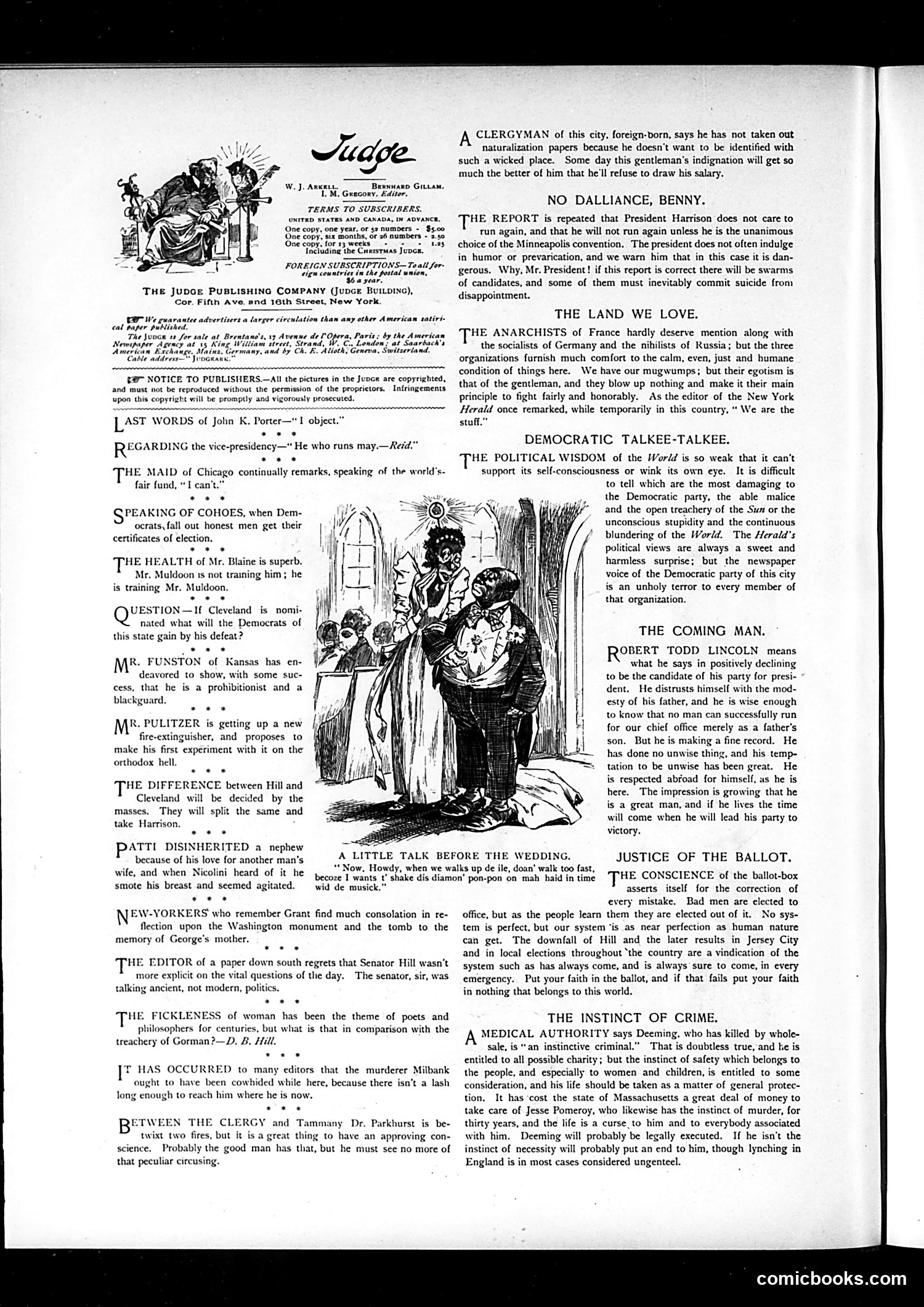
This page contains editorial commentary rather than cartoons. The main illustrated piece, "A Little Talk Before the Wedding," depicts a priest counseling a couple, with text joking about marital advice ("when we walk up de isle, don't walk too fast, because I wants t' shake de diamond' pop'pon on mah haid it line wid de match"). The editorial sections target contemporary political figures and issues: - **"No Dalliance, Benny"** criticizes President Harrison's reluctance to run for re-election - **"The Coming Man"** praises Robert Todd Lincoln as a potential presidential candidate - **"Justice of the Ballot"** discusses electoral integrity and the Jesse Pomeroy murder case in Massachusetts The commentary reflects late 19th-century Republican political debates and sensational crime coverage.
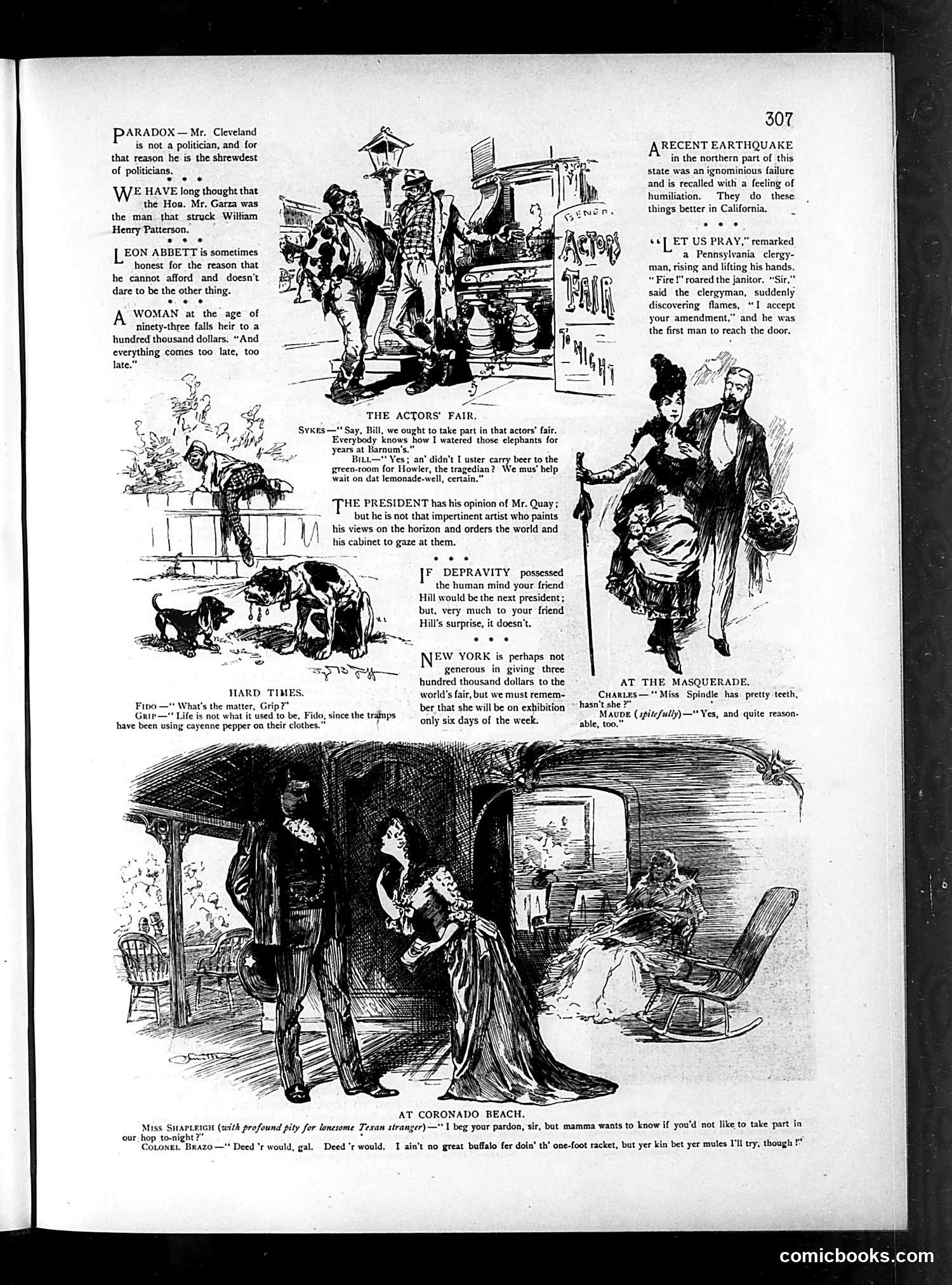
This page contains several satirical vignettes typical of late-19th/early-20th century humor magazines: **"The Actors' Fair"** mocks theatrical pretension through a dialogue about watering down elephants—likely criticizing exaggerated theatrical claims or animal exploitation in performances. **"Hard Times"** depicts struggling figures (Fido and Grip), using animal characters to comment on economic hardship and poverty. **"At the Masquerade"** and **"At Coronado Beach"** are social satires featuring wealthy or fashionable characters, poking fun at upper-class affectations and comportment. The scattered single-panel jokes at top ("Paradox," "A Woman at the Age") employ wordplay common to the era's humor. Overall, this represents Judge's typical formula: mixing political/social commentary with lighthearted domestic observations aimed at middle-class readers, using caricature and exaggeration as satirical tools.
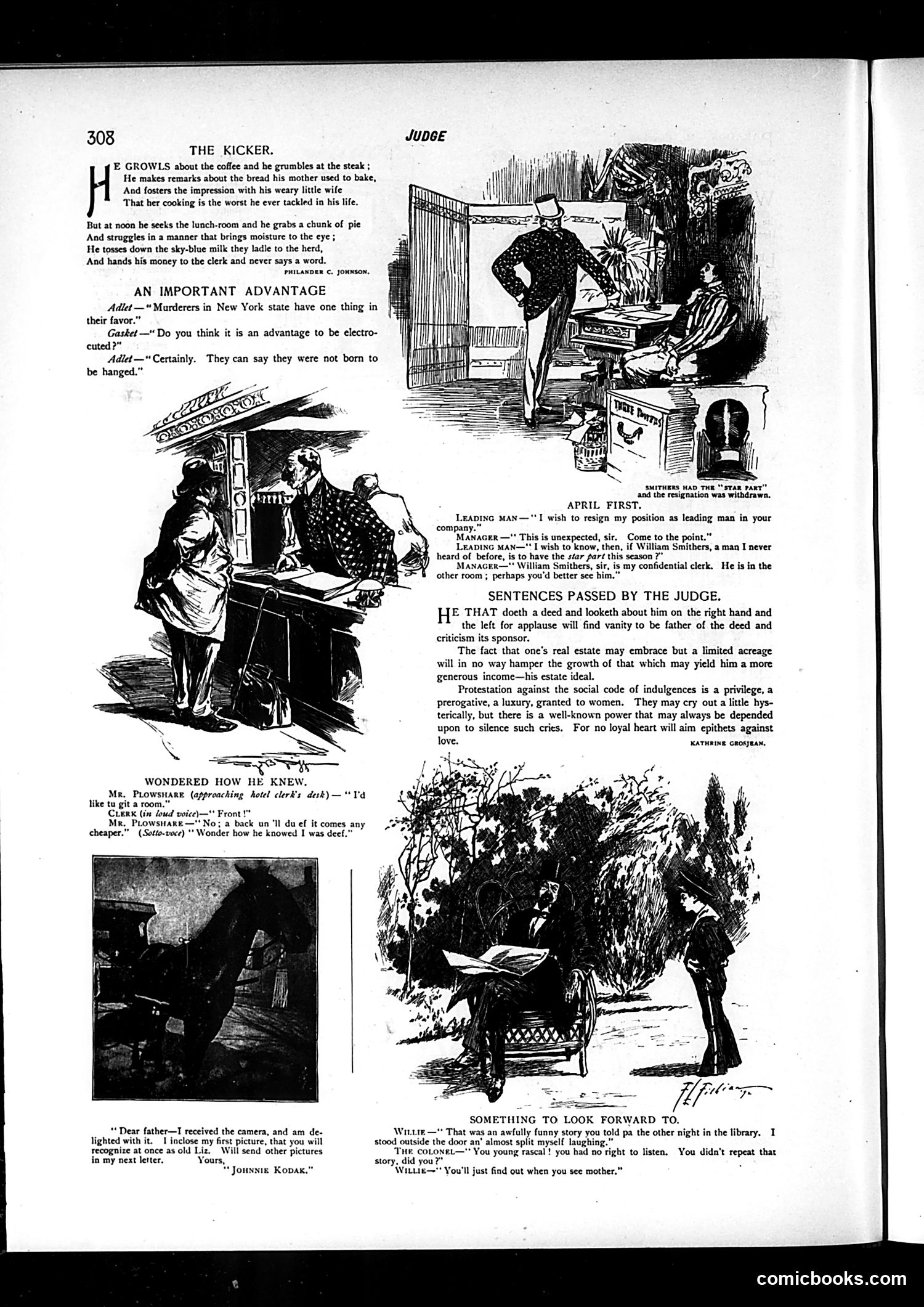
This page contains several satirical pieces typical of Judge's social commentary: **"The Kicker"** mocks the hypocritical husband who complains loudly about his wife's cooking at home but eagerly devours cheap diner food without complaint—satirizing masculine bluster and ingratitude. **"An Important Advantage"** is a dark joke about New York's use of electrocution for executions (versus hanging in other states), suggesting condemned men might prefer one method over another. This references the contemporary debate over capital punishment methods. **"April First"** plays on theatrical backstage drama, where an actor fears losing his leading role to an unknown rival—who turns out to be the manager's clerk, suggesting nepotism or favoritism in theater casting. **"Sentences Passed by the Judge"** offers philosophical aphorisms on vanity, property, and women's social constraints—typical of Judge's moralizing content. The remaining pieces are light domestic humor about miscommunication and family secrets, representing the magazine's mix of satire and everyday observational comedy.
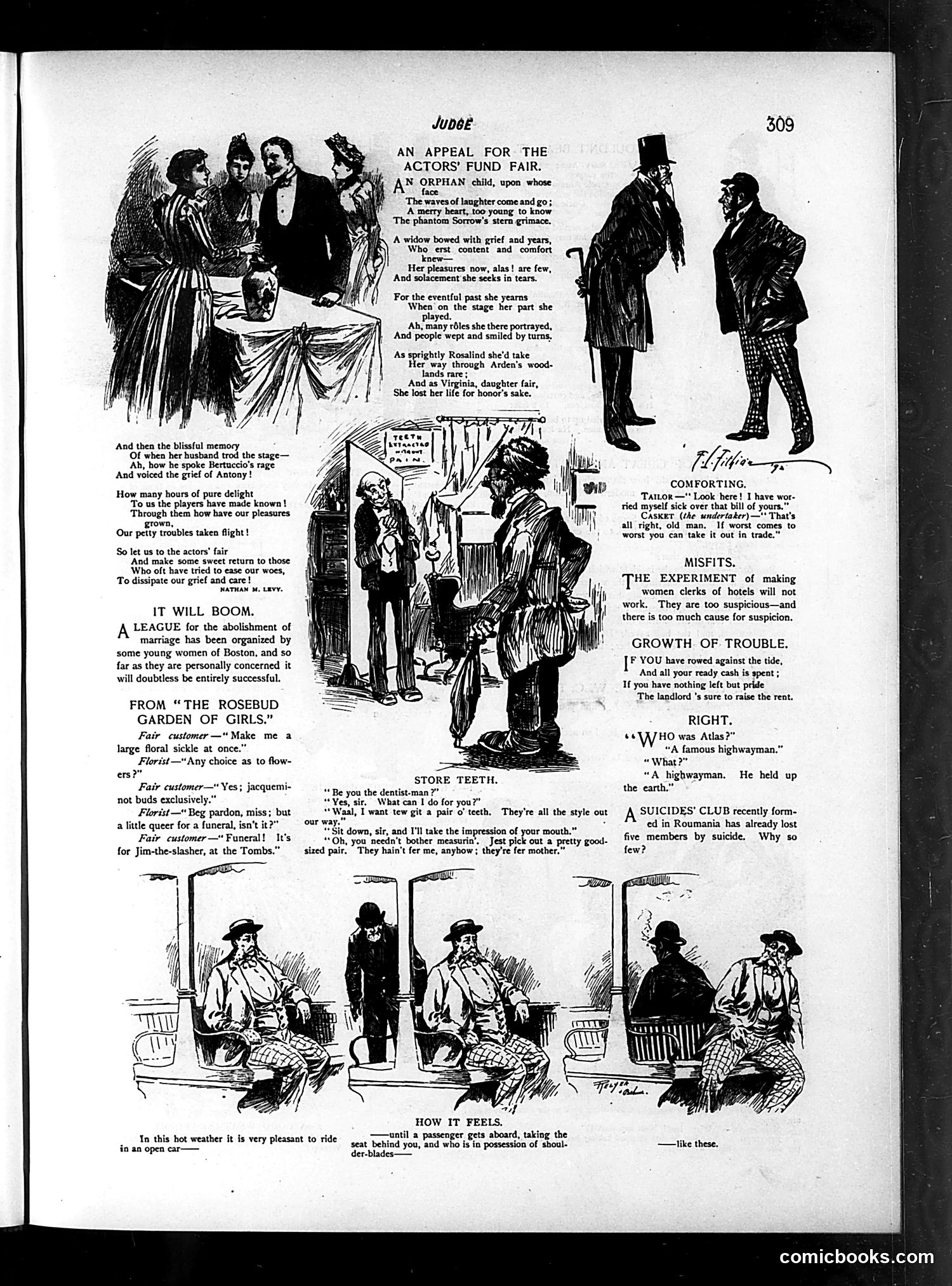
This page contains several disconnected satirical pieces typical of Judge magazine's format: **"An Appeal for the Actors' Fund Fair"** is a sentimental poem soliciting donations for theatrical performers' charity, contrasting orphans, widows, and former actresses who found solace in theater. **"It Will Boom"** mockingly notes a Boston women's anti-marriage league will "succeed" since its members won't marry anyway—a jab at progressive feminism. **"Store Teeth"** depicts rural dialect humor: a rustic seeking false teeth not for himself but his mother, playing on class and educational stereotypes. **"How It Feels"** is a visual gag about discomfort from a passenger's sharp shoulder blades in close quarters—everyday urban annoyance. **"Right"** offers wordplay: "Atlas" is misidentified as a highwayman rather than the mythological figure, punning on "holding up" the earth. **"Misfits"** suggests women hotel clerks are "too suspicious" and distrusts female workers. The page reflects turn-of-century American prejudices: skepticism toward women's independence, rural mockery, and class-based humor presented as genteel satire.
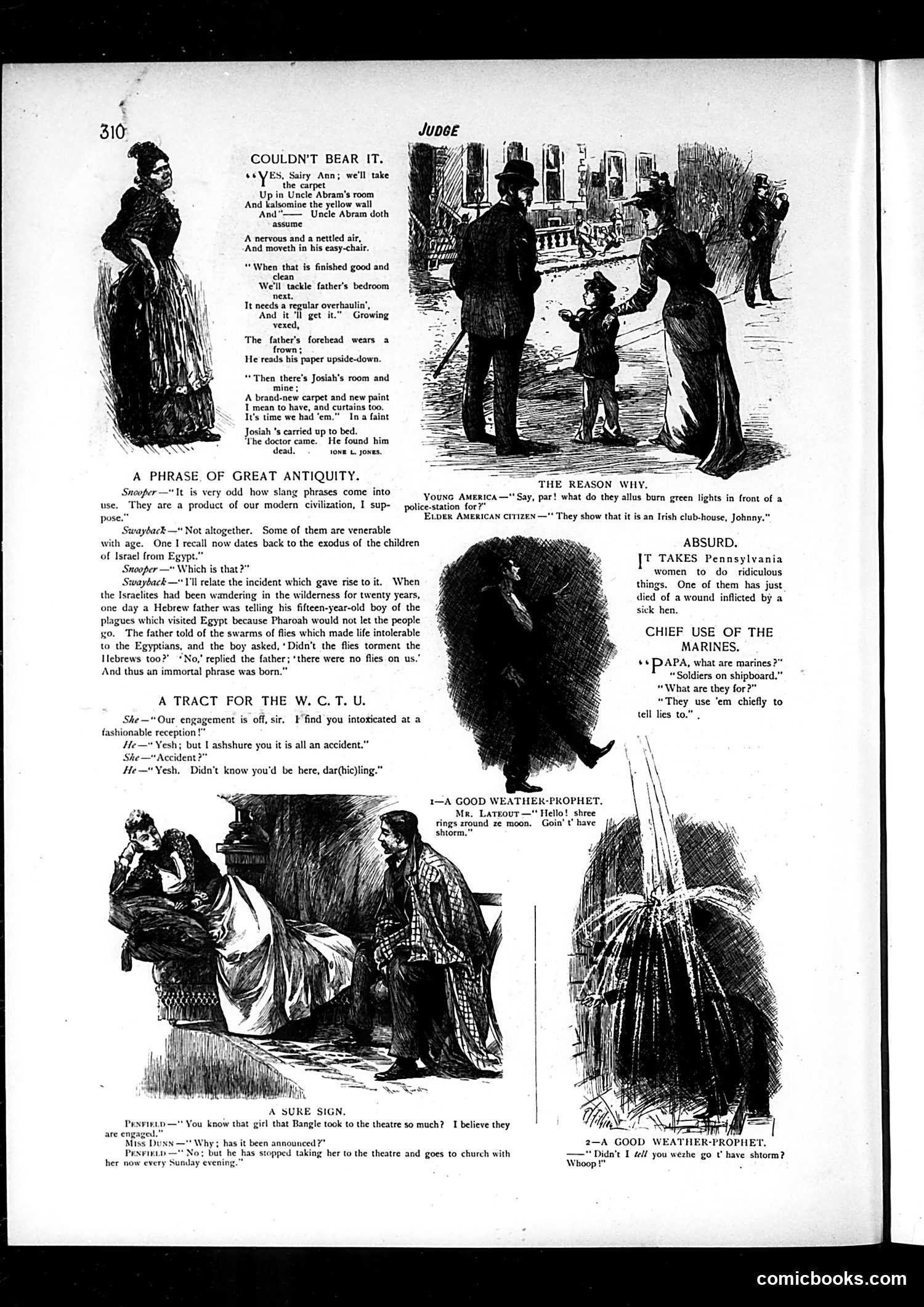
This page contains several short satirical pieces typical of late 19th-century American humor: **"Couldn't Bear It"** depicts domestic renovation chaos—a wife enthusiastically plans extensive house improvements (carpets, paint, redecorating multiple rooms) while her husband and son grow increasingly distressed. The joke's dark punchline: the constant upheaval literally kills their son Josiah. This satirizes both wives' decorating obsessions and the anxieties of home improvement. **"A Phrase of Great Antiquity"** plays with the expression "there were no flies on us" (meaning we weren't fooled), tracing it humorously back to the Biblical plagues of Egypt. The remaining pieces are brief ethnic/social jokes: Irish-Americans and police stations, Pennsylvania women's foolishness, Marines' dishonesty, drunk engagements, and weather predictions. These reflect Judge's typical formula: domestic humor, ethnic stereotyping, and broad social satire targeting middle-class American life and immigrant communities—representative of early 1890s popular entertainment standards and attitudes.
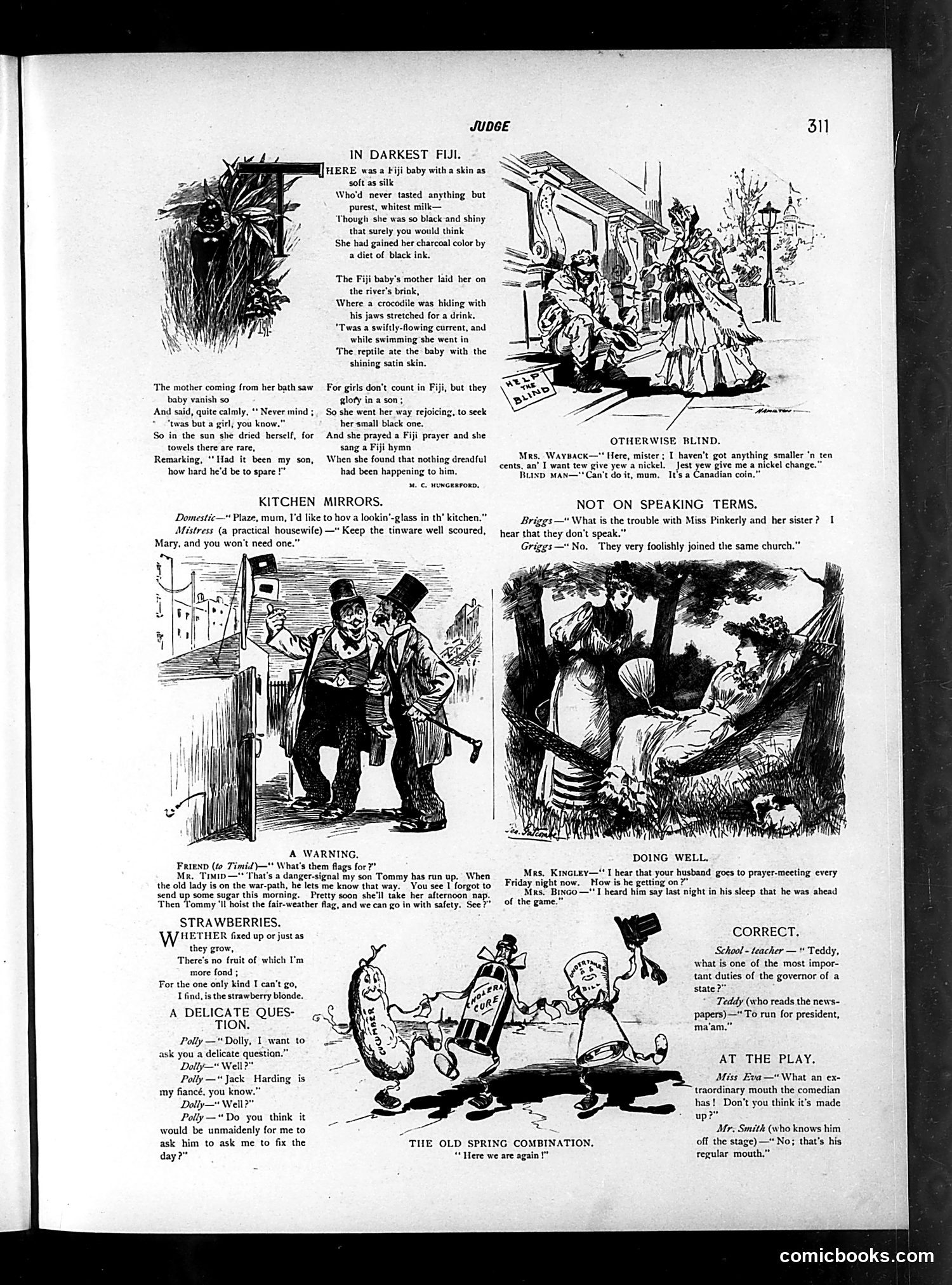
This page contains multiple brief satirical pieces typical of Judge's humor circa early 1900s: **"In Darkest Fiji"** mocks racist stereotypes about African and Pacific Islander peoples. It presents a grotesque scenario where a Fijian mother is indifferent to her daughter's death by crocodile, valuing sons over daughters—portraying the culture as barbaric and morally inverted. **Other brief jokes** satirize domestic life: a wife's temper ("A Warning"), marital prayer-meeting attendance ("Doing Well"), sisters foolishly joined the same church and won't speak ("Not on Speaking Terms"), and a dismissive comment about blonde women. **"Kitchen Mirrors"** and **"A Delicate Question"** are standard domestic humor about household management and courtship propriety. The page reflects Judge's typical approach: Anglo-American middle-class perspectives presented as superior, with foreign cultures and working-class life depicted as comic subjects. The humor assumes readers' familiarity with period social conventions and prejudices now recognized as offensive.
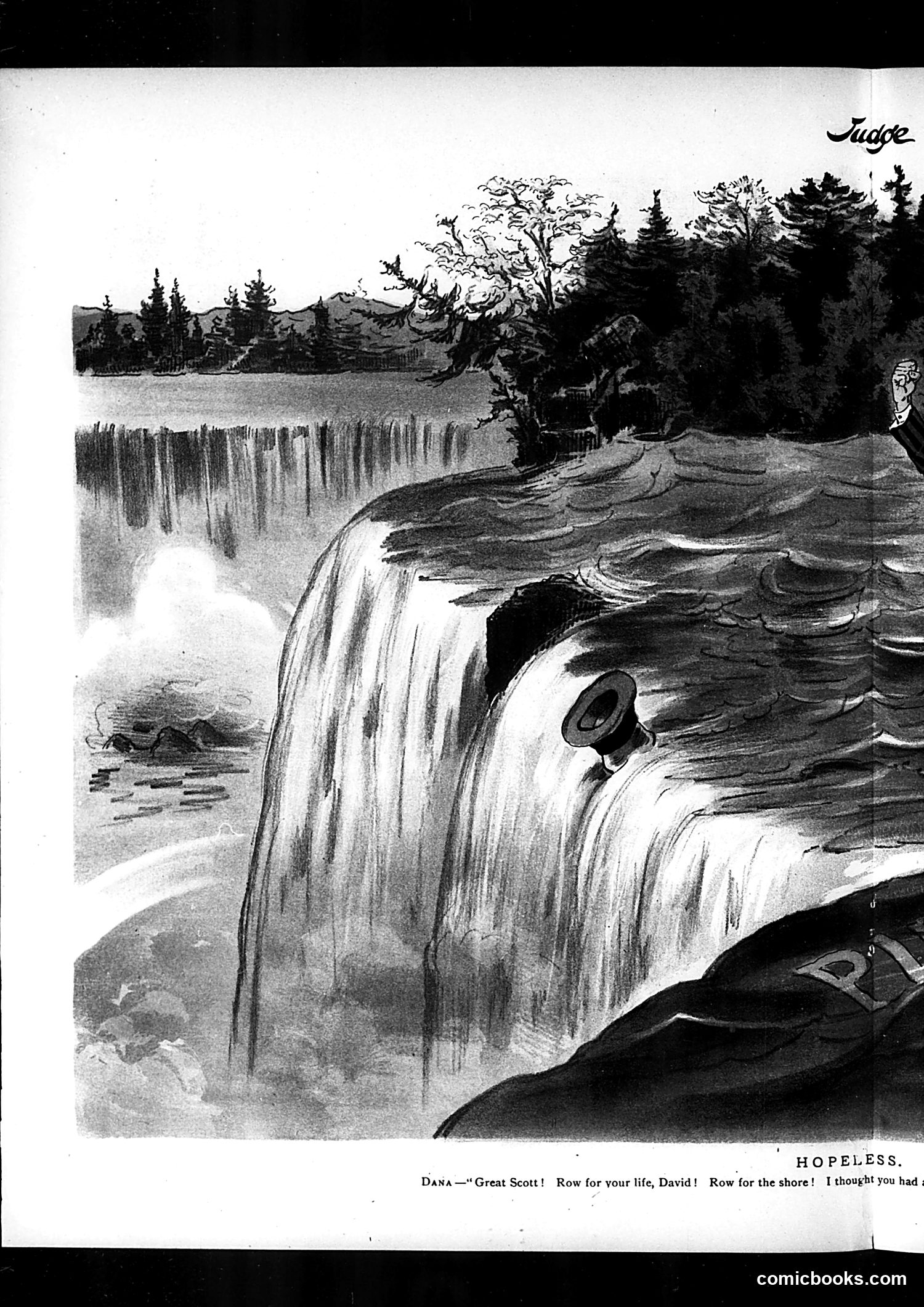
This cartoon depicts a dramatic waterfall scene titled "Hopeless." A man in a hat (labeled "Dana") is in a boat at the edge of a massive waterfall, while another figure shouts warnings to "row for your life, David" and "row for the shore." "Dana" likely refers to **Charles A. Dana**, a prominent 19th-century newspaper editor and political figure. The cartoon appears to satirize Dana's political or editorial predicament as hopeless—he's about to go over a waterfall despite desperate pleas to escape. Without additional context about the specific date or political moment, the exact reference remains unclear. However, the visual metaphor suggests Dana faced an inevitable downfall or catastrophic situation that could not be averted, despite warnings. The melodramatic tone is typical of Judge magazine's satirical style.
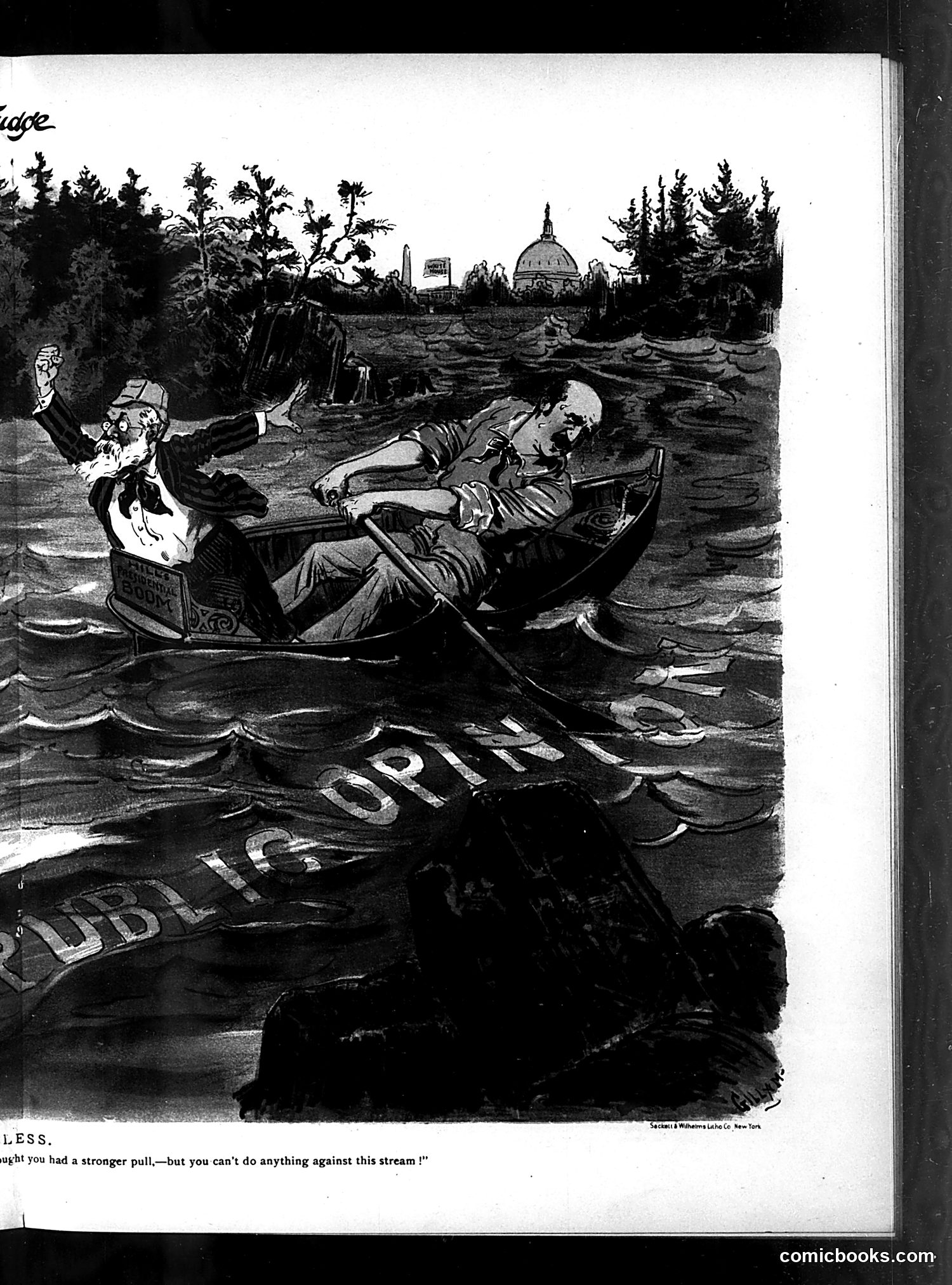
This is a political cartoon depicting two figures in a gondola being swept away by a strong current in water. The visible text ("I thought you had a stronger pull,—but you can't do anything against this stream!") suggests a commentary on political powerlessness against overwhelming forces. The Capitol building visible in the background indicates this is about American politics. The figures appear to represent political actors or factions trying to maintain control but being overpowered by larger currents—likely representing public opinion, economic forces, or political momentum they cannot resist. The cartoon's message is that even those with political influence ("pull") cannot overcome powerful societal or economic movements. Without more specific OCR context or visible labels on the figures, the exact political situation remains unclear, though the satire criticizes political futility against historical forces.
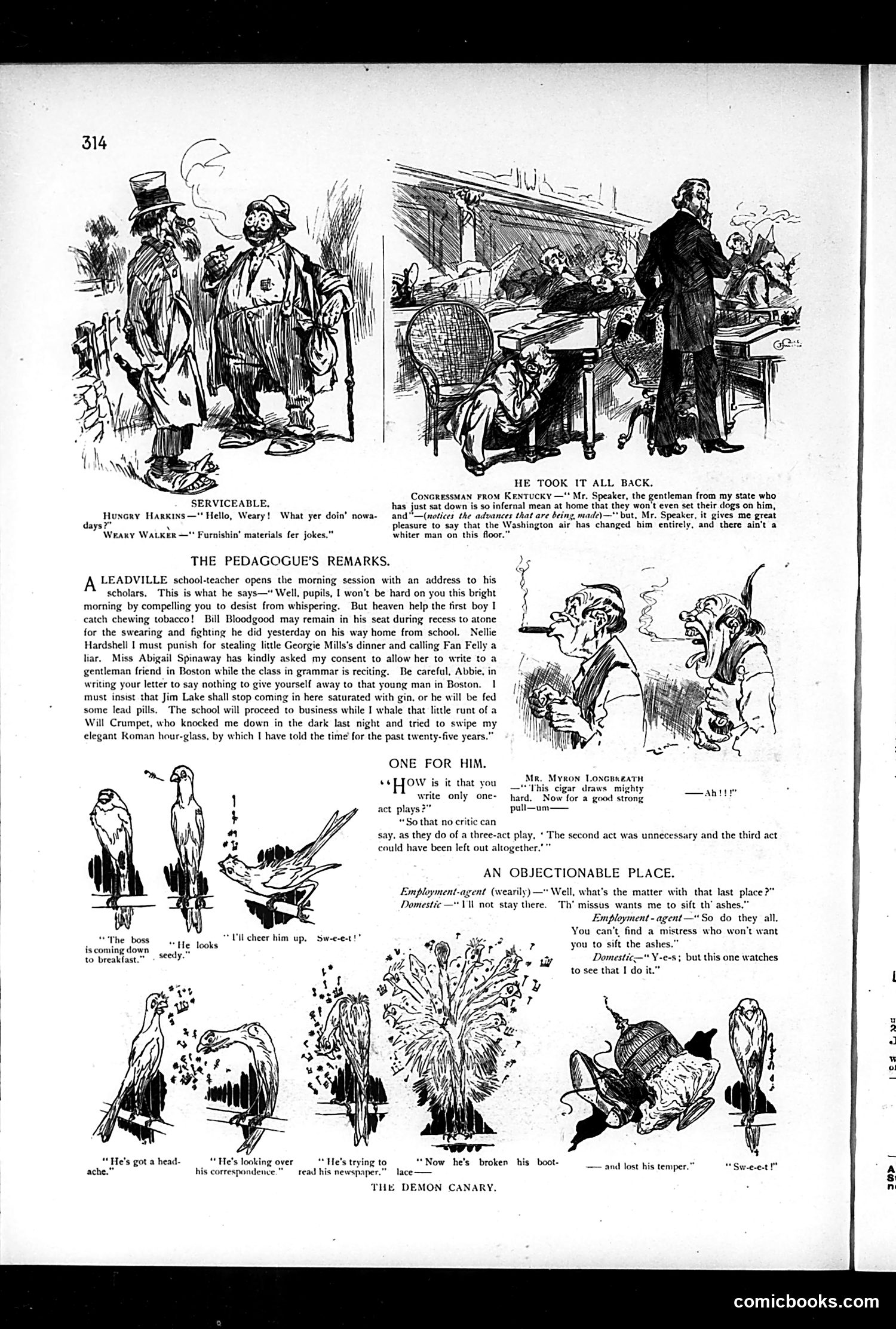
This page contains several unrelated satirical sketches typical of Judge's format: **"He Took It All Back"** depicts a Kentucky congressman praising a colleague's improved behavior in Washington, claiming the man is now "the whitest man on this floor"—a racist inversion implying his moral character has improved, contrasting with his allegedly brutal treatment of people at home. **"The Pedagogue's Remarks"** mocks an exaggerated small-town schoolteacher listing ridiculous punishments and rules—from threatening "lead pills" (bullets) to permitting a student to write love letters. It satirizes harsh rural education and moral hypocrisy. **"One for Him"** jokes about dramatic criticism, with a playwright defending his three-act structure against claims of unnecessary acts. **"An Objectionable Place"** and **"The Demon Canary"** appear to be domestic humor sketches about servants and household problems. The page emphasizes class distinctions, rural versus urban contrasts, and Victorian-era social anxieties presented through exaggeration and crude caricature typical of Gilded Age humor publications.
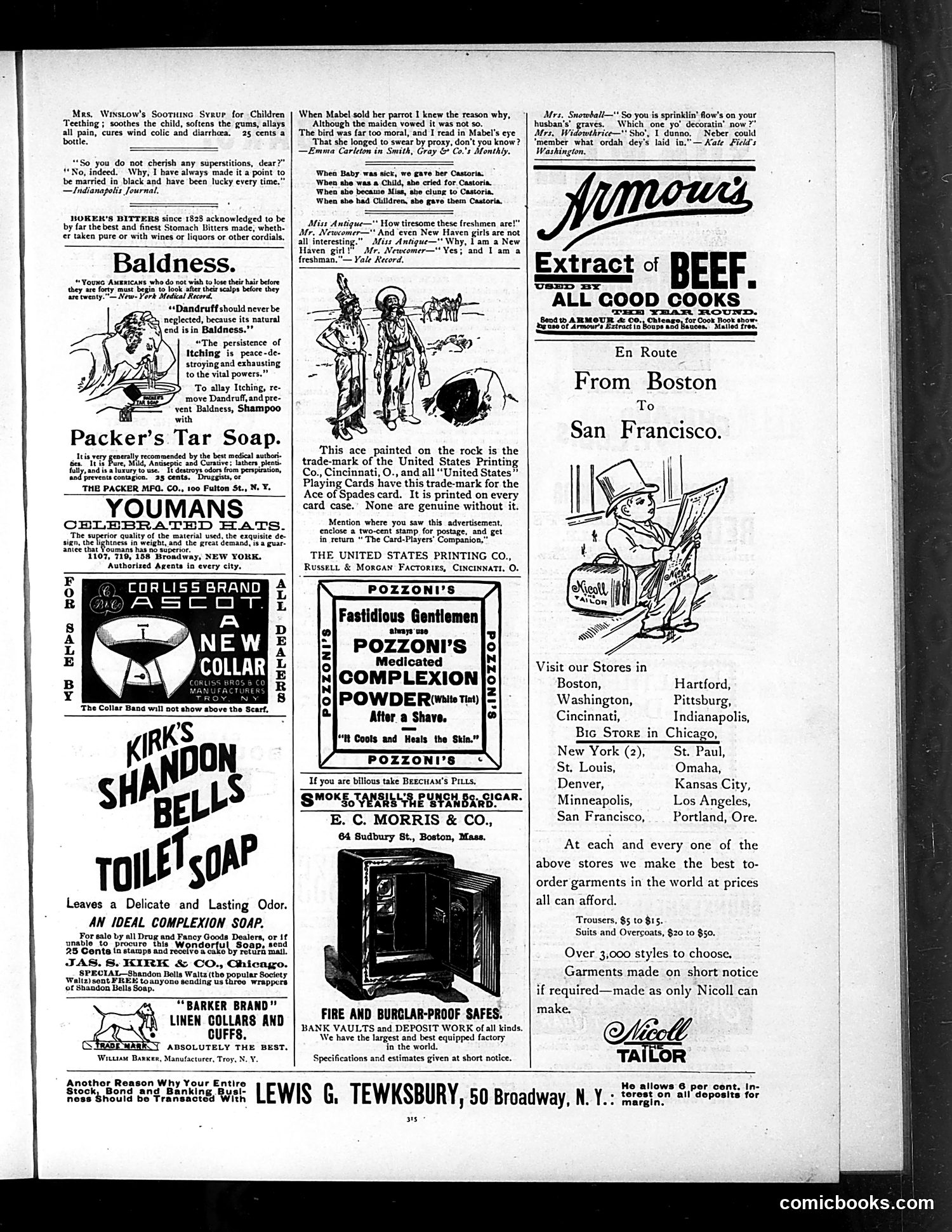
This page is primarily **advertising**, typical of late 19th-century American magazines. The satirical content is minimal—just a few brief jokes interspersed among product ads. The main humor appears in short anecdotes: 1. **The parrot joke** (attributed to Emma Carleton): A woman sells her parrot because it's "too moral"—she wants to swear without the bird's judgment. This satirizes Victorian propriety and the tension between public morality and private desires. 2. **The Yale joke**: A condescending exchange where a Yale freshman unknowingly insults a New Haven woman by calling Yale girls "uninteresting," only to learn she *is* from New Haven. Light social satire about regional/institutional snobbery. 3. **The marriage superstition joke**: A woman claims marrying in black brings luck—inverting traditional wedding superstitions for absurdist effect. The advertisements reflect period concerns: dandruff remedies, complexion powders, and "medicinal" products (likely containing questionable ingredients). The overall tone is genteel and commercial rather than deeply political.
This is primarily a **commercial advertising page** from Judge magazine, not a political cartoon page. The content consists almost entirely of product advertisements typical of the era (early 1900s). Notable items include: - **Kodak film** advertisement from Eastman Company - **Sohmer pianos** (celebrated brand) - Various transportation ads (Burlington Route railroad, Victor bicycles) - Food/beverage ads (Gail Borden condensed milk, Cook's champagne, Hires root beer) - Patent medicine ads (for deafness and drunkenness) - Clothing and cigar advertisements **The only satirical content** appears to be brief text items, including one joke about a farmer's boy and an "anti-crank bill," and another about a man needing to borrow a clean collar from his laundyman before attending a reception. There are **no significant political cartoons or caricatures** on this page—it's essentially a classified advertising section with minimal editorial humor, representing typical Judge magazine revenue from paid advertisements.
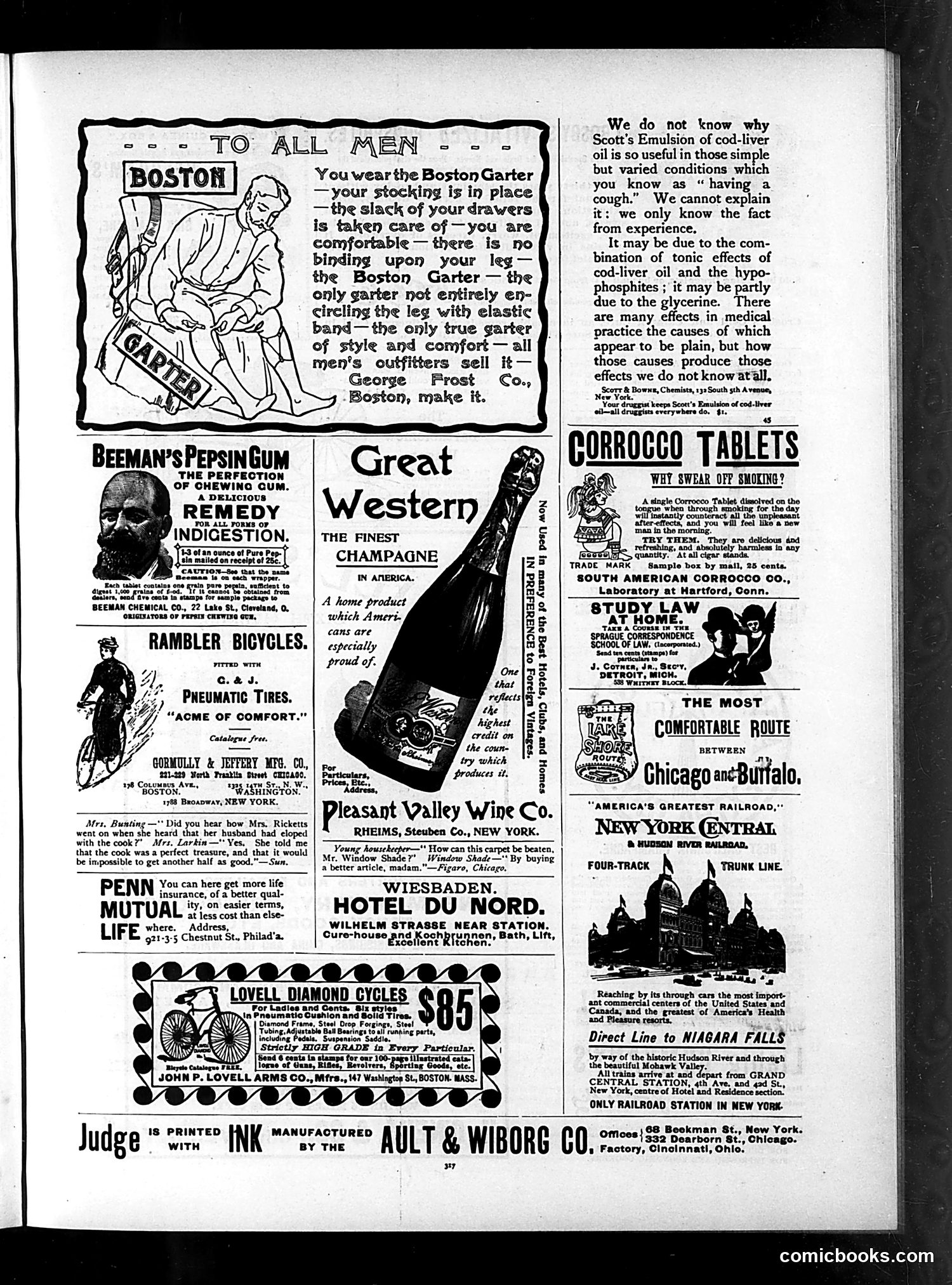
This is primarily an **advertising page** from an early 1900s issue of Judge magazine, with one small satirical anecdote. ## The Cartoon/Satire: The only humor piece is a brief dialogue about a wife whose husband eloped with the family cook. When the wife laments she can't find a replacement cook as good, her friend expresses shock—the joke being the wife's priorities are comically inverted. She's more concerned about losing household help than her husband's infidelity. This reflects early-20th-century domestic servant anxieties and satirizes women's practical materialism over romantic concerns. ## The Advertisements: The page is dominated by product ads typical of the era: Boston Garters, bicycles, champagne, patent medicines (Scott's Emulsion cod-liver oil, Corrocco smoking tablets), correspondence law schools, and railroads. These reflect consumer goods and self-improvement courses marketed to middle-class American men of the period. The ads themselves reveal social attitudes about masculinity, health remedies, and leisure rather than containing satirical commentary.
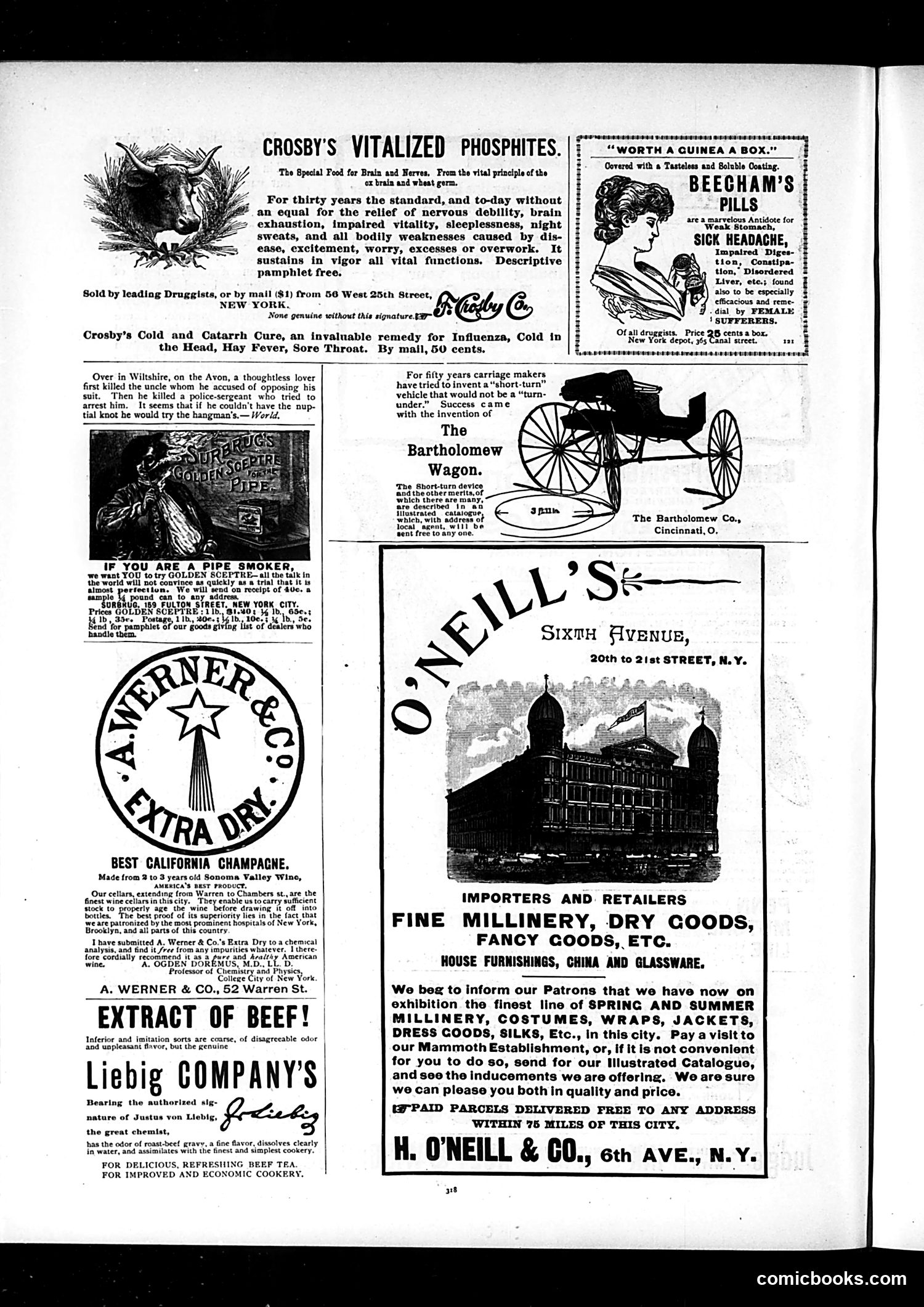
This is primarily an **advertising page** from Judge magazine, not a satirical cartoon page. It contains various patent medicine and product advertisements typical of the 1880s-1890s era. The ads promote dubious remedies—Crosby's Vitalized Phosphites for "nervous debility," Beecham's Pills for digestive complaints, and Liebig's Extract of Beef—reflecting the patent medicine boom of this period when such products made grandiose health claims without scientific regulation. One brief news item mentions a "thoughtless lover" in Wiltshire who murdered his uncle and a police sergeant to prevent arrest, but this appears to be filler text rather than satirical commentary. The remaining advertisements promote champagne, cigars, carriages, and retail establishments in New York. There are **no political cartoons or satirical commentary** visible on this page—it's essentially a commercial enterprise showcasing the magazine's advertising revenue.
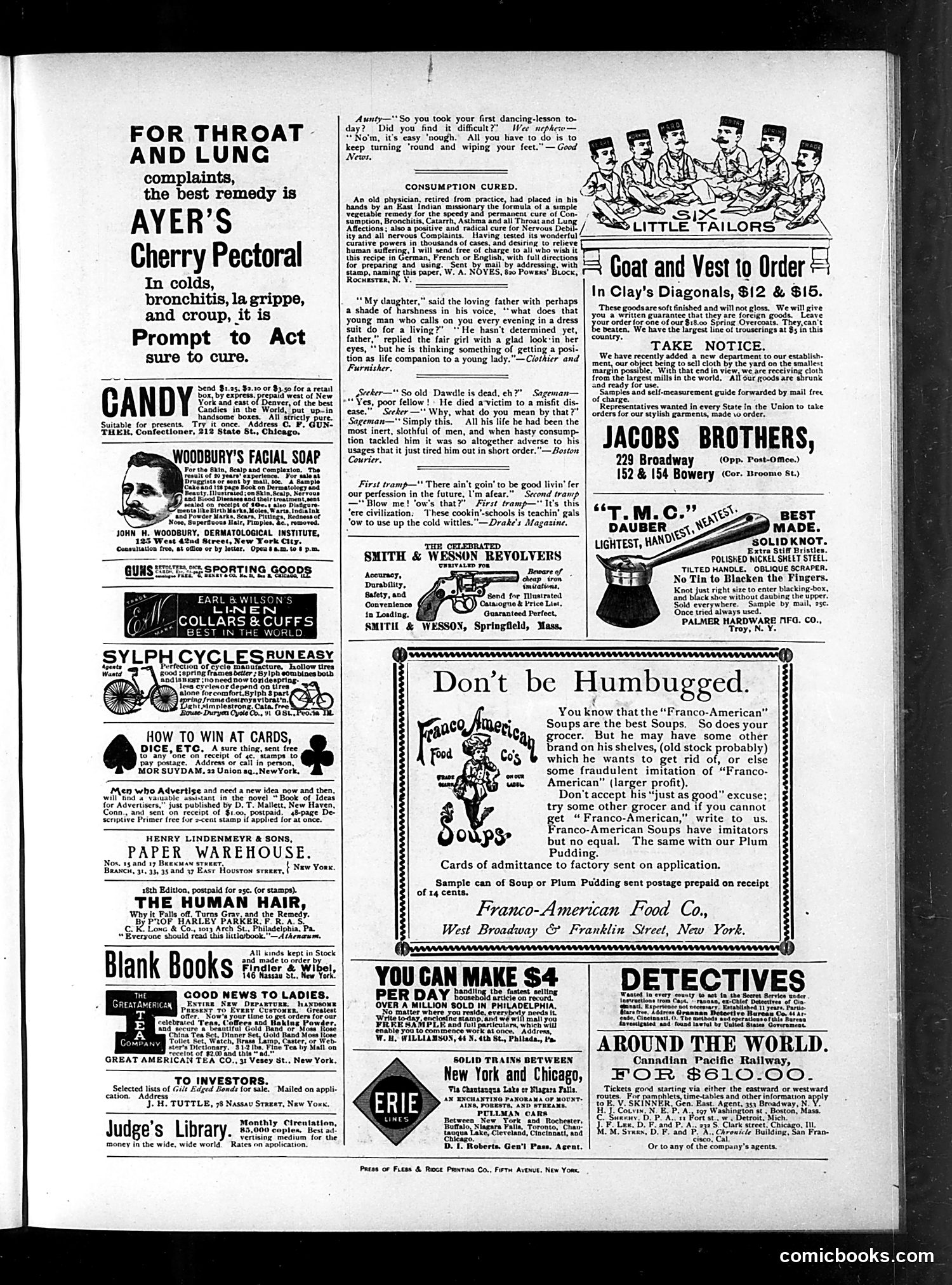
This page is predominantly **advertising**, with minimal editorial cartoon content. The small illustrated jokes present are typical period humor: 1. **"Little Tailors"** shows a child's misunderstanding of dance lessons—he thinks it's just "turning 'round and wiping your feet," a mild joke about children's literalism. 2. **The daughter/father exchange** satirizes young fortune-hunters: a girl tells her father a suitor is "thinking something of getting a position as life companion to a young lady"—a euphemism for marrying for money. 3. **The Dawdle anecdote** plays on the term "misfit disease"—a pun suggesting the lazy man was so inactive that even consumption (tuberculosis) couldn't properly affect him. The page otherwise consists of period product advertisements (Ayer's Cherry Pectoral, Woodbury's Soap, collars, bicycles) and business notices typical of 1890s-era magazines. No significant political satire or social commentary appears.
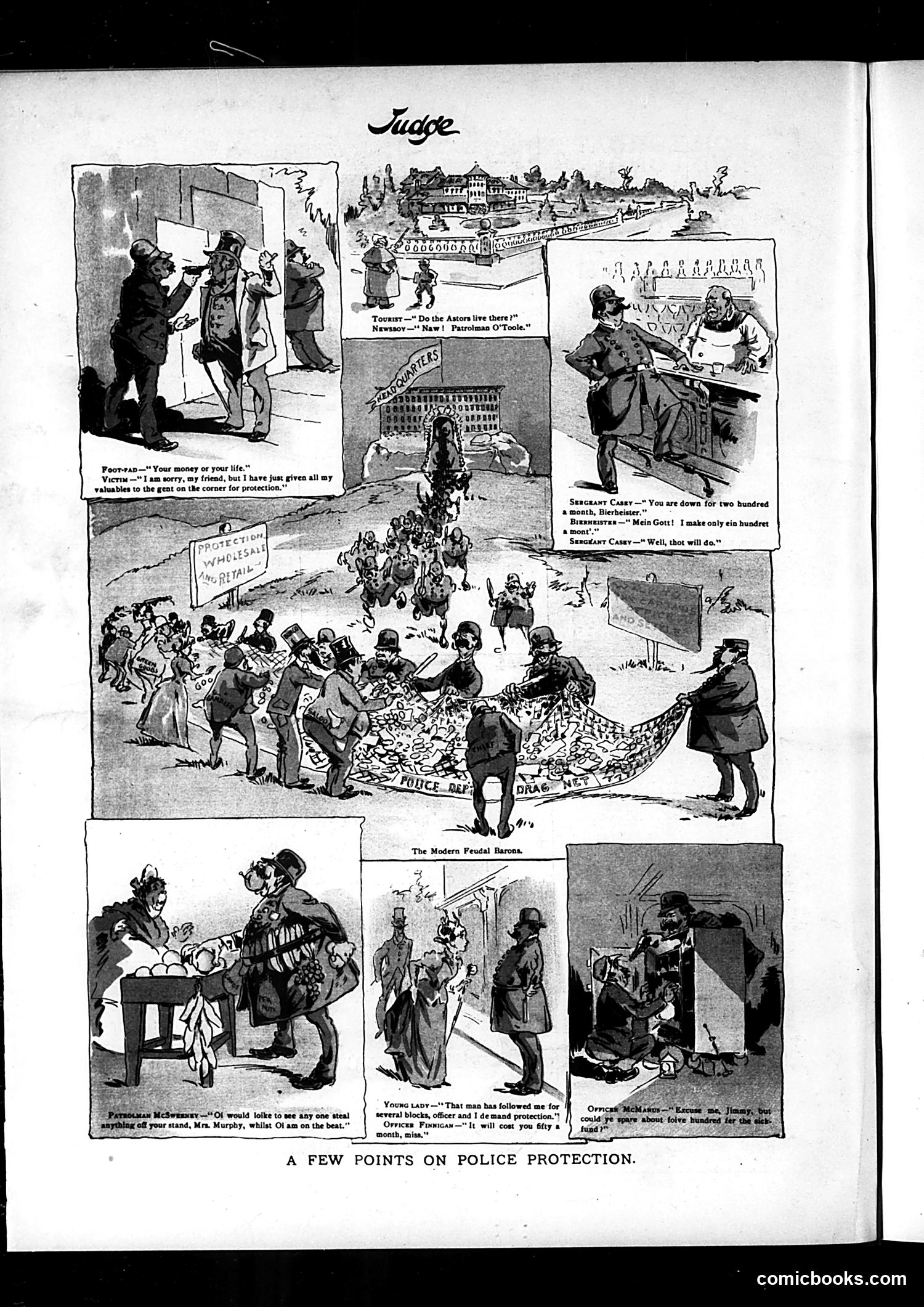
This Judge cartoon satirizes police corruption in early 20th-century America. The title and scenes depict officers extorting money from citizens under the guise of "protection"—a common practice in that era. The vignettes show: - A **footpad (mugger)** demanding money, then a **policeman** making the same demand from a victim who's already paid the criminal - A **wealthy businessman** (Bierheister) complaining he pays officers monthly protection fees - A **young woman** requesting police protection, only to be told it costs "fifty a month" - A **patrolman** (O'Toole) apparently substituting for the Astors as the neighborhood's notable resident—suggesting officers were the real power The satire exposes how police systematized bribery and extortion, effectively becoming indistinguishable from the criminals they supposedly fought. Citizens faced dual predation: from actual criminals and from corrupt cops operating as organized extortionists.