
A complete issue · 16 pages · 1892
Judge — April 23, 1892
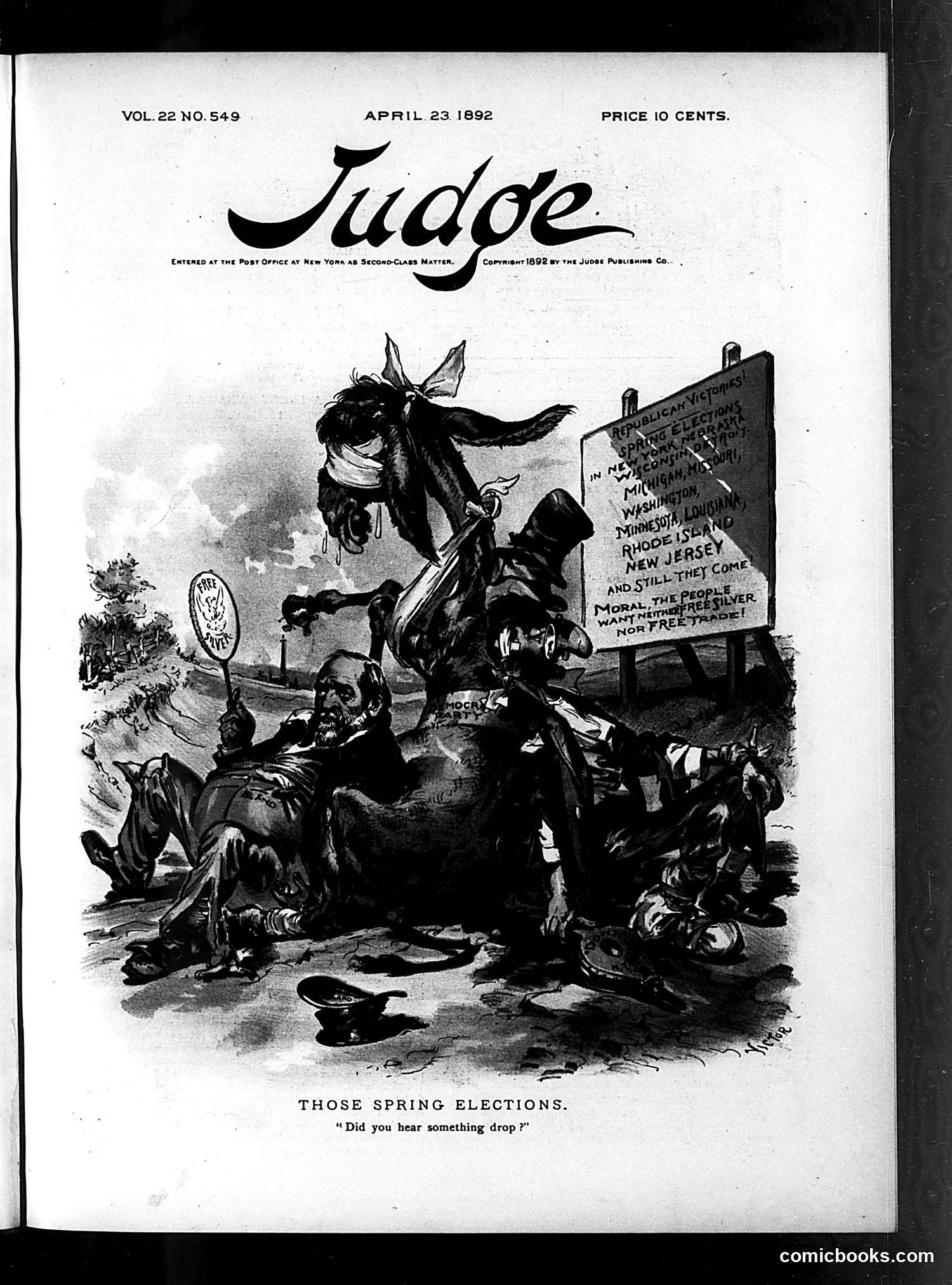
This April 1892 *Judge* cartoon satirizes spring electoral chaos. A donkey (representing the Democratic Party) bucks wildly, throwing riders while trampling figures beneath its hooves. The sign lists Republican victories across multiple states—New York, Pennsylvania, Minnesota, Rhode Island, and New Jersey—suggesting Democratic losses in recent elections. The caption "Did you hear something drop?" is sardonic: voters are "dropping" support for Democrats. The scattered, defeated figures represent Democratic politicians or supporters thrown from power. The donkey's uncontrollable behavior symbolizes the party's inability to maintain electoral dominance during this period. This reflects the turbulent 1892 election cycle preceding Cleveland's comeback presidency and the economic Panic of 1893.
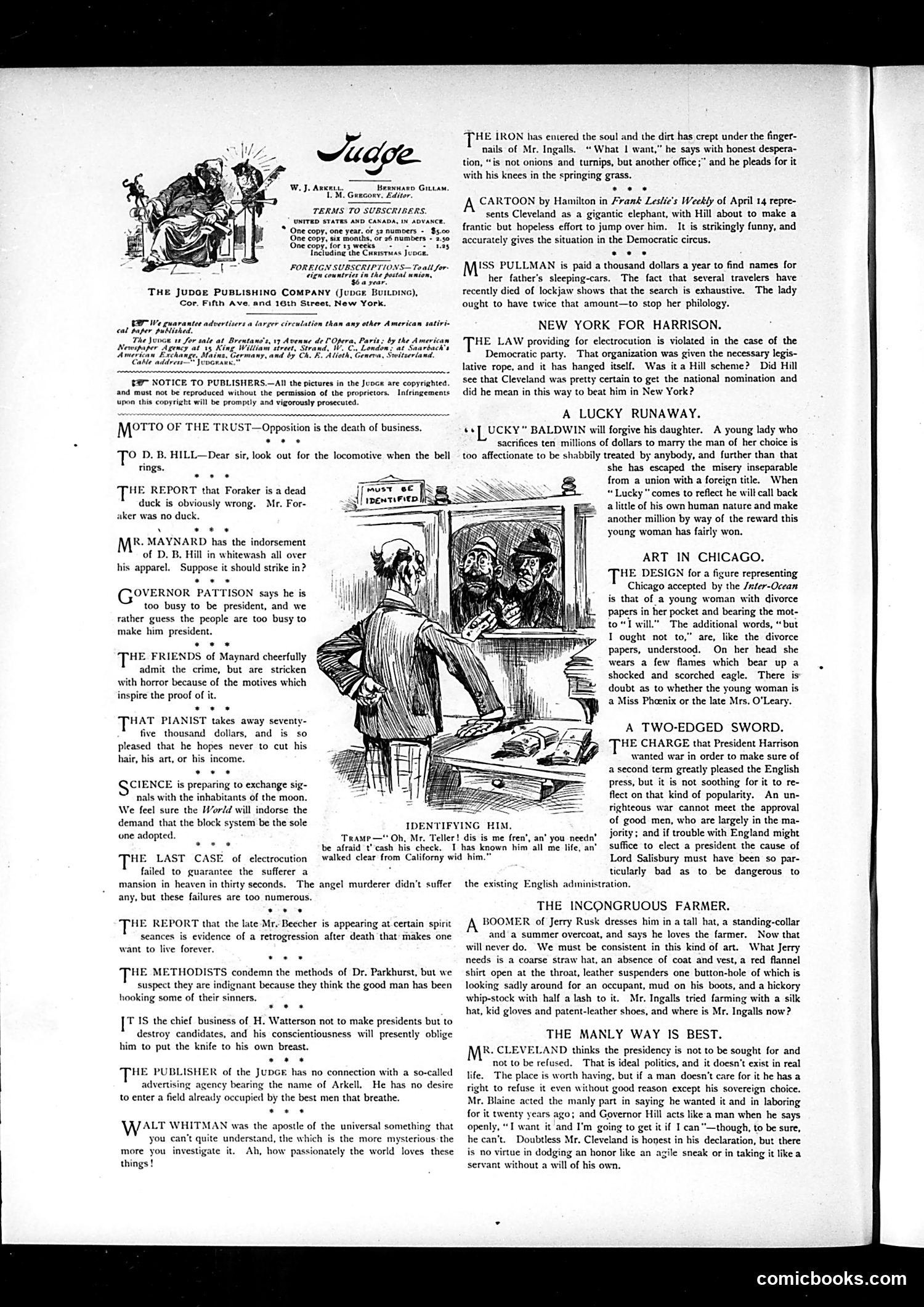
This page contains several brief satirical comments on contemporary political figures and events, along with a cartoon titled "IDENTIFYING HIM." The cartoon depicts a man at a window or counter confronting two rough-looking figures inside, with a caption about "cashing a check" and someone claiming to know the person "all his life." The accompanying text items mock various political figures including Governor Pattison, President Harrison, and references to debates over electrocution laws and war policy. One item critiques Harrison's desire for war to boost English popularity; another mocks Cleveland's pursuit of the presidency despite previous refusals. The overall tone is typical of Judge's irreverent political commentary—using humor to critique politicians' inconsistencies and questionable motives. Without specific dates visible, precise historical context remains somewhat unclear.
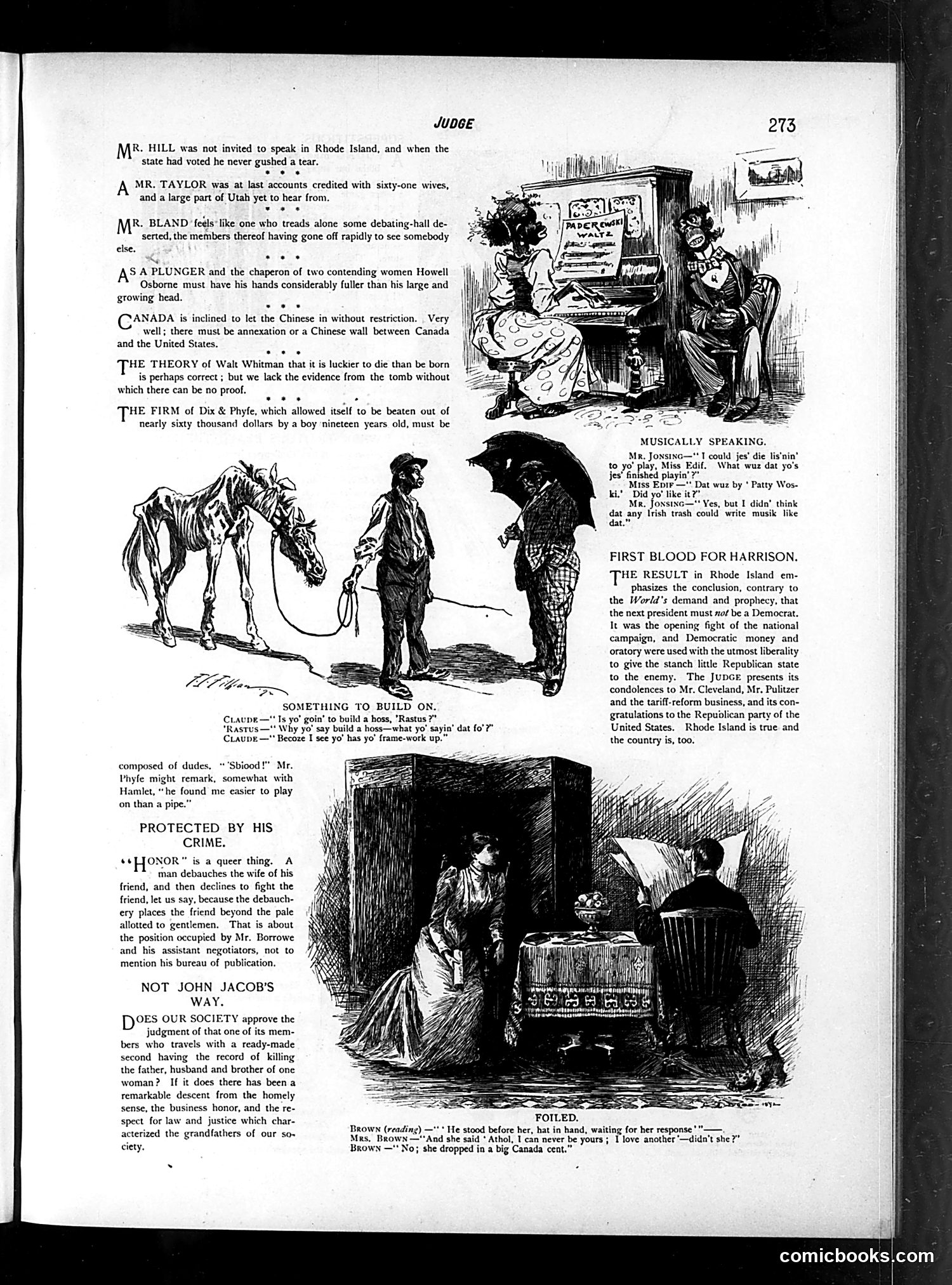
This page contains political commentary and satirical illustrations from Judge magazine. The text discusses various contemporary issues: Mr. Hill's exclusion from speaking in Rhode Island, Mr. Taylor's financial troubles in Utah, debates about Chinese immigration to Canada, and Walt Whitman theories. The illustrations mock social and political figures through caricature. "Musically Speaking" depicts a music lesson scene with ethnic humor typical of the era. "Something to Build On" shows a man with a starving horse, satirizing economic hardship. "First Blood for Harrison" references Republican political campaign activities. The lower illustration, titled "Foiled," depicts a domestic scene with apparent class commentary. Overall, the page mixes partisan political satire with social observation characteristic of late 19th-century American humor magazines, though specific individuals and events referenced are now unclear without additional historical context.
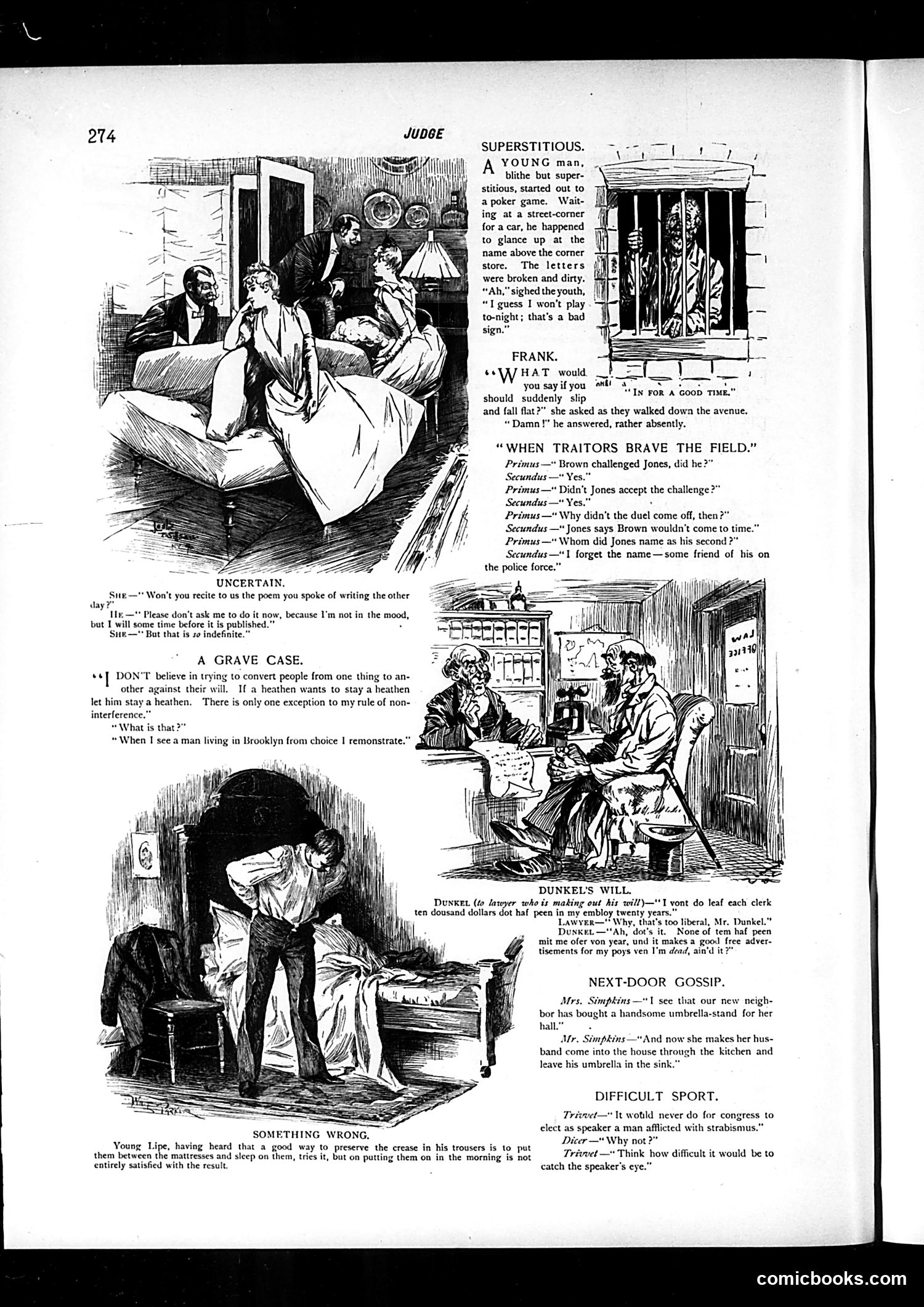
This page contains multiple brief satirical sketches typical of late 19th/early 20th-century American humor magazines: **"Superstitious"** mocks a young man who avoids poker because broken letters on a store sign seem unlucky—satire on superstition among the working class. **"When Traitors Brave the Field"** appears to ridicule a challenged duel that never occurs, with the challenger's second being a police officer—likely mocking either cowardice or police corruption. **"A Grave Case"** jokes that Brooklyn is so undesirable that only converting someone voluntarily living there from choice requires intervention. **"Dunkel's Will"** features a German-accented businessman (indicated by dialect) who leaves each short-term employee money as posthumous advertising—satire on cheap, exploitative employers. **"Next-Door Gossip"** mocks status-conscious neighbors and petty domestic power dynamics. **"Difficult Sport"** makes a pun: electing a speaker with strabismus (crossed eyes) would be difficult because you couldn't "catch his eye." These reflect Judge's focus on urban social observation and wordplay humor.
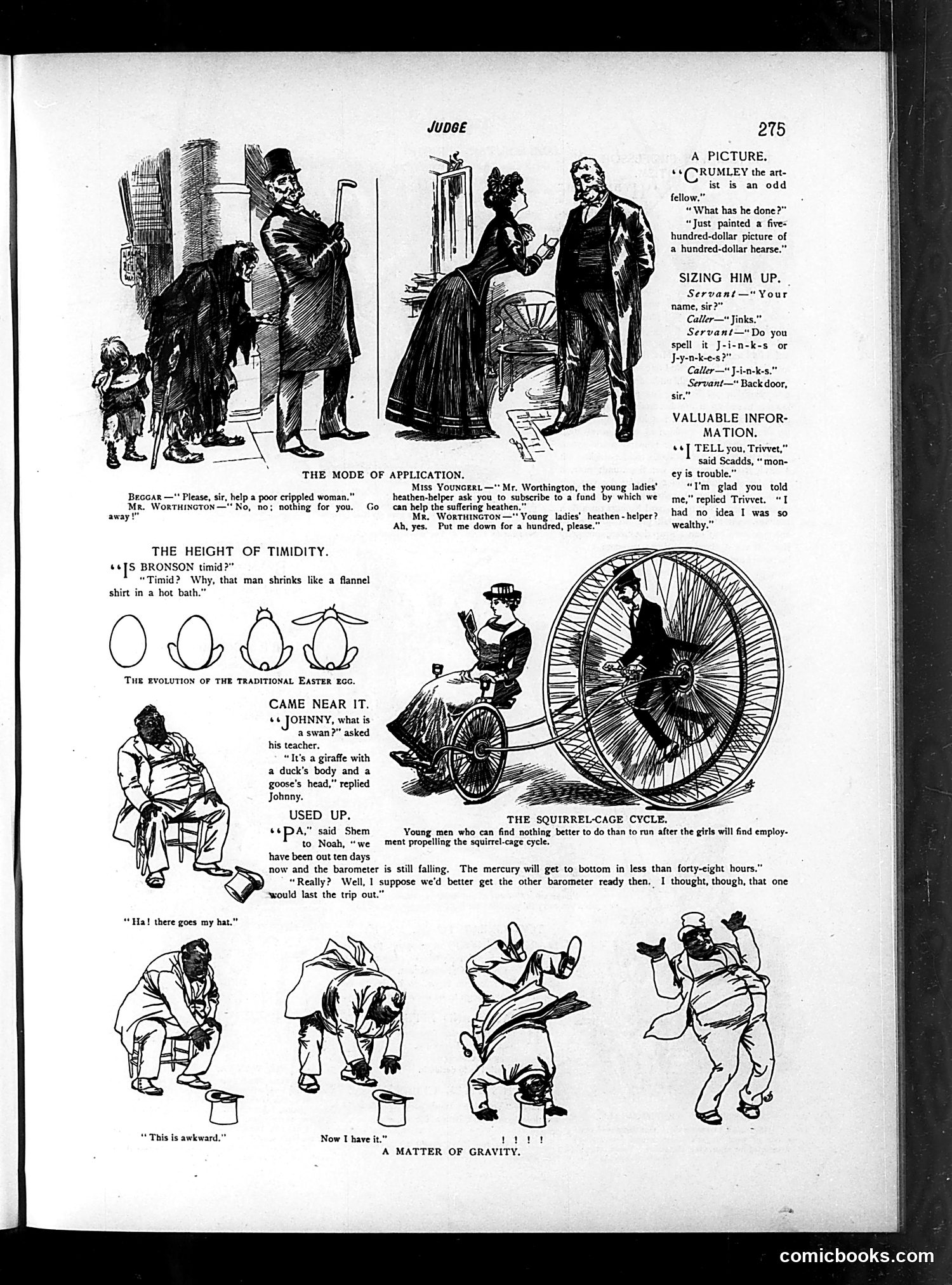
This page contains multiple unrelated satirical cartoons and jokes typical of Judge magazine's format: **"A Picture"**: Mocks artist Crumley for painting an expensive portrait of a cheap hearse—absurd subject matter for high price. **"The Mode of Application"**: A beggar asks Mr. Worthington for help; Worthington refuses. When young ladies ask him to donate to a "heathen-helper" fund, he immediately contributes $100. The satire: wealthy men readily give to charitable causes when solicited by society women, but ignore direct poverty. **"Sizing Him Up"**: A servant struggles to spell "Jinks" when announcing a caller—mild humor about class and literacy. **"The Squirrel-Cage Cycle"**: Young men chasing girls on bicycles are compared to squirrels running in exercise wheels—pointless, repetitive activity. **"A Matter of Gravity"**: Sequential drawings of a man losing his hat, progressing from awkwardness to frantic recovery—physical comedy about dignity. The page is primarily humor without specific political references, reflecting Judge's mix of social satire, domestic jokes, and visual gags.
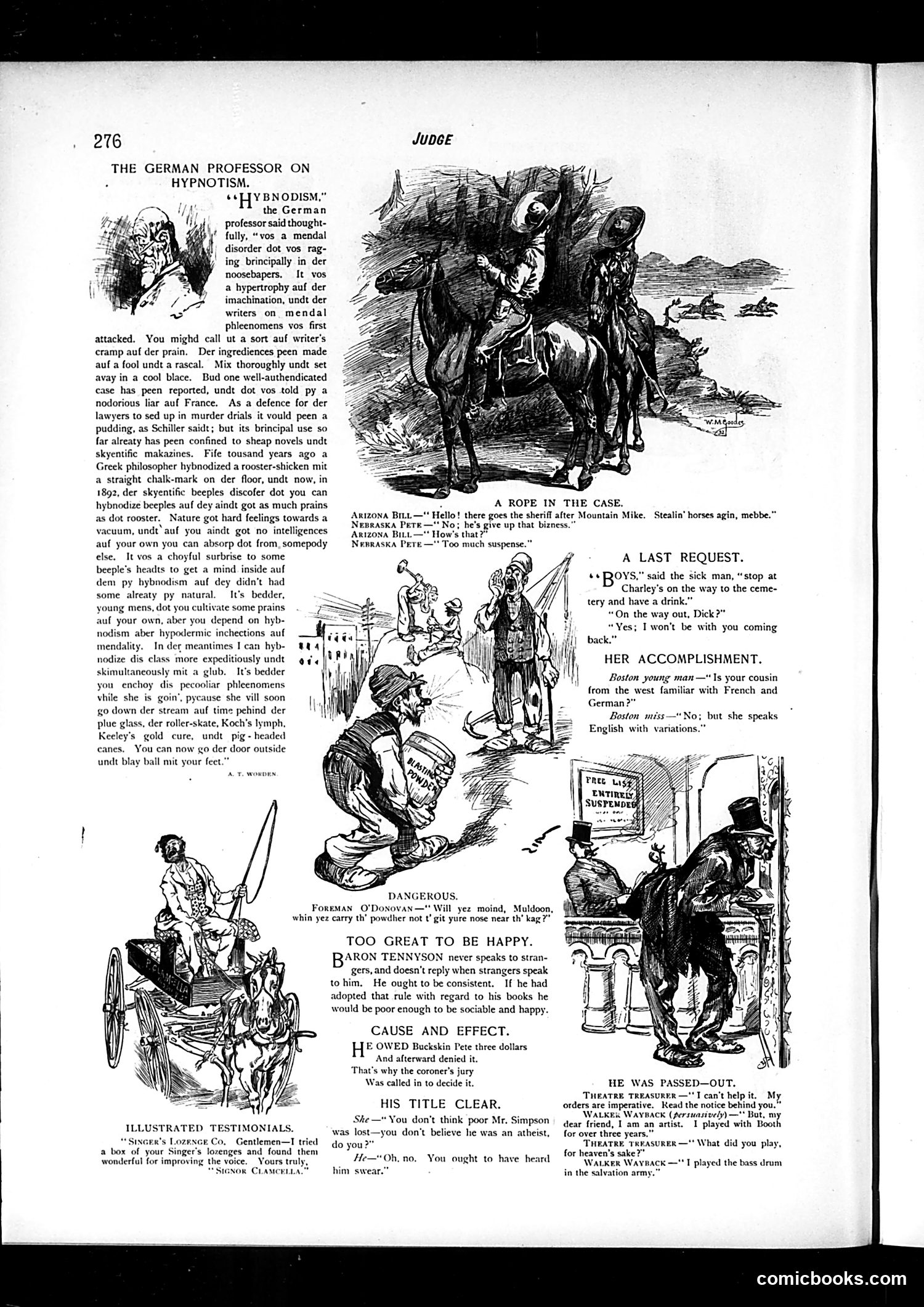
This page contains multiple satirical pieces typical of 1890s American humor: **Main feature**: "The German Professor on Hypnotism" mocks both the German accent (rendered phonetically) and the contemporary craze for hypnotism as pseudoscience. The professor's thick dialect and pseudo-intellectual rambling expose hypnotism as charlatanry dressed up in pseudo-medical language—popular in the 1890s but lacking scientific validity. **Other jokes target**: - Baron Tennyson (the poet) for being antisocial yet prolific—hypocritical - "Too Great to Be Happy" satirizes wealth breeding discontent - Various brief anecdotes about frontier characters ("Arizona Bill," "Nebraska Pete") using period slang - A theater treasurer dismissing an artist who only played bass drum in the Salvation Army The page reflects 1890s concerns: pseudoscience fads, European pretension, literary celebrity hypocrisy, and working-class struggles. The heavy German accent caricature likely reflects period anti-German sentiment or immigrant mockery common in Judge's editorial stance.
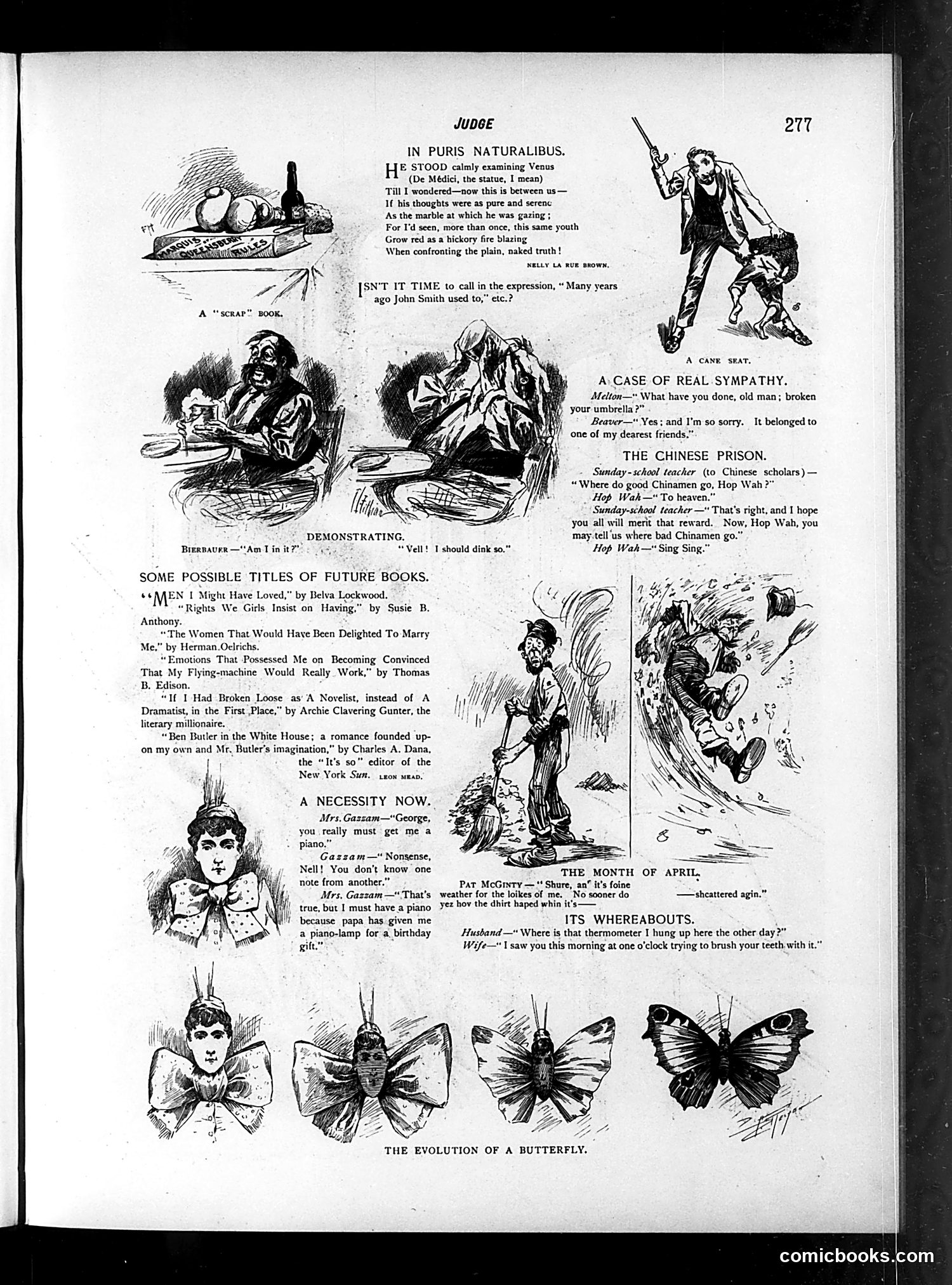
This satirical page from Judge magazine contains multiple short humor pieces mocking Victorian social hypocrisy and contemporary absurdities: **"In Puris Naturalibus"** critiques a young man who blushes at nudity in classical art yet claims moral purity—exposing the contradiction between affected propriety and actual prudishness. **"The Chinese Prison"** satirizes American attitudes toward Chinese immigrants through a Sunday school lesson where a child innocently reveals Sing Sing (an American prison) as the destination for "bad Chinamen"—mocking both racist stereotypes and oblivious white educators. **"Some Possible Titles"** lists mock-serious book proposals, including works by Belva Lockwood (women's suffrage advocate) and Thomas Edison, lampooning pretentious autobiographies. **"A Necessity Now"** depicts spousal manipulation: a wife demands a piano not for music but because her father bought her a decorative "piano-lamp," illustrating domestic absurdity. The humor relies on recognizing period social conventions—Victorian prudishness, anti-Chinese prejudice, and domestic comedy tropes—that modern readers need historical context to appreciate.
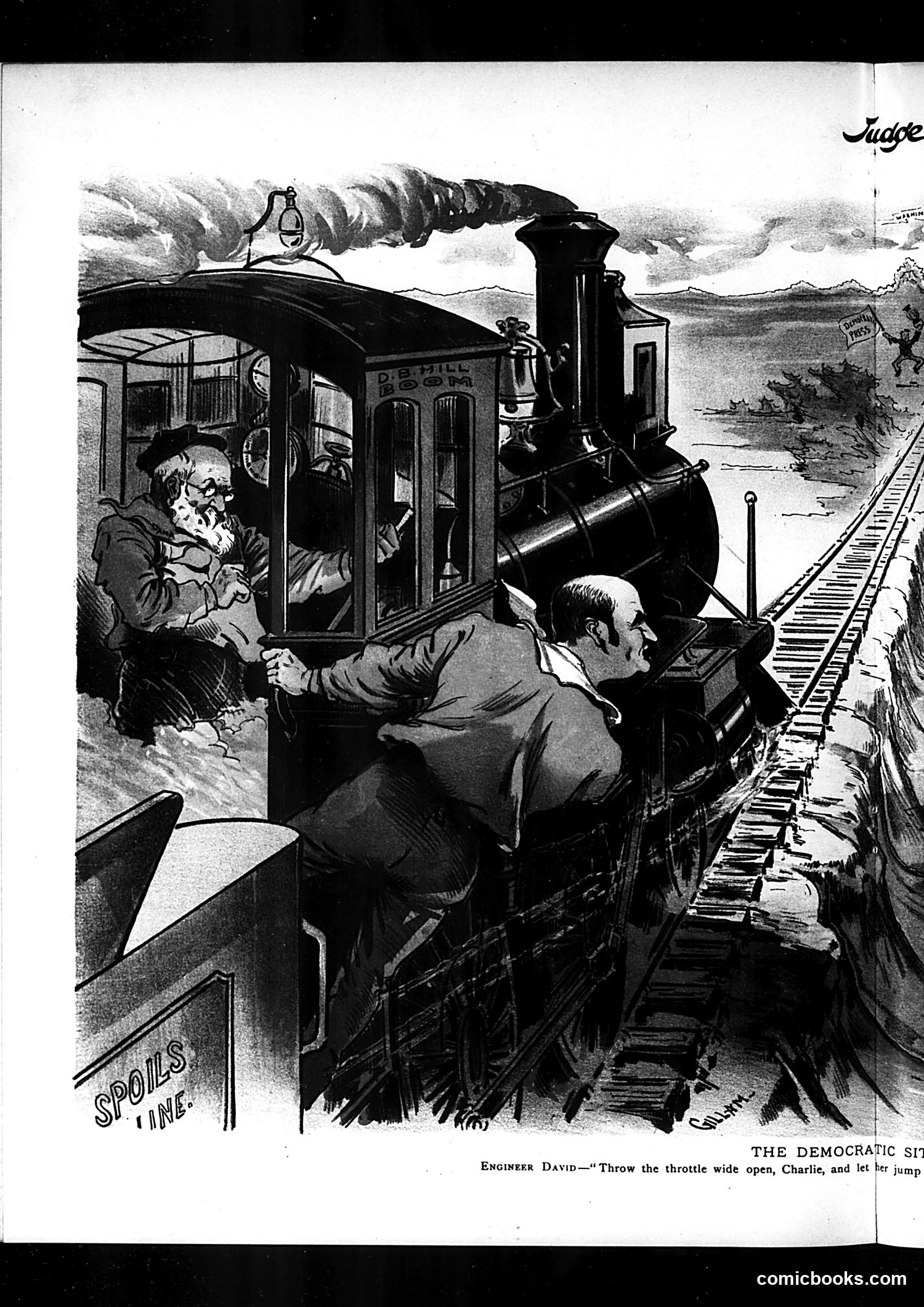
This appears to be a political cartoon titled "The Democratic Slip" (partially visible). It depicts an engineer named David operating a locomotive labeled "D.B. HILL" while a passenger in the cab looks alarmed. The caption reads: "Engineer David—'Throw the throttle wide open, Charlie, and let her jump.'" The cartoon satirizes Democratic Party leadership, likely from the 1890s. "D.B. Hill" refers to David B. Hill, a prominent Democratic politician. The "spoils line" visible on the left suggests criticism of patronage politics. The imagery of reckless locomotive operation represents the satirist's view that Democratic leadership was dangerously mismanaging the party or nation—pushing forward without proper caution. The alarmed passenger represents concerned citizens or party moderates watching this reckless course.
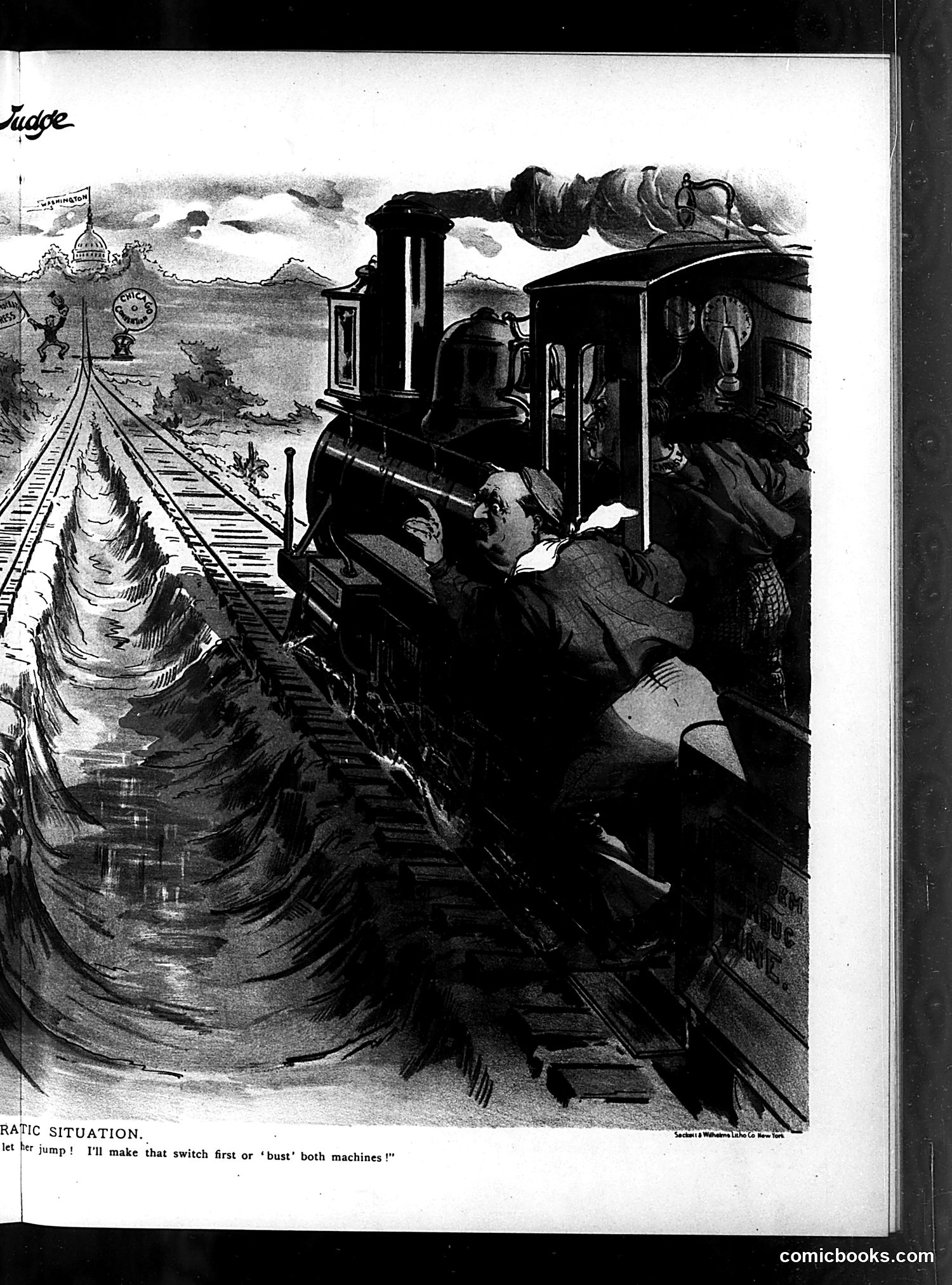
This appears to be a satirical cartoon about railroad competition or a Democratic political situation (suggested by "RATIC SITUATION," likely "Democratic"). Two men in a locomotive cabin are depicted in conflict—one demanding the other "let her jump" while threatening to "bust both machines" if he doesn't make a switch first. The cartoon likely uses the train as a metaphor for political control or power. The competing engineers represent rival factions or politicians fighting for control of the same operation, each threatening mutual destruction rather than compromise. The dramatic scene suggests a reckless, dangerous political standoff where neither side will yield, risking catastrophic consequences for everyone involved. Without a clear date or additional context, the specific political figures or event remain unclear, but the satire criticizes destructive internal political conflict.
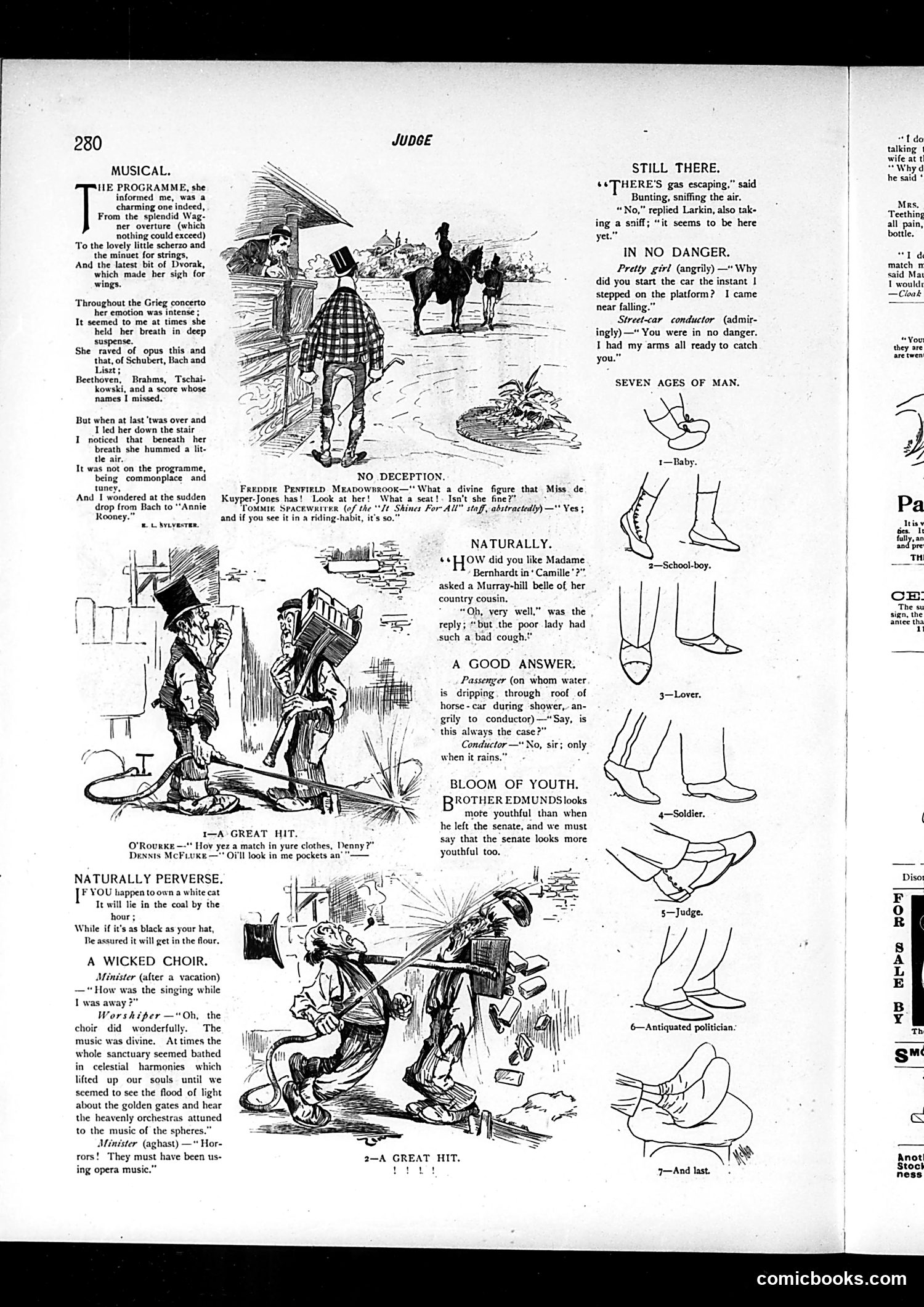
This page collects brief humorous pieces and satirical cartoons typical of Judge's style. Key content includes: **"Musical"**: A poem mocking pretentious concert-goers who profess deep appreciation for classical composers (Wagner, Beethoven, Brahms) but actually prefer simple, tuneful music like "Annie Rooney." **"A Wicked Choir"**: A minister is horrified to learn the choir sounded "divine" during his vacation—implying they must have used opera music, which he considers inappropriate for church. **"Bloom of Youth"**: A jab at Senator Edmunds, suggesting he looks younger after leaving office, while the Senate itself appears more youthful without him—a backhanded compliment implying he was aging the institution. **"Seven Ages of Man"**: Illustrations of feet/shoes at different life stages, a visual pun on Shakespeare's concept. Other pieces mock everyday absurdities: a cat's contradictory behavior, a conductor's excuse about rain, and street-car mishaps. The humor is genteel, observational satire targeting middle and upper-class social pretension.
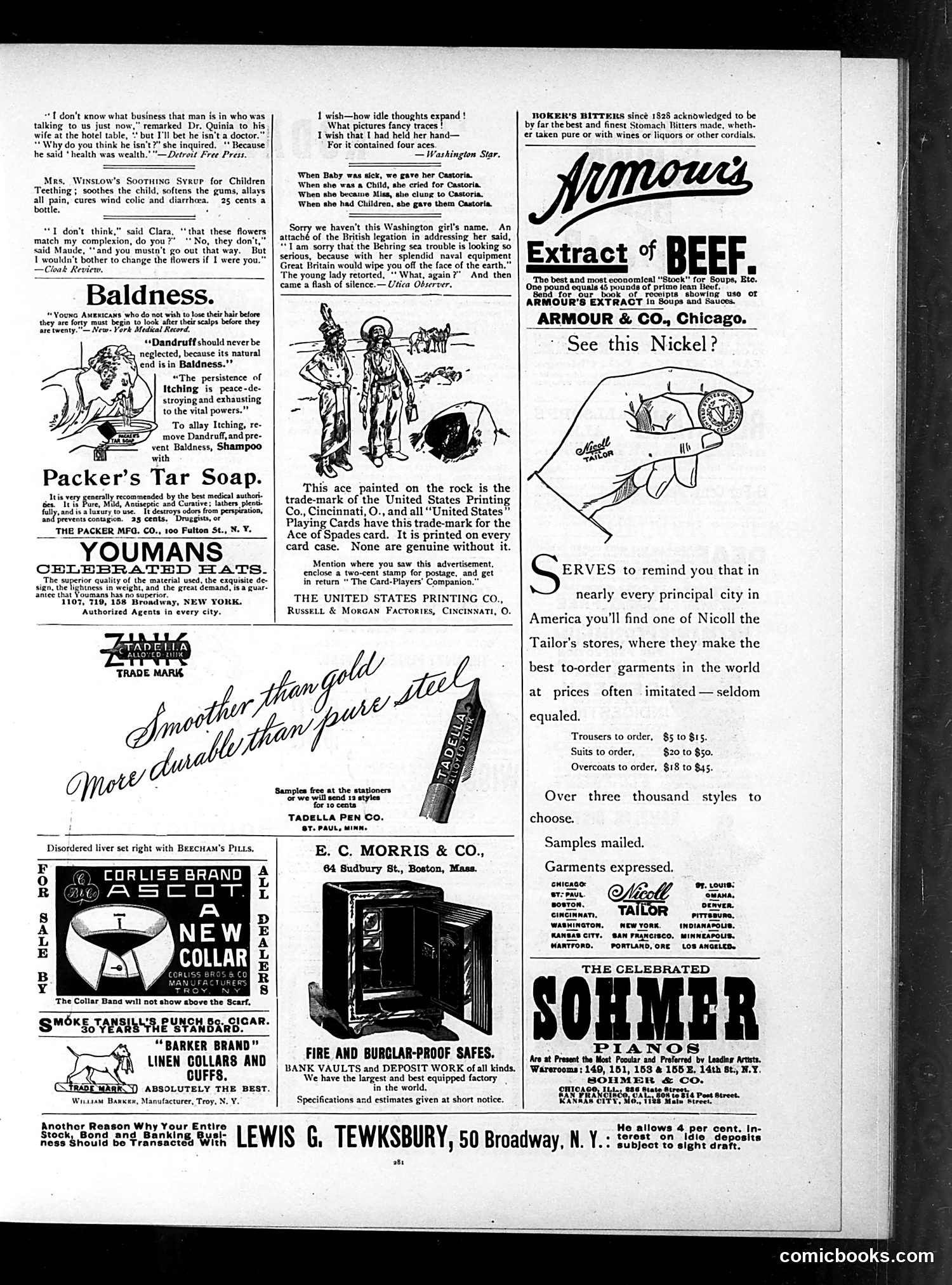
This is primarily an **advertising page** with several short comedic items interspersed. There are no coherent political cartoons or sustained satire. The jokes are lightweight social commentary: - A doctor is mocked for saying "health is wealth" (considered clichéd advice) - A woman is told her flower corsage doesn't match her complexion, but advised against changing it (implying vanity) - A young woman makes a poker joke about wanting to hold a girl's hand because "it contained four aces" (a pun) - A British diplomat threatens to "wipe" America "off the face of the earth" over the Behring Sea dispute; the American woman responds "What, again?" (mocking British naval superiority claims) The **Behring Sea reference** reflects a real late 19th-century trade dispute between Britain and America over seal hunting rights. Otherwise, the page is filled with **product advertisements** for patent medicines, clothing, safes, and other goods typical of the era. The page demonstrates how Judge magazine mixed humor with commercial content.
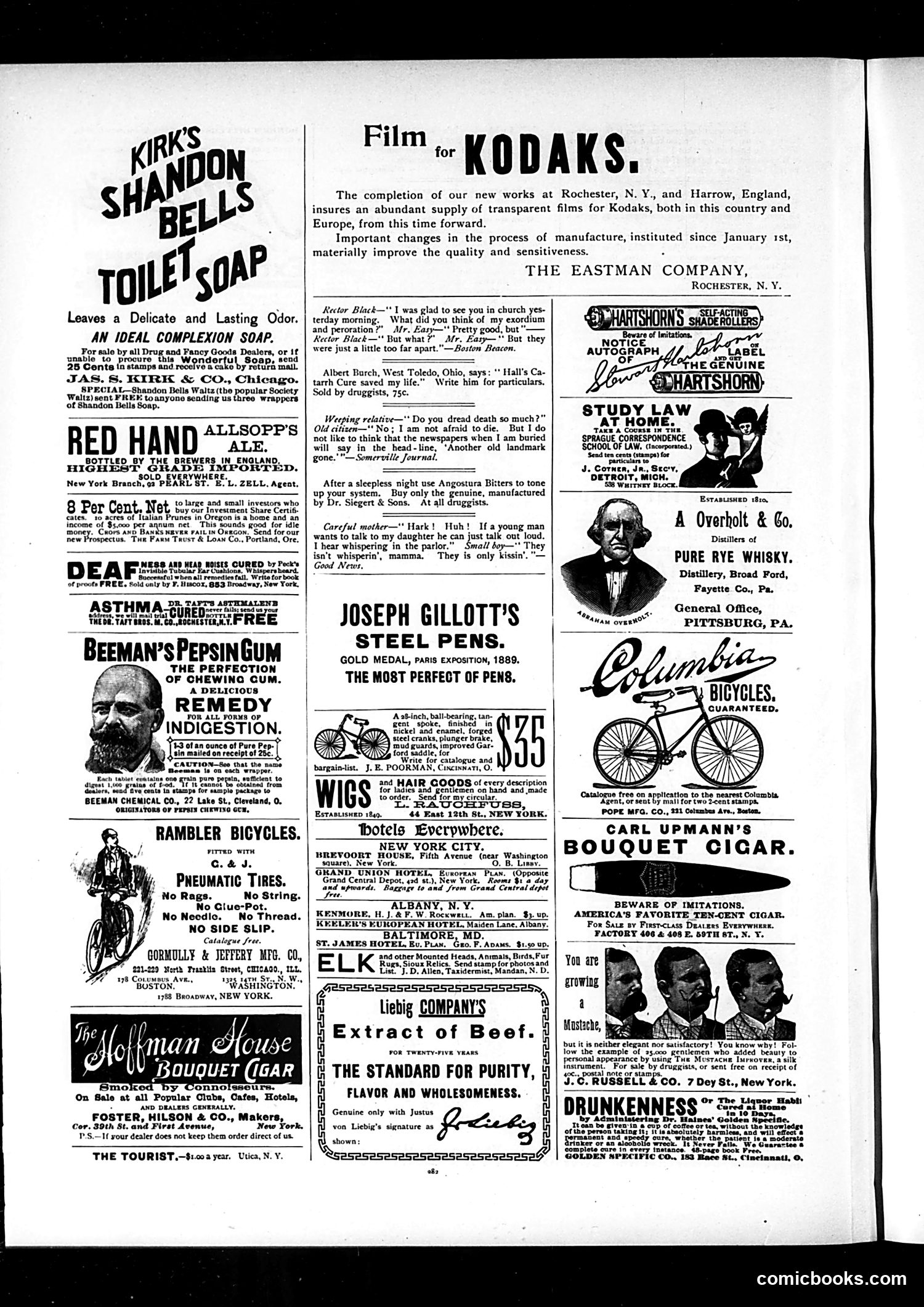
This page is primarily **advertising**, with a few short humor pieces interspersed. Here's what's visible: The main content consists of product advertisements typical of the 1890s: Kirk's Shandon Bells soap, Allsopp's Red Hand beer, investment schemes, medical devices (ear cushions for deafness), patent medicines (for asthma, indigestion), Beeman's chewing gum, Kodak film, Joseph Gillott's steel pens, wigs, bicycles, whisky, cigars, and beef extract. Embedded are three brief **joke items**: one about a rector's sermon structure, another about a youth courting (the humor turns on the mother overhearing kissing she euphemistically calls "kissin'"), and a third where an old man dreads being called "an old landmark" in his obituary. These jokes reflect genteel, domestic humor typical of the era—mildly saucy but appropriate for respectable magazines. The page demonstrates how Judge mixed editorial content with paid advertising to subsidize publication.
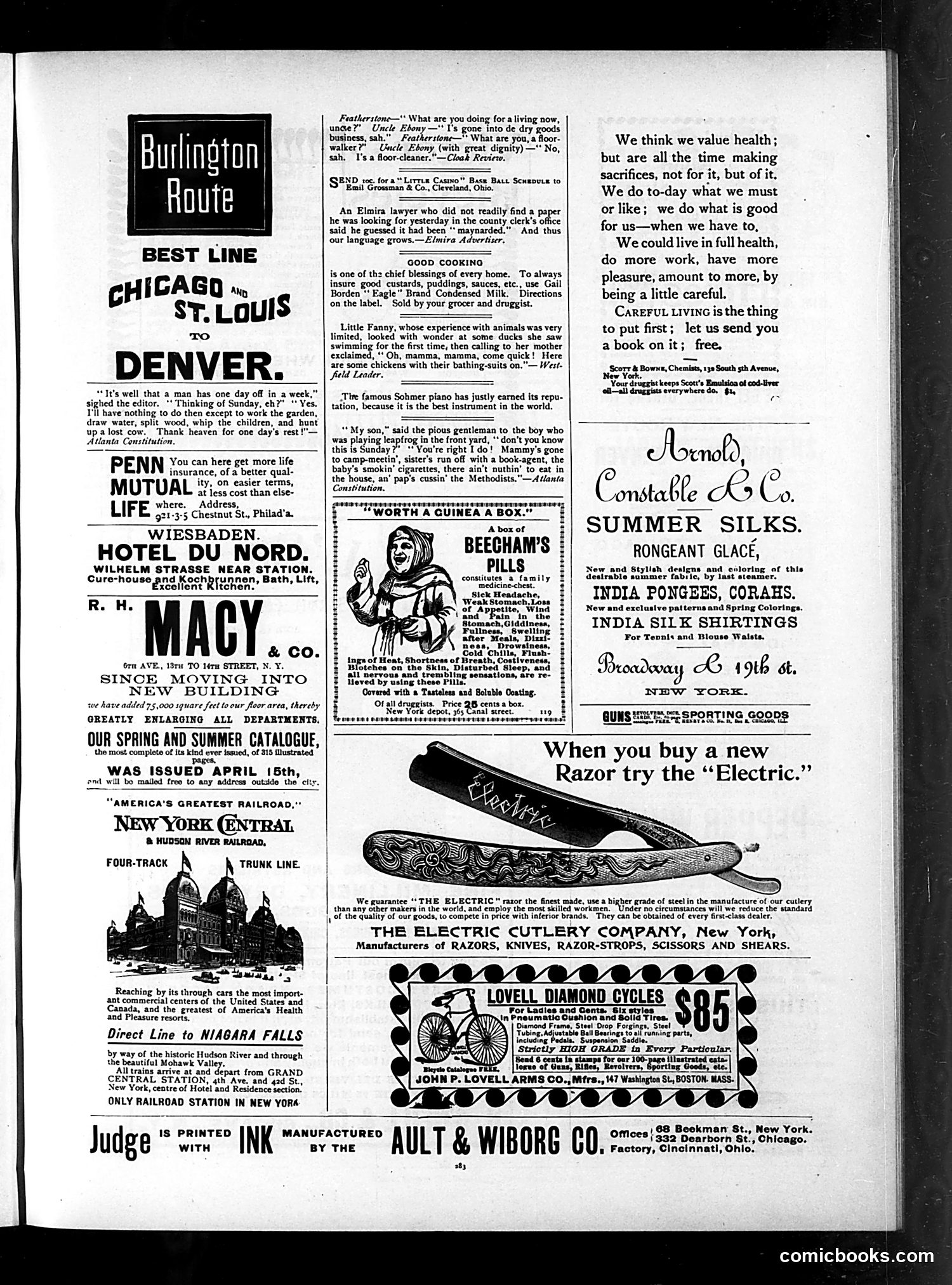
This page is **primarily advertisements** with minimal satirical content. The few humorous anecdotes present contain period-specific racial and gender stereotypes typical of early 1900s humor magazines. The notable cartoon/text jokes include: 1. **"Featherstone" dialogue**: A conversation between characters about employment in dry goods—appears to rely on dialect humor, likely involving racial caricature ("Uncle Ebony"), though the point is unclear from the OCR. 2. **The editor's day off**: A joke about a man claiming Sunday is his only rest day, then listing exhausting household chores (garden work, childcare, livestock)—satirizing the middle-class "working man's" burdens. 3. **The boy on Sunday**: Similar humor about a child playing while his mother, sister, and baby are absent and his father curses—the joke being the boy's obliviousness to disorder around him. The page is dominated by **commercial advertising** for railroads, insurance, medicines, pianos, silk goods, razors, and bicycles—typical of *Judge* magazine's revenue model.
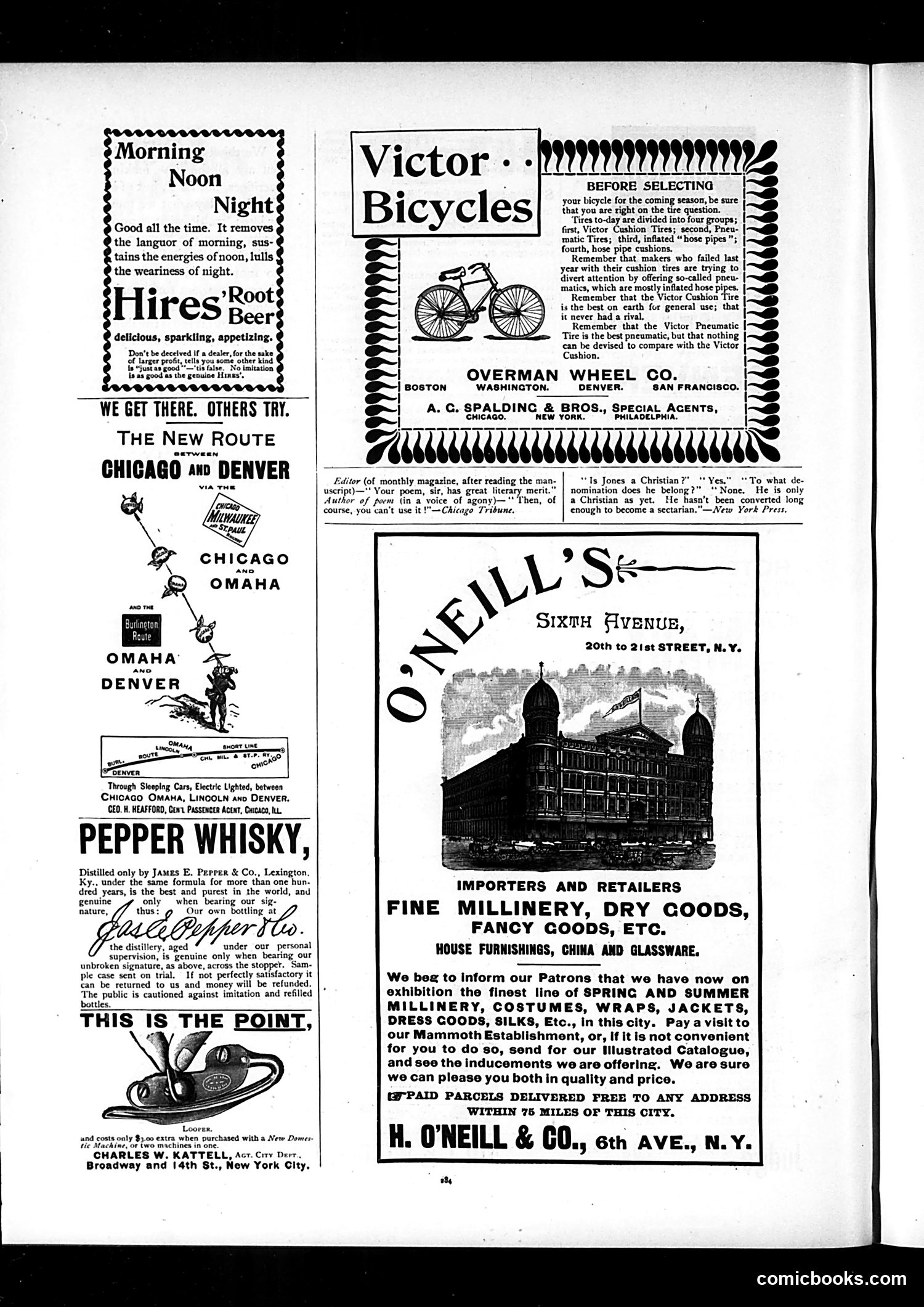
This is primarily an **advertising page** from Judge magazine, not a political cartoon. The page contains commercial advertisements for various products and services popular in the early 1900s: Hires Root Beer, railroad routes (Chicago to Denver), Pepper Whisky, Victor Bicycles, sewing machines, and department stores. Two brief **humor items** appear among the ads: 1. An editor tells a poet his work has "great literary merit"—but can't publish it, suggesting mediocre work often sells better than quality literature. 2. A joke distinguishing between being Christian versus belonging to a specific denomination, satirizing how Americans conflate organized religion with faith itself. The **Victor Bicycle ad** emphasizes tire quality against inferior competitors, typical market competition messaging of the era. Overall, this reflects Judge's mixed content: satirical editorial pieces interspersed with period advertising targeting middle and upper-class readers.
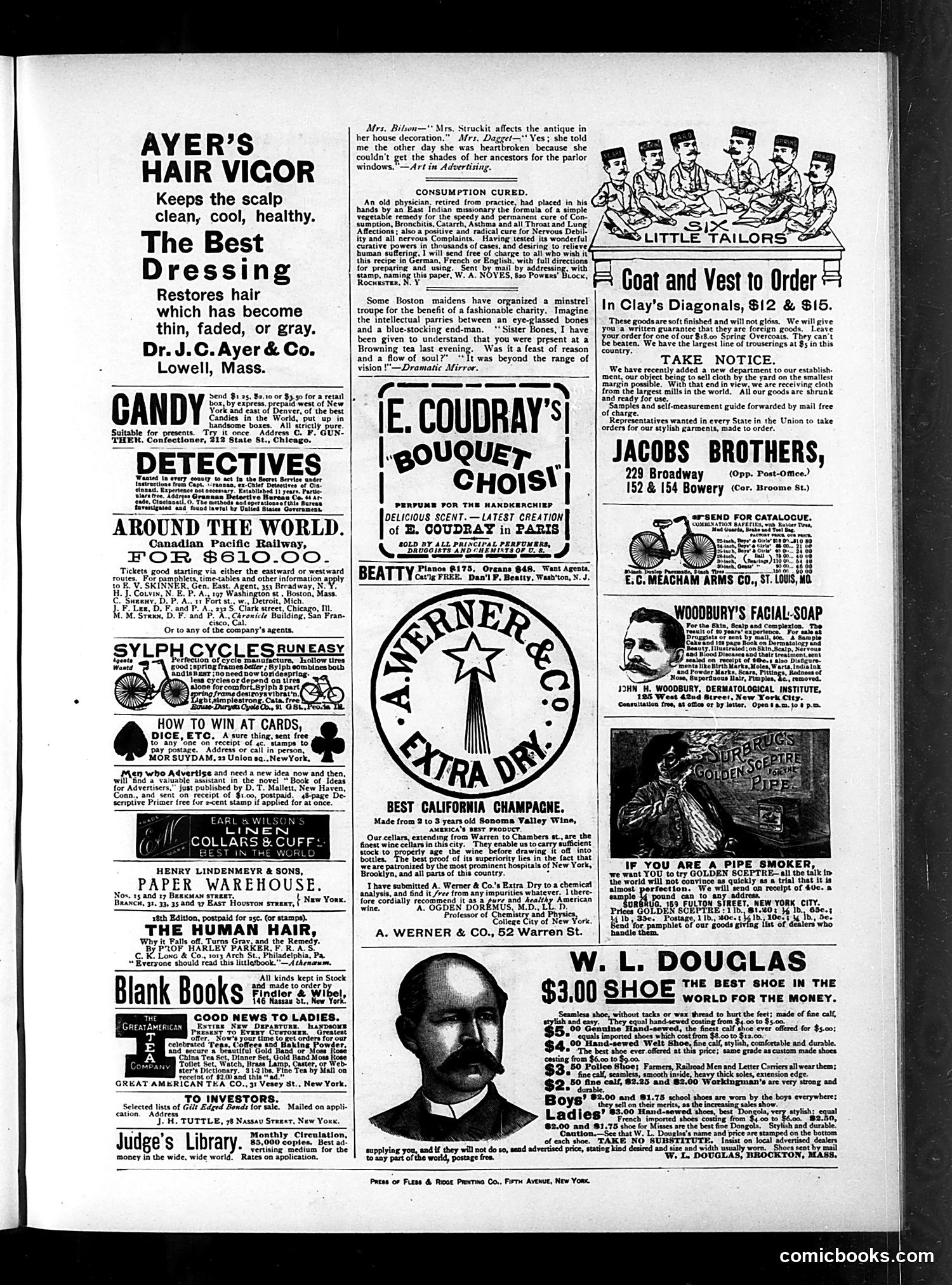
This page is **primarily advertisements** with minimal editorial cartoon content. The one clear satirical item is a brief two-line joke about Mrs. Bilson and Mrs. Dagget discussing interior decoration—specifically, that Mrs. Struckit affects antique furnishings but laments she cannot obtain "the shades of her ancestors for the parlor windows." The humor plays on the double meaning of "shades" (window coverings vs. ghosts/spirits), satirizing the pretentious affectation of wealthy women attempting to achieve fashionable "antique" aesthetics. The rest of the page consists of period advertisements for patent medicines (Ayer's Hair Vigor, consumption cures), bicycles, shoes, clothing tailoring, and other commercial goods typical of late-19th-century American magazines. No political content or identifiable public figures appear on this page.
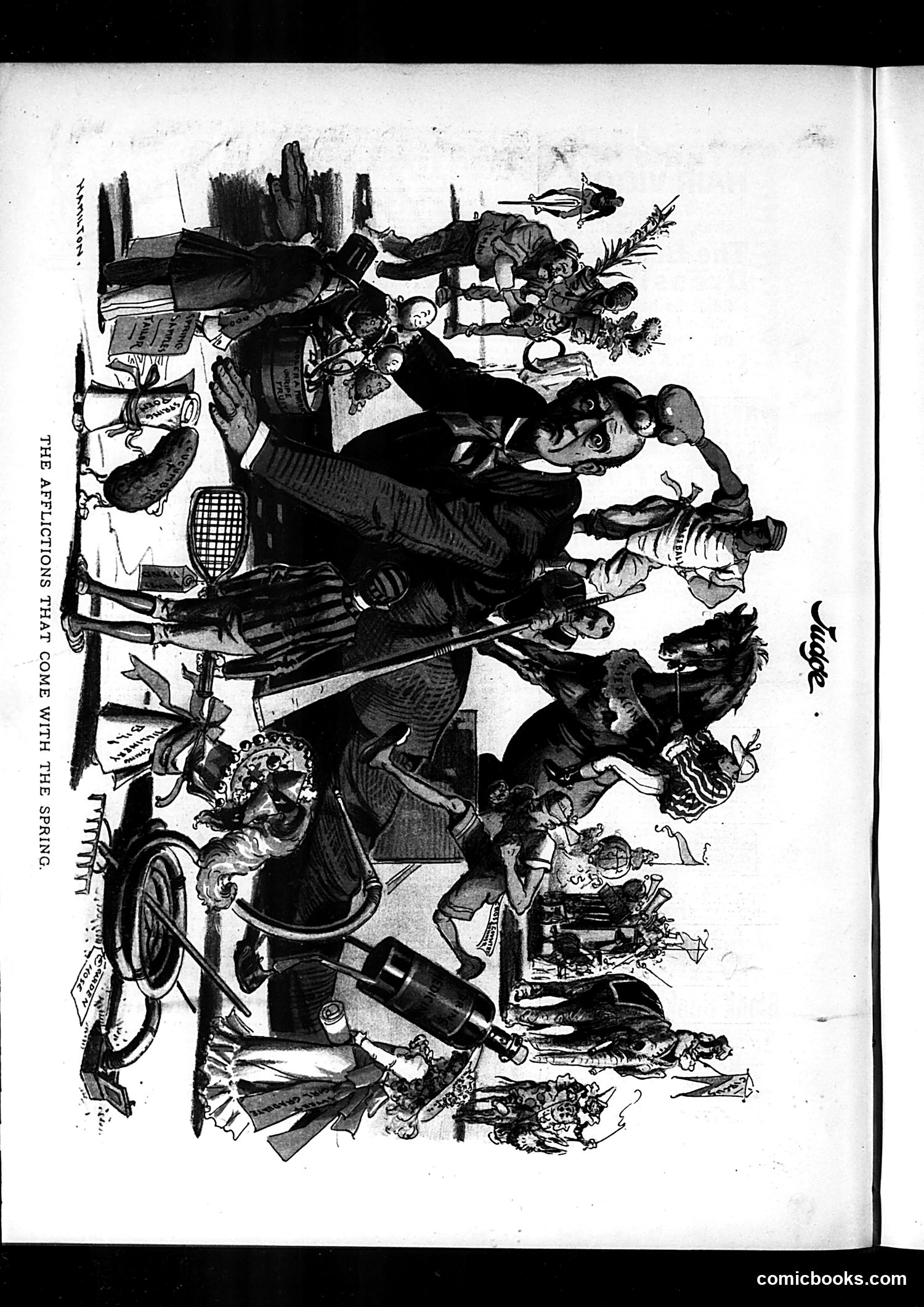
I can see this is a satirical illustration from Judge magazine, but the image is rotated and the OCR text appears corrupted/reversed, making it difficult to read the caption or identify specific references with certainty. What's visible: The illustration depicts a central figure (appears to be a well-dressed man) surrounded by various symbolic elements including animals, smaller figures, household items, and what appear to be caricatured characters. The style suggests late 19th or early 20th-century political satire. Without legible text identifying the subject, the specific political figures, or the satirical point, I cannot reliably explain what this cartoon means to a modern reader. The composition suggests commentary on corruption, excess, or political influence, but asserting specific targets would require clearer source material than what's legible here.