
Judge, 1892-04-23 · page 4 of 16
Judge — April 23, 1892 — page 4: what you’re looking at
What you’re looking at
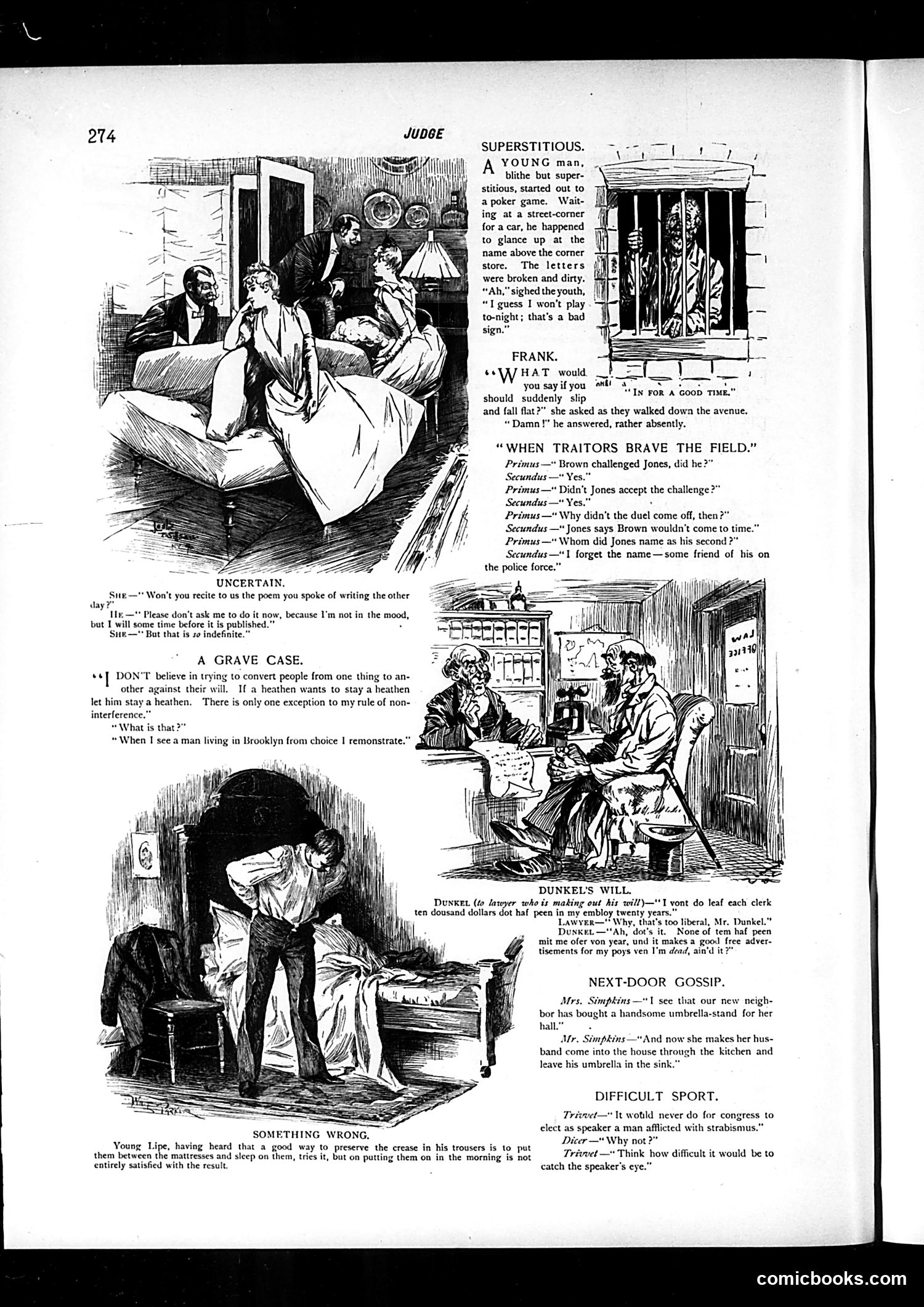
This page contains multiple brief satirical sketches typical of late 19th/early 20th-century American humor magazines: **"Superstitious"** mocks a young man who avoids poker because broken letters on a store sign seem unlucky—satire on superstition among the working class. **"When Traitors Brave the Field"** appears to ridicule a challenged duel that never occurs, with the challenger's second being a police officer—likely mocking either cowardice or police corruption. **"A Grave Case"** jokes that Brooklyn is so undesirable that only converting someone voluntarily living there from choice requires intervention. **"Dunkel's Will"** features a German-accented businessman (indicated by dialect) who leaves each short-term employee money as posthumous advertising—satire on cheap, exploitative employers. **"Next-Door Gossip"** mocks status-conscious neighbors and petty domestic power dynamics. **"Difficult Sport"** makes a pun: electing a speaker with strabismus (crossed eyes) would be difficult because you couldn't "catch his eye." These reflect Judge's focus on urban social observation and wordplay humor.
📄 Transcribed text from this page (OCR, searchable)
Machine-transcribed from the original scan — historical spelling and the odd misread are preserved.
SUPERSTITIOUS. A YOUNG man, blithe but super- stitious, started out to a poker game. Wait- ing at a street-corner for a car, he happened to glance up at the name above the corner store. The letters were broken and dirty. “Ah,” sighed the youth, “T guess I won't play to-night; that's a bad sign.” FRANK. SY HAT would _? you say if you ol! should suddenly slip and fall flat?” she asked as they walked down the avenue, “Damn!” he answered, rather absently. “IN FOR A GOOD TIME,” “WHEN TRAITORS BRAVE THE FIELD.” Primus — Brown challenged Jones, did he?” Secundus —*Yes.” Didn't Jones accept the challenge?” Secundus — Jones says Brown wouldn't come to time.” Primus — Whom did Jones name as his second?” Secundus—" forget the name—some friend of his on the police force.” E—"* Won't you recite to us the poem you spoke of writing the other IIx —** Please don’t ask me to do it now, because I'm not in the mood, but I will some time before it is published.” . Sue—"* But that is so indefinite. A GRAVE CASE. $4] DON'T believe in trying to convert people from one thing to an- other against their will. If a heathen wants to stay a heathen let him stay a heathen. There is only one exception to my rule of non- interference.” “What is that?” “When I see a man living in Brooklyn from choice I remonstrate.”” DUunxet (to lawyer who is making out his will)—'*1 vont do leaf each clerk ten dousand dollars dot haf peen in my embloy twenty years.” j 1 Why, that's too liberal, Mr. Dunkel.” ‘Ah, dot's it. None of tem haf peen mit me ofer von year, und it makes a good free adver- tisements for my poys ven I'm dead, ain'd it?” NEXT-DOOR GOSSIP. Mrs. Simpkins —"1 see that our new neigh- bought a handsome umbrella-stand for her Mr. Simpkins —" And now she makes her hus- band come into the house through the kitchen and leave his umbrella in the sink.” DIFFICULT SPORT. Trivvet—" It wotld never do for congress to lect as speaker a man afflicted with strabismus.” Dicer —"Why not?” “Think how difficult it would be to catch the speaker's eye.” SOMETHING WRONG, Young Lipe, having heard that a good way to preserve the crease in his trousers is to put & them between the mattresses and sleep on them, tries it, but on putting them on in the morning is not Trévvet entirely satisfied with the result. comicbooks.com