
Judge, 1892-04-23 · page 2 of 16
Judge — April 23, 1892 — page 2: what you’re looking at
What you’re looking at
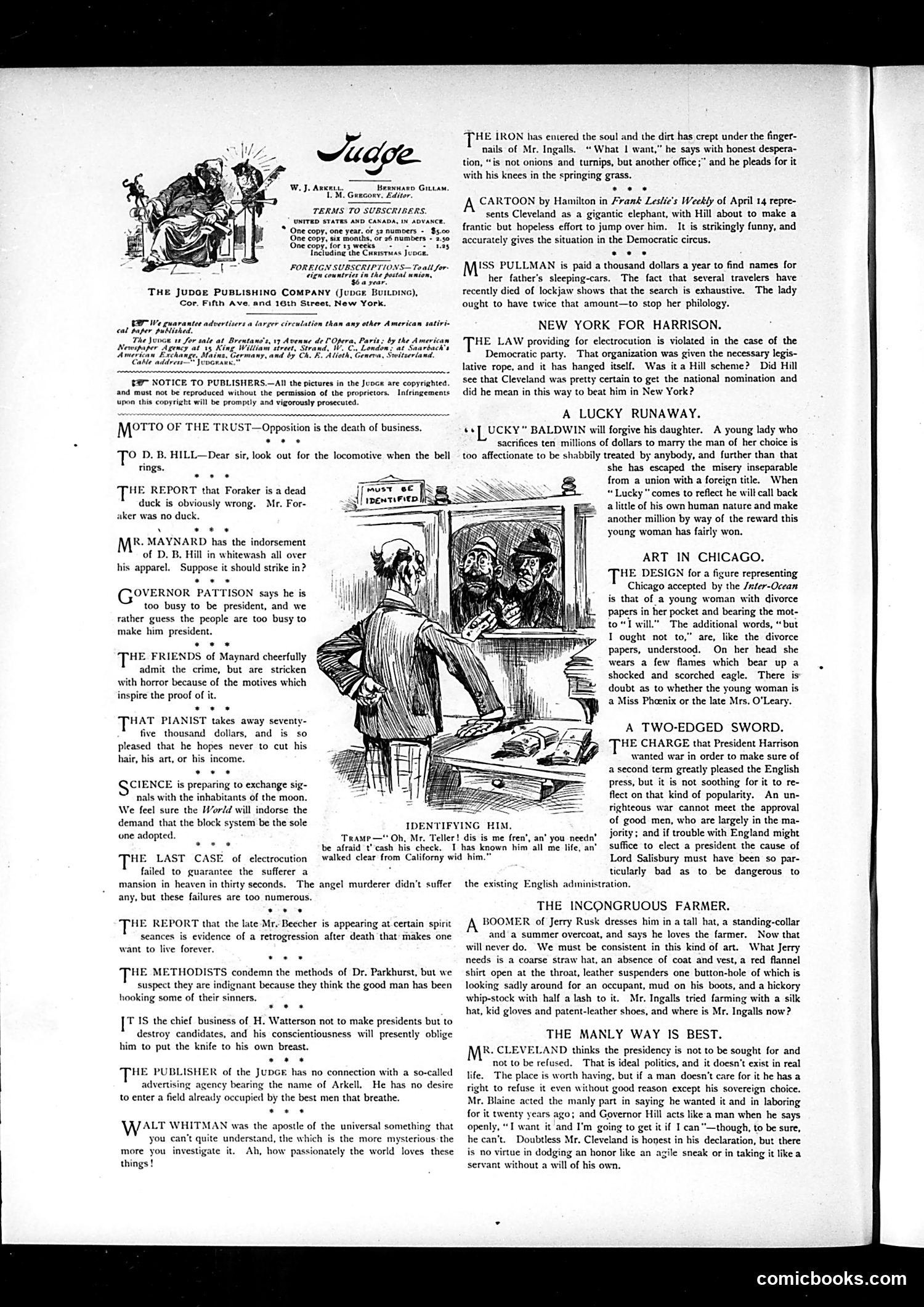
This page contains several brief satirical comments on contemporary political figures and events, along with a cartoon titled "IDENTIFYING HIM." The cartoon depicts a man at a window or counter confronting two rough-looking figures inside, with a caption about "cashing a check" and someone claiming to know the person "all his life." The accompanying text items mock various political figures including Governor Pattison, President Harrison, and references to debates over electrocution laws and war policy. One item critiques Harrison's desire for war to boost English popularity; another mocks Cleveland's pursuit of the presidency despite previous refusals. The overall tone is typical of Judge's irreverent political commentary—using humor to critique politicians' inconsistencies and questionable motives. Without specific dates visible, precise historical context remains somewhat unclear.
📄 Transcribed text from this page (OCR, searchable)
Machine-transcribed from the original scan — historical spelling and the odd misread are preserved.
Braxnaro Gittam. ony. Editor. TERMS TO SUBSCRIBERS. UNITED STATES AND CANADA, IN ADVANCE, * One copy, one year, of s2 numoers - $5.00 One copy, six months, or 26 numbers - 3:30 One copy: for 13 week has Including the C FOREIGN SUBSCRIPTION S— Teall for- ‘ign countries in the postal union, a year. THE JUDGE PUBLISHING COMPANY (Jupcr BUILDING), Cor. Fifth Ave. and 16th Street, New York. isritas JupcE. (Ws ceavanter advertioers a large? circalation than any other American satiri- cal paper published. it if The Jov0K 1 for sale at Brentan Newrpaper Ageniy at is Ring Willows ents Ametican Exchange, Maina: Germany. and by Ck. Paris; by the American London: at Saarbach's jemera, Stwiteerland. and, W. B. Alieth, $27 NOTICE TO PUBLISHERS.—All the pictures in the Juocn are copyrighted. reproduced without the permission of the proprietors. Infringements will be promptly and vigorously prosecuted. Motto OF THE TRUST—Opposition is the death of business. TO D. B. HILL—Dear sir, look out for the locomotive when the bell rings. THE REPORT that Foraker is a dead duck is obviously wrong. Mr. For- aker was no duck. . vee M®: MAYNARD has the indorsement of D. B. Hill in whitewash all over his apparel. Suppose it should strike in ? GOVERNOR PA ISON says he is too busy to be president, and we rather guess the people are too busy to make him president. eee 'HE FRIENDS of Maynard cheerfully admit the crime, but are stricken with horror because of the motives which inspire the proof of it. Rat PIANIST takes away seventy- five thousand dollars, and is so pleased that he hopes never to cut his hair, his art, or his income. SCIENCE is preparing to exchange sig- nals with the inhabitants of the moon. We feel sure the World will indorse the demand that the block system be the sole IDENTIF one adopted. ree be afraid t''cash his check. HE LAST C failed to guarantee the sufferer a mansion in heaven in thirty seconds. The angel murderer didn’t suffer any, but these failures are too numerous. THE REPORT that the late Mr. Beecher is appearing at certain spirit seances is evidence of a retrogression after death that makes one want to live forever. THE METHODISTS condemn the methods of Dr. Parkhurst, but we suspect they are indignant because they think the good man has been hooking some of their sinners. [TIS the chief business of H. Watterson not to make presidents but to destroy candidates, and his conscientiousness will presently oblige him to put the knife to his own breast. ws THE PUBLISHER of the JUDGE has no connection with a so-called advertising agency bearing the name of Arkell, He has no desire to enter a field already occupied by the best men that breathe. Witt WHITMAN was the apostle of the universal something that you can’t quite understand, the which is the more mysterious the more you investigate it. Ab, how passionately the world loves these things! = of electrocution walked clear from Californy wid him.” HE IRON has entered the soul and the dirt has crept under the finger- nails of Mr. Ingalls. “What | want,” he says with honest despera- tion, “is not onions and turnips, but another office ;” and he pleads for it with his knees in the springing grass. eae CARTOON by Hamilton in Frank Leslie's Weekly of April 14 repre- sents Cleveland as a gigantic elephant, with Hill about to make a frantic but hopeless effort to jump over him. It is strikingly funny, and accurately gives the situation in the Democratic circus. eee M'ss PULLMAN is paid a thousand dollars a year to find names for her father’s sleeping-cars. The fact that several travelers have recently died of lockjaw shows that the search is exhaustive. The lady ought to have twice that amount—to stop her philology. NEW YORK FOR HARRISON. HE LAW providing for electrocution is violated in the case of the Democratic party. That organization was given the necessary legis- lative rope, and it has hanged itself. Was it a Hill scheme? Did Hill see that Cleveland was pretty certain to get the national nomination and did he mean in this way to beat him in New York? A LUCKY RUNAWAY. ss] UCKY” BALDWIN will forgive his daughter. A young lady who sacrifices ten millions of dollars to marry the man of her choice is too affectionate to be shabbily treated by anybody, and further than that she has escaped the misery inseparable from a union with a foreign title. When Lucky "comes to reflect he will call back alittle of his own human nature and make another million by way of the reward this young woman has fairly won. ART IN CHICAGO. ‘THE. DESIGN for a figure representing Chicago accepted by the /nter-Ocean is that of a young woman with divorce papers in her pocket and bearing the mot- to “I will.” The additional words, “but I ought not to,” are, like the divorce Papers, understood. On her head she wears a few flames which bear up a shocked and scorched eagle. There is doubt as to whether the young woman is a Miss Phoenix or the late Mrs. O'Leary. A TWO-EDGED SWORD. HE CHARGE that President Harrison wanted war in order to make sure of a second term greatly pleased the English press, but it is not soothing for it to re- flect on that kind of popularity. An un- righteous war cannot meet the approval of good men, who are largely in the ma- YING HIM. aa A é . jority; and if trouble with England might Tramp—* Oh, Mr. Teller! dis is me fren‘, an’ you needn’ I has known him all me life, an’ Suffice to elect a president the cause of Lord Salisbury must have been so par- ticularly bad as to be dangerous to the existing English administration. THE INCONGRUOUS FARMER. A BOOMER of Jerry Rusk dresses him in a tall hat, a standing-collar and/a summer overcoat, and says he loves the farmer. Now that will never do. We must be consistent in this kind of art. What Jerry needs is a coarse straw hat, an absence of coat and vest, a red flannel shirt open at the throat, leather suspenders one button-hole of which is looking sadly around for an occupant, mud on his boots, and a hickory whip-stock with half a lash to it. Mr. Ingalls tried farming with a silk hat, kid gloves and patent-leather shoes, and where is Mr. Ingalls now? THE MANLY WAY IS BEST. MB- CLEVELAND thinks the presidency is not to be sought for and not to be refused. That is ideal politics, and it doesn’t exist in real life. The place is worth having, but if a man doesn’t care for it he has a right to refuse it even without good reason except his sovereign choice. Mr. Blaine acted the manly part in saying he wanted it and in laboring for it twenty years ago; and Governor Hill acts like'a man when he says openly, “I want it and I'm going to get it if I can"—though, to be sure, he can't. Doubtless Mr. Cleveland is honest in his declaration, but there is no virtue in dodging an honor like an agile sneak or in taking it like a servant without a will of his own. comicbooks.com