
A complete issue · 20 pages · 1892
Judge — April 16, 1892
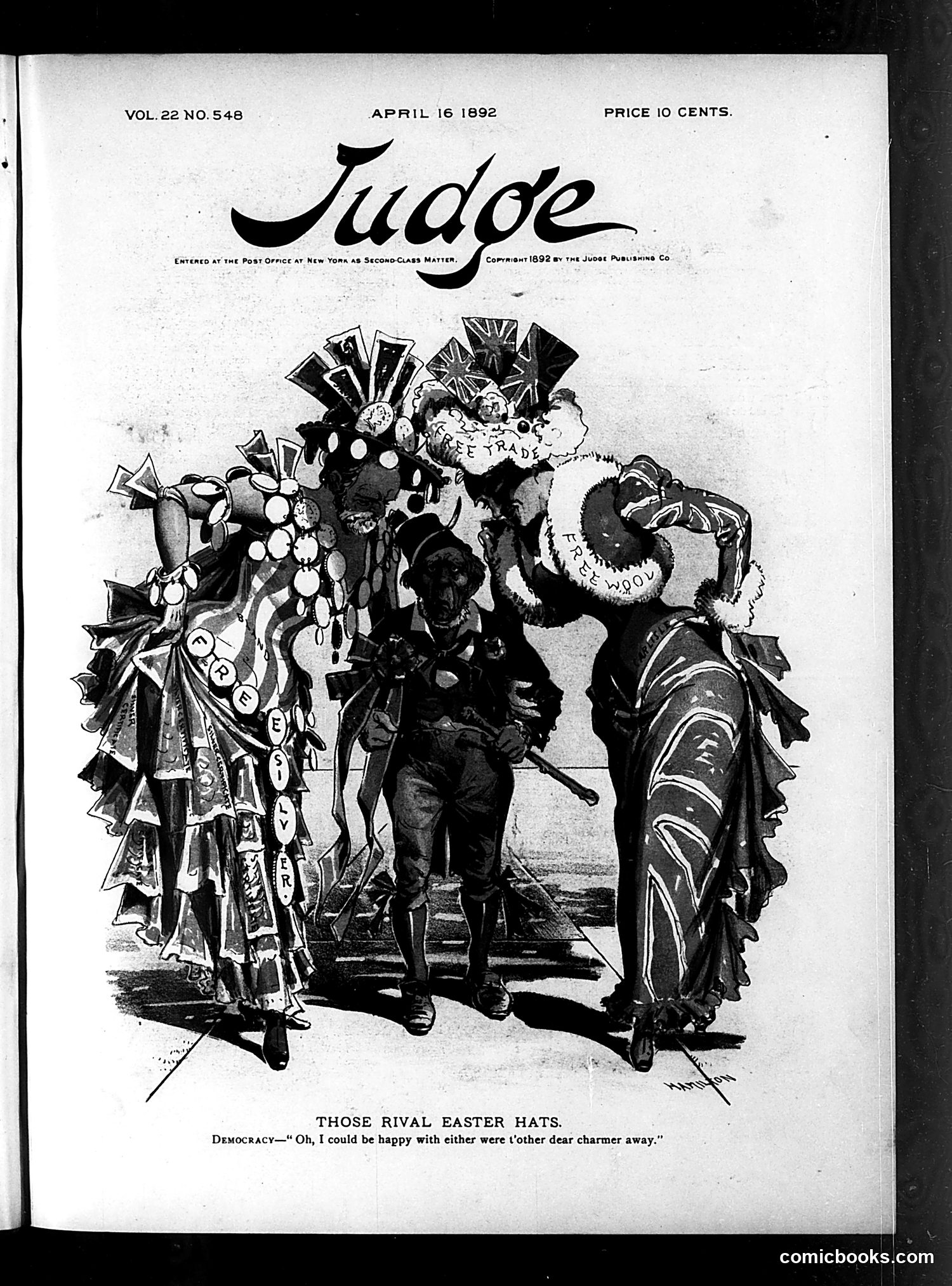
This April 1892 Judge cartoon satirizes the excessive fashion competition around Easter bonnets. The central figure appears to be a male voter or "Democracy" (labeled in the caption), positioned between two elaborately dressed women whose towering, ornate Easter hats are so enormous they completely dwarf him. The joke hinges on the caption: Democracy claims he'd "be happy with either were t'other dear charmer away"—suggesting he cannot choose between political rivals (likely Republicans and Democrats) just as he's overwhelmed by these competing fashion displays. The cartoon mocks both the absurdity of 1890s women's millinery fashions and, more pointedly, the fickleness of political allegiance, portraying voters as helpless observers caught between competing, equally ridiculous choices.
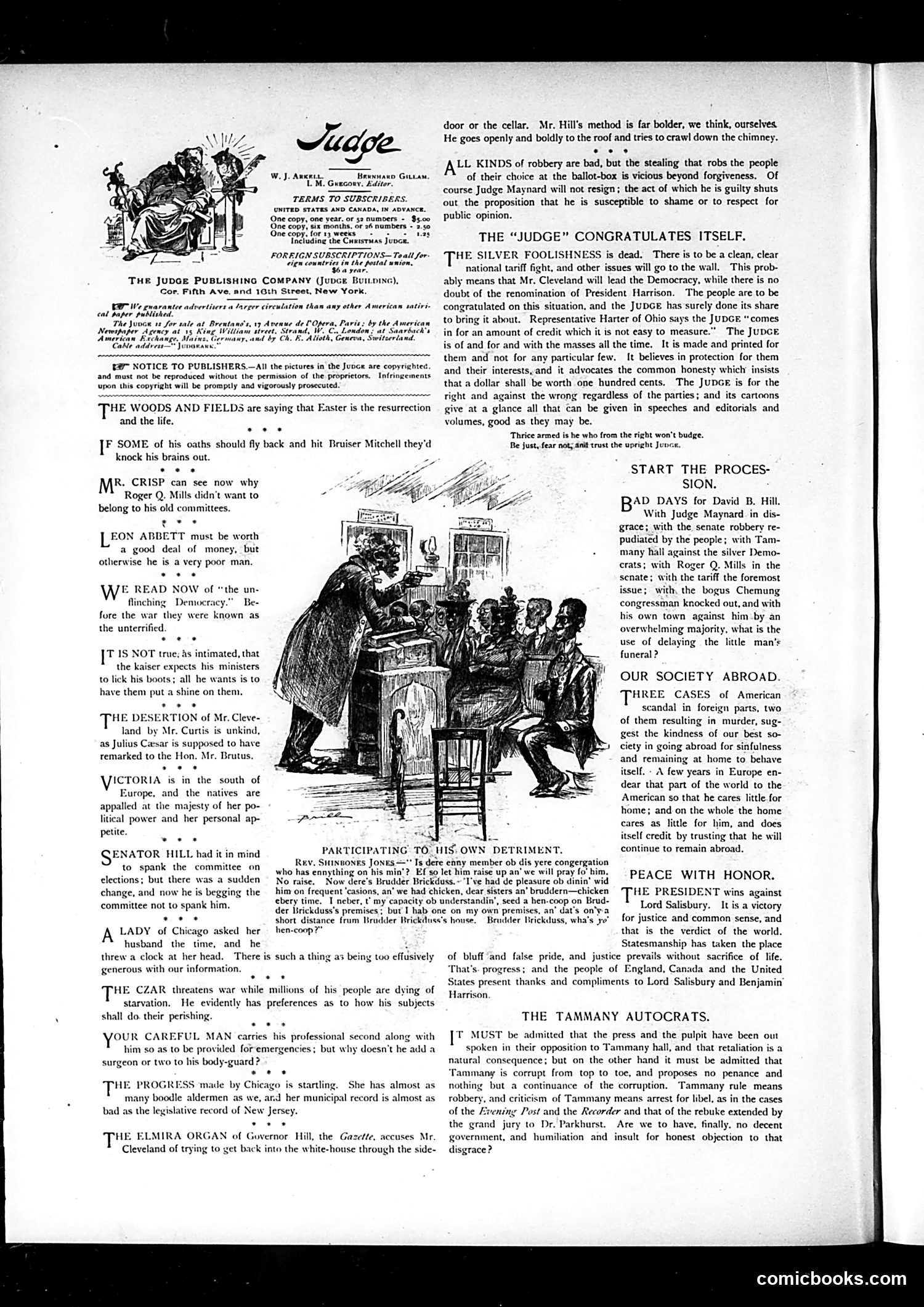
This page contains multiple satirical commentary pieces rather than a single cartoon. The main illustrated section, titled "PARTICIPATING TO HIS OWN DETRIMENT," depicts what appears to be a political or legal proceeding, likely referencing contemporary scandals. The text snippets mock various political figures and situations: Senator Hill's involvement in committees, Mr. Crisp's motives, and Mr. Cleveland's actions regarding tariffs. One section criticizes "The Tammany Autocrats" for corruption, specifically mentioning opposition to "Tammany Hall" and referencing the *Evening Post* and *Recorder* newspapers. The overall tone suggests early-1890s American politics, targeting Democratic machine politics (Tammany Hall), specific senators, and government corruption. Without clearer image resolution or publication date, precise figure identification remains unclear.
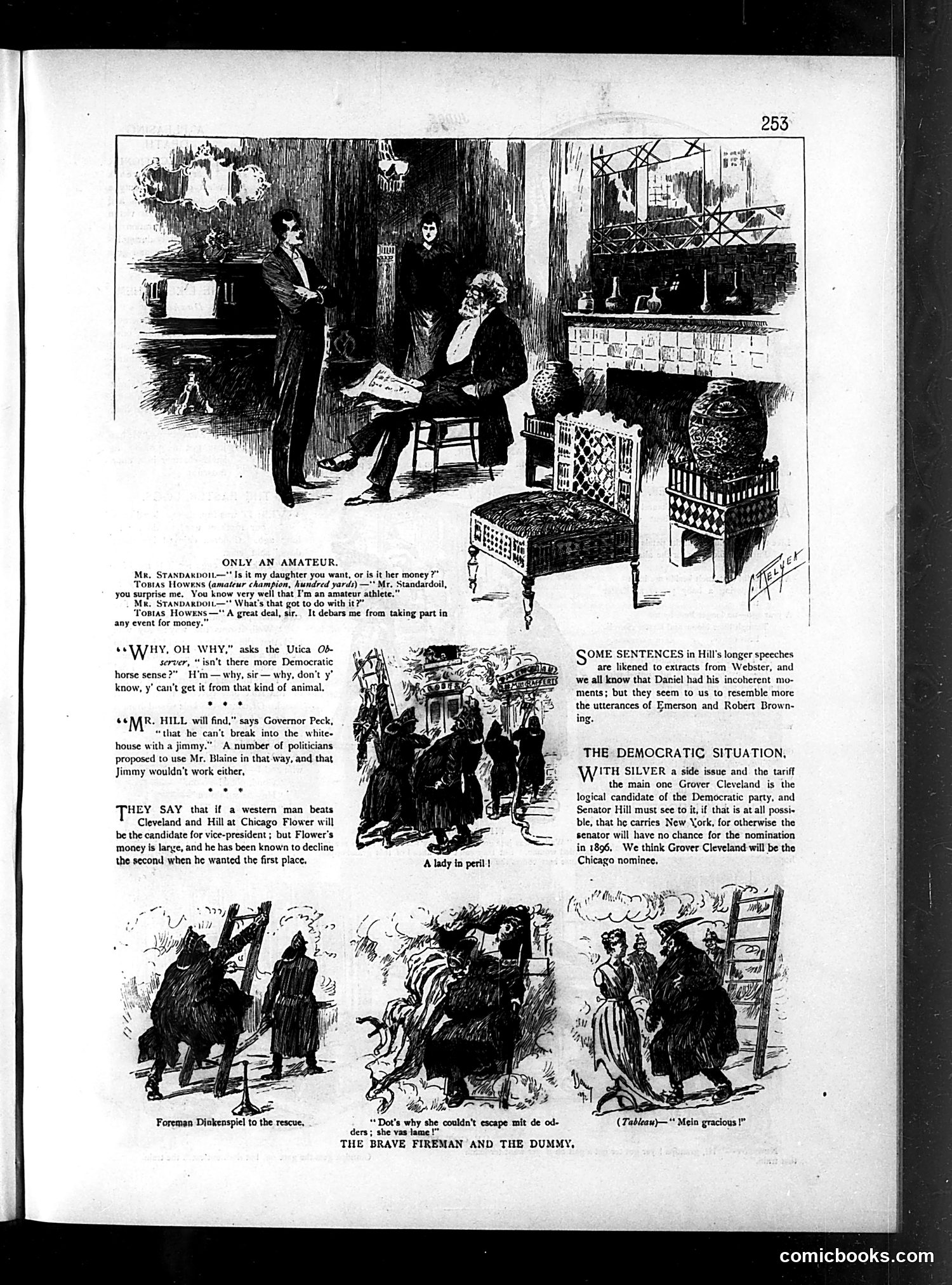
This page from *Judge* contains political and social satire from the 1890s era. The top cartoon titled "Only an Amateur" mocks a man named Standasloh who claims to be an amateur athlete while seeking payment—satirizing the hypocrisy of "amateur" sports figures who secretly accept money. "The Democratic Situation" section discusses Grover Cleveland as the logical Democratic candidate, with apparent debate over whether he should carry New York state to secure the nomination in 1896. The lower cartoons appear to reference a fireman rescue scenario (titled "The Brave Fireman and the Dummy"), though the specific political or social commentary is unclear from the visible text fragments. The overall page reflects 1890s American political discourse and social commentary on athletics, politics, and public figures.
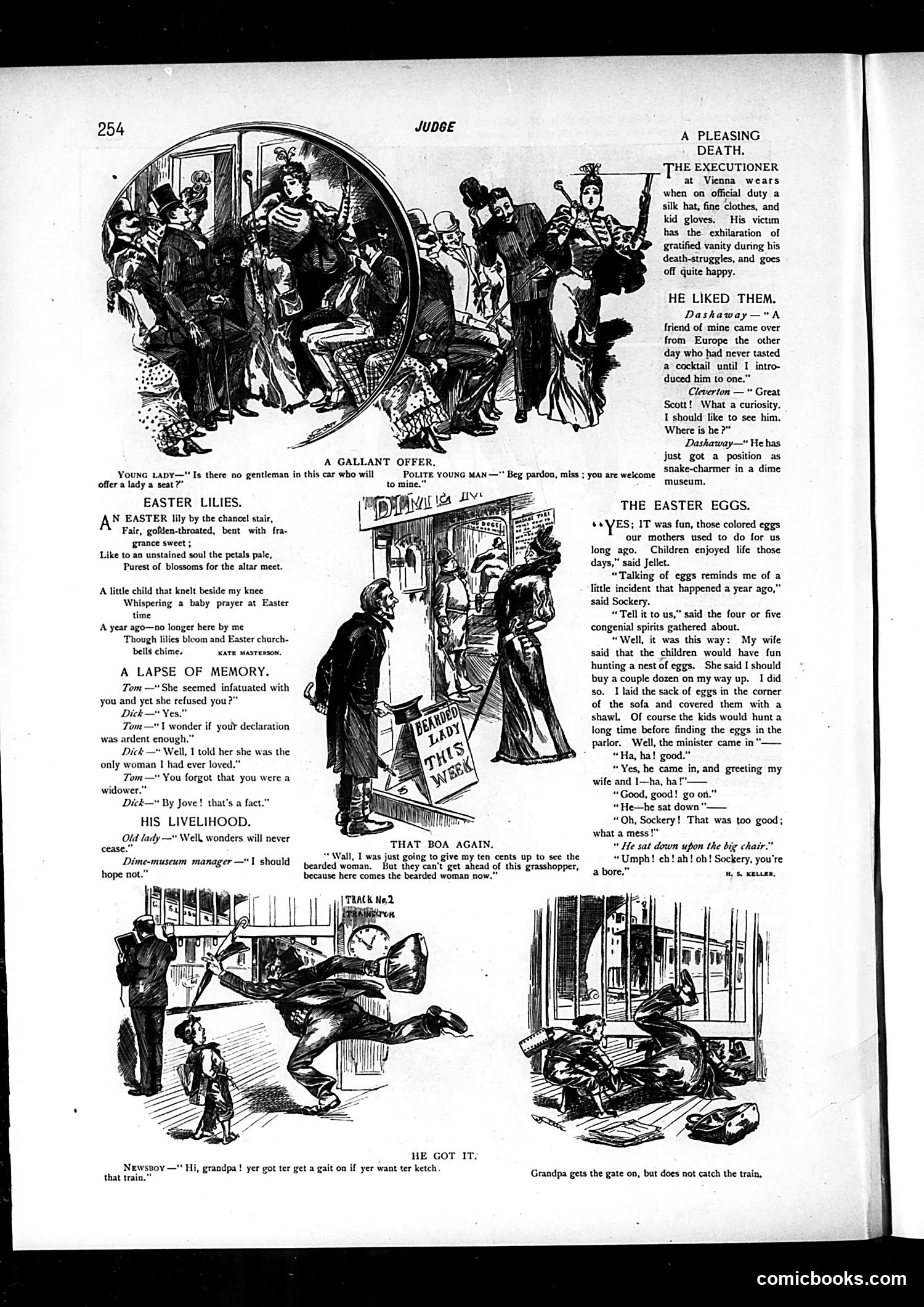
This page contains multiple short humorous pieces typical of late-19th-century American satirical journalism: **"A Pleasing Death"** mocks European pretension—specifically Vienna's executioner who dresses formally in silk hat and kid gloves, allowing condemned prisoners to feel dignified during execution. The satire ridicules both the executioner's vanity and the condemned person's shallow comfort in facing death. **"A Gallant Offer"** is a simple joke about a polite young man offering a lady his seat on a streetcar—she accepts his offer literally, taking his physical seat rather than understanding his courteous gesture. The remaining pieces are brief anecdotes and sentimental verses about Easter traditions, cocktail culture, and domestic life—typical filler content alongside the illustrated cartoons. "The Easter Eggs" recounts a humorous domestic mishap where a minister sits on eggs hidden in a parlor chair. Overall, this page represents typical Judge content: light social satire, domestic humor, and sentimental poetry aimed at middle-class readers.
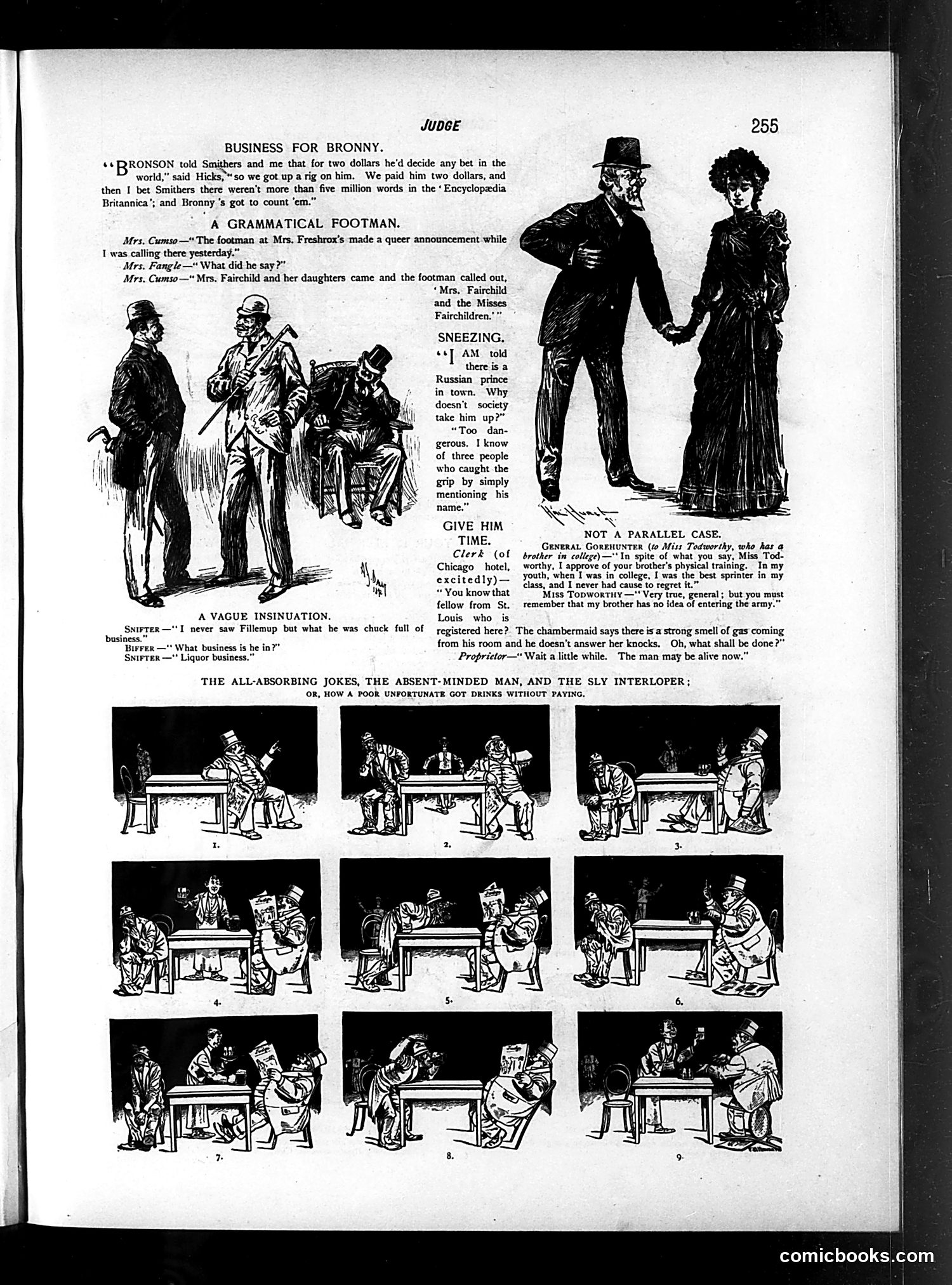
This page collects satirical short jokes and a nine-panel comic strip typical of Judge magazine's format. **The jokes mock:** - Gullible people (a man duped into counting Encyclopedia Britannica words) - Social pretension (a footman's grammatical error calling guests "Misses Fairchildren") - Vague gossip and rumor-mongering (mentioning a Russian prince's name allegedly spreads illness) - Class anxiety (concern about a Russian aristocrat's social standing) - Outdated military values (a general proud of his college sprinting, missing that modern physical training serves civilian purposes) - Morbid humor (a hotel proprietor waiting for a guest to die from gas exposure) **The bottom comic strip** appears to show how a shabby man obtains free drinks through social manipulation at a bar—exploiting absent-mindedness and posing as someone respectable. These represent typical Judge humor: lightweight social satire targeting Victorian manners, class consciousness, and human folly, with no specific political content.
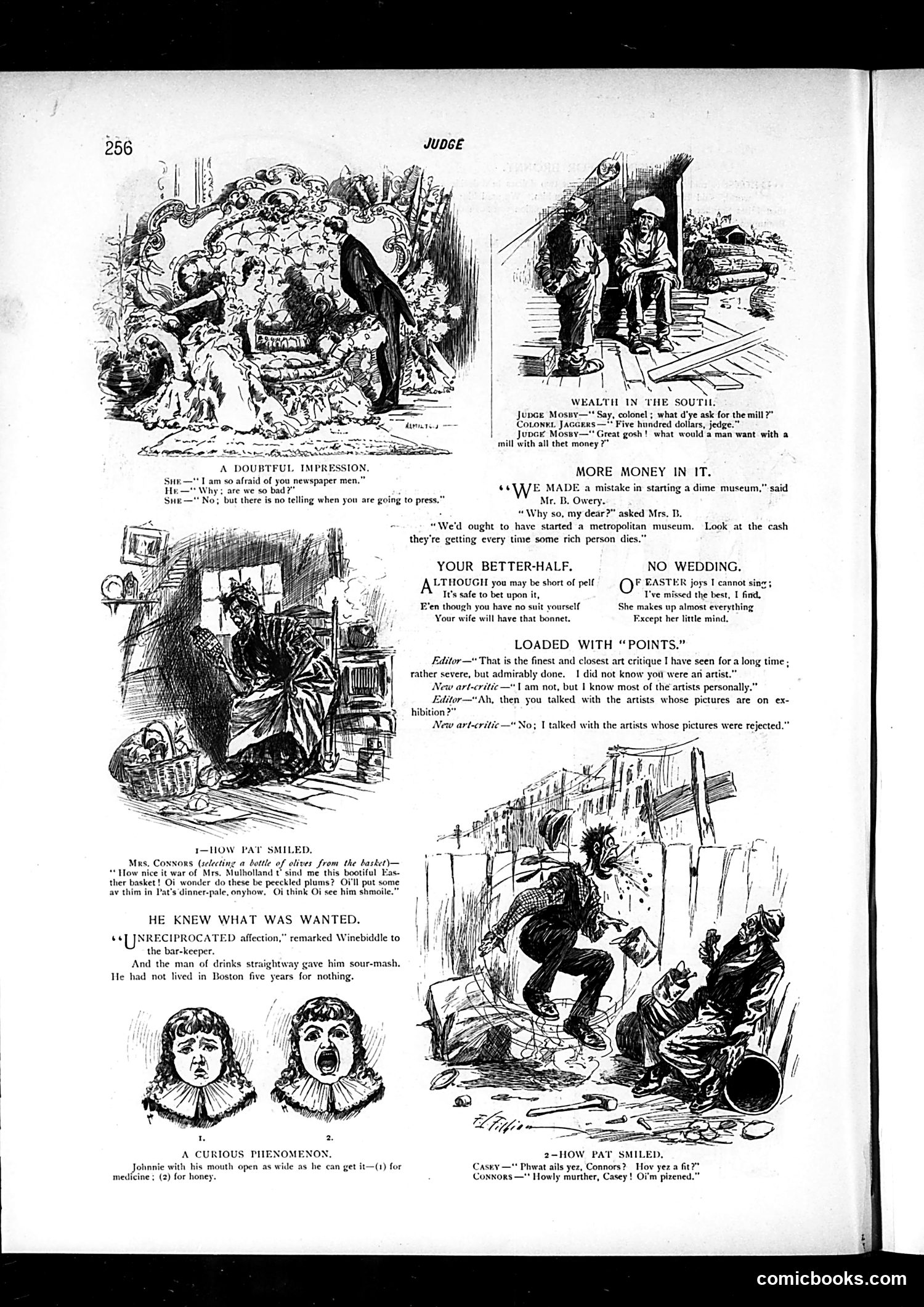
This page contains multiple satirical cartoons and jokes typical of late 19th-century American humor magazine *Judge*. **Key content:** "Wealth in the South" mocks Southern poverty by depicting a character (likely representing poor Southern whites post-Civil War) who considers $500 an enormous sum. "More Money in It" satirizes how metropolitan museums profit when wealthy donors die, suggesting Americans care more about inheritance than art. "Your Better-Half" and "No Wedding" are brief romantic humor pieces about marriage and courtship. "Loaded with Points" jokes about art criticism—a self-proclaimed critic knows artists only through rejected submissions, not accepted works, suggesting he's a failed artist judging others. "How Pat Smiled" (repeated twice) features Irish immigrant characters (names: Pat, Connors, Casey, Mrs. Mulholland) in working-class humor, typical of era's ethnic stereotyping. The cartoons employ Irish dialect humor and depict working-class domestic life, reflecting period attitudes toward immigrants.
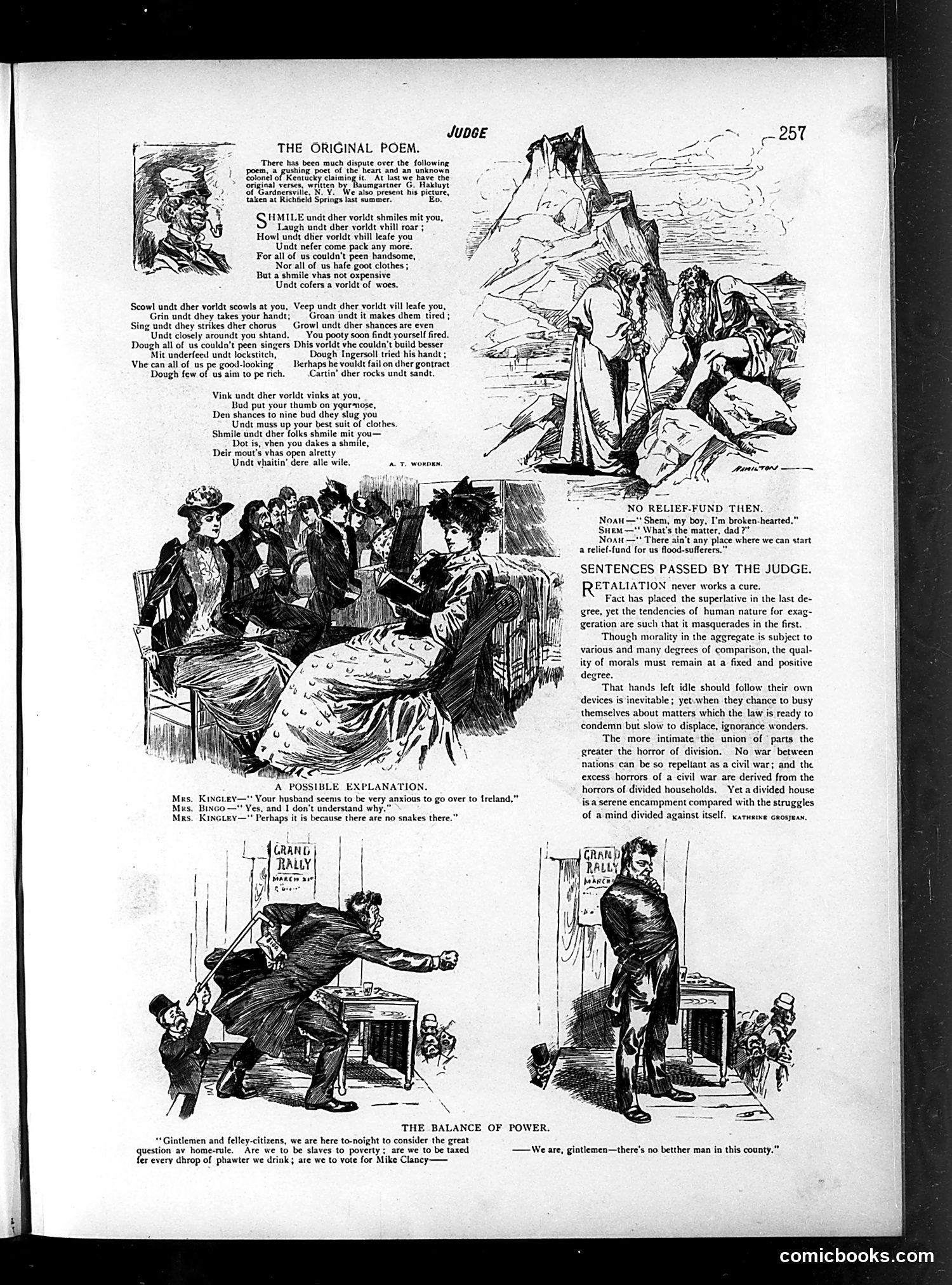
This page satirizes Irish-American immigration and politics circa the 1880s-90s. **"The Original Poem"** mocks sentimental Irish-immigrant verse through exaggerated dialect humor—deliberately misspelling English words ("shmile," "vorldt," "dhey") to ridicule Irish accents. The poem itself is genuine sappy sentiment, but the presentation is comedic mockery. **The cartoons below** target Irish-American political culture. "No Relief-Fund Then" jokes about Irish flood victims unable to organize relief because "there ain't any place where we can start a relief-fund"—likely referencing either political disorganization or Irish saloons being the only gathering spaces. **"The Balance of Power"** depicts Irish-American voters ("gintlemen," "Mike Clancy") as politically manipulated masses, depicted as crude and easily led, discussing "home-rule" (Irish independence) while seemingly disconnected from actual civic responsibility. The overall message: Irish immigrants are portrayed as dialect-speaking, politically unreliable, and culturally backward—typical nativist satire of the era targeting Catholic immigrants.
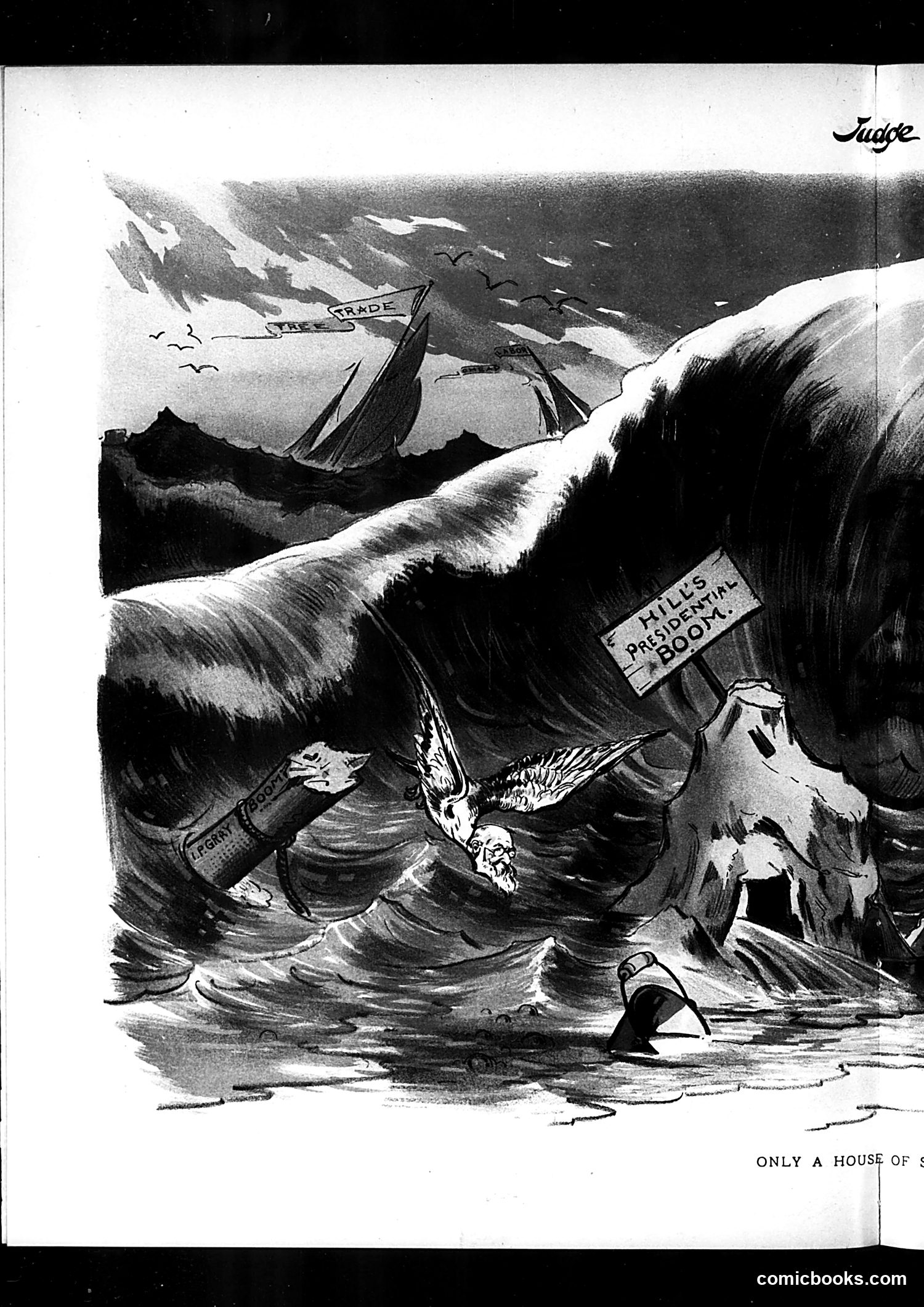
This appears to be a satirical cartoon from *Judge* magazine depicting economic or trade turmoil. The central image shows a sinking ship labeled "TRADE" amid rough waters, with an eagle (representing America) trapped beneath massive waves or ice. Visible labels include "HILLS PRESIDENTIALISM" and what appears to be "BOOKA" or similar text on debris. The cartoon likely critiques protectionist trade policies or economic collapse, showing American commerce and national pride literally drowning. The eagle's entrapment suggests the nation is bound or harmed by specific policies—possibly referencing President [unclear without date context] and controversial trade or economic legislation. The OCR text's fragmented final line ("ONLY A HOUSE OF S...") is illegible but suggests a continuation of the satirical message.
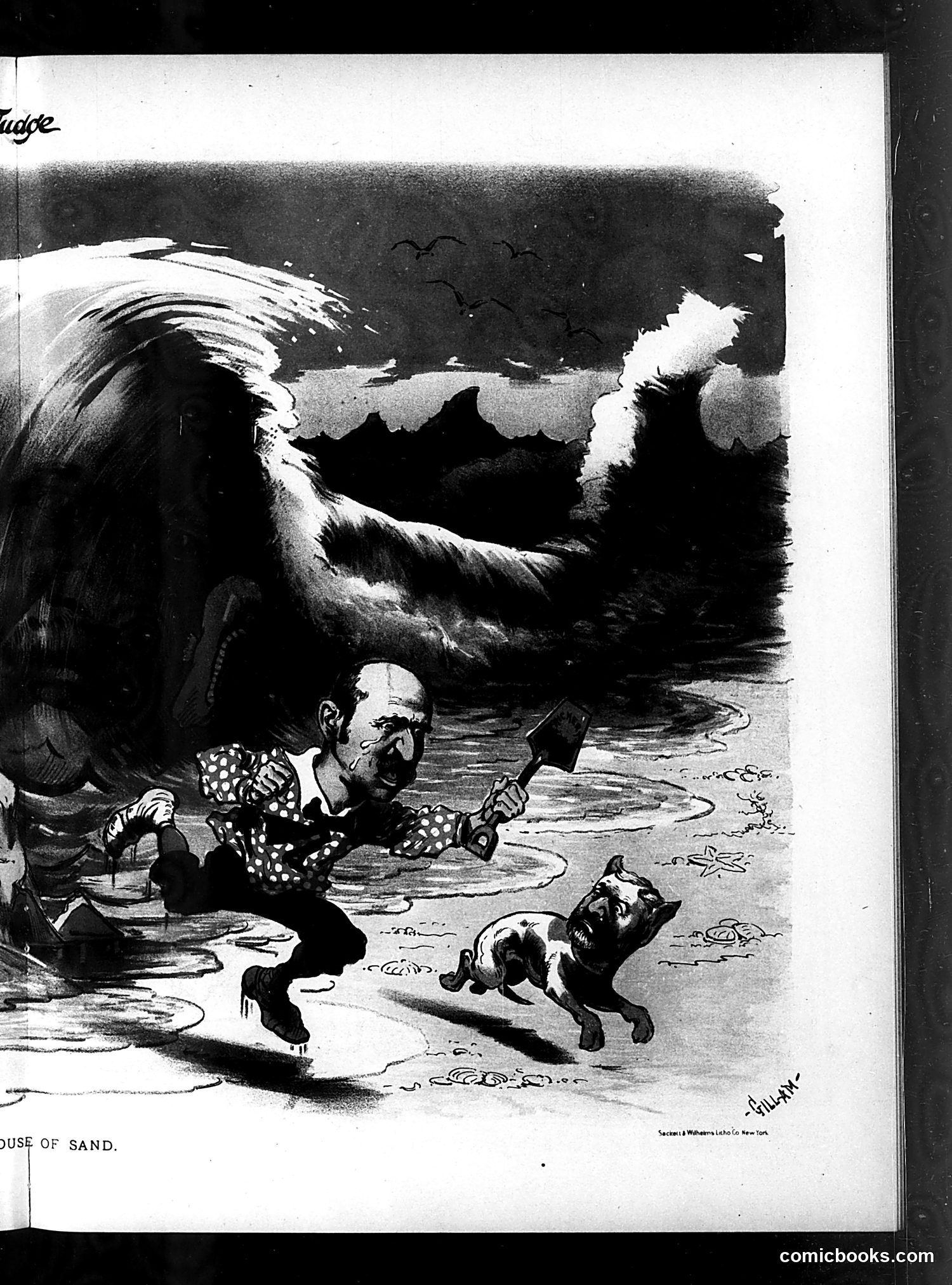
This cartoon depicts a man in a polka-dotted costume wielding an axe, apparently constructing or demolishing a structure made of sand. Two dogs observe the scene. The title "House of Sand" likely references the biblical phrase meaning something unstable or built on weak foundations. The figure appears to be a political caricature, though the specific identity is unclear from the image alone. The cartoon satirizes someone's political position or policy as fundamentally flawed and destined to collapse—like a house literally made of sand. The absurd polka-dot costume emphasizes the ridiculousness of the endeavor. Without additional context about Judge magazine's publication date and political climate, the precise target remains uncertain, but the satire concerns futile or foolish political building.
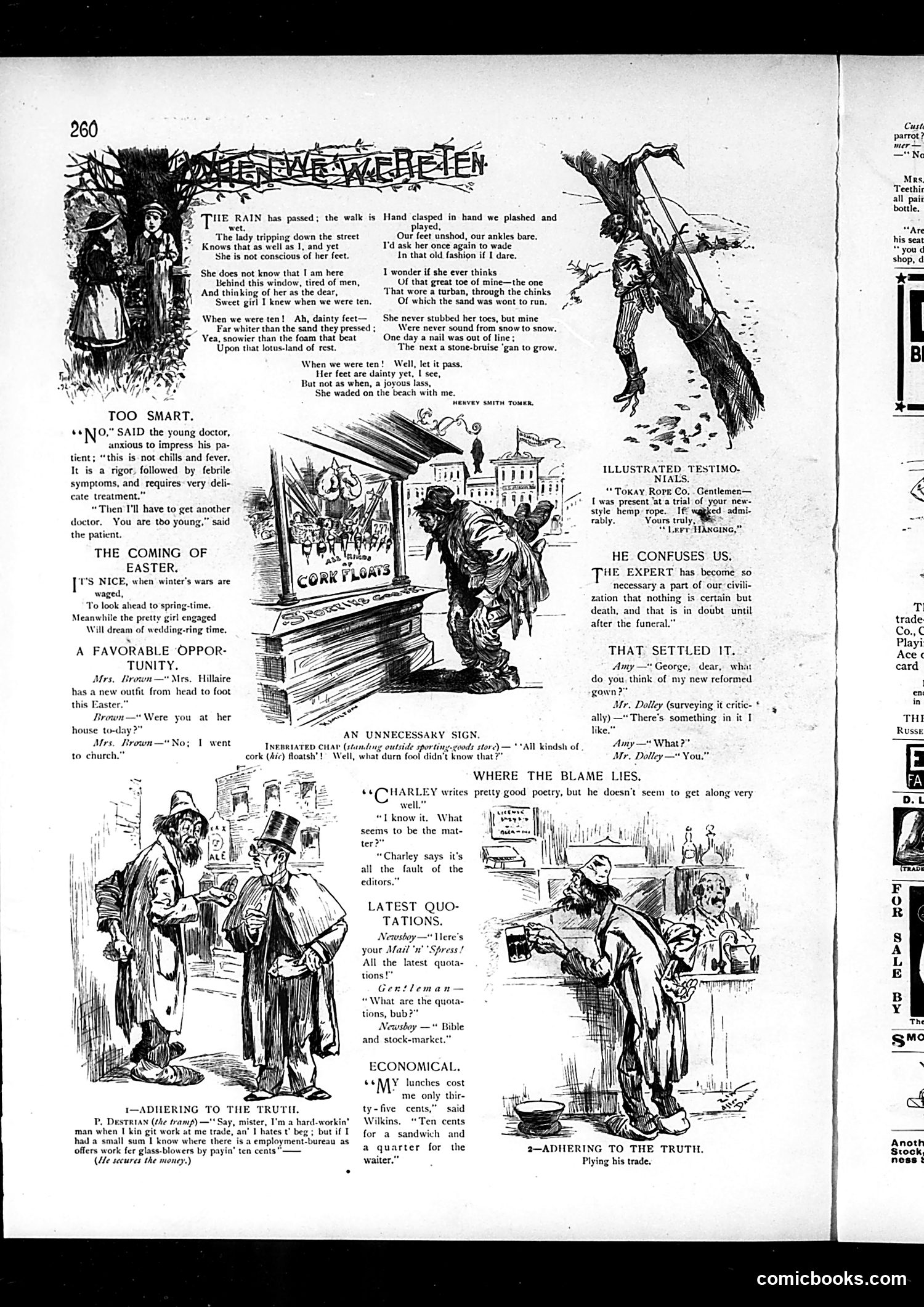
This page contains multiple short satirical pieces typical of Judge's humor: **"Too Smart"** mocks pretentious young doctors using unnecessarily complex medical terminology ("rigor," "febrile symptoms") to impress patients, only to be dismissed by a skeptical older patient who prefers experienced physicians. **"Where the Blame Lies"** suggests that poet Charley's lack of success stems not from his writing ability but from editors' poor judgment—a jab at literary gatekeepers. **"Latest Quotations"** presents a newsboy's deadpan response: the day's important news is merely Bible verses and stock-market prices, satirizing America's simultaneous concern with morality and profit. **"Economical" and "Adhering to the Truth"** depict working-class characters negotiating survival—a glass-blower seeking employment through questionable means, and a servant negotiating meal costs—reflecting late-19th-century labor anxieties. The romantic poem at top explores nostalgic memory and class difference through the lens of a man remembering a barefoot girl from childhood, now observing her from behind a window—poignant social commentary wrapped in sentimentality.
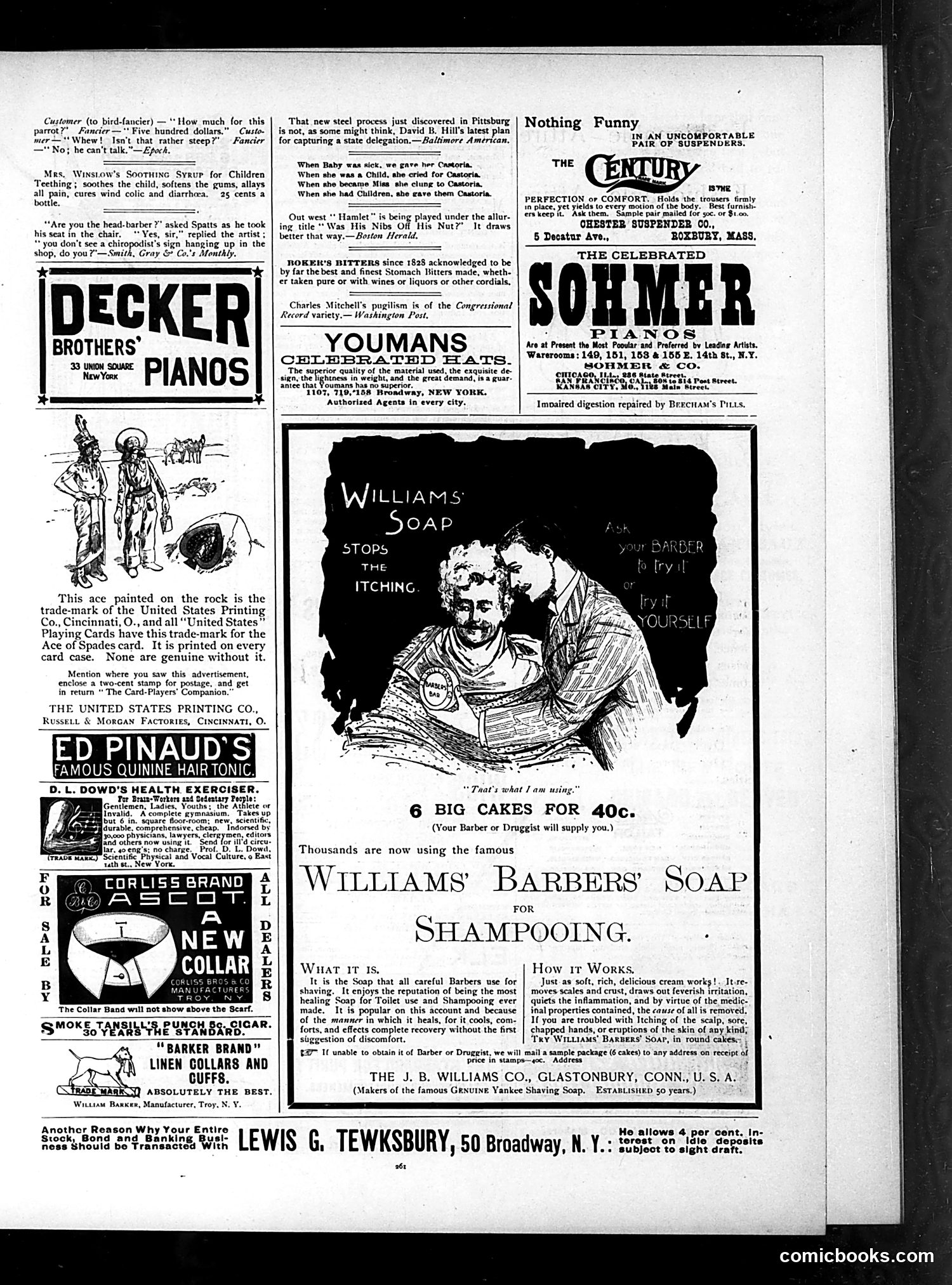
This page is primarily **advertising**, with minimal editorial cartoons. The few jokes present are brief one-liners: 1. **Bird-fancier joke**: A parrot costs $500 because it *can't* talk—a reversal of expected value. The humor plays on the common assumption that talking parrots are expensive. 2. **Barber/chiropodist joke**: A head barber deflects a customer's question by noting there's no chiropodist's sign in the shop—a mild workplace hierarchy joke. 3. **Political reference**: One ad mentions David B. Hill's "latest plan for capturing a state delegation" via a steel process, apparently comparing political maneuvering to industrial processes. Hill was a New York politician active in the 1880s-90s, but the specific reference is unclear without additional context. The page otherwise consists of product advertisements (pianos, soap, hair tonic, suspenders, etc.) typical of late 19th-century magazines. No significant satirical content or caricatures are visible.
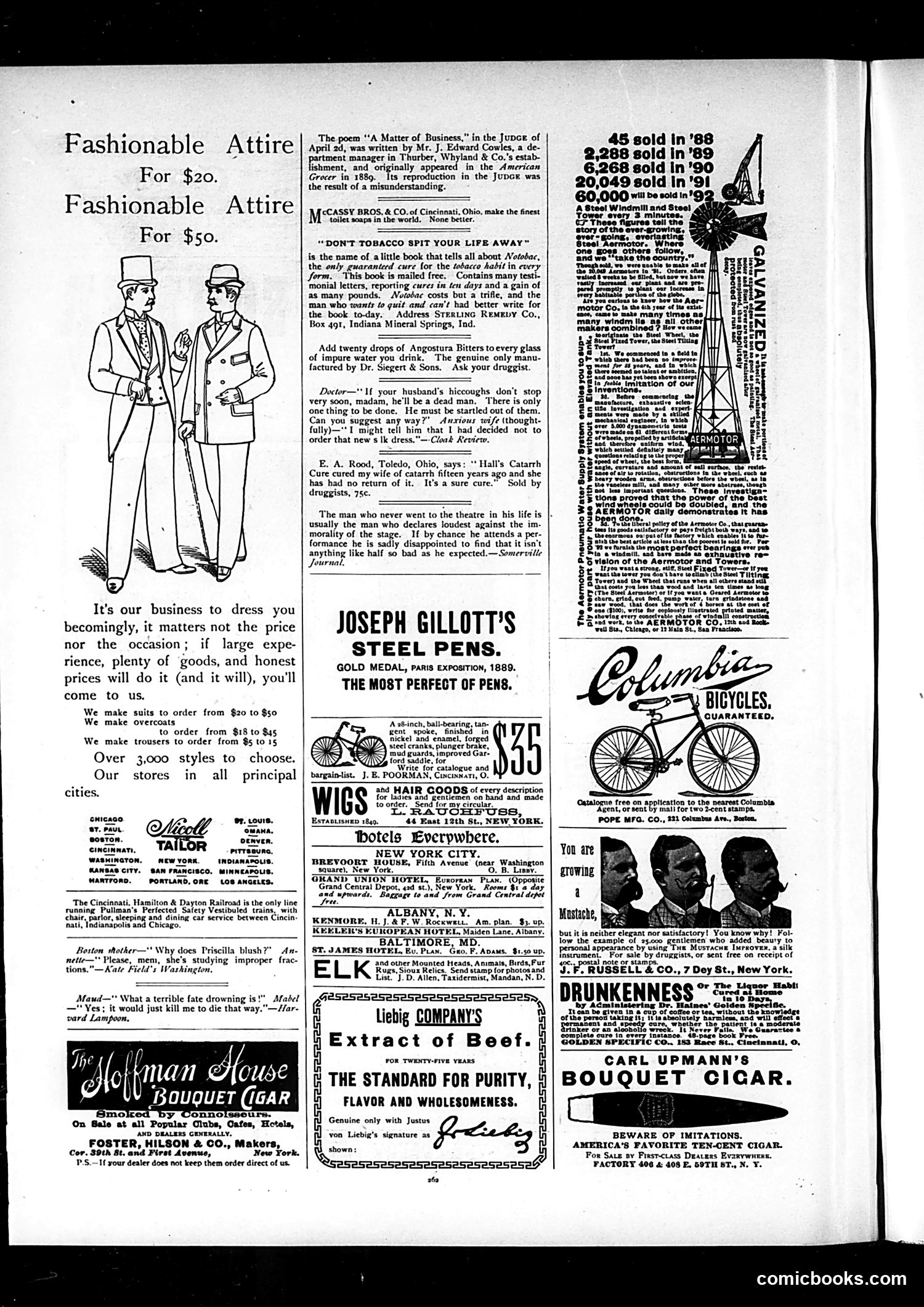
This is primarily an **advertising page** from Judge magazine, not a political cartoon. The page consists almost entirely of commercial advertisements for various products and services, including: - **Clothing**: A tailor shop advertising suits for $20-$50 - **Pens**: Joseph Gillott's steel pens (Gold Medal winner) - **Patent medicines**: Notobac (tobacco cessation), Hall's Catarrh Cure, Angostura Bitters - **Bicycles**: Columbia bicycles - **Hotels and railroads**: Cincinnati & Dayton Railroad, various hotels - **Cigars**: Hoffman House and Bouquet cigars - **Beef extract**: Liebig's Extract of Beef - **Hair goods and wigs** The only non-advertisement content is a brief humorous anecdote about a wife threatening to cancel a new dress to startle her hiccupping husband, and some editorial notes about previous articles. This reflects Judge's business model: satirical editorial content subsidized by advertising revenue.
This page is primarily advertising, typical of Judge magazine's revenue model. The notable content includes: **Main Advertisement**: Kirk's Shandon Bells Toilet Soap dominates the upper left, emphasizing "delicate and lasting odor" for complexion care. **Social Humor**: A small joke from Brooklyn Life plays on marital dynamics—a man notes his wife seems gloomy when he visits but happy when he leaves, a mild jab at domestic relationships. **Period Products**: The page showcases era-typical advertisements: Gail Borden condensed milk (marketed for infants), W. Baker & Co.'s breakfast cocoa (emphasizing purity without "alkalies"), Beecham's Pills for digestive complaints, and the Remington Standard Typewriter. **Warwick Bicycles**: An endorsement features "John," a fastidious fellow praising pneumatic tires—reflecting 1890s cycling enthusiasm. **Travel/Hospitality**: Fall River steamship line and Wiesbaden Hotel advertisements target leisure travelers. The page reflects late-19th-century consumer culture with minimal political content—primarily commercial messaging targeting middle-class readers.
This page is primarily **advertising**, not political satire. It contains various commercial advertisements from 1892, including: - Railroad and transportation ads (Burlington Route, New York Central) - Consumer goods (Kodak cameras, bicycles, whiskey, eau de cologne, playing cards) - Patent medicines (Piso's Remedy for Catarrh, anti-hair products) The only **satirical content** is a brief exchange between an "Inspector" and "Capitalist" about tenement housing—mocking capitalist greed by having the capitalist define an ideal poor-house as one yielding "thirty-five per cent" profit rather than actually serving residents' needs. The page also includes a humorous anecdote about a poet whose submission was rejected, and a joke about unmarried women. These are light entertainment rather than political commentary. This appears to be a typical *Judge* magazine page mixing advertisements with mild satirical humor.
This page is primarily **advertisements and notices**, not political cartoons. The content reflects late 19th-century consumer culture: **Key Advertisements:** - **Victor Bicycles** and **Overman Wheel Co.**: Bicycle companies competing in the 1890s bicycle craze - **Jacobs Brothers**: Tailoring services in New York - **Electro-Medical Batteries**: Pseudoscientific health devices (common in this era) - **Laroche's Invigorating Tonic**: Patent medicine claiming to cure appetite loss, fever, malaria, and indigestion - **H. O'Neill & Co.**: Department store advertising spring millinery - **Railroad vestibule service** between Cincinnati and St. Louis **The Only Satirical Element:** A brief quote mocking the proliferation of biographies about Columbus, suggesting every literary person was writing one. **The Bottom Joke:** A brief quip about a cork-headed man being suited to swimming—mild, self-contained humor. This represents typical **Judge magazine advertising**, targeting middle-class urban readers with consumer goods and dubious health remedies now recognized as fraudulent.
This is primarily a **advertising section**, not a satirical cartoon page. It showcases the New York Central & Hudson River Railroad's promotional book series for travelers—the "Four-Track Series." The page advertises guidebooks covering American tourist destinations: Niagara Falls, the Adirondacks, Thousand Islands, and Hudson River summer homes. Each book description includes romantic poetry excerpts emphasizing nature, leisure, and escape from urban life. The small illustrations on the right side (a champagne bottle for "Great Western" wine and a playing card advertisement for "Triton") are unrelated commercial ads. **The satire, if any, is subtle**: the grandiose poetic language paired with railroad marketing suggests gentle mockery of the era's romanticized "nature tourism"—wealthy urbanites seeking authentic wilderness experiences via luxury rail service. However, this reads primarily as **sincere period advertising** rather than sharp satirical commentary.
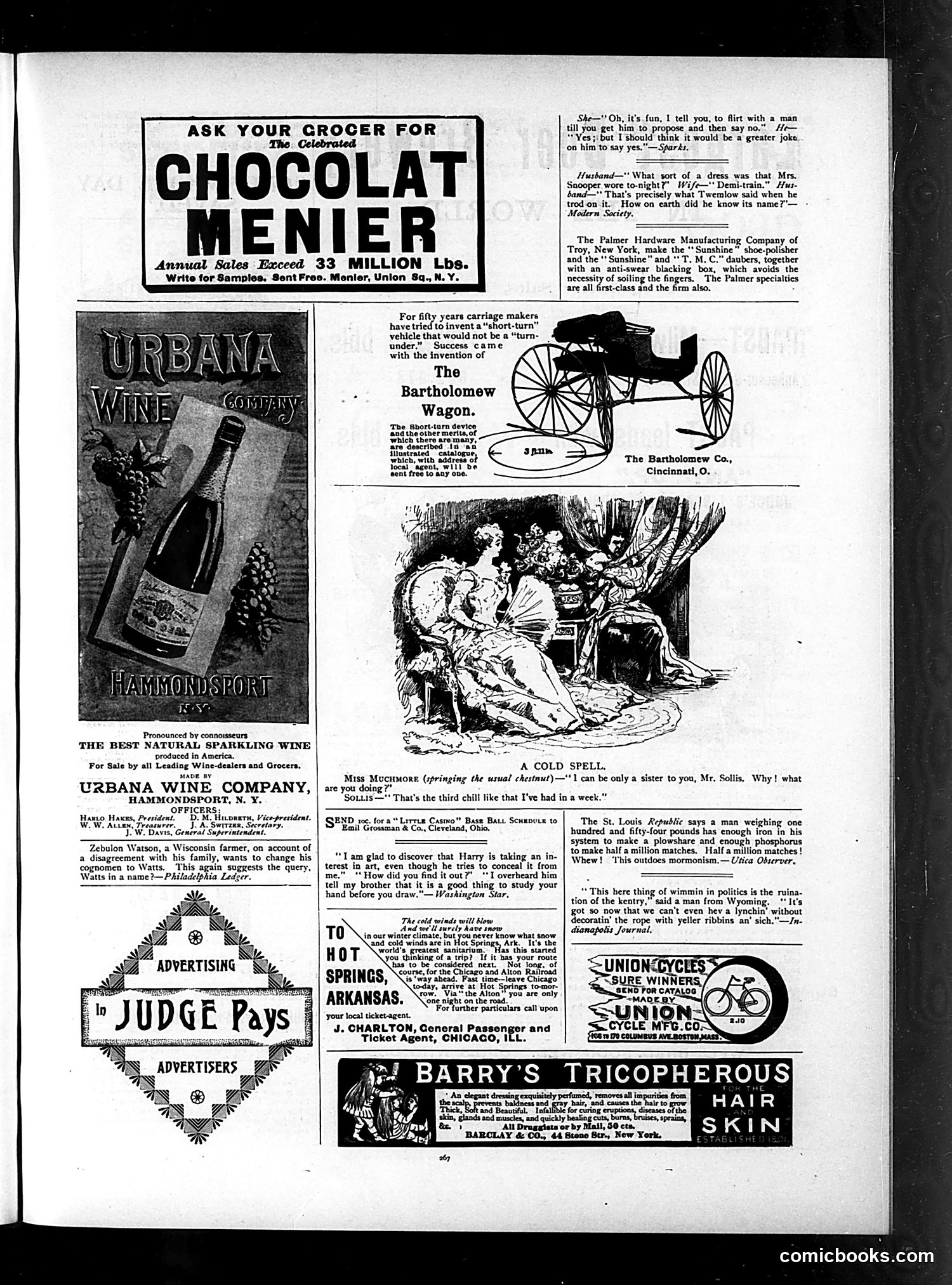
This is primarily an **advertising page** from the satirical magazine *Judge*, featuring multiple product advertisements interspersed with brief humorous anecdotes. The cartoons and jokes are minor and generic: - A dialogue about flirting and proposals - A couple's conversation about a dress style ("demi-train") - A Wisconsin farmer wanting to change his name from Watson to Watts - A woman using the tired pickup line "I can only be a sister to you" (the man responds he's had three chills like that) - A joke about a man studying art by looking at his hand before drawing - A statistical oddity about iron and phosphorus in human bodies The page's **main content is commercial**: promoting Chocolat Menier chocolate, Urbana wine, the Bartholomew wagon, Union cycles, Hot Springs Arkansas tourism, Barry's Tricopherous hair/skin products, and a baseball schedule. The humor is light, domestic, and apolitical—typical filler content for a magazine page. No significant satire or political commentary appears here; this functions as a monetized advertising vehicle with modest comedic padding.
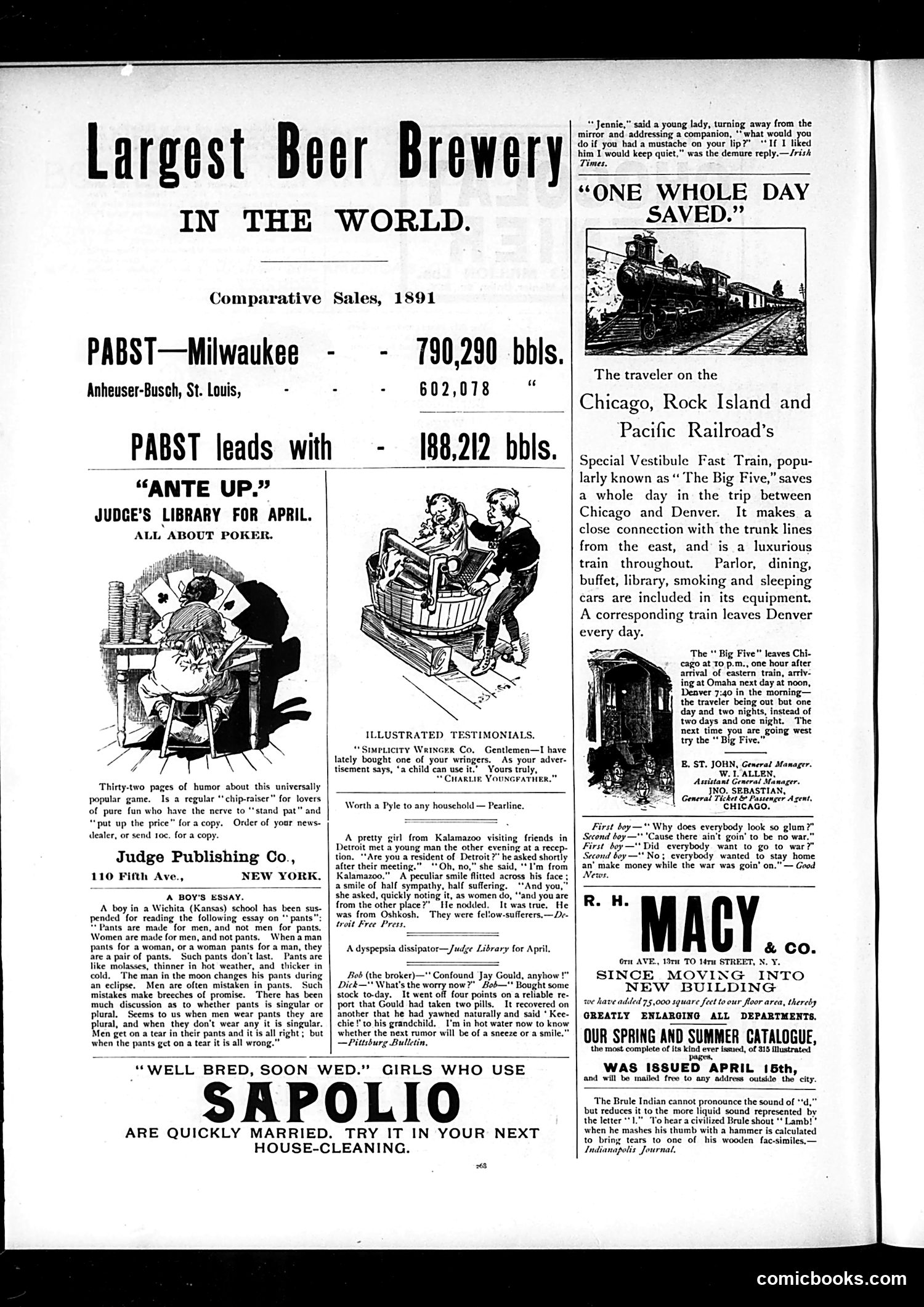
This page is primarily **advertising and humor content** rather than political satire. The main elements include: **Beer Brewery Competition**: The top section compares 1891 sales figures, showing Pabst Milwaukee leading Anheuser-Busch by 188,212 barrels—a straightforward commercial comparison presented as news. **Humor Sections**: Multiple brief comedic pieces mock everyday situations—a boy's absurdist essay on "pants," a girl from Kalamazoo meeting an "Oshkosh" man (implying both cities are undesirable), and a broker's anxiety over stock prices tied to Jay Gould rumors. These rely on period stereotypes and puns rather than political messaging. **Advertisements**: Sapolio cleaning product, Macy's, and the Chicago, Rock Island and Pacific Railroad's "Big Five" train dominate the lower half, each with their own brief marketing copy. The page reflects **Judge's mix of satirical commentary on social conventions with commercial advertising**—typical of 1890s satirical magazines that relied on ad revenue while entertaining readers with light social mockery.
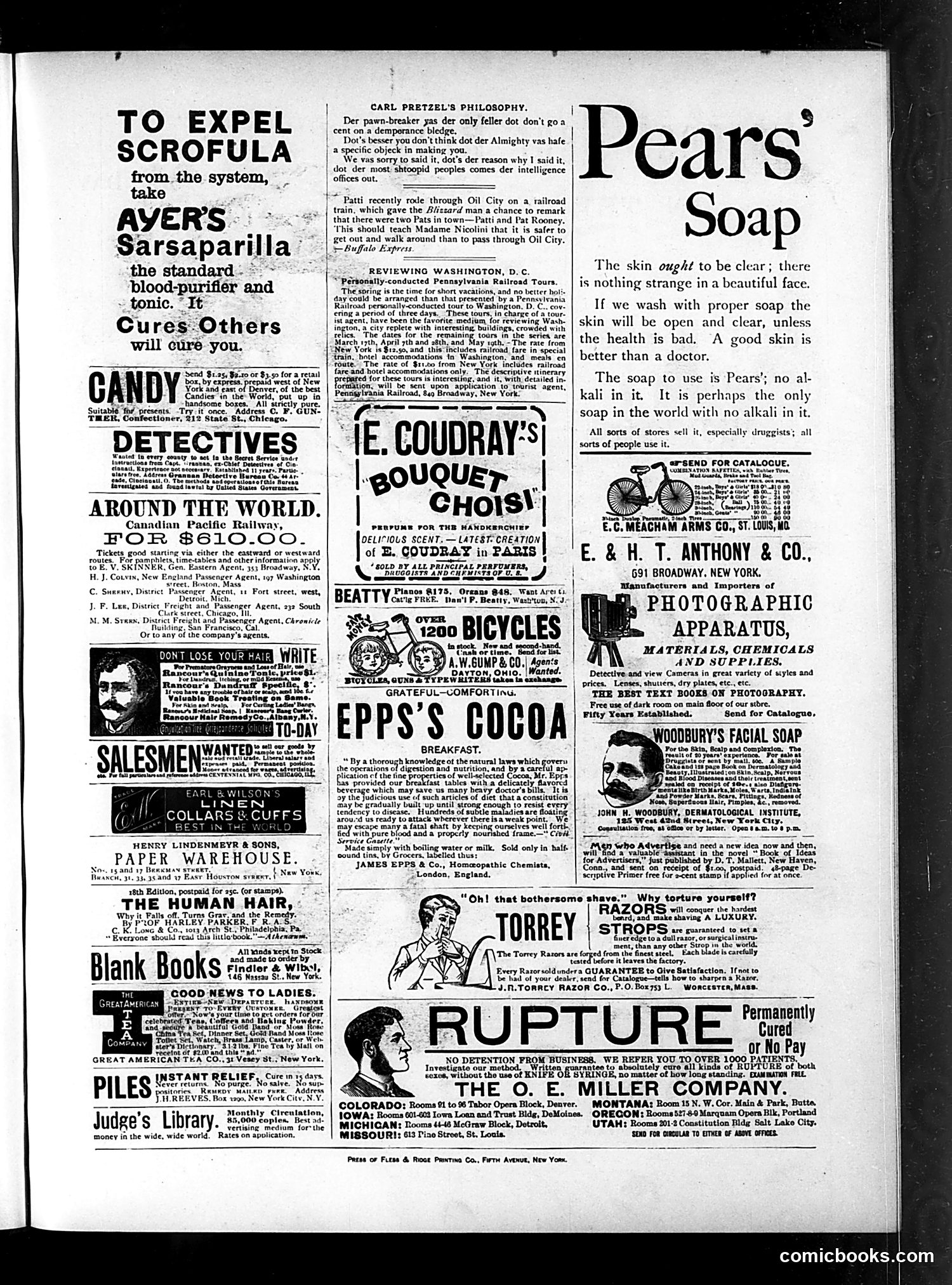
This is primarily an **advertising page** from Judge magazine, with one notable satirical element. The main content consists of period product advertisements: Ayer's Sarsaparilla (blood purifier), candy, rail tours, paper warehouses, hair treatments, and remedies for piles and other ailments—typical late 19th-century patent medicine and commercial ads. The **satirical element** is "Carl Pretzel's Philosophy"—ethnic dialect humor featuring a German-accented character offering folk wisdom. The jokes mock immigrant speech patterns while presenting sardonic observations (the pawnbroker doesn't respect temperance pledges; intelligent people don't come from employment agencies). This represents Judge's typical use of ethnic caricature for humor—acceptable to contemporary readers but offensive by modern standards. The page reflects Judge's business model: satirical content supported by lucrative advertising from dubious medical products and services that would later be regulated or banned.
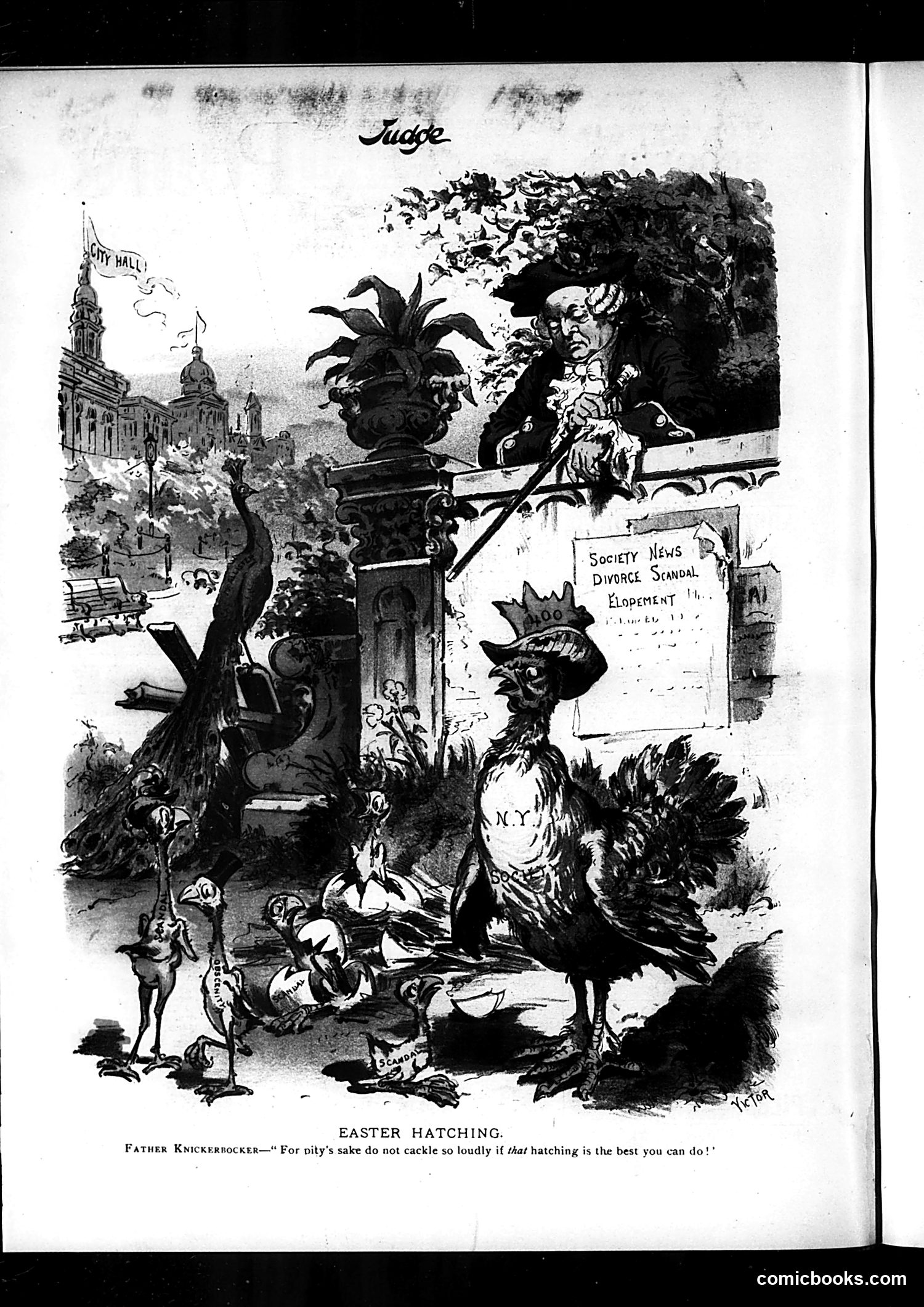
This Judge cartoon satirizes New York City gossip culture through animal symbolism. Father Knickerbocker (personified New York, identifiable by the Dutch colonial reference) scolds a large hen for loudly "cackling" about scandal—specifically society divorce scandals and elopements, visible on the posted notice. The hen represents the city's gossipy newspaper/media culture that sensationalizes high-society scandals. The eggs and chicks symbolize the "hatching" or spreading of rumors and scandalous stories. Father Knickerbocker's complaint suggests this scandal-mongering, while perhaps entertaining, damages the city's reputation. The cartoon mocks both the society scandals themselves and the media's enthusiastic coverage of them—criticizing how New York newspapers "cackle" loudly about divorces and elopements for public consumption.