
A complete issue · 16 pages · 1892
Judge — April 2, 1892
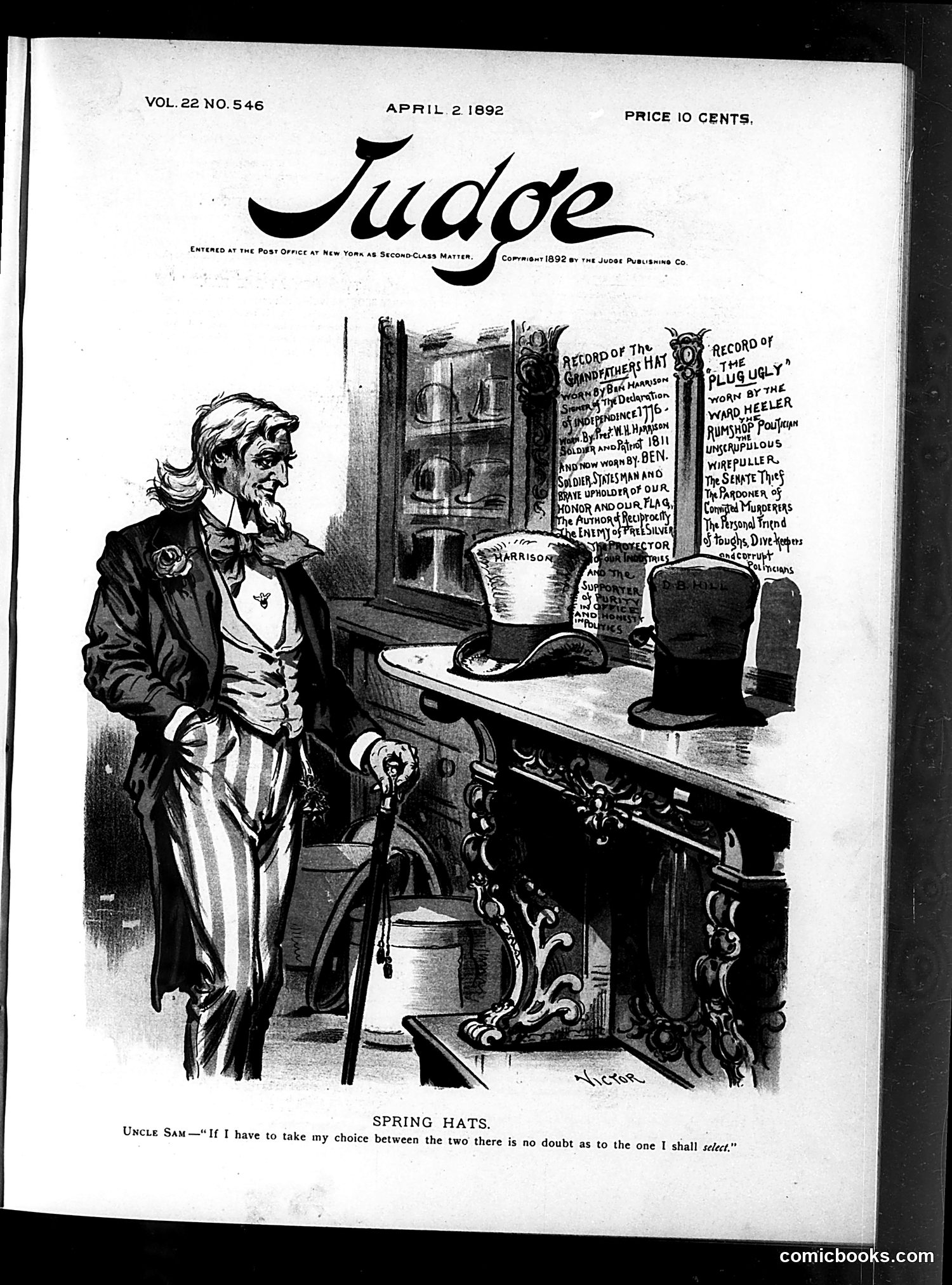
This cartoon depicts **Uncle Sam** (the bearded figure in patriotic dress) in a hat shop, facing a choice between two spring hats displayed on the counter. The text placard behind lists various "records" of political achievements and scandals, appearing to reference competing political platforms or candidates. The joke concerns Uncle Sam's difficulty choosing between two political options—likely the 1892 presidential election platforms. The "spring hats" serve as metaphor for the competing political choices available to voters. The satirical point targets the complexity or undesirability of both options before him, suggesting neither choice is clearly preferable. This reflects Judge magazine's skeptical, humorous approach to contemporary American politics and the election season.
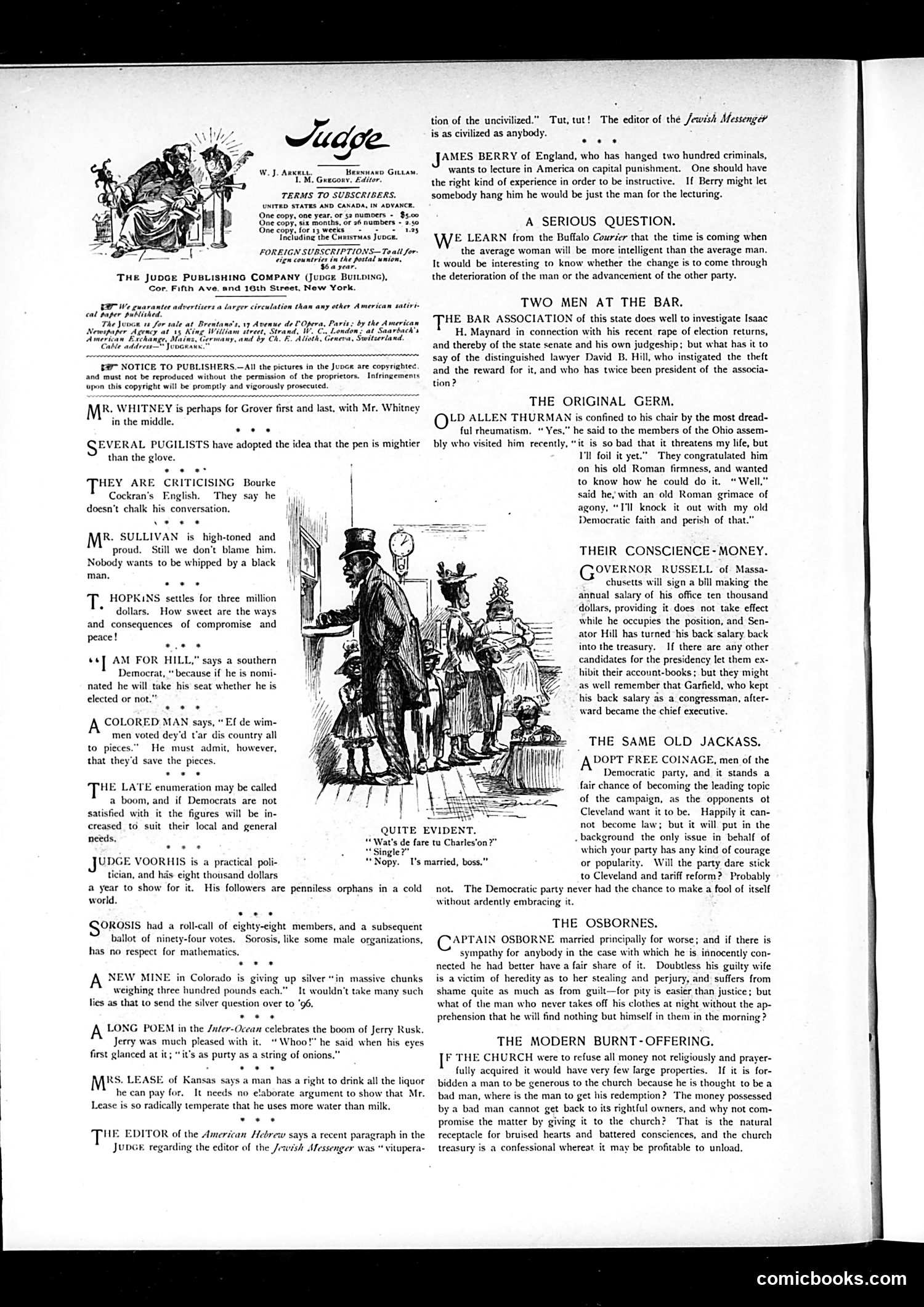
The main cartoon titled "QUITE EVIDENT" depicts a street scene where a man in a top hat (appearing to be a politician or wealthy figure) stands with a woman and child. The caption reads: "Wat's de fare to Charles'on?" / "Single" / "Married, boss?" / "Married, boss." This appears to be satirizing political hypocrisy regarding family values or marital status among public figures. The joke likely comments on how politicians present themselves differently in public versus private life, or how wealth/position allows selective morality. The surrounding text snippets mock various political figures and their contradictions—Governor Russell's salary conscience, discussions of coinage policy, and critiques of party leadership. The overall theme targets political inconsistency and corruption during this era (appears to be early 1900s based on style).
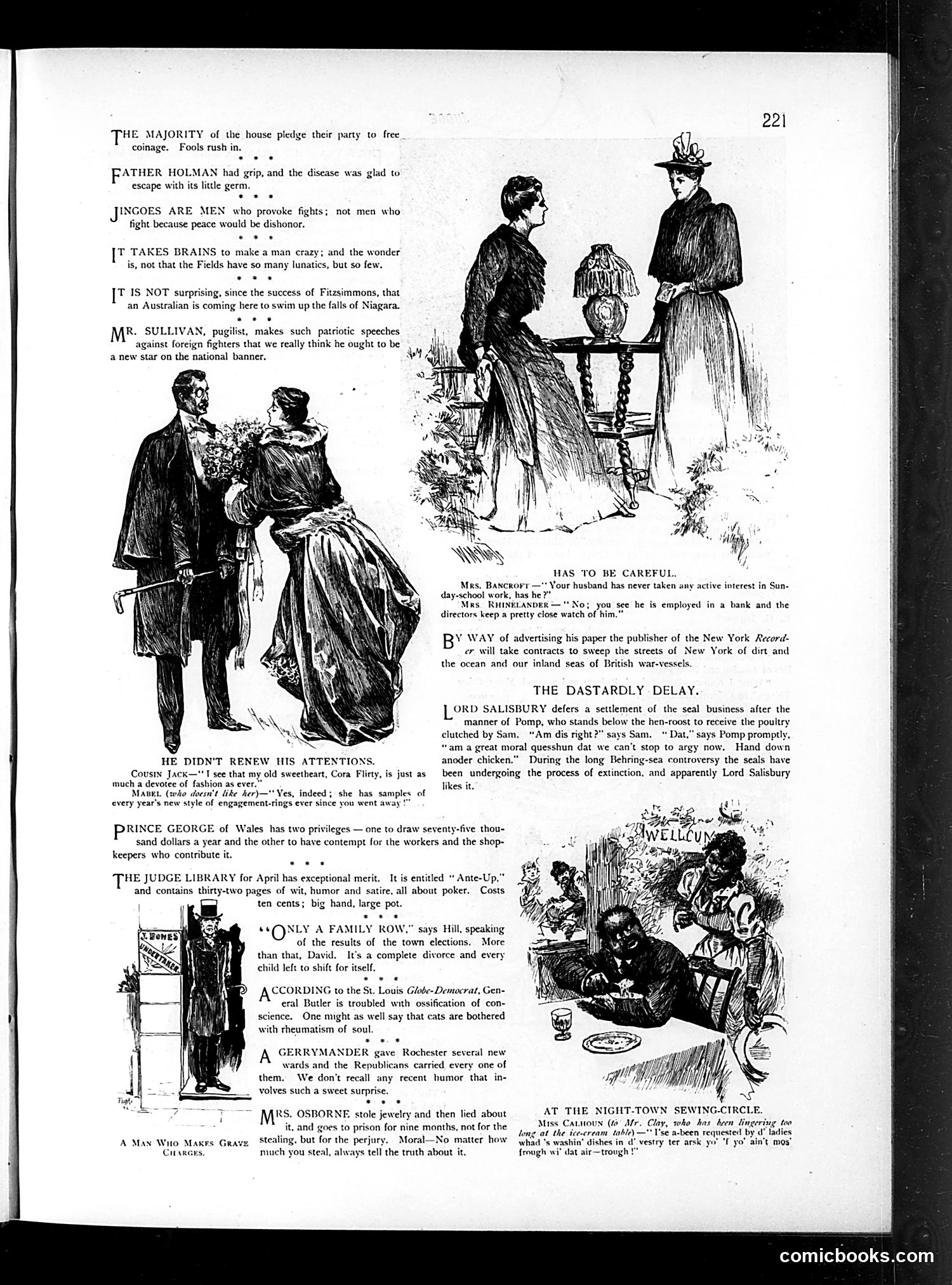
This page contains several brief satirical items and illustrations typical of Judge's format. The visible cartoon "Has to Be Careful" depicts a conversation between a man and woman about her husband's employment at a bank, with the joke apparently concerning marital supervision. "The Dastardly Delay" section mocks Lord Salisbury regarding seal business controversies, playing on his government's handling of maritime/colonial affairs. Other items reference Prince George of Wales's financial privileges, a judge library book about poker, town election results, and General Butler's political troubles. The bottom illustration "At the Night-Town Sewing Circle" shows women gossiping, a common Judge stereotype. The satire targets politicians, social pretensions, and contemporary scandals, though specific individuals and events are unclear without additional historical context.
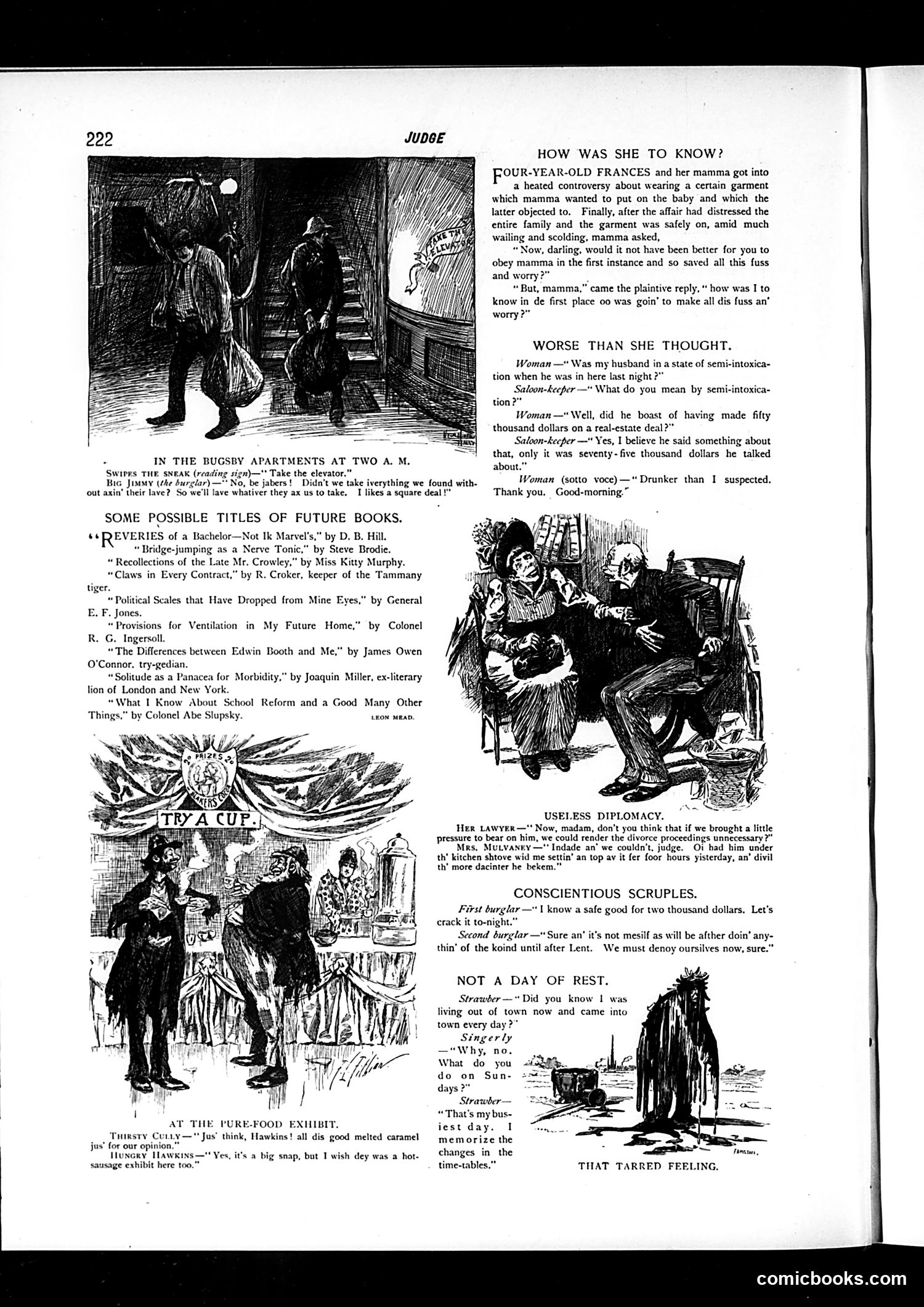
This page contains several humorous vignettes satirizing late-19th-century American society: **"In the Bugsby Apartments"**: Two burglars discuss their "code"—they won't steal without asking permission first, treating theft as a business transaction. The satire mocks criminal honor codes. **Book Titles Section**: Parodies real authors and contemporary scandals. "Claws in Every Contract" references Boss Tweed's Tammany Hall corruption machine (the "tiger"). Other entries mock spiritualists, atheists, and failed authors by suggesting absurd memoirs. **Pure Food Exhibit**: Visitors joke about free caramel samples, satirizing both consumer gullibility and the pure food safety movement's growing public awareness. **"How Was She to Know?"**: A child's logic defeats maternal authority—light satire on parent-child conflicts. **Other items**: Brief jokes mocking drunkenness, divorce proceedings, religious hypocrisy (burglars avoiding sin during Lent), and commuting inconveniences. The page represents Judge's typical format: short, punchy social satire targeting corruption, pretension, and human foibles through exaggerated characters and situations.
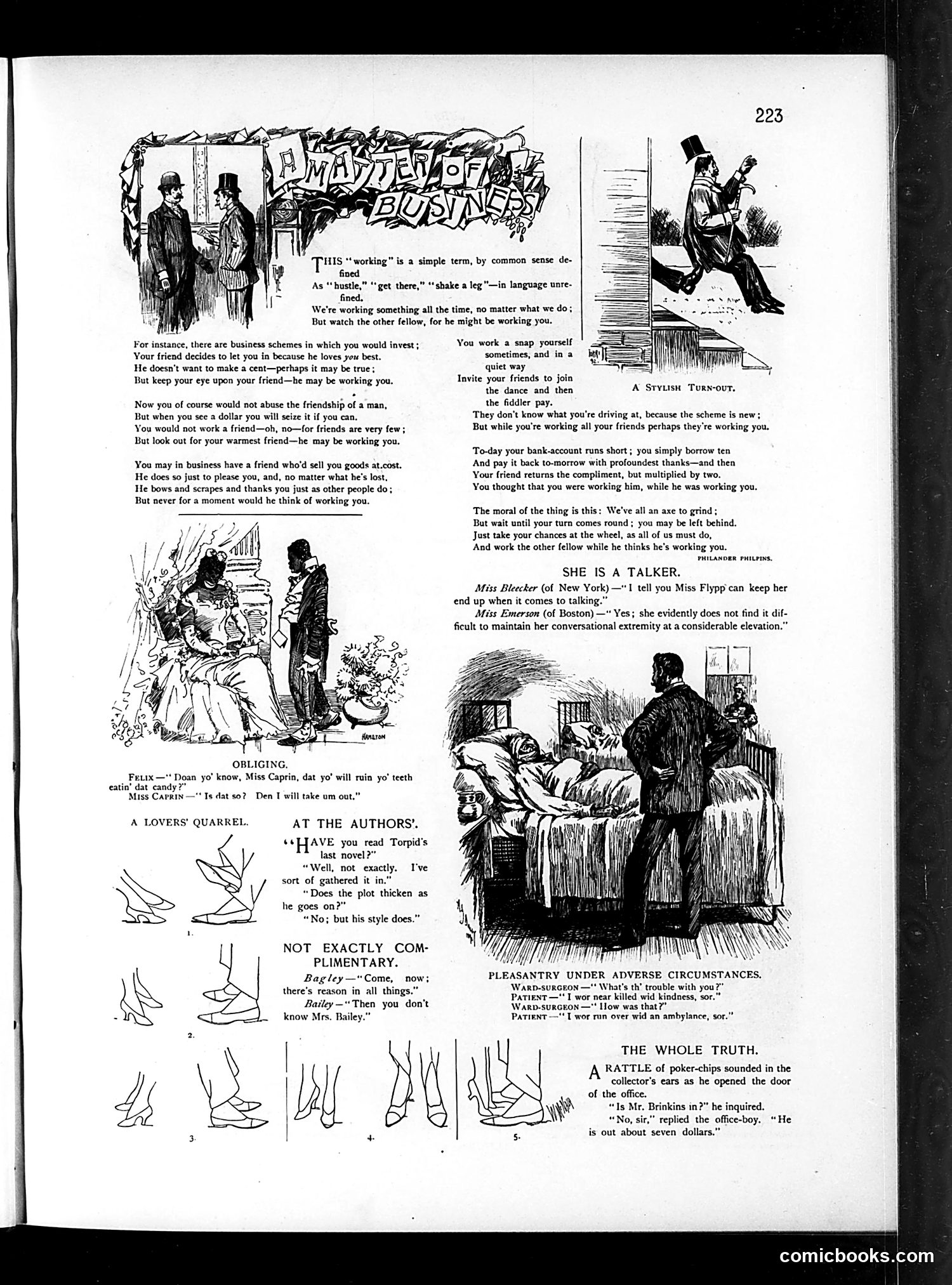
This page satirizes late 19th/early 20th-century American business culture and social hypocrisy. The lead article, "Matters of Business," mocks the prevalence of schemes and con artists in commercial dealings—the central joke being that everyone claims friendship while simultaneously "working" (exploiting) everyone else for profit. The poem warns readers that even trusted friends may be swindling them while appearing generous. The smaller humorous anecdotes mock affectation and pretense: a Boston woman using overly formal language to call someone talkative; characters praising an author's style while admitting they haven't read his work; someone getting run over by an ambulance described as "kindness"; an office boy's explanation that his boss is "out about seven dollars" (implying he's lost that sum). The cartoons and illustrations throughout emphasize the gap between stated intentions and actual behavior—a characteristic concern of Gilded Age satire.
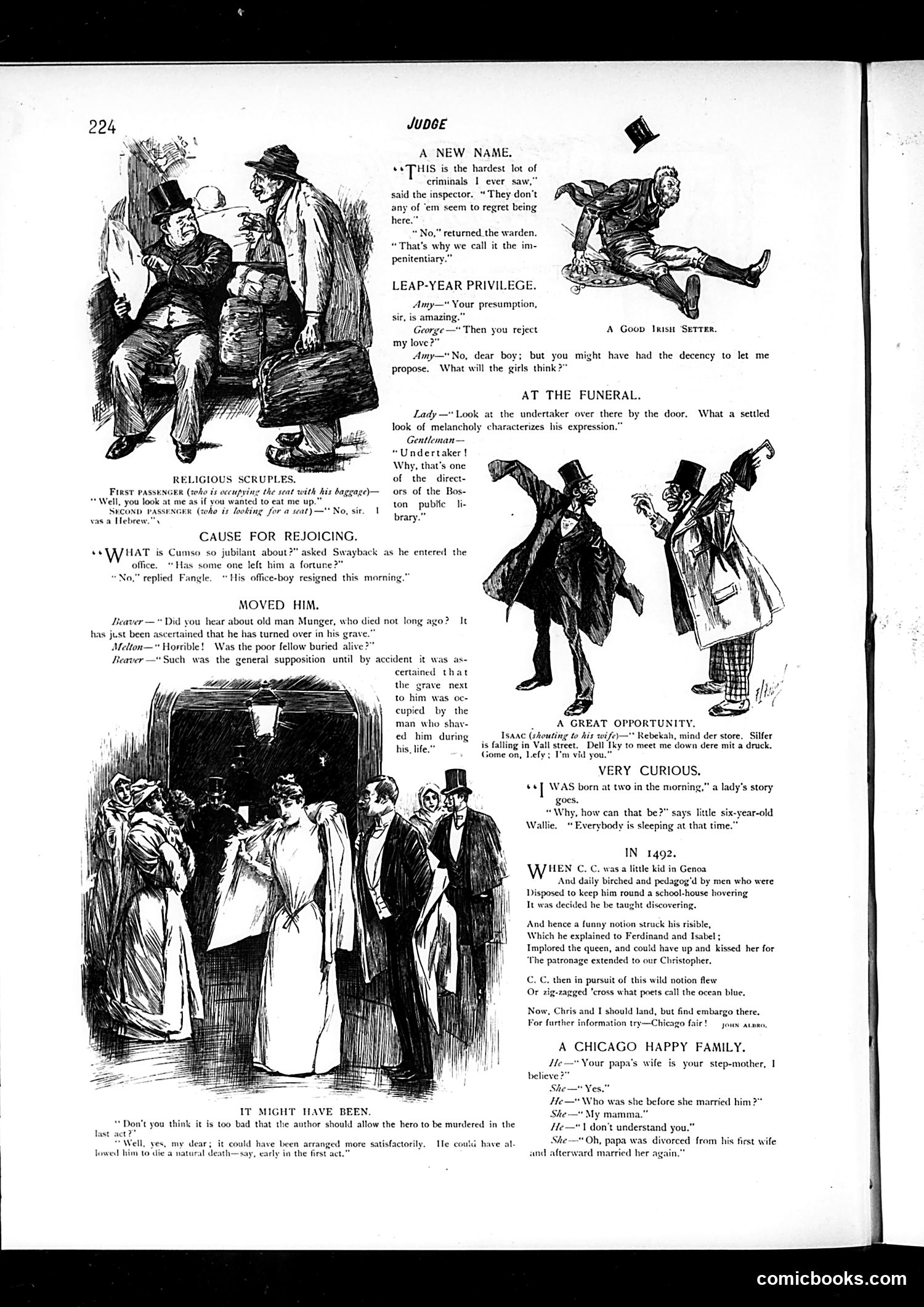
This page contains multiple brief satirical items typical of Judge's humor circa the 1890s-1900s: **"A New Name"** jokes about criminals in the penitentiary showing no remorse—the warden explains they're called "the impenetiary" (a pun on "impenitent"). **"Leap-Year Privilege"** plays on the tradition that women could propose to men during leap years. A woman (Amy) rejects her suitor George, who protests she could have shown "decency" by letting him propose first. **"At the Funeral"** depicts an undertaker—one of the directors of the Boston Public Library—suggesting intellectual pretension among funeral workers. **"In 1492"** offers a humorous alternate history where Columbus's patronage relates to a contemporary "Chicago fair" (likely the 1893 World's Columbian Exposition). The **funeral scene illustration** shows Victorian-era mourners in formal dress gathered around a casket. Most jokes rely on wordplay, social observation about class and propriety, and contemporary references now obscure to modern readers. The page is primarily humor content, not political commentary.
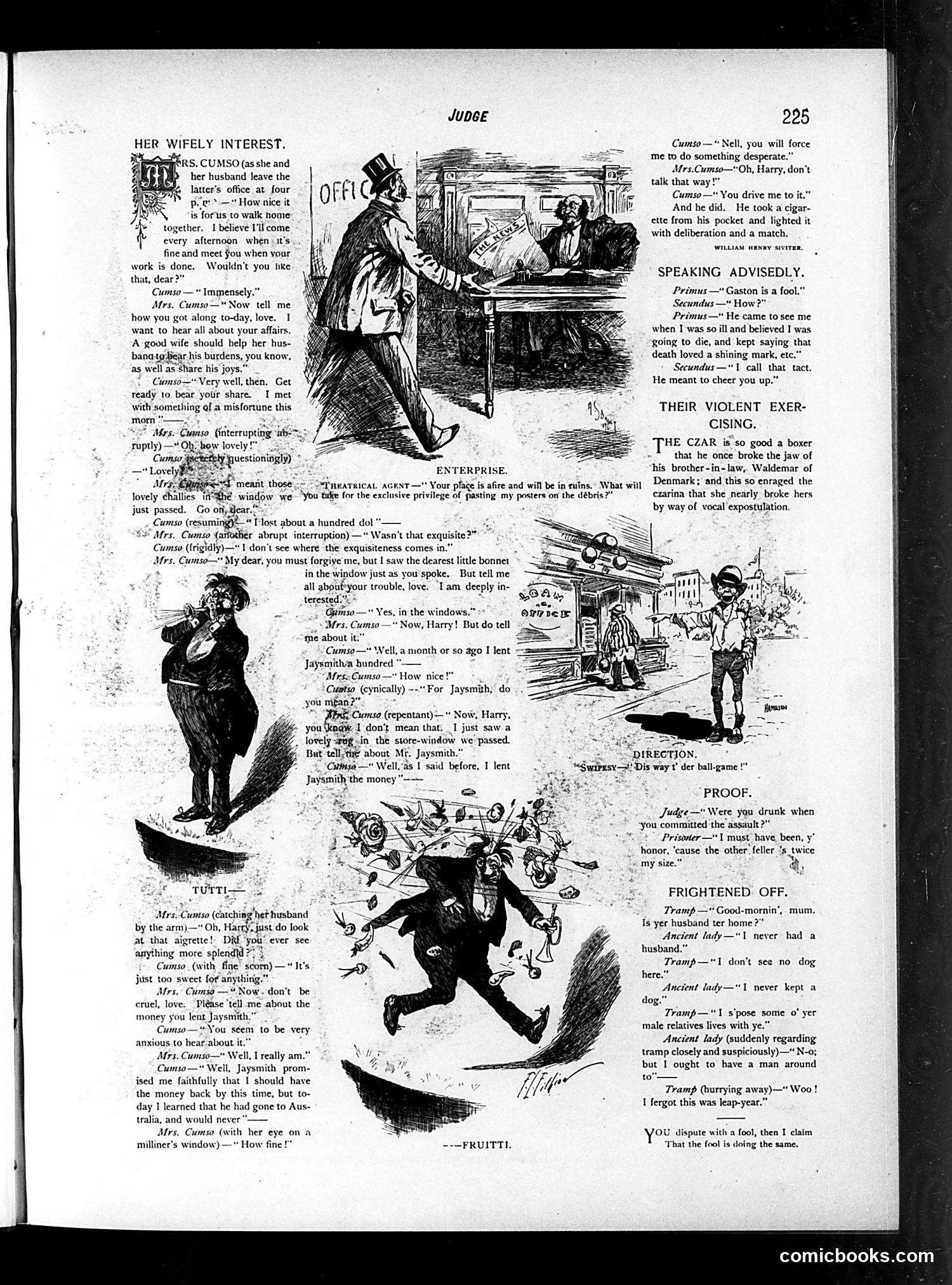
This page contains multiple satirical cartoons typical of late 19th/early 20th-century American humor: **"Her Wifely Interest"** depicts a wife who claims to want to share her husband's burdens, then repeatedly interrupts him with trivial observations about shop windows and bonnets. The joke: women's supposed shallow materialism undermines their stated domestic virtue. The punchline—he resorts to smoking a cigarette in desperation—treats her chatter as unbearable. **"Enterprise"** shows a theatrical agent negotiating poster placement on a burning building's ruins—dark humor about capitalist opportunism amid disaster. **"Their Violent Exercising"** references the Russian Czar boxing his brother-in-law so hard he broke his jaw, and the Czarina retaliating. It's gossip-style mockery of European nobility. The page also includes brief joke exchanges ("Speaking Advisedly," "Proof") and a "Frightened Off" comic about a tramp who flees when an elderly woman suggests she needs male company—playing on period anxieties about unmarried women living alone. The humor relies on gender stereotypes, class mockery, and scandal-mongering about foreign rulers.
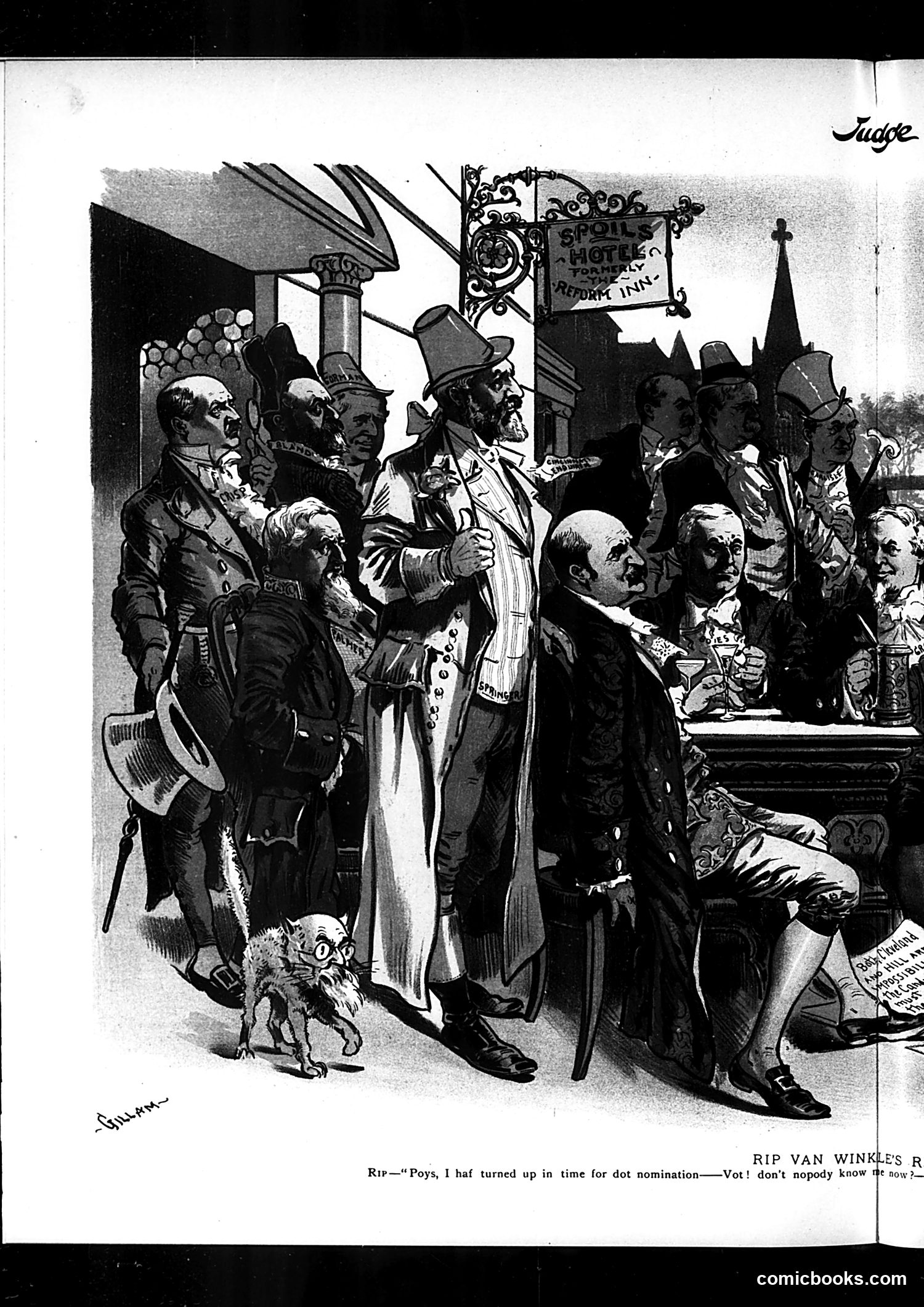
This appears to be a satirical cartoon titled "Rip Van Winkle's R[eturn]," referencing the famous Washington Irving story about a man who slept for years and awoke confused. The cartoon depicts a military or political figure (center, in white/light coat with top hat) surrounded by officials and aristocrats at what appears to be a formal establishment (the "Reform Inn" sign visible). A small dog is present at the figure's feet. The caption reads: "Poys, I haf turned up in time for dot nomination—Vot! don't nopody know me now?" The satire suggests someone has returned after a long absence, expecting recognition and nomination but finding himself forgotten or irrelevant. The German-accented dialect in the caption adds mockery to the character. Without clearer identification of the specific historical moment or figure, the precise political target remains unclear—though it likely satirizes a returning politician or leader whose relevance has faded.
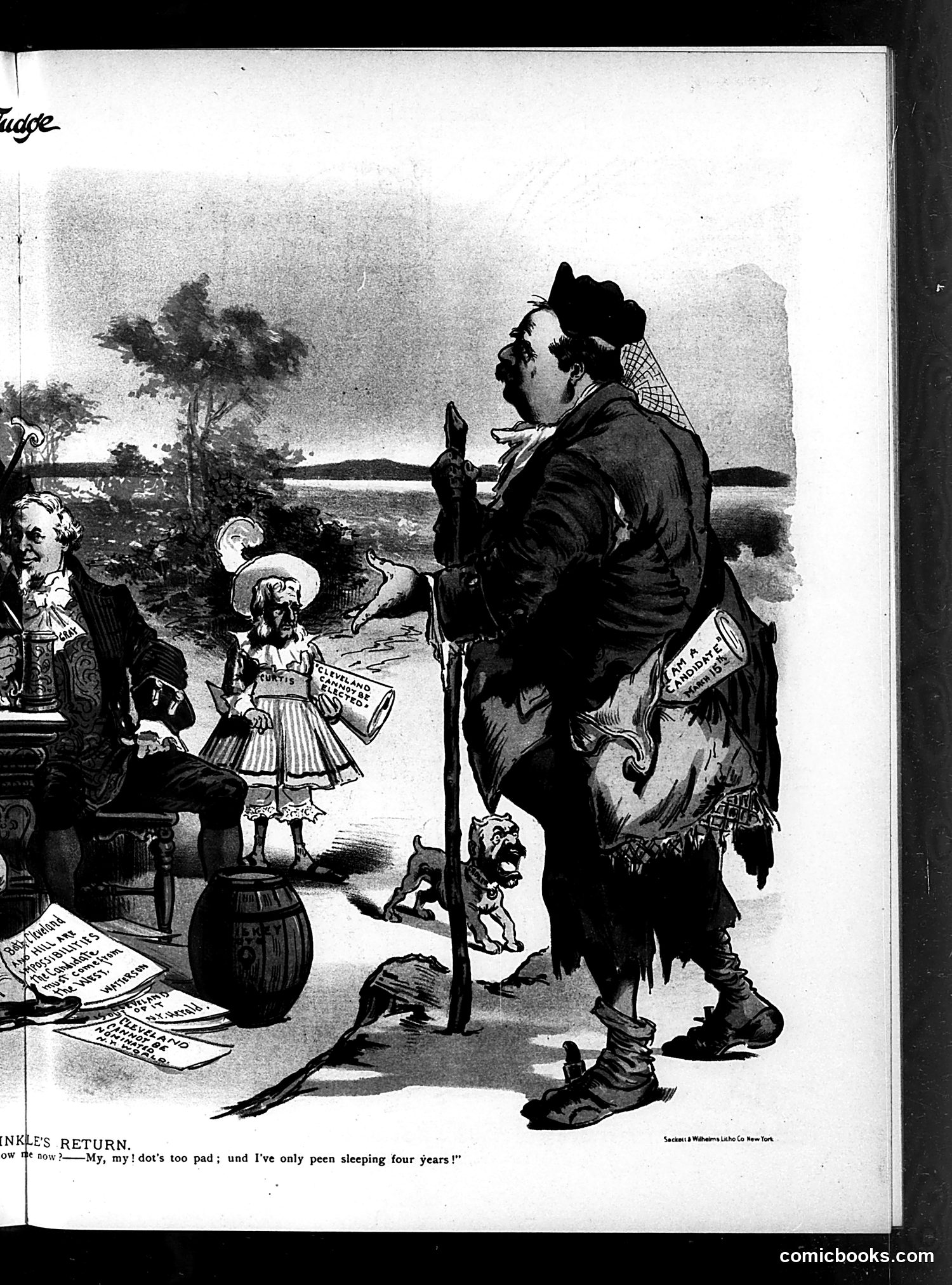
This satirical cartoon depicts a figure (likely representing a political or business leader) returning after a four-year absence, expressing shock at conditions he finds. The exaggerated German accent in the caption ("dot's," "peen") suggests ethnic satire common to Judge magazine. The scene includes caricatured figures in period dress, documents labeled with text (illegible in reproduction), and a landscape background. The composition suggests commentary on someone's surprise upon returning to American political or economic circumstances. Without clearer text visibility or publication date, identifying the specific historical figure and event referenced is difficult. The satire likely concerns either a political comeback or commentary on social/economic changes during the protagonist's absence, but precise context remains unclear from the image alone.
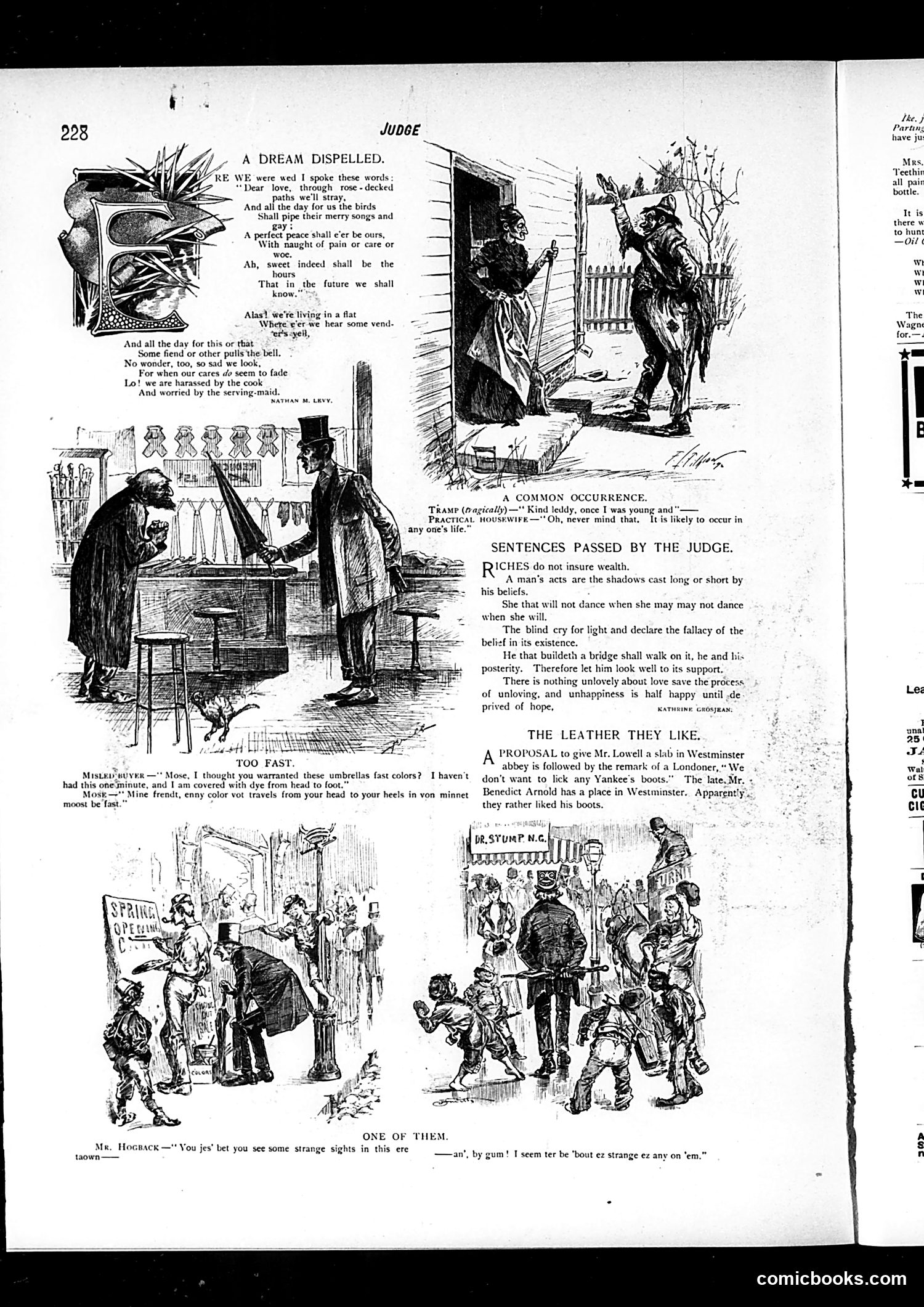
This page contains multiple satirical cartoons and commentary typical of late-19th century American humor: **"A Dream Dispelled"** mocks newlyweds' romantic ideals. The poem describes a husband's fantasy of perfect married life, immediately undercut by reality: street vendors' noise, demanding servants, and household chaos. The satire targets naive expectations about domestic bliss. **"A Common Occurrence"** shows a vagrant making excuses to a practical housewife, who dismissively notes that misfortune is universal—a cynical take on beggary and sympathy. **"Sentences Passed by the Judge"** presents aphoristic wisdom about wealth, behavior, and fate in Judge's characteristic moralizing style. **"The Leather They Like"** references James Russell Lowell's proposed Westminster Abbey burial, with a Londoner's jab that Americans only respect British things. The joke appears unclear from context provided. **"Too Fast"** and **"One of Them"** are dialect-humor sketches involving characters with exaggerated immigrant or lower-class speech patterns—common comedic fodder of the era, though cringe by modern standards.
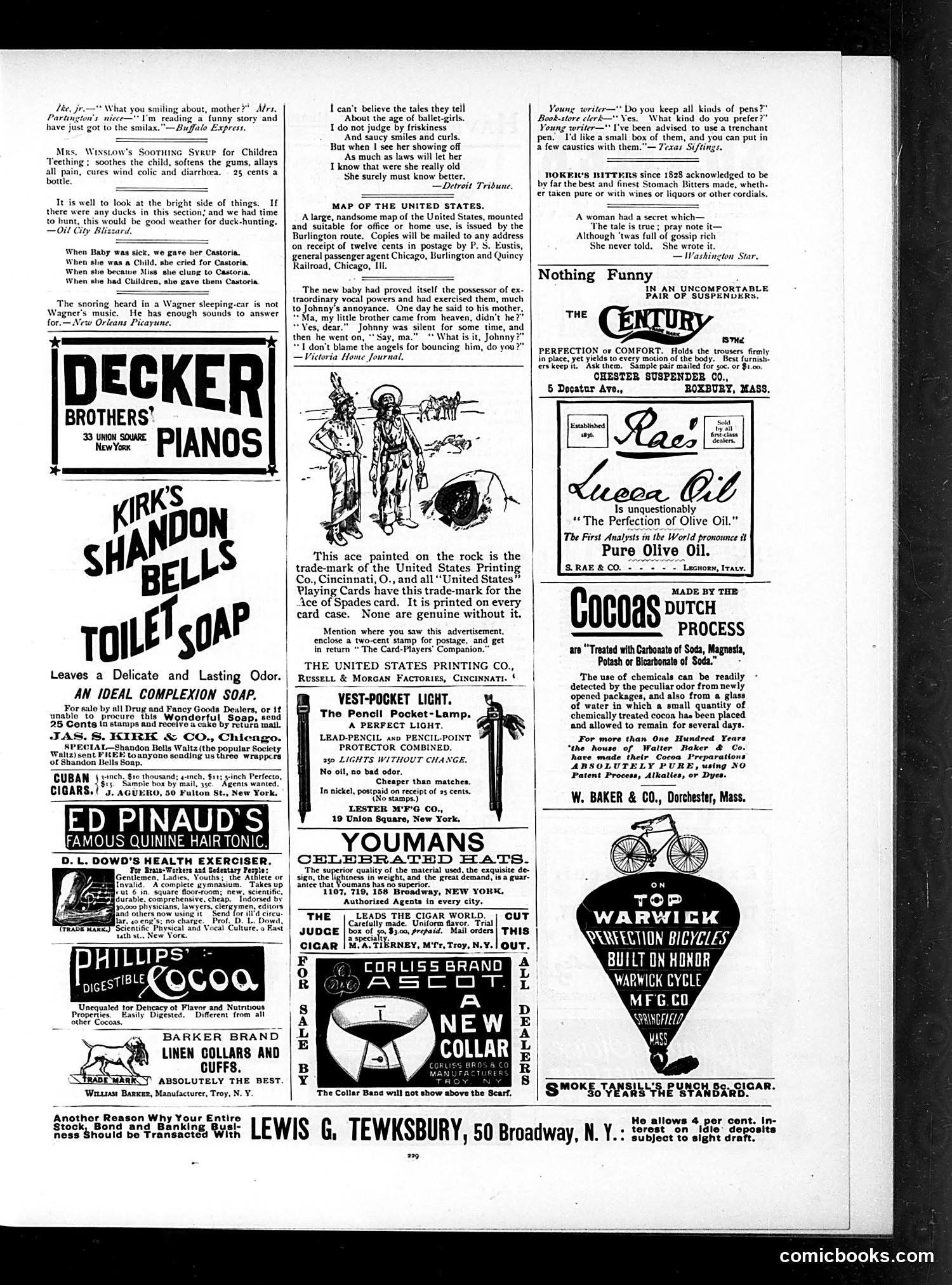
This page is primarily **advertising**, with brief comic snippets interspersed. The notable content includes: **Cartoons/Humor:** - A joke about a woman reading "smilax" (a plant)—a pun on amusement - A quip mocking Wagner's music as inferior to train noises - A joke about a mother explaining babies come from heaven, with a boy jokingly asking if angels "bounced" his annoying baby brother out—absurdist humor about infant behavior **Advertisements:** The page features numerous period products: Decker pianos, Kirk's Shandon Bells soap, Castoria (a baby remedy), quinine hair tonic, cocoa products, collars, and early novelty items like a "vest-pocket light" (flashlight precursor). **Historical Context:** This reflects late 19th-century consumer culture, when *Judge* magazine mixed satirical commentary with commercial advertising. The humor is domestic and mildly sarcastic rather than overtly political on this particular page.
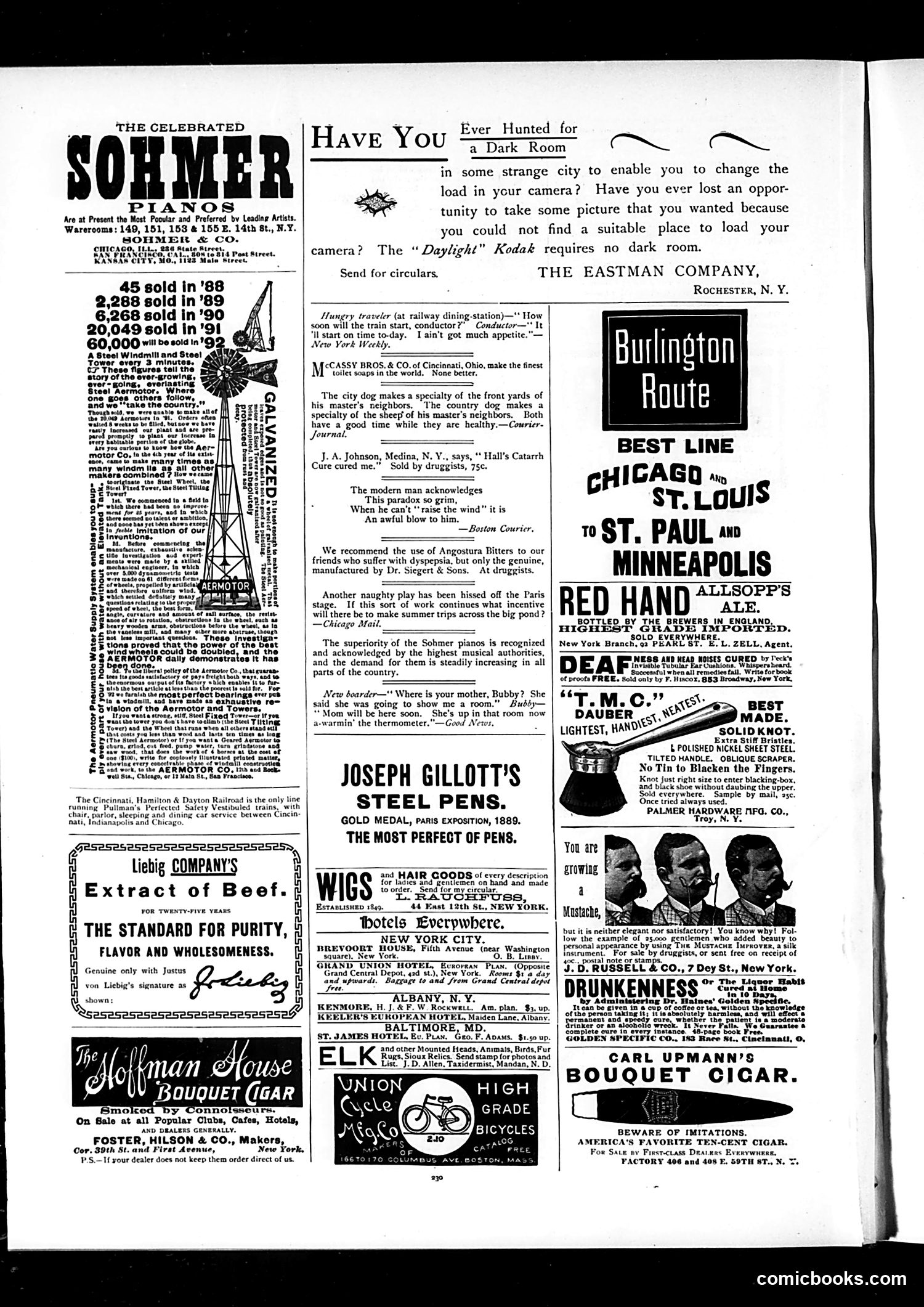
This page is primarily a collection of late-19th-century advertisements (appears to be from Judge magazine), not political or social satire cartoons. The visible content includes ads for: - Sohmer pianos (emphasizing sales growth) - Steel windmills/Aermotor machines - Extract of Beef by Liebig Company - The Hoffman House Bouquet Cigar - Kodak cameras (promoting their "no dark room needed" advantage) - Various hotels and commercial products The few humorous anecdotes scattered throughout are brief jokes rather than cartoons—including a traveler impatient at a railway station and a child exaggerating about warming a thermometer. There are no identified political figures, caricatures, or satirical commentary visible. This appears to be a standard advertising-heavy page typical of Judge's format during this period, with small filler humor scattered between commercial announcements.
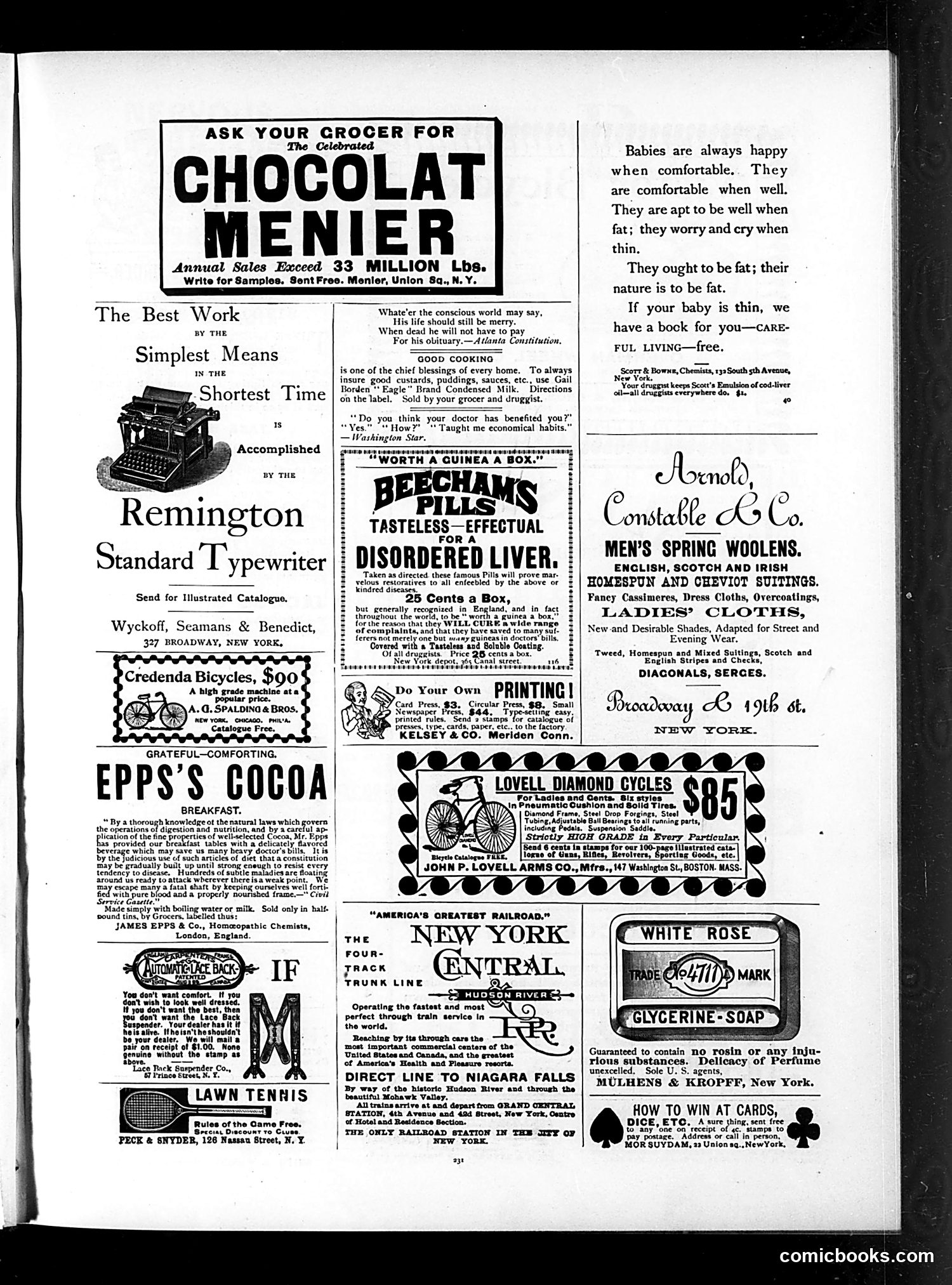
This is primarily an **advertising page**, not a satirical cartoon. It contains various commercial advertisements typical of an early 20th-century magazine, including: **Notable ads:** - Chocolat Menier (chocolate) - Remington typewriters - Beecham's Pills (liver remedy) - Epps's Cocoa - New York Central Railroad - Various clothing and bicycle ads **The only potential humor** appears in brief text snippets between ads—particularly a Washington Star joke about a doctor teaching "economical habits" and an Atlanta Constitution quip about obituaries. These are mild, generic humor fillers rather than political satire. **For modern readers:** This reflects advertising's dominance in Judge magazine and the era's casual medical claims (Beecham's Pills, tonics promising cures). The page demonstrates how magazines monetized content through dense advertising, which subsidized production costs.
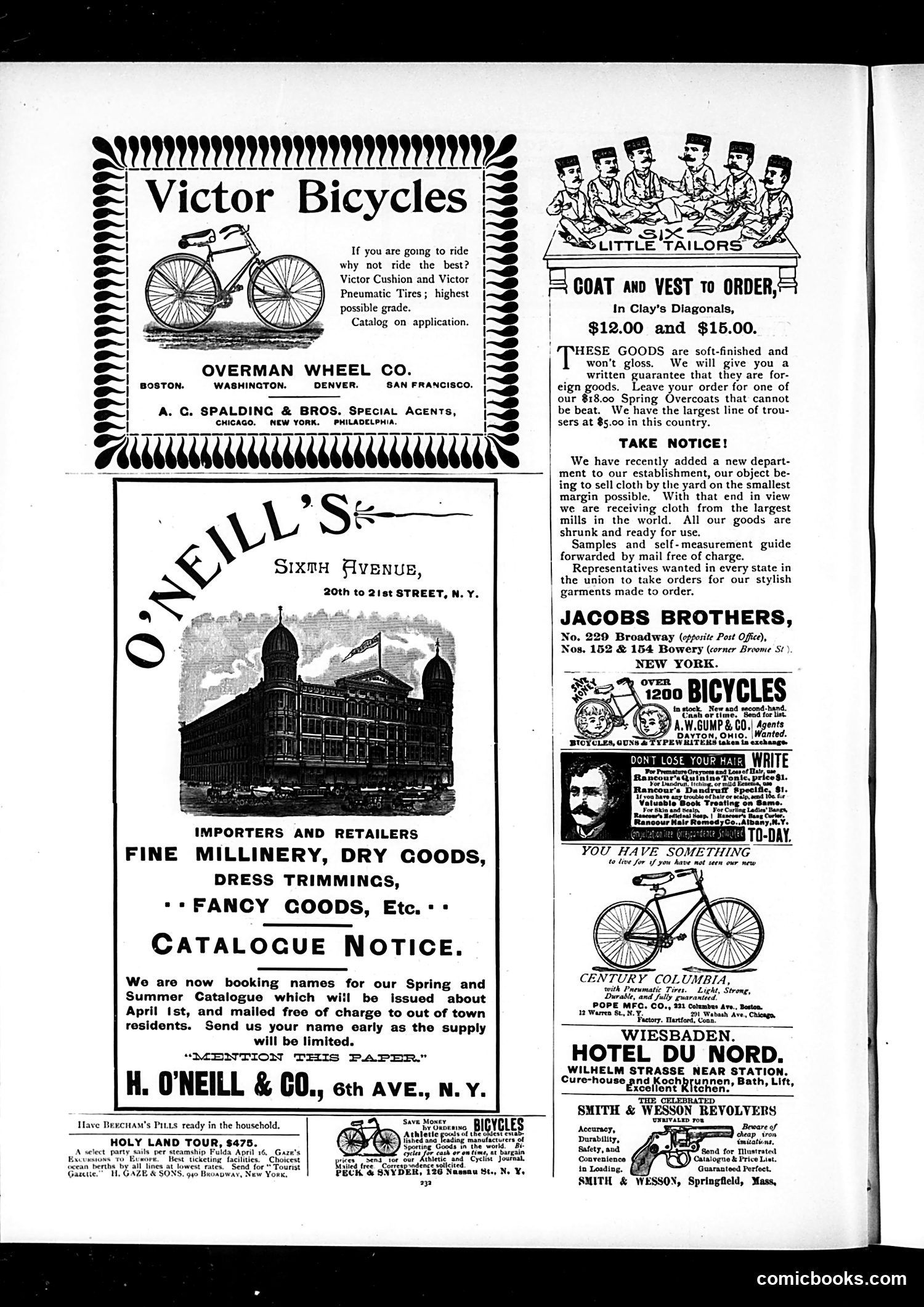
This page is primarily **advertising**, not satirical cartoons. It contains commercial notices from the 1890s era, dominated by product advertisements rather than political commentary. The ads showcase period consumer goods: Victor bicycles, fine millinery and dry goods from O'Neill's, tailored clothing (goat and vest), bicycles from various manufacturers, Smith & Wesson revolvers, and a European hotel. There's also a Holy Land tour offering. One small notice references "Beecham's Pills" and mentions a product's household use, but this is straightforward marketing rather than satire. **No political cartoons or satirical commentary appear on this page.** It represents typical Judge magazine monetization through advertising rather than editorial content. The "Little Tailors" illustration at top right is decorative branding for a clothing advertiser, not social satire.
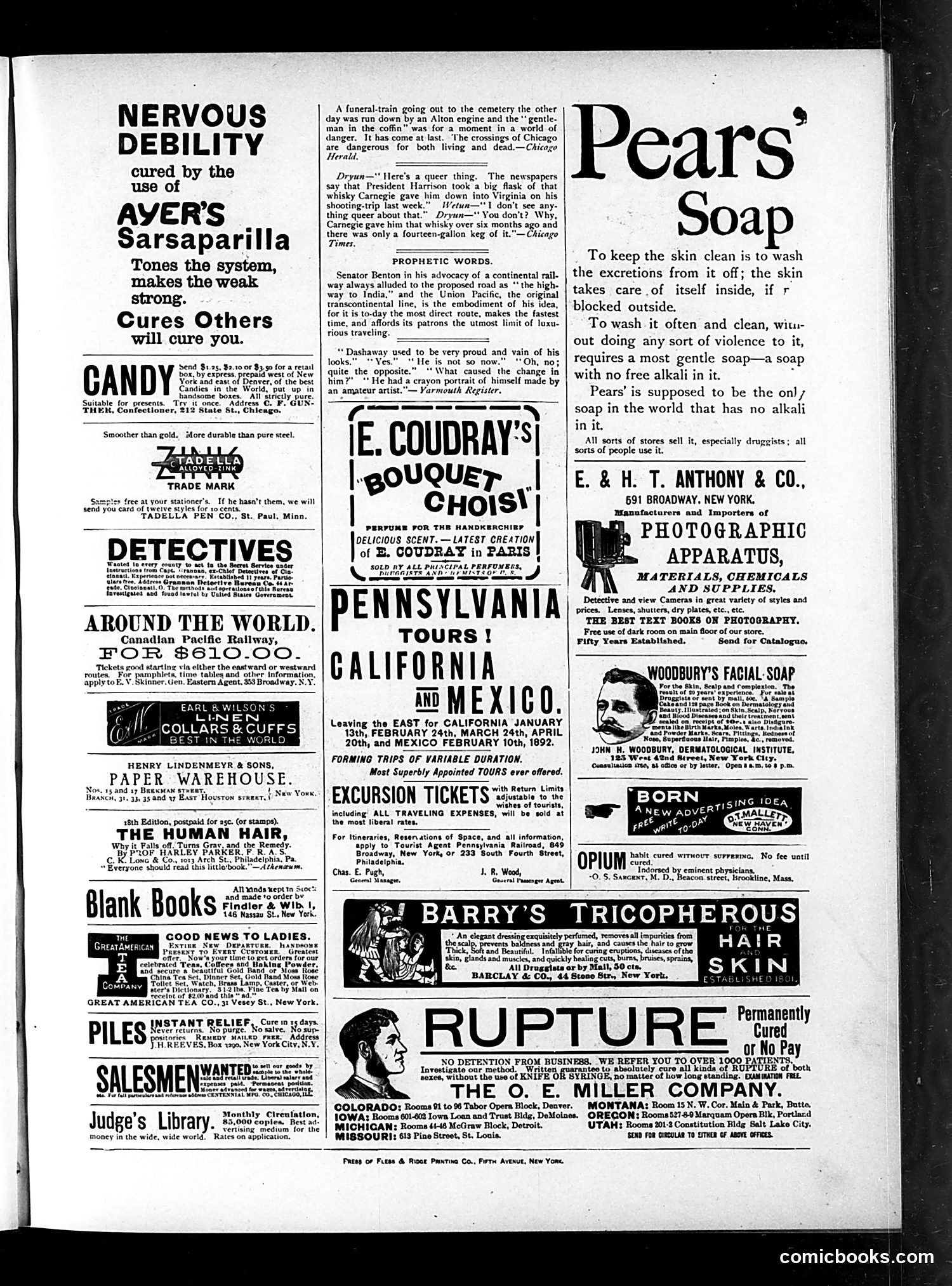
This page is primarily **advertising**, typical of late 19th-century magazines. However, it includes brief satirical items: **"Prophetic Words"** jokes about President Harrison and Andrew Carnegie. The humor references Harrison accepting a whisky gift from industrialist Carnegie during a hunting trip months earlier, then still having it—suggesting either the gift was absurdly large or Harrison was stingy enough to preserve it unusually long. **The "Crayon Portrait" joke** mocks amateur portrait painters: a vain man named Dashaway stopped caring about his appearance after having a portrait done, implying the artist's poor work destroyed his vanity. **The railroad anecdote** darkly jokes that Chicago's dangerous railroad crossings now endanger "both living and dead"—a coffin's funeral train was struck by an Alton engine. These brief items exemplify *Judge*'s humor: topical references to public figures, social commentary on amateur artists and dangerous industrialization, and morbid wit. The bulk of the page, however, consists of patent medicines, soap, and travel advertisements typical of the era.
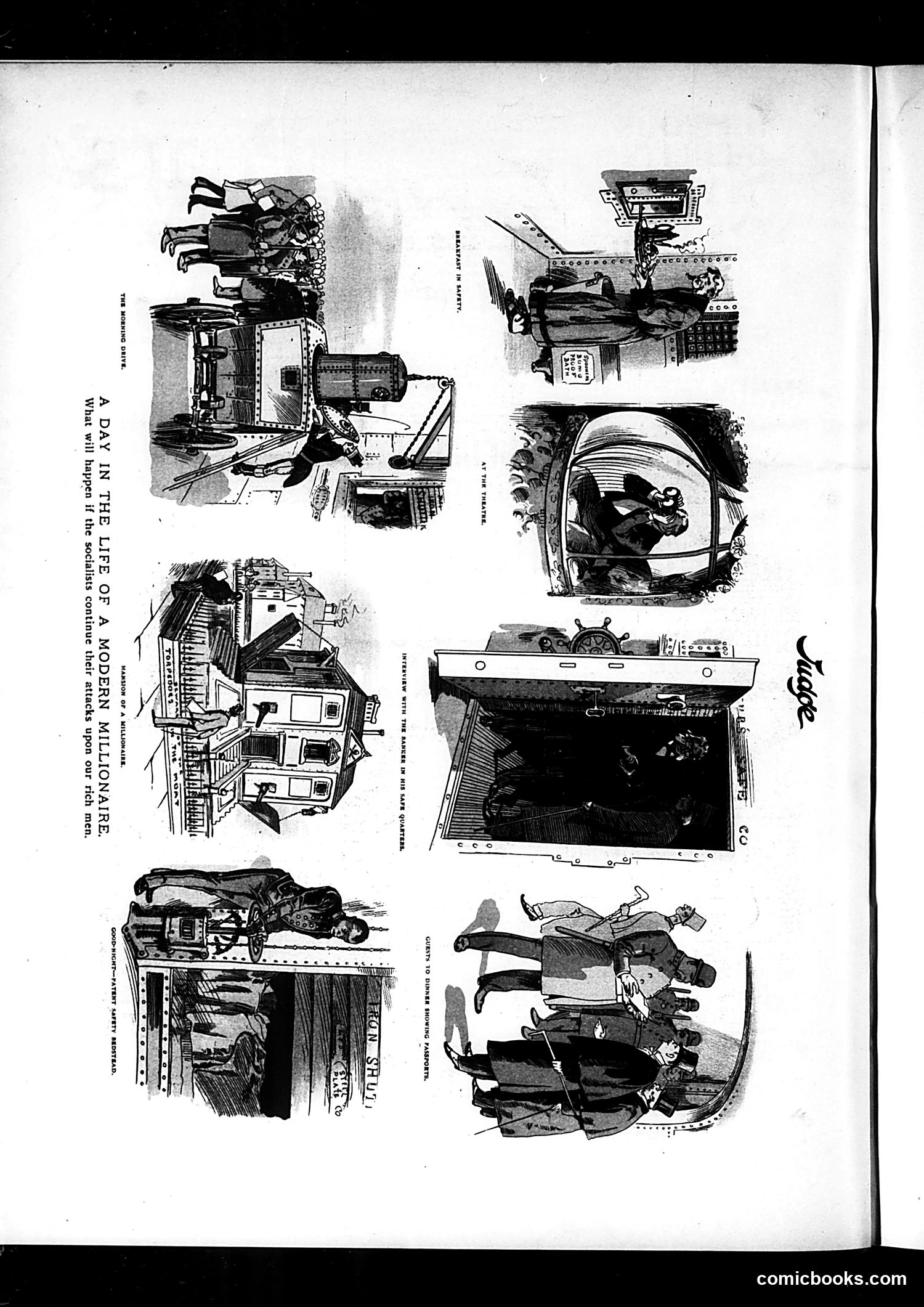
This satirical page mocks wealthy industrialists by depicting the elaborate security measures a millionaire must employ to survive "socialist attacks." The cartoon shows various scenes: heavily fortified breakfast arrangements, an armored morning commute, mansion defenses, and what appears to be armed guards protecting the wealthy man throughout his day. The satire targets both socialists advocating wealth redistribution AND the extreme paranoia of the rich. The caption's warning—"What will happen if the socialists continue their attacks"—is tongue-in-cheek; Judge presents this dystopian security state as a ridiculous exaggeration of fears about labor unrest and anti-capitalist sentiment. The joke suggests wealthy industrialists are both anxious about socialist movements AND deserve such scrutiny, commentary typical of Judge's mixed political stance during the Progressive Era.