
Judge, 1892-04-02 · page 5 of 16
Judge — April 2, 1892 — page 5: what you’re looking at
What you’re looking at
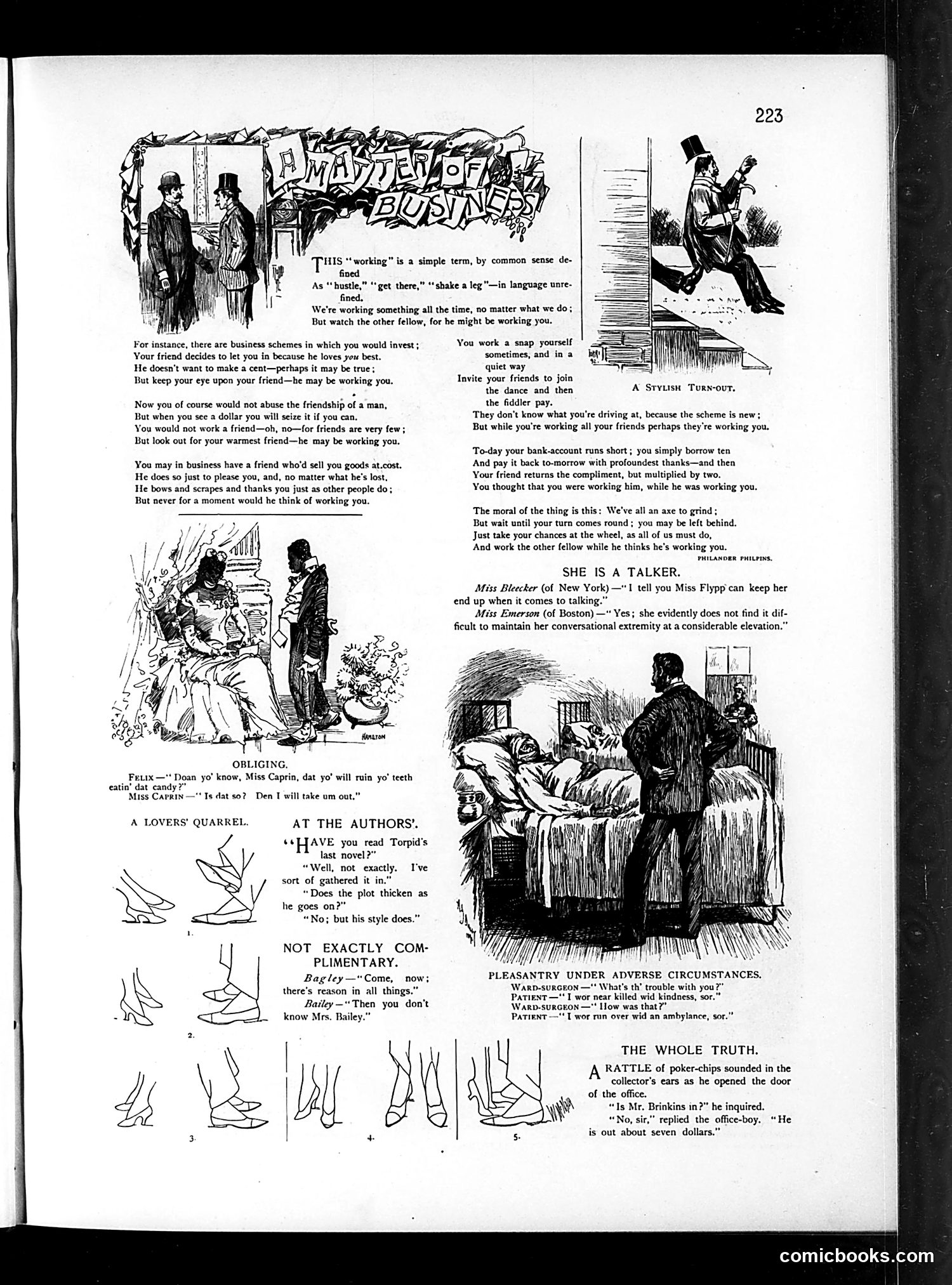
This page satirizes late 19th/early 20th-century American business culture and social hypocrisy. The lead article, "Matters of Business," mocks the prevalence of schemes and con artists in commercial dealings—the central joke being that everyone claims friendship while simultaneously "working" (exploiting) everyone else for profit. The poem warns readers that even trusted friends may be swindling them while appearing generous. The smaller humorous anecdotes mock affectation and pretense: a Boston woman using overly formal language to call someone talkative; characters praising an author's style while admitting they haven't read his work; someone getting run over by an ambulance described as "kindness"; an office boy's explanation that his boss is "out about seven dollars" (implying he's lost that sum). The cartoons and illustrations throughout emphasize the gap between stated intentions and actual behavior—a characteristic concern of Gilded Age satire.
📄 Transcribed text from this page (OCR, searchable)
Machine-transcribed from the original scan — historical spelling and the odd misread are preserved.
L owe aeee THIS “working” is a simple term, by common sense de- fined As “hustle,” “get there,” ‘shake a leg"—in language unre- fined. We're working something all the time, no matter what we do; But watch the other fellow, for he might be working you. For instance, there are business schemes in which you would invest ; You work a snap yourself Your friend decides to let you in because he loves you best. sometimes, and in a He doesn't want to make a cent—perhaps it may be true; quiet way ead i wite your friends to join But keep your eye upon your friend—he may be sare you, Tnvite % aie ee AGT Now you of course would not abuse the friendship of a man, the fiddler pay. But when you see a dollar you will seize it if you can. They don't know what you're driving at, because the scheme is new; You would not work a friend—oh, no—for friends are very few; But while you're working all your friends perhaps they're working you, But look out for your warmest friend—he may be working you. To-day your bank-account runs short ; you simply borrow ten You may in business have a friend who'd sell you goods at.cost. And pay it back to-morrow with profoundest thanks—and then He does so just to please you, and, no matter what he’s lost, Your friend returns the compliment, but multiplied by two. He bows and scrapes and thanks you just as other people do; You thought that you were working him, while he was working you. But never for a moment would he think of working you. ‘The moral of the thing is this: We've all an axe to grind ; But wait until your turn comes round ; you may be left behind. Just take your chances at the wheel, as all of us must do, ‘And work the other fellow while he thinks he’s working you. PHILANDRR PHILINS, SHE IS A TALKER. Miss Bleecker (of New York) —"I tell you Miss Flypp'can keep her end up when it comes to talking.” Miss Emerson (of Boston) —“ Yes; she evidently does not find it dif- ficult to maintain her conversational extremity at a considerable elevation.” OBLIGING. Feix—" Doan yo! know, Miss Caprin, dat yo’ will ruin yo’ teeth eatin’ dat candy?” Miss Caprin —"‘Is dat so? Den I will take um out,” A LOVERS’ QUARREL. AT THE AUTHORS’. Se LTAVE you read Torpid’s last novel?” “Well, not exactly. I've sort of gathered it in." “Does the plot thicken as he goes on?” “No; but his style does.” NOT EXACTLY COM- PLIMENTARY. Bagley—"Come, now; PLEASANTRY UNDER ADVERSE CIRCUMSTANCES. there's reason in all things Warp-surGon —'* What's th’ trouble with you?” cm ont Patient —‘‘I wor near killed wid kindness, sor.” Batley—"Then you don’t WarD-surGeon —"' How was that?” know Mrs. Bailey.” Patient —"' T wor ran over wid an ambylance, sor.” \ THE WHOLE TRUTH. A RATTLE of poker-chips sounded in the collector's ears as he opened the door da _ of the office, ye “Is Mr. Brinkins in?” he inquired. “No, sir,” replied the office-boy. “He s. is out about seven dollars.” comicbooks.com