
A complete issue · 16 pages · 1891
Judge — June 13, 1891
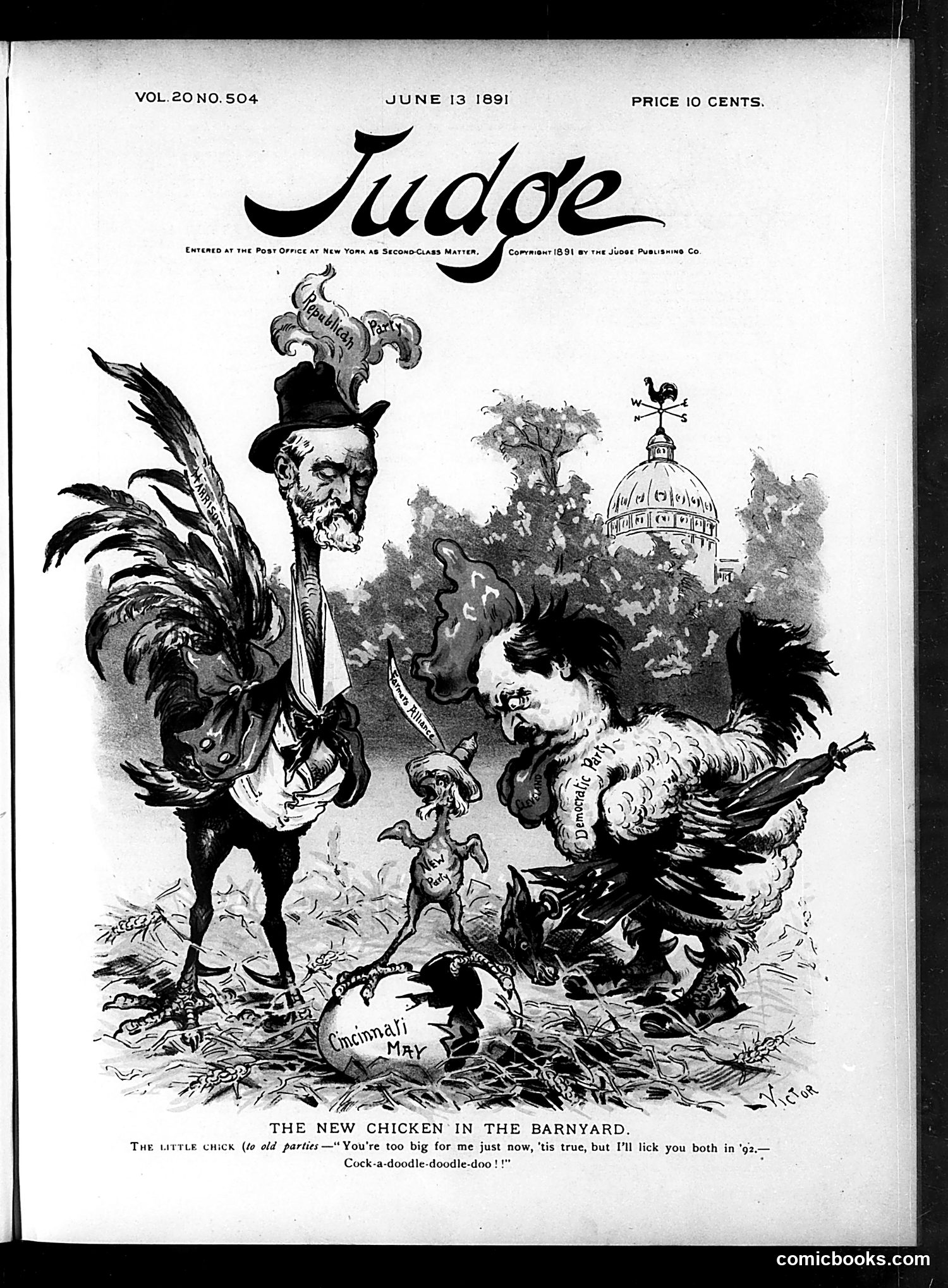
This is a political cartoon satirizing Cincinnati's political situation in 1891. The title refers to a newcomer entering local politics—the "new chicken" (small figure in center). The two large roosters represent established political factions competing for dominance, with the Capitol building visible in the background indicating governmental stakes. The dialogue ("You're too big for me just now, 'tis true, but I'll lick you both in '92") suggests the newcomer is a candidate warning existing power brokers of a future political challenge. The "Cincinnati, May" label on the egg confirms the local reference. This mockingly depicts political rivalry using farmyard animal metaphors common to Gilded Age satirical journalism.
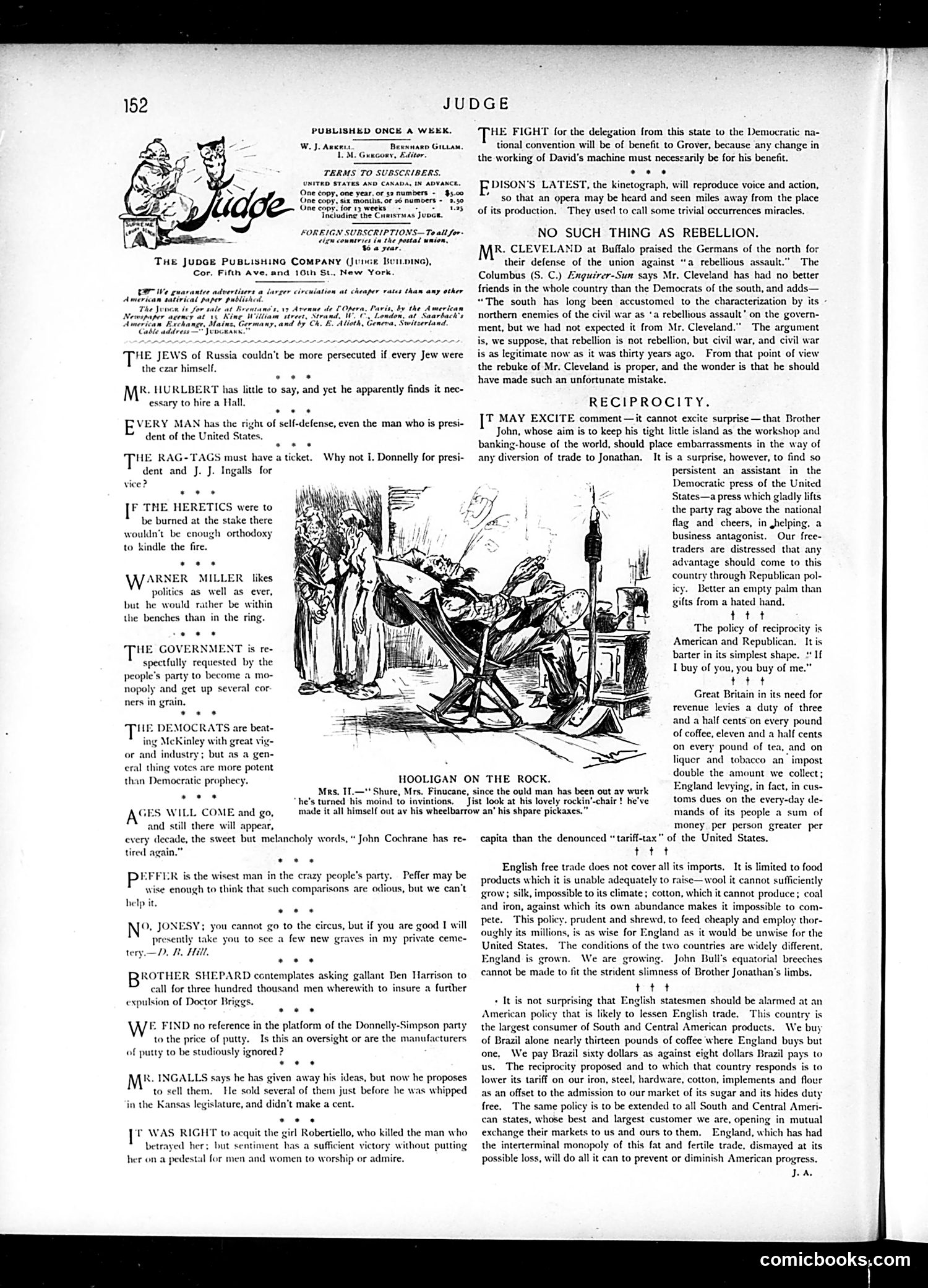
The main cartoon, "Hooligan on the Rock," depicts a disheveled man sitting on rocks near water, addressing two women (Mrs. H. and Mrs. Fincanc). The visual joke contrasts his ragged appearance with his boastful claim about his "lovely rockin'-chair" at home and his wheelbarrow as his "share pickaxes." The surrounding text consists of brief political commentary snippets mocking various figures and policies—including jabs at Cleveland's defense of the Union, criticisms of Democratic reciprocity trade policies, and commentary on tariffs affecting England and American trade. The cartoon appears to satirize poverty and homelessness through absurdist humor, while the surrounding commentary reflects late 19th-century debates over tariffs, trade policy, and party politics—likely from the 1880s-1890s era.
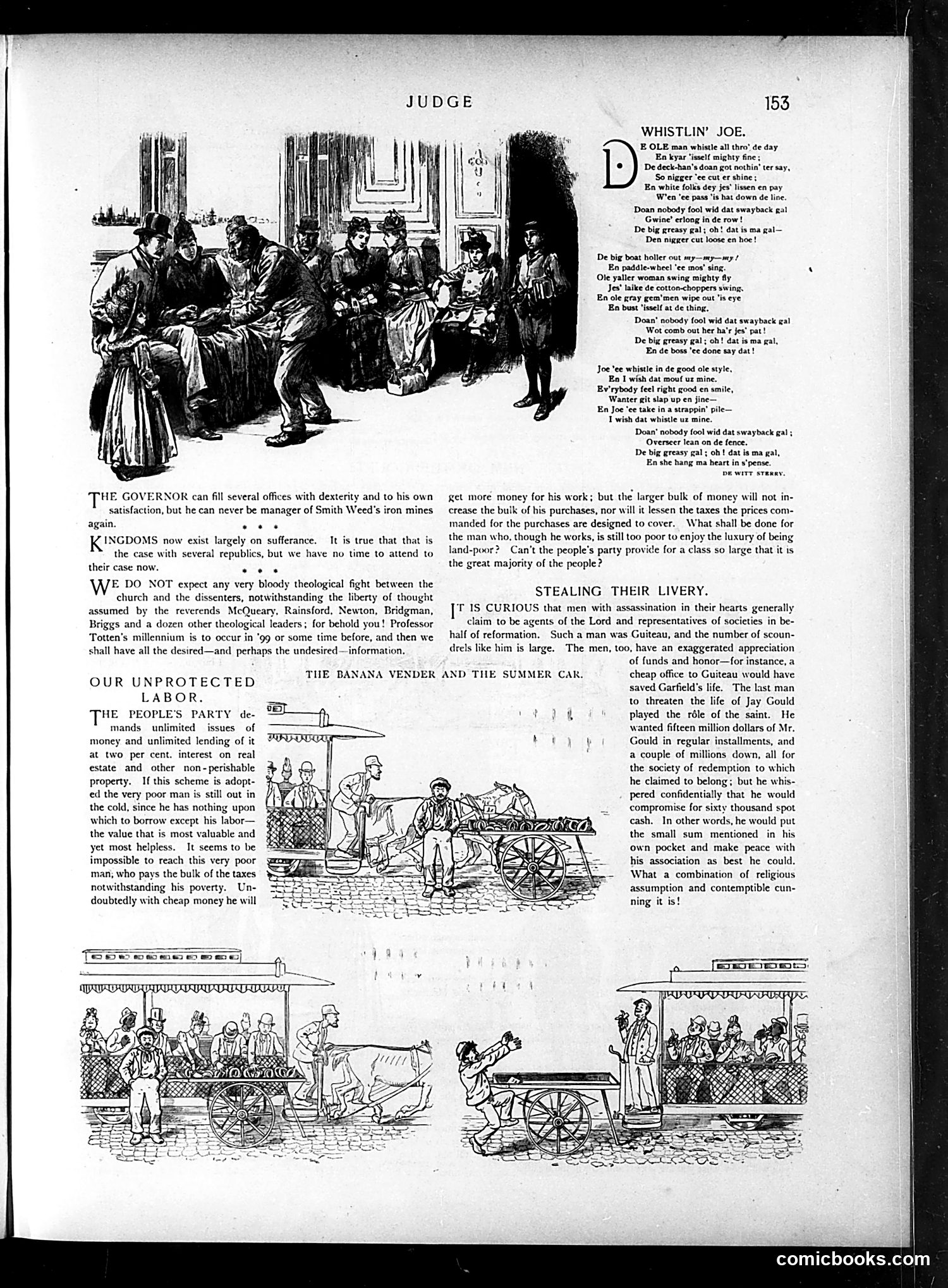
This page contains satirical commentary on late 19th-century American labor and political issues. **"Whistlin' Joe"** (poem, right side) appears to be a working-class character boasting about his lifestyle—drinking, fighting, and dismissing social concerns. It's likely satirizing either a specific public figure or the stereotype of the "common man" politician. The illustrated sections address **labor exploitation and poverty**. "Our Unprotected Labor" criticizes how the poor remain economically trapped despite working. "The Banana Vender and the Summer Car" and "Stealing Their Livery" (with accompanying street-scene drawings) illustrate working-class struggles—street vendors, laborers, and those dependent on whatever meager employment they can find. The text mockingly suggests that even religious charity organizations exploit the poor for donations while offering minimal actual relief.
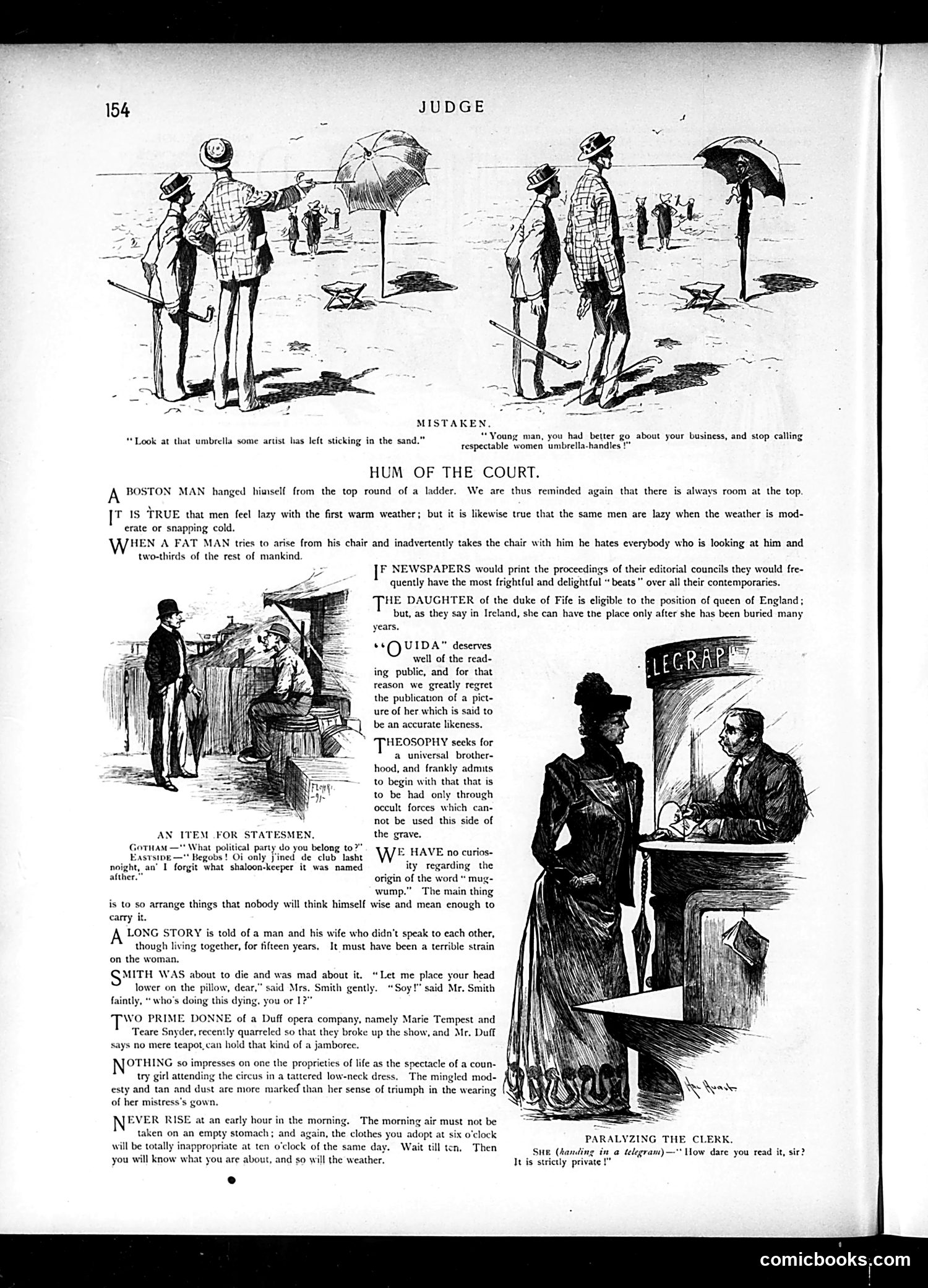
This page collects short satirical pieces and illustrations typical of Judge's humor. The top cartoon "MISTAKEN" shows a beach scene where a woman rebukes a young man for flirting with her by using her umbrella as a prop—the joke being his clumsy pickup line calling the umbrella an "umbrella-handle." The bulk of the page comprises "HUM OF THE COURT," a column of brief satirical observations on contemporary life and manners. These include jibes at lazy men, fat men's embarrassment, newspaper editorial practices, and Irish attitudes toward aristocracy. References to "Ouida" (likely the Victorian novelist), Theosophy, and opera performers (Marie Tempest and Teare Snyder) suggest topical material for Judge's educated readership. The final cartoon "PARALYZING THE CLERK" shows a woman objecting to a telegraph clerk reading her private telegram—a joke about Victorian notions of privacy and propriety. Throughout, the satire targets social pretension, human weakness, and absurd conventions of the era.
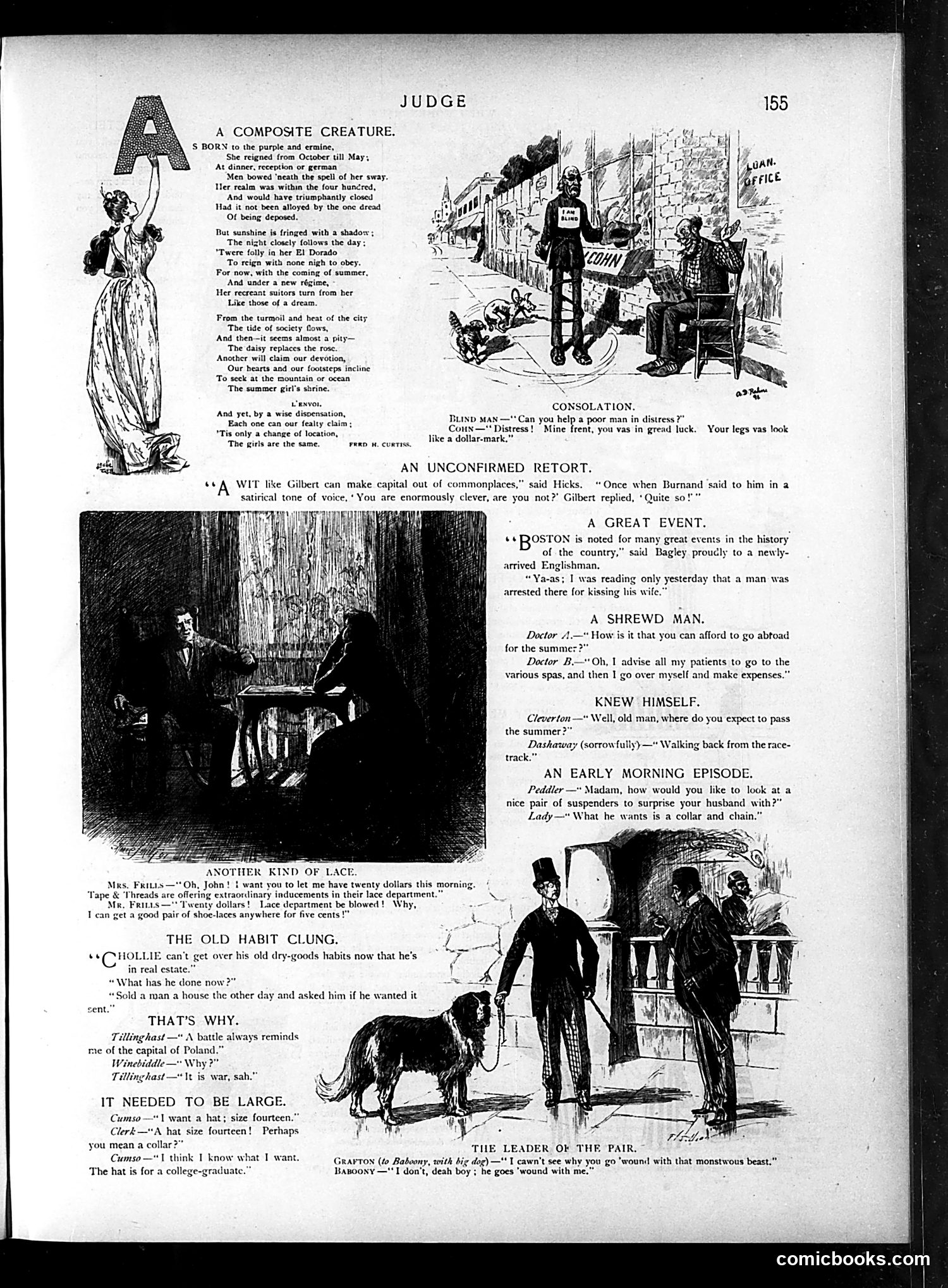
This page from *Judge* contains multiple brief satirical pieces typical of the era's humor magazine format. The main illustration, "A Composite Creature," depicts the "society girl" or debutante whose social power evaporates when high society leaves the city for summer. The satire targets the artificial hierarchy of wealthy urban social circles—these women reign supreme during the winter "season" but become irrelevant once society migrates to vacation destinations. The remaining pieces are short jokes about contemporary social types: a doctor who profits by sending patients to spas while vacationing himself; a husband's confusion between expensive lace (fabric) and cheap shoelaces; a real estate agent clinging to dry-goods sales habits; and ethnic dialect humor (the "blind beggar" with a Yiddish accent making a pun about someone's thin legs). The cartoons employ period stereotypes and class-based humor. The overall tone mocks both the pretensions of wealthy society and the follies of various working and middle-class characters.
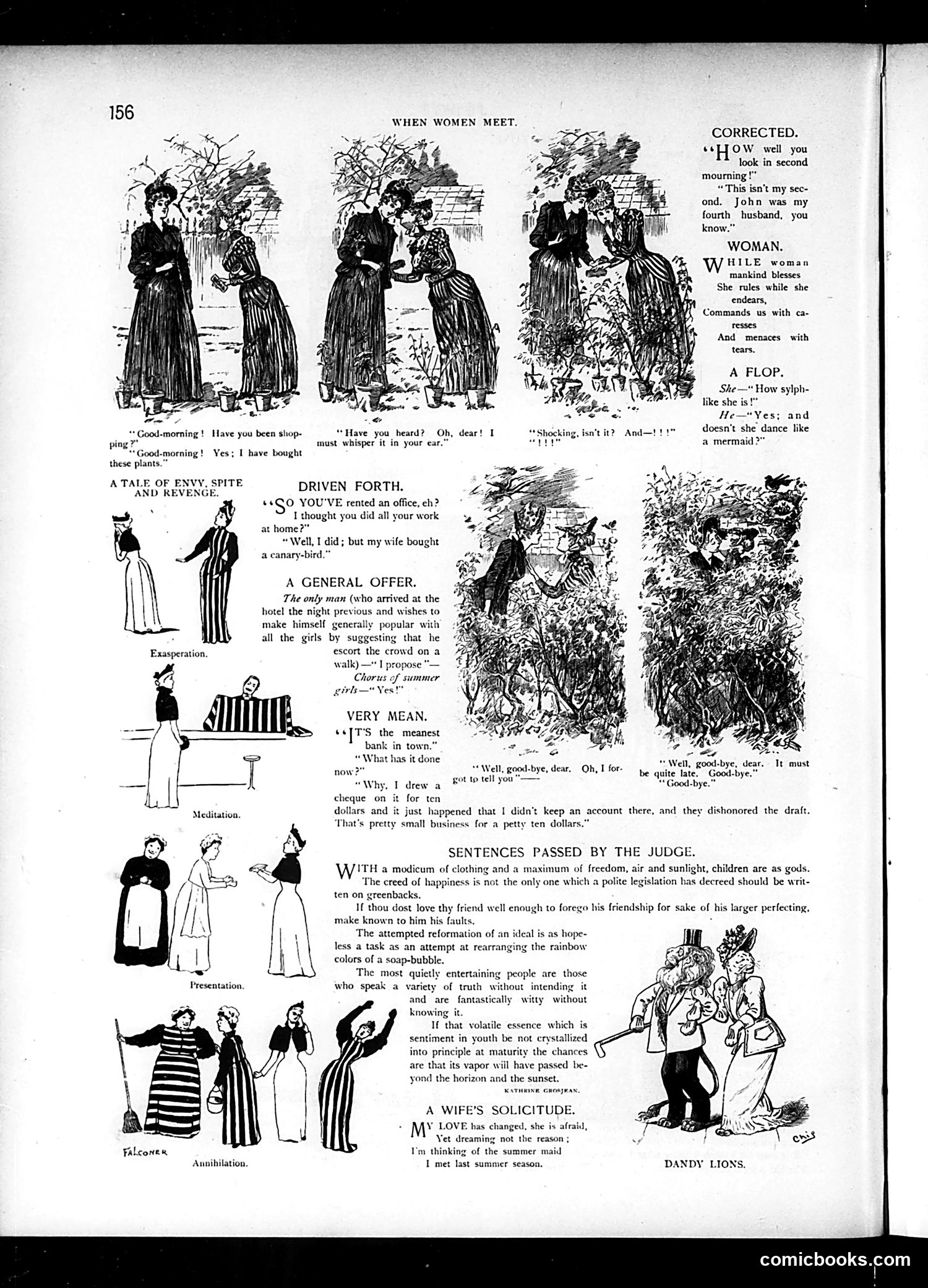
This page satirizes Victorian-era social conventions and gender dynamics through humor and moral commentary. **"When Women Meet"** mocks women's gossiping and materialism: a widow casually mentions her fourth husband, suggesting women cycle through marriages without genuine mourning. **"A General Offer"** ridicules men's clumsy attempts at courting—a hotel guest tries to win over multiple women simultaneously by offering to escort them on a walk. **"Driven Forth"** jokes about domestic complaints: a man rents an office to escape his wife's pet canary bird at home. **"Very Mean"** puns on banking: a man complains a bank is "mean" for dishonoring a check when he lacked an account there. **"A Wife's Solicitude"** portrays marital disconnection: a wife suspects infidelity (her husband's wandering attention to "the summer maid"), unaware of his actual distraction. The "Sentences Passed by the Judge" section offers philosophical morality about youth, friendship, happiness, and sentiment—typical of Judge's mix of satire and earnest social commentary.
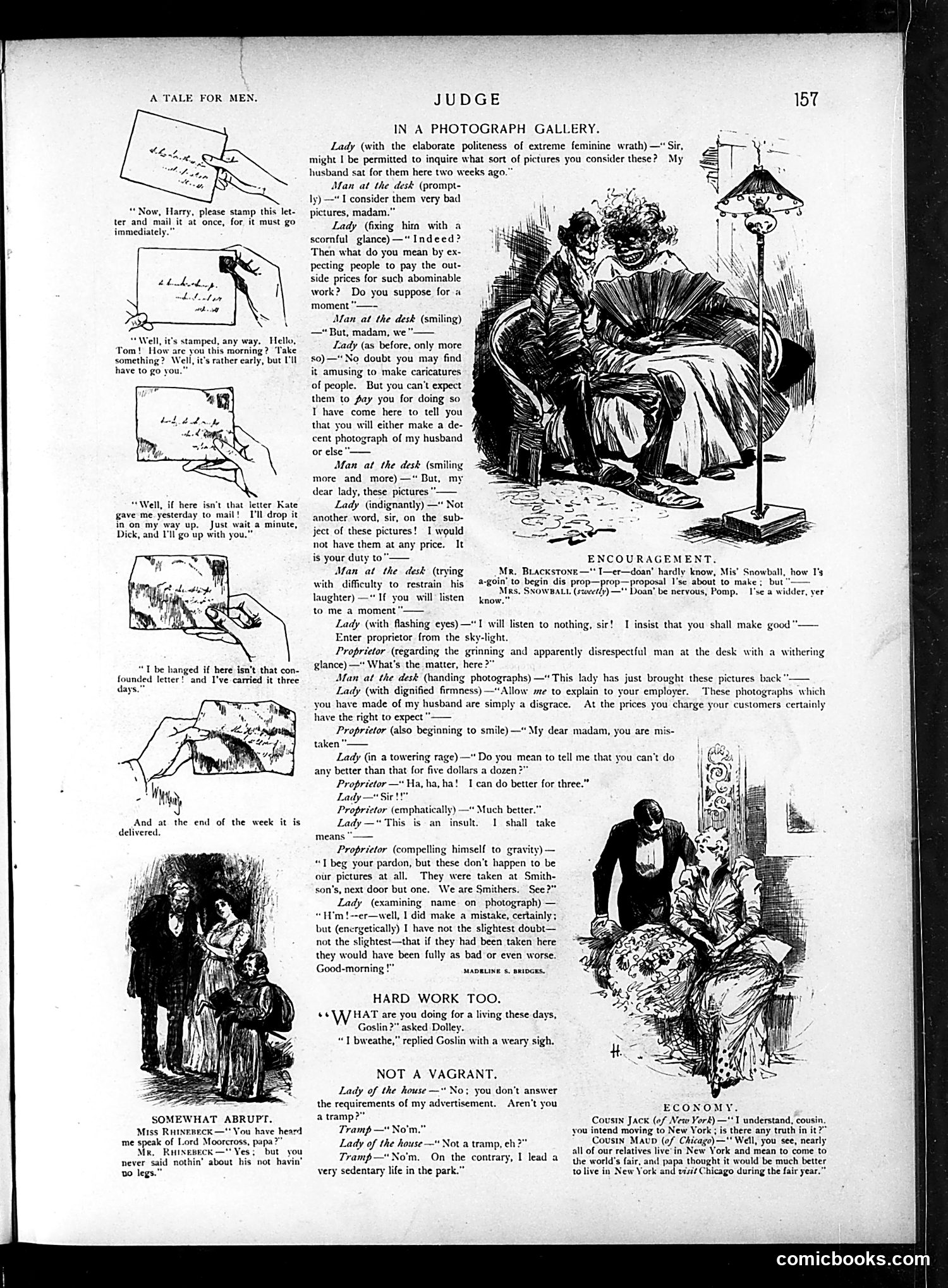
This multi-panel cartoon satirizes a woman's unreasonable complaint about her husband's portrait photographs. The joke operates on two levels: **The Setup:** A lady demands the photographer either remake her husband's "disgrace" portraits or refund her five dollars. The photographer and his staff, increasingly amused, try deflecting her fury. **The Punchline:** After the woman's escalating rage, the proprietor reveals the photographs weren't even taken at their studio—they're from the competitor next door. The woman, undeterred by this revelation, insists the pictures would have been "fully as bad or even worse" if made there. **The Satire:** Judge mocks consumers (particularly women) who complain endlessly regardless of facts, and who assume service providers are inherently incompetent. The woman's logic is circular and irrational—she's angry not because of actual poor service, but from sheer combativeness. The male workers' barely-suppressed laughter suggests bemused resignation to unreasonable customer behavior. The other vignettes on the page appear unrelated comic sketches about employment and social awkwardness.
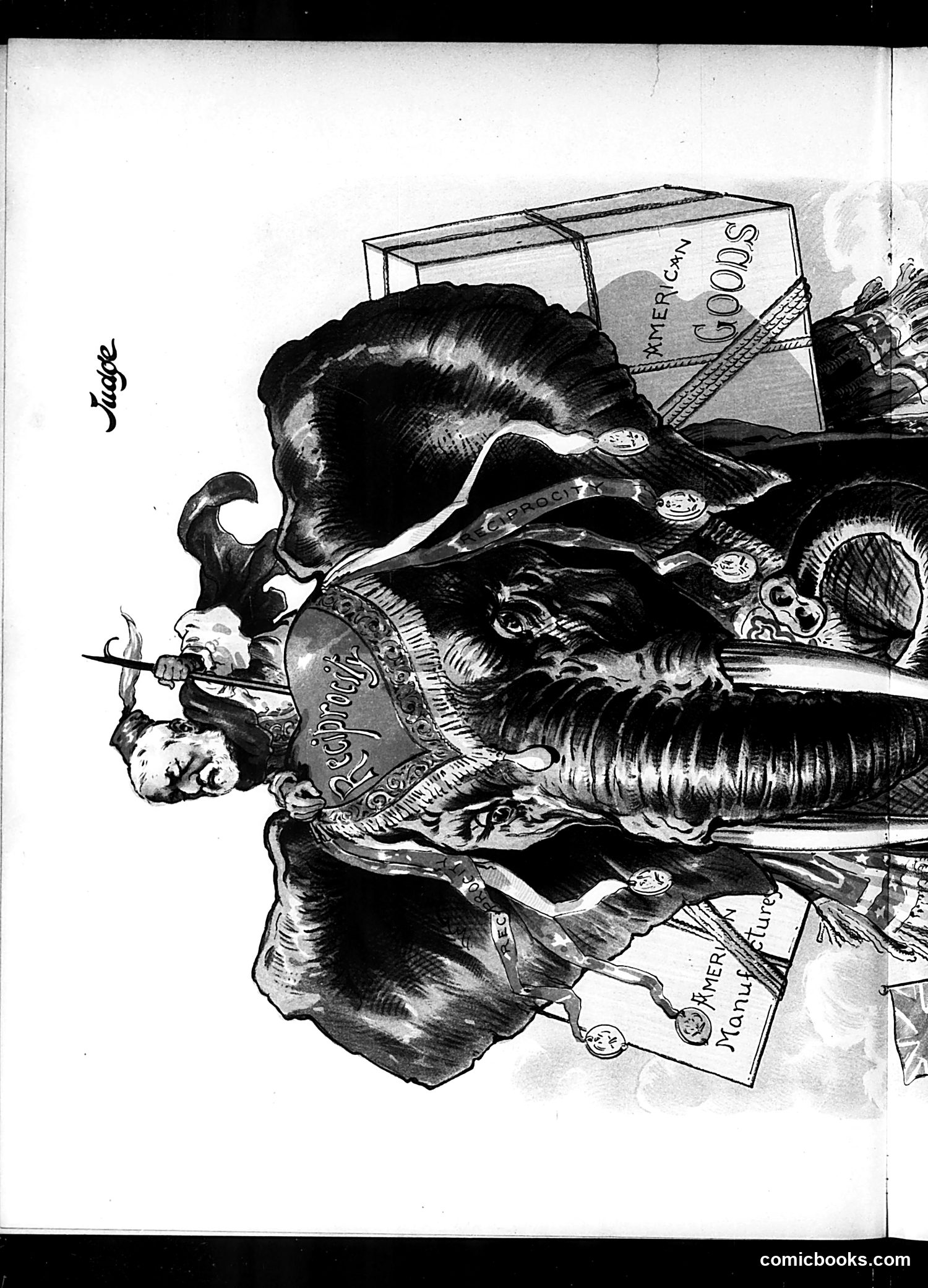
This appears to be a satirical cartoon from *Judge* magazine, though the OCR text is largely illegible. The image shows a grotesque caricatured figure in formal dress holding a torch and what appears to be official documents or papers. The figure has exaggerated facial features typical of period political caricature. Visible text fragments reference "American Goods" and other partially readable labels. The torch and formal attire suggest themes of authority, progress, or American institutions. The grotesque style indicates satirical mockery of a political figure or movement. **Without clearer text or date information, the specific subject remains unclear.** The cartoon likely critiques a contemporary political issue or prominent figure from the *Judge* era, but identifying the exact target would require additional context not reliably readable in this reproduction.
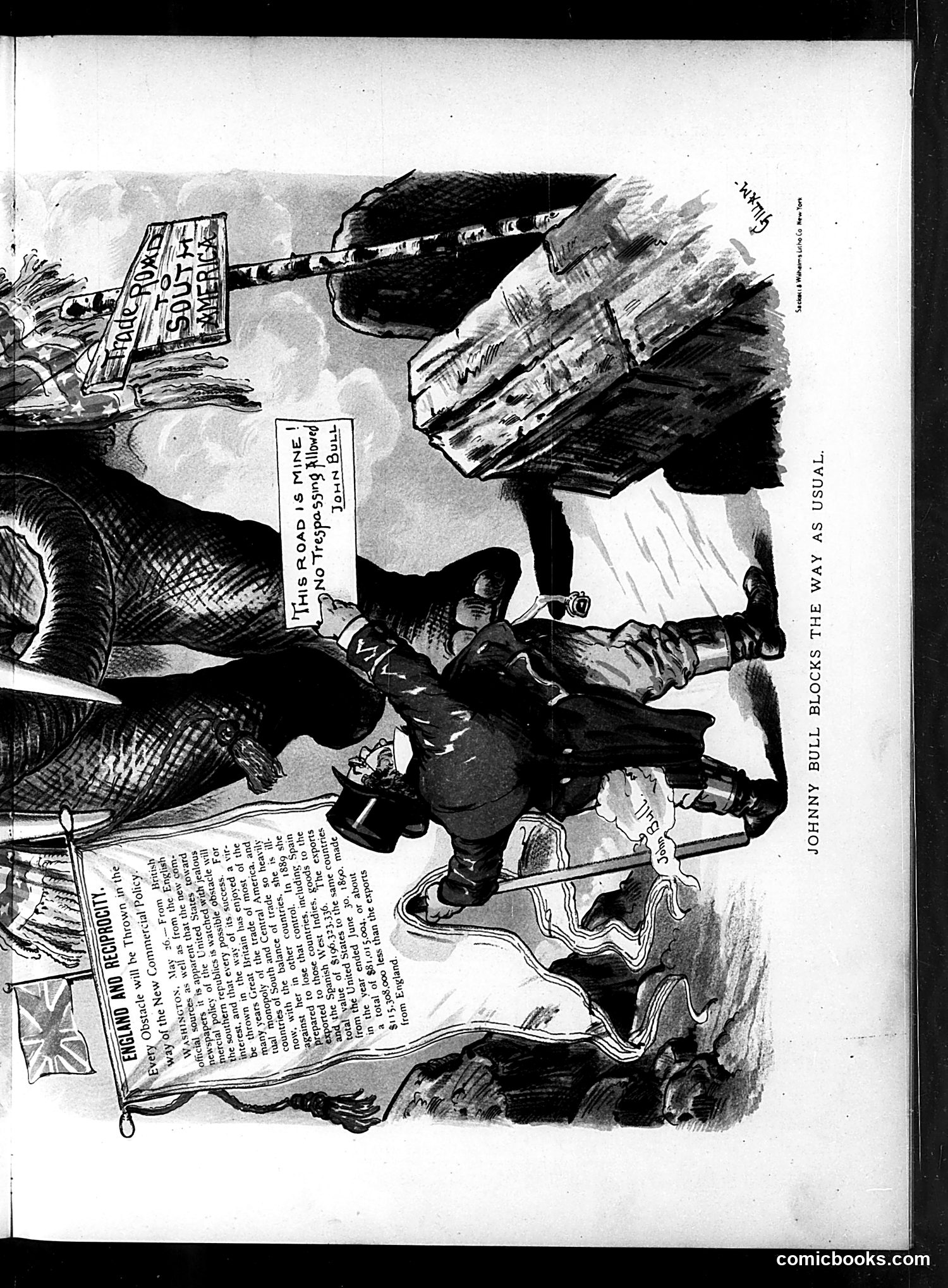
This appears to be a satirical cartoon titled "JOHNNY BULL BLOCKS THE WAY AS USUAL" (visible on the right margin). The image depicts a confrontation between figures representing different nations or interests. The cartoon shows what appears to be a British figure (Johnny Bull) blocking a path or obstruction, with various papers and documents scattered around. There's a sign mentioning "The Roads is find No trespassing here" (OCR unclear), suggesting disputes over access or territorial rights. Without clearer text or dates, I cannot definitively identify the specific political conflict referenced—whether this concerns trade routes, colonial disputes, or international negotiations common to Judge magazine's era. The satirical nature suggests criticism of British obstruction of some international matter, but the specific historical context remains unclear from this image alone.
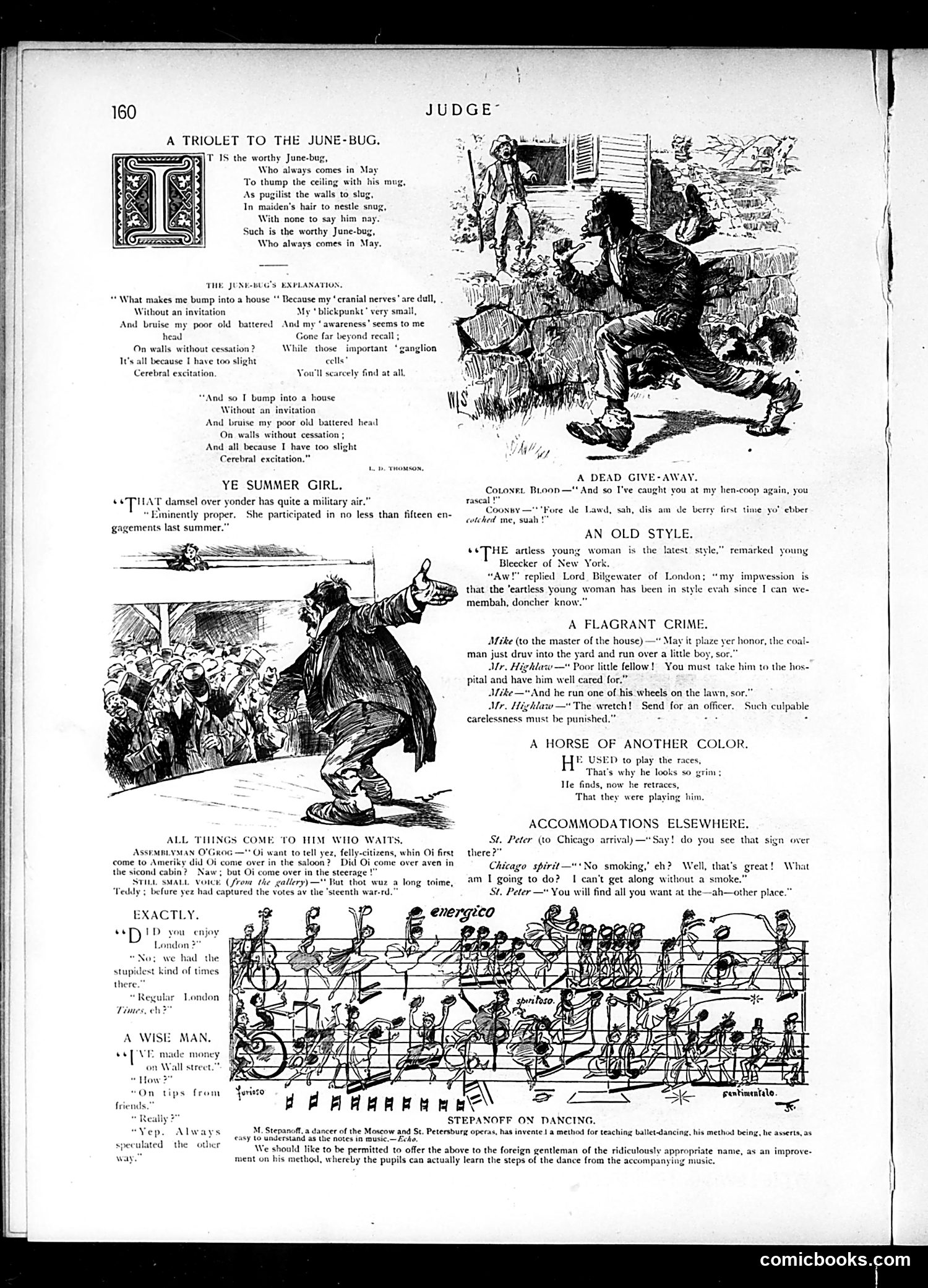
This page contains multiple brief satirical pieces typical of Judge magazine's humor: **"A Triolet to the June-Bug"** mocks the insect's behavior—appearing in May (not June), bumping into things and bothering people. The "June-bug's Explanation" parodies pseudo-scientific excuses, blaming tiny "cranial nerves" and "ganglia" for the bug's annoying behavior. The satire targets those who use scientific jargon to excuse rudeness. **Other pieces** include: - A joke about a woman's "military air" (suggesting masculine behavior) - Irish immigrant humor (common in period publications, often condescending) - A racial caricature ("A Dead Give-Away") using offensive dialect - Satire on callous wealthy people ("A Flagrant Crime"—caring more about lawn damage than a hit child) - Social commentary on gambling and Chicago's reputation for vice The **Stepanoff cartoon** references a real Russian ballet instructor's teaching method using musical notation. The humor relies on ethnic stereotypes, class mockery, and puns—standard for 1880s-90s American satire magazines, though many references and jokes now read as dated or offensive.
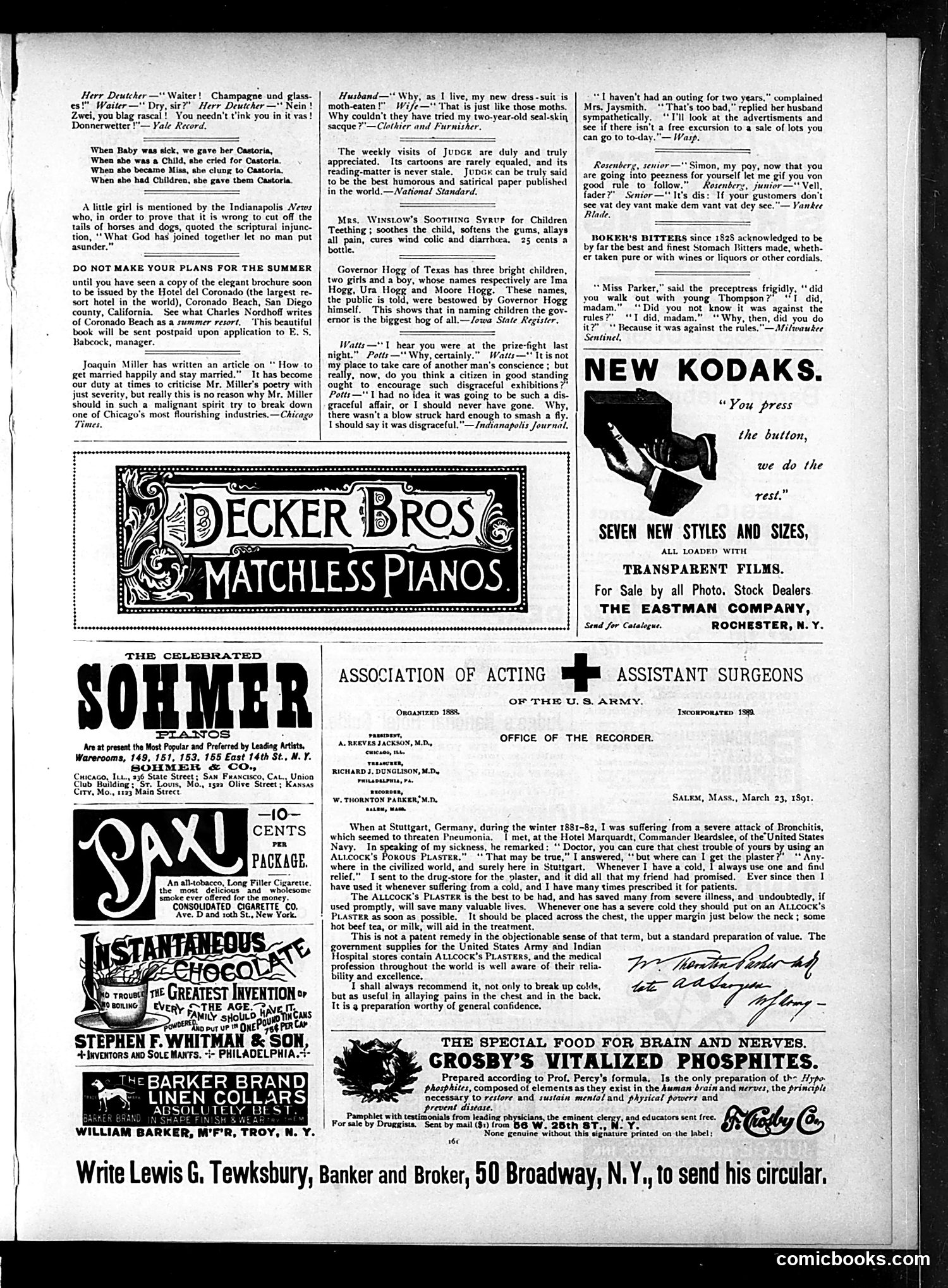
This is primarily an **advertising and filler content page** rather than a political cartoon page. The OCR'd jokes and anecdotes are typical of Judge's satirical humor from this era. The few notable items: **"Herr Deutcher" joke**: Mocks German immigrants through stereotypical dialect humor ("Nein," "Donnerwetter"), typical of late 19th-century American publications that caricatured ethnic groups. **Governor Hogg joke**: References Texas Governor James Stephen Hogg's children (Ima, Ura, and Moore Hogg—names that survive in records). The pun ("biggest hog of all") is crude wordplay on his surname. **Watts/Potts dialogue**: Satirizes hypocrisy about attending prizefights—suggesting moralizing citizens attended fights they publicly condemned. The page is otherwise **dominated by period advertisements** (Decker Bros. pianos, Kodak cameras, Crosby's Phosphites, etc.) and product endorsements, which was standard for Judge magazine's revenue model. No significant political commentary is visible here.
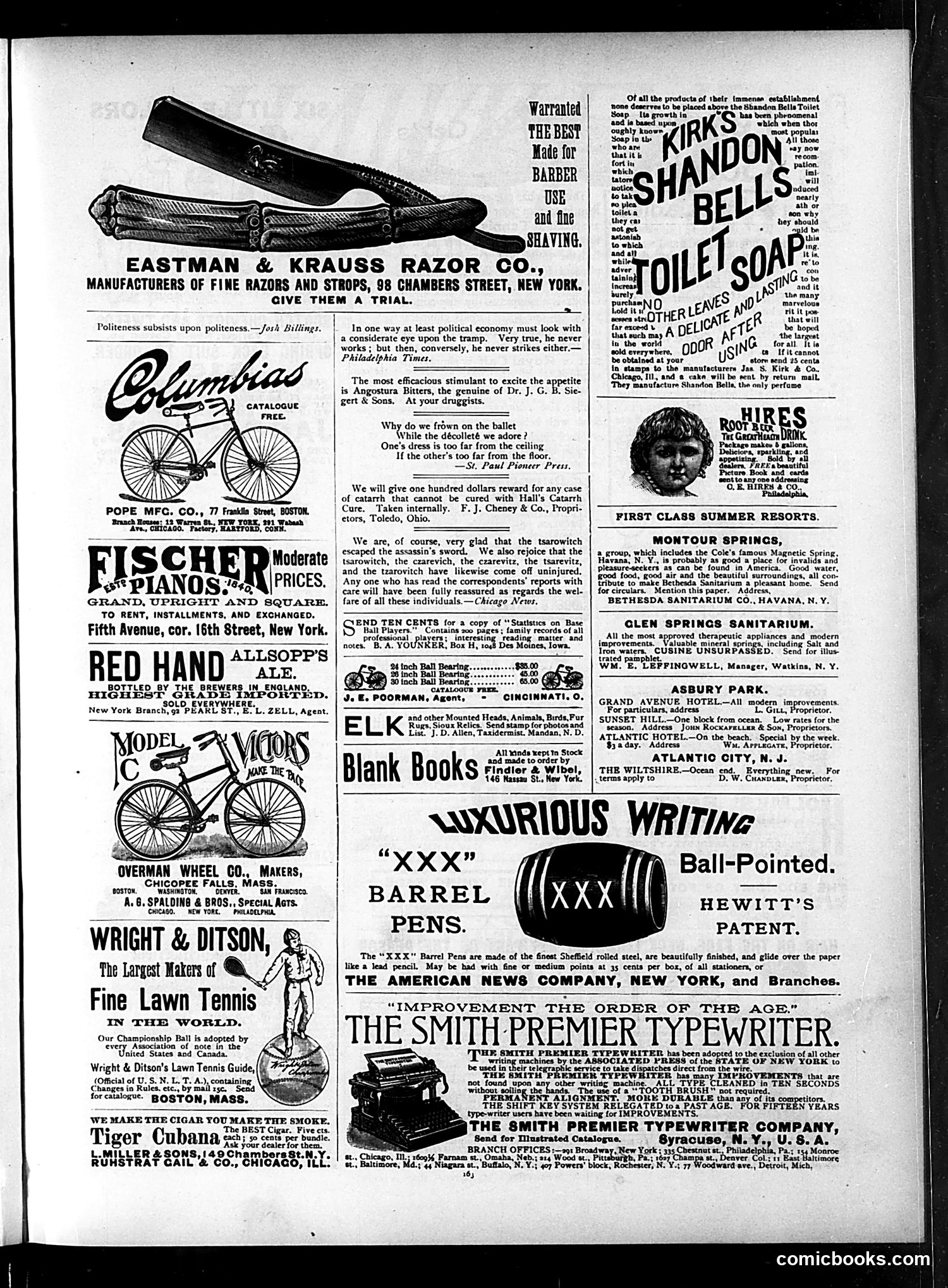
This page is **primarily advertising**, not satirical content. The advertisements occupy most of the space—for razors, bicycles, pianos, ales, typewriters, and resort hotels. The only clear satirical content appears in the brief quoted sections at the top. A **Josh Billings quote** on politeness is followed by commentary suggesting **political/economic irony**: the tramp should be viewed favorably because, unlike workers, he "never strikes"—a reference to labor unrest and strikes of the era. The joke mocks both tramps and striking workers through cynical "economic logic." A second quote from the **St. Paul Pioneer Press** satirizes social hypocrisy regarding women's dress codes—criticizing the arbitrary double standard that condemns ballet dancers' exposed clothing while praising theatrical performers' similar attire. The **Chicago News excerpt** makes dry fun of repetitive newspaper coverage of an assassination attempt on the Russian tsarevich (crown prince), mocking correspondents' obsessive variations on his title. These brief satirical pieces are typical Judge filler material between advertisements.
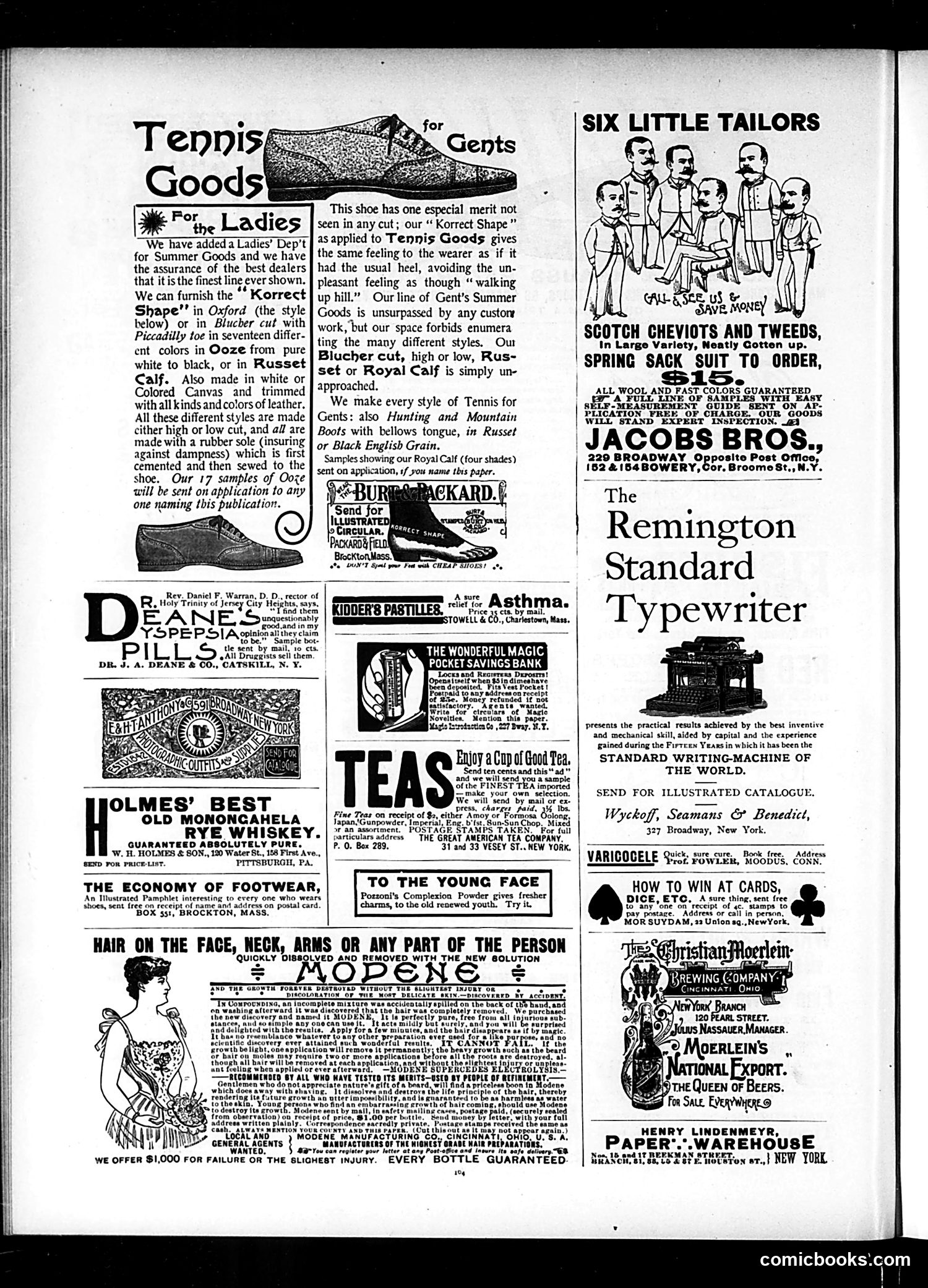
This is primarily an **advertising page**, not a satirical cartoon. It contains roughly a dozen period product advertisements from circa 1880s-1890s America. **Notable ads include:** - **Tennis Goods shoes** for ladies and gentlemen, emphasizing the "Korrect Shape" design - **Dr. J.A. Deane's Pills** for dyspepsia (indigestion) - **Holmes' Old Monongahela Rye Whiskey**, guaranteed "absolutely pure" - **Hair removal solution** claiming to dissolve unwanted body hair - **Remington Standard Typewriter**, emphasizing 15 years of market dominance - **Pozzoni's Complexion Powder** for women's skin - Various other products: tea, tailoring services, playing card cheating guides **The satirical angle** (if any) is implicit in the ads themselves—the exaggerated health claims, dubious remedies, and beauty products reflect common patent medicine and consumer culture absurdities of the era. The page demonstrates how Judge's revenue relied on advertising revenue from these merchants.
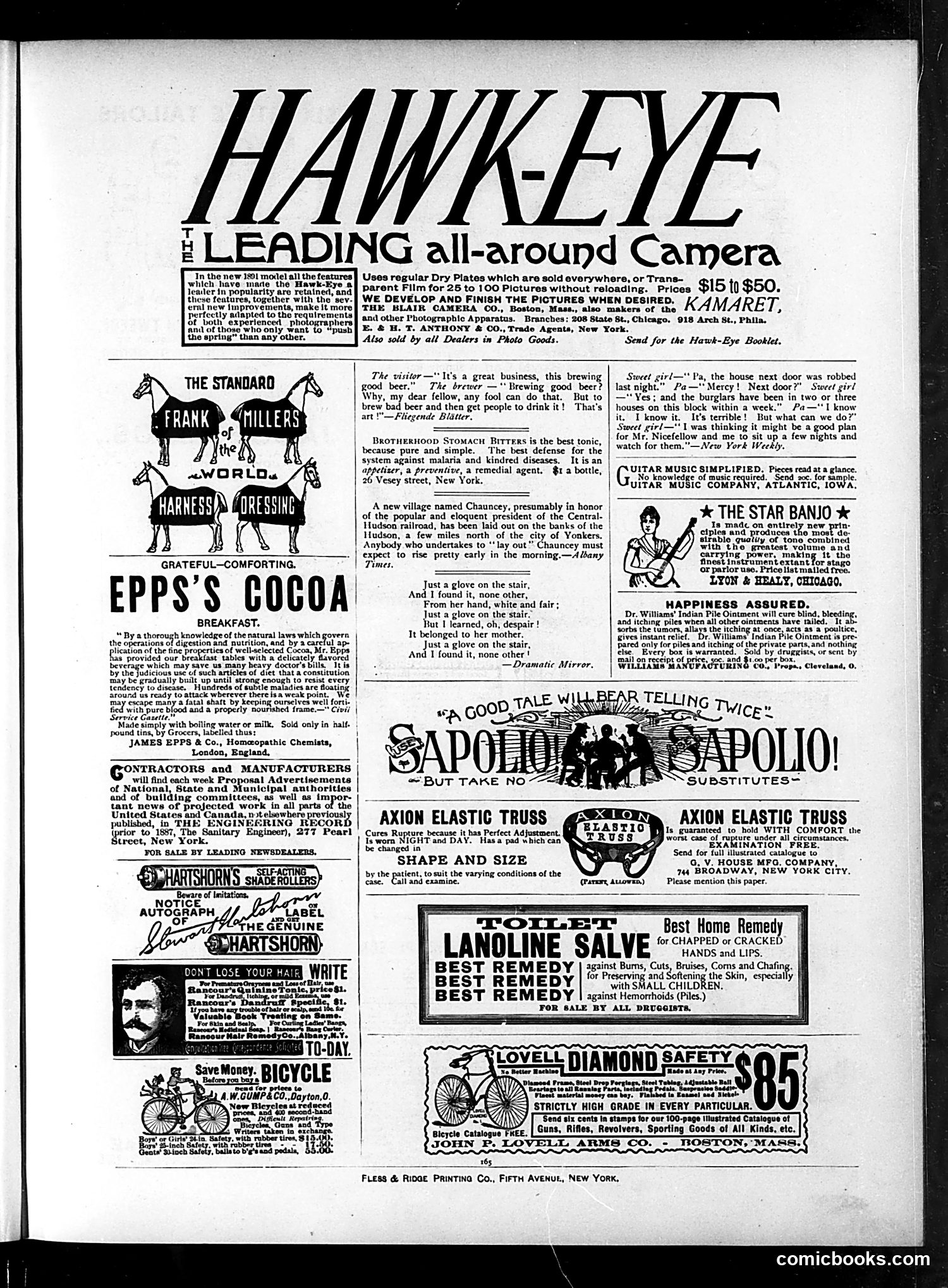
This is primarily an **advertising page** from Judge magazine, not a political cartoon. The main content consists of product advertisements typical of the 1890s: cameras, cocoa, hair remedies, bicycles, and medical tonics. The few humorous pieces are gentle domestic comedy: - A **brewer's joke** about the art of selling bad beer - A **young woman's safety concern**: she suggests she and "Mr. Nicefellow" watch for burglars at night—a flirtation disguised as neighborhood concern - A **village naming anecdote** about Chauncey, allegedly named after a railroad president The advertisements reveal period concerns: patent medicines (stomach bitters, elastic trusses), hair loss remedies, and new photography technology. The tone is lighthearted domesticity rather than political satire. This page demonstrates how Judge mixed advertising with humor to subsidize the magazine's publication costs.
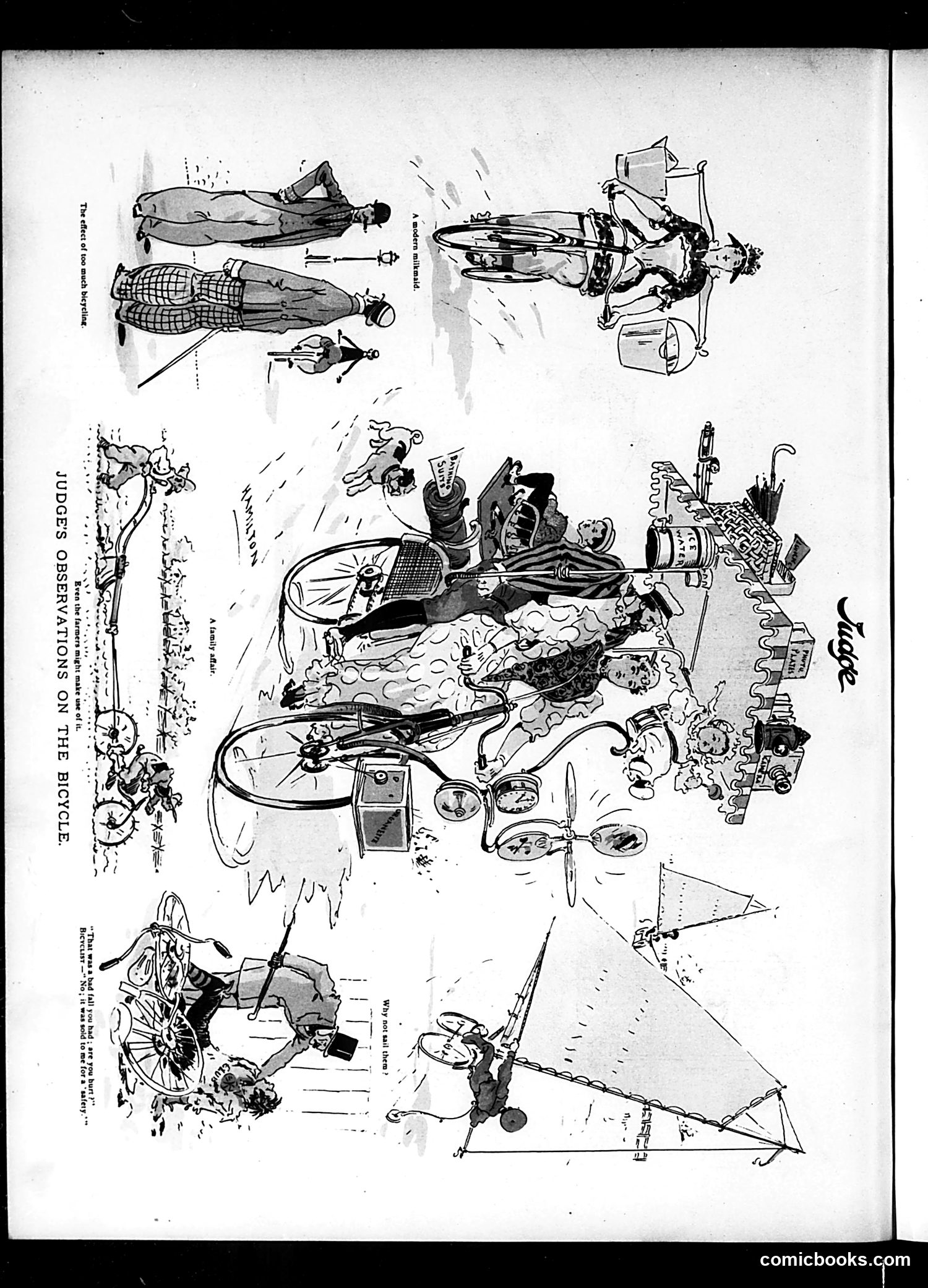
This page satirizes the bicycle craze of the 1890s. The central cartoon shows a person injured after a bicycle fall, joking they weren't hurt because the bike was sold as a "safety" bicycle—a popular marketing claim of the era. The surrounding illustrations depict various bicycle-related scenes: cyclists in different poses, bicycle components, and social situations involving riders. The left panel appears to show "Observations on the Cycle," documenting the obsessive nature of bicycle culture. The satire targets how bicycles were heavily promoted as safe transportation, yet accidents were common. The humor also reflects broader late-Victorian concerns about the bicycle craze's social impact—women's liberation, changing fashion (bloomers), and the general disruption of traditional society that this new technology caused.