
Judge, 1891-06-13 · page 3 of 16
Judge — June 13, 1891 — page 3: what you’re looking at
What you’re looking at
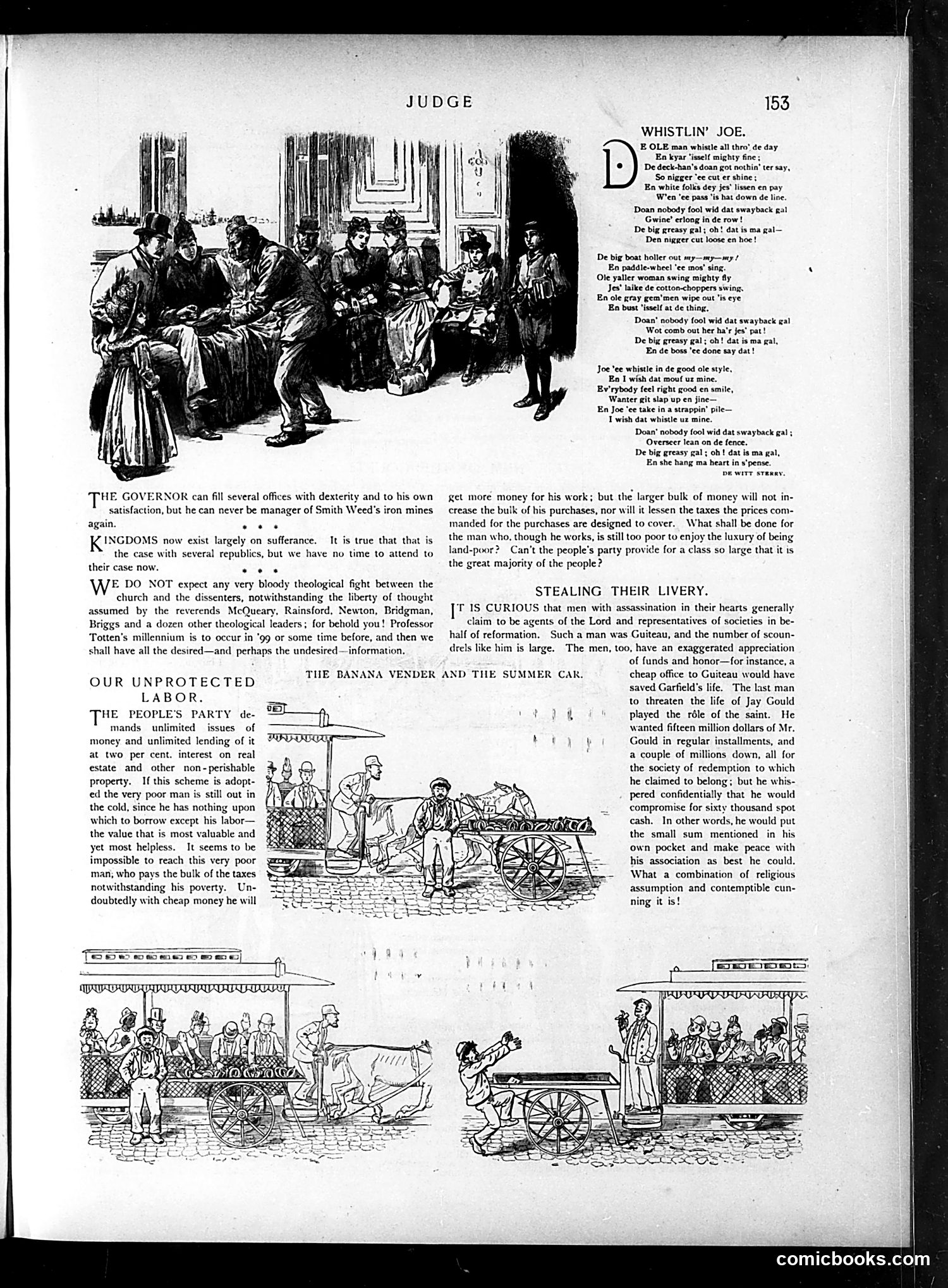
This page contains satirical commentary on late 19th-century American labor and political issues. **"Whistlin' Joe"** (poem, right side) appears to be a working-class character boasting about his lifestyle—drinking, fighting, and dismissing social concerns. It's likely satirizing either a specific public figure or the stereotype of the "common man" politician. The illustrated sections address **labor exploitation and poverty**. "Our Unprotected Labor" criticizes how the poor remain economically trapped despite working. "The Banana Vender and the Summer Car" and "Stealing Their Livery" (with accompanying street-scene drawings) illustrate working-class struggles—street vendors, laborers, and those dependent on whatever meager employment they can find. The text mockingly suggests that even religious charity organizations exploit the poor for donations while offering minimal actual relief.
📄 Transcribed text from this page (OCR, searchable)
Machine-transcribed from the original scan — historical spelling and the odd misread are preserved.
NOK can fill several offices with dexterity and to his own satisfaction, but he can never be manager of Smith Weed’s iron mines KINGDOMS now exist largely on sufferance. It is true that that is the case with several republics, but we have no time to attend to their case now. saa i E DO NOT expect any very bloody theological fight between the church and the dissenters, notwithstanding the liberty of thought assumed by the reverends McQueary, Rainsford, Newton, Bridgman, Briggs and a dozen other theological leaders; for behold you! Professor Totten’s millennium is to occur in *99 or some time before, and then we shall have all the desired—and perhaps the undesired— information. OUR UNPROTECTED LABOR. HE PEOPLE'S PARTY de- mands unlimited issues of money and unlimited lending of it at two per cent, interest on real estate and other non-perishable property. If this scheme is adopt- ed the very poor man is still out in the cold, since he has nothing upon which to borrow except his labor— the value that is most valuable and yet most helpless. It seems to be impossible to reach this very poor man; who pays the bulk of the taxes notwithstanding his poverty. Un- doubtedly with cheap money he will THE BANANA VENDER AND THE SUMMER CAR. 153 WHISTLIN’ JOE. E OLE man whistle all thro’ de day En kyar ‘isself mighty fine; De deck-han’s doan got nothin’ ter say, So nigger ‘ce cut er shine; En white follis dey jes' lissen en pay Wren ‘ee pass ‘is hat down de line. Doan nobody fool wid dat swayback gal Gwine’ erlong in de row! De big greasy gal; oh! dat is ma gal— Den nigger cut loose en hoe! De big boat holler out my—my—my / En paddle-wheel ‘ee mos’ sing. Ole yaller woman swing mighty fly, Jes’ laike de cotton-choppers swing. En ole gray gem'men wipe out ‘is eye En bust ‘isself at de thing, Doan’ nobody fool wid dat swayback gal ‘Wot comb out her ha'r jes’ pat! De big greasy gal; oh! dat is ma gal, En de boss ‘ee done say dat! Joe ’ee whistle in de good ole style, Ea I wish dat mouf uz mine. Ev'rybody feel right good en smile, Wanter git slap up en jine— En Joe ‘ee take in a strappin’ pile— T wish dat whistle uz mine. Doan’ nobody fool wid dat swayback gal ; Overseer lean on de fence. De big greasy gal; ob ! dat is ma gal, En she hang ma heart in s'pense. get more money for his work; but the larger bulk of money will not in- crease the bulk of his purchases, nor will it lessen the taxes the prices com- manded for the purchases are designed to cover. What shall be done for the man who, though he works, is still too poor to enjoy the luxury of being land-poor? Can't the people's party provide for a class so large that it is the great majority of the people? STEALING THEIR LIVERY. ‘T IS CURIOUS that men with assassination in their hearts generally claim to be agents of the Lord and representatives of societies in be- half of reformation. Such a man was Guiteau, and the number of scoun- drels like him is large. The men, too, have an exaggerated appreciation of funds and honor—for instance, a cheap office to Guiteau would have saved Garfield's life. The last man to threaten the life of Jay Gould played the rdle of the saint. He wanted fifteen million dollars of Mr. Gould in regular installments, and a couple of millions down, all for the society of redemption to which he claimed to belong; but he whis- pered confidentially that he would compromise for sixty thousand spot cash. In other words, he would put the small sum mentioned in his ‘own pocket and make peace with his association as best he could. What a combination of religious assumption and contemptible cun- ning it is! comicbooks.co m