
Judge, 1891-06-13 · page 2 of 16
Judge — June 13, 1891 — page 2: what you’re looking at
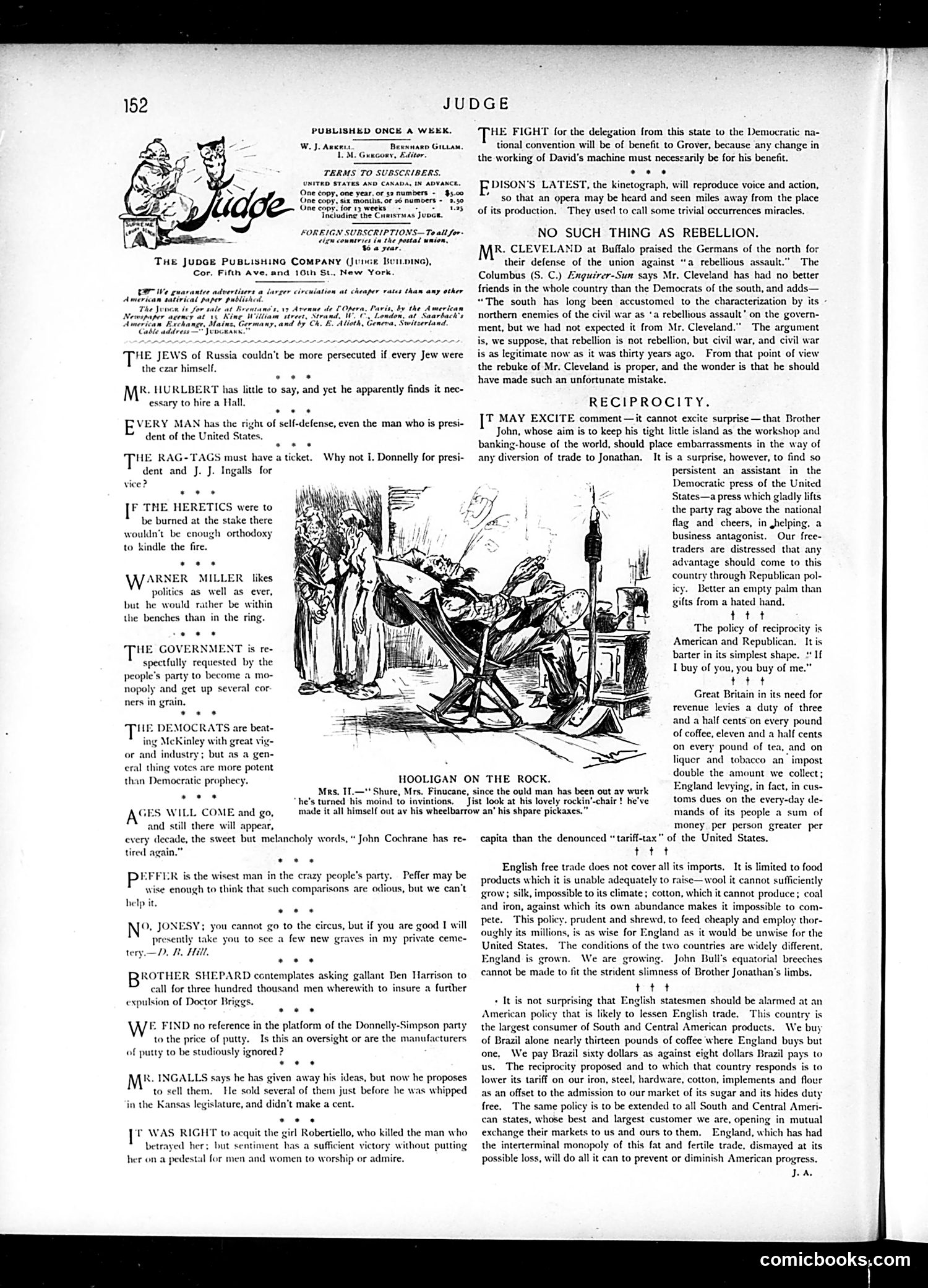
What you’re looking at
The main cartoon, "Hooligan on the Rock," depicts a disheveled man sitting on rocks near water, addressing two women (Mrs. H. and Mrs. Fincanc). The visual joke contrasts his ragged appearance with his boastful claim about his "lovely rockin'-chair" at home and his wheelbarrow as his "share pickaxes." The surrounding text consists of brief political commentary snippets mocking various figures and policies—including jabs at Cleveland's defense of the Union, criticisms of Democratic reciprocity trade policies, and commentary on tariffs affecting England and American trade. The cartoon appears to satirize poverty and homelessness through absurdist humor, while the surrounding commentary reflects late 19th-century debates over tariffs, trade policy, and party politics—likely from the 1880s-1890s era.
📄 Transcribed text from this page (OCR, searchable)
Machine-transcribed from the original scan — historical spelling and the odd misread are preserved.
TERMS TO SUBSCKIBERS. UNITRD STATES AXD CANADA, IN ADVANCE. ix montis. oF 26 numoers » One copy: for 13 weeks + = Including the Cnerststas Jupce. FOREIGN SUBSCRIPTI $3 a sear. THE JUDGE PUBLISHING ComPaNy (Junce BetptNa), Cor. Fifth Ave. and 10th St.. New York. Co We guarantee advertizers a larger circulation at cheaper rates than any other American satirical paper published. The Junon tt for sale at Brentane's, 17 Avenue de [Opera Newspaper acemcy at 1s Kine William street, Strand. WC American Bere Mains, Germany, and by Ch. E. é Cable addres: De rit, by the American at Saarback's . Switeerland. THE JEWS of Russia couldn't be more persecuted if every Jew were the czar himself. R. HURLBERT has little to say, and yet he apparently finds it nec- essary to hire a Hall, VERY MAN has the right of self-defense, even the man who is presi- dent of the United States. HE RAG-TAGS must have a ticket. dent and J. J. Ingalls for vice? Why not i, Donnelly for presi- F TNE HERETICS were to be burned at the stake there wouldn't be enough orthodoxy to kindle the fire. eee WARNER MILLER likes politics as well as ever, but he would rather be within the benches than in the ring. eee HE GOVERNME spectfully requested by the people’s party to become a mo- nopoly and get up several cor: g ner: THE DEMOCRATS are beat- ing Mckinley with great vi or and industry; but as a gen- eral thing votes are more potent than Democratic prophecy. Mrs. I1.— he’s turned his m 1 to invintions. and still there will appear, y decade, the sweet but melancholy words, “ tired again.” John Cochrane has re- eae EFFER is the wisest man in the crazy people's party. Peffer may be wise enough to think that such comparisons are odious, but we can’t help it. NO JONESY: you cannot go to the circus, but if you are good 1 will presently take you to sce a few new graves in my private ceme- tery. —D. 2, Hill, BROTHER SHEPARD contemplates asking gallant Ben Harrison to ‘all for three hundred thousand men wherewith to insure a further expulsion of Doctor Briggs. E, FIND no reference in the platform of the Donnelly-Simpson party to the price of putty. Is this an oversight or are the manufacturers of putty to be studiously ignored ? MB: INGALLS says he has given away his ideas, but now he proposes to sell them, He sold several of them just before he was whipped in the Kansas legislature, and didn’t make a cent. T WAS RIGHT to acquit the girl Robertiello, who killed the man who betrayed her; but sentiment has a sufficient victory without putting her on a pedestal for men and women to worship or admire. HOOLIGAN ON THE ROCK. hure, Mrs, Finucane, since the ould man has been out av wurk Jist look at his lovely rockin’.chair ! he've made it all himself out av his wheelbarrow an’ his shpare pickaxes.”” JUDGE PUBLISHED ONCE A WEEK. THE FIGHT for the delegation {rom this state to the Democratic na- tional convention will be of benefit to Grover, because any change in the working of David’s machine must necessarily be for his benefit. E DISON’S LATEST, the kinetograph, will reproduce voice and action, * so that an opera may be heard and seen miles away from the place of its production. They used to call some trivial occurrences miracles. NO SUCH THING AS REBELLION. R. CLEVELAND at Buffalo praised the Germans of the north for their defense of the union against ‘a rebellious assault.” The Columbus (S. C.) Enguirer-Sun says Mr. Cleveland has had no better friends in the whole country than the Democrats of the south, and adds. “The south has long been accustomed to the characterization by northern enemies of the civil war as ‘a rebellious assault’ on the govern- ment, but we had not expected it from Mr. Cleveland.” The argument is, we suppose, that rebellion is not rebellion, but civil war, and civil war is as legitimate now as it was thirty years ago. From that point of view the rebuke of Mr. Cleveland is proper, and the wonder is that he should have made such an unfortunate mistake. RECIPROCITY. It MAY EXCITE comment —it cannot excite surprise —that Brother John, whose aim is to keep his tight little island as the workshop and banking-house of the world, should place embarrassments in the way of any diversion of trade to Jonathan. It is a surprise, however, to find so persistent an assistant in the Democratic press of the United States—a press which gladly lifts the party rag above the national flag and cheers, in helping, a business antagonist. Our free- traders are distressed that any advantage should come to this country through Republican pol- icy. Better an empty palm than gifts from a hated hand. fetet The policy of reciprocity is American and Republican. It is barter in its simplest shay f I buy of you, you buy of me. tietest Great Britain in its need for revenue levies a duty of three and a half cents on every pound of coffee, eleven and a half cents on every pound of tea, and on liquer and tobacco an’ impost double the amount we collect; England levying, in fact, in cus- toms dues on the every-day de- mands of its people a sum of money. per person greater per iff-tax” of the United States, tet t English free trade does not cover all its imports. It is limited to food products which it is unable adequately to raise—wool it cannot sufficiently grow; silk, impossible to its climate; cotton, which it cannot produce; coal and iron, against which its own abundance makes it impossible to com- pete. This policy. prudent and shrewd, to feed cheaply and employ thor- oughly its millions, is as wise for England as it would be unwise for the United States. The conditions of the two countries are widely different. England is grown. We are growing. John Bull's equatorial breeches cannot be made to fit the strident slimness of Brother Jonathan's limbs. toot th + It is not surprising that English statesmen should be alarmed at an American policy that is likely to lessen English trade. This country the largest consumer of South and Central American products. We buy of Brazil alone nearly thirteen pounds of coffee where Eng!: one, We pay Brazil sixty dollars as against eight dollars Bra us. The reciprocity proposed and to which that country responds is to lower its tariff on our iron, steel, hardware, cotton, implements and flour as an offset to the admission to our market of its sugar and its hides duty free, The same poli to be extended to all South and Central Ameri- can states, whose best and largest customer we are, opening in mutual exchange their markets to us and ours to them. England, which has had the interterminal monopoly of this fat and fertile trade, dismayed at its possible loss, will do all it can to prevent or diminish American progress. Jok, capita than the denounced “ts comicbooks,com