
A complete issue · 16 pages · 1891
Judge — May 23, 1891
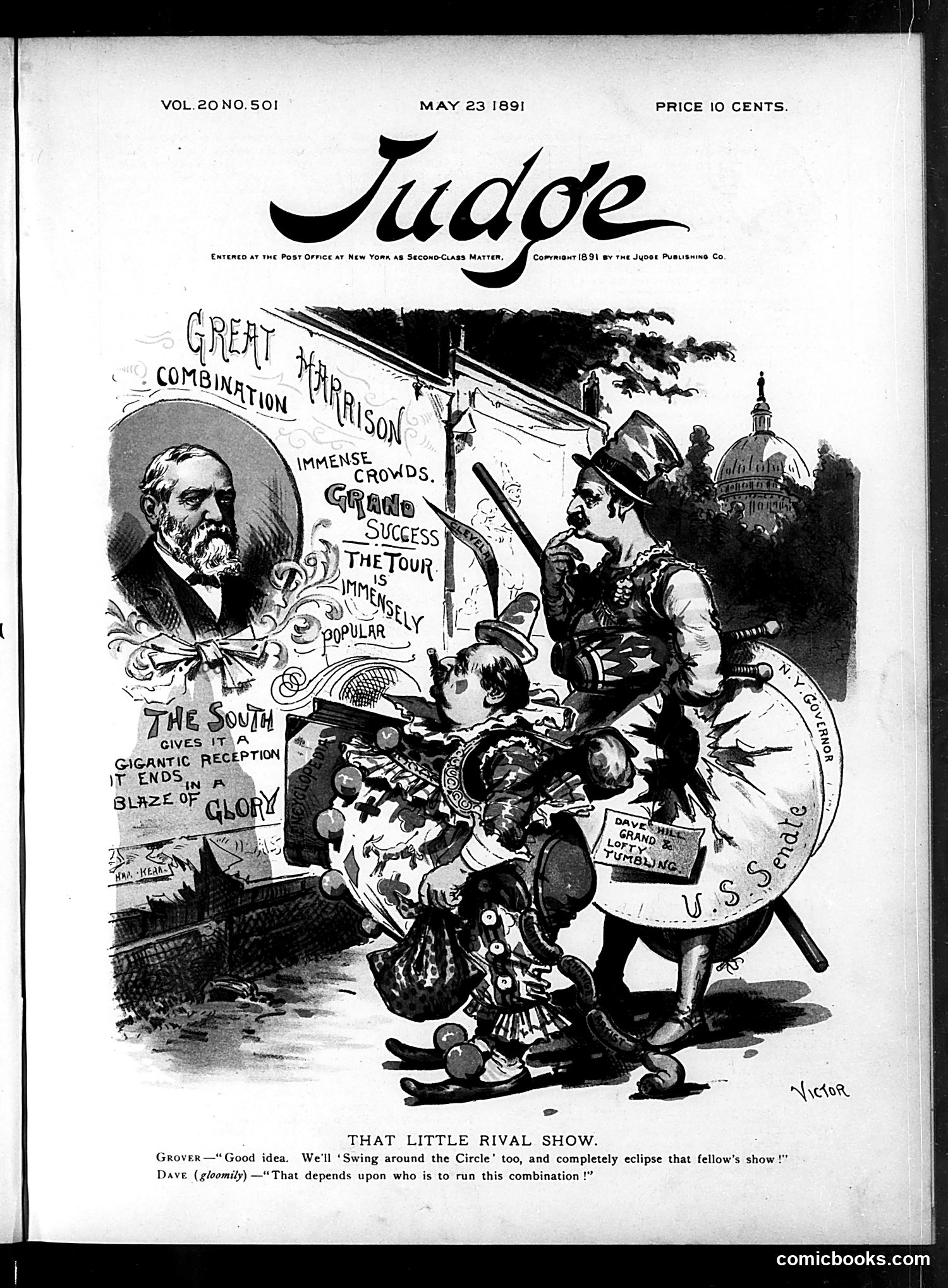
This political cartoon satirizes what appears to be a **competitive touring show or exhibition** in the American South during the 1891 season. The left panel shows a bearded man (likely a promoter or showman) advertising his event's success with promotional signs mentioning "Great Harrison," "immense crowds," and "the South gives a gigantic reception." The right panel depicts two figures in theatrical/circus costume with a "U.S. Port" circular emblem, discussing their competing show. The caption "That Little Rival Show" suggests rivalry between competing entertainers or exhibitions. The satire appears to mock Southern enthusiasm for touring spectacles while questioning whether promotional success depends on who runs the operation. The exact historical event remains **unclear** from visual evidence alone.
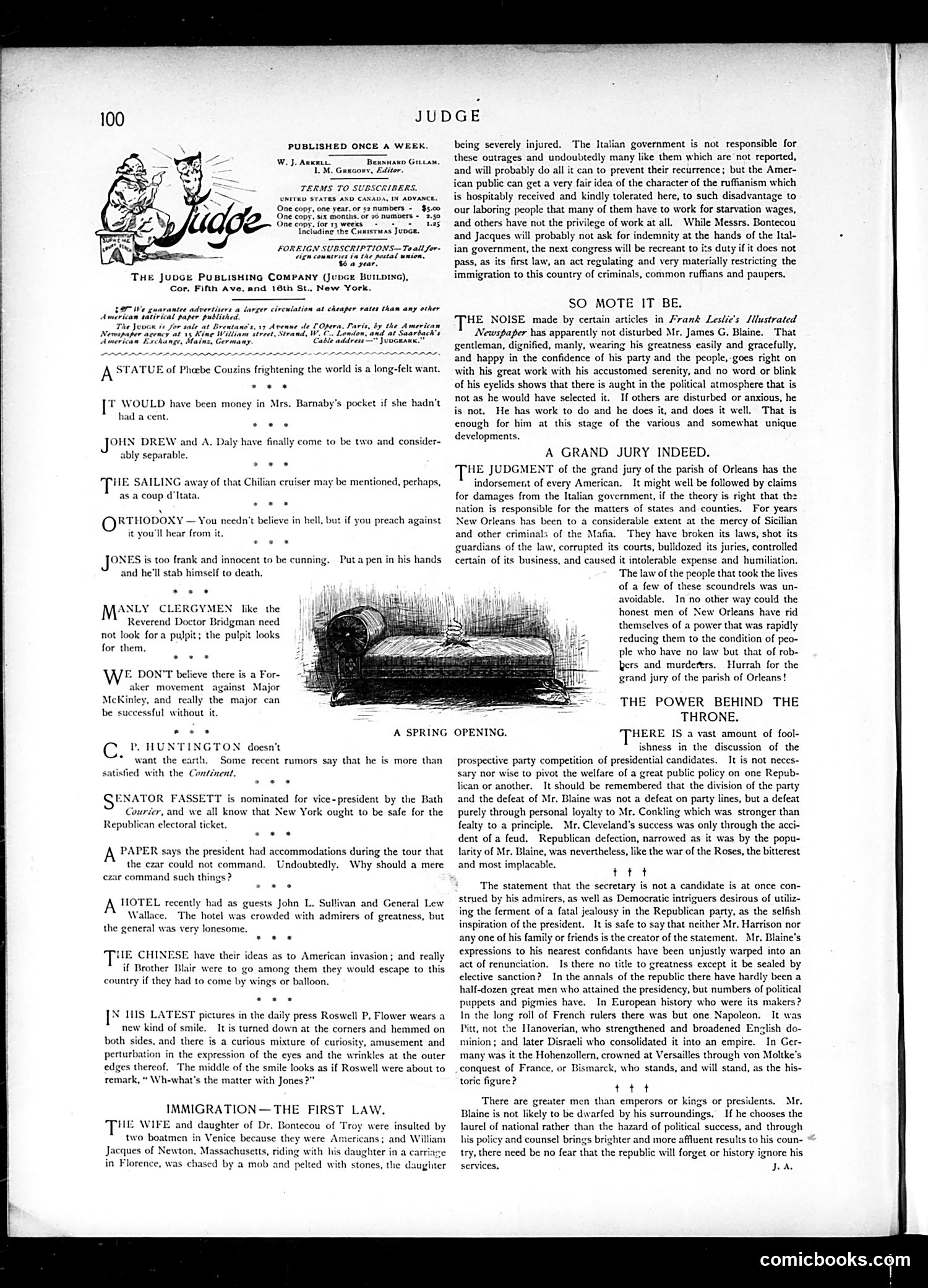
This page contains several short satirical items rather than a single cartoon. The visible sketch shows "A Spring Opening"—a bed, likely satirizing political "openings" or campaign season developments. The text references contemporary political figures and events: **Senator Fassett's** vice-presidential nomination, **McKinley** and the Republican ticket, **Blaine's** earlier political defeats, and **Cleveland's** presidency. The final section, "Immigration—The First Law," satirizes anti-immigration sentiment, mocking a mob attack on American visitors in Venice, Italy, who were mistaken for foreigners. This appears to be commentary on American xenophobia and immigrant prejudice. The pieces collectively critique Republican politics, presidential ambitions, and American attitudes toward foreigners during the Gilded Age.
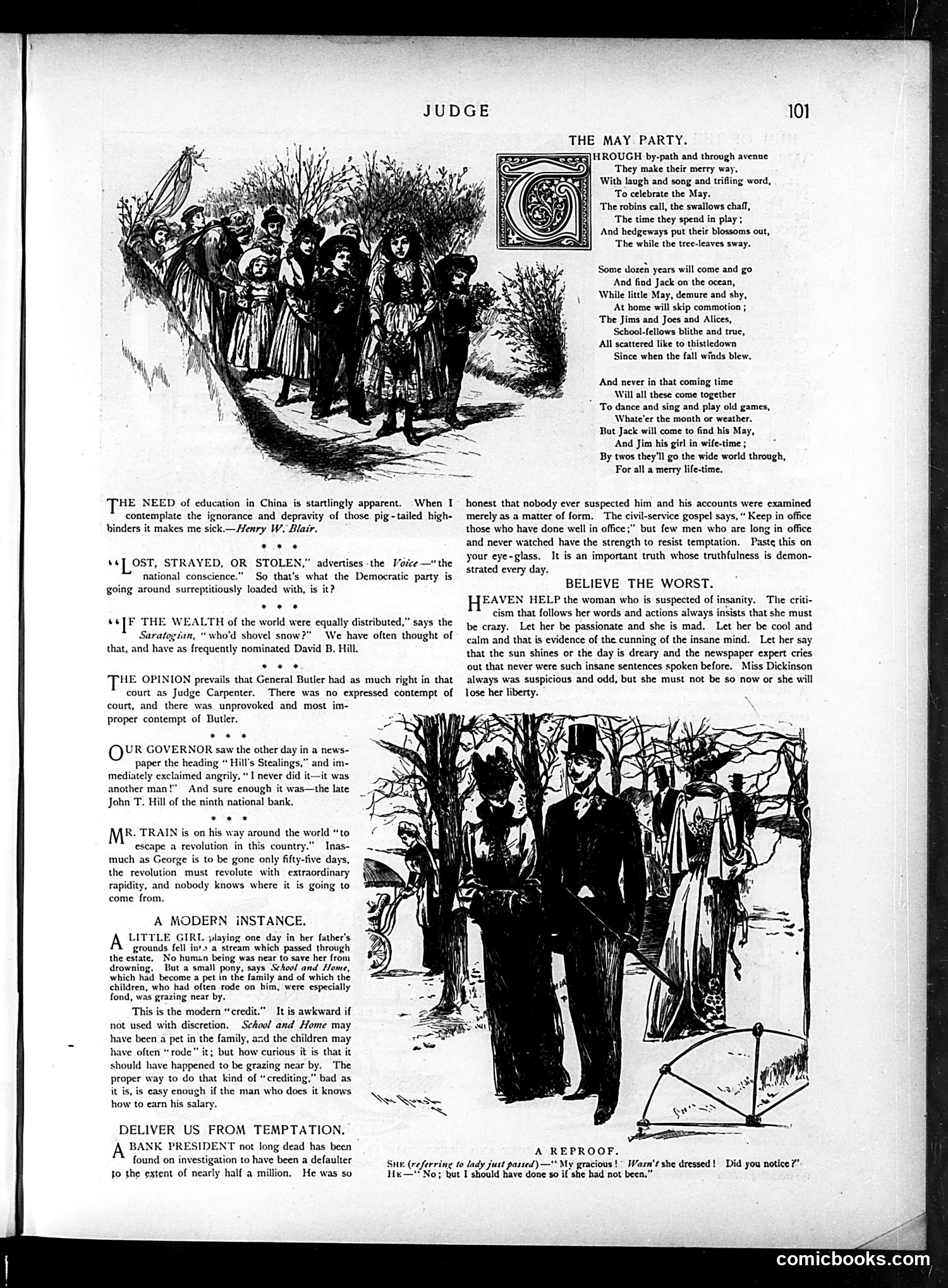
**Top Illustration:** A group of children in Victorian dress walk through countryside vegetation. The accompanying poem "The May Party" celebrates a traditional springtime children's outing, describing nature walks, games, and innocent pleasures. It references specific children by name (Jack, May, Jim, Joes, Alices) in a sentimental narrative about childhood friendships scattering over time. **Lower Content:** The page contains various satirical political and social commentary pieces typical of Judge magazine, including critiques of government policies, banking practices, and social hypocrisy. References include General Butler, David B. Hill, and other contemporary political figures, though specific historical context for these references would require additional period documentation. The overall tone blends nostalgic Americana with sharp social criticism characteristic of late 19th-century American satire.
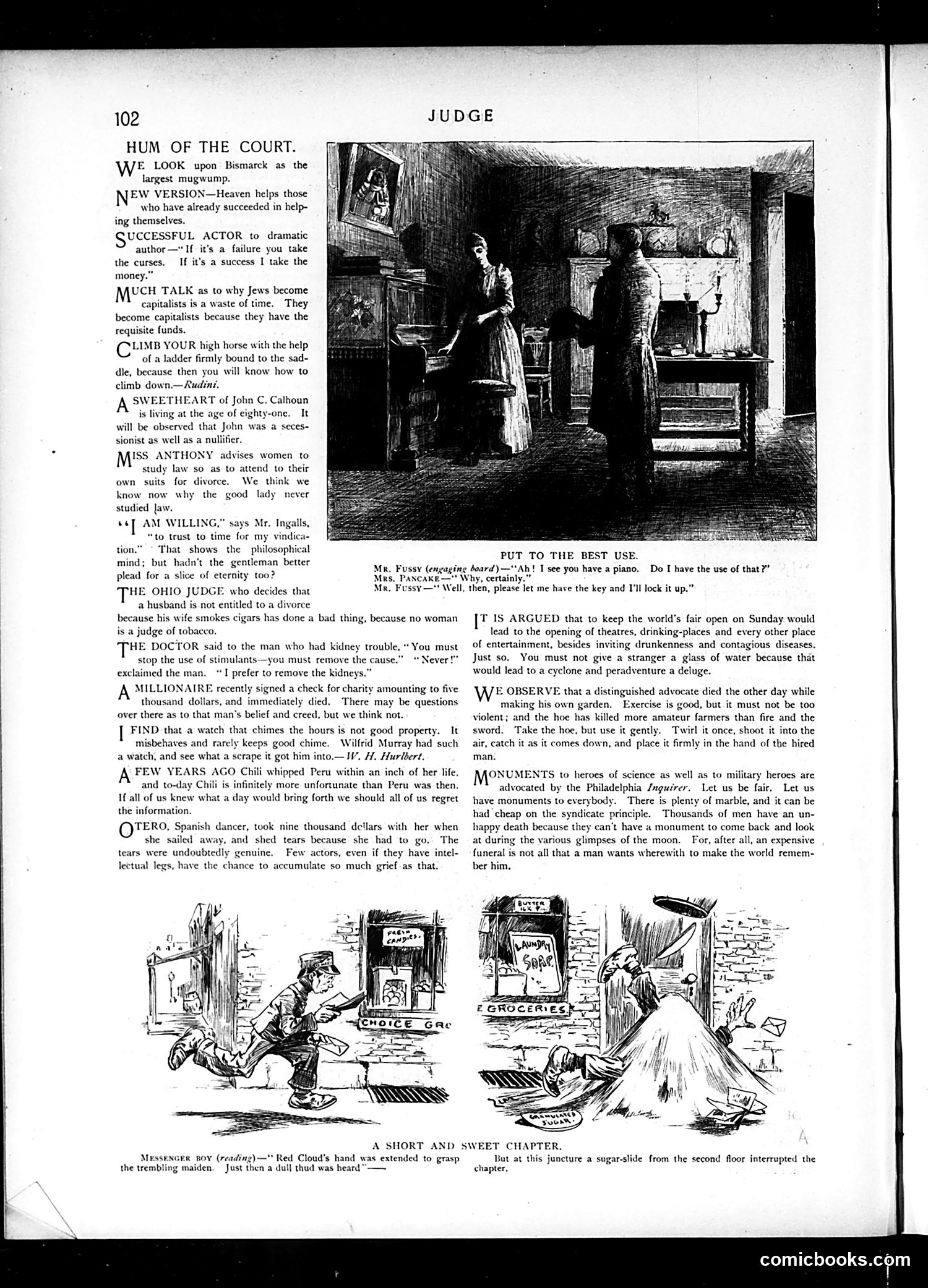
This page collects brief satirical quips and observations typical of Judge's "Hum of the Court" column. The content mocks contemporary figures and social pretensions: **Key references include:** - Bismarck as a "mugwump" (independent/unreliable politician) - John C. Calhoun (19th-century statesman) and nullification politics - Miss Anthony (likely Susan B. Anthony) and women's legal rights - An Ohio judge's ruling denying divorce based on a wife smoking cigars - References to Chile-Peru conflict and Spanish dancer **The central cartoon** shows a boarding-house keeper refusing a piano tenant use of the instrument, offering to lock it up instead—mocking stingy miserliness disguised as practicality. **Overall tone:** Judge satirizes American hypocrisy, legal absurdities, and social pretension through short, barbed jokes targeting politicians, judges, wealthy figures, and gender-related controversies of the period.
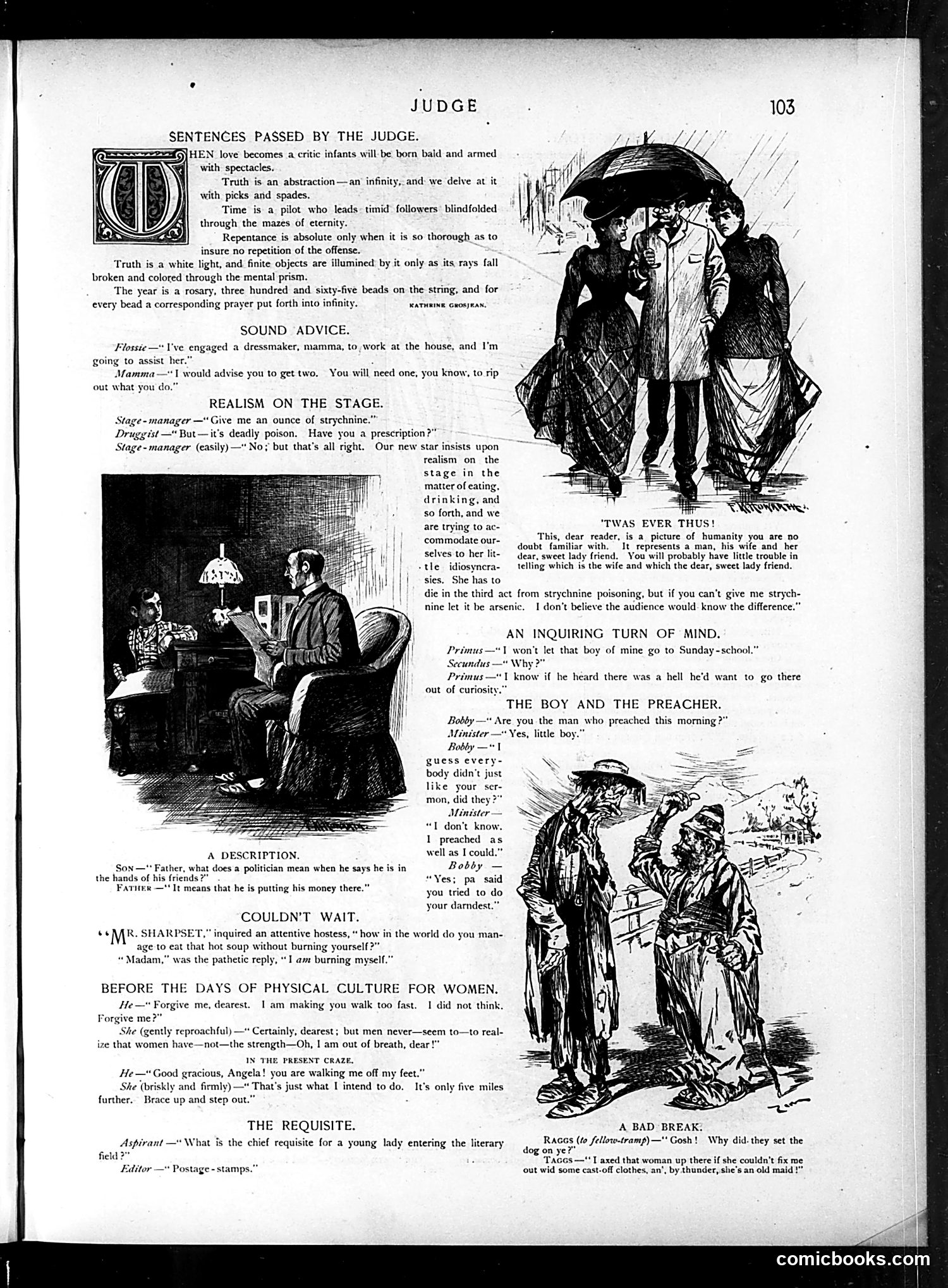
This page from *Judge* magazine collects brief satirical pieces mocking contemporary society and human nature. Key items include: **"Realism on the Stage"** ridicules theatrical pretension—a stage manager requests deadly poison (strychnine or arsenic) to poison an actress during performance, claiming the "star insists upon realism." The satire targets both Method acting extremism and producers' absurd accommodation of artistic demands. **"The Boy and the Preacher"** presents a child's innocent logic: he won't attend Sunday school because hearing about hell made him curious to experience it—mocking both religious instruction and parental concerns. **"Before the Days of Physical Culture for Women"** contrasts traditional femininity (claiming weakness, breathlessness) with the "present craze" of vigorous female athleticism, where a woman energetically forces her exhausted male companion to hike five more miles—satirizing evolving gender expectations and the physical culture movement. Other brief jokes target dressmakers, politicians, and social pretension. The illustrations complement the text's gentle mockery of modern life's absurdities.
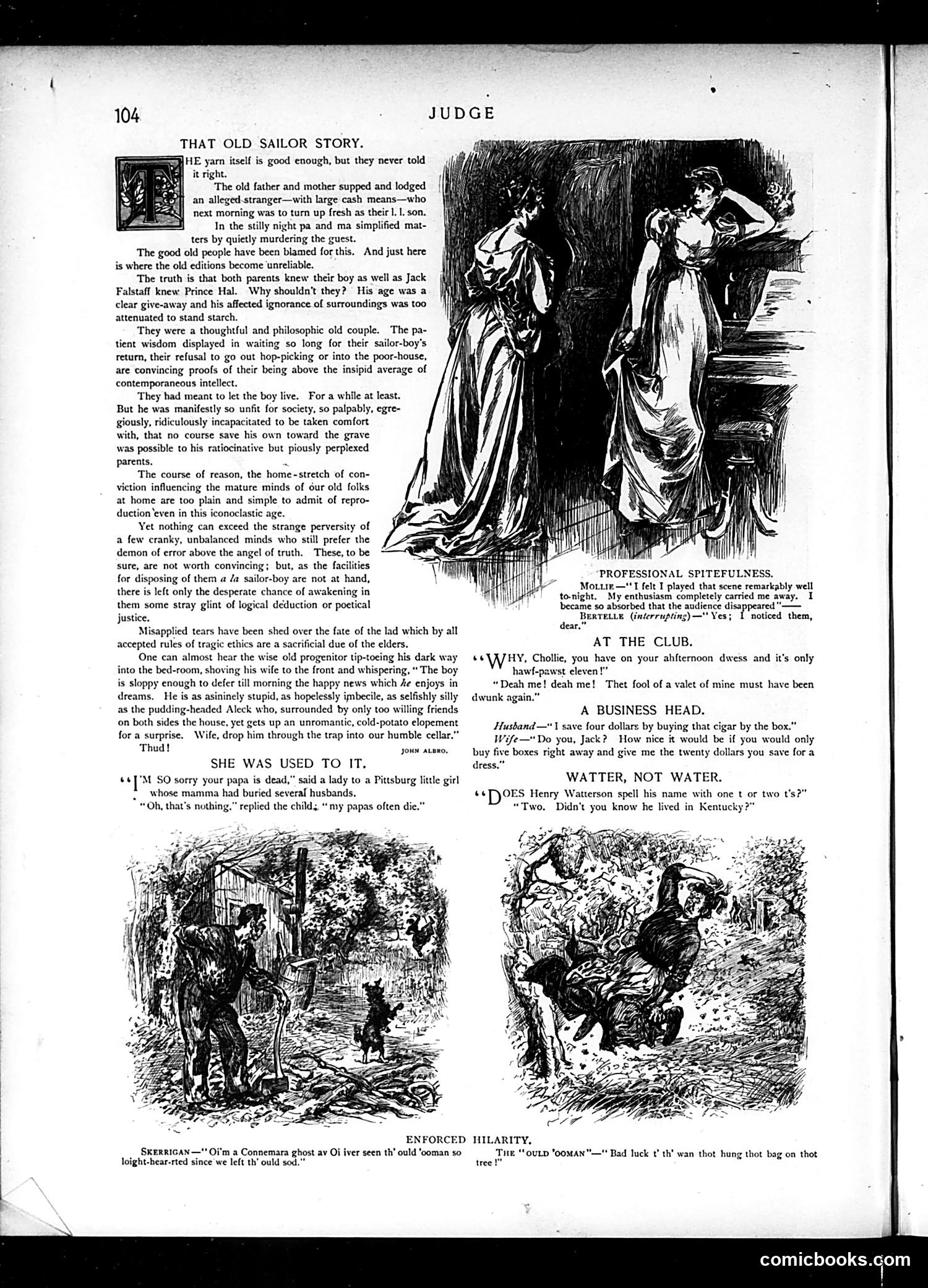
This page presents multiple satirical pieces mocking Victorian sentimentality and social pretension. **Main Story:** A darkly humorous tale defending elderly parents who murder a returning sailor son. The satire ridicules the sentimental "prodigal son" narrative by suggesting the parents recognized their grown boy as hopelessly stupid and socially incompetent—thus murder was a rational act of mercy. Judge uses verbose, philosophical language to mock both the parents' actions and readers' tearful reactions to such stories in popular literature. **Short Jokes:** Minor satirical vignettes targeting social classes: - A Pittsburgh girl's blasé attitude about multiple dead fathers (mocking remarriage) - Theatrical vanity (an actor congratulating himself while audiences fled) - Gender dynamics (wife outmaneuvering husband's savings) - Irish dialect humor (Connemaugh ghost) The page exemplifies Judge's brand of cynical, irreverent humor—using exaggeration and inversion to deflate contemporary moral pieties and expose human foolishness across class lines.
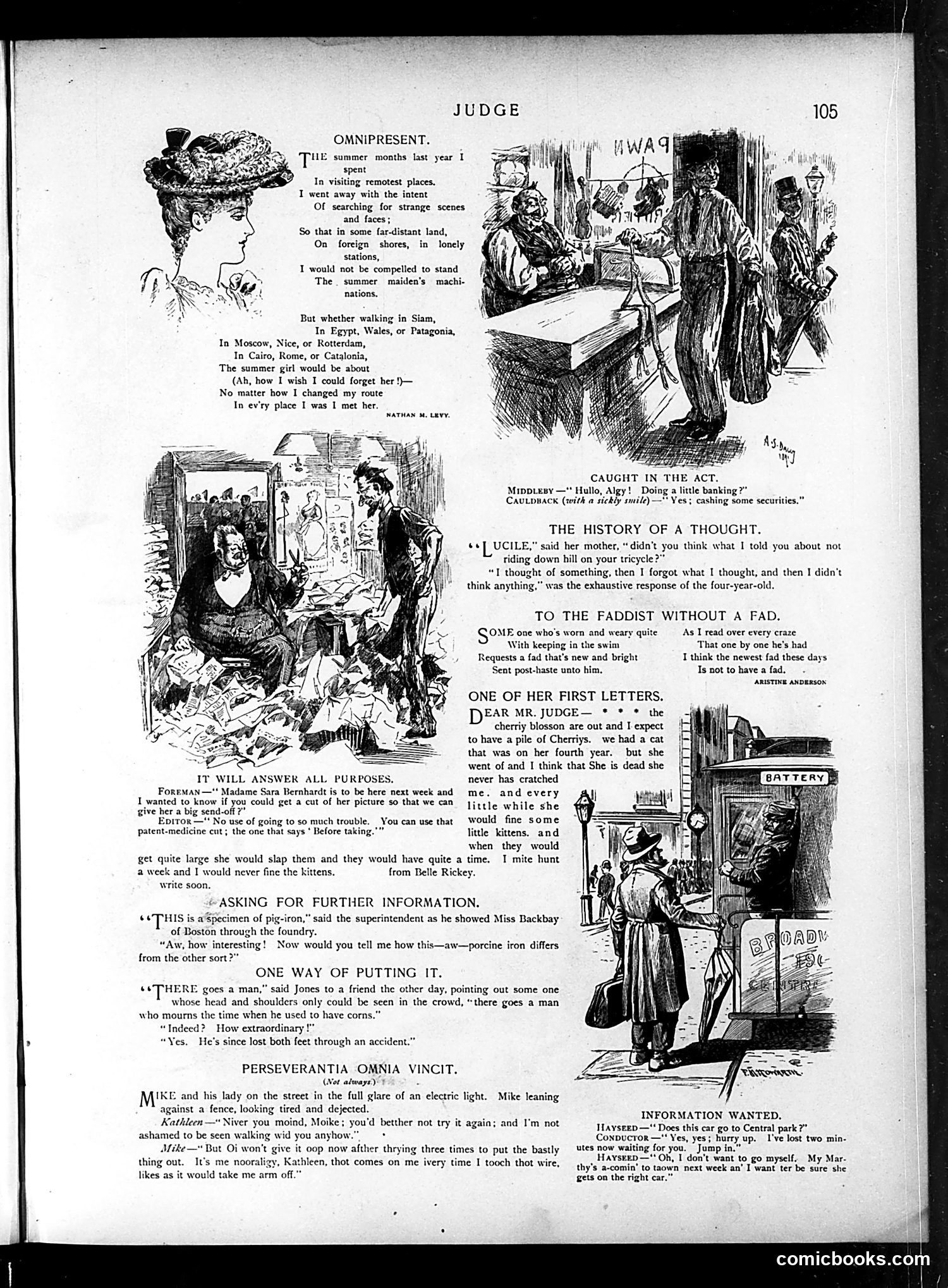
This page contains multiple short humor pieces and cartoons typical of Judge's satirical format. **"Omnipresent"** features a poem about a woman traveling globally, with an illustration of an elegant woman's profile. **"Caught in the Act"** appears to be a brief joke about someone caught doing something inappropriate (specifics unclear from partial OCR). **"The History of a Thought"** humorously depicts a child's logic about forgetting thoughts. **"One of Her First Letters"** presents correspondence about a dead cat and missing kittens—domestic humor about pet ownership. **"Perseverantia Omnia Vincit"** shows a couple under electric light discussing a mishap with wire. The cartoons employ the magazine's typical approach: satirizing everyday social situations, domestic life, and human foibles rather than explicit political commentary. The illustrations use period-appropriate pen-and-ink style characteristic of early 20th-century American humor magazines.
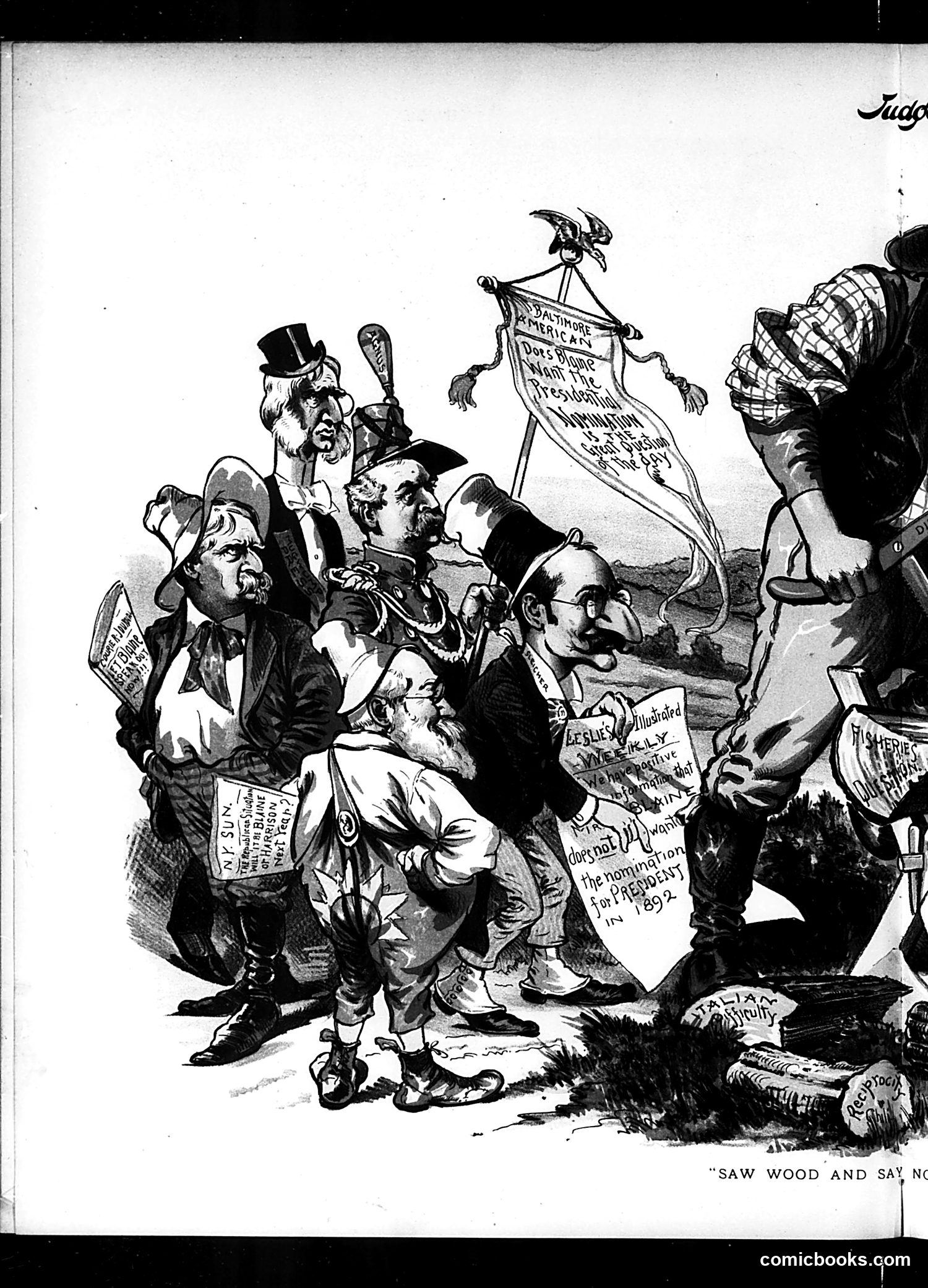
This appears to be a late 19th-century political cartoon from *Judge* magazine satirizing American political figures and interests. The central scene shows caricatured men in formal dress examining or discussing what appear to be territorial or political claims (visible on banners/documents they're holding). The kite or banner suspended above bears text suggesting Baltimore interests or claims. One figure on the right holds what appears to be a "Fisheries" document. The caption "Saw Wood and Say No" (partially visible) suggests a commentary on political maneuvering or duplicitous behavior—appearing to work while actually obstructing progress. The exaggerated facial features and formal dress suggest mockery of politicians or political stakeholders negotiating territorial, commercial, or diplomatic matters, likely from the 1890s based on the artistic style.
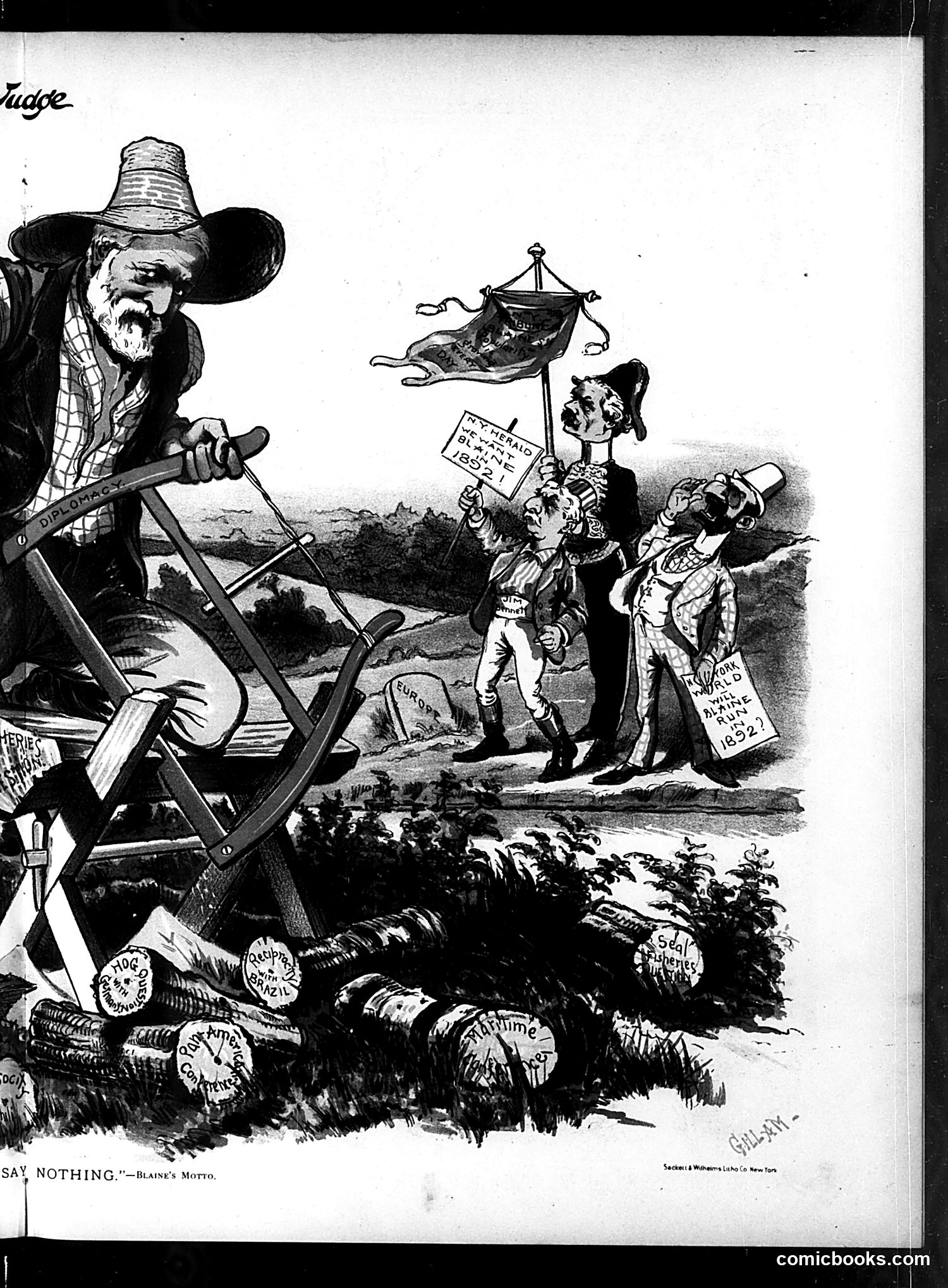
This is a satirical cartoon titled "Say Nothing"—Blaise's Motto," attributed to an artist named Blak (signature visible). The cartoon depicts a large man in a cowboy hat operating what appears to be a surveying or measuring device, while smaller figures below hold signs and look upward. The logs scattered below are labeled with what appear to be place names or territories. This likely satirizes American expansionism or territorial disputes in the late 19th/early 20th century. The figure with the surveying equipment suggests someone measuring or claiming land, while the smaller figures' distress indicates resistance or concern about territorial appropriation. "Blaise's Motto" and "Say Nothing" suggest a policy of silent or unquestioned expansion. Without clearer date confirmation or visible publication information, the specific historical event remains unclear, though the imagery strongly suggests colonial or imperialist commentary.
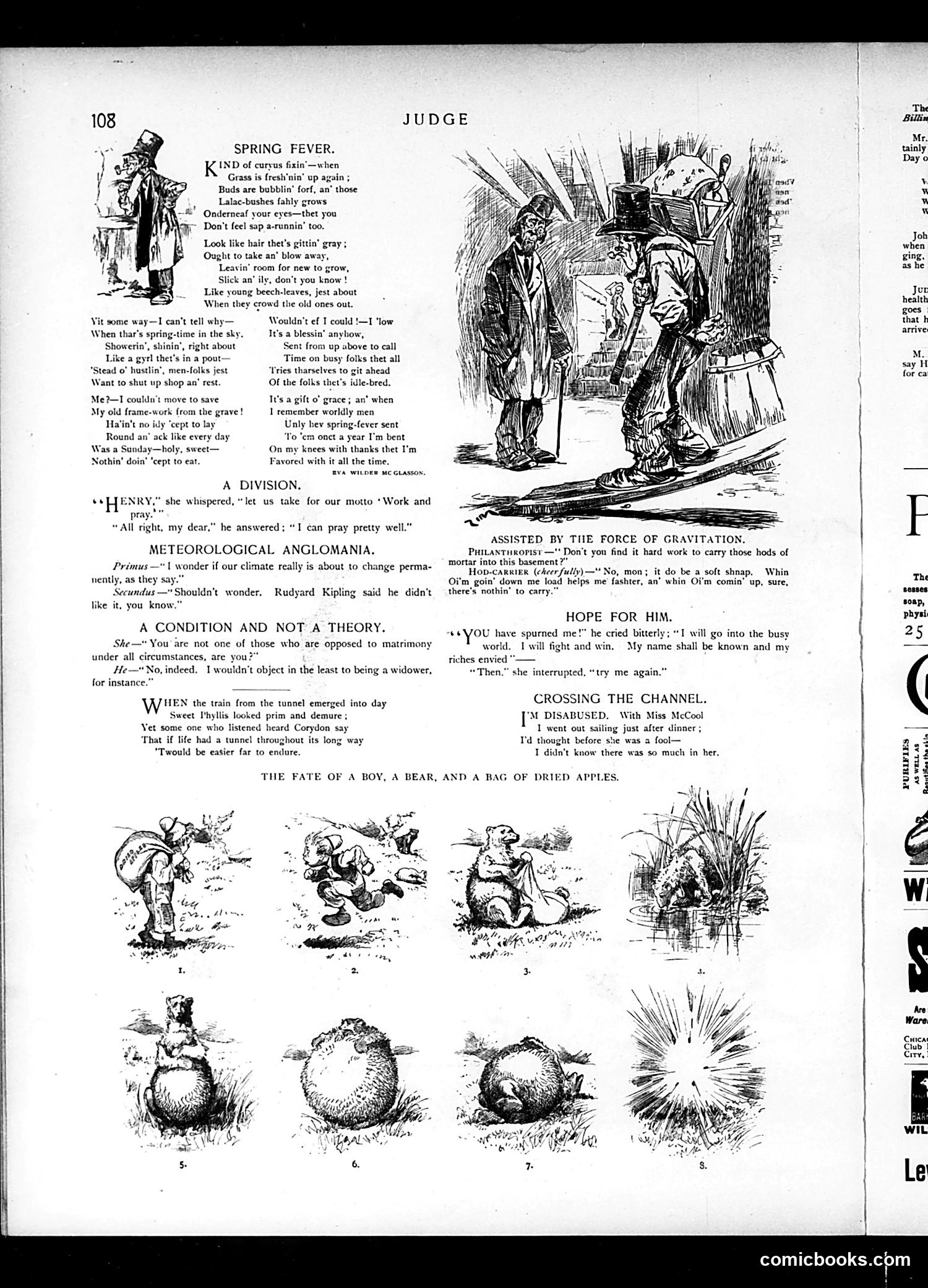
This page collects several short humorous pieces typical of Judge's satirical commentary: **"Spring Fever"** is a dialect poem mocking rural/working-class attitudes toward spring—the speaker celebrates laziness and indolence when warm weather arrives, contrasting with those who maintain work ethic. **"A Division"** satirizes marital compromise: a couple agrees on "Work and pray" as their motto, suggesting couples must negotiate fundamentally opposing values. **"Assisted by the Force of Gravitation"** features an Irish laborer (identified by dialect spelling "Oi'm," "Whin") explaining to a philanthropist that gravity helps him carry loads downward but hinders going up—a joke about physics and manual labor. **"Hope for Him"** depicts a romantic scenario where a rejected suitor vows to prove himself through worldly success; the woman agrees to "try again" once he's wealthy—satirizing mercenary attitudes in courtship. The bottom section shows sequential cartoon panels illustrating "The Fate of a Boy, a Bear, and a Bag of Dried Apples"—likely a visual gag story now illegible without context.
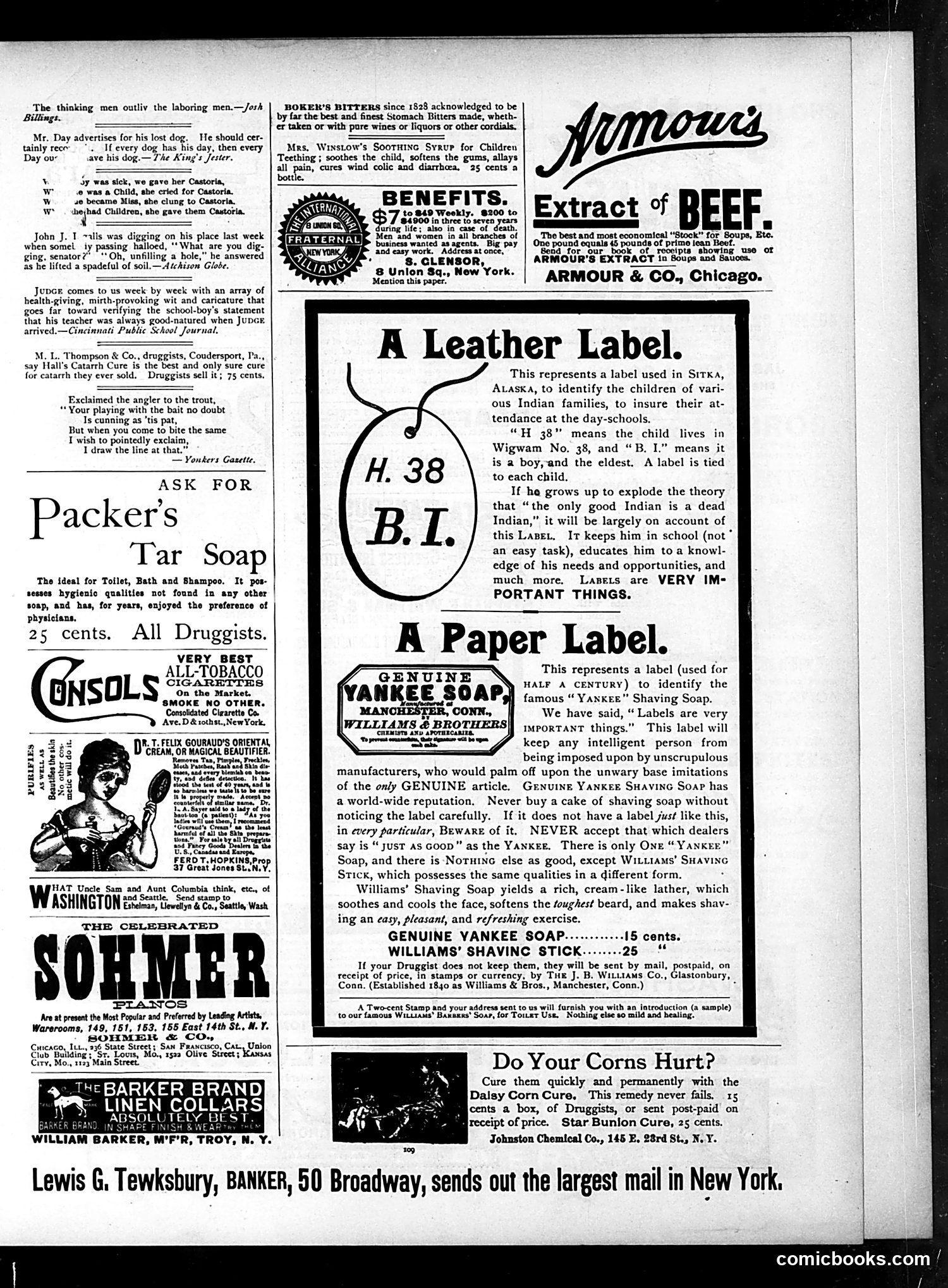
This page is primarily **advertising**, with minimal satirical content. The few joke items scattered among ads include: **Visible Humor:** - A pun about "Mr. Day" losing his dog, playing on the phrase "every dog has his day" - A brief anecdote about Senator "T" filling a hole while digging, with wordplay on "unfilling" - An angler's complaint to a trout about the fishing bait **Notable Content:** The page features a substantive illustrated article about **leather labels used in Sitka, Alaska to identify Native American (Indigenous) children at day schools**. The article explains the labeling system (e.g., "H.38" = Wigwam No. 38, "B.I." = boy, eldest), and optimistically suggests such schooling might counter the racist saying "the only good Indian is a dead Indian." This reflects late 19th-century assimilationist attitudes toward Indigenous peoples—presenting forced attendance at colonial schools as benevolent "education." The remainder consists of period patent medicines, soaps, and products typical of Judge's advertising base.
This page is primarily **advertising**, not political satire. It's a typical late 19th-century magazine page filled with commercial notices for consumer goods and services. The one editorial content item is a brief humor piece about "The Ideal Passenger Train," which praises the Pennsylvania Railroad's "limited" service as America's finest train. This appears to be straightforward promotional commentary rather than satire. The accompanying anecdote about a boy naming his dog "Fish" because "he won't bite" is a simple joke about wordplay—the dog's name confuses a stranger, leading to a pun about biting. The remainder of the page consists entirely of advertisements for products including perfume, chocolate, bicycles, wines, musical instruments, tea, and patent medicines—typical commercial messaging of the era. There is no discernible political commentary or satirical content visible in either the text or illustrations.
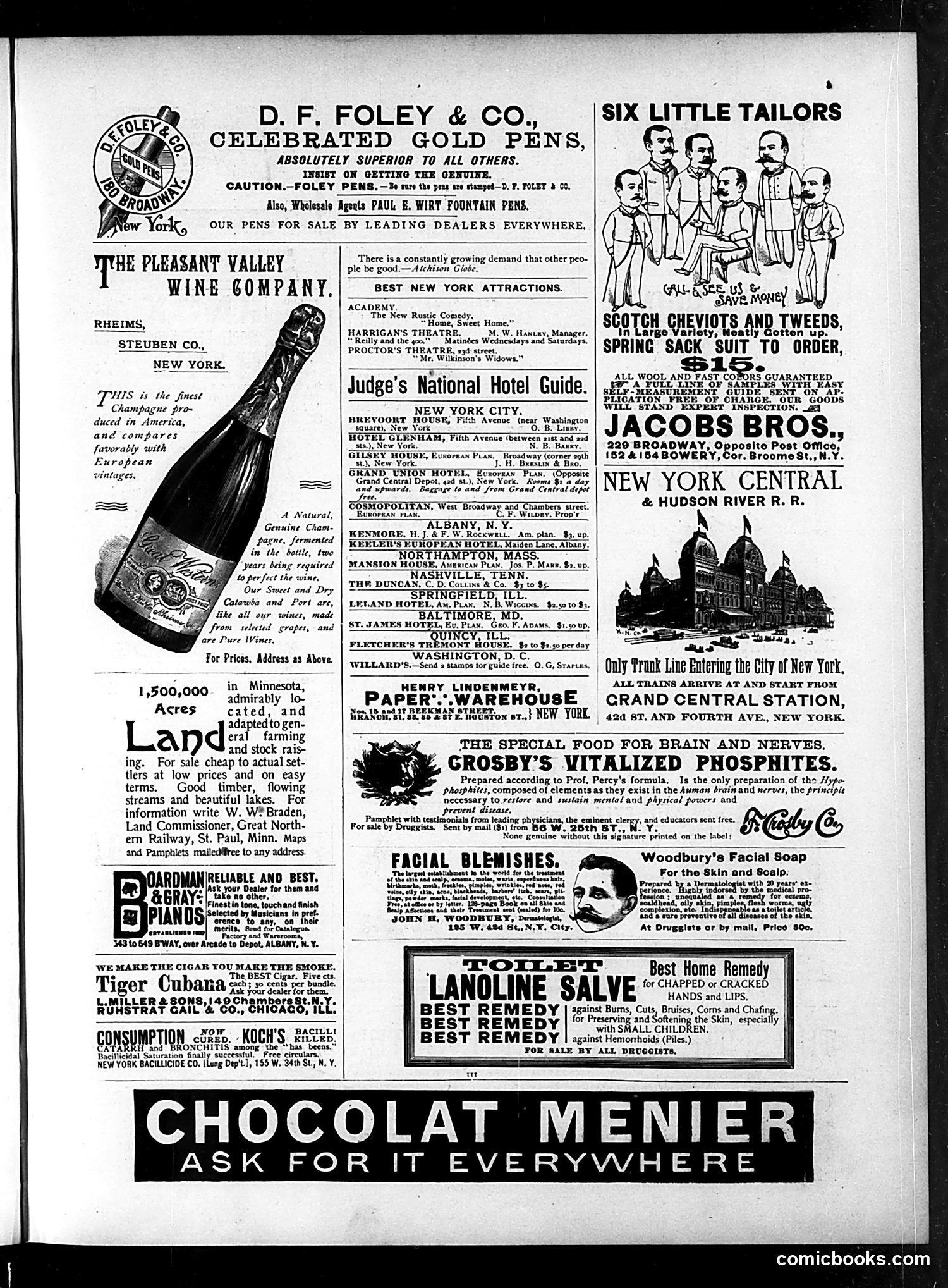
This is primarily an **advertising page** from Judge magazine, not a satirical cartoon. The page contains dozens of period advertisements for various products and services: pens, wine, champagne, land in Minnesota, pianos, cigars, hotels across America, and patent medicines. The only potentially satirical element is a small quotation at the top: "There is a constantly growing demand that other people be good.—Atchison Globe." This appears to be a gentle jab at social reformism—the idea that people want *others* to behave morally while exempting themselves. The illustrated content includes a **"Six Little Tailors"** advertisement showing six men in tailoring poses, promoting Scottish tweeds and spring suits. The rest consists of hotel guides, product endorsements, and medical cure-alls typical of late 19th-century publishing. Most notably, "Grosby's Vitalized Phosphites" and consumption remedies represent the era's patent medicine culture before FDA regulation. This appears to be a revenue page rather than editorial content.
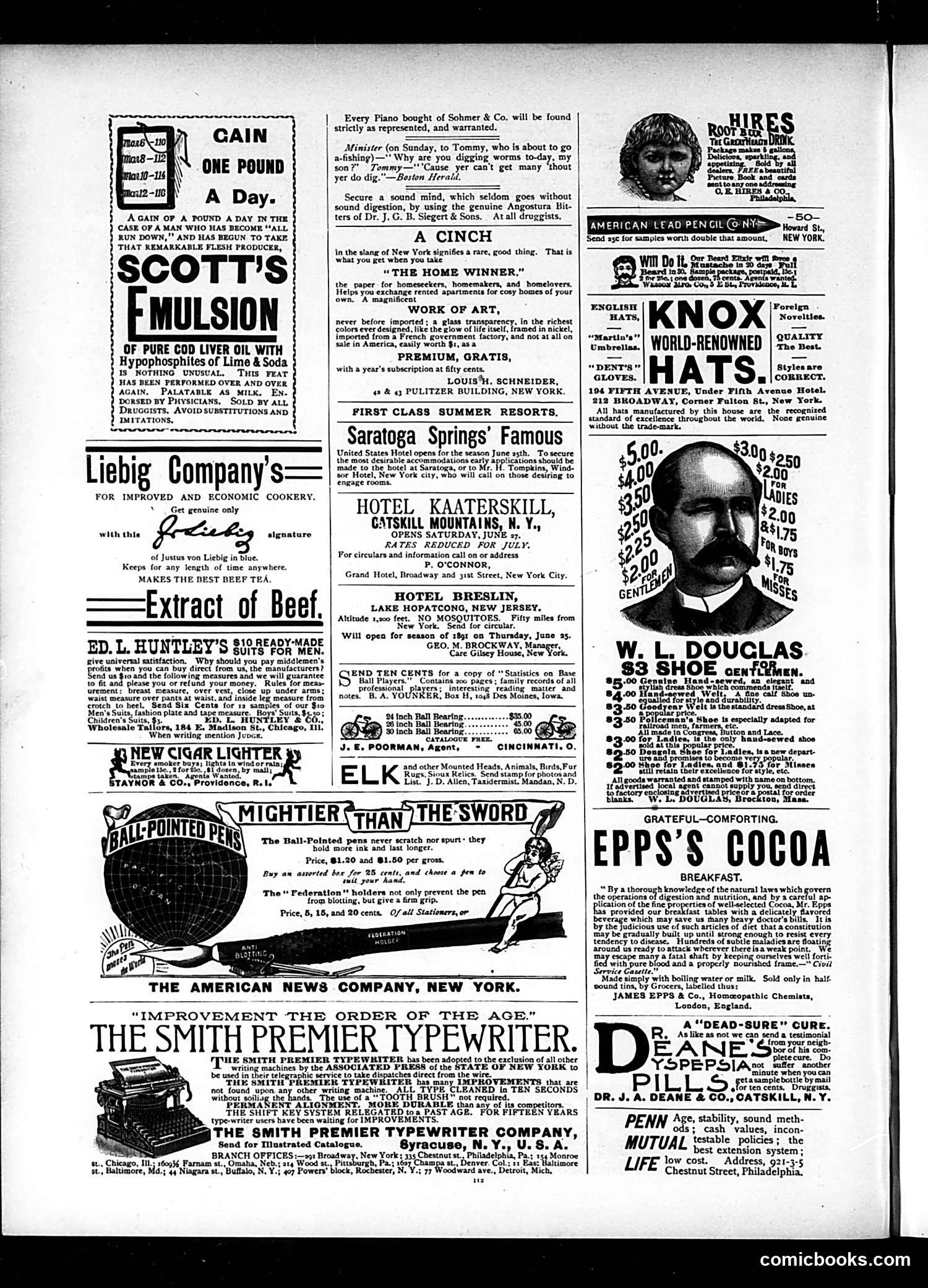
This page is primarily **advertisements** rather than editorial cartoons, typical of early American magazines. The content reflects **late 19th/early 20th-century consumer culture**, with ads for: - **Health tonics** (Scott's Emulsion cod liver oil, Angostura Bitters) claiming to cure weakness - **Men's suits** sold directly by manufacturers, bypassing middlemen - **Hotels and resorts** (Saratoga Springs, Catskill Mountains) for leisure travel - **Office equipment** (Smith Premier typewriter) - **Cocoa and breakfast products** (Epps's) There is **one brief joke** about fishing worms between a minister and boy ("Tommy"), illustrating Judge's typical humor style. The ads reveal what concerned middle/upper-class readers then: physical health, cost-saving through direct purchase, Victorian leisure travel, and emerging technologies. No clear political satire appears on this page.
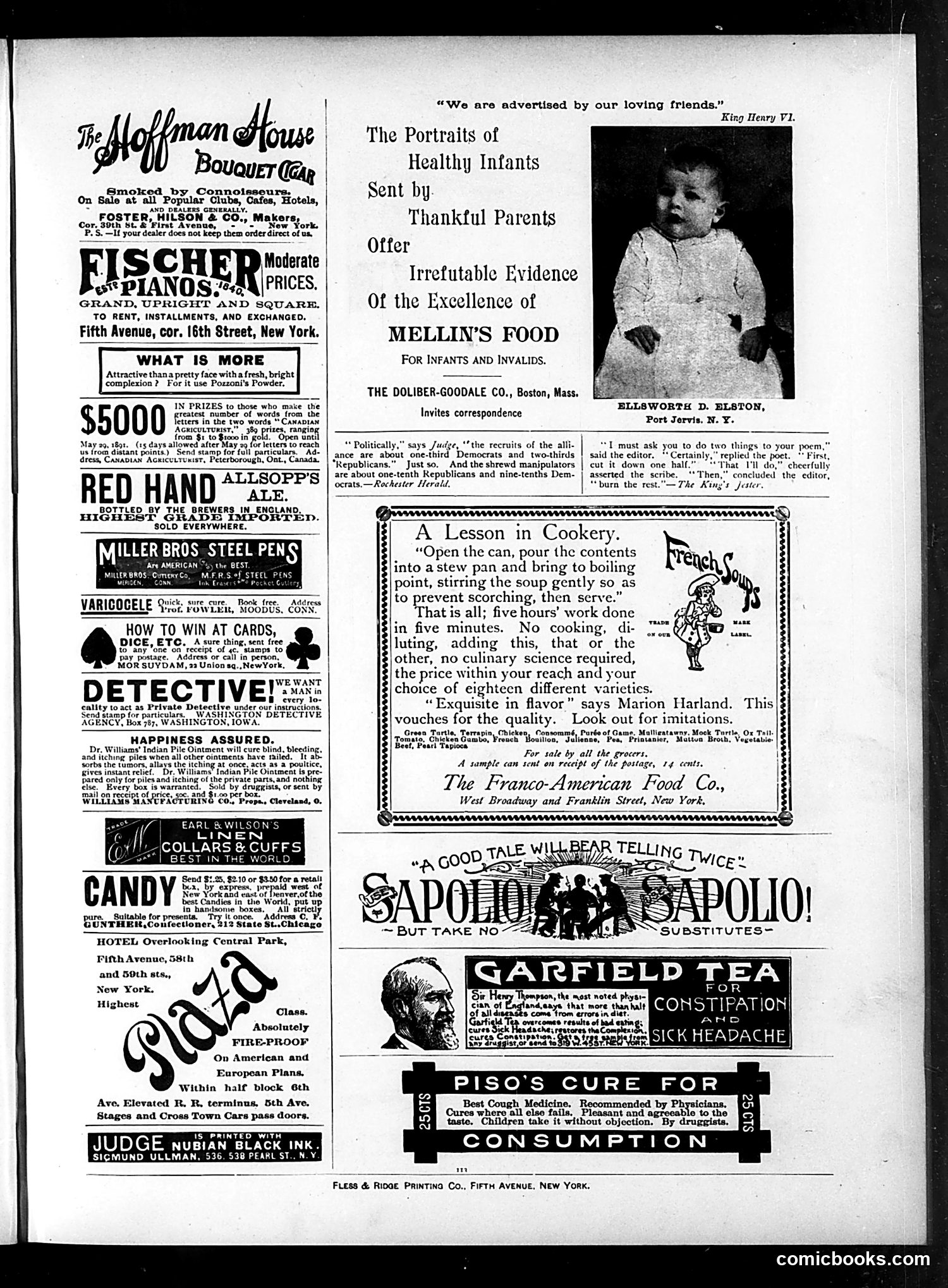
This page consists primarily of **advertisements rather than satirical cartoons**. The few small editorial pieces are brief humor items rather than political commentary. The main notable content includes a short political joke contrasting Democratic and Republican party composition, and a "Lesson in Cookery" advertising the Franco-American Food Co.'s canned soups—satirizing how prepared foods promise to eliminate actual cooking labor in just five minutes. The page's centerpiece is a portrait photograph of "Ellsworth D. Elston, Fort Jervis, N.Y." labeled as "The Portraits of Healthy Infants Sent by Thankful Parents," endorsing Mellin's Food infant formula. Most of the real estate showcases period advertisements: pianos, pens, ale, candy, detective services, patent medicines (Piso's Cure, Garfield Tea), and hotel accommodations. The publication date and specific context remain unclear from visible text.
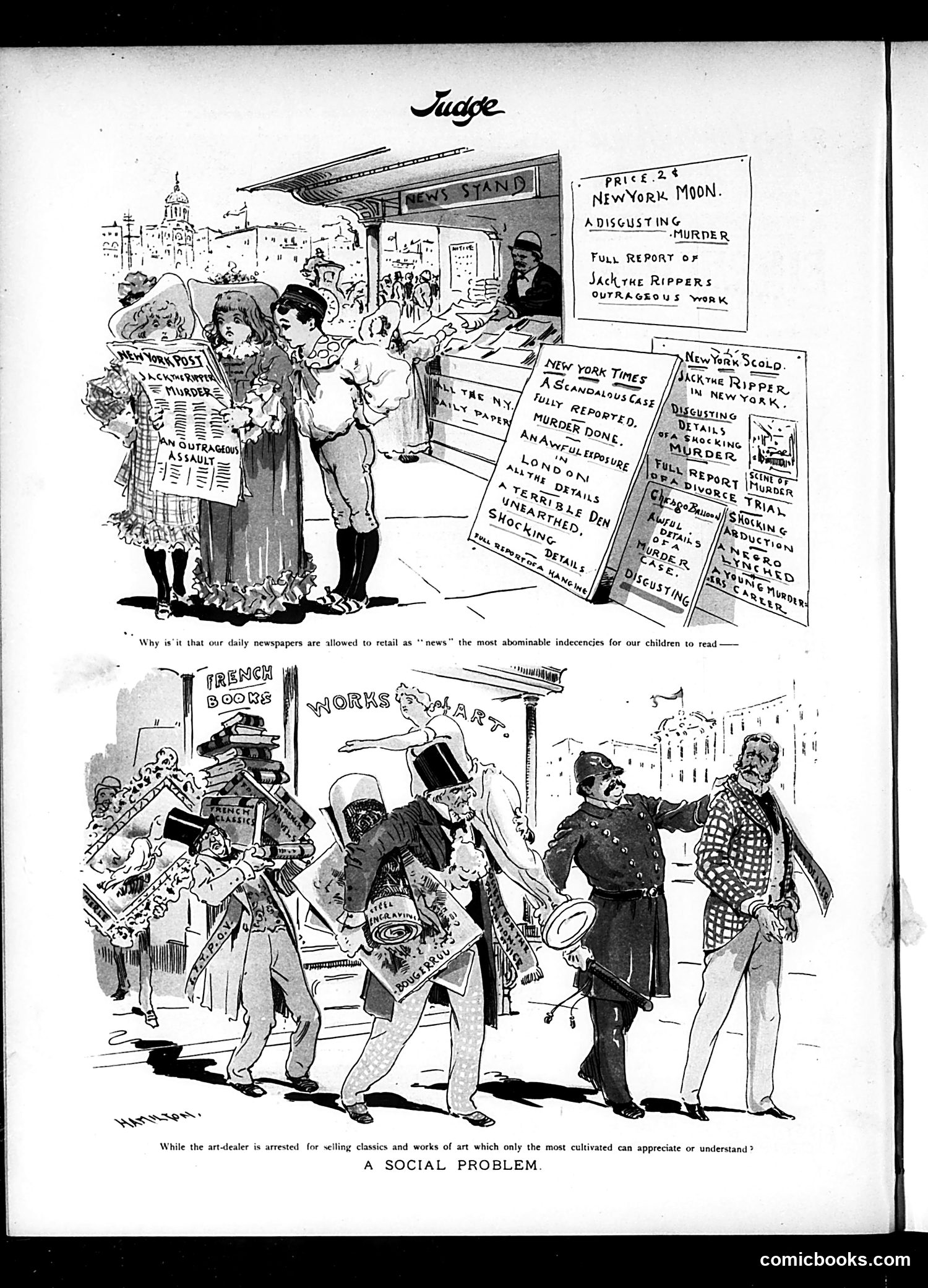
This satirical page critiques **media hypocrisy and censorship standards** in late 19th/early 20th-century America. The **top cartoon** shows a newspaper stand hawking sensationalist crime coverage, including "Jack the Ripper" stories and lurid murder details. Children are visible purchasing these papers despite the graphic content. The **bottom cartoon** depicts an art dealer being arrested while respectable citizens (labeled "Works of Art") pass by freely, suggesting cultural and legal double standards. The **satire's point**: Newspapers freely distribute disturbing crime stories to the public—including children—yet authorities arrest art dealers for selling classical works that only "cultivated" audiences appreciate. The cartoonist questions this inverted moral logic: why is explicit crime news deemed acceptable public fare while legitimate art faces censorship? This reflects Progressive Era anxieties about **yellow journalism**, child exposure to violence, and what constitutes appropriate public discourse versus obscenity.