
A complete issue · 16 pages · 1891
Judge — May 16, 1891
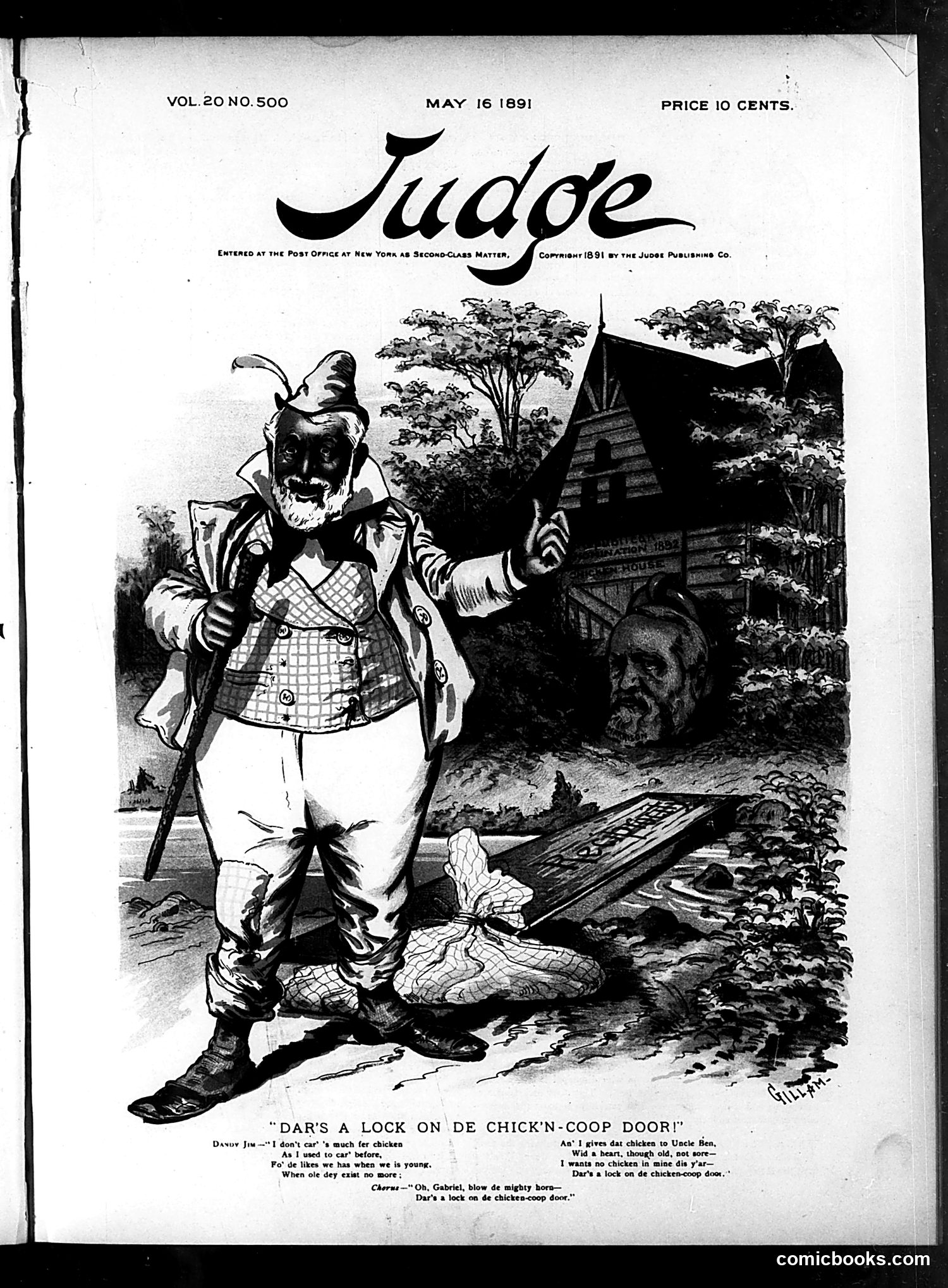
This 1891 Judge cartoon satirizes racial stereotypes through dialect humor. The central figure appears to be a caricatured Black man drawn with exaggerated features, depicted as a chicken thief caught red-handed. The accompanying verse, written in heavy dialect, presents him making excuses about the locked chicken coop door. The satire likely targets both petty rural crime and prevalent racist stereotypes of the era that associated Black people with stealing. The "Uncle Remus" style dialect and the rural setting reinforce period entertainment conventions. The severed head visible in the background suggests darker consequences, though the exact narrative context remains unclear. This represents the offensive caricatural humor common in 1890s American satirical publications.
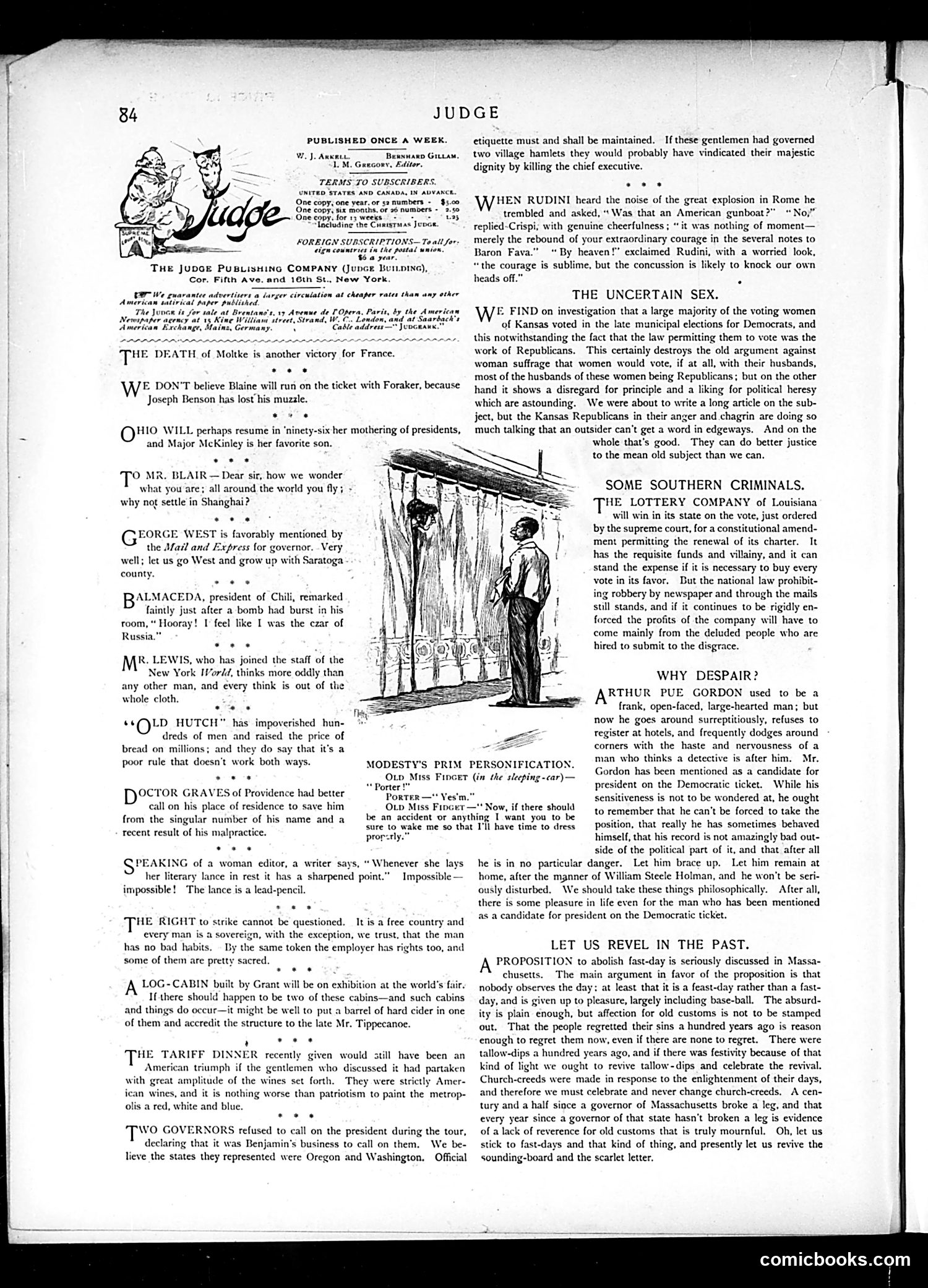
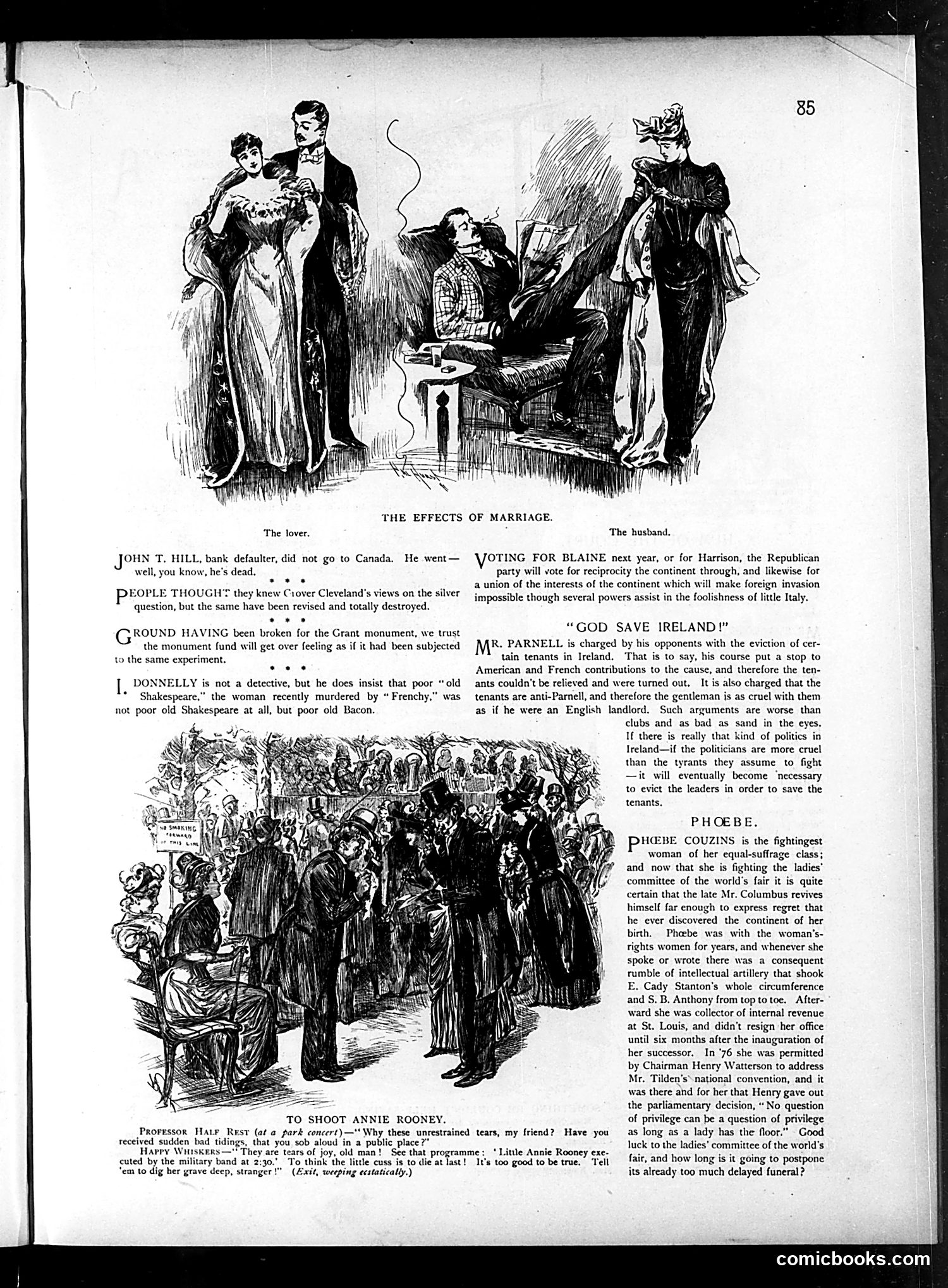
**"The Effects of Marriage"** (top cartoon): A satirical comparison contrasting the carefree "lover" with the transformed "husband." The illustration shows contrasting scenes of romance versus domestic reality, typical of period humor about marriage's sobering effects. **Political commentary sections** address three figures: 1. **John T. Hill** - a bank defaulter who fled rather than face consequences 2. **Mr. Parnell** - charged with evicting Irish tenants; the text critiques his political inconsistency regarding Irish-American support 3. **Phoebe Couzins** - celebrated as a suffragist and women's-rights advocate who addressed political conventions The bottom illustration, "To Shoot Annie Rooney," depicts a crowded public gathering, likely referencing contemporary political or social events, though the specific reference is unclear without additional historical context.
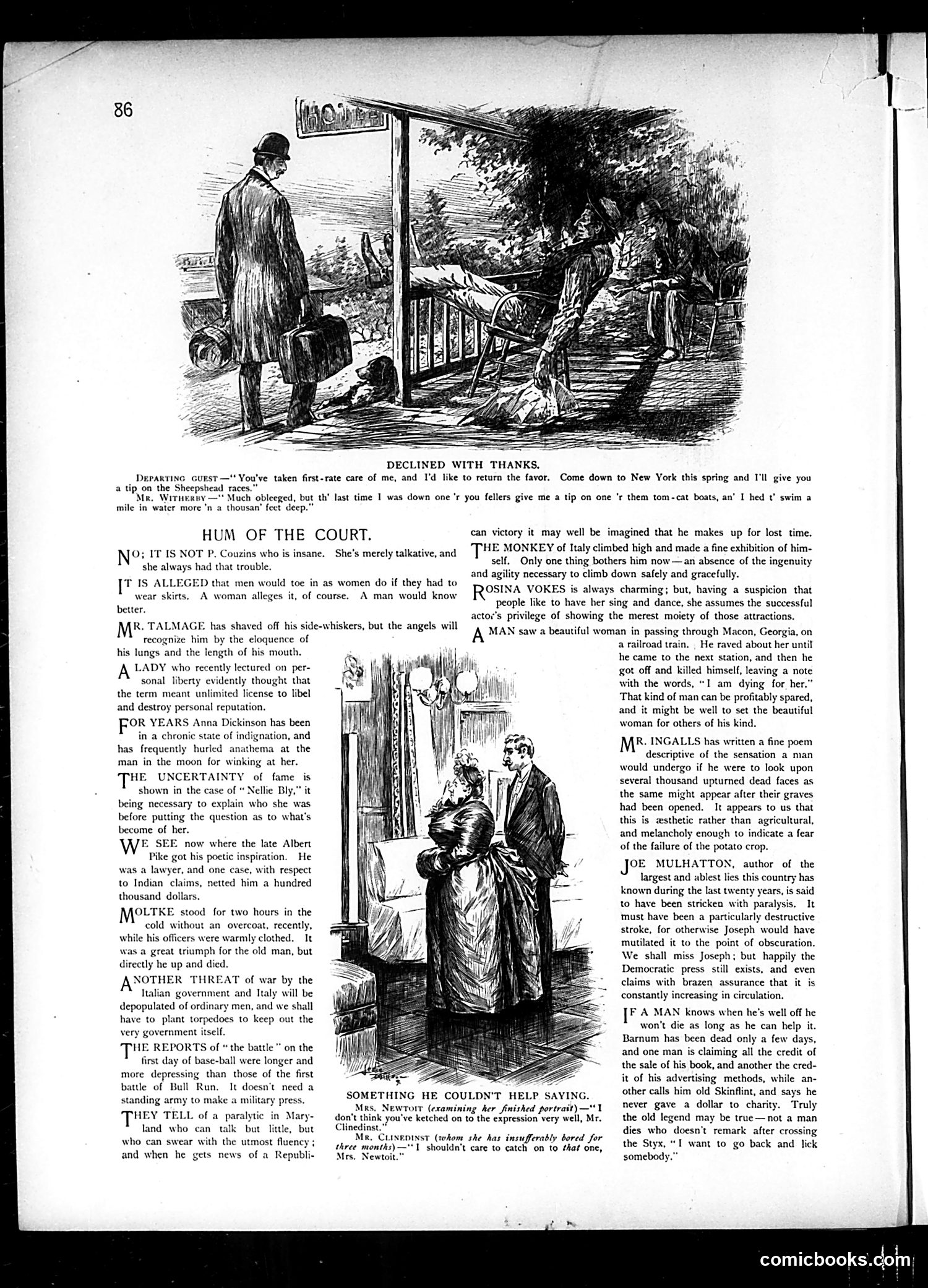
This page from *Judge* magazine contains several brief satirical items mocking public figures and social foibles of the era (appears to be 1870s-80s based on references). **Top cartoon**: A departing guest offers to repay hospitality by inviting someone to the Sheepshead races in New York. The host declines, recalling a previous "tip" on a horse that resulted in him nearly drowning—a joke about fixed races or bad gambling advice. **Text items below** mock various figures: P. Couzins (appears to be a woman known for public speaking); an actress named Nellie (unclear which one); a woman who lectured on "personal liberty" but used it to slander others; and various political/public figures including Italian leadership and politician Ingalls. **Bottom cartoon**: A portrait painter (Clinedinst) admits to a client he couldn't capture her expression because she bored him for three months—humor at the client's expense. The satire targets verbose women, political figures, and social pretension typical of *Judge*'s editorial voice.
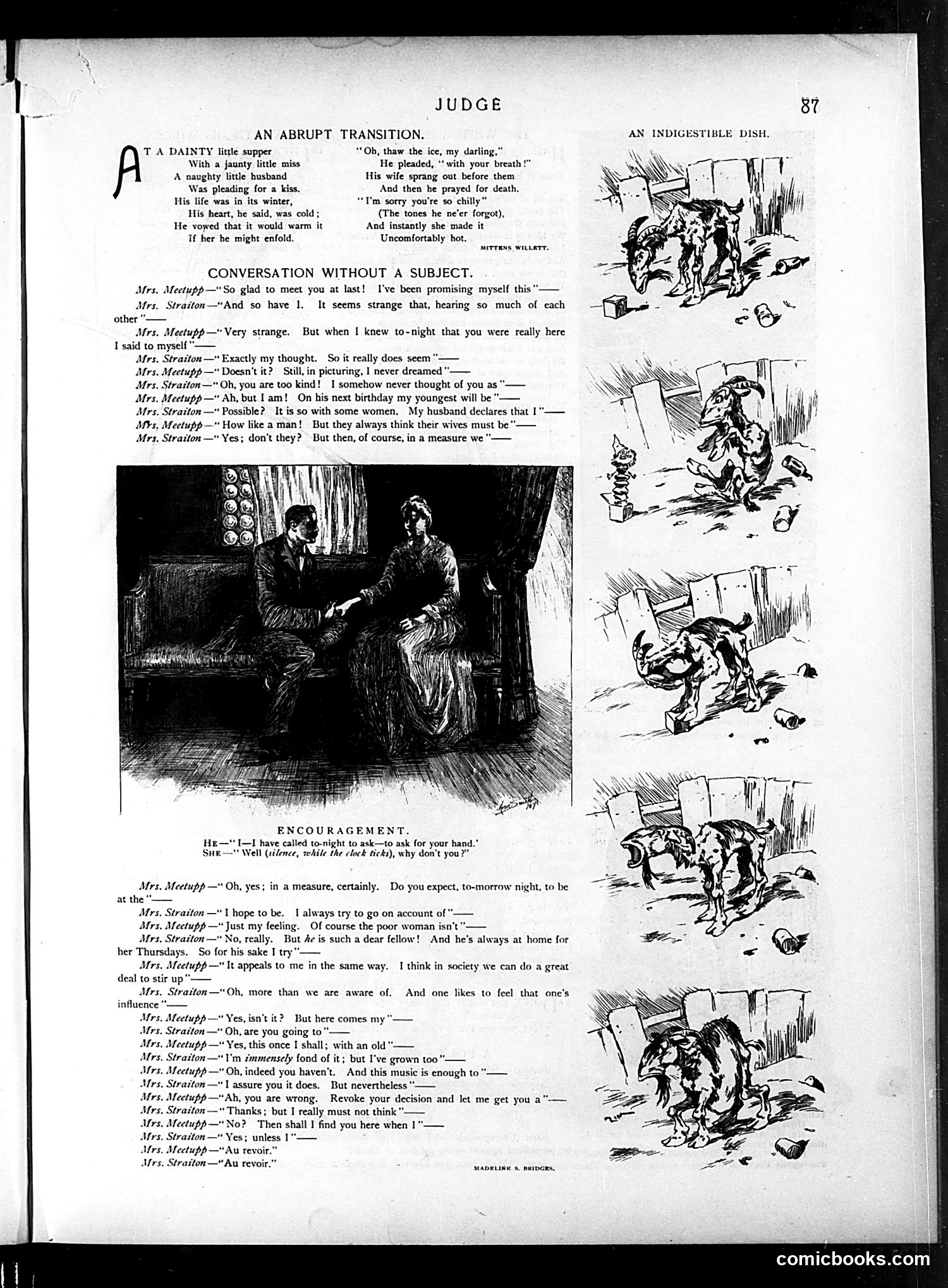
This page contains three satirical pieces mocking social conventions of the era: **"An Abrupt Transition"** and **"An Indigestible Dish"** are paired poems about marriage—the first depicts a husband's romantic plea rejected by his cold wife; the second shows the uncomfortable consequences when she finally responds warmly. The humor targets the awkwardness of Victorian married life and domestic disappointment. **"Conversation Without a Subject"** is the main satire, showing two society women (Mrs. Meetupp and Mrs. Straiton) meeting and engaging in utterly meaningless small talk—constant interruptions, vague pleasantries, and incomplete sentences. The joke exposes how upper-class women conducted superficial social interactions, filling time with empty chatter about husbands, children, and social obligations while saying absolutely nothing substantive. The right side shows **"An Indigestible Dish"**—comic illustrations of dogs fighting over or eating scraps, a visual pun on digestibility that contrasts with the pretentious human social interactions above.
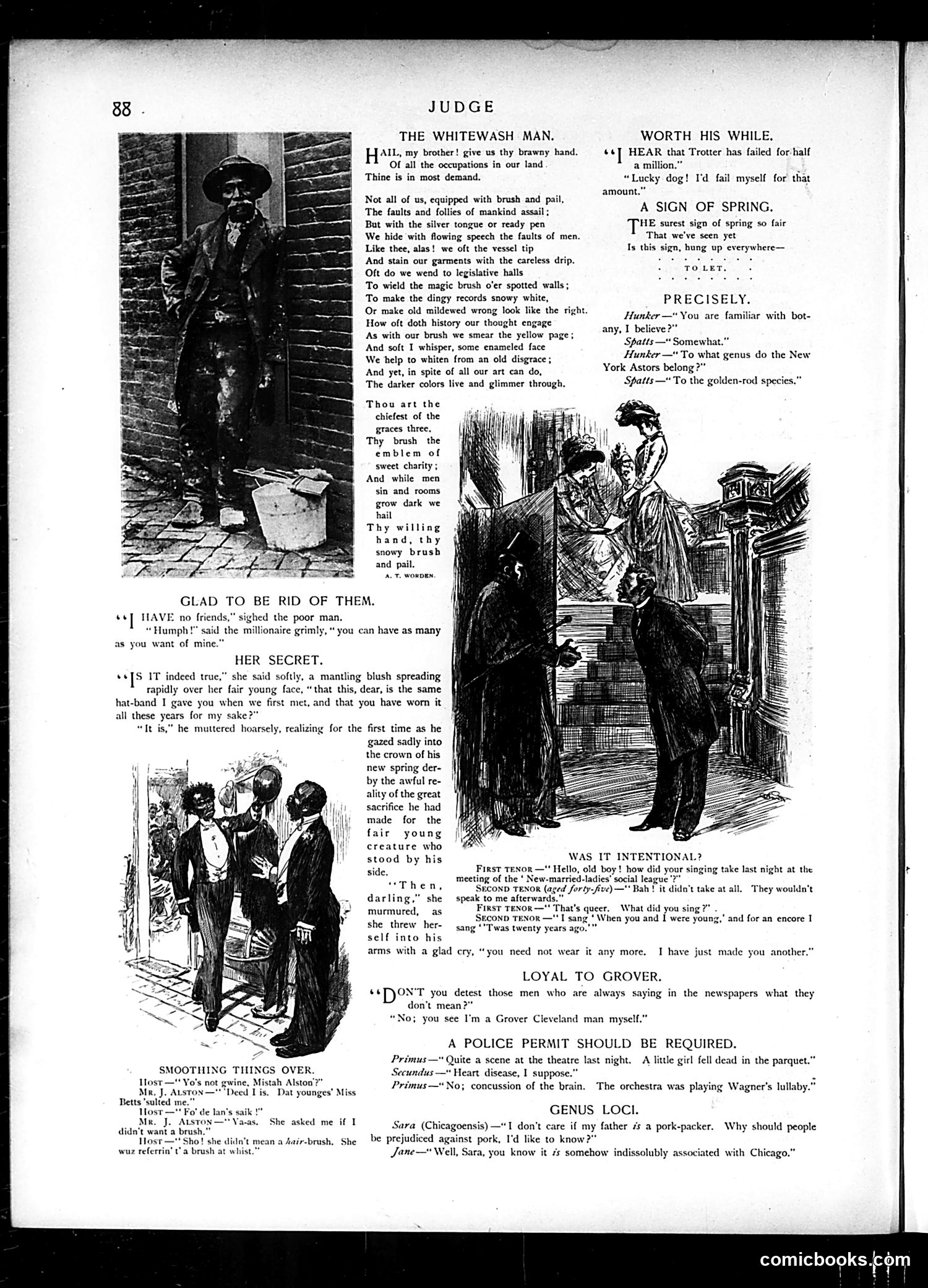
This page contains several short satirical pieces typical of Judge magazine's social commentary: **"The Whitewash Man"** is the main cartoon, using the metaphor of literal whitewashing to critique corruption and cover-ups in government and society. The poem suggests that politicians and public figures use rhetoric and manipulation to hide scandals and wrongdoing—just as whitewashers literally cover stains—yet the truth ("darker colors") inevitably shows through. **Other brief jokes** mock wealth and privilege: one celebrates a businessman's bankruptcy as profitable, another depicts the wealthy Astor family as mere "golden-rod species" (a common plant), and another shows a woman exploiting her sweetheart by keeping a worn hat-band as evidence of devotion while secretly planning to discard it. The remaining items are largely gossip-style social humor about theater etiquette, Wagner's music, and Chicago's association with the meatpacking industry. The page reflects Judge's typical blend of political satire with lighthearted social mockery of American life and manners.
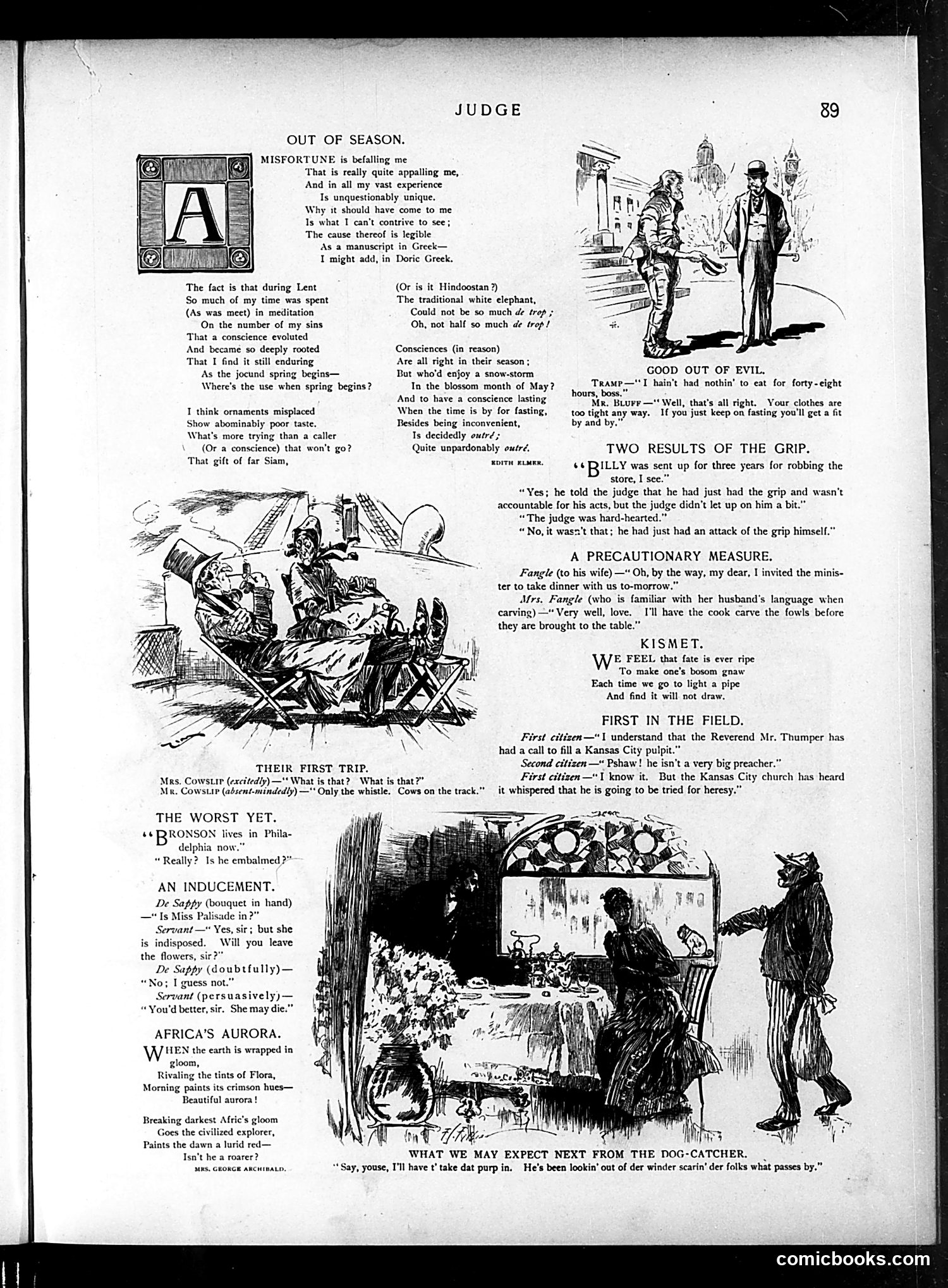
This page contains multiple satirical sketches typical of late 19th-century American humor: **"Out of Season"** mocks the guilt that persists after Lenten self-reflection—the speaker laments his evolved conscience won't disappear when spring arrives, comparing it to an unwanted "white elephant." **"Two Results of the Grip"** jokes about influenza ("the grip"). A criminal claims the illness caused his store robbery, but the judge is unmoved—having just suffered the same illness himself, he understands the excuse but remains harsh anyway. **"A Precautionary Measure"** plays on crude table manners: Mr. Fangle's wife preemptively has the cook carve fowl before dinner, anticipating her husband's messy, aggressive carving style. **"First in the Field"** concerns a rural preacher being tried for heresy—small-town gossip presented as dialogue. The remaining items are brief comic vignettes about rejection, fate, and dog-catching. The page demonstrates Judge's formula: mixing social observation with puns, domestic humor, and class-based comedy targeting contemporary readers' experiences.
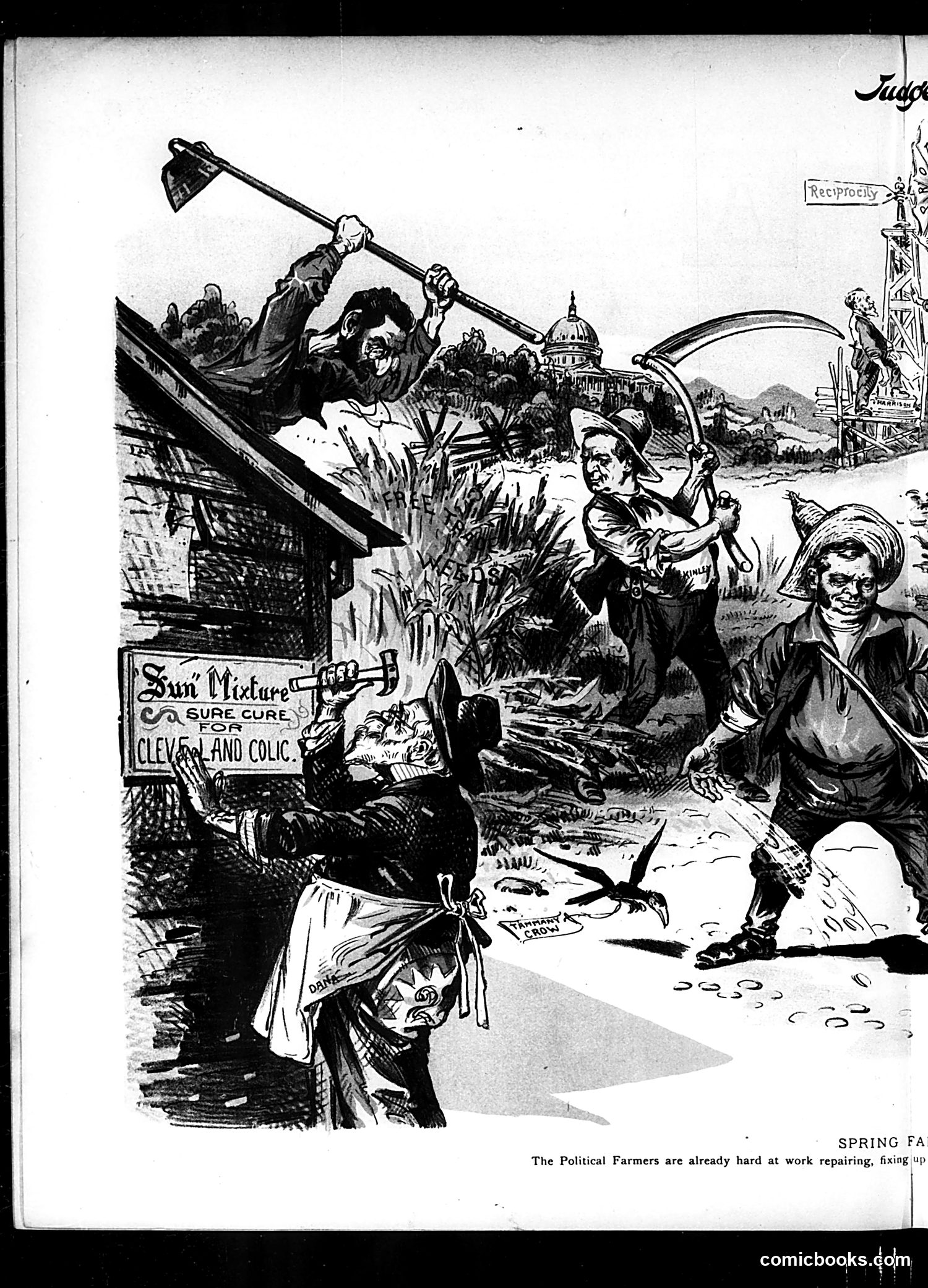
This satirical cartoon depicts farmers as literal laborers "repairing" and "fixing up" — likely referring to political damage or failures. The scene shows rural workers engaged in restoration work near the Capitol building visible in the background, suggesting Congress or federal government policies affecting agriculture. The visible product label "Sun Mixture" and text mentioning "CLEVER AND COLIC" appear to reference patent medicines or agricultural remedies, possibly satirizing false promises made to farmers. The cartoon critiques "political farmers" — likely politicians claiming to represent agricultural interests — as engaged in damage control or cleanup work. The spring setting and rural imagery emphasize farming's seasonal concerns. The satire suggests these politicians are merely patching problems rather than implementing genuine solutions to farmers' challenges, a common critique of political rhetoric during the Populist era and Progressive period.
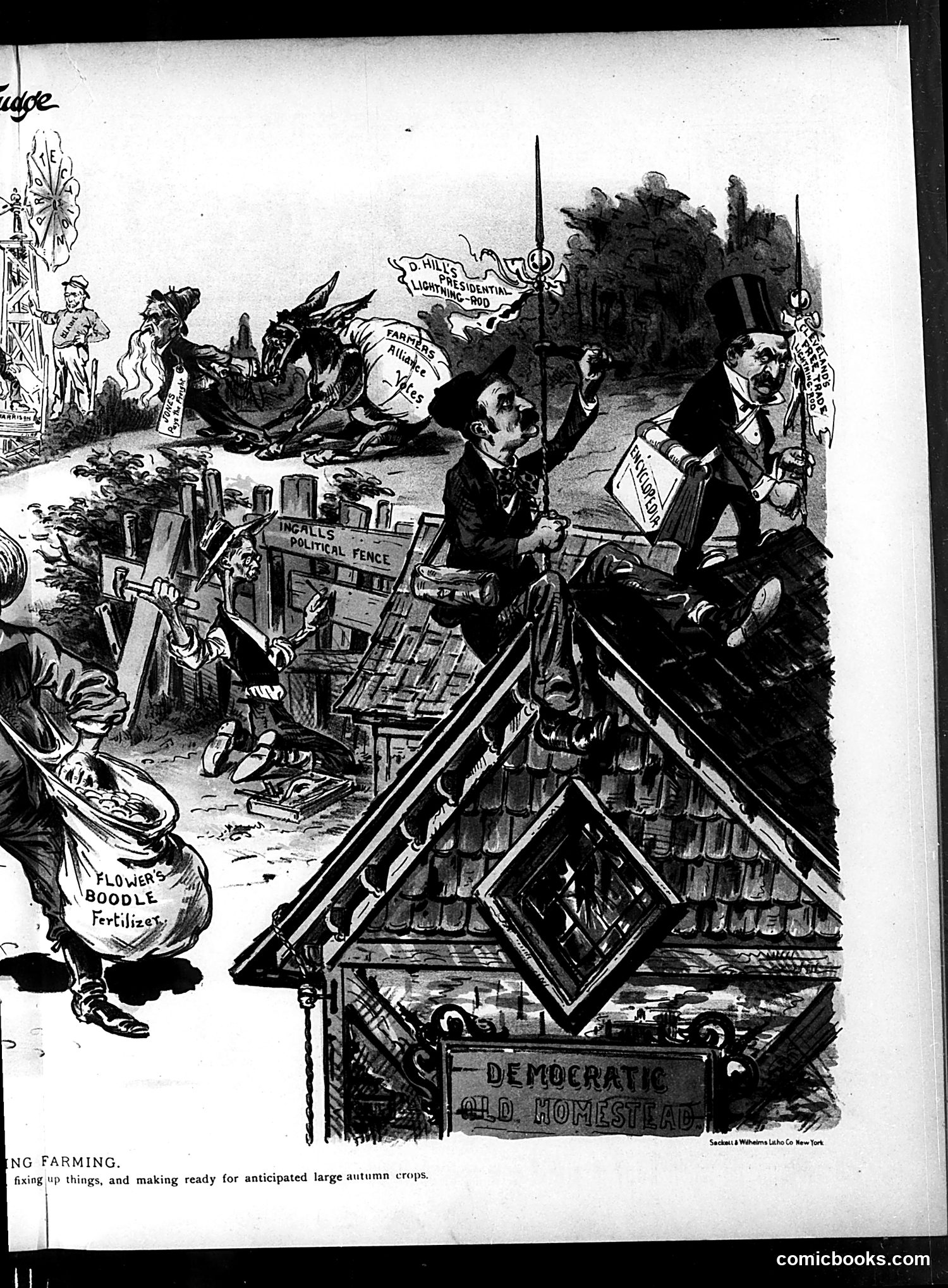
This political cartoon satirizes the Democratic Party's "old homestead" as a dilapidated structure requiring constant repair. Two well-dressed men (likely Democratic politicians or leaders) stand on the collapsing roof, attempting to patch things up for anticipated electoral "crops" (fall elections). The imagery plays on the metaphor of "farming" politics—suggesting Democrats are merely fixing superficial problems rather than addressing fundamental decay. References to "Flower's Boodle Fertilizer" mock political corruption ("boodle" meant bribes/graft), implying the party relies on corrupt money rather than honest governance. The overall message: the Democratic Party is structurally unsound, requiring constant band-aid solutions and corrupt funding to remain functional. The cartoon appears critical of Democratic management and moral standing during the Gilded Age.
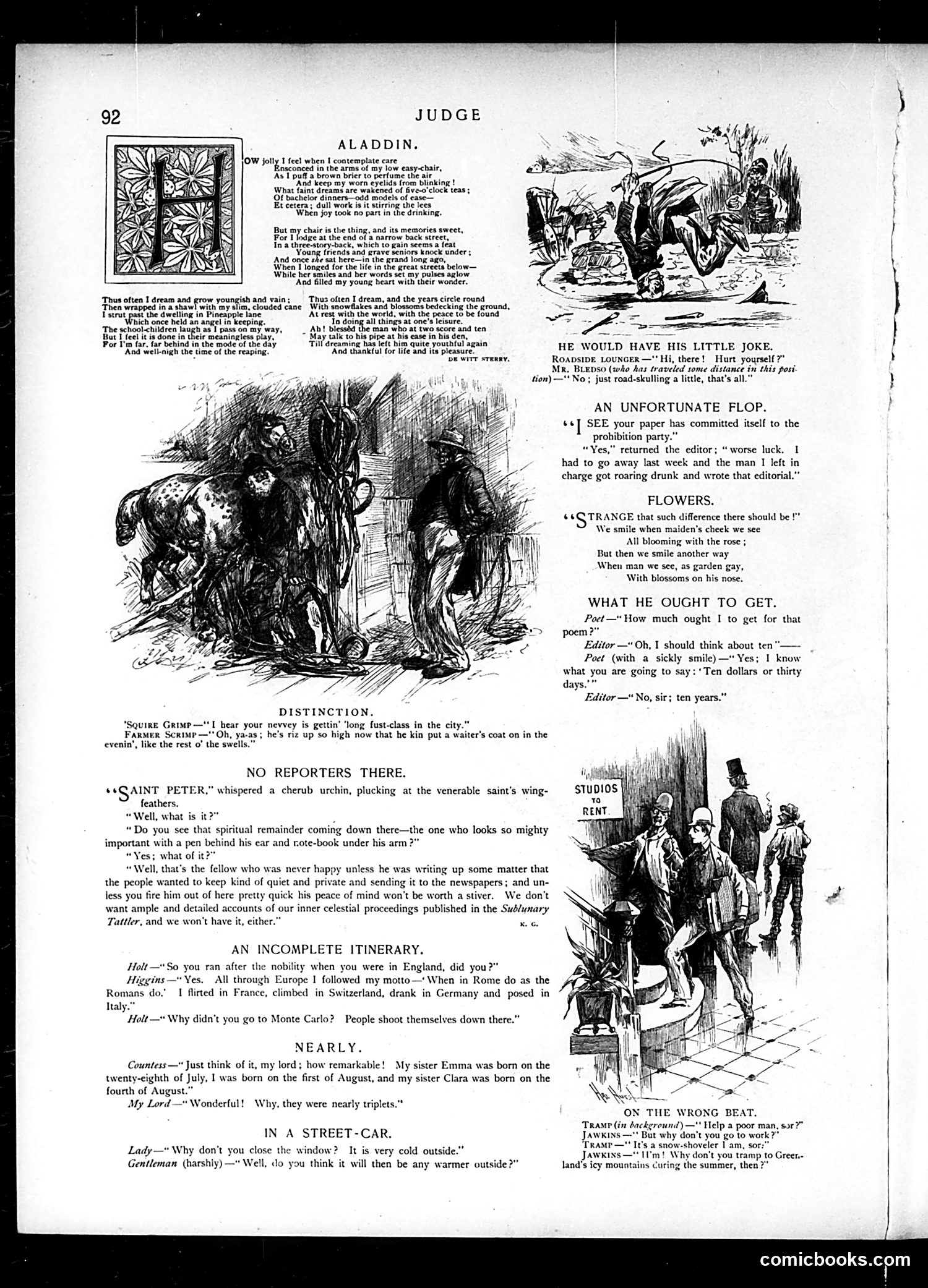
This page from *Judge* contains several short humorous sketches typical of late-19th/early-20th century American satirical journalism: **"Aladdin"** (poem with illustration): A nostalgic piece about an aging bachelor reminiscing over his easy chair and a lost love who once sat there. **"Distinction"**: A rural joke contrasting a farmer's pride that his nephew has "made it" in the city—the distinction being merely that he can now afford a waiter's coat like other wealthy men. **"No Reporters There"**: A cherub warns Saint Peter about admitting a reporter to heaven, fearing he'll publicize private celestial matters in the *Sedentary Tattler* (a fictional gossip publication). This satirizes journalists' intrusive reporting habits. **Other shorts** include mild absurdist humor ("Nearly"—three sisters born on consecutive dates deemed "nearly triplets") and social commentary on urban manners ("Street-Car"). The sketches mock journalism, social pretension, and urban-rural class differences through exaggeration and wordplay rather than specific political events.
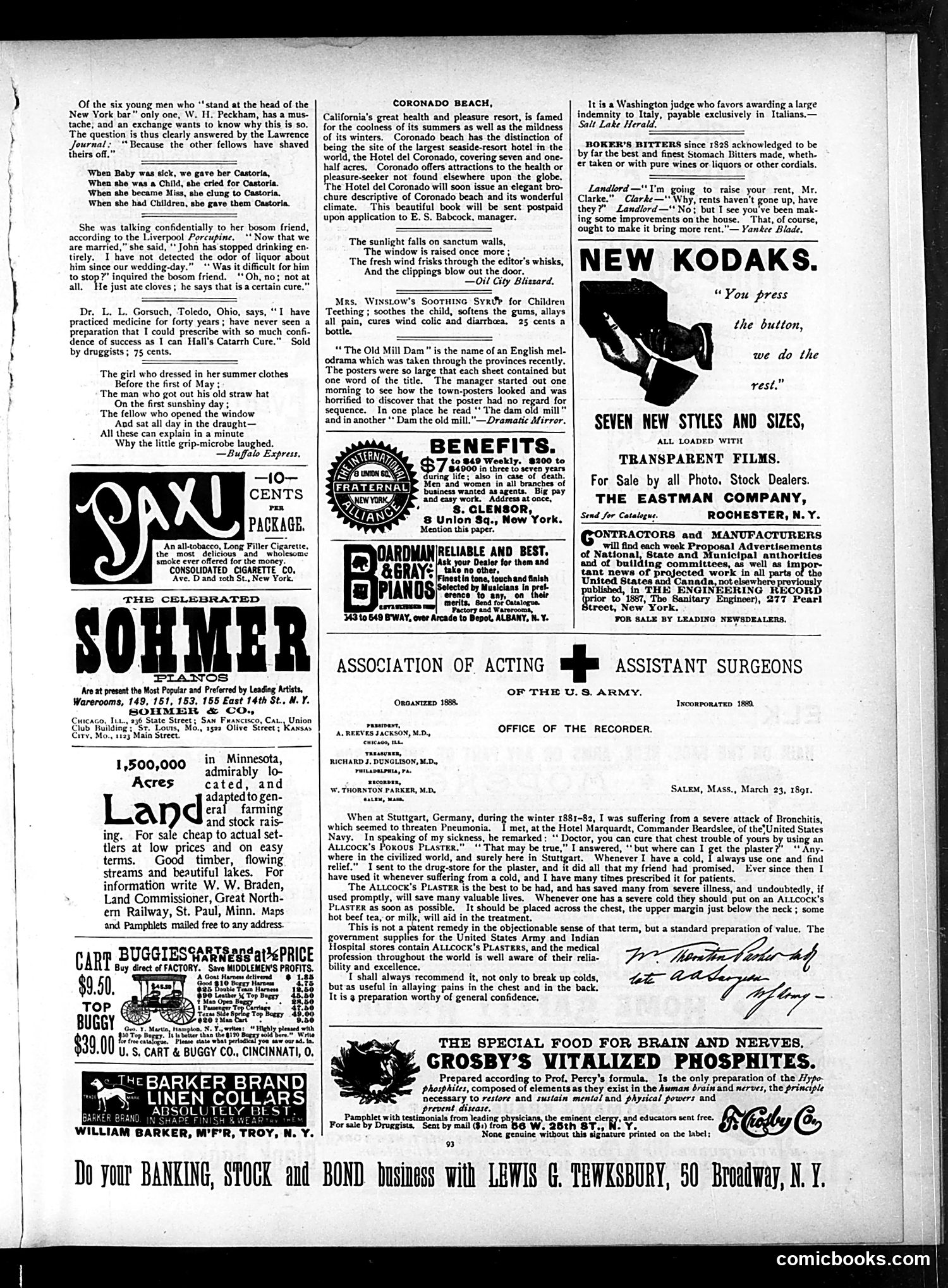
This page is primarily advertising with some satirical short humorous items. The visible cartoon/satirical content consists of brief jokes and anecdotes: 1. **The bar joke**: Mocks why prominent New York lawyers are clean-shaven—a trivial observation inflated as significant news. 2. **The Castoria ad**: An extended jingle using sentimental domestic scenes, satirizing patent medicine marketing through emotional appeals rather than actual efficacy. 3. **The marriage/cloves joke**: A domestic humor piece where a wife misinterprets her husband's "cure" for drinking as stopping entirely, when he's simply disguising the smell with cloves—a mild jest about marital naïveté. 4. **The "grip-microbe" item**: Mocks fashion trends and behavior (wearing summer clothes too early, opening windows during drafts) as inviting cold/influenza. These are light satirical jabs at social conventions, medical fraud, and personal foolishness. The page is dominated by patent medicine advertisements (Castoria, Mrs. Winslow's Syrup, Hall's Catarrh Cure, Crosby's Phosphites) typical of *Judge* magazine's era.
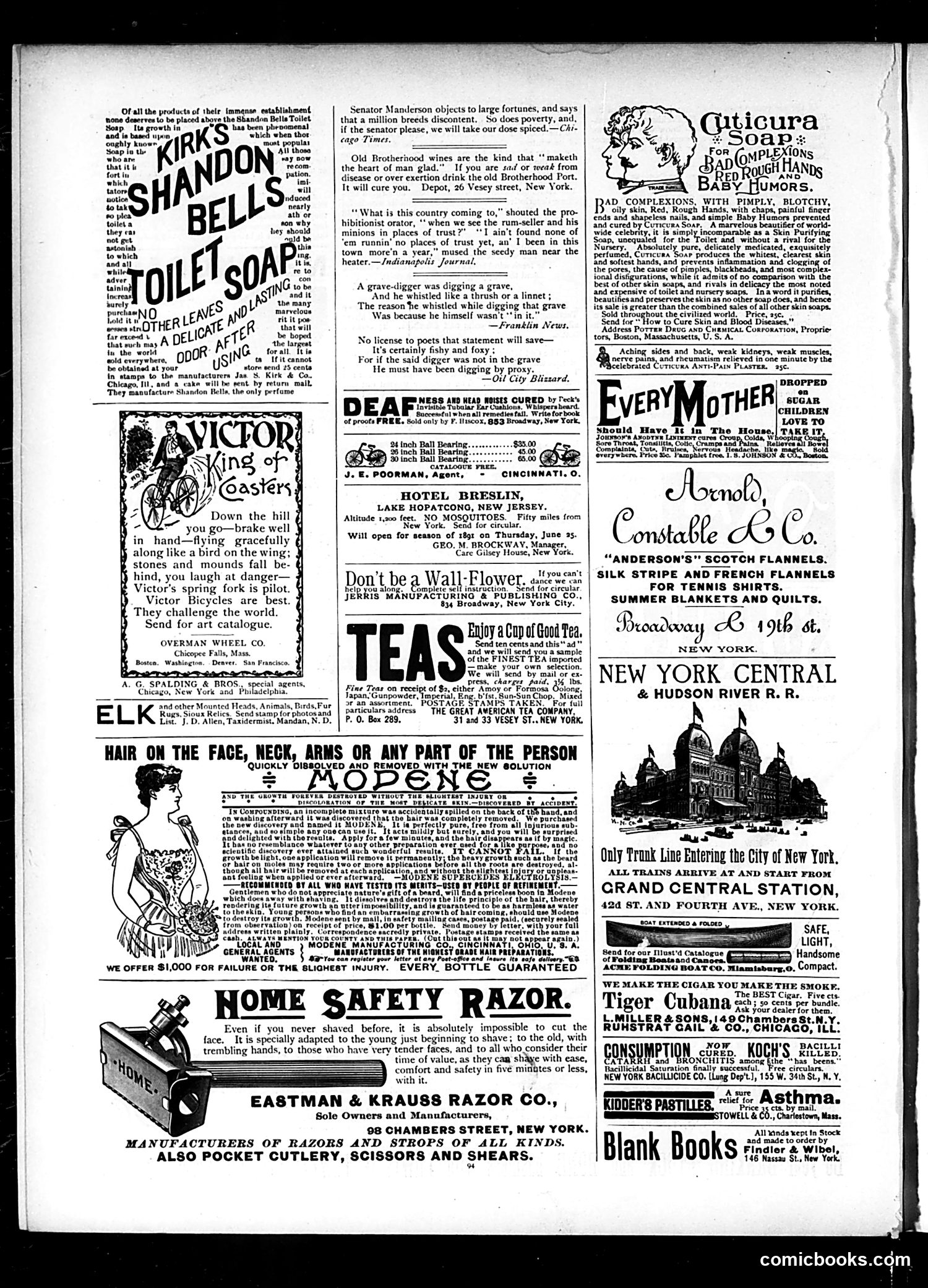
This page is primarily **advertisements** interspersed with brief **satirical verses** typical of Judge magazine's format. The satirical content includes: 1. **Senator Manderson critique**: A jab at Senator Charles Manderson's complaint that large fortunes breed discontent—the satirist counters that poverty does too, so either way society loses. 2. **Prohibitionist hypocrisy joke**: A prohibitionist orator rails against "rum-sellers in places of trust," but a working-class observer notes he's never actually seen any—suggesting the reformer's outrage is disconnected from reality. 3. **Grave-digger verses**: Humorous poems playing on the phrase "in it"—the digger whistles while working because he's not literally "in" the grave being dug. The page is dominated by period advertisements for **razors, bicycles, hair removal products, hotels, tea, and patent medicines**—reflecting late 19th-century consumer culture. The content reflects Judge's mix of social satire and commercial promotion.
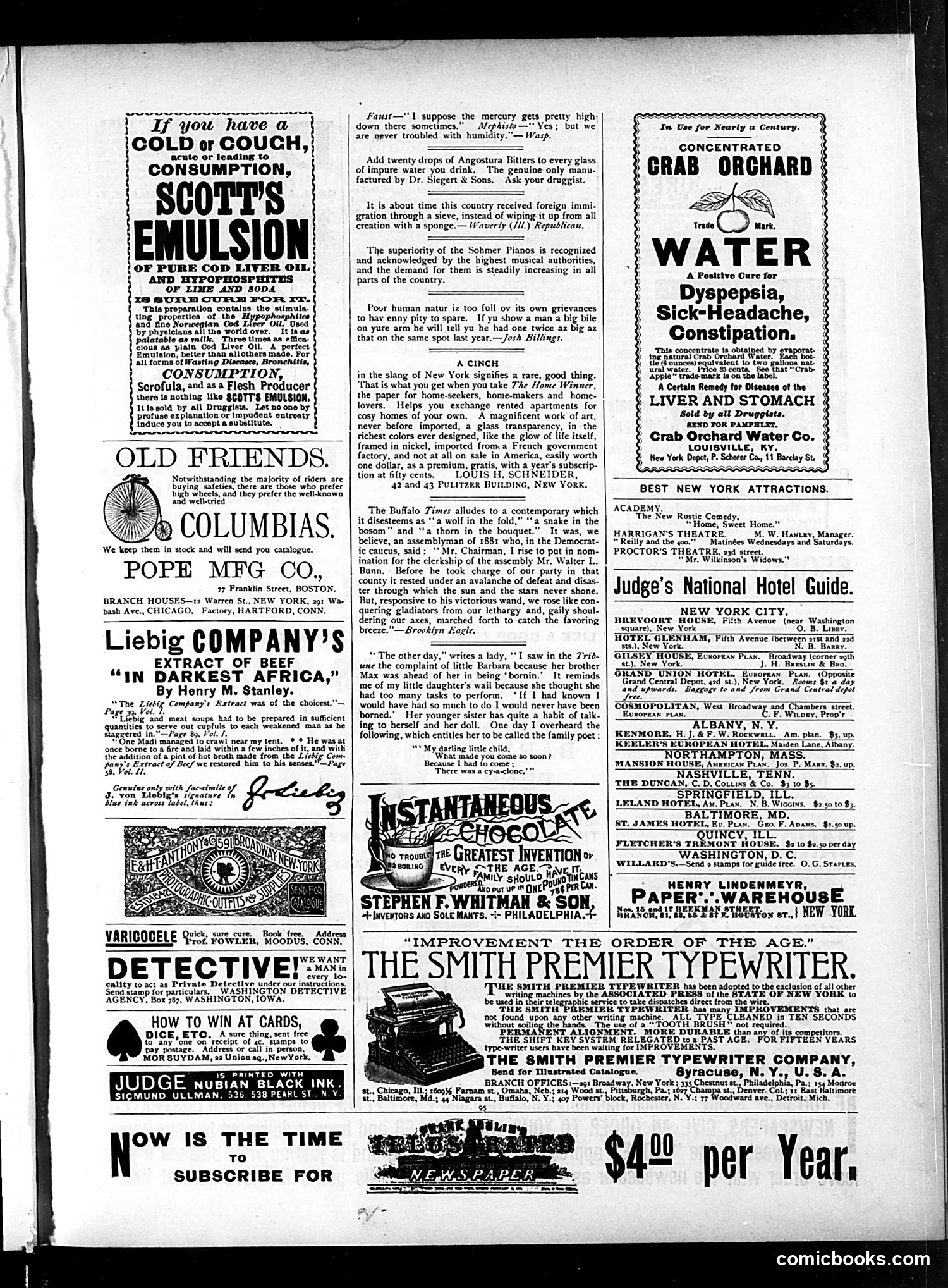
This is primarily an **advertising page** from Judge magazine, not a satirical cartoon page. The layout contains mostly commercial advertisements for patent medicines, bicycles, and other products typical of the late 19th century. The few text snippets that appear to be satirical are brief **jokes or editorial quips**: - A Faust/Mephistopheles joke about Hell's humidity - A Josh Billings folk-wisdom piece about human nature and complaints - A comment about immigration policy (wishing the country had "received foreign immigration through a sieve, instead of wiping it up from all creation with a sponge") The immigration reference appears mildly **nativist in tone**, suggesting skepticism about accepting immigrants. Otherwise, the page showcases period advertisements for Scott's Emulsion (cod liver oil), Columbia bicycles, Liebig beef extract, and other remedies—reflecting Judge's commercial function alongside its satirical content. No specific political figures or events are clearly referenced.
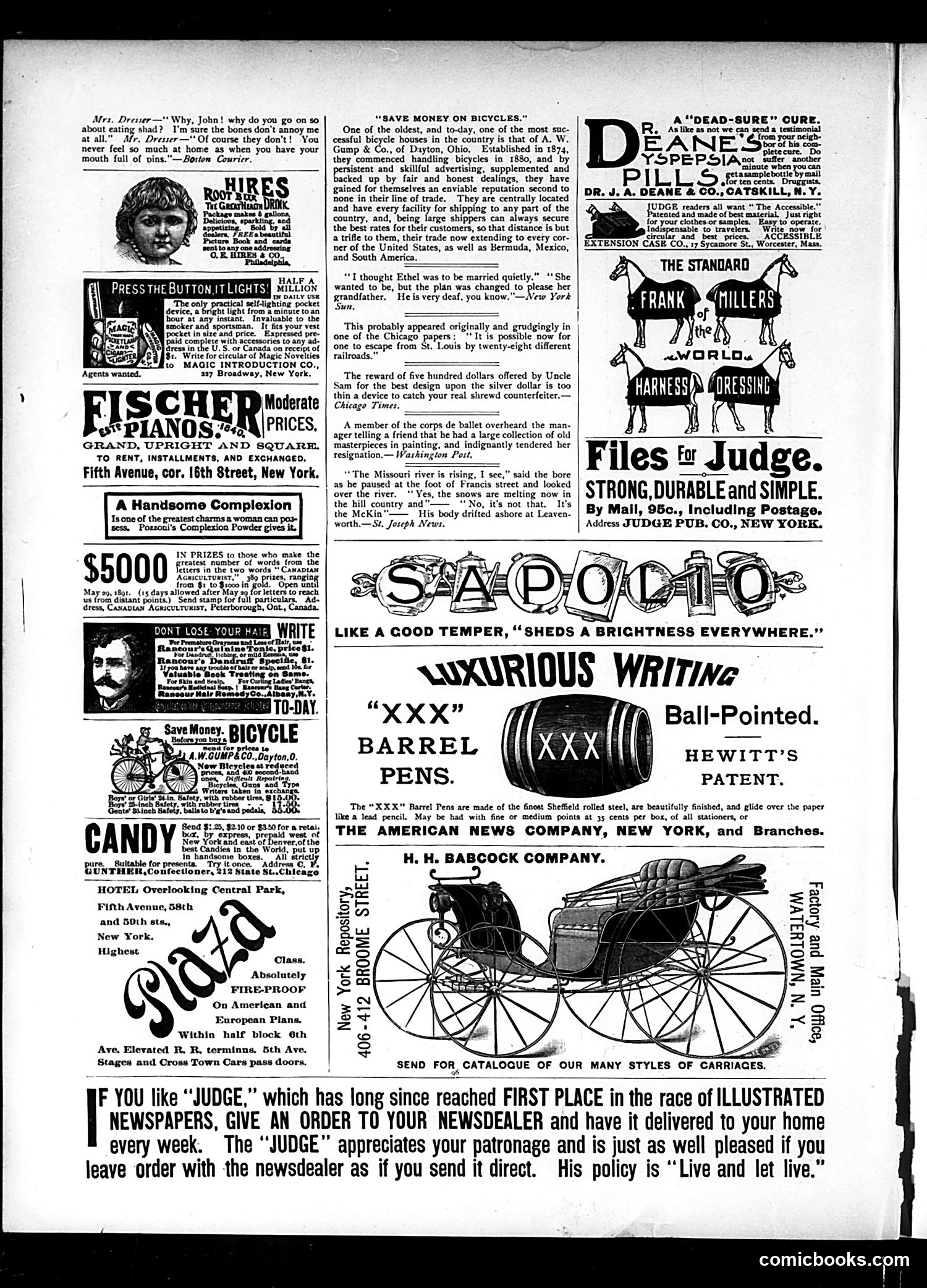
This is primarily an **advertising page** from the satirical magazine Judge, with several brief jokes interspersed among product advertisements. The few editorial jokes include: - A domestic humor piece about Mrs. Dresser tolerating fish bones (shad) while eating, with her husband sarcastically suggesting she enjoys having her "mouth full" - A joke about a woman who wanted a quiet wedding but her deaf grandfather forced changes so he could hear the ceremony - Regional humor mocking St. Louis and the Missouri River - A quip about counterfeiters being too clever to be caught by a competition for a silver dollar design The **advertisements dominate**: they promote bicycles (A.W. Gump & Co.), pianos (Fischer), pocket lighters, hair treatments, candy, hotels, carriages (H.H. Babacock Company), and various patent medicines and beauty products typical of the 1890s-1900s era. This reflects Judge's role as both satirical magazine and commercial vehicle for consumer goods targeting middle and upper-class readers.
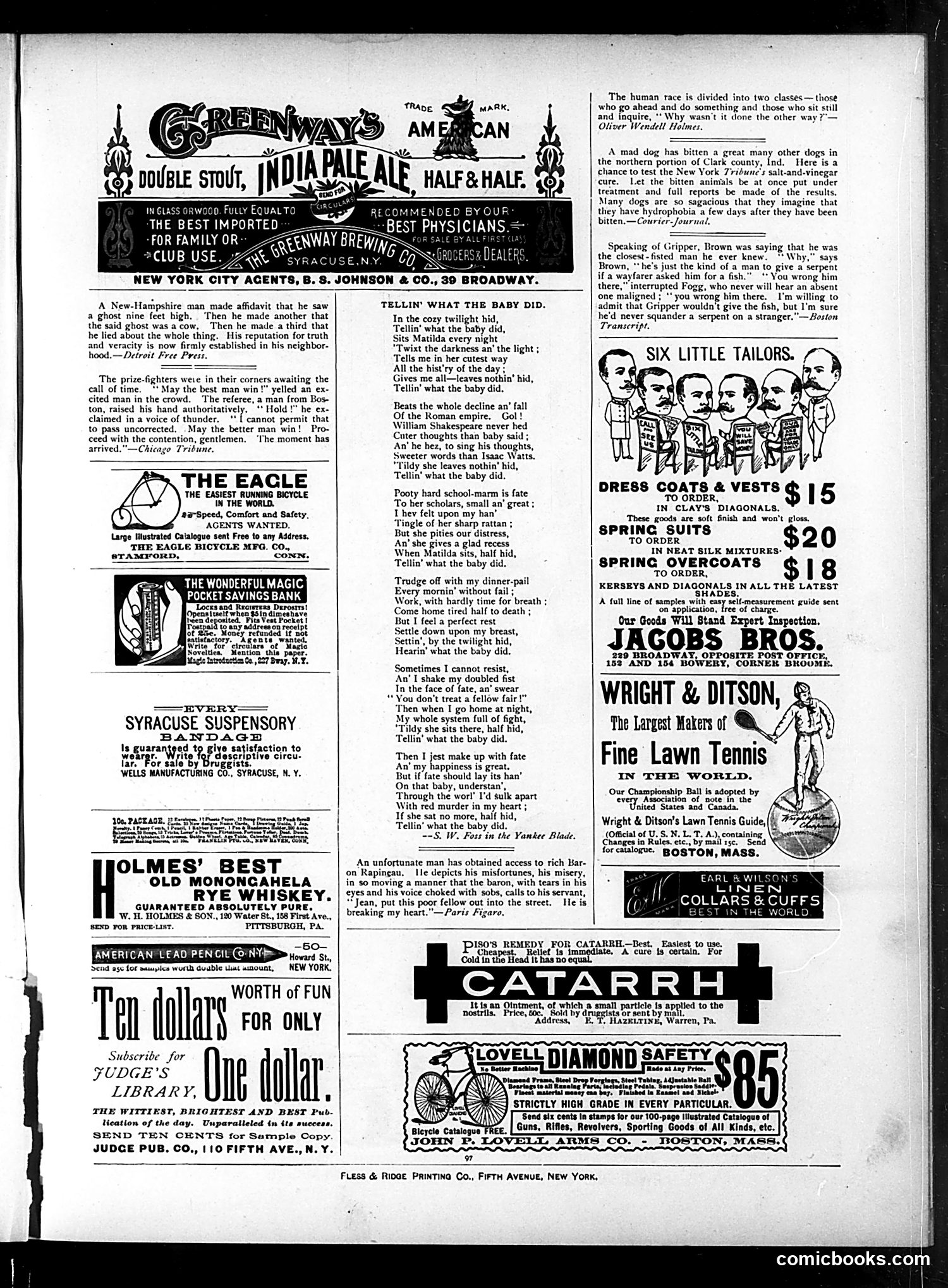
This is primarily an **advertising page** with some light editorial content, not political satire. The page contains numerous commercial advertisements (bicycles, whiskey, banking products, clothing) interspersed with shorter pieces. The main editorial content is "Tellin' What the Baby Did," a sentimental poem by S. W. Foss about a man finding solace in his daughter Matilda describing her day. It's domestic humor—the joke being that the father's exhaustion and life frustrations melt away hearing mundane baby observations. Two brief anecdotes appear: one mocking a New Hampshire man's contradictory testimony about a ghost/cow, and another where a Boston referee pedantically corrects "best man" to "better man" during a boxing match—both gentle satirizing of human absurdity rather than political commentary. The page reflects late 19th-century *Judge* magazine's mix of advertising revenue and sentimental/humorous content, targeting a middle-class American audience with family-oriented humor and consumer products.
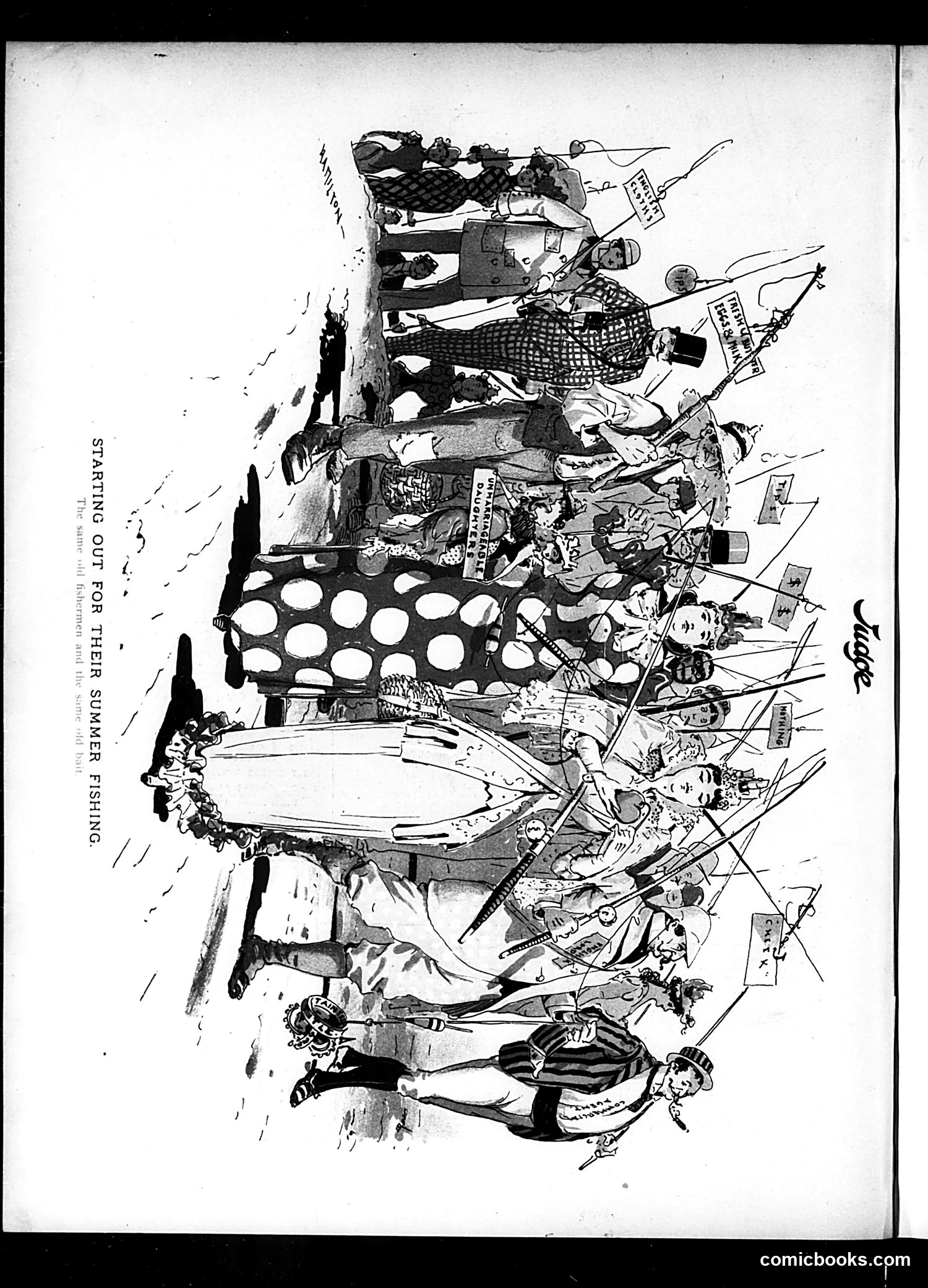
This satirical cartoon depicts a chaotic summer fishing expedition. The image shows multiple figures crammed together with fishing equipment, baskets of supplies, and various gear in disarray. The composition suggests the comedic mayhem of organizing a group outing—overcrowding, poor planning, and bumbling preparation. The cartoon appears to satirize the American leisure class's enthusiasm for summer recreation, likely poking fun at the pretensions and impracticality of elaborate recreational outings. The clutter and confusion suggest incompetence or absurdity in execution, a common Judge magazine theme. Multiple small labeled signs appear throughout the scene, though specific text is difficult to read in this reproduction. The overall message seems to be mockery of overly ambitious, poorly organized recreational pursuits—a relatable subject for Judge's affluent readership.