
A complete issue · 16 pages · 1891
Judge — January 3, 1891
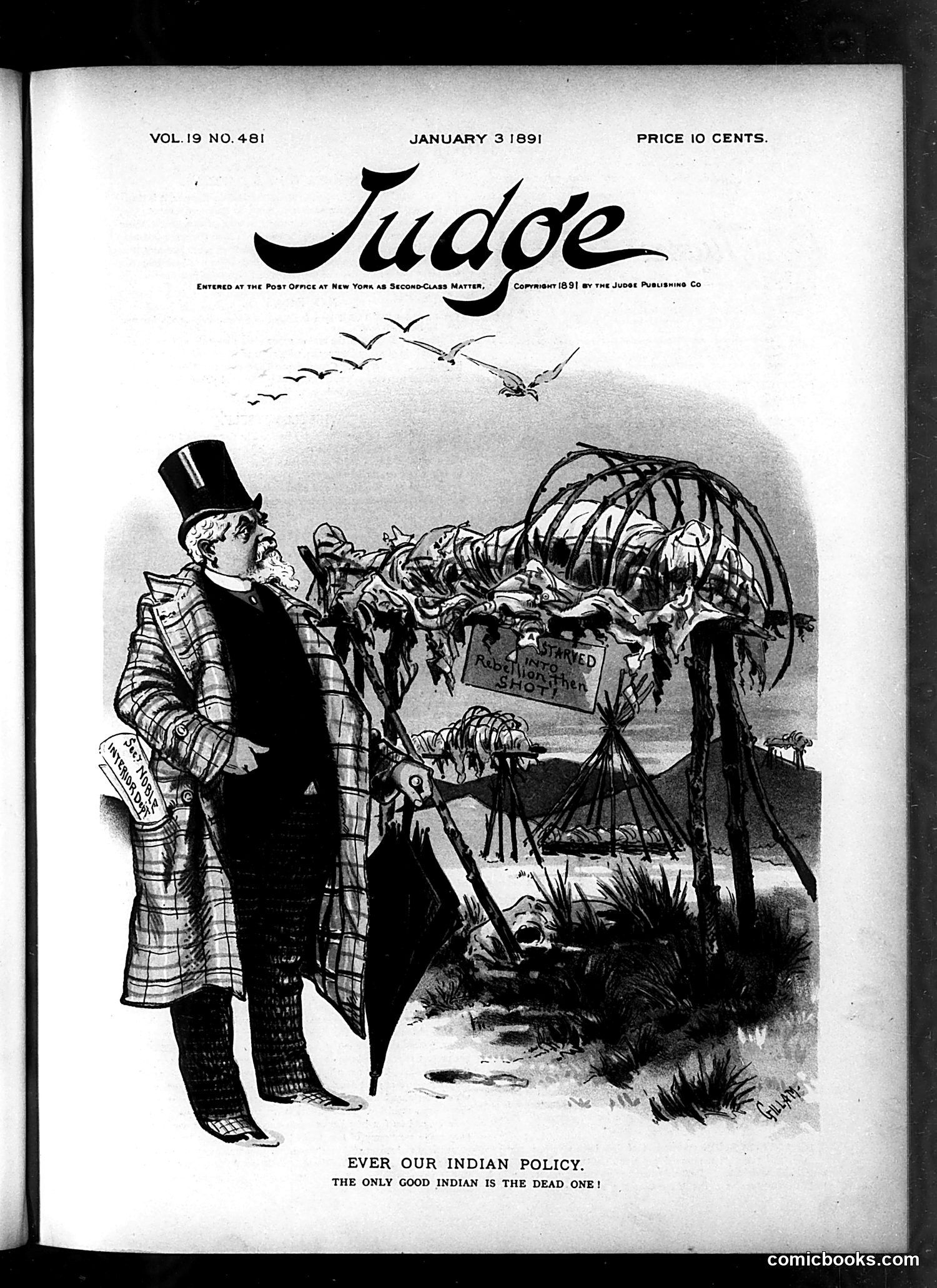
This 1891 *Judge* cartoon satirizes U.S. government policy toward Native Americans. A well-dressed gentleman (likely representing a government official or politician) stands examining what appears to be a mass grave or burial site marked "Restricted Reservation Grounds." Dead bodies and skeletal remains are visible within. The caption reads: "THE ONLY GOOD INDIAN IS THE DEAD ONE!"—a dark reference to the notorious phrase attributed to military figures of the era. The cartoon critiques the government's approach to Native Americans as effectively genocidal, presenting the "Indian policy" as one that accepts or encourages Native American deaths rather than pursuing peaceful coexistence or fair treatment. This reflects the period's brutal realities, including the Wounded Knee massacre (December 1890), which had occurred weeks before this issue's publication.
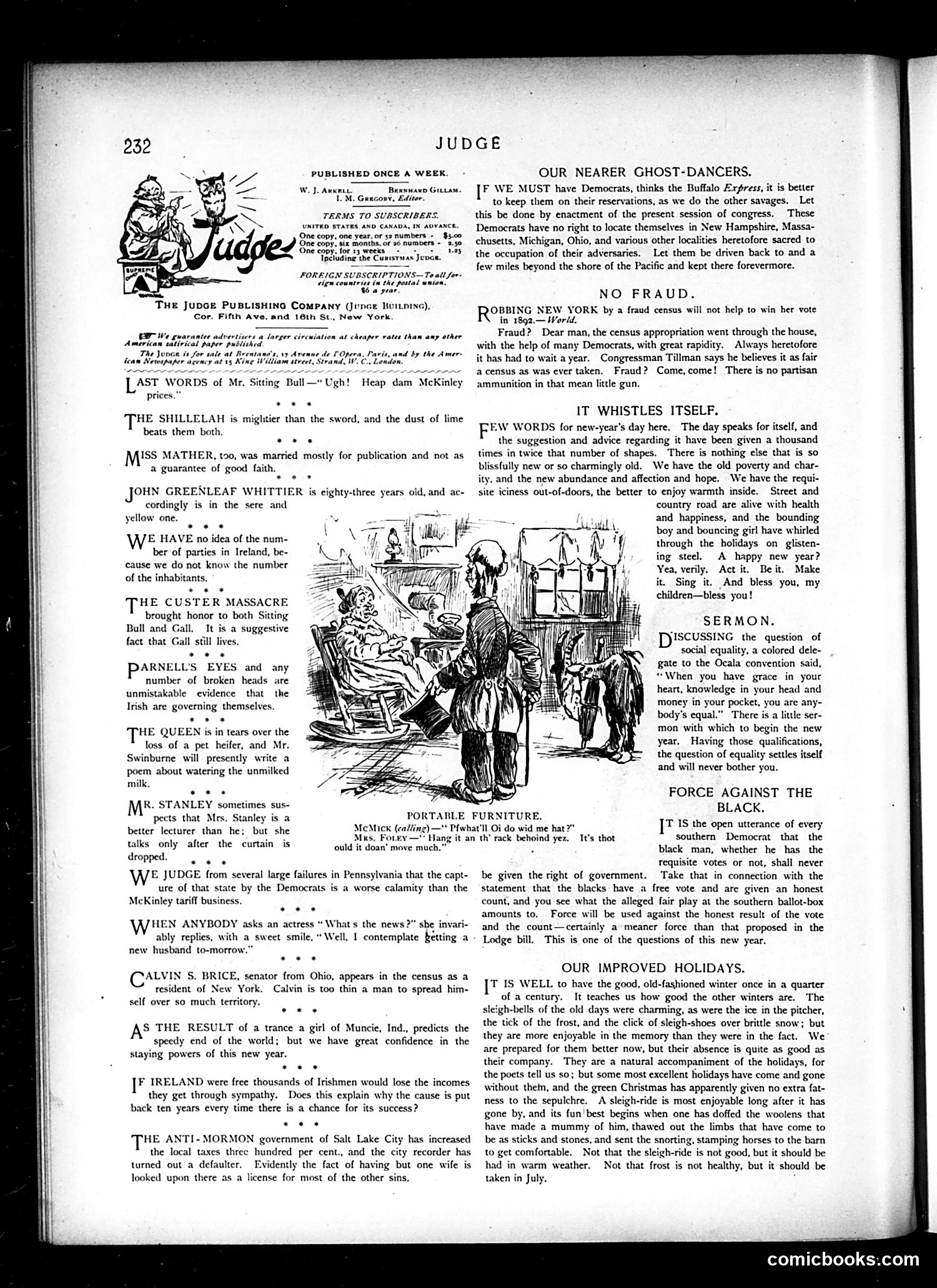
This page features satirical commentary typical of Judge magazine's political content. The main cartoon, titled "Portable Furniture," depicts what appears to be a tenement or working-class interior scene with multiple figures. The caption suggests commentary on housing or living conditions. The text sections address contemporary political issues: "Our Nearer Ghost-Dancers" discusses Democratic strategy regarding Native American reservations; "No Fraud" critiques census procedures; "Force Against the Black" discusses voting rights for Black Americans and their political participation. The overall tone reflects late 19th-century Republican/conservative satirical perspectives on Democratic politics, immigration policy, and racial issues. The specific historical context—exact date and figures—remains unclear from this page alone, though the social commentary targets Democratic Party positions of the era.
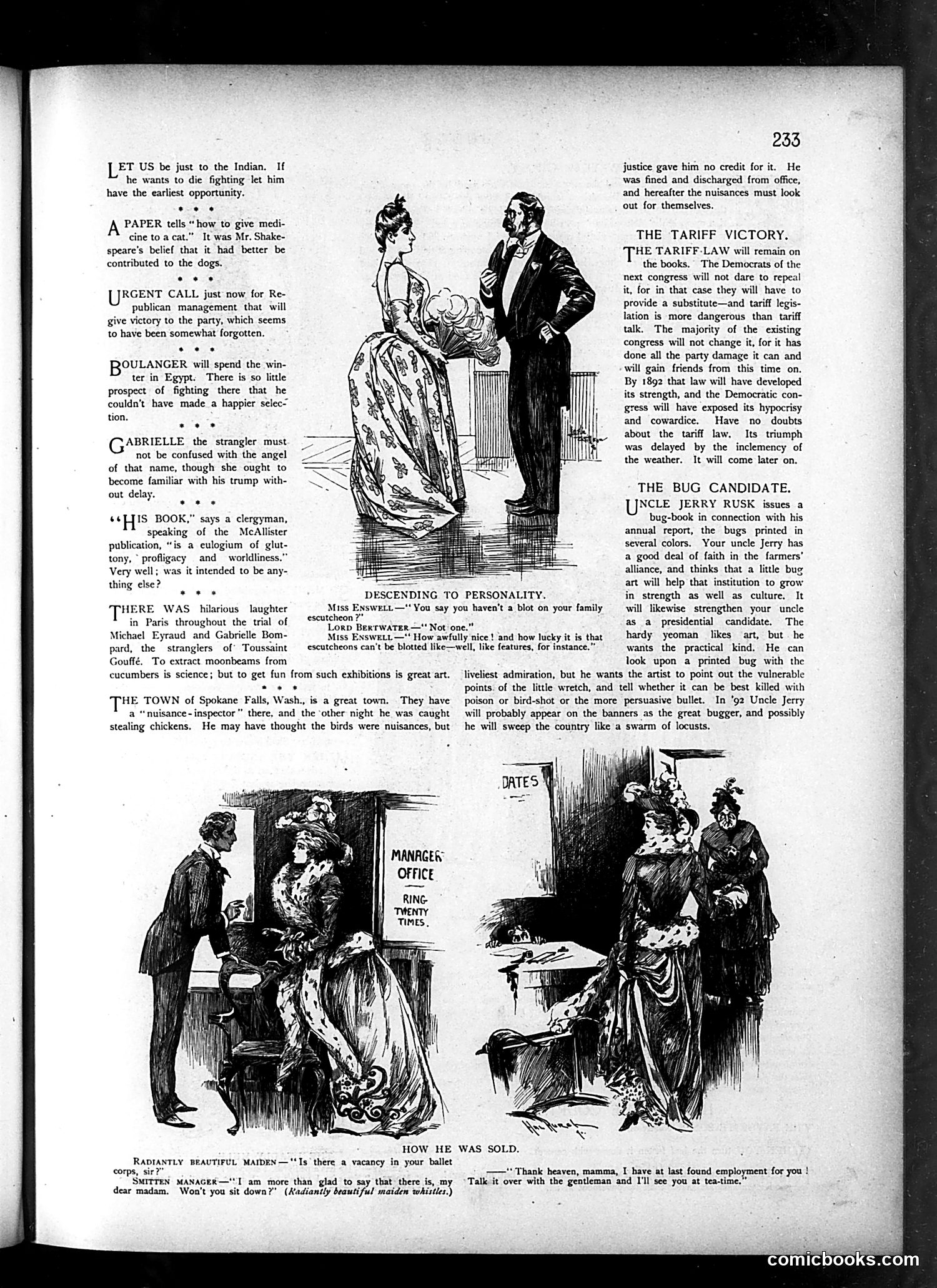
The top cartoon depicts a social interaction captioned "Descending to Personality." Miss Emswell boasts she hasn't a blot on her family escutcheon (ancestry), while Lord Braywater counters that his family's features are unblotted "like features, for instance." The satire mocks aristocratic pretension—specifically how upper-class individuals reduced themselves to physical insults when competing over genealogical superiority. The joke suggests that when breeding and pedigree fail as arguments, the debate devolves into personal appearance attacks, undercutting claims of refined dignity. The bottom cartoons ("How He Was Sold") appear unrelated vignettes about theatrical employment negotiations, likely satirizing show-business exploitation or deception in hiring practices.
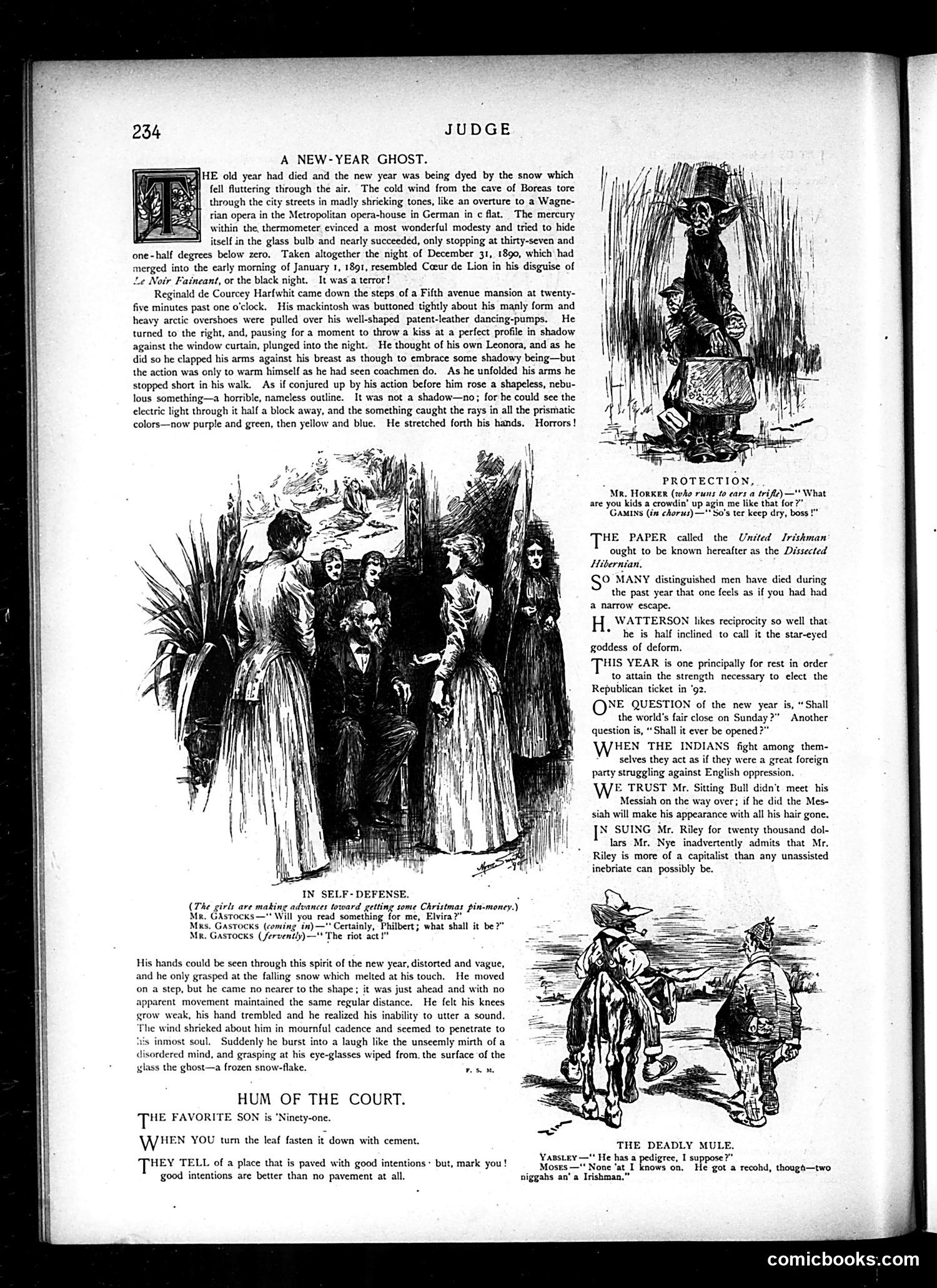
This 1890-91 New Year's story satirizes the passing of an old year through a supernatural encounter. A gentleman named Reginald encounters a ghostly, shapeless apparition on New Year's Eve—likely representing the departing year itself or death/time's passage. The narrative employs Gothic horror language (invoking Wagner, "Coeur de Lion") to mock both the theatrical pretensions of the era and anxieties about mortality. The accompanying shorter pieces mock contemporary figures and issues: Henry Watterson's reciprocity position, Native American conflicts (Sitting Bull), the 1892 Republican ticket, and the World's Fair's Sunday-closing debates. "A Protection" jokes about poor Irish immigrants seeking shelter. The page blends supernatural fiction with topical political commentary—Judge's typical formula mixing literature parody with social criticism.
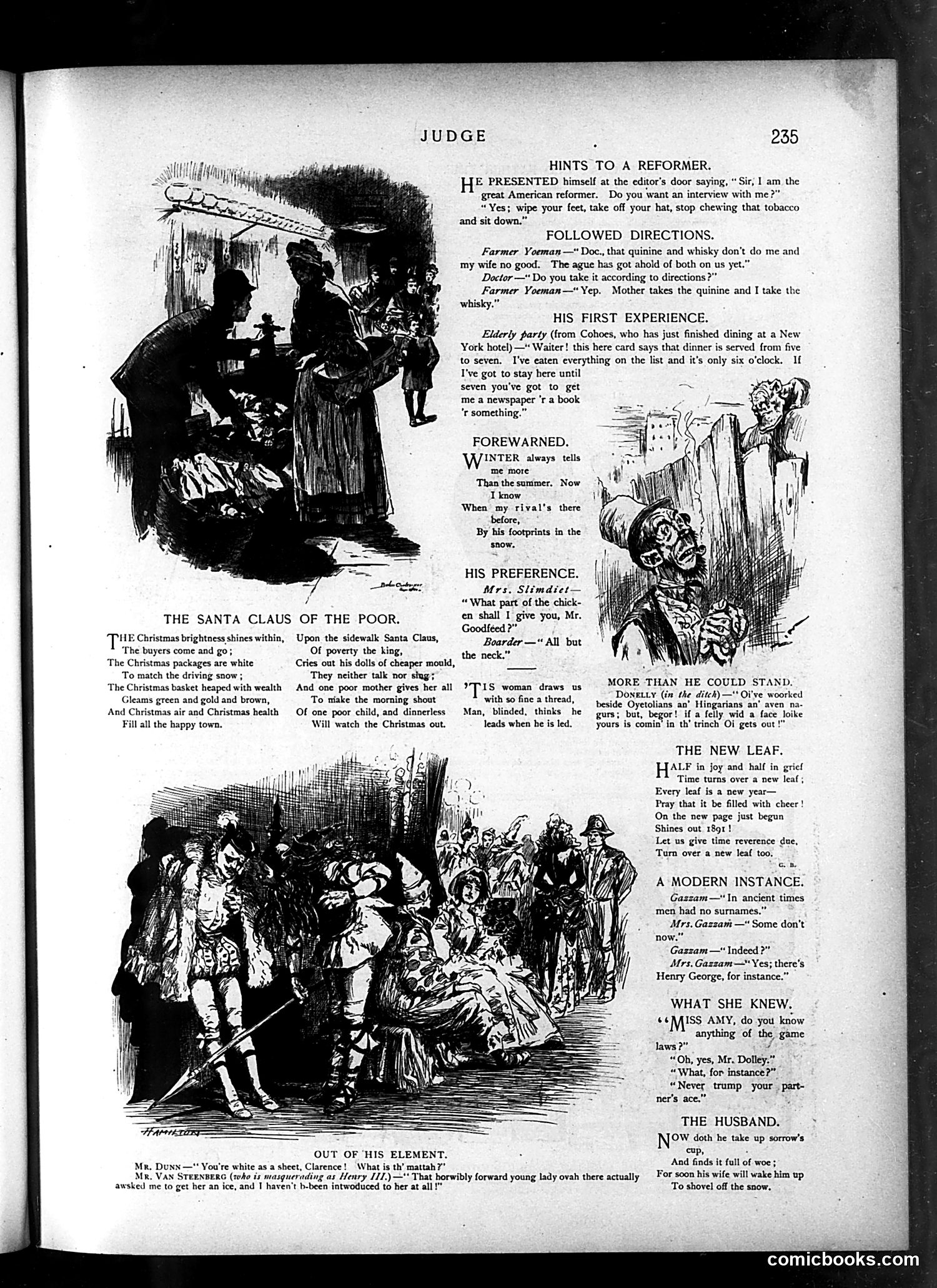
This page collects various short satirical pieces typical of Judge magazine's format. The main cartoon, "The Santa Claus of the Poor," contrasts wealthy Christmas abundance with a poor street vendor selling cheap dolls—critiquing economic inequality during the holiday season. Other pieces mock social pretension and human nature: a self-proclaimed "reformer" is told to mind his manners; a farmer misunderstands medical directions; a boarder complains about dinner timing; and a woman insults a man's appearance (appearing Irish, based on dialect). The humor ranges from domestic comedy ("The Husband" about shoveling snow) to commentary on contemporary figures like Henry George, the 19th-century economist. One piece satirizes a snobbish man pretending to be aristocracy who's shocked by a woman's forwardness. The overall tone reflects Judge's blend of class-conscious humor, gender dynamics, and commentary on American social climbing and hypocrisy.
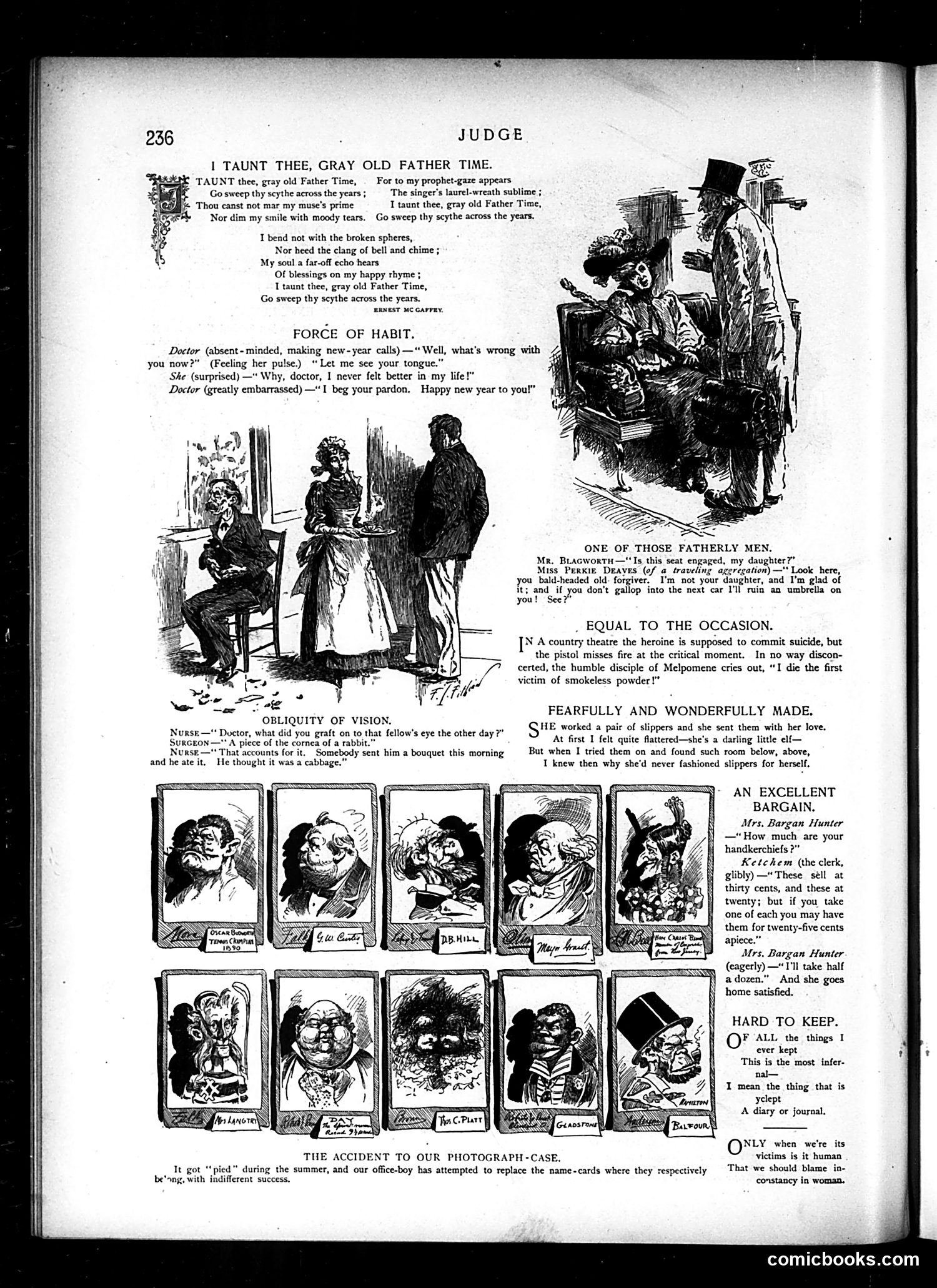
This page contains multiple short humorous pieces typical of late-19th/early-20th-century American satire: **"Force of Habit"** mocks an absent-minded doctor making new-year house calls who automatically examines a healthy patient by reflex, then awkwardly apologizes. **"One of Those Fatherly Men"** shows a lecherous older man approaching a young traveling actress, who aggressively rejects his advances with threats—satirizing predatory behavior toward vulnerable women performers. **"Equal to the Occasion"** jokes about a stage actress improvising when a suicide-scene prop gun misfires, blaming "smokeless powder"—poking fun at theater adaptability and contemporary ammunition technology. **"Obliquity of Vision"** features a humorous anecdote about grafting rabbit cornea onto a man's eye. The remaining pieces are light domestic humor: a doctor's wife's homemade slippers with poor fit, bargain hunting, and a diary that won't stay organized. The **photograph name-cards cartoon** shows office chaos when a boy tries reassembling mixed-up portrait labels—visual humor about workplace mishaps.
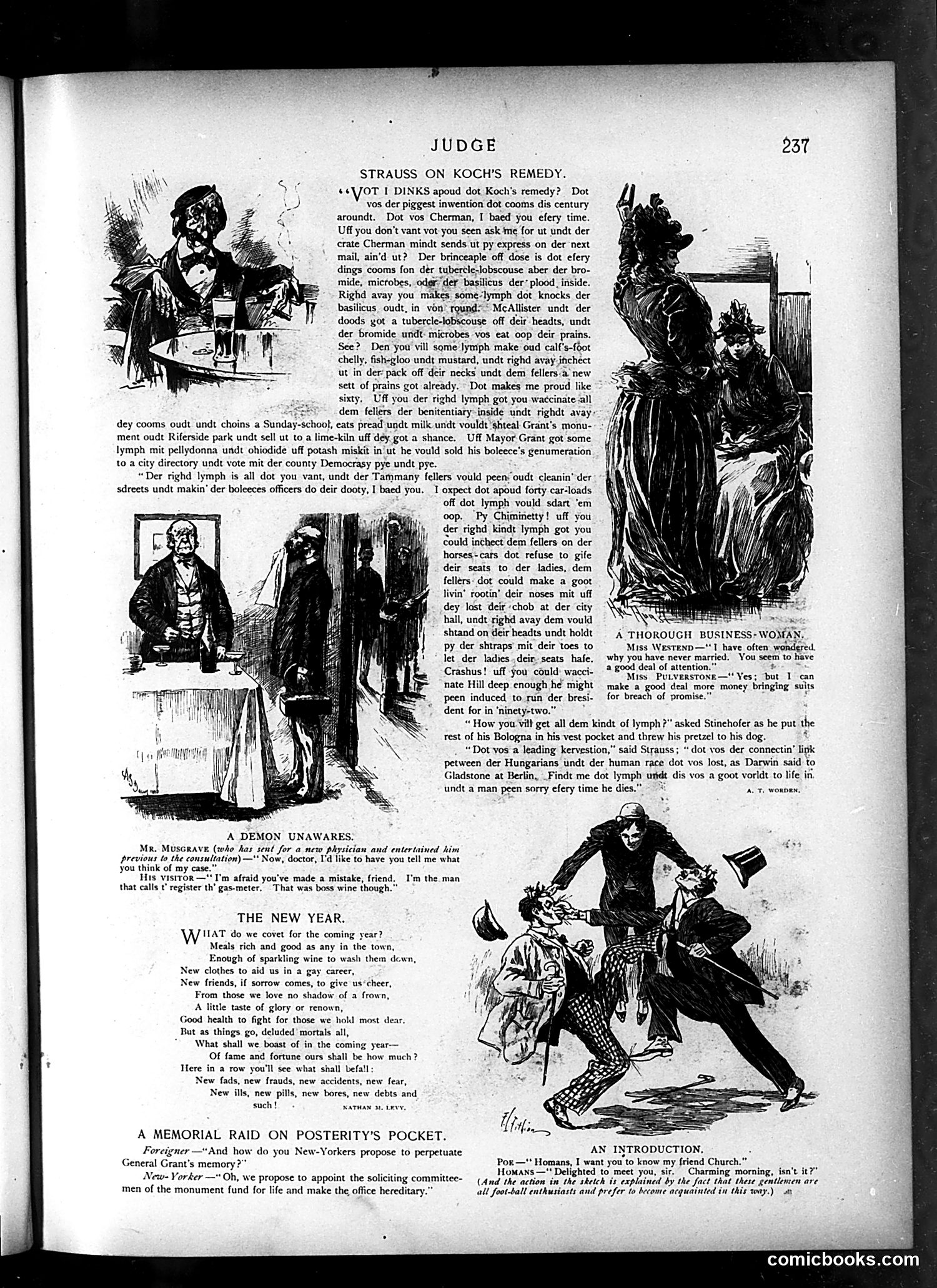
This page satirizes late-19th-century medical quackery and urban politics through a thick German-immigrant dialect monologue attributed to "Strauss." The speaker enthusiastically endorses Koch's Remedy—a real but ultimately ineffective tuberculosis treatment promoted by Robert Koch—as a cure-all for society's ills. The satire mocks both the credulous public embrace of dubious medical science and corrupt New York politics (referencing Mayor Grant and Tammany Hall). Strauss absurdly claims the "lymph" would reform prisoners, make corrupt officials honest, and cure social problems—obviously ridiculous exaggerations. The heavy dialect caricature reflects period anti-German immigrant prejudice common in Judge's pages. Other sections include light social humor ("A Thorough Business Woman") and a poem on New Year's hopes. The cartoons' sketchy illustrative style typifies Judge's satirical format of the era.
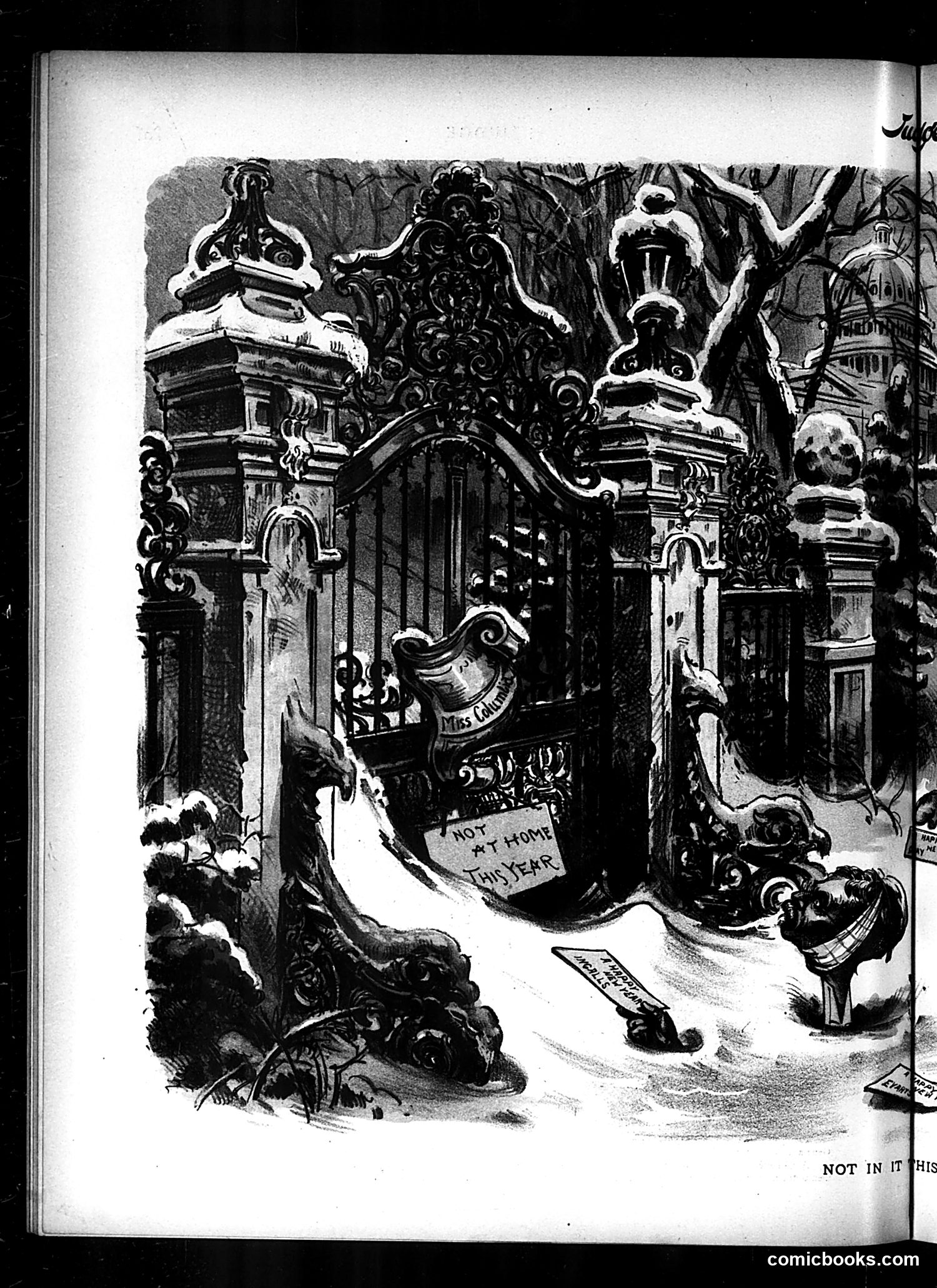
This political cartoon depicts an ornate government building (likely Capitol or similar) with elaborate architectural details. A figure in the center, labeled "NOT AT HOME THIS YEAR," appears to be refusing entry or hiding from something outside. The caption "NOT IN IT HIS" (partially visible) suggests commentary on someone's absence or refusal to participate. Without clearer text or date information, the exact political reference remains uncertain. However, the style suggests early-to-mid 20th century American politics. The elaborate gates and "not at home" message likely satirize a political figure's avoidance of responsibility or public engagement during a particular election cycle or controversy. The ornate architecture emphasizes the formal, prestigious nature of the position being avoided.
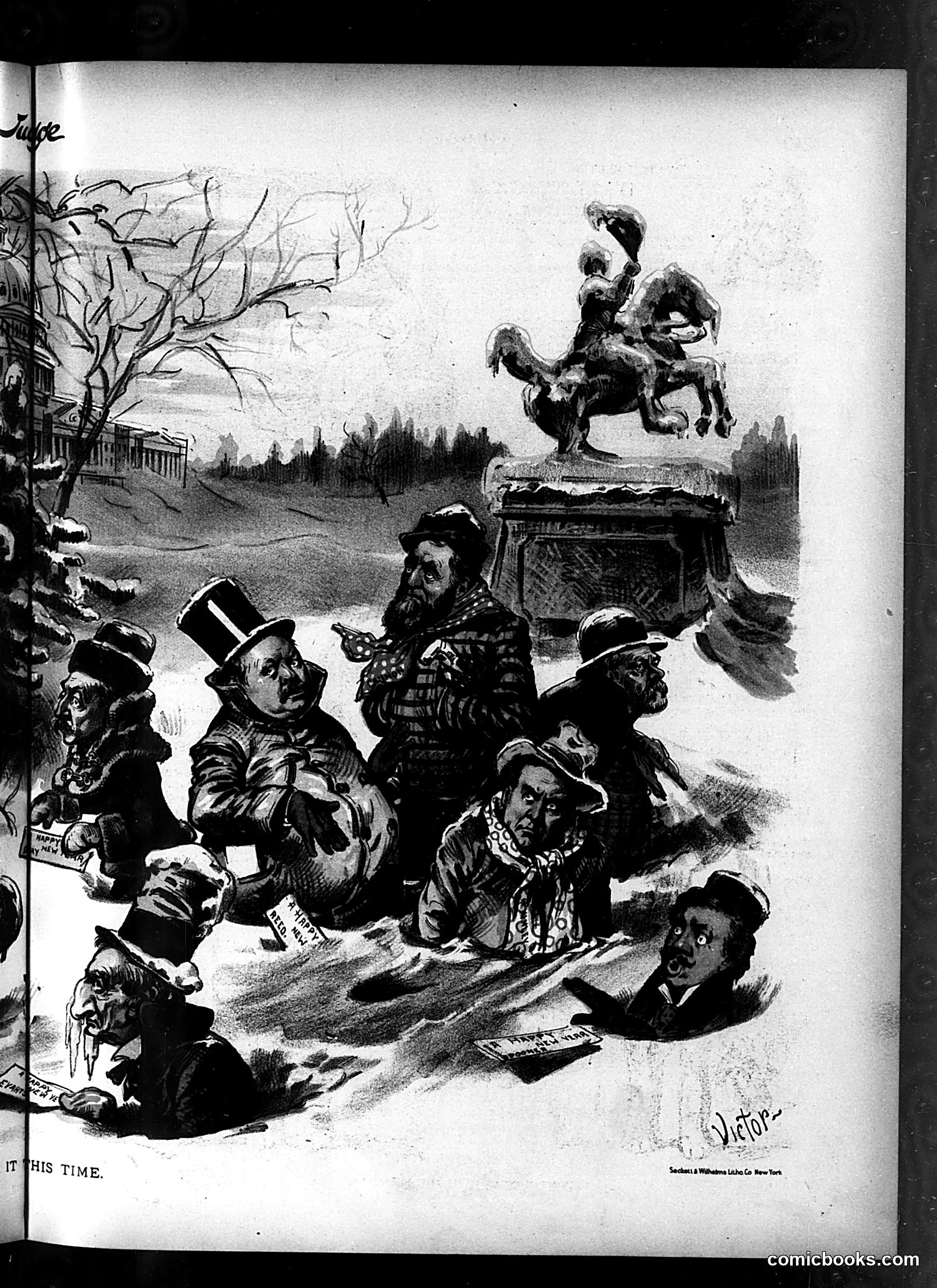
This political cartoon depicts a group of caricatured figures gathered around a pedestal supporting an equestrian statue. The style and composition suggest satirical commentary on political leadership or power structures, likely from the late 19th or early 20th century. The figures appear to represent various political or social archetypes rendered as caricatures. The pedestal monument suggests they're paying homage to—or mocking—some form of authority or established power. The bare tree on the left and desolate landscape convey a sense of societal decline or winter/hardship. However, without clearer text or identifying labels on specific figures, I cannot definitively identify which particular politicians, events, or social movements this cartoon satirizes. The page's partial visibility limits confident interpretation of its specific political target.
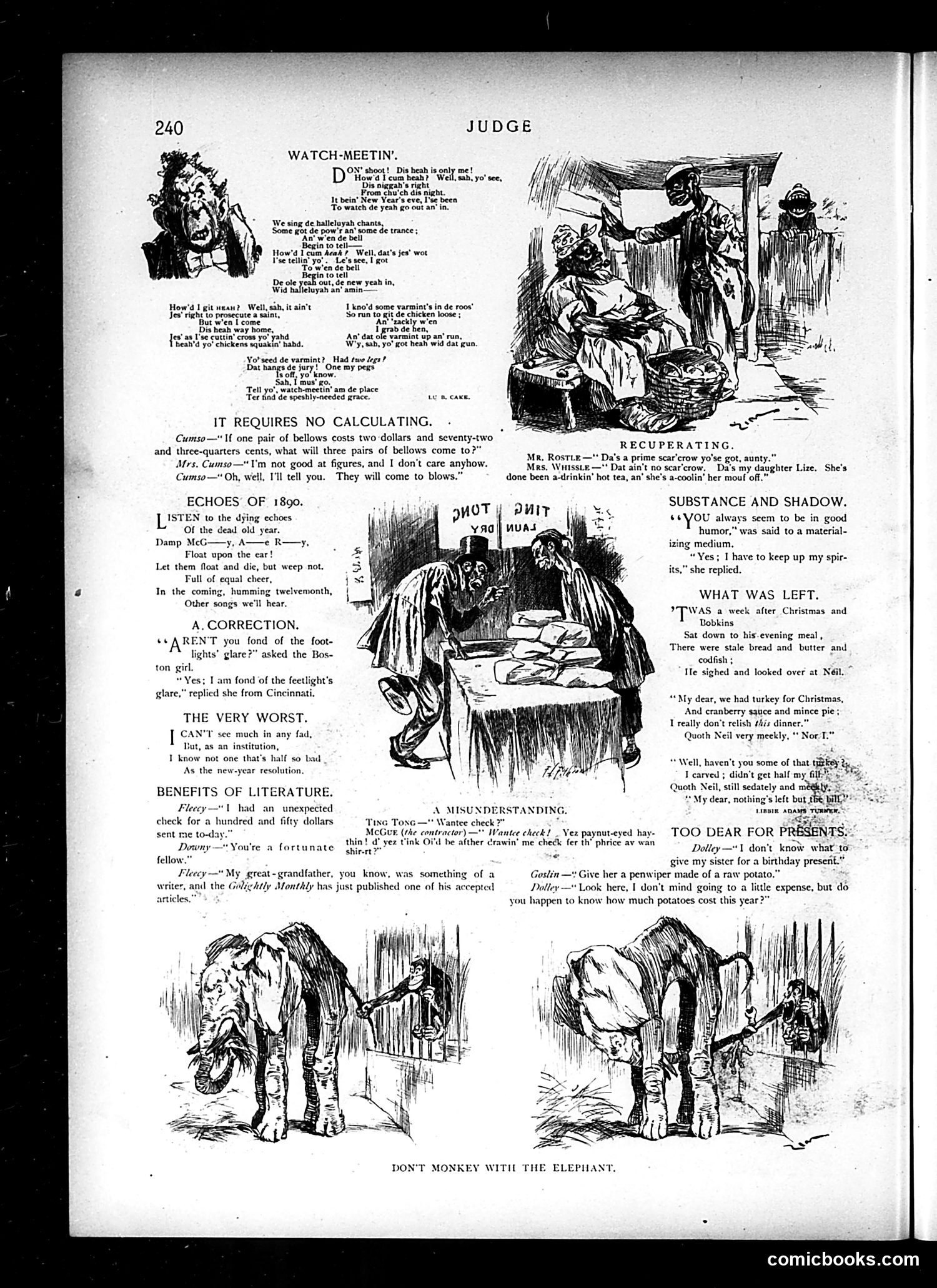
This page from Judge magazine (appears to be circa 1890, based on "Echoes of 1890") contains multiple short humorous sketches and cartoons reflecting late 19th-century American comedy. The dominant piece, "Watch-Meetin'," uses heavy dialect to depict an African American character explaining how he arrived at a New Year's Eve church gathering—the humor relies on racist stereotyping common to the era. Other sketches employ puns and domestic humor: a couple argues about bellows "coming to blows"; a woman corrects her accent; New Year's resolutions are mocked. The illustrations at bottom show an elephant in two poses—the caption "Don't Monkey with the Elephant" likely references political cartoons of the era, though the specific reference is unclear without additional context. Much of the page's comedy depends on wordplay, marital disputes, and character types rather than specific political events. The racist dialect humor represents attitudes that were considered acceptable entertainment at Judge's time.
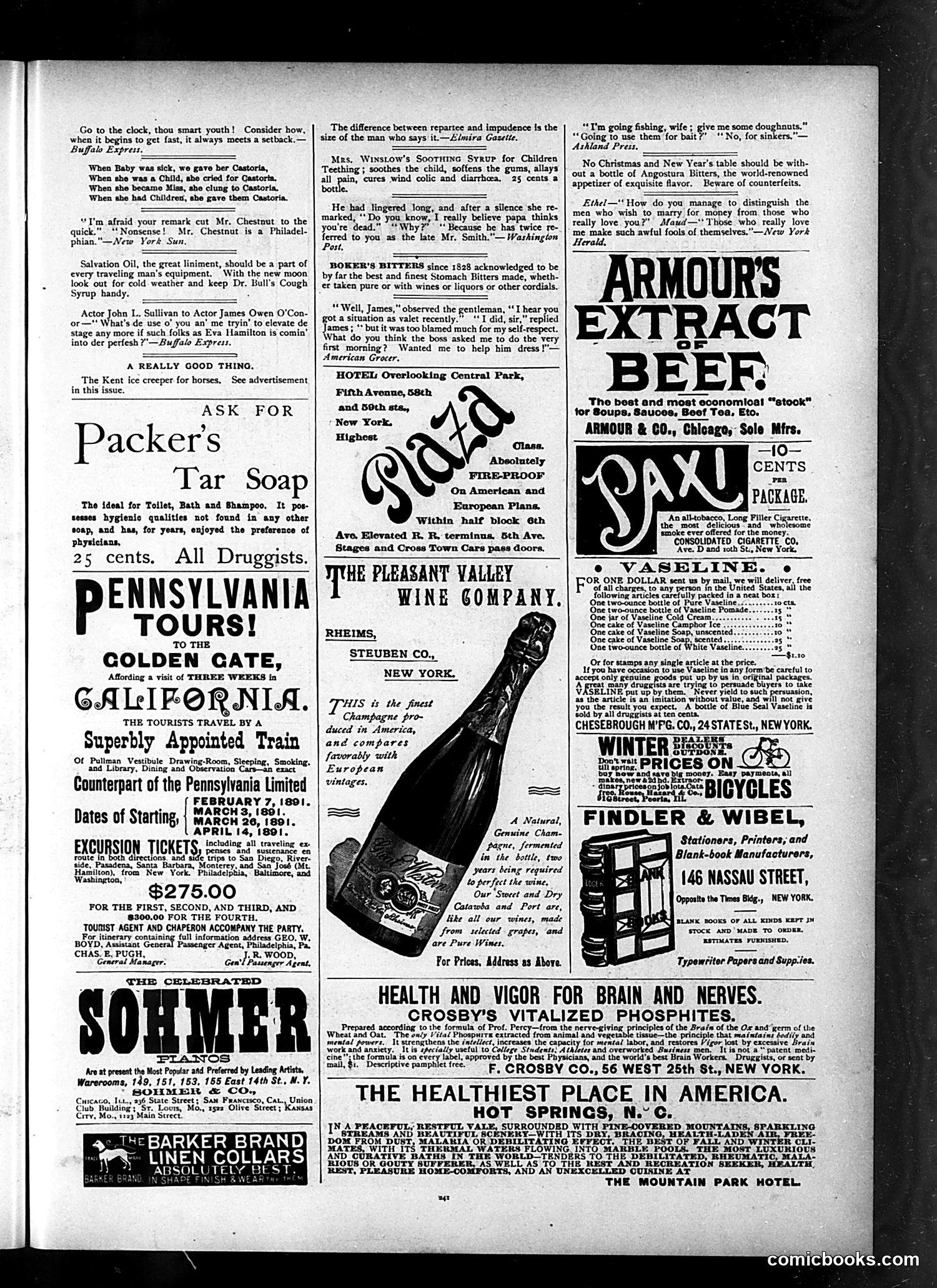
This page from Judge (circa 1891) is primarily **advertisements interspersed with brief humorous anecdotes** rather than political cartoons. The jokes are genteel, topical one-liners reflecting period social attitudes. Notable content includes: - A reference to **John L. Sullivan**, the famous boxer, depicted as lamenting the stage's decline - A quip about **Philadelphia society** (Chestnut as stereotypically quick-witted) - Gender humor about women and marriage ("distinguishing men who marry for money") - Class humor mocking valets and service workers The advertisements promote patent medicines (Castoria, Salvation Oil), luxury travel to California, pianos, bicycles, and alcohol—typical of 1890s consumer culture. The overall tone reflects upper-class, urbane sensibilities with light mockery of social pretension and working-class aspirations, typical of Judge's audience at this period.
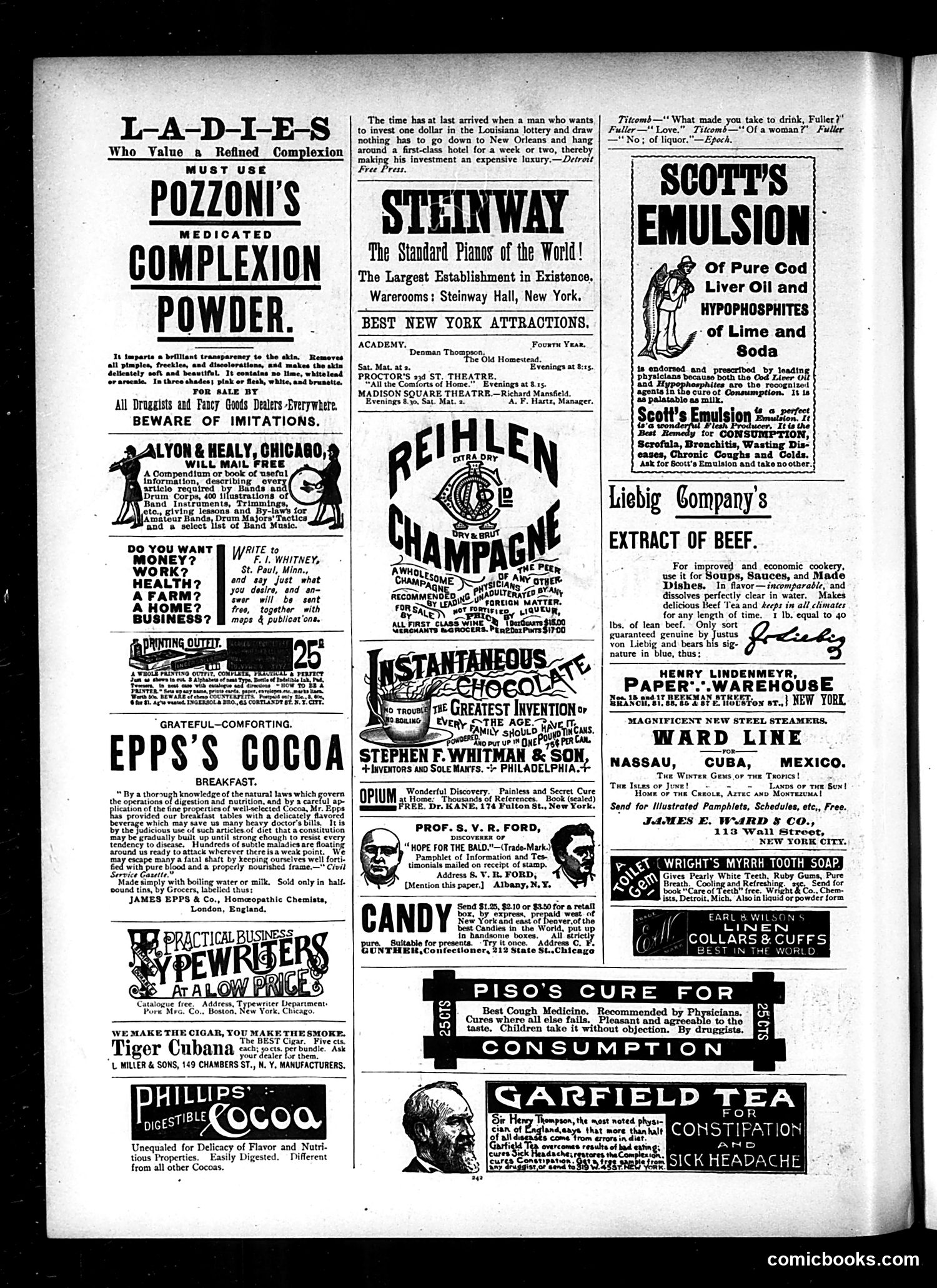
This is primarily **an advertising page** from Judge magazine, with one small joke at the top right. **The Joke:** A brief dialogue between characters Titcomb and Fuller: when asked why Fuller "took to drink," he first suggests love of a woman, then clarifies he means love of liquor itself. The satire is a simple play on words about alcoholism. **The Advertisements:** The page is dominated by late-19th/early-20th-century product ads reflecting period consumer culture: - Beauty products (Pozzoni's complexion powder) - Patent medicines (Piso's Cure for Consumption, Ford's hair loss treatment, Opium cure) - Foods (Epps's Cocoa, Liebig's Extract of Beef) - Luxury goods (Steinway pianos, Scott's Emulsion cod liver oil) - Cigars and candy **Historical Context:** These ads reveal what concerned consumers then: complexion flaws, baldness, opium addiction, tuberculosis ("consumption"), and constipation. The unregulated patent medicine industry aggressively marketed often-ineffective or dangerous "cures."
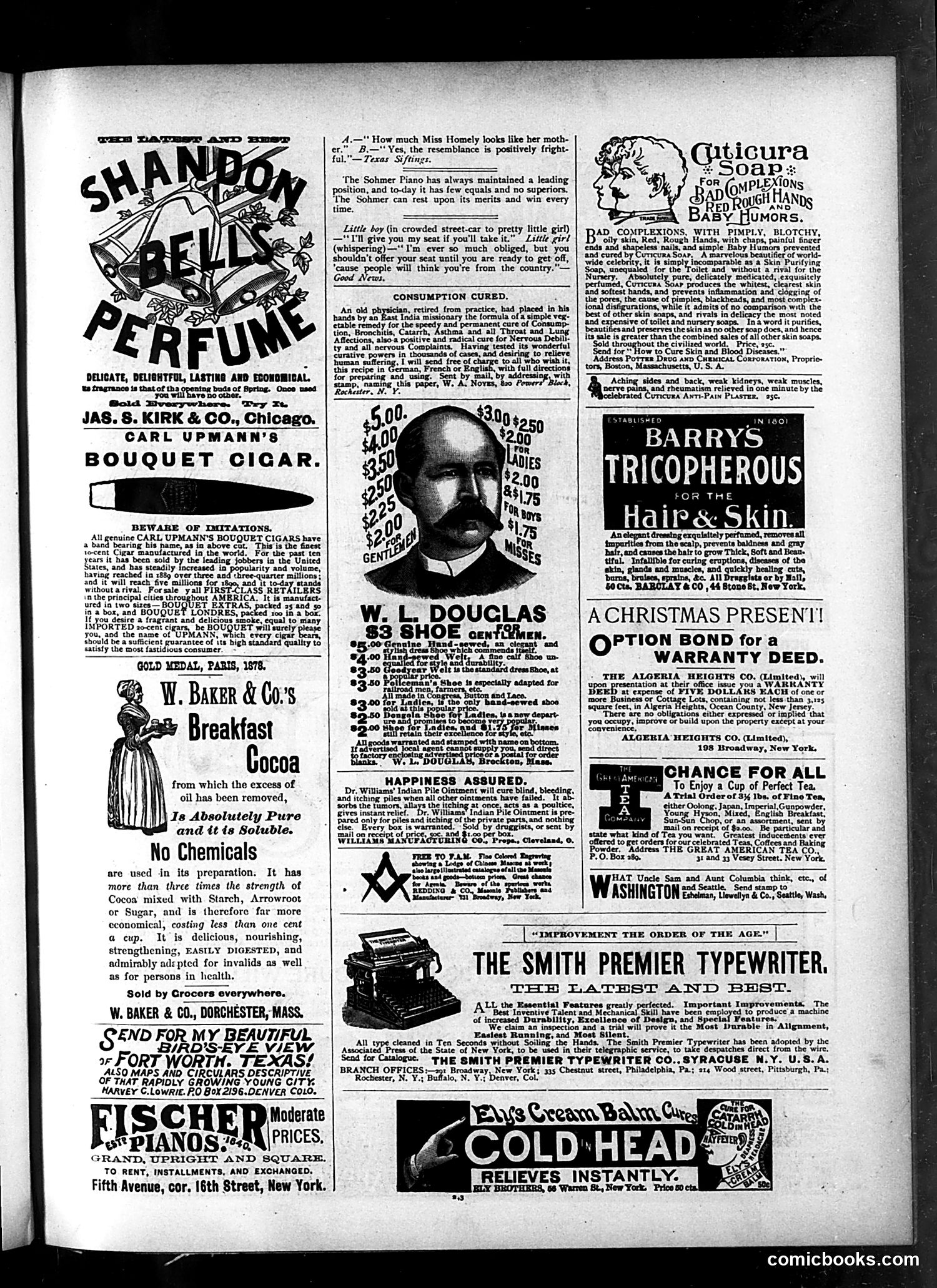
This page is primarily **advertising**, featuring numerous product advertisements typical of late 19th-century American magazines. There is one small joke at the top. ## The Cartoon/Joke: A brief exchange appears under the Sohmer Piano ad: a young man offers his seat to a pretty girl on a crowded streetcar; she declines, whispering that people will think he's "from the country." The satire mocks urban social pretension—suggesting that offering one's seat (a polite, rural custom) marks someone as unsophisticated by city standards. ## The Advertisements: The page showcases typical period products: Shandon perfume, Carl Upmann cigars, W.L. Douglas shoes, Baker's Cocoa, piano sales, the Smith Premier typewriter, hair/skin treatments (Cuticura Soap, Barry's Tricophorous), digestive remedies, and real estate promotions. These ads reflect Gilded Age consumer culture and common patent medicine claims. Many advertisements emphasize social class markers and promise transformative results (cures for "complexions," baldness, etc.), reflecting Victorian anxieties about appearance and respectability. The page illustrates how satirical magazines funded themselves through advertising.
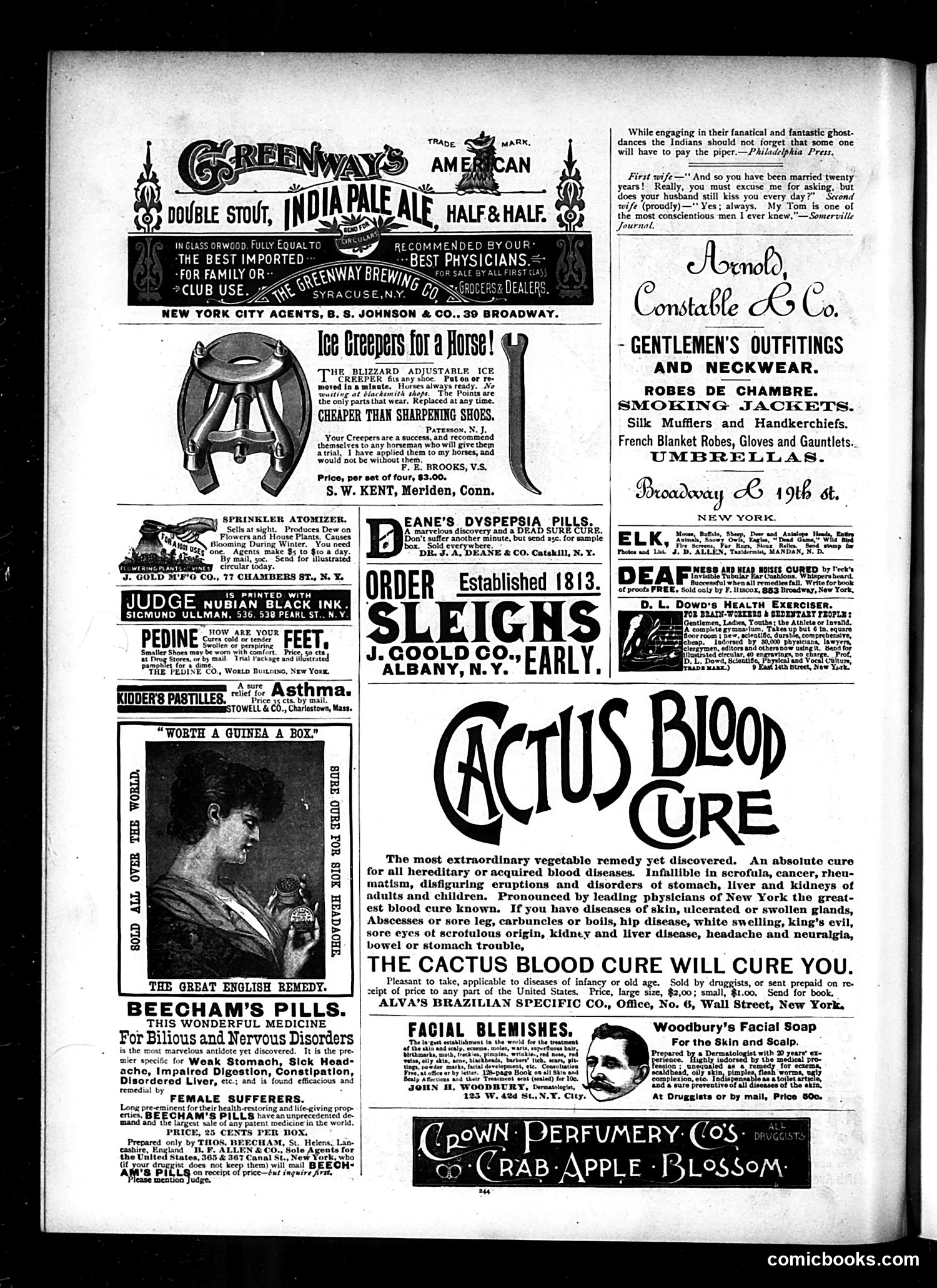
This is primarily an **advertising page** from Judge magazine, not a satirical cartoon page. It contains commercial advertisements for patent medicines, clothing, and consumer products typical of the late 19th/early 20th century. The notable content includes: **Two brief humor items** at the top—mild jokes about Native American "ghost dances" (referencing actual ceremonies) and spousal affection—rather than political satire. **Numerous dubious "remedies"**: The page advertises quack medicines claiming to cure everything from blood diseases to dyspepsia. "Cactus Blood Cure" promises to treat cancer, scrofula, and kidney disease—claims we now recognize as fraudulent. Beecham's Pills and other tonics were common patent medicines of this era, often containing harmful ingredients and making exaggerated health claims. **Legitimate products** like Arnold Constable clothing and Crown Perfumery appear alongside the medical frauds, reflecting how unregulated advertising was then. This page illustrates **pre-FDA consumer culture**, when magazines freely published false medical advertising without scrutiny—a practice that contributed to the eventual passage of food and drug regulations.
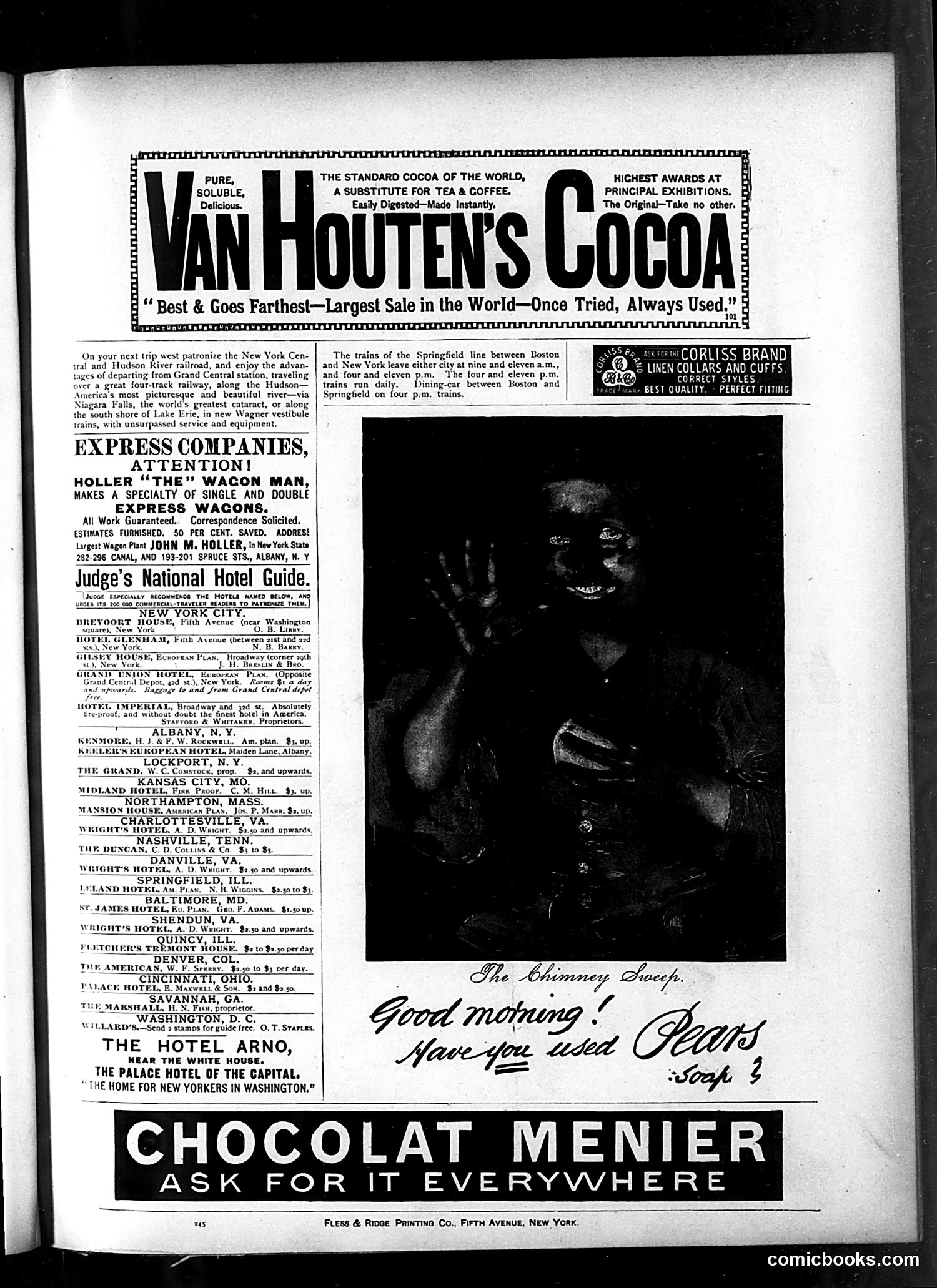
This page is primarily **advertising**, not satire or political commentary. It contains multiple commercial advertisements typical of late 19th/early 20th-century magazines. The main visual element is a photograph captioned "The Chimney Sweep" with accompanying text reading "Good morning! Have you used Pears soap?" This is an advertisement for Pears soap, using a sentimental image of a young chimney sweep (a figure associated with poverty and child labor) to sell cleaning products. The juxtaposition is characteristic of period advertising: using sympathetic or emotional imagery to market goods, without irony or critique. Below this are extensive hotel recommendations and advertisements for express wagons, railroad services, cocoa, and other consumer products. The page represents Judge's primary revenue source during this era: paid advertising integrated with editorial content.
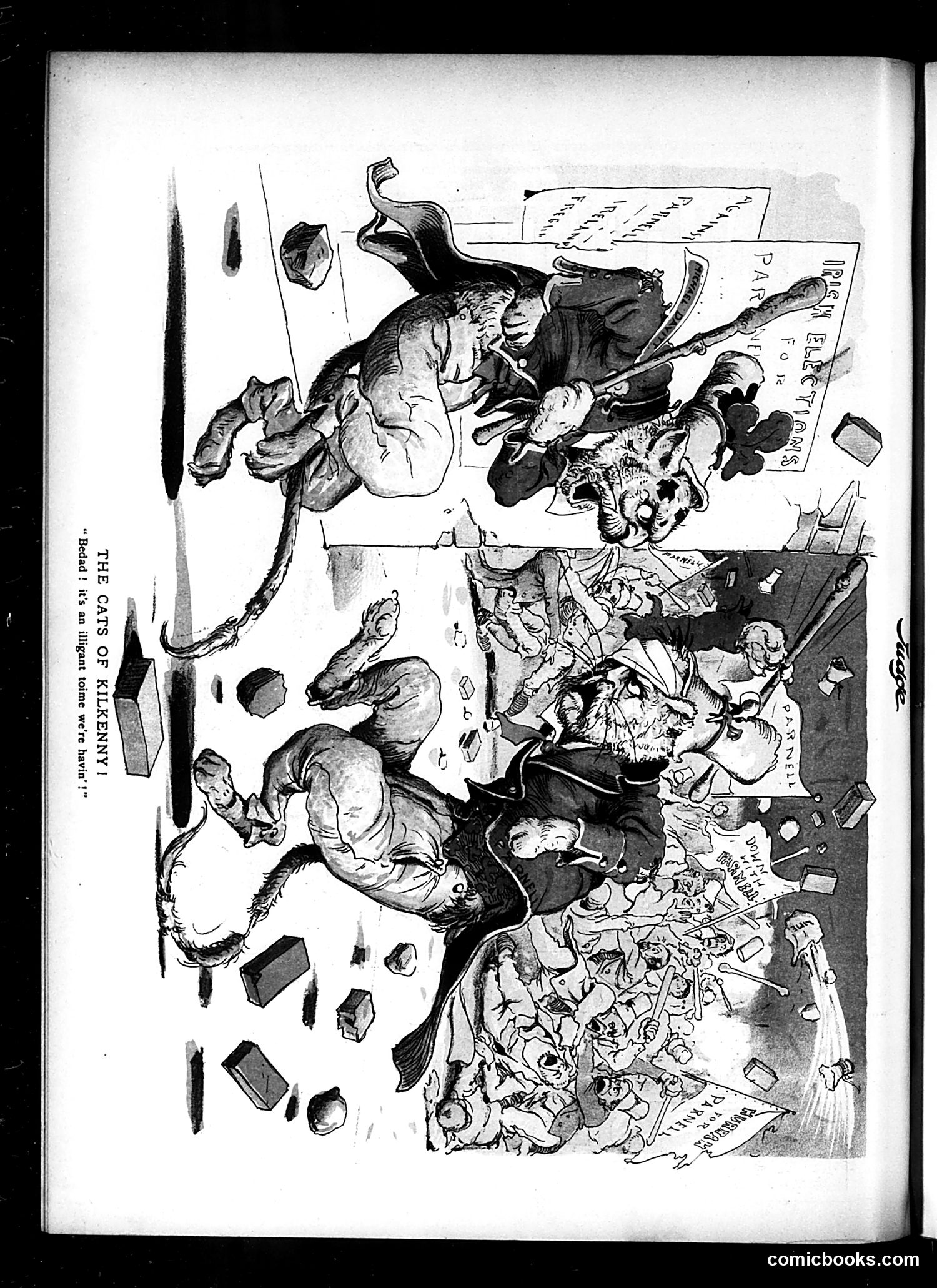
This appears to be a satirical cartoon from Judge magazine, presented upside-down on the page. The title references the famous nursery rhyme about two cats fighting until only their tails remain. The cartoon depicts multiple figures engaged in chaotic conflict, with various objects scattered about—possibly representing politicians or public figures of the era fighting over resources or power. The detailed caricatures and violent imagery suggest commentary on political infighting or social discord. However, the OCR text is largely corrupted and unreadable, making it difficult to identify specific figures or pinpoint the exact historical/political reference. The upside-down presentation may be intentional—perhaps itself part of the satirical commentary—but without clearer text or visible publication date, I cannot confidently specify which political conflict or scandal this addresses.