
A complete issue · 20 pages · 1890
Judge — November 22, 1890
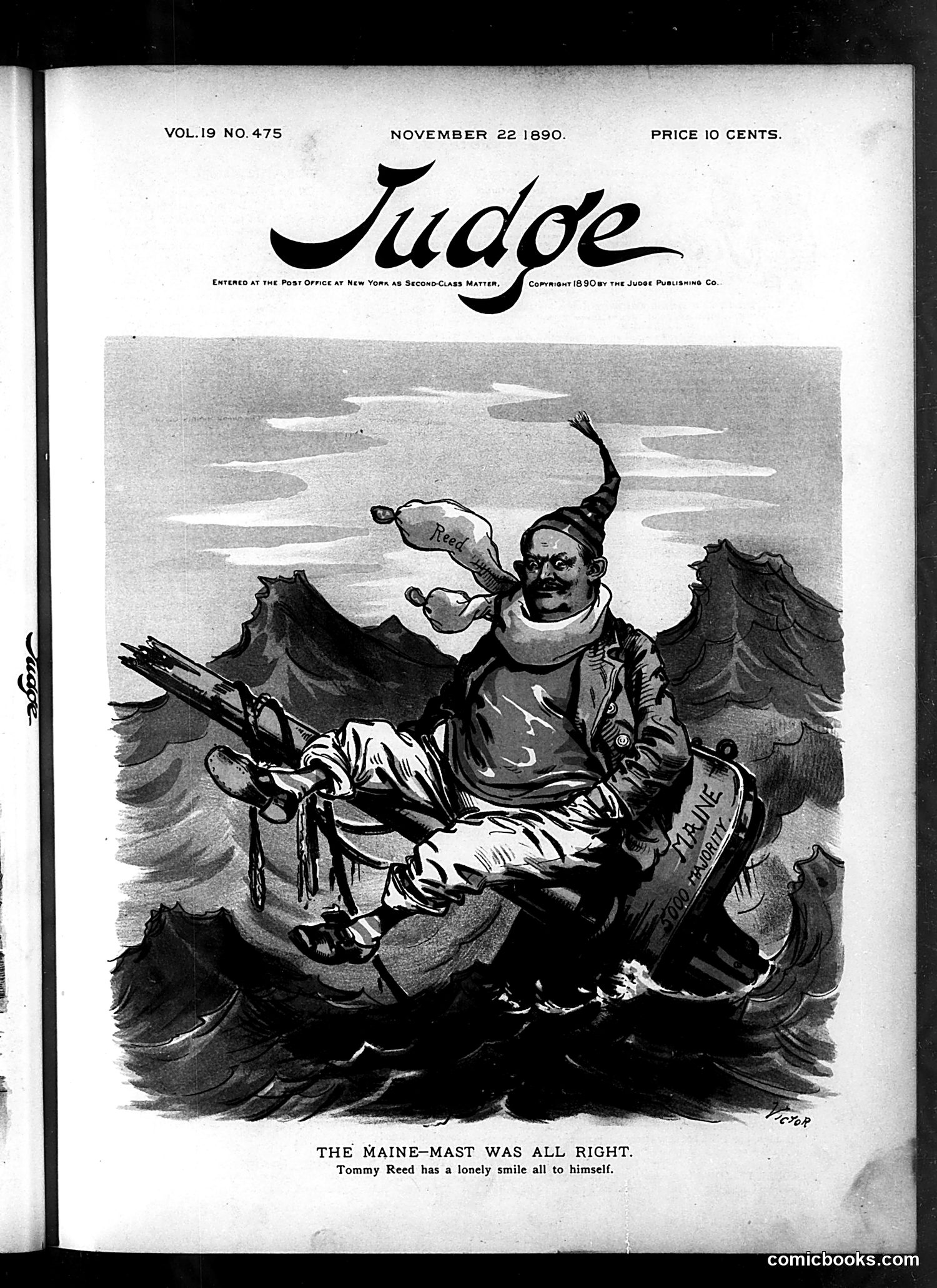
This satirical cartoon depicts a figure labeled "Reed" in a rowboat during rough seas, holding a document marked "MAINE" and appearing distressed or gleeful. The caption reads "THE MAINE-MAST WAS ALL RIGHT. Tommy Reed has a lonely smile all to himself." The cartoon likely references **Thomas Brackett Reed**, Speaker of the House, who advocated for naval expansion and U.S. power projection. "Tommy Reed" appears to be celebrating something related to Maine—possibly a naval issue or political victory in that state. The sinking boat imagery suggests political turbulence or precarious circumstances despite Reed's confidence. Without additional context about specific 1890 Maine political events, the exact satirical target remains somewhat unclear, though it clearly mocks Reed's self-satisfaction during uncertain political waters.
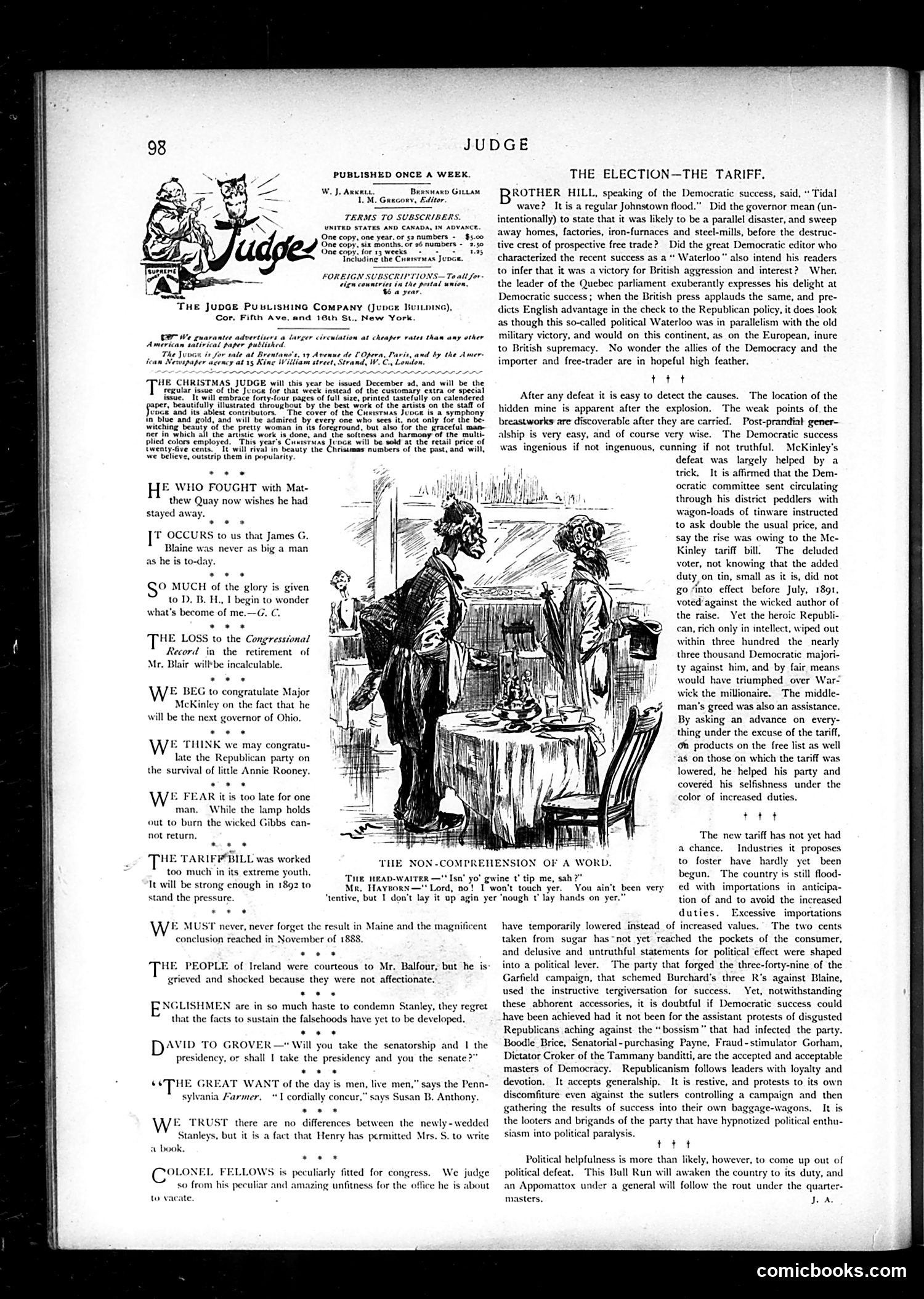
This cartoon depicts two men in conversation at a table. The caption suggests a waiter addressing a diner, with dialogue about gauging ("'Ize ye gauge it 'tip me, s'h'?") and not touching yet—appearing to satirize class miscommunication or service-industry confusion. The surrounding text addresses political matters: McKinley's tariff policies, Democratic opposition, and Republican strategy. The cartoon likely illustrates the disconnect between working-class concerns and political leadership's understanding of them—a "non-comprehension" of ordinary citizens' needs. The specific figures are unclear, but the satire targets how politicians discuss trade policy and tariffs while common people struggle with their practical effects.
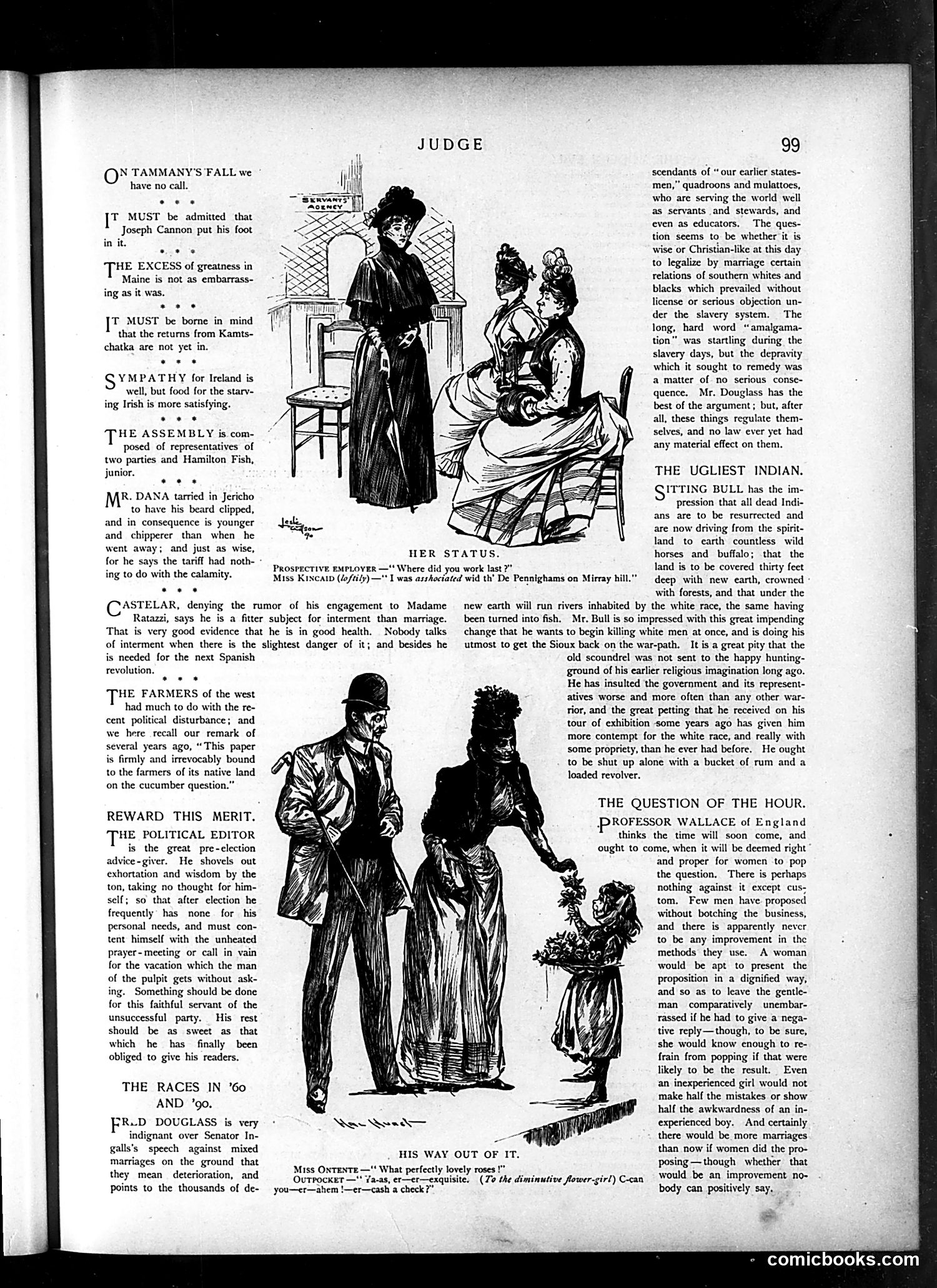
This page contains several satirical sketches and commentary on late 19th-century American issues: **"Her Status"** (top): depicts a woman being interrogated about employment, satirizing concerns about women's labor and social position. **"His Way Out of It"** (bottom): shows a man with a woman and child, likely mocking marriage evasion or paternity disputes—common Judge topics. The text discusses **racial amalgamation debates**, **Native American policy** (references to Sitting Bull and "the Sioux"), and **women's suffrage** through Professor Wallace's commentary on whether women should vote. The satire reflects 1890s anxieties: interracial relationships were scandalous; Native Americans were portrayed as obstacles to progress; women's political participation was hotly contested. The cartoons use exaggerated facial features typical of period satirical illustration.
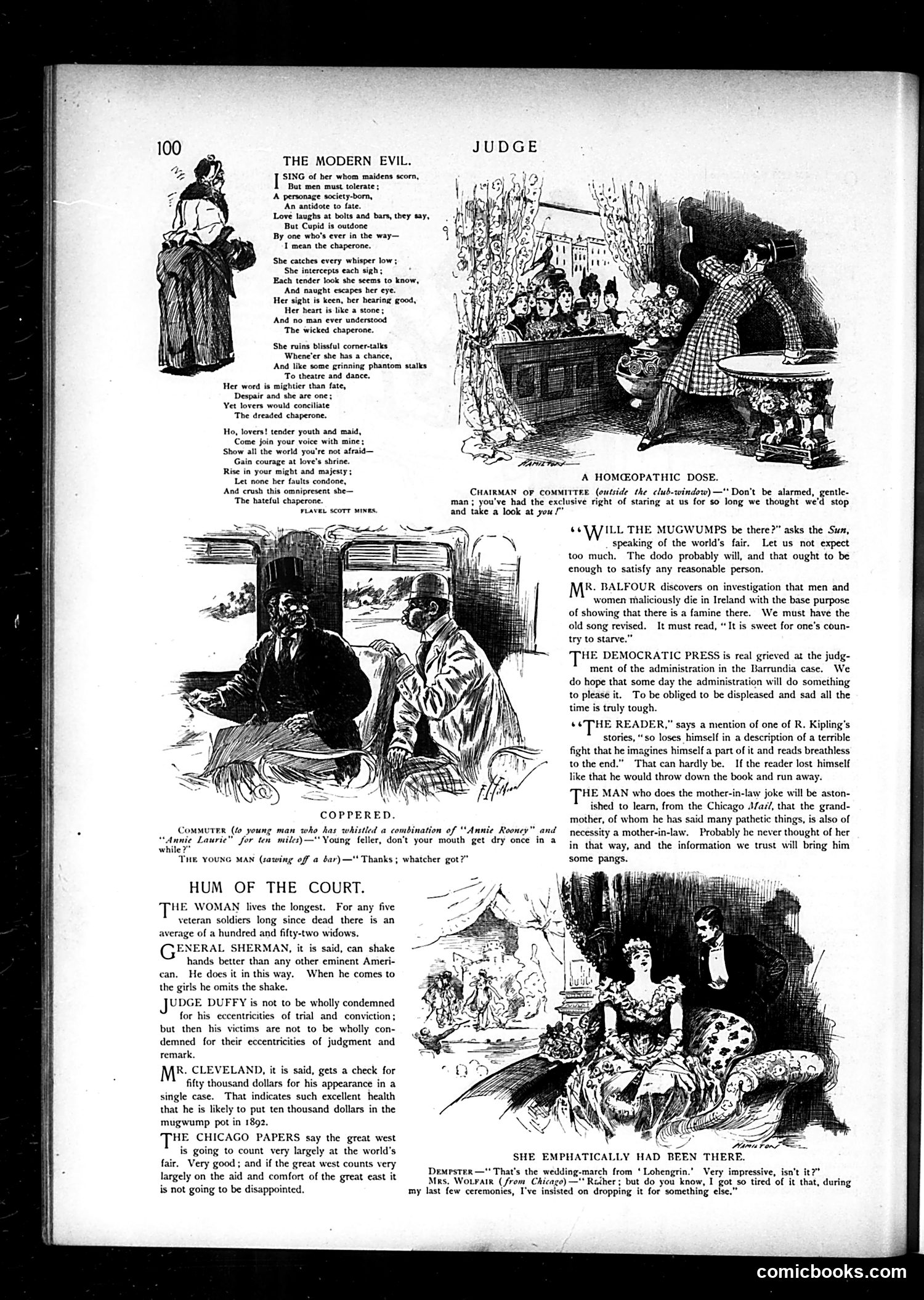
This page from Judge magazine contains multiple satirical commentaries on 1890s American life and politics. **"The Modern Evil"** poem mocks the social institution of chaperones—elderly women who supervised young unmarried couples. The satire frames the chaperone as an omnipresent obstacle to romance, sympathizing with frustrated lovers. This reflects Victorian-era anxieties about courtship restrictions. **Political references** include jabs at: - **Mugwumps** (Republicans who opposed their party's 1884 nominee) - **Balfour** (Irish secretary accused of mishandling famine relief) - **Cleveland** (President, referenced regarding an 1892 political contribution) - **Judge Duffy** (apparently a controversial judge) The cartoons use visual humor: one shows a committee member sarcastically inviting scrutiny after long surveillance of others; another depicts a commuter's dry mouth from whistling popular songs. The "Hum of the Court" section offers brief satirical observations on contemporary figures and social conditions, typical of Judge's editorial style during this period.
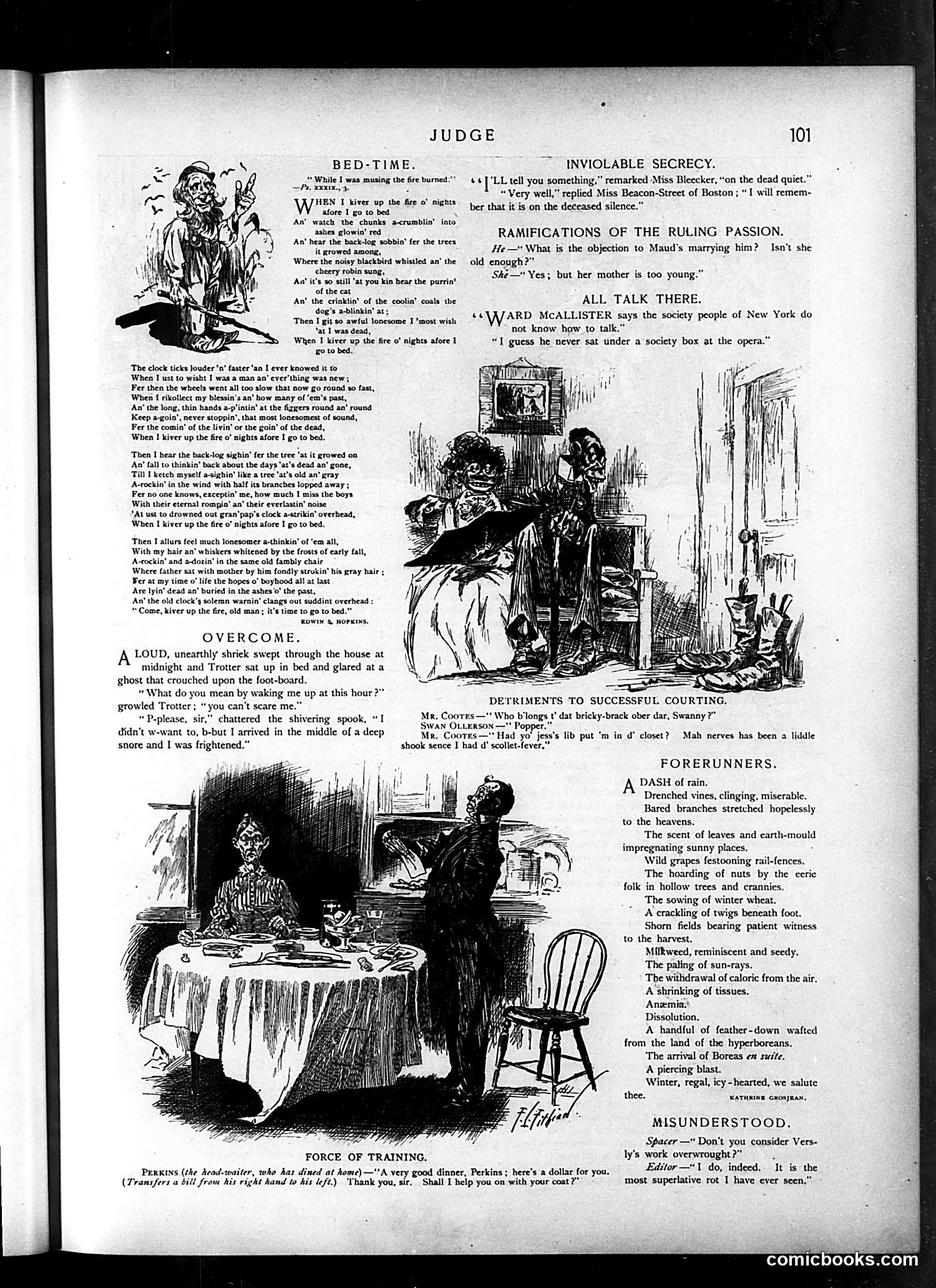
This page contains several satirical pieces typical of the era's humor magazine: **"Bed-Time"** is a nostalgic poem about an elderly person reflecting on loneliness while tending a fire at night, contrasting their quiet present with memories of childhood noise and family. **"Overcome"** is a brief comedic sketch where a ghost, arriving mid-snore, frightens a man who dismisses it—reversing the expected terror dynamic for humor. **"All Talk There"** references Ward McAllister, a real Gilded Age figure famous for defining New York "high society." The joke satirizes society people's pretentiousness—they can't even conduct proper conversation, needing to hide in opera boxes. **"Ramifications of the Ruling Passion"** jokes about an older woman wanting to marry someone younger than her own mother, mocking romantic delusion. Other sections include miscellaneous humorous observations and a poem about autumn ("Forerunners"). The page reflects typical late 19th/early 20th-century satirical magazine content targeting social pretension and domestic life.
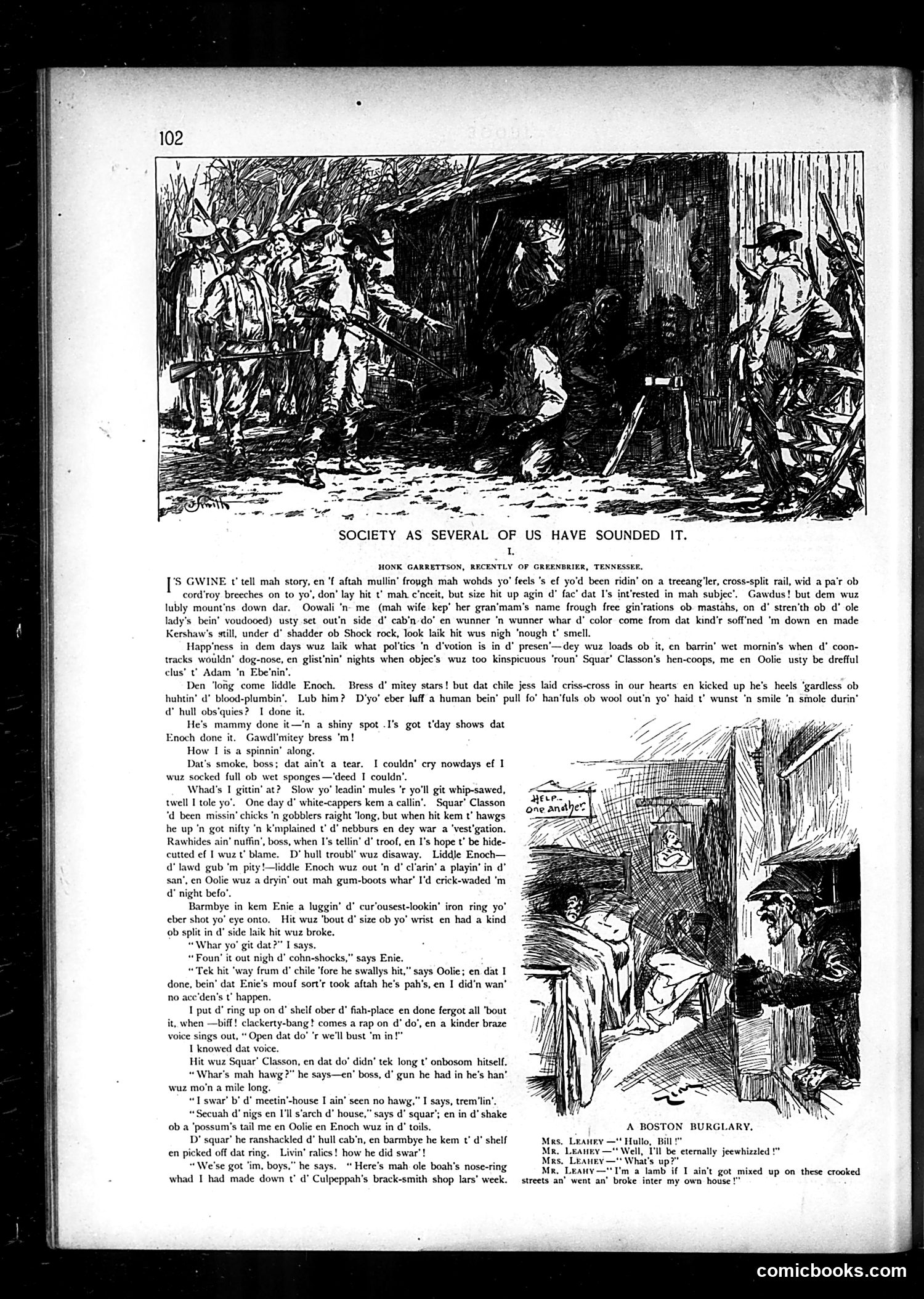
This page contains a dialect story by Honk Garrettson of Tennessee, presented in heavily stereotyped African American vernacular. The narrative describes a poor rural family whose child finds a mysterious iron ring, which a white neighbor (Squar' Classon) identifies as his missing pig's nose-ring. The "white-cappers" (vigilante groups) had been investigating livestock thefts. The story climaxes with Classon arriving armed, discovering the ring, and apparently preparing to enact violence based on circumstantial evidence. **For modern readers:** This represents the racist literary conventions of early 20th-century American magazines—presenting Black characters through exaggerated dialect to mock rural poverty and suggest criminality. The implicit threat of white mob violence against an innocent family reflects historical realities of lynching, though presented here as entertainment. The accompanying cartoon and advertisement about "A Boston Burglary" suggest the page mixed various narratives for satirical effect.
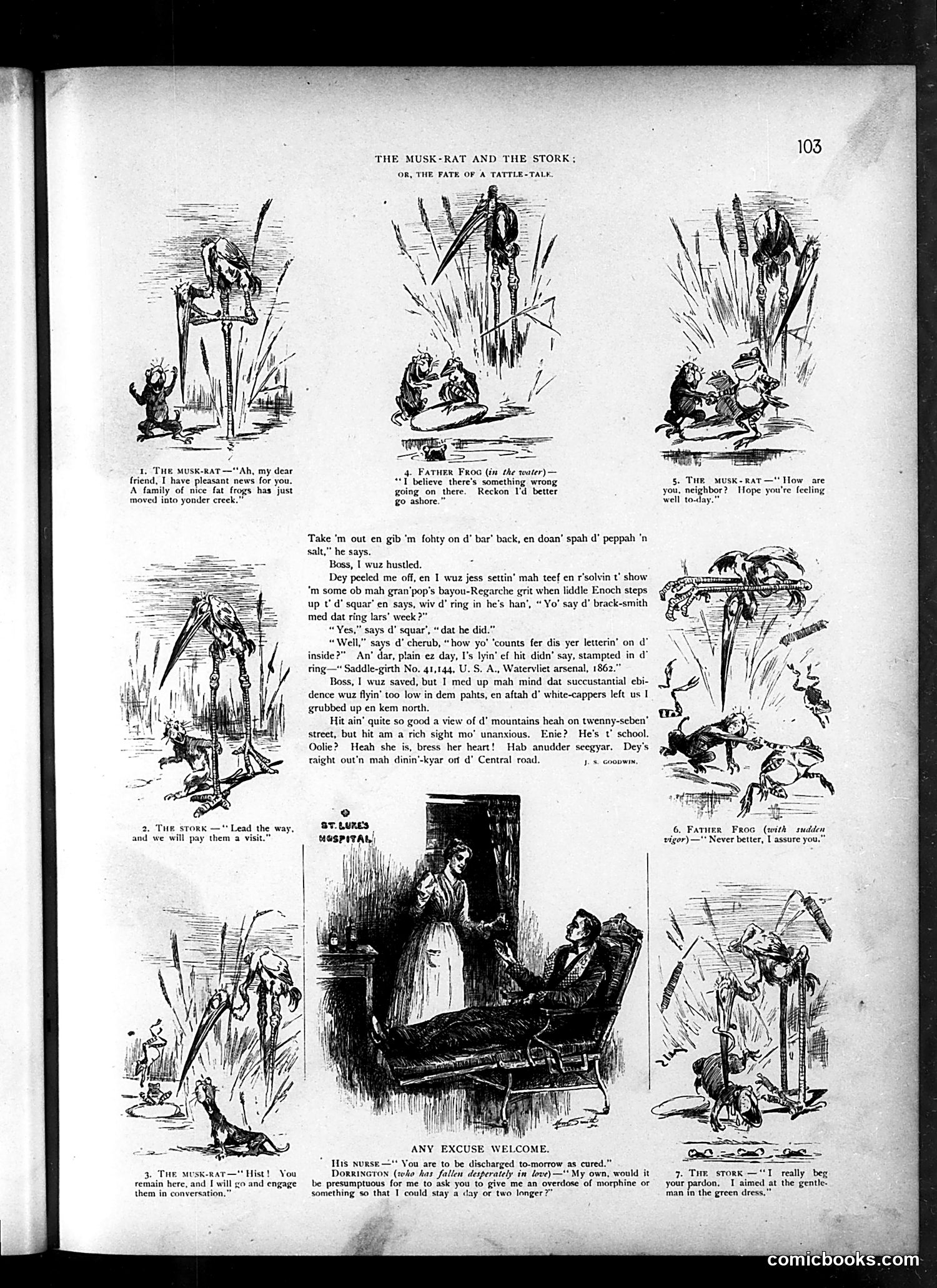
This is a cautionary fable in dialect (rendered in exaggerated African American vernacular, reflecting the period's problematic conventions). A musk-rat befriends a stork by revealing where fat frogs live, intending them to be eaten together. Instead, the stork kills the frogs while the musk-rat is attacked by angry locals. The moral: informants/tattletales face consequences for their betrayal. The story frames betrayal as self-destructive. The musk-rat learns this lesson and migrates north to find peace, suggesting that discretion and minding one's own business bring safety and contentment. The page's second cartoon, "Any Excuse Welcome," is a separate joke about a lovesick hospital patient seeking to extend his stay by requesting a fatal overdose—dark humor about desperation and romance.
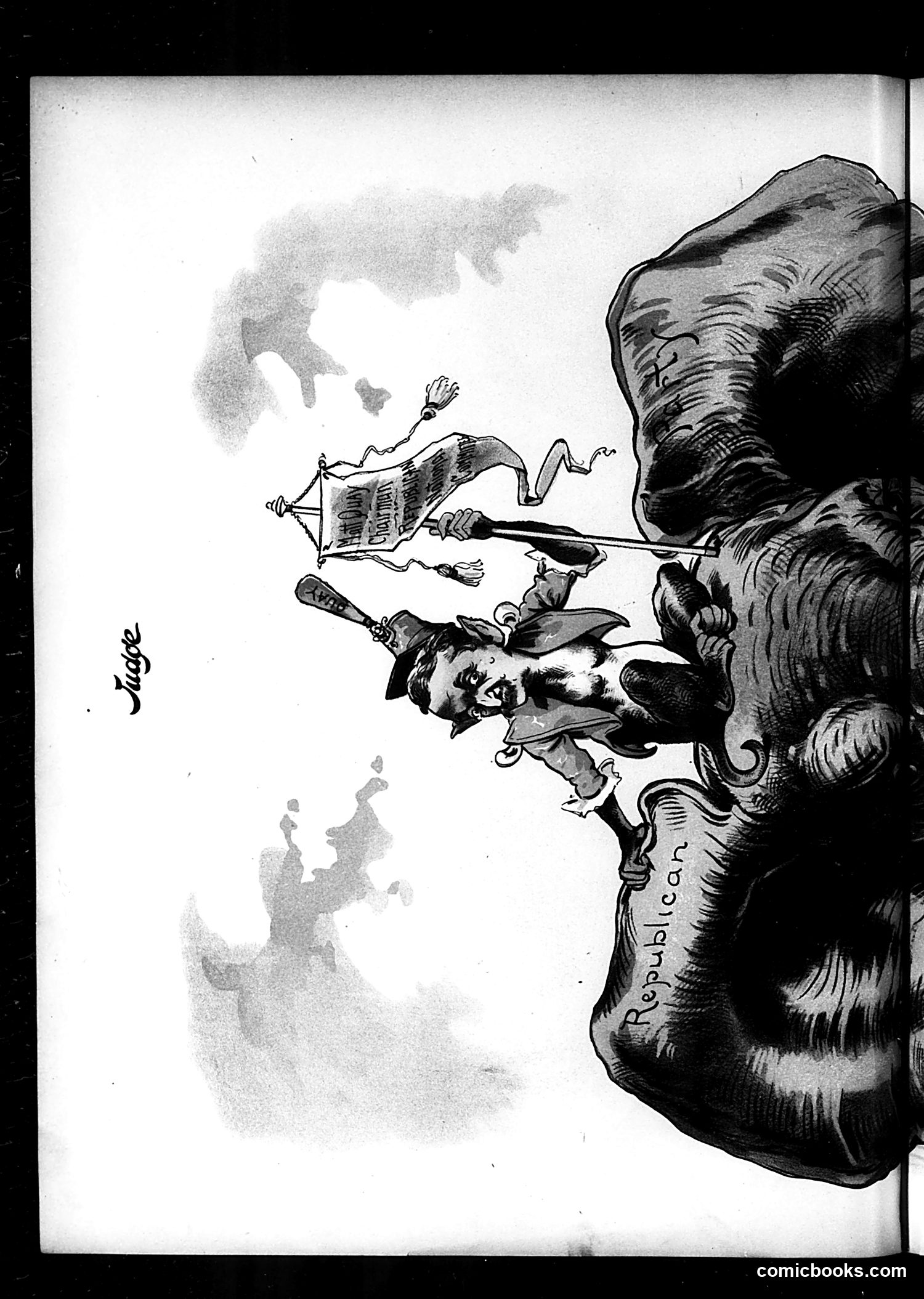
This appears to be a satirical cartoon from *Judge* magazine depicting a confrontation between a small human figure (likely representing a political opponent or critic) and a large, menacing elephant labeled "Republican." The elephant dominates the composition, drawn with exaggerated, threatening features. The small figure holds a bow and arrow—suggesting a David-and-Goliath dynamic—and appears to be confronting the much larger power represented by the Republican elephant. The cartoon likely critiques either Republican political dominance or a specific Republican policy, using the size disparity to emphasize the imbalance of power between the challenger and the established party apparatus. The exact historical context and specific figures involved aren't clearly identifiable from the image alone.
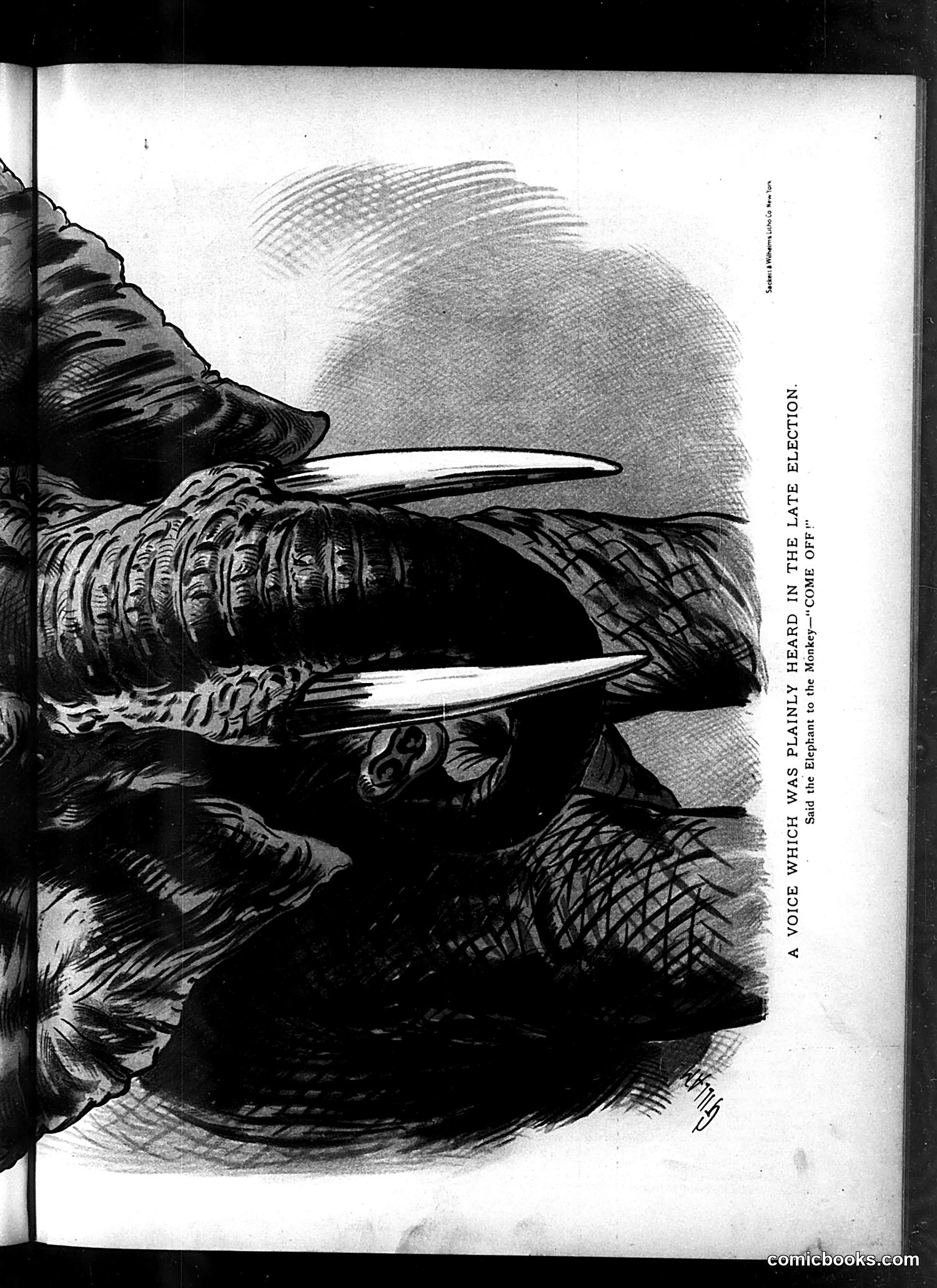
This political cartoon depicts a bearded figure (likely representing a political opponent or public figure) with an open mouth, suggesting he is speaking or making proclamations. The caption reads "A VOICE WHICH WAS PLAINLY HEARD IN THE LATE ELECTION" with subtitle "See the Emphasis to the Remark 'COME OFF!'" The satire appears to mock someone whose voice or message was notably heard during a recent election—the emphasis on "come off" suggests the cartoonist is sarcastically critiquing this person's claims or promises. The exaggerated facial features and dramatic rendering typical of Judge magazine's political commentary indicate this was meant to ridicule a specific political figure's rhetoric or influence during an election period. Without clearer dating or textual markers, the specific election and figure remain unclear.
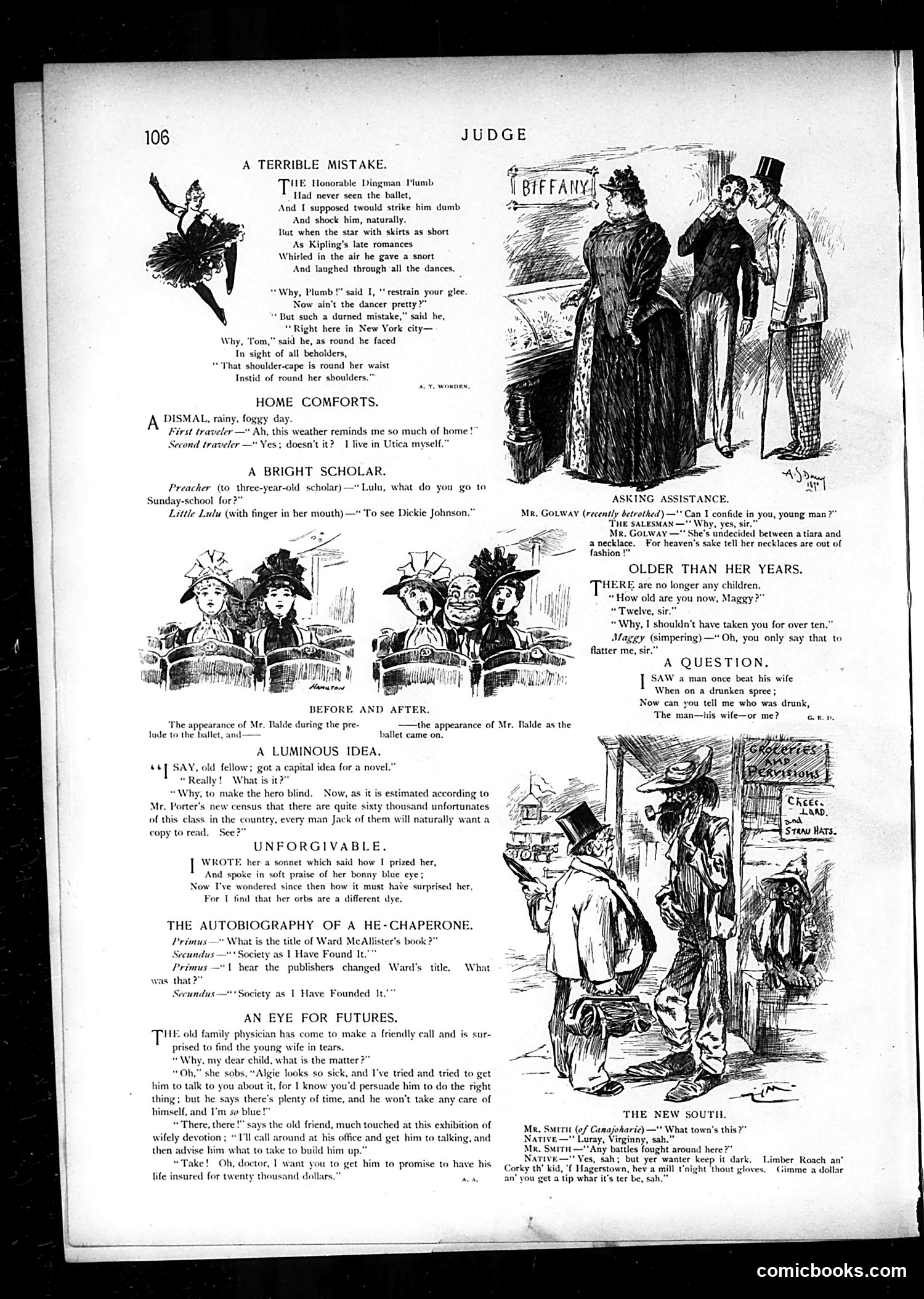
This page contains multiple brief satirical pieces typical of late 19th-century humor magazines: **"A Terrible Mistake"** mocks a country politician (Honorable Dingman Plumb) attending the ballet for the first time. The joke: he's shocked not by dancers' short skirts—which he finds amusing—but by a costume detail (a shoulder-cape worn at the waist instead of shoulders), revealing his provincial prudishness mixed with obliviousness. **Other sketches** include mild social humor: a preacher's student attending Sunday school to see a boy; an engaged man wanting his fiancée to wear a tiara instead of a necklace because necklaces are "out of fashion"; and a doctor calling on a patient whose wife worries he won't take care of himself—so she asks the doctor to pressure him into life insurance. **"The New South"** features dialect humor between a Northern visitor and a Southern native about local battles, using exaggerated speech patterns typical of period ethnic/regional stereotyping. The page exemplifies Judge's light, domestic satire aimed at middle-class readers, emphasizing social missteps and provincial manners rather than sharp political commentary.
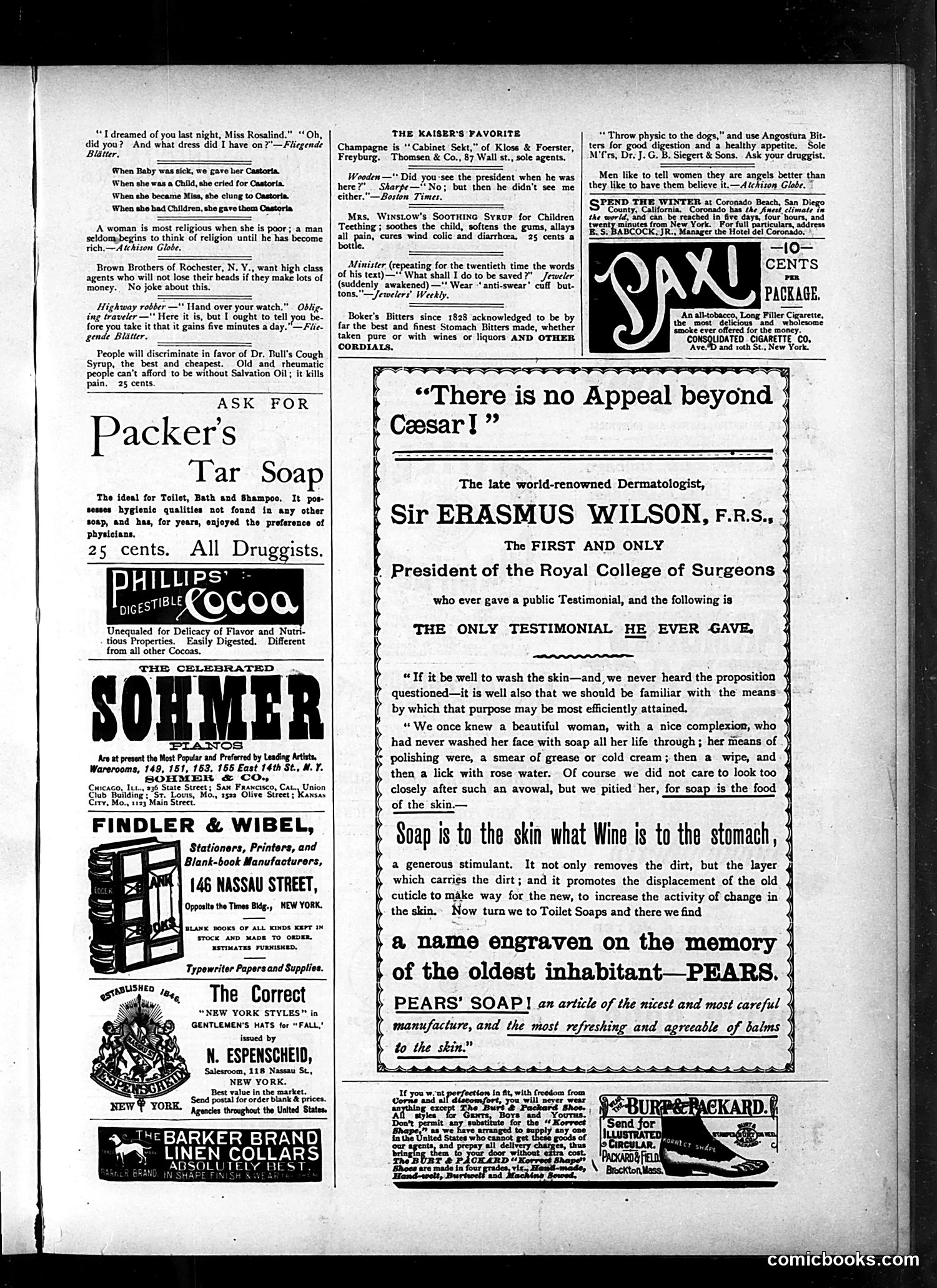
This page is primarily **advertising**, not satirical cartoons. It contains brief humorous snippets and product advertisements typical of late-19th-century American magazines. The small jokes scattered throughout are generic observations: a woman's relationship with a product (Castoria), gender commentary on religion and wealth, a traveler's watch joke. These appear to be filler content rather than pointed political satire. The dominant feature is a large boxed testimonial from **Sir Erasmus Wilson**, a real dermatologist and president of the Royal College of Surgeons. The advertisement claims he gave "the first and only" public testimonial in his life—endorsing Pears' Soap. The text includes his philosophical musings on soap's benefits to skin, comparing it to wine's effect on the stomach. This appears designed to lend medical authority to a soap product. The "Kaiser's Favorite" champagne reference is the only topical element, likely appealing to wealthy readers familiar with German products. Overall, this is a commercial page offering little modern political or social satire.
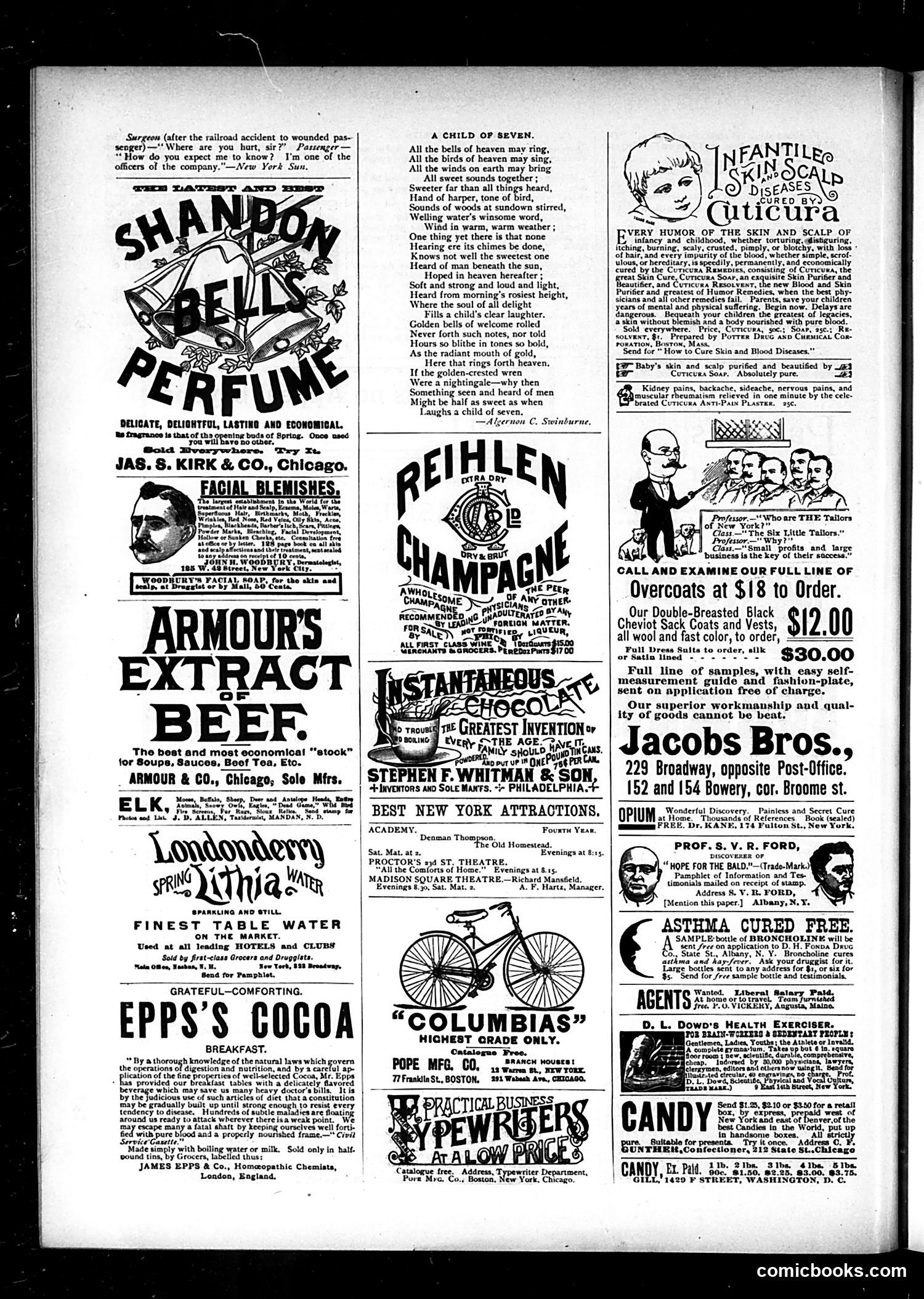
This page is primarily **advertisements** with one brief political joke at the top. The lone cartoon/joke concerns a **railroad accident**. A surgeon asks an injured passenger where he's hurt. The passenger replies he doesn't know—he's an officer of the railroad company itself. **The satire**: This mocks railroad company officers for their indifference to passenger safety and suffering. The joke suggests these officials are so disconnected from—or unconcerned with—the actual human cost of accidents that even when injured themselves, they wouldn't understand or acknowledge the harm. It's a jab at corporate negligence and callousness during the Gilded Age, when railroad safety was a notorious problem and companies were often blamed for preventable disasters. The rest of the page consists of period advertisements for products like Shambon Perfume, Armour's Beef Extract, and Epps's Cocoa.
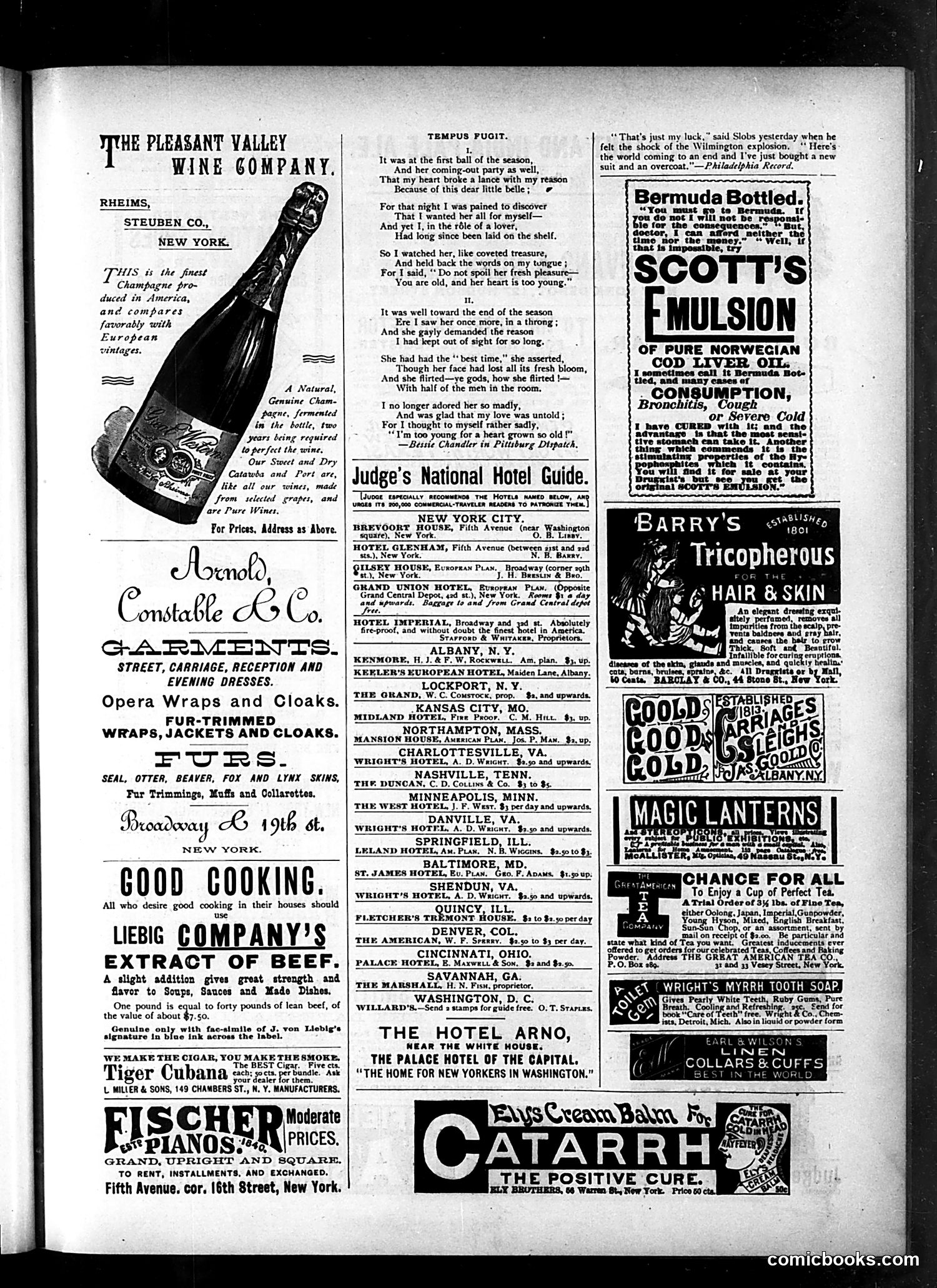
This is primarily an **advertising and directory page** rather than a satirical cartoon page. The bulk of the content consists of: 1. **Hotel Directory**: "Judge's National Hotel Guide" listing commercial hotels across America, targeting the magazine's 209,000 "commercial-traveler readers"—salesmen and traveling businessmen. 2. **Product Advertisements**: Champagne, pianos, fur-trimmed clothing, beef extract, cigars, and patent medicines (notably "Catarrh" cream balm). 3. **One Poetry Piece**: "Tempus Fugit" by Bessie Chandler depicts a melancholic romantic scene—an older man watches a debutante at balls, realizes she's becoming jaded and frivolous, and concludes sadly that she's "too old" in spirit for his affections. The page reflects **late 19th-century commercial culture**: Judge monetized its circulation by selling advertising space and promoting hotels to its male business-reader demographic. The poetry offers sentimental romanticism typical of period publications, but no overt political or social satire appears here.
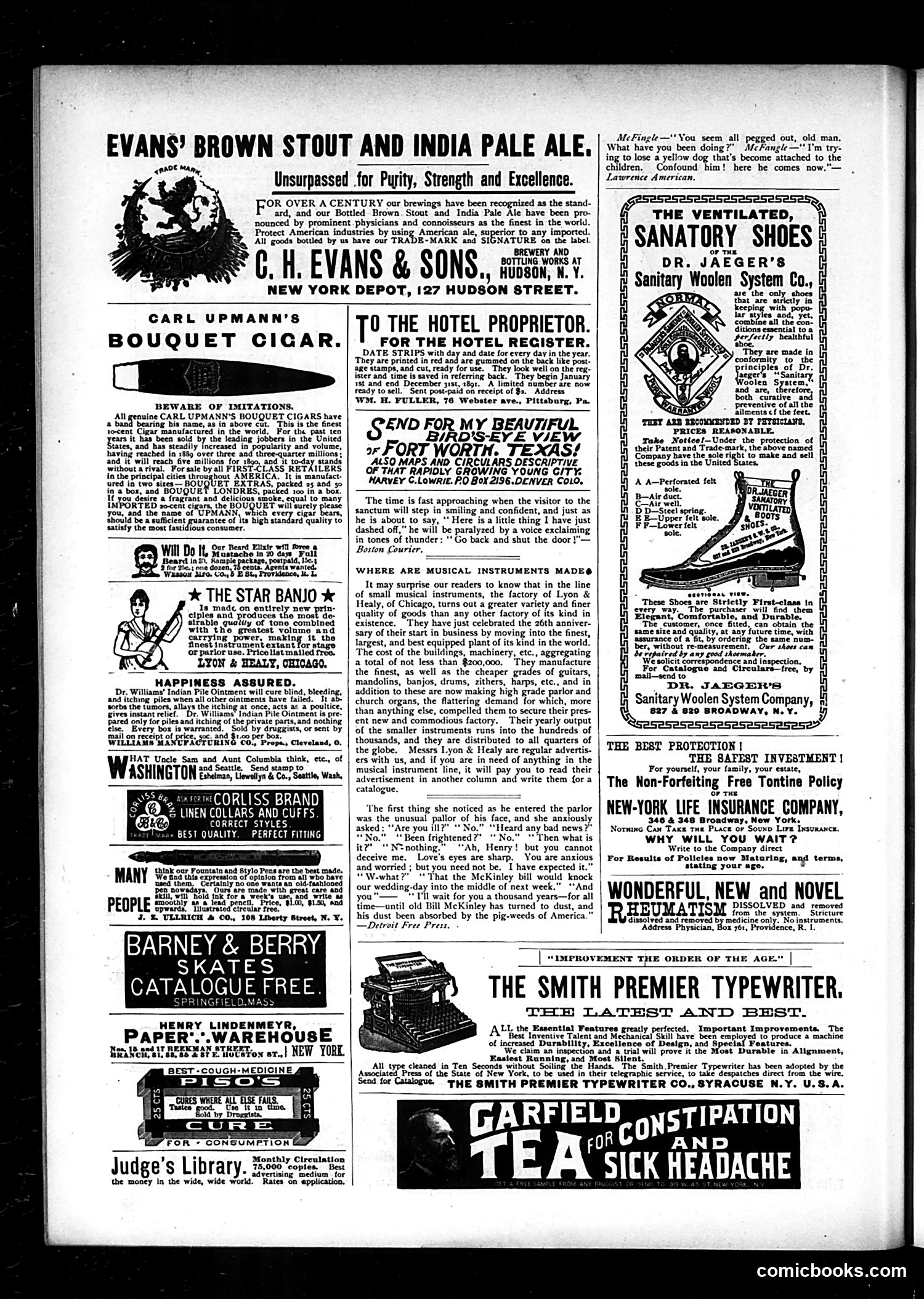
This is primarily an **advertisement page** from Judge magazine, not a satirical cartoon page. It contains various commercial advertisements for products including: - **Evans' Brown Stout and India Pale Ale** - positioning American-made beer as superior to imports - **Carl Upmann's Bouquet Cigar** - claiming to be the world's finest cigar - **Dr. Jaeger's Sanitary Shoes** - medical footwear - **Smith Premier Typewriter** - the "latest and best" - Various patent medicines and other goods The page reflects late-19th-century American commercial culture and advertising practices. One notable element is the beer advertisement's explicit appeal to "**Protect American industries by using American ale**" — reflecting contemporary protectionist sentiment and nationalism. The advertisements themselves constitute the "satire" insofar as they exemplify the exaggerated, superlative claims typical of Victorian-era marketing. There are no identified political figures or cartoon commentary visible on this page.
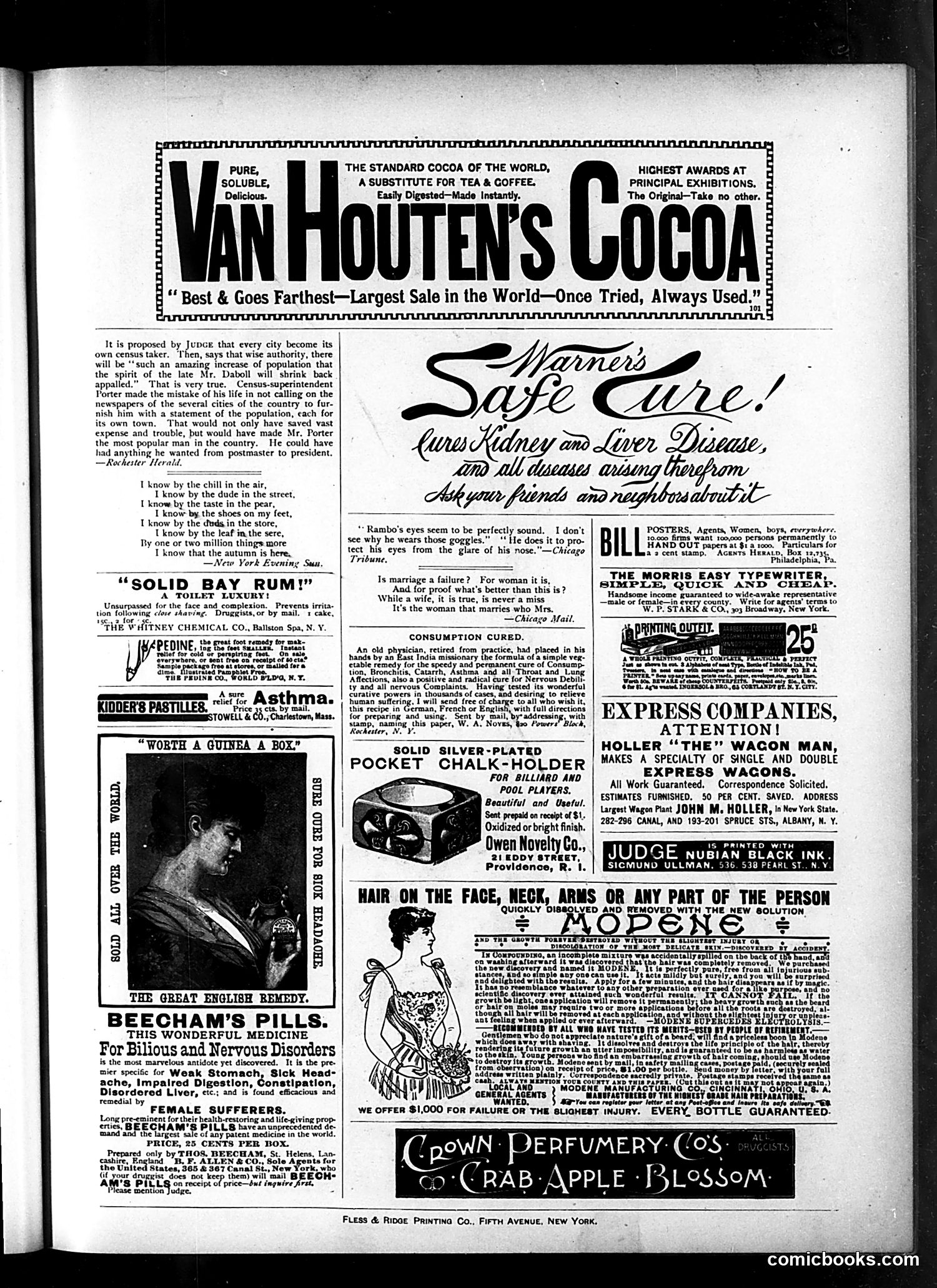
This page is primarily **advertising**, typical of Judge magazine's revenue model. The content includes: **Main Features:** - Van Houten's Cocoa dominates the top with claims of being "the standard cocoa of the world" - Multiple patent medicine ads (Beecham's Pills, remedies for consumption, hair removal products) - Small satirical items scattered throughout, including a brief Judge editorial proposing cities conduct their own censuses to inflate population counts—a joke about civic pride and Census Superintendent Porter's apparent unpopularity **Social Context:** The ads reveal common late-19th/early-20th-century concerns: digestive issues, weak nerves, consumption (tuberculosis), unwanted body hair, and marital dissatisfaction. Patent medicines dominated advertising before FDA regulation. **The Satire:** The census joke mocks both local boosterism and Porter's unpopularity, suggesting if he'd let newspapers report inflated figures, he'd be "the most popular man in the country." The page contains minimal actual political cartooning—mostly filler material and period advertisements reflecting contemporary anxieties and commercial practices.
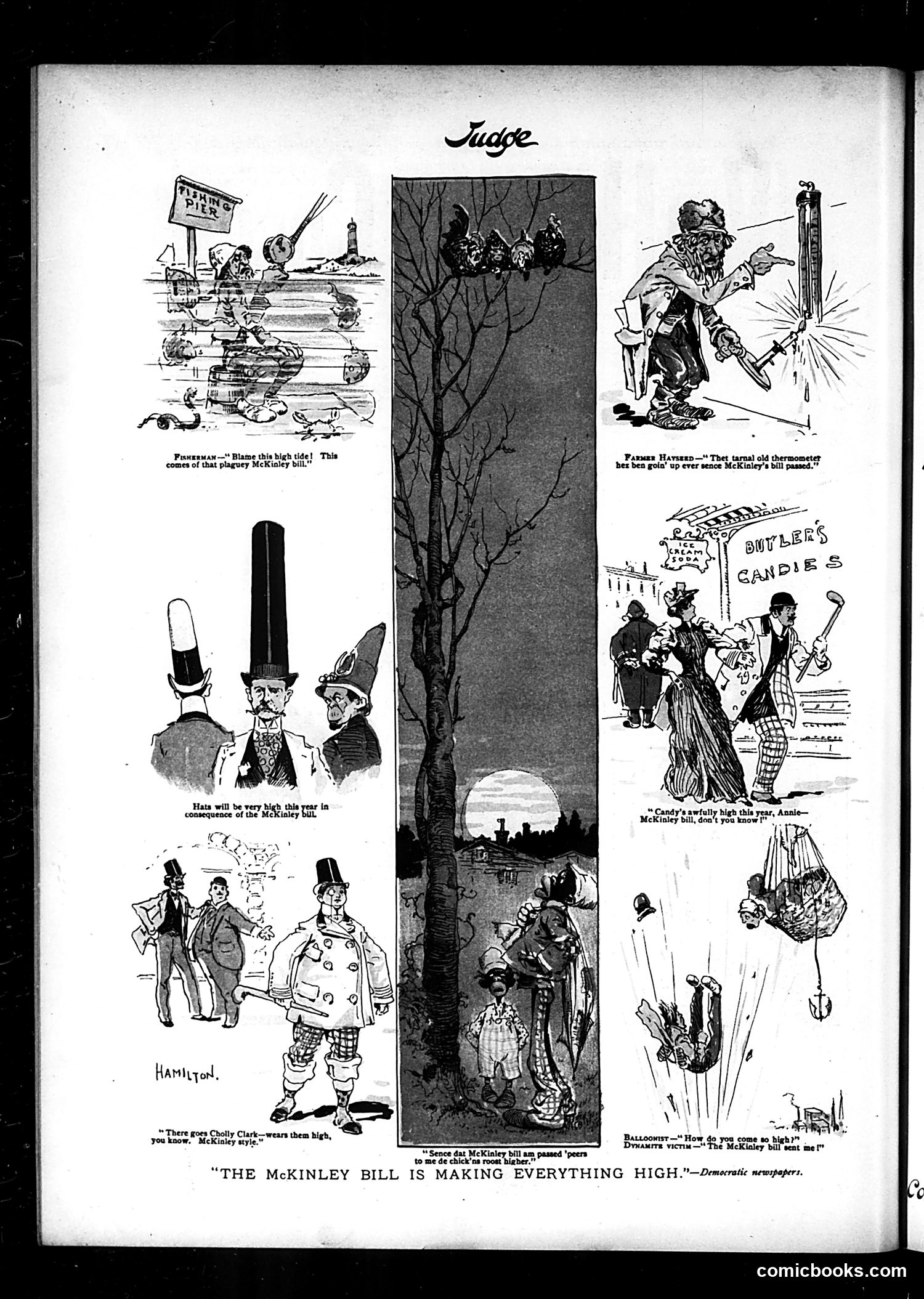
This Judge magazine page satirizes Democratic criticism of the McKinley Tariff Bill through multiple vignettes showing various complaints attributed to it. The cartoons depict characters blaming McKinley's protective tariff legislation for rising prices across everyday goods and services: a fisherman blames high tides on the bill, a farmer claims his thermometer readings increased due to it, and references to rising costs for chickens and other commodities appear throughout. The satire mocks Democratic newspapers' tendency to attribute virtually *every* price increase to McKinley's tariff—suggesting their criticism is absurdly overblown and disconnected from natural causes (like actual tides or weather). By showing ridiculous correlations between the bill and unrelated phenomena, Judge's Republican perspective ridicules Democratic economic arguments as exaggerated partisan complaints rather than legitimate policy analysis.
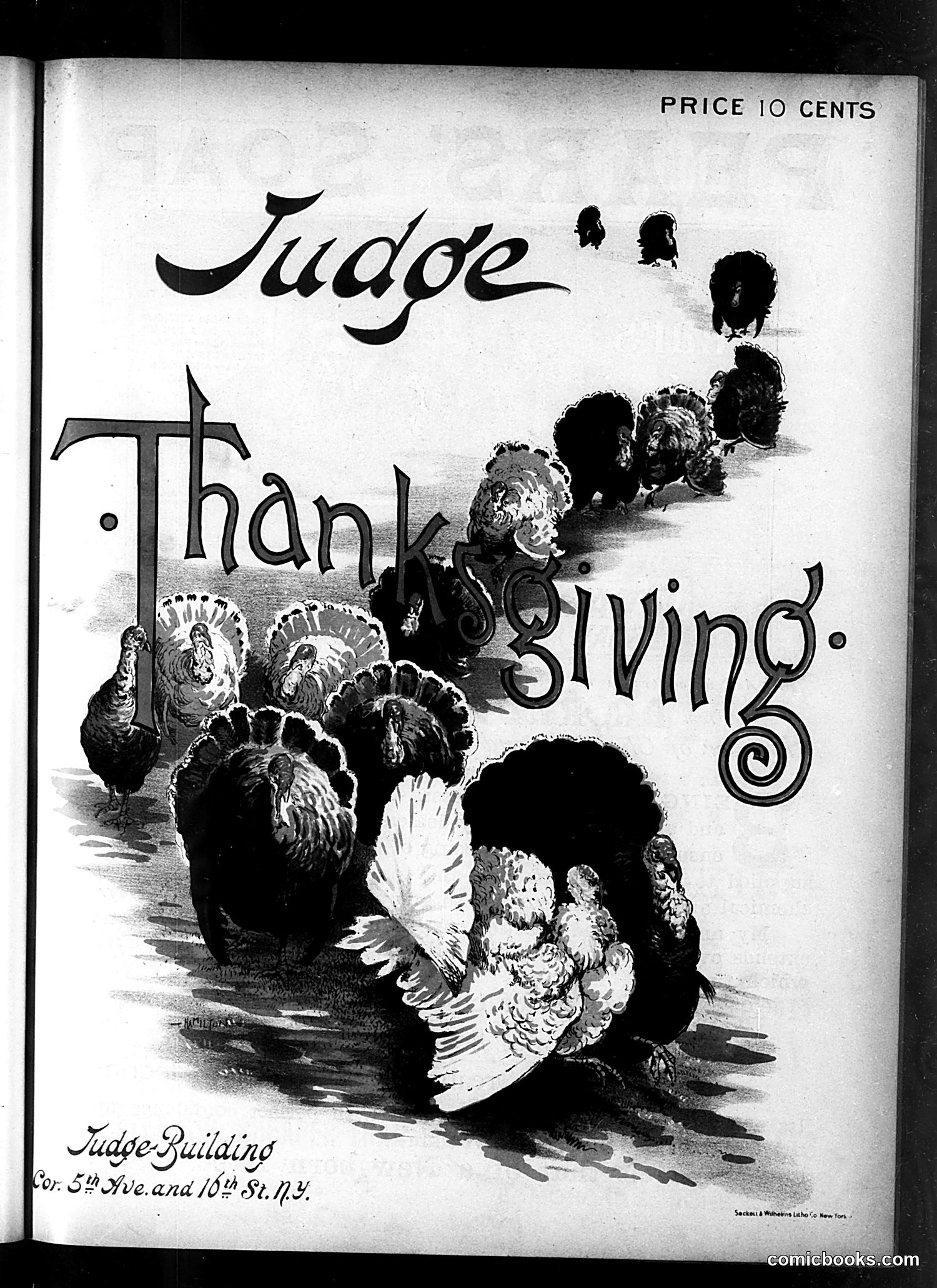
This is the cover of *Judge* magazine's Thanksgiving issue, priced at 10 cents. The artwork depicts a procession of turkeys marching toward their fate, led by one large turkey carrying a cross—a darkly humorous visual pun on the holiday's traditional centerpiece. The satire works on multiple levels: turkeys "giving thanks" before being slaughtered for the holiday meal, the religious imagery suggesting martyrdom, and the procession of doomed birds suggesting inevitability. The illustration is signed and uses period engraving techniques typical of early 20th-century satirical magazines. The joke relies on anthropomorphizing the turkeys to highlight the grim irony of Thanksgiving—a holiday of gratitude that involves killing the bird that symbolizes the occasion.
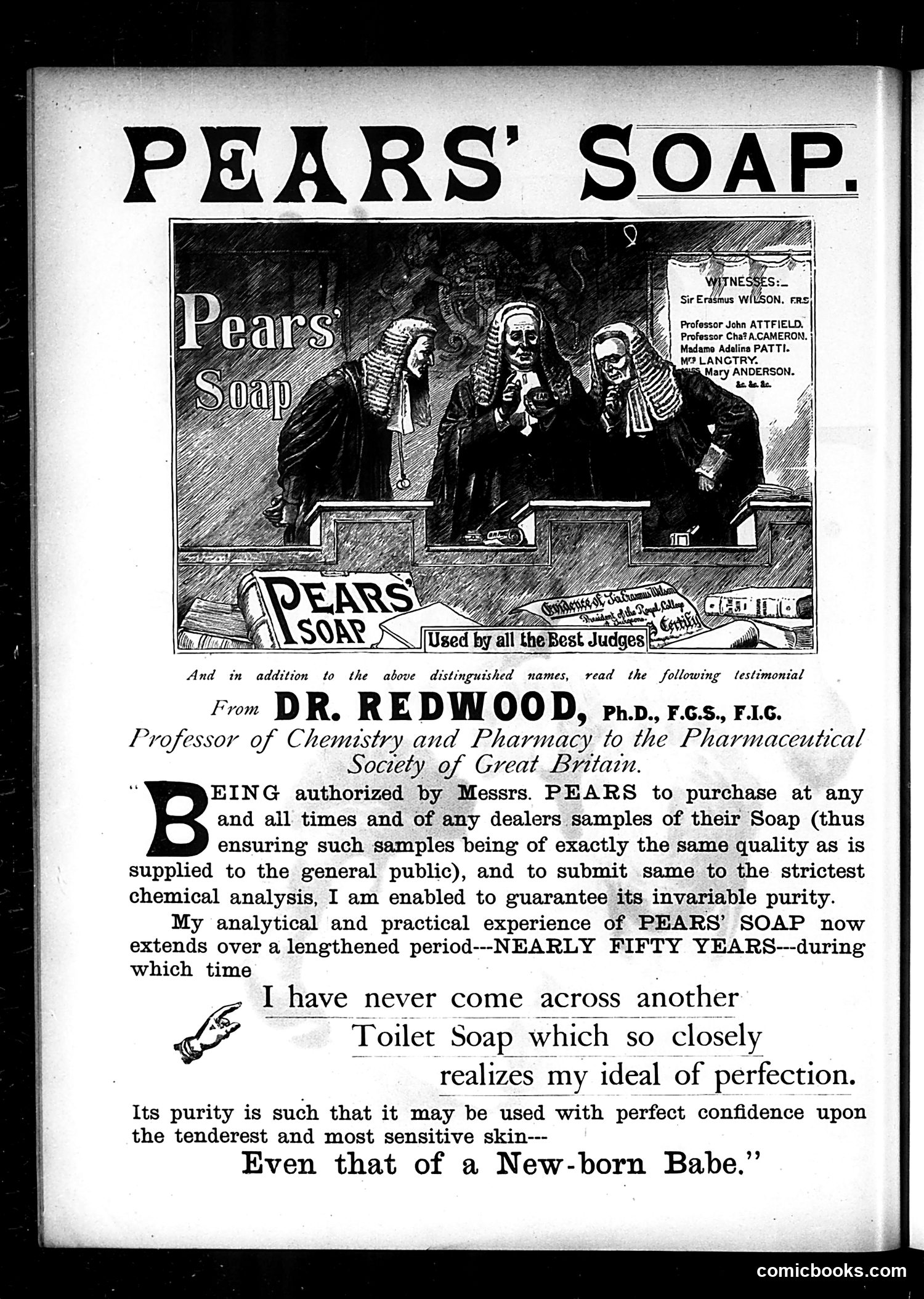
This is primarily a **product advertisement**, not satire. However, it uses satirical elements typical of Judge magazine's style. The image depicts judges in formal courtroom dress endorsing Pears' Soap, with the caption "Used by all the Best Judges"—a play on judicial authority to suggest the product's superiority. The advertisement then lists celebrity witnesses (including apparent Victorian-era notables like actress Lillie Langtry and opera singer Adelina Patti) and a lengthy testimonial from Dr. Redwood, a chemist with 50 years' experience. The humor lies in the **absurd weight of endorsement**: marshaling legal and scientific authority, famous names, and decades of analysis to promote ordinary soap. This exaggerated appeal to credibility itself becomes comic—the overkill of testimonials satirizes advertising's tendency to use impressive credentials to sell mundane products. The emphasis on purity and safety "even for a new-born babe" suggests contemporary anxieties about product quality and ingredient safety in the Victorian era.
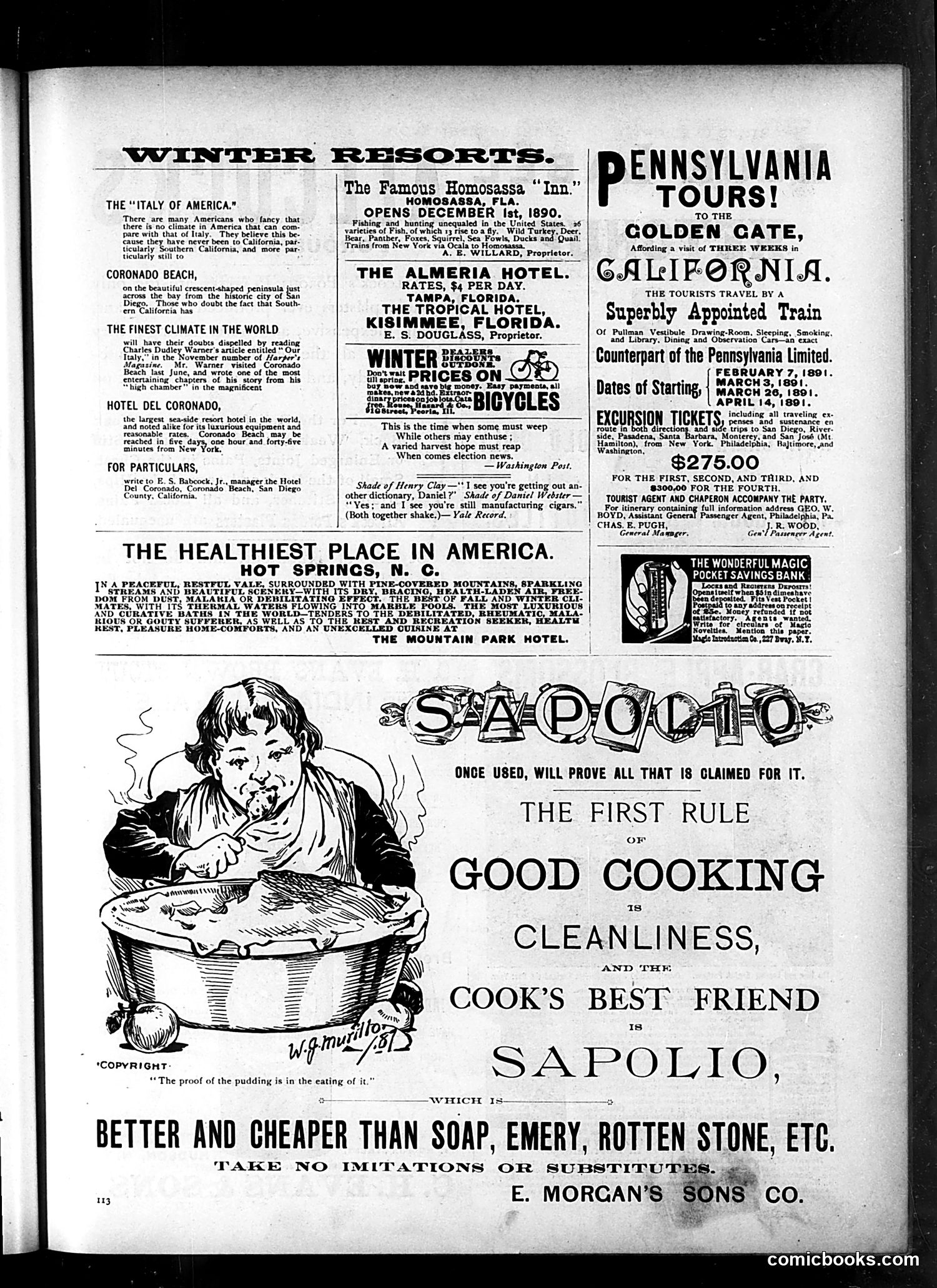
This page is **primarily advertising** for winter resorts and travel, with one small satirical cartoon. The main cartoon appears in the middle-right section, showing a brief dialogue between two figures identified as "Shade of Henry Clay" and "Shade of Daniel Webster"—these are **ghosts of deceased American political figures** from the antebellum era. The joke is mild: one ghost observes the other still "manufacturing cigars," implying Daniel Webster's continued commercial activity even in the afterlife. This is a light topical reference playing on these famous statesmen's legacies. The rest of the page consists of advertisements for luxury winter destinations (Florida, California, Pennsylvania rail tours) and products like Sapolio cleaning powder—typical of *Judge* magazine's commercial content from 1891. **The satire is minimal here.** Rather than political commentary, this represents *Judge*'s standard format: mixing resort advertising with genteel humor for a middle-class readership seeking vacation destinations and consumer goods.
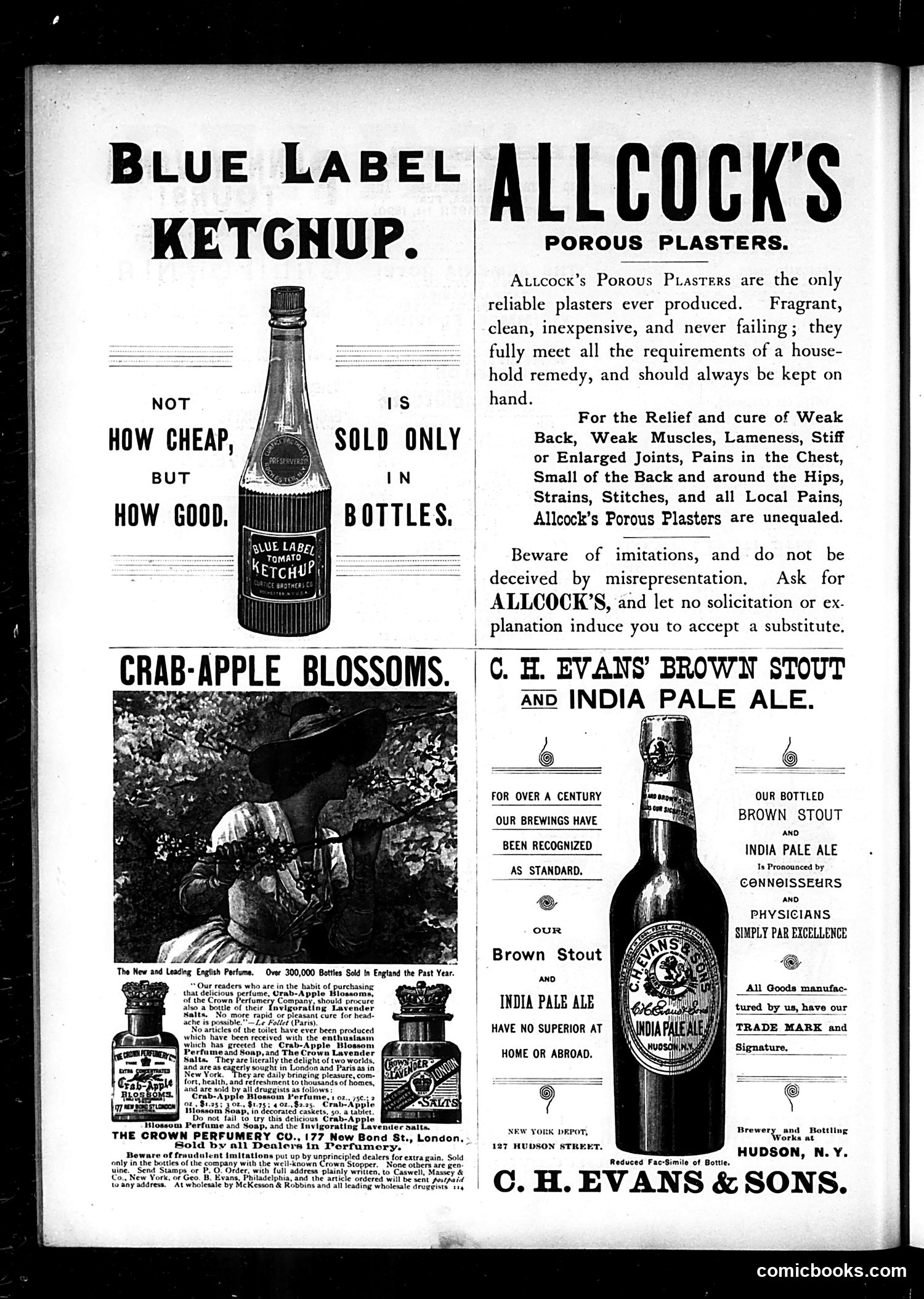
This page is **primarily advertisements**, not political satire or editorial cartoons. It contains four product advertisements from the late 19th century: 1. **Blue Label Ketchup** — emphasizes quality over cheapness with a bottle illustration 2. **Allcock's Porous Plasters** — medical remedy advertisement claiming superiority and warning against imitations 3. **Crab-Apple Blossoms** — perfume/soap product with a photograph of a woman among blossoms 4. **C.H. Evans Brown Stout and India Pale Ale** — beer advertisement claiming century-old brewing standards The recurring theme across these ads is **brand authenticity and warning against counterfeits/substitutes** — a common concern in this era before modern trademark protection. Each advertisement emphasizes that their product is the genuine article and urges consumers to avoid imitations and accept no substitutes. There is no political cartoon or satirical commentary visible on this page. It appears to be a standard advertising section from *Judge* magazine.