
A complete issue · 20 pages · 1890
Judge — July 26, 1890
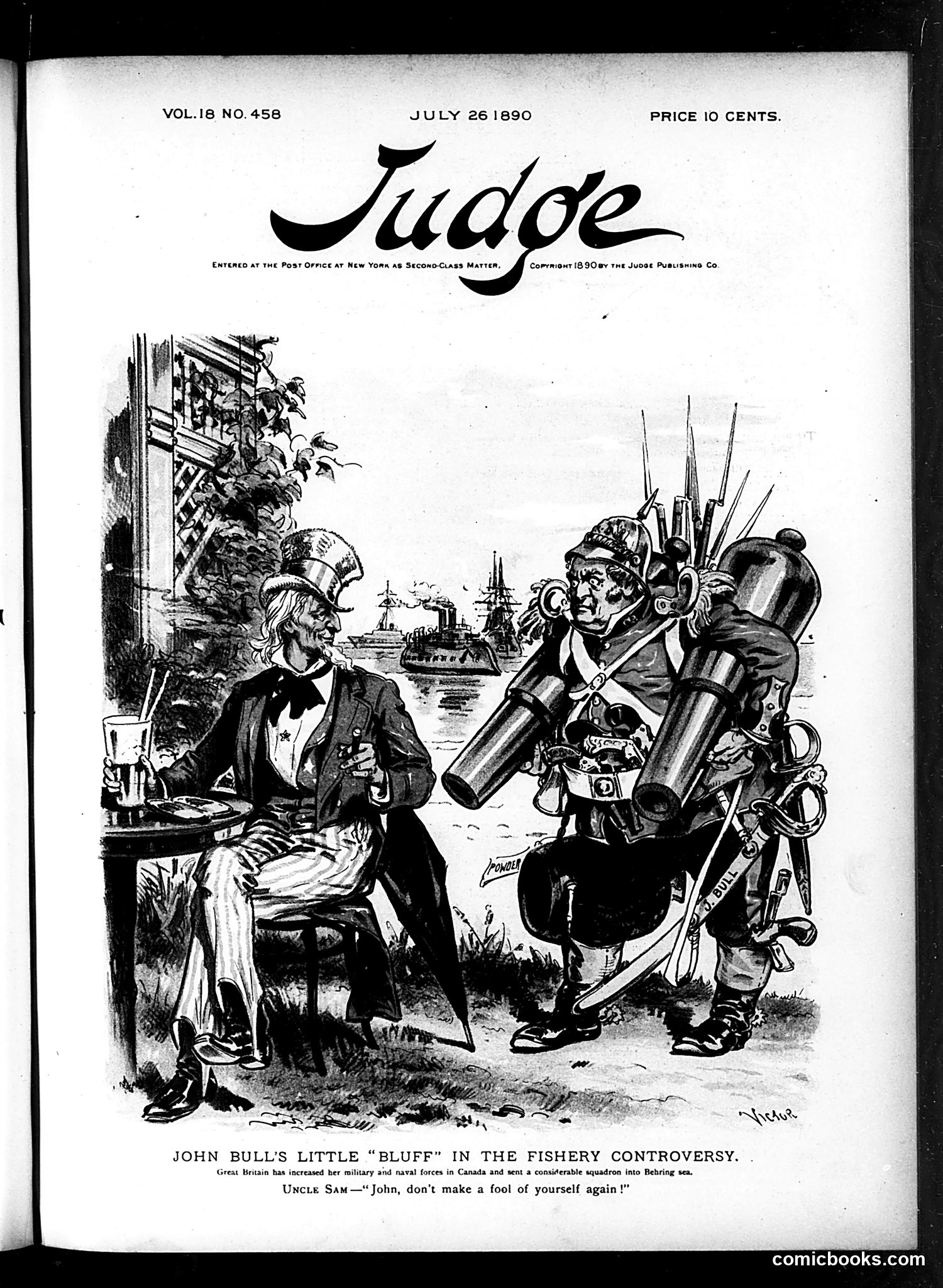
**Title and Context:** "John Bull's Little 'Bluff' in the Fishery Controversy" references a diplomatic dispute between Great Britain ("John Bull," personified as the gentleman) and the United States ("Uncle Sam," on the right). **The Satire:** Britain has increased military and naval forces in Canadian waters during a fishing rights disagreement, but Uncle Sam dismisses this as mere bluffing. The cartoon mocks Britain's aggressive posturing as ineffectual theater. **Visual Elements:** John Bull sits relaxed, seemingly unconcerned, while Uncle Sam appears heavily armed with weapons and military equipment, suggesting American confidence and superior military readiness despite British threats. The caption's dialogue reinforces that Uncle Sam views Britain's military buildup as posturing rather than genuine threat.
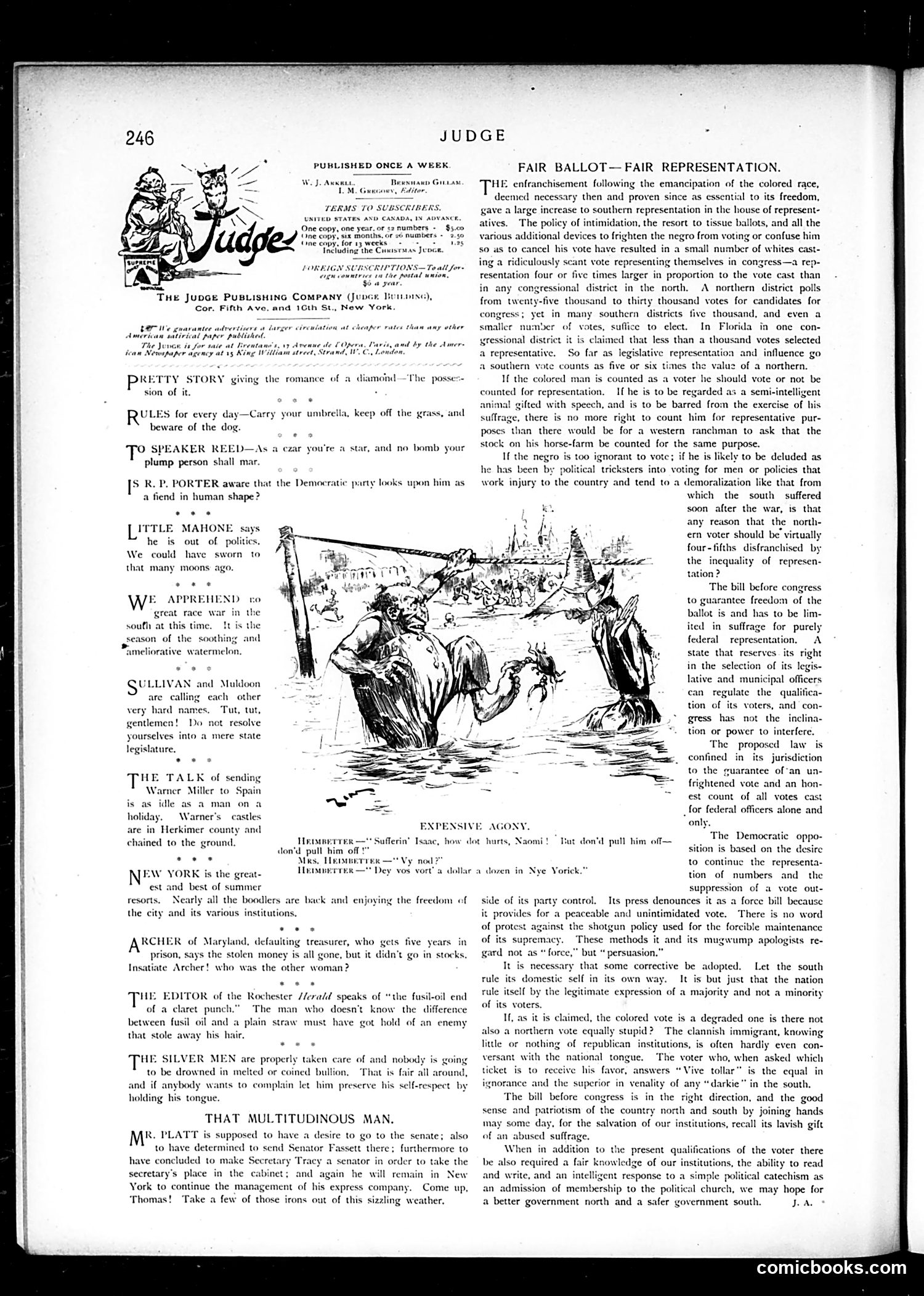
The main cartoon titled "Expensive Agony" depicts a figure (appears to be a politician or public figure) floundering in water, surrounded by what look like political obstacles or critics. The accompanying article "Fair Ballot—Fair Representation" discusses voting rights and representation, particularly addressing Southern electoral practices and the voting power of African Americans. The satire critiques Democratic Party opposition to fair representation, arguing that Southern districts use intimidation and violence to suppress Black voters. The cartoon likely represents a politician struggling with the political consequences of these discriminatory voting practices. The surrounding humorous items mock various political figures and current events, typical of Judge's satirical approach during this era (appears to be early 20th century).
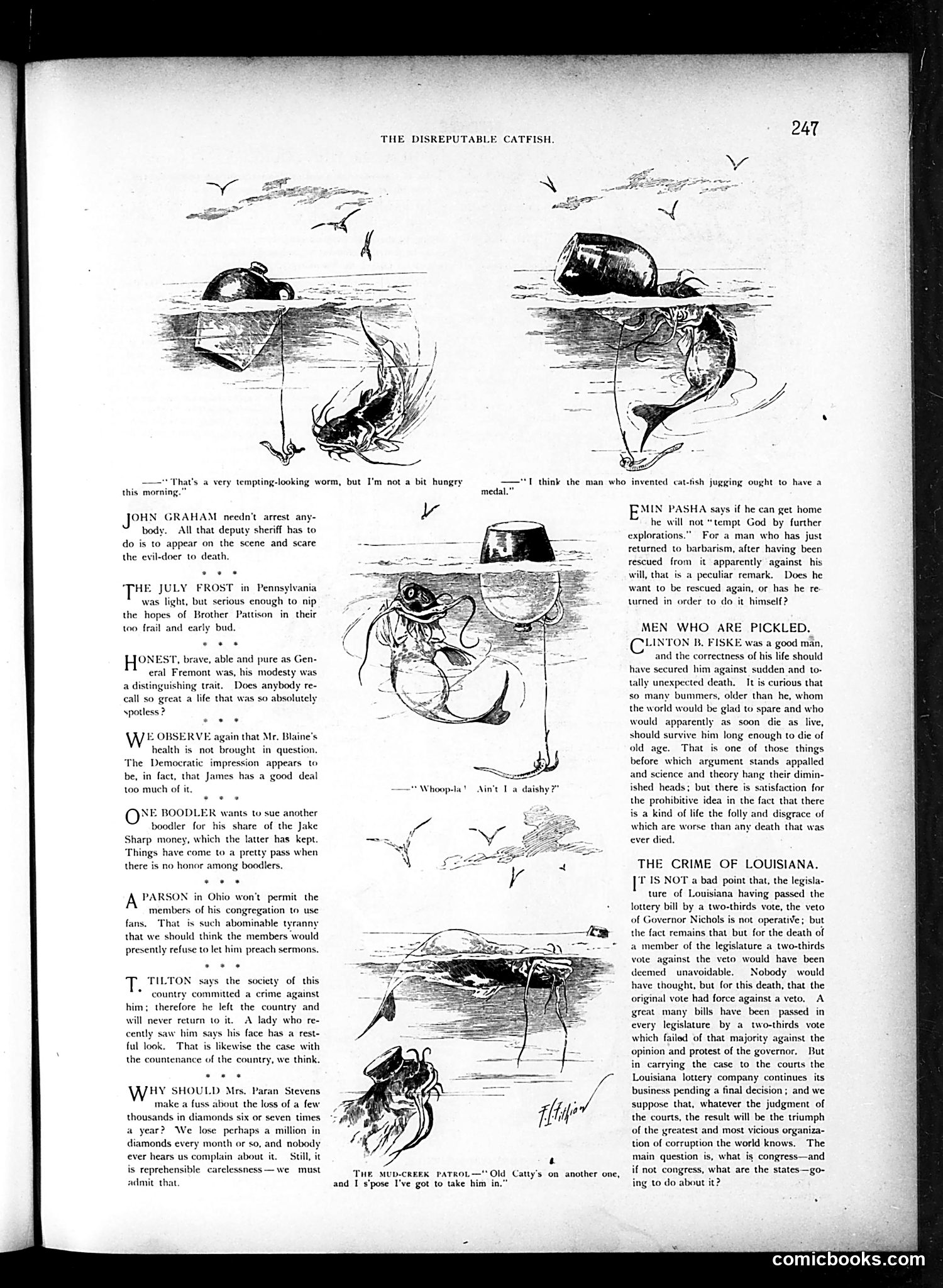
This page satirizes various American social and political absurdities through short anecdotes paired with catfish-related cartoons. The fish illustrations pun on the phrase "catfish," depicting literal catfish in humorous situations (one saying "Whoops! Ain't I a dashy?"). The text mocks: - Unnecessary legal procedures (John Graham's arrest theatrics) - Pennsylvania's harsh July Frost conditions - General Fremont's unwarranted modesty - Democratic political claims - Ohio's religious tyranny regarding fan use in church - The Louisiana lottery scandal—criticizing that despite a gubernatorial veto, the corrupt lottery organization continues operating, questioning Congress's inaction The cartoons serve as visual puns rather than political commentary, while the prose tackles serious corruption and governmental failures of the era.
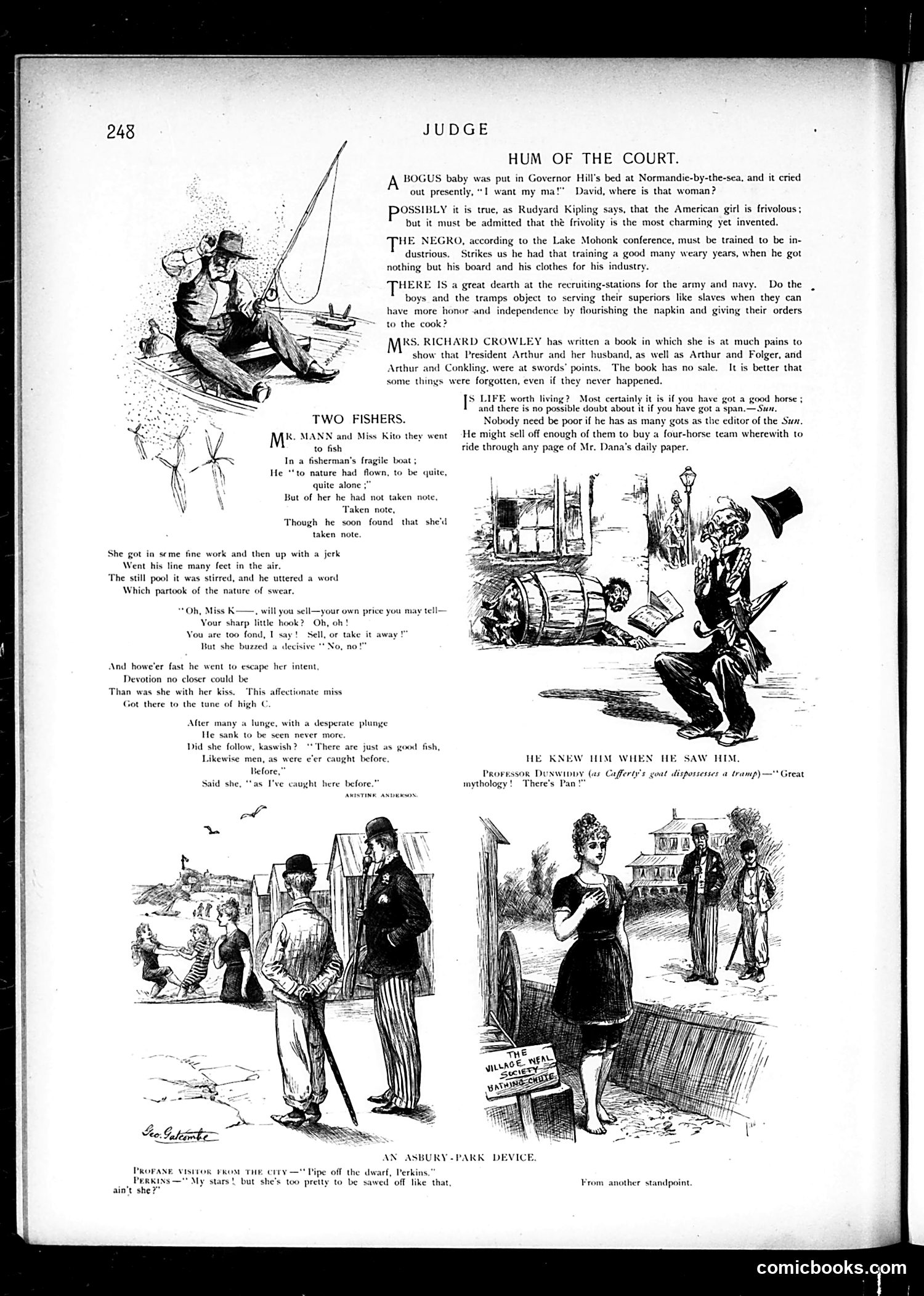
This page contains several brief satirical commentaries typical of Judge's political humor: **"Hum of the Court"** offers sharp jabs at contemporary issues: Governor Hill (likely David B. Hill of New York) is mocked for a dubious incident; Kipling's characterization of American girls is critiqued; the Lake Mohonk Conference's paternalistic approach to training African Americans is satirized as ironic given slavery's forced labor; military recruiting struggles are blamed on young men preferring dignified service jobs to army servitude. **"Two Fishers"** is a light romantic poem about a man and woman fishing, where the woman aggressively pursues him despite his resistance—a playful commentary on female assertiveness. The **Asbury Park illustration** shows wealthy city visitors encountering a circus dwarf, with crude humor about his physical appearance. Overall, the page mixes political criticism (race relations, military recruitment) with society commentary and lowbrow humor typical of 1880s Judge magazine.
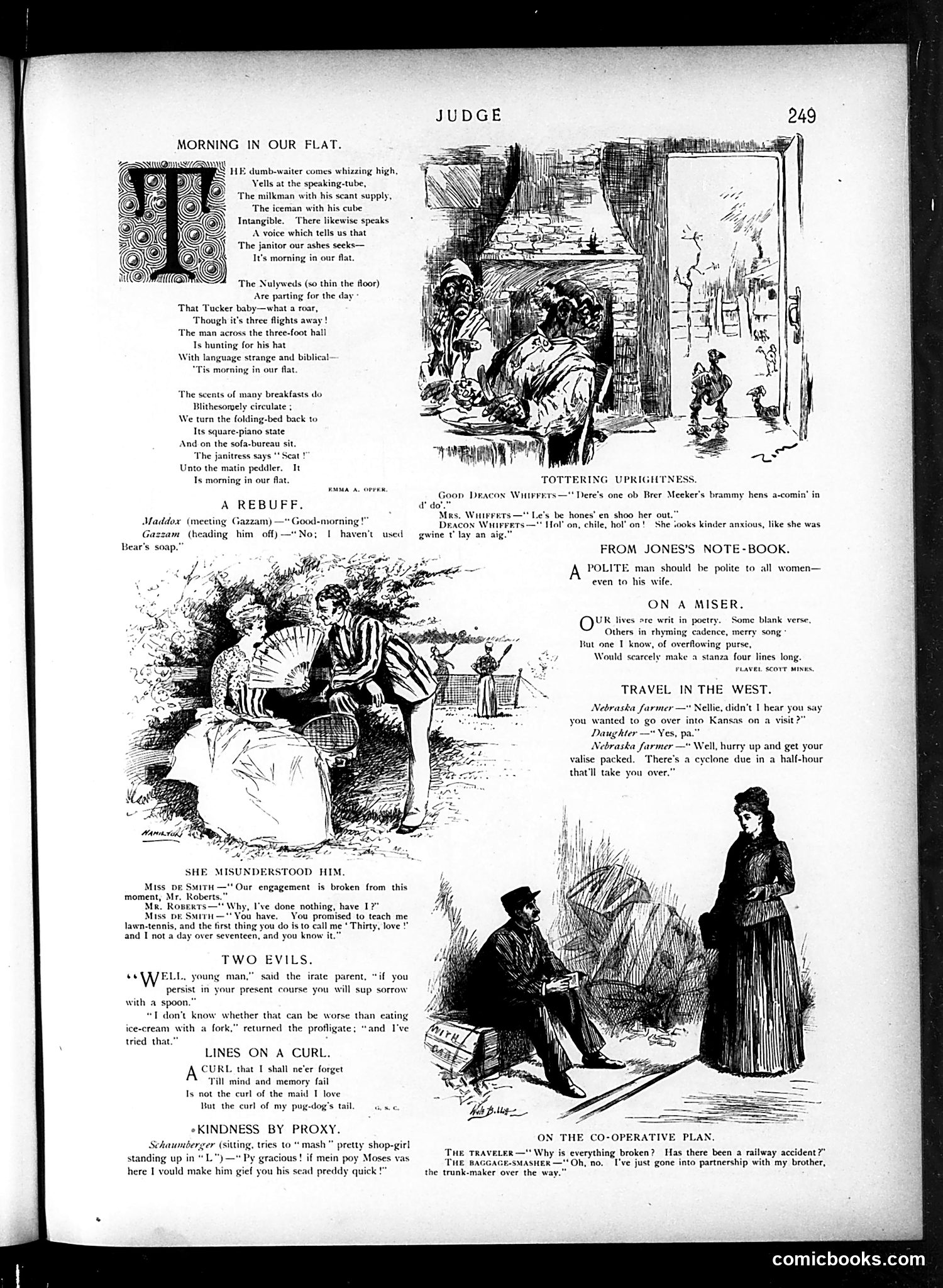
This page collects brief humorous pieces typical of *Judge*'s satirical approach. "Morning in Our Flat" mocks cramped urban apartment living—the cacophony of dumbwaiters, milkmen, crying babies, and neighbors' noise that define tenement existence. "Tottering Upright" appears to reference dialect humor involving African American characters and a hen, common (if offensive) to period magazines. Other items satirize social conventions: a young man insulted when called "Thirty, love" during tennis lessons; a stingy miser whose life can't fill four poetic lines; ethnic humor about a German immigrant ("Schaumberger") attempting to flirt. "Travel in the West" jokes about Kansas cyclones as transportation. "On the Co-Operative Plan" mocks business partnerships through a "trunk-maker" destroying goods. The cartoons and verse collectively lampoon modern urban life, romantic courtship, immigrant behavior, and commercial incompetence—standard *Judge* fare for affluent readers.
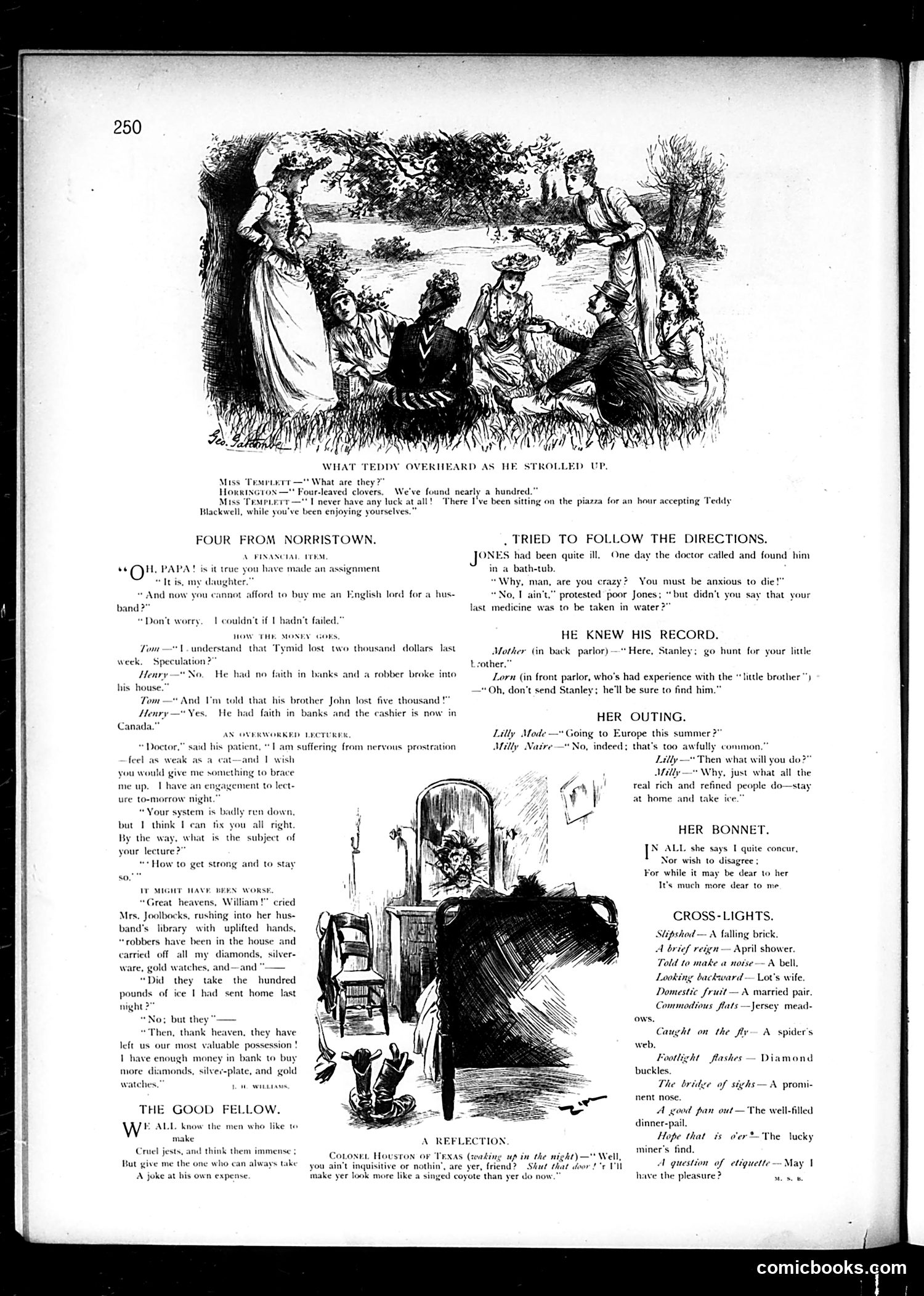
This page from *Judge* contains several brief humorous vignettes satirizing middle-class American life around the turn of the 20th century. **Key jokes include:** - **"Four from Norristown"**: Comic dialogues mocking financial mismanagement—people losing money to speculation, banks, and robbery with dark irony about which is "safer." - **The overworked lecturer**: A doctor tells a nervous patient to rest, then the patient reveals he must lecture on "How to get strong"—absurdist irony. - **Burglars and ice**: A wife laments thieves stole her valuables but left "the hundred pounds of ice"—mocking the era's reliance on ice delivery before refrigeration. - **"Teddy"**: Likely refers to Theodore Roosevelt; the humor involves sitting on a piazza "accepting Teddy" for an hour (unclear specific reference). - **Cross-lights**: Wordplay definitions ("Domestic fruit—a married pair"; "Commodious flats—Jersey meadows") typical of period humor magazines. The overall tone targets nouveau-riche pretension, medical quackery, and domestic mishaps of the American middle class.
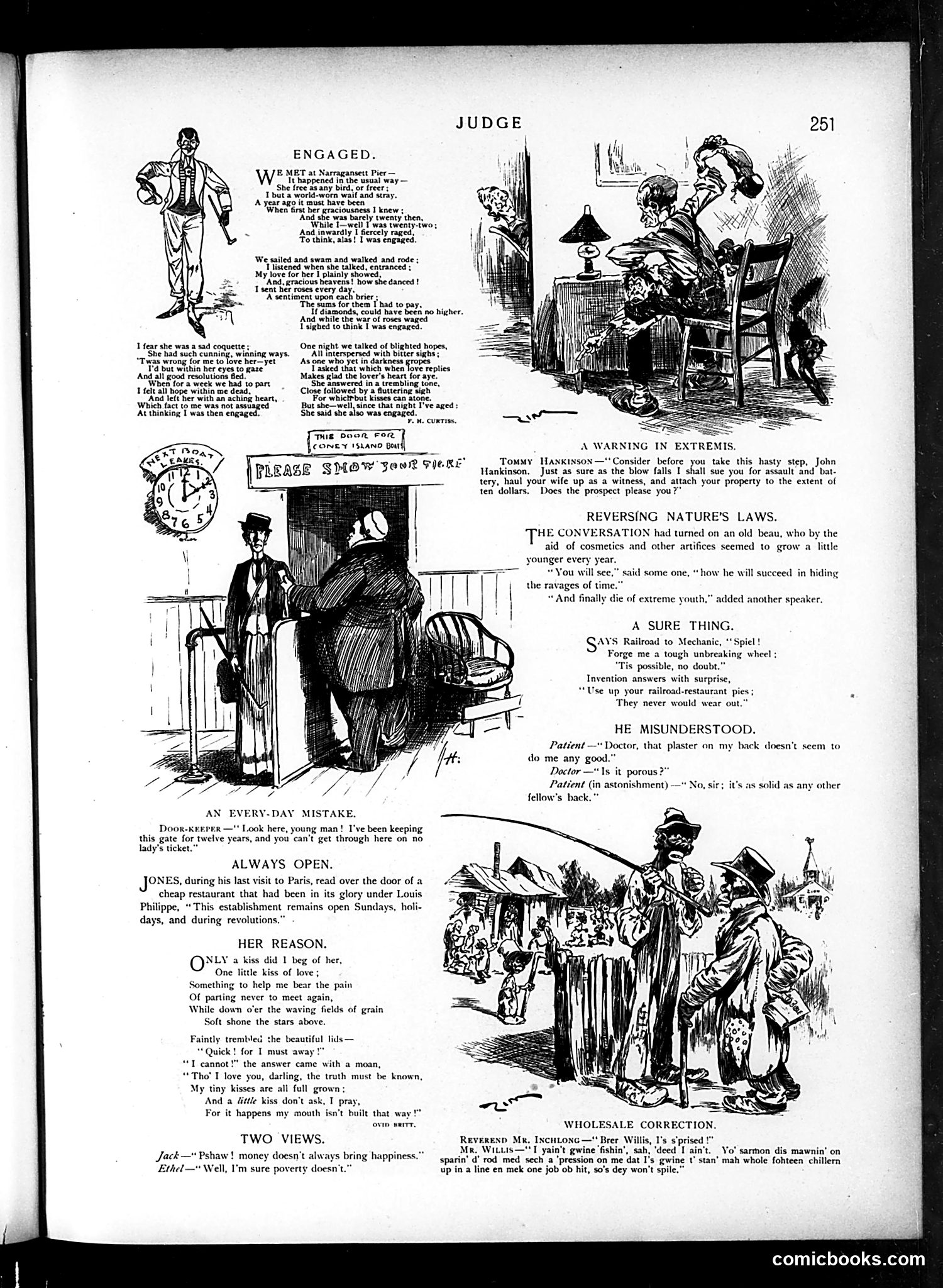
This page features primarily humorous verse and short jokes typical of Judge magazine's satirical style. The main poem "Engaged" (by F.M. Curtis) satirizes romantic entanglement through irony: a man falls deeply in love with a woman at Narragansett Pier, believing himself free while she's constrained by prior engagement. He pursues her ardently with gifts and attention, only to discover—after finally winning her heart—that *he* still remains engaged to someone else. The joke reverses typical romantic expectations: his emotional investment proves futile due to his own prior commitment he'd apparently minimized. The other brief pieces employ wordplay and situational humor ("Always Open" about a Parisian restaurant staying open during revolutions; "Her Reason" with puns about kisses and mouth size) typical of period magazine filler. The cartoons accompany these pieces but lack specific political references—they illustrate domestic and social comedy rather than pressing contemporary issues, suggesting this is a lighter entertainment page rather than serious satirical commentary.
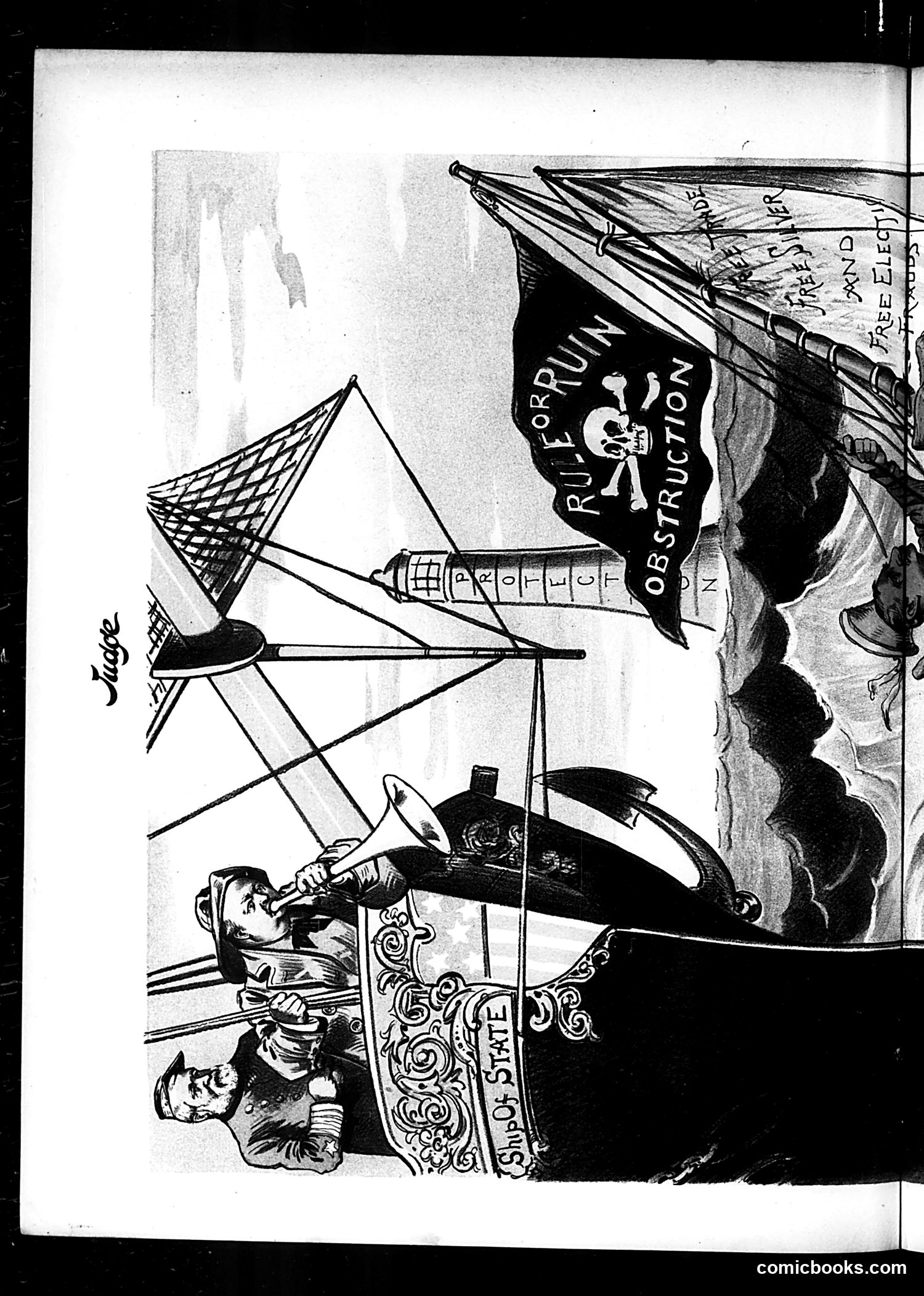
This appears to be a satirical cartoon from *Judge* magazine featuring a naval theme. The visible text references "Rule or Ruin" and "Obstruction," suggesting commentary on political obstruction or power struggles. A figure (likely a politician or public figure) is shown operating what appears to be a large gun or naval weapon, while another figure holds a telescope or spyglass. The elaborate decorative frame labeled "Such Stuff" and the nautical setting suggest this satirizes military or naval policy disputes. The cartoon's point appears critical of someone's use of power or obstructionist tactics—the "rule or ruin" text implies a threat-based approach to governance. Without clearer date or figure identification visible, the specific political conflict remains uncertain, though the naval imagery suggests possible commentary on military appropriations or naval policy debates common in early 20th-century American politics.
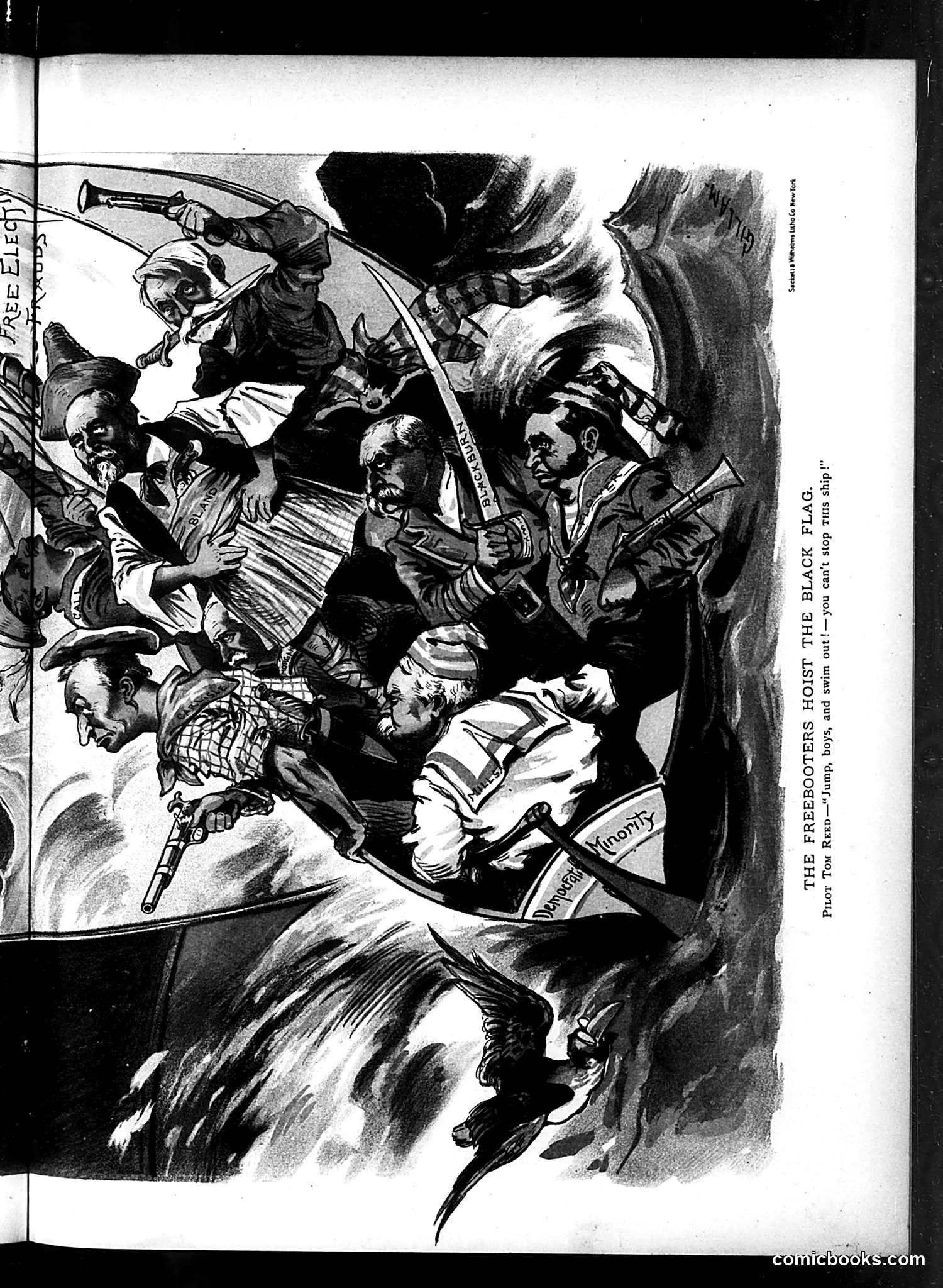
This political cartoon depicts what appears to be corrupt or lawless political figures literally hoisting a pirate flag marked "Minority" — suggesting they are operating outside legitimate authority. The figures are rendered as roughneck pirates with weapons, drums, and trumpets, creating chaos and disorder. The satire likely critiques a political minority faction (possibly referring to late 19th-century Congressional dynamics) as acting like pirates or brigands — stealing, disrupting, and operating outside legal norms. The "black flag" traditionally signifies lawlessness and piracy. The OCR text is too garbled to read reliably, limiting certainty about specific political figures or events referenced. However, the core message is clear: the cartoon portrays certain politicians as illegitimate usurpers rather than legitimate governing bodies.
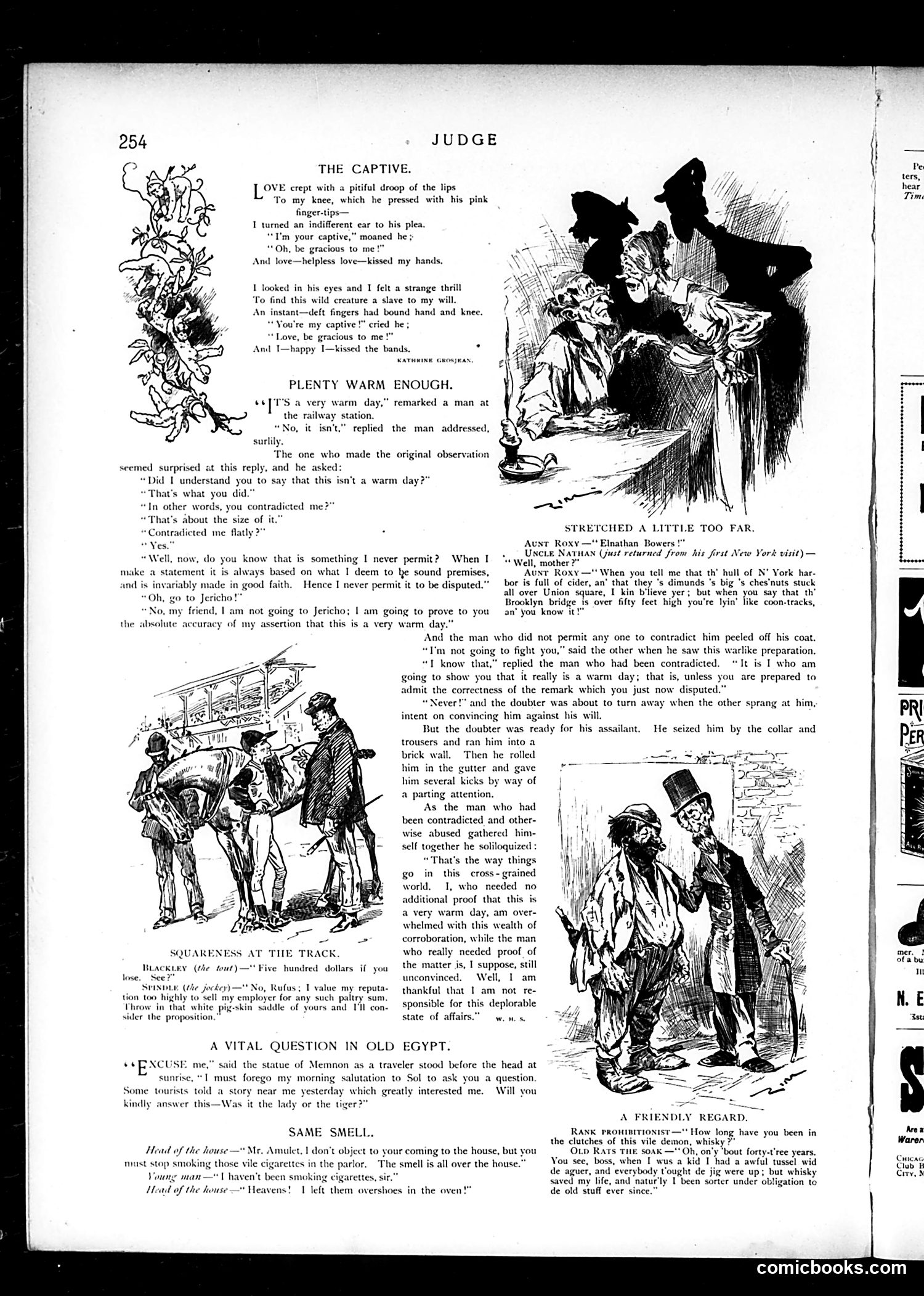
This page contains several satirical pieces typical of Judge's humor: **"The Captive"** (top left): A sentimental poem about romantic domination, likely mocking overwrought Victorian romance literature with its melodramatic language about love and bondage. **"Plenty Warm Enough"** (center): A man who insists on absolute obedience to his statements picks a fight with someone who contradicts him about the weather. The joke satirizes stubborn, authoritarian personalities—the man needs physical violence to "prove" his point, revealing the absurdity of his position. **"Stretched a Little Too Far"** (right): Uncle Nathan returns from New York with exaggerated tall tales, while Aunt Roxy catches him lying about the Brooklyn Bridge being 50 feet high. This mocks both rural gullibility about urban wonders and travelers' tendency to embellish. The page also includes minor jokes about horses, Egyptian statuary, and cigarette smoke. The humor targets human vanity, stubbornness, and self-deception—standard Judge fare.
This page is primarily **advertising with scattered humor snippets**, typical of Judge's format. The cartoons/jokes are brief: **Key Content:** - Small comic dialogues mock social pretension, incompetence, and class dynamics (a tramp claiming to be a "gentleman," a streetcar conductor's confusion, lawyers refusing a fool as juror) - One recurring joke targets upper-class affectation: four men discussing a musician "Von Boolow" by name-dropping his technique without having actually heard him perform—satirizing fashionable society's empty cultural posturing **The Advertisements:** Dominate the page (Decker pianos, Pax cigarettes, Sohmer pianos, Castoria patent medicine, etc.), reflecting Judge's revenue model. **Historical Context:** This appears to be from the **Gilded Age** (late 1800s based on style), when Judge mixed genteel satire targeting upper-class vanity with working-class humor. The jokes assume readers recognize pretentious social behavior as ridiculous. The satire is **mild and observational** rather than hard-hitting political commentary—typical of Judge's mainstream approach to social comedy.
This is primarily an **advertising page** with minimal editorial content. The page contains several brief jokes and anecdotes scattered among ads for patent medicines, pens, bicycles, and railroads. The notable satirical content includes: **"American Millionaire in Paris"** — A jab at American wealth and European snobbery. An American brags that his daughter is "waited upon by a duke," but a world traveler deflates this by noting dukes are common as restaurant waiters—implying European nobility is either abundant or debased. **Cautionary anecdotes** about a boy shooting himself with a toy pistol and a child injured by fireworks mock parental negligence disguised as indulgence. The page primarily reflects **Judge's advertising base** rather than editorial satire. Most content serves the magazine's commercial function, promoting dubious patent medicines (Beecham's Pills, Broncholine for asthma), writing implements, and transportation services—typical of late-19th-century American periodicals.
This is primarily a **advertising page** from Judge magazine, featuring numerous commercial advertisements for products like bicycles, typewriters, rum, water, photography equipment, and candy. The only editorial content is a **humorous poem titled "The Yellow-Hammer's Tap,"** which uses onomatopoeia (tip-tap, tipity-tap) to describe the rhythmic pecking sound of a woodpecker throughout different seasons and times of day. It's a light nature poem with no apparent political satire. Below the poem are two brief jokes: one about hunting ("How natural for the man who comes back without any game...") and another children's joke about twins and babies that plays on wordplay. The page reflects Judge's mixed format of satire, humor, and commercial advertisements typical of late 19th/early 20th-century American magazines. There are **no political cartoons or caricatures visible** on this particular page.
This page is primarily **advertising**, with one substantial satirical poem titled "The Ready-Made Man" by S. W. Foss (credited to *The Yankee Blade*). The poem mocks the idea of scientifically manufacturing a perfect human being. Ancient Hindu sages attempt to create a man by mixing chemicals (phosphoric acid, carbon, salt, water, creatine) in a bowl, then animating him. The result is a disaster: the artificial man is "crazy and wild," howling like a beast, then crying like a child. Various chemical adjustments fail to improve him—he becomes foolish, then violently aggressive like boxer John L. Sullivan, forcing the sages to destroy their creation. **The satire's point**: The poem ridicules the era's pseudo-scientific faith in mechanistic solutions to human nature and self-improvement. It suggests that creating a "perfect man" through chemistry or engineering is futile—genuine human development requires time, natural growth, and "mellowing." The surrounding page contains typical late-19th-century advertisements for wines, root beer, typewriters, patent medicines, and hotels—common *Judge* magazine content.
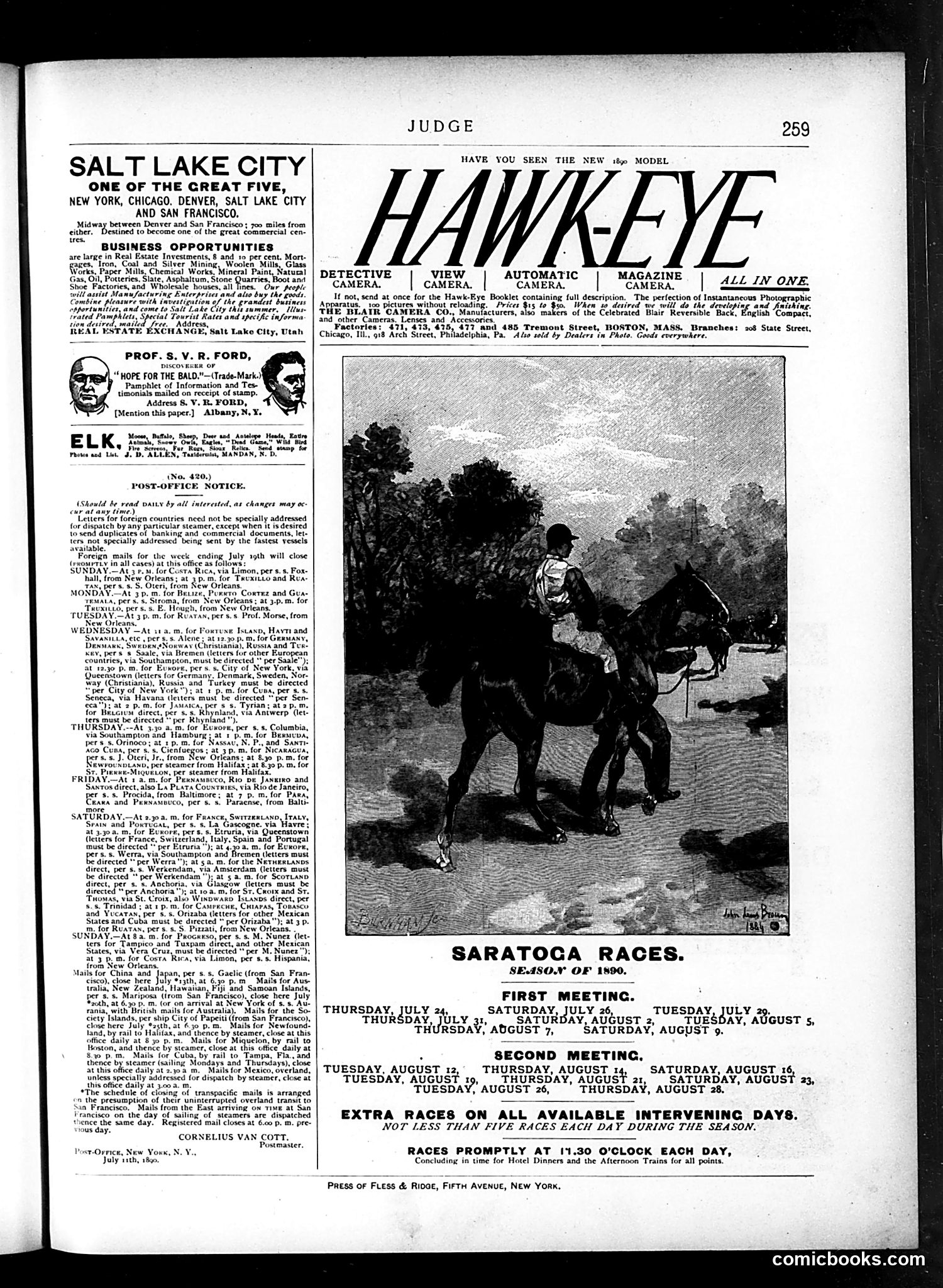
This page is primarily **advertising and notices**, not a political cartoon. The main content includes: 1. **Salt Lake City promotion** - A real estate advertisement highlighting business opportunities (mining, manufacturing, etc.), positioning Salt Lake City as one of "the great five" commercial centers. 2. **Prof. S.V.R. Ford's "Hope for the Bald"** - A patent medicine advertisement claiming to cure baldness. 3. **Post Office Notice** - Detailed shipping schedules for international mail by steamship. 4. **Saratoga Races advertisement** - Horse racing event details for summer 1890. The only visual element is a **photograph of a horse and rider** at the Saratoga Races. Judge magazine's satirical cartoons typically appeared elsewhere in issues. This particular page serves primarily as a platform for classified advertising and public notices, which were common revenue sources for 19th-century publications.
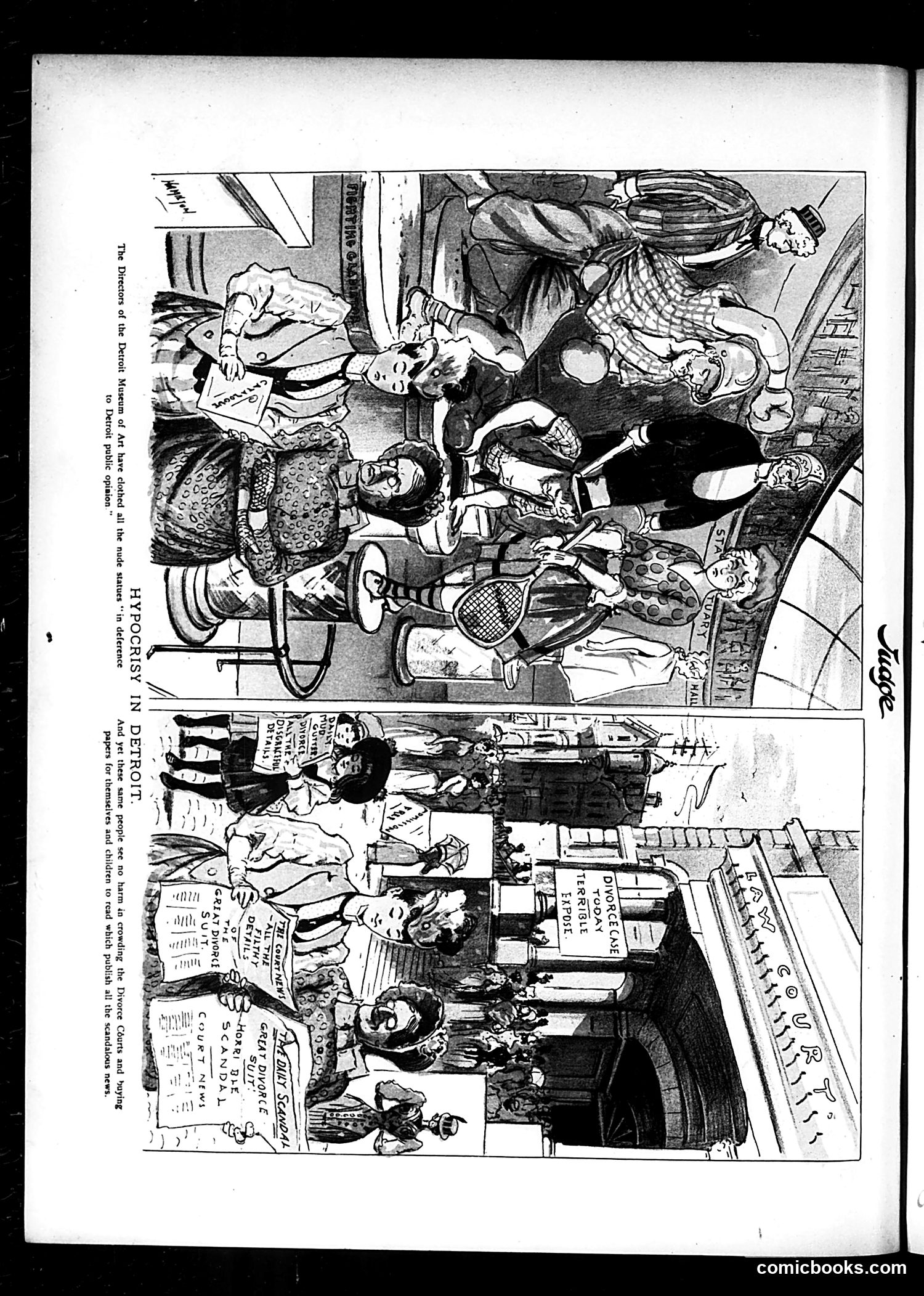
This cartoon satirizes moral inconsistency among Detroit's cultural elite. The top panel shows museum directors prudishly clothing nude statues "in deference to Detroit public opinion." The bottom panel depicts the same people eagerly attending divorce court proceedings and purchasing newspapers filled with scandal and sexual impropriety—the very sensational content they claim to shield the public from. The satire's point: these officials are hypocrites. They censor art in the name of public morality while simultaneously consuming and promoting the scandalous divorce coverage they condemn. The cartoon suggests their prudishness is performative—they want to appear respectable while indulging the very sensationalism they publicly reject. It mocks the selective moral outrage of the privileged class.
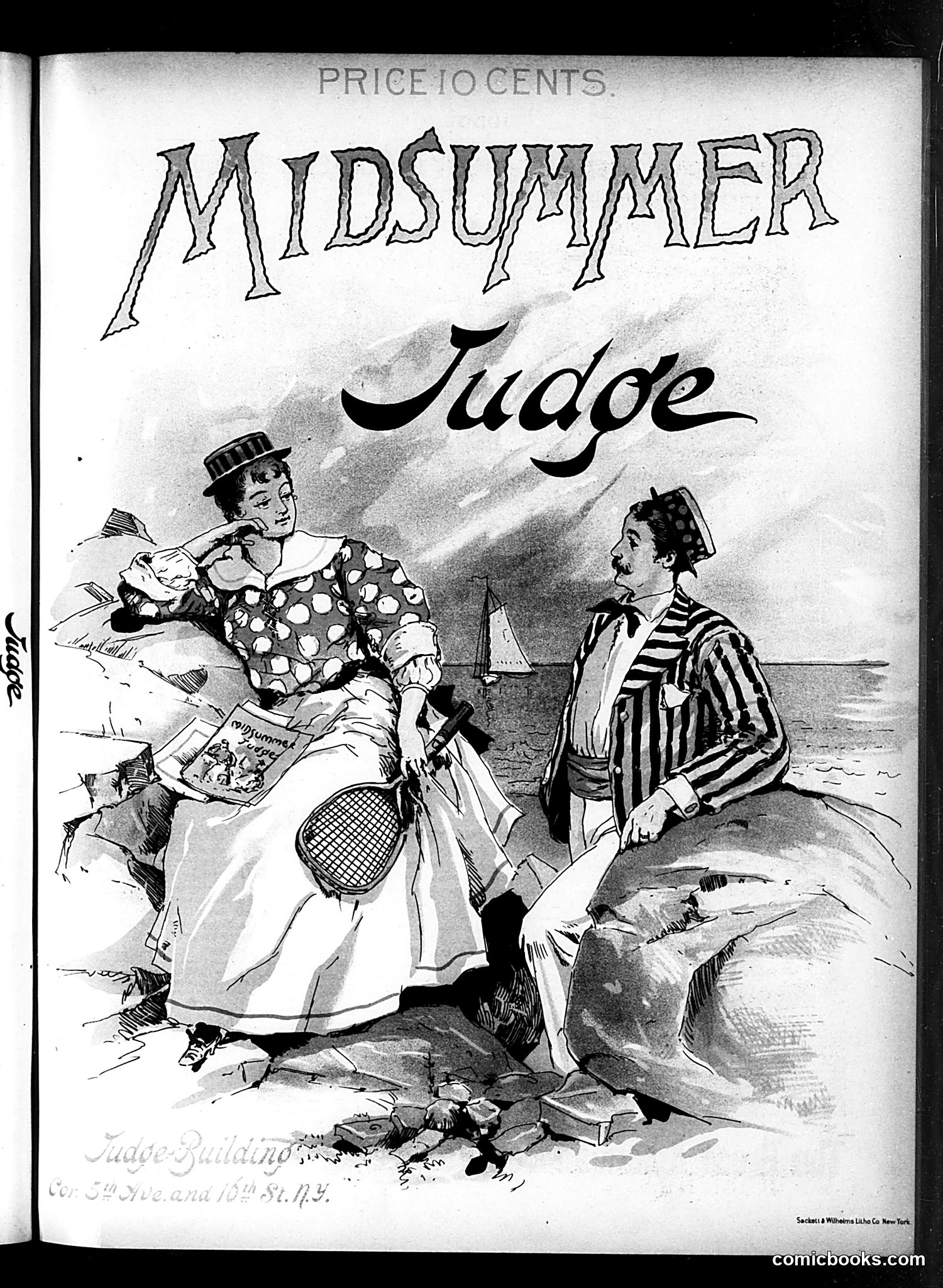
This appears to be a cover or title page for *Judge* magazine priced at 10 cents. The illustration depicts two figures at a beach: a woman in fashionable, patterned clothing holding a parasol and magazine, seated comfortably, and a man in striped bathing attire standing nearby. A sailboat appears in the background. The satire likely mocks leisure culture and gender dynamics of the era—possibly critiquing the contrast between leisured femininity (the woman's elaborate dress and relaxation) and masculine discomfort or subordination in the bathing scene. The "Midsummer Judge" title suggests this is a summer-themed satirical issue, typical of the magazine's humorous commentary on contemporary social customs and fashion. Without additional context about the specific date or cultural references, the exact target of the joke remains somewhat unclear, though it engages with turn-of-the-century beach culture and gender roles.
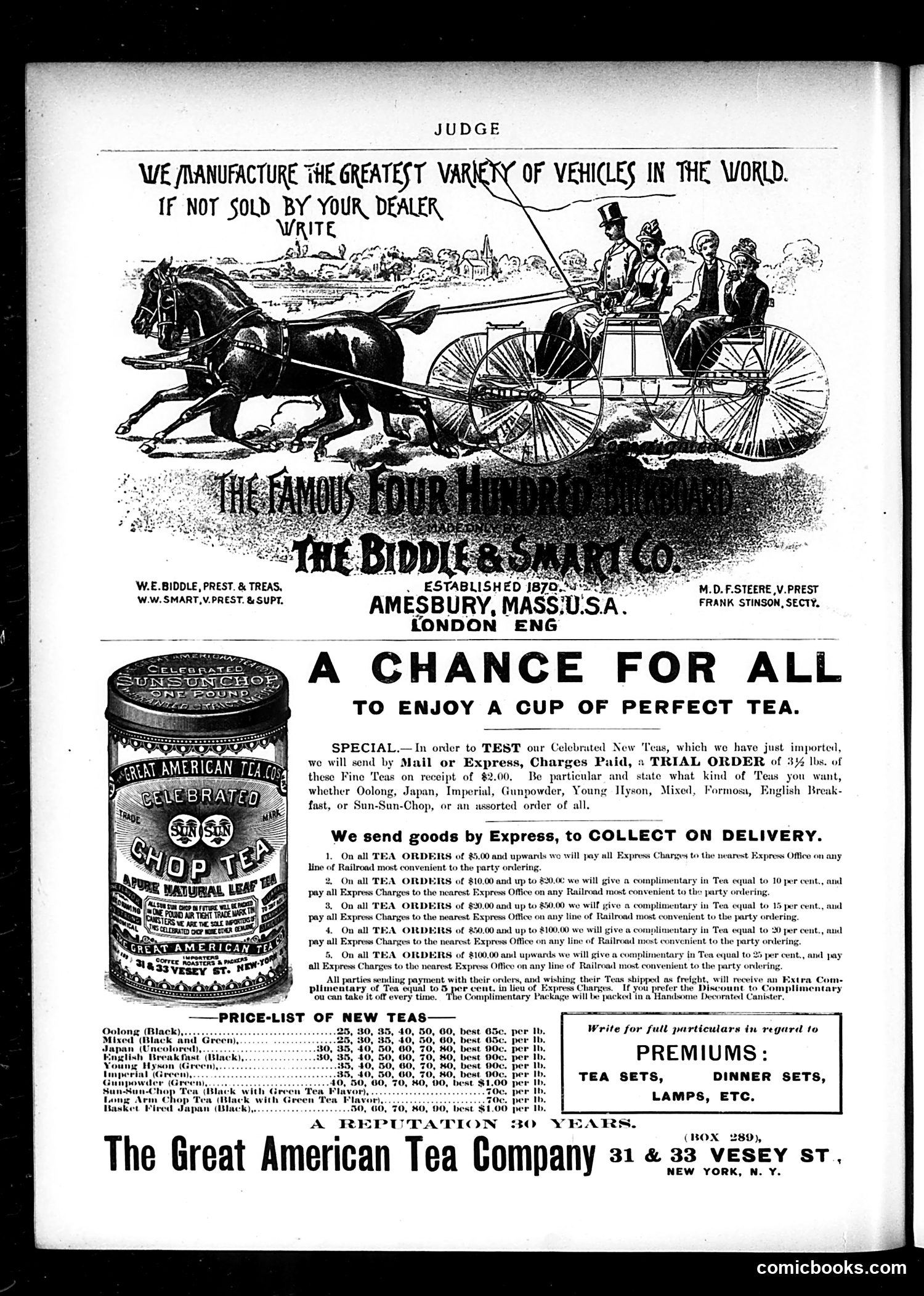
This page is primarily **advertising**, not political satire. It contains two distinct ads: **Top section:** The Biddle & Smart Company (established 1870) advertises horse-drawn carriages/vehicles manufactured in Amesbury, Massachusetts, with London representation. The illustration shows a genteel four-person carriage pulled by a single horse—a standard Victorian-era vehicle advertisement with no satirical content. **Bottom section:** The Great American Tea Company advertises imported teas with a mail-order trial offer ($2.00 for 3.5 lbs) and a tiered discount structure based on order size. The company promises to pay express shipping charges on larger orders and offers complimentary premiums (tea sets, dinner sets, lamps). The page's title, "JUDGE," indicates it appeared in the satirical magazine, but this particular page functions as a standard commercial advertisement section rather than editorial satire. The ads target affluent Victorian consumers with disposable income for carriages and imported luxuries.
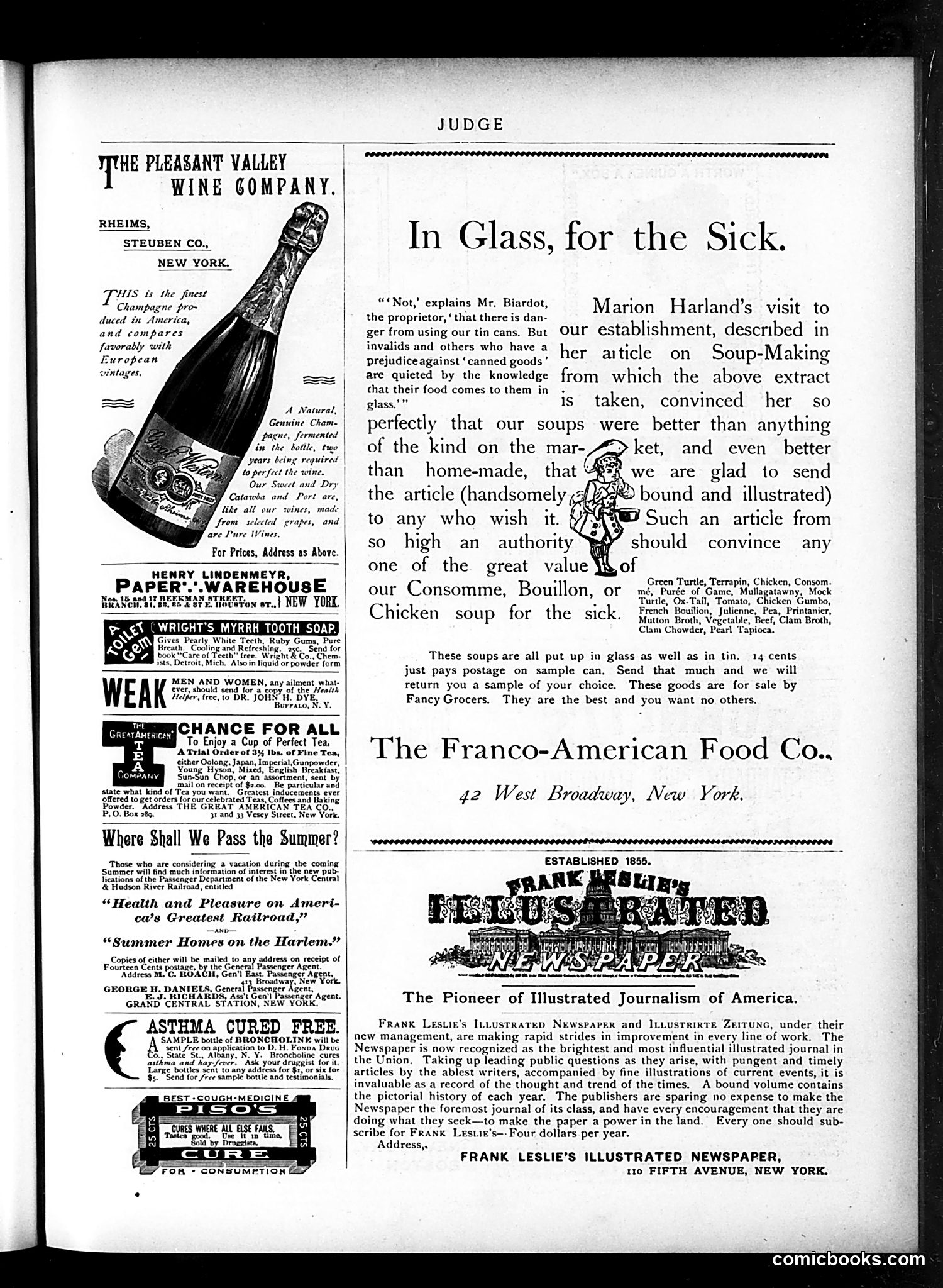
This page is primarily **advertising**, not political satire. The main content is a promotional article for the Franco-American Food Co.'s canned soups, particularly targeting consumers concerned about food safety. The "joke" (if present) is subtle: the proprietor, Mr. Biardot, explains that invalids and others with prejudices against canned goods are reassured when they learn their soup comes in glass containers rather than tin cans. This reflects **late-19th-century consumer anxiety about tin cans**—newly popular but viewed with suspicion regarding safety and food quality. Marion Harland, apparently a recognized food writer of the period, visited the establishment and was convinced of the product's superiority. Her endorsement in a published article lends credibility. The surrounding advertisements (wines, tea, tooth soap, asthma remedies) are typical period marketing. The page demonstrates how food companies addressed emerging consumer concerns about industrial food processing and packaging safety.
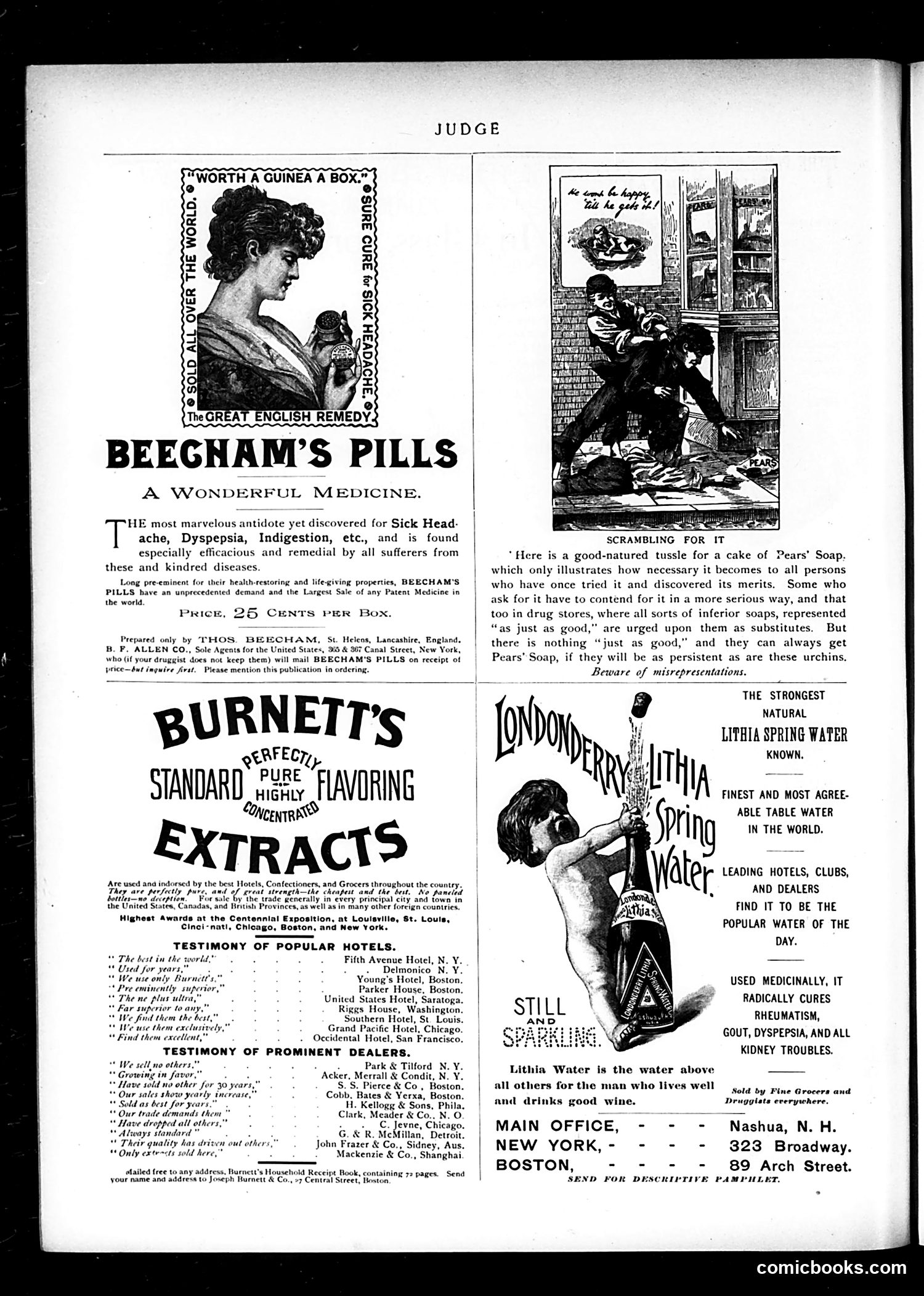
This page is primarily **advertisements**, not political satire. It features patent medicines and consumer products popular in the late 19th century, including Beecham's Pills (for indigestion), Burnett's Extracts (flavoring), Londonderry Lithia Spring Water, and Pears' Soap. The one cartoon—"Scrambling for It"—depicts **children fighting over Pears' Soap**, illustrating the product's supposed desirability. The accompanying text uses this as a sales pitch, claiming the soap is so superior that customers must "persistently" demand it over inferior "just as good" substitutes pushed by druggists. This reflects the era's widespread practice of **product substitution**—retailers promoting cheaper knockoffs. The cartoon humorously suggests Pears' is worth fighting for, while the text warns consumers against accepting inferior alternatives.