
A complete issue · 16 pages · 1890
Judge — July 12, 1890
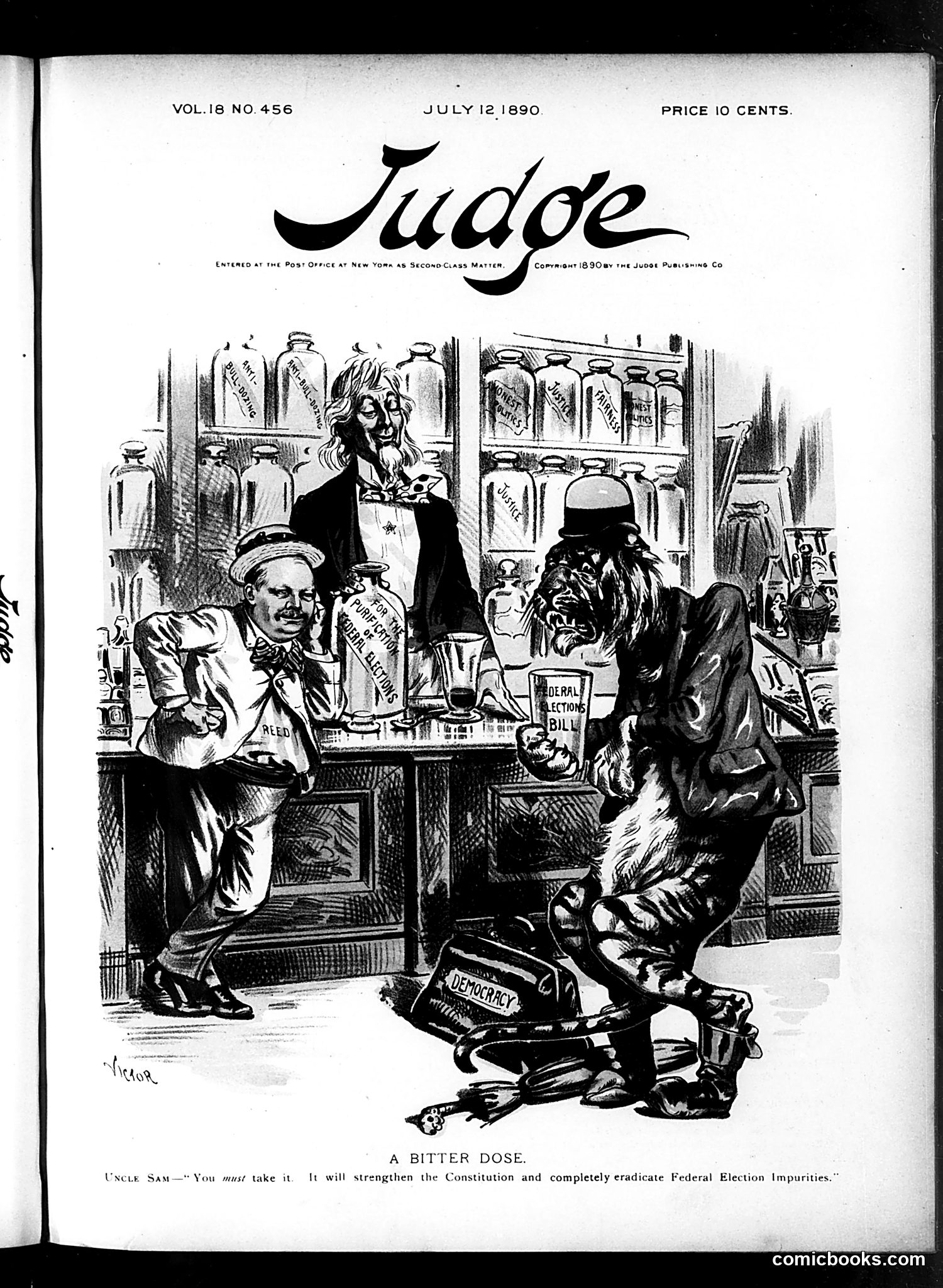
This political cartoon depicts **Uncle Sam** (representing the U.S. government) forcing a bitter medicine on a figure labeled "Democracy," shown as a disheveled, resistant character. The pharmacy shelves behind them display bottles labeled with what appears to be election-related remedies. The caption states Uncle Sam insists the dose "will strengthen the Constitution and completely eradicate Federal Election Impurities." This satirizes federal intervention in elections—likely referencing the controversial **Federal Elections Bill** (the "Force Bill") debated in Congress around 1890, which proposed federal oversight of state elections. The cartoon suggests such measures, while claimed to purify elections, would actually harm democratic principles, presenting them as an unpalatable "bitter dose" rather than legitimate reform.
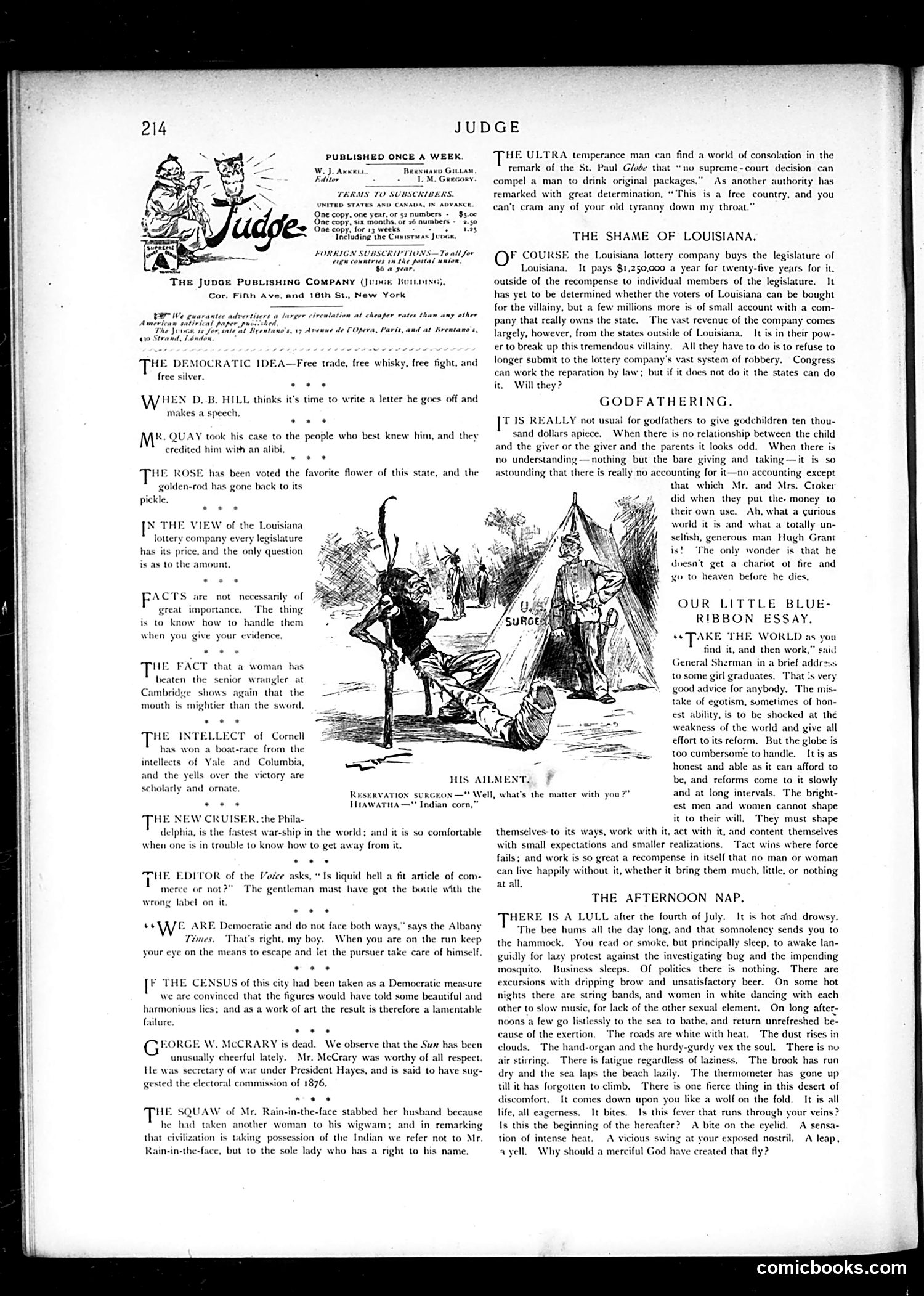
The main cartoon depicts a figure labeled "His Ailment" with an Indian character saying "Well, what's the matter with you?" to a prone, suffering figure labeled "Surgeon." This appears to satirize a Louisiana lottery scandal. The text references the Louisiana lottery company's massive revenue and its corrupting influence on state legislators. The "surgeon" figure likely represents Louisiana's government or political system, depicted as diseased and requiring diagnosis. The Indian character may represent an outside perspective examining the state's problems. The cartoon suggests Louisiana's lottery corruption has created a systemic illness requiring urgent treatment. The surrounding editorial comments criticize various political figures and Democratic Party positions on free trade and other issues, typical of Judge's Republican-leaning satire from this era (likely 1890s).
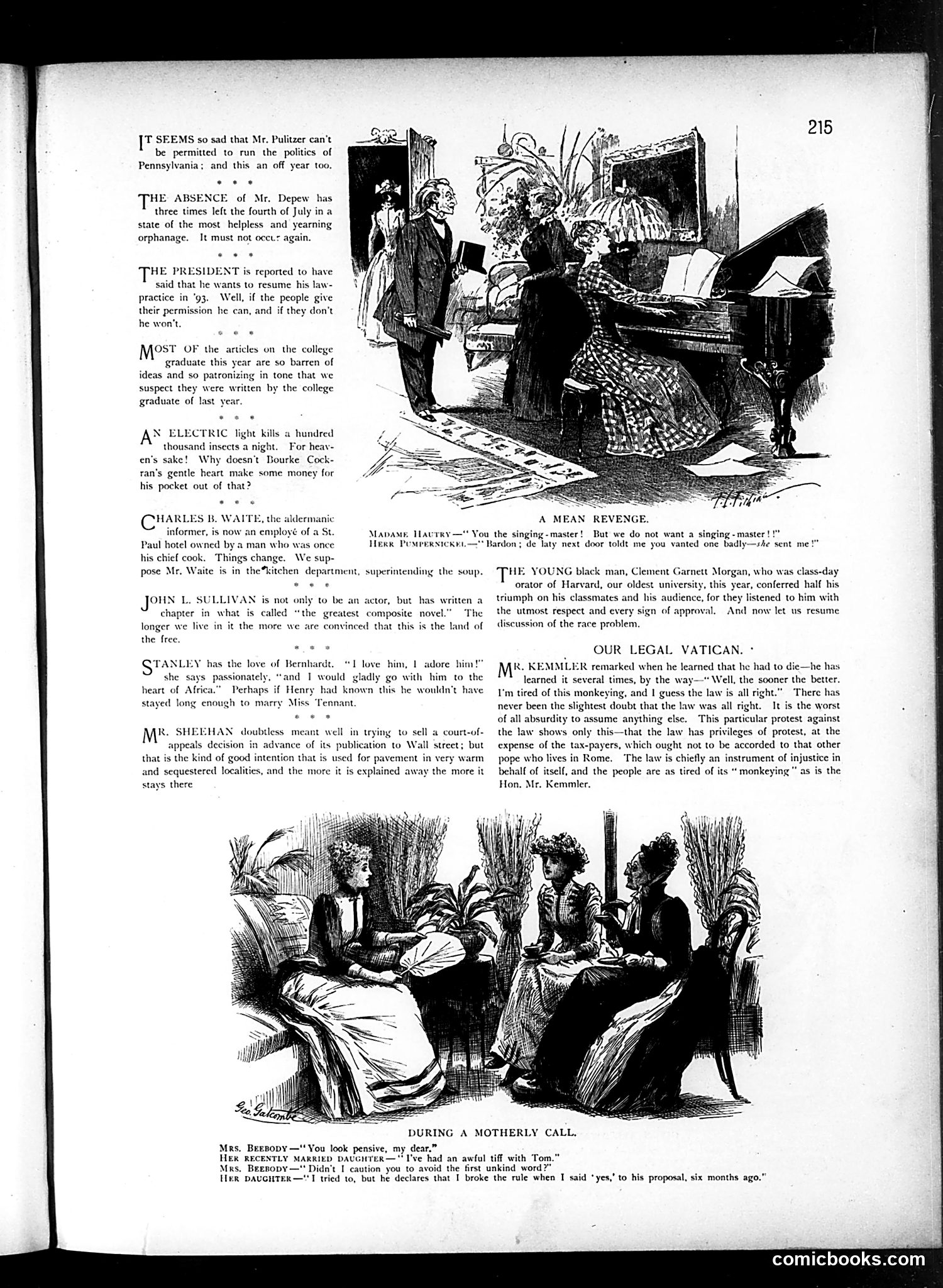
**"A Mean Revenge"** (top cartoon): A singing master confronts a woman at a piano. The caption suggests she's rejecting his romantic advances, threatening to hire a different instructor. The satire mocks both the pretentious music pedagogue and the woman's weaponized rejection—using professional dismissal as "revenge" for romantic rebuff. **"During a Motherly Call"** (bottom cartoon): Three women discuss a recently married daughter's marital troubles. The daughter admits breaking "the rule" by saying "yes" to a proposal six months ago—satirizing the absurdity of women's constrained choices in courtship, where even accepting a proposal is framed as rule-breaking. Both cartoons lampoon gender relations and the awkward social conventions governing Victorian-era courtship and marriage.
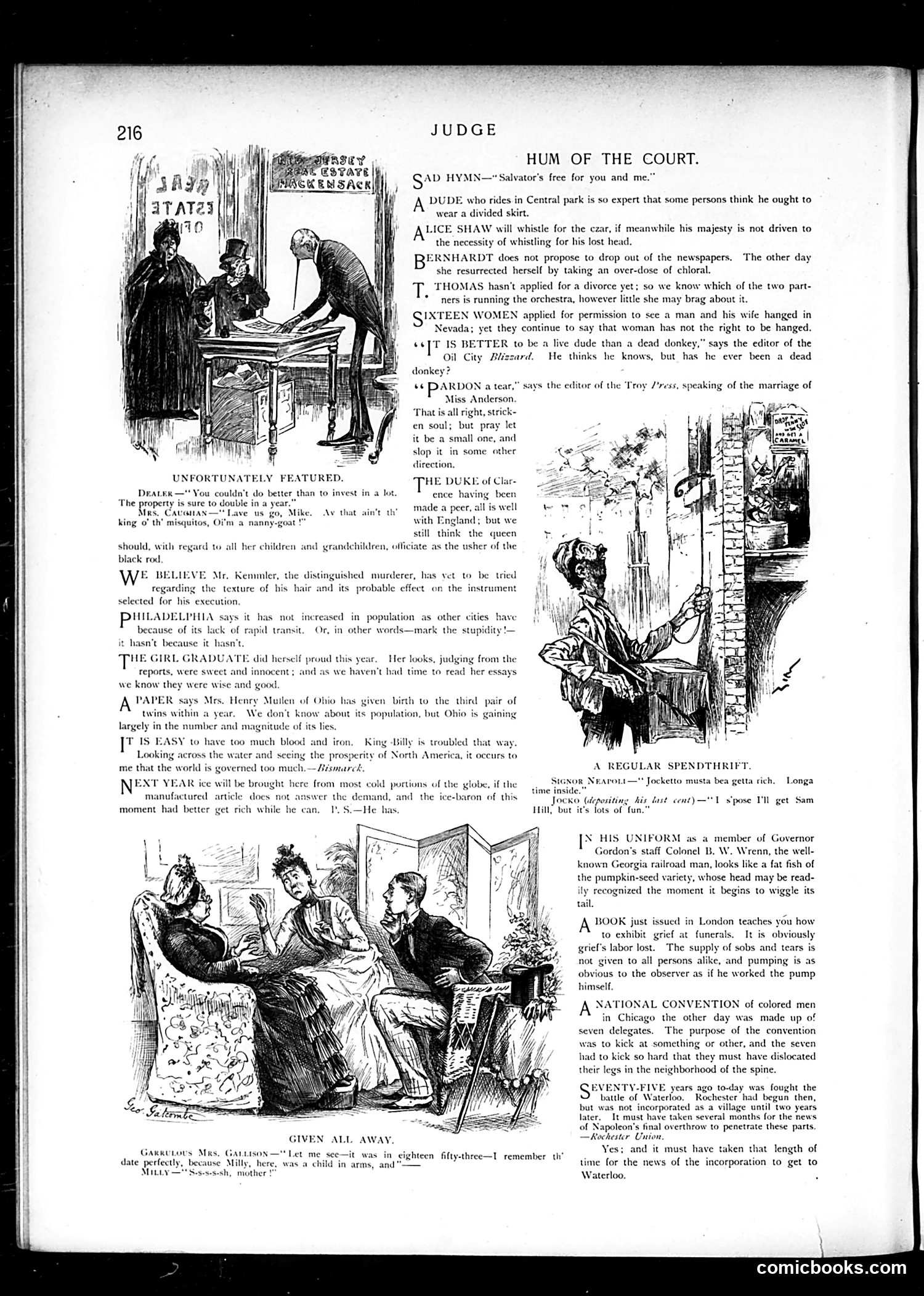
This page from *Judge* contains brief satirical quips mocking contemporary figures and social absurdities. Key targets include: **Public Figures:** Sarah Bernhardt (the actress, mocked for seeking publicity through a chloral overdose); "T. Thomas" (likely a conductor whose wife dominates); and Colonel B.W. Wrenn (a Georgia railroad official ridiculed for his appearance in military uniform). **Social Commentary:** The satire critiques gender politics (sixteen women seeking to witness executions while claiming no rights), journalistic hypocrisy (editors praising "dead donkeys" over live dudes), and regional pride (Philadelphia's population stagnation blamed on lack of rapid transit, not actual problems). **Humor Style:** Typical of *Judge*'s approach—short, sharp jabs mixing personal mockery with broader social critique. The cartoons (showing office and domestic scenes) accompany these written barbs, using visual exaggeration to enhance the satirical effect. The page reflects late-19th-century American magazine satire: gossipy, class-conscious, and aimed at educated urban readers familiar with contemporary scandals and personalities.
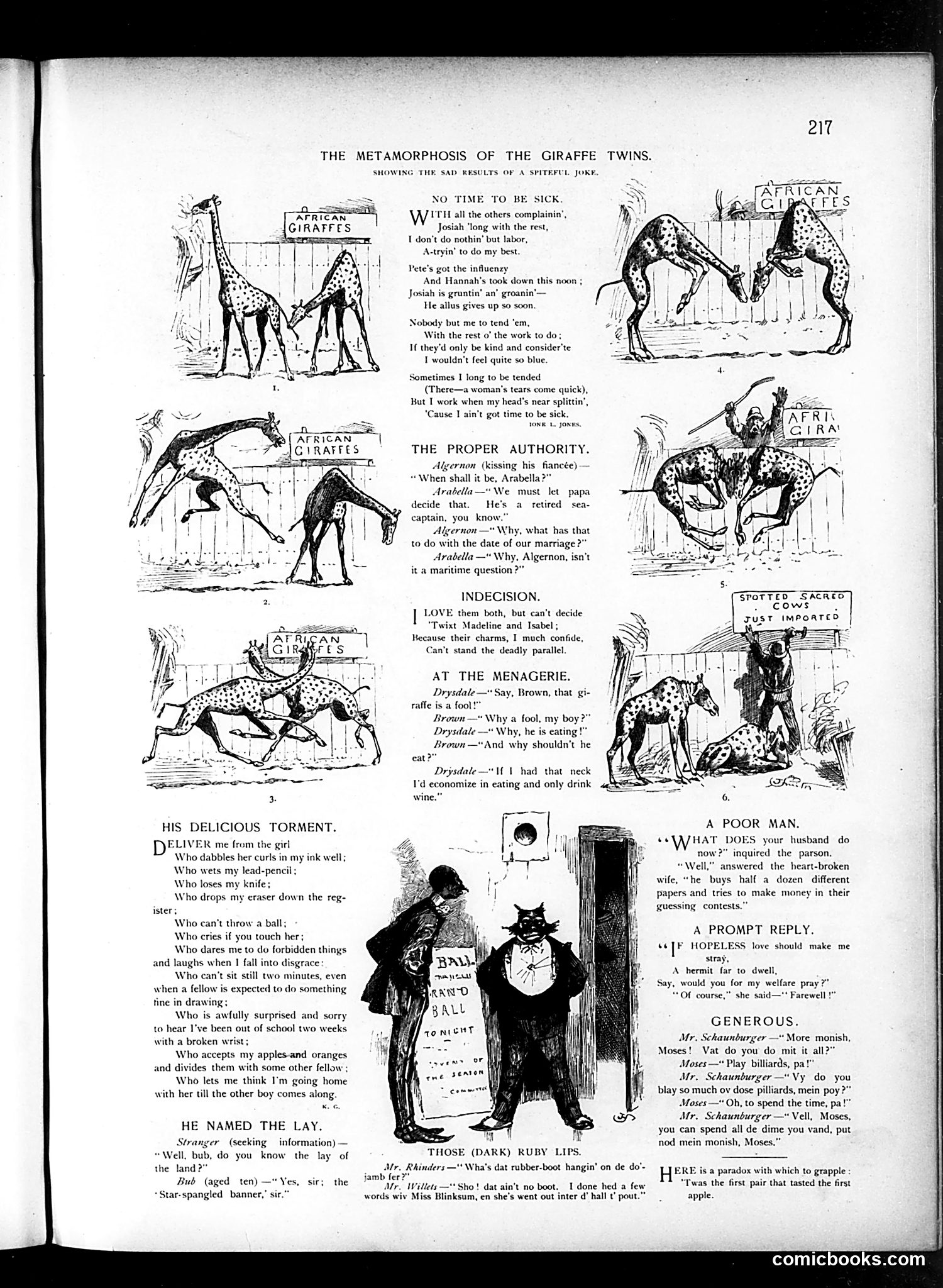
This page collects multiple unrelated comic sketches and jokes typical of Judge magazine's format. The main feature uses anthropomorphic giraffes in various scenarios to satirize human social pretensions and absurdities. The giraffe cartoons mock Victorian propriety: one depicts a working-class giraffe refusing to take sick leave despite illness (social commentary on labor exploitation); another shows a couple seeking a retired sea-captain's permission for marriage, satirizing paternal authority; others ridicule urban pretension at menageries and courtship indecision. Surrounding sketches target stereotypical figures: a tormented artist bothered by a frivolous girl, working-class immigrants (the "Yiddish" dialect speakers), and a poor man wasting money on lottery schemes. The humor relies on period-specific social anxieties—gender roles, class distinctions, immigrant caricatures, and courtship rituals—presented as universal human folly through exaggeration and wordplay.
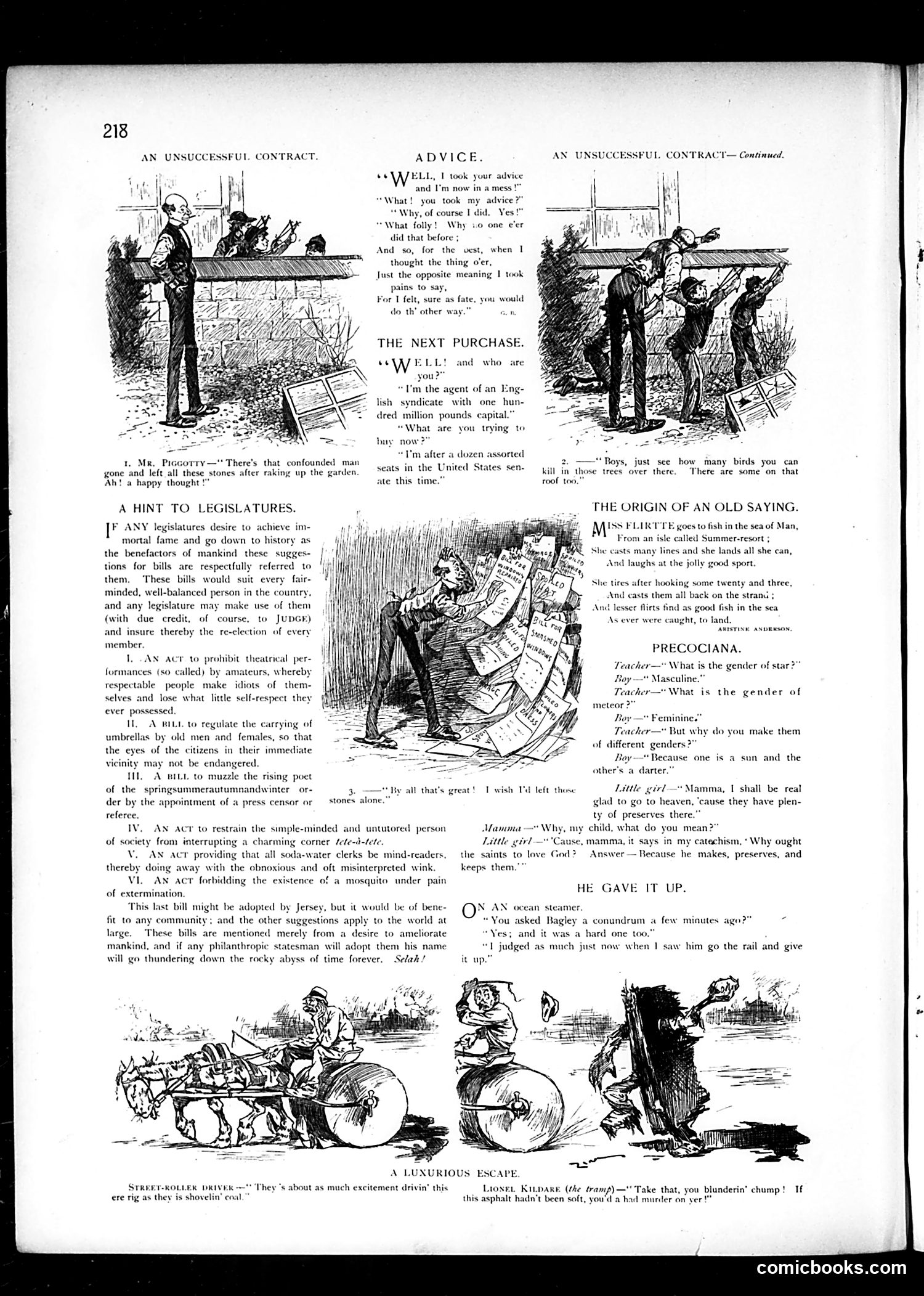
This page from Judge magazine contains several satirical pieces typical of late 19th-century American humor: **"An Unsuccessful Contract"** mocks someone who took bad advice, with the ironic twist that following the advisor's guidance led to disaster. **"A Hint to Legislatures"** is satirical legislation proposals—absurd bills supposedly benefiting society, like prohibiting amateur theatricals, regulating umbrellas, and muzzling poets. This satirizes legislative overreach and silly laws. **"The Next Purchase"** depicts a wealthy English syndicate agent seeking American real estate—likely commenting on British investment in American assets, a contemporary concern. **"The Origin of an Old Saying"** offers a humorous etymology for "plenty of fish in the sea," using a flirtatious woman casting fishing lines as metaphor. **"Precociana"** presents children's absurd logic about grammatical genders and religious catechism—standard period humor about childish misunderstandings. **"He Gave It Up"** shows someone unable to solve a riddle and abandoning effort—simple joke humor. The sketches throughout use typical Judge-style line drawings and satirize contemporary social behaviors and legislative foolishness.
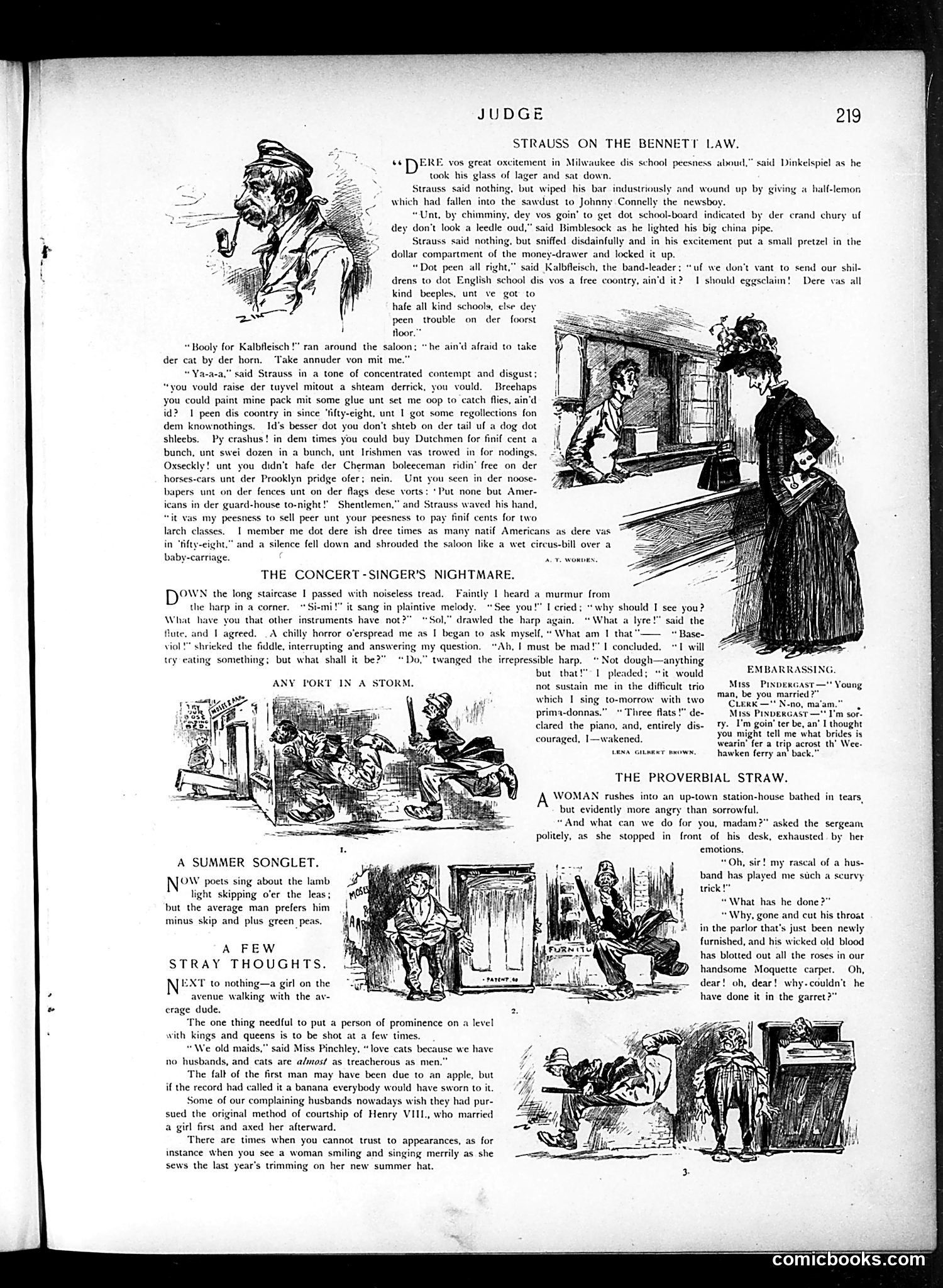
This page contains three unrelated satirical pieces typical of Judge's 1890s-era content: **"Strauss on the Bennett Law"** depicts German-immigrant saloon patrons debating Wisconsin's Bennett Law (likely 1890), which mandated English-language instruction in schools. The caricatured German accents ("vos," "dere," "chimminy") mock immigrant perspectives. Strauss, the bartender, dismisses their complaints, invoking nativist Know-Nothing sentiment from the 1850s to argue German immigrants shouldn't object to assimilation demands when they themselves benefited from America's freedoms. The satire critiques both restrictive language laws and immigrant resistance to Americanization. **"The Concert-Singer's Nightmare"** is a humorous fantasy where musical instruments heckle the dreaming singer with puns ("Do," "Sol," "Lyre"). **"A Summer Songlet"** and "Stray Thoughts"** offer light comic commentary on poets' romanticization of nature and observations about prominent people. The illustrations throughout are character sketches typical of the magazine's style.
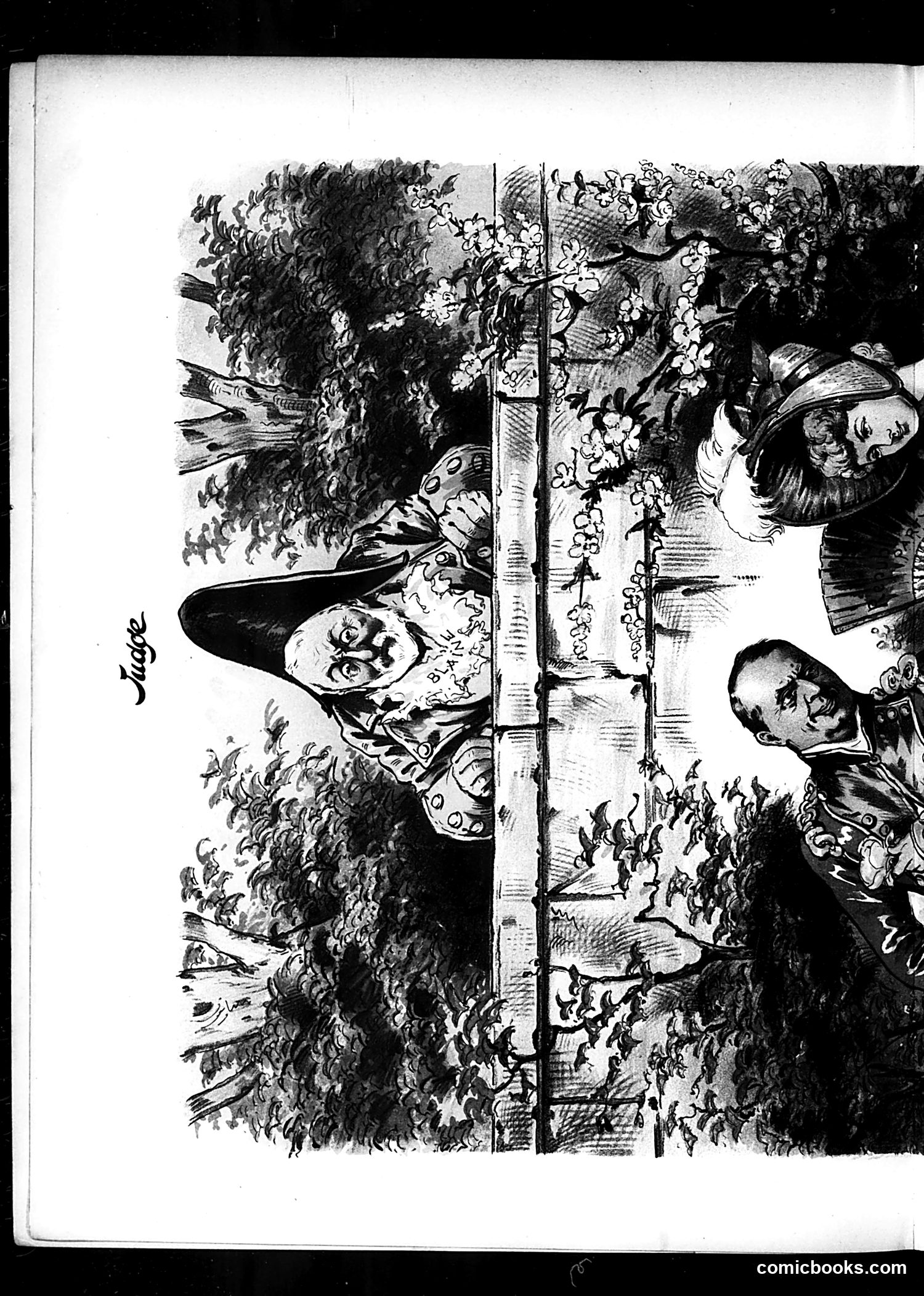
The OCR text on this page appears to be corrupted or non-functional—it contains only random letters and symbols with no intelligible content. While the image shows what appears to be a satirical engraving with multiple figures in period dress, ornate foliage, and detailed cross-hatching typical of 19th-century Judge magazine illustrations, **without readable text or a visible title/caption, I cannot reliably identify the specific figures, political references, or satirical point** being made. To properly explain this cartoon's meaning to a modern reader, I would need either legible OCR text, a visible title, or additional context about the publication date and issue.
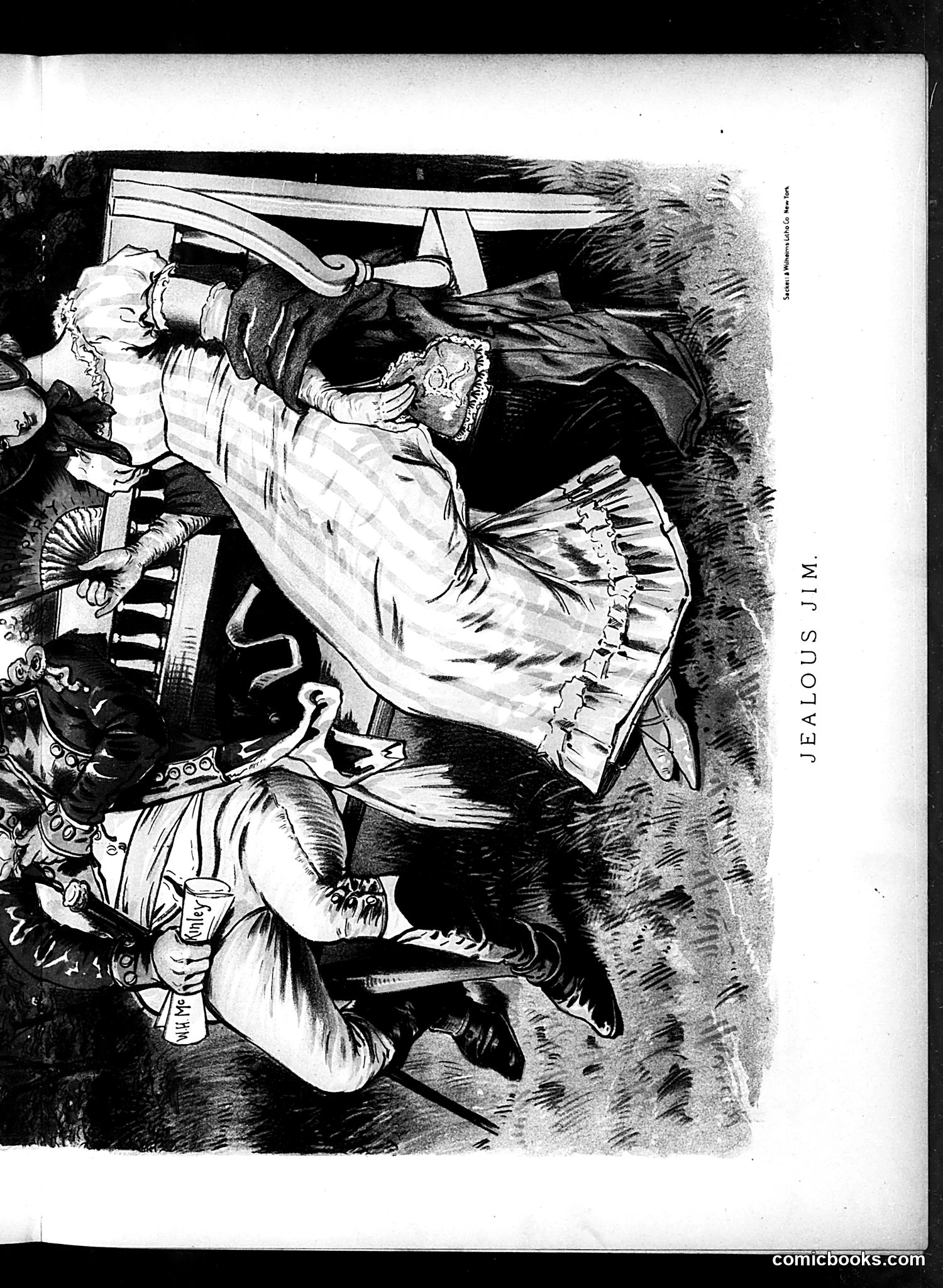
This Judge magazine cartoon depicts a domestic scene titled "Jealous Jim." The image shows a man in period dress appearing agitated or confrontational, with a woman in an elaborate dress nearby and what appears to be another male figure in the background. The scene suggests a love triangle or jealousy-driven conflict scenario. The cartoon likely satirizes male jealousy and possessiveness in romantic relationships, common themes in late 19th/early 20th-century American humor. The exaggerated expressions and theatrical poses typical of Judge's satirical style emphasize the absurdity of the jealous man's reaction. Without additional context about the specific date or accompanying text, the precise social commentary remains unclear, but the cartoon appears to mock masculine insecurity and dramatic relationship dynamics.
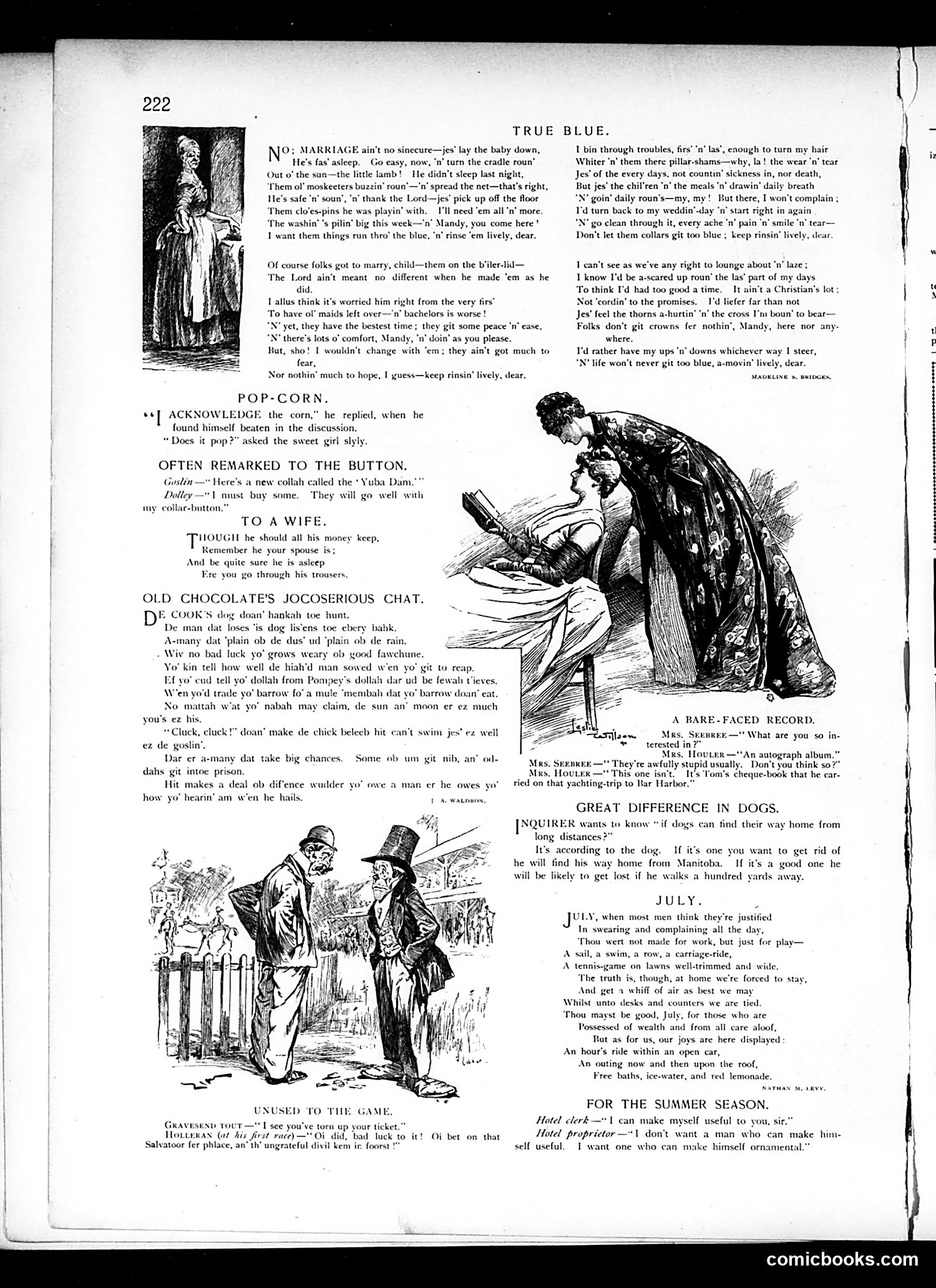
This page contains multiple satirical pieces typical of late-19th/early-20th century American humor: **"True Blue"** (top): A lengthy dialectal monologue by an African American woman discussing marriage, motherhood, and domestic labor. The piece uses stereotypical dialect and presents her perspective on women's inevitable suffering through childbirth and housework as divinely ordained—"Christian's lot." The satire appears aimed at sentimentalizing (or mocking) working-class female resignation to hardship. **"Pop-Corn"** and other brief jokes: Mild wordplay and domestic humor. **"Old Chocolate's Jocoserious Chat"** (bottom left): A character speaking in exaggerated African American dialect dispensing folk wisdom about dogs, debt, and morality. This represents the "comic Negro" stereotype common in period humor. **"Unused to the Game"** (bottom): An Irishman at a racetrack—identifiable by dialect ("Oi")—complains about a horse, using ethnic stereotype humor. The page reflects Judge's reliance on racial and ethnic caricature for comedic effect, now recognized as offensive.
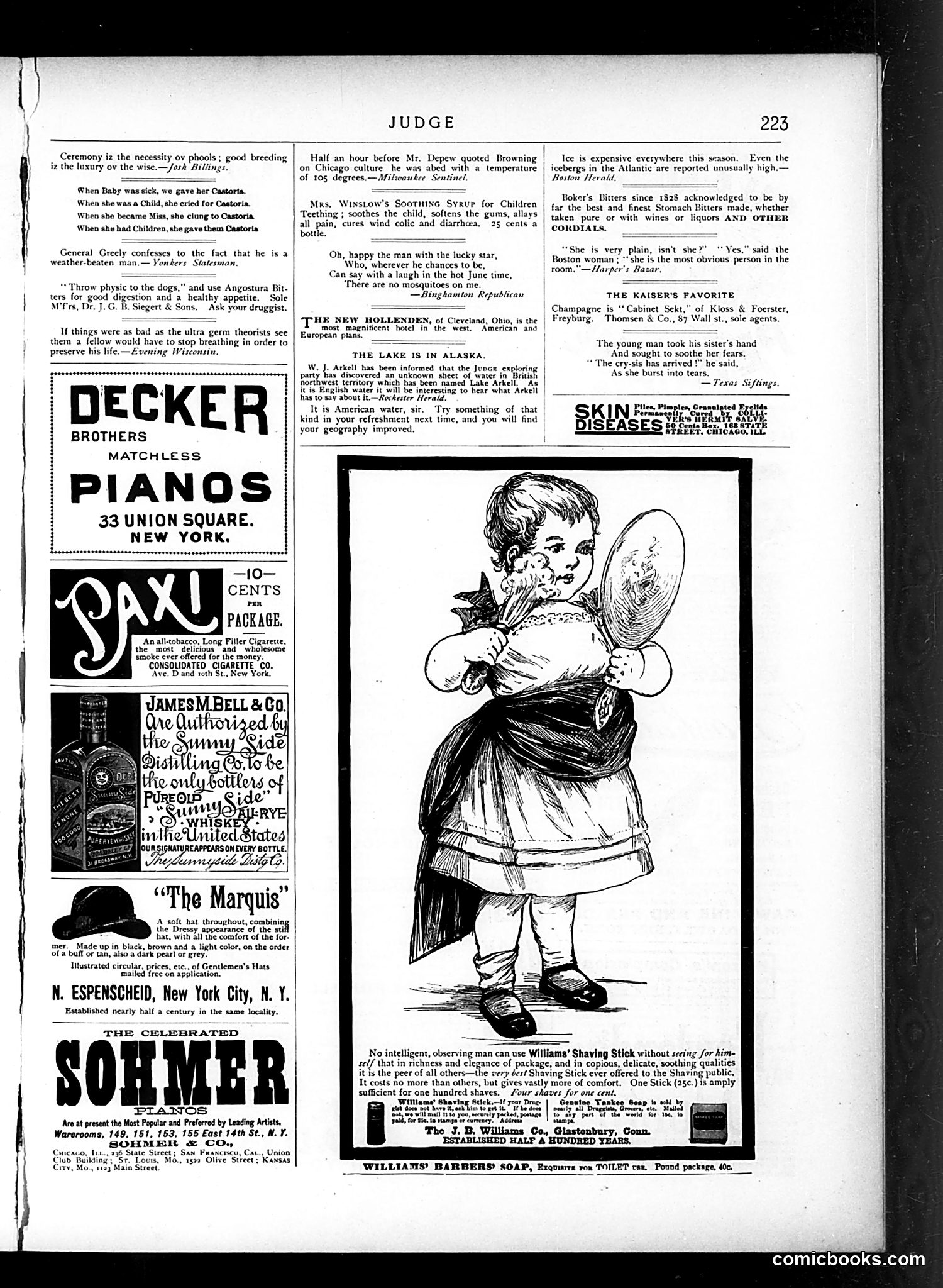
This page from Judge magazine (a satirical weekly) is primarily **advertising**, with brief satirical commentary interspersed. The main cartoon depicts a **child holding a hand mirror**, accompanying an advertisement for **Williams' Shaving Stick**. The joke plays on the phrase "No intelligent, observing man can use Williams' Shaving Stick without noting" its superiority—the illustration suggests even a child would notice the product's obvious quality. Other satirical notes mock: - **Chauncey Depew** (a prominent New York politician/railroad executive), joking that he caught a fever before giving a lecture on Chicago culture - **General Greely**, described as "weather-beaten" - Germ theory alarmists - Ice prices and Atlantic icebergs The page otherwise consists of period product advertisements (pianos, hats, cigarettes, medicinal syrups) typical of late 19th-century magazines. The satirical content is minimal and light—social observation rather than political commentary.
This page is primarily **advertising**, not political satire. It's from *Judge*, a humor magazine, but this particular page contains mostly commercial ads for personal grooming products (complexion powder, tooth powder, fountain pens, shaving cream) typical of late 19th-century publications. The few non-advertising items are brief **jokes** about courtship and marriage: - A woman gives away strawberries at dinner (implying romantic interest) - A woman won't marry a man whose "heart was not in the right place" - A couple arguing about religious revision sounds like murder There's one paragraph mocking a printer named F.B. Garrett who claimed to have made leather from a seal at a fictional lake—apparently a local prank or tall tale circulating among press associations. **No identifiable political figures or satire appear on this page.** It reflects period concerns about appearance and self-presentation through consumer products.
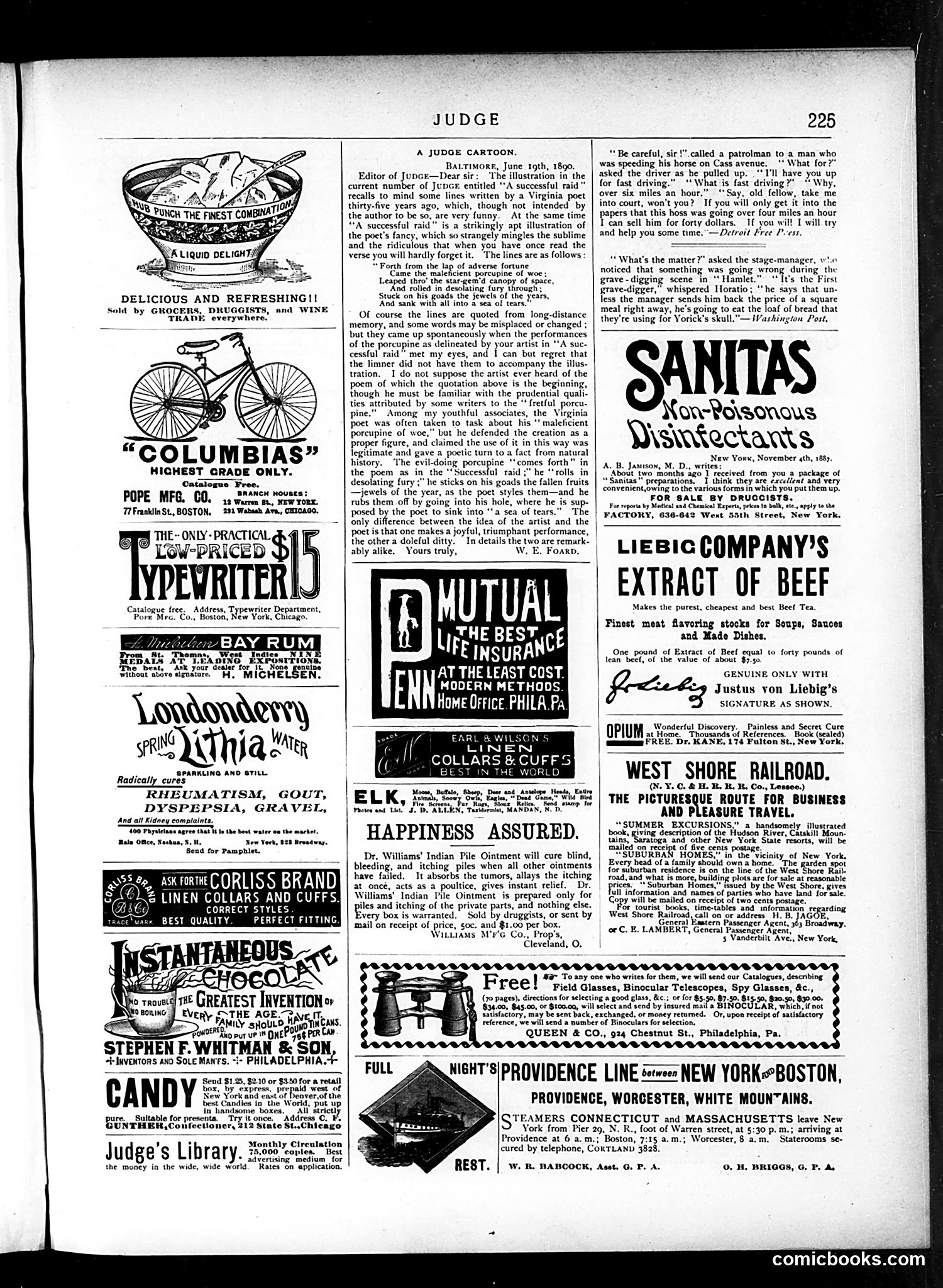
This page is primarily advertisements, with one notable editorial feature. In the upper right, there's a reader's letter comparing a Judge cartoon titled "A successful raid" (not visible on this page) to a 19th-century Virginia poem. The letter's author suggests the cartoon illustrates the poem's imagery of a "maleficient porcupine of woe" emerging from "adverse fortune," moving through space, and causing destructive chaos—apparently a satirical jab at political or social misfortune. The writer notes the cartoon inadvertently captures the poem's absurdist tone blending sublime and ridiculous elements. The rest of the page contains period advertisements for typewriters, water, collars, insurance, and other consumer goods typical of 1890s publications.
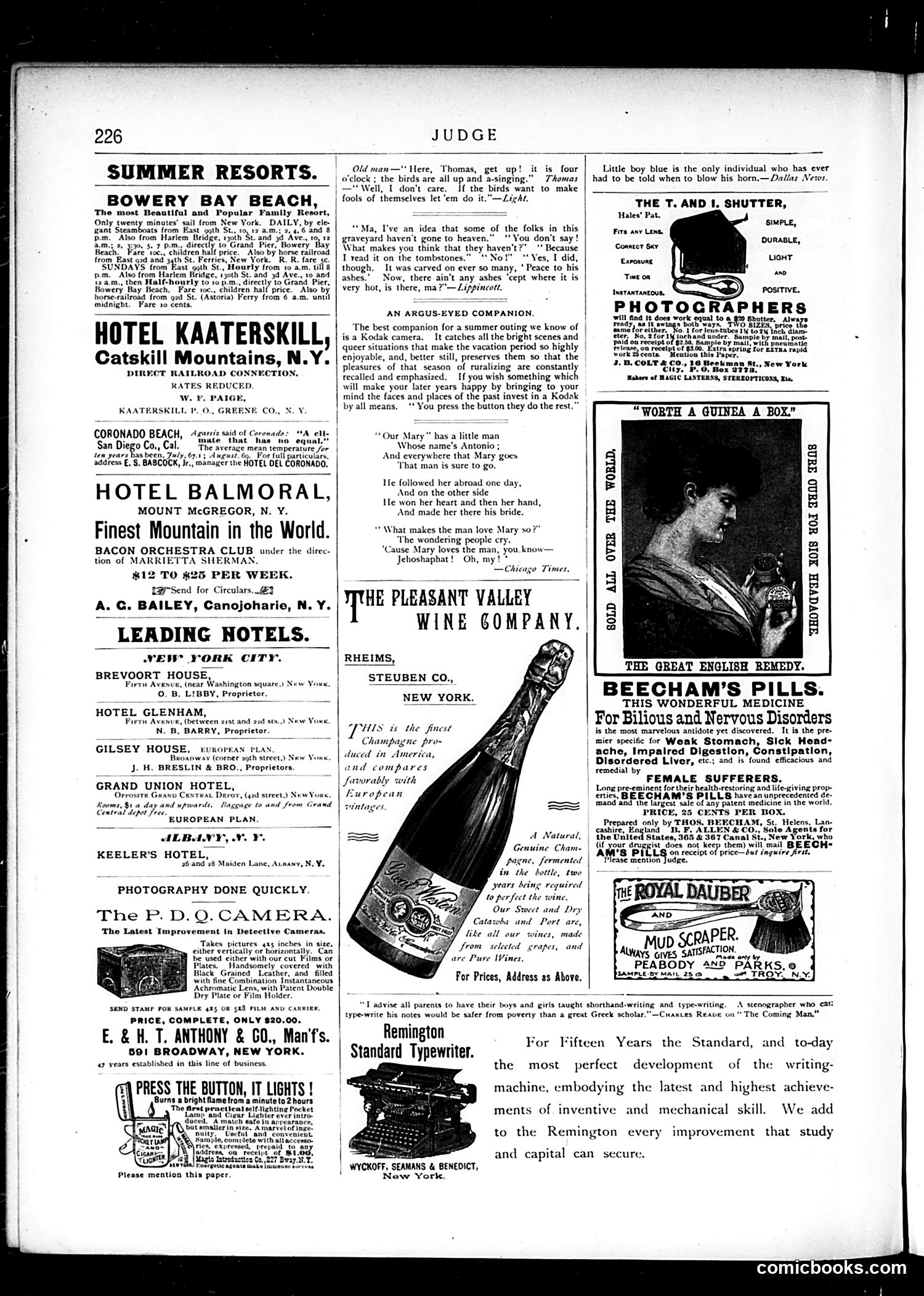
This page is primarily advertising, with some editorial cartoons and jokes interspersed. The main illustrated content includes: 1. **"An Argus-Eyed Companion"** — A Kodak camera advertisement promoting photography as essential for capturing vacation memories. "Argus-eyed" references the mythological giant with multiple eyes, suggesting the camera as an all-seeing companion. 2. **Pleasant Valley Wine Company advertisement** — promoting wine with an image of a champagne bottle. 3. **Beecham's Pills advertisement** — marketing patent medicine for various ailments including "Bilious and Nervous Disorders." The page also contains several brief humorous pieces, including jokes about children's logic regarding gravestones and church. These reflect Victorian-era domestic humor typical of Judge magazine's satirical content. The bulk of the page consists of hotel and resort advertisements for summer destinations around New York and beyond, representing the leisure activities available to affluent readers of this period.
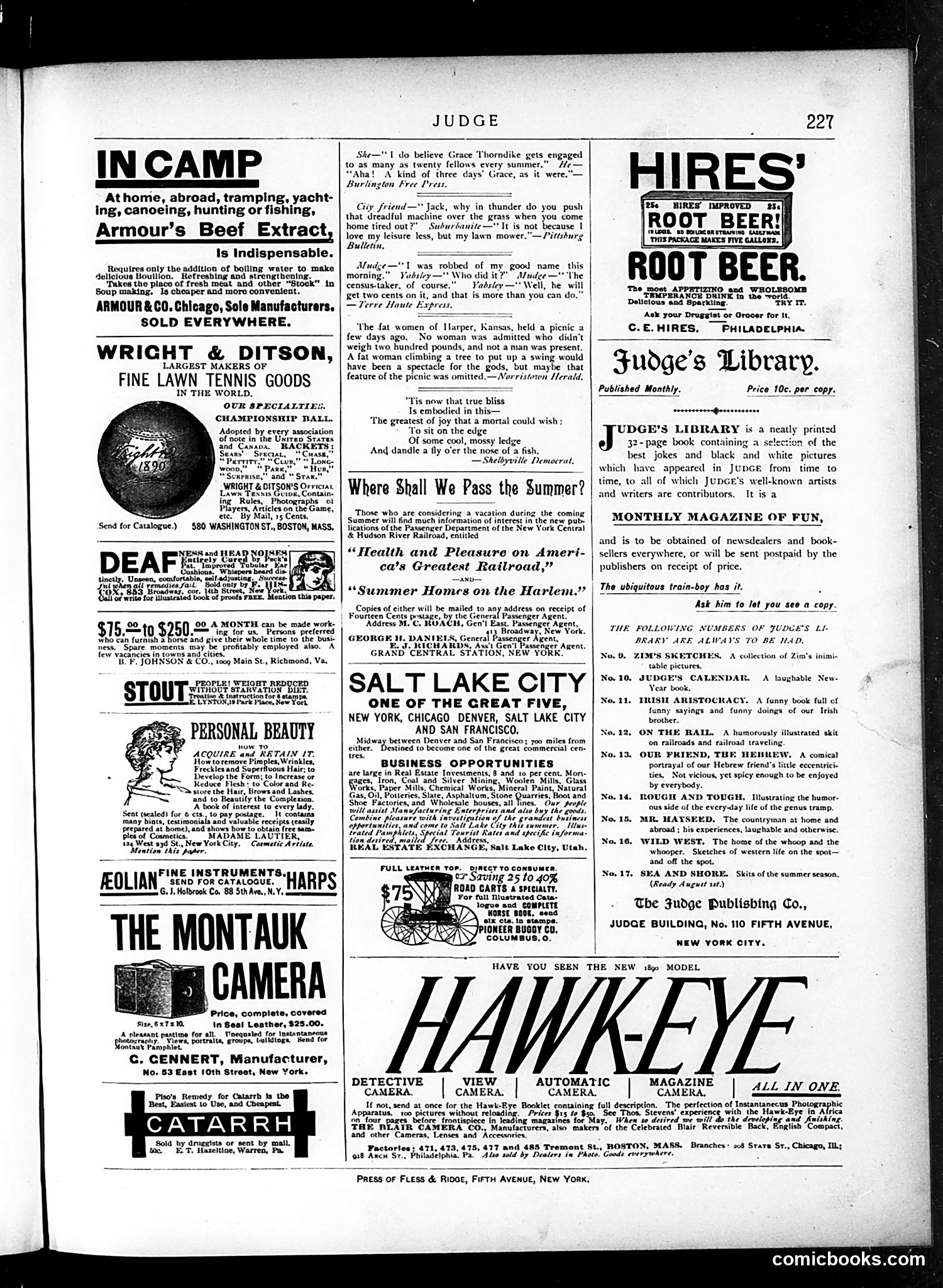
This page is primarily **advertisements and humor snippets** rather than a political cartoon. The content reflects late 19th/early 20th-century American consumer culture and social attitudes. The humor pieces are brief, genteel jokes about: - **Romance/courtship**: A woman who gets engaged frequently ("three days' Grace") - **Suburban life**: A tired husband preferring his lawn mower to leisure - **Class/propriety**: A census-taker's rudeness; a Kansas women's picnic requiring 200+ pounds admission The ads promote products (Armour's Beef Extract, tennis equipment, cameras) and services (weight loss, beauty treatments, real estate in Salt Lake City) targeting middle-class consumers. The page's humor is characteristic of Judge's genteel satire—mild social observation rather than sharp political critique. There are **no identifiable political figures or events** referenced. The content simply captures period attitudes about consumption, gender, and respectability.
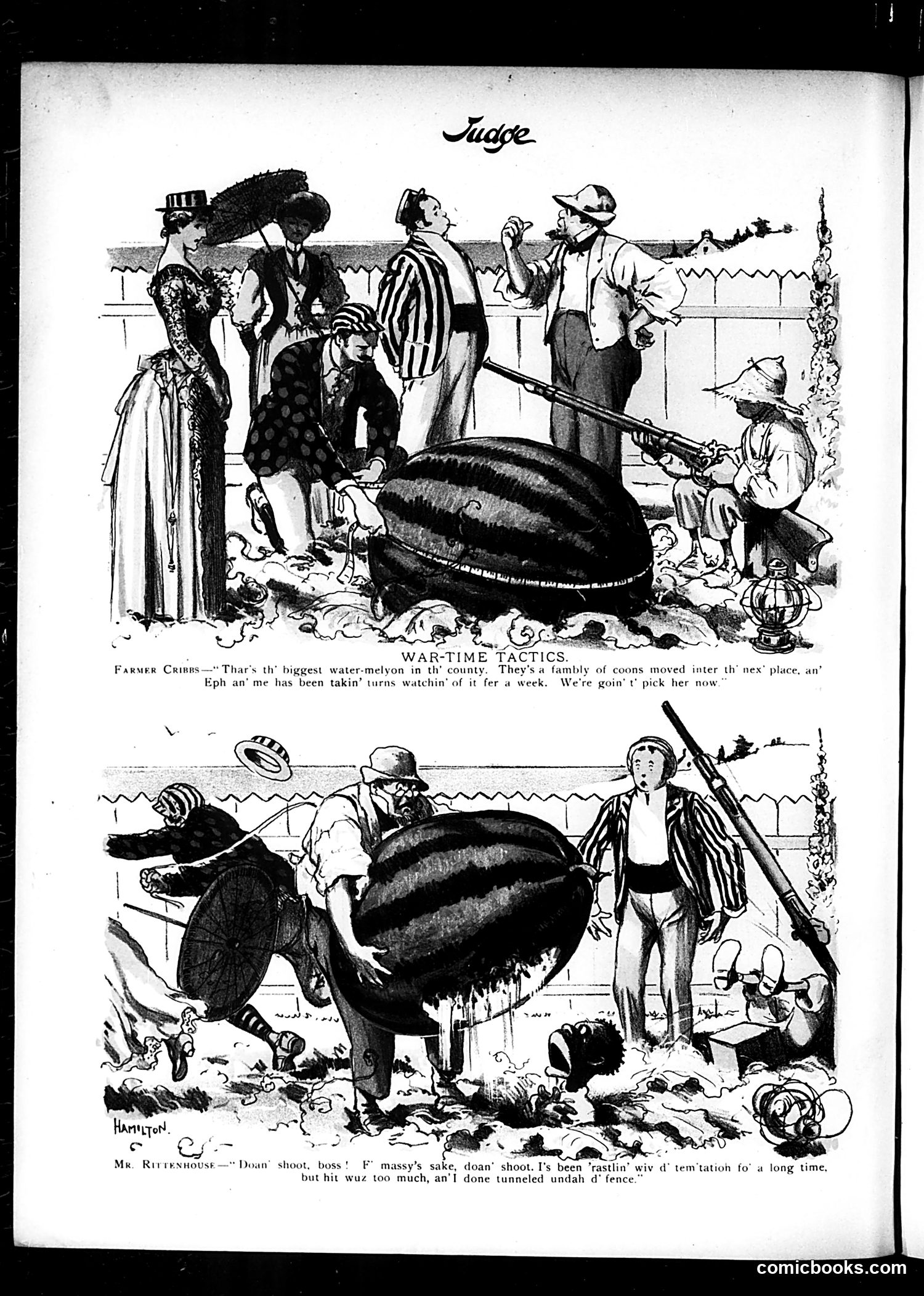
This Judge page contains two related cartoons using racist dialect and imagery to satirize wartime food shortages and rationing. Both depict white farmers guarding watermelons against Black people, using period slurs. The top panel shows a farmer explaining he and a neighbor have been taking turns watching their watermelon because a Black family moved nearby. The bottom panel depicts a Black man caught stealing, confessing he couldn't resist temptation and tunneled under the fence. The "war-time tactics" title suggests these are meant as humorous takes on scarcity and vigilance during wartime. The satire targets both the perceived threat to agricultural property and the depicted characters' inability to resist stealing—perpetuating deeply harmful racial stereotypes common in early 20th-century American humor publications. The content reflects the casual racism typical of Judge magazine during this era.