
A complete issue · 16 pages · 1890
Judge — May 3, 1890
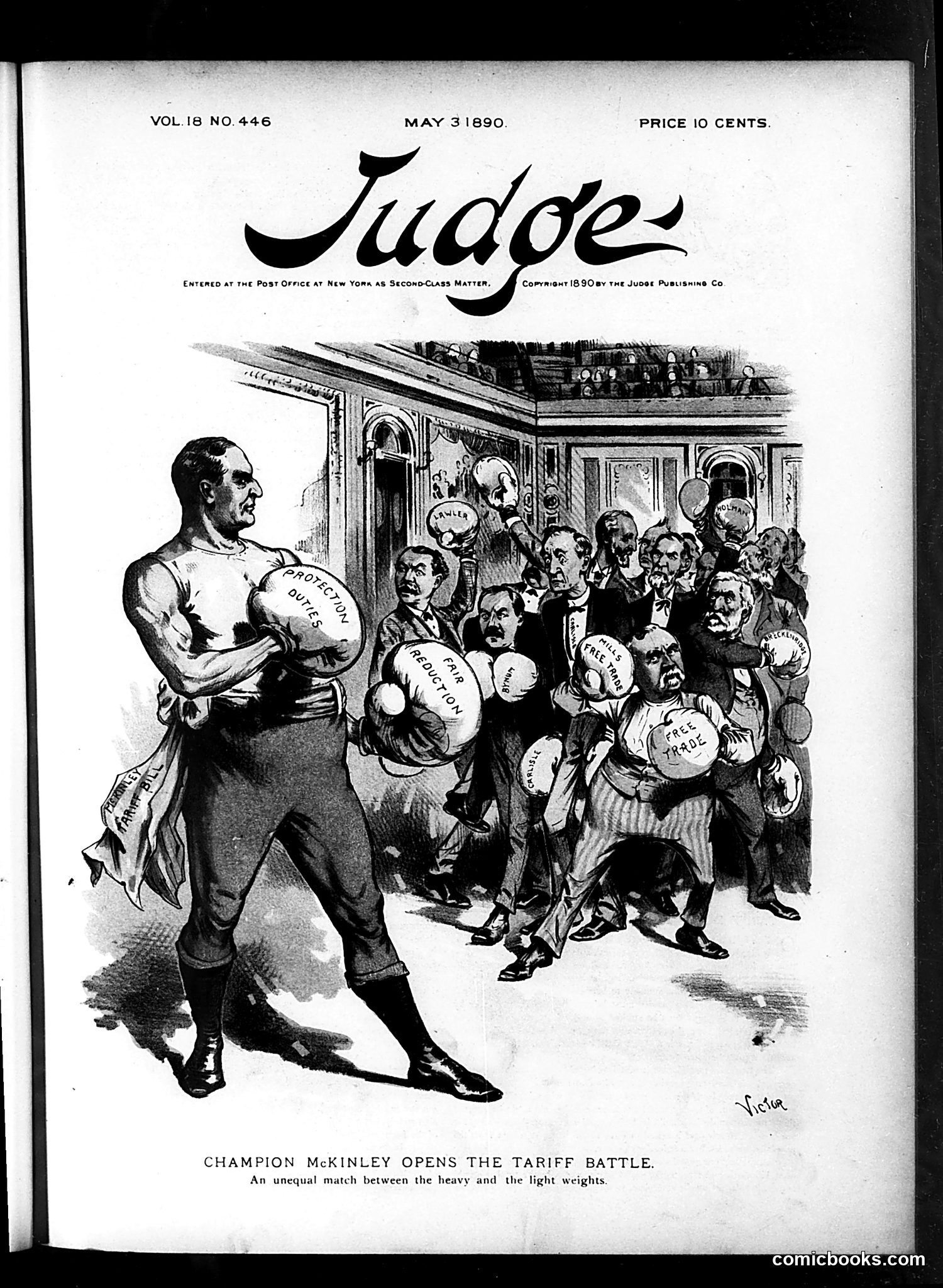
This 1890 Judge magazine cartoon satirizes President William McKinley's tariff policies through boxing metaphor. McKinley, depicted as a muscular boxer in fighting stance (left), confronts a crowd of smaller figures labeled as various interests—likely representing business sectors, labor groups, or political opponents concerned about tariff impacts. The caption describes it as "an unequal match between the heavy and the light weights," suggesting McKinley's administration wielded disproportionate power over fragmented opposition forces. The boxing imagery reflects how tariff debates were portrayed as direct political combat. This likely references McKinley's tariff agenda, which became central to his presidency and generated significant public controversy regarding protectionism versus free trade.
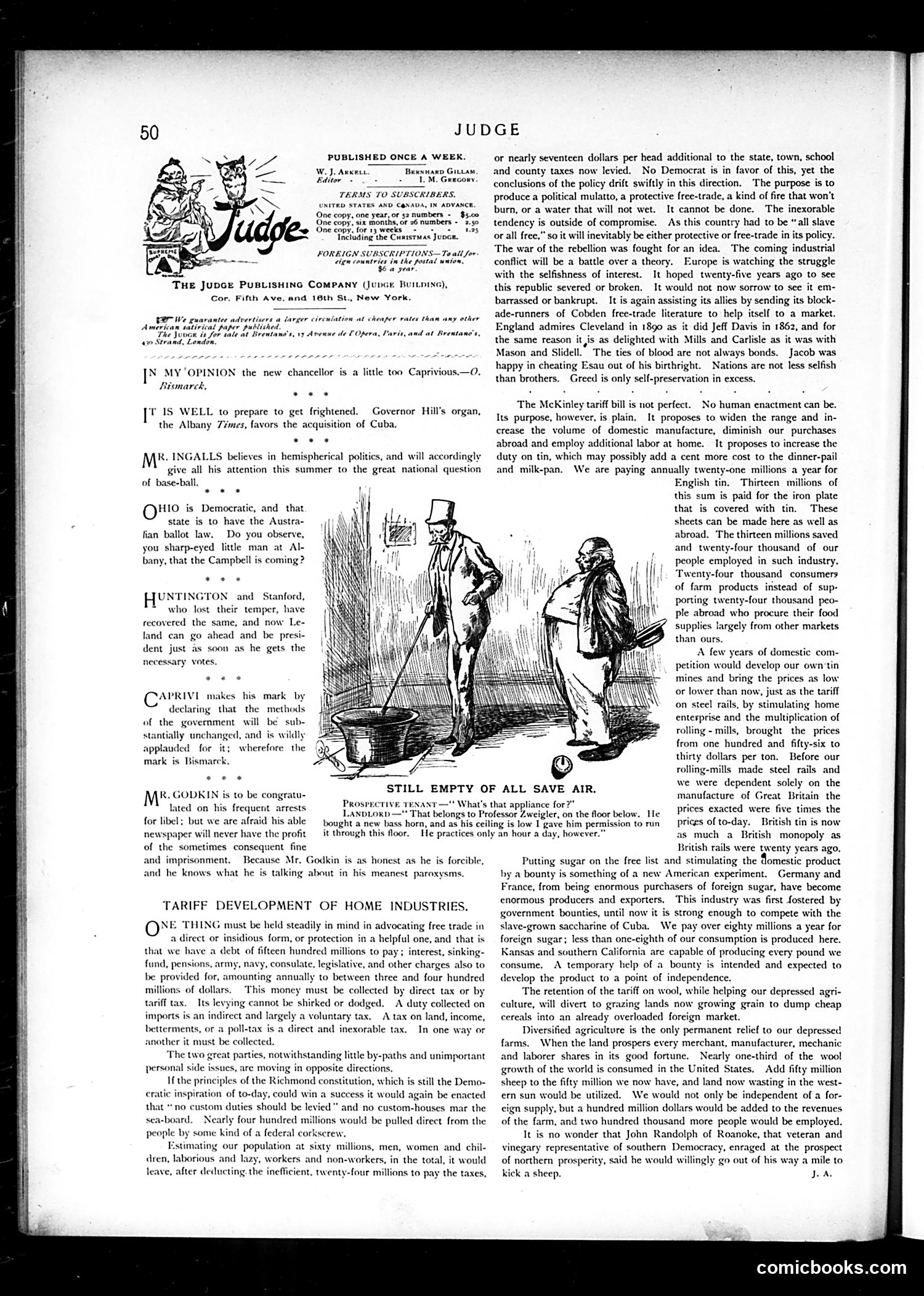
The main cartoon titled "STILL EMPTY OF ALL SAVE AIR" depicts a dialogue between a Landlord and Professor Ziegler about a worthless appliance. The landlord claims it belonged to a professor on the floor below who "gave him permission to use it" before leaving. The cartoon satirizes academic pretension and landlord-tenant disputes common in urban settings. The surrounding text discusses tariff policy and domestic industries, advocating protective tariffs for American manufacturing—particularly steel, tin, wool, and sugar production. The author argues tariffs would stimulate home enterprise, reduce foreign imports, and create employment across multiple sectors, directly challenging free-trade Democratic policies of the era. This reflects early 1900s protectionist economic debates.
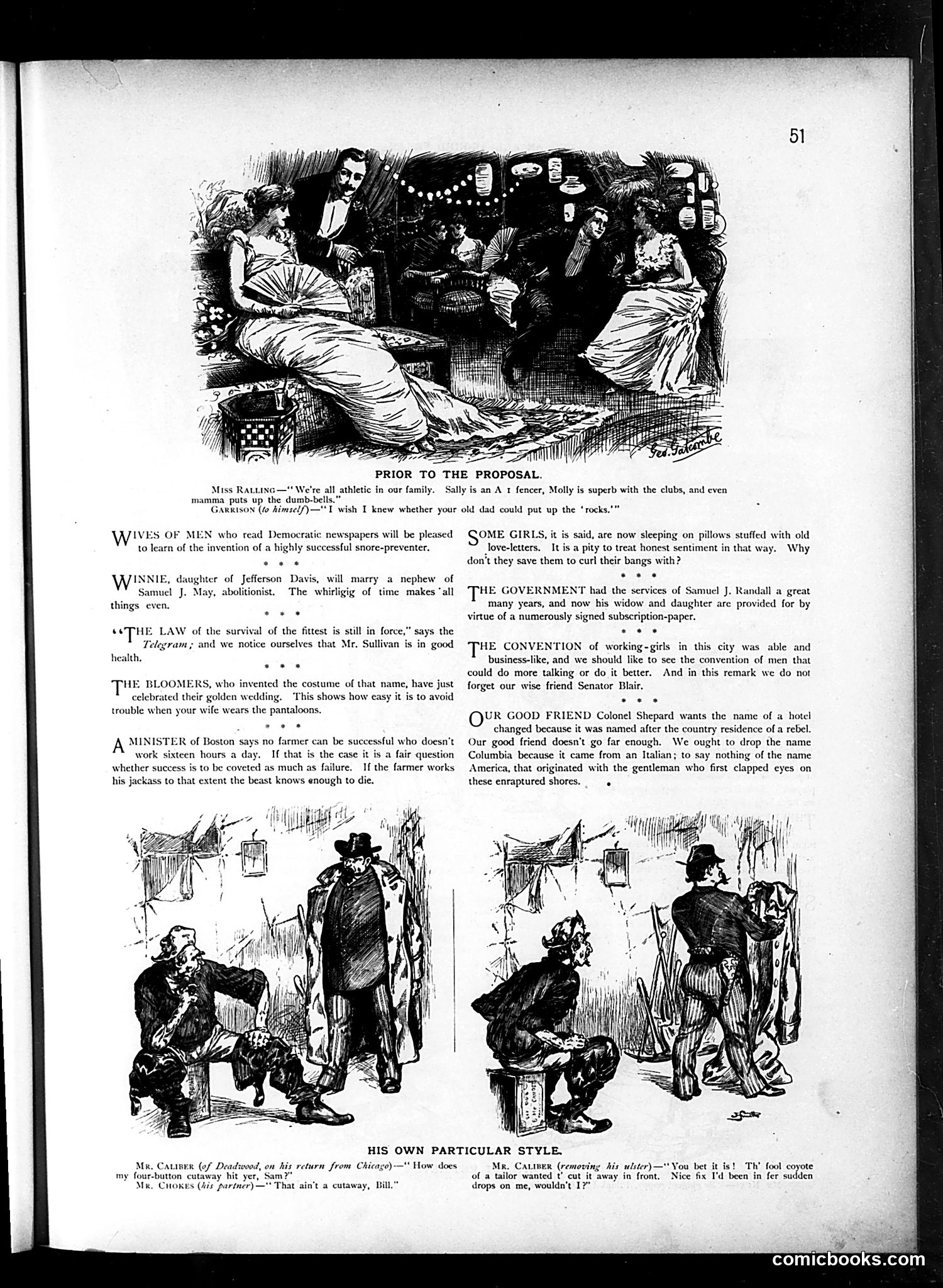
The top illustration, "Prior to the Proposal," depicts a wealthy social gathering where women discuss athletic pursuits and romantic sentiments, satirizing upper-class social conventions. The lower section, "His Own Particular Style," shows two separate street scenes featuring working-class men (Mr. Caliber and Mr. Chokes) in comedic interactions. The dialogue suggests class-based humor about fashion mishaps—one man's "four-button cutaway" coat malfunction and another's misunderstanding about a "cataway" garment. The intervening text discusses various social topics: Democratic newspaper readership, girls sleeping on love-letters, Samuel J. May (an abolitionist), survival of the fittest philosophy, women's costume conventions, and a hotel name change from "Columbia" to avoid Italian associations. Overall, the page blends high-society satire with working-class humor, typical of Judge's appeal to diverse American readers in its era.
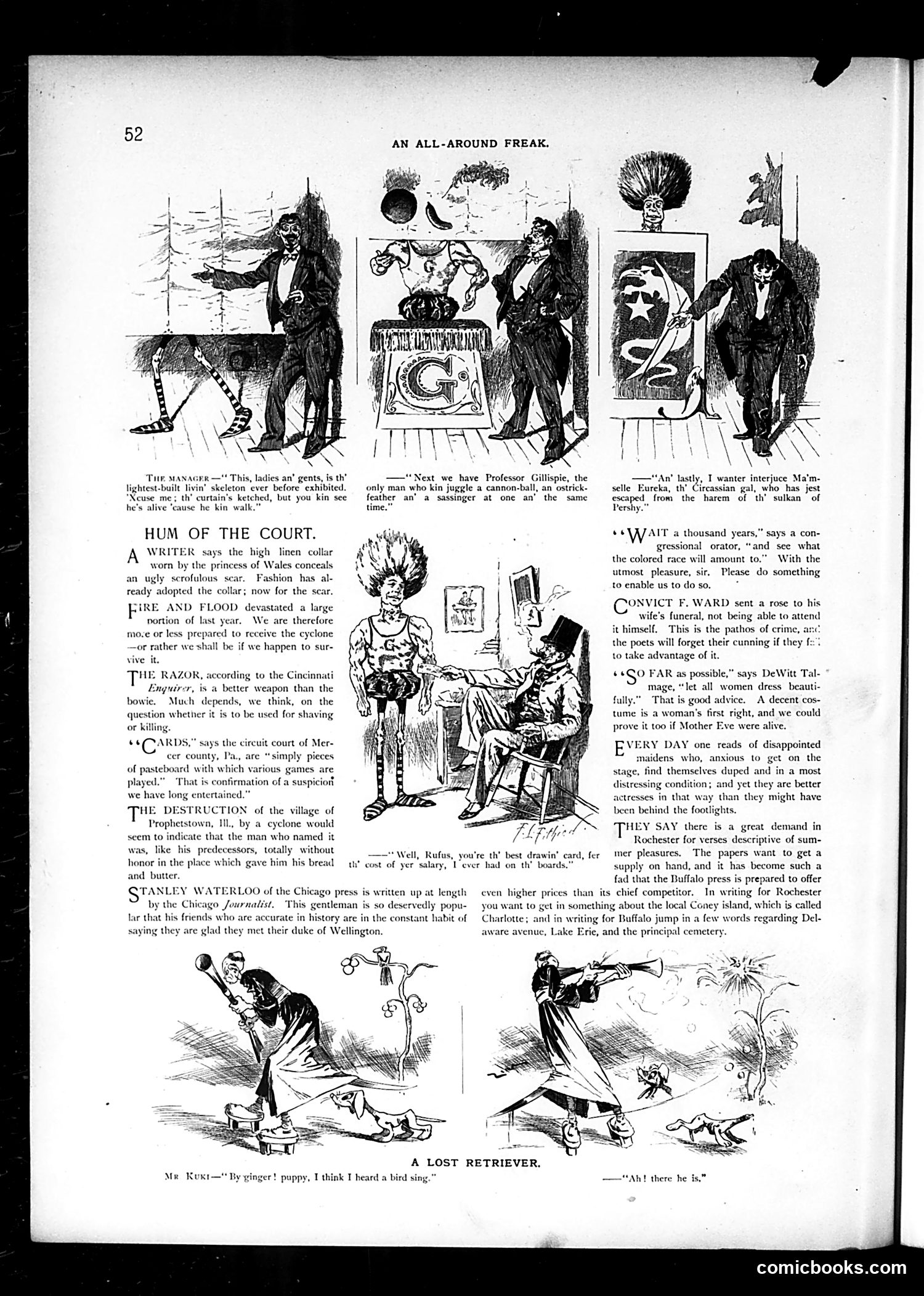
This page satirizes Victorian-era circus and variety show culture. The top section depicts a carnival barker presenting absurd "attractions": a skeleton that walks, Professor Gillispie juggling incompatible objects (cannonball, ostrich feather, sausage), and a "Circassian girl" escapee from a harem—exploitative exotica typical of 19th-century sideshows. The "Hum of the Court" section collects brief jokes about contemporary social absurdities: the Princess of Wales's high collar (allegedly hiding scars), cyclone destruction, playing cards, and razor safety. "A Lost Retriever" (bottom) shows a woman searching for her dog while holding a gun—likely mocking society women's incompetence or the tension between Victorian femininity and practical capability. The overall tone mocks both carnival exploitation and upper-class pretension, reflecting Judge's satirical approach to gilded-age American society.
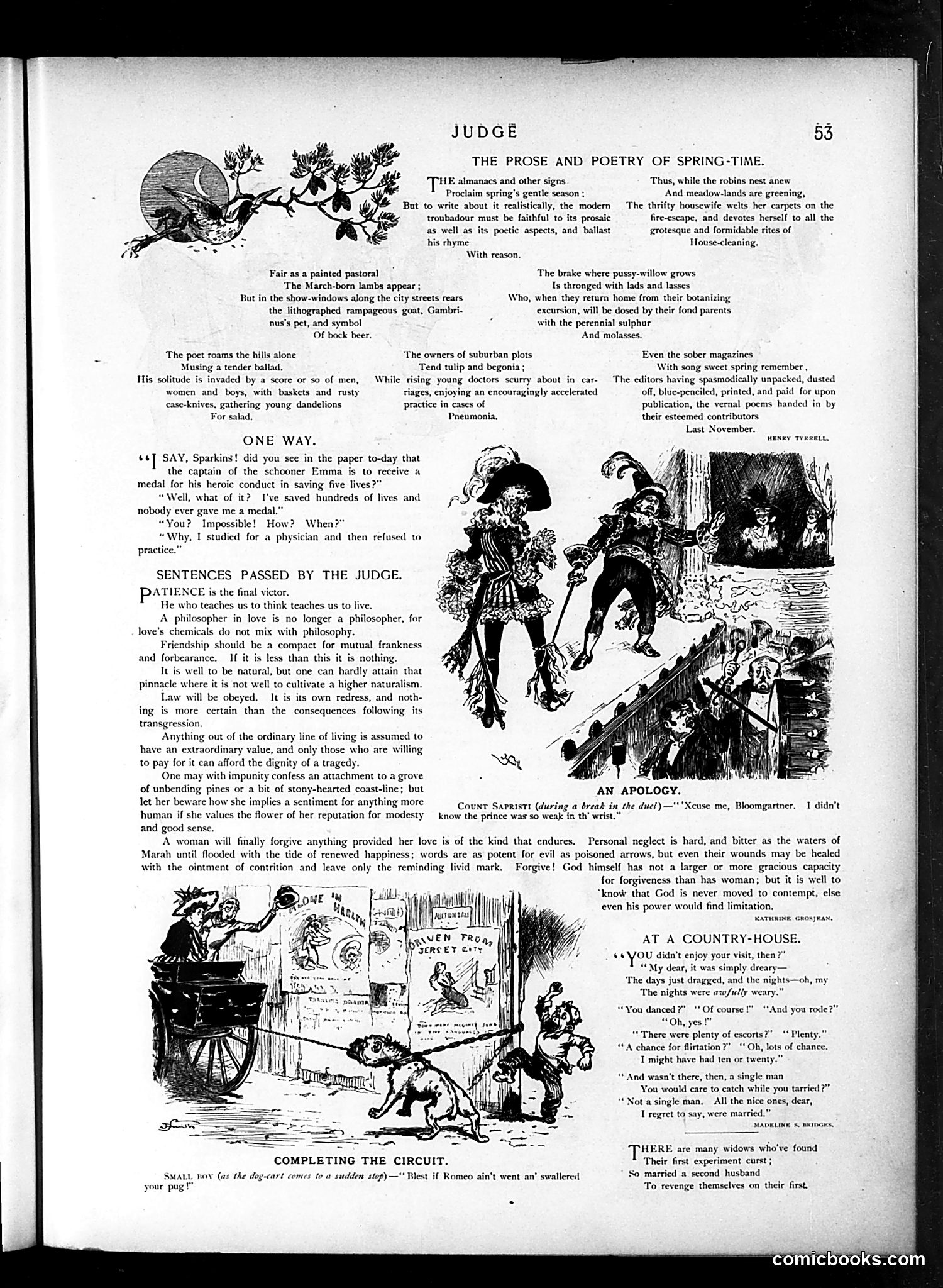
This page from Judge magazine combines satirical poetry and humorous anecdotes mocking spring-time sentimentality versus urban reality. **"The Prose and Poetry of Spring-Time"** parodies Romantic poetry by contrasting idealized pastoral images (lambs, poets in hills) with mundane realities: city goats symbolizing cheap beer, dandelion-picking for salad, suburban "culture," and women's obsessive spring house-cleaning. The satire undercuts flowery sentiment with deadpan practicality. **"One Way"** jokes about a physician who studied medicine but refused to practice—when told a ship captain received a medal for saving five lives, he claims he "saved hundreds" by refusing to treat pneumonia patients. The joke ridicules people who take unwarranted credit for inaction. **Brief anecdotes** and "Sentences by the Judge" offer moral aphorisms mixed with sharp observations about human nature (friendship, reputation, women's forgiveness). **Bottom cartoons** include slapstick humor: a child worrying a dog ate a pug, and a duellist interrupted by concerns about sword technique. The page exemplifies Judge's style: deflating earnest sentiment with shrewd, often cynical observation of American life.
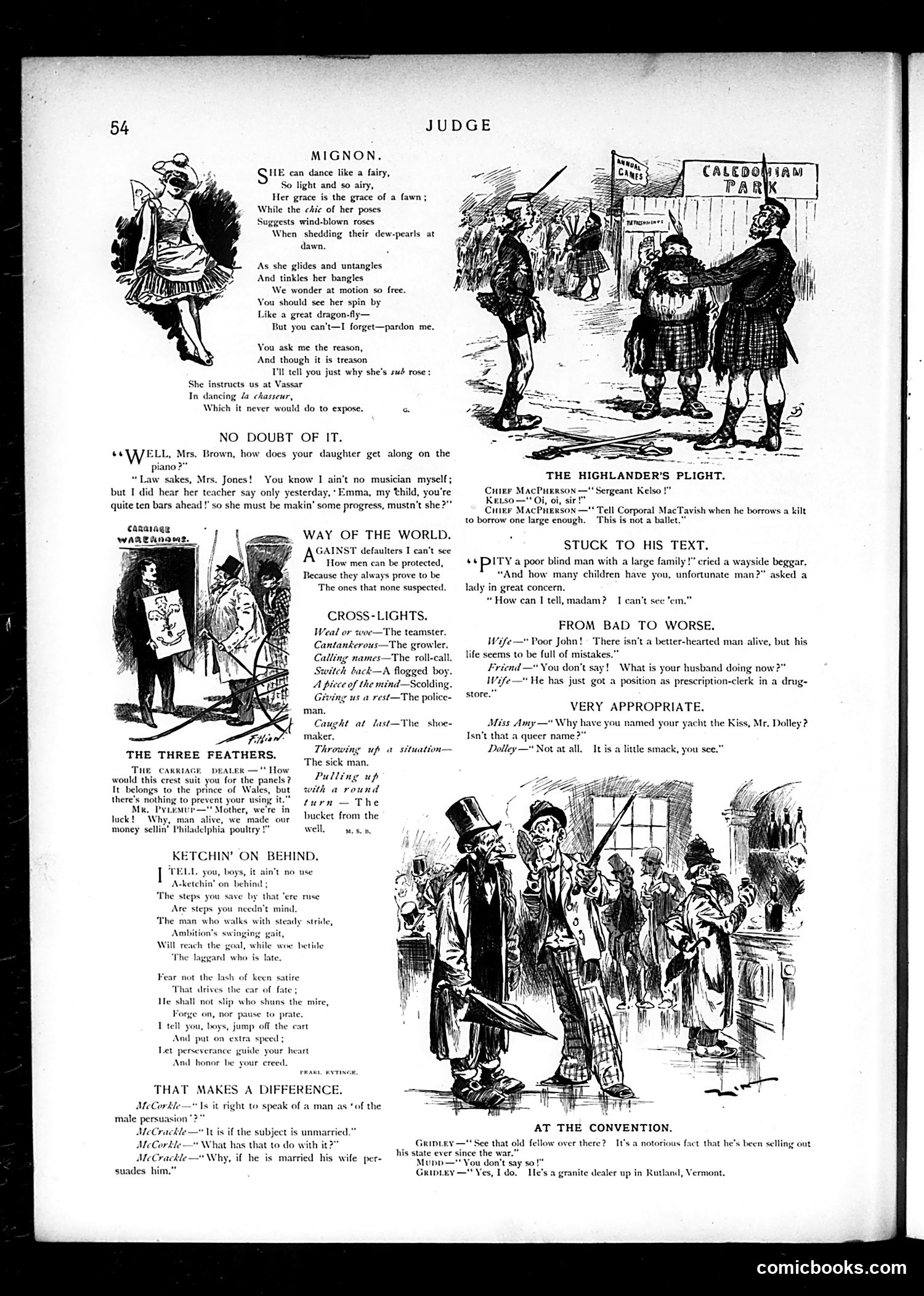
This page from *Judge* contains multiple satirical pieces typical of the publication's social humor circa the late 1800s. **"Mignon"** is a poem mocking an affected woman who teaches dancing at Vassar College—the satire suggests her pretentious French affectations ("la chasseur") mask ordinary abilities. **"The Three Feathers"** jokes about nouveau riche parvenus (the "Philadelphia poultry" dealers) attempting to adopt aristocratic heraldry, satirizing social climbing. **"The Highlander's Plight"** depicts Scottish soldiers (Highlanders) dealing with bureaucratic confusion—a sergeant must tell a corporal his borrowed kilt is unsuitable for a "ballet," poking fun at military absurdity. **"Stuck to His Text"** is a simple joke about a blind beggar claiming he cannot count his children because he cannot see them. Other brief gags target common targets: pretentious piano playing, social pretension, political corruption ("granite dealer" as euphemism for graft), and marital disappointment. The overall tone is lighthearted social commentary on American manners, class aspiration, and domestic life rather than partisan politics.
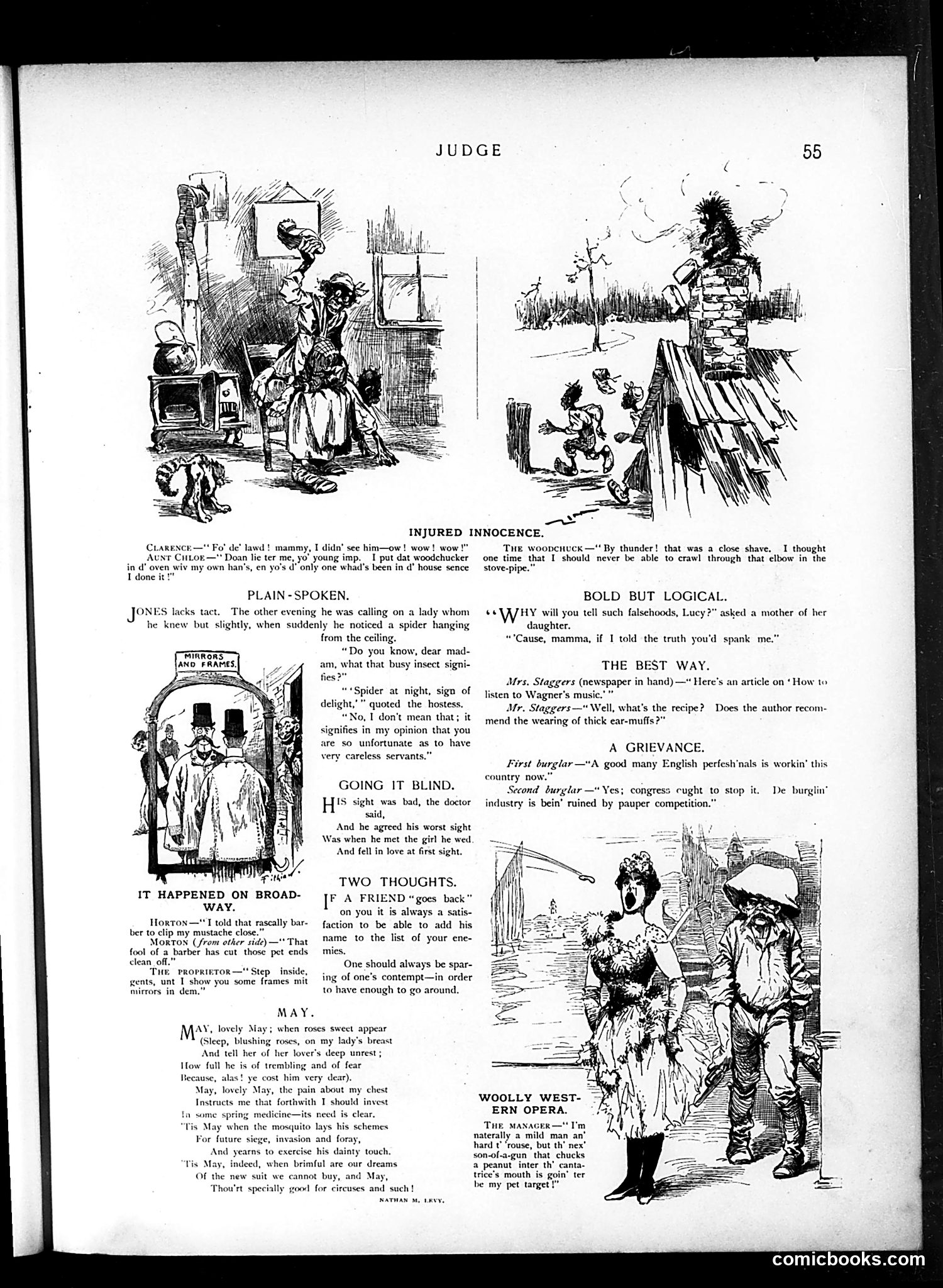
This page from Judge contains multiple short humorous sketches typical of late-19th/early-20th-century American satire: **"Injured Innocence"** depicts a racist caricature of an African American child caught red-handed near a woodchuck that disappeared from the oven—reflecting the period's crude ethnic humor. **"Plain-Spoken"** and other brief anecdotes mock social awkwardness and tactlessness among the middle class. **"Going It Blind"** plays on a doctor's poor eyesight and ironic bad judgment about romance. The poems about "May" and miscellaneous quips satirize spring complaints, courtship anxieties, and minor grievances. **"Woolly Western Opera"** features crude Western stereotypes with a manager boasting about violently silencing opera singers—satire of both rough frontier culture and opera's perceived pretentiousness. The page reflects Judge's formula: quick gags targeting immigrants, ethnic groups, social pretension, and everyday annoyances through caricature and wordplay.
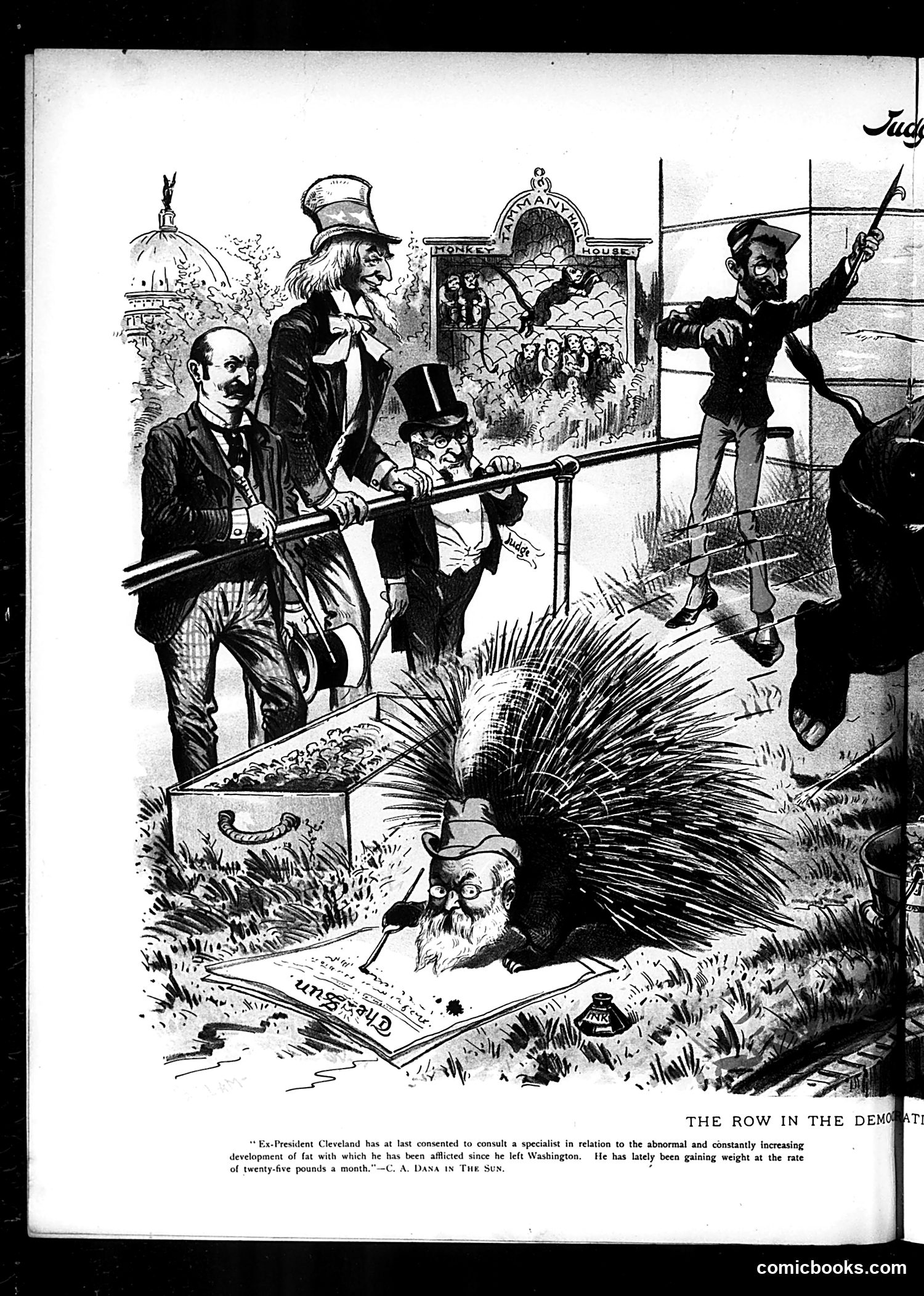
This political cartoon mocks former President Grover Cleveland's weight gain after leaving office. The caption, attributed to newspaper editor C.A. Dana, reports Cleveland consulting a specialist about gaining twenty-five pounds monthly. The cartoon depicts Cleveland as a large porcupine or spiky creature being prodded by Democratic Party figures with bayonets and poles—suggesting internal party conflict over his physical condition or, more likely, his post-presidential role and influence. The "row" (quarrel) appears to reference Democratic infighting. The satire plays on Cleveland's changed appearance and suggests the party is literally attacking or rejecting him. The visual metaphor conflates his literal weight gain with political weight or liability to the party. This reflects late 19th-century *Judge* magazine's Republican leanings and its mockery of prominent Democrats.
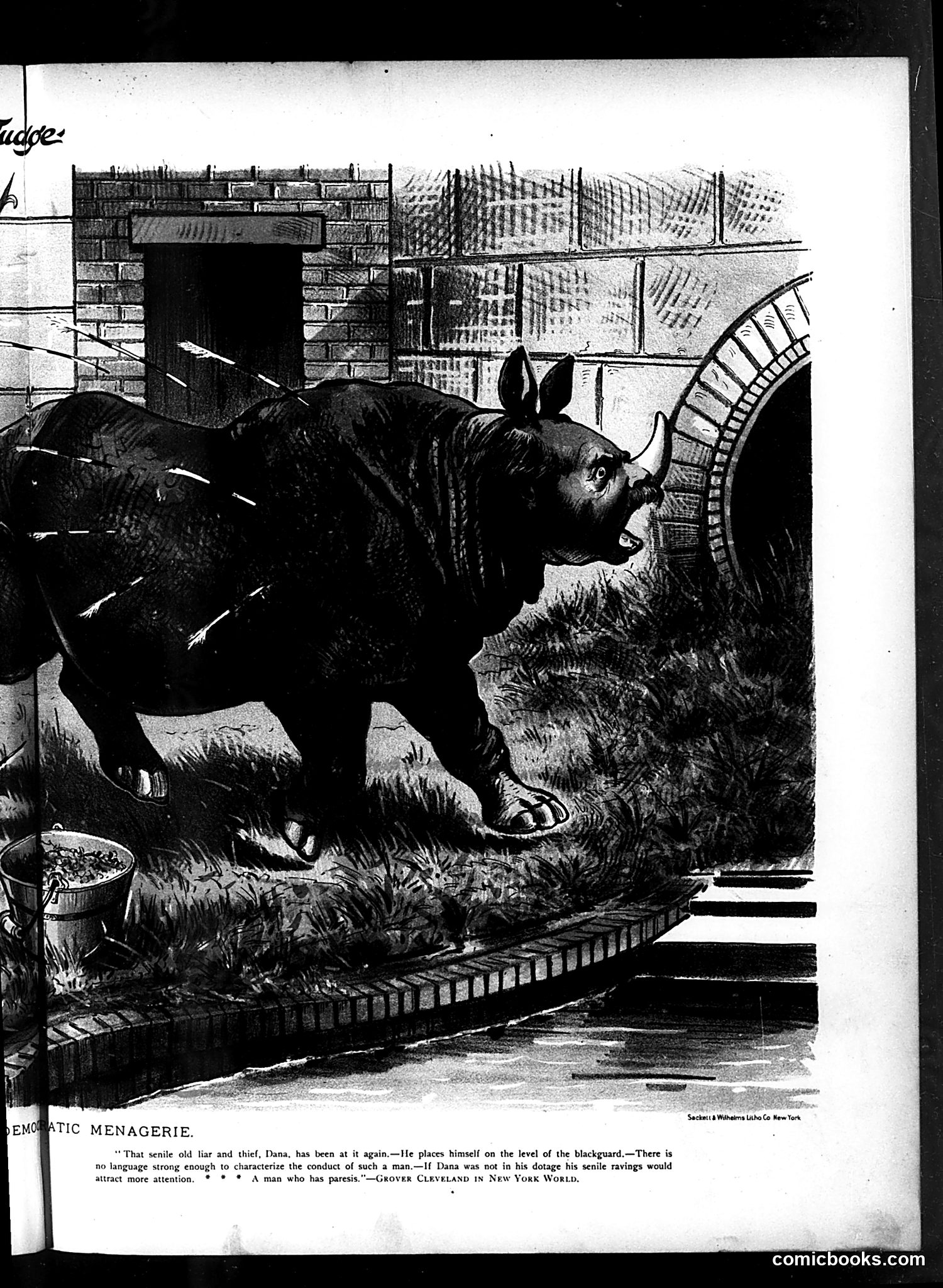
This political cartoon satirizes a feud between Democratic figures, likely from the 1880s-90s. The image depicts two animals (appearing to be a rhinoceros and a goat or similar creature) fighting or confronting each other in a barnyard setting—a visual metaphor for infighting within the Democratic Party. The caption attributes vicious insults to Grover Cleveland (the sitting president), calling someone named Dana "a senile old liar and thief" and questioning his mental fitness ("dotage," "paresis"—a disease affecting cognition). "Dana" likely refers to Charles A. Dana, editor of the New York Sun, a political opponent. The "menagerie" title and animal depiction mock Democratic leaders as behaving like barnyard beasts rather than statesmen. The cartoon criticizes the party's internal discord and Cleveland's undignified public attacks on critics.
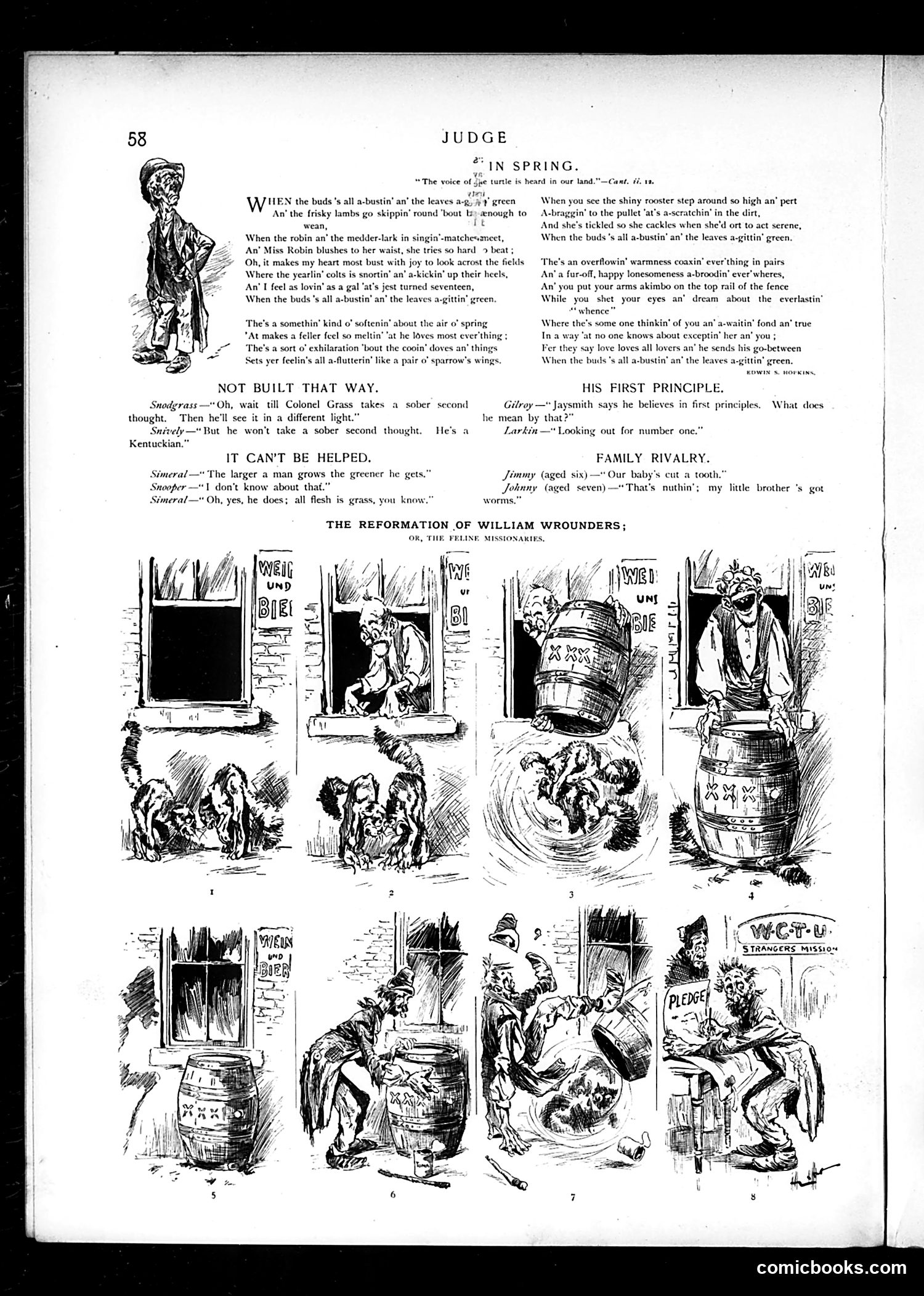
This page contains humorous verse and comic strips from *Judge* magazine. The top section features sentimental spring poetry celebrating nature's renewal and romantic feelings—traditional pastoral humor mocking overly flowery sentimentality. Below are brief dialogue jokes: "Not Built That Way" jokes that Colonel Grass won't reconsider his views; "It Can't Be Helped" plays on the phrase "all flesh is grass"; "His First Principle" satirizes someone claiming to believe in high ideals while actually pursuing self-interest ("number one"). The main feature, "The Reformation of William Wrounders; or, The Feline Missionaries," is an 8-panel comic strip (unclear from this image alone what the full narrative is) depicting cats in various situations with barrels or containers, suggesting some kind of transformation or moral story—likely satirizing both cats' behavior and reform movements of the era. The bottom includes brief family humor about children's competitive boasting.
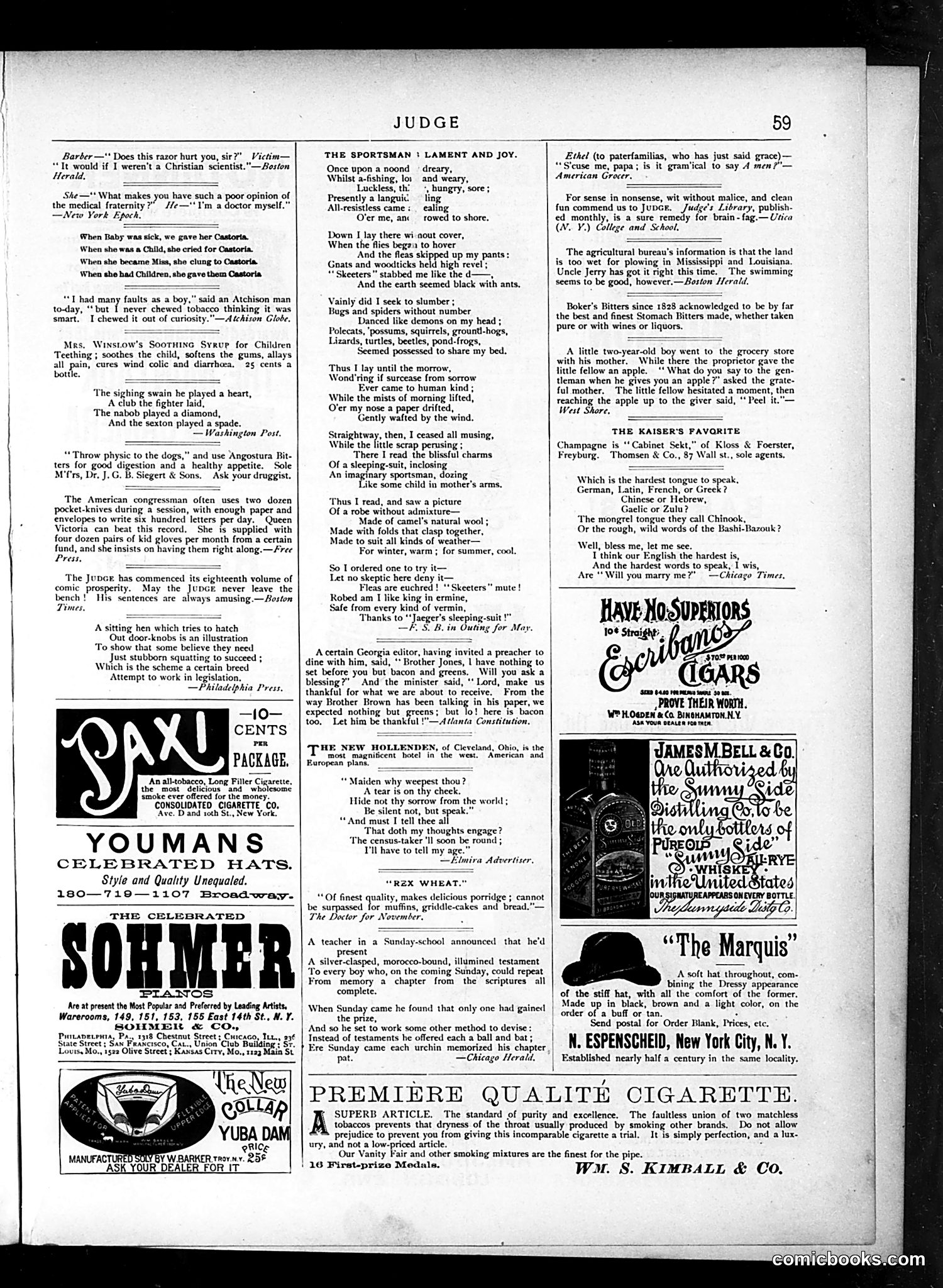
This page contains primarily **advertising and light humor** rather than political satire. The main content includes: **Humorous Quips:** - A Christian Scientist barber joke (medical skepticism) - Doctor self-deprecation jokes - A congressman's excessive use of pocket-knives (legislative inefficiency) - A sitting hen trying to hatch doorknobs as metaphor for stubborn legislative attempts **The Sportsman's Lament and Joy:** A mock-Poe poem about a fisherman's miserable night camping—harassed by insects, animals, and discomfort—until he reads an advertisement for a sleeping suit featuring a man peacefully resting. The satire mocks both outdoor hardship and advertising's exaggerated promises. **Numerous Product Advertisements:** Castoria (children's medicine), razor blades, piano makers, hats, cigars, and whiskey—typical of Judge's revenue model. The page reflects late 19th-century consumer culture and gentle satire of medical quackery and advertising excess, rather than sharp political commentary.
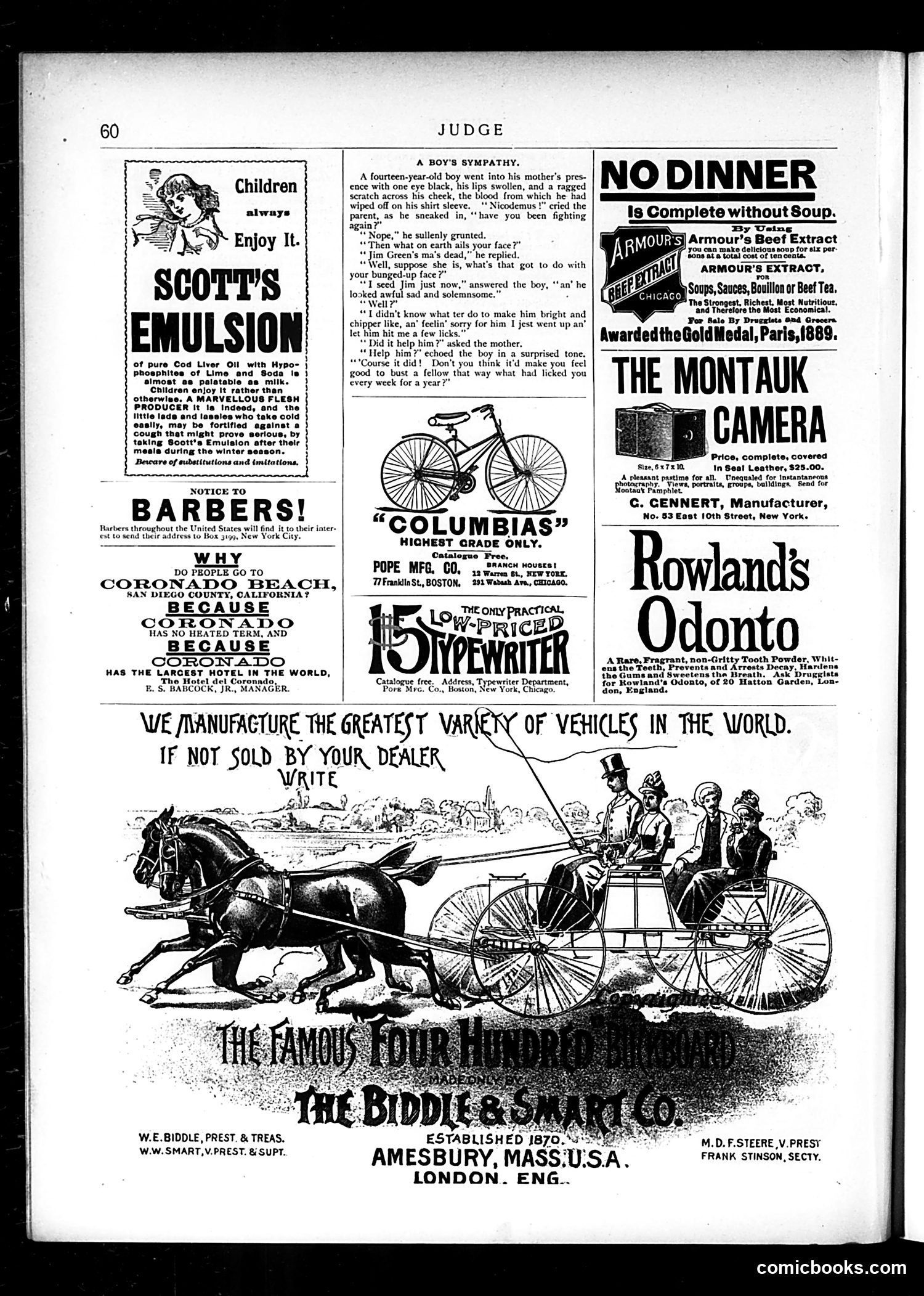
This page is primarily **advertising**, not political satire. It showcases late-19th century consumer products and services typical of Judge magazine's revenue model. The one notable editorial piece is "A Boy's Sympathy"—a sentimental anecdote about a fourteen-year-old boy who fights his friend Jim Green to cheer him up after Jim's mother dies. The boy reasons that violence might improve Jim's mood. This appears to be gentle social commentary on boyish logic and misguided attempts at friendship, though it reads more as sentimental humor than sharp satire. The advertisements reflect period concerns: Scott's Emulsion (cod liver oil tonic), Coronado Beach resort, bicycles, typewriters, and tooth powder. The large vehicle advertisement at bottom features a horse-drawn carriage, suggesting early automobile-era competition. No identifiable political figures or specific events are referenced. The page demonstrates Judge's dual nature as both satirical publication and advertising vehicle for emerging consumer brands.
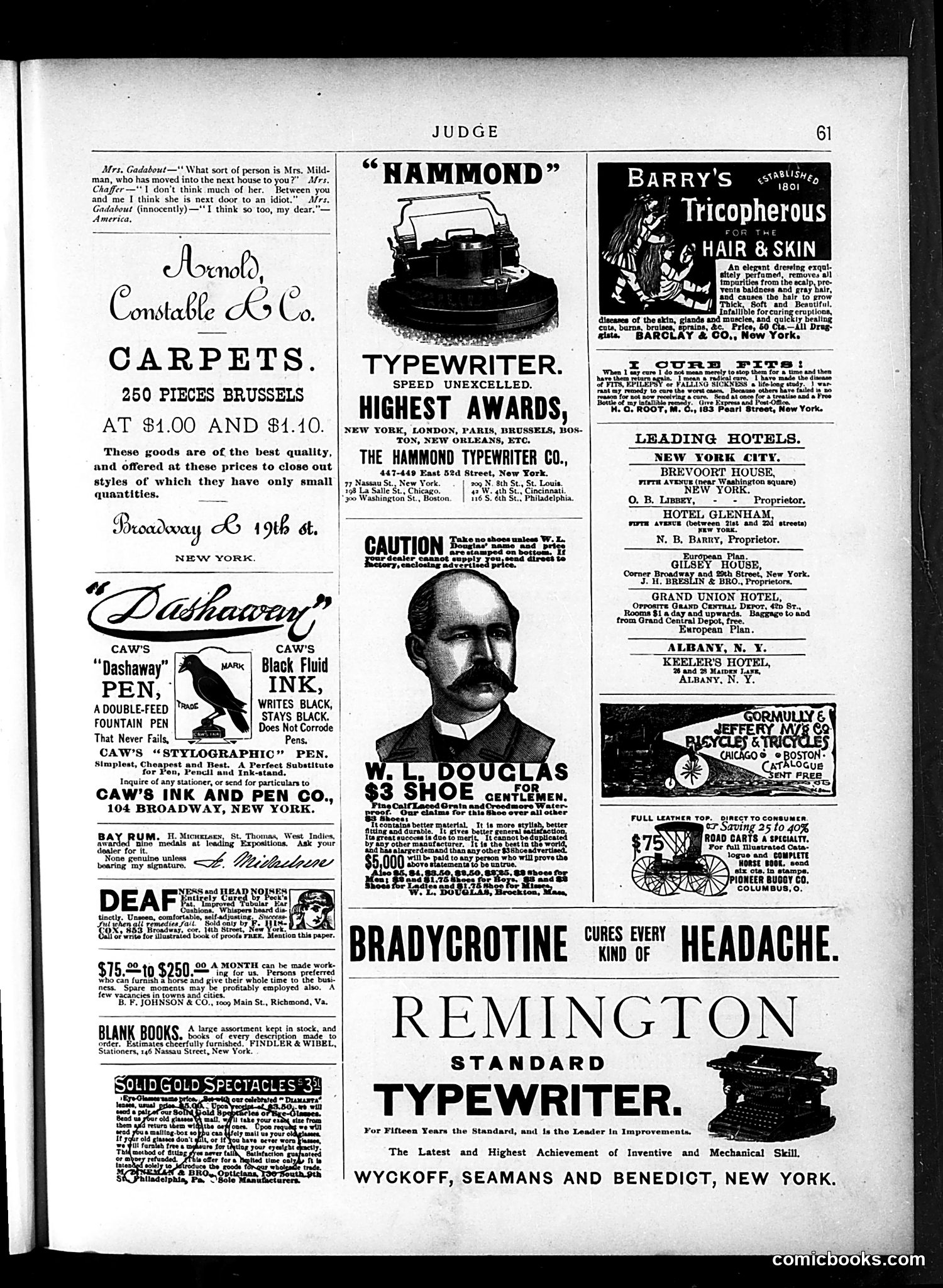
This is primarily an **advertising page**, not a satirical cartoon section. The page contains commercial advertisements for late 19th-century products and services typical of Judge magazine's revenue model. The only joke content is a brief exchange at the top between Mrs. Gadabout and Mrs. Chaffer, where Chaffer makes a cutting remark that her neighbor is "next door to an idiot." Gadabout innocently replies she agrees—the humor lies in the phrase "next door to" being interpreted literally (the neighbor lives next door) rather than as an idiom (almost an idiot). The rest showcases typewriters (Hammond, Remington), shoes, pens, carpets, hotel advertisements, and patent medicines like "Bradycrotine" (promising headache cures—typical of dubious medicinal claims of the era). These ads reveal consumer culture and commercial practices of the period, but contain no political or satirical content worth analyzing.
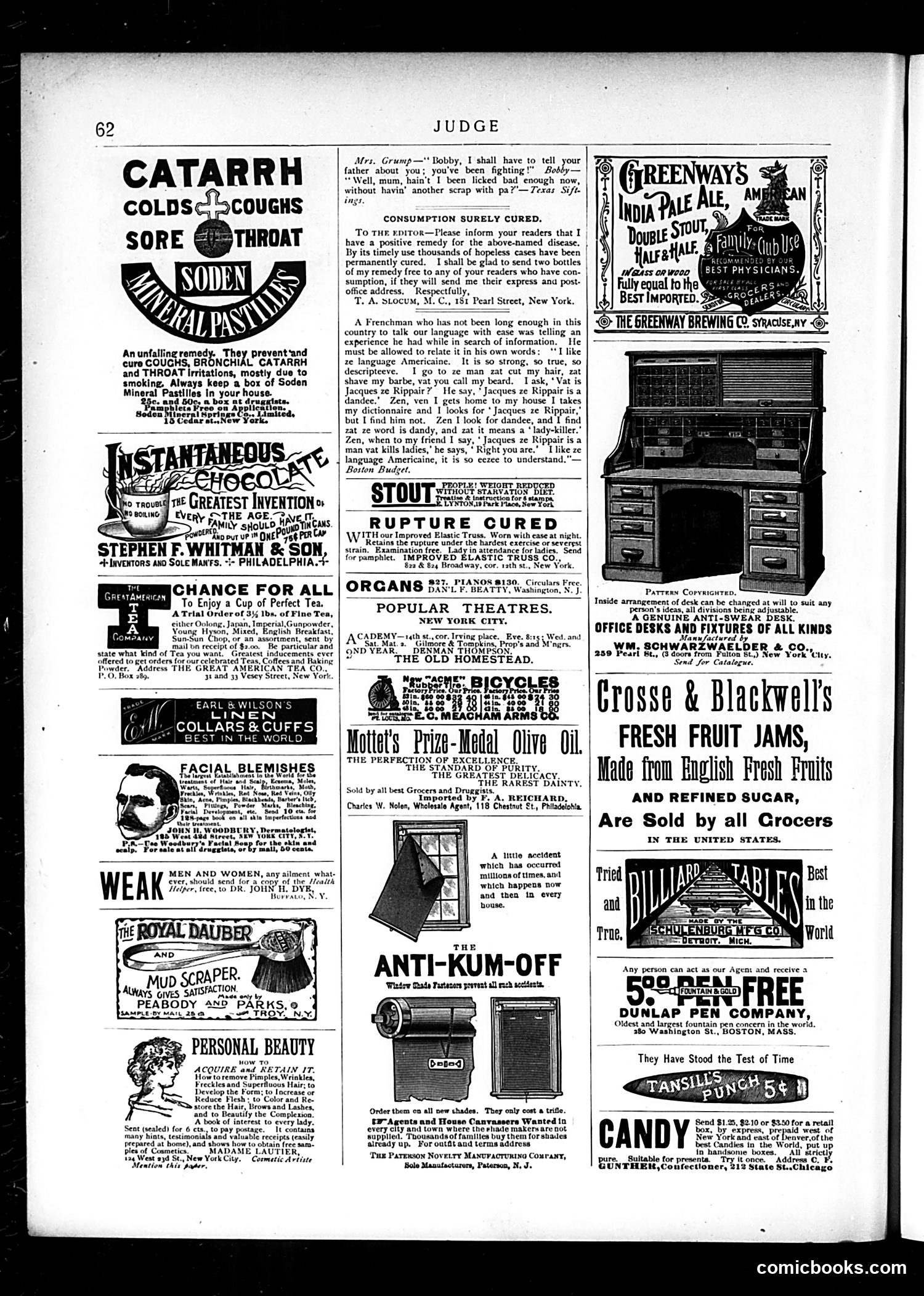
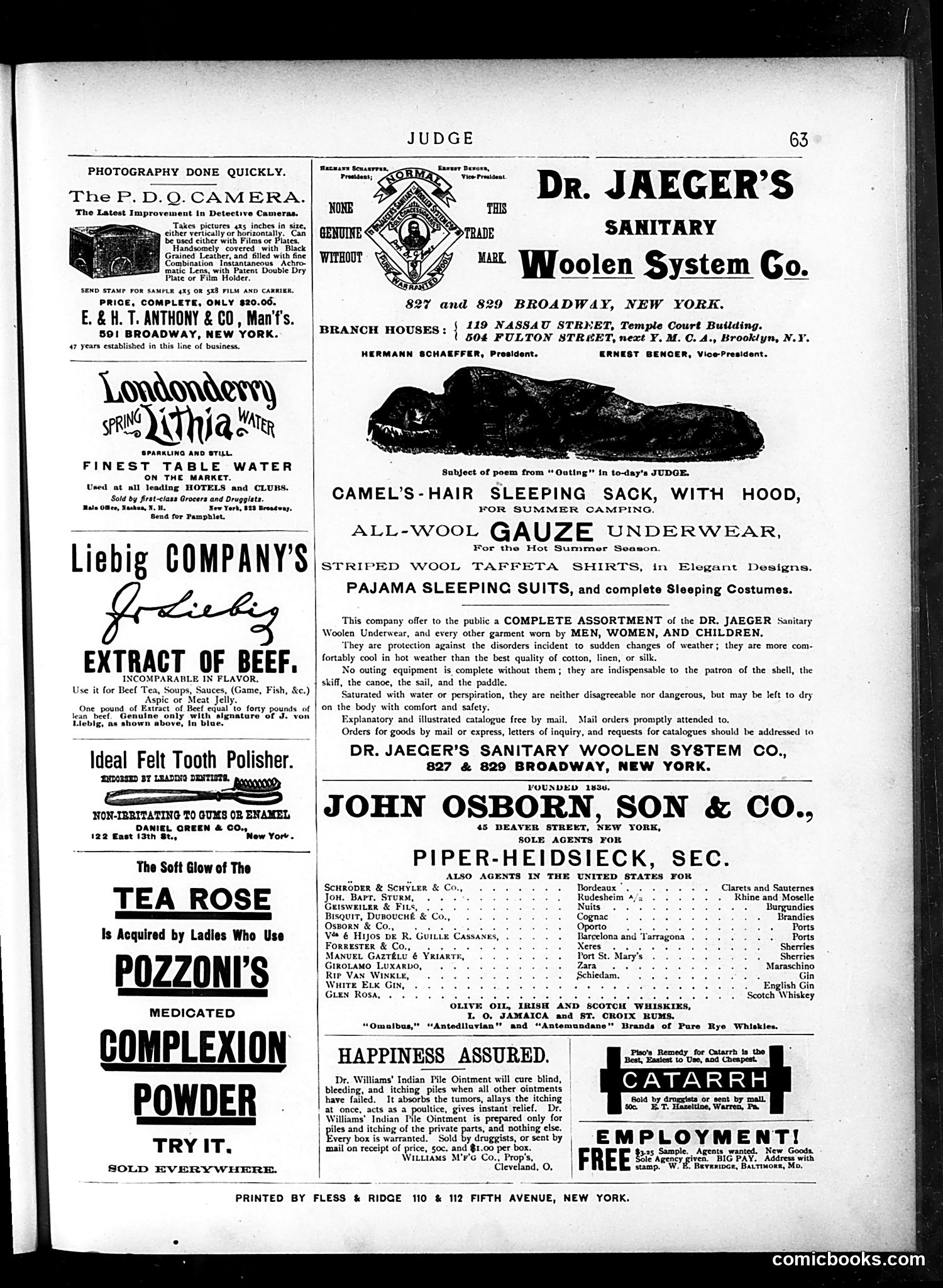
This page is primarily **advertising**, not satirical content. Judge magazine uses it to showcase commercial products and services from the 1890s-early 1900s era. The advertisements reflect period consumer interests: photography equipment (the P.D.O. Camera), bottled water, beef extract, tooth polish, and complexion powder. Notably, **Dr. Jaeger's Sanitary Woolen System** dominates the center—a major pitch for wool underwear and camping gear marketed as health-protective clothing for "sudden changes of weather" and outdoor activities. The lower half features **John Osborn, Son & Co.**, wine and spirits merchants listing imported European products (champagne, cognac, German wines, whiskies). At the very bottom, a **medical advertisement for Dr. Williams' Indian Pile Ointment**—a hemorrhoid treatment—exemplifies the patent medicines Judge's audience regularly encountered. There are **no political cartoons visible**. The "subject of poem from 'Outing'" reference suggests related editorial content elsewhere in the issue, but this page functions purely as revenue-generating classified advertising, typical of late 19th-century magazines.
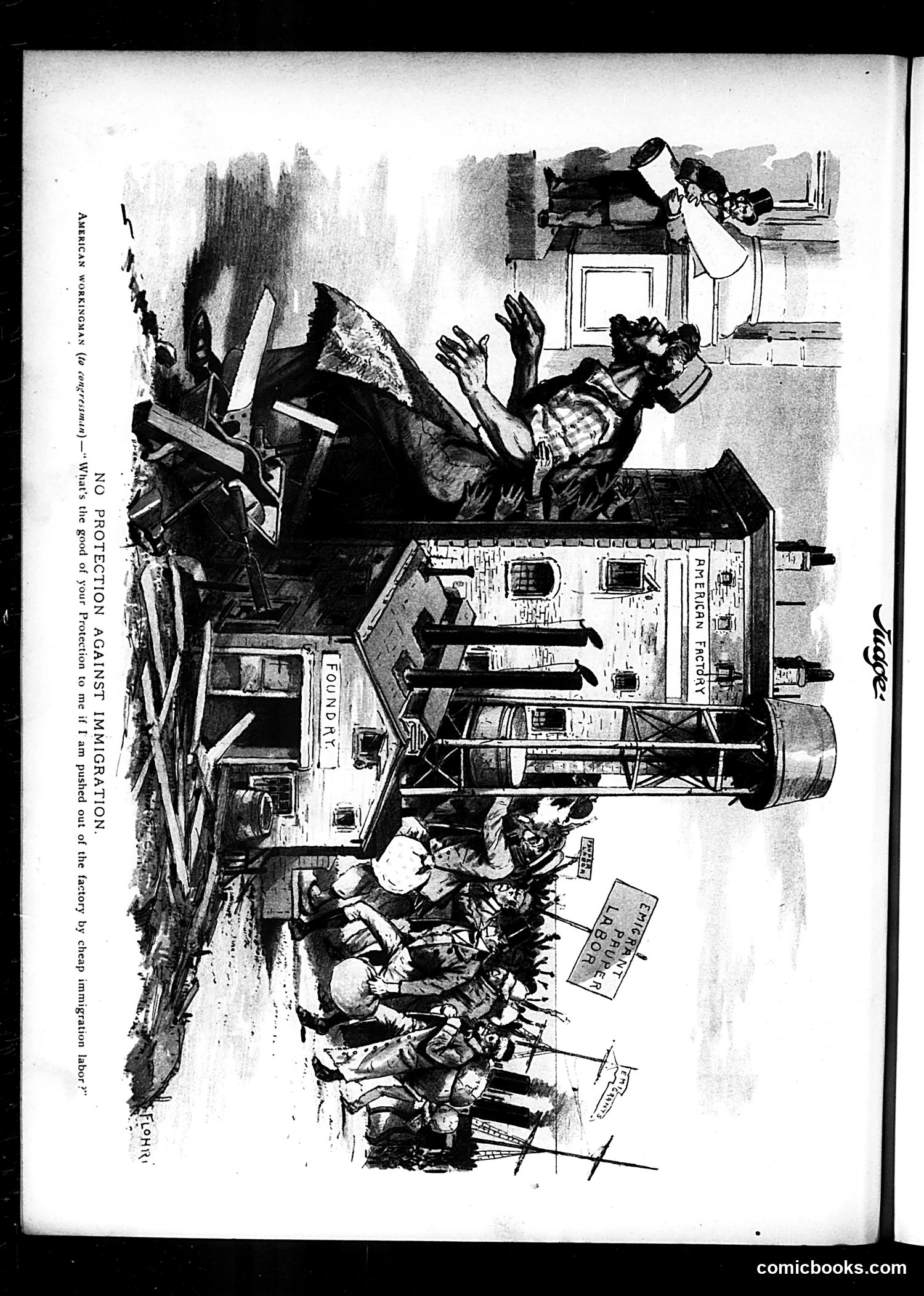
This Judge magazine cartoon critiques American protectionist trade policy as inadequate for working-class interests. An American workingman confronts a congressman, arguing that protective tariffs—designed to shield domestic industry from foreign competition—fail to protect *him* from cheap immigrant labor undercutting wages. The satire targets the contradiction in late-19th/early-20th-century Republican protectionist rhetoric: while tariffs purportedly defended American workers and industry, they did nothing to restrict immigration, which flooded labor markets and depressed wages. The cartoon suggests that without immigration restrictions, trade protection remains hollow—workers still lose jobs to employers seeking cheaper labor, regardless of tariff walls. This reflects the era's growing tension between pro-business Republicans and working-class constituencies over immigration policy.