
Judge, 1890-05-03 · page 2 of 16
Judge — May 3, 1890 — page 2: what you’re looking at
What you’re looking at
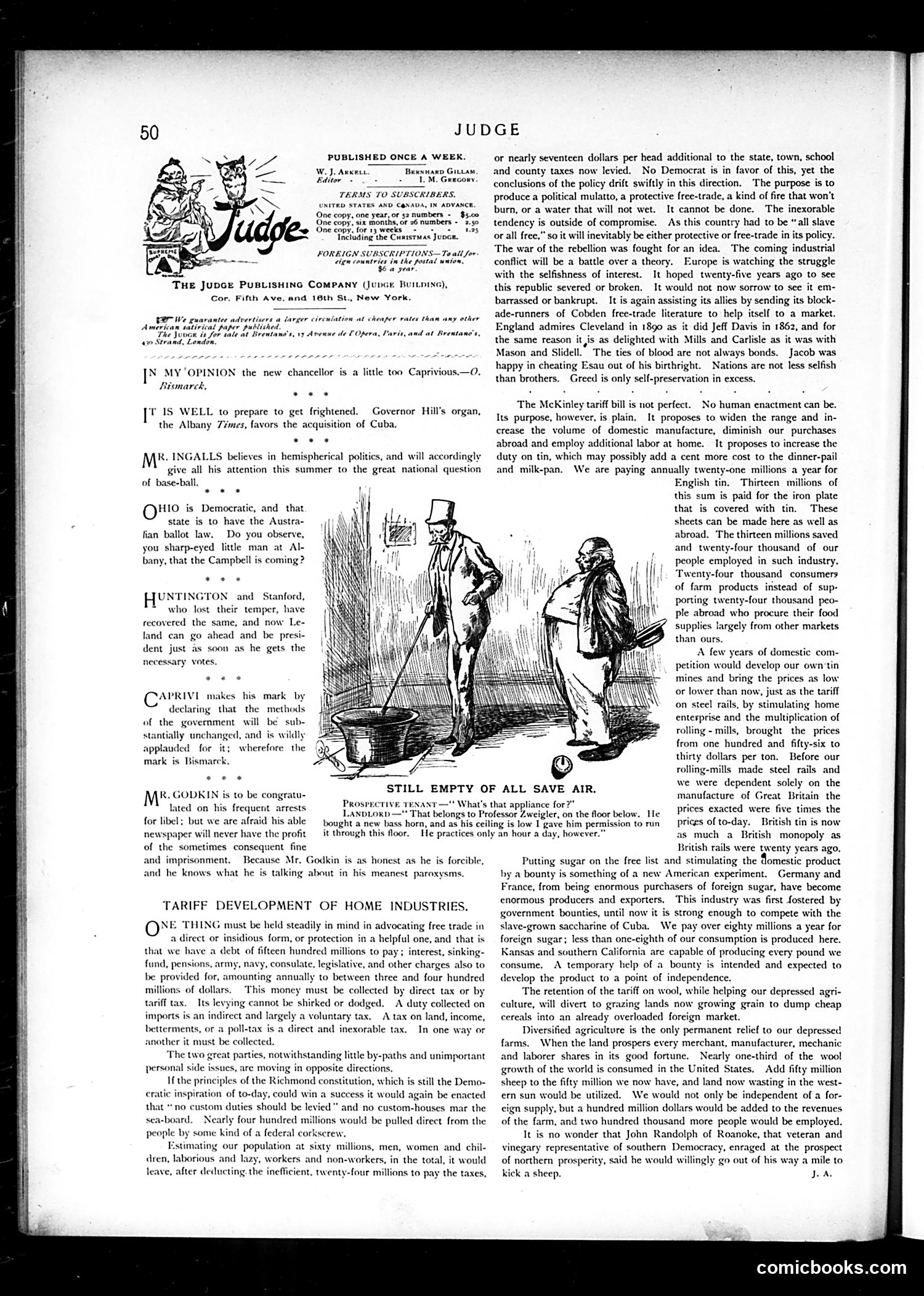
The main cartoon titled "STILL EMPTY OF ALL SAVE AIR" depicts a dialogue between a Landlord and Professor Ziegler about a worthless appliance. The landlord claims it belonged to a professor on the floor below who "gave him permission to use it" before leaving. The cartoon satirizes academic pretension and landlord-tenant disputes common in urban settings. The surrounding text discusses tariff policy and domestic industries, advocating protective tariffs for American manufacturing—particularly steel, tin, wool, and sugar production. The author argues tariffs would stimulate home enterprise, reduce foreign imports, and create employment across multiple sectors, directly challenging free-trade Democratic policies of the era. This reflects early 1900s protectionist economic debates.
📄 Transcribed text from this page (OCR, searchable)
Machine-transcribed from the original scan — historical spelling and the odd misread are preserved.
JUDGE PUBLISHED ONCE A WEEK. W. J. Avene rs Braxnarn Gittas. TERMS TO SUBSCRIBERS. UNITRD STATES AND C@NADA, IN. ADVANCE, One copy, one year, or s2 numbers One copy, six months, or 26 numbers One copy. for 13 weeks + = Including the Cweiststas June FOREIGN SUBSCRIPTIONS—To all for ign countries im the postal union $6 @ year THE JUDGE PUBLISHING ComPANY (JupcE ButLpr Cor. Fifth Ave. and 16th St, New York. “nk We suarantes adverts a mericam satirical paper ys The Juice tegot onte at Brentane's, 17 Avenue de POpera ao Strand, London, larger circulation at cheaper rates than any other rit, and at Brentane N MY‘OPINION the new chancellor is a little too Caprivious.—O. ismarck, [1S WELL to prepare to get frightened. Governor Hill's organ, the Albany 7émes, favors the acquisition of Cuba. R. INGALLS believes in hemispherical politics, and will according! give all his attention this summer to the great national question of base-ball. HIO is Democratic, and that state is to have the Austra fan ballot law. Do you observe, you sharp-eyed little man at Al- bany, that the Campbell is coming? NTINGTON and Stanford, who lost their temper, have recovered the same, and now Le- land can go ahead and be presi- dent just as soon as he gets the necessary votes. CAPRIVE makes his mark by declaring that the methods of the government will be sub- stantially unchanged, and is wildly applauded for it; wherefore the mark is Bismarck, R. GODKIN is to be congratu- lated on his frequent arrests for libel; but we are afraid his able newspaper will never have the profit of the sometimes consequent fine and imprisonment, Because Mr. Godkin is as honest as he is forcible, and he knows what he is talking about in his meanest. paroxysms, it through this floor. TARIFF DE OPMENT OF HOME INDUSTRIES. QE THING must be held steadily in mind in advocating free trade in a direct or insidious form, or protection in a helpful one, and that is that we have a debt of fifteen hundred millions to pay; interest, sinking- fund, pensions, army, navy, consulate, legislative, and other charges also to be provided for, amounting annually to between three and four hundred millions of dollars. This money must be collected by direct tax or by tariff tax. Its levying cannot be shirked or dodged. A duty collected on imports is an indirect and largely a voluntary tax. A tax on land, income, betterments, or a poll-tax is a direct and inexorable tax. In one way or another it must be collected. The two great parties, notwithstandi personal side issues, are moving in opposite directions. If the principles of the Richmond constitution, which is still the Demo- cratic inspiration of to-day, could win a success it would again be enacted that “no custom duties should be levied” and no custom-houses mar the sea-board. Nearly four hundred millions would be pulled direct from the people by some kind of a federal corkscrew. Estimating our population at sixty millions, men, women and chil- dren, laborious and lazy, workers and non-workers, in the total, it would leave, after deducting: the inefficient, twenty-four millions to pay the taxes, ¢ little by-paths and unimportant STILL EMPTY OF ALL SAVE AIR. Prosrecrive TENANT—" What's that appliance for? LANDLORD —"* That belongs to Professor Zweigler, on the floor below. He bought a new bass horn, and as his ceiling is low I gave him permission to run Prices of to-day. He practices only an hour a day, however.” or nearly seventeen dollars per head additional to the state, town, school and county taxes now levied. No Democrat is in favor of this, yet the conclusions of the policy drift swiftly in this direction. ‘The purpose is to produce a political mulatto, a protective free-trade, a kind of fire that won't burn, or a water that will not wet. It cannot be done. The inexorable tendency is outside of compromise. As this country had to be “all slave or all free,” so it will inevitably be either protective or free-trade in its policy. The war of the rebellion was fought for an idea. The coming industrial conflict will be a battle over a theory. Europe is watching the struggle with the selfishness of interest. It hoped twenty-five years ago to see this republic severed or broken, It would not now sorrow to sce it em- barrassed or bankrupt. It is again assisting its allies by sending its block- ade-runners of Cobden free-trade literature to help itself to a market. England admires Cleveland in 1890 as it did Jeff Davis in 1862, and for the same reason it,is as delighted with Mills and Carlisle as it was with Mason and Slidell.’ The ties of blood are not always bonds. Jacob was happy in cheating Esau out of his birthright. Nations are not less selfish than brothers. Greed is only self-preservation in excess. The McKinley tariff bill is not perfect. No human enactment can be. Its purpose, however, is plain, It proposes to widen the range and in- crease the volume of domestic manufacture, diminish our purchases abroad and employ additional labor at home. It proposes to increase the duty on tin, which may possibly add a cent more cost to the dinner-pail and milk-pan. We are paying annually twenty-one millions a year for English ti Thirteen millions of this sum is paid for the iron plate that is covered with tin, These sheets can be made here as well as abroad. The thirteen millions saved and twenty-four thousand of our people employed in such industry. Twenty-four thousand consumers of farm products instead of sup- porting twenty-four thousand peo- ple abroad who procure their food supplies largely from other markets than ours. A few years of domestic com- petition would develop our own’tin mines and bring the prices as low or lower than now, just as the tariff on steel rails, by stimulating home entesprise and the multiplication of rolling - mills, brought the prices from one hundred and fifty-six to thirty dollars per ton. Before our rolling-mills made steel rails and we were dependent solely on the manufacture of Great Britain the prices exacted were five times the British tin is now as much a British monopoly as British rails were twenty years ago. Putting sugar on the free list and stimulating the fomestic product by a bounty is something of a new American experiment. Germany and France, from being enormous purchasers of foreign sugar, have become enormous producers and exporters. This industry was first fostered by government bounties, until now it is strong enough to compete with the slave-grown saccharine of Cuba. We pay over eighty millions a year for foreign sugar; less than one-cighth of our consumption is produced here. Kansas and southern California are capable of producing every pound \ consume. A temporary help of a bounty is intended and expected to develop the product to a point of independence. The retention of the tariff on wool, while helping our depressed agri- culture, will divert to grazing lands now growing grain to dump cheap cereals into an already overloaded foreign market. Diversified agriculture is the only permanent relief to our depressed farms. When the land prospers every merchant, manufacturer, mechanic and laborer shares in its good fortune. Nearly one-third of the wool growth of the world is consumed in the United States. Add fifty million sheep to the fifty million we now have, and land now wasting in the west- ern sun would be utilized. We would not only be independent of a for- cign supply, but a hundred million dollars would be added to the revenu of the farm, and two hundred thousand more people would be employed. It is no wonder that John Randolph of Roanoke, that veteran and vinegary representative of southern Democracy, enraged at the prospect of northern prosperity, said he would willingly go out of his way a mile to kick a sheep. Joa. comicbooks.com