
A complete issue · 16 pages · 1889
Judge — August 17, 1889
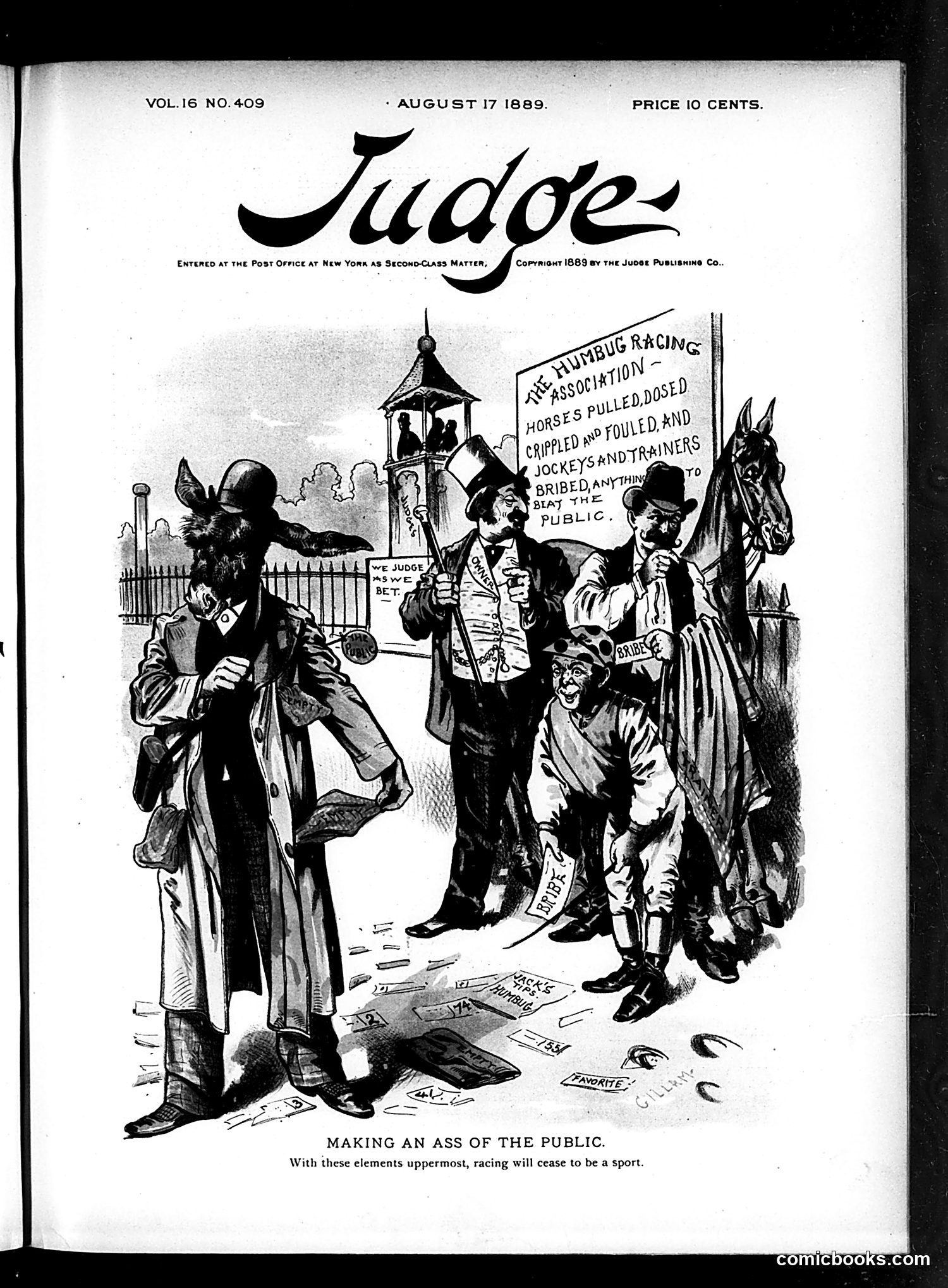
This satirical cartoon criticizes corruption in horse racing at the Humbug Racing Association. The central figure appears to be a judge or official, with a sign listing corrupt practices: horses being "pulled, dosed, crippled and fouled" and jockeys "bribed" to "cheat the public." The donkey-headed figure on the left represents the public being made foolish ("ass"). The caption's subtitle states "With these elements uppermost, racing will cease to be a sport"—meaning that when corruption dominates, the sport loses legitimacy. The scattered papers and betting slips on the ground reinforce the theme of fraud. The cartoon satirizes how racing authorities tolerate systematic cheating that victimizes bettors and undermines the sport's integrity.
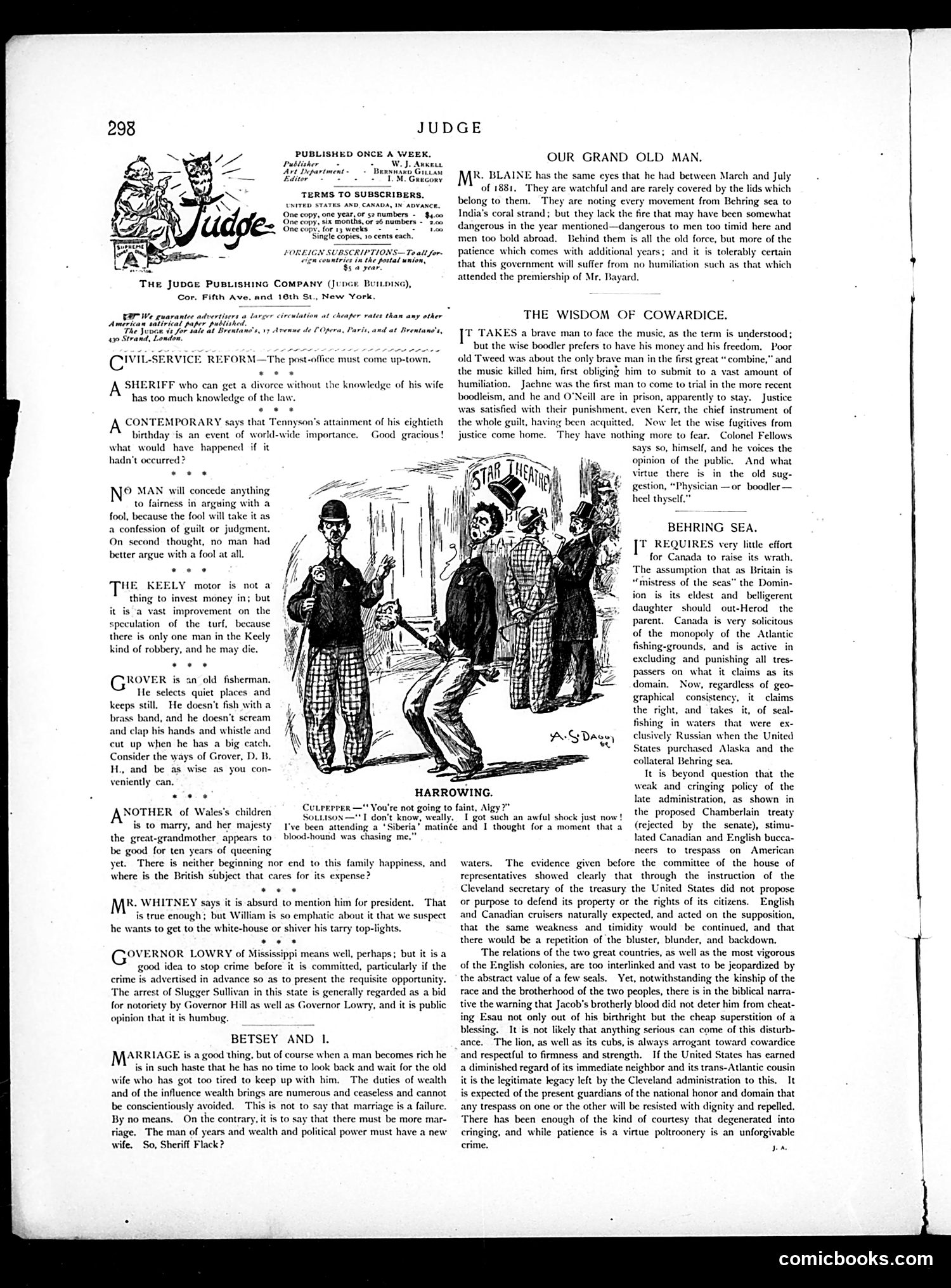
This page contains satirical commentary on early 20th-century politics and social issues rather than a single unified cartoon. The main illustration labeled "HARROWING" depicts what appears to be immigration or labor-related officials confronting working-class figures, likely satirizing bureaucratic treatment of immigrants or workers. The text sections mock various public figures and policies: a sheriff's ignorance of law, a contemporary figure's (possibly Tennyson's) overrated importance, and Governor Lowry of Mississippi's approach to crime prevention. A substantial section criticizes weak foreign policy regarding the Bering Sea and fishing rights disputes between the United States, Canada, and Russia—suggesting American timidity in defending national interests. The "Betsey and I" section satirizes hasty marriages among the wealthy, implying such unions prioritize fortune over genuine compatibility.
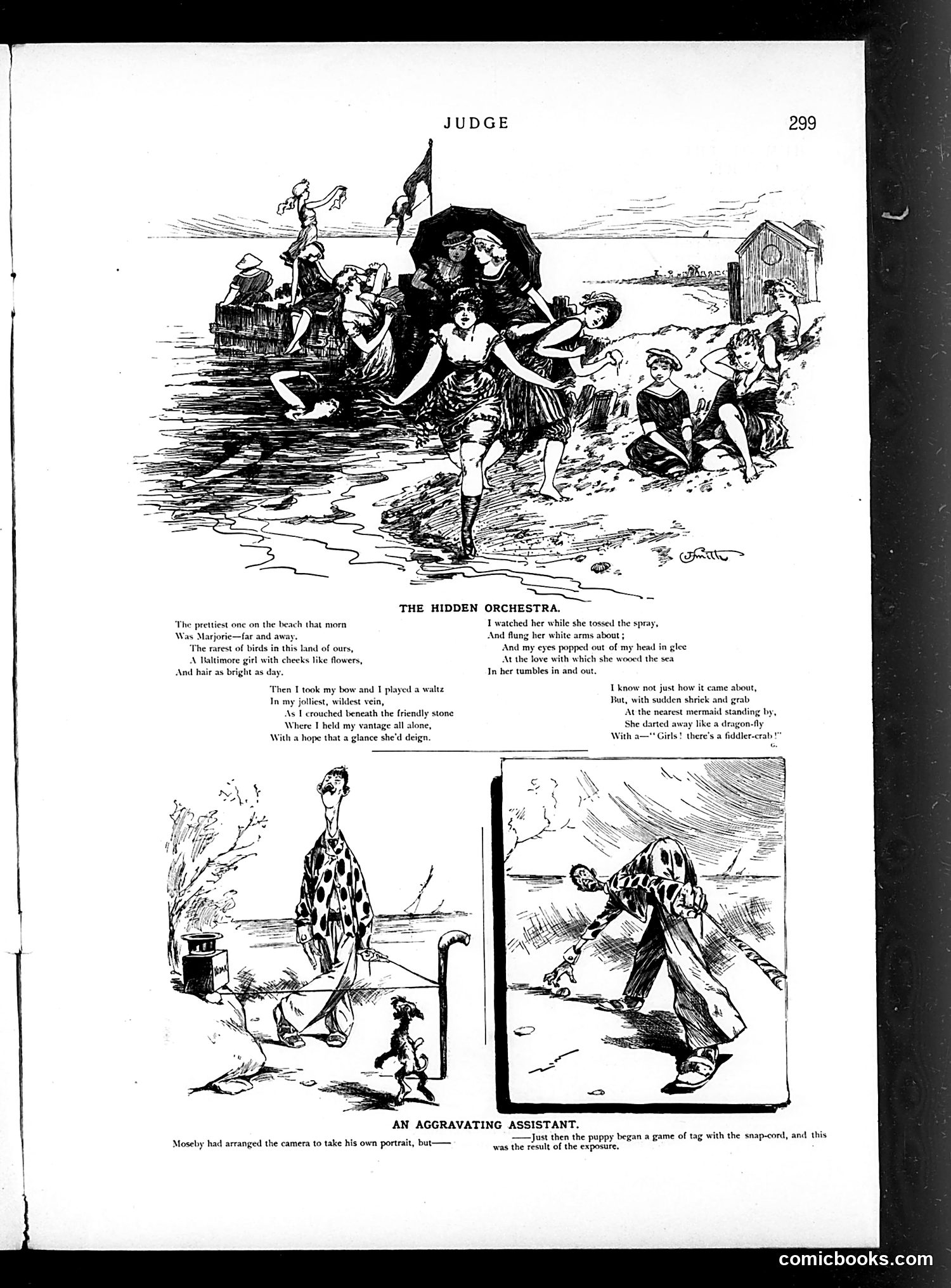
This page contains two humorous illustrated stories from Judge magazine (a satirical weekly). **"The Hidden Orchestra"** is a whimsical poem about a hidden musician who plays violin beneath a stone while watching a pretty Baltimore girl named Marjorie enjoy the beach. The joke builds as natural sounds (waves, animals) seem to accompany her movements like orchestral music—until the reveal: a fiddler crab causes her to shriek, breaking the romantic illusion. **"An Aggravating Assistant"** shows a man (Moseby) attempting to photograph himself using an early camera setup. The humor derives from the failure of early self-photography technology: just as he's positioned everything, a playful puppy tangles with the camera's snap-cord, ruining the exposure. Both pieces satirize romantic pretension and technological mishaps—common Judge themes. The cartoons rely on observational humor about everyday frustrations rather than political commentary, reflecting the magazine's dual nature as both satirical and entertainment-focused.
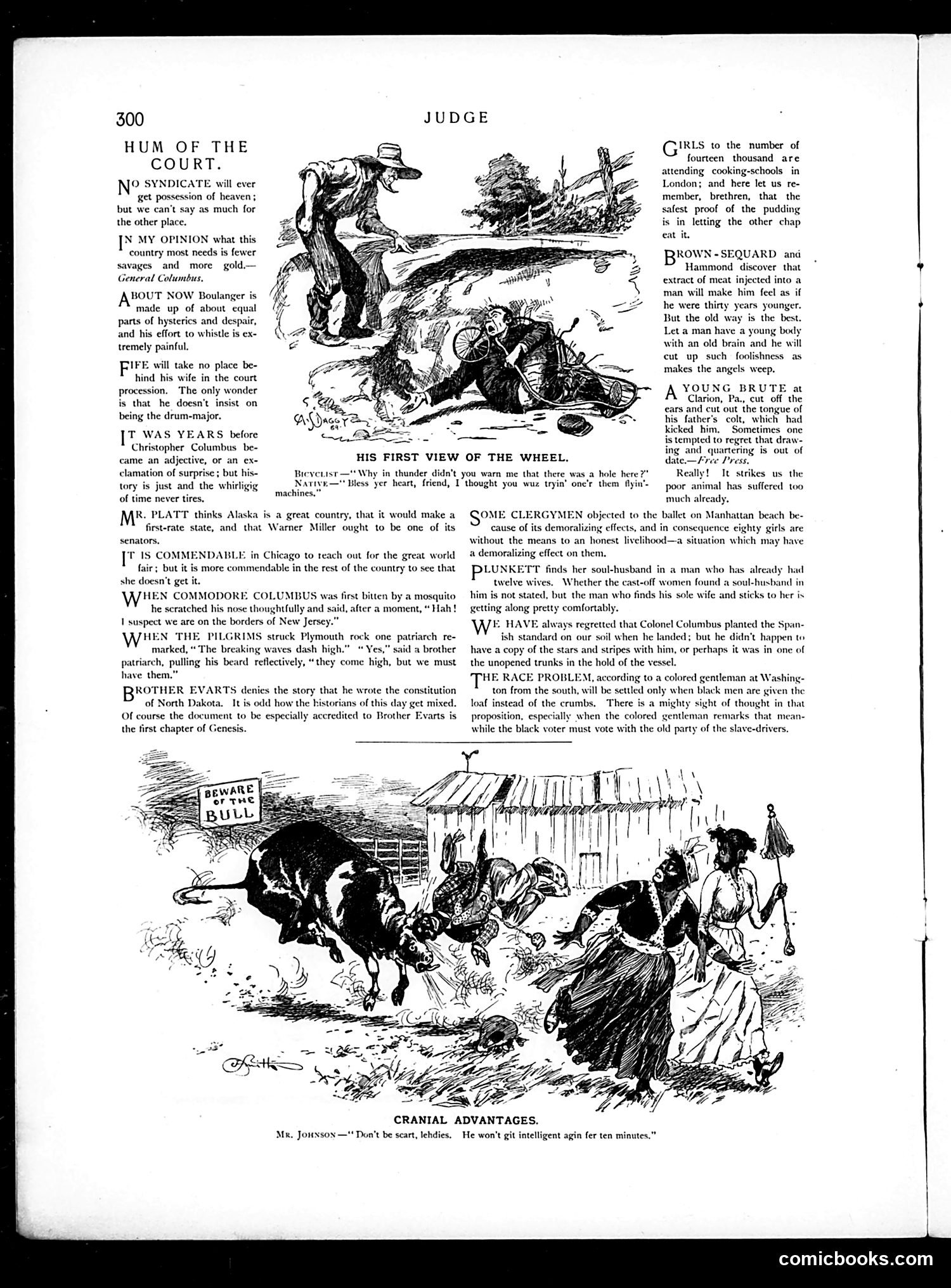
This page from Judge magazine contains brief satirical commentary and two cartoons mocking contemporary figures and social issues circa the 1880s-90s. **Top cartoon ("His First View of the Wheel"):** A novice bicyclist has crashed, blaming the cyclist behind him for not warning of a hole. The joke plays on the bicycle craze and newcomers' incompetence with the new technology. **Bottom cartoon ("Cranial Advantages"):** Depicts a charging bull terrifying women, with the caption quoting "Mr. Johnson" assuring frightened ladies the bull won't "get intelligent again for ten minutes"—suggesting animal stupidity as comic relief. **Text commentary** includes snipes at: General Boulanger (French military figure), Columbus references, Senator Platt's Alaska interests, and a racial commentary about voting rights for Black Americans—presenting it as conditional on receiving fair economic treatment rather than "crumbs." The page reflects Judge's satirical style: topical political jabs, technology mockery, and period racial attitudes presented as humor.
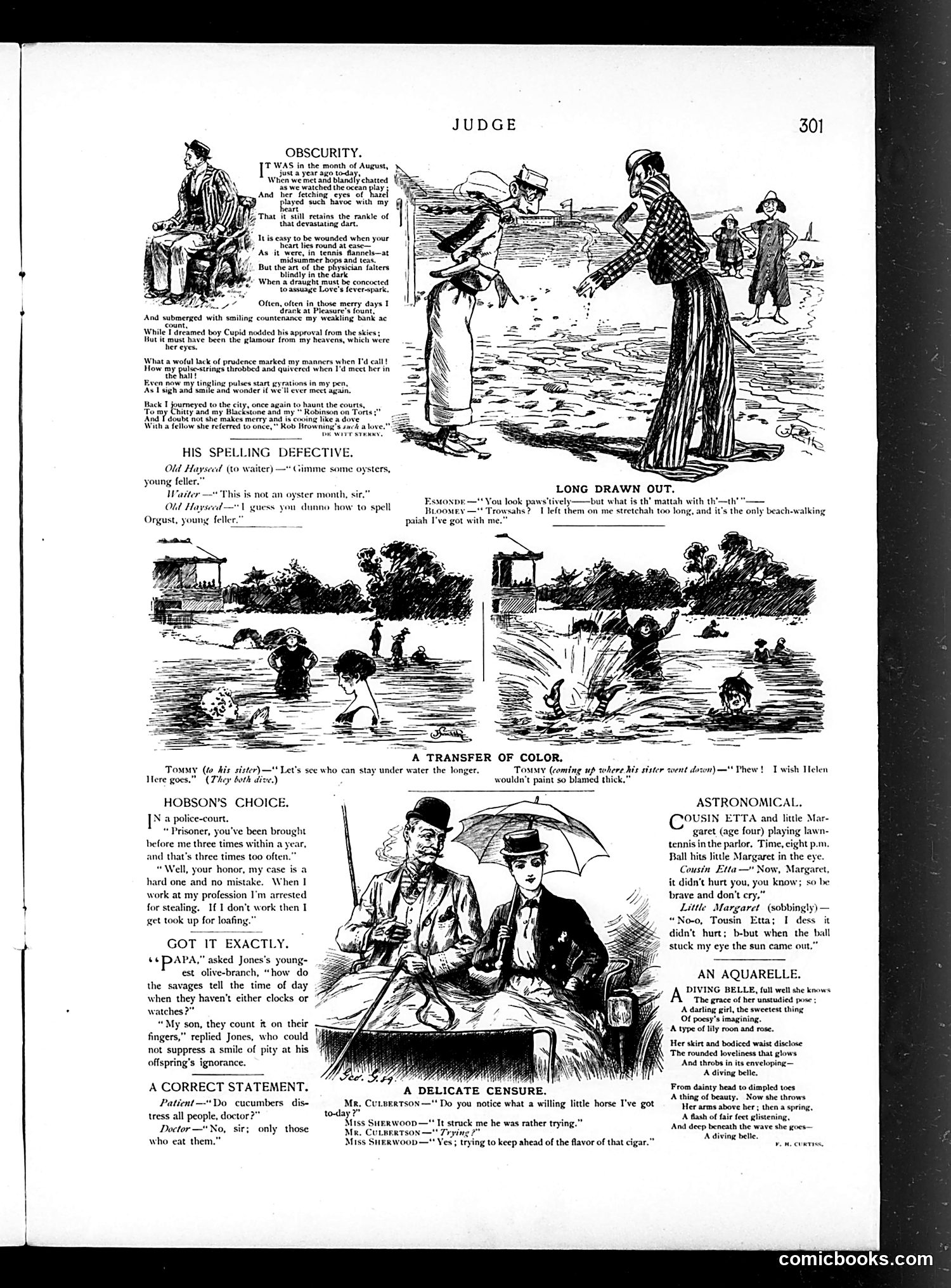
This page contains humorous short pieces typical of *Judge* magazine's satirical content from the early 1900s. **"Obscurity"** is a romantic poem about a man pining for a woman he met in August a year prior, now lamenting their separation as he studies law. It's sentimental rather than satirical. **"His Spelling Defective"** mocks rural dialect—an old farmer asks a waiter for "oysters" but misspells it. The humor relies on period stereotypes about rural/working-class speech patterns. **"Long Drawn Out"** shows a woman complaining her companion overstayed at the beach, leaving tan lines. It's simple observational humor about summer leisure. **"A Transfer of Color"** depicts children diving underwater, with one sibling emerging darker—racist "humor" based on darkened skin from submersion. **"Hobson's Choice"** presents a prisoner caught in a bind: arrested for stealing while working, or for vagrancy while idle. This satirizes systemic poverty traps. The remaining pieces are brief gags about children's logic, police courts, and general domestic humor—typical light satirical content for the era, mixing class commentary with sentimental poetry and crude period stereotypes.
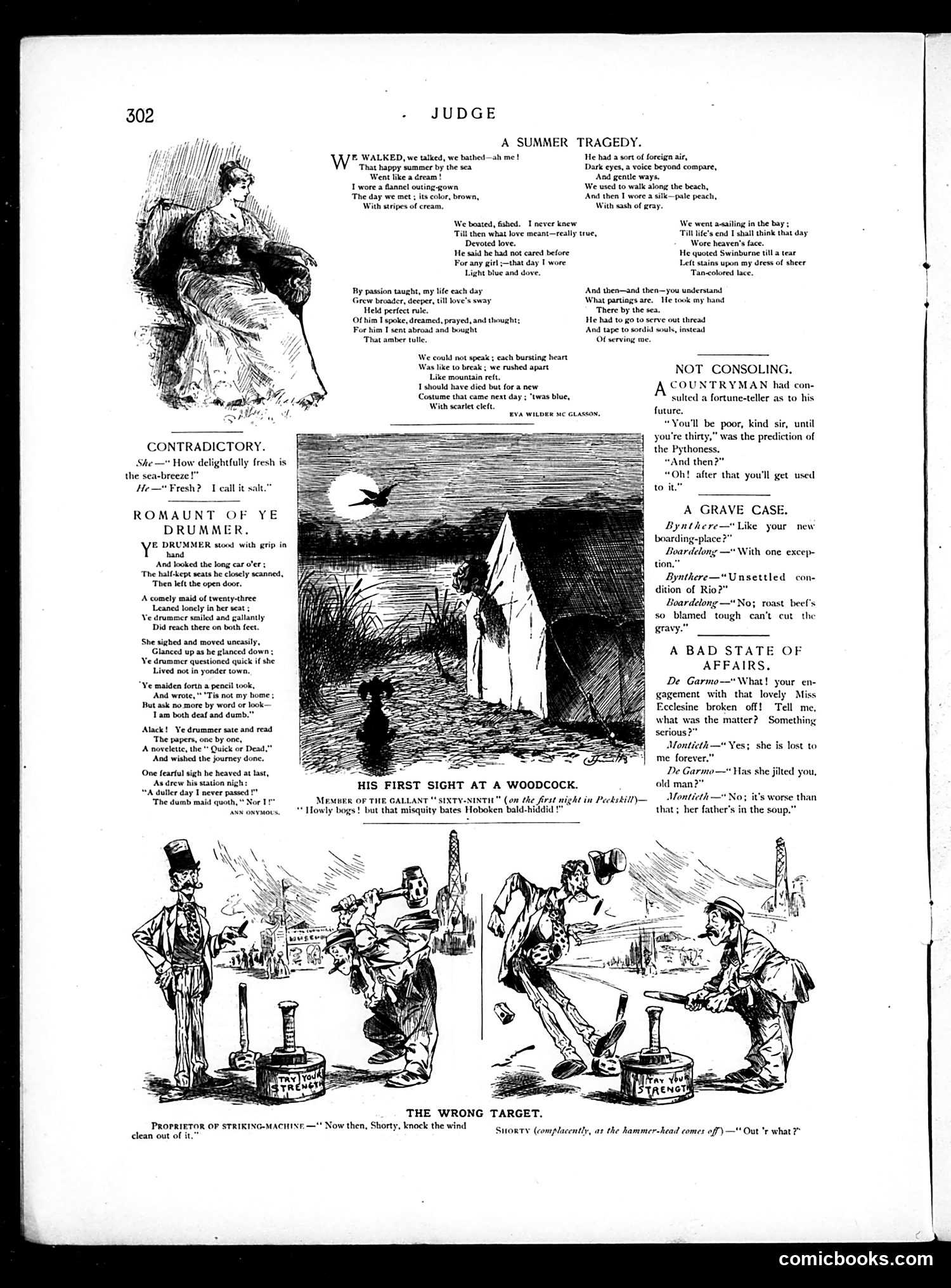
This page contains several satirical pieces typical of late 19th-century American humor: **"A Summer Tragedy"** is a romantic poem mocking melodramatic love stories—the narrator falls for a mysterious foreign gentleman by the seaside, but he abandons her to work in mundane commerce (selling thread and tape), reducing grand passion to prosaic reality. **"Contradictory"** is a one-liner joke about conversational inconsistency regarding fresh sea breeze. **"Romaunt of Ye Drummer"** satirizes a traveling salesman's attempt to flirt with a young woman on a train who, to escape his advances, pretends to be deaf and dumb. The joke mocks both his persistence and her effective escape strategy. **Bottom cartoons** appear to depict slapstick incidents involving striking/carnival machines—likely poking fun at public amusements or workplace mishaps. The overall tone reflects Judge's characteristic blend of romantic satire, social observation about courtship and class, and physical comedy targeting contemporary American life.
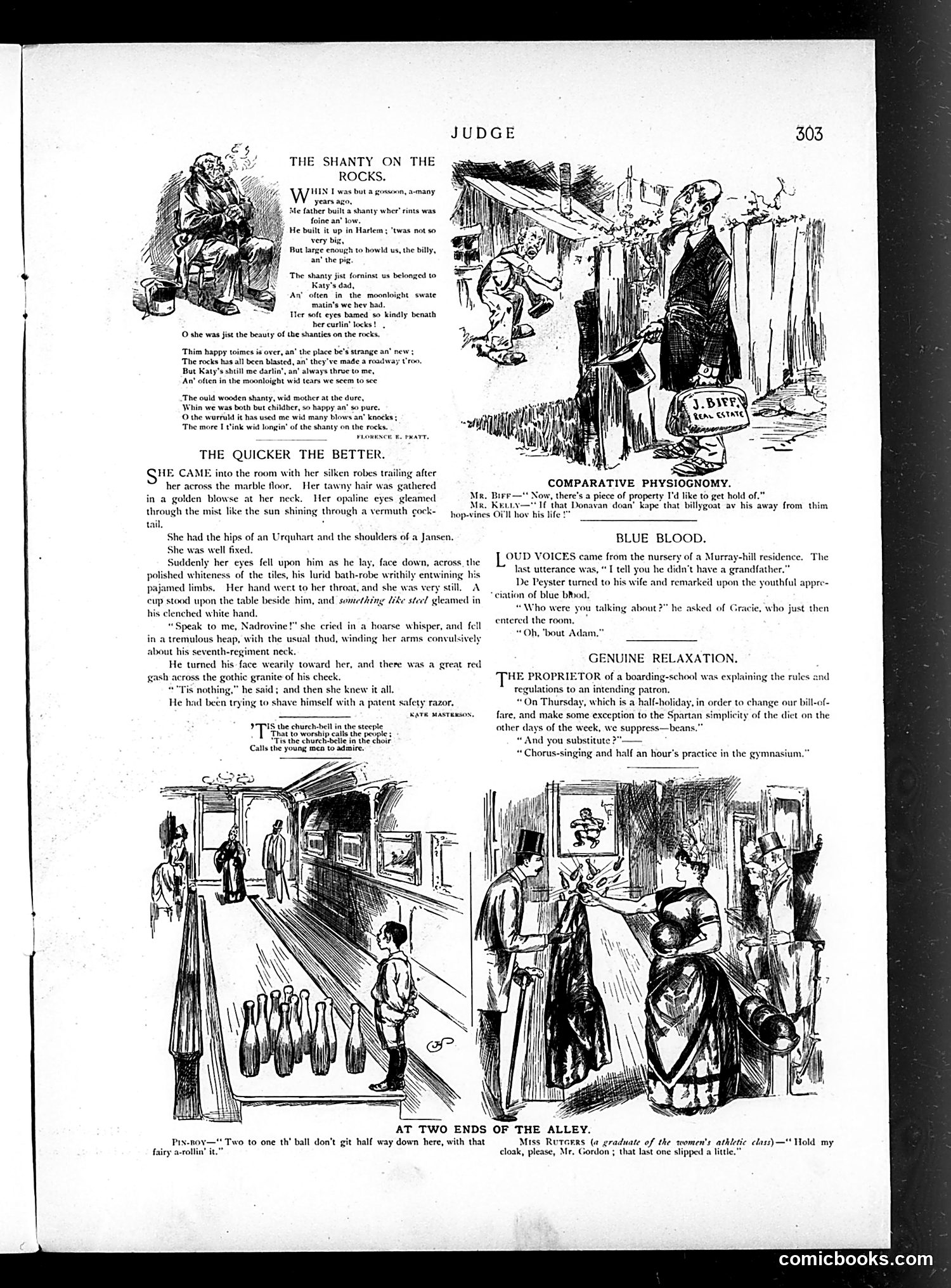
This page contains four unrelated satirical pieces typical of Judge's style: **"The Shanty on the Rocks"** is an Irish-dialect sentimental poem about urban displacement—a poor Irish immigrant nostalgically recalls his childhood shanty in Harlem before development ("rocks blasted") destroyed the neighborhood. The satire likely mocks overly sentimental Irish immigrant narratives popular in the era. **"The Quicker the Better"** parodies melodramatic romance fiction, describing a woman discovering her lover injured. The punchline reveals he's simply cut himself shaving with a safety razor—mocking overwrought literary conventions. **"Blue Blood"** jokes about class pretension: a child casually mentions "Adam" as lacking a grandfather, and the parent interprets this as commentary on noble lineage, when the child simply means the Biblical figure. **"Genuine Relaxation"** satirizes athletic education for women by showing a female boarding-school graduate who's so muscular/strong she accidentally damages a cloak—poking fun at emerging women's athletics programs. The page showcases Judge's mix of ethnic humor, literary parody, and social commentary on contemporary American concerns.
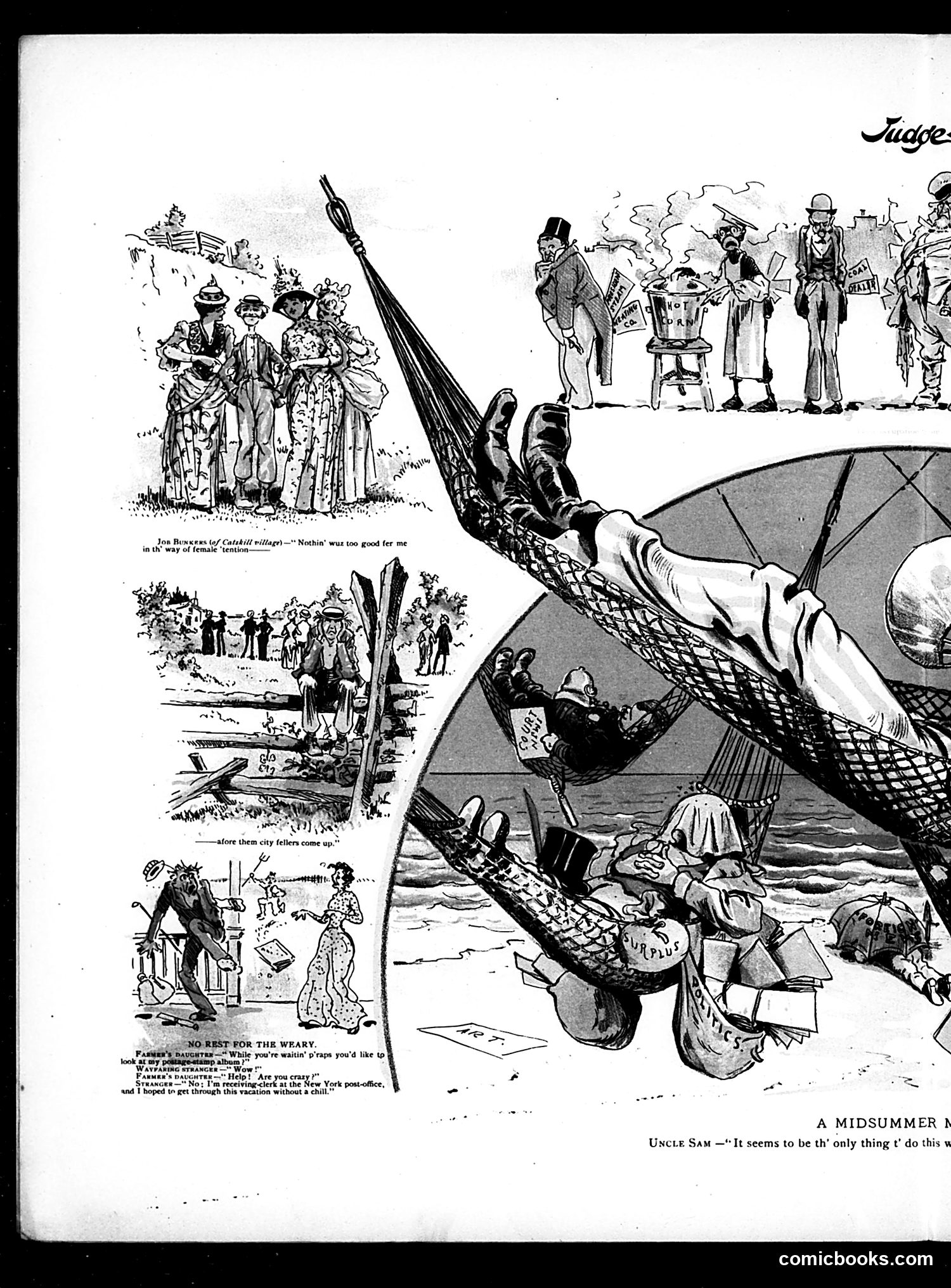
This Judge magazine page contains multiple satirical cartoons commenting on summer vacation experiences and rural-urban contrasts. The **main narrative** involves a father and daughter encountering "city fellers" during their country vacation. The humor satirizes the collision between rural and urban cultures—rustic characters attempting to maintain their simple lifestyle while city visitors intrude with modern affectations and complaints. The **lower panels** depict a weary traveler complaining about various vacation mishaps (sleeping arrangements, strange food, insects), representing the common "vacation gone wrong" trope. The **large right panel** shows what appears to be a fishing/boating scene, likely illustrating the contrast between leisurely vacation activities and the complications tourists bring. The satirical point targets both groups: rural people's suspicion of city visitors, and tourists' unrealistic expectations of peaceful country retreats. The title "A MIDSUMMER" (likely "Madness") reinforces the theme that summer vacationing creates chaos for everyone involved.
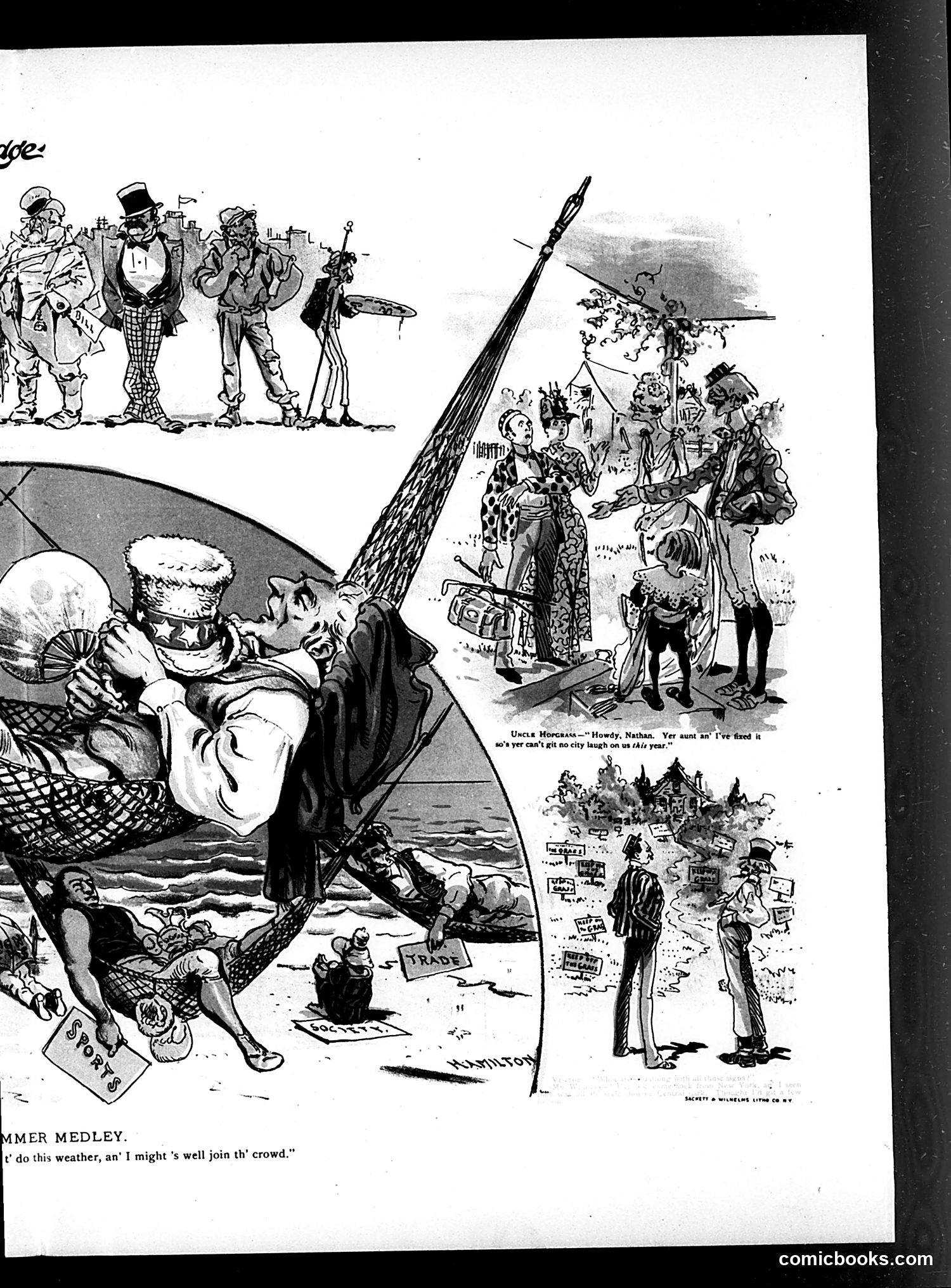
This page contains satirical commentary on American politics and trade. The left panel shows "Uncle Horsesense" (a rural character representing American common sense) speaking with Nathan, suggesting that city folk can't laugh at rural Americans anymore. The right panel depicts what appears to be a political gathering or fair, with various figures representing different social or political interests—possibly relating to trade policy or economic debates of the era. The satire contrasts rural versus urban perspectives, with the implication that despite differing viewpoints, even rural characters might be tempted to "join the crowd" of broader political movements. The overall tone suggests commentary on American divisiveness and the pull of mass politics during a period of significant economic or policy debate, though the specific historical moment remains unclear without additional context.
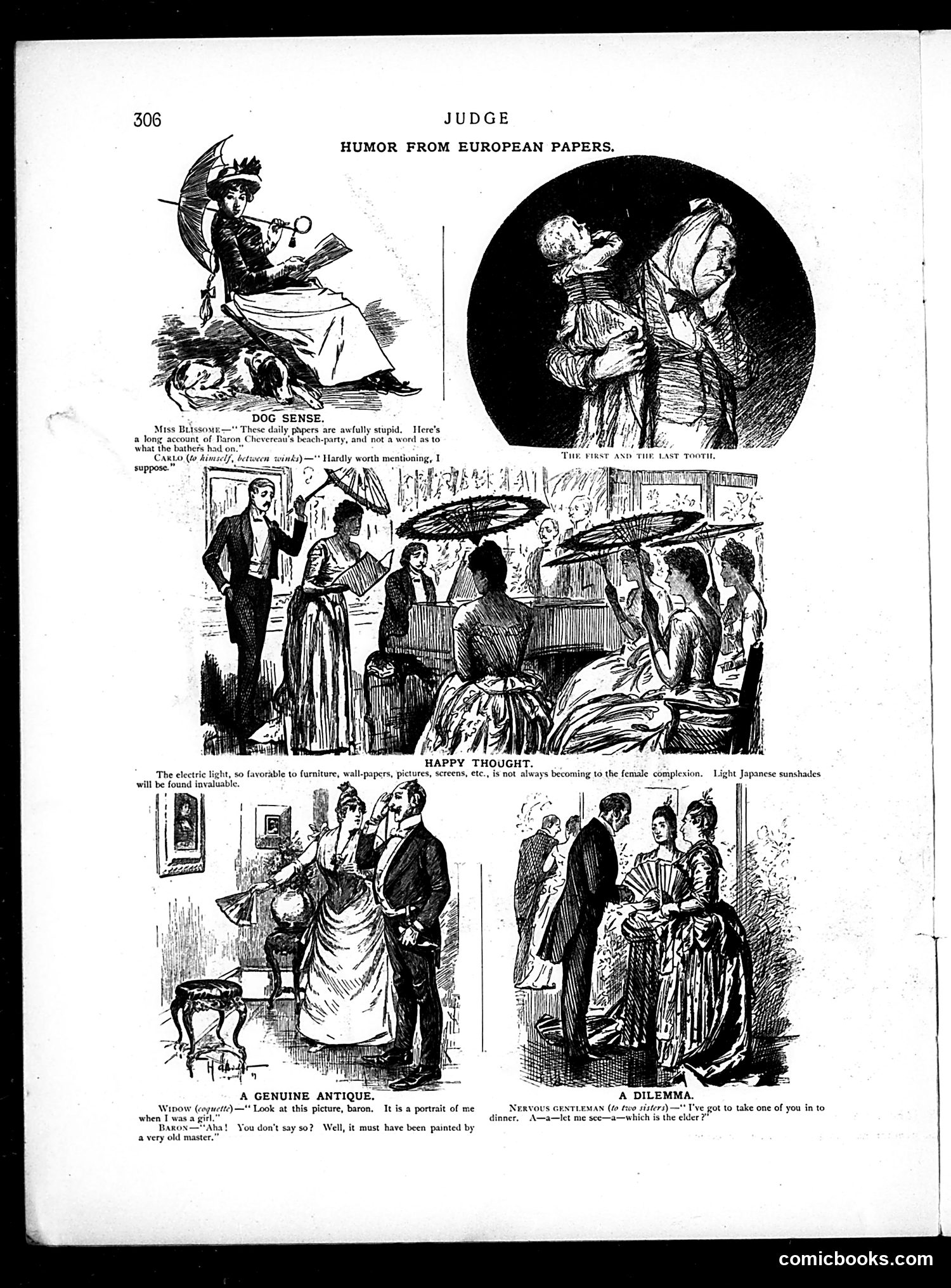
This page reprints satirical cartoons from European publications. The humor focuses on Victorian-era social commentary: **"The First and the Last Tooth"**: Depicts an older man with a child, likely satirizing aging and mortality through dental humor. **"Happy Thought"**: Mocks the new electric lighting technology's unflattering effects on women's complexions, suggesting Japanese sunshades as a solution—poking fun at both vanity and the era's obsession with appearance under modern lighting. **"A Genuine Antique"**: A widow shows a baron her portrait, claiming it's from her youth. His response—that it "must have been painted by a very old master"—is a double insult: suggesting both the painting's age and implying she's aged considerably since it was made. These cartoons satirize contemporary concerns: technological change, female beauty standards, and social pretension among the wealthy.
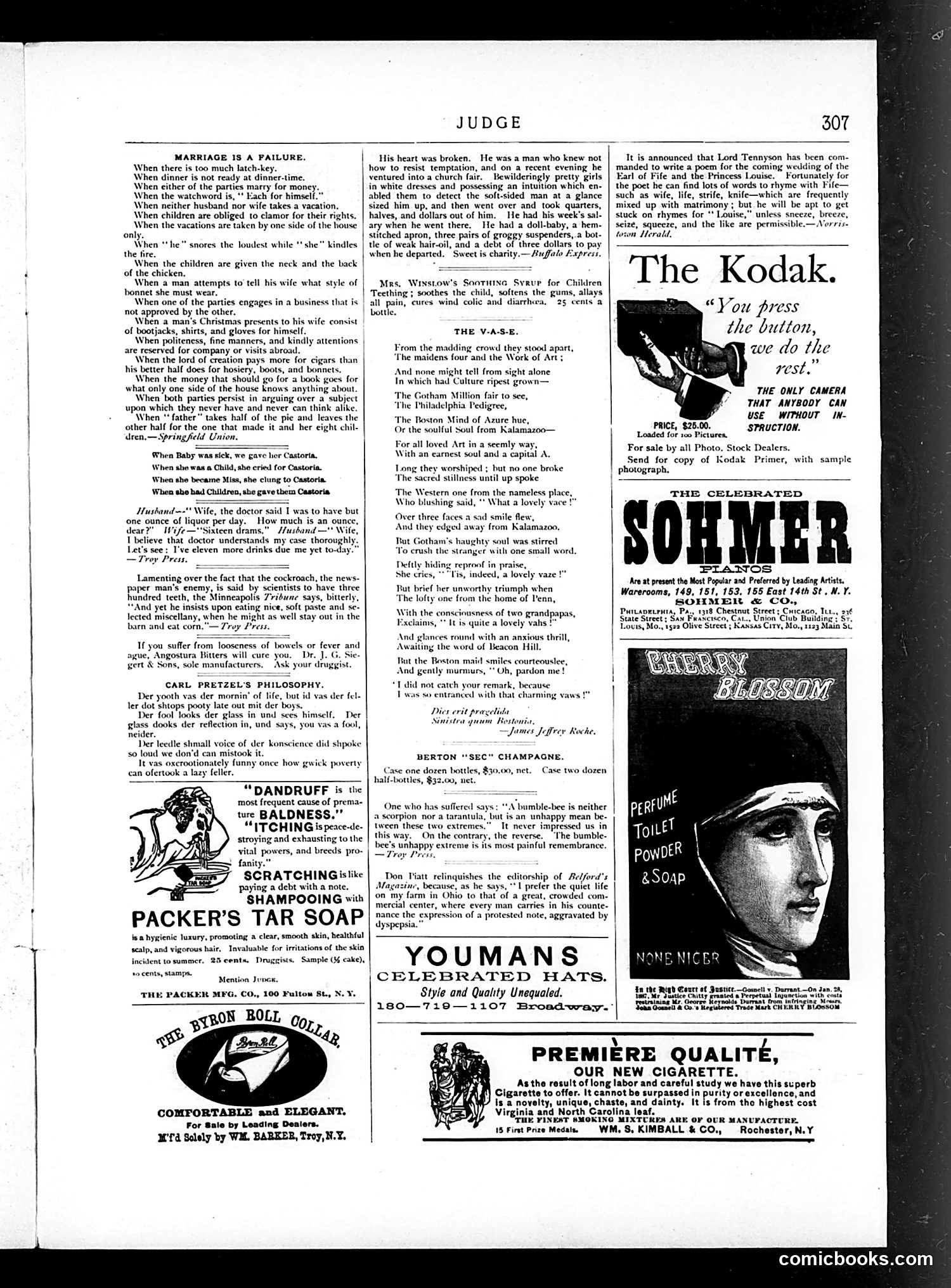
This page's main content is a satirical essay listing reasons marriages fail, presented as social commentary rather than a cartoon. The piece attacks both husbands and wives for marital neglect: men who prioritize cigars over their wives' clothing budgets, women who serve inferior cuts of chicken to family, couples who argue endlessly, and both parties who fail to maintain courtesies and affection. The satire targets middle-class domestic inequality and selfishness—particularly men's dismissiveness of wives' needs and both spouses' abandonment of civility within marriage. References to "latch-key" independence and separate spending habits suggest evolving gender roles troubling to the era's social commentators. The remainder consists of period advertisements (Castoria, Packer's Tar Soap, cigarettes) and humorous anecdotes about cockroaches and drunkenness, typical of Judge magazine's mixed content format.
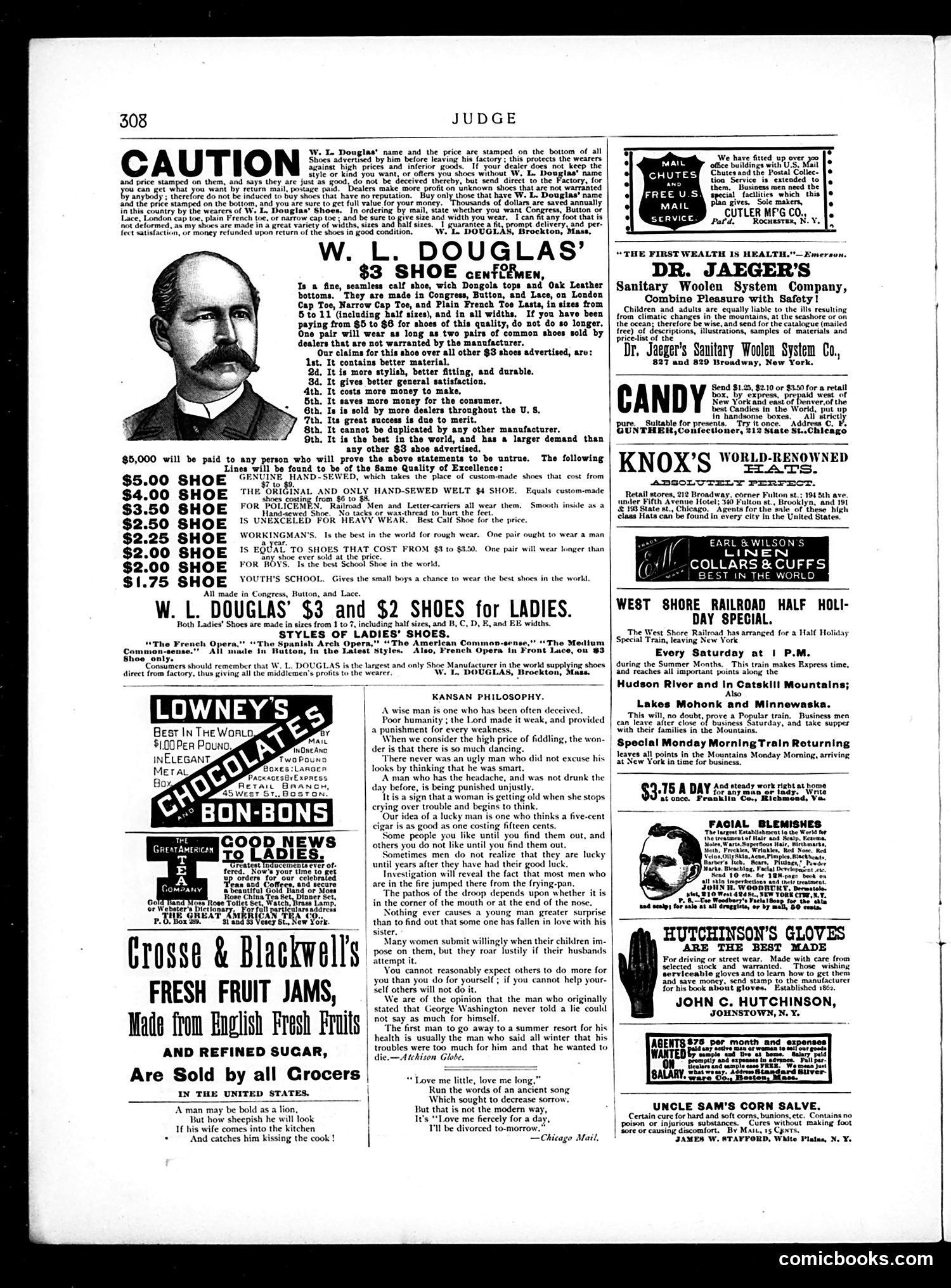
This page is primarily **advertising, not political satire**. It contains commercial advertisements for shoes, chocolates, jams, collars, gloves, and patent medicines—typical Judge magazine filler content. The only cartoon element is a **portrait of W.L. Douglas**, a shoe manufacturer, accompanying his "$3 Shoe for Gentlemen" advertisement. This appears to be **commercial rather than satirical**—Douglas is promoting his own product line by featuring his likeness and listing shoe quality claims. The page includes standard late-19th/early-20th century ads for consumer goods, remedies ("Uncle Sam's Corn Salve"), and services (railroad excursions). The Douglas shoe ad's lengthy pitch about durability and value represents typical period advertising practice rather than social commentary or political humor.
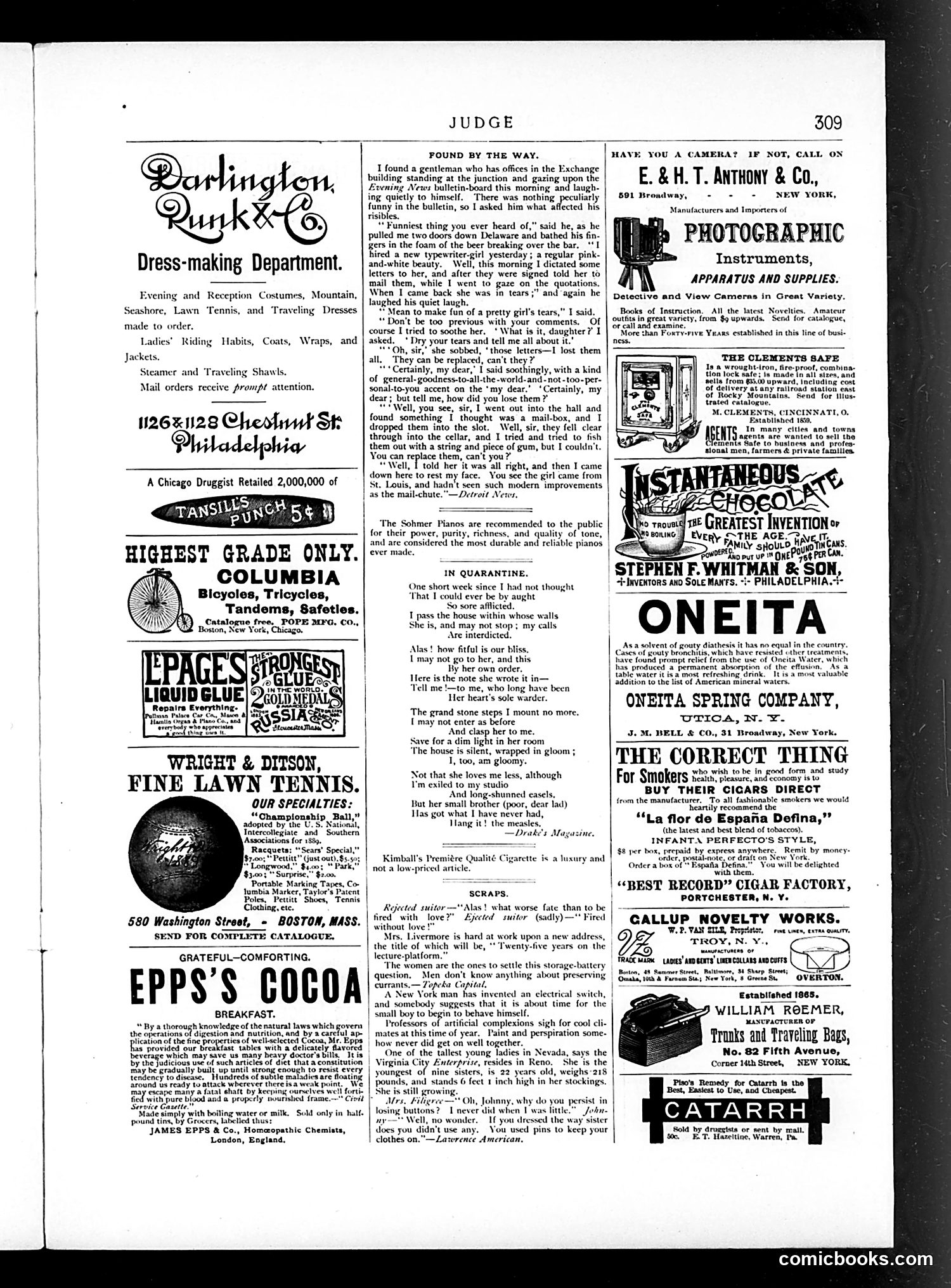
This page is primarily **advertisements and commercial content** with one substantial humorous article titled "Found by the Way." The main article is a **lighthearted anecdote** without political satire. It describes a businessman who hires a new typewriter-girl from St. Louis. When he asks her to mail letters, she mistakes a mail chute (a modern building convenience) for a mailbox and drops them down it into the cellar. The joke relies on the girl's unfamiliarity with urban infrastructure—a common theme of turn-of-the-century humor about rural or provincial newcomers encountering city life. The surrounding content consists entirely of **period advertisements**: dress-making services, bicycles, lawn tennis equipment, cocoa, cigars, photographic equipment, and pianos. There are no political cartoons or satirical illustrations visible on this page. The humor is gentle and domestic rather than political or socially critical.
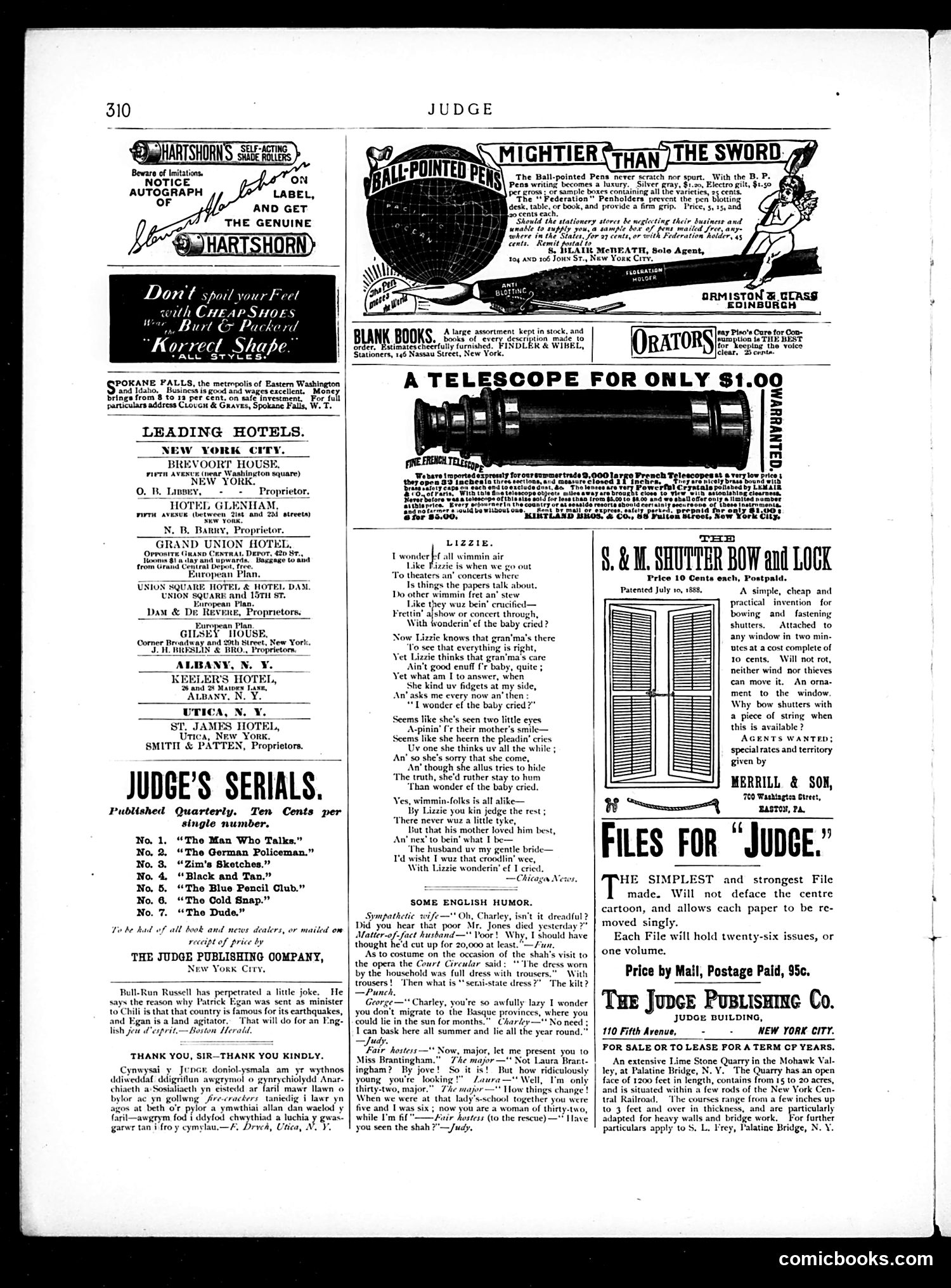
This page is primarily **advertising and miscellaneous content** rather than political satire. The layout includes: **Advertisements:** Shoe polish, hotels, Judge's serialized fiction, ball-pointed pens, telescopes, and other commercial products dominate the page. **Literary Content:** A sentimental poem titled "Lizzie" about a woman attending concerts while worrying whether her baby is crying at home—typical Victorian domestic sentiment. Below it, "Some English Humor" offers mild jokes about a husband's mercenary reaction to a neighbor's death and costume advice for the Shah's visit. **Minimal Satire:** A brief joke about "Bull-Run Russell" suggesting Patrick Egan was sent as minister to Chile because he's a "land agitator" and Chile experiences earthquakes. This is generic political humor without clear contemporary reference. The page reflects Judge magazine's mixed approach: serious advertising revenue alongside light verse and gentle social humor rather than sharp editorial cartoons.
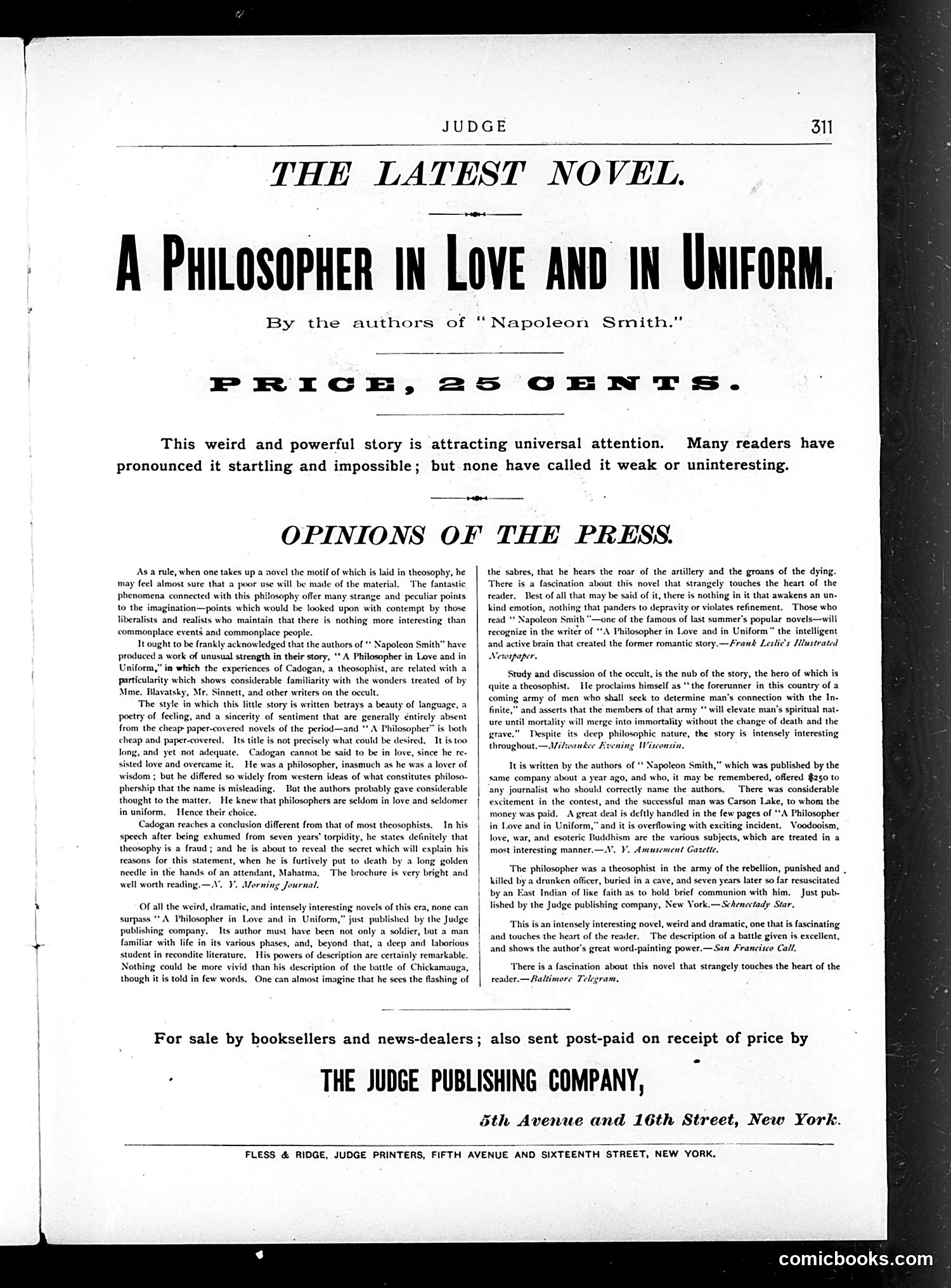
This page is primarily **advertising**, not political satire. It promotes a novel by the authors of "Napoleon Smith," priced at 25 cents, published by Judge Publishing Company. The book itself appears to blend **theosophy** (a spiritual philosophy popular in the late 19th century) with romantic fiction. The protagonist, Cadogan, is a theosophist soldier who ultimately rejects theosophy as fraudulent—a position that gets him murdered by a "Mahatma" (spiritual master) using a golden needle before he can expose the secret. The quoted reviews praise the novel's vivid battle descriptions (specifically Chickamauga, suggesting Civil War context) and literary quality, while noting the ironic title—philosophers typically aren't "in uniform" or in love. The satire appears **gentle**: Judge is mocking the earnestness of theosophical fiction while acknowledging its unusual literary merit.
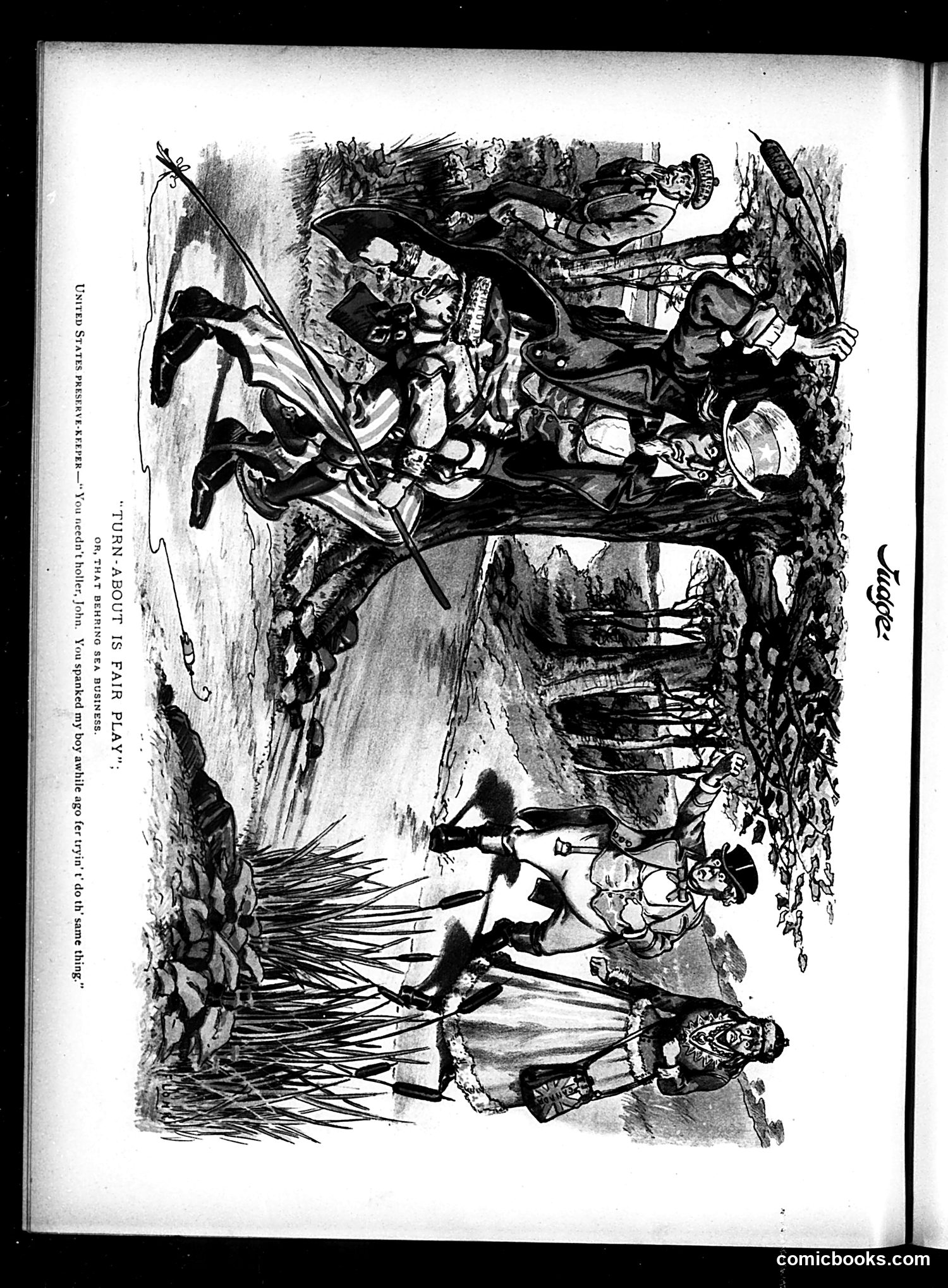
This appears to be a satirical cartoon titled "Turn-About is Fair Play; or, That Big Sea Business," though the OCR text is too degraded to read the accompanying article clearly. The image shows what appears to be a maritime or naval scene with multiple figures in period dress (likely late 19th century). The composition suggests a reversal or ironic situation—the title's phrase "turn-about is fair play" implies the cartoon satirizes someone receiving treatment they previously inflicted on others. Without clearer text or visible publication date, I cannot definitively identify the specific political figures or naval/commercial dispute being referenced. The cartoon likely addresses contemporary maritime policy, trade issues, or international naval conflicts, but further context would be needed for precise interpretation.