
A complete issue · 16 pages · 1889
Judge — July 6, 1889
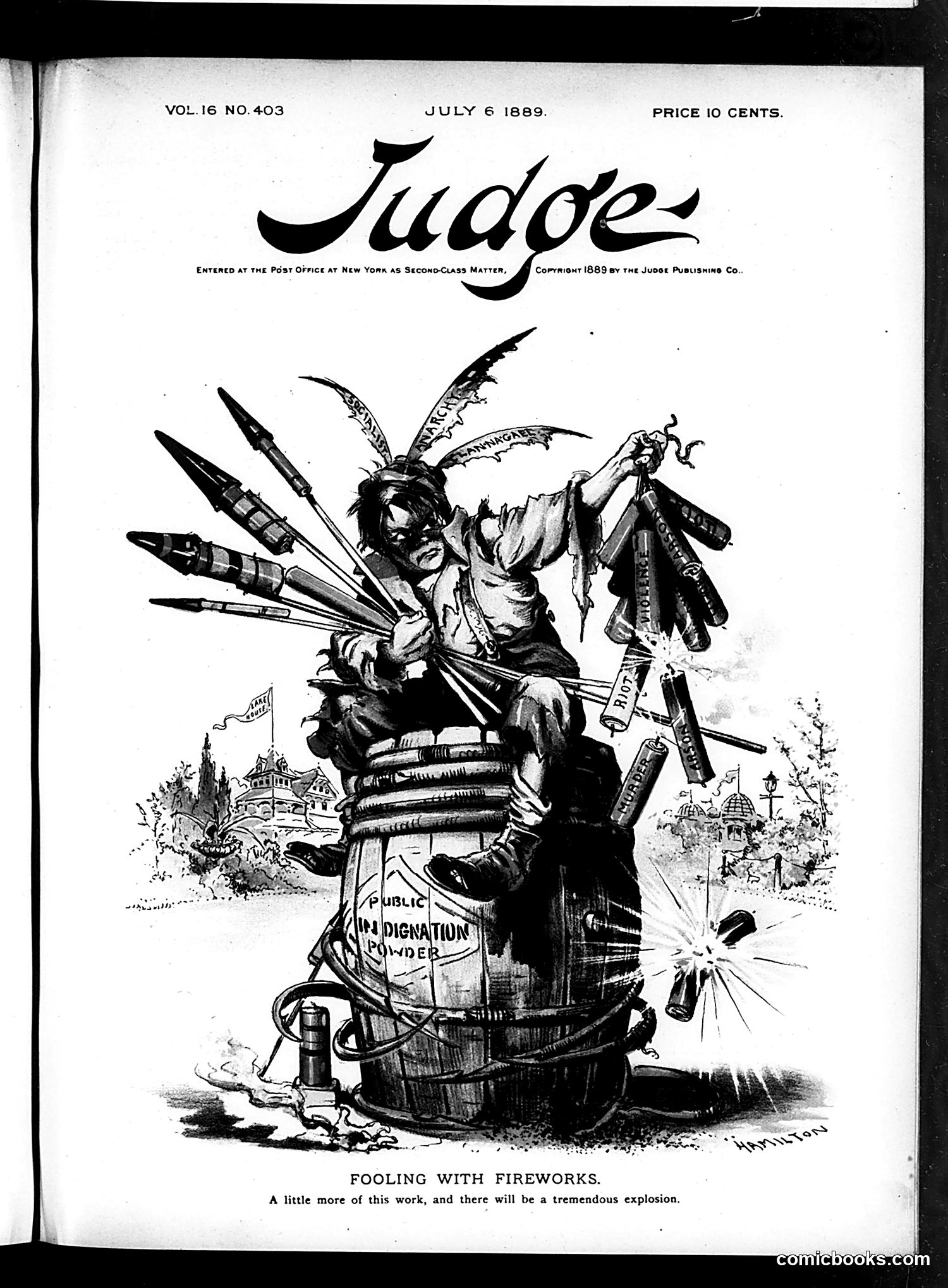
This satirical cartoon warns against the dangers of fireworks during Fourth of July celebrations. The central figure is a demonic jester or fool perched atop a barrel labeled "Public Indignation Powder"—a pun suggesting public anger or unstable social sentiment. He juggles various fireworks and explosives while surrounded by artillery shells and rockets. The caption "Fooling with Fireworks" and subtitle "A little more of this work, and there will be a tremendous explosion" suggest the cartoon critiques reckless behavior, likely referring to either literal Fourth of July fireworks safety or metaphorically to political/social tensions building in 1889 America. The "public indignation powder" label suggests commentary on volatile public opinion or political instability of the era.
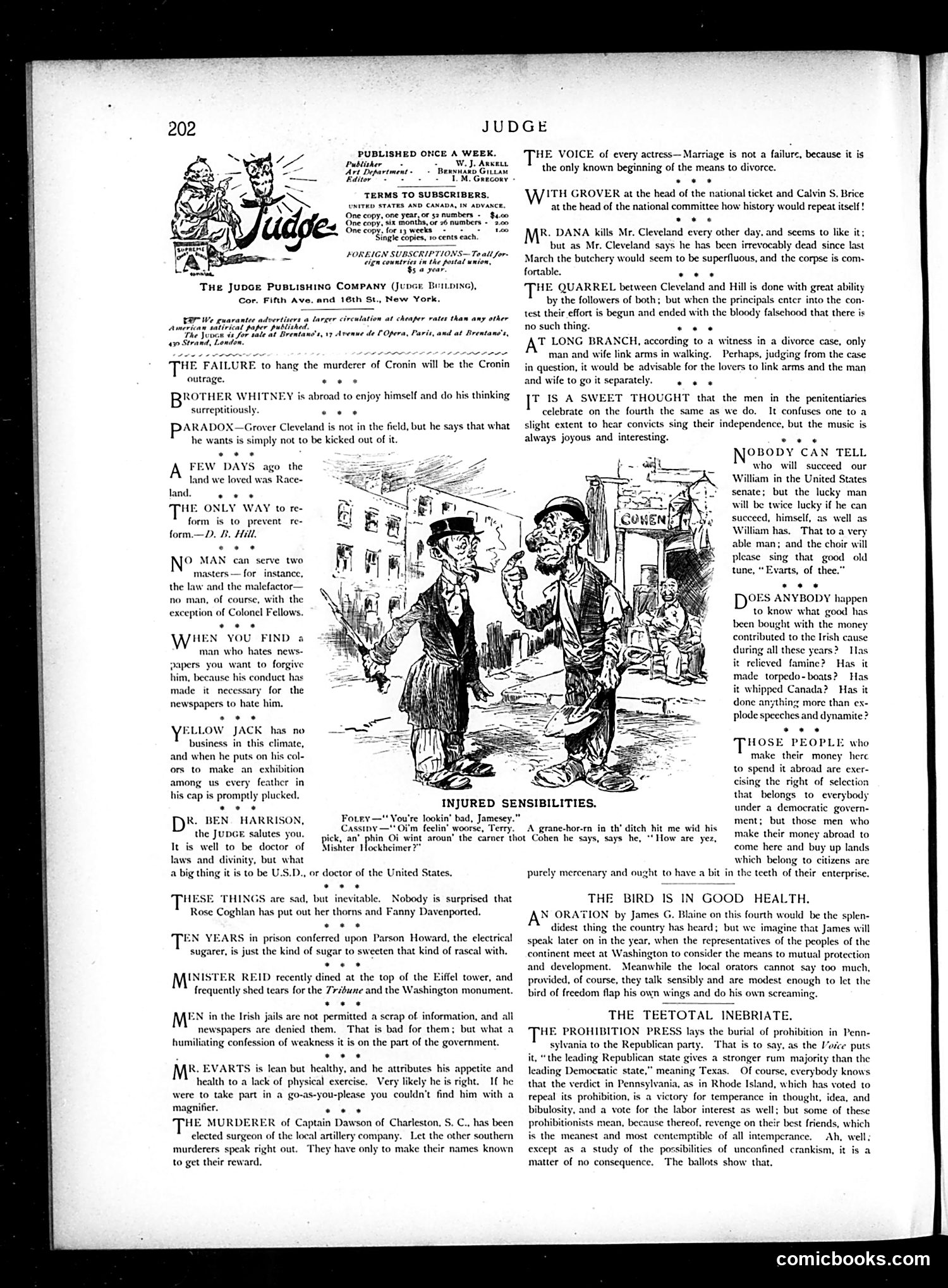
The central cartoon depicts two men in conversation on a street. The caption "INJURED SENSIBILITIES" and dialogue ("You're lookin' bad, Jamsey") suggests this illustrates working-class or immigrant characters discussing hardship. The accompanying text references "Foley" and mentions "a grain-born in th' ditch hit me wid his pick" and discussion of "the carver that Cohen he says, be." This appears to involve Irish immigrant laborers (suggested by names like Jamsey) and interpersonal conflicts, possibly over employment or wages. The satire likely mocks either the pretensions of working-class dignity or documents contemporary labor tensions and ethnic interactions in urban America during this period. Without clearer historical context, the specific incident referenced remains unclear.
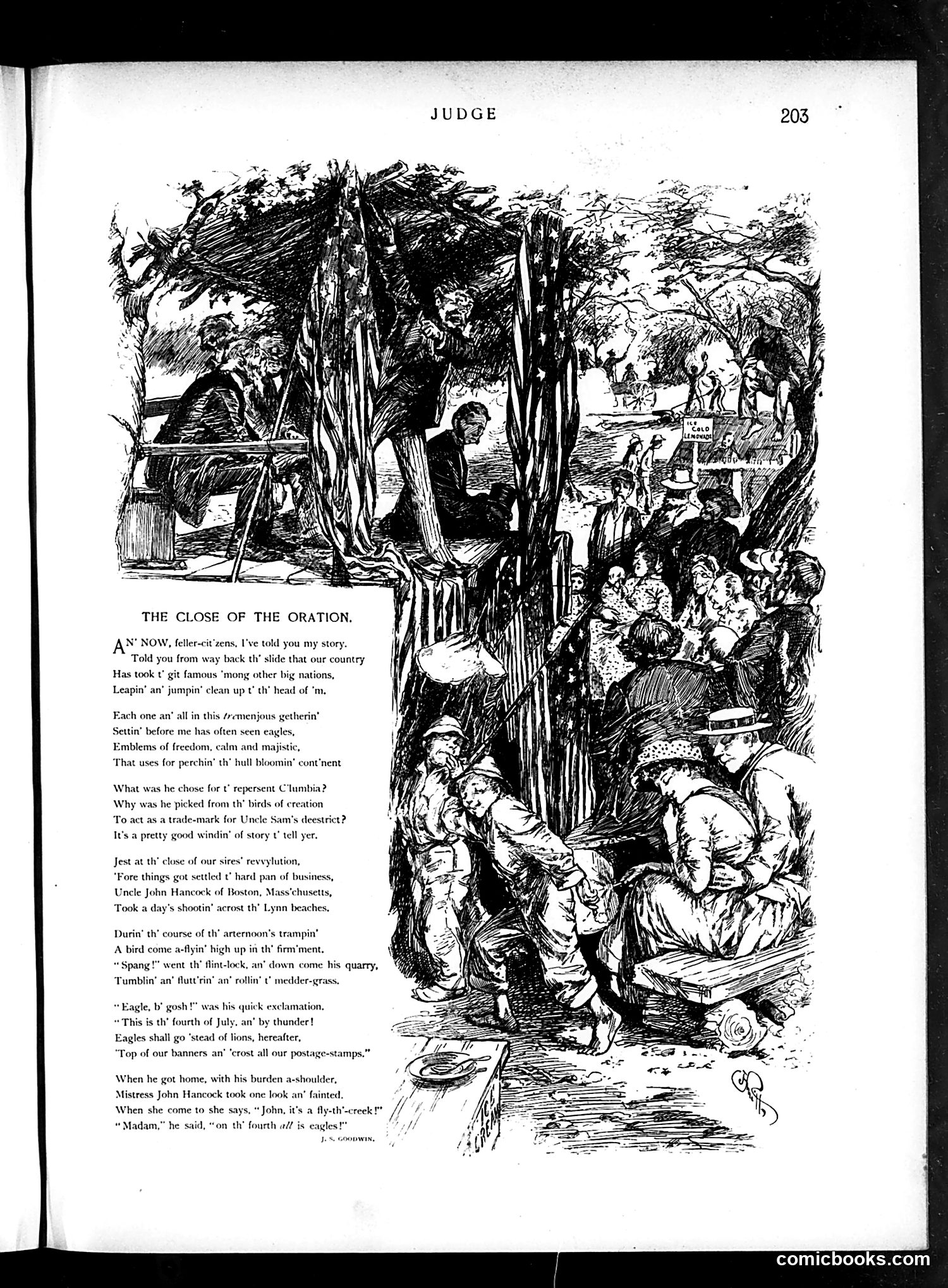
This page presents a tall tale explaining America's choice of the eagle as its national symbol. The narrative, delivered in exaggerated rural dialect, attributes the decision to John Hancock shooting an eagle on the Fourth of July during the Revolutionary War era. The satire mocks both patriotic mythology-making and the overwrought oratorical style of 19th-century political speeches. By presenting the eagle's adoption as a casual hunting accident rather than deliberate symbolism, the cartoon ridicules the grandiose narratives politicians constructed around American identity. The crude dialect and folksy framing suggest satire of populist political rhetoric—the speaker presents himself as an everyman explaining profound national matters in colloquial terms. The ornate illustration shows an outdoor gathering listening to this story, emphasizing Judge magazine's critique of how Americans consumed patriotic narratives through flowery speeches and invented historical anecdotes. The humor targets both the audience's gullibility and speakers' manipulation of patriotic sentiment.
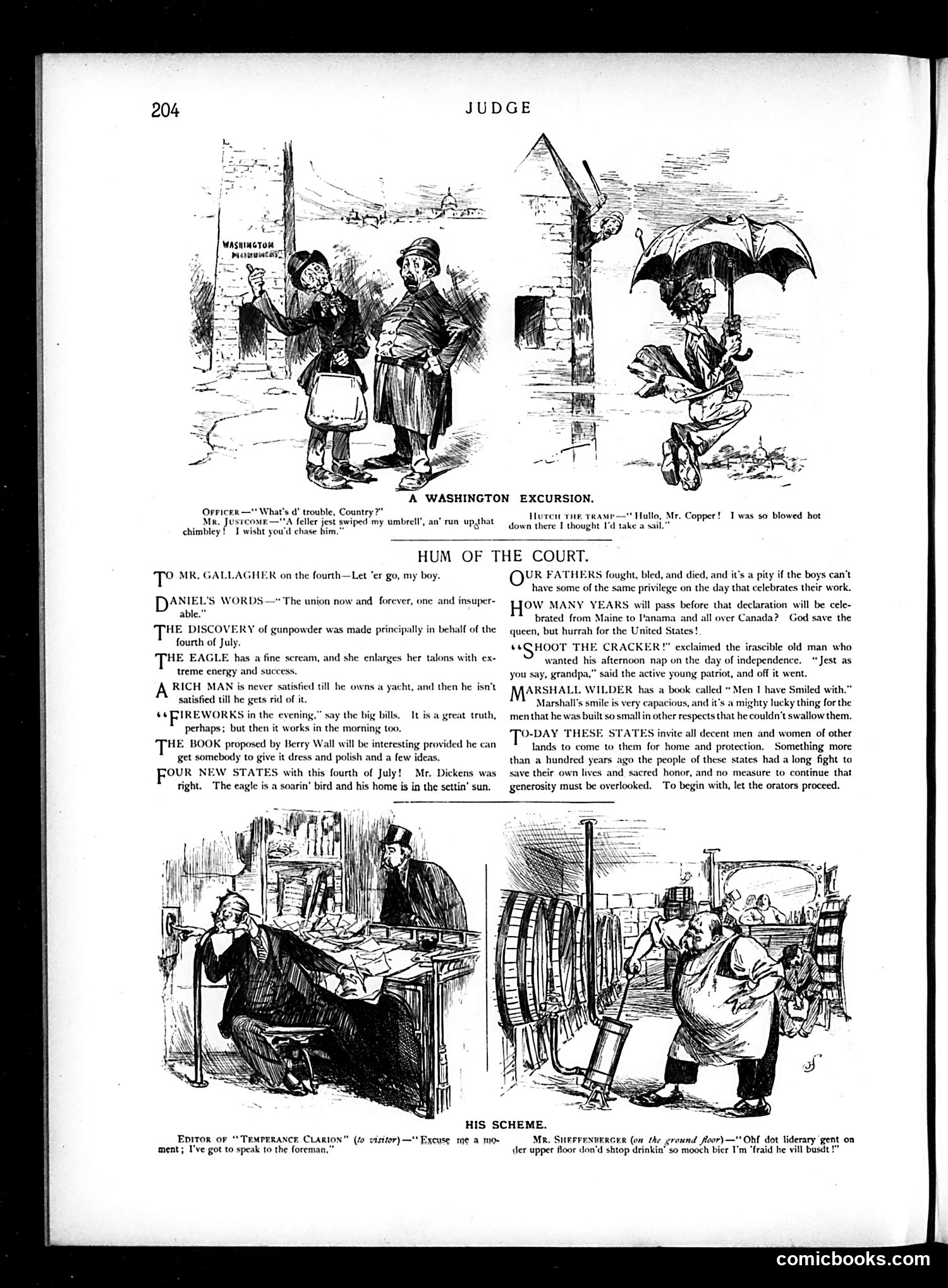
This page from **Judge** magazine contains Fourth of July-themed satirical content. The cartoons mock American social pretensions and hypocrisy: **Top cartoons**: "A Washington Excursion" jokes about urban crime and heat; "Hum of the Court" offers cynical observations about wealth, patriotism, and fireworks. **Main section**: Commentary celebrates Independence Day while critiquing American society. It notes the irony that while founding fathers "fought, bled, and died," their descendants enjoy lesser privileges. References include Berry Wall (a wealthy socialite), Marshall Wilder (a comedian), and calls for extending American values "from Maine to Panama and all over Canada." **Bottom cartoon "His Scheme"**: Satirizes temperance reform movements. An editor of a temperance newspaper drinks heavily on upper floors while his German-accented superintendent complains the literary man drinks so much beer he'll "burst"—mocking the hypocrisy of prohibition advocates. The page's overarching theme: American ideals versus actual practice.
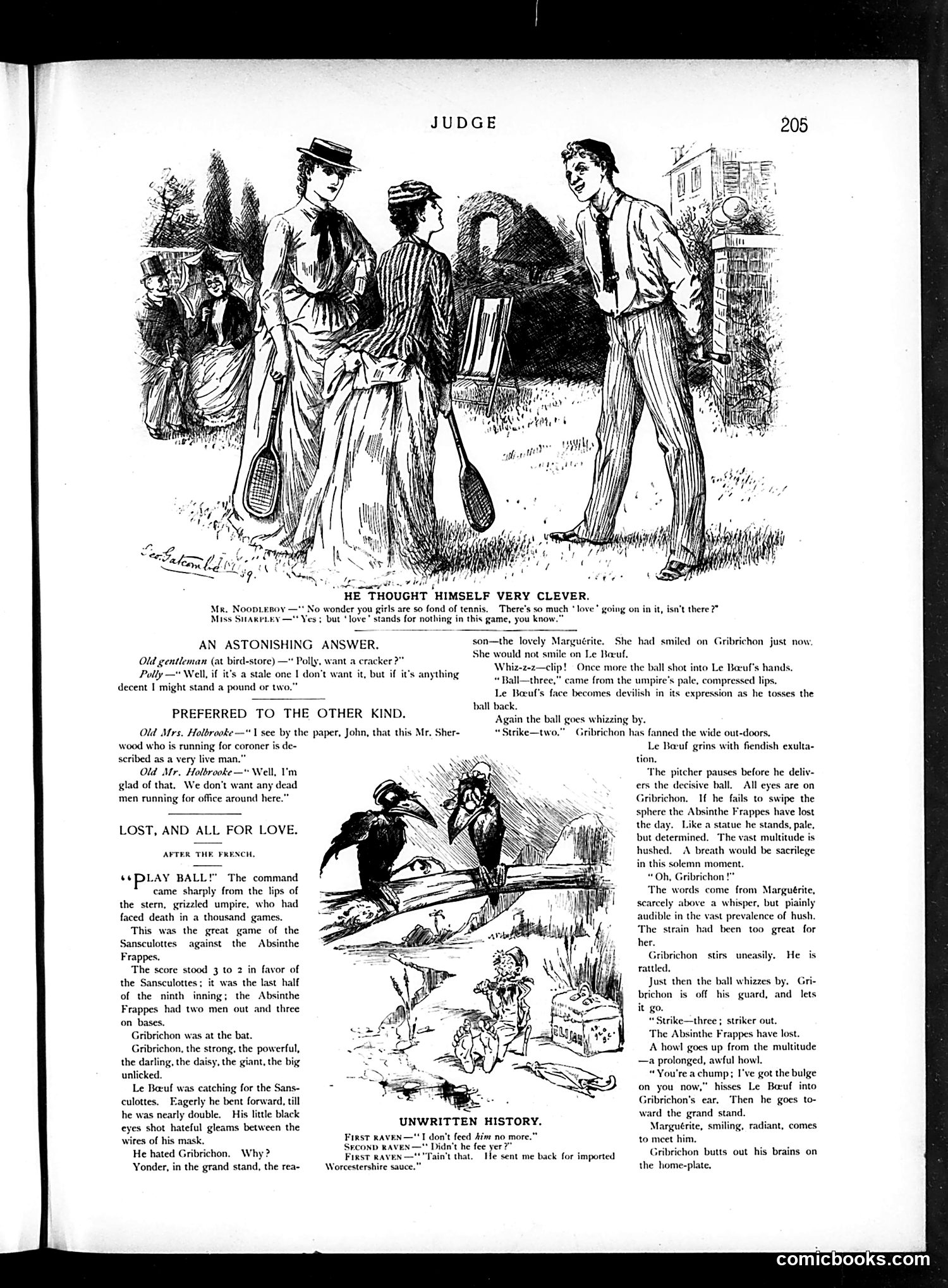
This page contains four separate joke items mocking Victorian social conventions and French culture. The top cartoon shows a man lecturing women about tennis and "love," with the punchline that women prefer tennis because there's more "love" involved—a double entendre on romance versus the tennis term. The middle sections present absurdist humor: a parrot rejecting stale crackers, and a man praising a coroner candidate as a "live man" (wordplay on his vitality versus his profession with the dead). The longest piece, "Lost and All for Love," is a satirical baseball story set in France featuring French character types (Sansculottes, Absinthe Frappes) playing out melodrama. A player, Gribrichon, strikes out after being distracted by his love interest Marguérite, losing the game. The rival catcher Le Boeuf wins her affection instead, leading Gribrichon to suicide—a mock-tragic ending that parodies both French romanticism and contemporary baseball fervor. The satire targets sentimental French literature, competitive masculinity, and passion overriding reason.
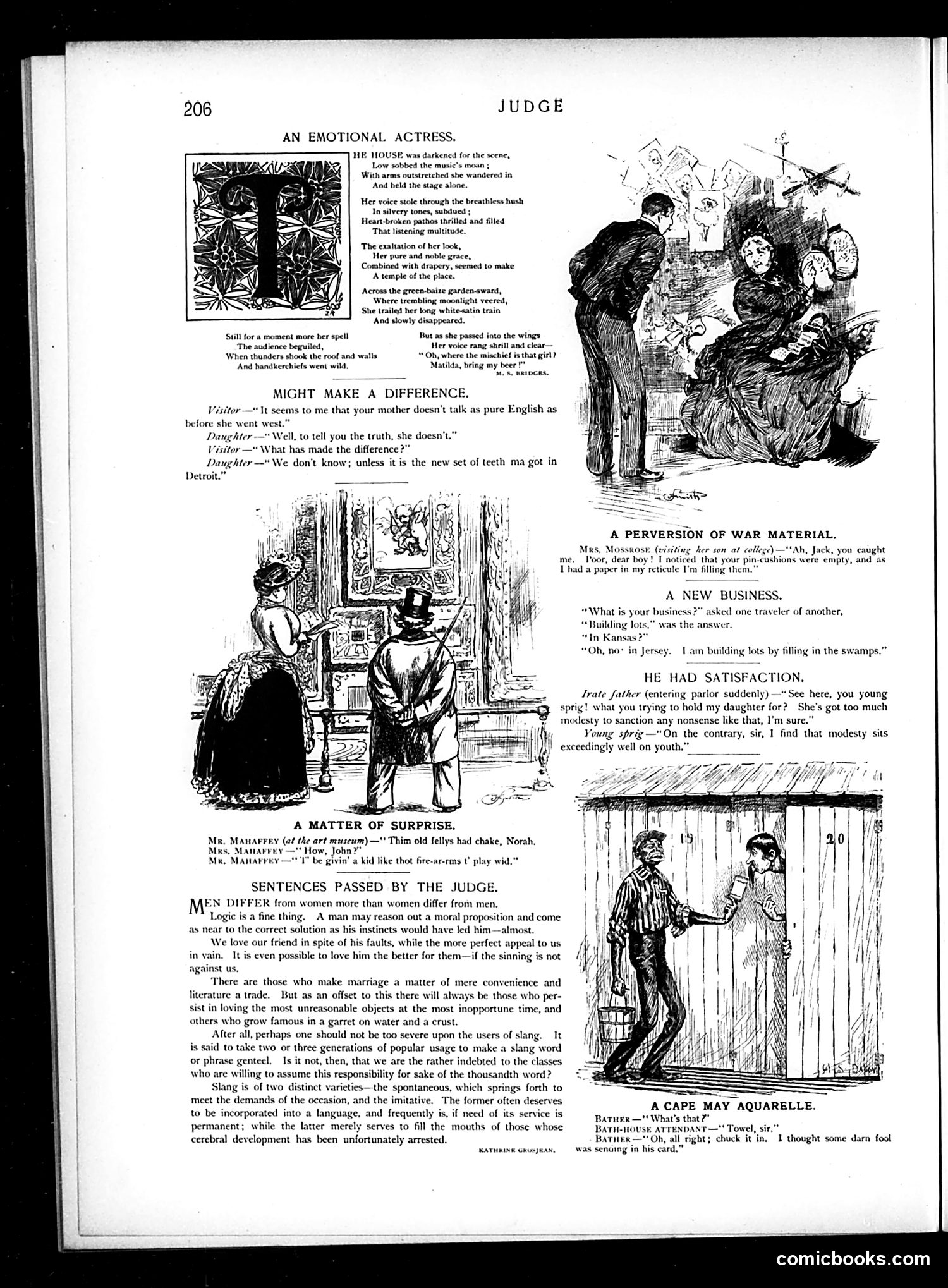
This page contains several brief satirical sketches typical of early 20th-century American humor magazines. **"An Emotional Actress"** mocks theatrical pretension: an actress delivers a dramatically moving performance, but the moment she exits offstage, her refined manner vanishes—she shouts coarsely for a beer, exposing the artifice of her performance. **"Might Make a Difference"** jokes about regional dialect: a visitor notes the mother speaks poor English after moving west, which the daughter attributes to new false teeth from Detroit—implying the teeth, not geography, caused the accent change. **"A New Business"** satirizes post-war opportunism: building lots by filling New Jersey swamps represents exploiting environmental conditions for profit. **"Sentences Passed by the Judge"** is a philosophical essay on gender differences in love and reason, not satire. The remaining sketches ("He Had Satisfaction," "A Matter of Surprise," "A Cape May Aquarelle") are brief comic dialogues about courtship, museum visitors, and seaside encounters—typical light social humor without specific political references.
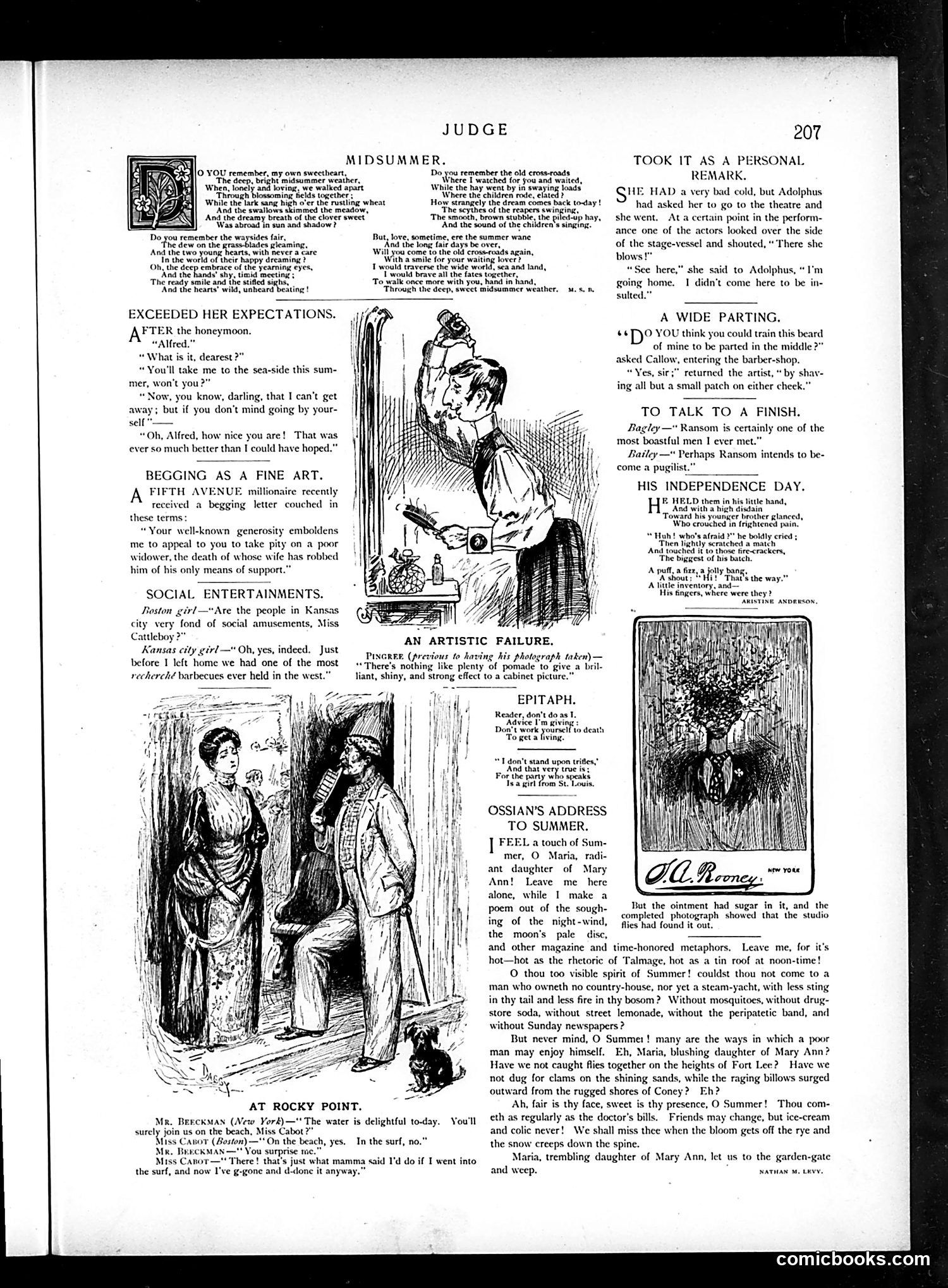
This page contains multiple short satirical pieces typical of Judge's humor: **"Exceeded Her Expectations"** mocks newlywed dynamics—a husband avoids taking his wife to the seaside by suggesting she go alone, and she's pleased because his response exceeded her low expectations. **"Begging as a Fine Art"** satirizes both wealthy Fifth Avenue residents and manipulative begging letters by showing a beggar's clever appeal to vanity. **"Social Entertainments"** jokes about Kansas City's cultural provinciality—a Kansas City girl calls a *barbecue* "recherche" (refined/rare), suggesting frontier crudeness masquerading as sophistication. **"An Artistic Touch"** (partially visible) appears to comment on photography or portraiture. **"At Rocky Point"** contrasts regional manners: a New York man finds beach behavior surprising; a Boston woman distinguishes between "the beach" (acceptable) and "the surf" (not respectable). The page's humor targets class pretensions, regional stereotypes, and marriage dynamics—typical Judge fare. The illustrated poems are sentimental midsummer memories.
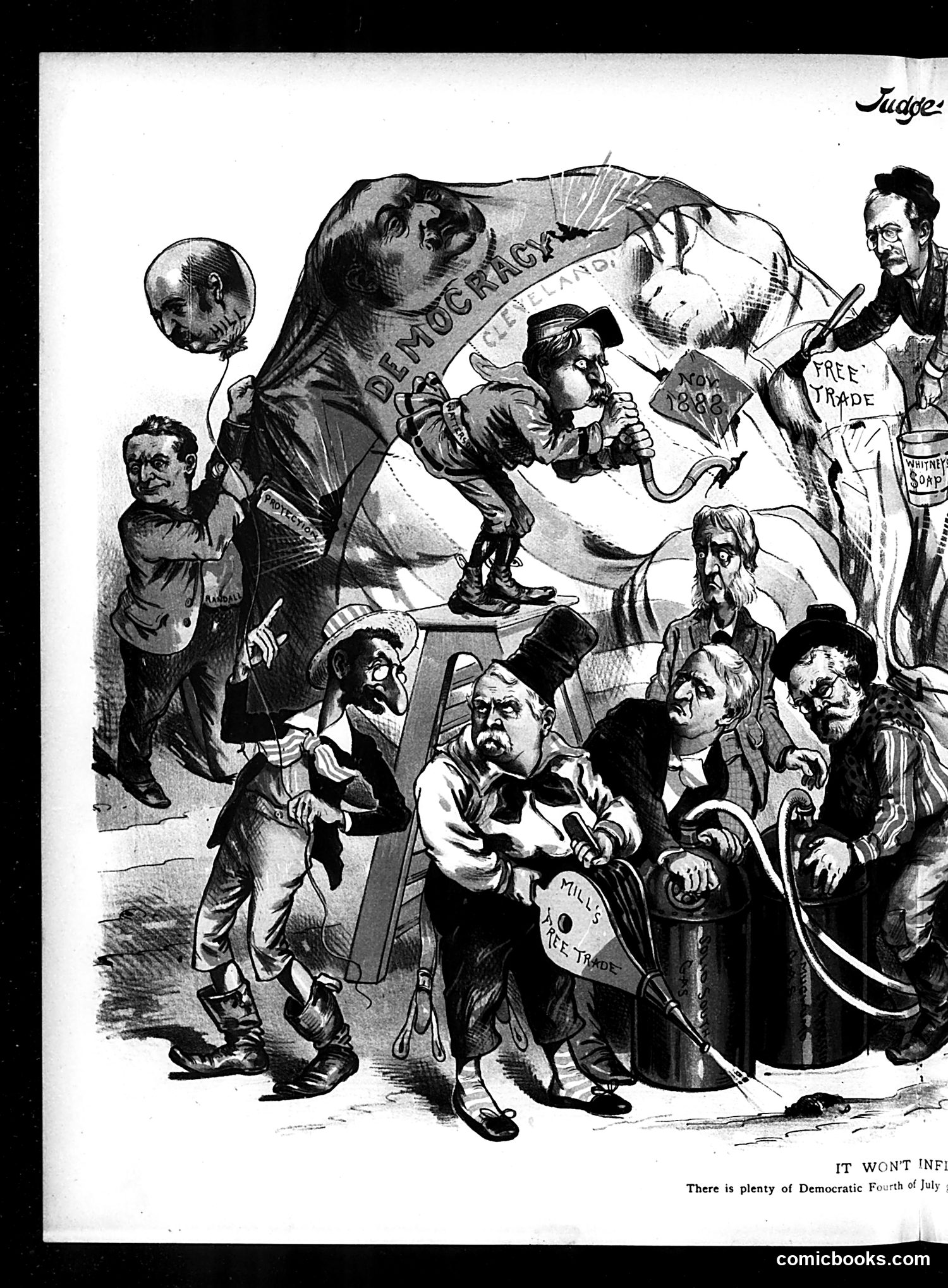
This appears to be a late 19th-century satirical cartoon from *Judge* magazine depicting Democratic Party infighting. A large figure labeled "DEMOCRACY" looms over a group of smaller men—likely representing Democratic politicians or factions—who are quarreling and pulling in different directions. Visible labels include "FREE TRADE," "PROTECTION," and "MILLS" (possibly referencing tariff policy debates), suggesting internal conflict over trade and economic policy. The caption "IT WON'T INFLATE / There is plenty of Democratic Fourth of July" sarcastically comments that Democrats have ample internal discord to celebrate—mocking their party divisions during a patriotic holiday. The cartoonist satirizes Democratic unity as illusory, with competing interests undermining the party.
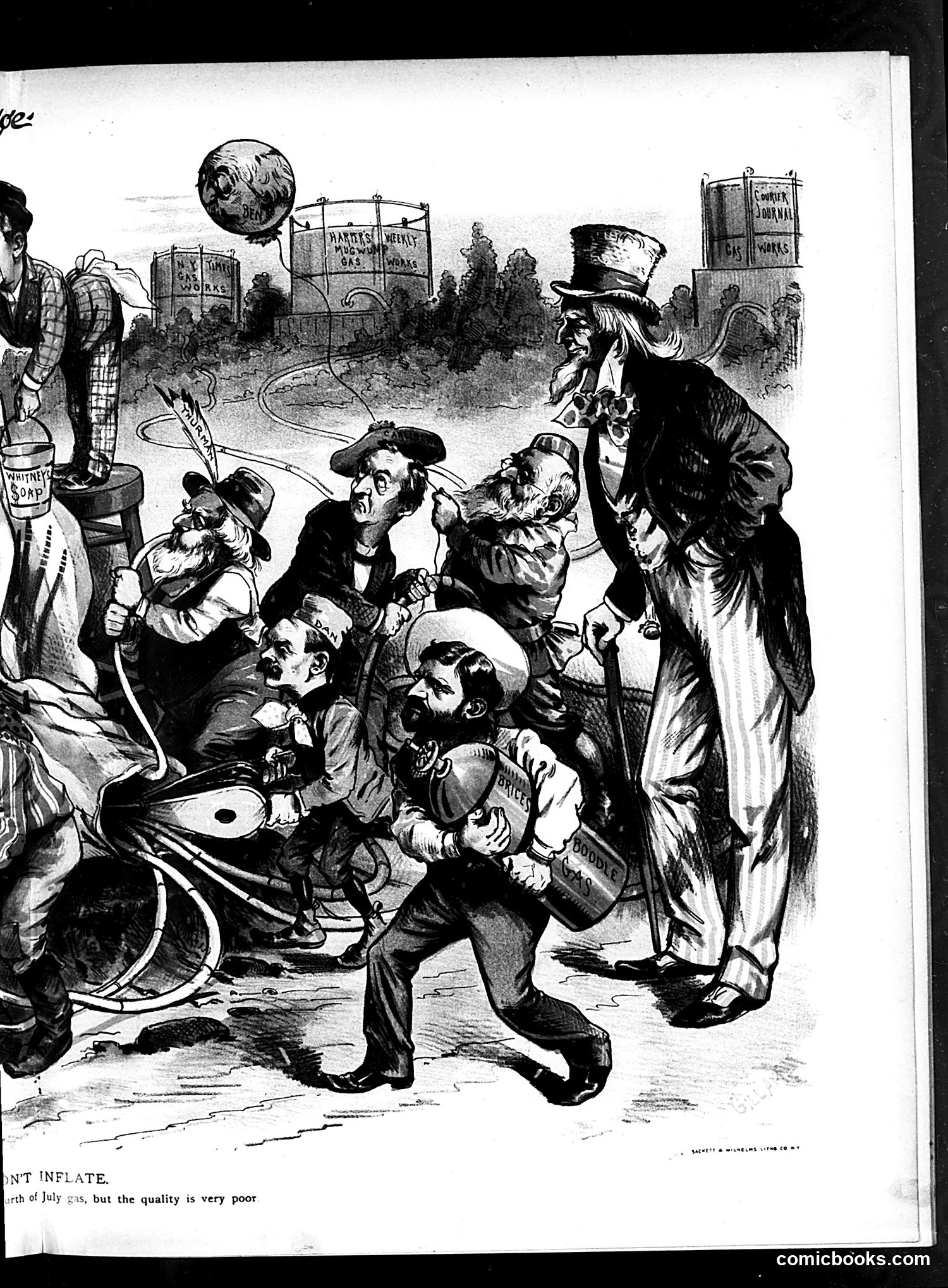
This political cartoon satirizes poor-quality Fourth of July celebrations or patriotic displays. The visible text references "Fourth of July gas" with "very poor" quality, suggesting the cartoon critiques hollow or inferior patriotism. The scene depicts well-dressed figures (likely politicians or wealthy elites) attempting to inflate a balloon or gaseous display while working-class men and children struggle below, appearing distressed or gasping. The large storage containers in the background labeled "works" suggest manufactured or artificial patriotic sentiment being mass-produced. The satire appears to mock the gap between elite proclamations of patriotism and the actual hardship experienced by ordinary citizens—suggesting that Fourth of July celebrations ring hollow when economic conditions remain poor for the working classes.
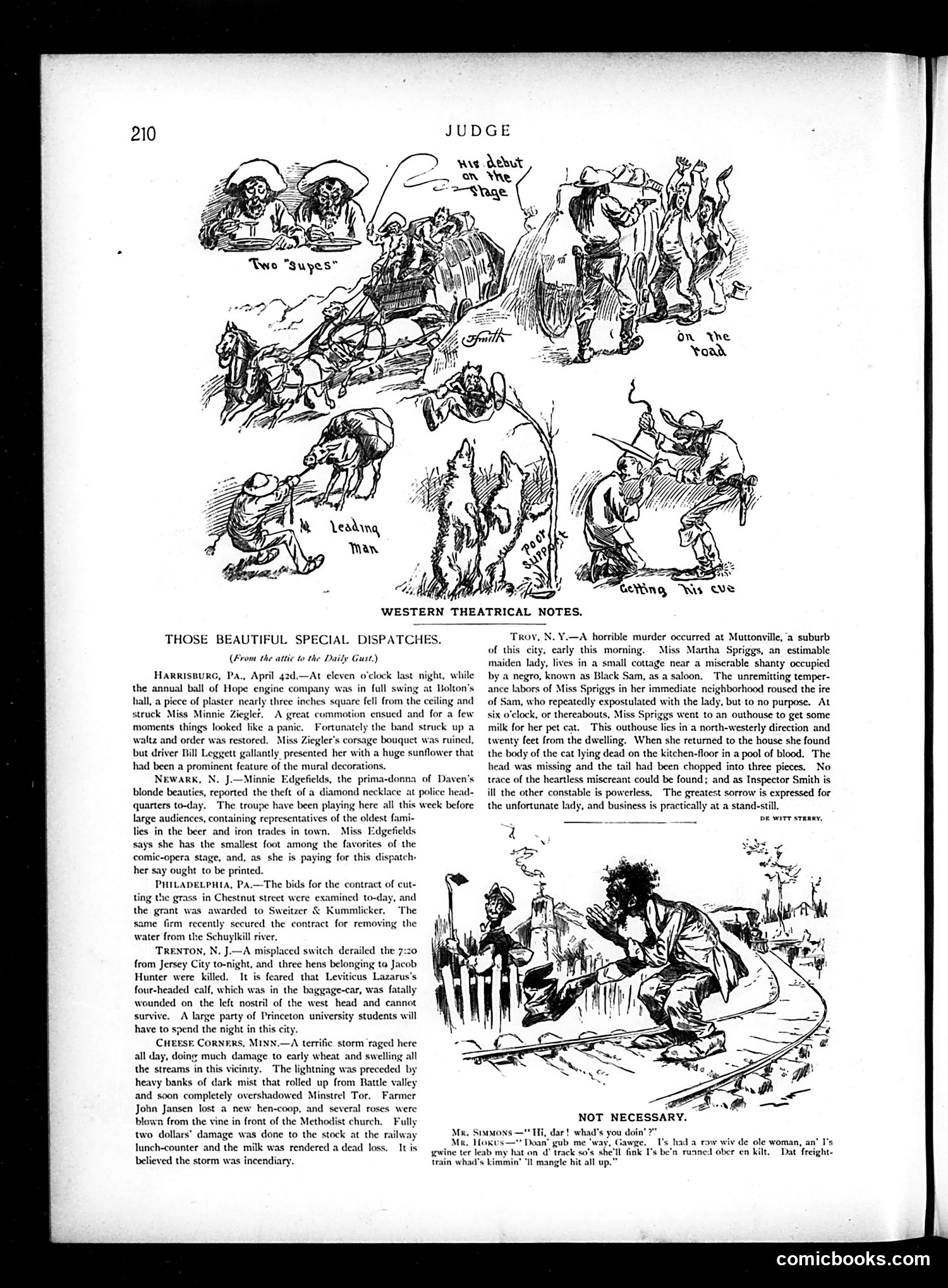
This page satirizes sensationalist newspaper journalism through mock "dispatches" from various cities. The cartoons and text mock how newspapers fabricated or exaggerated trivial incidents as major news stories. The dispatches ridicule this practice: a plaster chip falling at a dance becomes a dramatic "panic," a stolen necklace is reported by an opera singer who sneaks it into the story, and absurdly bureaucratic solutions (awarding grass-cutting contracts to a firm that previously "removed water from the Schuylkill River") expose municipal incompetence. The bottom cartoon depicts working-class dialect humor typical of the era—two men in a train accident scenario. The page mocks how newspapers sensationalized minor events while also reflecting period attitudes toward race, class, and immigrant speech patterns that modern readers would find offensive. The overall satire targets journalism's tendency toward exaggeration and fabrication.
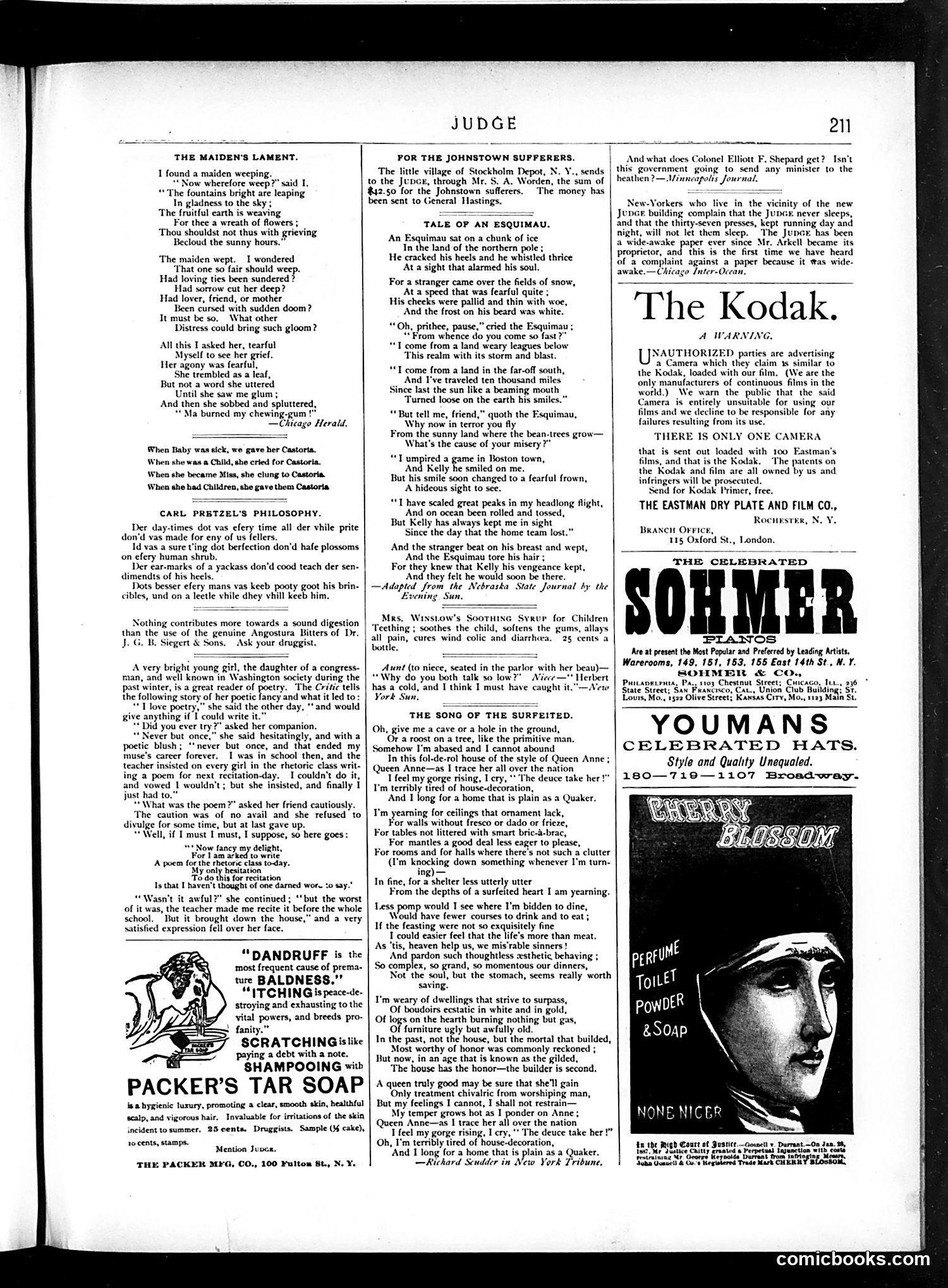
This page from *Judge* (a 19th-century American satirical magazine) contains primarily **poetry, humor columns, and advertisements** rather than political cartoons. The main content includes: - **"The Maiden's Lament"**: A humorous poem poking fun at melodramatic poetry conventions—a girl weeps dramatically, but her "tragedy" is merely that her mother burned her chewing gum. - **"Carl Pretzel's Philosophy"**: Ethnic humor featuring a German-accented character offering folksy wisdom (common in period humor). - **A story about a congressman's daughter** attempting to write poetry, satirizing both pretentious literary ambitions and the forced recitation exercises of schoolchildren. - **Charitable note**: Stockholm Depot, New York donated $12.50 to Johnstown flood sufferers (likely the 1889 Johnstown, Pennsylvania disaster). - **Multiple product advertisements**: Including Castoria (children's medicine), Packer's Tar Soap (hair/skin treatment), and Sohmer pianos. The page reflects period values: sentimental humor, ethnic comedy, and the integration of advertising with editorial content typical of late-19th-century magazines.
This poem satirizes the pretensions of the McKee family—likely referring to Baby McKee, grandson of President Benjamin Harrison (whose mother was a McKee). The satirist mocks the child's inflated status and supposed importance. The poem plays on the baby's royal connections: he's treated as royalty ("in his own right a king") because his grandfather is President and his grandmother was a queen. Yet the satirist repeatedly emphasizes the baby's actual insignificance—he's just a toddler playing with his toes ("little pink toeses") by the ocean at Cape May Point, a fashionable resort. The satire's point: despite his grand lineage and elevated social position, this baby is still just a baby, and no amount of aristocratic connection will protect him from life's ordinary disappointments ("your dreams, too, will break"). The grandiose language about his "porphyrogene" status contrasts absurdly with his innocent, simple play. It's mockery of American aristocratic pretension wrapped in seemingly sentimental verse.
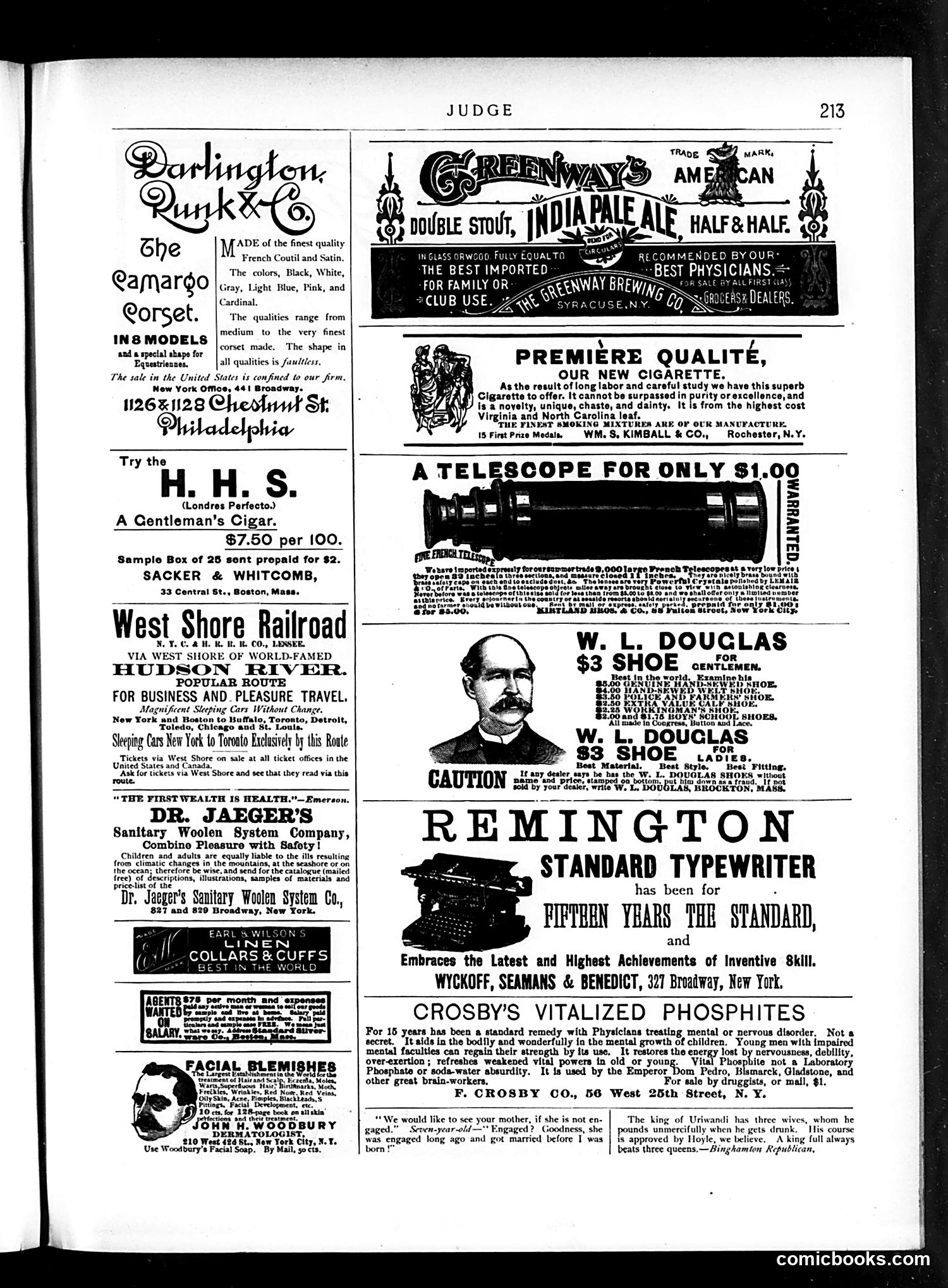
This page is primarily **advertising**, typical of Judge magazine's revenue model. The ads showcase late 19th/early 20th-century consumer goods: corsets, cigars, railroad service, shoes, typewriters, and patent medicines. The **humor content** is minimal—two brief jokes at the bottom: 1. A child's misunderstanding about "engagement" (betrothal vs. mechanical parts) 2. A crude racist joke about an African king's drinking and wife-beating, framed as poker humor ("a king full always beats three queens") The second joke reveals period attitudes: African rulers were depicted as comic stereotypes in American publications, and domestic violence was treated as comedic material. The advertisements reflect Gilded Age consumer culture and the dubious medical claims ("vitalized phosphites," "sanitary woolen systems") common to the era.
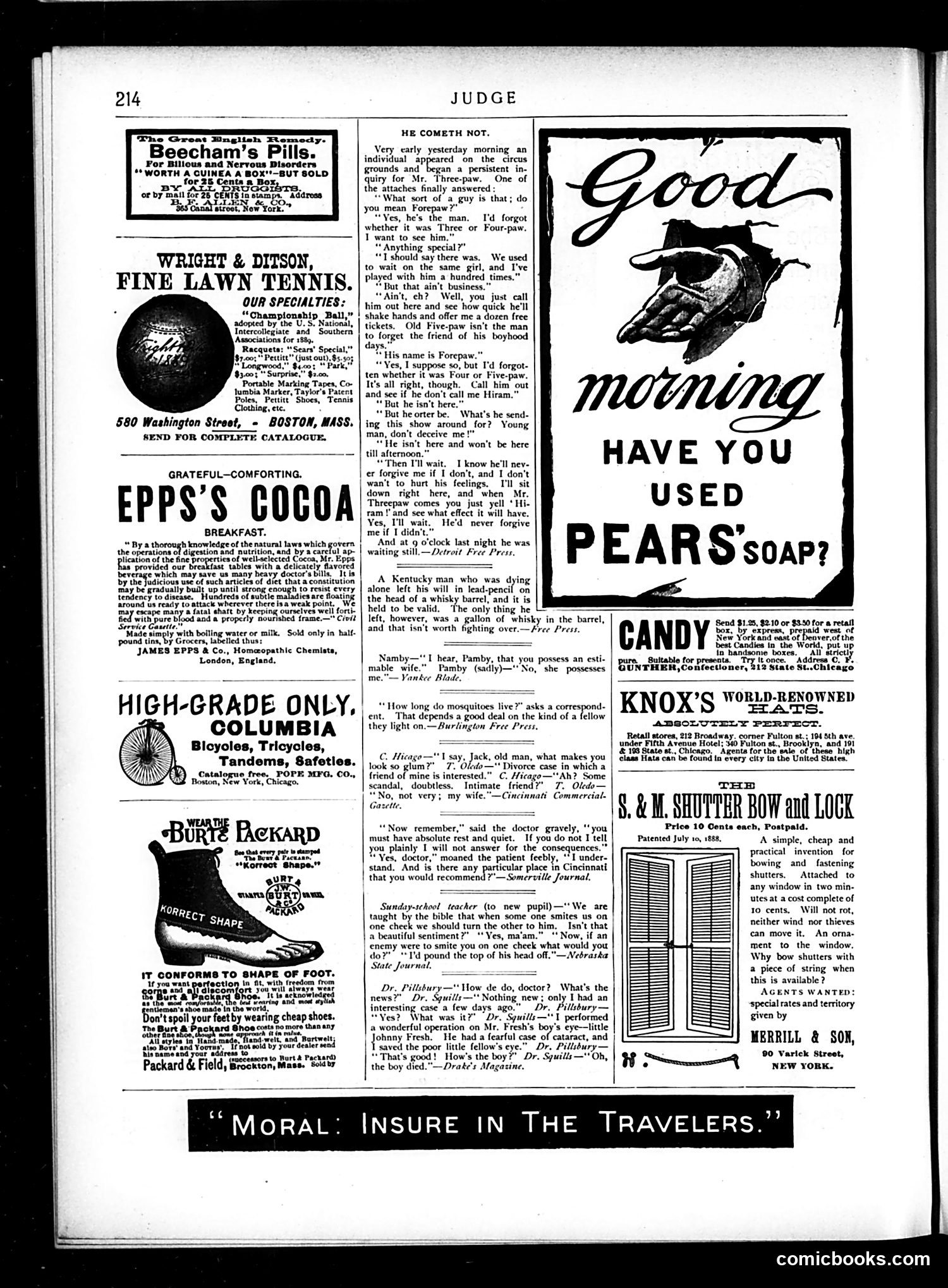
This page is primarily **advertisements** with minimal satirical content. The main pieces are: **"He Cometh Not"** - A humorous anecdote about a circus visitor seeking his childhood friend "Forepaw" (or "Three-paw"/"Five-paw"—he keeps forgetting). The joke relies on the visitor's persistence despite being told the man isn't there, and his refusal to accept this answer, insisting he'll wait all day. It's gentle humor about stubborn optimism and misremembered names. **The secondary anecdote** about a Kentucky man whose will written on a whisky barrel was deemed valid is a dark joke about frontier justice and the unexpected validity of unconventional documents. The bulk of the page consists of period advertisements for products (Beecham's Pills, tennis equipment, cocoa, bicycles, shoes, soap) typical of 1880s American magazines. The moral at bottom—"Insure in The Travelers"—is an insurance company plug. There is **no evident political satire** on this particular page.
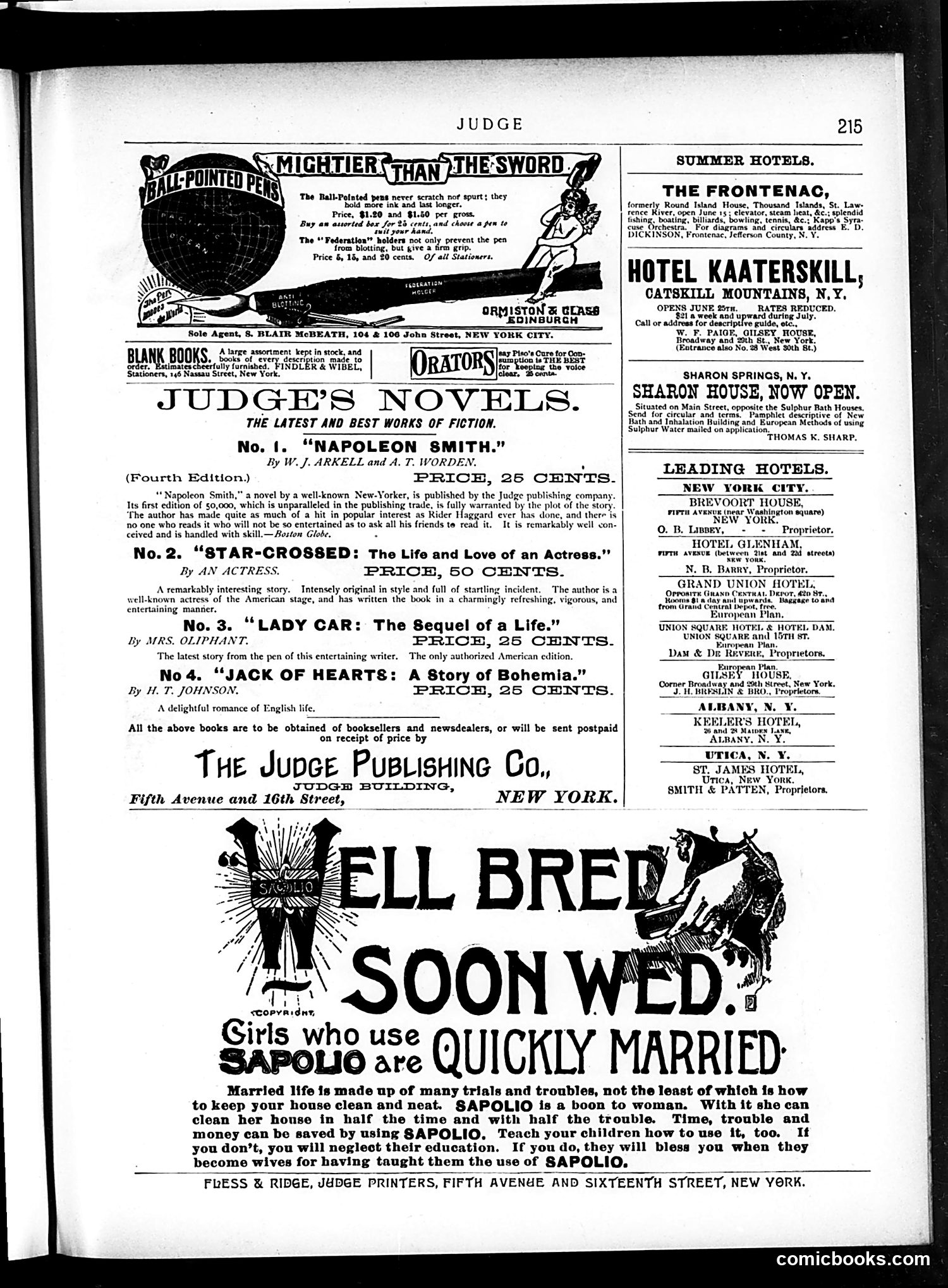
This page is primarily **advertising and promotional content** for Judge Publishing Company's books and various hotels and products. The top cartoon "**Mightier Than the Sword**" advertises **ball-pointed pens**—a relatively new innovation at the time. It depicts a large pen defeating or overpowering a sword, using the famous phrase to suggest that writing instruments are more powerful than weapons. This is straightforward product marketing rather than political satire. The bulk of the page advertises Judge's published novels (including "Napoleon Smith" and "Star-Crossed") and summer hotels in New York and nearby regions. The large advertisement at bottom promotes **Sapolio**, a cleaning product, using the slogan "Well Bred Soon Wed"—suggesting that girls who keep clean houses (using Sapolio) will marry quickly. This reflects Victorian-era gender expectations: a woman's housekeeping ability was presented as essential to marriage prospects. The page contains no political cartoons or social satire—it's essentially a **turn-of-century advertising section** of Judge magazine.
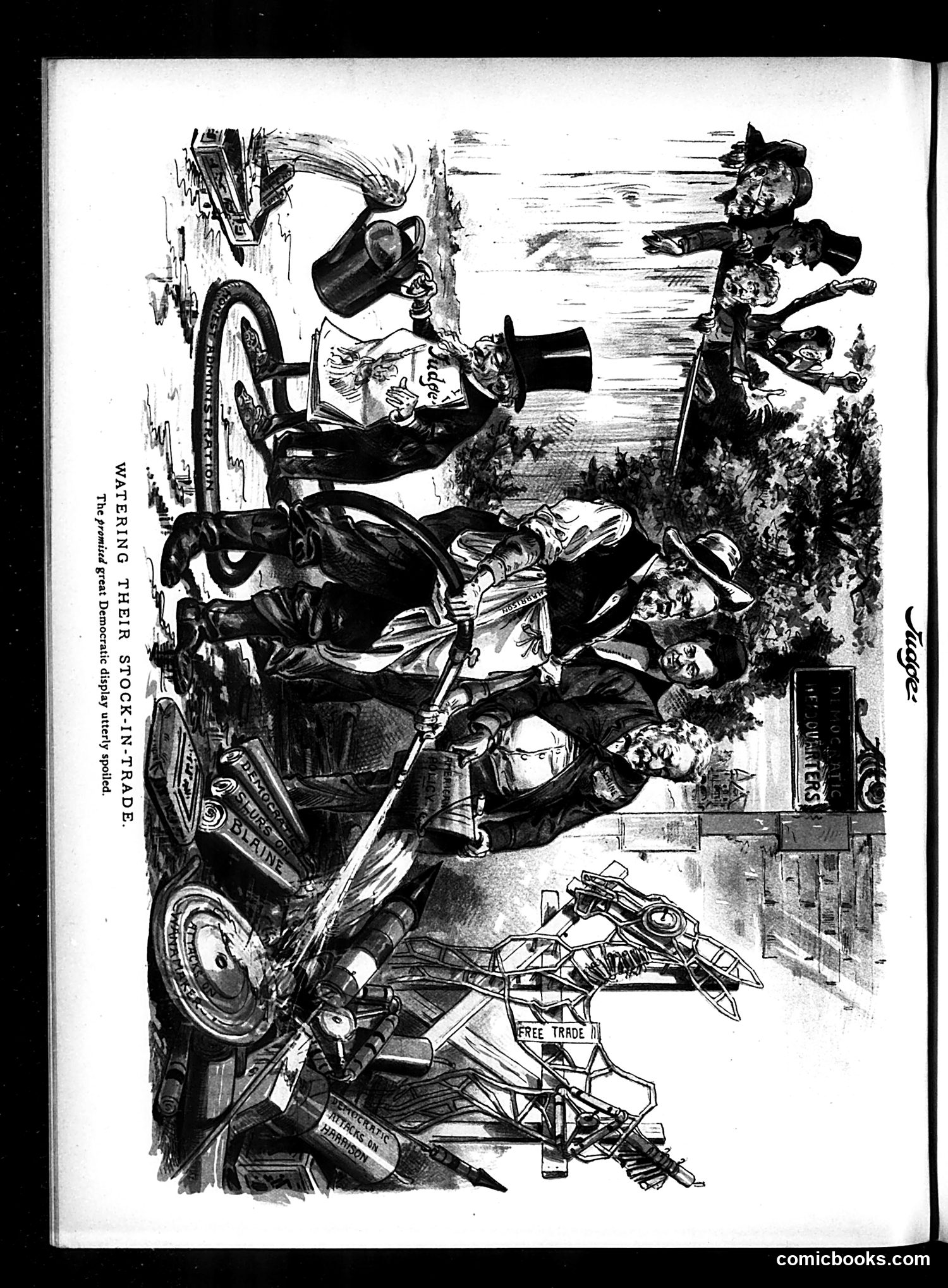
This **Judge** magazine cartoon satirizes Democratic Party leadership during what appears to be a major political event or convention ("the promised great Democratic display"). The title "Watering Their Stock" uses agricultural metaphor—referring to diluting livestock feed with water to deceive buyers about quality. The cartoon depicts Democratic figures pouring water (literally shown with buckets and pitchers) onto what the caption suggests represents their political promises or platform. The satire suggests Democratic leaders were deliberately weakening or compromising their stated positions to appear more moderate or acceptable to voters. The chaotic scene with multiple figures and scattered debris implies internal party dysfunction. Without visible date context, the specific event remains unclear, but the core message is clear: Democrats were accused of betraying their own principles through political compromise.