
Judge, 1889-07-06 · page 3 of 16
Judge — July 6, 1889 — page 3: what you’re looking at
What you’re looking at
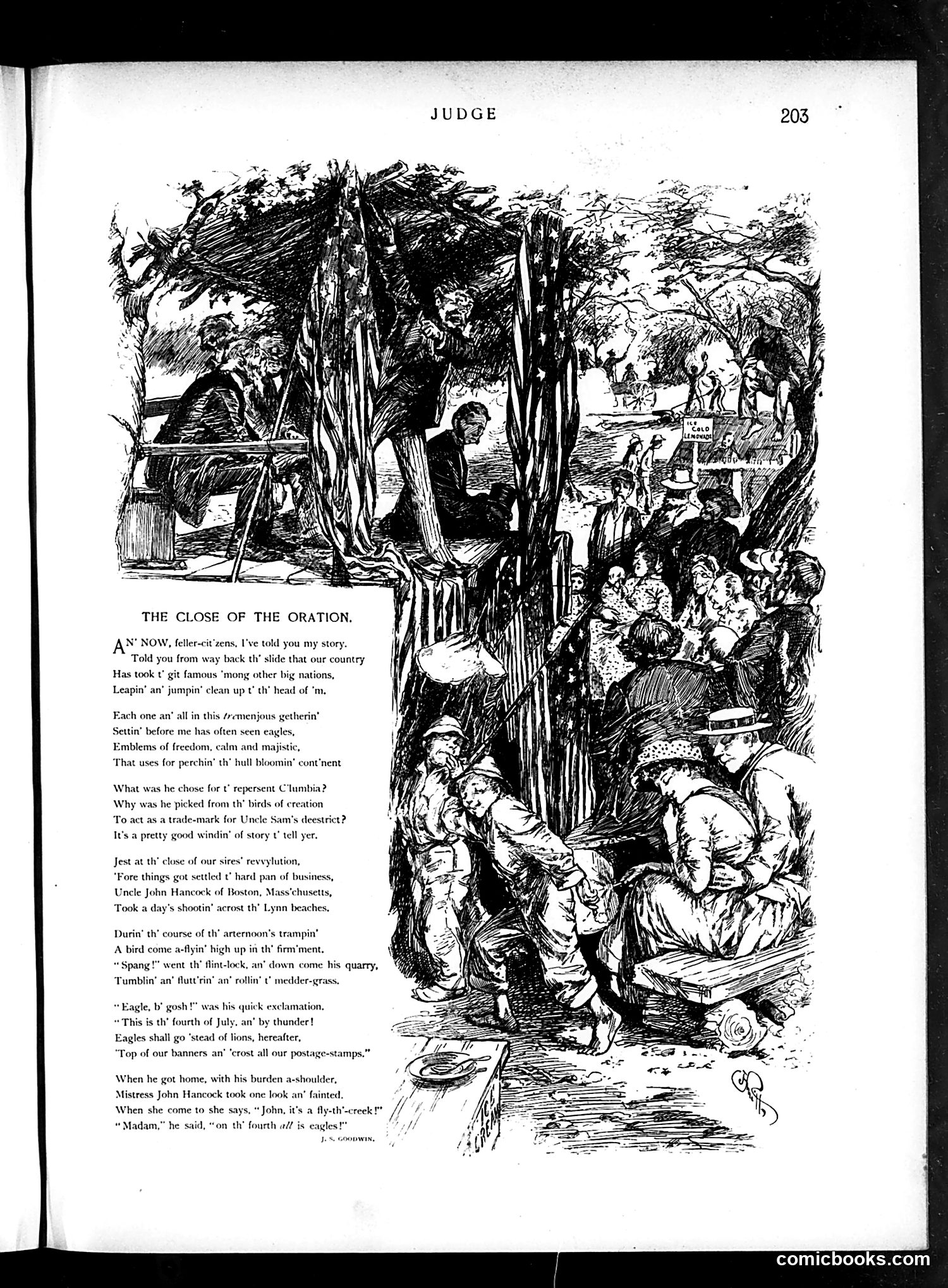
This page presents a tall tale explaining America's choice of the eagle as its national symbol. The narrative, delivered in exaggerated rural dialect, attributes the decision to John Hancock shooting an eagle on the Fourth of July during the Revolutionary War era. The satire mocks both patriotic mythology-making and the overwrought oratorical style of 19th-century political speeches. By presenting the eagle's adoption as a casual hunting accident rather than deliberate symbolism, the cartoon ridicules the grandiose narratives politicians constructed around American identity. The crude dialect and folksy framing suggest satire of populist political rhetoric—the speaker presents himself as an everyman explaining profound national matters in colloquial terms. The ornate illustration shows an outdoor gathering listening to this story, emphasizing Judge magazine's critique of how Americans consumed patriotic narratives through flowery speeches and invented historical anecdotes. The humor targets both the audience's gullibility and speakers' manipulation of patriotic sentiment.
📄 Transcribed text from this page (OCR, searchable)
Machine-transcribed from the original scan — historical spelling and the odd misread are preserved.
THE CLOSE OF THE ORATION. N' NOW, feller-cit’ ve told you my story. Told you from y k th’ slide that our country Has took t' git famous ‘mong other big nations, Leapin’ an’ jumpin’ clean up t th’ head of ‘m. Each one an’ all in this ¢remenjous getherin’ Settin’ before me has often seen Emblems of freedom, calm and maijist ‘That uses for perchin’ th’ hull bloomin’ cont’nent What was he chose for t" repersent Clumbia? Why was he picked from th’ birds of creation To act as a trade-mark for Uncle Sam's deestrict? It's a pretty good windin’ of story t' tell yer. Jest at th’ close of our sires’ revvylution, “Fore things got settled t' hard pan of business, Uncle John Hancock of Boston, Mass‘chusetts, Took a day's shootin’ acrost th’ Lynn beaches. Durin’ th’ course of th’ arternoon’s trampin’ A bird come a-flyin’ high up in th’ firm'ment. “Spang!” went th’ flint-lock, an’ down come his quarry, Tumblin’ an’ flutt'rin’ an’ rollin’ ' medder-grass, “Eagle, b’ gosh!" was his quick exclamation, “This is th’ fourth of July, an’ by thunder! Eagles shall go ‘stead of lions, hereafter, “Top of our banners an’ ‘crost all our postage-stamps.” When he got home, with his burden a-shoulder, Mistress John Hancock took one look an’ fainted. When she come to she says, “John, it's a fl “Madam,” he said, “on th’ fourth a// is eag! comicbooks.com