
A complete issue · 18 pages · 1889
Judge — May 25, 1889
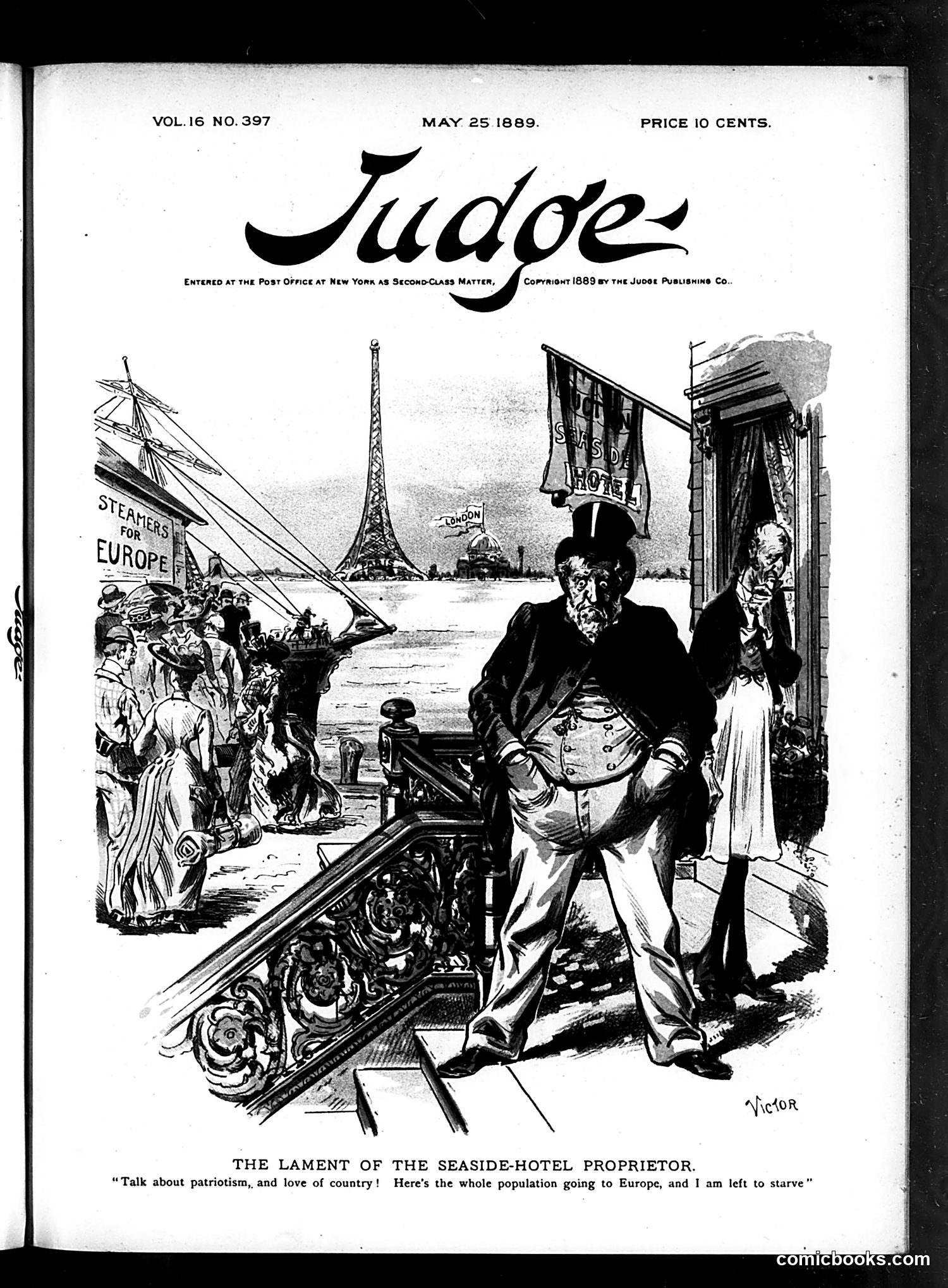
This 1889 cartoon satirizes a British hotel owner's complaint about mass emigration to Europe. The image shows a portly, well-dressed man at a seaside resort lamenting that patriotic talk of "love of country" rings hollow when the entire population is leaving for Europe—leaving him to "starve." The satire mocks the proprietor's hypocrisy: he invokes nationalism while his real concern is profit. The background depicts crowds boarding steamships bound for Europe, the Eiffel Tower visible across the water. The cartoon critiques how business interests clash with nationalist rhetoric, and suggests the emigration trend is so severe that even tourist industries suffer.
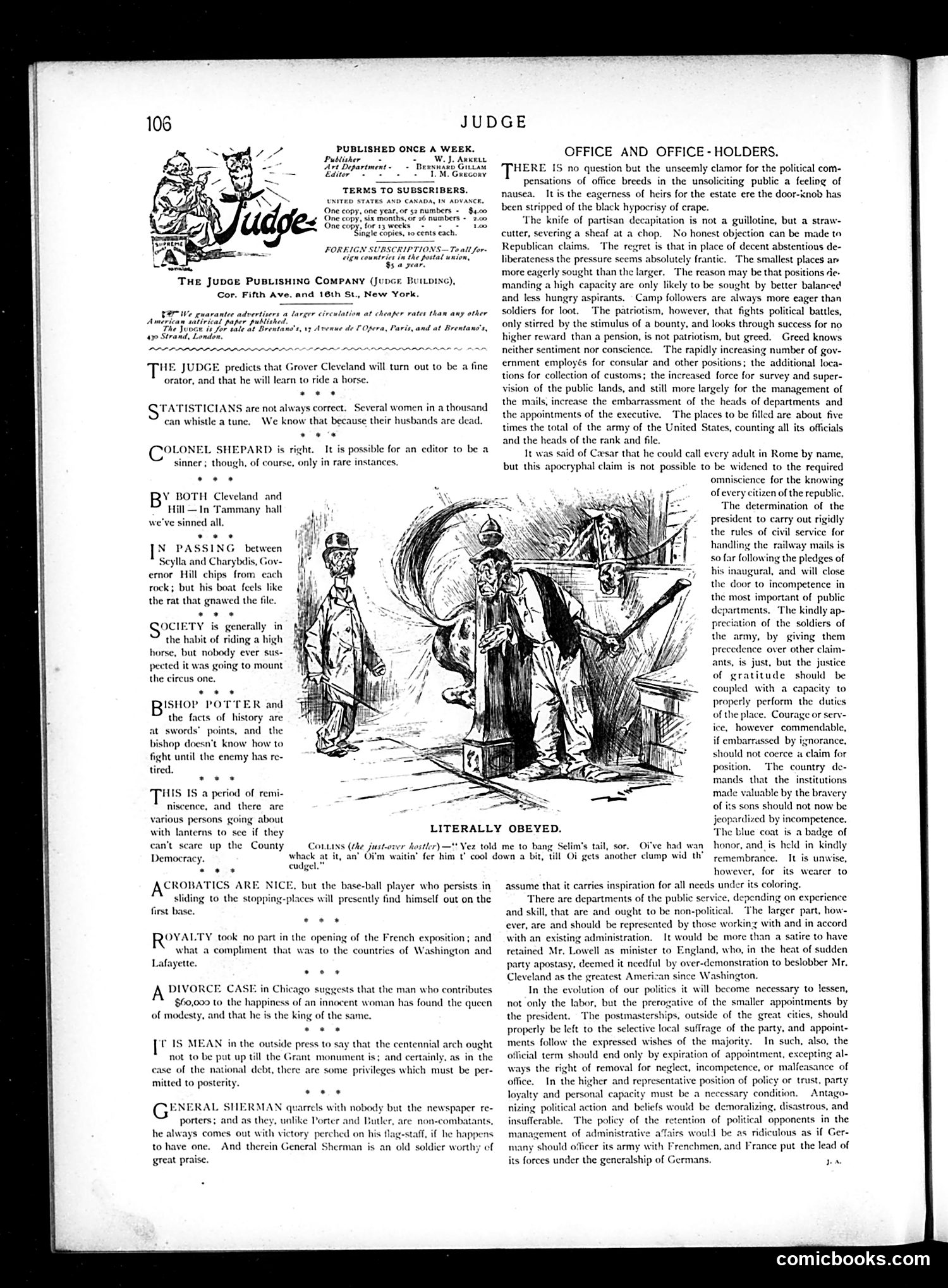
The page contains a satirical illustration titled "LITERALLY OBEYED" depicting what appears to be a military or law enforcement scene. A figure labeled "COLLINS (the jailer-bully)" is shown with another character, referencing a command to "hang Sellin's tail, sore" and "Ov'e had won what a feller lost till Oi gets another chop wid it." The accompanying article discusses civil service reform and political appointments, criticizing the practice of awarding government positions based on patronage rather than merit. It argues for professional, non-political administration and warns against incompetence in public service. The cartoon likely satirizes either literal or absurd interpretation of orders by government officials or military personnel. Without clearer context on "Sellin" or the specific incident referenced, the precise political target remains unclear.
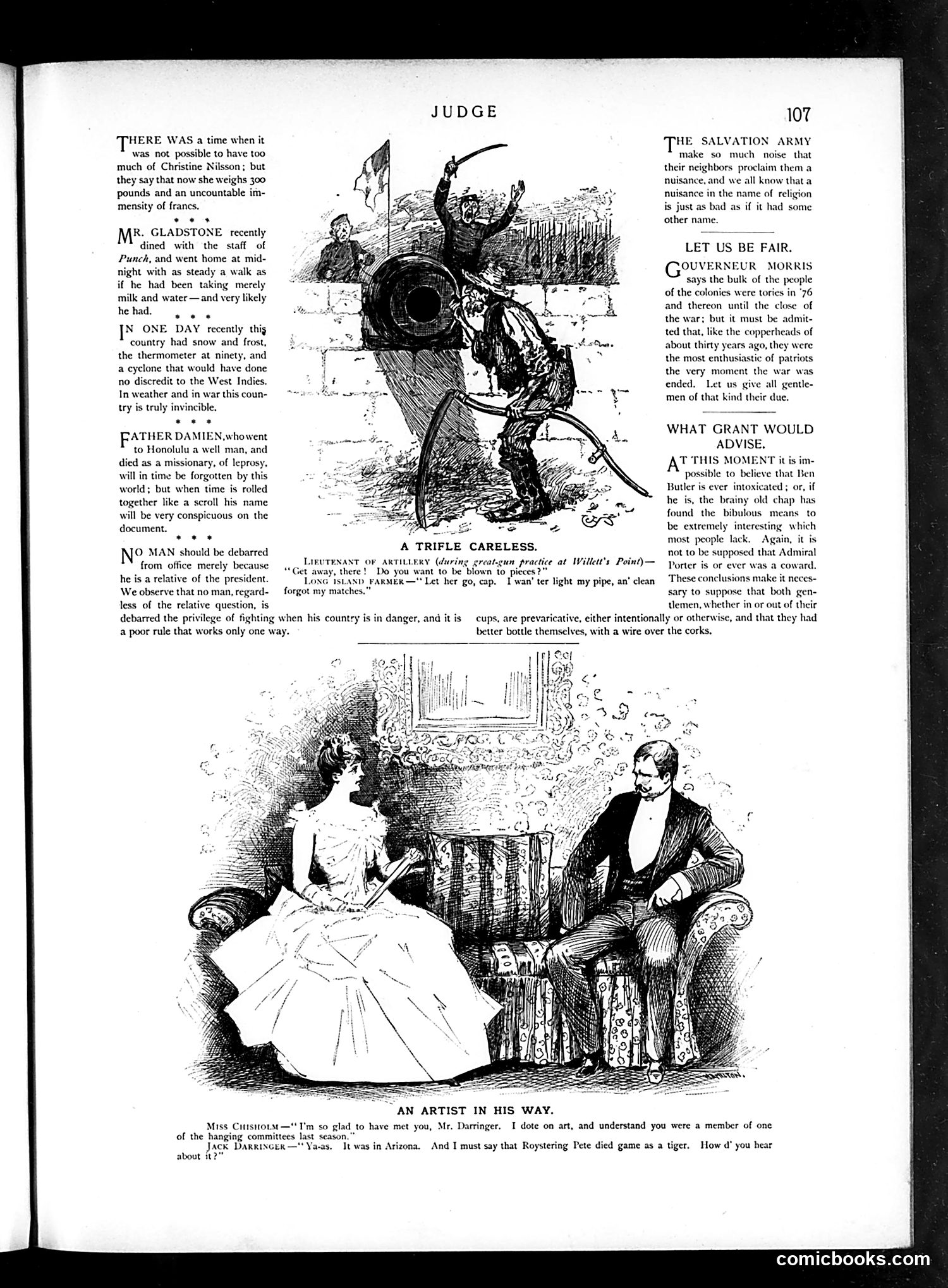
This page contains several brief satirical items typical of Judge's format: **Top cartoon ("A Trifle Careless"):** A farmer casually lights his pipe near an artillery officer conducting weapons practice, oblivious to the danger. The satire mocks rural carelessness and indifference to military operations. **Bottom cartoon ("An Artist in His Way"):** A woman congratulates a man on being a "hanging committee" member, misunderstanding "art" as execution rather than aesthetic creation. This appears to mock either actual executions or capital punishment practices of the era, presented as dark "art." **Text items** satirize contemporary figures: Gladstone's temperance, the Salvation Army's noise, Father Damien (a real missionary who died of leprosy), and military/political figures like Grant, Butler, and Porter. The magazine maintains a cynical, mordant tone throughout, using brief anecdotes and visual gags to comment on social and political absurdities of the period.
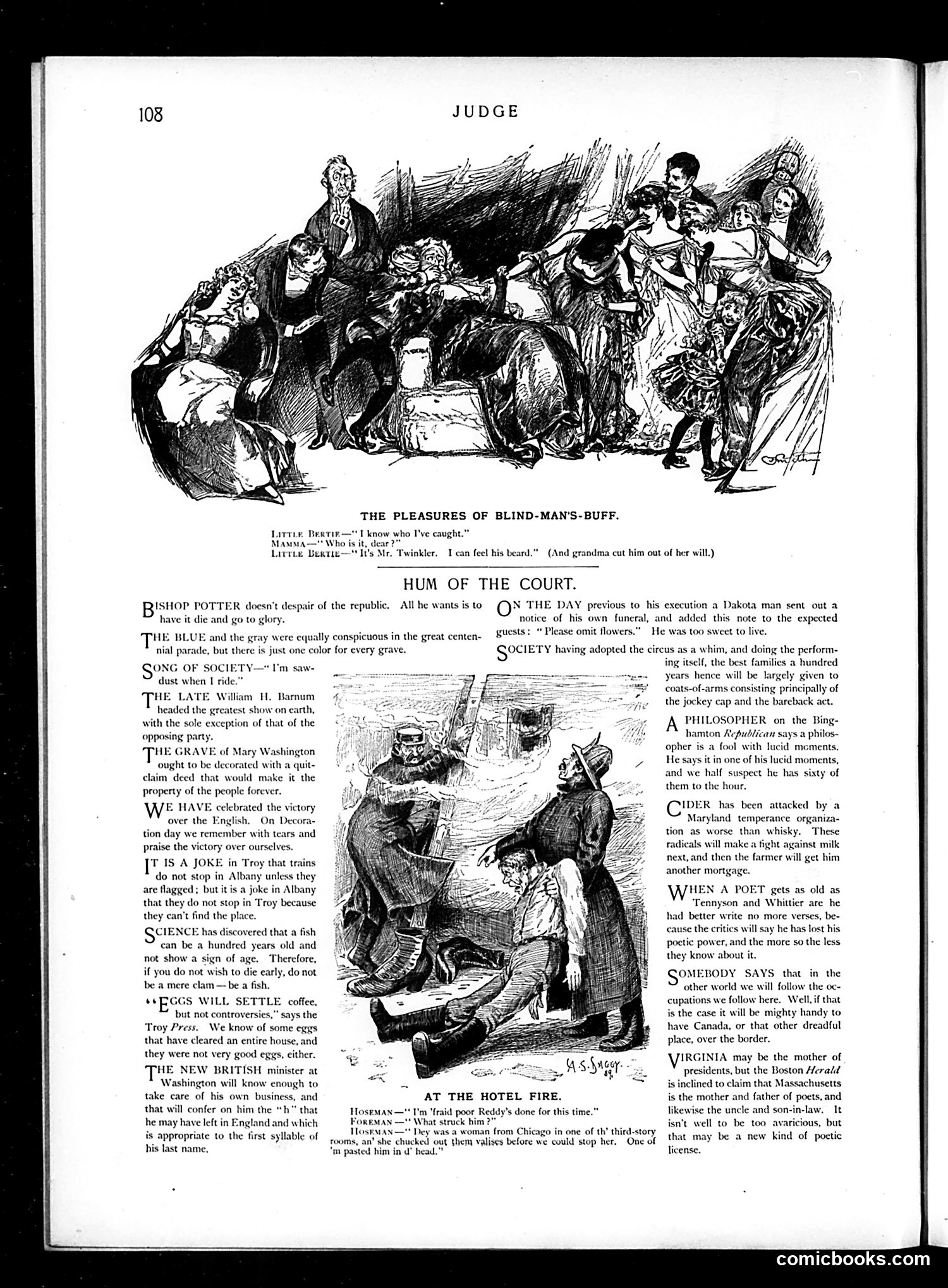
This page contains several satirical pieces mocking American politics and society of the late 19th century. **Top cartoon "Blind-Man's-Buff"**: A commentary on political confusion, depicting a chaotic game where participants cannot identify who they've caught—likely satirizing unclear political allegiances or the difficulty of distinguishing between political parties. **"Hum of the Court" section**: Short jokes and observations on various topics. Notable: Bishop Potter's indifference to the republic's fate; criticism of political corruption ("the grave of Mary Washington" should belong to the people); and jabs at Albany and Troy's train services, suggesting local incompetence. **"At the Hotel Fire"** (bottom illustration): A dark humor piece about a Chicago woman throwing luggage from a burning building, one piece striking a man in the head fatally. The pun: "He was too sweet to live." The page reflects Judge's typical satirical approach—combining political commentary with social observations and crude humor. The cartoons mock government inefficiency, moral hypocrisy, and contemporary scandals, though specific figures beyond Bishop Potter remain unclear without additional context.
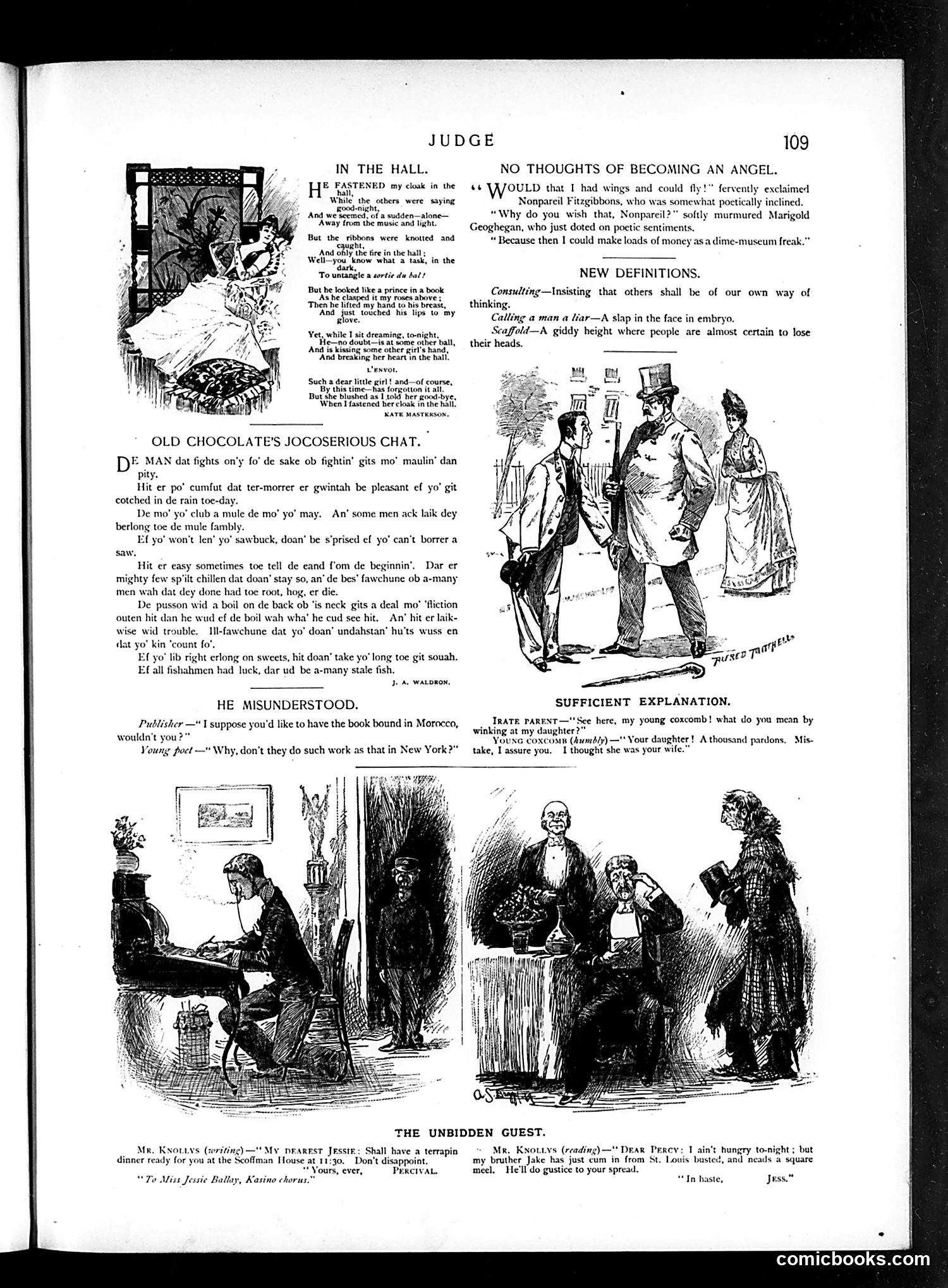
This page from *Judge* contains several satirical pieces typical of late 19th-century American humor: **"The Unbidden Guest"** presents the main joke: a gentleman invites his girlfriend "Jessie" to an expensive dinner at a fashionable restaurant, but she replies that her broke brother Jake has just arrived from St. Louis and will attend instead. The satire mocks both the unexpected intrusion of poor relatives into genteel social settings and the pragmatic priorities of women who prioritize family needs over romantic dinners. **"He Misunderstood"** is a brief joke about a publisher asking if a poet wants his book bound in Moroccan leather. The poet misinterprets "Morocco" as the country, not the material—satirizing either the poet's ignorance or the publisher's unclear diction. **"Old Chocolate's Jocoserious Chat"** presents dialect humor featuring an older Black character dispensing folksy philosophy, typical (though offensive by modern standards) of period entertainment. The remaining content includes sentimental poetry and humorous definitions mocking social pretension and romantic delusion.
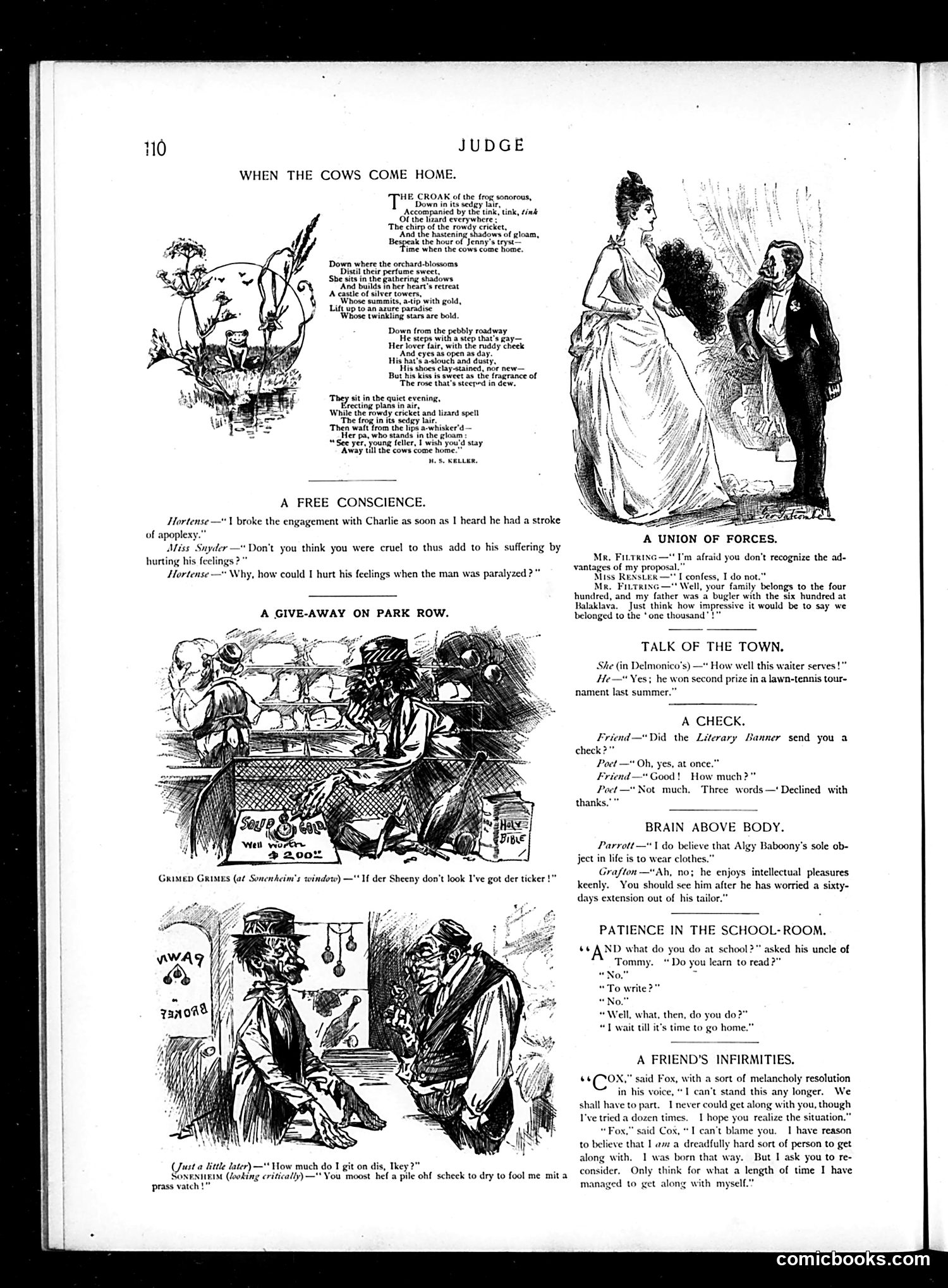
This page contains multiple brief satirical pieces typical of Judge magazine's humor: **"When the Cows Come Home"** is a sentimental poem about young romance, interrupted by a father's crude demand that the suitor leave—the joke being the contrast between romantic verse and blunt rural dialect. **"A Free Conscience"** mocks a woman's callous logic: she broke her engagement with a paralyzed man, claiming she couldn't hurt his feelings since he was already incapacitated—absurd reasoning presented deadpan. **"A Give-Away on Park Row"** (illustrated) appears to lampoon newspaper row gossip, though details are unclear from the OCR. **Social commentary pieces** include jokes about poets receiving rejection slips, a child admitting school means "waiting till it's time to go home," and a man explaining his difficult personality is innate. **"A Union of Forces"** references someone's ancestor at Balaklava (Crimean War), using old military credentials as social pretension. The humor throughout is light, domestic satire targeting romantic pretense, social climbing, and human foibles rather than political targets.
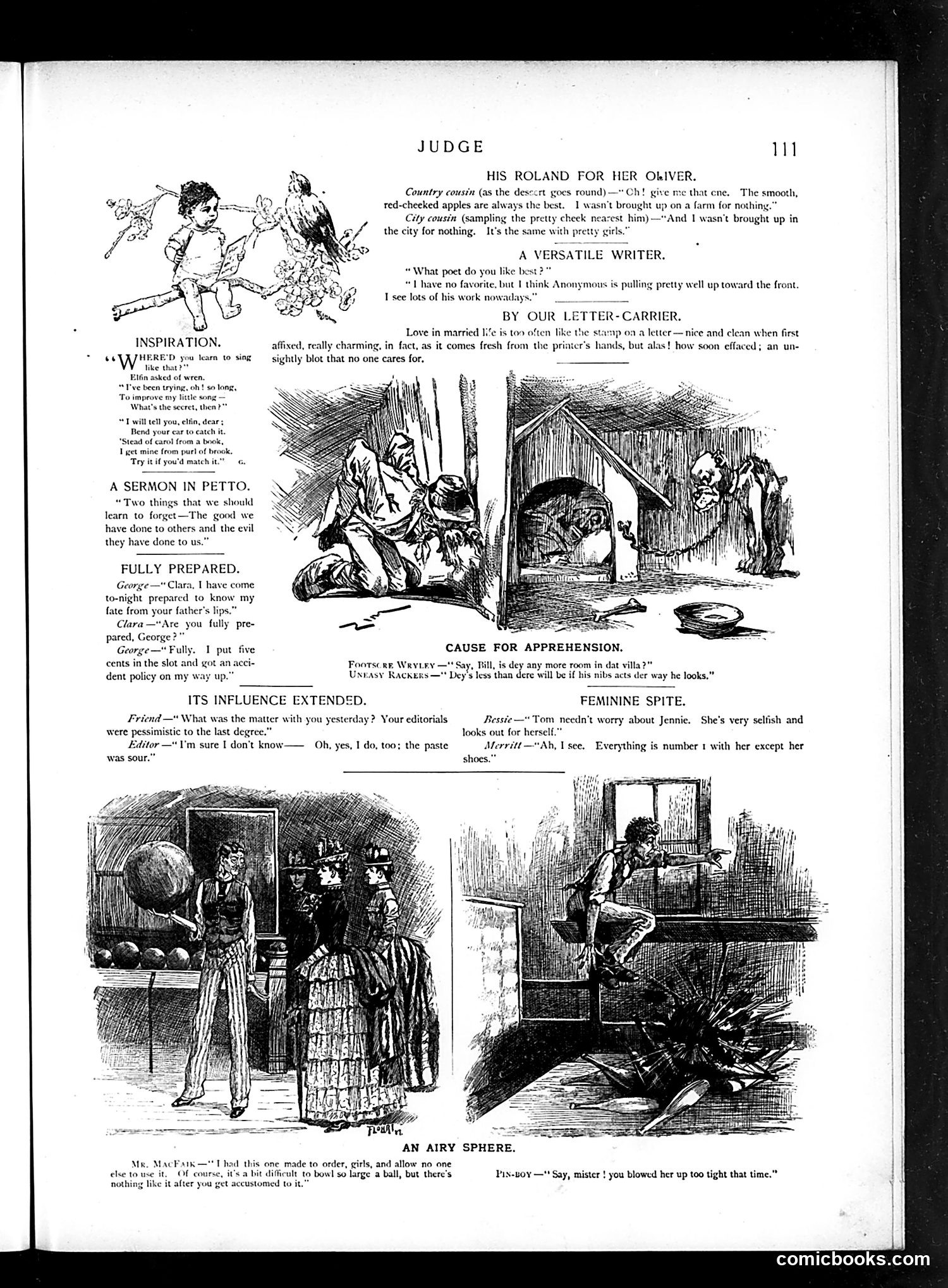
This page from *Judge* contains multiple brief satirical pieces mocking contemporary social conventions: **"His Roland for Her Oliver"** contrasts rural and urban courtship values—a country cousin prefers honest apples; a city cousin applies the same materialistic logic to "pretty girls," suggesting urban superficiality. **"A Versatile Writer"** jokes that "Anonymous" is the most prolific modern poet, likely mocking either plagiarism or the trend of unsigned newspaper contributions. **"Love in Married Life"** compares marriage to a letter: initially charming but gradually becoming worn and neglected—a commentary on domestic disillusionment. Other brief pieces target pretension ("Fully Prepared"), editorial pessimism ("Its Influence Extended"), and female vanity ("Feminine Spite" and "An Airy Sphere"). The sketches use working-class dialect ("Dey's less than dere") for comedic effect. Overall, the page reflects Victorian-era middle-class anxieties about authenticity, gender roles, and urban versus rural life.
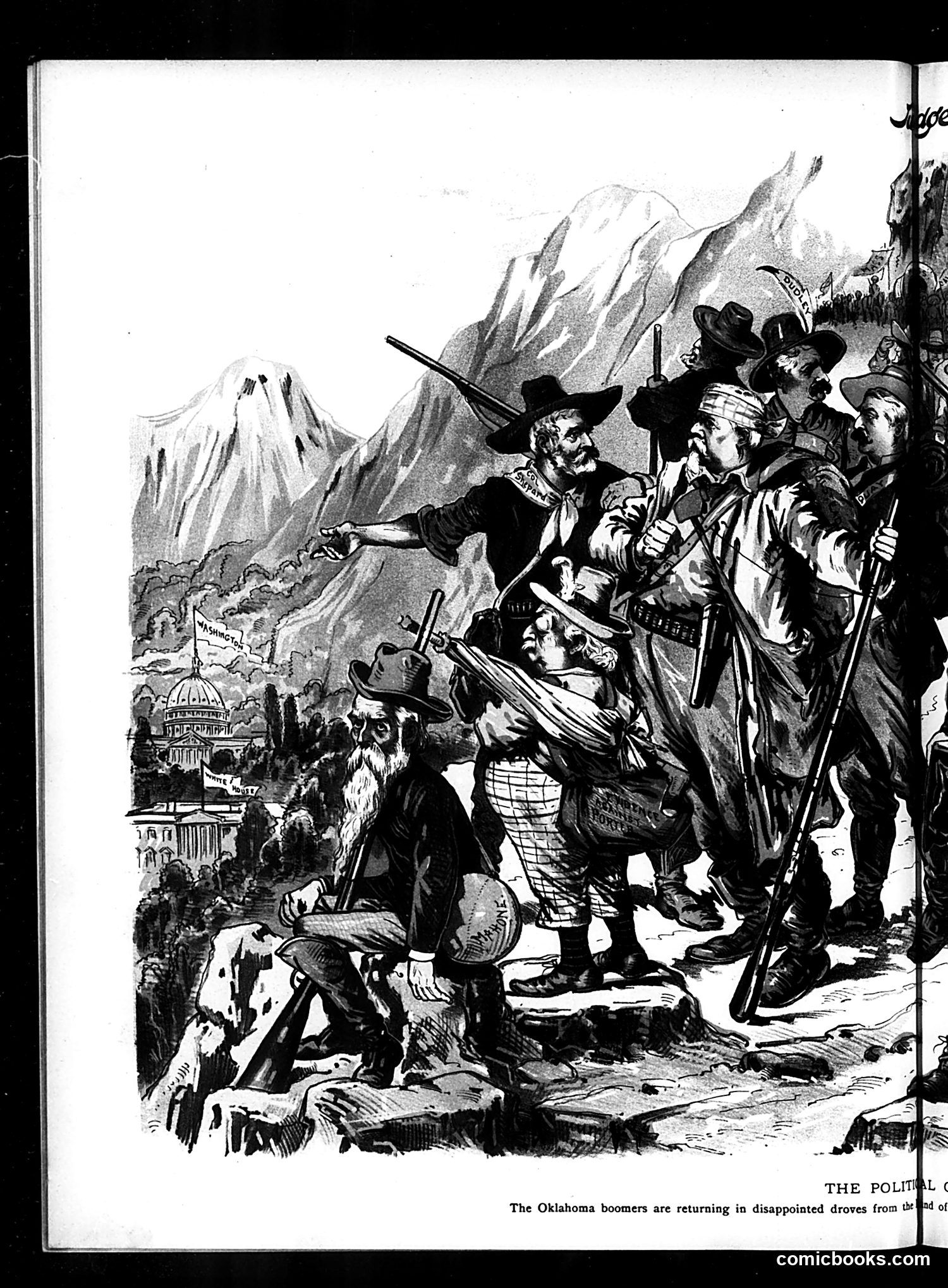
This engraving satirizes the **Oklahoma Land Rush** (likely 1889 or a subsequent run). The caption states: "The Oklahoma boomers are returning in disappointed droves from the...end of" The cartoon depicts settlers returning from Oklahoma in defeat, with mountainous terrain visible in the background and what appears to be a capitol building in the valley. The figures show frustrated, armed men trudging back—a stark contrast to the optimistic rush to claim free land that had driven them westward. The satire mocks the failed expectations of "boomers" who sought fortune in Oklahoma Territory. Rather than striking it rich, they're shown dejected and weaponless (surrendered arms), suggesting either conflict with Native Americans or simply the harsh reality that free land didn't guarantee prosperity. Judge uses this as social commentary on American expansionism and the gap between frontier mythology and actual experience.
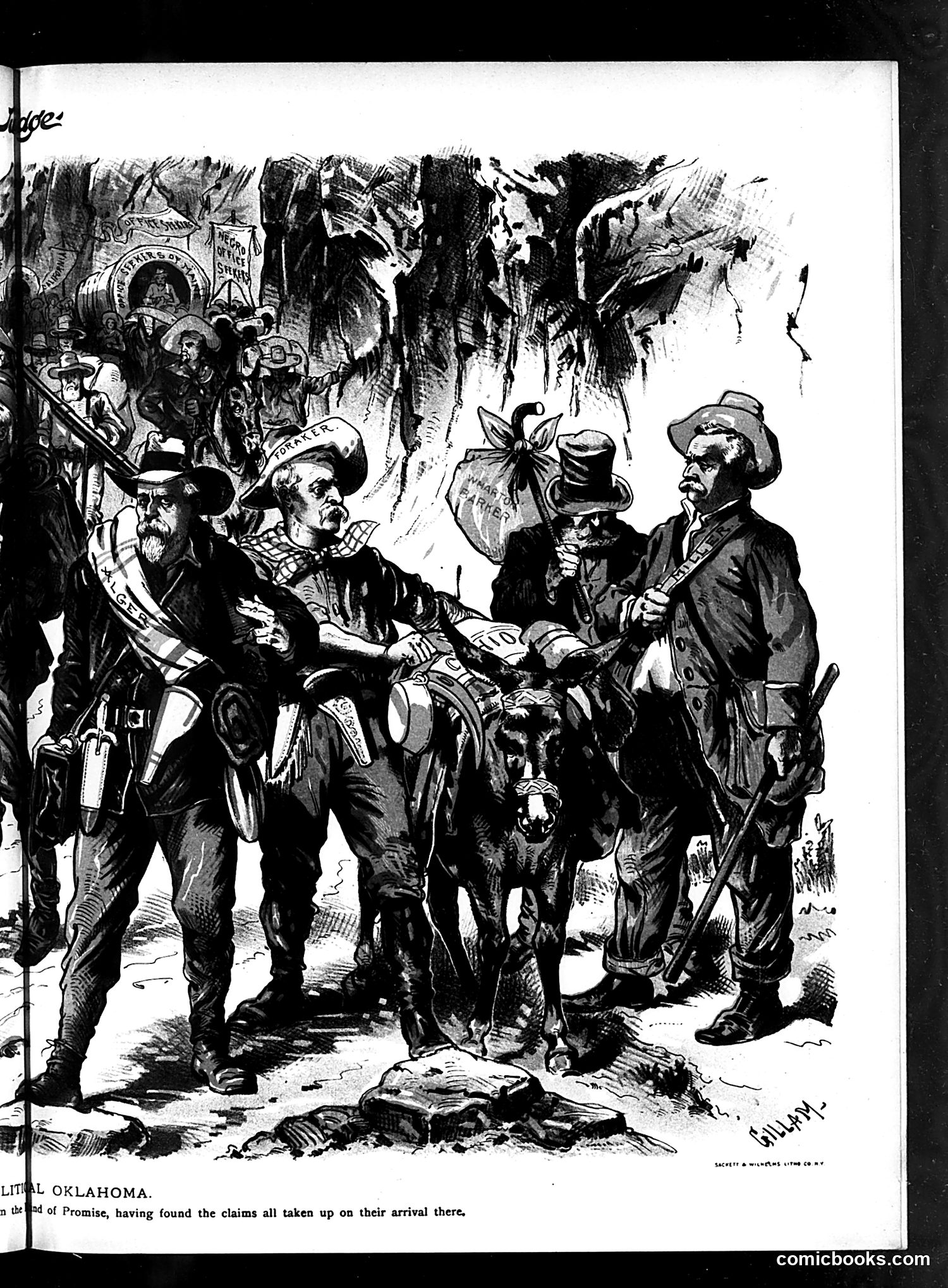
This satirical cartoon depicts the **Oklahoma Land Rush** — the 1889 event when settlers rushed to claim free government land in Oklahoma Territory. The image shows disappointed prospectors arriving to find all available claims already taken, despite the government's promise of abundant land for settlers. The four figures in the foreground represent different types of would-be settlers (identifiable by their varied clothing and hats), standing dejectedly with their possessions. The chaotic scene behind them shows the frenzied rush already underway, with people and horses in disarray. The satire is clear: the cartoon mocks the gap between the government's promotional promises ("Land of Promise") and harsh reality. For modern readers, it illustrates how westward expansion through land grants often disappointed ordinary people, with the best claims monopolized by those with advantages or those who arrived first.
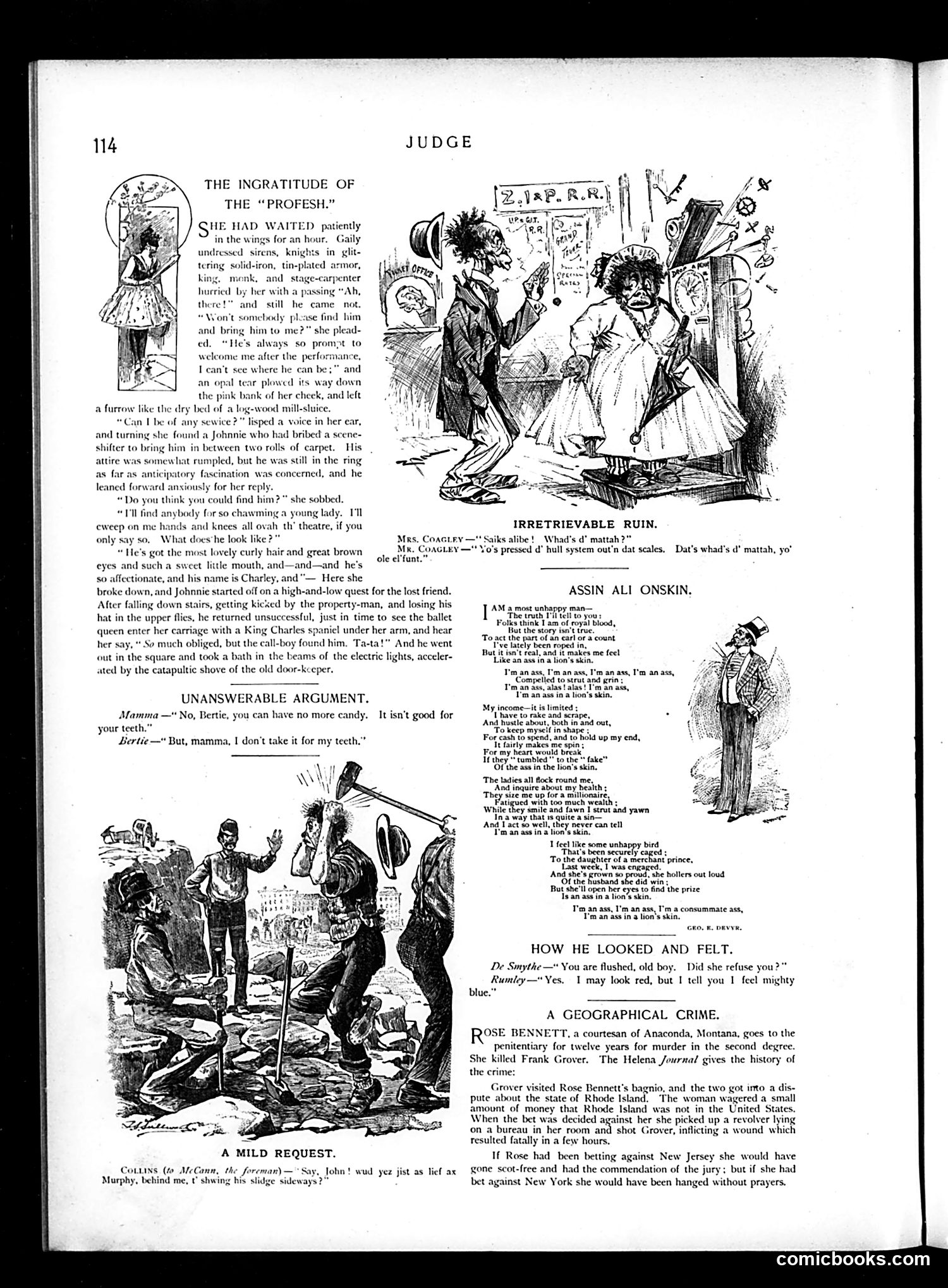
This page contains several satirical sketches typical of late 19th/early 20th-century American humor: **"The Ingratitude of the Profesh"** mocks theatrical performers' supposed ingratitude. A stage actress waits for a gentleman caller after a performance, but he never arrives—he's actually taken the lead actress home instead. The joke satirizes theater-world priorities and romantic fickleness. **"Irretrievable Ruin"** features two characters (appears to be working-class figures) discussing a broken scale—likely mocking mechanical failures or incompetence. **"Assin Ali Onskin"** is a poem about someone pretending to be nobility ("lion's skin") while actually being an "ass"—a commentary on social pretense and class fraud. **"A Geographical Crime"** describes a murder in Montana committed during an argument about Rhode Island's location—the satire ridicules that such a trivial geographical dispute led to serious violence, mocking both Western roughness and human irrationality. The sketches collectively represent Judge's characteristic irreverent humor targeting social hypocrisy, theatrical affectation, and human absurdity.
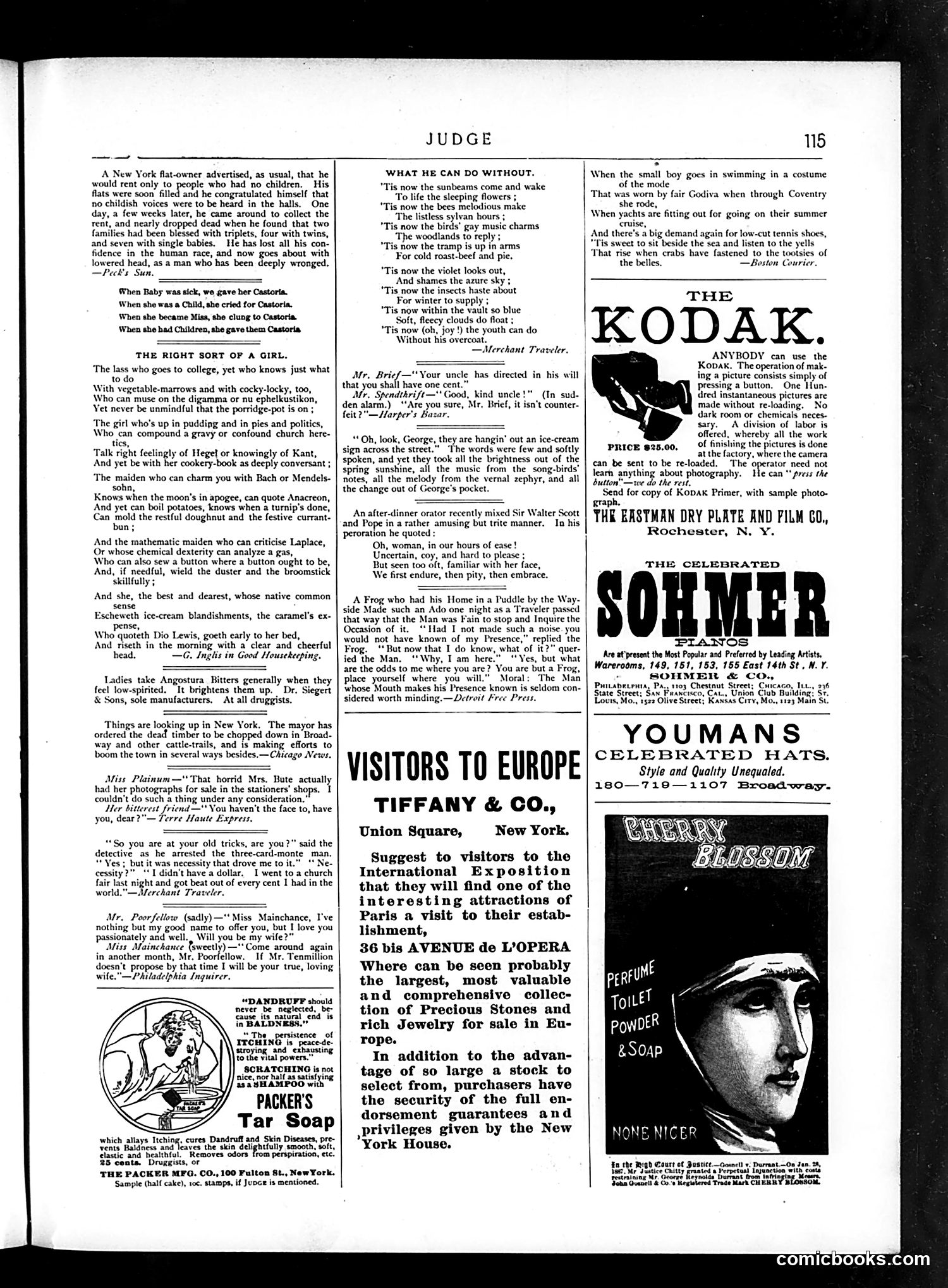
This page combines satirical commentary with period advertisements. The main content includes: **"The Right Sort of a Girl"** — A lengthy poem sarcastically praising the "ideal" woman as someone simultaneously educated (understanding classical philosophy, mathematics, chemistry) *and* domestically skilled (cooking, cleaning, sewing). The satire mocks the impossible standard imposed on women: they must master both intellectual pursuits and household labor equally well. **Other brief humor pieces** mock: - A landlord who forbade tenants from having children, only to find they lied - A young man inheriting one cent (commenting on miserly relatives) - A couple's joy at spring ruined by an ice-cream vendor's sign (poking fun at frivolous spending) **The advertisements** (Kodak, Sohmer pianos, Tiffany & Co., Youmans hats) represent typical Judge magazine content—luxury goods marketed to affluent readers. The page reflects turn-of-the-century tensions around women's education, gender roles, and consumer culture among the American middle and upper classes.
This page is primarily **advertising** with a small section of **satirical commentary** titled "Carl Pretzel's Philosophy." The advertisements promote patent medicines and consumer goods typical of the era: Allcock's Porous Plasters for sudden pains, Crosse & Blackwell jams, Liebig's meat extract, and Dennin's cure for rheumatism and gout. The satirical content includes brief philosophical observations attributed to "Carl Pretzel" (a German-accented character, evident from dialect spellings like "yoost" and "dond"). The commentary mocks politicians and mugwumps (reform-minded Republicans who switched parties). A Kansas City newspaper is quoted dismissing mugwumps as only useful during elections. Below are short book reviews and humorous anecdotes about travelers and hotel-keepers—typical light humor for a satirical magazine. The page reflects late 19th-century concerns: health remedies, political reform movements, and genteel leisure reading.
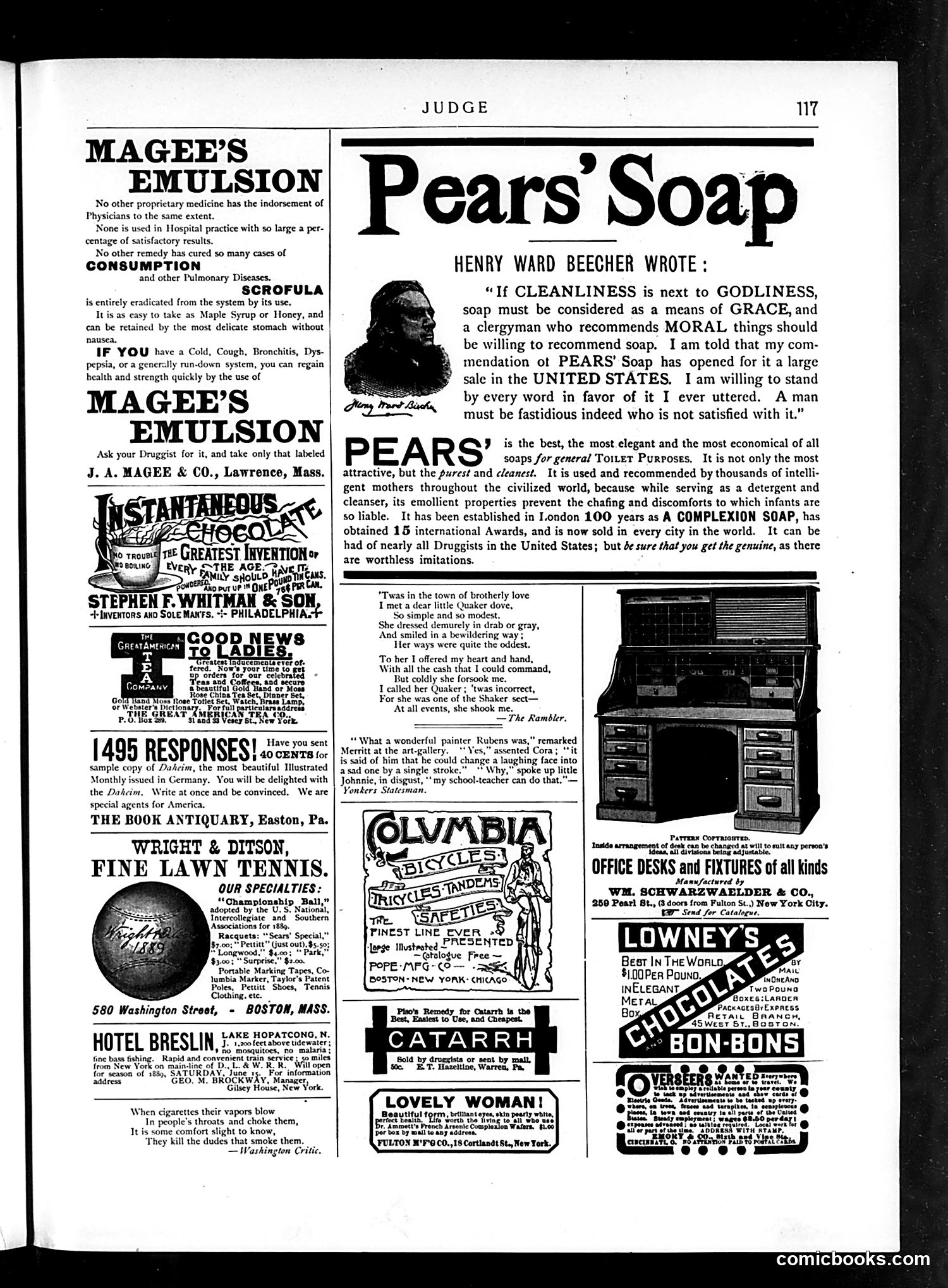
This page is primarily **advertising**, not satirical content. The dominant feature is a large Pears' Soap advertisement quoting preacher Henry Ward Beecher endorsing the product as a moral necessity ("cleanliness is next to godliness"). The page contains numerous patent medicine and consumer product ads typical of late-19th-century magazines: Magee's Emulsion (claimed cure for consumption and scrofula), Whitman's chocolate, lawn tennis equipment, and office furniture. Two brief humorous verses appear: one mocking cigarette smokers as "dudes," and another about a romantic rejection by a Shaker woman ("she shook me"—a pun). These are light social humor rather than political satire. There's no significant political commentary or social criticism visible. This represents how Judge balanced satirical editorial content with lucrative advertising revenue—a common magazine practice of the era.
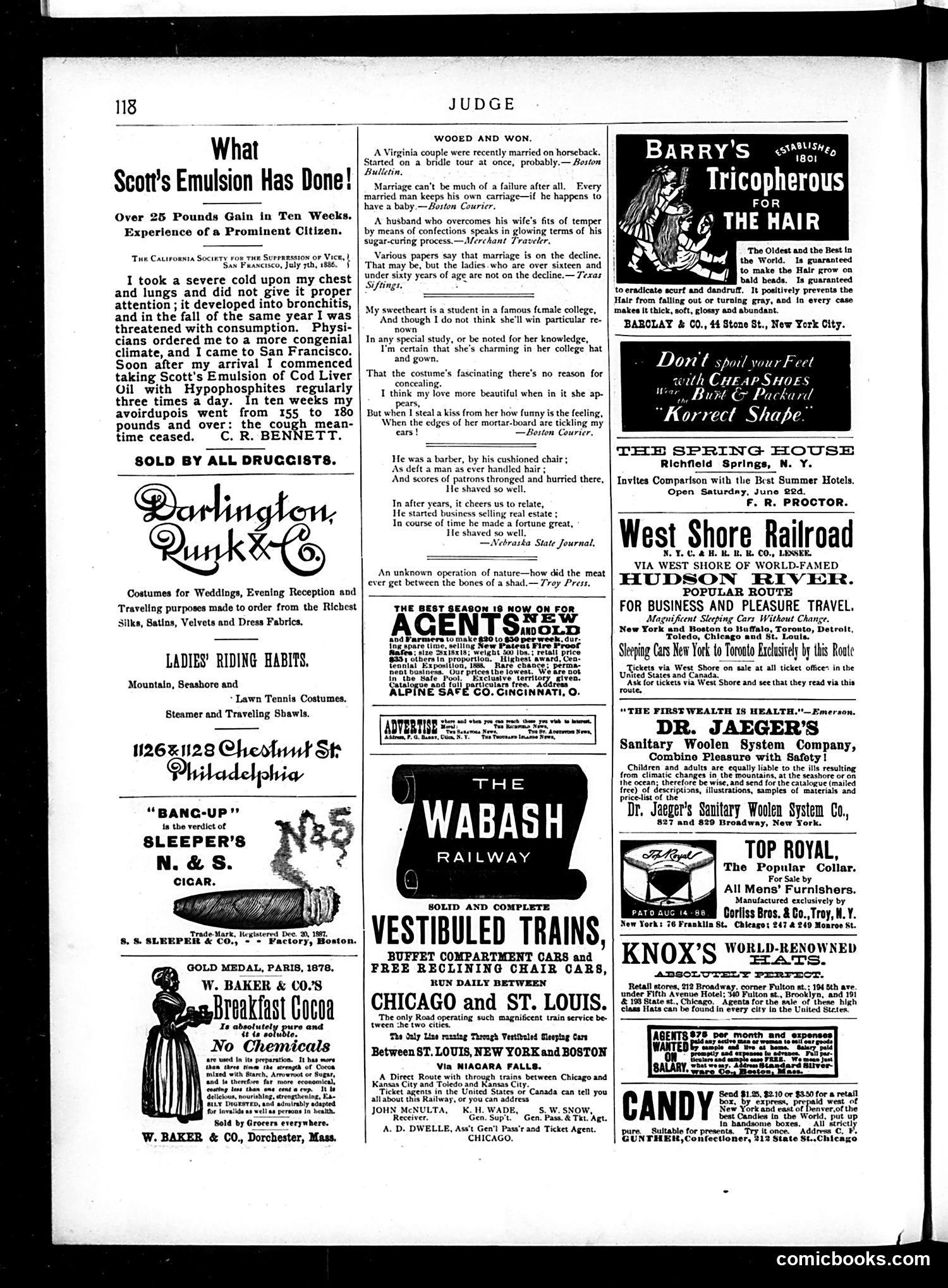
This page is primarily **advertising** with minimal editorial content. The dominant feature is a testimonial advertisement for Scott's Emulsion (a cod liver oil product), claiming a man gained 25 pounds in ten weeks while recovering from bronchitis—typical patent medicine marketing of the 1880s. The small section titled "WOOED AND WON" contains brief satirical quips about marriage, including jokes about married men keeping carriages (because of babies), a husband using "sugar-curing" (candy/confections) to manage his wife's temper, and a humorous poem about a college girl's mortarboard tickling during kisses. These are light, domestic humor typical of the era—poking fun at marriage conventions and courtship rituals rather than addressing serious social issues. The remaining space features period advertisements for railroads (Wabash Railway), clothing, cocoa, cigars, and other products. No political cartoons or significant satirical content appears on this page.
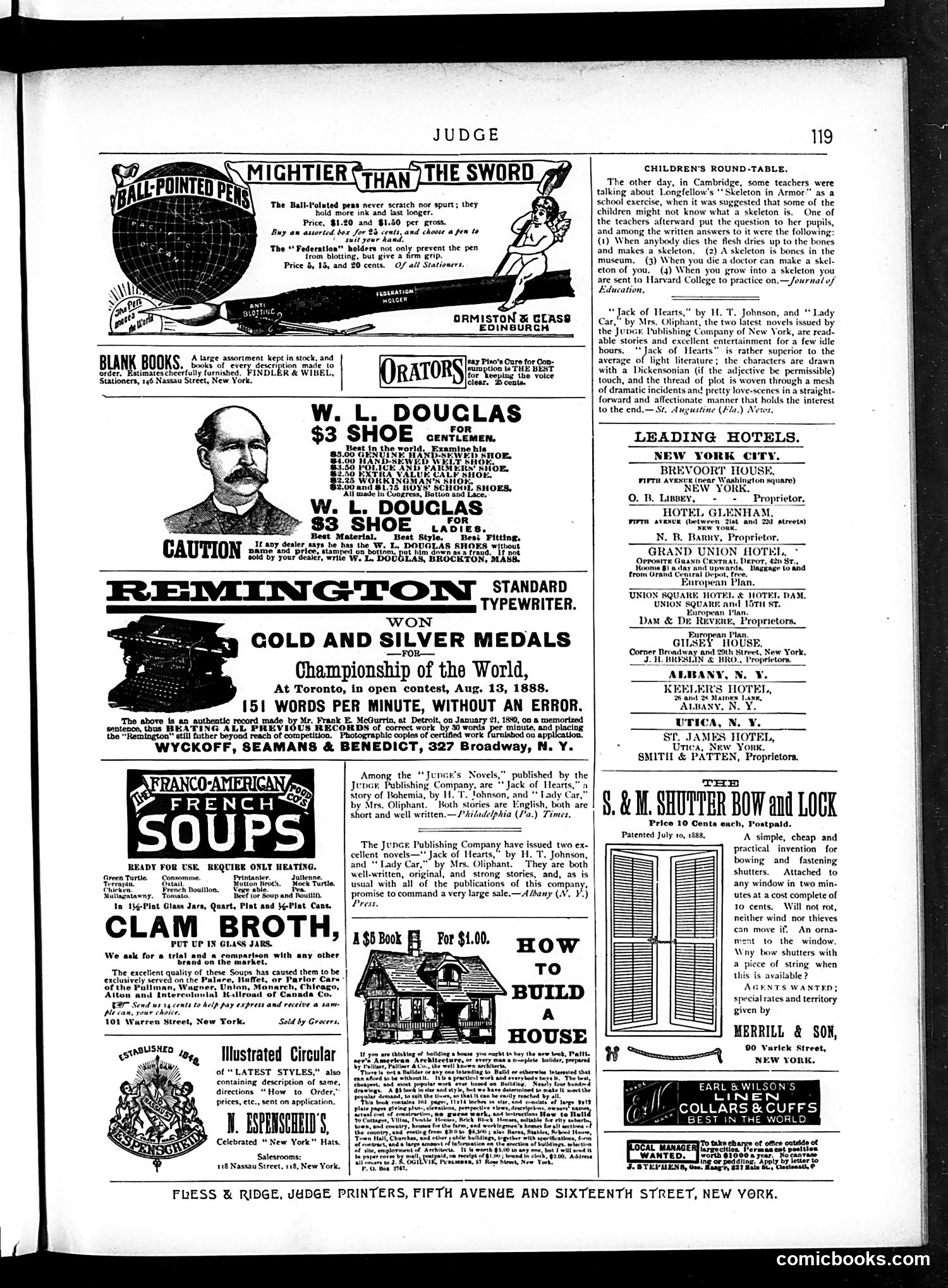
This page is primarily a late-19th-century advertising section (page 119 of Judge magazine), with minor editorial content—not a political cartoon page. **Key advertisements:** - **Ball-Pointed pens** and writing supplies - **W.L. Douglas $3 shoes** (a real budget brand, emphasizing affordability) - **Remington Typewriter**, touting a world championship typing record (151 words per minute) achieved in 1888 - **Franco-American Soups** (canned goods) - Various hotel listings and other products **Editorial content:** The "Children's Round-Table" includes amusing answers from schoolchildren about what a skeleton is—the joke being that one child defines it as bones "sent to Harvard College to practice on," poking gentle fun at Harvard's rigor. There is **no political satire** on this page. It's a commercial and light-entertainment section typical of Judge's mixed editorial-advertising format, serving as a snapshot of 1880s consumer products and period humor.
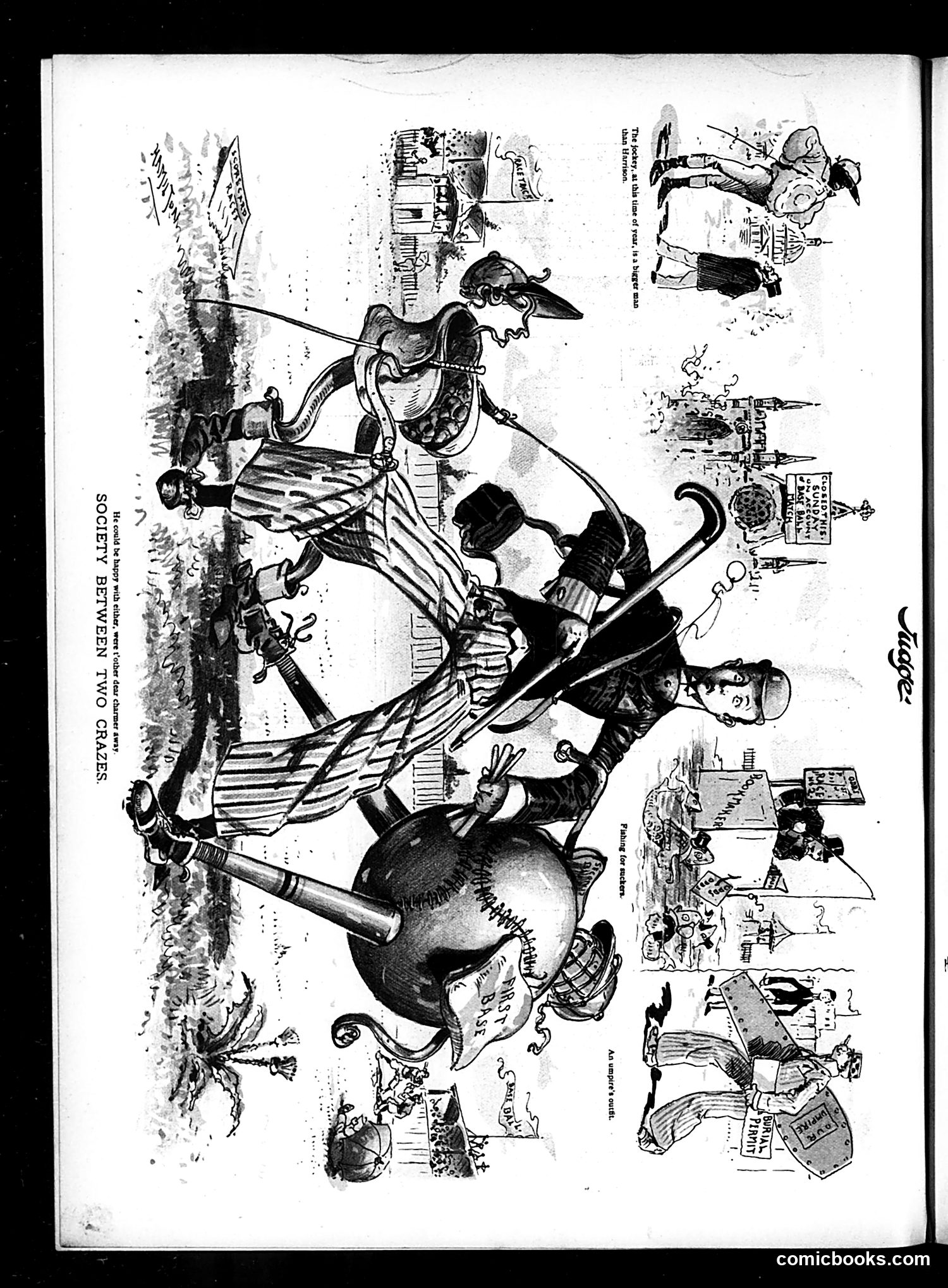
This Judge magazine cartoon satirizes late 19th-century American society's obsession with horse racing. The central figure—a jockey—is depicted as more influential than President Harrison, suggesting the public cares more about racing than politics. The caption "Society Between Two Crazes" indicates the cartoon critiques how wealthy society oscillates between fashionable obsessions. The elaborate central illustration shows figures caught between competing interests or vices, represented through caricatured social types. The phrase "He could be happy with either, were t'other dear charmer away" suggests commentary on fickle social priorities—wealthy Americans devoted themselves passionately to whatever trend dominated the moment, unable to balance multiple interests rationally. The surrounding vignettes likely illustrate related social follies connected to this racing mania.
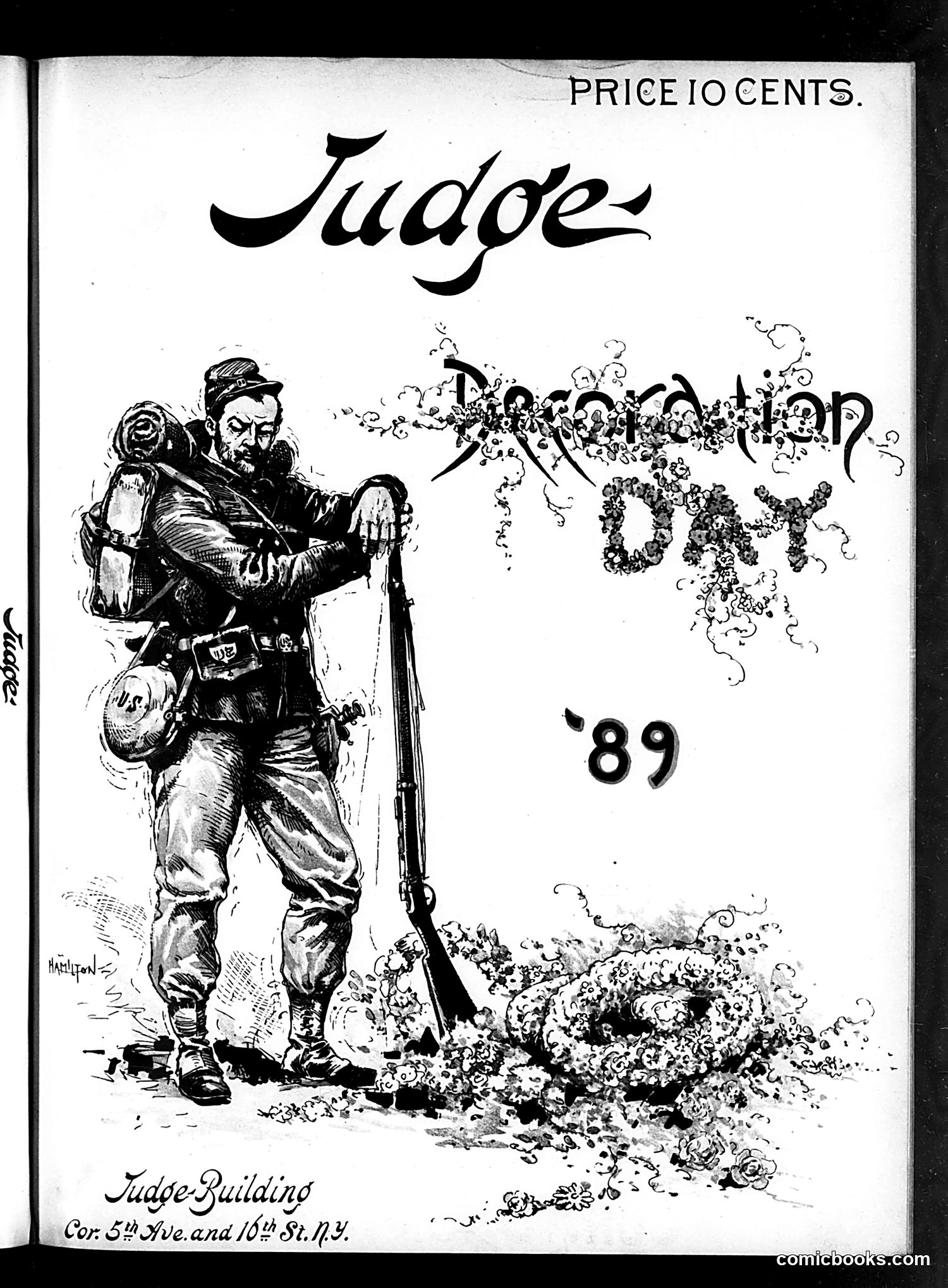
This is a Judge magazine cover featuring an illustration by Hamilton (signed lower left). The central image depicts a soldier or military figure in full gear, holding a rifle and spade, standing amid rubble and debris. The decorative text "Judge" appears stylized at top, with "'89" marked below. The title "Judge Building" at bottom references the magazine's headquarters at the corner of Fifth Avenue and 16th Street in New York City. The soldier and construction debris likely allude to building or reconstruction—possibly commentary on post-Civil War reconstruction efforts or urban development occurring in 1889. The soldier's prominent placement suggests either militarism in contemporary American life or associations between military strength and national progress. Without additional context, the specific satirical target remains unclear.
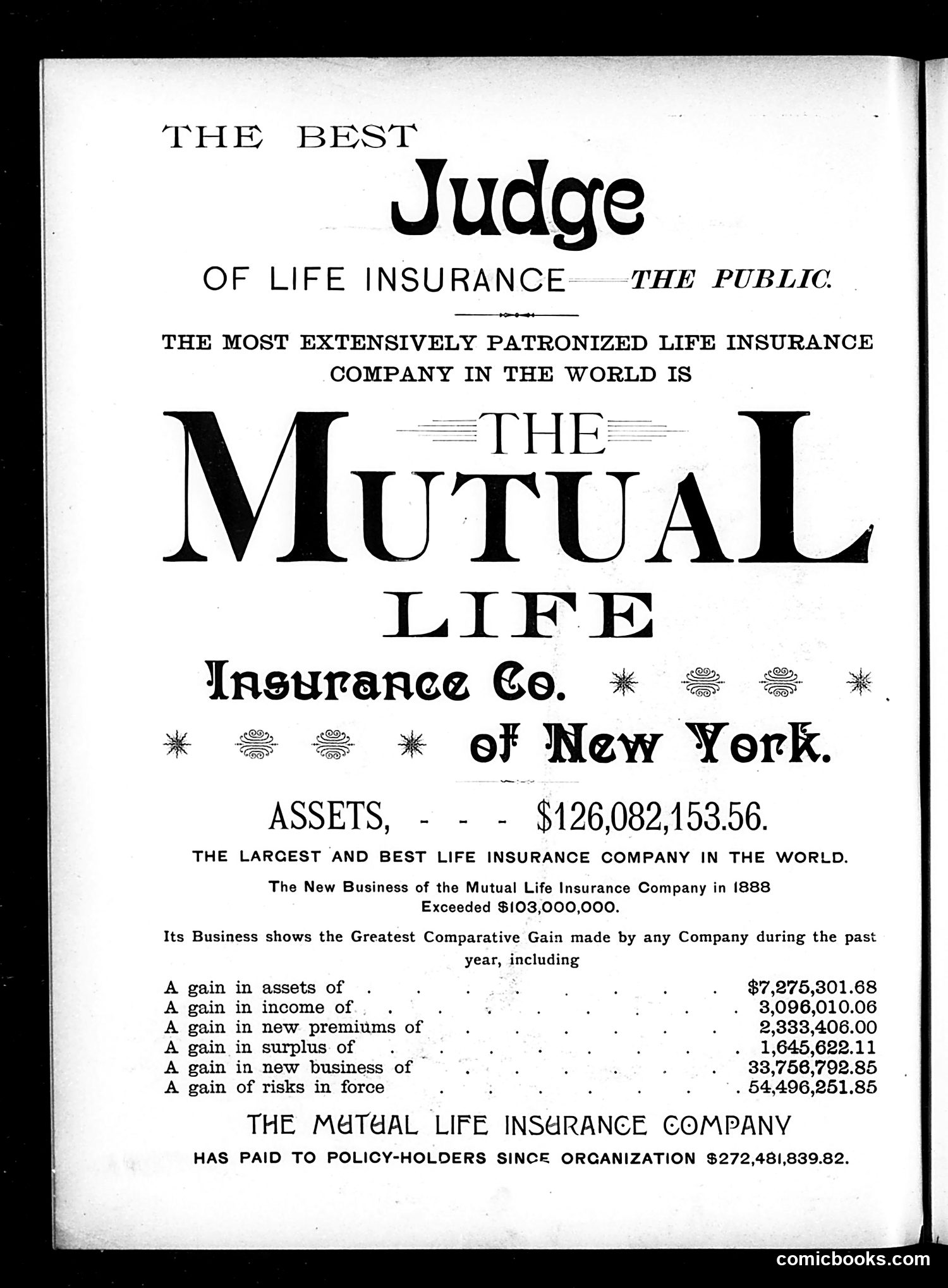
This is primarily an **advertisement**, not a cartoon or satire. It's a full-page promotional piece for the Mutual Life Insurance Company of New York, published in *Judge* magazine (likely 1889, based on the 1888 financial data cited). The ad makes no satirical point—it straightforwardly touts the company as "the best judge of life insurance" and "the largest and best life insurance company in the world." It lists impressive financial statistics: $126 million in assets, $103 million in new business for 1888, and $272 million paid to policyholders since the company's founding. This represents honest-to-goodliness corporate advertising in a humor magazine, which *Judge* regularly published to fund operations. There's no irony, caricature, or political commentary intended—just corporate self-promotion masquerading as factual endorsement.