
A complete issue · 17 pages · 1889
Judge — April 6, 1889
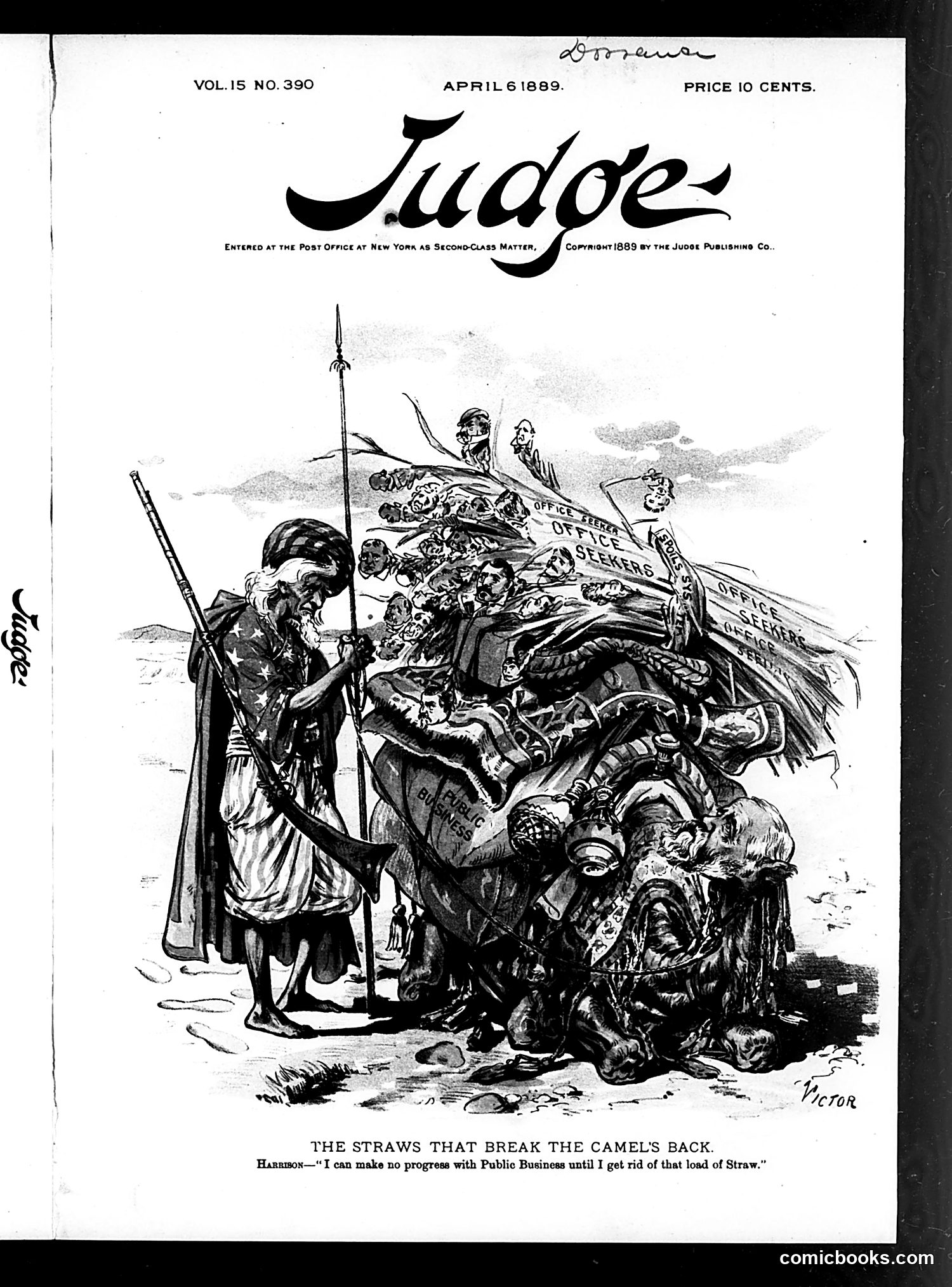
This 1889 Judge magazine cartoon uses the proverb about breaking a camel's back to critique President Benjamin Harrison's administration. A figure identified as "Harrison" (left, with beard and spear) stands beside an overburdened camel labeled with various "Office Seekers" demands. The camel carries bags labeled with bureaucratic burdens, while office-seekers pile additional weight on top. The satire mocks Harrison's inability to manage the overwhelming demands from political appointees seeking government positions—the "straws" that threaten to collapse his presidency under patronage pressures. The artist (signed "Victor") suggests Harrison cannot make progress on substantive public business while drowning in patronage obligations, a common complaint about Gilded Age politics.
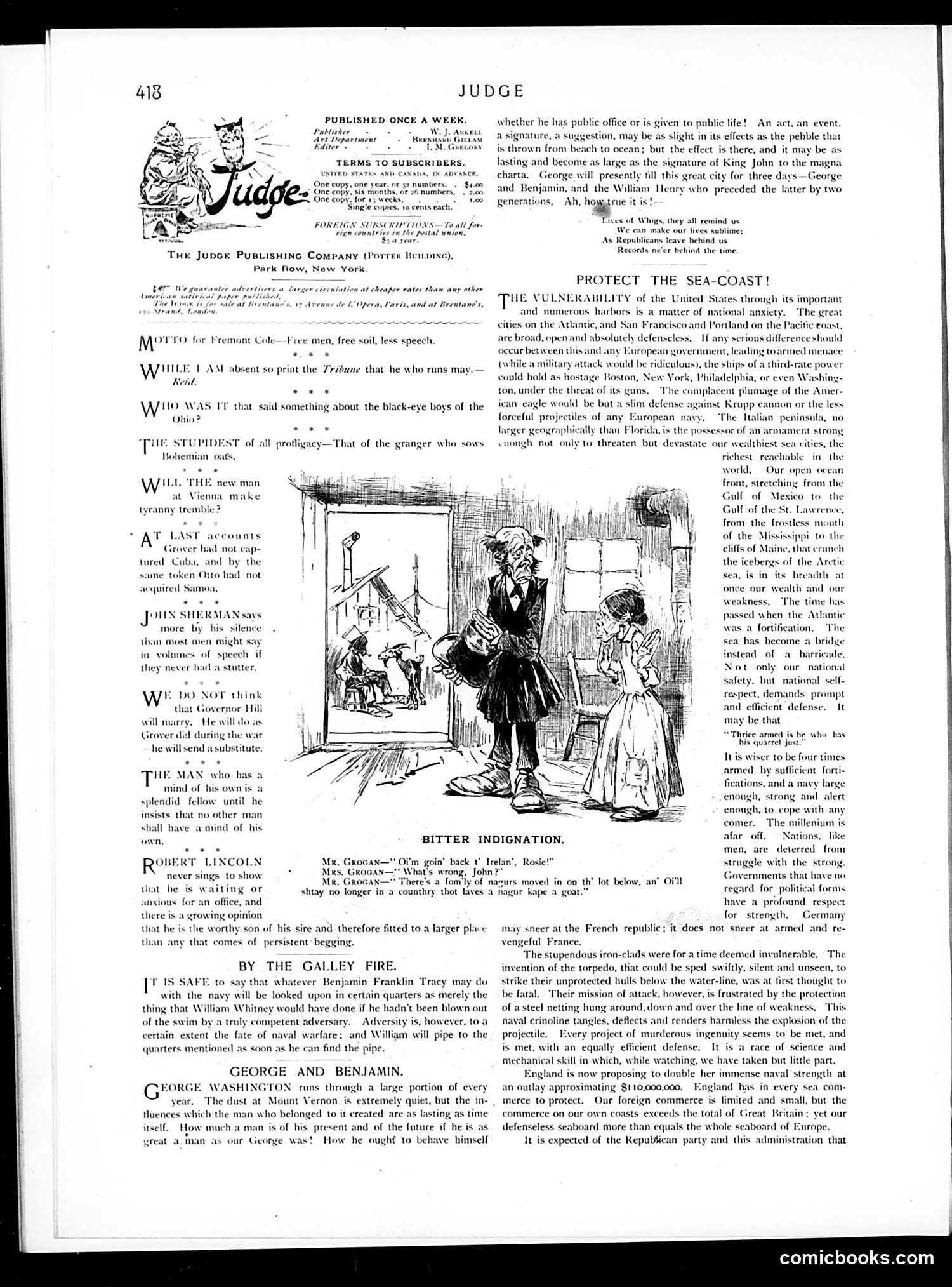
This cartoon depicts what appears to be a domestic dispute, with a woman confronting a man at a doorway while children look on. The dialogue references "going back to Ireland" and moving "on my lot below," suggesting an Irish-American immigrant household. The satire likely targets Irish-American family dynamics or immigration experiences—a common subject in turn-of-the-century Judge magazine. The woman's anger and the man's apparent defensiveness suggest marital conflict, possibly over finances or the family's living situation. Without clearer historical context or dates visible on the page, the specific incident being mocked remains uncertain, though it clearly ridicules Irish-American working-class domestic life as fodder for contemporary satire.
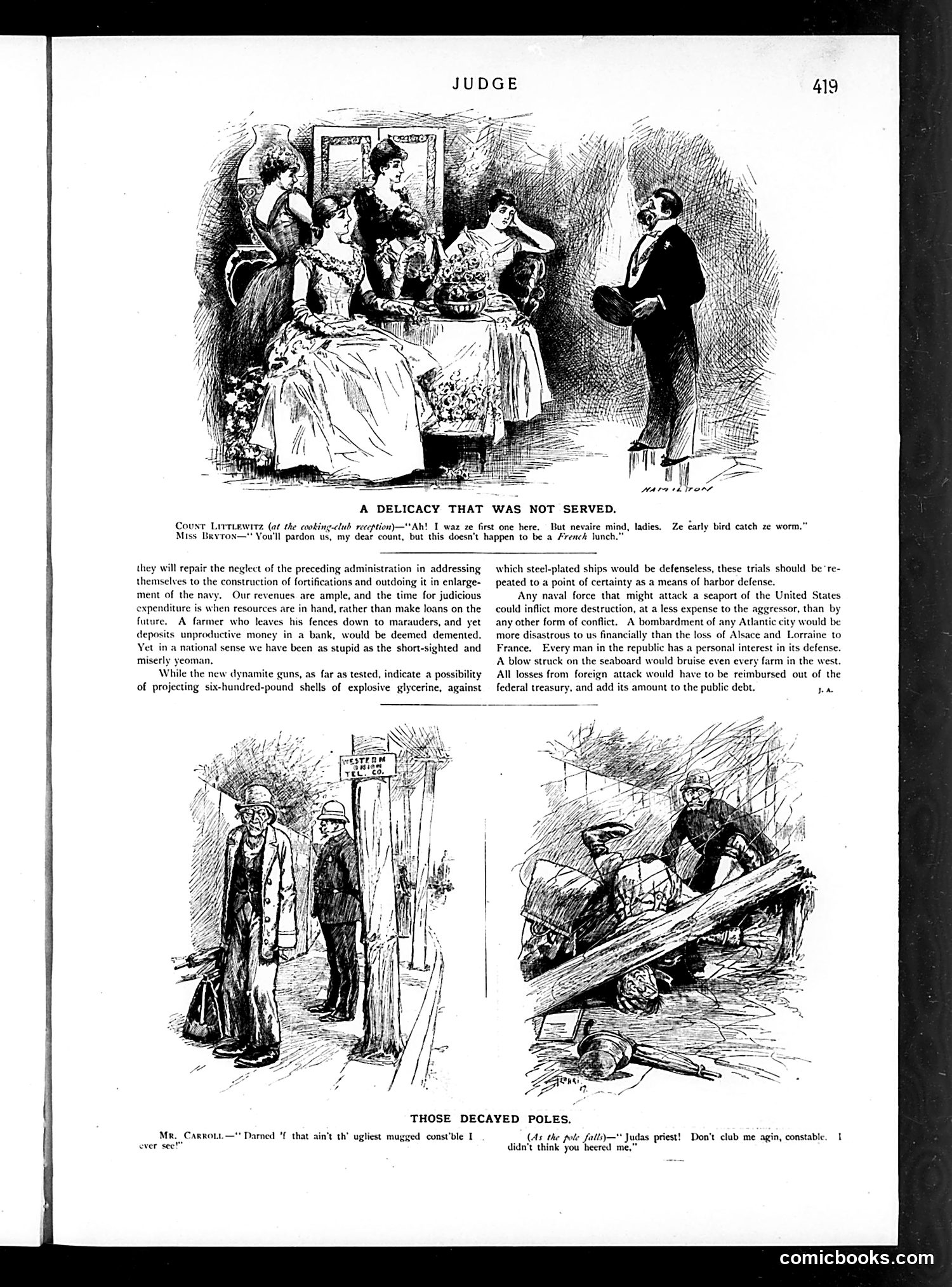
**Top Cartoon ("A Delicacy That Was Not Served"):** A woman (Miss Brytos, likely representing France) hosts a cooking-club reception. A count arrives late, hoping for French lunch, but is told this "doesn't happen to be a French lunch"—a joke about broken hospitality expectations. The satire appears to mock diplomatic relations or social pretense, possibly referencing Franco-American relations during a period of tension. **Bottom Cartoon ("Those Decayed Poles"):** A man and constable stand near a deteriorating pole. The man complains it's "the ugliest mugged const'ble," then the pole falls on him. The priest exclaims "Judas priest! Don't club me again, constable"—a visual pun playing on the fallen "pole" and the constable's club. The satire ridicules urban neglect or poor municipal maintenance that endangers citizens. Both cartoons use wordplay and visual humor typical of Judge's style.
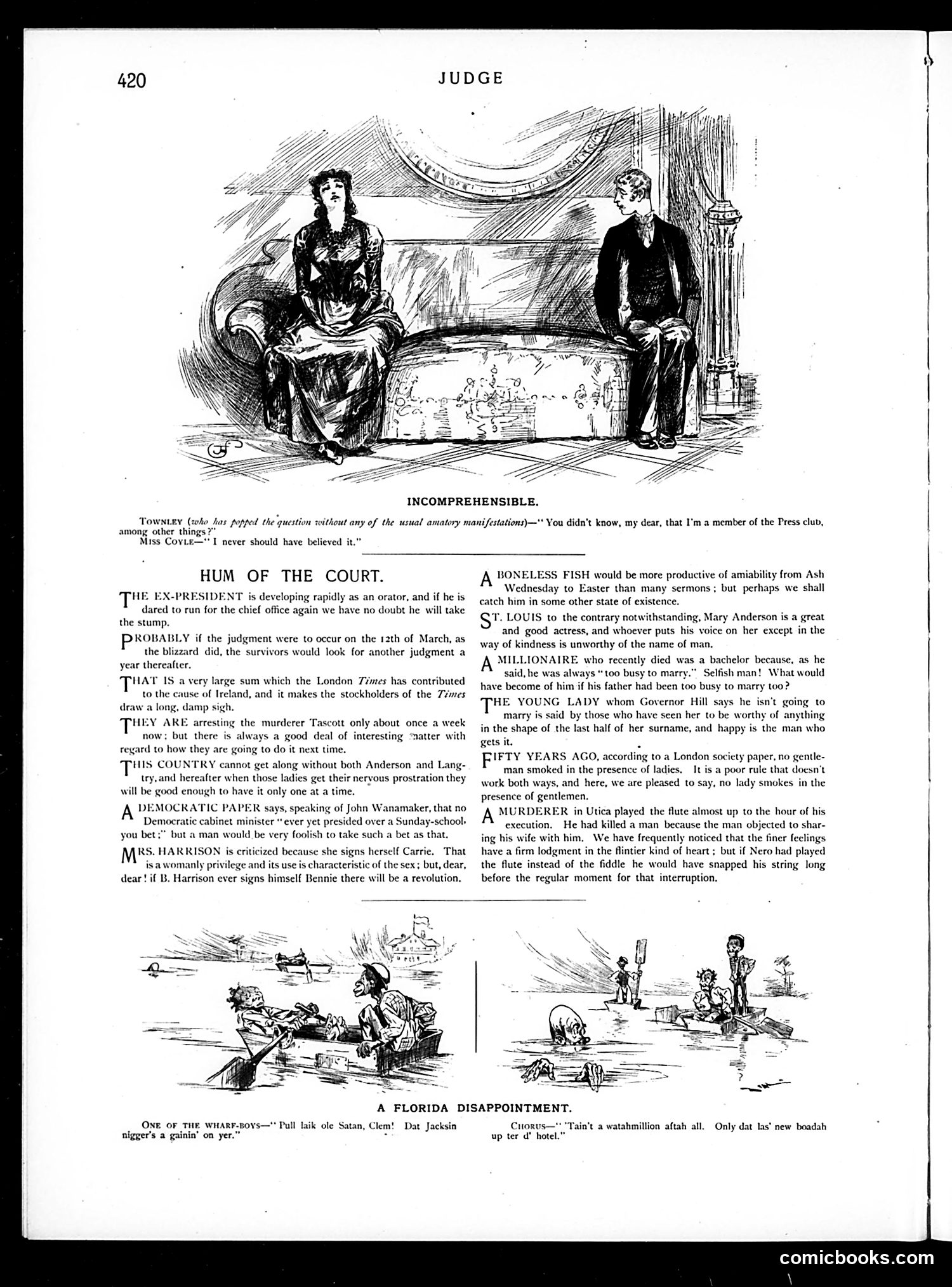
This page from *Judge* contains satirical commentary on contemporary 1880s-90s American politics and society rather than a single unified cartoon. The top illustration, "Incomprehensible," depicts a man explaining his marriage proposal by claiming membership in the Press Club—the joke being that journalists' cynicism makes romantic gestures seem absurd. "Hum of the Court" collects brief political jabs: mocking an unnamed ex-president's oratorical ambitions, criticizing the *London Times*' Irish fundraising, and referencing actress Lillie Langtry and Mary Anderson. References to "murderer Tascott" and Governor Hill appear to reference contemporary scandals now obscure. The bottom section, "A Florida Disappointment," shows two sketches of vernacular humor involving working-class characters discovering false expectations—one about a watermelon, another unclear without more context. The humor relies heavily on topical references and inside knowledge of 1880s-90s personalities and events that require historical research to fully decode.
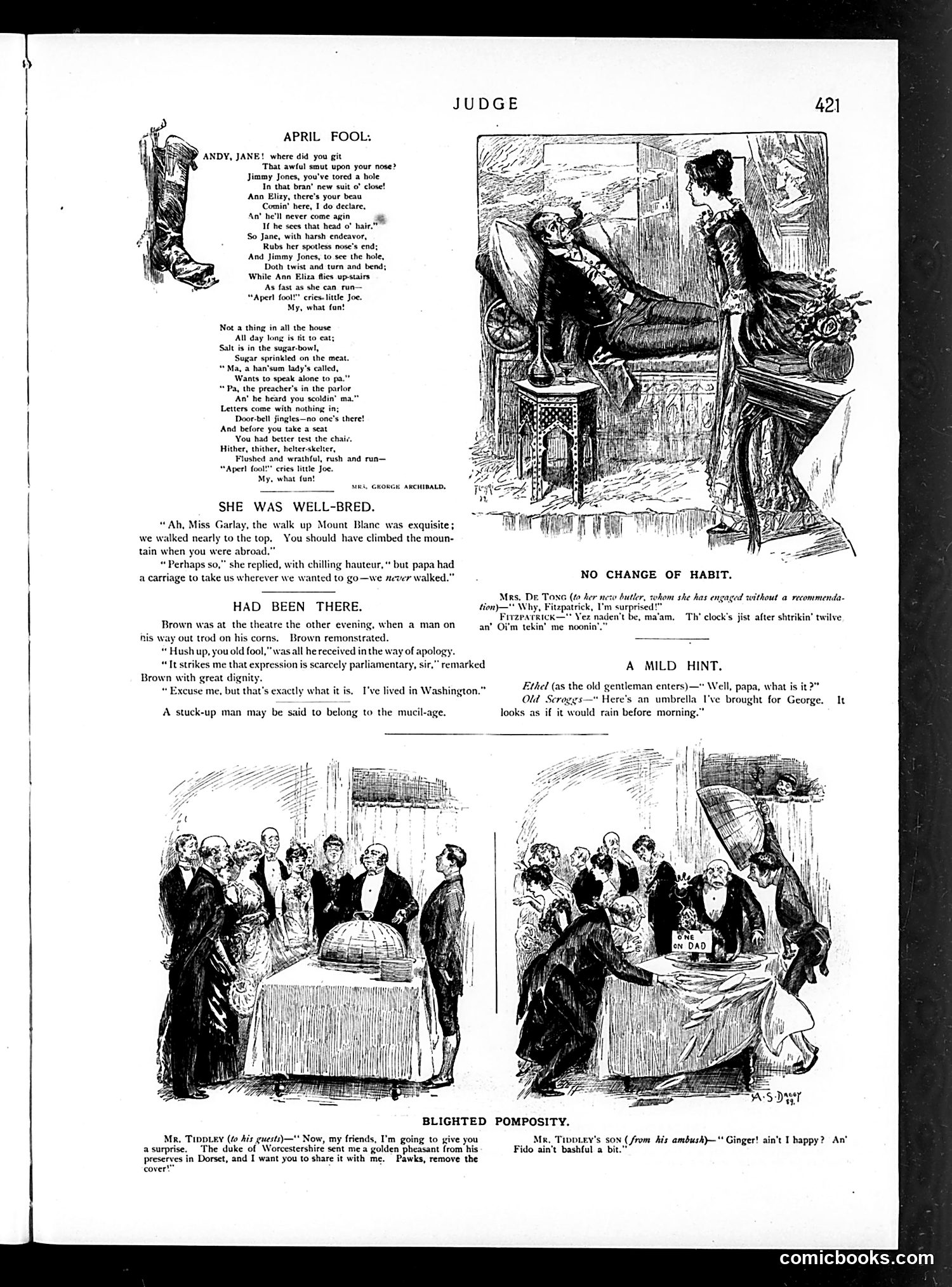
This page collects five short humorous pieces typical of *Judge* magazine's satirical style: **"April Fool"** mocks the chaos of April Fools' Day pranks in a household—children playing tricks that disrupt adults' routines (salt in sugar, missing letters, wobbly chairs). **"She Was Well-Bred"** satirizes upper-class affectation: a woman brags about climbing Mount Blanc but admits her family never actually walked anywhere, relying on carriages—mocking false pretension. **"Had Been There"** jokes about a pompous man citing Washington experience to justify his rudeness to someone he stepped on in a theater. **"No Change of Habit"** features an Irish butler (Fitzpatrick, identified by dialect) explaining he takes his noon break at midnight because "the clock's just after striking twelve"—absurdist humor. **"Blighted Pomposity"** shows a man bragging about serving a rare pheasant from a duke, only to have his son reveal the family dog ate it—deflating snobbish pretension through slapstick. The cartoons target vanity, pretension, and social climbing common to Gilded Age America.
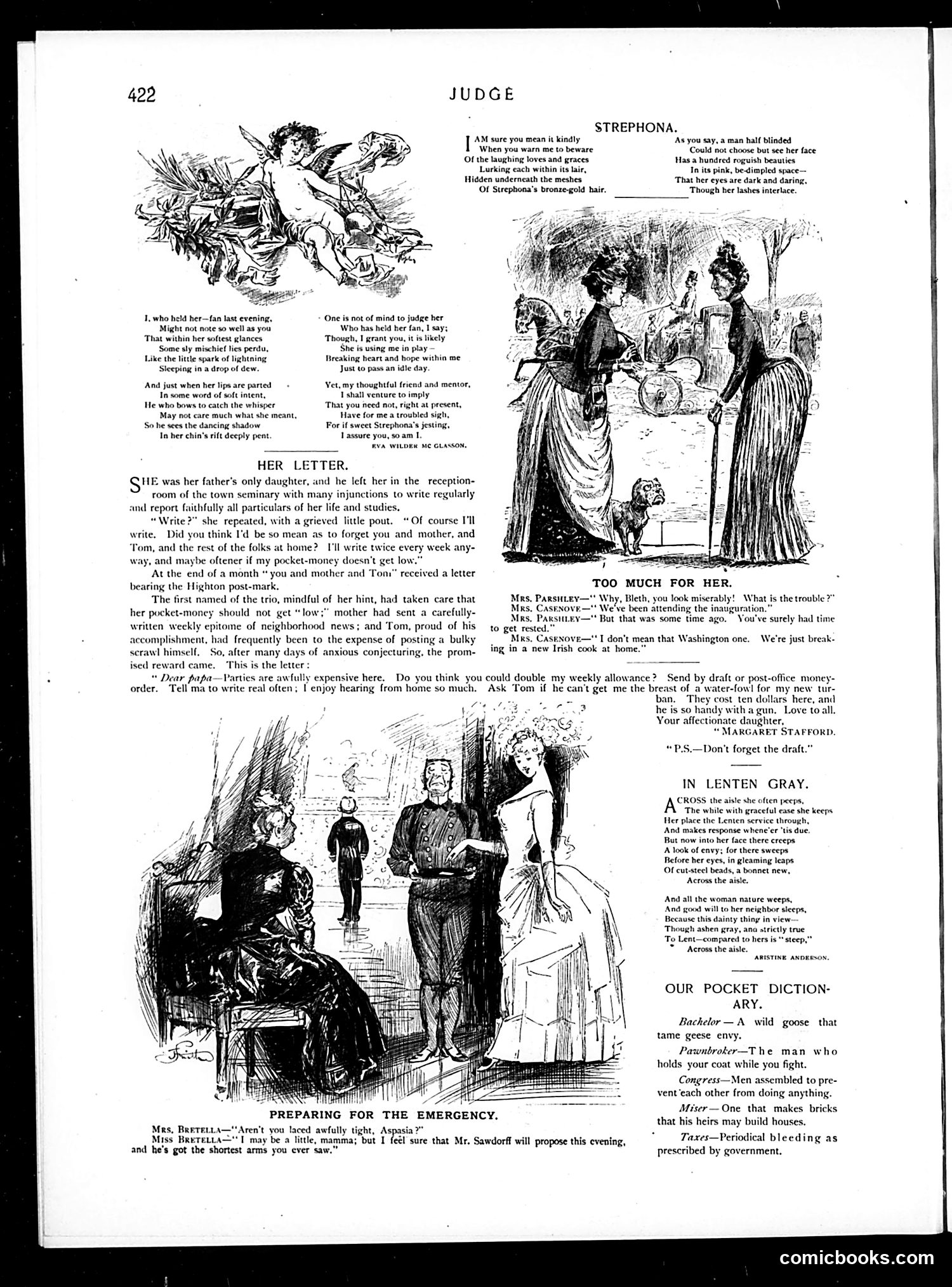
This page contains three distinct pieces of social satire typical of late 19th-century American humor: **"Strephona"** (top): A romantic poem mocking courtship conventions. A man warns his friend about a flirtatious woman named Strephona, but the friend defends her—both are equally infatuated and self-aware about being played with. **"Her Letter"** (center): Satirizes privileged daughters at seminary. Margaret Stafford's letter to her father requests doubled allowance, gun-hunted game for a hat, and dismisses correspondence—revealing the superficiality and entitlement of wealthy young women focused only on fashion and expenses rather than education. **"In Lenten Gray"** (bottom right): Mocks religious hypocrisy during Lent. A woman maintaining strict gray dress for church observance becomes envious seeing a neighbor's newer, fancier "Lenten gray" bonnet, exposing vanity lurking beneath pious appearances. **"Our Pocket Dictionary"** (bottom): Brief satirical definitions of social types (bachelors, congressmen, misers) offering cynical observations about human nature and institutions.
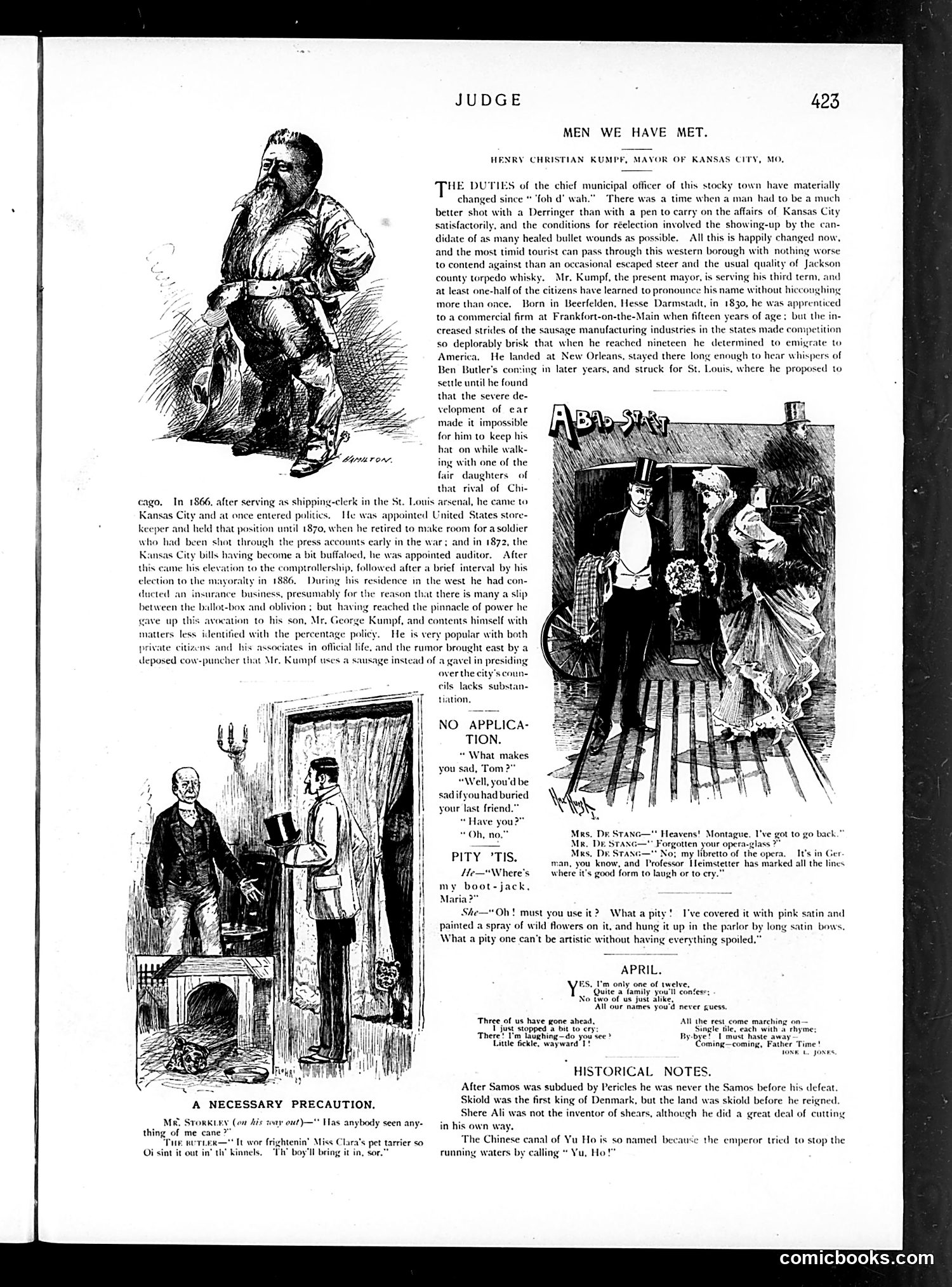
This page features "Men We Have Met," a biographical profile of **Henry Christian Kumpf, Mayor of Kansas City, Missouri**. The main text humorously contrasts Kansas City's violent frontier past with its civilized present—noting that mayors once needed gunfight skills rather than administrative ability, but Kumpf (a German immigrant sausage manufacturer) could now govern safely. The smaller cartoons are unrelated social humor: - **"A Necessary Precaution"**: A man asks another if he's seen his cane, explaining he lost it while frightening his neighbor's pet terrier. The joke: the terrier is so small it required a full cane to scare it away. - **"No Application" and "Pity 'Tis"**: Domestic comedies about mourning and repurposing a boot-jack as parlor decoration. The satire mocks both frontier lawlessness and contemporary bourgeois affectation, presenting Kumpf as embodying civilized progress while poking fun at upper-class pretension elsewhere on the page.
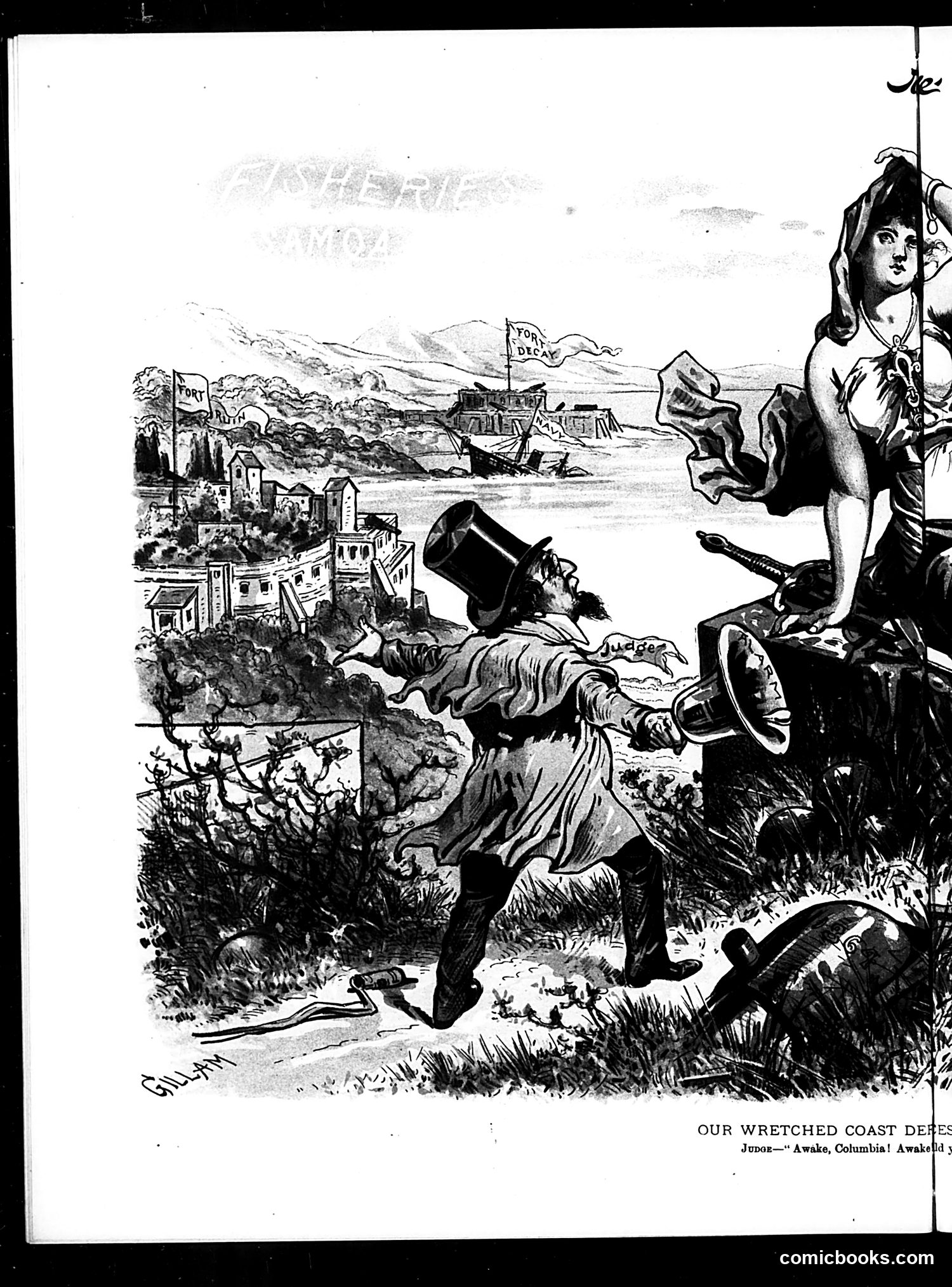
This Judge magazine cartoon depicts "Columbia" (the female allegorical personification of America, shown on the right) urgently awakening a sleeping man wearing a top hat—likely representing American political leadership or the nation's decision-makers. The caption "Awake, Columbia! Awake!" suggests an urgent call to action. In the background, coastal fortifications labeled "Fort" and "Decay" are visible, with ships and military structures. This imagery suggests the cartoon addresses coastal defense readiness or military preparedness concerns. The title "OUR WRETCHED COAST DEFENSES" confirms the subject: the cartoon satirizes inadequate American coastal fortifications, portraying them as neglected and deteriorating. Columbia's dramatic gesture emphasizes the urgency of addressing this national defense vulnerability during what was likely a period of military concern or international tension.
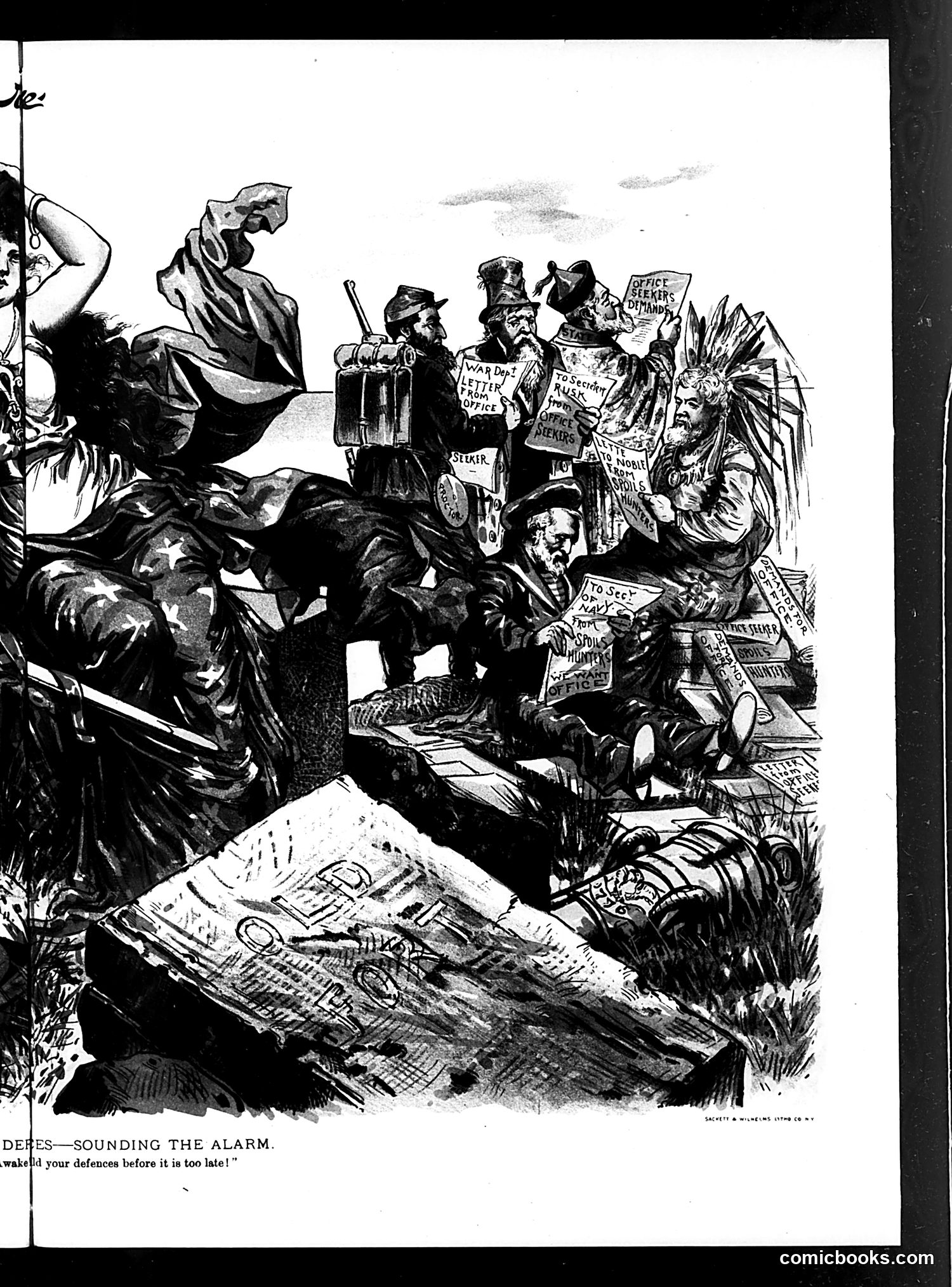
This cartoon titled "Sounding the Alarm" depicts various figures in period dress holding signs with warnings about national defense. The figures appear to represent different constituencies or interest groups advocating for military preparedness, their signs reading messages like "Wake up your defences before it is too late!" The imagery suggests this is pre-war propaganda, likely from the World War I era, urging American vigilance and defense spending. The caricatured figures and their diverse appearances seem to represent different social groups united in calling for military readiness. Without clearer identification of specific individuals or dates on the page, I cannot definitively name the figures depicted, but the overall message champions defensive mobilization against an implied foreign threat.
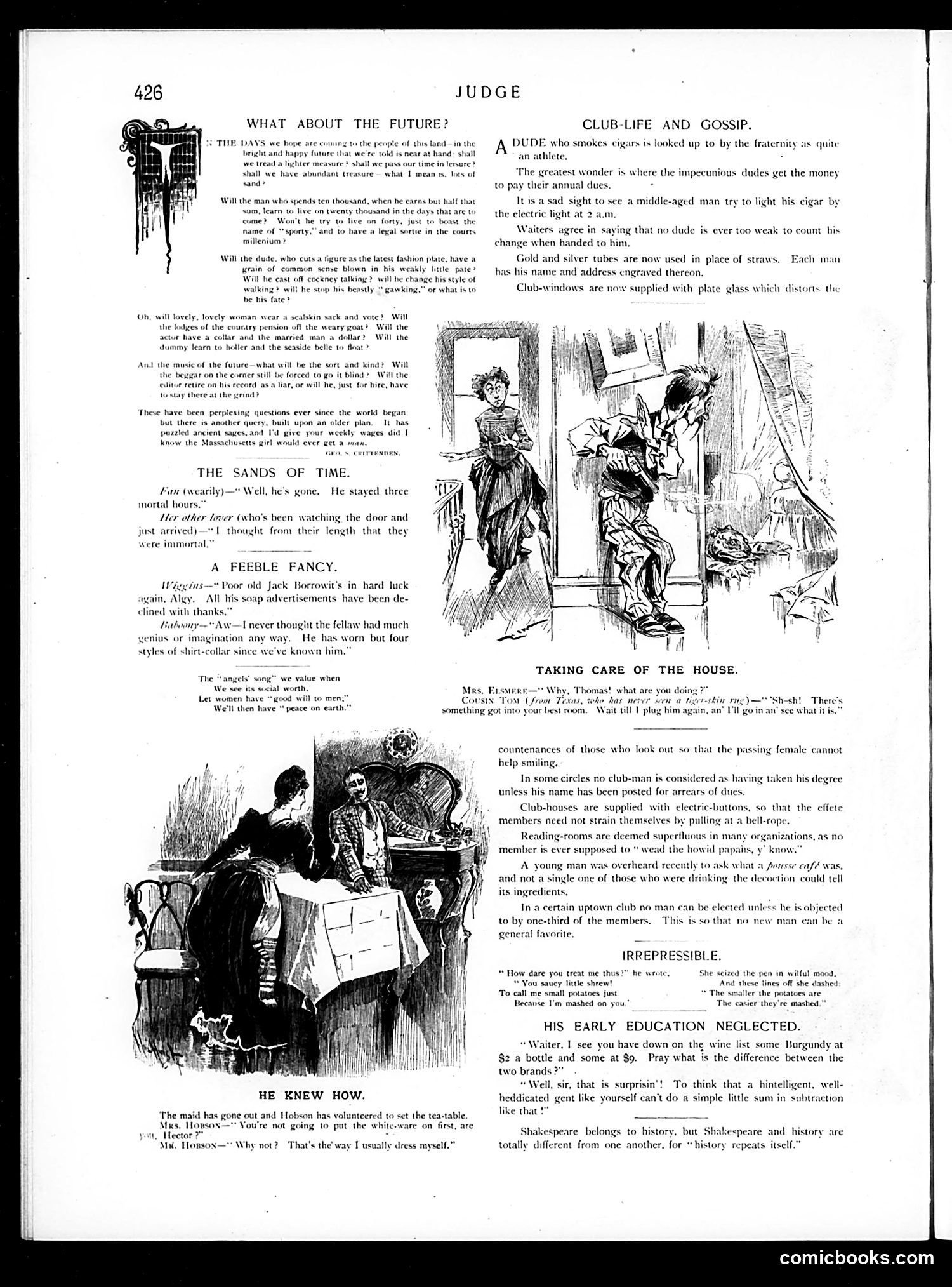
This page from *Judge* satirizes Gilded Age club culture and upper-class affectations. The main content mocks exclusive men's clubs—their pretentious rituals, social hierarchies, and shallow membership standards. **Key targets:** - **Club snobbery**: Members judge each other by fashion, cigar-smoking, and ability to pay dues; new members face arbitrary blackballing by existing members - **Servant dynamics**: The comic "He Knew How" depicts a servant (Hobson) treating tableware like clothing, suggesting dudes are so clueless they need instruction on basic tasks - **Conspicuous consumption**: Ridicules wealthy men adopting expensive affectations (gold tubes replacing straws, plate-glass windows to distort passersby's views) - **Intellectual emptiness**: A club member doesn't know what a *frappe café* is—mocking pretension masking ignorance The smaller "Sands of Time" and "Feeble Fancy" sketches continue light social commentary on romantic affairs and advertising. The overall message: wealthy club culture is absurd, superficial, and populated by incompetent, vain men.
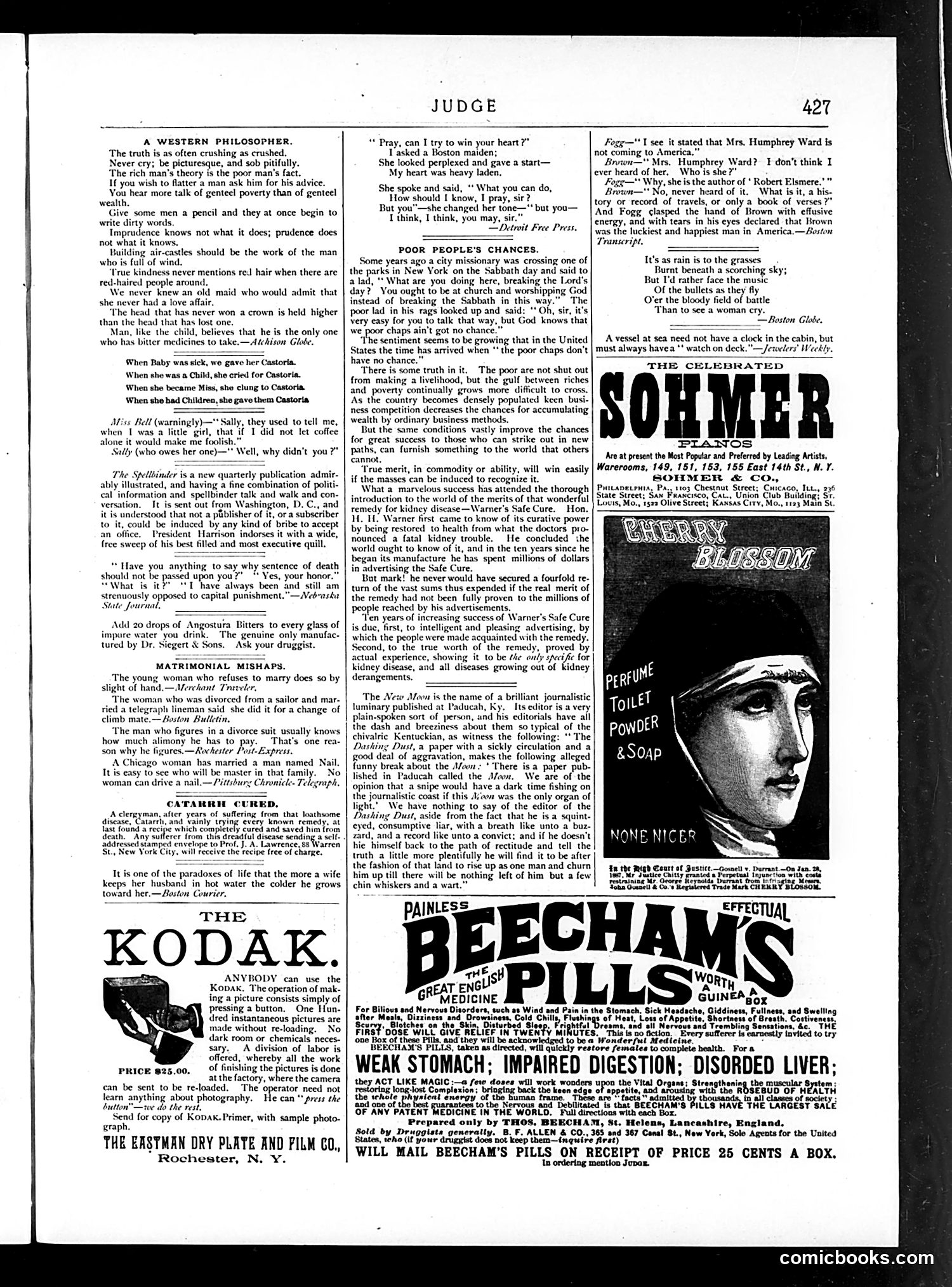
This page from Judge magazine (a satirical weekly) contains primarily **advertisements and miscellaneous short humor items**—not focused political cartoons. The main content includes: - **"A Western Philosopher"**: Brief witty aphorisms satirizing human nature and social pretension (e.g., "The rich man's theory is the poor man's fact") - **"Matrimonial Mishaps"**: Short jokes about marriage and divorce, typical light social satire of the era - **"Catarrh Cured"**: A patent medicine advertisement (common in period magazines) - **Large advertisements** for Kodak cameras, Beecham's Pills, and "Sohmer" pianos The Castoria jingle mocking product loyalty and the "Spellbinder" political magazine reference suggest mild contemporary satire, but this page is primarily a **commercial/miscellaneous content page** rather than featuring significant political commentary or satirical cartoons requiring historical context for modern readers.
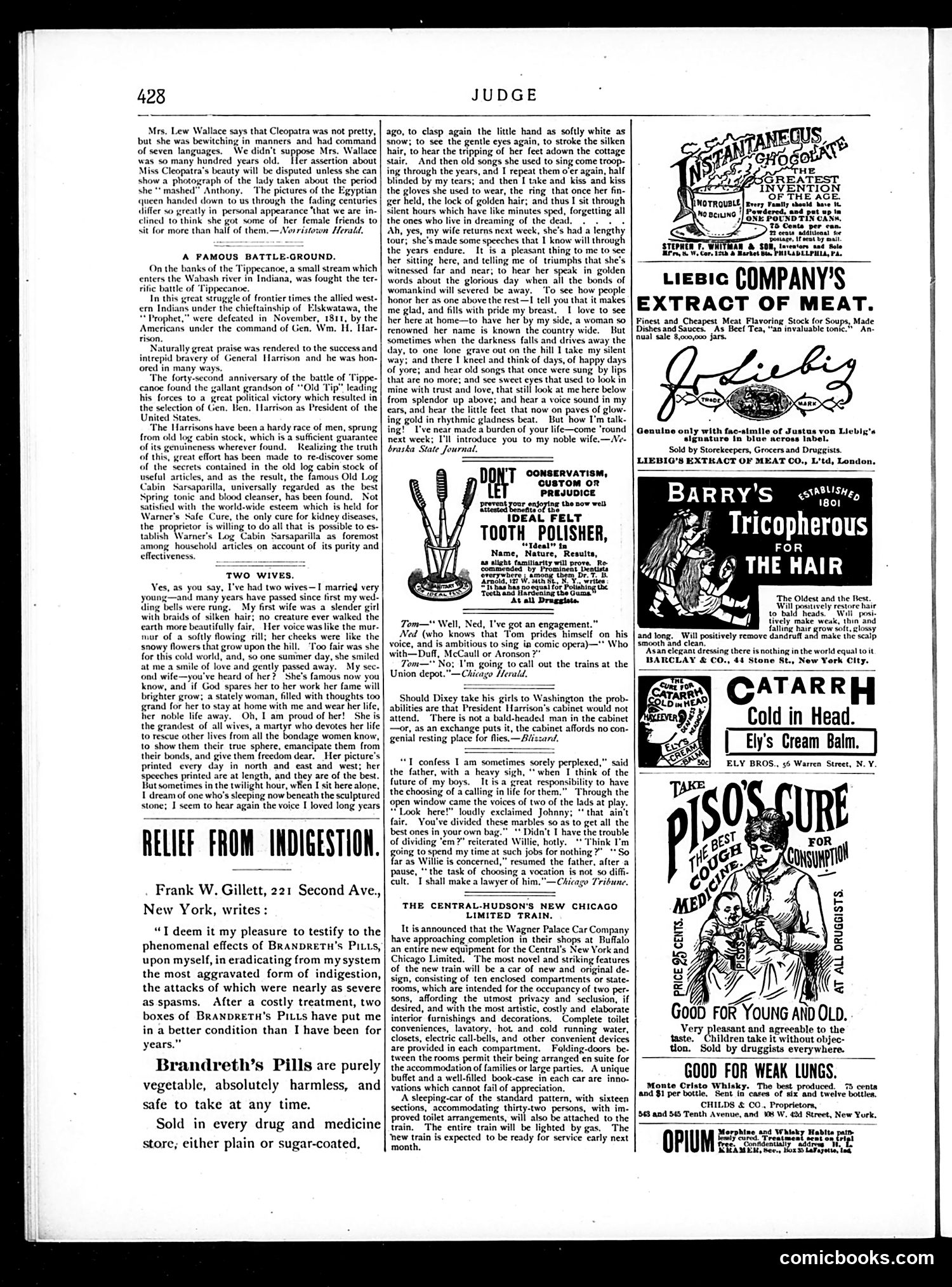
This page is primarily **advertising and miscellaneous content** rather than political cartoons. The main elements include: **Text pieces** about historical figures (Mrs. Lew Wallace discussing Cleopatra) and the Battle of Tippecanoe (1811), which references William Henry Harrison's military victory and his grandson's later presidential election—used to promote "Old Log Cabin Sarsaparilla" tonic, capitalizing on the "log cabin" presidential mythology. **Advertisements** dominate the right side, promoting patent medicines and tonics typical of the era: Liebig's Extract of Meat, Barry's Tricopherous hair treatment, Piso's Cure for consumption, and Brandreth's Pills. **A sentimental poem** titled "Two Wives" about a man's first deceased wife and his second, more famous wife devoted to social reform. The page reflects **late 19th-century advertising culture**, where medical claims were unregulated and products exploited both historical nostalgia and emotional appeals to sell remedies.
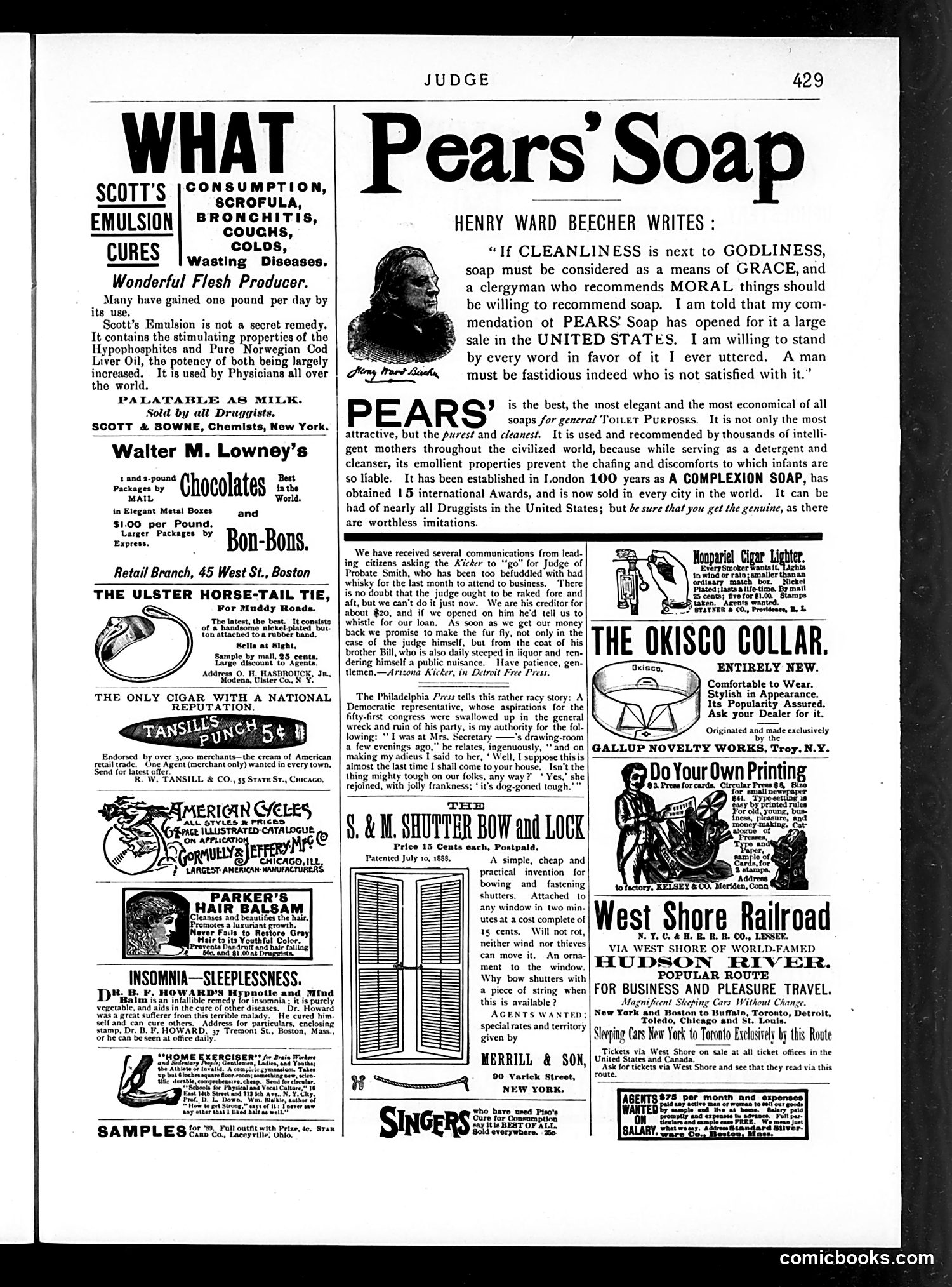
This page is primarily **advertising**, featuring prominent endorsements from Henry Ward Beecher (a famous 19th-century clergyman and moral authority) for Pears' Soap. The advertisement leverages religious rhetoric, equating cleanliness with godliness to market the product as a moral good. The endorsement uses Beecher's authority strategically—he claims the soap's popularity in America validates his recommendation, creating circular logic that appeals to respectability-conscious consumers. The smaller text mentions warnings against "worthless imitations," reflecting genuine market competition and counterfeiting concerns of the era. The page contains numerous other product advertisements (Scott's Emulsion, chocolates, cigars, hair products) typical of Judge magazine's revenue model. There appears to be a brief satirical piece mocking a corrupt judge, but the dominant content is commercial rather than satirical.
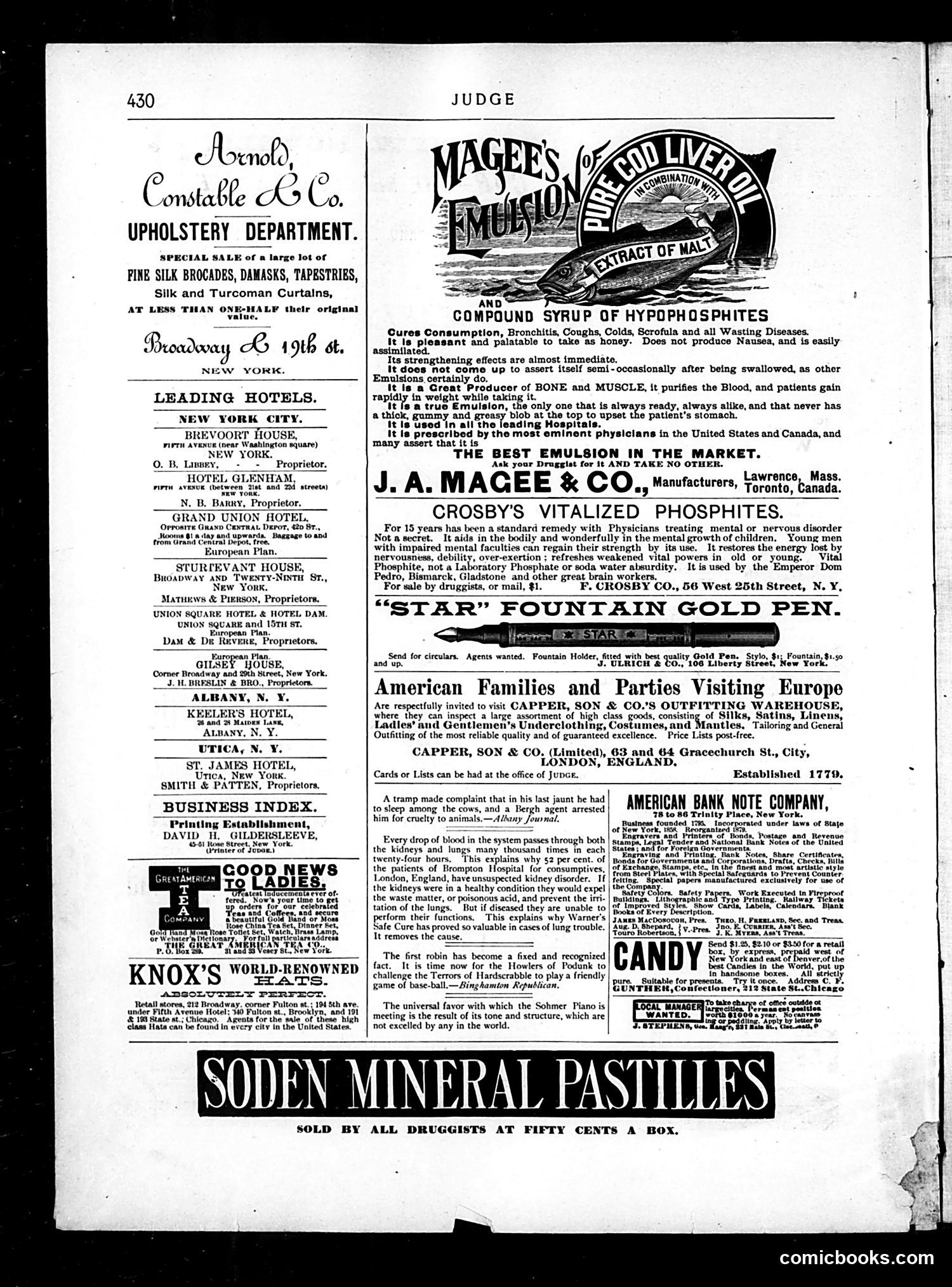
This is primarily an **advertising page** from Judge magazine, containing no significant political cartoons or satirical content to analyze. The page features: - **Commercial advertisements** for upscale goods (furniture, hotels, pharmaceuticals, pens) - **Patent medicine ads** (Magee's Emulsion, Crosby's Phosphites, Soden Mineral Pastilles)—typical of late 19th-century publications, promoting dubious health tonics - **Hotel listings** for New York establishments - **A brief anecdote** about a tramp complaining of sleeping near cows (incomplete, appears to be a joke setup) The only potential satirical element is the **patent medicine advertisements**, which Judge (as a satirical publication) may have included ironically, mocking the era's widespread promotion of unproven remedies. However, the page is fundamentally a commercial section rather than editorial satire. This reflects how 19th-century magazines subsidized content through extensive advertising.
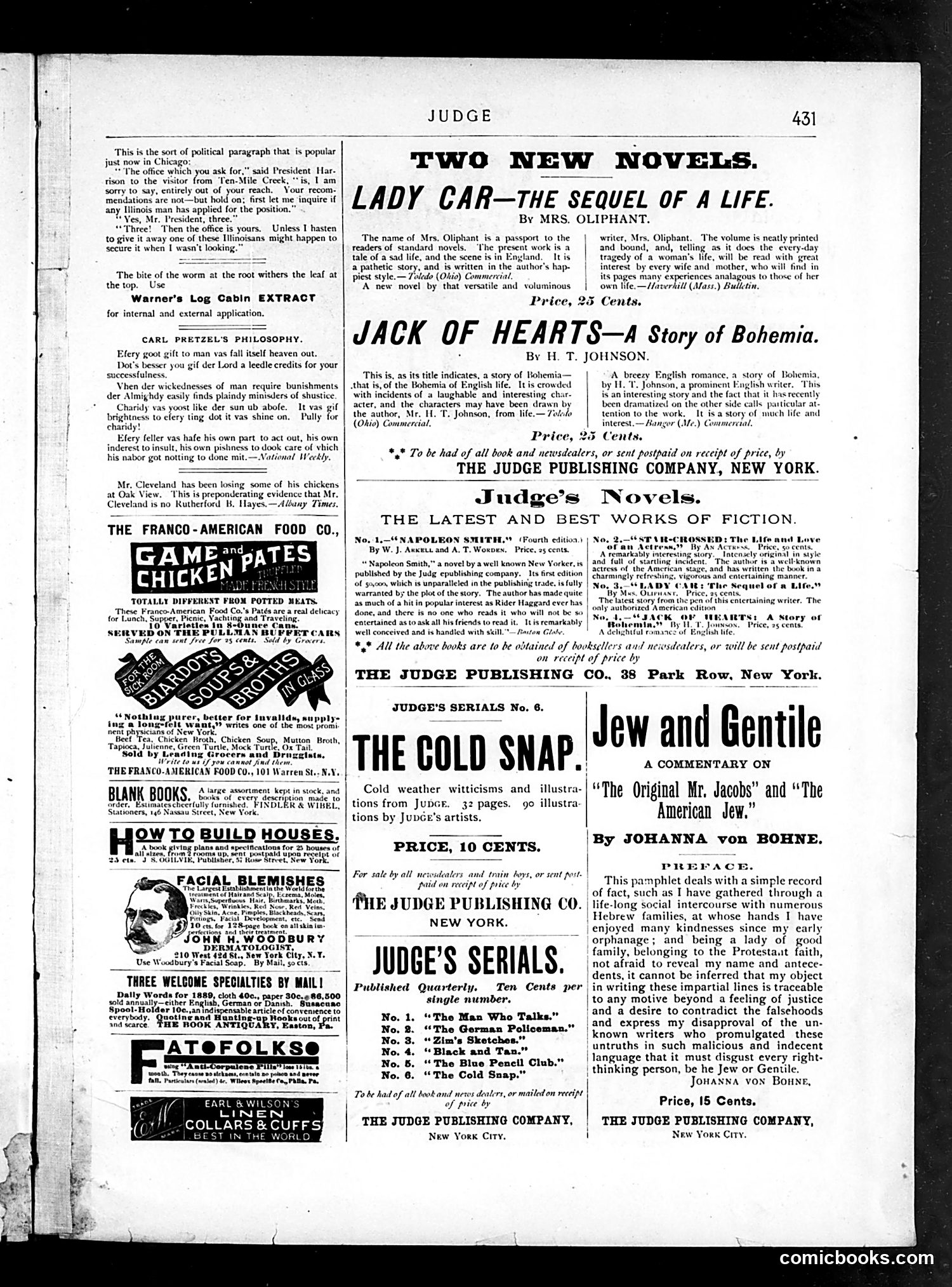
This page is primarily **advertising and book announcements** rather than political satire. However, it contains one brief political joke: At the top, there's a quoted exchange between President **Harrison** (likely Benjamin Harrison, late 1880s-90s) and a job-seeker from Texas. The satire mocks **patronage politics**—the corrupt system where political appointments went to party loyalists rather than merit. Harrison quips that if the office-seeker is from Illinois (a key political state), he'll get the job, but if three Illinois men have already applied, the position is "yours"—meaning he'll rush to award it to prevent losing it to another Illinois politician. The joke exposes how desperately politicians scrambled to distribute federal jobs to politically connected applicants, treating positions as spoils to distribute quickly rather than carefully. This was a common Gilded Age critique of the patronage system that plagued American government.
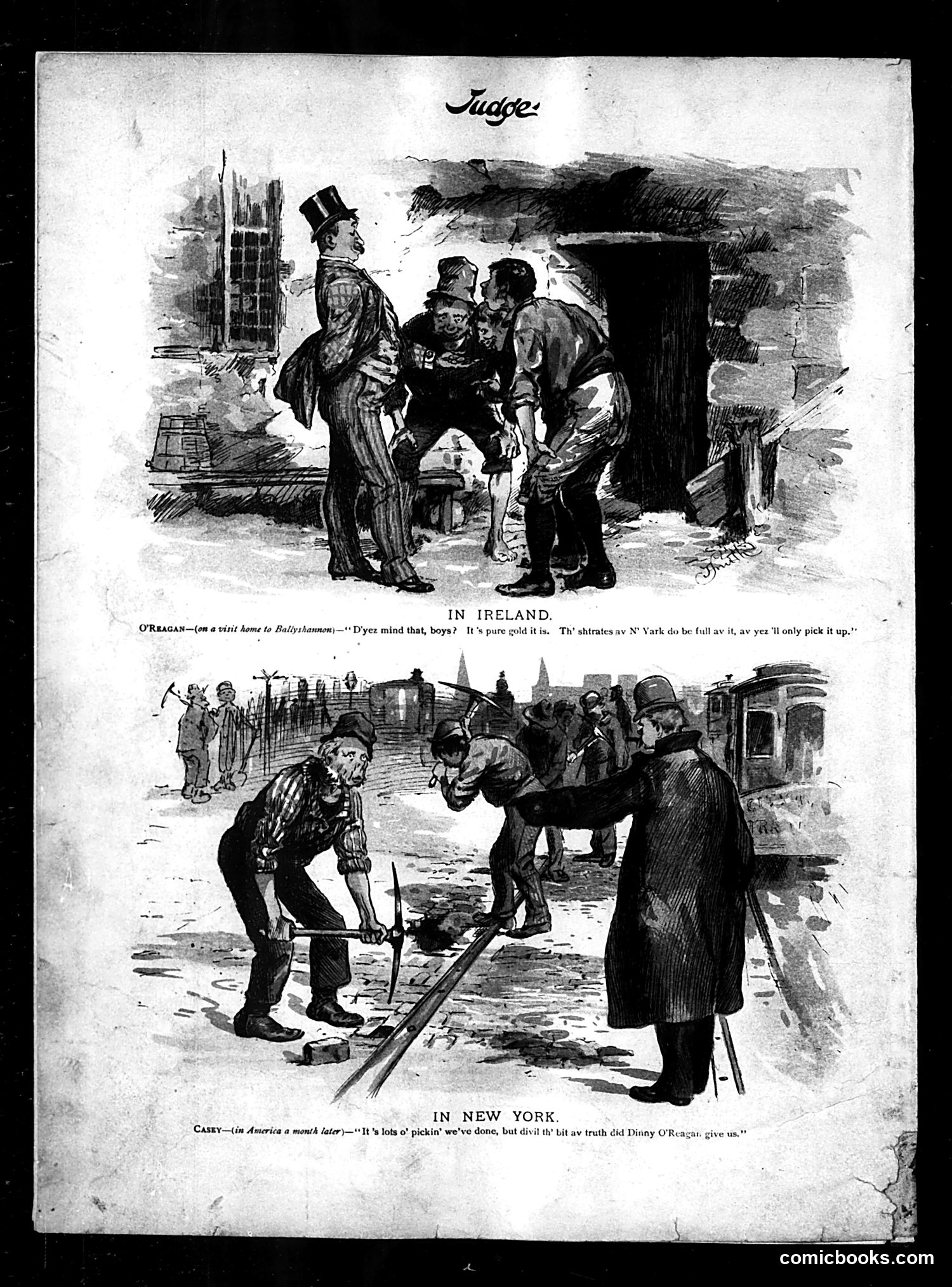
This two-panel cartoon satirizes Irish immigration to America through ethnic stereotyping common to the era. **Top panel ("In Ireland"):** An Irishman named O'Reagan boasts to neighbors back home that New York streets are paved with gold—a common immigrant fantasy/rumor. **Bottom panel ("In New York"):** The same man, now called "Casey," is shown doing manual labor (appears to be railroad or street work). He admits to a fellow Irish worker that despite a month of hard "pickin'" (labor), they've found no truth to O'Reagan's claims. **The satire:** The cartoon mocks both the naive optimism of Irish emigrants and the disappointing reality they encountered. It portrays Irish immigrants as credulous, perpetuating stereotypes about their dialect, naiveté about American opportunity, and relegation to backbreaking manual work. The joke depends on anti-Irish prejudice typical of 19th-century American publications.

I can see this is a page from *Judge* magazine, but the image is almost entirely black with only faint edges visible on the left and right sides, and a small marking in the lower right corner. The OCR text provides only a website attribution ("comicbooks.com") with no readable cartoon content, headlines, captions, or article text visible. Without being able to discern any illustrations, text, or identifying information from the actual image, I cannot identify figures, explain satirical references, or interpret the page's meaning. This appears to be either a blank page, a heavily degraded scan, or an image that failed to load properly. A clearer scan would be needed for analysis.