
A complete issue · 16 pages · 1889
Judge — January 12, 1889
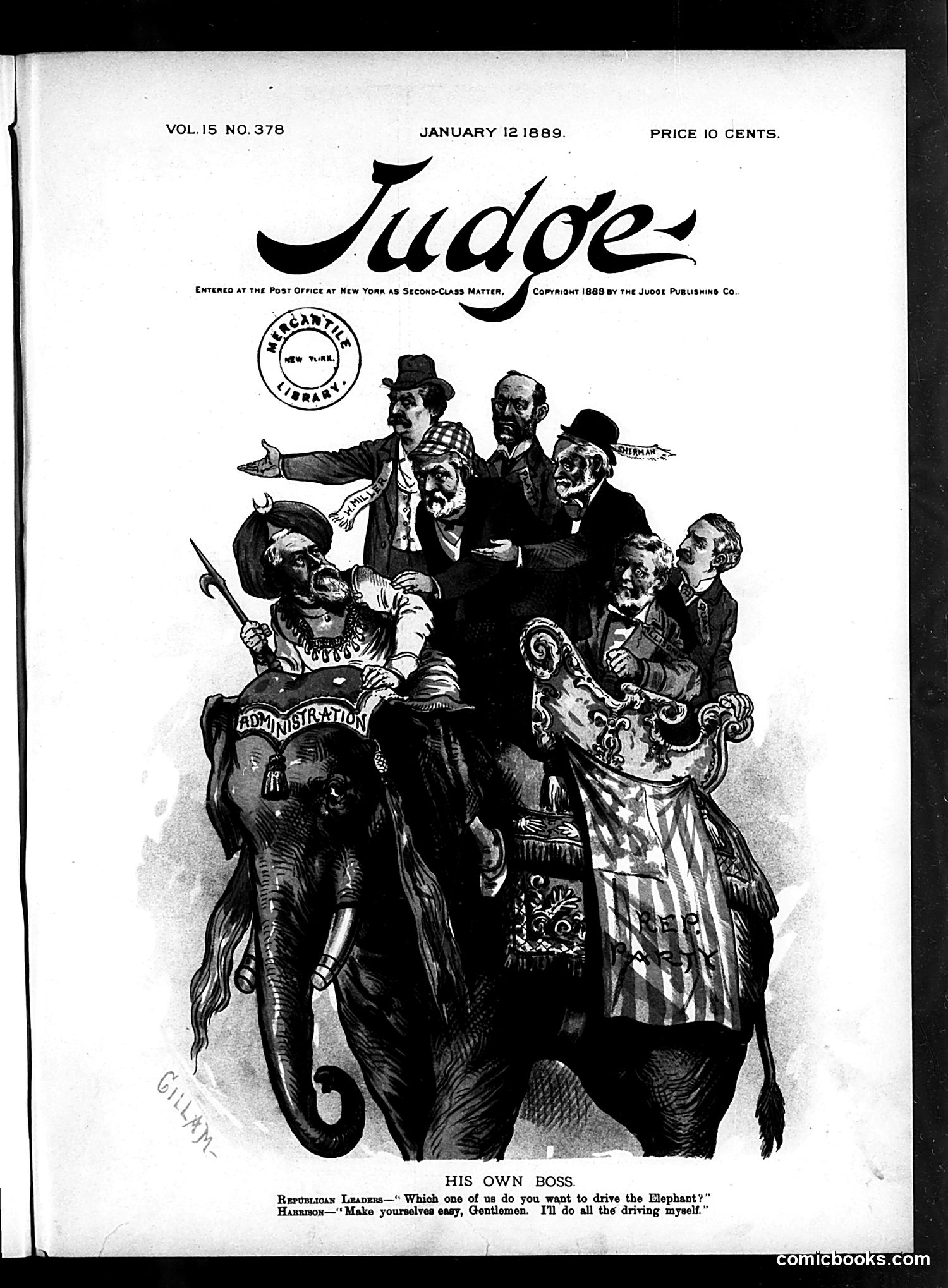
This cartoon satirizes Republican leadership struggles during the early Harrison administration. The caption's dialogue—Republican leaders asking "Which one of us do you want to drive the elephant?" with Harrison responding "I'll do all the driving myself"—depicts tension over who controls the party. The elephant represents the Republican Party. Multiple caricatured figures (likely prominent Republicans) crowd atop it, suggesting internal power struggles and competing interests within the GOP leadership. Harrison's assertion that he'll "do all the driving" indicates his determination to lead independently rather than be controlled by party bosses or factions. The satire targets Republican infighting and questions Harrison's ability to manage competing party interests effectively during his presidency.
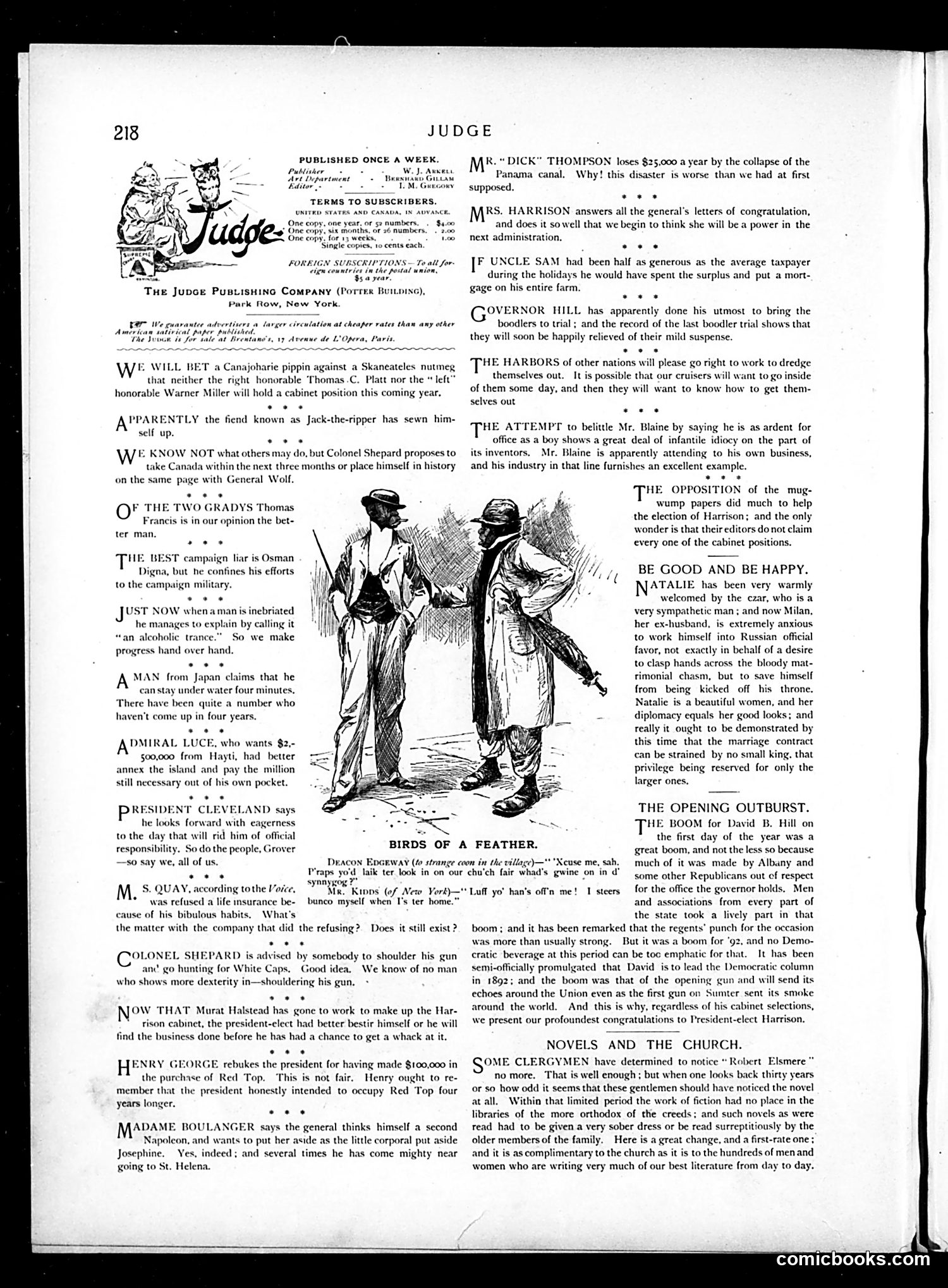
This cartoon depicts two men in conversation, labeled "Birds of a Feather." Based on the surrounding text snippets, the satire appears to address political corruption or questionable dealings during the Harrison administration (referenced in multiple items on the page). The cartoon likely mocks collusion between political figures—one appears to be a politician or officeholder, the other possibly a businessman or lobbyist. The "birds of a feather" metaphor suggests they're equally culpable partners in unsavory activity. The dialogue ("Excuse me, sh—") indicates one warning the other to be discreet. Without clearer identification of the specific figures or the exact historical event, the precise target remains unclear, but the satire condemns corrupt relationships between political and business interests.
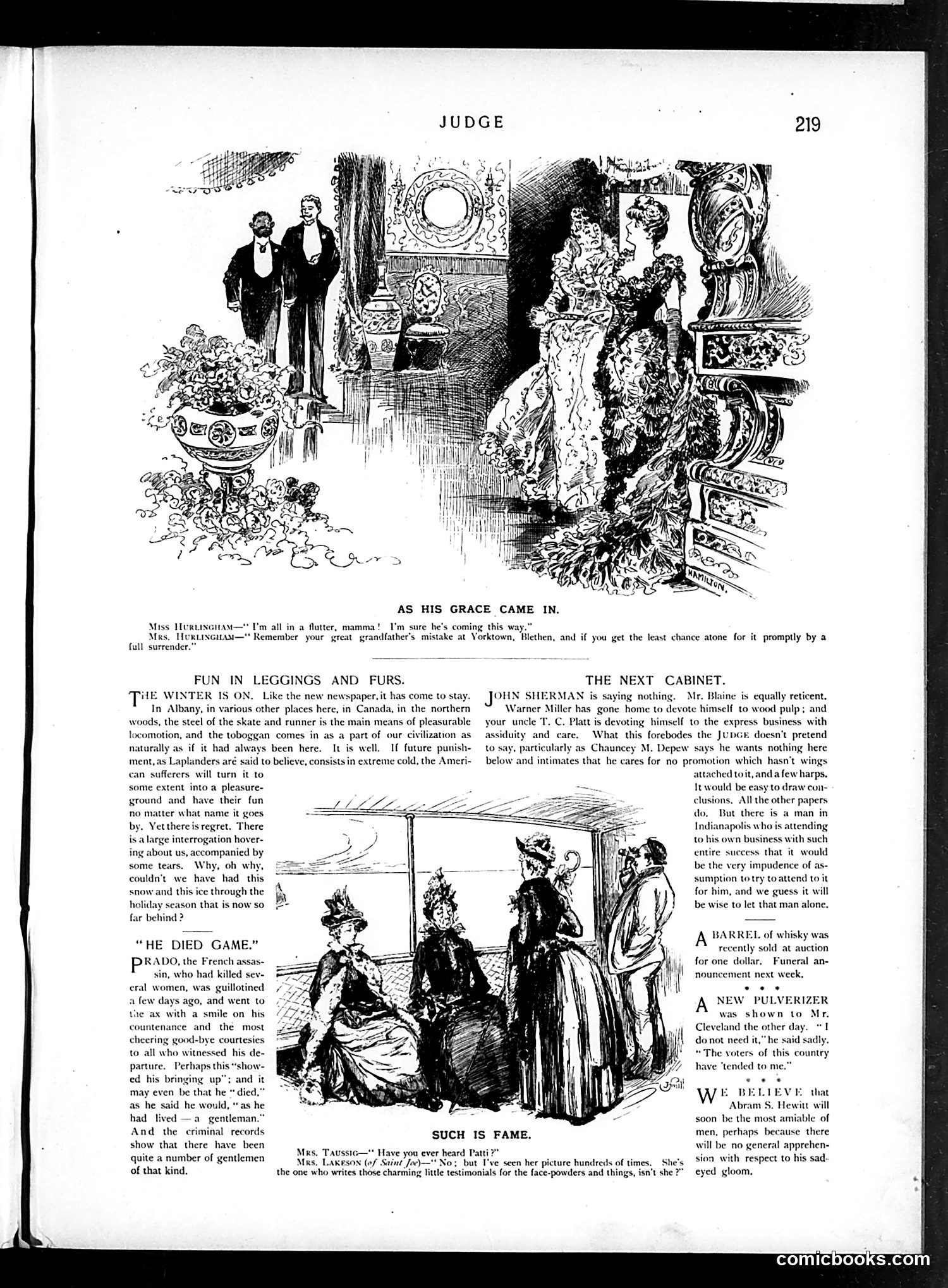
This page from Judge (likely 1880s-90s) contains multiple satirical pieces about contemporary American politics and society: **"As His Grace Came In"** mocks aristocratic social anxiety, with a mother warning her daughter to "atone" for an ancestor's surrender at Yorktown—suggesting nervousness about entertaining British nobility. **"The Next Cabinet"** satirizes potential cabinet appointments under a future administration. It references John Sherman, James Blaine, and others as silent or evasive about their roles, while mocking T.C. Platt's focus on express business and poking fun at Chauncey Depew's ambition for promotion. **"He Died Game"** discusses Prado, a French assassin recently executed, praising his composure—likely dark commentary on celebrity and notoriety in crime. **"Fun in Leggings and Furs"** celebrates winter sports becoming mainstream American recreation, though with nostalgic regret. The page primarily targets politicians' evasiveness and self-interested career moves during a period of cabinet speculation.
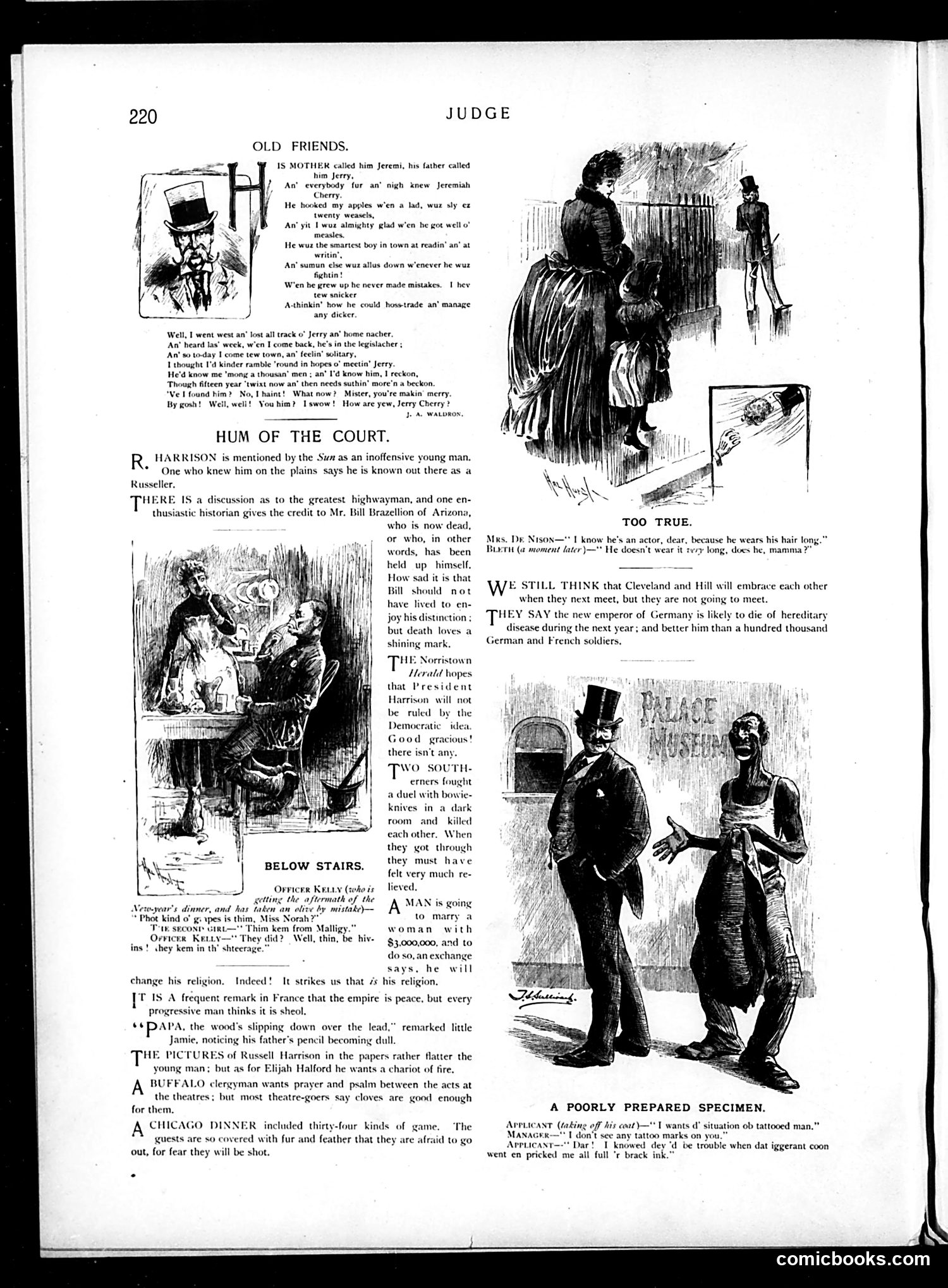
This page contains several satirical pieces typical of late-19th-century American humor: **"Old Friends"** is a sentimental poem about reuniting with a childhood acquaintance named Jerry Cherry who became a legislator—likely poking fun at ordinary men rising to political office. **"Hum of the Court"** includes brief political jabs: mocking President Harrison as "inoffensive," joking that a famous highwayman "Bill Brazellion" couldn't enjoy his criminal distinction after death, and sarcastically praising Democratic Party leadership. **The cartoons** illustrate various social observations: a woman discussing an actor's hairpiece, a poorly tattooed Black man seeking employment as a "tattooed specimen" (using period racist dialect), and class-based humor about servants. The page reflects Judge's formula: mixing political commentary, social satire, and ethnic stereotypes considered acceptable entertainment for educated readers of that era. The racist caricatures and dialect humor represent problematic historical attitudes now recognized as offensive.
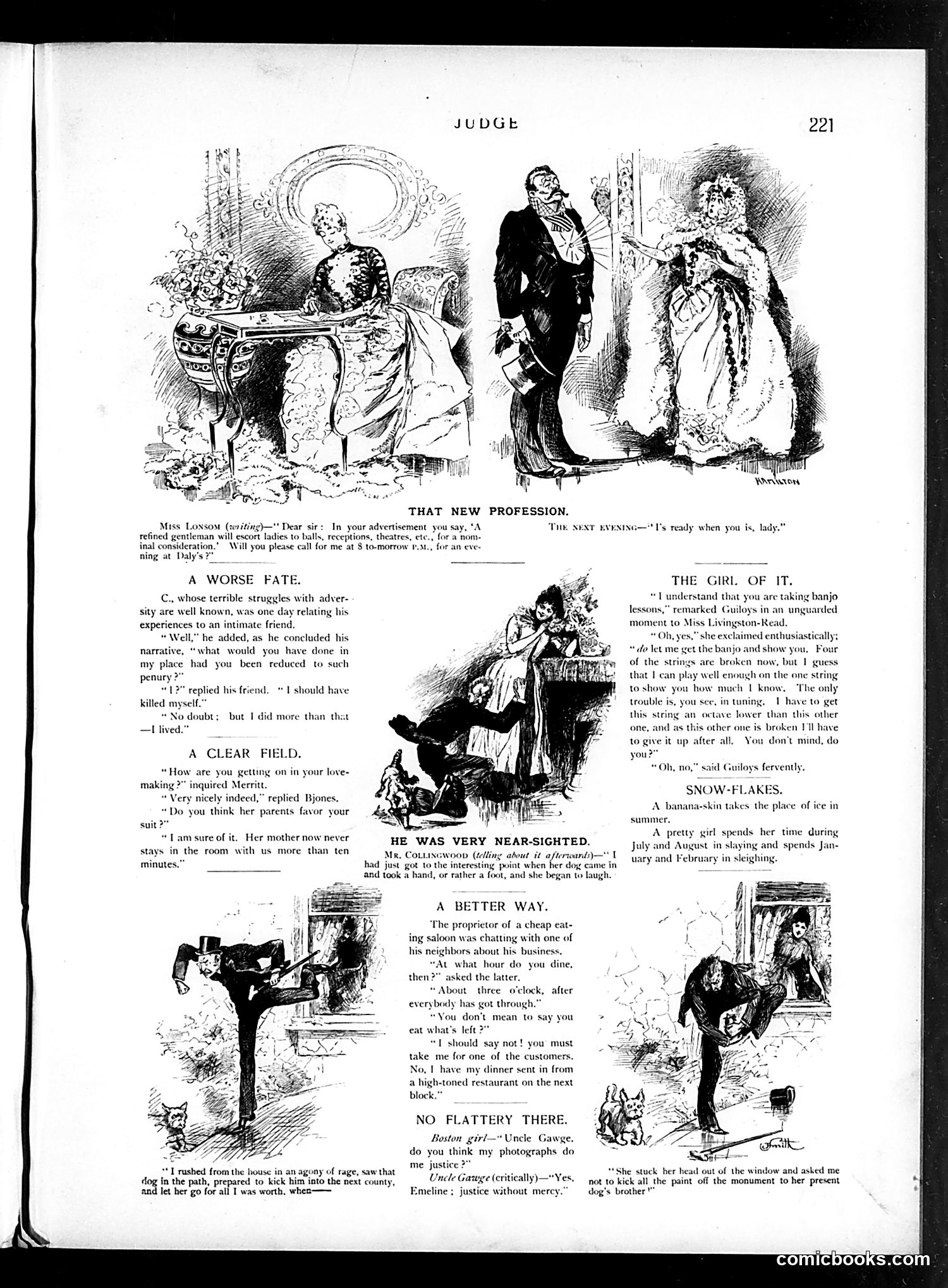
This page contains six brief humorous anecdotes satirizing late-19th-century social conventions and human nature: **"That New Profession"** mocks the emerging practice of gentlemen hiring themselves as paid escorts to social events—a new commercial service that blurs propriety. **"A Worse Fate"** jokes darkly about poverty: a man says he'd have committed suicide rather than face the destitution his friend endured. **"A Clear Field"** satirizes parental approval of courtship through neglect—the suitor's presence is tolerated only because the mother refuses to supervise. **"He Was Very Near-Sighted"** is a simple domestic humor piece about an interruption during a romantic moment. **"A Better Way"** ridicules a cheap restaurant owner's pretension: he won't eat his own food but imports meals from an upscale restaurant next door, maintaining false respectability while serving inferior fare. **"No Flattery There"** and **"Snow-Flakes"** offer mild social observations about photography vanity and seasonal female leisure activities. These represent Judge's light satirical style—poking at class consciousness, social climbing, and courtship rituals rather than political targets.
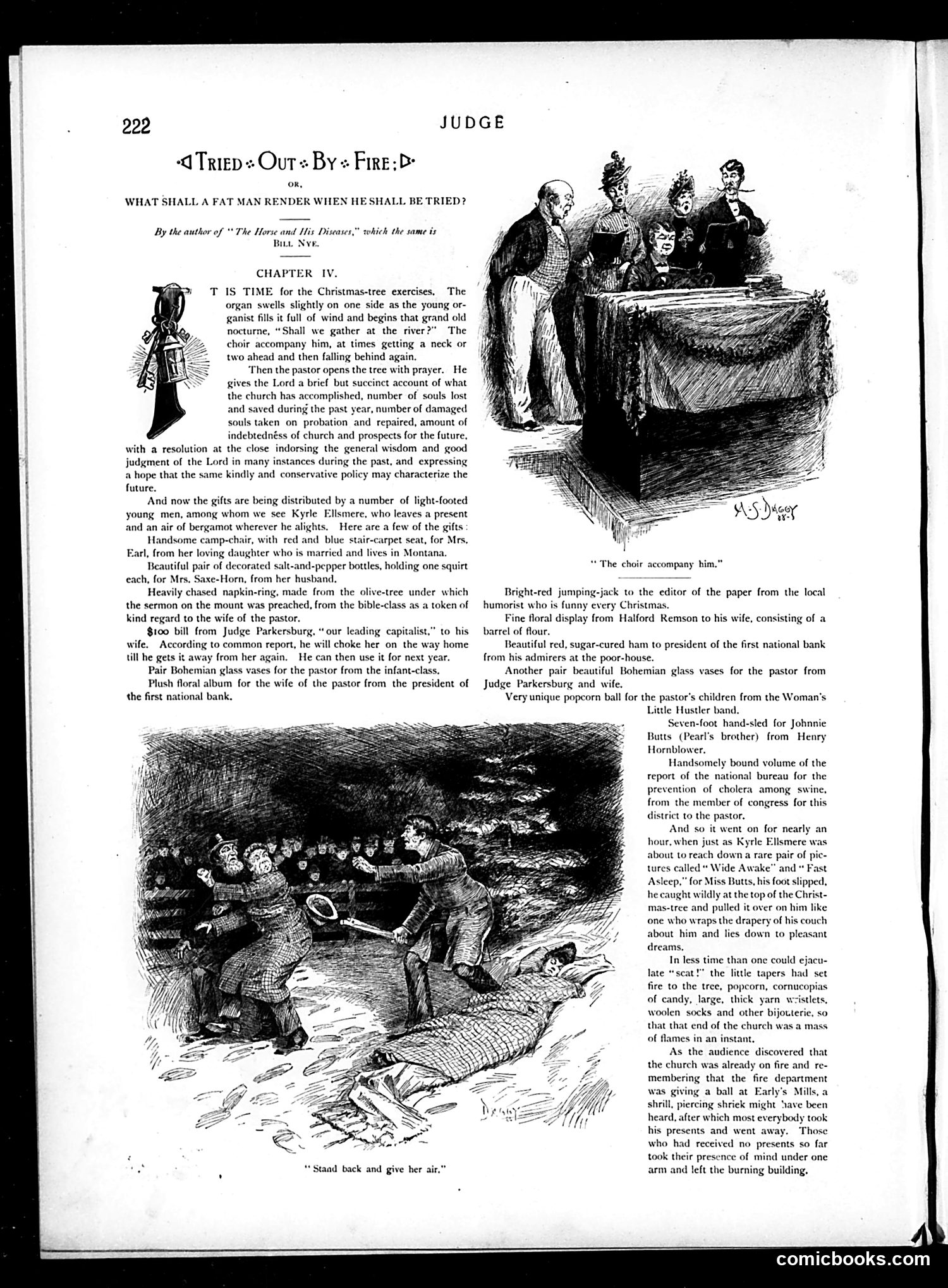
This is Bill Nye's satirical story about a church Christmas celebration that ends in disaster. The narrative mocks small-town religious hypocrisy through a gift-distribution scene where Judge Parkersburg (identified as "our leading capitalist") gives money he plans to steal back from his wife, and church officials receive lavish gifts while the poor receive humble ones. The satire's target is class inequality and religious pretense: wealthy townspeople perform generosity at Christmas while the pastor receives duplicate gifts, and the "leading capitalist" cynically exploits charity. The climax—when young Kyrle Ellsmere accidentally sets the tree ablaze—uses literal fire as metaphor for exposing institutional corruption. The title's double meaning ("tried out by fire") suggests both testing one's faith and being caught red-handed. The irony peaks when the fire department is unavailable due to their own ball, leaving the burning church undefended.
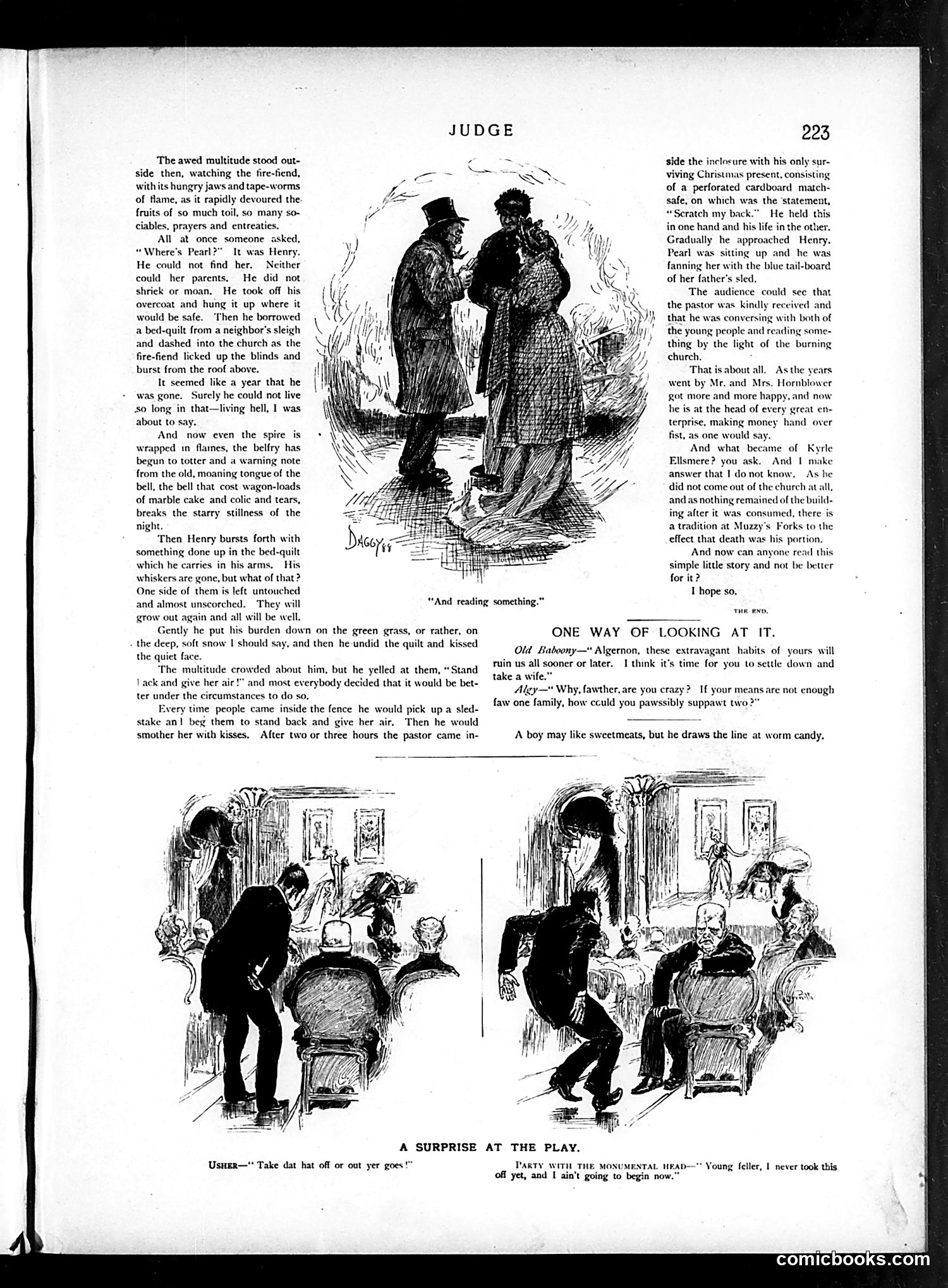
This page contains a serialized story about a church fire rescue, followed by two separate satirical pieces. **Main Story**: A man named Henry rescues a woman named Pearl from a burning church. The narrative emphasizes his devotion—he strips off his coat to preserve it, borrows a quilt, and risks the flames. The satire appears gentle: after Pearl's rescue, Henry obsessively demands people "give her air" and later becomes a successful businessman. The story mocks sentimental Victorian melodrama and romantic excess. **"One Way of Looking at It"**: A father ("Old Baboonny") tells his son "Algernon" to marry and settle down. When the son protests that his means cannot support two families, the father questions his logic. The satire targets upper-class young men and their excuses for remaining unmarried—implying Algernon's claim is absurd or dishonest. **"A Surprise at the Play"**: Shows theater patrons being asked to remove their hats. One refuses, claiming he's never removed it. This satirizes inconsiderate theatergoers who obstruct others' views—a common complaint of the era.
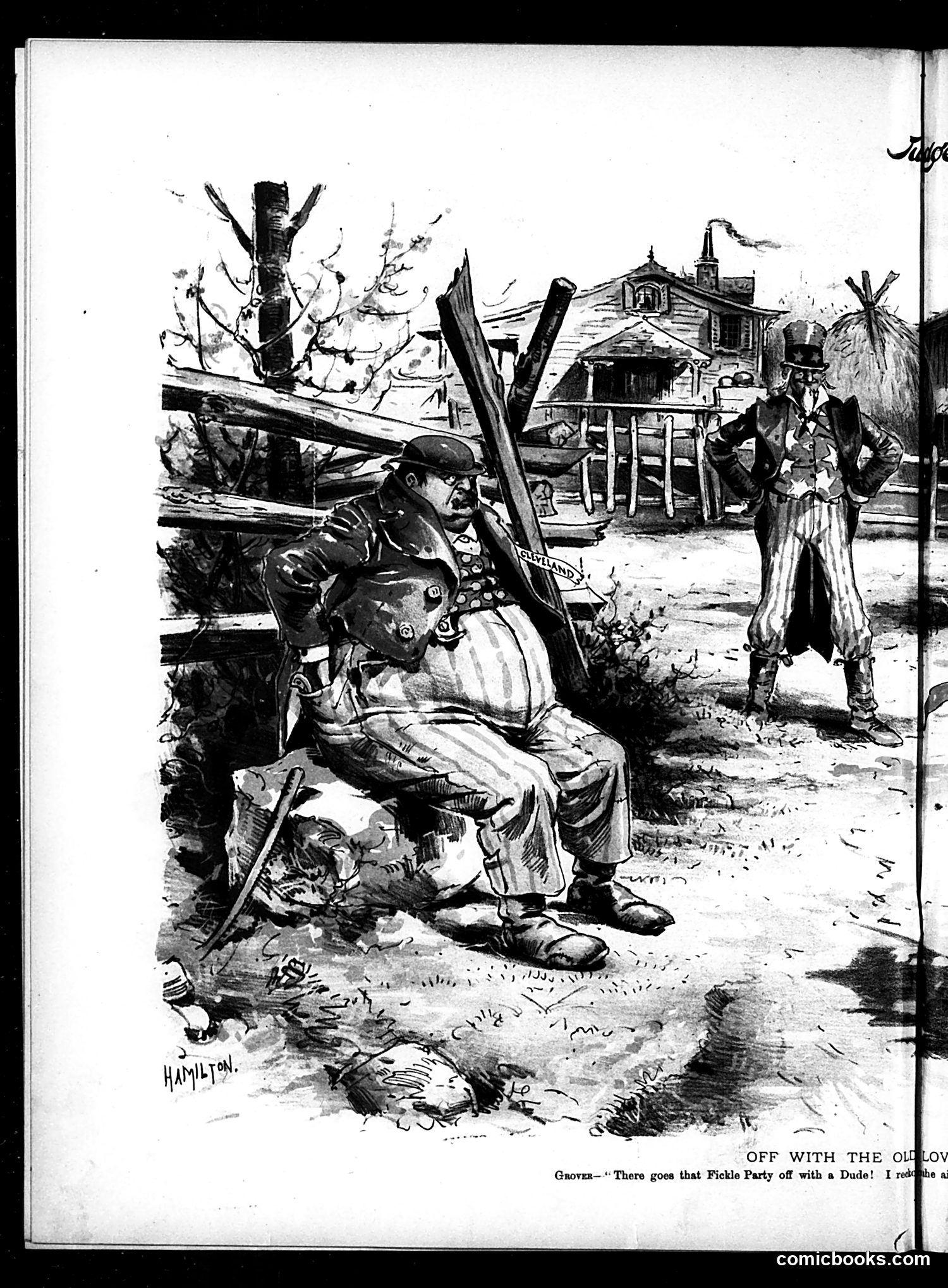
This cartoon, titled "OFF WITH THE OLD LOVE," depicts a seated figure in military dress being observed by another uniformed man. The caption reads: "GROVER—'There goes that Pickle Party off with a Dude! I reckon a—'" The sketch appears to reference late 19th-century American political figures, likely satirizing romantic or social scandals involving prominent men of the era. "Pickle Party" is an unclear reference, possibly a political faction or social group. The soldier figure marked "GROVER" suggests President Grover Cleveland, though the exact historical situation remains uncertain without additional context. The humor targets perceived hypocrisy or romantic entanglements among the political elite, a common Judge magazine theme. The artist's signature reads "HAMILTON."
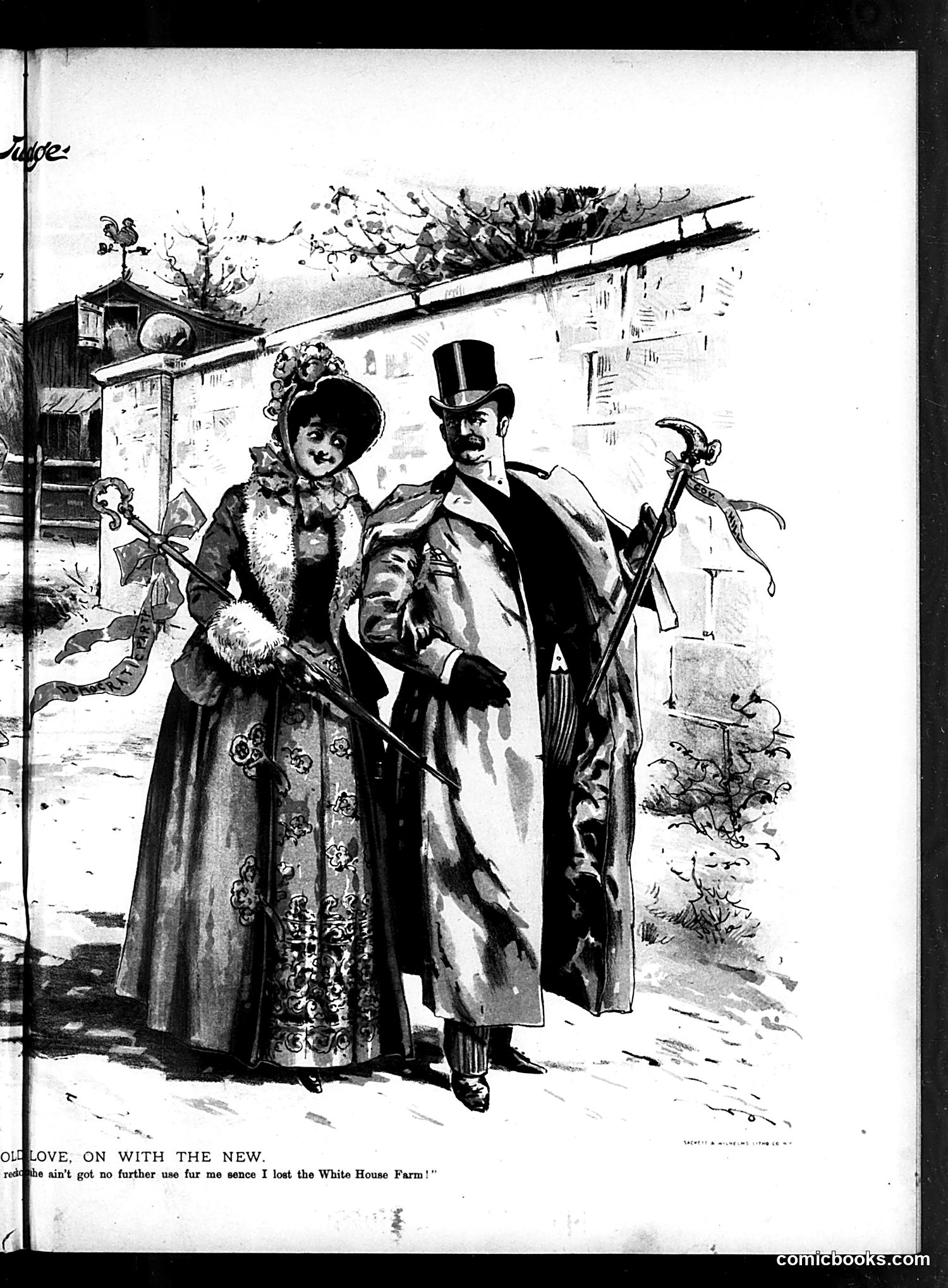
This political cartoon depicts a well-dressed man in a top hat (appearing to represent a politician or public figure) being rejected by a fashionably-dressed woman. The caption reveals the joke: he claims the woman "ain't got no further use" for him since he "lost the White House Farm." The satire targets a politician who benefited from political patronage or access to presidential resources—colloquially called the "White House Farm"—and has been abandoned by his social circle once he lost that position and power. This reflects the transactional nature of Gilded Age political relationships, where social standing and romantic interest were tied to political influence and access to wealth. The cartoon mocks both the corrupt system and the fickle loyalty it created.
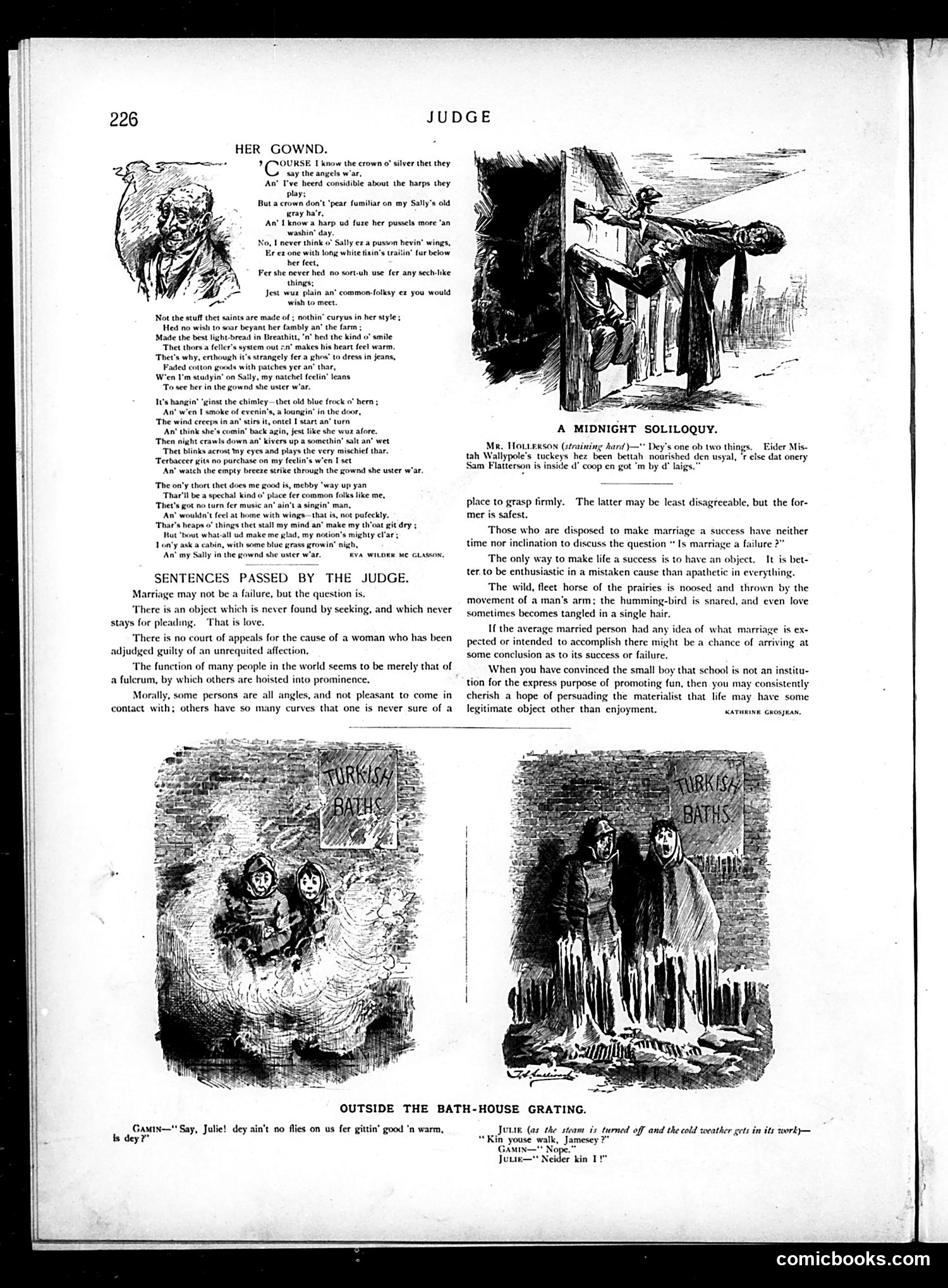
This page contains sentimental and humorous content from an American satirical magazine. **"Her Gownd"** is a dialect poem (in rural/Appalachian vernacular) about a widower's grief. The speaker, a ghost or deceased man, recalls his wife Sally through her simple blue work dress hanging by the chimney. Rather than imagining her in heaven with harps and crowns, he wants only to see her in her everyday gown—emphasizing how ordinary domestic life, not heavenly reward, was their happiness. The melancholy humor derives from the contrast between religious expectations of the afterlife and working-class sentiment for humble, earthly reality. **"A Midnight Soliloquy"** shows a man trying to determine whether neighbor Wallypole's turkeys are well-fed or whether Sam Flatterton has stolen them. It's a simple rural joke about farm theft and suspicion. **"Sentences Passed by the Judge"** offers brief, cynical aphorisms about marriage, love, and human nature—typical Judge magazine fare satirizing social pretense. The illustrations support these homespun, melancholic themes.
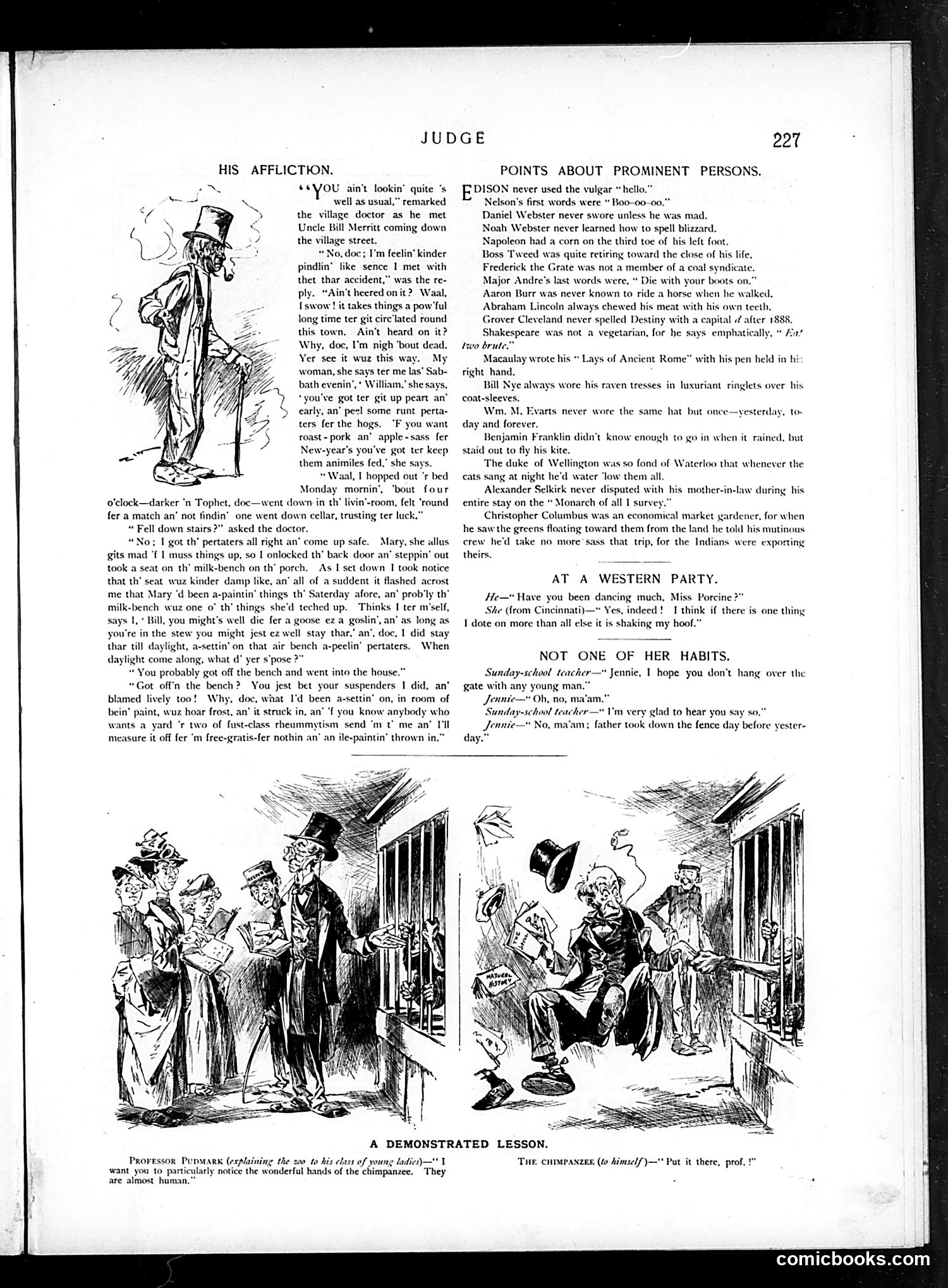
This page from the satirical magazine *Judge* contains several distinct pieces of humor: **"His Affliction"** (main story with illustration): A rural dialect monologue where Uncle Bill Merritt recounts sitting on a freshly painted bench in darkness, mistaking wet paint for hoar frost. He sits there all night peeling potatoes, only discovering his error at daylight—resulting in rheumatism. The joke targets rural simplicity and the comedy of mishap. **"Points About Prominent Persons"** (middle section): A list of trivial, invented "facts" about famous historical figures (Edison, Napoleon, Lincoln, etc.), satirizing the tendency of publications to print dubious biographical anecdotes as established truth. **Bottom cartoons and brief dialogue sketches**: Illustrate genteel social awkwardness—a "demonstrated lesson" and an exchange at a western party where a woman admits to caring only about shaking her hood (likely a bonnet or hat), mocking superficial social pretension. The page's overall humor derives from exaggeration, mistaken identity, and mockery of both rural naiveté and urban social pretension.
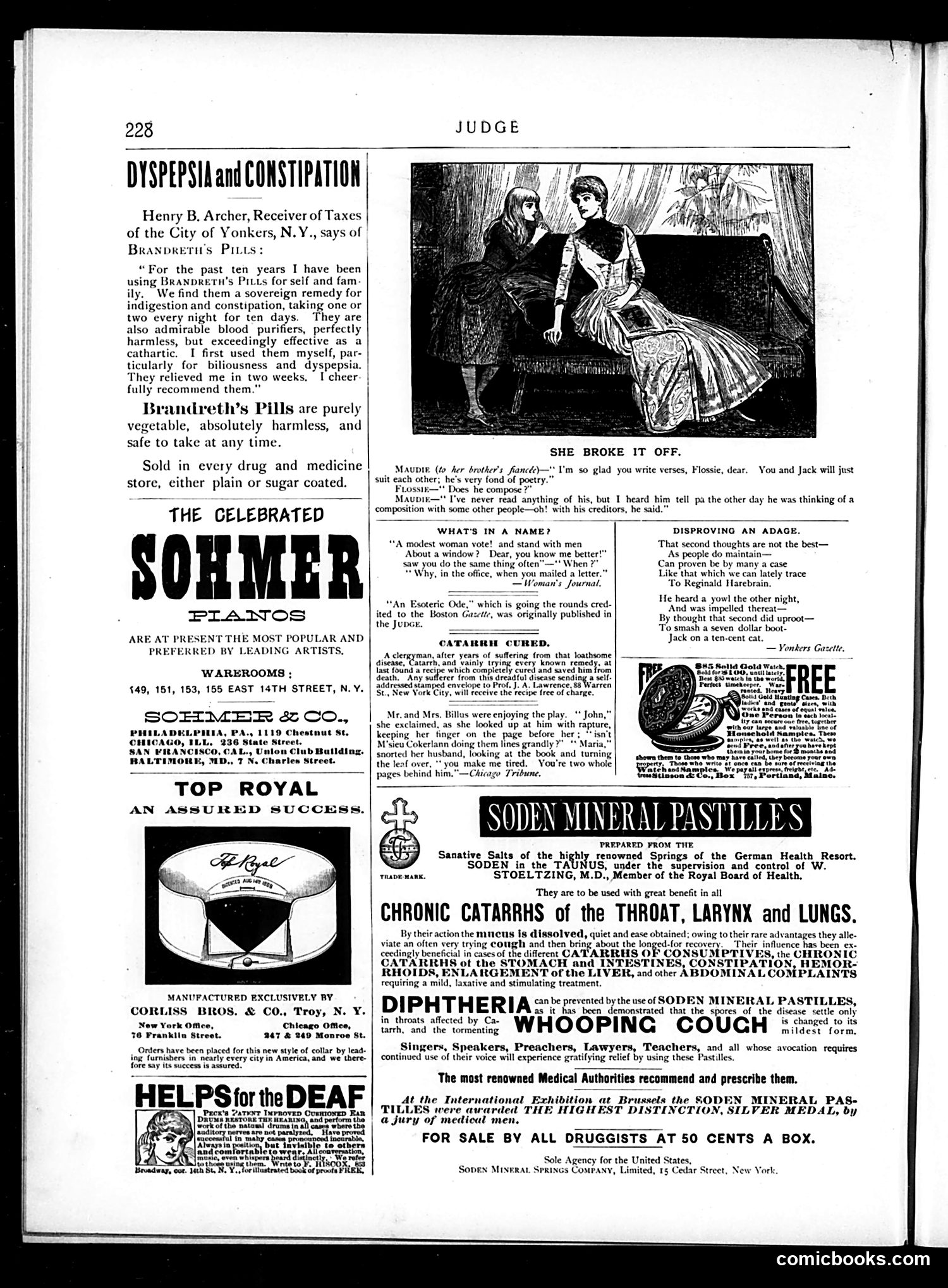
This page is primarily an **advertising spread** with several elements typical of Judge magazine's format: **Main content:** The central illustration depicts a couple breaking an engagement, with the caption "SHE BROKE IT OFF." The accompanying prose dialogue satirizes romantic pretension—the woman's brother's fiancée boasts that the groom-to-be writes poetry, but he's actually been composing letters to *creditors*, suggesting financial desperation masked by artistic pretense. **Satirical items below** include brief jokes mocking women's voting, a man destroying furniture over a rejected poem, and couples misinterpreting behavior. **Advertisements** dominate the page: Brandreth's Pills for digestive ailments, Sohmer Pianos, "Helps for the Deaf," Top Royal collar, Soden Mineral Pastilles for throat/lung issues—typical patent medicines and luxury goods marketed in turn-of-century publications. The advertisements, interspersed with the satirical content, reflect Judge's dual function as both humor magazine and advertising vehicle.
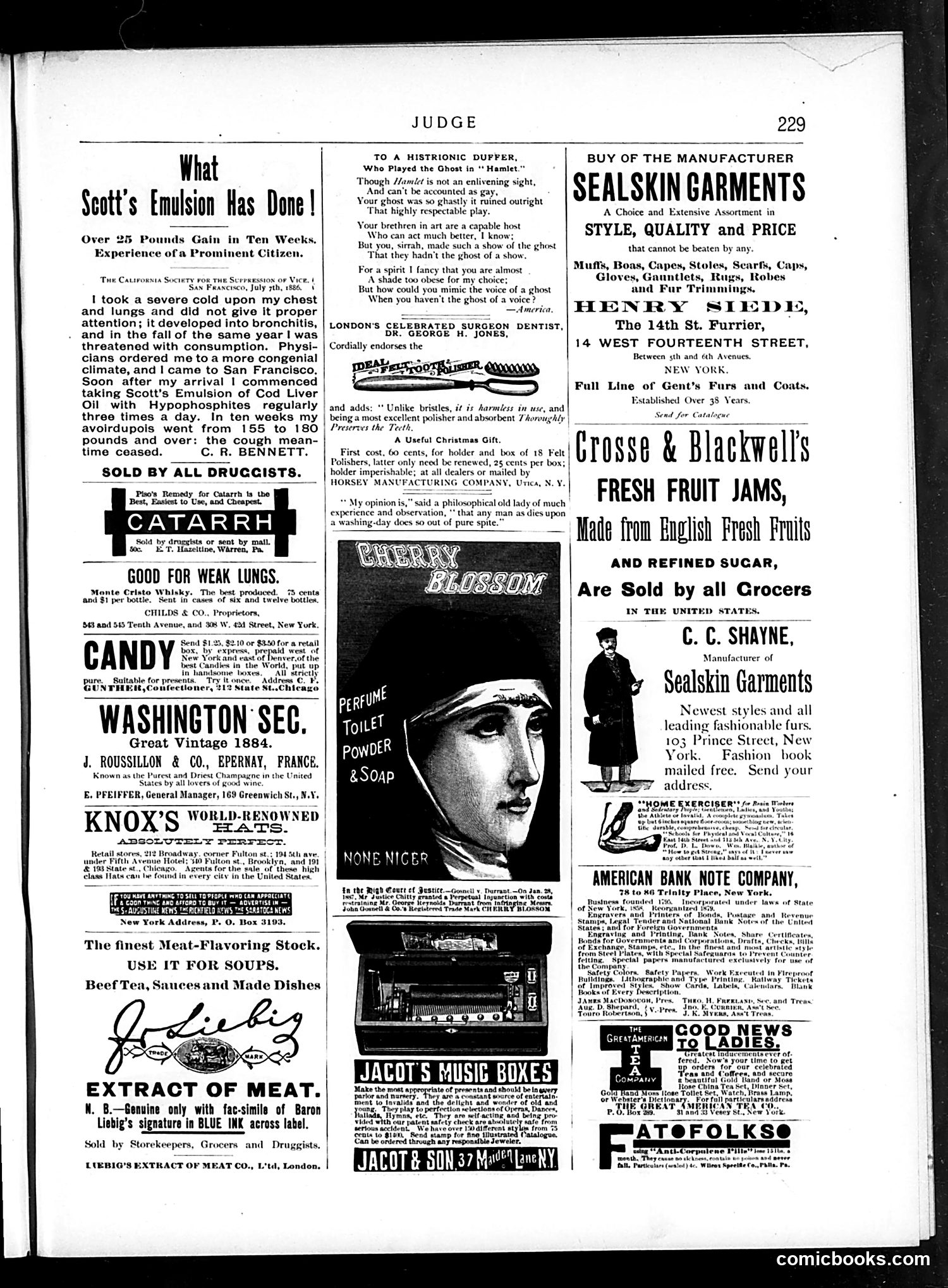
This page is **primarily advertisements**, with one visible satirical poem occupying the upper-center portion. The main satirical content is a poem titled "To a Histrionic Duffer, Who Played the Ghost in 'Hamlet.'" It mocks a bad actor who performed the Ghost character in Shakespeare's *Hamlet*. The satire relies on: - **Puns on "ghost"**: The writer criticizes the actor for being too obese ("a shade too obese"), having a poor voice ("haven't the ghost of a voice"), and ruining the play so badly that other actors "hadn't the ghost of a show" - **Theater criticism**: The poem suggests the actor's incompetence—his physical appearance and vocal delivery—undermined what should be a serious theatrical production The rest of the page contains period advertisements for patent medicines (Scott's Emulsion for consumption), food products (Liebig's Extract), tooth powder, whisky, champagne, sealskin garments, and music boxes—typical of 1880s American consumer culture.
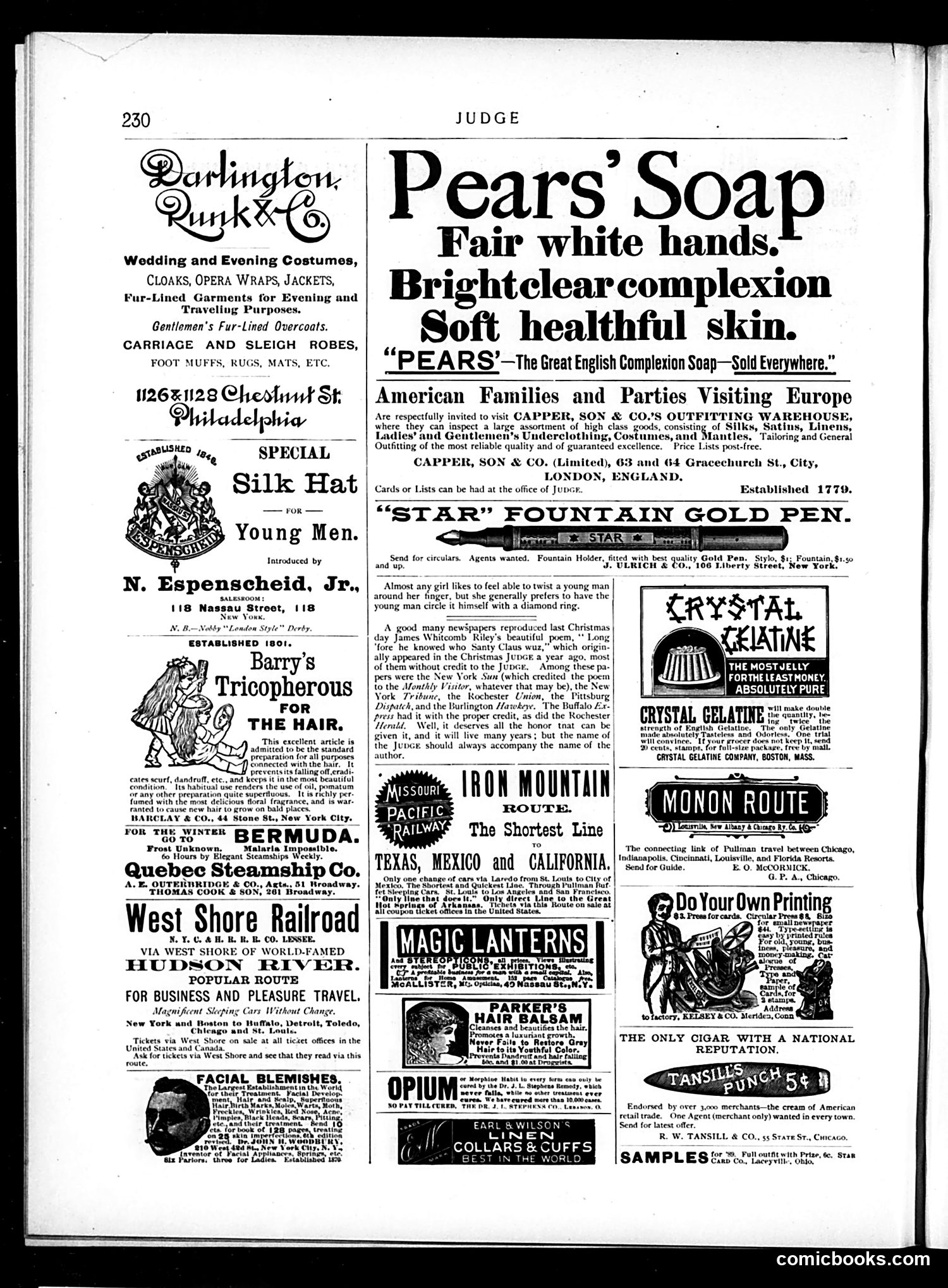
This page is primarily **advertising**, not political satire. It's from Judge magazine (a satirical publication), but this particular page showcases commercial advertisements typical of late-19th-century magazines. The only notable non-advertising content is a brief humorous observation about a James Whitcomb Riley Christmas poem. The text notes that several newspapers reprinted Riley's poem without crediting Judge magazine (where it originally appeared), and expresses mild frustration that while the poem deserves recognition, Judge's role as the original publisher should be acknowledged. The advertisements themselves—for Pears' Soap, railroad travel, fountain pens, and various luxury goods—reflect the magazine's affluent readership and the era's consumer culture. There is **no political cartoon or satirical commentary visible** on this page; it functions purely as a revenue-generating advertisement section with one brief editorial complaint about plagiarism.
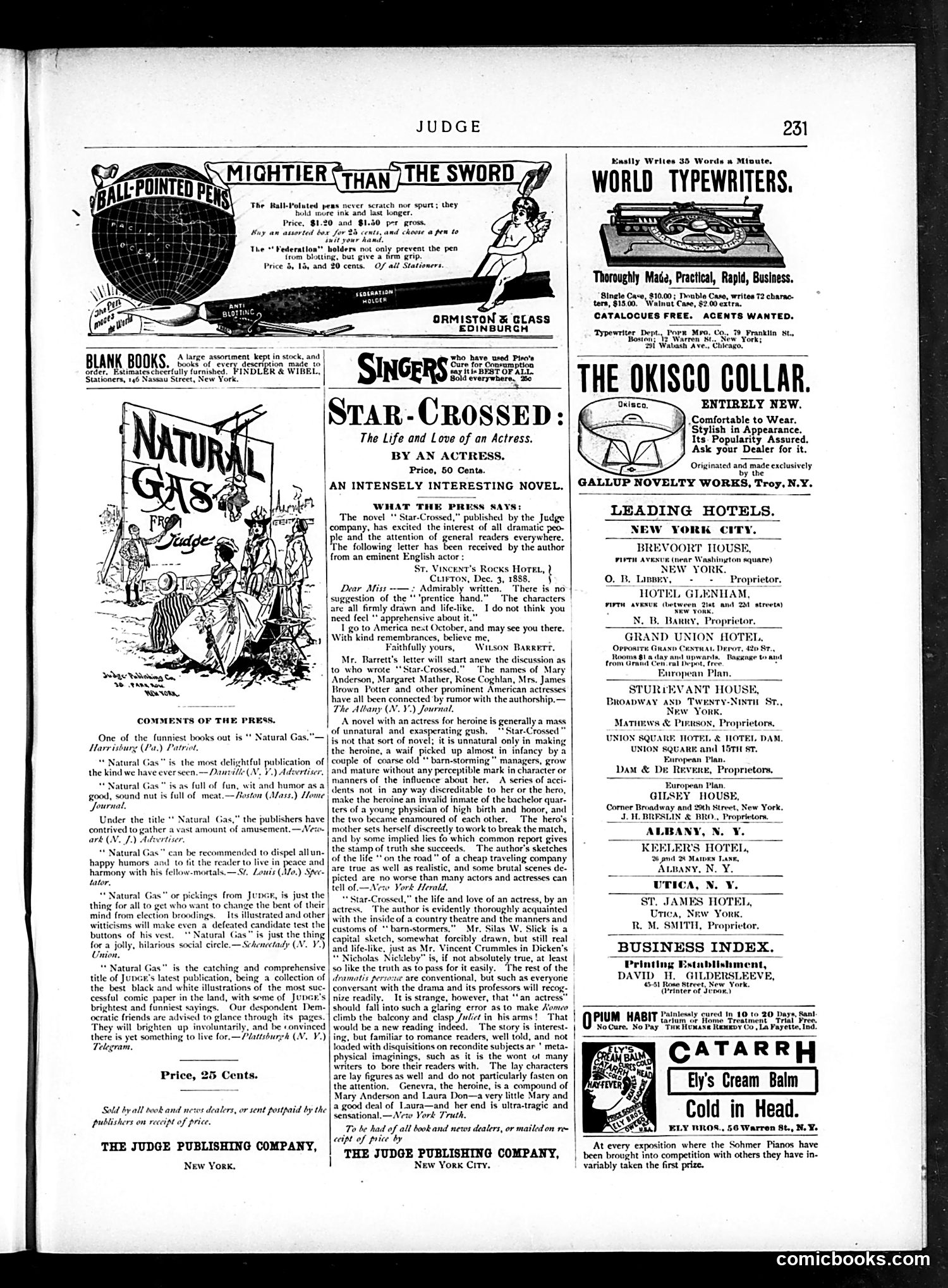
This page is primarily **advertising and promotional content** rather than political satire. The main elements are: **Top Advertisement:** "Ball-Pointed Pens" by Ormiston & Glass—a product advertisement emphasizing pen durability and ink-holding capacity. **"Natural Gas" Book Promotion:** Judge Publishing promotes a humorous collection titled *Natural Gas*, reprinting press reviews praising it as entertaining and funny. The subtitle suggests it's a compilation of illustrations and comics from Judge magazine itself. **"Star-Crossed" Novel:** Advertisement for a serialized or published novel about an actress, with a quoted letter from actor Wilson Barrett lending credibility. The mystery authorship (possibly by Mary Anderson or another actress) generated publicity. **Hotel and Business Listings:** Standard classified advertisements for New York hotels and services. **Overall:** This appears to be a typical Judge magazine back-page mixing house promotions, book advertisements, and classifieds—reflecting late 19th-century magazine business models rather than containing satirical political commentary.
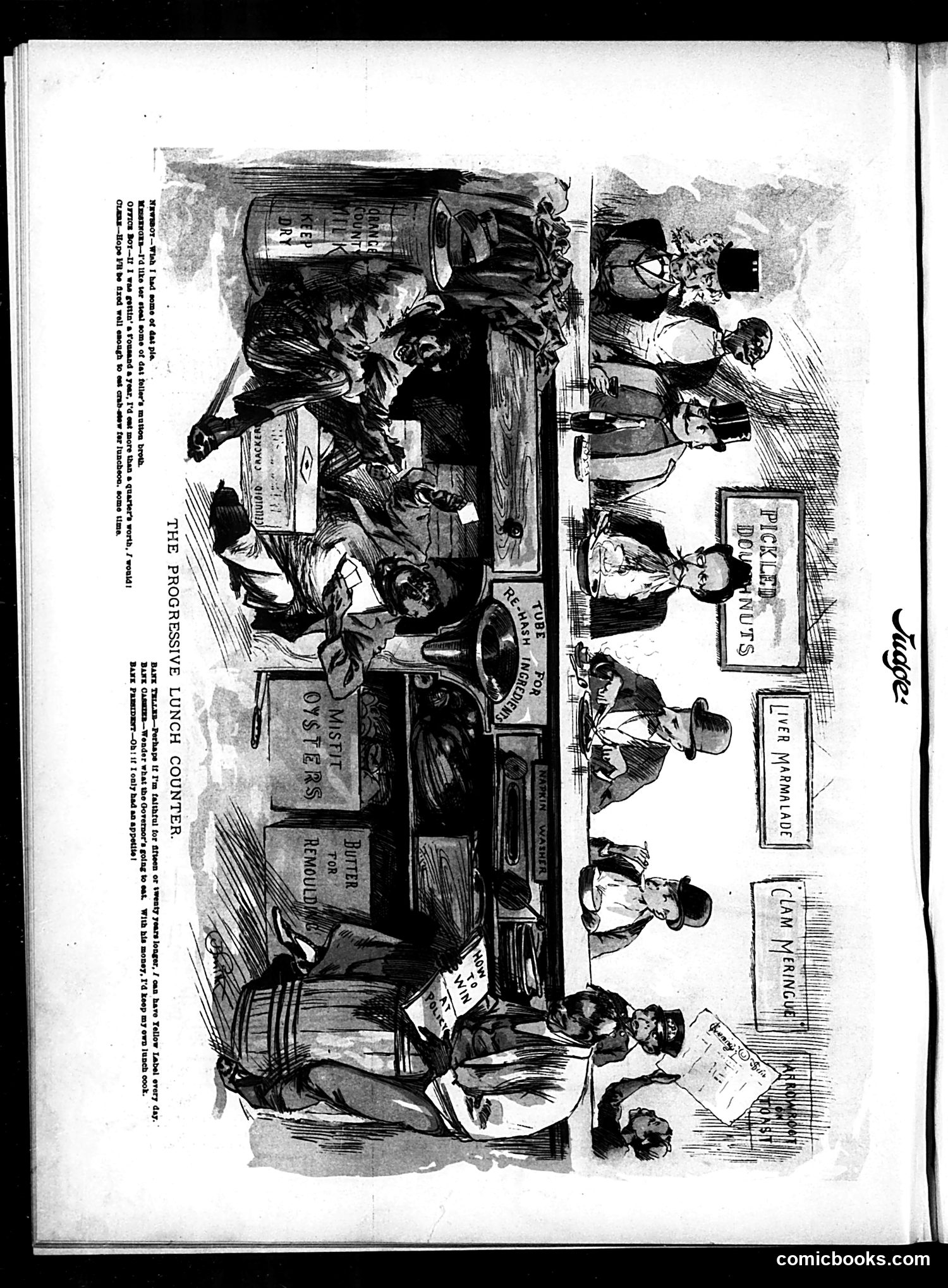
This satirical cartoon depicts economic inequality through a lunch counter metaphor. Figures at different social/economic levels—messenger, bank teller, office boy, bank cashier, bank president, and clerk—stand before food of varying quality, representing their respective wages and station. The joke critiques the extreme wealth disparity: the bank president has abundant food but lacks appetite to enjoy it, while lower-ranking workers (messenger, office boy) fantasize about modest meals they cannot afford. The "progressive" title sarcastically suggests this hierarchical system represents progress. The cartoon likely references early 20th-century labor debates and wealth inequality during the Progressive Era. It mocks both the indifference of wealthy elites and the desperate aspiration of working-class employees—suggesting the system is fundamentally unjust, where those with least resources most desire basic comforts, while the wealthy remain unsatisfied.