
A complete issue · 18 pages · 1888
Judge — November 17, 1888
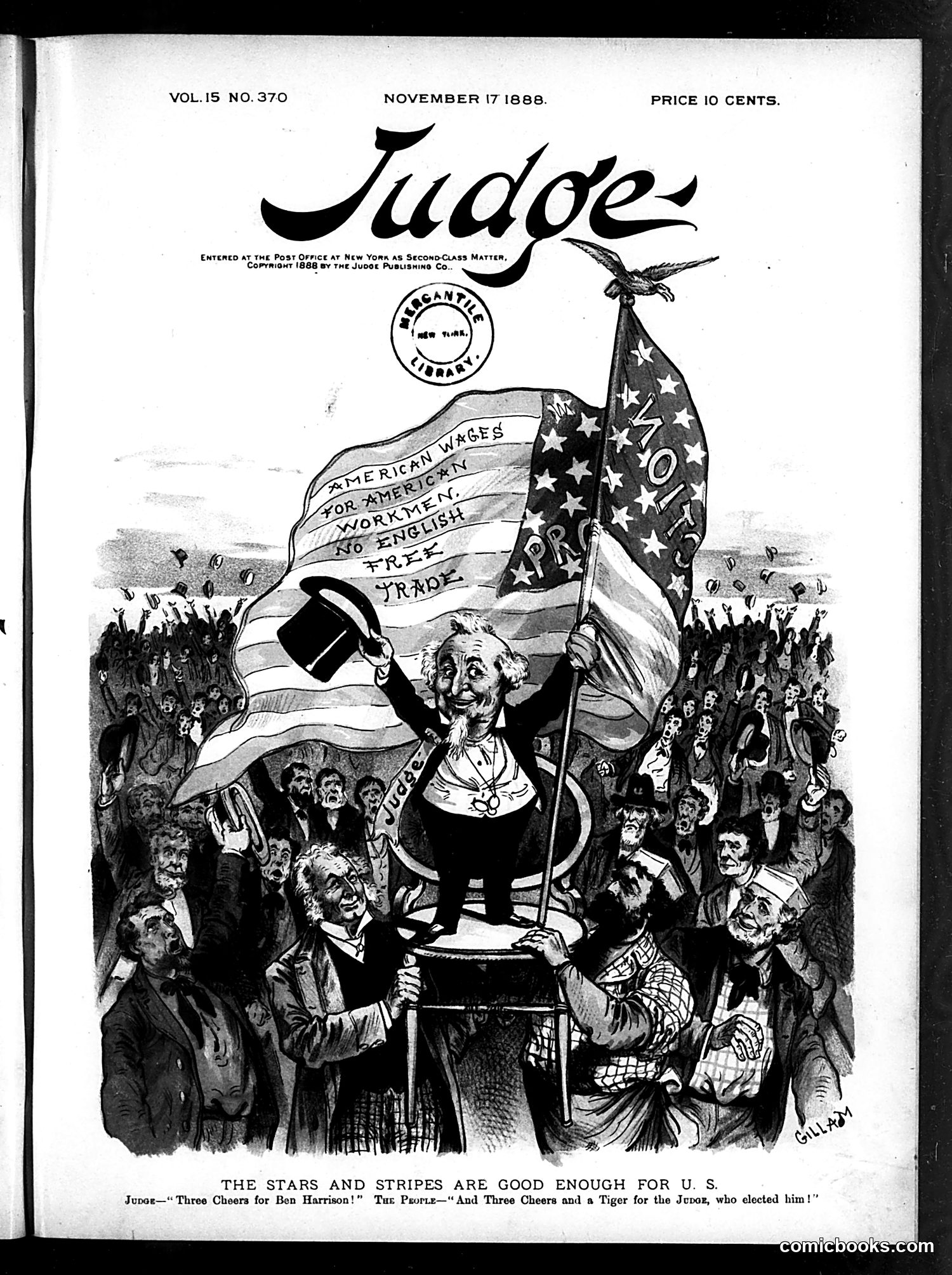
This 1888 *Judge* magazine cover satirizes the presidential election. A central figure (likely Benjamin Harrison, the Republican candidate) stands triumphantly holding an American flag while crowds cheer below. The banner lists protectionist Republican campaign promises: "American Wages for American Workmen," "No English Free Trade." The caption reads: "Three Cheers for Ben Harrison!" and "Aint three cheers and a Tiger for the Jones, who elected him!" The satire criticizes the Republican Party's appeal to working-class voters through nationalist, anti-free-trade rhetoric. The cartoon mocks how these populist slogans mobilized supporters, with the implication that such patriotic appeals obscure corporate interests. The crowded, celebratory masses suggest manufactured enthusiasm rather than genuine grassroots sentiment.
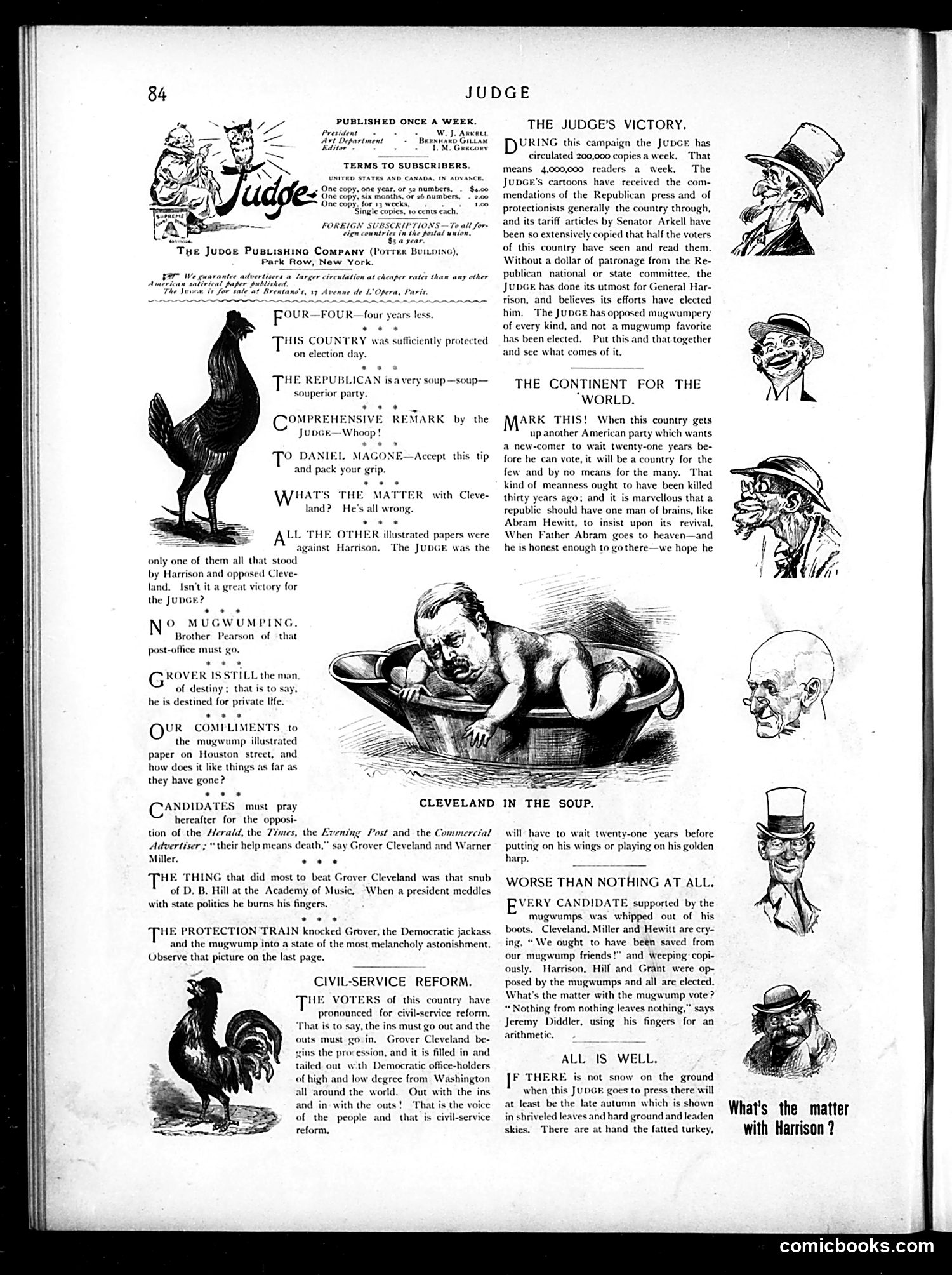
This page celebrates the Judge magazine's electoral victory, claiming 300,000 weekly readers. The central cartoon depicts **Cleveland in the soup**—a visual pun mocking President Grover Cleveland's political troubles. The rooster imagery and various caricatured heads reference rival political figures and opposition newspapers. The text ridicules Cleveland's vulnerability, particularly his unpopular stance on tariffs ("what's the matter with Cleveland?"). References to "mugwumping" (political fence-sitting) and civil-service reform debates indicate this addresses late-19th century Republican attacks on Cleveland's Democratic administration. The satire celebrates Judge's influence in opposing Cleveland while promoting Republican candidates. The overall tone is triumphalist, claiming the magazine's cartoons helped elect Harrison and demonstrating editorial confidence in their political impact.
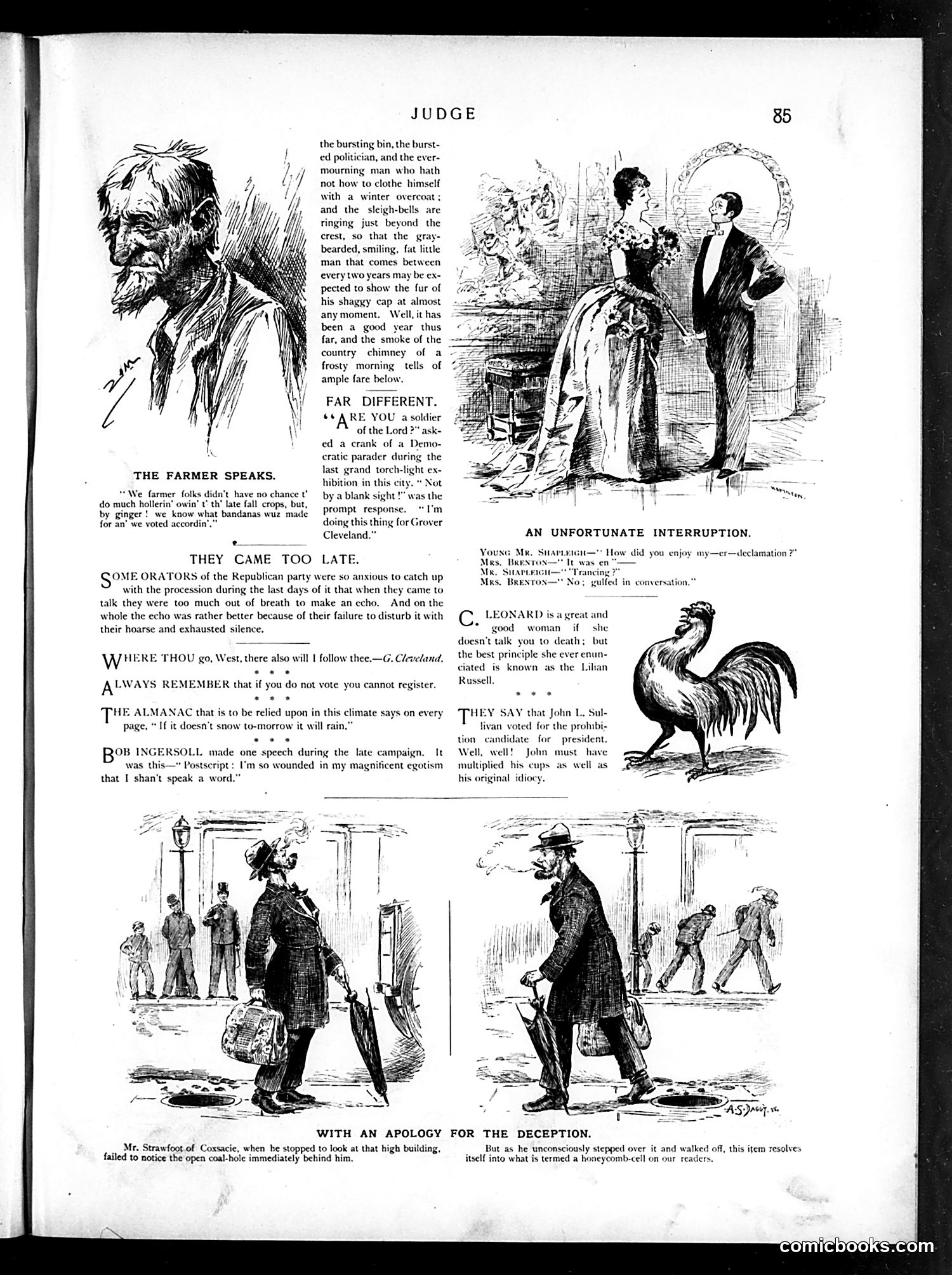
This page from Judge satirizes the 1884 election, likely following Grover Cleveland's victory. Key elements: **"The Farmer Speaks"**: Rural voters claim they voted based on principle despite limited campaigning time, supporting Cleveland ("doing this thing for Grover Cleveland"). **"They Came Too Late"**: Republicans' late-campaign speeches were ineffective—speakers were breathless and made no impact, their silence preferable to their actual words. **Political jabs**: References to candidates multiplying "his cups" (drinking) mock John L. Sullivan's reported support for the Prohibition candidate, questioning his judgment. **"An Unfortunate Interruption"**: Social satire mocking a woman (likely a public figure) for monopolizing conversation at a gathering. The page combines election commentary with general social humor, using the farmer as everyman validating Cleveland's legitimacy while lampooning Republican campaign failures and personal vices of political figures.
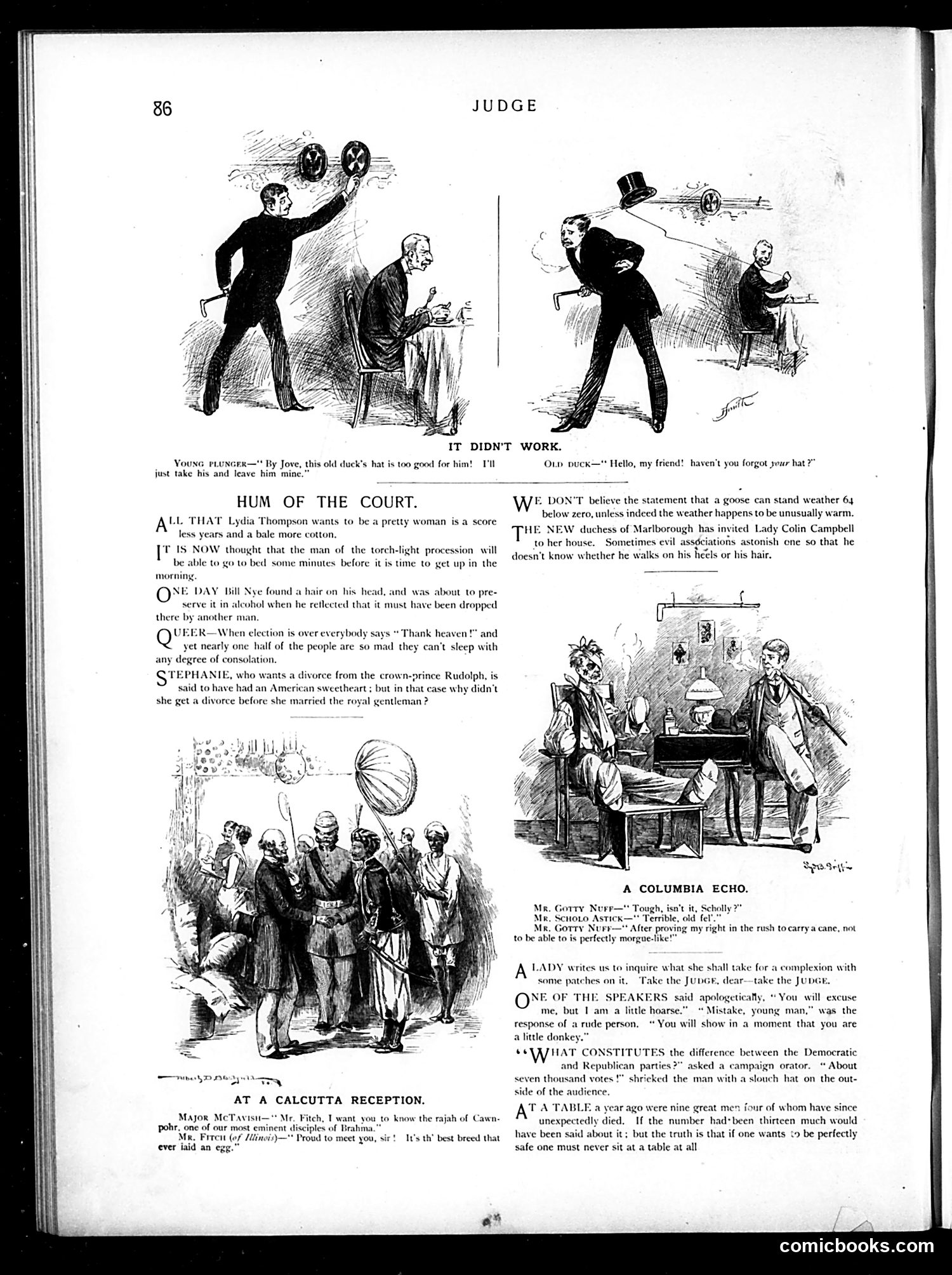
This page contains several satirical short jokes and cartoon vignettes typical of *Judge* magazine's humor: **"It Didn't Work"** shows a failed hat-swap scheme between two men, illustrating the maxim that well-intentioned exchanges often backfire. **"Hum of the Court"** consists of brief social jabs: mocking Lydia Thompson's vanity, referencing Bill Nye (a popular humorist), and satirizing post-election exhaustion and political divisiveness. **"A Columbia Echo"** jokes about schoolboys proving their "right" to carry canes—a status symbol—then being unable to perform the gesture properly. **"A Calcutta Reception"** appears to mock pretentious discourse about Indian society and the absurdity of claiming someone is a "disciple of Brahma" while making crude jokes about eggs and breeding. The recurring theme: American social pretension, hollow customs, and the gap between claims and reality. The humor relies on period-specific references (cane-carrying, Lydia Thompson's celebrity) that require historical context.
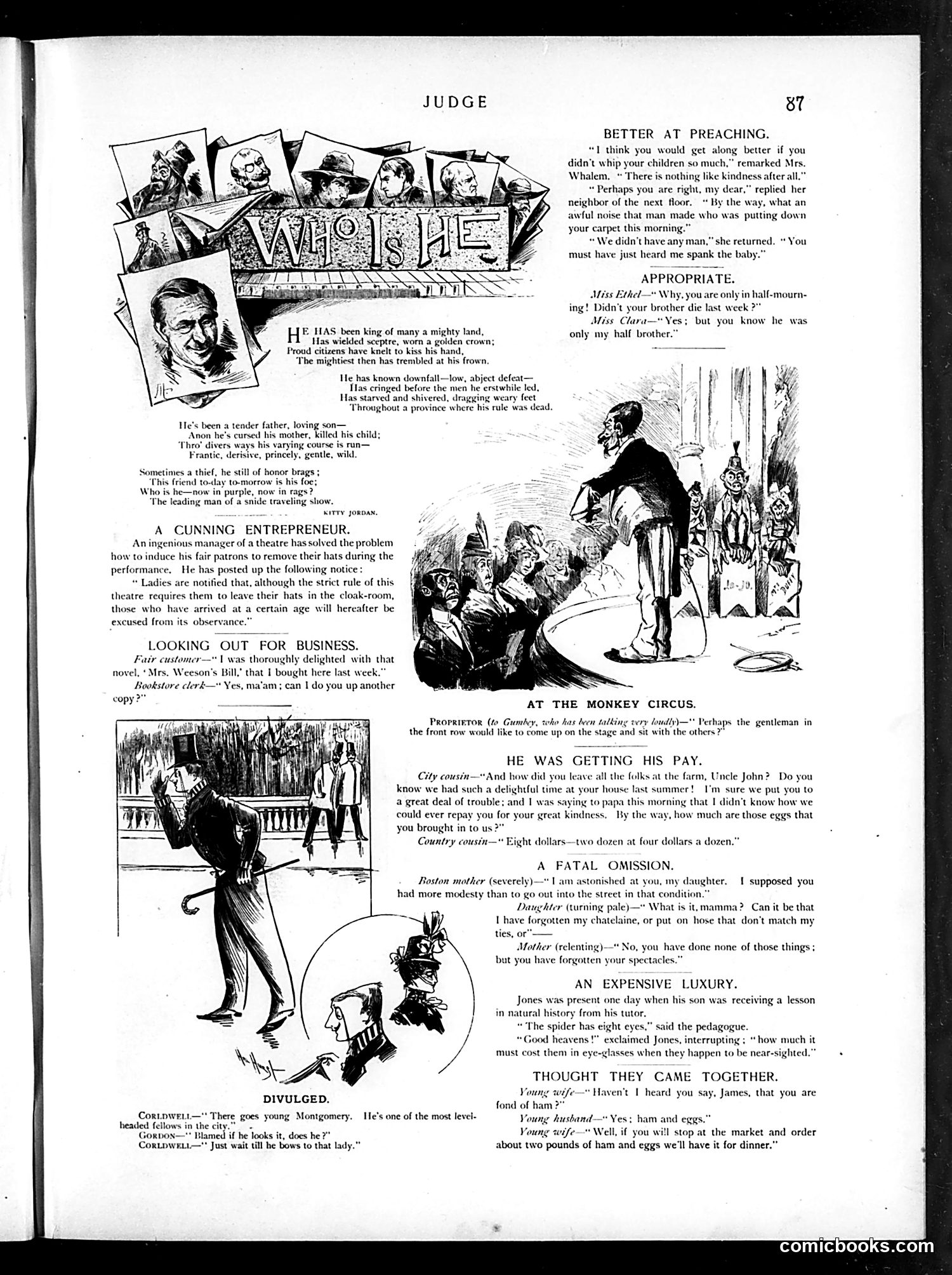
This page collects brief humorous sketches mocking middle and upper-class hypocrisy and pretension circa early 1900s. **"Better at Preaching"** satirizes a woman who lectures her neighbor about kindness toward children while apparently beating her own baby—the ultimate hypocrisy. The neighbor's complaint about carpet-installation noise becomes the punchline revealing the source. **"At the Monkey Circus"** jokes that a loud patron behaves like the animals on display, with the proprietor sarcastically suggesting he join the exhibition. **"He Was Getting His Pay"** depicts a country cousin outwitting city relatives who feel obligated to repay his hospitality—he charges exorbitant prices for eggs, extracting payment through commerce rather than accepting gratitude. **"An Expensive Luxury"** mocks vanity: a mother criticizes her daughter's immodesty, but the real offense is forgetting her spectacles in public. **"Thought They Came Together"** plays on the husband's misunderstanding that "ham and eggs" are a package deal, not separate items to purchase. The humor targets social pretension, miscommunication, and economic self-interest masquerading as propriety.
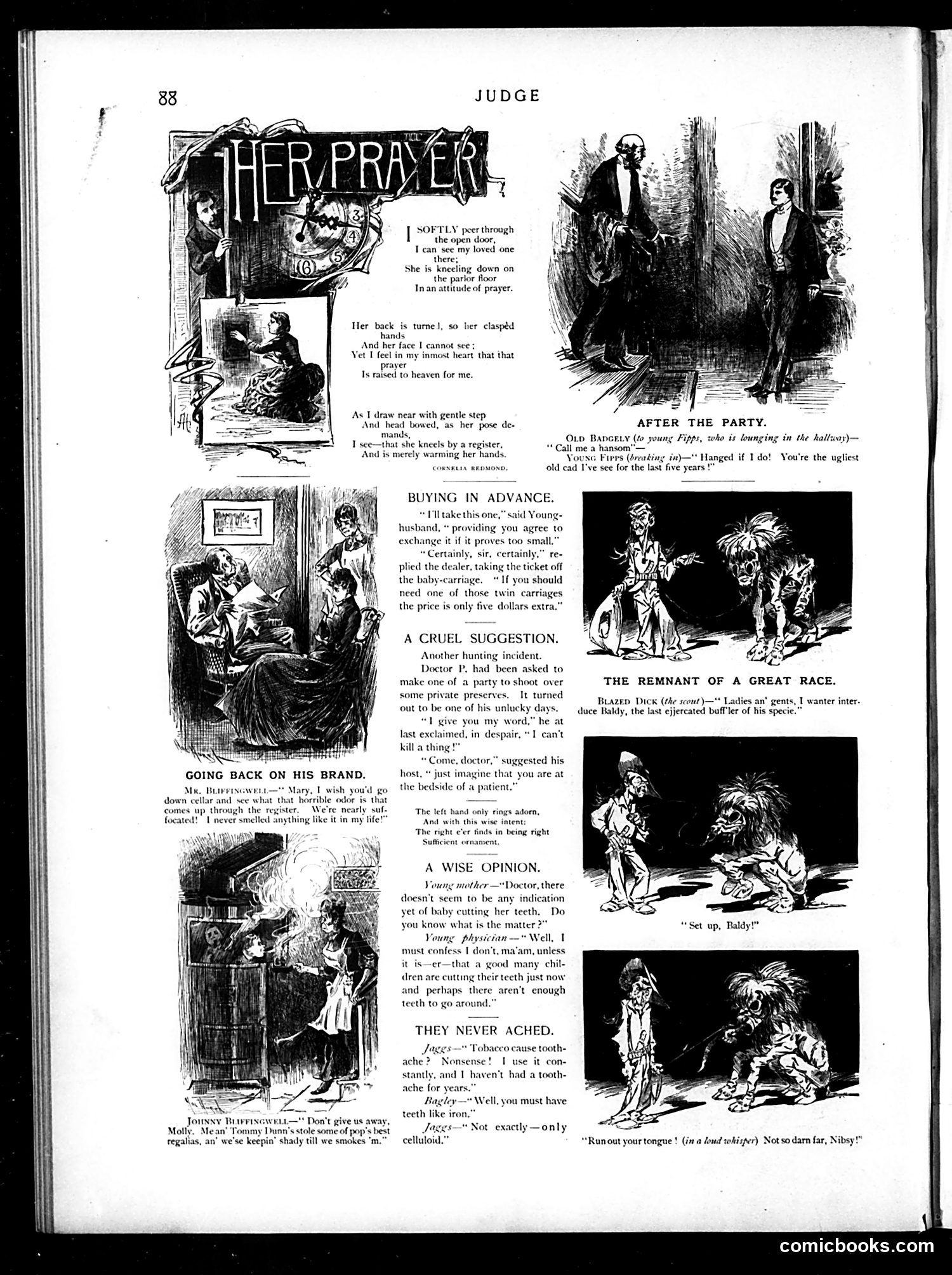
This page contains multiple satirical vignettes typical of late-19th-century American humor magazines: **"Her Prayer"** and related domestic sketches mock Victorian sentimentality—a woman praying turns out to be warming her hands by a register, deflating romantic expectations. **"Buying in Advance"** satirizes consumer culture and sharp dealing—a shopkeeper upsells a nervous customer on a baby carriage with dubious warranties. **"A Cruel Suggestion"** jokes about an unsuccessful hunter; the doctor's host suggests he imagine himself at a patient's bedside to improve his aim (dark humor about physicians' perceived powerlessness). **"They Never Ached"** mocks patent medicine claims—a man swears by tobacco for toothaches because he's extracted all his teeth already. **"The Remnant of a Great Race"** presents a traveling showman displaying a "civilized buffalo," satirizing both circus exploitation and pseudo-scientific racial hierarchies popular in the era. The page combines social commentary on medicine, commerce, and contemporary obsessions with humor grounded in class observation and physical comedy.
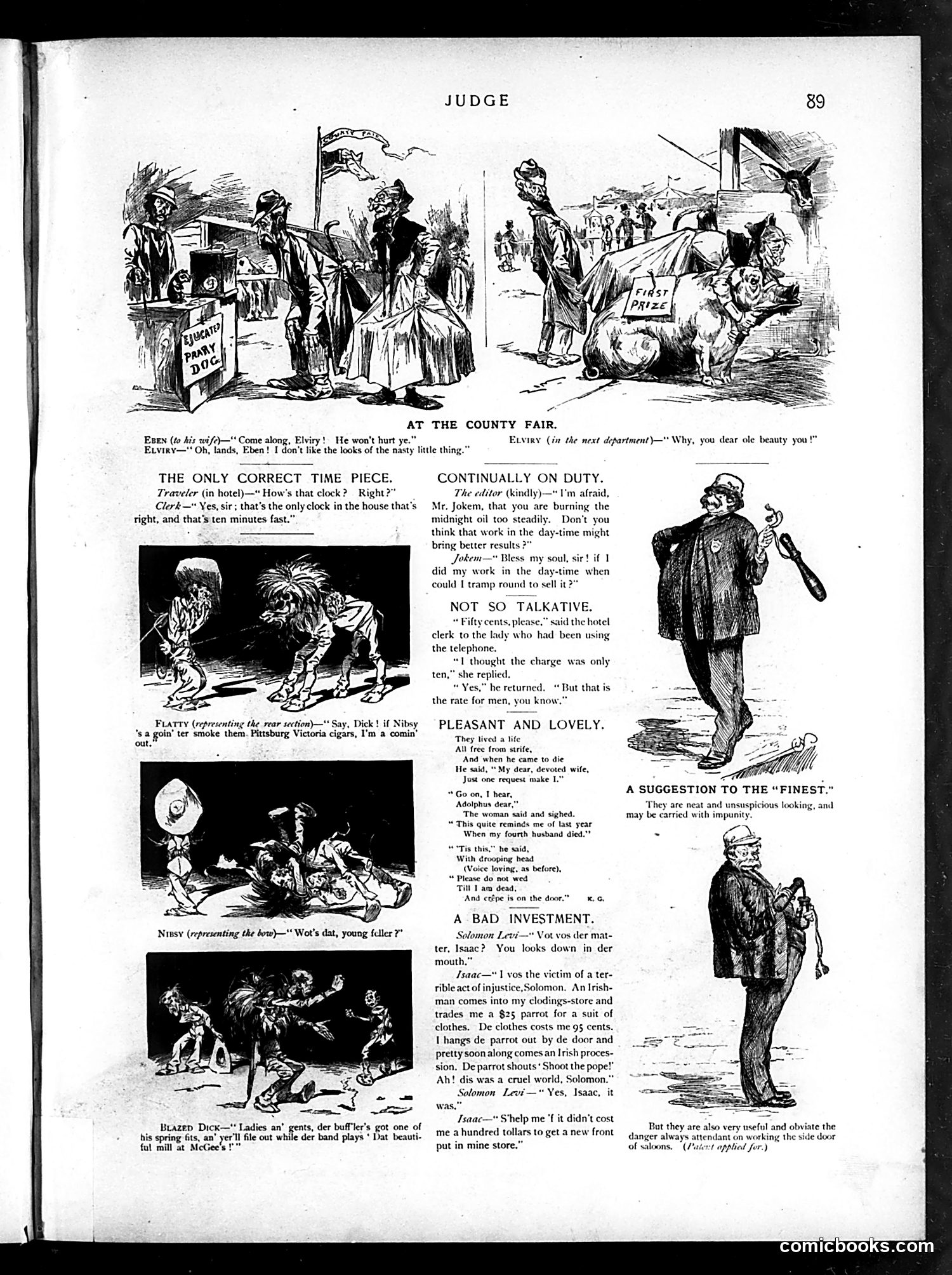
This page contains several short satirical pieces typical of late-19th century American humor: **"At the County Fair"** depicts rural characters (Eben and Elviry) nervously approaching what appears to be livestock, playing on rustic stereotypes. **"The Only Correct Time Piece"** jokes about hotel incompetence—the clerk admits their clock runs ten minutes fast, yet claims it's the only correct one. **"Continually on Duty"** satirizes a struggling writer/editor (Jokem) who apparently conducts business pitching his work at night rather than during daylight hours. **"Not So Talkative"** is a proto-feminist joke: a hotel charges women 50 cents for phone calls versus the male rate, implying women talk excessively. **"A Bad Investment"** features Jewish characters (Solomon Levi, Isaac) using Yiddish dialect—a common Judge stereotype. Isaac trades expensive clothing for a parrot that shouts anti-Catholic slurs during an Irish procession, costing him business. The page reflects period prejudices alongside general comedic observations about human folly and social hypocrisy.
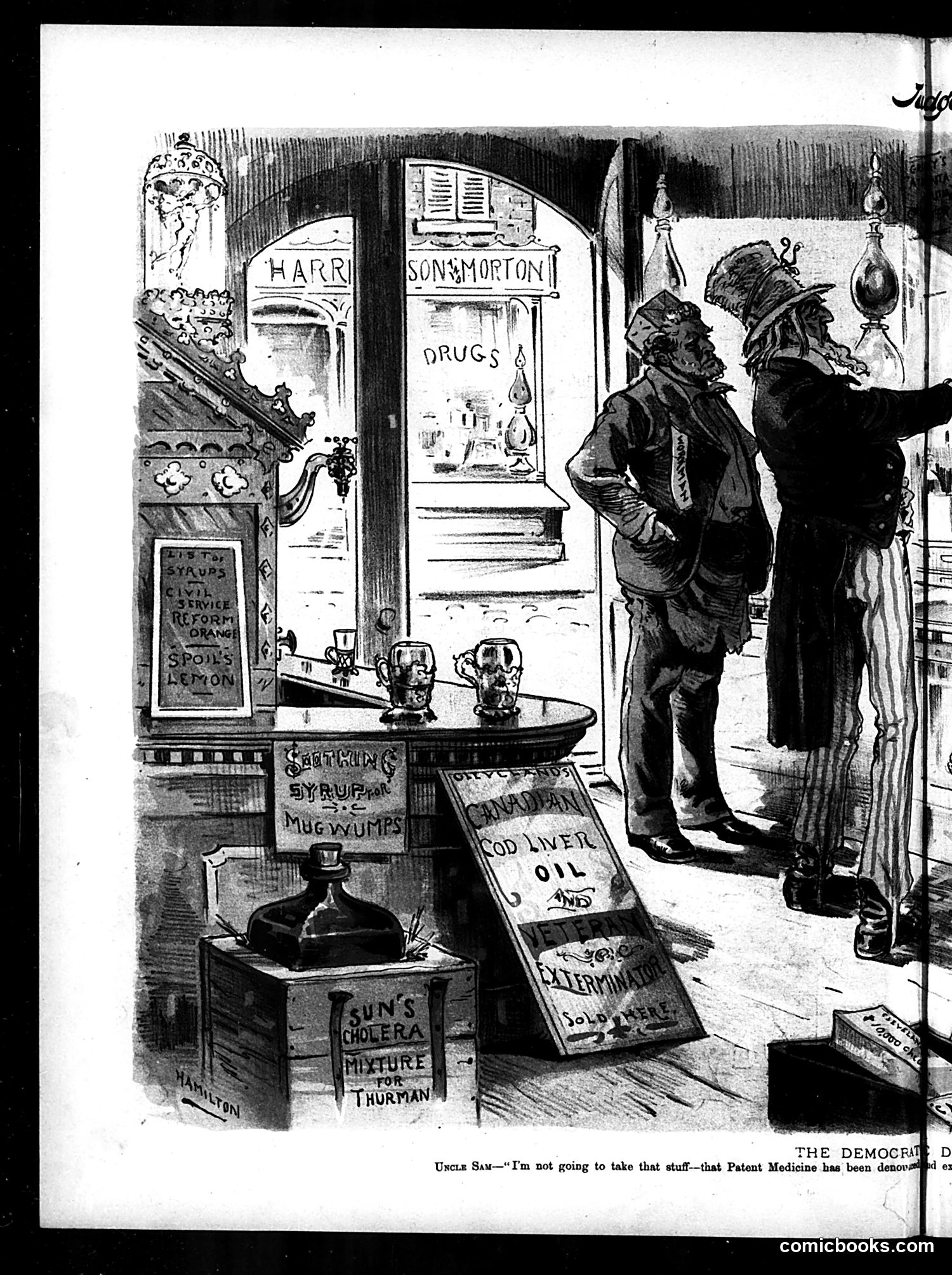
This satirical cartoon depicts Uncle Sam (personifying the U.S. government) rejecting a patent medicine being sold by a quack pharmacist at "Harris & Sons Morton Drugs." The storefront displays fraudulent remedies with exaggerated claims: "Sun's Cholera Mixture for Thurman," "Cathartic Syrup," "Cod Liver Oil and Exterminator," and other dubious tonics. The caption shows Uncle Sam refusing the medicine, stating it's been "denounced." The cartoon satirizes the prevalence of unregulated patent medicines in the late 19th/early 20th century—products making false health claims while containing harmful or useless ingredients. By portraying the government rejecting such "stuff," the cartoonist advocates for regulation and consumer protection against medical fraud, a major public health concern of that era.
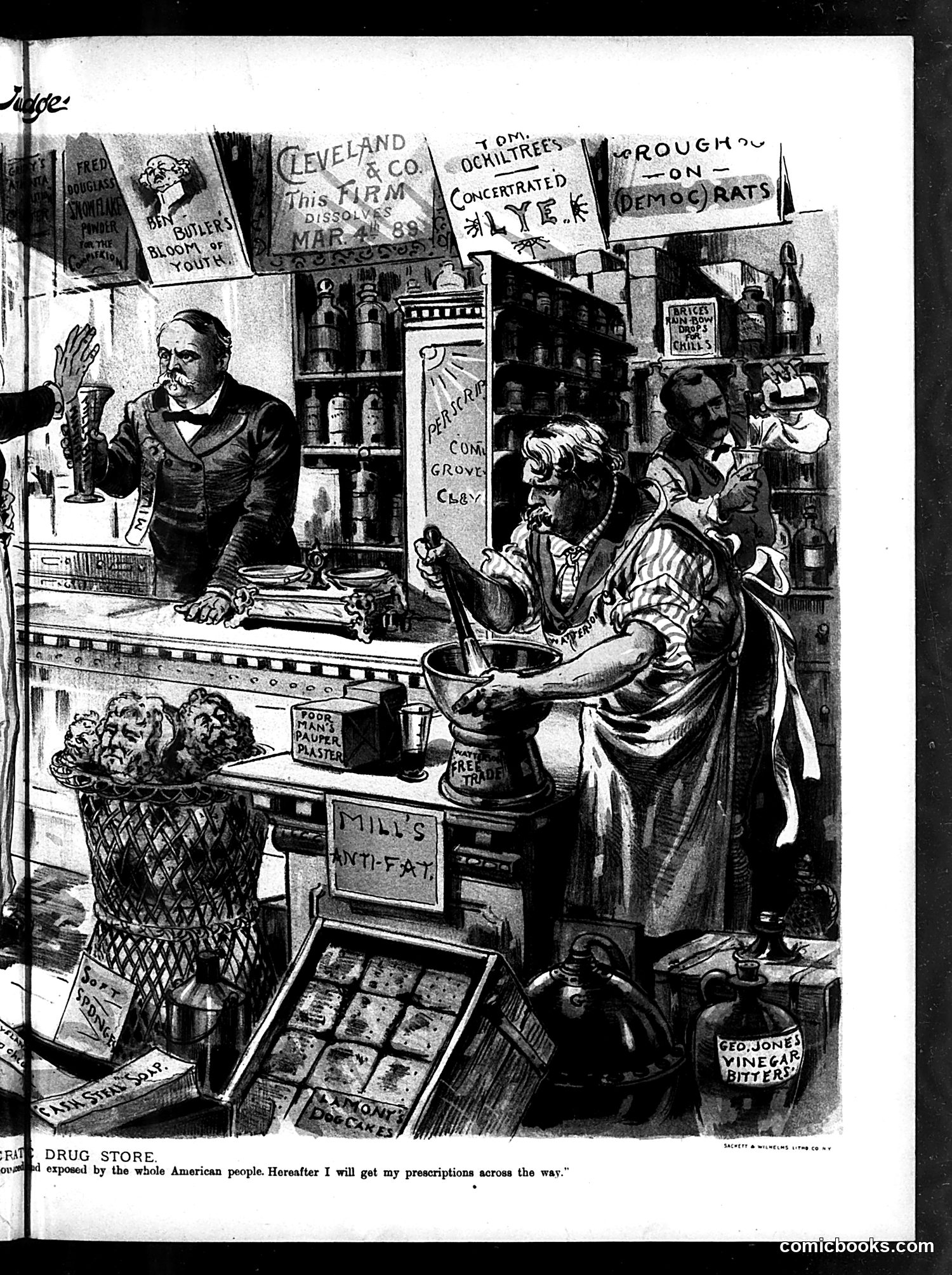
This satirical cartoon depicts a drugstore scandal, likely referencing adulterated or dangerous patent medicines sold in early 20th-century American pharmacies. The well-dressed pharmacist behind the counter appears confronted by working-class customers who've discovered his questionable practices. Visible signs advertise dubious products: "Cleveland & Co.," "Ookham's Concentrated Slyk," and "Rough on Democ Rats" (a rat poison brand name, likely a political jab). Other labels reference suspect remedies like "Mill's Anti-Fat" and "Free Trade" products. The caption's quote—"I will get my prescriptions across the way"—suggests customers are abandoning this dishonest druggist for a competitor after exposure of his deceptive sales. The cartoon satirizes the widespread problem of fraudulent medicines and unregulated pharmacy practices that plagued America before FDA oversight was established.
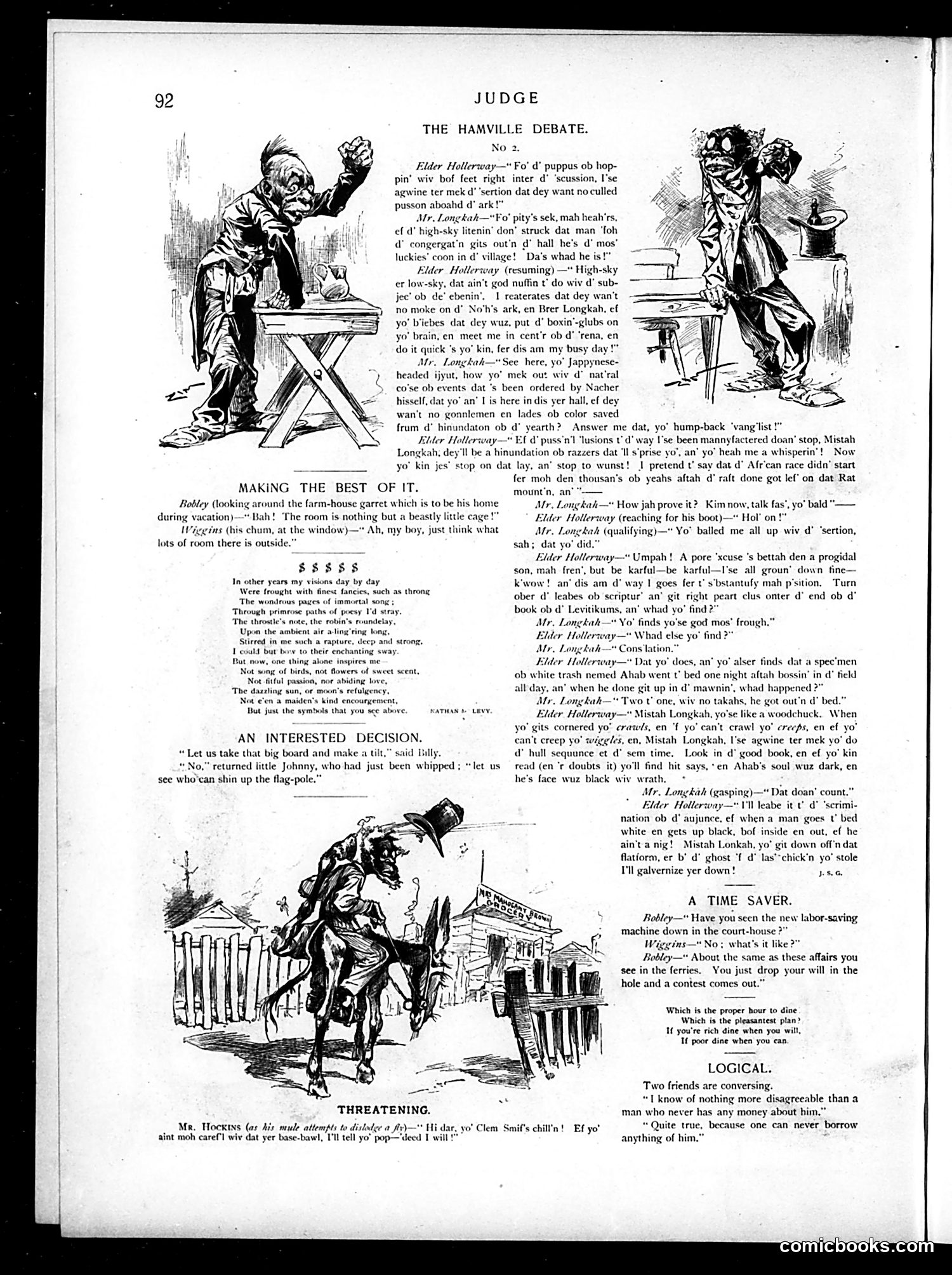
This page features dialectal humor and satirical sketches typical of Judge's style. **"The Hamville Debate"** presents a dialogue between characters using exaggerated rural/working-class speech patterns—common in period satirical humor that mocked non-standard English speakers. The three illustrated scenes show domestic and rural comedy: "Making the Best of It" depicts a farmhand and his wife, "An Interested Decision" shows children deciding who can climb a flagpole, and "Threatening" illustrates a confrontation. These illustrate everyday working-class life rendered as comedic subjects. The page also includes brief comic items like "A Time Saver" and "Logical"—short joke formats. The satire relies on dialect humor and class-based comedy that was popular but considered acceptable ridicule in this era.
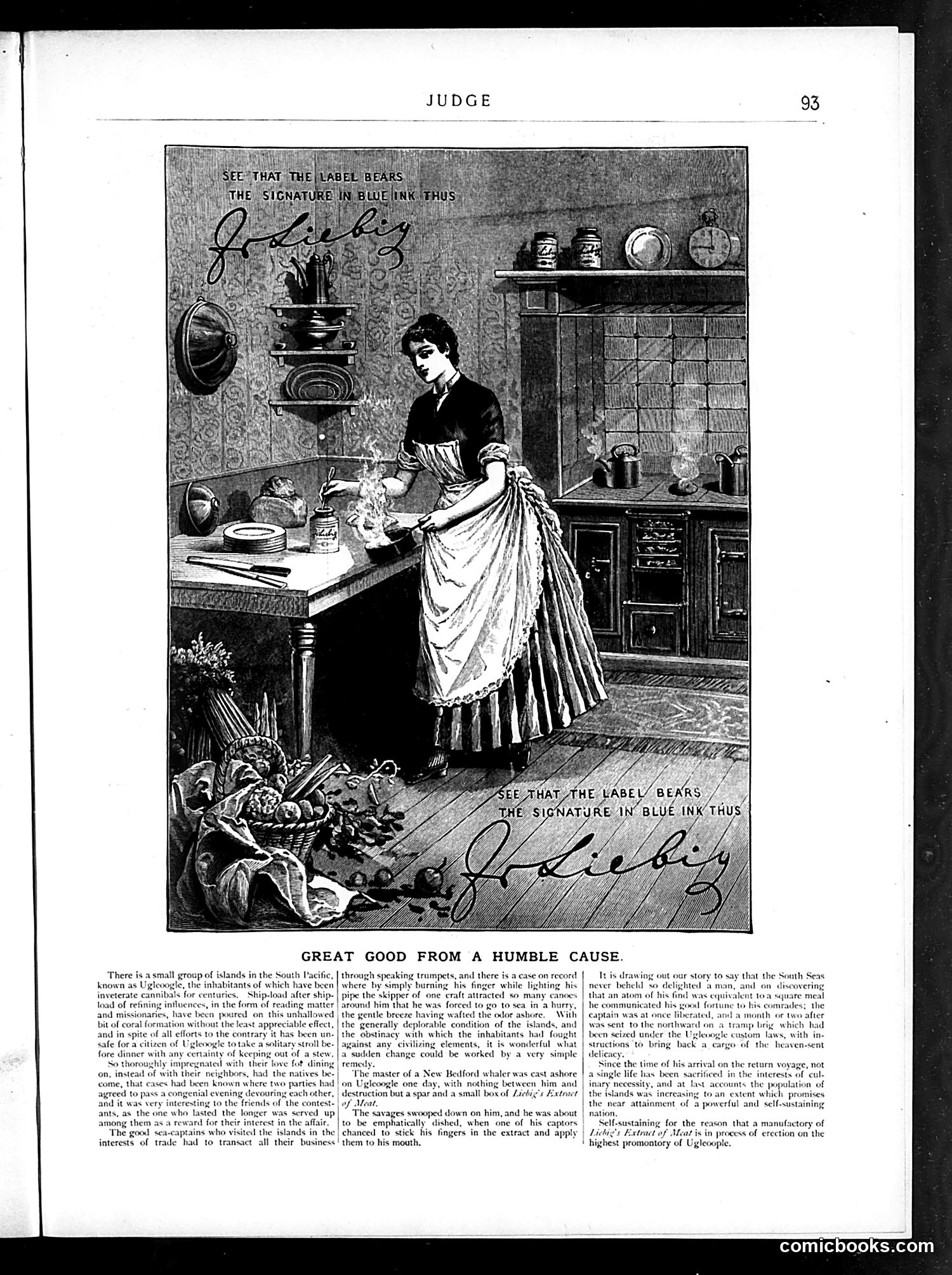
This page satirizes Victorian-era missionary and colonial efforts in the South Pacific. The illustration shows a domestic kitchen scene with a woman using what appears to be a commercial product (likely a cleaning or cooking extract, given the text mentions "Extract"). The article describes how a New Bedford whaler, stranded on islands in the South Pacific inhabited by cannibals, accidentally introduced a commercial product to the natives. The satire's point: a simple consumer product—not religious conversion or "civilizing" efforts—accidentally achieved what missionaries couldn't, reducing the islanders' cannibalism. The joke mocks both the ineffectiveness of missionary work and the era's racial stereotypes about "savages." By suggesting a humble commercial product works better than intentional civilization efforts, Judge ridicules the self-importance of colonial and religious enterprises. The woman in the kitchen represents how even ordinary domestic commerce has more "civilizing" power than deliberate interventions.
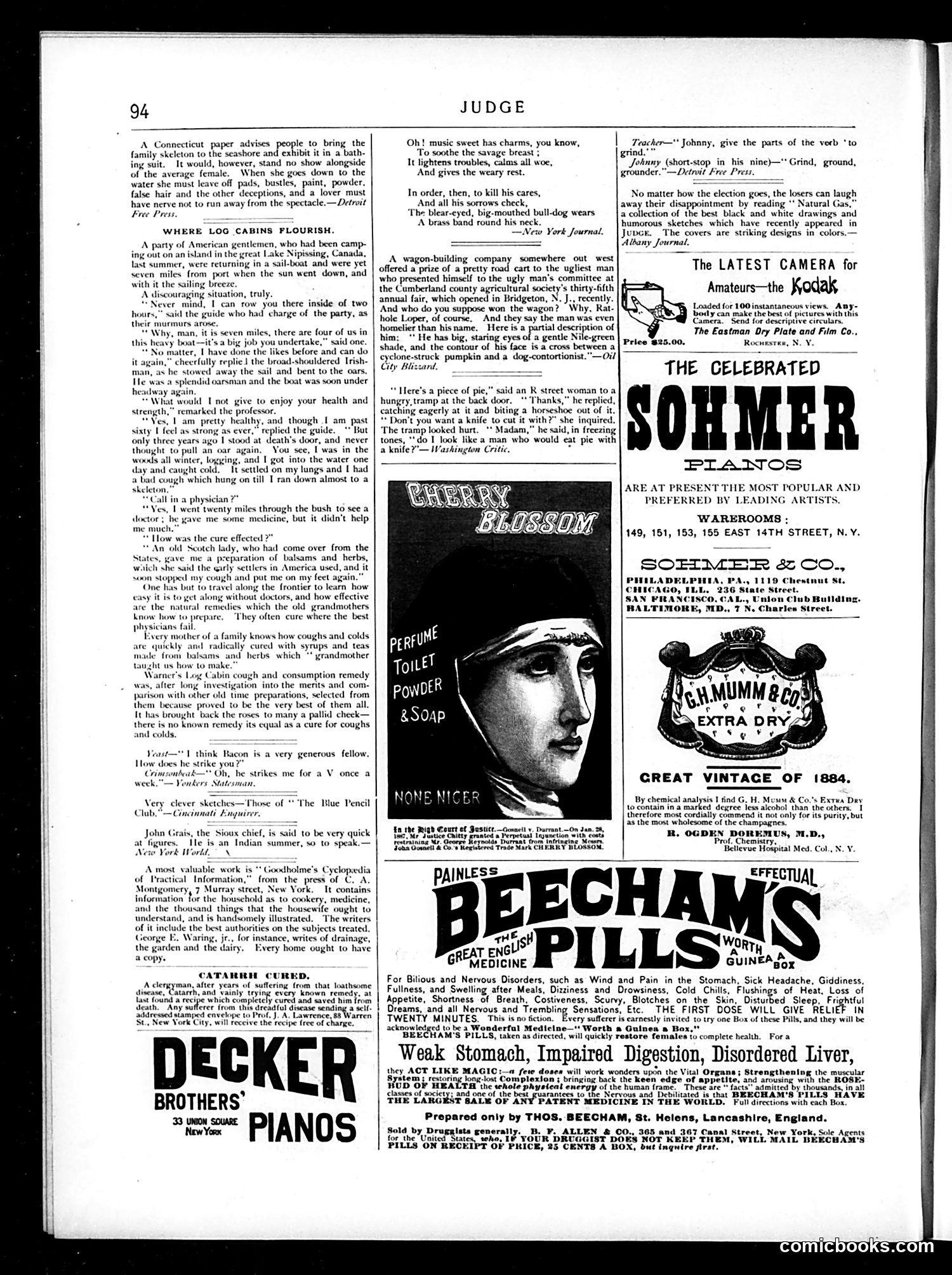
This page is primarily **advertising with brief satirical content**. The main items are: **Satirical Sections:** - Opening joke about women at the seashore: mocks Victorian-era feminine artifice (padding, bustles, cosmetics), suggesting women appear unrecognizable without these deceptions - Brief anecdotes about frontier life and folk remedies - Small witticisms about various figures **Advertisements dominate the page:** - Kodak cameras (newly available technology) - **Sohmer Pianos** (major product placement) - Warner's Log Cabin cough remedy (patent medicine) - Decker Brothers pianos - None Niger perfume/soap - Beecham's Pills (patent medicine with exaggerated health claims) - G. Hummel Extra Dry champagne **Context for modern readers:** This reflects 1880s-90s America's obsession with patent medicines (largely unregulated, often containing dubious ingredients), aggressive advertising, and Victorian anxieties about female appearance and "natural" versus artificial beauty.
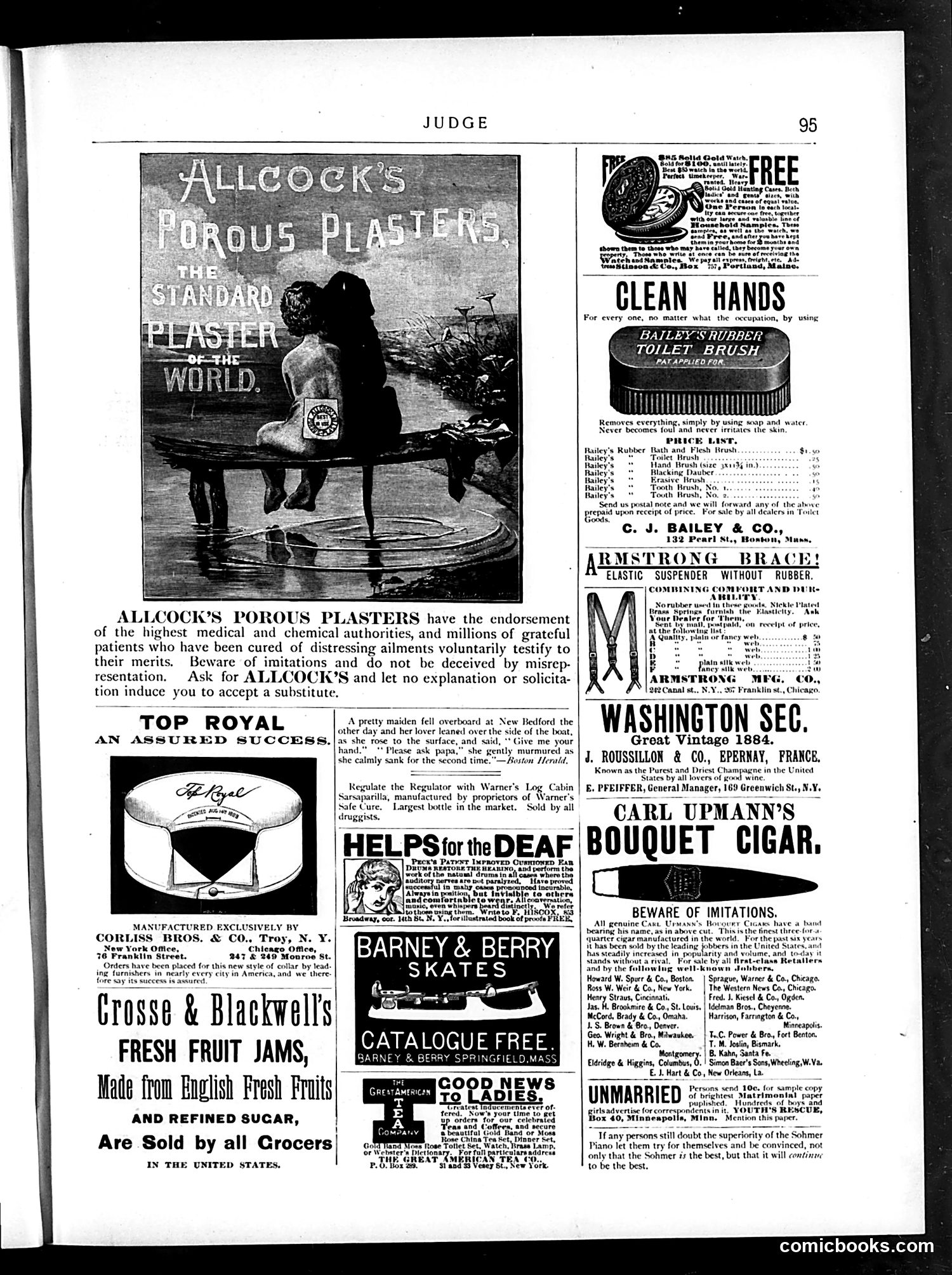
This is primarily an **advertising page** with minimal satirical content. The page showcases various patent medicines, consumer products, and services typical of late 19th-century American commerce. The one **joke** present is the anecdote about a maiden falling overboard at New Bedford. When her lover asks her to grab his hand, she demurely requests he "ask papa" first—a satirical jab at excessive Victorian propriety and courtship formality. The humor lies in her drowning rather than violate social convention by accepting help without parental permission. The advertisements reflect period concerns: **Allcock's Porous Plasters** (medical cure-alls), **Warner's Sarsaparilla** (patent medicine), **Bailey's Rubber Toilet Brush** (hygiene), and various luxury goods like **Carl Upmann cigars** and **Sohmer pianos**. These ads reveal what contemporary advertisers believed would appeal to Judge's affluent, educated male readership—health remedies, grooming products, and status symbols.
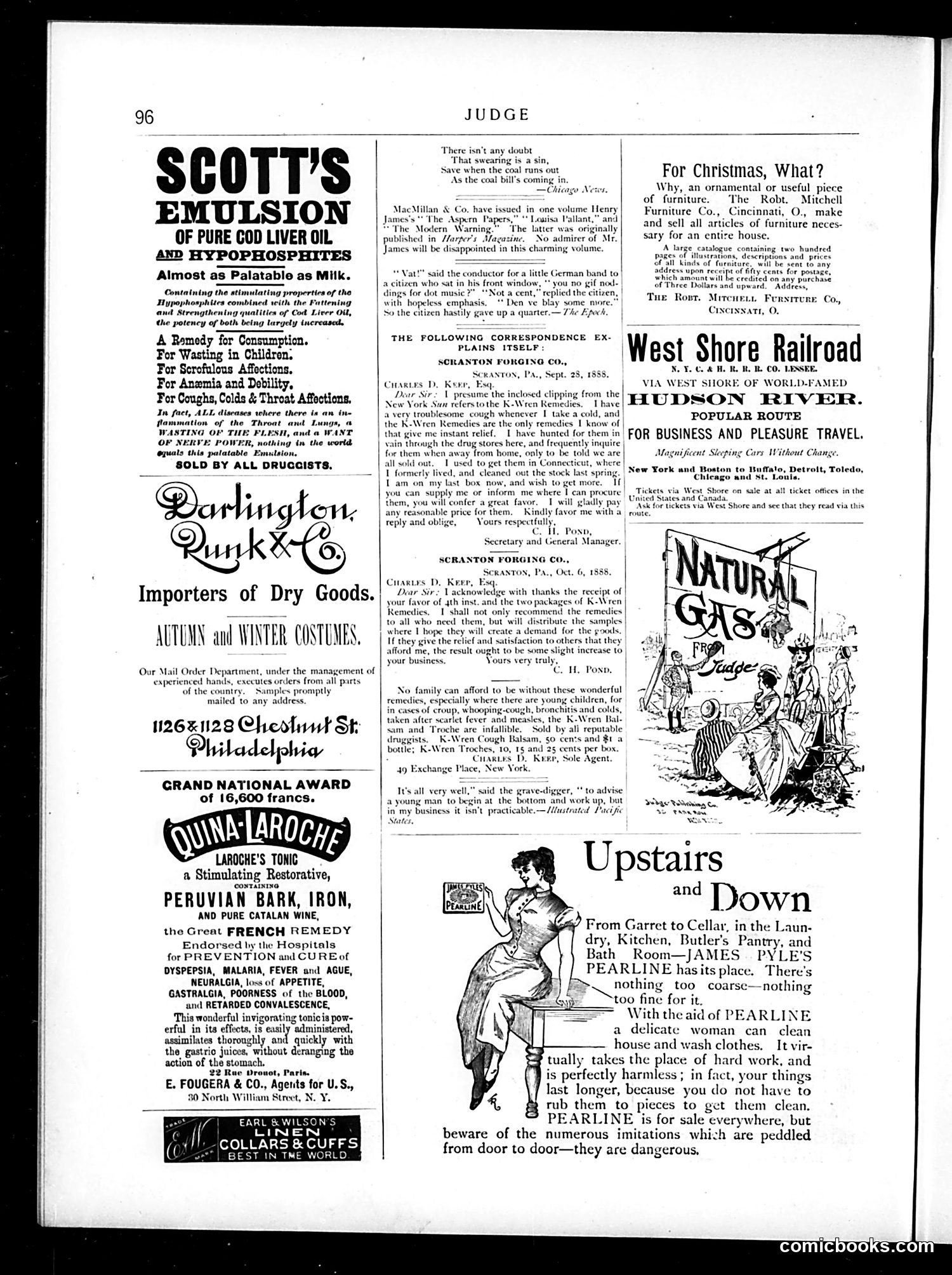
This is primarily an **advertising page** from Judge magazine, with minimal editorial cartoon content. The page consists almost entirely of commercial advertisements for patent medicines, clothing, railroads, and household products—typical of late 19th-century magazines. The small editorial content includes: 1. **A brief poem** mocking hypocrisy about swearing—suggesting it's sinful except when complaining about coal bills (a relatable middle-class grievance). 2. **A conductor anecdote** about a musician asking payment for music, to which the conductor responds dismissively—likely satire on low regard for musicians' worth. 3. **"Upstairs and Down"** advertisement for James Pyle's Pearline cleaning product, featuring an illustrated woman, emphasizing the product's ease of use for household cleaning. The dominant content is **patent medicine advertising** (Scott's Emulsion, Laroche's Tonic)—products making dubious health claims typical of the unregulated era. These ads reflect contemporary medical quackery and consumer gullibility that Judge presumably mocked editorially elsewhere.
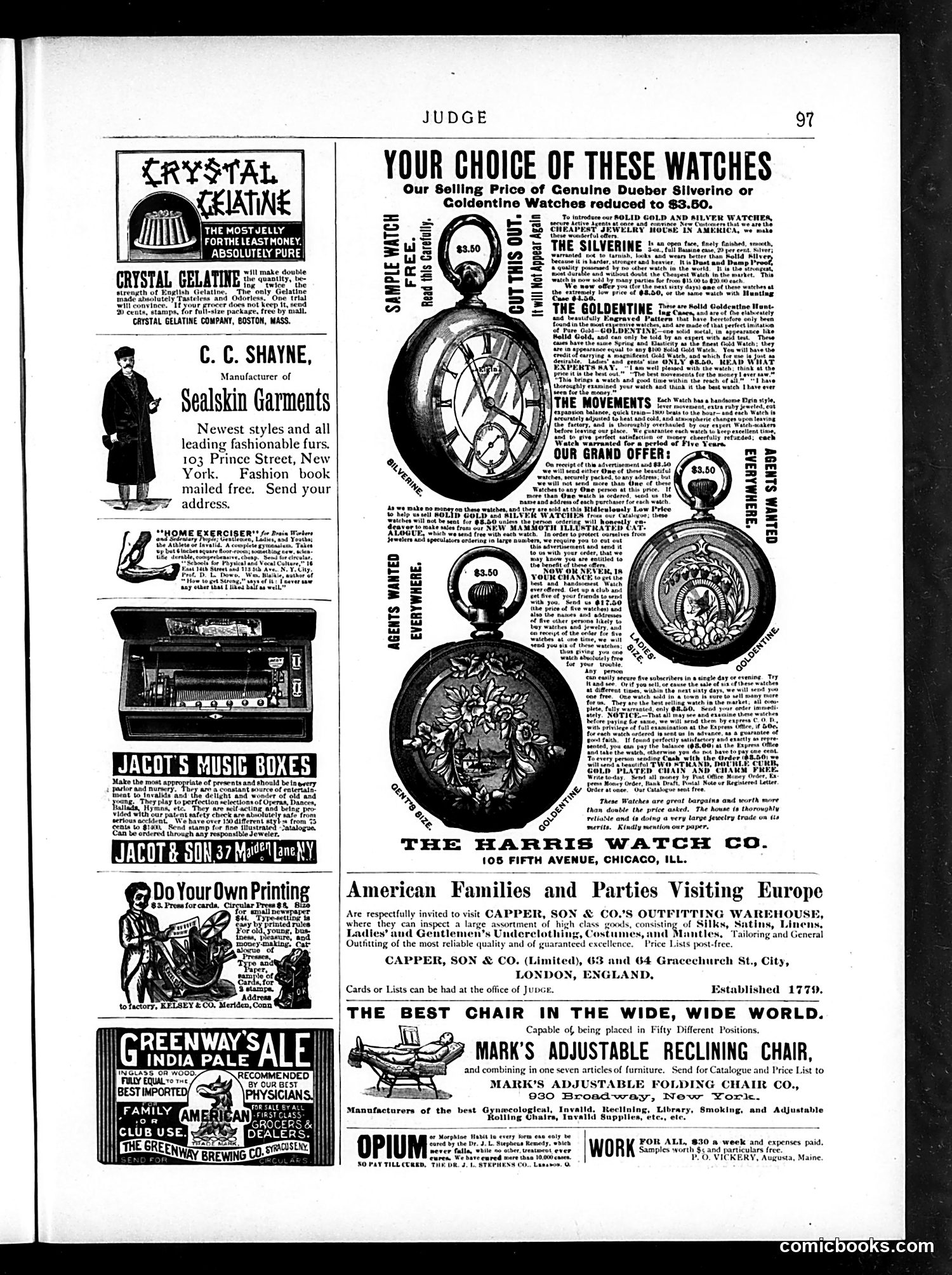
This page is primarily **advertisements**, not political satire or editorial cartoons. It contains various commercial ads typical of a late 19th-century publication. The dominant feature is a large advertisement for watches from the Harris Watch Co. (Chicago), offering multiple watch models at $3.50 with claims of genuine quality at bargain prices. This appears to be a common mail-order pitch of the era. Other ads include: - Crystal Gelatine (food product) - Sealskin garments by C.C. Shayne - Jacot's Music Boxes - Home exercise equipment - Various other consumer goods A notable exception is an ad inviting "American Families and Parties Visiting Europe" to visit Capper, Son & Co.'s outfitting warehouse in London—reflecting period tourism patterns among wealthy Americans. The page contains **no identifiable political cartoons or satirical content**—it functions primarily as advertising space, which was standard filler material in Judge magazine to support publication costs.
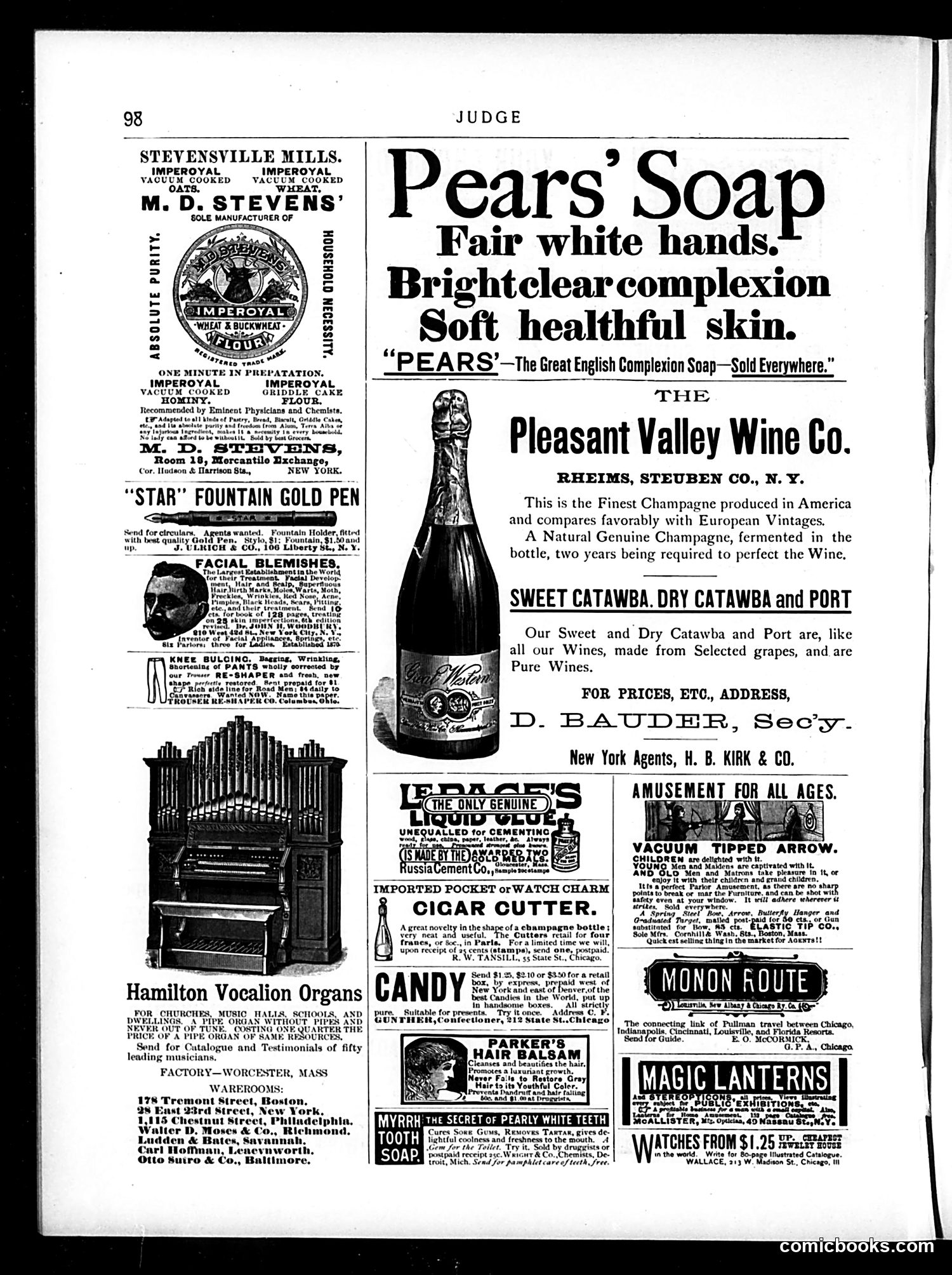
This is primarily an **advertising page** from Judge magazine (page 98), not a satirical cartoon. The page contains multiple commercial advertisements typical of late 19th-century American publications. The major ads include: - **Pears' Soap** (prominent, center-right): A British complexion soap marketed with claims of producing "fair white hands" and "bright clear complexion"—language reflecting period beauty standards emphasizing pale skin - **Pleasant Valley Wine Co.**: Advertising American champagne and wines from New York - **Hamilton Vocalion Organs**: Musical instruments for churches and halls - Various patent medicines and novelty items (fountain pens, cigar cutters, tooth soap, hair products) The ads collectively reflect consumer culture and manufacturing innovation of the Gilded Age. The Pears' Soap ad is notably prominent, suggesting its popularity with Judge's readership. There are no political cartoons or satirical commentary visible on this page—it functions as commercial space rather than editorial content.
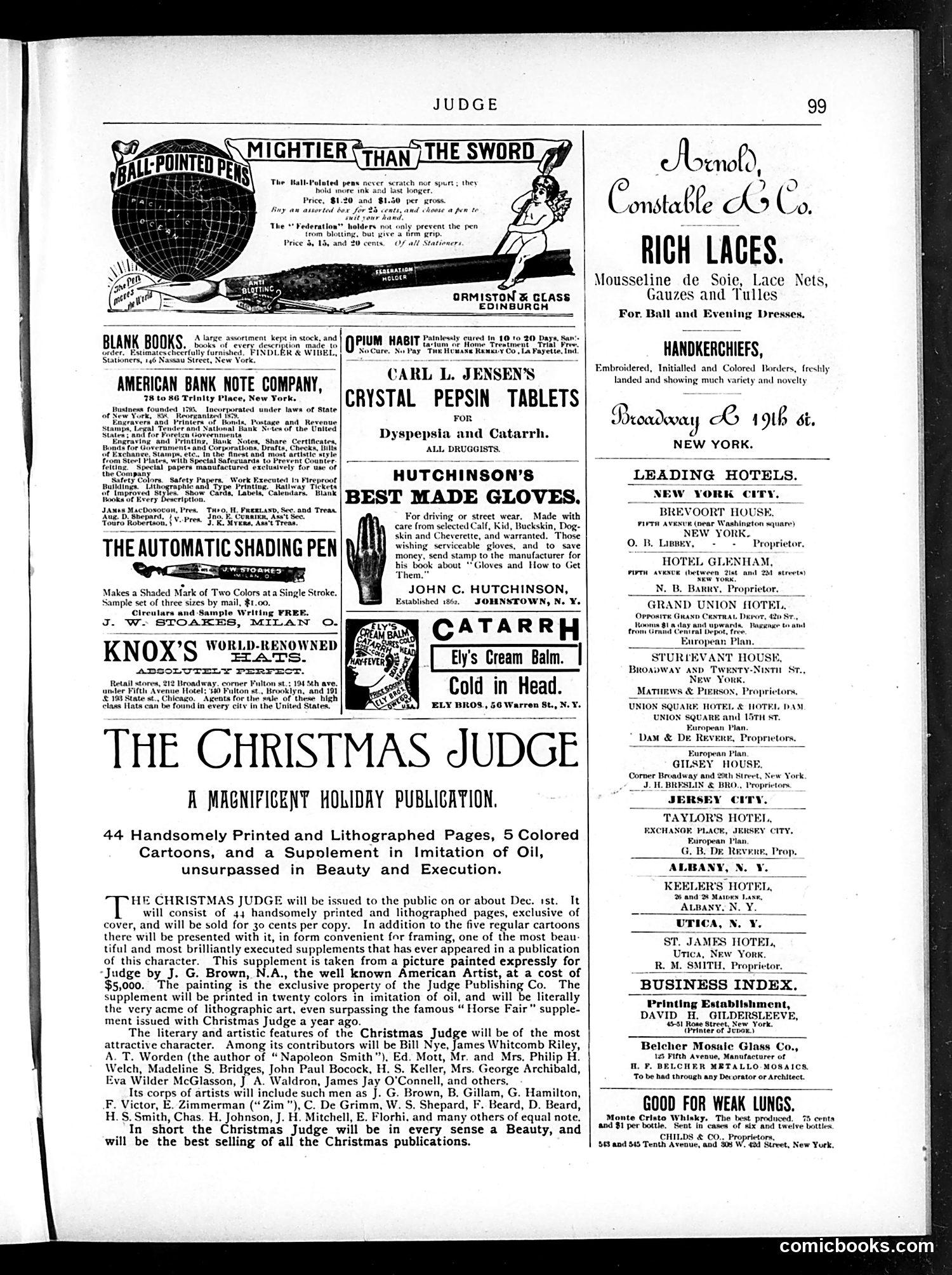
This page is primarily **advertising and promotional material** rather than satirical content. The dominant feature is a large advertisement for *The Christmas Judge*, a special holiday publication. **Key Content:** The Christmas Judge announcement promotes a 34-page illustrated publication (30 cents) featuring five cartoons and a luxury supplement. The supplement, painted by renowned American artist J.G. Brown at a cost of $5,000, will be printed in twenty colors imitating oil painting—reportedly surpassing a famous "Horse Fair" supplement from the previous year. **Notable Contributors Listed:** - Writers: Bill Nye, James Whitcomb Riley, various others - Artists: J.G. Brown, political cartoonist Bernhard Gillam, and multiple other illustrators The page also contains typical period advertisements (pens, bank notes, gloves, medical tablets, hotels) common to Judge magazine issues. **For Modern Readers:** This demonstrates how 19th-century satirical magazines monetized their brand through premium holiday editions, leveraging celebrity contributors and expensive artistic production as marketing tools.
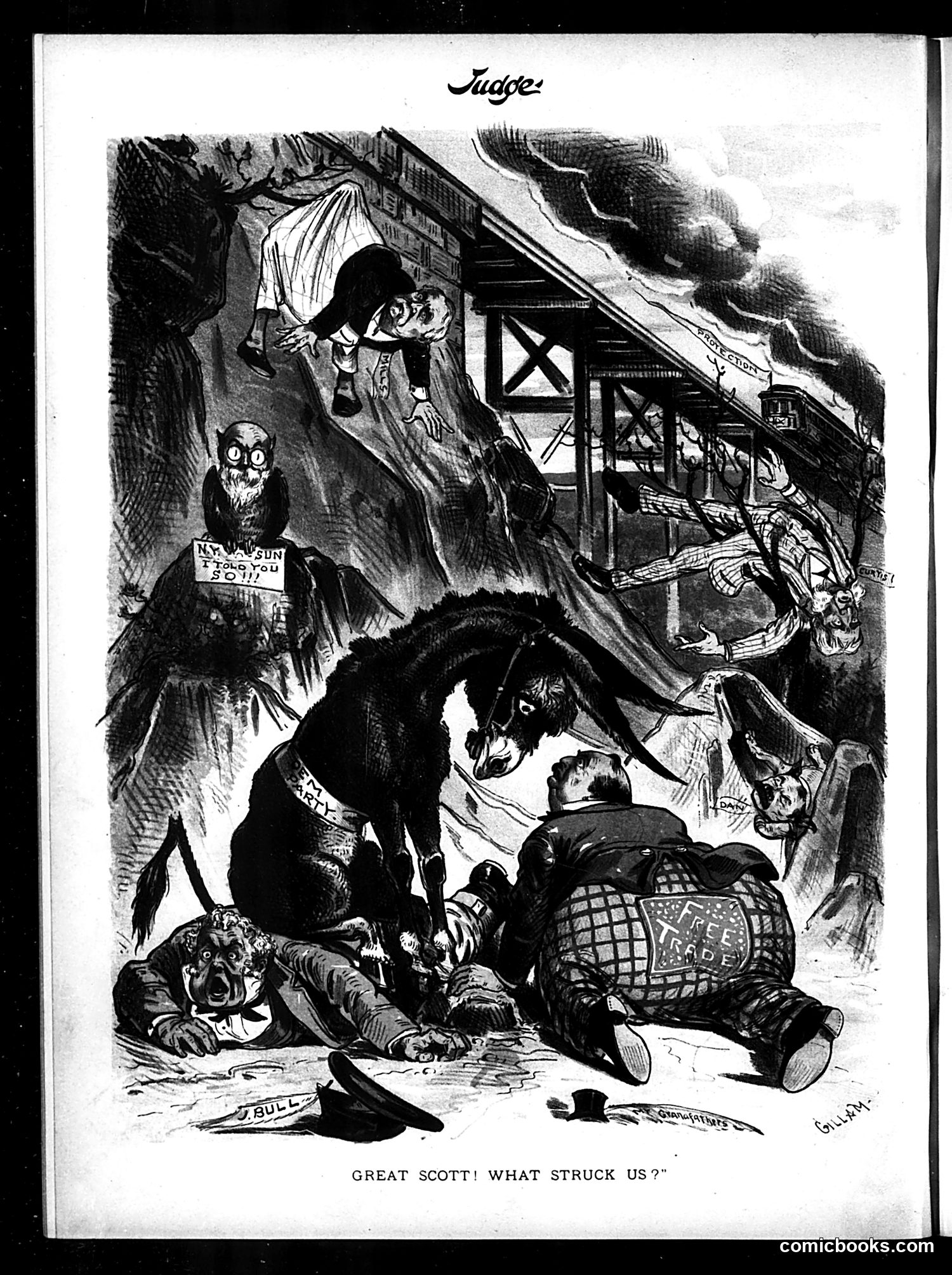
This **Judge** magazine cartoon titled "Great Scott! What Struck Us?" depicts a chaotic scene of destruction. The central figure appears to be Uncle Sam or a representative of American commerce, struck down amid debris labeled "Free Trade" and other commercial goods. An owl with a sign reading "It's about time you got wise" observes from above—likely representing wisdom or commentary on American policy. The scene suggests satire about the consequences of free trade policies on American workers and industry. The "bull" label visible at bottom may reference reckless economic behavior. Without the specific publication date visible, the exact political moment remains unclear, but this appears to critique how free trade agreements or economic policies harm American interests—a recurring satirical theme in late 19th/early 20th-century American political cartooning.