
A complete issue · 16 pages · 1888
Judge — November 10, 1888
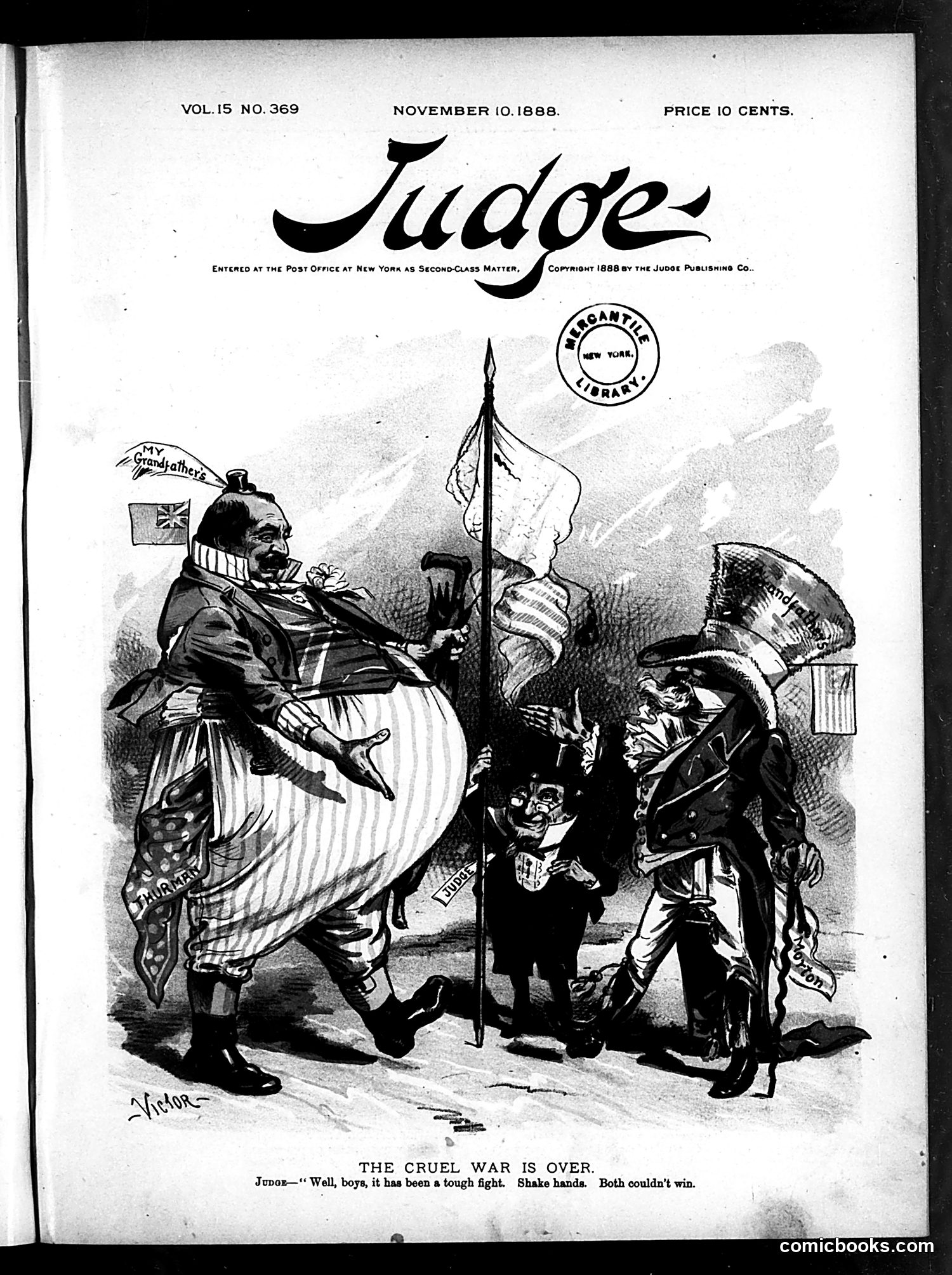
This November 1888 *Judge* cartoon depicts a reconciliation between two figures representing warring parties. The large central figure wearing British regalia appears to represent Britain or a British interest, while the military figure on the right likely represents another nation or political faction. The smaller figure between them, labeled "Judge," mediates their dispute. The caption—"Well, boys, it has been a tough fight. Shake hands. Both couldn't win"—suggests satirical commentary on a concluded conflict where neither side achieved total victory. Without identifying the specific 1888 dispute, the cartoon's point appears to be mockery of an exhausting stalemate and the necessity of accepting compromise rather than decisive triumph. The comic tone undercuts the supposed nobility of the settlement.
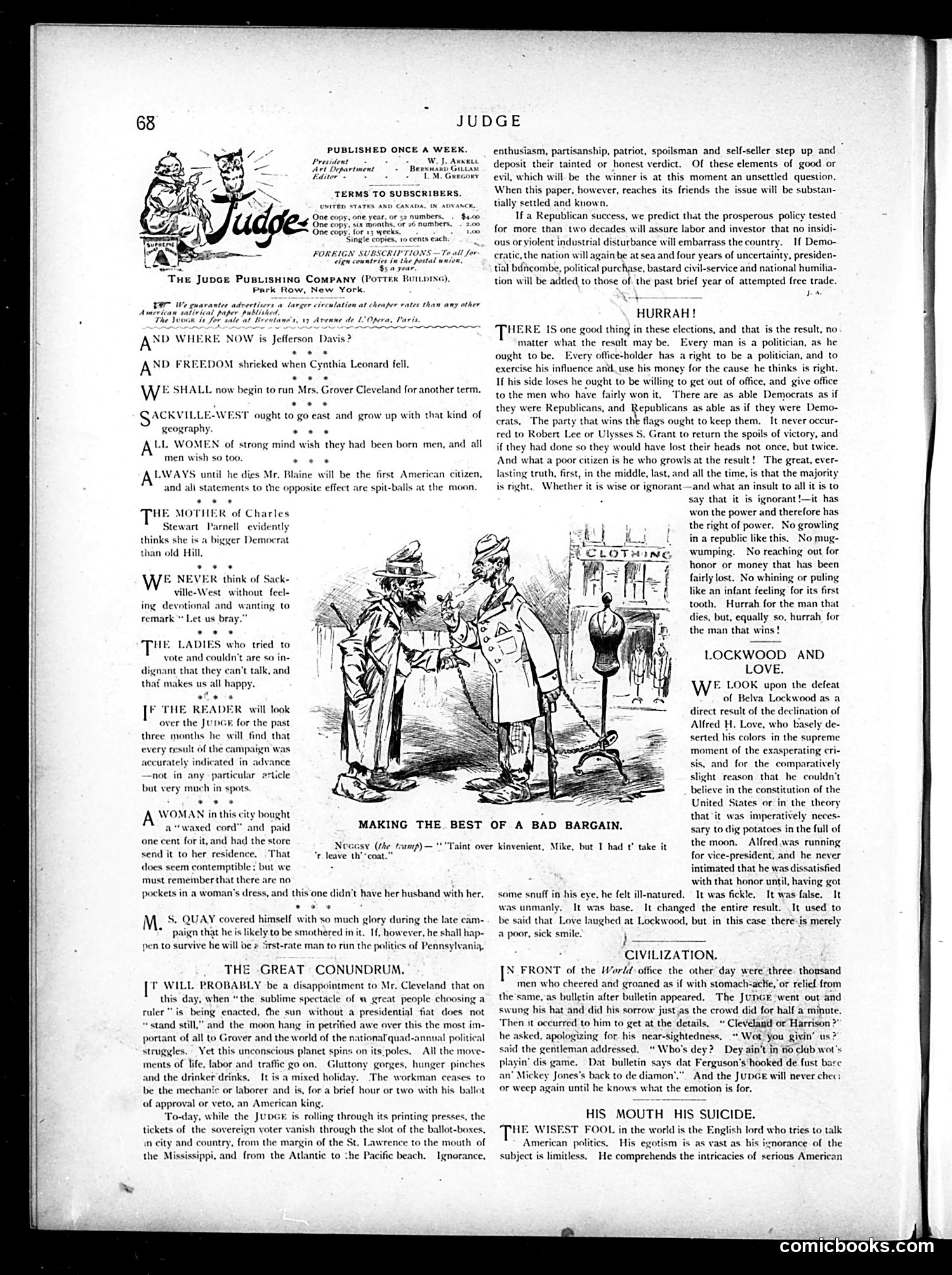
The cartoon depicts two figures in what appears to be a clothing transaction, with one character labeled as "Nuggy" negotiating with another. The dialogue suggests someone reluctant about a poor trade—"Taint over klivensteen, Mike, but I had t' take it" / "leave it" coat. The satire likely critiques either consumer fraud, dishonest commercial dealings, or perhaps political compromise presented as necessary evil. The phrase "making the best of a bad bargain" suggests accepting an unfavorable situation as inevitable. Without clearer identification of the specific figures or contemporary context, the exact political reference remains unclear, though the overall tone mocks accepting unsatisfactory outcomes in commercial or political negotiations.
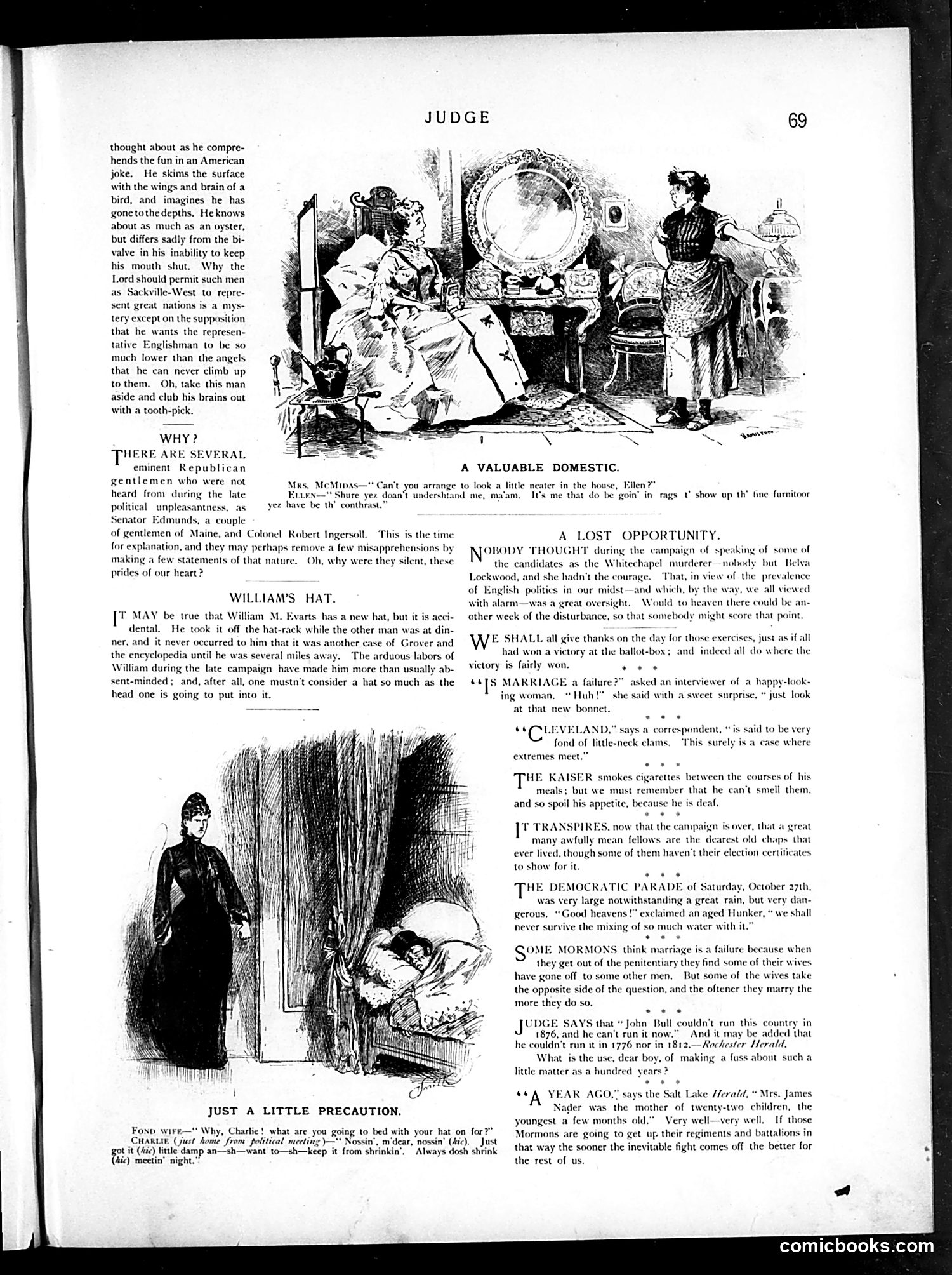
This page contains several satirical pieces targeting American political figures and social issues circa the 1880s: **"Why?"** attacks Republican gentlemen (including Senator Edmunds) for silence during a recent campaign, questioning their pride and leadership. **"William's Hat"** mocks William M. Evarts (prominent Republican politician/lawyer) for absent-mindedly taking another man's hat, attributing his confusion to campaign exhaustion. The reference to "Grover" likely means President Grover Cleveland. **Other short pieces** include domestic humor about Irish servants, marriage skepticism, and observations about the Kaiser and Mormons. The cartoons' sketched style and dialect humor ("m'dear," "nossin'") typify Judge's satirical approach. The overall tone reflects post-campaign political disappointment and social commentary common to 1880s American satire magazines.
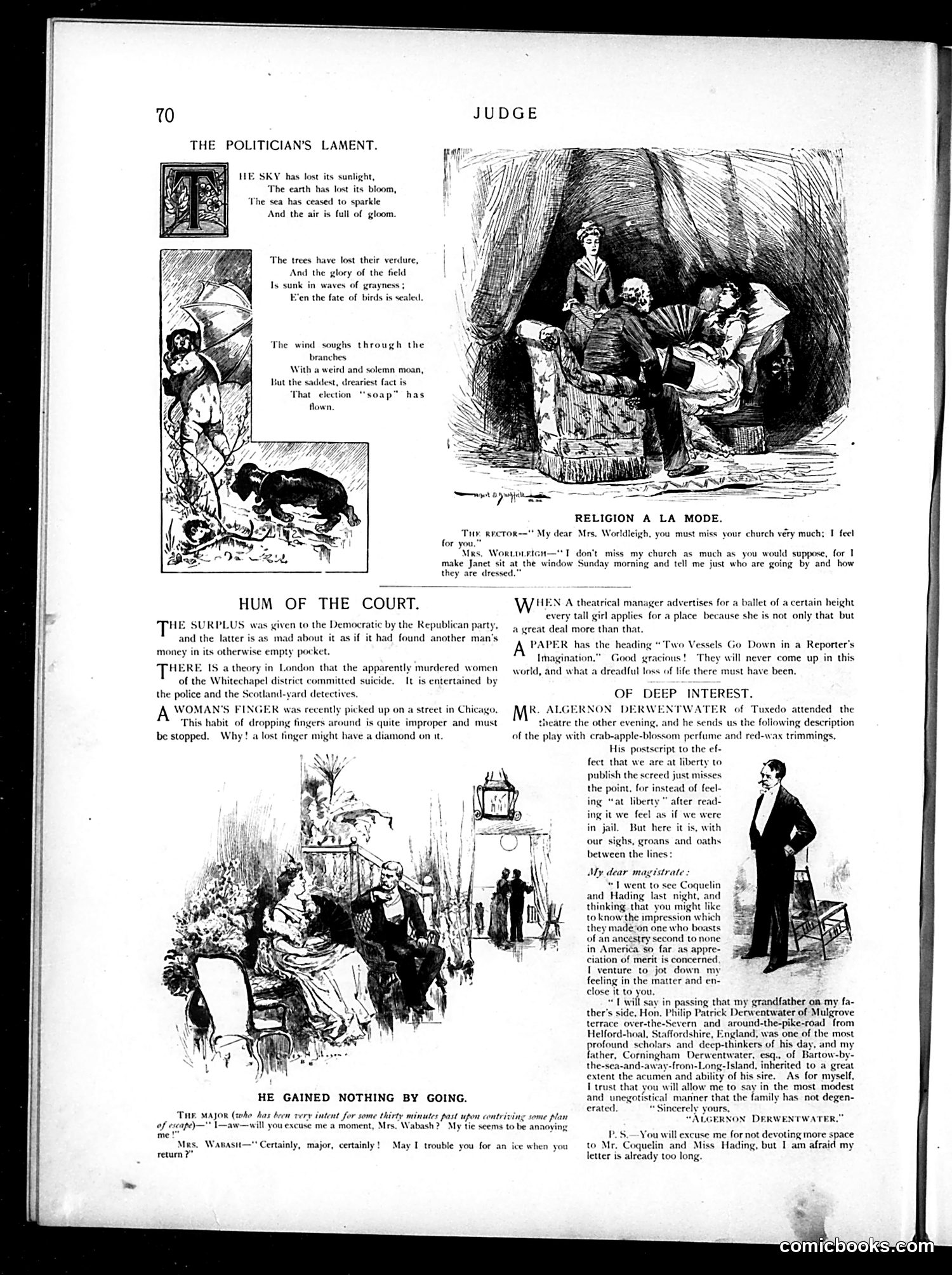
This page from *Judge* magazine contains several satirical pieces mocking late 19th-century American politics and society. **"The Politician's Lament"** depicts a politician mourning that election campaign funds ("soap") have dried up—suggesting corruption was endemic and politicians depended on questionable money. **"Hum of the Court"** includes brief jokes: one mocks London police for entertaining theories that Whitechapel murder victims committed suicide; another jokes about a woman's severed finger found in Chicago, quipping it might have had a diamond ring. **"Religion à la Mode"** satirizes wealthy people performing piety selectively—a woman brags she has her servant report who attends church while she stays home. **"Of Deep Interest"** ridicules social climbers through "Algernon Derwentwater," a pompous theater-goer who obsessively name-drops his aristocratic ancestry while describing seeing French actors perform, revealing his pretentiousness and insecurity about social status. The cartoons mock political corruption, class pretension, and hollow morality among the wealthy.
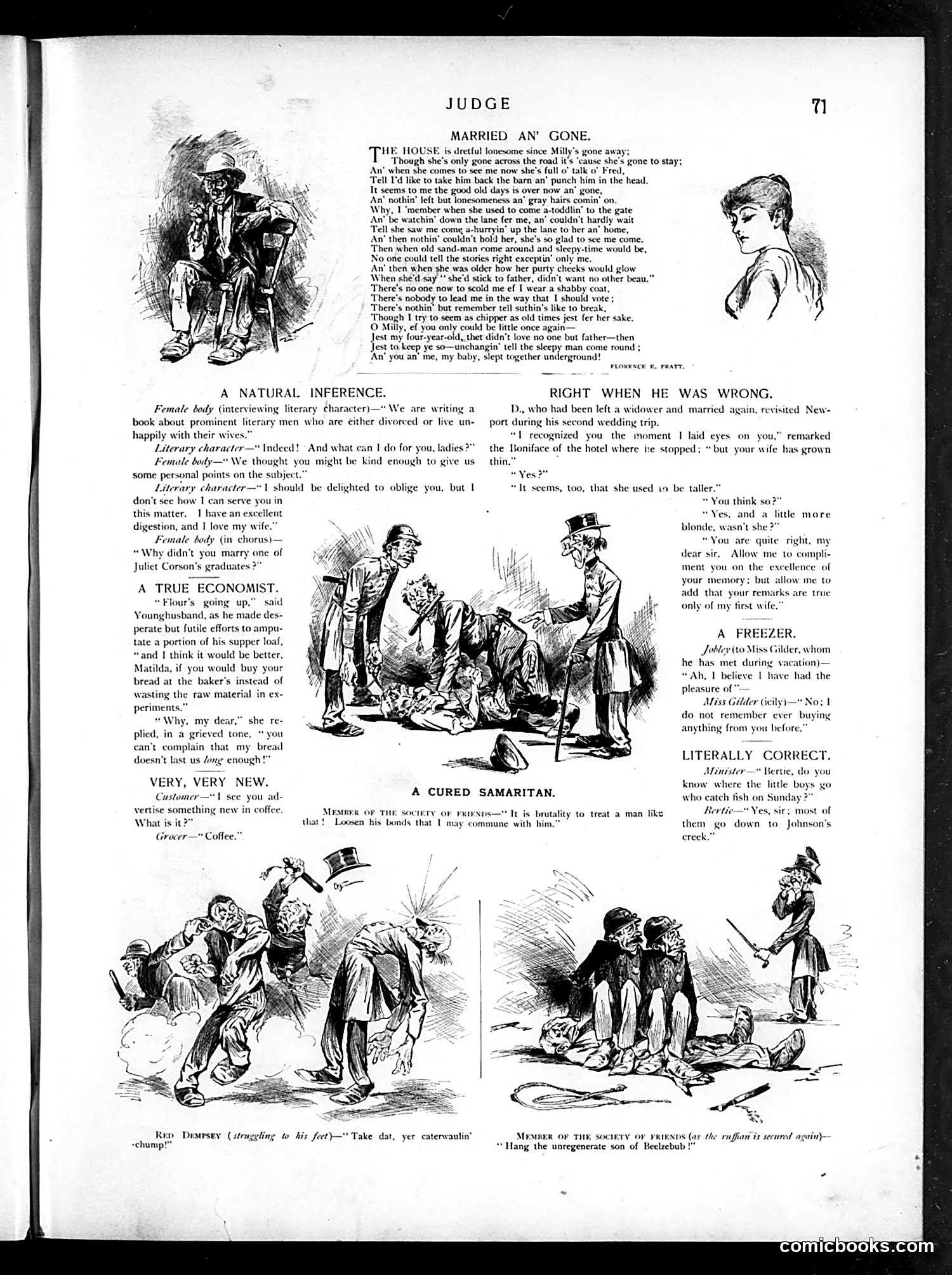
This page contains multiple short satirical pieces typical of Judge's humor: **"Married An' Gone"** is a sentimental poem about a father's loneliness after his daughter Milly marries and moves away. The satire lies in the contrast between his nostalgic memories of her childhood devotion and her current indifference, now absorbed in her husband Fred. It mocks both paternal sentimentality and how marriage supposedly transforms women's loyalties. **"Right When He Was Wrong"** jokes about a remarried widower whose new wife has visibly changed (aged, darker hair) compared to his first wife—yet he insists his observations about her decline are "true only of my first wife," an absurd denial. **"A Natural Inference"** satirizes literary pretension: female interviewers assume a famous author's marital happiness stems from wisdom about relationships, but he dismissively attributes it to good digestion. The remaining pieces ("A True Economist," "Very, Very New," "A Cured Samaritan," "A Freezer," "Literally Correct") are brief jokes targeting domestic economy, commercial novelty, religious hypocrisy, and literal-minded responses—standard Judge fare of social observation and wordplay humor.
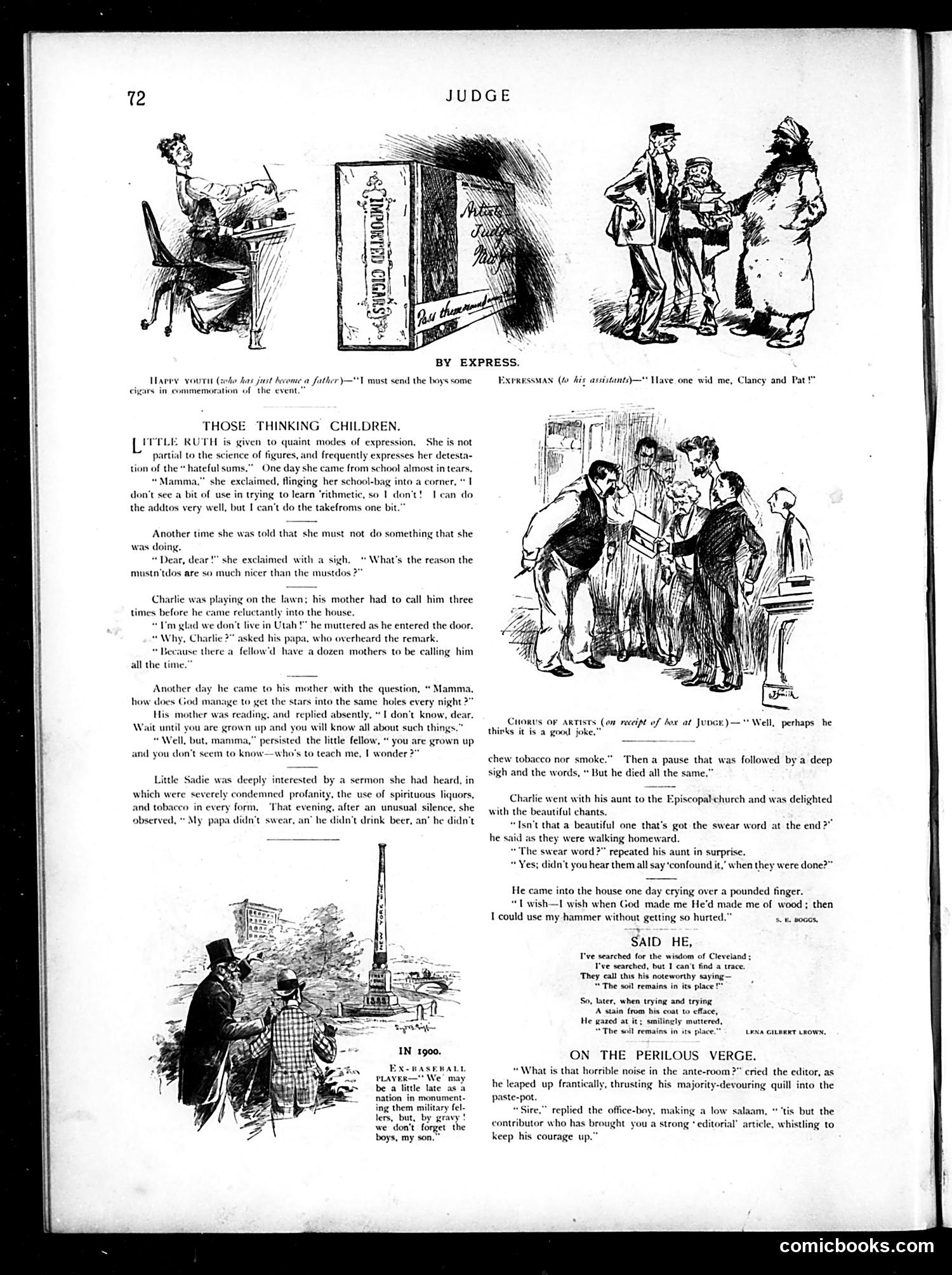
This page contains humor pieces targeting contemporary figures and social issues circa early 1900s. **"By Express"** cartoon: A new father sends cigars to celebrate his birth. The expressman requests extras for himself and colleagues—satirizing how working-class men appropriated upper-class customs. **"Those Thinking Children"** section: Humorous anecdotes about children's literal-minded logic, poking fun at their confused reasoning about arithmetic, religious questions, and morality. **"Said He"** poem: Mocks President Grover Cleveland's famous statement "The soil remains in its place"—apparently his notable remark about a stain. The satire ridicules this as his signature "wisdom," suggesting his actual accomplishments were forgettable. **"On the Perilous Verge"**: Brief joke about an office editor startled by noise from a contributor energetically writing an editorial—gentle workplace humor about passionate journalism. The page blends domestic humor, political satire of Cleveland, and office comedy typical of Judge's satirical approach.
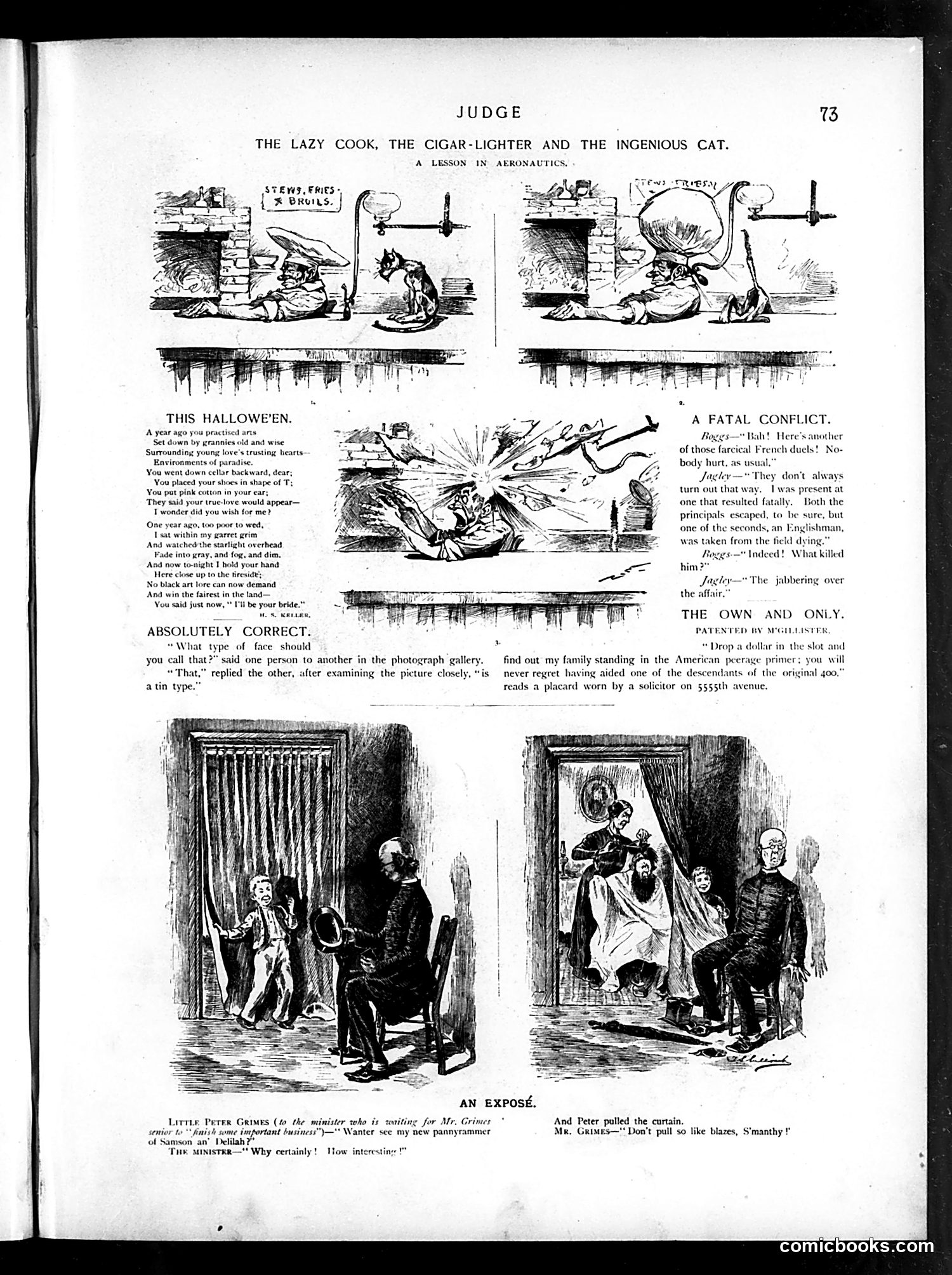
This page contains several satirical pieces typical of late-19th-century American humor: **Top cartoons:** "The Lazy Cook, the Cigar-Lighter and the Ingenious Cat" depicts a domestic contraption where a cat's antics create an absurd chain reaction for cooking—satirizing both Victorian mechanical gadgetry obsession and servants' incompetence. **"This Hallowe'en":** A poem mocking romantic superstitions where young women performed divination rituals on Halloween, poking fun at sentimentality and gullibility. **"A Fatal Conflict":** Two gentlemen discuss a duel between French rivals, with the joke being that while the principals survived, a bystander (an Englishman) was killed—satirizing the absurdity and collateral damage of European honor culture. **"Absolutely Correct":** A brief joke about physiognomy—the pseudoscientific belief that one's appearance revealed character type. **"An Exposé":** A domestic scene where a minister visits, and a child nearly reveals an embarrassing secret before being shushed—gentle satire on hypocrisy and propriety. The overall tone mixes domestic humor with gentle jabs at contemporary pretensions.
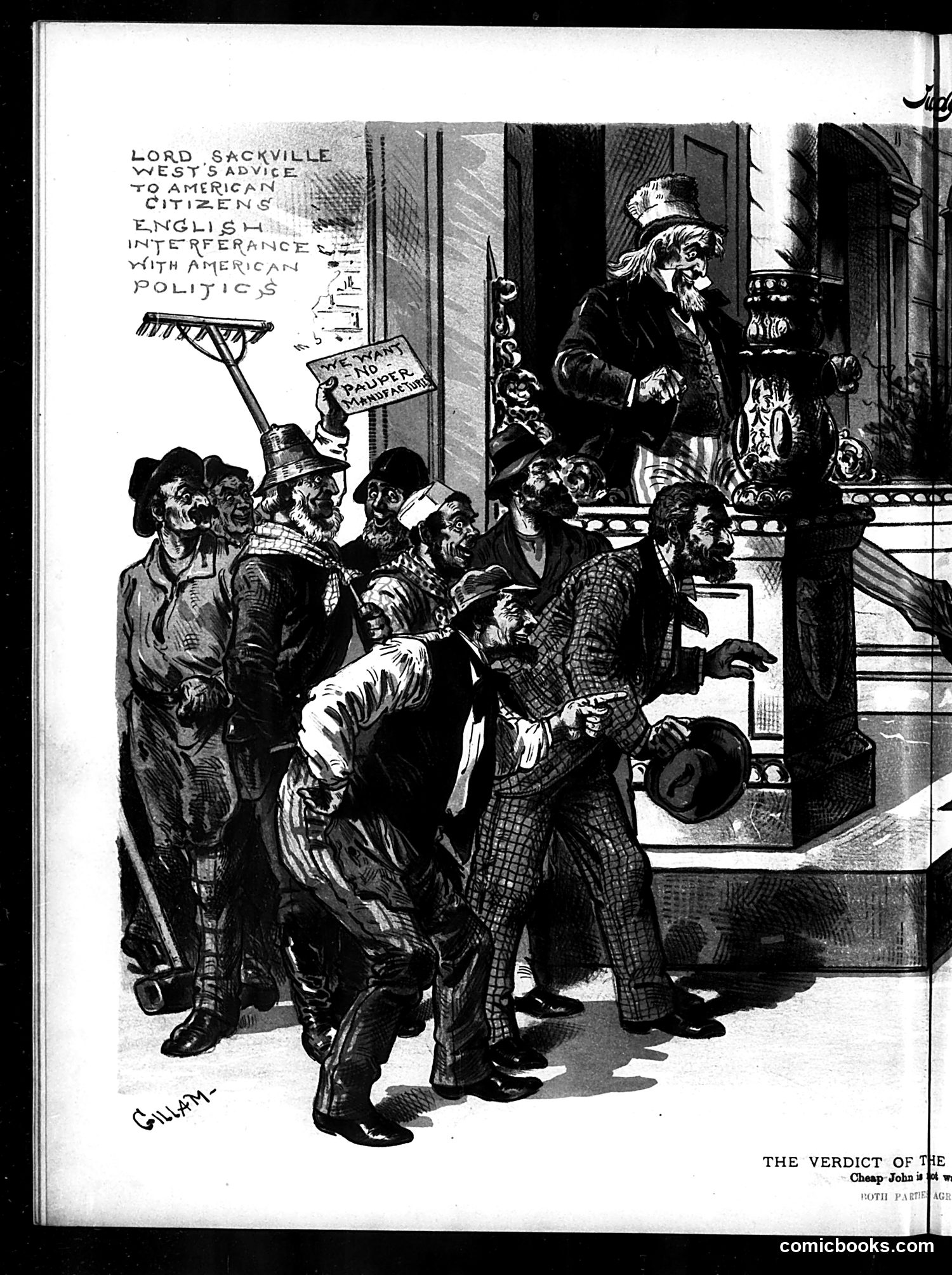
This satirical cartoon depicts Lord Sackville-West, a British diplomat, offering advice to American citizens about interfering in American politics. The image shows a bearded British nobleman addressing a crowd of working-class Americans gathered outside what appears to be an official building. The satire criticizes British interference in American political affairs. The sign the figure holds emphasizes "English Interference With American Politics" — the cartoon's central complaint. The gathering of ordinary Americans suggests public concern about foreign meddling in domestic governance. Lord Sackville-West was the British Minister to the United States during the 1880s, making this likely commentary on actual diplomatic tensions between the nations over American electoral or policy matters. The cartoon mocks British presumption in advising Americans while portraying common citizens as rightfully skeptical of such interference.
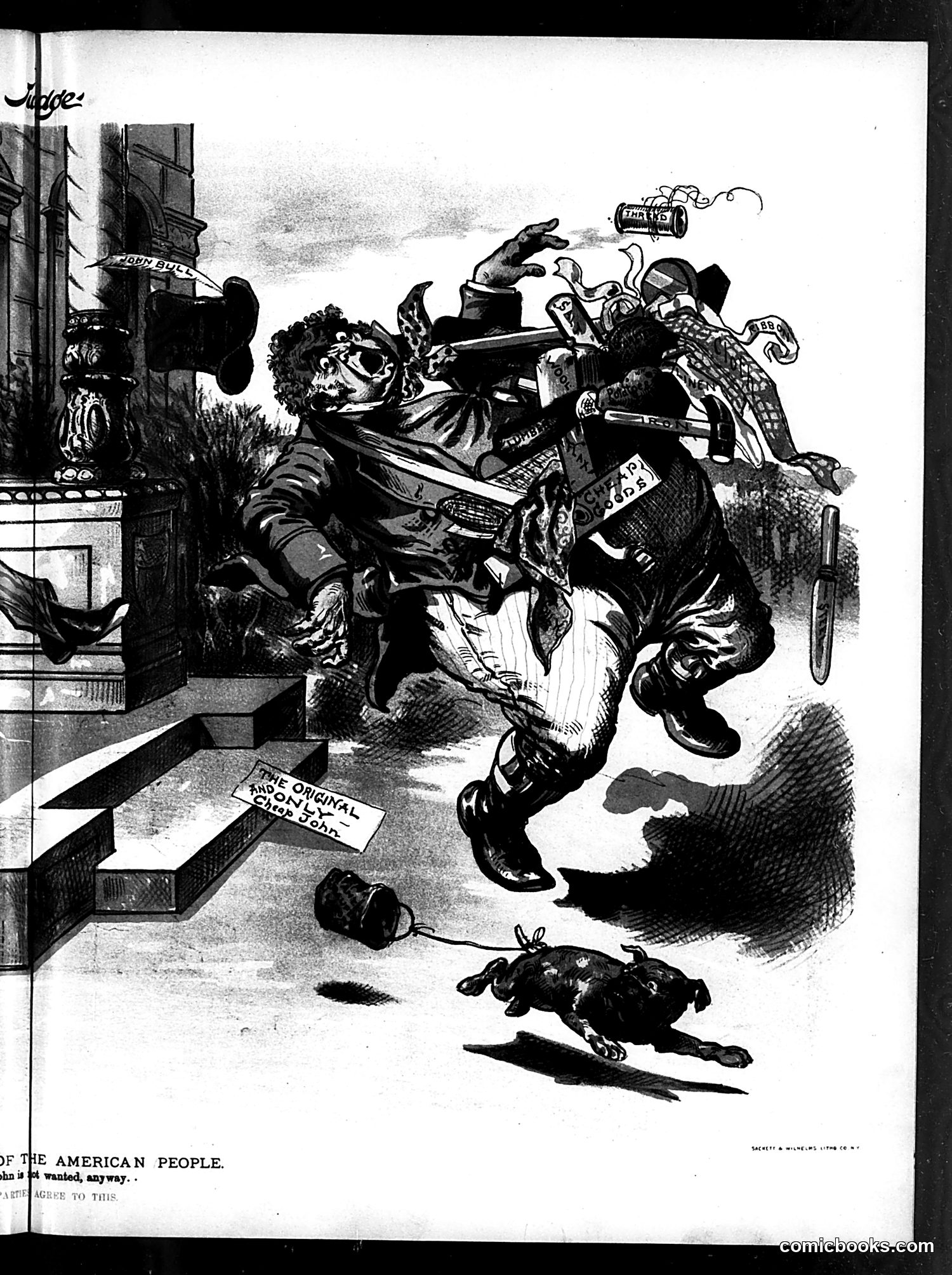
This Judge magazine cartoon depicts a chaotic street scene with a rotund figure in military/official dress being chased or accosted by what appears to be anarchists or revolutionaries. A bomb labeled "ANARCHY" flies overhead, while a dog flees in panic below. The figure's frantic pose and the surrounding mayhem suggest political violence or revolutionary threat. The partial visible text references "the American people," indicating commentary on civil unrest or political extremism. The caricatured style and exaggerated features appear to target a specific political figure or ideology, likely reflecting late 19th or early 20th-century anxieties about anarchism and violent radicalism in America. Without complete caption text visible, the specific target figure remains unclear.
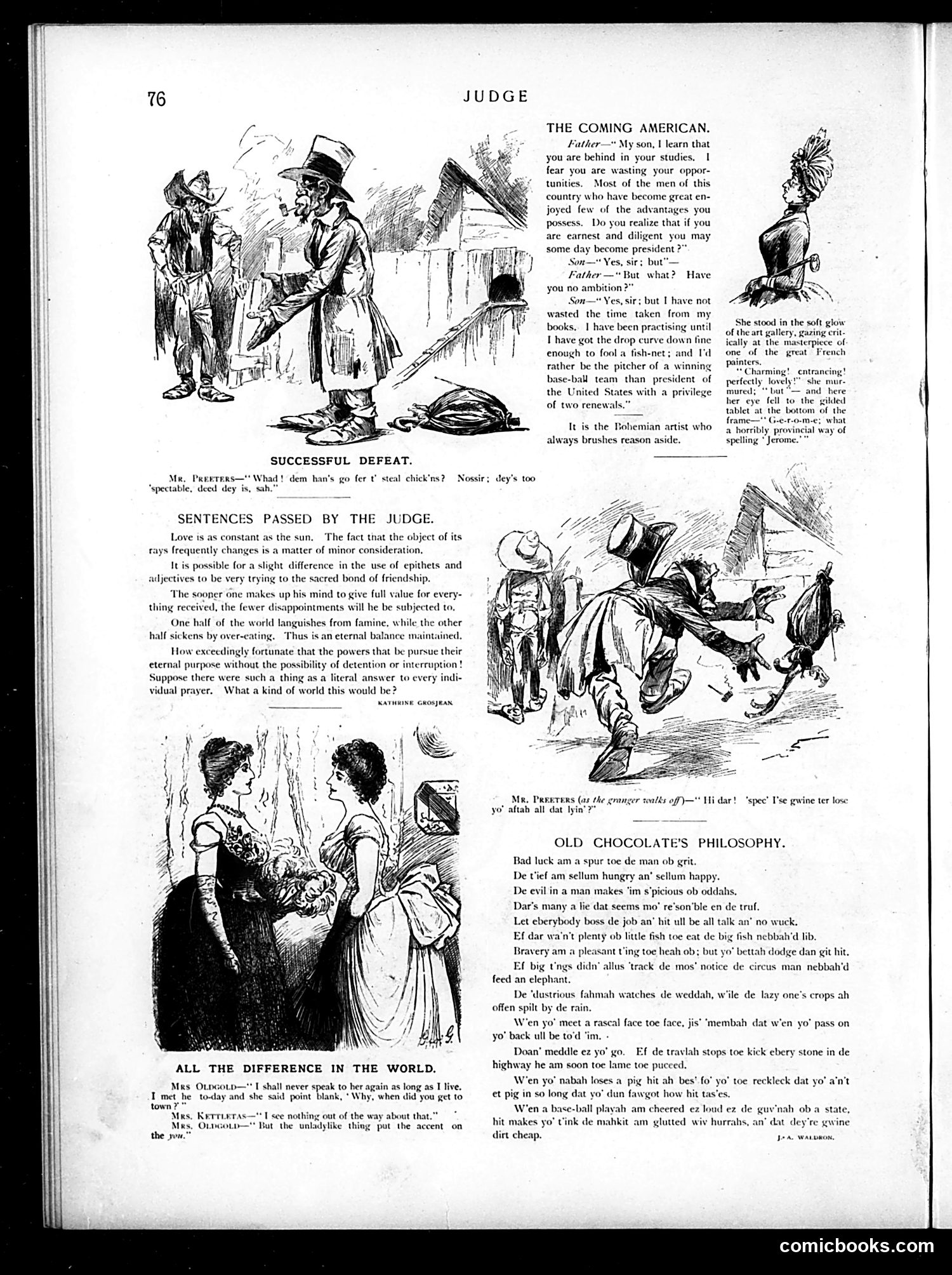
This page contains three satirical pieces reflecting late 19th-century American attitudes: **"Successful Defeat"** depicts a Black man (dialect-speaking character) being asked about stealing chickens—the cartoon mocks both the stereotype and the questioner's assumptions. **"The Coming American"** satirizes American ambition. A father urges his son toward the presidency; the son reveals he'd rather be a winning baseball pitcher. The joke mocks both paternal pressure and the era's obsession with success-climbing, suggesting baseball represents a more honest pursuit than political ambition. **"Old Chocolate's Philosophy"** presents folk wisdom in exaggerated Black dialect—a common Judge format. These aphorisms (about luck, honesty, hard work, and fate) appear intended as "quaint" observations, though the heavy dialect suggests condescension toward both the character and rural/working-class perspectives. All three pieces reflect Judge's satirical targets: class pretension, American ambition, and racial stereotyping typical of 1880s-90s humor magazines.
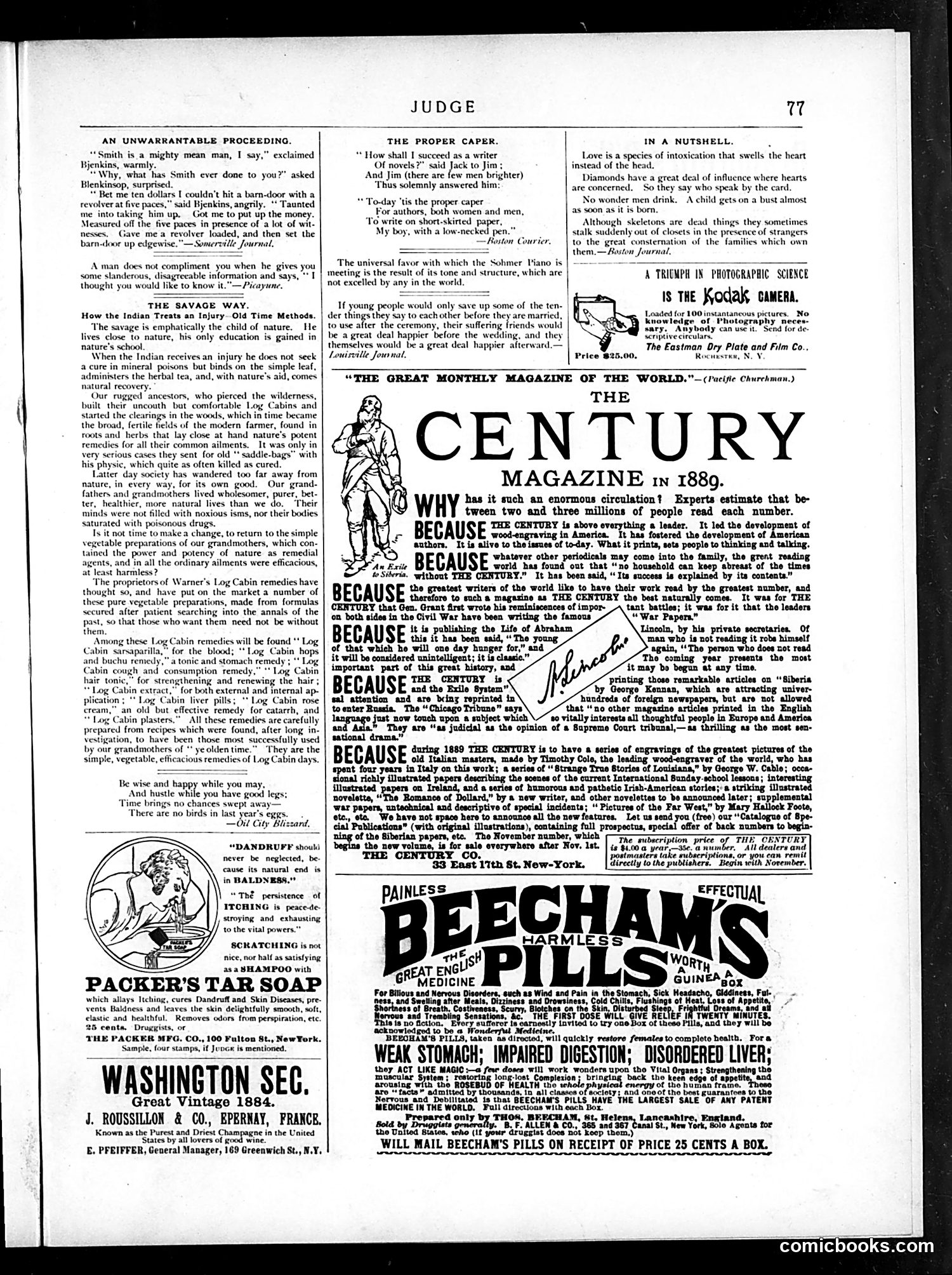
This page primarily contains **advertisements and lighter editorial content** rather than political satire. The main cartoon appears at top: a humorous anecdote about a man (Jenkins) angry at Smith for a wager trick—Smith bet Jenkins he couldn't shoot a barn door with a revolver at five paces, then set the door upright (making it much harder). The joke critiques underhanded wagering and trickery. Below are **nostalgic essays** praising "natural" remedies from frontier times—contrasting Indigenous and colonial healing practices (herbs, simple remedies) against modern "poisonous" mineral medicines. This reflects late-19th-century anxiety about industrialization and pharmaceutical capitalism. The page is dominated by **period advertisements**: Warner's Log Cabin remedies (marketed as "natural" alternatives), Packer's Tar Soap (for dandruff/baldness), Beecham's Pills, and other patent medicines—ironically undercutting the editorial's skepticism of modern pharmaceuticals. These ads represent the lucrative "quack medicine" market of the 1880s.
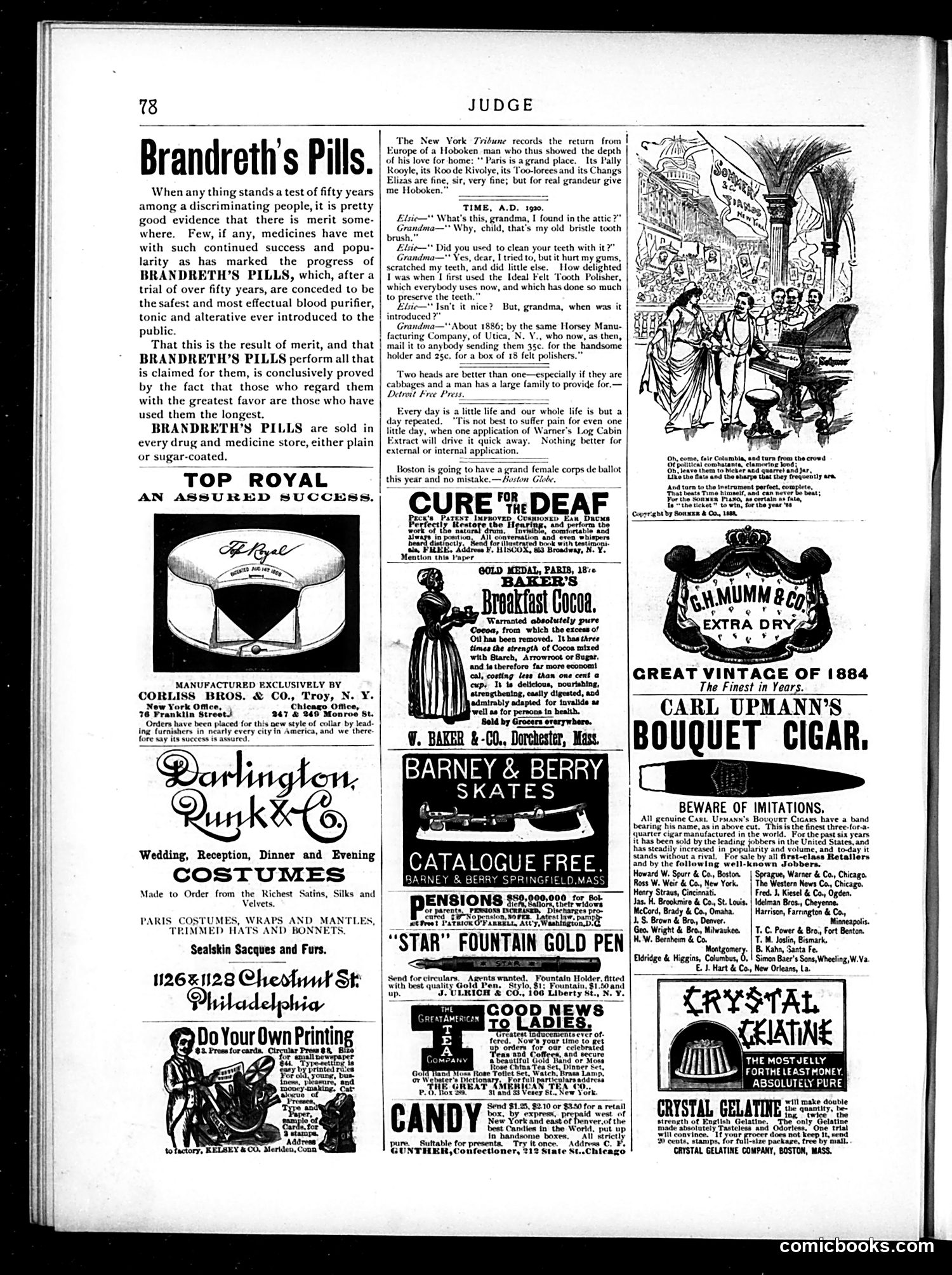
This page is primarily **advertising**, not political satire. It contains numerous commercial advertisements for products popular in the late 1800s or early 1900s, including: - Brandreth's Pills (patent medicine) - Baker's Breakfast Cocoa - Carl Upmann's Bouquet Cigars - Barney & Berry Skates - Star Fountain Gold Pen - Crystal Gelatine The only editorial content is a brief humorous dialogue between a grandmother and child about tooth care and the history of Brandreth's Pills. The main illustration (top right) appears to be a generic scene of street life or a public gathering, unrelated to specific political commentary. This is a typical Judge magazine page devoted primarily to revenue-generating advertisements rather than satirical cartoons.
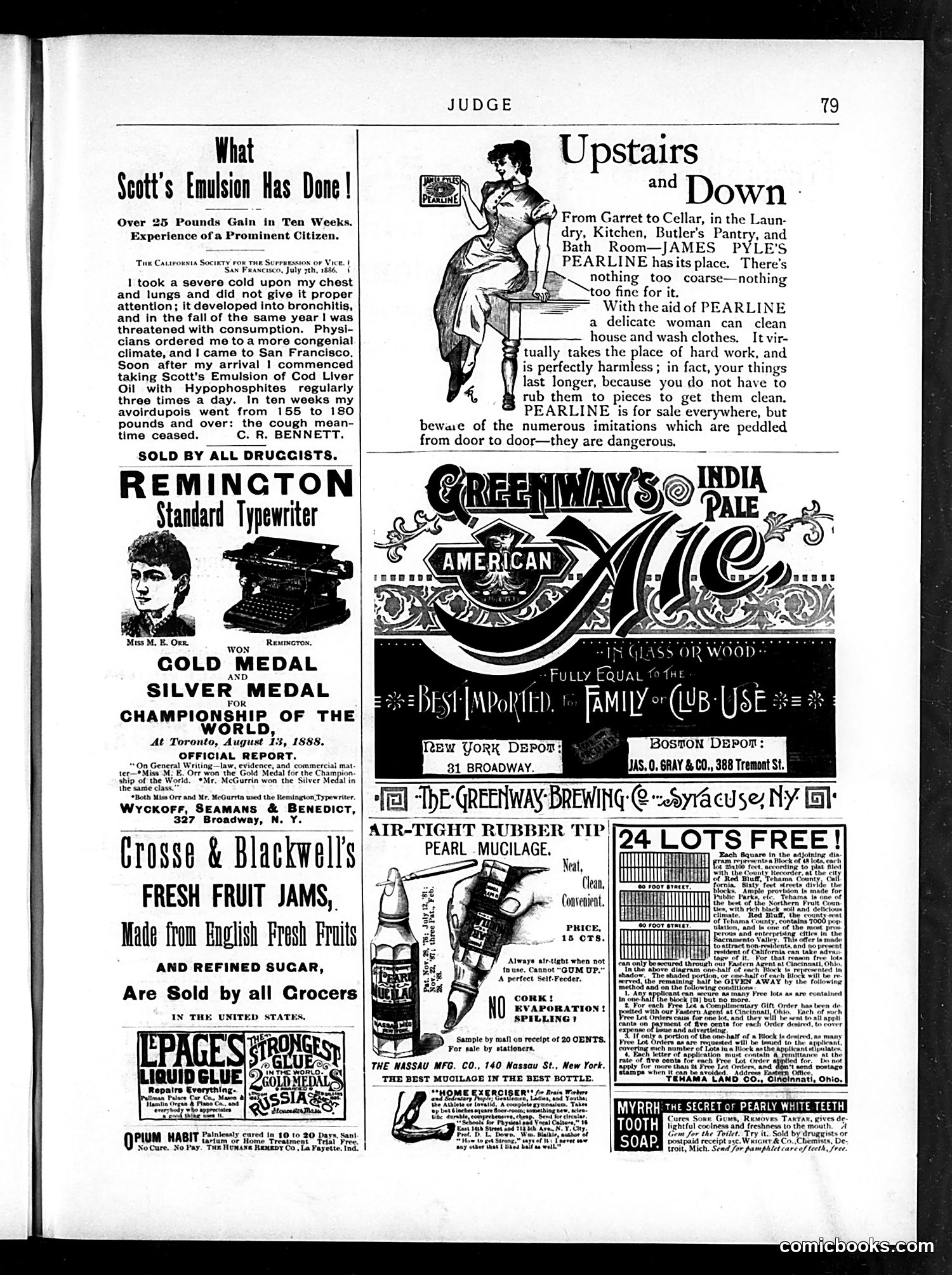
This page is primarily **advertising**, not satire or editorial content. It's from an 1888 issue of the satirical magazine *Judge*, but the space is devoted to commercial advertisements rather than political cartoons. The ads reflect late 19th-century consumer goods and health claims typical of the era: Scott's Emulsion (a cod liver oil supplement claiming to cure consumption/bronchitis), Remington typewriters, Pearline cleaning product, Greenway's India Pale Ale, fresh fruit jams, an opium addiction cure, and various other products. Notable to modern readers: these ads freely make medical cure claims (weight gain, consumption treatment, opium addiction) without FDA regulation—practices illegal today. The Pearline ad's emphasis on cleaning without "hard work" reflects period gender assumptions about women's domestic labor. No identifiable political figures or satirical commentary appears on this page.
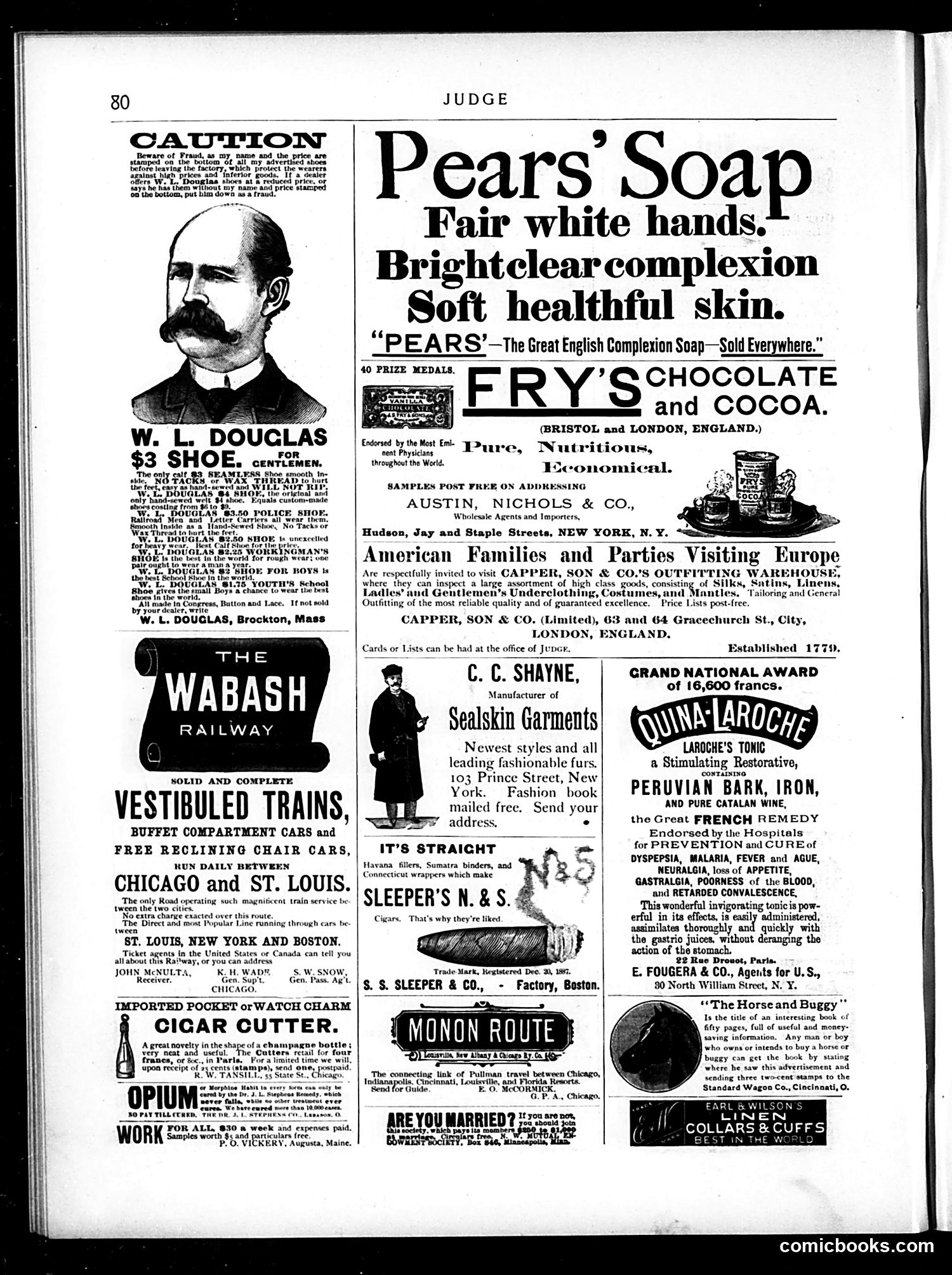
This page is primarily **advertising**, typical of late-19th-century American magazines. The masthead identifies it as "JUDGE," a satirical publication, but this particular page contains no political cartoons—only commercial advertisements. Notable ads include: - **W.L. Douglas Shoes**: Emphasizes anti-fraud protection with manufacturer's stamp on soles - **Pears' Soap**: Promises "fair white hands" and "bright clear complexion"—reflecting period beauty standards - **Fry's Chocolate and Cocoa**: British luxury goods - **Laroche's Tonic**: A patent medicine claiming to cure dyspepsia, malaria, and neuralgia - **Wabash Railway**: Promotes luxury train service between major cities The ads collectively reveal **Gilded Age consumer culture**: manufactured goods, international luxury imports, patent medicines (many containing questionable ingredients), and growing rail infrastructure. The emphasis on appearance (soap, complexion) and health tonics reflects contemporary anxieties and aggressive marketing tactics characteristic of the period. No political satire or recognizable figures appear on this page.
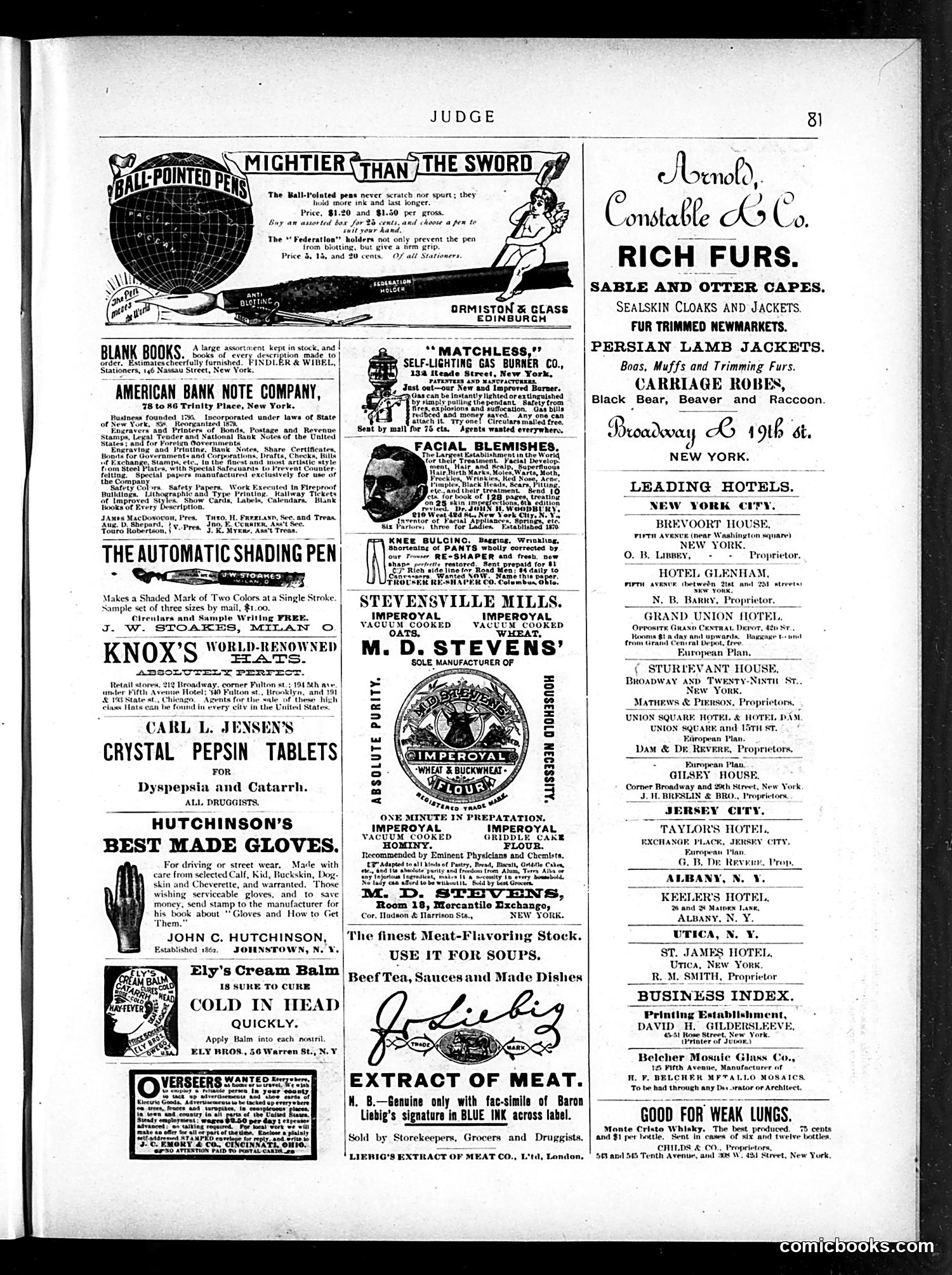
This page is primarily **advertising**, not editorial content or political cartoons. It contains commercial advertisements for various products and services popular in the late 19th or early 20th century, including: - Writing instruments (Ball-Pointed Pens, Automatic Shading Pen) - Banking and stationery services - Patent medicines (Crystal Pepsin Tablets, Hutchinson's Gloves) - Food products (Liebig's Extract of Meat, Stevensville Mills flour) - Hotels and lodging in New York City and other locations - Furs and clothing (Arnold, Constable & Co.) The only illustration with potential satirical content is the "Mightier Than the Sword" header showing a pen, which appears to be a product advertisement rather than political commentary. The page reflects Judge magazine's revenue model: advertising supported the publication.
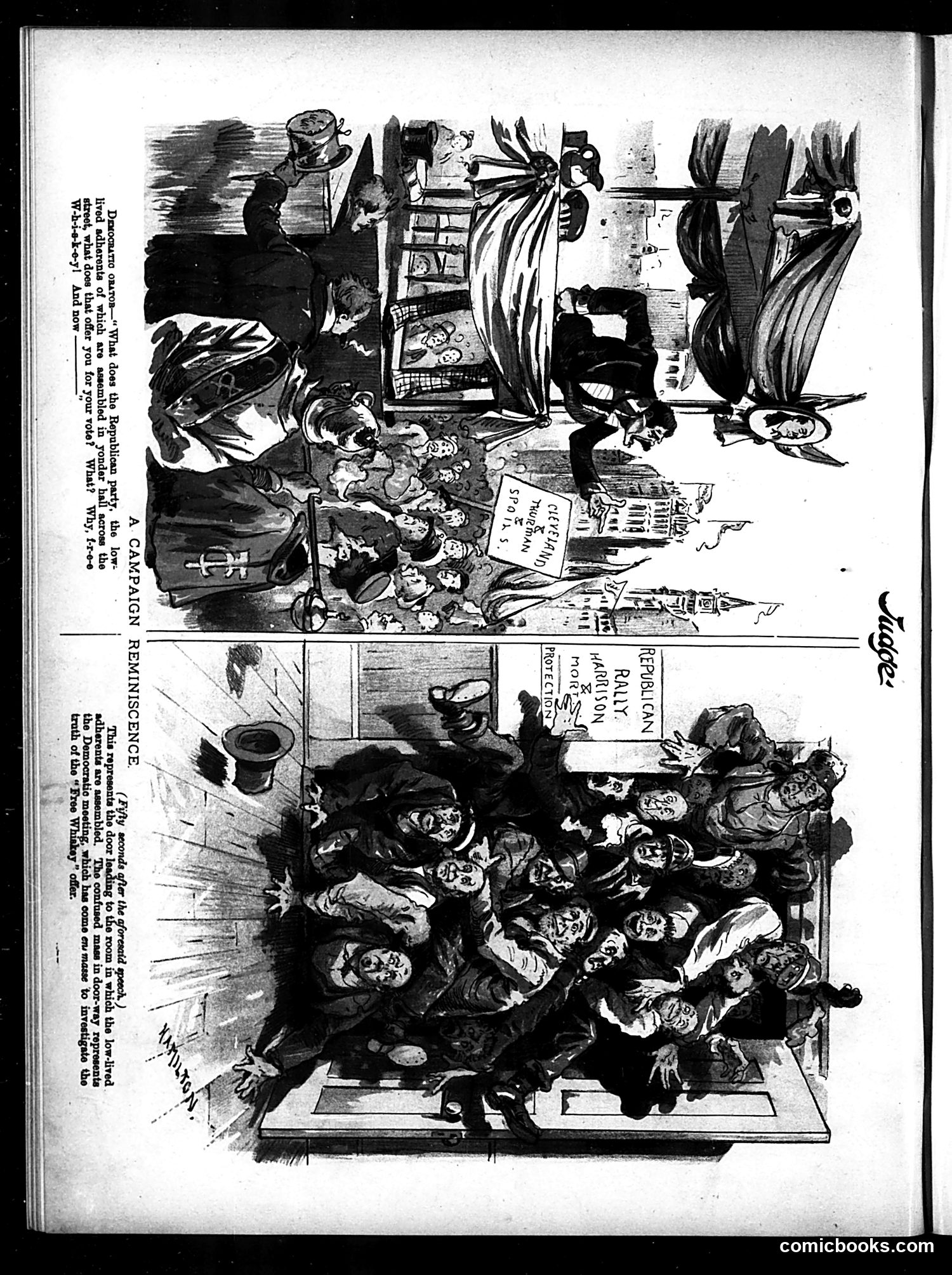
This is a satirical cartoon mocking Republican campaign tactics, likely from the late 19th century. The top panel depicts Republicans bribing voters with free whiskey to secure their votes—a common historical practice called "treating." The cartoon portrays Republican supporters as "low-lived adherents" crowding through a doorway. The bottom panel shows a Democratic response or counterpoint, with a confused mass of people at the doorway, suggesting the Democrats are investigating or commenting on Republican corruption. The satire targets Republican voter-buying practices through alcohol distribution, presenting this as disreputable and morally corrupt. The crude caricatures and chaotic scenes emphasize the cartoon's contempt for both the practice and the party engaging in it. This reflects genuine concerns about election fraud and bribery in Gilded Age American politics.