
A complete issue · 18 pages · 1888
Judge — October 27, 1888
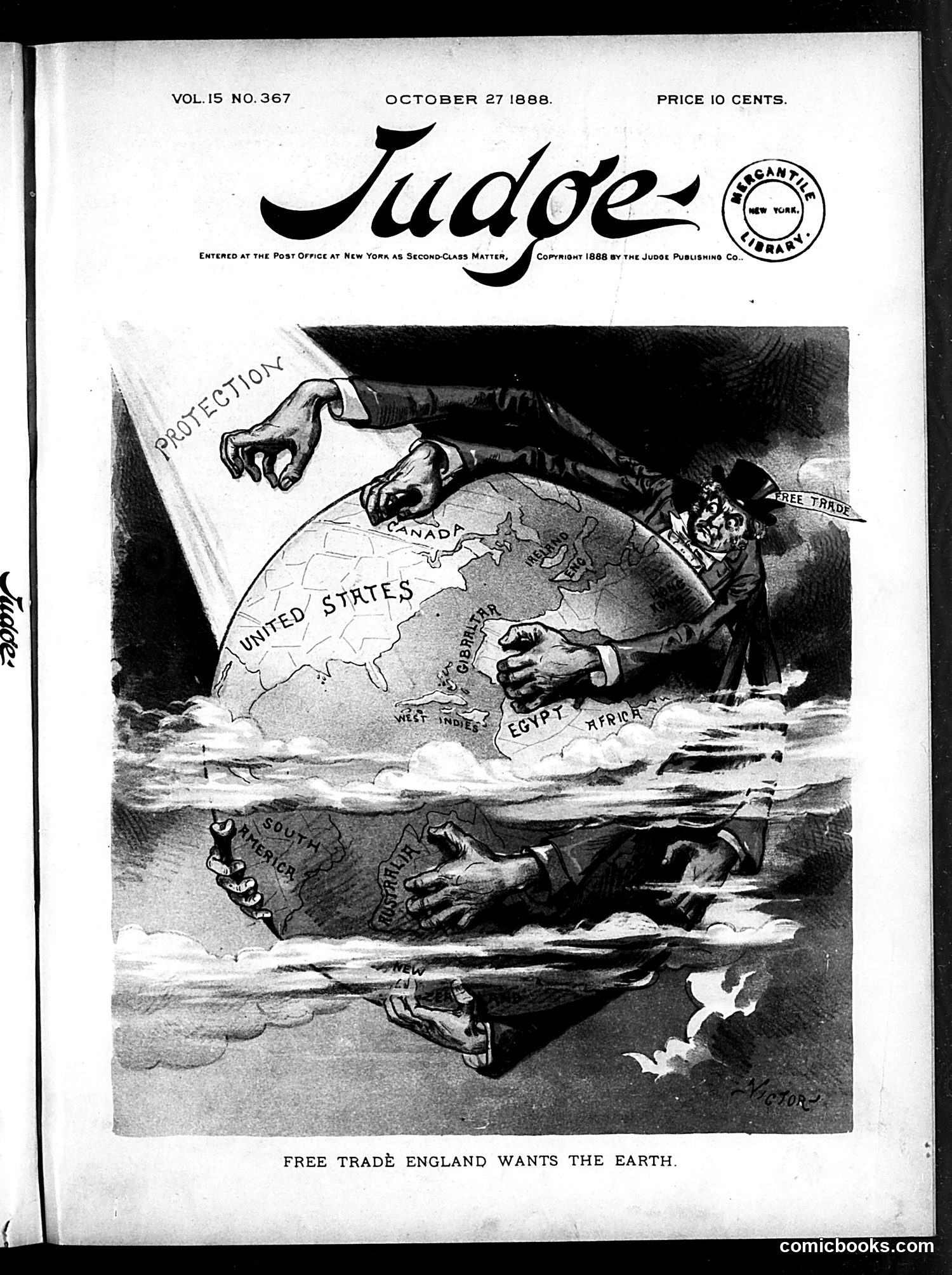
This political cartoon satirizes British free-trade imperialism. The central figure appears to be a British political or commercial entity (depicted as a grasping hand labeled "Protection" at top) attempting to seize a globe showing North America, Egypt, and Africa. Below, other figures representing competing powers—likely representing protectionist trade rivals or other imperial nations—also grasp for territorial control. The caption "Free Trade England Wants the Earth" ironically criticizes Britain's claim that free trade benefits all nations, while the visual narrative shows British imperial ambition as purely acquisitive and predatory. The cartoon suggests hypocrisy: Britain promotes "free trade" ideology while aggressively pursuing territorial expansion and economic dominance globally during the height of the British Empire.
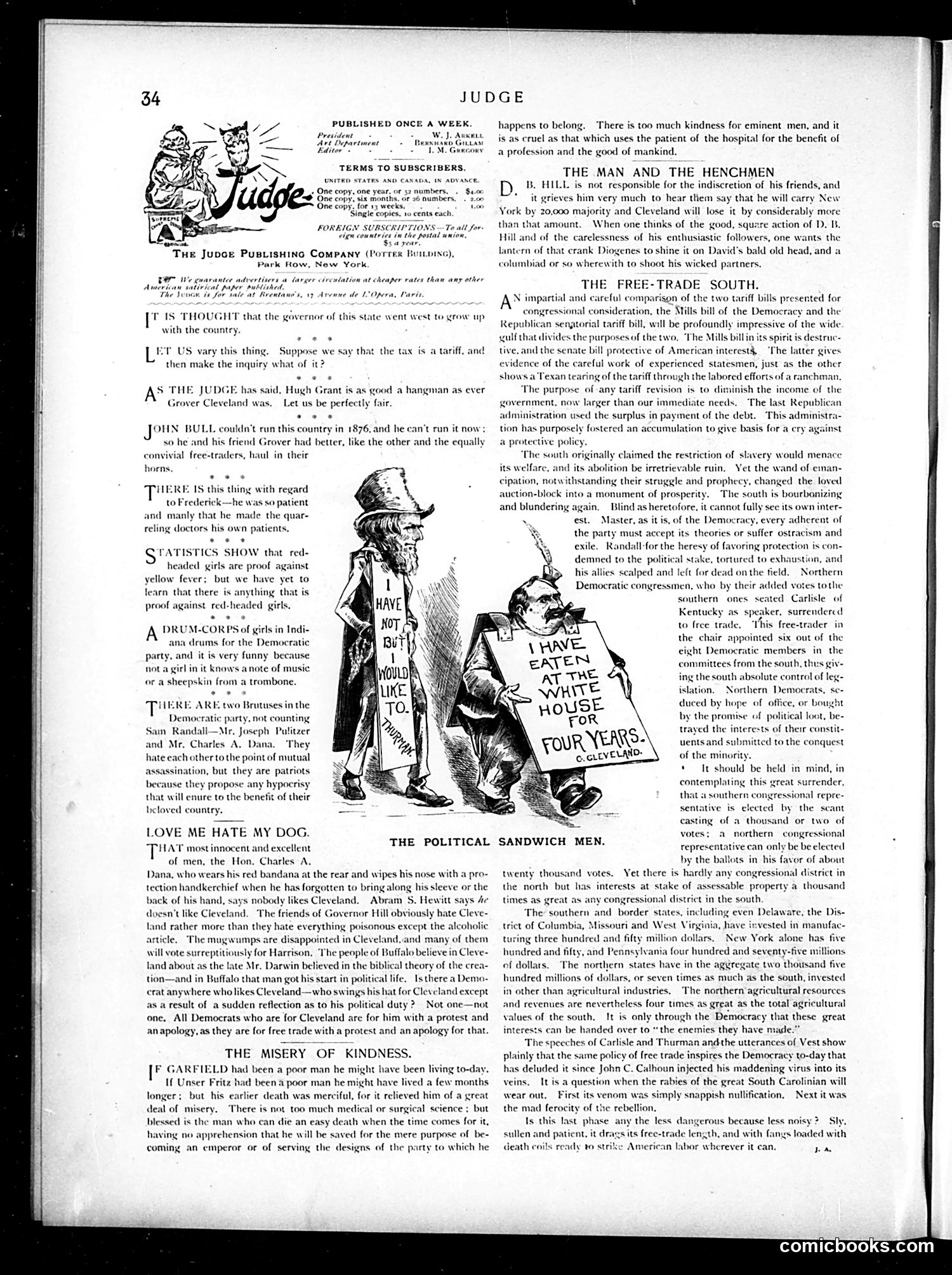
This cartoon satirizes Democratic congressional representatives from the South who, despite opposing free trade policies, were forced to accept them as party doctrine. The two figures—labeled "I HAVE NOT EATEN AT THE WHITE HOUSE FOR FOUR YEARS" and "I HAVE EATEN"—represent Southern Democrats trapped between their regional economic interests and party loyalty. The "sandwich men" metaphor depicts them as walking billboards, carrying contradictory messages. One appears embittered by exclusion from power under Cleveland's administration, while the other reluctantly accepts party discipline despite personal grievances. The satire critiques how Southern congressmen sacrificed their constituents' protectionist interests to maintain Democratic unity, reducing them to mere political tools rather than independent representatives.
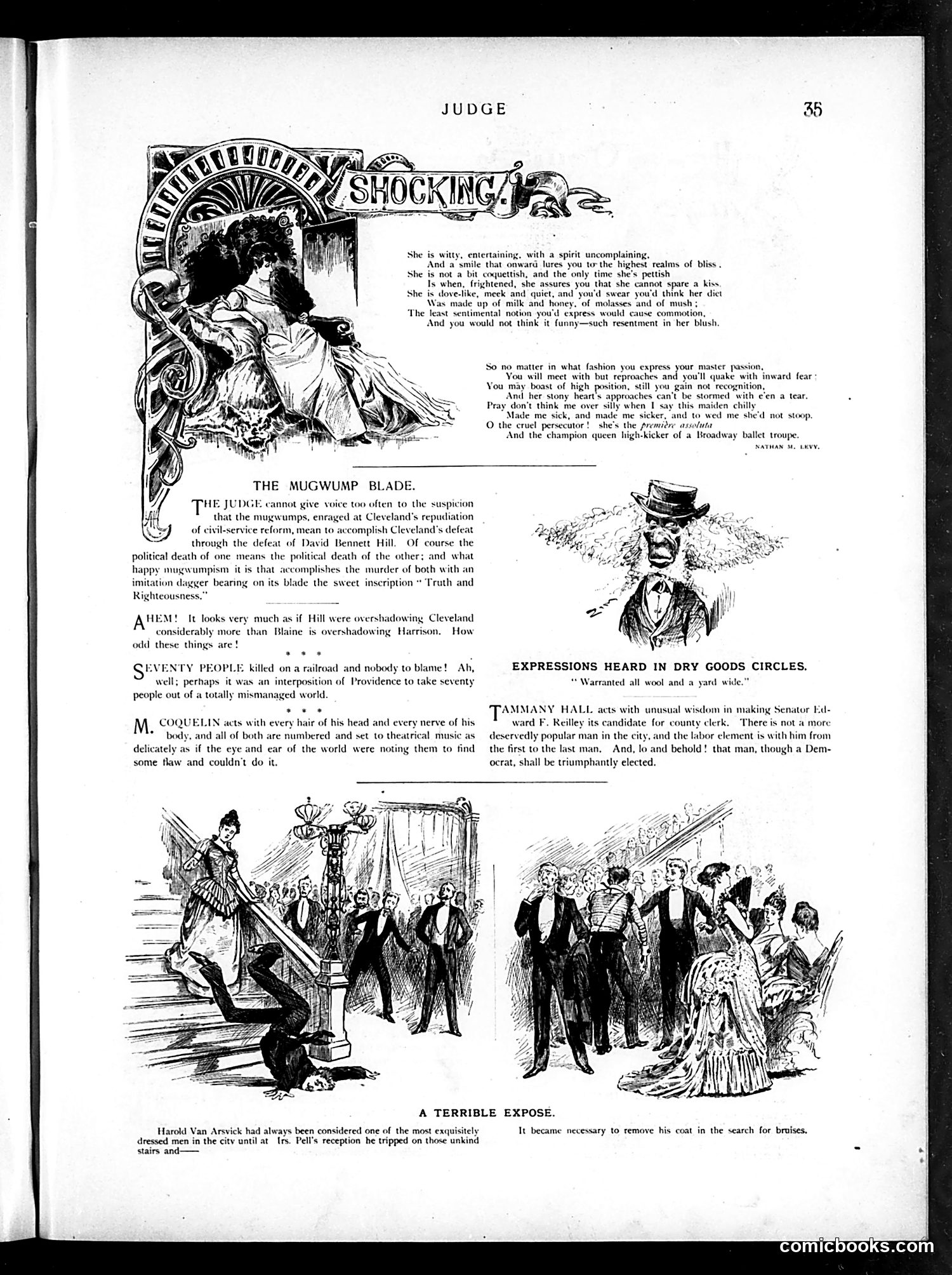
This page contains several satirical pieces typical of 1880s-90s Judge magazine: **"The Mugwump Blade"**: References the political split between Cleveland supporters (mugwumps) and David Bennett Hill. The satire suggests mugwumps claim moral superiority ("Truth and Righteousness") while actually working to defeat both Cleveland and Hill—accomplishing mutual political destruction while hypocritically cloaking it in reform rhetoric. **"Shocking"**: A poem mocking an aloof Broadway dancer—a "premier absolute" and "high-kicker"—who rejects all suitors regardless of their status, position, or emotional appeals. The satire targets both the performer's haughtiness and male entitlement. **Other brief items**: Mock dry goods advertising ("Warranted all wool"), praise Tammany Hall's endorsement of a Democratic county clerk candidate, and joke about Harold Van Arsvick's embarrassing fall at a society reception requiring him to remove his coat. The page exemplifies Judge's focus on political corruption, social pretension, and New York society gossip.
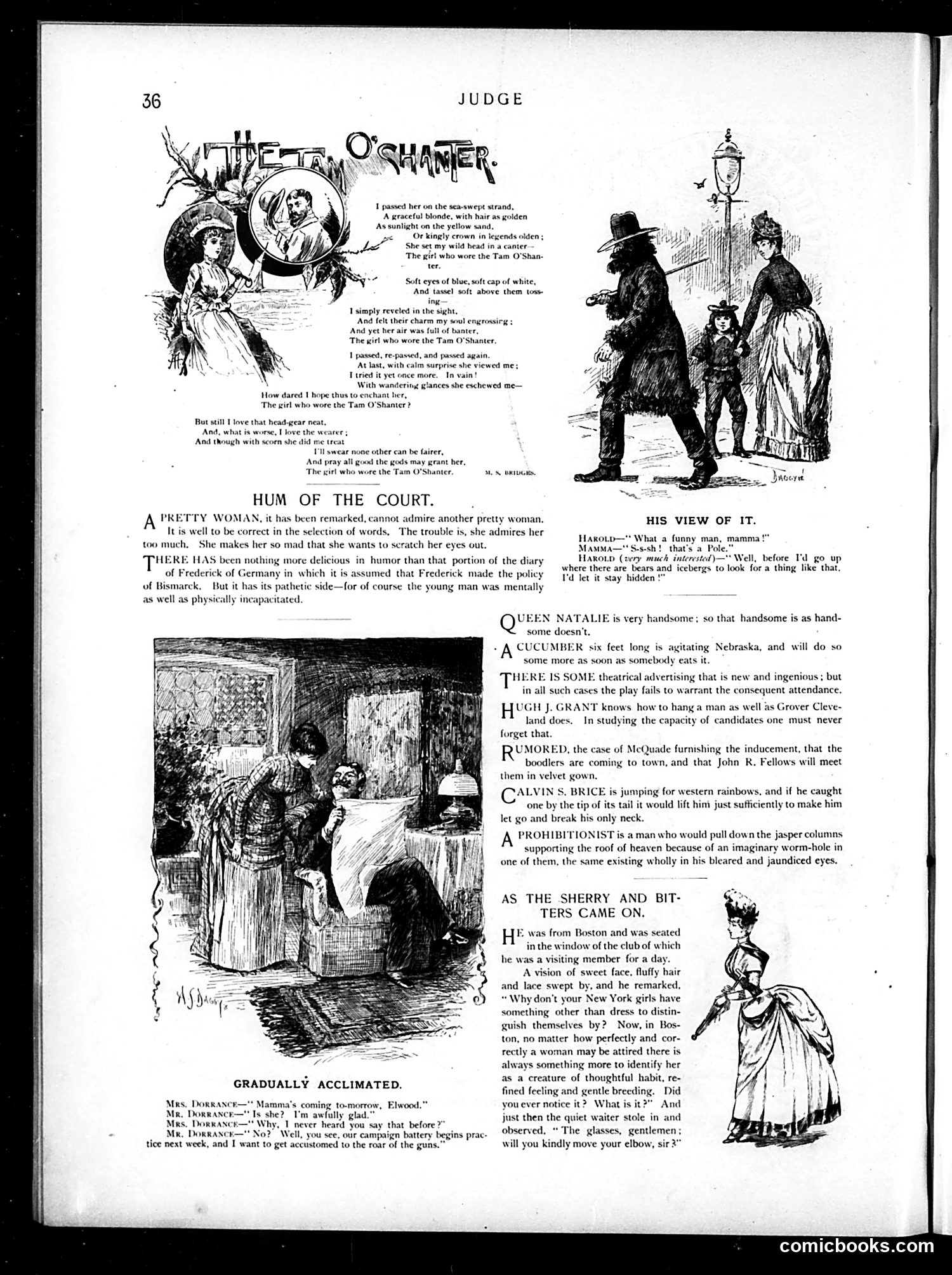
This page from Judge contains several satirical pieces mocking contemporary figures and social types: **"The Tam O'Shanter"** is a romantic poem about a woman in Scottish dress, likely poking fun at fashionable affectations of the era. **"Hum of the Court"** includes brief satirical jabs at political/public figures: Hugh J. Grant (comparing his willingness to execute criminals to Grover Cleveland), Calvin S. Brice (a Republican politician, mocked as recklessly ambitious), and references to "boodlers" (corrupt politicians) coming to town. **"His View of It"** shows a child's innocent perspective contrasting with adult pretension—a mother warns her son a "Pole" is funny; the child notes he'd rather not venture to dangerous lands seeking hidden things. **"As the Sherry and Bitters Came On"** satirizes snobbish Boston elites claiming superior refinement while being interrupted by a waiter—deflating their pretensions through the mundane. The cartoons use exaggerated Victorian-era illustration styles typical of Judge's humor: social satire targeting politicians, ethnic stereotypes, and class-based comedy.
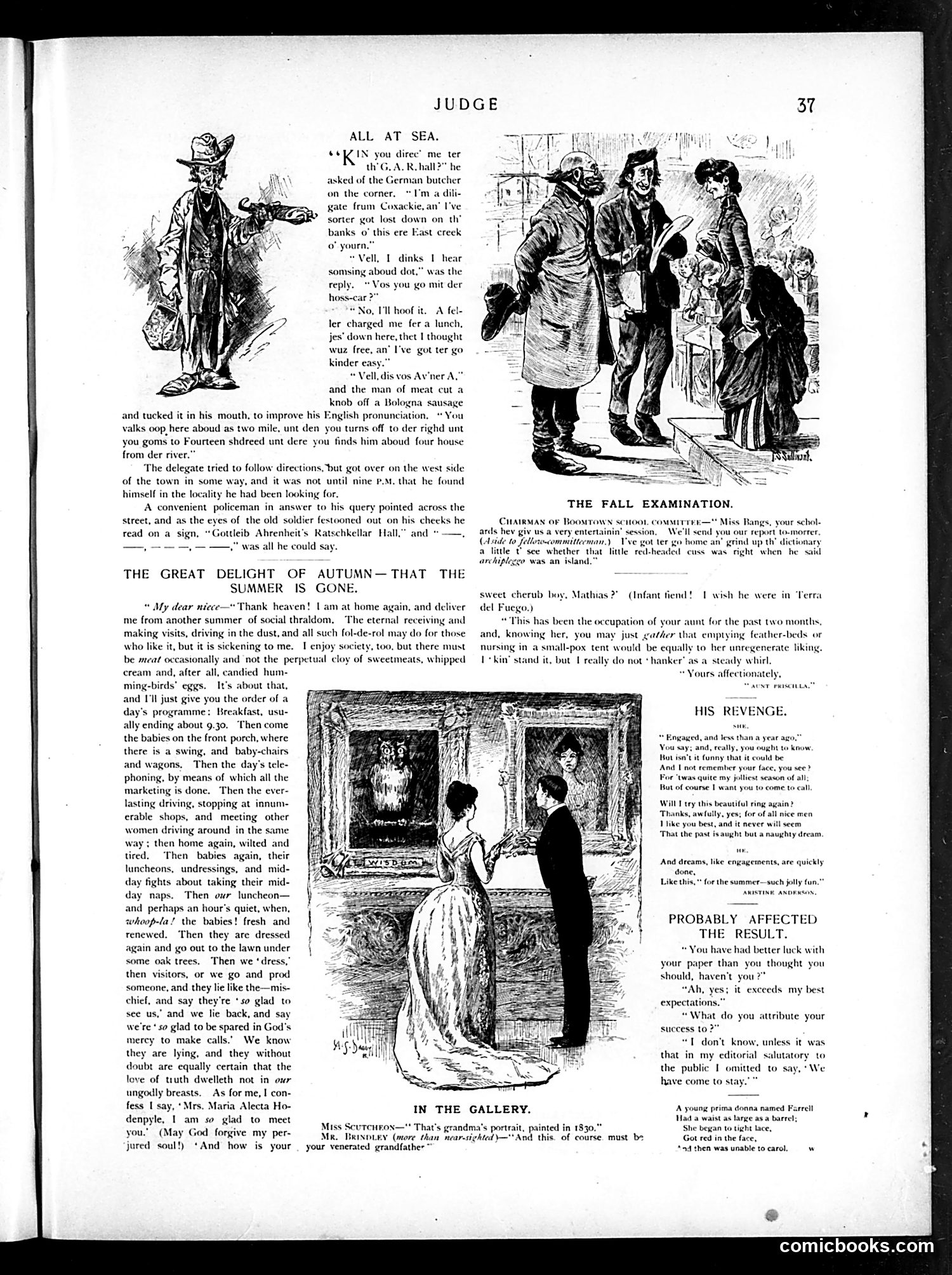
This page contains several satirical pieces typical of late 19th-century American humor: **"All at Sea"** mocks both German immigrants and American hospitality through dialect humor. A lost German delegate asks directions from a German butcher, who provides confusing guidance while eating bologna—playing on ethnic stereotypes about German immigrants' speech and food. **"The Great Delight of Autumn"** satirizes upper-class women's tedious social obligations: endless visiting, shopping, childcare, and mandatory social calls where both parties lie about enjoying each other's company. The satire targets the performative nature of genteel society life and its mind-numbing repetition. **"The Fall Examination"** and other brief pieces use school exams and social situations for light humor, including the awkward moment when a student's aunt has been grinding up a dictionary to help him cheat. The overall tone reflects Judge's typical targets: immigrant groups, pretentious society, and domestic absurdities—delivered through exaggeration and dialect humor common to the era.
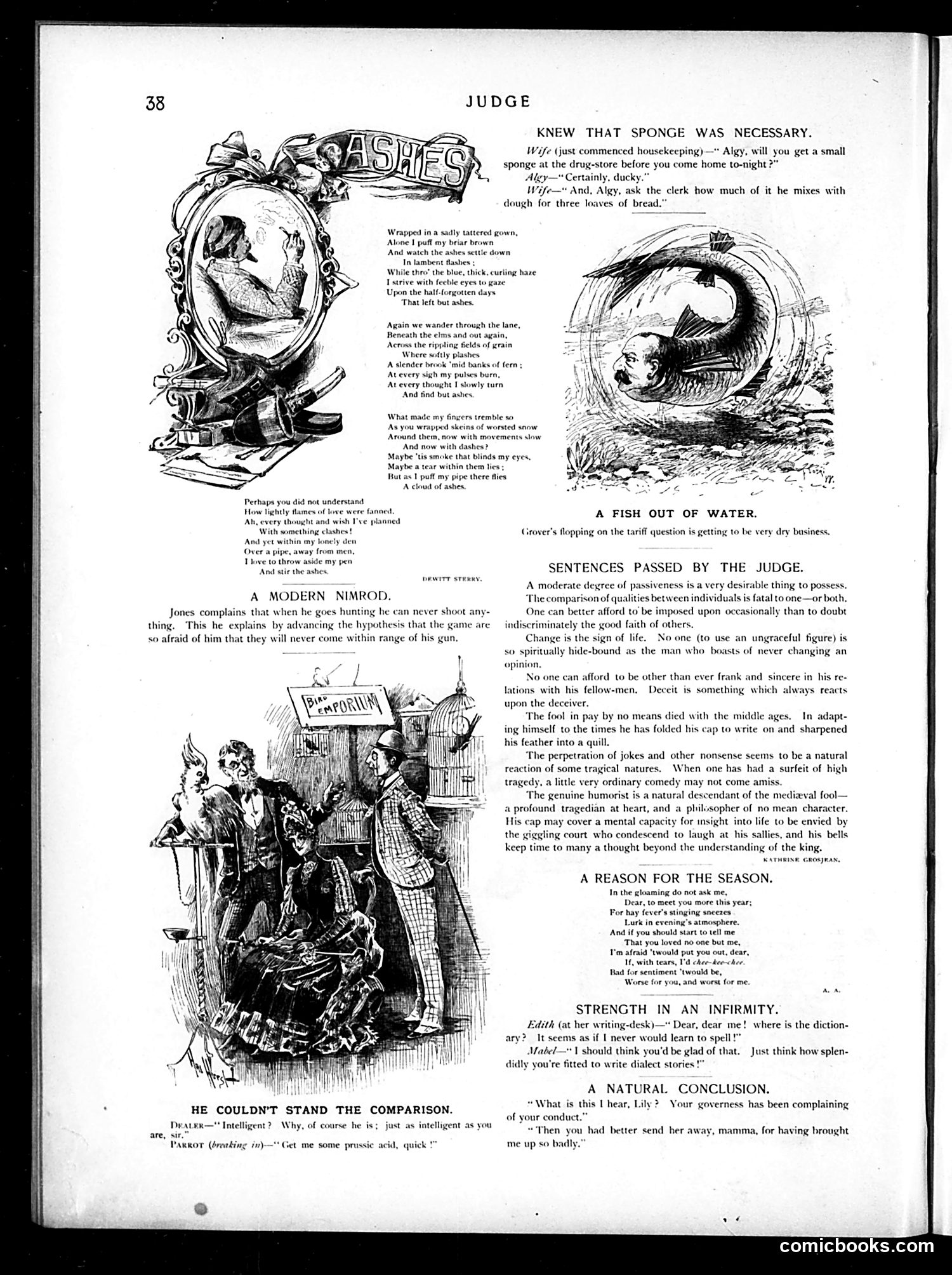
This page contains several satirical pieces typical of late 19th-century American humor: **"A Modern Nimrod"** mocks an incompetent hunter (Jones) who blames game for avoiding him rather than acknowledging his poor marksmanship—a jab at self-deluding people who won't accept responsibility. **"A Fish Out of Water"** references Grover (likely President Grover Cleveland) struggling with the tariff question, suggesting his discomfort with this political issue. **"He Couldn't Stand the Comparison"** shows a parrot outperforming a man intellectually, implying the man is no smarter than a bird. The page also includes poetry and philosophical "Sentences Passed by the Judge"—witty moral observations on honesty, change, and human nature. Brief humorous sketches appear throughout: a newlywed's confusion about baker's sponge, hay fever preventing romance, and a governess complaint resolved by dismissal. The overall tone is genteel Victorian satire targeting pomposity, incompetence, and social pretension.
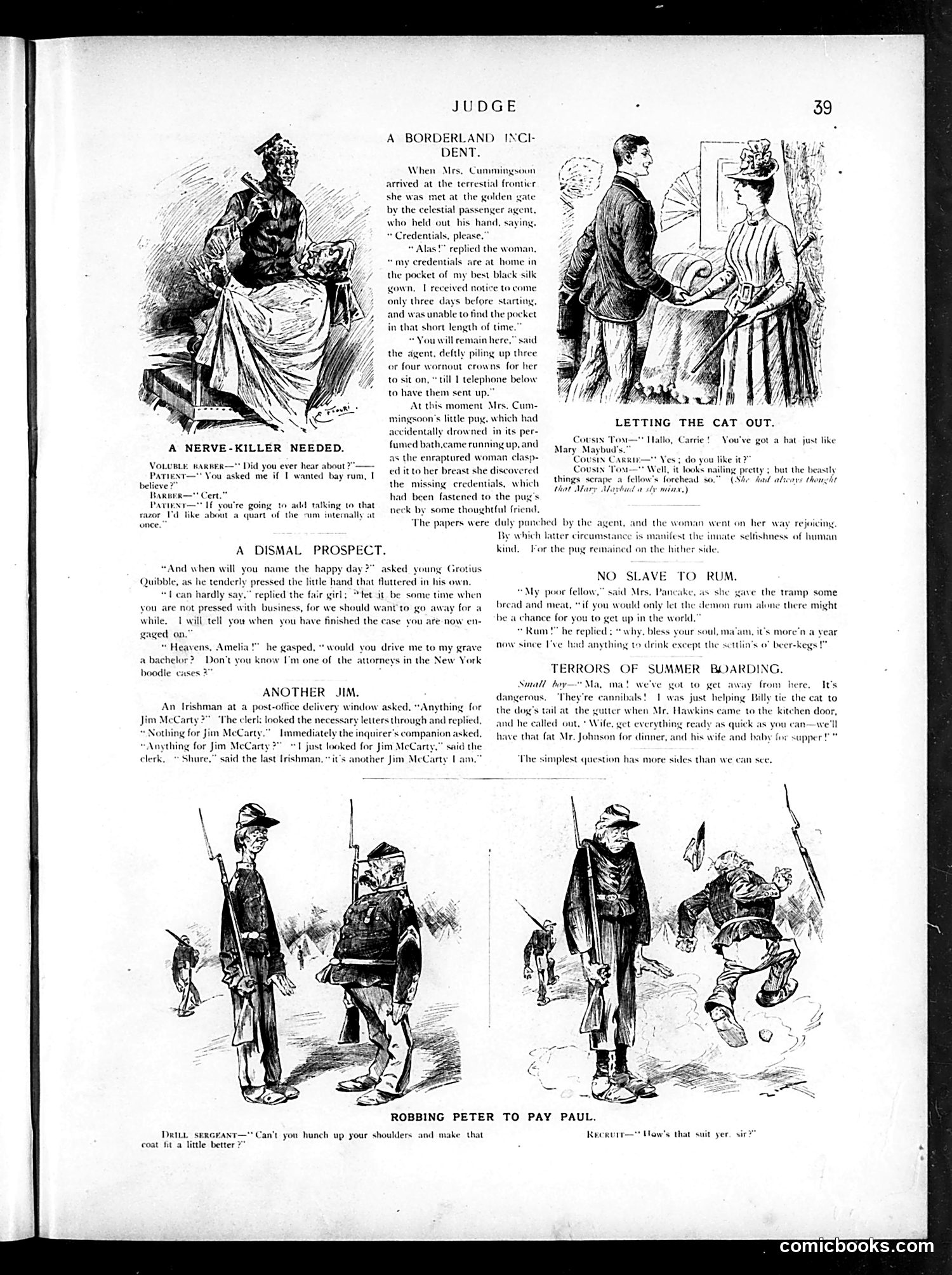
This page contains multiple short satirical pieces typical of Judge magazine's humor: **"A Borderland Incident"** mocks bureaucratic inefficiency through a heavenly afterlife scenario—Mrs. Cummingsoon arrives at heaven's gate without required credentials and must wait while they're retrieved from Earth. **"A Nerve-Killer Needed"** and **"Another Jim"** are brief jokes about verbal absurdities and Irish malapropisms, common stereotypical humor of the era. **"Letting the Cat Out"** satirizes women's fashion, specifically the impracticality of hats with brims that scratch the forehead—a veiled criticism of female vanity. **"No Slave to Rum"** ironically shows a vagrant claiming he hasn't drunk in a year except for "scrapings off beer-kegs"—mocking both temperance rhetoric and working-class poverty. **"Terrors of Summer Boarding"** depicts vacation chaos when children's cruelty (tying a cat to a dog's tail) coincides with unexpected wealthy dinner guests. **"Robbing Peter to Pay Paul"** addresses tailoring—a visual joke about poor-fitting clothes. The illustrations use period engraving style typical of Judge's Victorian-era satirical approach.
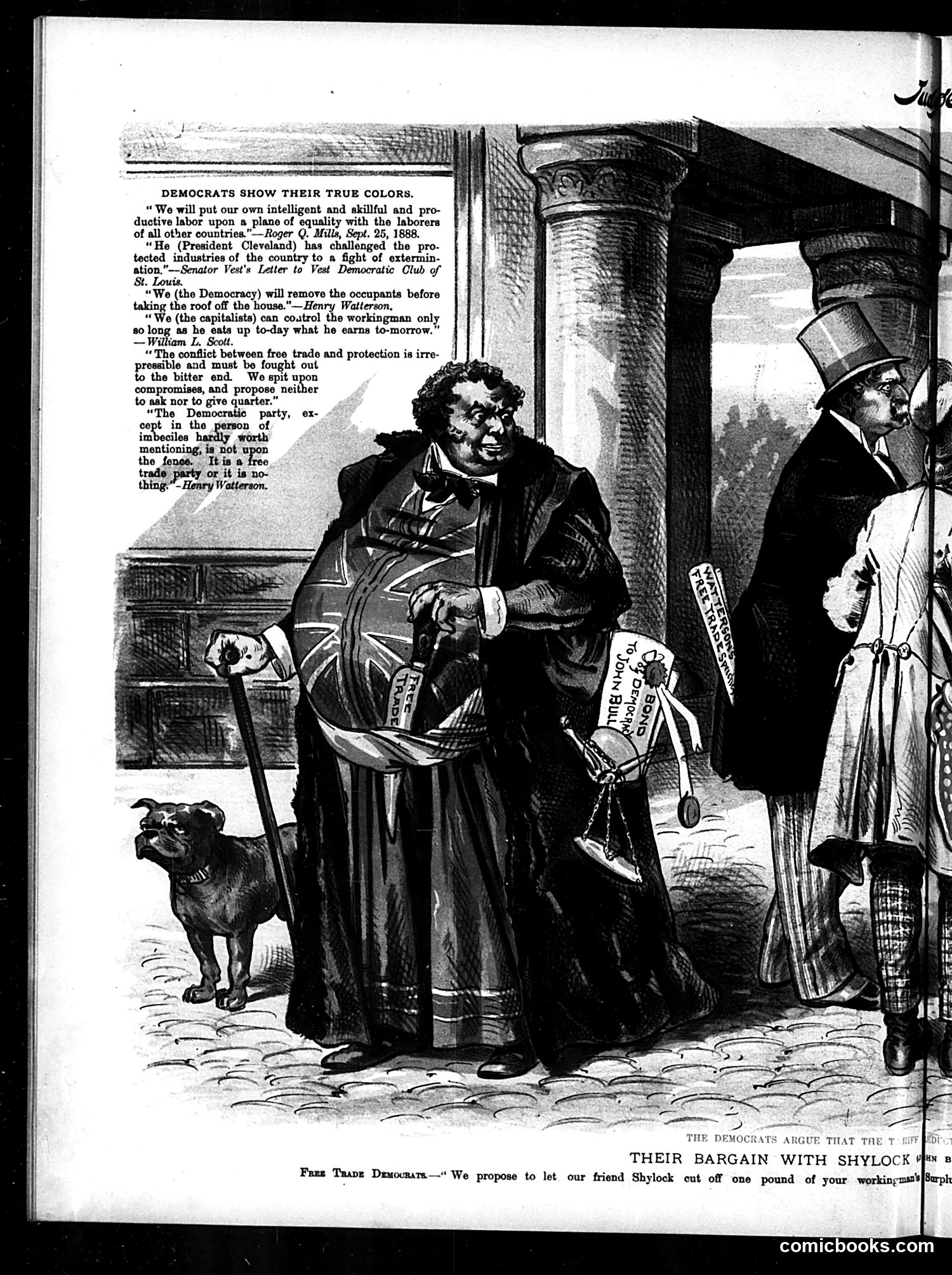
This 1888 Judge cartoon satirizes Democratic Party positions on trade policy, particularly free trade advocacy. The central figure appears to be a Democratic politician or personification, depicted with exaggerated features typical of period caricature. The "Shylock" reference invokes Shakespeare's *Merchant of Venice*—the Jewish moneylender demanding his "pound of flesh"—to suggest Democrats are making a dangerous deal. The cartoon's point: Democratic leaders (quoted above) propose removing tariff protections and allowing unrestricted competition with foreign labor, which Judge portrays as sacrificing American workers' welfare. The multiple quotes present Democratic arguments for free trade, which the cartoonist presents as threats to working-class livelihoods. The dog and well-dressed figures likely represent capital and labor. Judge's Republican perspective frames Democratic trade policy as betraying workers' interests—a "bargain" that extracts a literal pound of flesh (workers' wages and jobs).
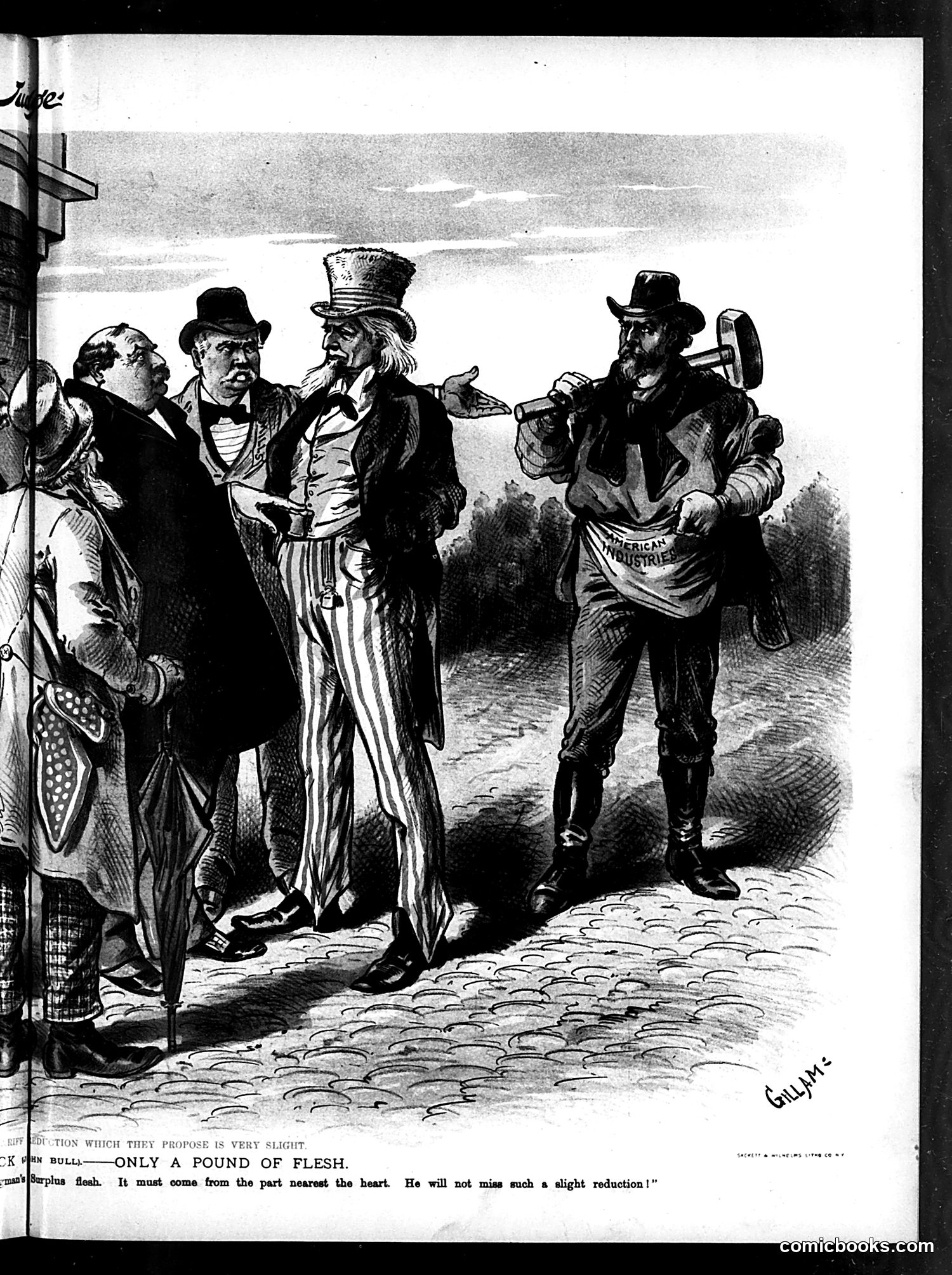
This is a Shakespearean reference cartoon, alluding to *The Merchant of Venice*'s "pound of flesh" demand. The central figure appears to be **Uncle Sam** (identifiable by his striped pants and tall hat), surrounded by men in formal dress. One figure on the right wears a sash labeled "American Industry." The cartoon satirizes labor disputes or financial negotiations where capitalists demand concessions from workers or the nation. The "pound of flesh" metaphor suggests they're making seemingly modest demands ("very slight reduction") that actually cut dangerously close to vital interests—specifically "nearest the heart." The dark humor implies these proposals, though presented as minor, would cause significant harm. The cartoonist (signed "Gillam") criticizes how business interests frame aggressive demands as reasonable compromises.
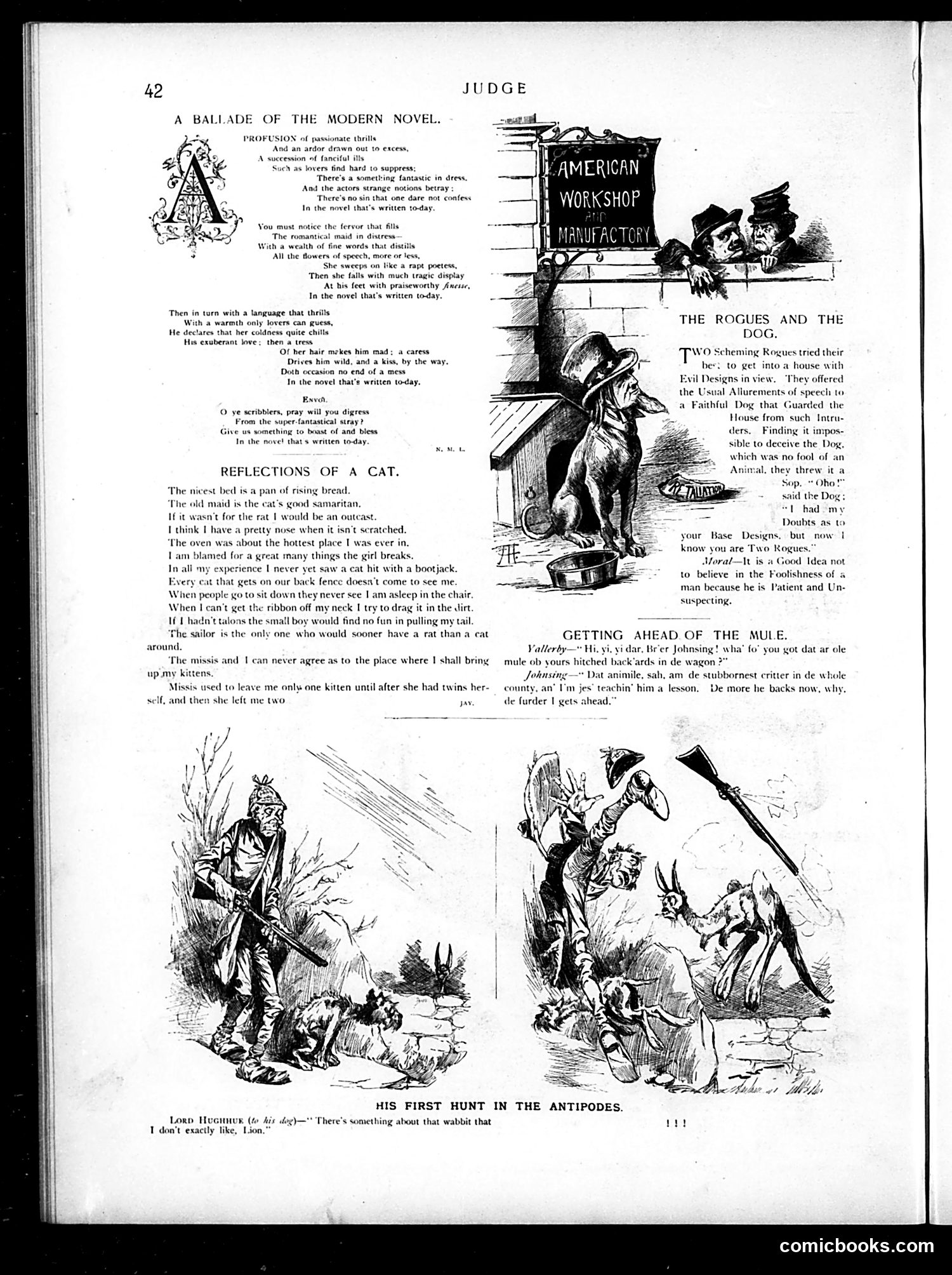
This page contains several distinct pieces of satirical content: **"A Ballade of the Modern Novel"** (top left) mocks contemporary fiction for excessive melodrama—overwrought passion, theatrical characters, and scandalous confessions. The satire asks writers to produce something worthy of praise rather than sensational drivel. **"Reflections of a Cat"** presents humorous observations from a feline perspective, including complaints about old maids, rats, and humans' inconsiderate behavior—lighthearted domestic humor rather than political satire. **Three moral fables** occupy the right side: "The Rogues and the Dog" warns against trusting smooth-talking deceivers; "Getting Ahead of the Mule" shows a man using reverse psychology on a stubborn animal; and "His First Hunt in the Antipodes" depicts hunting mishaps. These employ ethnic dialect and slapstick humor typical of the era's comedy conventions. The page emphasizes Judge's mix of literary criticism and illustrated humor aimed at middle-class readers.
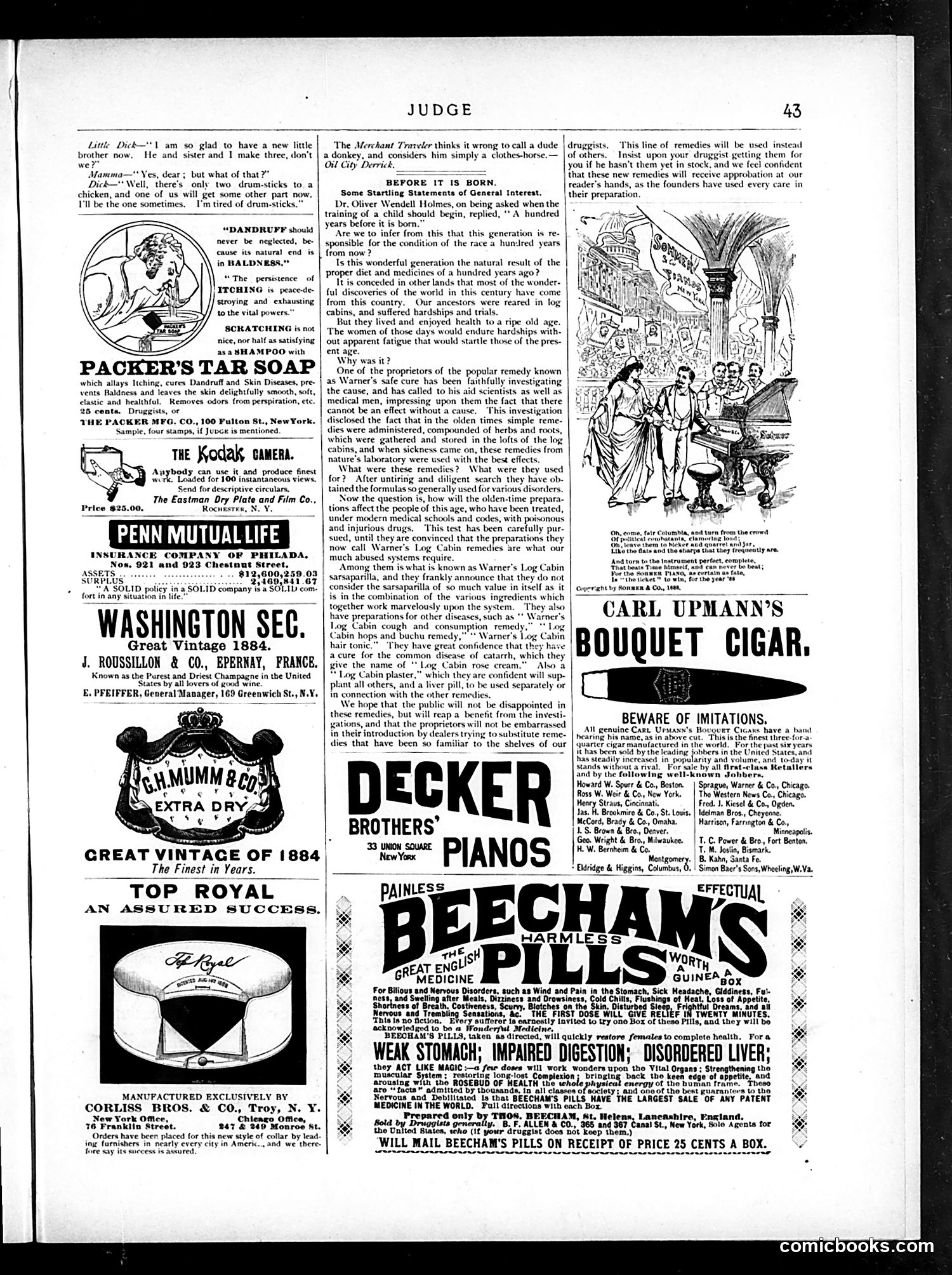
This page is primarily **advertisements** with one brief cartoon dialogue at the top. **The Cartoon:** A child named "Little Dick" discusses chicken dinner with his mother. He's pleased about a new baby sibling because it means three children instead of two—and since a chicken only has two drumsticks, he'll now sometimes get a different piece instead of always losing out. The joke is a child's innocent, selfish logic about how a new family member affects his food portions. **Context for Modern Readers:** This reflects Victorian-era family humor about sibling rivalry and childhood materialism. It's lighthearted domestic comedy with no political content. **The Advertisements:** The page features typical late-19th-century patent medicine and product ads—Packer's Tar Soap (dandruff cure), Kodak cameras, life insurance, champagne, and Beecham's Pills (a popular laxative). These ads reveal period attitudes about health remedies, many now recognized as ineffective or harmful. The ads use pseudo-scientific language to market products to middle-class consumers.
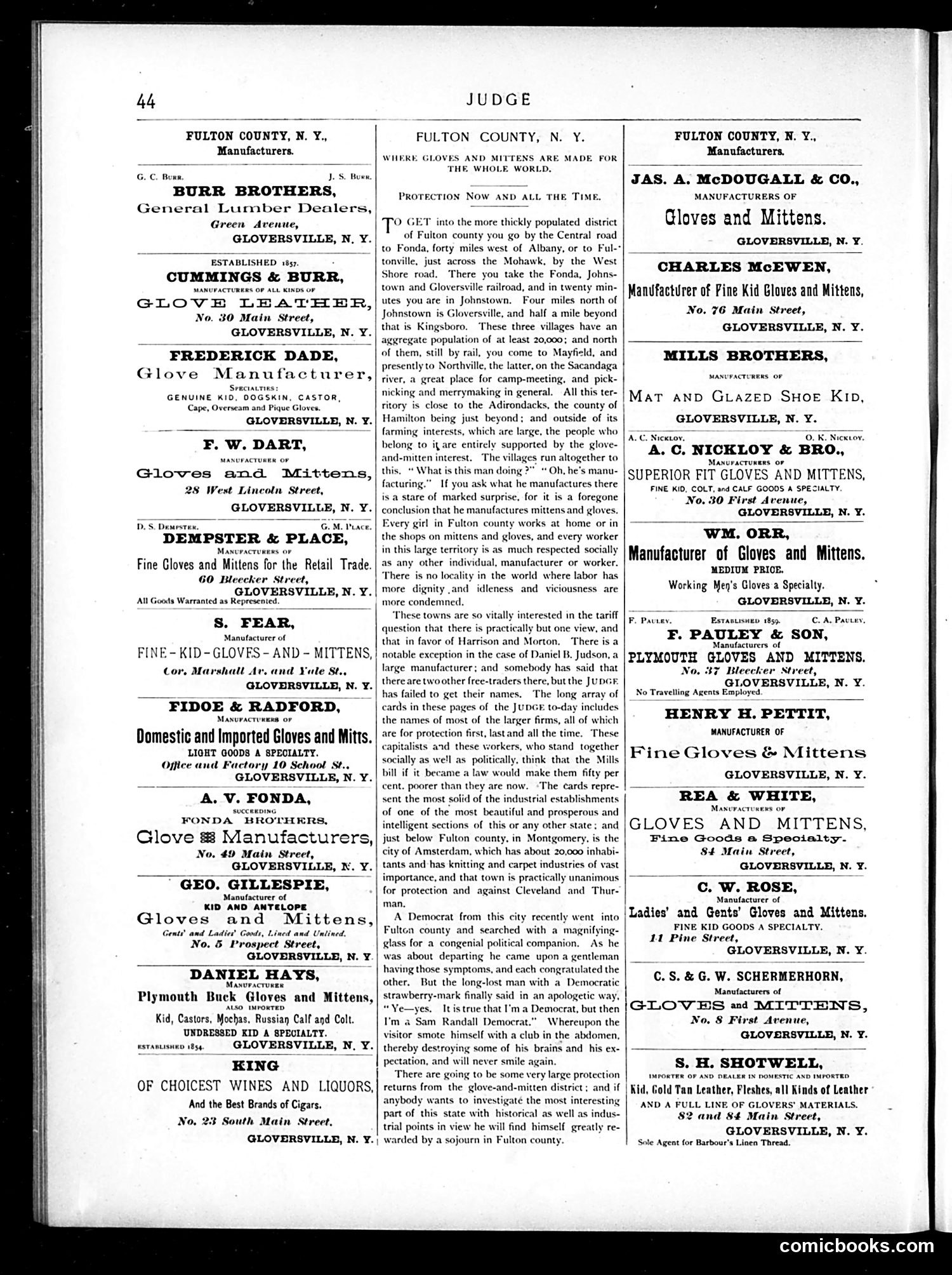
This page is primarily **advertising**, not editorial content or cartoons. It showcases glove and mitten manufacturers in Fulton County, New York—specifically Gloversville and surrounding towns. The accompanying text describes the region's economy, centered entirely on glove manufacturing. It notes that virtually every worker in the area makes gloves or mittens, and that this labor is socially respected rather than stigmatized. Politically, the text reveals the page's partisan purpose: it emphasizes that these manufacturing towns overwhelmingly support **Harrison and Morton** (the 1888 Republican ticket) and favor protective tariffs. The text sarcastically notes one notable exception—manufacturer **Daniel B. Judson**, a free-trader and apparent Democrat—treating his protectionist opposition as an amusing aberration. The page appears designed to showcase Republican-supporting industrial constituencies and their economic interests during a presidential campaign season.
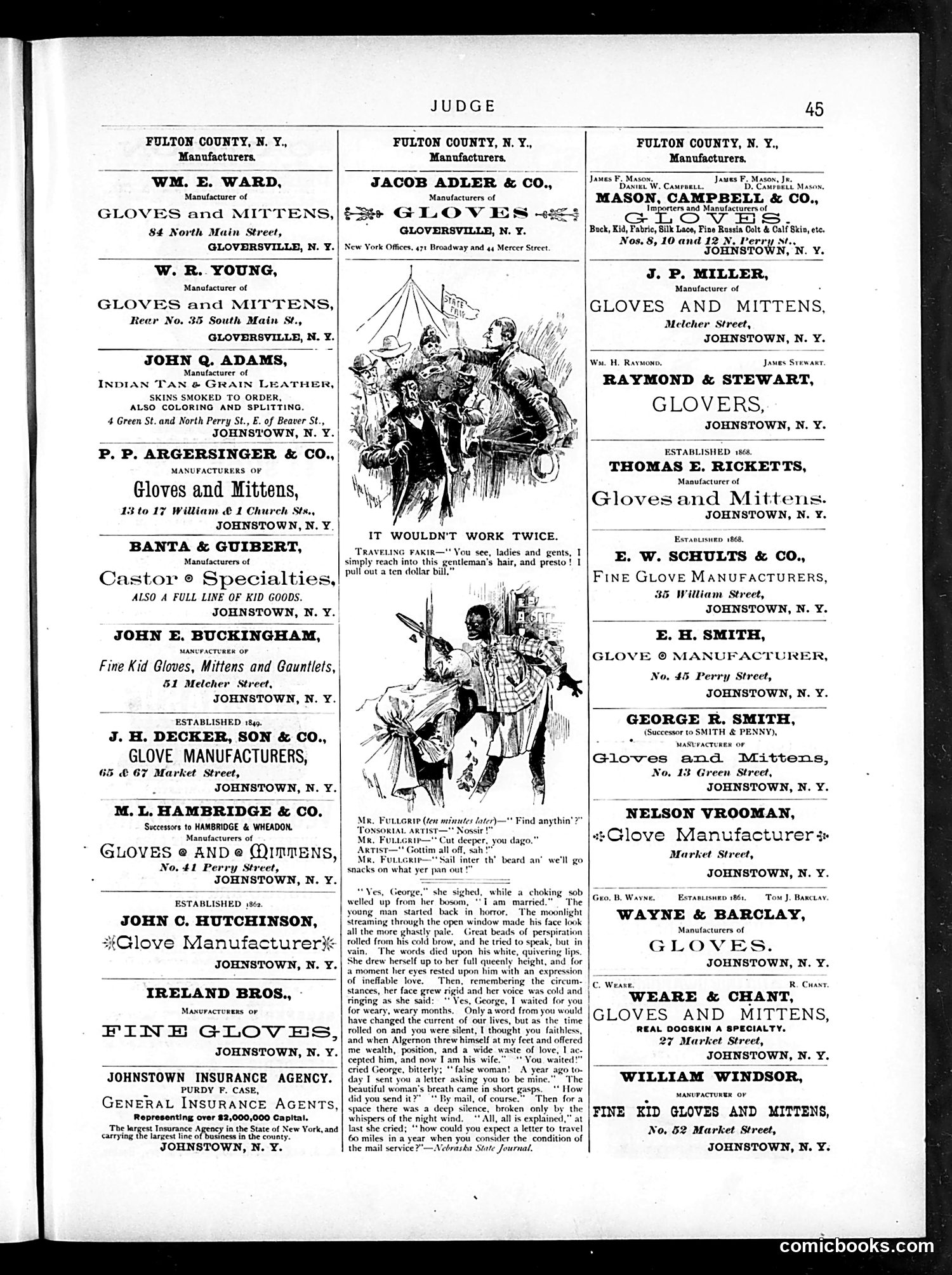
This page is primarily a **business directory** for glove manufacturers in Fulton County, New York (particularly Johnstown and Gloversville), with two embedded cartoons serving as filler content. **The cartoons:** 1. **"It Wouldn't Work Twice"** (top): A traveling con artist demonstrates pulling a ten-dollar bill from a man's hair. The man's barber then proposes they collaborate on the same scheme in reverse—searching the man's beard for hidden money to split. The joke: the mark won't fall for the same trick twice, so the barber cynically suggests exploiting him differently. 2. **Bottom cartoon** (untitled): A melodramatic romantic scene where a woman confesses she married another man while waiting for her lover's letter. The punchline subverts the emotional drama: the letter never arrived because of poor mail service—a practical, mundane explanation undermining the tragic tone. Both cartoons use **anti-climactic, deflating humor**—typical of *Judge* magazine's satirical style—replacing expected sentiment with crude practicality or bureaucratic reality.
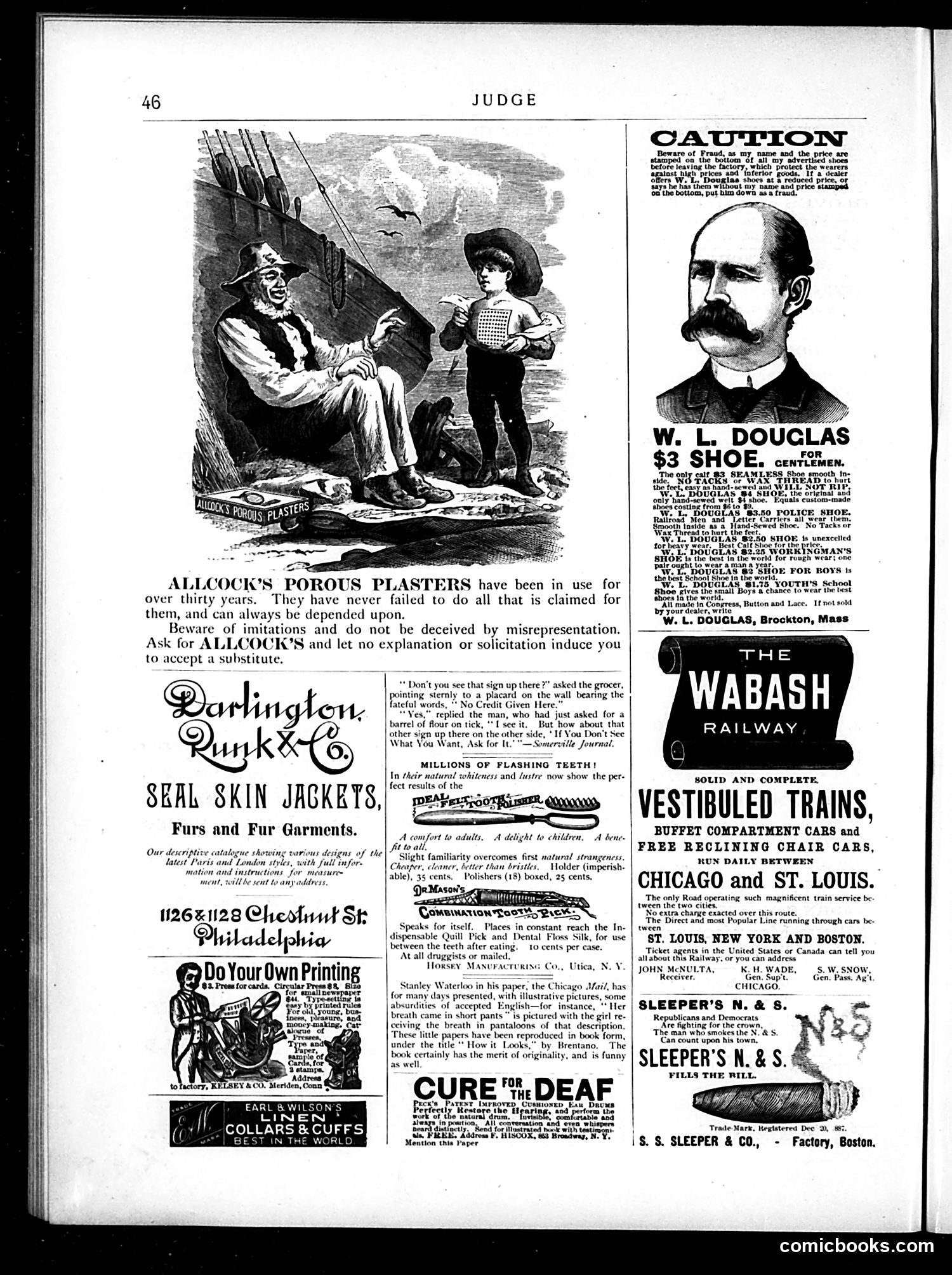
This page is primarily **advertising**, typical of late-19th-century magazine layout. The dominant cartoon depicts a sailor and child, illustrating **Allcock's Porous Plasters**—a medical product claiming thirty years of reliable use. The satirical element is minimal here; it's straightforward product endorsement. The page includes advertisements for: - **W.L. Douglas shoes** (Brockton, Mass.)—emphasizing authenticity and warning against counterfeits - **Seal skin jackets** from Philadelphia furriers - **The Wabash Railway** promoting vestibuled trains between Chicago and St. Louis - Various other products (printing presses, dental implements, collars, cigars, sleeping cars) One small humorous item appears: a *Somerset Journal* quip about a grocer's contradictory signs ("No Credit Given Here" vs. "If You Don't See What You Want, Ask for It"). The page reflects Gilded Age consumer culture and product competition, with manufacturers using warnings against fraud and imitation—indicating widespread counterfeiting concerns.
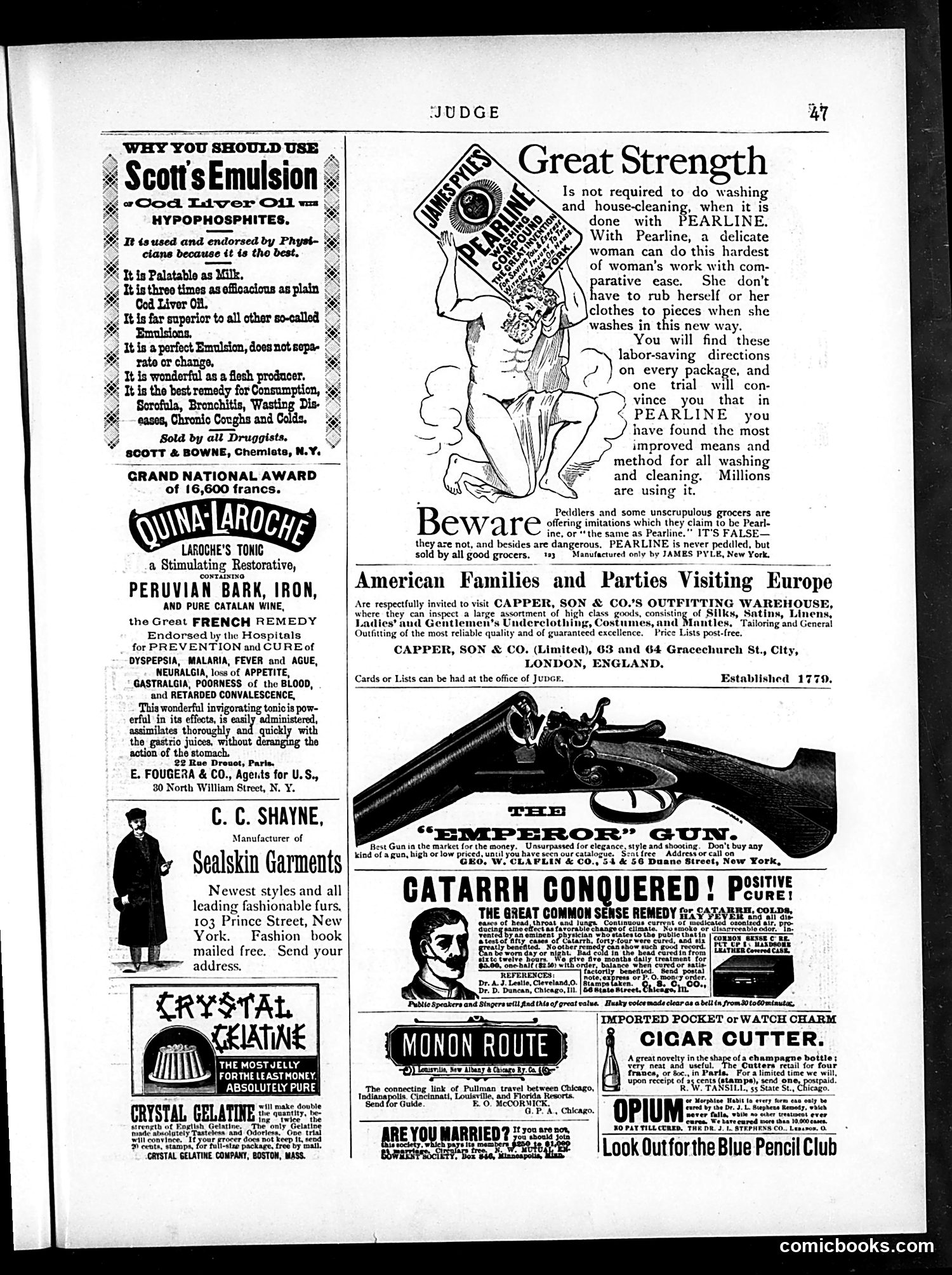
This is primarily an **advertising page** from Judge magazine, with no political cartoons or satirical content to analyze. The page contains period advertisements for patent medicines and consumer goods typical of late 19th/early 20th century publications: Scott's Emulsion (cod liver oil), Laroche's Tonic (a French "cure-all"), sealskin garments, and Crystal Gelatine. These ads reflect contemporary medical misconceptions—products marketed as remedies for consumption, malaria, and dyspepsia without scientific evidence. Notable is an ad for **Pearline**, a soap product emphasizing labor-saving benefits for women doing housework—reflecting era concerns about women's domestic drudgery. There's also a commercial ad for **Capper, Son & Co.**, a London outfitter serving American tourists in Europe, and advertisements for firearms and travel services. No satirical commentary or political messaging is present on this page—it functions as a commercial vehicle for advertisers rather than editorial content.
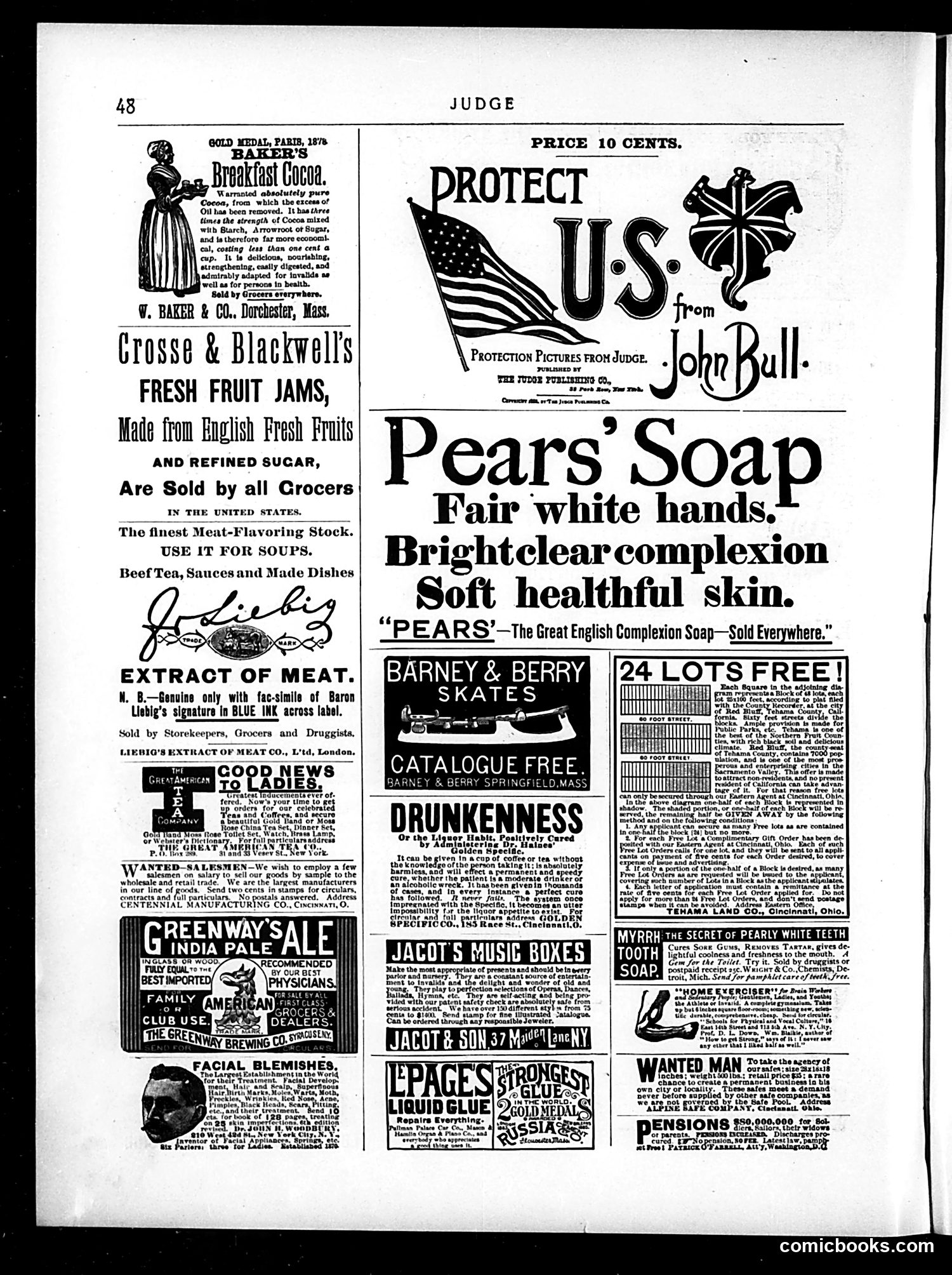
This is primarily an **advertisement page** from Judge magazine, not a political cartoon page. It contains numerous commercial ads typical of late 19th-century American publications, including: **Notable ads visible:** - Baker's Breakfast Cocoa (with Gold Medal, Paris 1878) - Crosse & Blackwell's Fruit Jams - Pears' Soap (prominently featuring promises of "fair white hands" and "bright clear complexion") - Greenway's Ale (marketed to physicians) - Jacob's Music Boxes - Page's Liquid Glue - Various patent medicines and tonics **Historical context:** The ads reflect period obsessions with self-improvement products, medicinal tonics (many containing dubious ingredients), and beauty products with explicit racial undertones—notably Pears' Soap's emphasis on whiteness. There is one small editorial image at top right: "Protect U.S. from John Bull"—likely a political reference to British trade competition—but the page is overwhelmingly commercial rather than satirical.
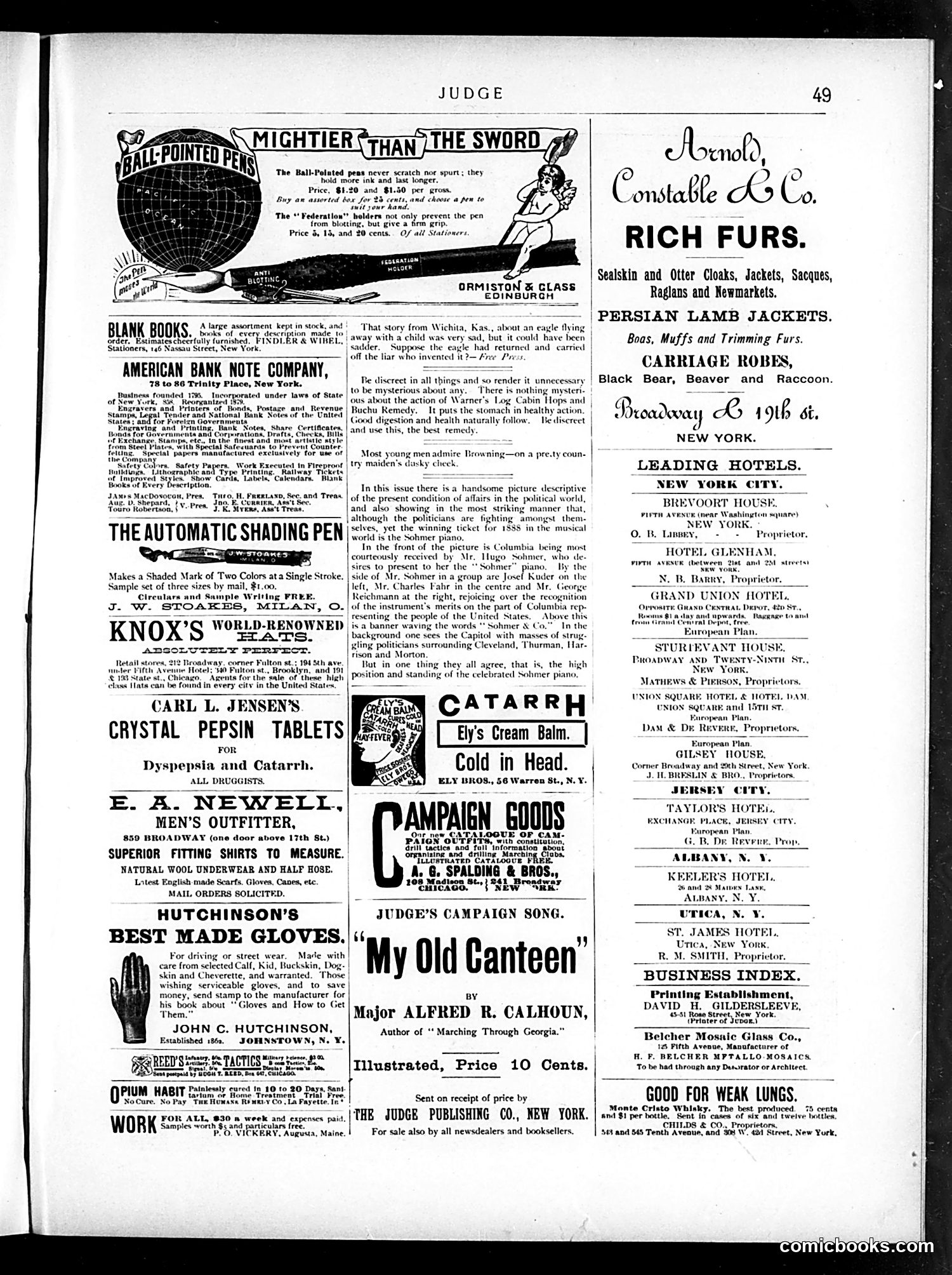
This page is primarily **advertising**—for pens, bank notes, gloves, medicines, and hotels. However, one advertisement contains political content: a **Sohmer piano company ad** describes an allegorical illustration showing "Columbia" (the female personification of America) being courted by piano manufacturer Hugo Sohmer. The scene depicts politicians fighting in the background around Cleveland, Thurman, and Harrison—likely references to the 1888 presidential election. The satire suggests that while politicians squabble, American industry (represented by the piano) competes for the nation's favor. This reflects the **Gilded Age tension between political corruption and industrial progress**—a common Judge magazine theme mocking politicians as self-interested while celebrating American manufacturing. The advertisement uses patriotic allegory to promote commercial success over partisan politics.
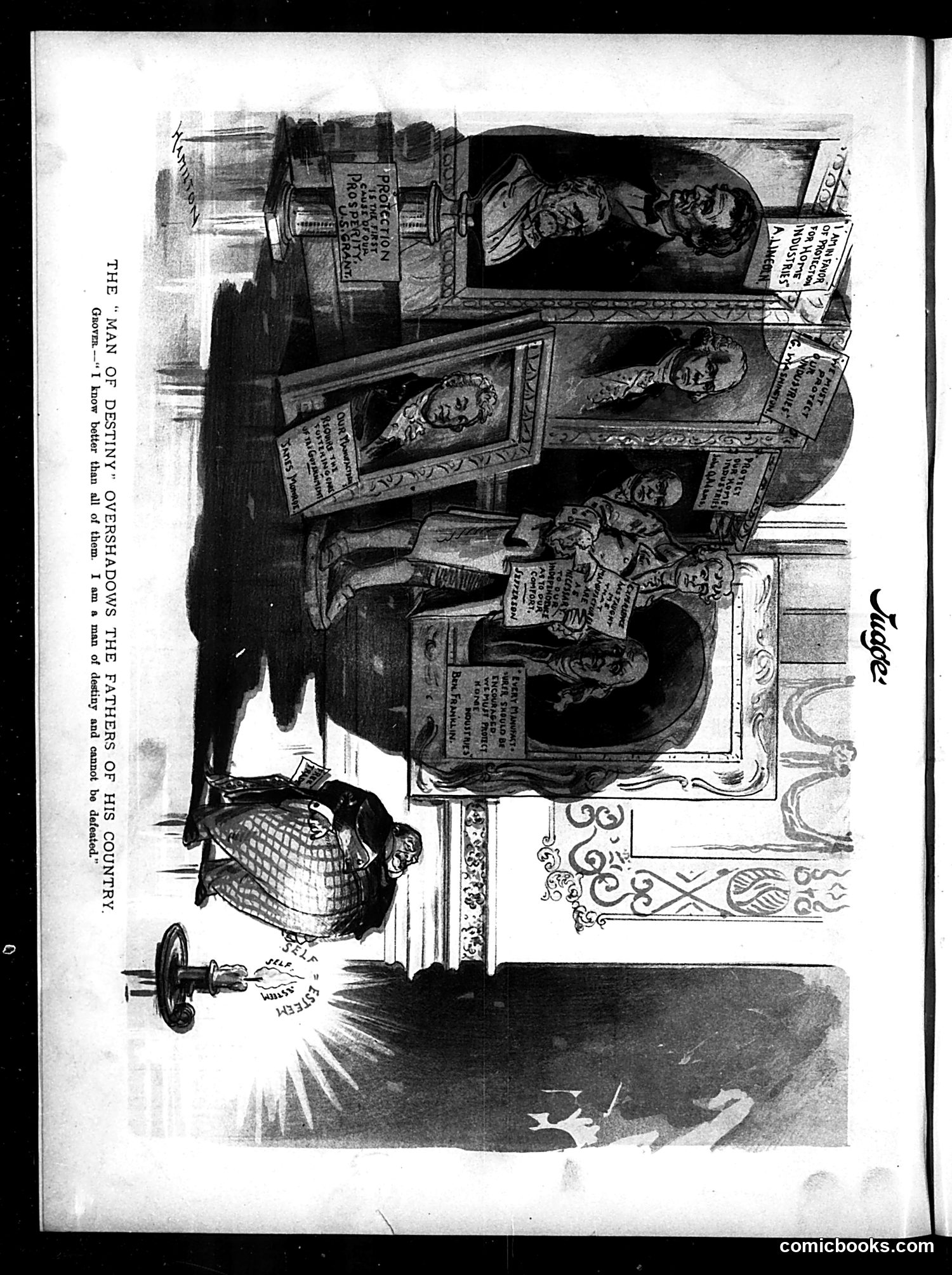
This political cartoon satirizes President Grover Cleveland's arrogance and disregard for predecessors. The image shows Cleveland as an oversized figure literally casting a shadow over portraits of earlier American presidents ("the Fathers of his Country"). Cleveland's quoted boast—"I know better than all of them. I am a man of destiny and cannot be defeated"—mocks his perceived hubris and dismissiveness toward historical precedent and constitutional tradition. The cartoon critiques Cleveland's executive overreach and his apparent belief that his personal judgment supersedes the wisdom of previous administrations. "Judge" magazine, a Republican publication, used this to question Cleveland's fitness for office during his presidency.